A Daily History of Holes, Dots, Lines, Science, History, Math, Physics, Art, the Unintentional Absurd, Architecture, Maps, Data Visualization, Blank and Missing Things, and so on. |1.6 million words, 7500 images, 4.9 million hits| Press & appearances in The Times, Le Figaro, Mensa, The Economist, The Guardian, Discovery News, Slate, Le Monde, Sci American Blogs, Le Pont, and many other places… 5000+ total posts since 2008.

Category: Absurdist, Unintentional

  • Airport in the Sky, Airborne Zeppelin Airfield, 1925

    JF Ptak Science Books  Post 1101

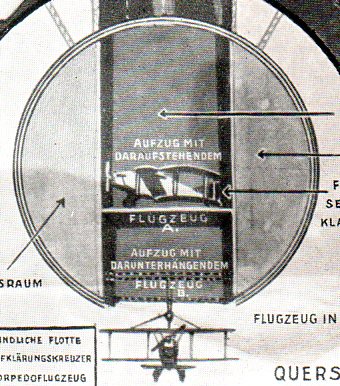
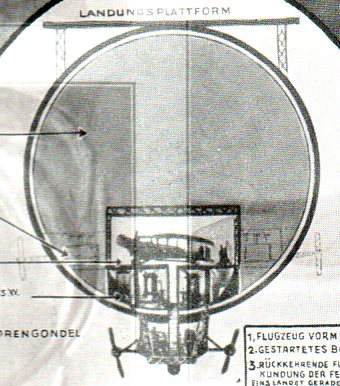
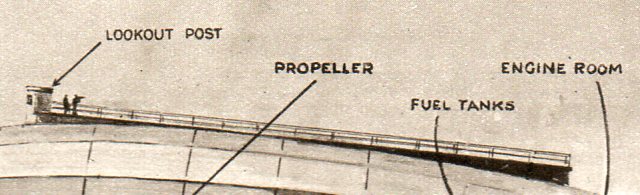
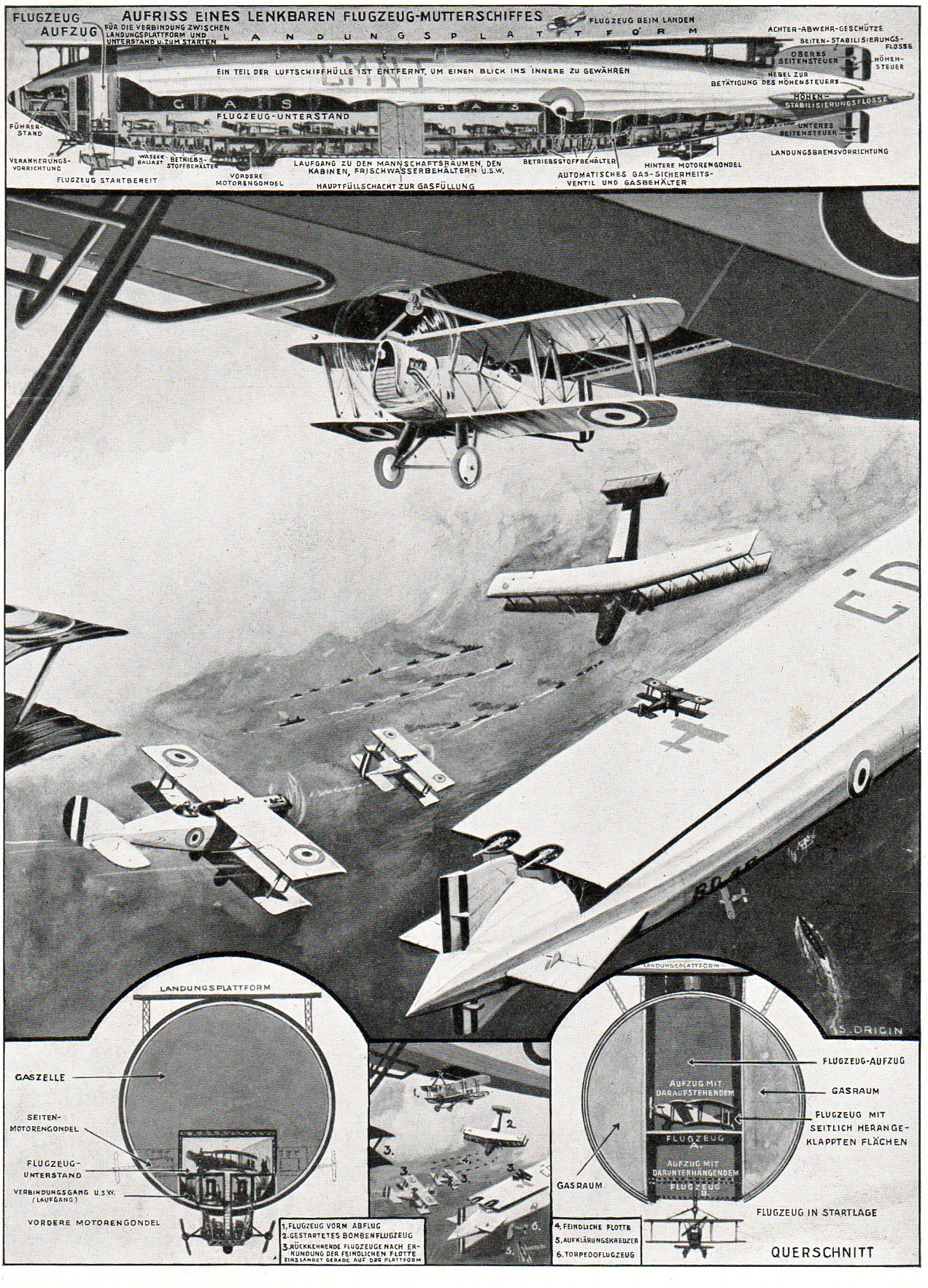
    This interesting image comes from the Illustriete Zeitung (Leipzig) for July 1925 (“Zeppelinsche Riesenluftschiffe” by Dr. Hildebrandt), and shows a British proposal for a dirigible outfitted as a sea-going airborne airport for military planes. 

    Airport--dirigible241

    The aircraft would land aft, and then proceed forward to an elevator that would lower it belowdecks to a hangar (looking as though it could accommodate 11 or 12 aircraft).  Once refueled and re-outfitted, the planes could be lowered from the body of the dirigible and launched into space. 


    Airport--dirigible a243

    Airport--dirigible b244

    And of course some cross sections:

    Airport--dirigible c245 

    Airport--dirigible d246


  • A History of Blank, Empty & Missing Things: Lost Astonishment of Astonishing Things, Part I–the Phonograph

    JF Ptak Science Books   Post 1100   [One in a series on the History of Blank and Missing Things]

    Most everything that was once revolutionary, or new, or innovative, comes to the point of being not so to most people, where the thing of marvel and wonder just becomes the thing of interest and then the thing and then, well, sort of no-thing.  The great object becomes a simple bridge to something else, whether it is to communicate massive amounts of information instantly or overcoming distance quickly or storing food for long periods of time or shaving nutmeg onto a dinner plate. 
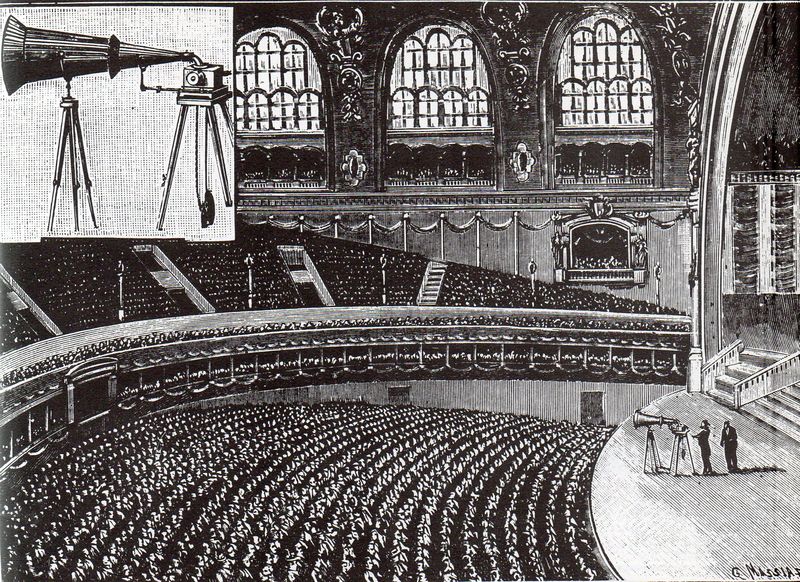
    Astonishment phonograph248
    Astonishment wears quickly.  For example, the long line of vanished astonishment in communications shows how thin wonder becomes over the course of time, as communication is facilitated by a postal delivery system to a ground semaphore to an electric telegraph to the telephone to wireless radio to airmail to television to DARPAnet to email to texting to twitter.  The beginning of instantaneous, person-to-person communication is really only 134 years old (with Bell’s 1876 invention), and now we’re sitting in the middle of the possibility of the most fabulously instantaneous communication bog in the history of humanity, and its brilliant astonishment level has been worn to a dull copper tone. (I don’t necessarily mean “fabulous” in a good context, because all of this also presents the greatest assault on concentrated thought that has ever been known, but that’s another story.) Things just get taken for granted.  (This observation isn’t restricted to techno stuff–just ask any old person.)

    This is an excellent image to remind us of the wonder and fascination of invention–especially for the things that we take for granted, the essentials of modern life.  This image from 1897 shows a very large audience gathered in the great Trocadero in Paris to listen to a demonstration of a phonograph.  Now the phonograph had already been reliably around since Edison’s introduction of his successful machine the year after the invention of the telephone in 1877 (though variations of the instrument had been around since the late 1850’s, though that is another story), so the general public was already well-familiar with the concept of captured sound replayed–then why such a big crowd in 1897? 

    I think the reason for the full house was partially for the fact that it was a home-town event for a national French figure–the machine was being demonstrated by Henri Jules Lioret, an inventor who for about two decades had been tinkering with improvement to the machine.  What the Trocadero crowd was listening to was the Lioretograph No. 3, a large, weight-driven phonograph with a big bellow–a machine powerful enough to be heard in a big hall, which was another point of fascination for the attraction of such a large crowd.  A  third possibility may have been with Lioret himself–perhaps the event was free, perhaps the inventor went out to fill the Trocadero via whatever means possible so that an engraving of the event would appear in newspapers and journals everywhere so that he could sell more machines.  

    The reason I mos enjoy and wish for though is that the people were simply fascinated with the bright new big machine, filling the famous musical hall with a big sound and doing it without an orchestra, or without one playing player for that matter. 

    It is also about the wonder of storing and replaying sound. 

    Loss of astonishment isn’t necessarily a complacency–perhaps it is just more of a forgetting, a loss of the stuff that has come before.  Maybe it is a function of time, or distance, between newness and necessity.

    If you can grow to feel the astonishment felt by this Trocadero audience for the phonograph, or for the astonishment in anything fantastic-if-old, then you get to see the components of today’s necessary stuff and see that it has a history and a full geology of an idea.  To me, being open to astonishment like this makes you susceptible to wonder, and from wonder comes curiosity, and from curiosity comes everything else worth thinking about. 

    Notes 1:

    Edison celebrates his phonograph in the North American Review
    (May 1878) and
    then lists what he saw as the readymade faits
    acomplis
    of the invention, the first of which was
    weirdly/spectacularly
    worded:  “1. The captivity of all manner
    of sound-waves heretofore designated as fugitive, and their permanent
    retention.”  Do you hear a soundtrack
    with that description?  I did.  He proceeded
    with less fanfare: “2. Their
    reproduction with all their original characteristics at will, without
    the
    presence or consent of the original source, and after the lapse of any
    period
    of time. 3. The transmission of such captive sounds through the ordinary
    channels of
    commercial intercourse and trade in material form, for purposes of
    communication
    or as merchantable goods. 4. Indefinite multiplication and preservation
    of
    such sounds, without regard to the existence or non-existence of the
    original source. 5. The
    captivation of sounds, with or without the knowledge or consent of the
    source
    of their origin.”

  • History of Sharing Music Without Musicians–Beginnings

    JF Ptak Science Books   Post 1098   [Part of a series on the History of Blank, Missing and Empty Things.]

    Music shared235

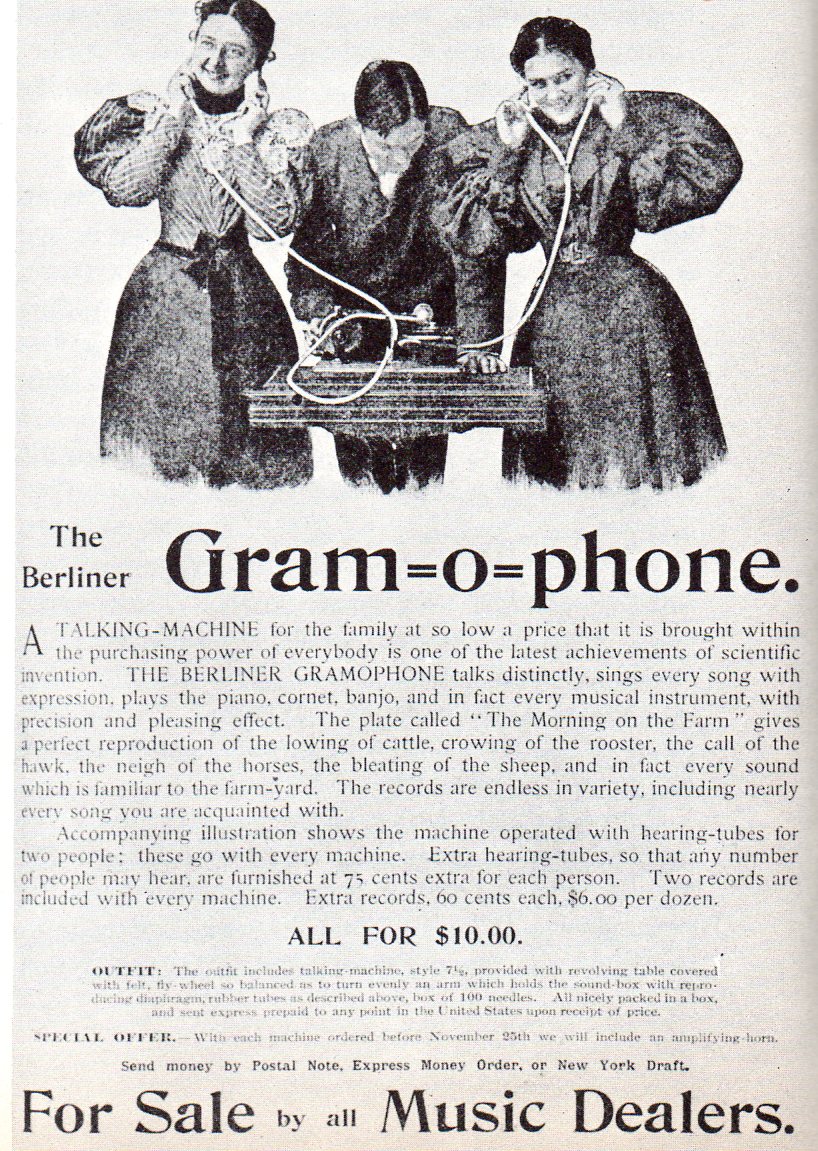
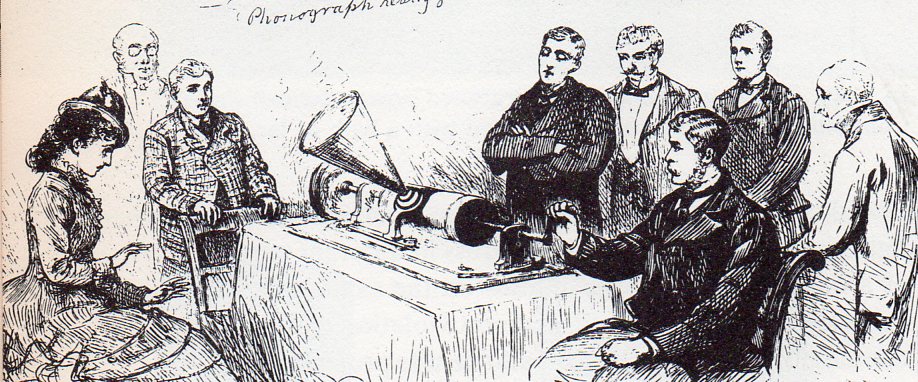
    This first image struck me as a sort of prototype for the shared-music experience that is common to youtube and a plethera of other online sites, showing  a humble beginning of sharing for a revolutionary idea and experience.  The idea of recording and playing back sound1, the idea of being able to save sound and listen to it later, was an astonishing realization and invention.  (There will be more on this in a post later today.)  And it struck me that being able to enjoy music without the necessity of having the musicians there to play it, live, uniquely, is a phenomenon that is recent in the history of listening to things, being less than 134 years old. 

    This is one of the earliest images of that shared experience:  the Edison phonograph, being played in company, ca. 1878. 

    Music shared 2236
      The first image comes a little later, but I like it so because of the
    headsets–it resonates the separate/shared experience a little better.

    Notes:

    1.  The earliest “phonograph” was one which successfully recorded sound but could not play the sound back.  Or at least until recently, when these 150-year-old recordings were played back for the first time. This was the work of Edouard-Leon Scott de Martinville, (1817-1879), a French bookseller (!) who patented his phomautograph in 1857.

    These recordings can be heard HERE.


  • Department of Strange Steampunk: Oddest Place to Find a Locomotive?

    JF Ptak Science Books      Post 1096

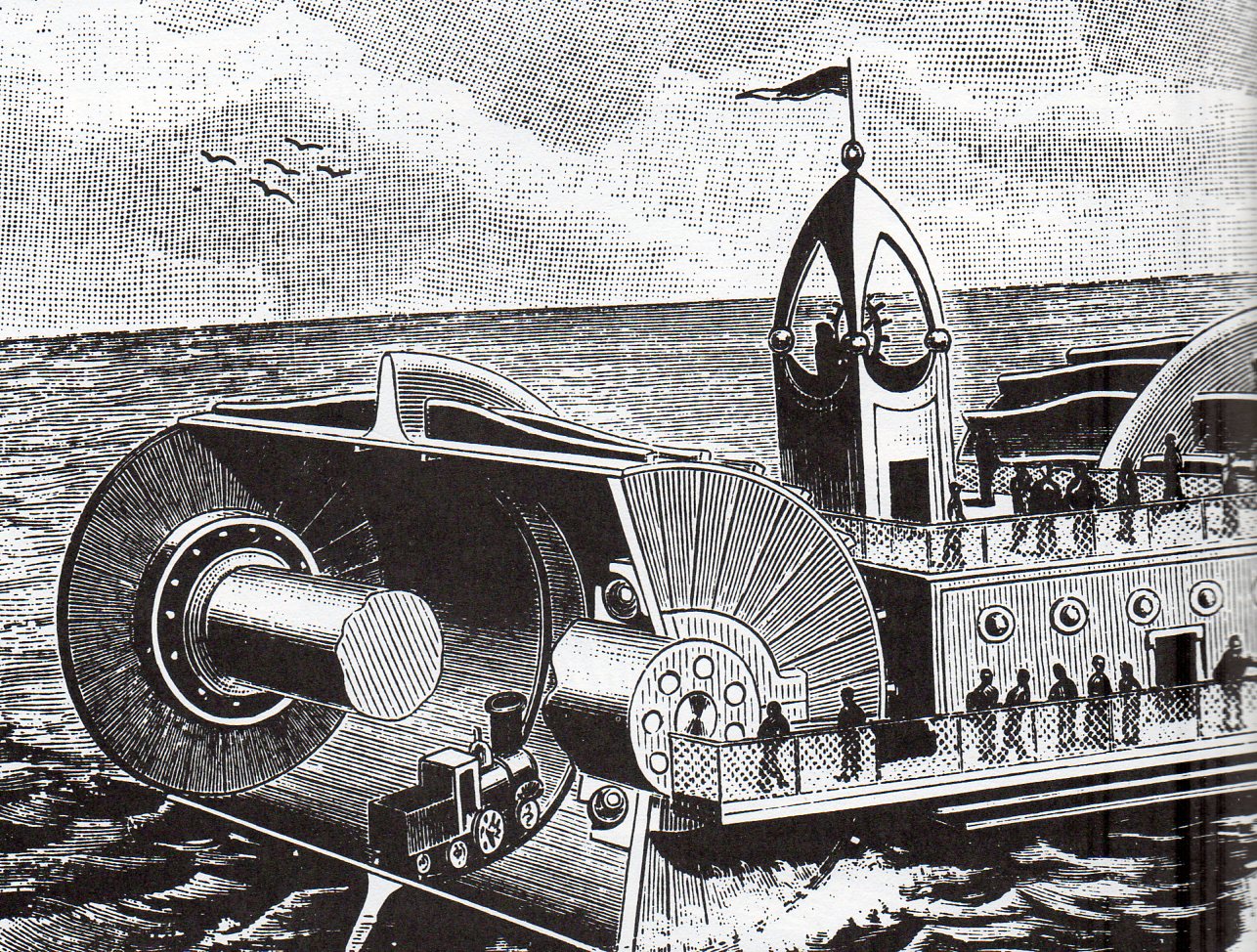
    I think perhaps one of the oddest places to find a locomotive is in the inside of a propeller of a ship on the high seas. 

    What is it--loco in ship227

    This image really belongs to the sub-category “Out of Place Department”, along with the unexpectedly-found restaurant at the top of a punked-out 19th c Eiffel Tower, a swimming pool in the bottom of a mine shaft, a steamboat along the side of a mountain in Amazonia, and so on.  Seeing this strange sea craft and the cutaway schematic showing the man-sized locomotive (and tender) was very exciting and unexpected as well, perhaps more so than most of the unexpected steam/electro punky thingsa that I come across.

    It appeared as a real-life suggestion as “Chapman’s Roller Vessel” in (ca.) 1897 and looks o be a squarish, blocky ship of questionable seaworthiness, fitted out with two hollow cylindrical props powered by two small small-gauge locomotives running infinitely on  small-gauge tracks inside of them, push-pulling the ferry  through the water.  (I wonder about access to the engine and how to control its stopping and starting; I would only hope that there wasn’t someone at the locos’ controls.)

    It seems to me to be a bad idea of a high order.


  • Steampunk Bluetooth, Telegraphic Headset or Head Mapper? (1879)

    JF Ptak Science Books   Post 1095

    Hatter217

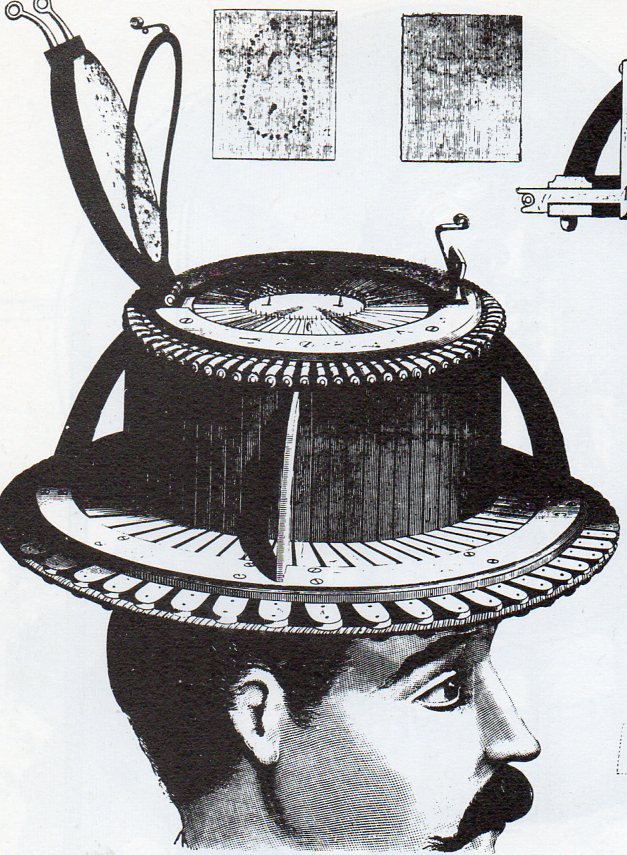
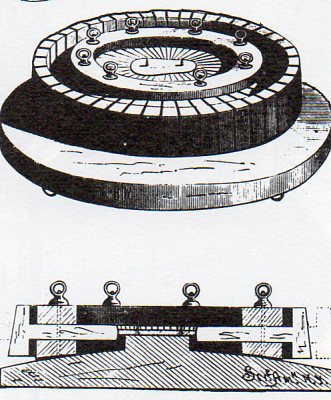
    Even though this woodcut looks a bit odd, it hides the fact that it is a superb device for its mechanical purpose–mapping the head for hatters.  Certainly most folks would look at this image and have their imaginations decide many more and creative (but not-real) uses than that.  But the fact remains that it was an ingenious instrument that Hatter2218

    could (can!) produce an excellent contour map of the head.  It is difficult to imagine a more accurate mechanical method of performing this task this beautiful device.  (The device would be place on the head like a hat, fitted down snug causing the head’s contours  to extend the spokes,  producing an image of the head’s shape like the map on the upper left inset. Very cool.) And I love the use of so many (clean) screws rimming the base of the mapper.

    Then on the other end of the spectrum of antiquarian steampunk headware:

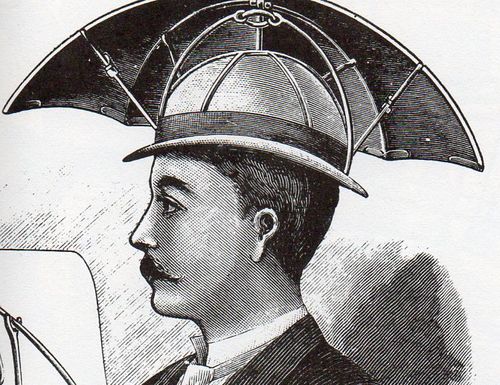
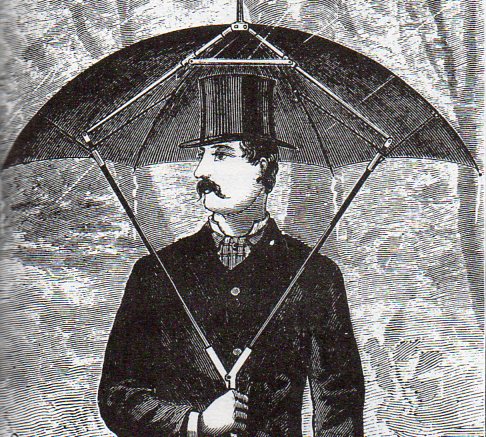
    Hatter umbrella 220

    was this  simple umbrella to protect the hat.  It reminds me of the utility of a portable pocket-sized mustache guard.  I wonder if you were expected to carry an umbrella to protect the rest of your body?  Or another to protect the umbrella that was protecting the hat umbrella?  (Tortoises all the way down….)  Still, though, this is a great drawing with applications far beyond the reach of a simple hat protector.

    Hatter umbrella 2221


  • Wings Taking over Prayers: Human Flight in 1714

    JF Ptak Science Books  Post 1090

    Valentini216

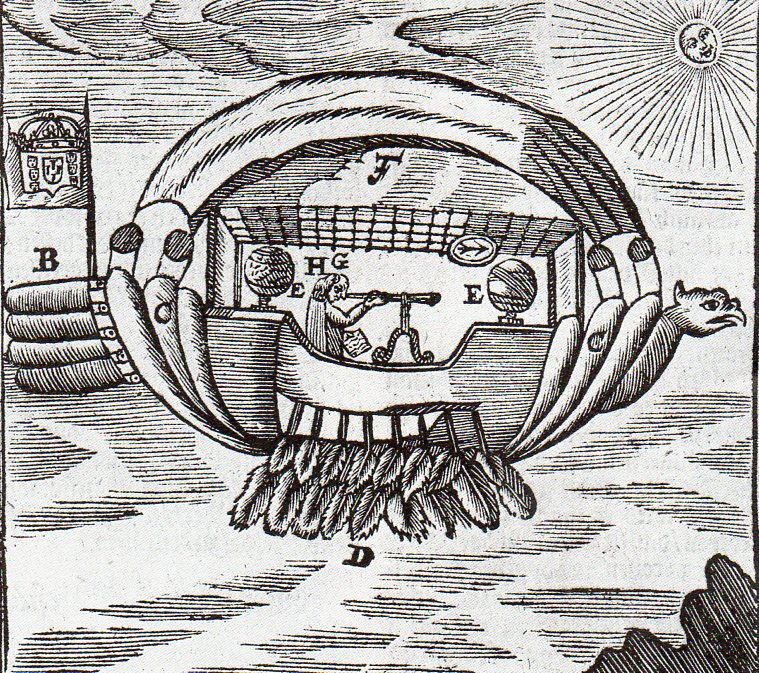
    The esteemed Michael Bernhard Valentini (1657 – 1729), professor of  medicine and of physics at Giessen, Germany and natural history collector, produced one of the century’s   most important works on the state of museums and natural history collections.  Actually, his Museum Museorum1 was much  more than that, its three volumes presenting more descriptions and illustrations of all manner of scientific things than just about anything else of the pre-encyclopedist 17th century. There are many “firsts” to be found in this work, including numerous first-time description of fossils, tropical plants, American botanical specimens, techno items, shells, and on and on, not to mention sections on monsters, dragons and mythical creatures. 

    One image that caught my attention appears in volume two, and seems to me to be a flying machine, though I can’t recover how it is being kept aloft, or what is providing its power.  The pilot is keeping a sharp eye on things with a  telescope, and is reckoning position with a compass2 and two globes.  The canopy of the aircraft seems to be just that, some sort of cloth held in place by pulleys and ropes, though I don;’t know what is providing lift, if anything.  Perhaps the whole thing finds its lift and propulsion with the many feathers on the craft’s keel.  I’m not sure.  But I can say that I don’t recall any other earlier image of a pilot using a telescope and compass.   

    Valentini also assembled an enormous natural history collection of his own, and in addition to his spectacular collection of the state of scientific and technical knowledge at the begininng of the 18th century, he also included in his book a  list of 100+ museums/collections of natural history objects–an extraordinary document for the time and unfortunately one that can’t be reproduced here.


  • The History of Rartity: Helium, Nutmeg, Breadfruit and Pepper

    JF Ptak Science Books   Post 1089

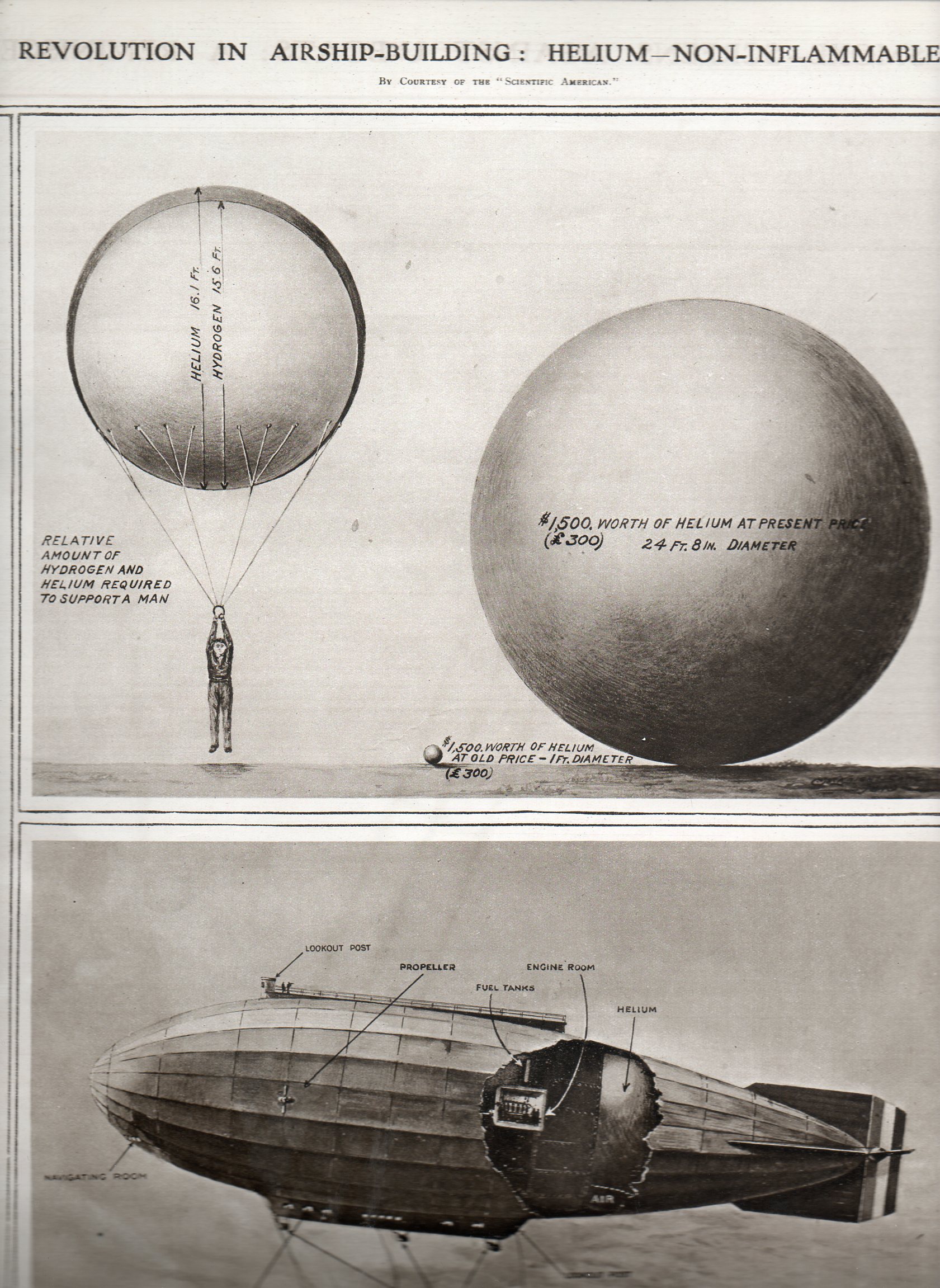
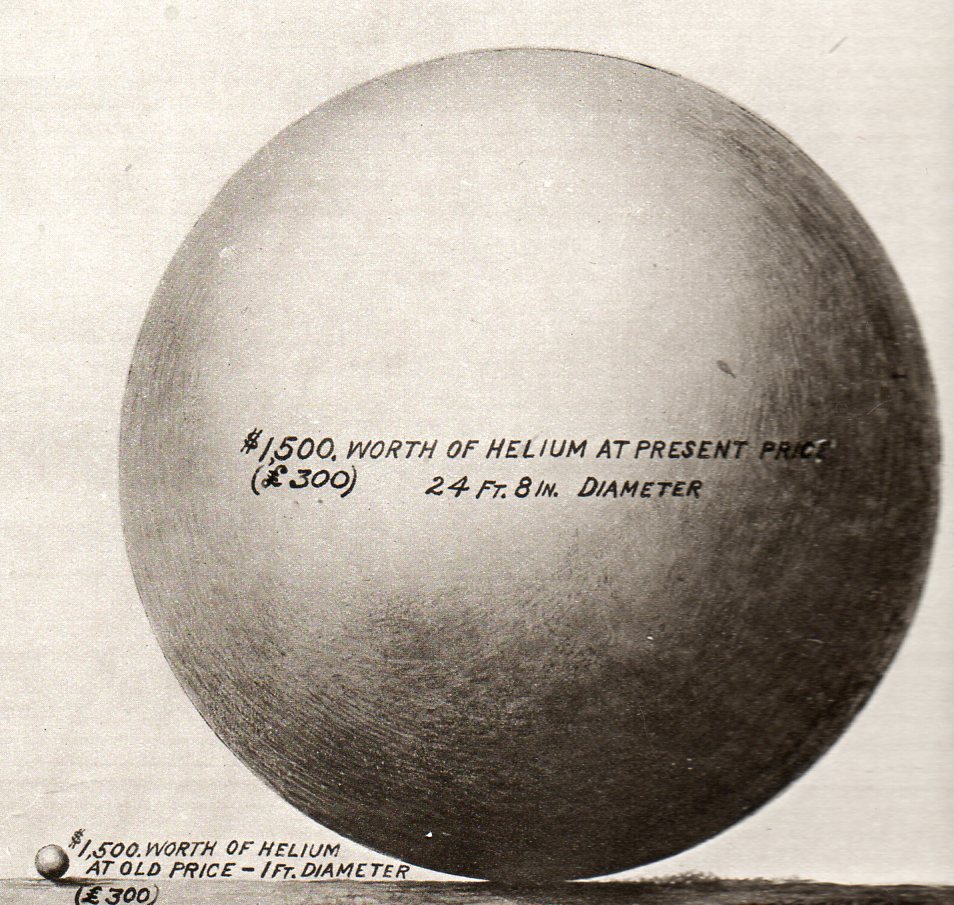
    Display info helium balloon212I guess we don’t think much of the rarity of some things.  Pepper and other spices were at one point quite rare, and the source of invention and exploration, and war.  Nutmeg, for example, a sought-after spice originating from the Banda Island group of Indonesia, once figured in a trade between Holland and England (the Treaty of Breda in 1667) that landed the Dutch the island of Run and control of the nutmeg trade, while the Brits got Manhattan.

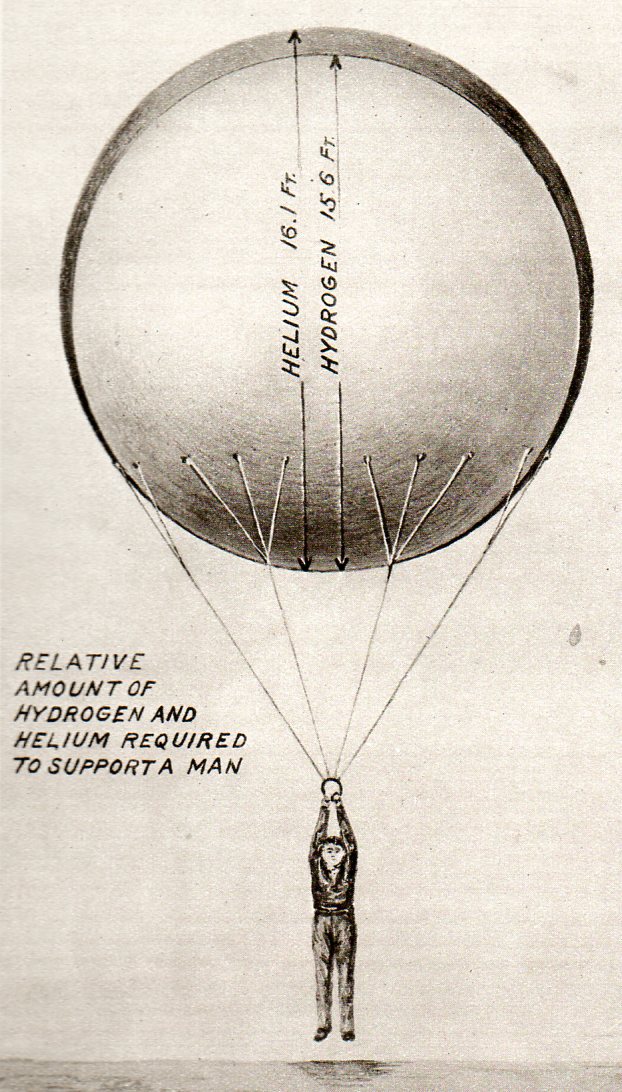
     Another great example is helium. When these images were produced for The Illustrated London News of 15 March 1919, rigid airships were filled with hydrogen, an explosive, not-happy gas that was the fuel of all manner of aerostatic accidents, everywhere.  Helium was still quite rare at this point, a year after the end of WWI and only 54 years after it was first observed1, and replacing hydrogen with helium was still yet a dream–basically because there wasn’t any, yet, to supply a dirigible2.

    Display info helium balloon man213

    The first helium-filled airship was still two years away at this point–the U.S. Navy’s great C-7, which made its maiden flight on 1 December 1921.  When the USS Shenandoah flew in 1923, it flew with most of the world’s entire supply of the noble gas helium. Its difficult today to think of pepper, nutmeg, sugar, helium and so on in terms of fabulousness and rarity, but it was so.  Remember, when Capt Bligh was jettisoned from the HMS Bounty, the ship’s precious cargo was also thrown overboard.  And the great treasure that sparked the Tahitian adventure that sparked the mutiny?  Breadfruit. 

    Display info helium balloon comparison214

    Notes
    1.  Observed for the first time by astronomer and early astrophysicist Pierre Janssen, in the spectrum of    the chromosphere of the sun, in 1868; separated for the first time on Earth in1895 by the British chemist Sir William Ramsay.   

    2.  By the way, “dirigible” is from the French, “diriger” (or “to direct “), meaning steerable, pilotable.  This differentiates the dirigible from the balloon, which was not by and large steerable. 

    Display info helium balloon dirigible215


  • “Woman Bagatelle”, ca. 1905

    JF Ptak Science Books   Post 1085

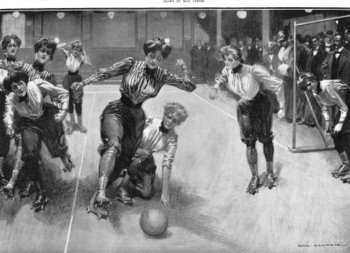
    I’m not sure why these women needed roller skates for this sport, but I guess that they were necessary for the good of this cross-“sport” between soccer and hockey.  The women put their hair up and got down to business, pushing the ball forward to the somber delight of the male audience.  I must say that I was attracted to this image because of the word “bagatelle”, which was nomrally reserved at this time to describe table-top marble game, a sort of passive pinball.  And perhaps that’s all this was, to the spectators, men rarely getting a chance to see women in such exertions, wearing so little. 
    File0180


  • The Road to the Economic Abyss: Visual Display of Quantitative Data, 1909

    JF Ptak Science Books  Post 1084

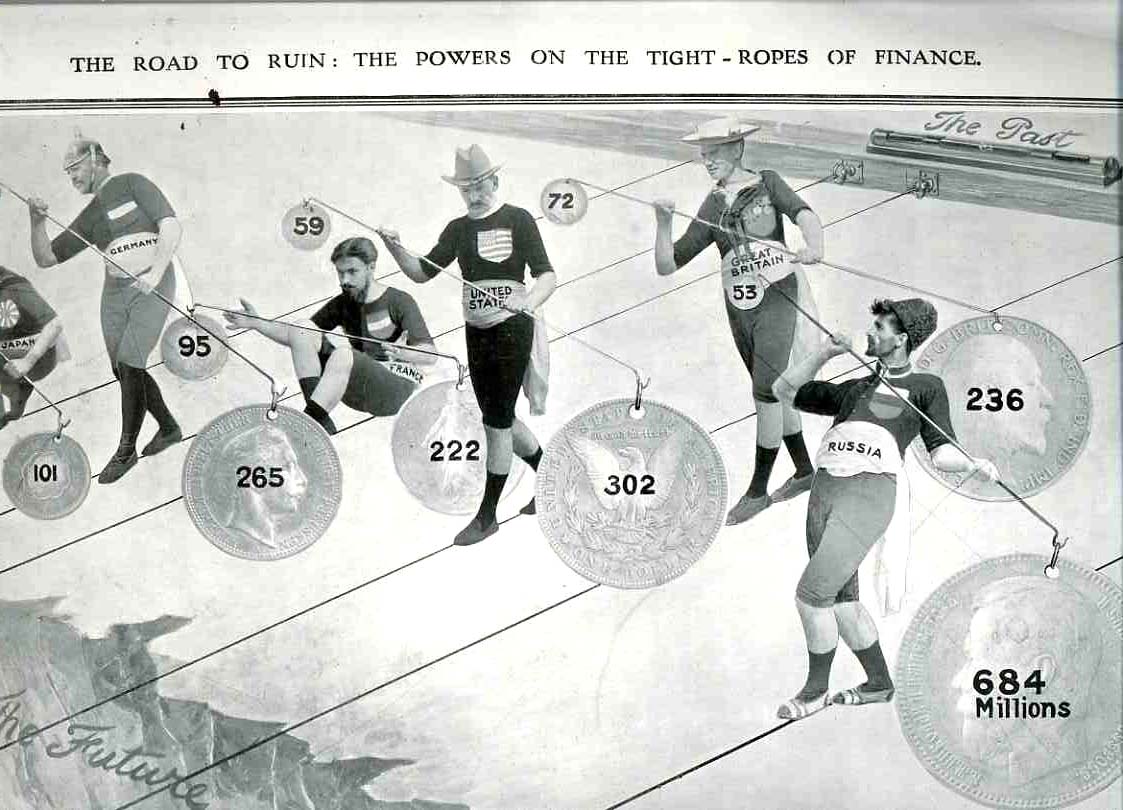
    The road to ruin is one of the oldest roads known to humanity; and, come to think of it, it was probably a road before roads existed, just an idea waiting for something concrete to show up and claim for its metaphor.  But certainly ever since the creation of money came (1) the need to have more, (2) the need to get it, in some fashion and (3) the possibility of losing it (though not necessarily in this order).  This image from the 4 September 1909 issue of The Illustrated London News is one in a long, ancient series of appreciating the way to financial doom, although this one happens to be a relatively early attempt at showing this idea via popular metaphor in the visual display.  And its pretty effective, too.
    00-blog-Oct 27 economic road to ruin938


  • Welcome (Again!) Jezebel Readers! (On the History of Women)

    I’m happy to report that one of this blog’s “History of Women” bits has  been posted on one of  the top-25-popular websites, Jezebel.  I thought that this was the ninth post from here that they’ve shared, but I can only find six. Jezebel is a wide, varied site with considerable interest.  Have a look and have fun!

    The
    Hidden, Mysterious Kisses In Vintage Comics


    Over on John F. Ptak’s site, there’s a post about what

    kisses looked like in the Golden Age of Comics.
    Hint: Lipless and faceless!  Views: 3,8413,841 views on this post, 60 new visitors 
    Comments: 62


    Girlie
    Shooting Gallery Is A Terrible Party-Game Idea


    An innocent Life magazine photo of dinner guests aiming
    harmless toy rifles — so nostalgic, so quaint! Actually, no. Not at all.
    More » Views:5,4115,411 views on this post, 87 new visitors Comments: 30


    The
    Average Housewife’s Workweek: Staggering Since 1947


    “35 beds to be made, 750 items of glass/china and 400 pieces of
    silverware to wash, 174 lbs. of food to prepare, some 250 pieces of
    laundry” — it added

    up to some 100 hours of joy per week. [PtakScienceBooks] Views:3,508 Comments: 69

     
    Click here
 to read A History Of
 Fainting Spells, Headaches, And Sexual Indifference


    A
    History Of Fainting Spells, Headaches, And Sexual Indifference


    “The manual is a codex of denial, submission, ignorance, boredom,
    tiredness, exasperation and triviality so far as sexuality is concerned
    for women—there is no hint of pride, or of enjoyment.” It’s a vintage
    medical hard sell!Views: 4,9654,965 views on this post, 240 new visitors Comments: 23 


    Giant
    Woman Sets Hemline Record!


    We’re not arguing with the

    claim that this image demonstrates “what must be the female record
    for the most distance between the ankle and the hemline.” But the nifty
    hemline chart has us sold.

    Views: 5,1635,163 views on this post, 74 new visitors Comments: 4


    Click here to read "Did You Give Him A
 
Chance To Impress You?"


    “Did
    You Give Him A Chance To Impress You?”


    Writer John Ptak has
    posted 1940s Ladies

    Home Journal piece that instructs young women on date conduct.
    The response of Ptak’s 17-year-old daughter? “It was simply beyond
    listening to…and certainly not anywhere near worthy of a response.”Views:3,9893,989 views on this post, 14 new visitors Comments: 34