A Daily History of Holes, Dots, Lines, Science, History, Math, Physics, Art, the Unintentional Absurd, Architecture, Maps, Data Visualization, Blank and Missing Things, and so on. |1.6 million words, 7500 images, 4.9 million hits| Press & appearances in The Times, Le Figaro, Mensa, The Economist, The Guardian, Discovery News, Slate, Le Monde, Sci American Blogs, Le Pont, and many other places… 5000+ total posts since 2008.

Category: Absurdist, Unintentional

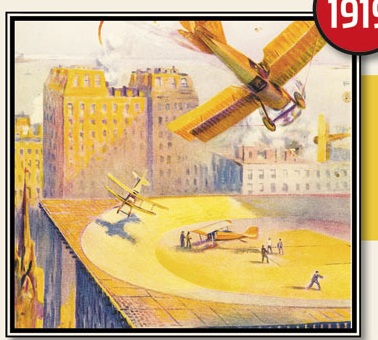
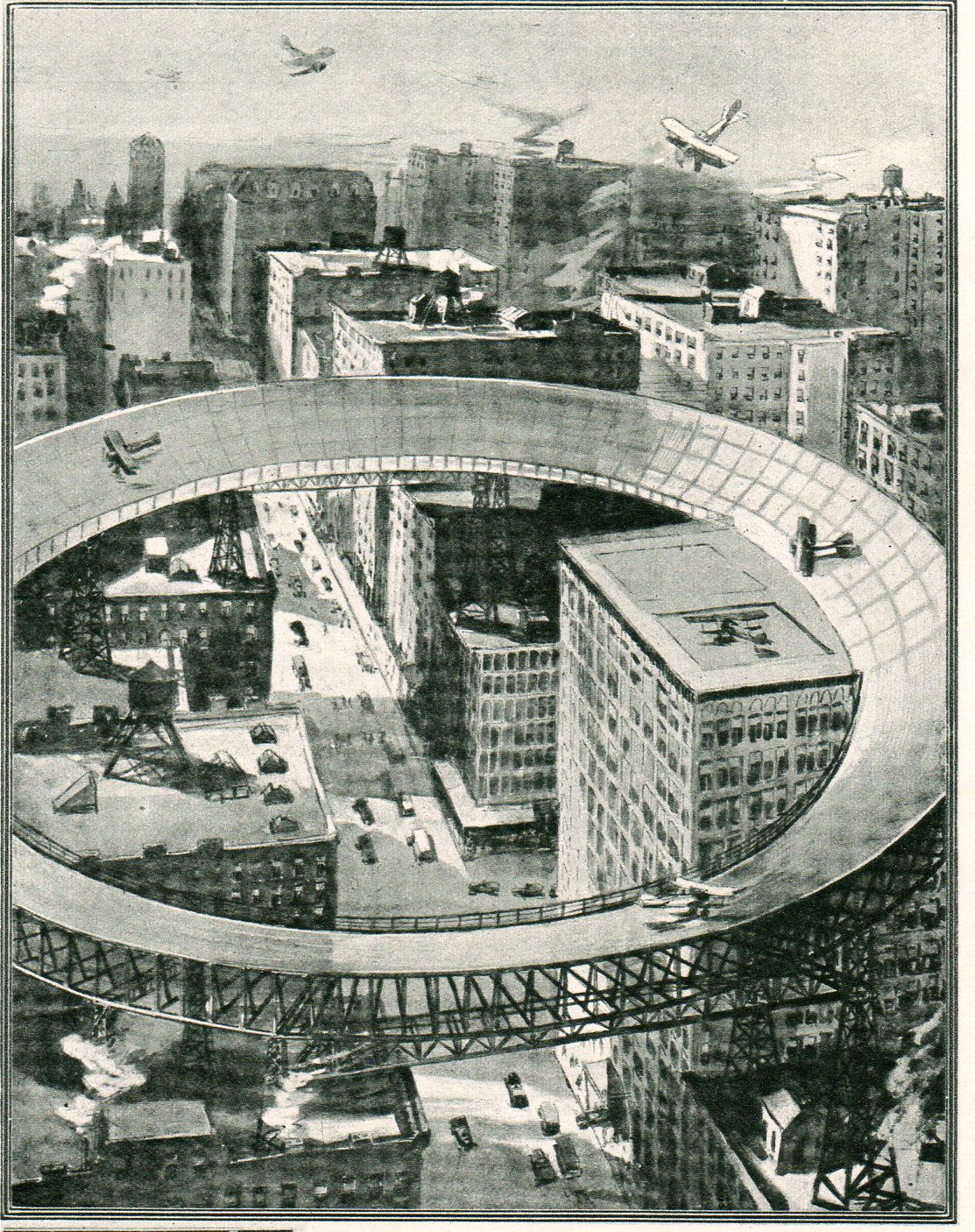
  • Elevated, Rooftop Inner-City Circular Airports, 1919

    JF Ptak Science Books  Post 1102

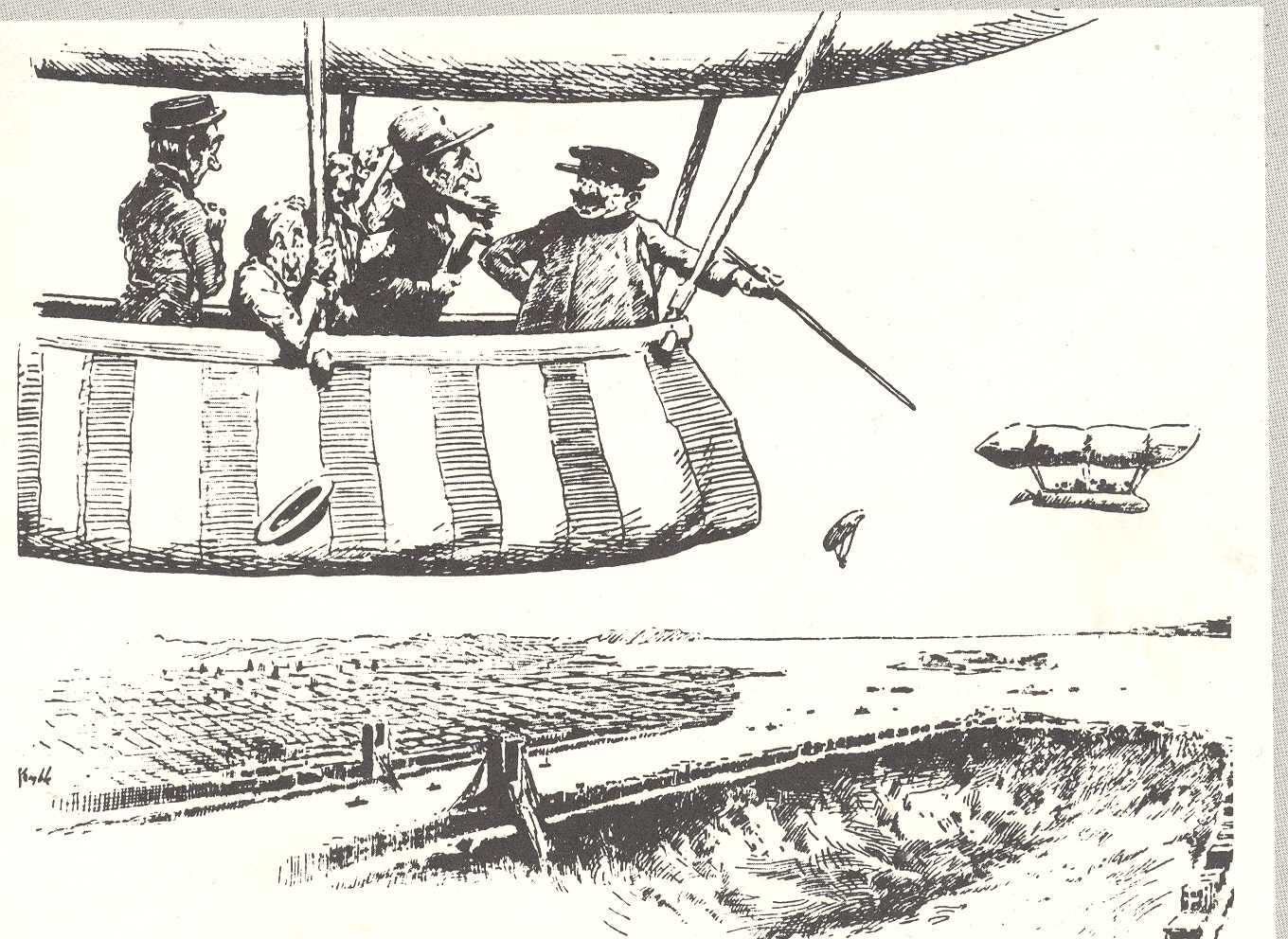
    The presumption of this Illustrated London News article (“On the Impulse to Fly Commercially”, 18 October 1919) on the growing popularity of commercial flying for business and pleasure was correct, but the placement of the airports to service the growing community of flyers was, well, not.  

    Airport--round 247

    This is a prototype, of sorts, for many dozens of proposals that would appear in magazines like  Science and Popular Science and Popular Mechanics and so on, suggesting inner-city airports that could be easily accommodated by the city bustle by placing the airport on top of buildings (as above), and these other closely-related ideas (below):

    [Picture source: Paleofuture.com]

    and this:

    Aircraft
    [Picture source, again, from Paleofutue.com]

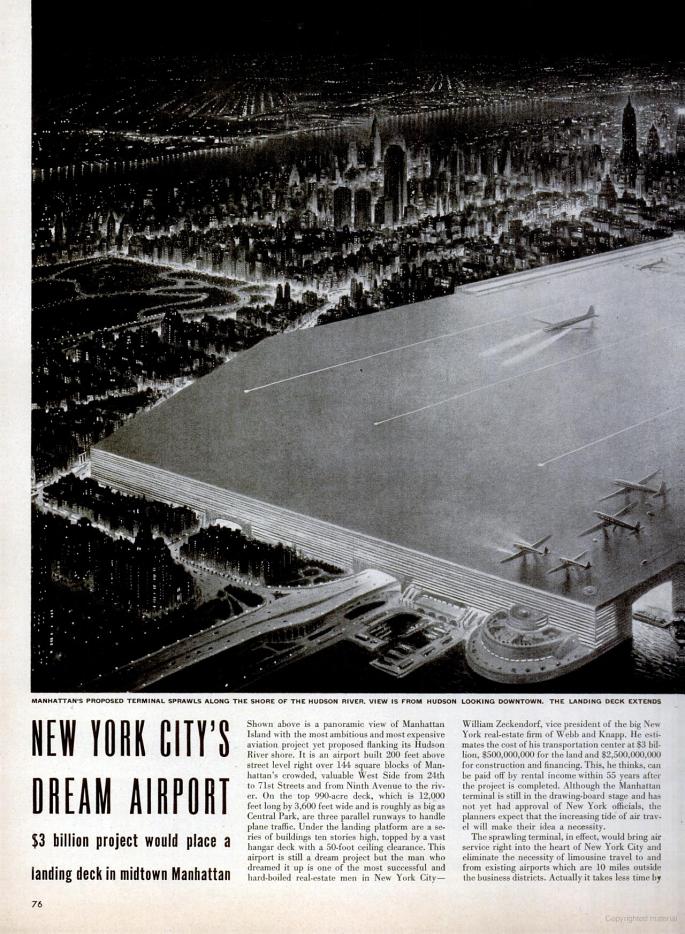
    These terrible ideas were also seen in building enormous platforms over entire sections of the city (like Zecendorf’s massively bad 1946 idea)

    Books

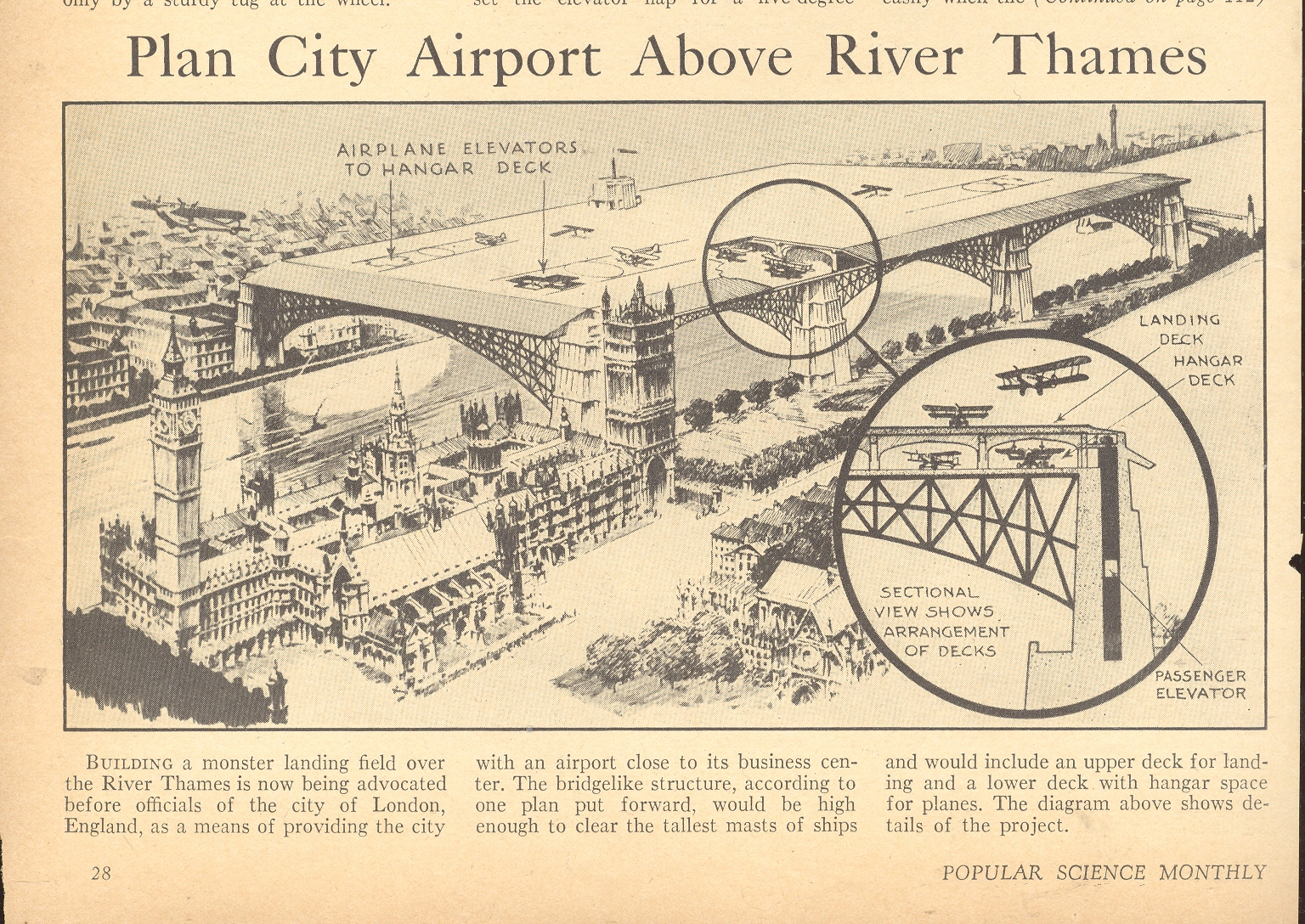
    or massive flyovers on rivers (which I also wrote about here),

    Blog Dec 17 thames airport

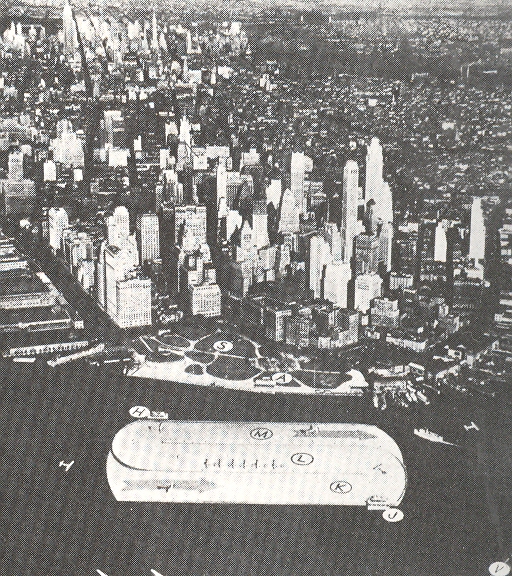
    or enormous floating airport islands (like that proposed by Norman Bel Geddes at the tip of Manhattan,  

    1--bel geddes airport 2 

    and of course a series of airports that stretched across the Atlantic.

    https://historyofideasblog.com/a/6a00d83542d51e69e2012876bef533970c-500wi

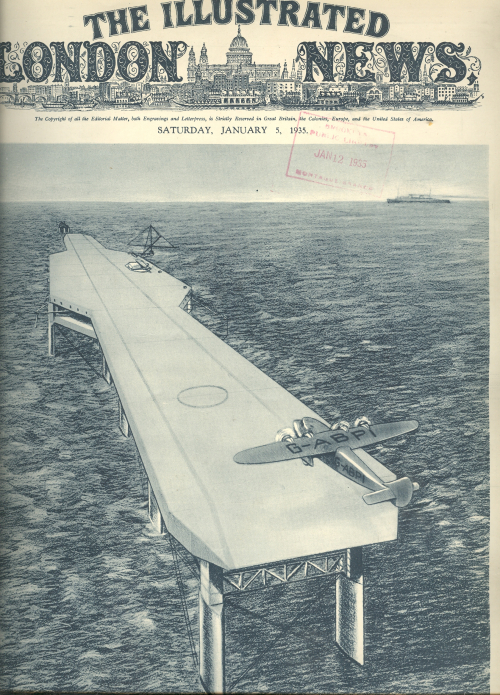
    But they all had to start somewhere, and perhaps this Illustrated London News entry for 1919 was among the first wave of these proposals. 


  • Strange Things in the Sky Department: Floating Airports

    JF Ptak Science Books  Post 1119Strange things--Floating airport

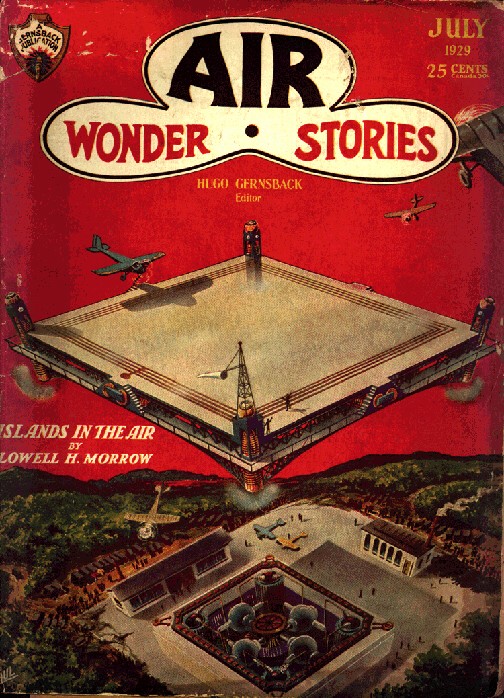
    I’ve written several posts here about floating an airport in the NYC narrows, as well as airports constructed over hundreds of acres of Midtown rooftops, hundreds of small landing strips crossing the Atlantic, innumerable planes and dirigibles with lad fields on/in them, and covering the Thames at Big Ben. (See here for some of these stories.) But I’ve not seen a floating or hovering anti-gravity airport until now. 

    The question for me would be–why, if you have somehow mastered gravity enough to float a large piece of concrete tonnage like an airport in the sky, why, oh why, are you still using airplanes? 

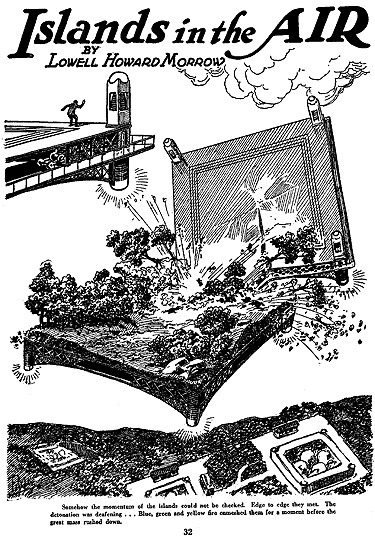
    The answer doesn’t matter, here, only the art does.Actually, the writing doesn’t matter, either; just check out the excerpt below.)   This again a piece of delicious imagination by Frank R. Pauil created  for the July 1929 issue of Air Wonder Stories.   The drawing below must be among the first of its kind to depict a collision between two anti-gravity floating/hovering airports. (!)

    Notes:

    The excerpt:

    “The Professor stared blankly a moment, then rushed away to the office. We followed breathlessly.

    The outer door had been forced, its lock being broken, but beyond
    this no damage had been done so far as we could discover. Anxiously we
    ran over the papers–not a print was missing….”

    It might have been more interesting if the thief had stolen all of the “e’s” from those papers.  There are 9,500 more words in this story, but I can’t make ir any further than this…

    And also this:

    Paul3.5C


  • Airport in the Sky, Airborne Zeppelin Airfield, 1925

    JF Ptak Science Books  Post 1101

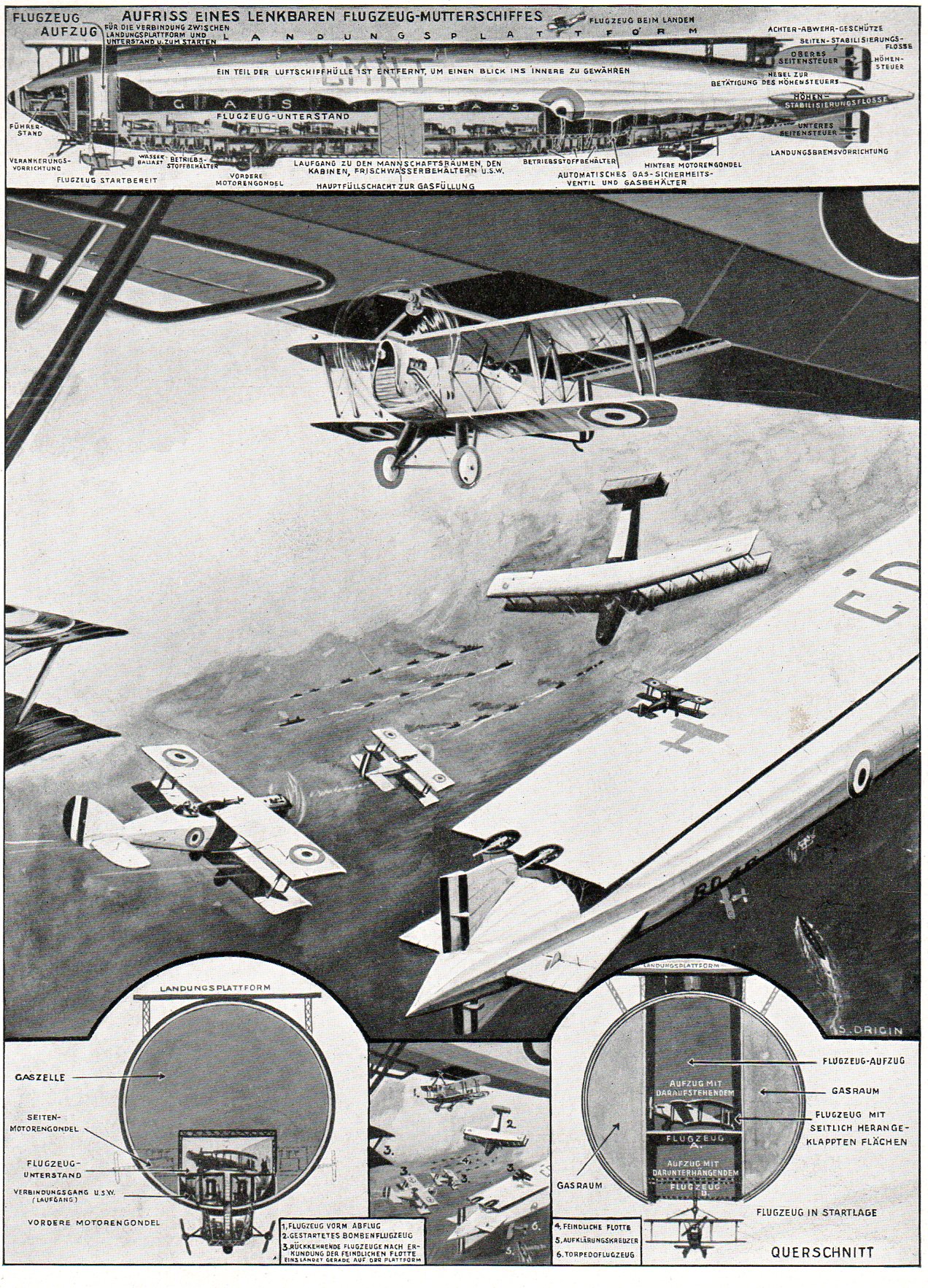
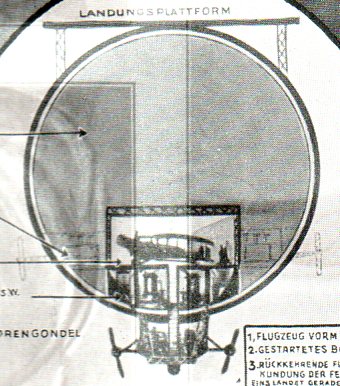
    This interesting image comes from the Illustriete Zeitung (Leipzig) for July 1925 (“Zeppelinsche Riesenluftschiffe” by Dr. Hildebrandt), and shows a British proposal for a dirigible outfitted as a sea-going airborne airport for military planes. 

    Airport--dirigible241

    The aircraft would land aft, and then proceed forward to an elevator that would lower it belowdecks to a hangar (looking as though it could accommodate 11 or 12 aircraft).  Once refueled and re-outfitted, the planes could be lowered from the body of the dirigible and launched into space. 


    Airport--dirigible a243

    Airport--dirigible b244

    And of course some cross sections:

    Airport--dirigible c245 

    Airport--dirigible d246


  • New York City: Attacked by Tentacled Flying Saucers, Giant Flying Snakes, Glaciers, and Mining Missile Space Aliens, 1929-1941

    JF Ptak Science Books   Post   1118

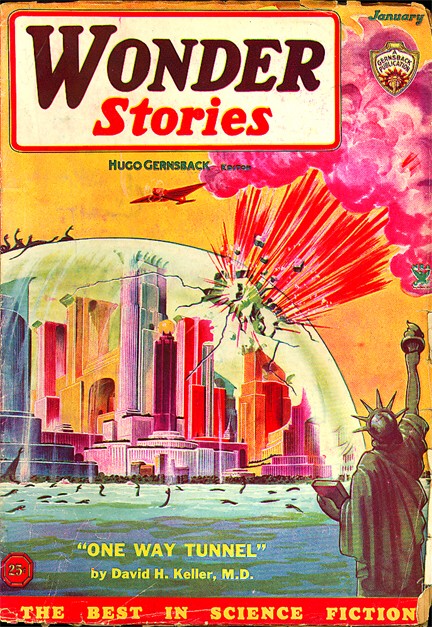
    This is a simple, non-analytical image dump for some in a continuing series on images of New York City in fantastical and improbable situations–there’s artwork that show the city being consumed by glaciers, drowned by the tide, ripped from the Earth and flung into the sun, floating in the sea, floating in space, sunken, and of course simply attacked by any number of different things, though most of those weren’t real.  There is of course the great unknown classic that I stumbled across–the duplicate NYC on a duplicate Earth orbiting the Earth ((?!) and pictured at the end of this post). I doubt that there’s enough for a dictionary of disasters, though there’s plenty for a Doomsday Book.

    For example the first image for this post shows a domed New York City–and in this scifi sub-classic,  like other major cities of the United States, NYC was suffering a catastrophic attack by winged snake monsters.  I don’t know why  the dome is exploding because the snakes don’t appear to be armed.

    NYC attacked

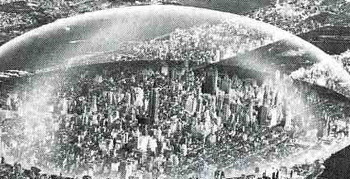
    This does remind me of an image from the mind of Buckminster Fuller, who
    came up with an extraordinarily bad idea to protect NYC against
    thermonuclear weapons. (Fuller’s dome appears here.)

    Big_archfuller_detail141 

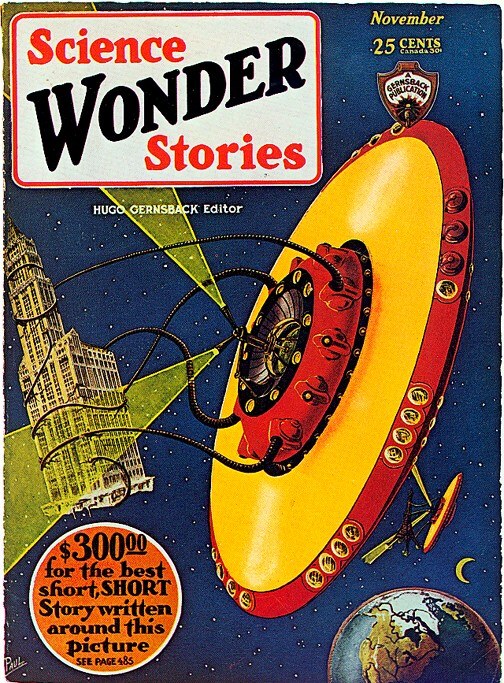
    Then there’s this magnificent cover for November, 1929, featuring a tentacled flying saucer removing the Woolworth Building into outer space (as well as the Eiffel Tower by another brethern craft (the Earth appearing again, as nearly usual, without cloud cover):

    Woolworth

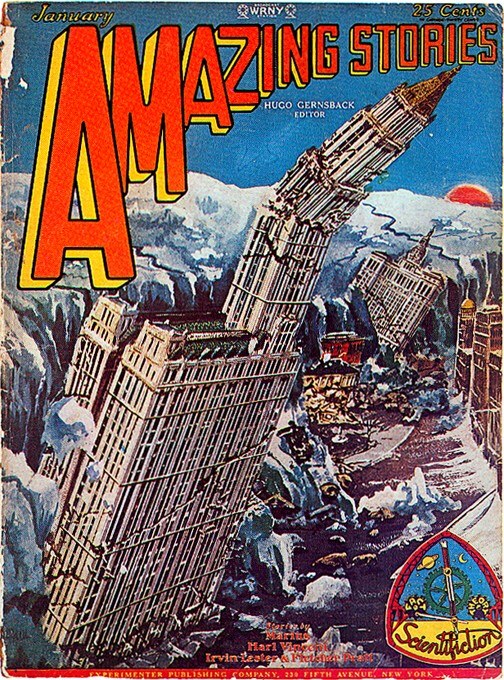
    And yet another destroyed Woolworth Building, this from January 1929, featuring an enormous glacier attacking the City:

    NYC destroyed--woolworth

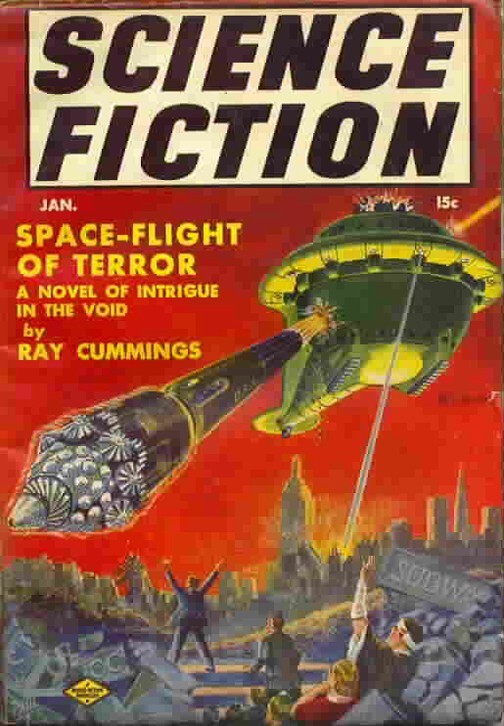
    And this vision of a decimated NYC, coming at the hands of giant hovering mining/missile space aliens:

    NEw York City in Ruins

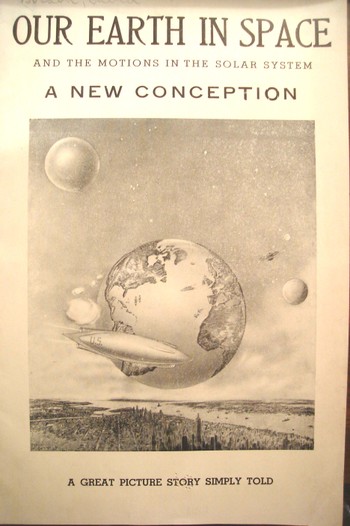
    And of course, the duplicate NYC on Extra Earth:

    Dsc04543


  • Triple Sci-Fi Negatives: Man-Tossing Giant Woman from the inside of Mother’s Wedding Ring (!) 1921

    JF Ptak Science Books   Post 1117

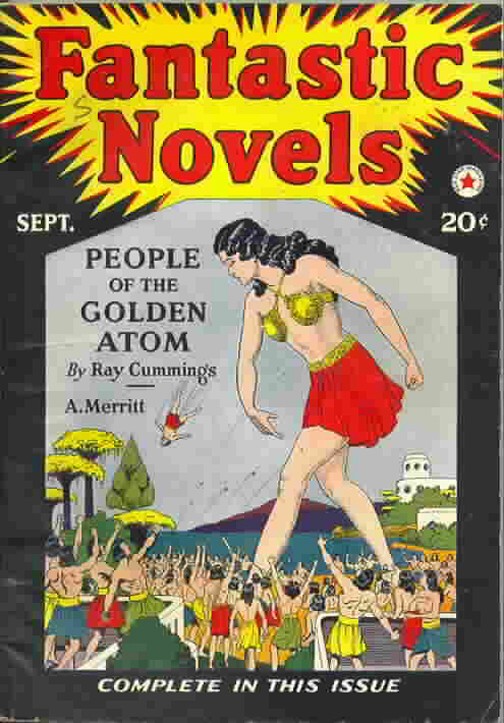
    There are times when even things that are made to look extraordinary and plainly, outrageously identifiable as what they are, simply aren’t–and sometimes they’re not even close.  For example, this cover of Fantastic Novels (1921?) seems to tell a straightforward story, but as it turns out the giant is giant but one living within a world in an atom of a gold wedding ring.
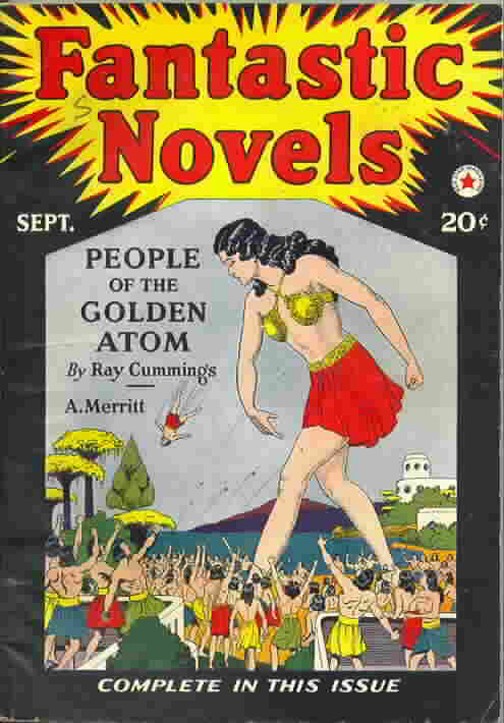
    Man throwing

    Author Ray Cummings (1887-1957) found a nice writing niche for himself in his fictional discovery of a drug that could make people as small as atoms and then, once inside the microworld, could be made as immense as micro-mountains.  The Girl in the Golden Atom was one of a five-part trilogy(?)1 and so far as I can tell, Cummings used the hell out of his original idea.  The prose reads like it is punctuated with invisible periods every fifth word2–evidently Cummings was so very busy writing 750 books and short stories that it  left him little time to edit or, maybe, think.

    Briefly and perhaps wrongly put, what I think that happens in this story  is this–four guys in a 1919 club do sumpin’, the chemist among them figures sumpin’ out and finds a micro world inside the atoms of his mother’s golden wedding ring where he falls in love with a chick  there and goes to visit her himself3; the shrunken chemist finds himself in the middle of a war and grows himself to gigantic proportions in microworld to help out his girlfriend’s people.  Or something like that. I don’t feel a need to understand this one. All I want is the cover art. 

    Personally, I’d rather be a giant rather than be miniaturized to somehow fight for my existence in the microscopical world.  Sure, finding sources of energy if you were 500 feet tall or whatever is going to be a problem; finding whatever problematic but less so. But at least nothing is going to try and eat/crush/liquidate you in the micro-world, where food is the least of your problems.  Color me in big.

    As I said, all my interest here is in the Frank R. Paul cover art.  I find very few images where giant women are throwing tiny men taken from a sea of tiny men into the far horizon. 
    ______   
    Notes.

    1. The other four parts of the five-part trilogy are The Princess of the Atom, The Man Who Mastered Time, The Shadow Girl and The Exile of Time)
    2. Here’s a sample of the writing:
    “Many things they threw,” Lylda [a giant woman]  answered. “But I was so big,” she smiled a little sad, twisted smile. “What they could do was as nothing. And
    because of that they fear and hate us so; yet never have I seen such
    fearless things as those they did. Death to the giants was their only
    cry. And I could have killed them–hundreds, thousands–yet never could
    I have made them stop while yet they were alive.”

    She was speaking to a character named Big Business Man. Makes my teeth fall out.

    3. Sounds like a lot of therapy source material


  • Strange Things in the Sky Department: Manhattan Ripped from the Earth and Flung into the Sun

    JF Ptak Science Books   Post 1116

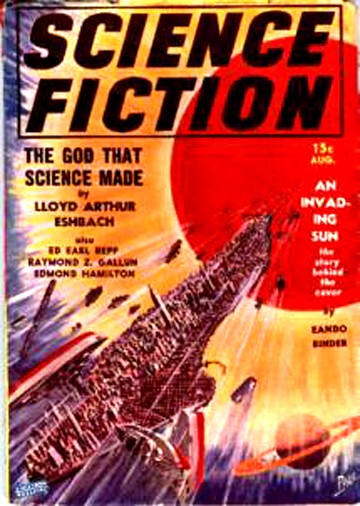
    Well, no, this isn’t quite the case, but it does look as though Manhattan was mysteriously transformed into a spaceship of some sort, an island in the sky (that it already is), hurtling towards a destiny with the sun.  But in sci-fi

    Strange things in the sky--Manhattan

    fact, Manhattan was being ripped straight out of the Earth, swallowed along with other Earthly goods and Solar System fixtures by an advancing and ravenous Sol.  (I should note that there is a battleship floating upside down over Manhattan–this is the second image of an upside-down above-Manhattan hovering battleship I have seen this week from Mr. Paul, an earlier version seen here.) .Physics problems aside, this cover was just too spectacular to not merit its own post, so that it is easily findable (even amidst the rest of the NYC swallowed/missing/in space/attacked/duplicated posts). 

    For example, there is the following case of Manhattan being missing, submerging itself into the bedrock under the weight of its skyscrapers (in 1902):

    3--nyc gone

    Frank R. Paul did the cover art for the story “An Invading Sun” that appeared in Science Fiction for August, 1939, and that’s as far as I got with this issue–anything more is destined to be a shrinking denouement.  There would’ve been plenty in the air, as it were, in the summer of 1939 to put the artist and the author in a foul prognosticating mood.  The Japanese had already been scourging China for several years now, and Nazi Germany had moved into Austria and Czechoslovakia, and were just about to begin WWII in earnest with their attack on Poland, just weeks away.  The 1930’s were a glorious decade for physics (and included the Miracle Year of 1932 spiked by Fermi, the Joliot-Curies and Carl Anderson; Oppenheimer and gravitational collapse, the overwhelmingly better-understood quantum theory, nuclear physics, and all the rest…a very busy decade). So the world was coming into a landing of some sort in 1939, what with densely compacted collapsing stars, the discovery of subatomic particles, the real birth of QM and nuclear physics, Nazis, the Japanese running amok in Asia, the death pangs of the Depression panging away, deep anti-involvement attitudes int he US, and so on.  No wonder the Earth was being consumed in science fiction fires. 

    _________

    Cover art by Frank R. Paul for August 1939 Science
    Fiction
    magazine source: Frank Wu’s Frank R. Paul Gallery.


  • Strange Things in the Sky Department: Floating NYC of the Future

    JF Ptak Science Books   Post 1116

    Strange things in Sky--Cities above Cities

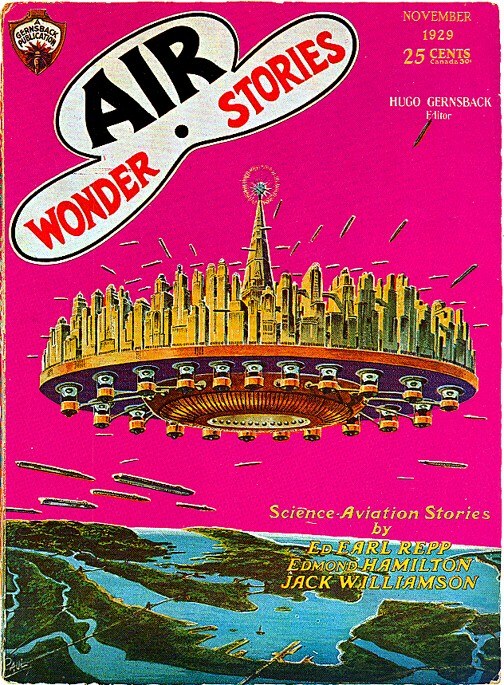
    Frank R. Paul (again!) put his indelible design stamp in this fantastic cover art for Edomnd Hamilton’s (1904-1977)1 story “Cities in the Air” that appeared in the November 1929 issue of Air Wonder Stories.  I don’t have access to the content of the story, but at base it seems, at the very least, that the city footprint underneath the floating city has got to be New York.   Some of the geography looks a little off, but if the City was allowed to return to its less-people origins, this is sort of what it looked like.  And since bridges are still standing though not necessarily buildings, and being that there so much lush green growth, something awful must’ve happened to reduce the population of Metropolis.  (Manhattan Island seems pretty identifiable, as does Staten Island, part of Jersey City, plus Brooklyn and the Bronx, plus the upper island of Manhattan….there’s no chance I think that there is not New York City.)

    So something big indeed must’ve happened to get everyone up in the floating NYC replacement–not the least of which would’ve been the discovery of some sort of gravity-negating something.  I’m not sure what the point of all of that is, exactly, unless these new floating cities are cultivating the Earth, or something, Eden-zing it. perhaps the cities were on the go, somehow, though a sudden start or stop or dip or thrust or whatever might prove devastating, unless there was something invented that would ensure certain laws of motion wouldn’t apply to anti-graviationally-platformed floating cities of the future.  And if it wasn’t going to move, why would you want to go through all of that effort in removing everyone to  giant floating city and keep it in the same pace, hovering above its former self.

    But in this sort of future, everything and anything is possible, so I guess it all makes sense as long as you can adjust definitions and “criteria of validity” at will.    I would like to see the city plan for the interior of the place–we can already see that it is ringed with enormous buildings, but I’d like to see center-city, especially the reason for the hole in the bottom of the floating city donut.  (I’m thinking that this could also classify in the rare cross-sub-category joining the History of the Future posts with the History of Holes–History of Future Holes.)

    ____

    Notes

    1.  Hamilton’s bibliography is located (at least) here.


  • Anti-gravity Atomic-powered Sun-fed Underground Woman of the Year 5000!

    JF Ptak Science Books   Post 1114

    Paul-50.8
    The woman in this picture is rising from her subterranean world in an anti-gravity atomic-powered crystaline homunuclus, flying out for shopping while being fed by sunbeam converters.  No doubt there’s something strange going on with earth three milennia in the future–since the Earth no longer supports vegetation, people live underground and eat the sun directly via sciencey voodoo.     

    The artwork is provided by my newest favorite science fiction illustrator, Frank R. Paul, for the 26 August 1938 issue of The Family Circle.  And according to the elegant Paul-ophile website, the Frank R. Paul Gallery, the cover article is an interview with the artist, who goes into great detail (again, supplied by the Gallery site), about what exactly is going on in the cover illustration.  Without the explanation, I would not have been able to guess the meaning of the images.

    Another bit of the cover: the blue ball is “solidified energy” of space-time headed into the sun; meanwhile, genius scientists hope that to cushion the exploded sun’s blow to earth by launching burned tired gases into the stratosphere.  The rubber gas cushion worked, except that it would up being pierced by a renegade energy blob which crashed into the Earth and via a great miracle cured the Depression.  I would not have guessed this.

    Lastly, the guy at the bottom is not a mad scientist, but a Supreme Intelligence (as Paul tells us, he is denoted so by the “S I” on his chestplate, which evidently does not stand for “Sports Illustrated” or Staten Island”). I guess if the guy’s intelligence was really supreme he could’ve figured out a way to show more than North and South America in the single hemisphere on the chestplate.


  • Strange Things in the Sky Department: Earth Bombarded from Mars

    JF Ptak Science Books   Post 1113

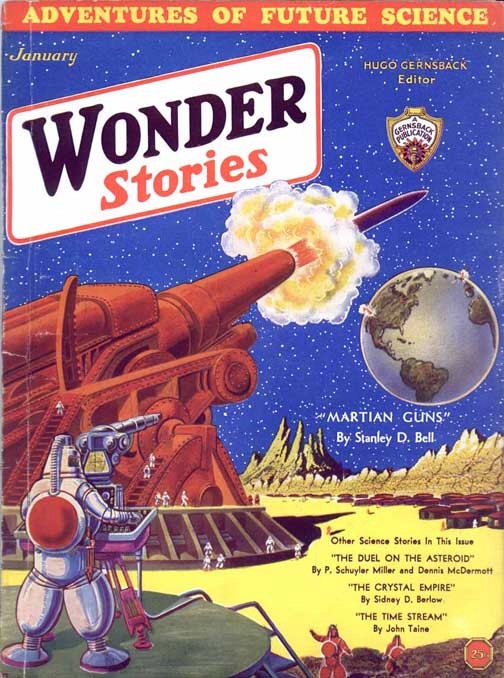
    Strange things in sky--martian guns
    Earlier in this blog I wrote about odd, extraterrestrial extra Earths–double Earths (like this, for example “Extra-Earth Humano-Alien Souls from Outer Space Repopulate Earth-Hell!”)–and then branched out to other strange things found in created skies.  This image would certainly classify:  its the cover art by the fabulous Frank R. Paul for Stanley D. Bell’s “Martian Guns” found in the January 1932 issue of Wonder Stories.  There’s really no way to determine how big the gun is except to say that it is probably “big”–there’s just nothing to place the thing in perspective, as the figures in the foreground, being Martian, don’t have a specific height.  They could be 6′ tall, or 60′–perhaps they’re only 1/10 of an inch tale, and the projectile they’re firing to the earth is so devastatingly powerful that size doesn’t matter.

    We also have no idea of the used to get the projectile/bomb moving–the nature of the explosive–but it is probable that the resulting muzzle flash wouldn’t look anything like what we’re seeing here.  This depends on the available bits in the microgravity, but I think all that you’d see as a result of firing canon would be a very bright flash of light, and here would be no smoke. Plus lots of other obvious stuff, like, well, the Martians, though at least the gun isn’t pointed directly at the Earth, which I think is just a function of fast work.  But no matter, this was 1932, and the specs don’t matter, as this is, after all, science affliction. 

    The destructive units are finding their targets, though; one seems to have found its mark around San Francisco, and another looks like it might be in France.   They’re easy to spot, made so for the reader, finding their thousand-mile high smoke plume in a cloudless atmosphere and all. 
    I’m sure it would’ve been an unsettling experience to the reader of the time.

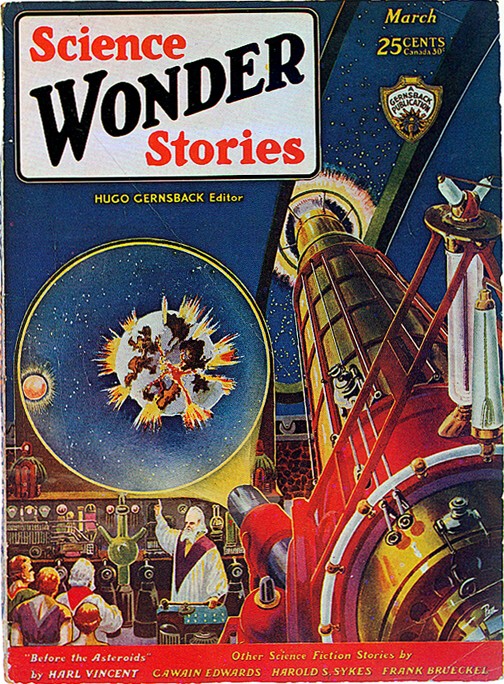
    Here’s another odd bit, this one seeming to show an exploding Earth–the “exploding Earth” subcategory of the “Strange Things in the Sky” category being among the rarest of these sorts of images. This comes from the January 1932 issue of Science Wonder Stories, from the “Before the Asteroids” article by mechanical engineer Harl Vincent (1893-1968).

    Big Gun

    I can’t find the text of the story, so I really don’t know if this is the Earth being detonated or whether it is an asteroid–I prefer it to be the Earth, and the exploding thing doesn’t look much at all like an asteroid.

    [Mr. Vincent had a nice way of turning a title, some of which include ”Creatures of Vibration, ”The Copper-Clad World” , “Vulcan’s Workshop” and Wanderer of Infinity” .]


  • Strange Things in the Sky Department: NYC and Floating, Upside-Down Battleships

    JF Ptak Science Books   Post 1112

    Battleship upside down

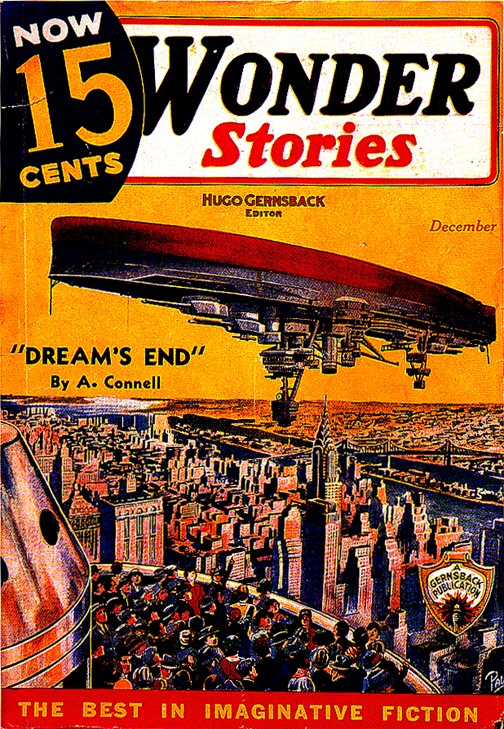
    This fantastic image was made for the Australian Alan Connell’s story “Dream’s End” which was published in the December, 1935 issue of Hugo Gernsback’s Wonder Stories (a company resulting from the merger of: Science Wonder Stories and Air Wonder Stories and then continued as Thrilling Wonder Stories). The floating battleship illustrates a point in Connell’s story about the frailty of reality, the slim margins of appearance, and how easily everything could seem strange and foreign if subtle changes are made in the fabric of the physical universe.  Actually, it was much more than that, and the subtlety quickly fades as Connell’s story lifted reality up and away from humanity, producing all of not only the earth but the entire universe  as a piece of a some larger intelligence’s dream. It is the story of a fragmentation of all reality as the being ends its dream and begins to awaken.  

    The striking cover is really quite fantastic, even if the perspective is off and problematic–it certainly captures your attention and makes you wonder about what on earth the story is about.  And that in spite of what seems to be less than half of the crowd on the observation deck looking at the upside-down floating battleship hovering over Midtown. (I guess that’s about par, this being NYC and all…)
    _____
    Notes:

    “Vol 7, No 6. 132pp. Cover art by F.R. Paul  suggested by “Dream’s End”. The cover and table of contents list December as the publication month but the editorial credit page lists November-December. Paul is credited as the cover artist based upon his signature. Oliver Saari has two different letters. A section headed “In Your Opinion” in the letter column lists the fan favorites from the September issue in descending order as “The Green Man of Greypec”, “The Ideal”, “World of the Mist”, “The Space Lens”, and “One Hundred Generations”.– From the ISFDB website.