A Daily History of Holes, Dots, Lines, Science, History, Math, Physics, Art, the Unintentional Absurd, Architecture, Maps, Data Visualization, Blank and Missing Things, and so on. |1.6 million words, 7500 images, 4.9 million hits| Press & appearances in The Times, Le Figaro, Mensa, The Economist, The Guardian, Discovery News, Slate, Le Monde, Sci American Blogs, Le Pont, and many other places… 5000+ total posts since 2008.

Author: JF Ptak

  • On Describing the Jobs of the Working Poor, Part 1: George Orwell and Mining

    JF Ptak Science Books   Quick Post

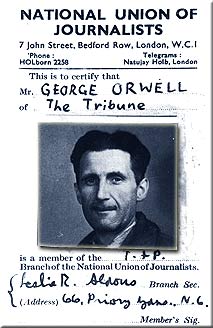
      OrwellGeorge Orwell’s description of the underground work-life of a miner is extraordinary, as were those workers and the work that they did under grave conditions and for a long period of time.  The first extract from his The Road to Wigan Pier (1937), chapter three, describes the world of the miner.  Another extract2 is a blistering description of how the miners got to the coal face after their 60 m.p.h. decent in their tiny elevator, walking like crabs for a half-mile or longer in hot and dusty conditions, in near blackness, with a roof four feet over the ground.  I read this many years ago and the image painted by Orwell remains a vivid and haunting one. Orwell’s work was superb in describing the conditions and efforts of these outstanding men.

    “When you go down a coal-mine it is important to try and get to the coal face when the ‘fillers’ are at work. This is not easy, because when the mine is working visitors are a nuisance and are not encouraged, but if you go at any other time, it is possible to come away with a totally wrong impression. On a Sunday, for instance, a mine seems almost peaceful. The time to go there is when the machines are roaring and the air is black with coal dust, and when you can actually see what the miners have to do. At those times the place is like hell, or at any rate like my own mental picture of hell. Most of the things one imagines in hell are if there– heat, noise, confusion, darkness, foul air, and, above all, unbearably cramped space. Everything except the fire, for there is no fire down there except the feeble beams of Davy Lamps and electric torches which scarcely penetrate the clouds of coal dust…1

    ·Posted by :

    ·in:


  • Blank, Empty & Missing Things Series: Stairs

    JF Ptak Science Books     Post 1637  (From the series on the History of Blank, Empty and Missing Things.)

    Spiral staircase st paul950
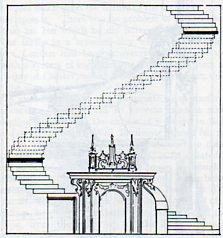
    This doesn’t quite fit this category, not really, but sometimes close enough is good enough, especially if there’s a really good image that doesn’t seem to fit anywhere else.

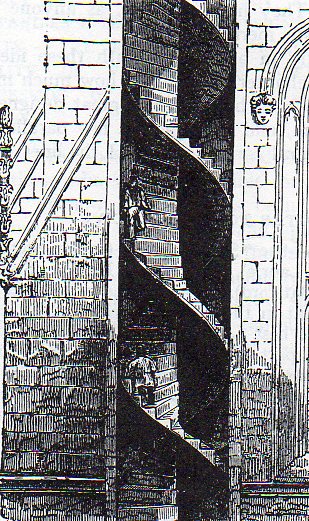
    Such is the case with this great drawing by Theo. G. Scott in the Architectural Record (July 1910) of Christopher Wren’s “Geometrical Staircase” in the southern tower of St. Paul’s Cathedral.  The stairs of course are not missing, they’re just not visible from the standard I’m-looking-at-stairs viewing scenario, as we can see in another classic view, this one found Theodore Cook’s The Curves of Life (1914): Spiral staircase double951

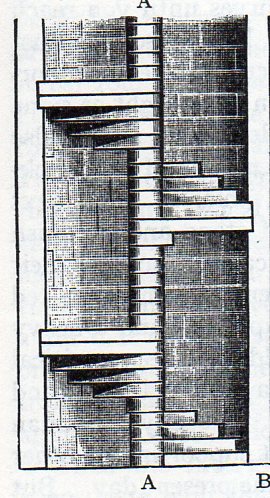
    [The double staircase as described in Cook’s book as the “Tamworth Church Tower”, which is actually St. Editha, in Staffordshire.  The church is Medieval, and building dates from 1369, though it is the fourth iteration of a structure there, the first of which (begun in the 9th century) was destroyed by the Danes soon after its completion. The staircase is remarkable because it allows one person to ascend and another to descend without either ever having to see the other.]

    Spiral staircase double952Engineers and architects had confronted the idea of spiral stairs for many centuries before Wren–perhaps as many as 40 generations, perhaps more.  The “invention” of the  spiral staircase, or its discovery in the places in which it sort of exists in nature (like in the shells terebra dimidiata  and voluta scalaris), seems like a very interesting thing, though I am not sure where it stands in the history of importance in architectural development.  Perhaps Pisa wouldn’t have nearly so many narrow towers without the spiral staircase, and I know for a fact that it is far  easier to deflect marauders from ascending a castle’s spiral staircase than any other (the defenders getting at least an order of magnitude (and maybe more) bump from that design than any other staircase. I doubt in comes anywhere close to the indoor fireplace/chimney, or downspout, and a lot of other stuff.  But it is definitely much prettier to look at in perspective and plan than just about anything else in architecture. 


  • Crowd Series–VE Day, May 1945

    • Ephemeral Uniqueness in Large Crowds, here.
    • Crowds and the Press of Humanity:  WWI German POWs, here.
    • The Chaos of Hats, here.
    • Crowd Series and Berlin Expectations, here
    • Clarity and Confusion in the Display of Human Masses, here
    • Large Crowds and Singular Persons Series–3 Images.  Here.
    • Servicemen and B-17s at the End of WWII, here.
    • Imaging Mass Casualties in WWI, here.
    • Relief in Capture: Churchill in Carthage and what 230,000 POWs Looks Like, here.
    • The Detail is in the Detail: What 20,000 Soldiers and 1 Mule Look Like, 1918, here.

    ·Posted by :

    ·in:

    —

  • Tools of a Scientist, ca. 1700

    JF Ptak Science Books   Post 1636

    Friedlein941

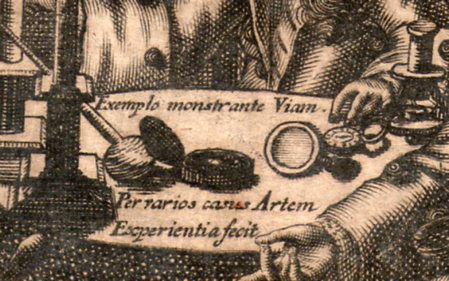
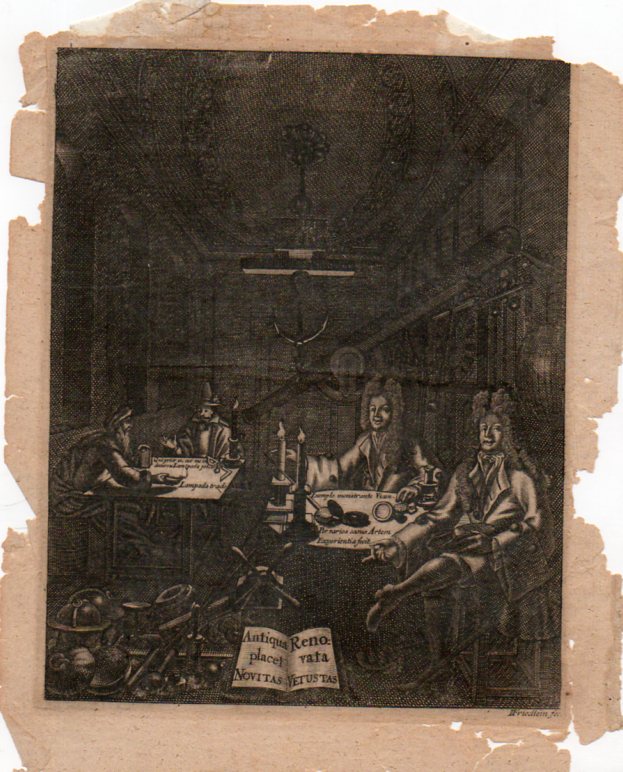
    This is an image of a  philosopher’s cabinet, engraving (on copper?) by “I. Friedlein fec”, who was actually Johnann Friedlein, an emigree from North Germany to Denmark, and who worked ca. 1680-1705. It shows the tools of the trade for someone working in natural philosophy (the name “scientist” would not come into use for another 150+ years or so) and is an interesting insight into a small, polite gentleman’s club for experiment and investigation. [The original may be purchased via our bolog bookstore, here.]

    Friedlein938

    ·Posted by :

    ·in:


  • The Computer Cyborg of 1867–the Typewriter

    JF Ptak Science Books   Post 1635

    “The most ignorant person at a reasonable charge, and with little bodily labor, may write books in philosophy, poetry, law, mathematics, and theology, without the least assistance from genius or study.”   Jonathan Swift, in Gulliver’s Travels (actually called Travels into Several Remote Nations of the World, in Four Parts. By Lemuel Gulliver, First a Surgeon, and then a Captain of Several Ships, printed 1726).

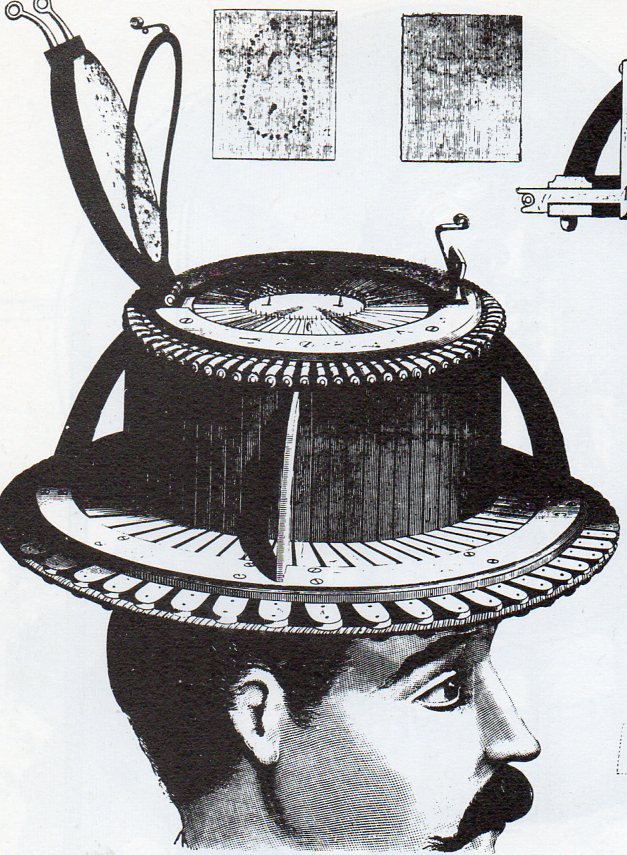
     

    https://historyofideasblog.com/a/6a00d83542d51e69e20133f2973d9a970b-pi

    Every age, every generation has a calling to the future that once that particular future arrives looks sometimes strangely like a past that was much further away than it was. Such is the case here, in September, 1867. in the pages of London’s Punch Magazine, when Mr. Punch rhapsodized on the future possibilities of the new invention, the typewriter. [Related items are available at our blog bookstore, here.]

    “Good News for Bad Writers” announced to the readership:

    “Writing Superseded.—Mr. Pratt, of Alabama, is the inventor of a typewriting machine, lately exhibited to tho London Society of Arts, which is said to print a man’s thoughts twice as fast as he can write them with the present process. By a sort of piano arrangement the letters are brought in contact with carbonised paper, which is moved by tho same manipulation,”

    The editor of Punch sniffed out a deeper deal in the typewriter than simple legibility:

    “Every author his own printer! What a happy state of things! No more struggles to write legibly with nibless tavern-pens: no more labour in deciphering the hieroglyphs of hasty writers. Literary work will be in future merely play—on the piano. The future Locke may write his essays by a touch upon the keys.”

    But the disappointments of the possible future wouldn’t stop there, and would or could or should go screaming into the dark night, the invention marking time in the brain of the writer, making able for him or her to compose without thinking, pillows taking over for the mind:
    “In this inventive age there really is no saying where discovery will stop. Now that authors are to put their thoughts in print with twice the pace that they can write them, perhaps ere long they will be able to put their works in type without so much as taking the trouble to compose them. A thought-hatching easy chair may very likely be invented, by the help of which an author may sit down at his ease before his thought-printing piano, and play away ad libitum whatever may occur to him. Different cushions may be used for different kinds of composition, some stuffed with serious thoughts, fit for sermons or reviews, and others with light fancies, fit for works of fiction, poetry, or fun. By a judicious choice of cushions an author will be able to sit down to his piano, and play a novel in three volumes twice or thrice a week, besides knocking off a leader every morning for a newspaper, anil issuing every fortnight a bulky epic poem, or a whole encyclopaedia complete within a month.”
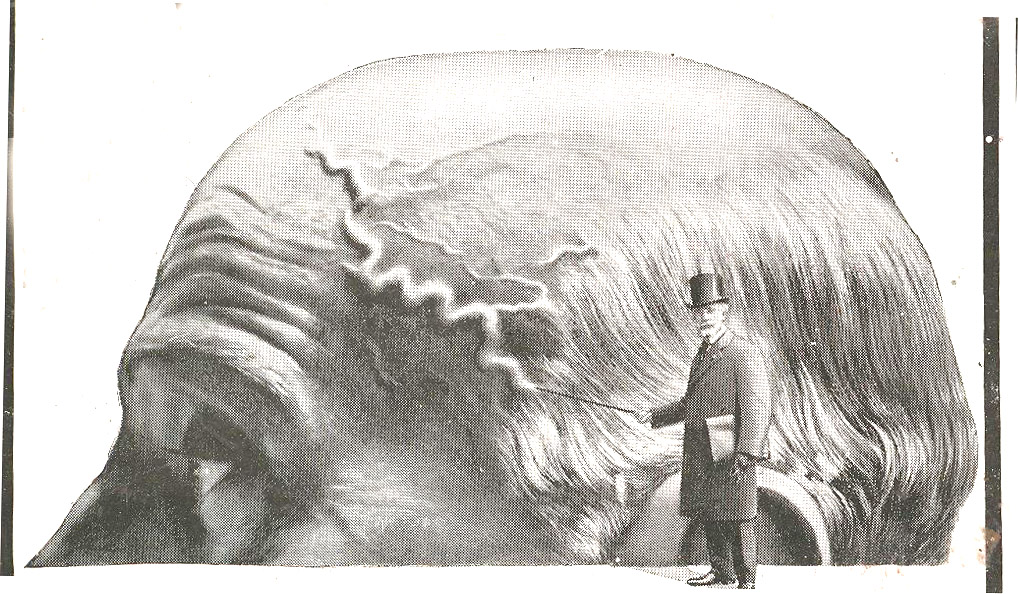
    https://historyofideasblog.com/a/6a00d83542d51e69e20133ed533188970b-pi
    This is not too terribly off the mark from the conversation/writing machine from Swift’s Gulliver in Laputa, except of course that this device (that I wrote about here) came 161 years ealrier.  But then again even the framework for this machine didn’t exist; the typewriter did, which at least got the science fiction aspect of its prospective powers going in the right direction in the real, three-dimensional very mentally High Victorian world.
    The typewriter was just another in a series of “robots” from antiquity, of the creation of moveable type printing taking over the job of scribes and scribes over the jobs of story tellers, of fabrications of automata, of rudimentary calculating machines of the 17th century, of the creation of the lighted semaphore, of the electric telegraph, of the telephone, of the wireless, of the radio, television, computer, internet.  Each offered a similar challenge to the people of their day and a similar challenge to their future–some of which came true, some didn’t. I know that Punch was kidding–mostly. 
    Photo

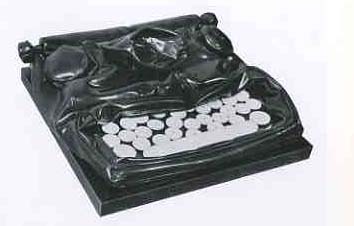
    [Claes Oldenburg’s “Soft Typeewriter, 1963.]

  • History of the Future–John von Neumann’s Crystal Ball & the Computer, 1949.

    JF Ptak SVon Neumanncience Books   Quick Post

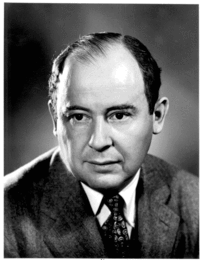
    John von Neumann contributed a major piece of prescient thinking in the 1949 volume of Proceedings/Computation Seminar, December 1949, assembled by Cutherbert Hurd of the IBM Applied Science Department. [The entire contents of the volume is available here.] Von Neumann (1903-1957)–perhaps the most advanced mind of the 20th century, a man whose work made the other advanced minds say “how did he do that?”–was a staggering polymath who made contributions in many fields, not the least of which was in the creation of the modern computer.  His one-page contribution to this volume was a deep  insight into the possibilities of the machine.  In 1949. Check out this terrific piece by the great Claude Shannon, “John von Neumann’s Contributions to Automata Theory” here.


  • First Printed Views of America: Columbus in Print in 1493

    JF Ptak Science Books   Quick Post

     Christopher Columbus was born in 1451, and born sometime over a three-month period that no one seems to be able to button down.  He (known as Christophorus Columbus in Latin, and Cristoforo Colombo in Italian and Cristobal Colon in Spanish)  and in an audacious dash to shortcut European rivals in trade with the East became one of the first Europeans to explore the Americas.  In his first of four voyages to what would be called “the New World”, he landed in the Bahama archipelago, and in time explored the Greater and Lesser Antilles, Central America, and the Caribbean coast of Venezula, claiming all for the Spanish Kingdom. 

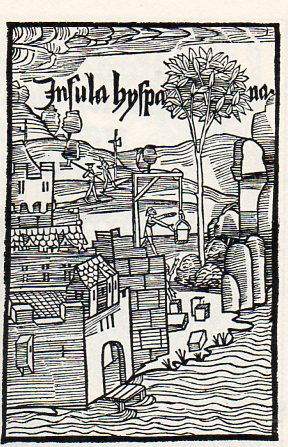
    The first images of his adventures appeared in Oceanica Classis, printed by Johann Bergmann de Olpe, in Basle, in 1493–the first, below, showing an imaginary view of the Island of Hispanola.  In the image of Insula Hyspania, below, we see Native peoples running from the approaching ship and long boat–they of course did not run far enough. (By the end of the 1620’s, something like 75% of the indigenous population in contact with Europeans (or in contact with people in contact with them) were dead, mostly from epidemics and diseases and lesser illness for which they had no immune systems.)

    Columbus933

    Four (of the other eight, two of which were repeated)  images from this fantastic work can be seen below:


  • Mother Goose for the Space Age (1958): “I Have Thunk, So I Cannot Am!”

    JF Ptak Science Books  Post 1633

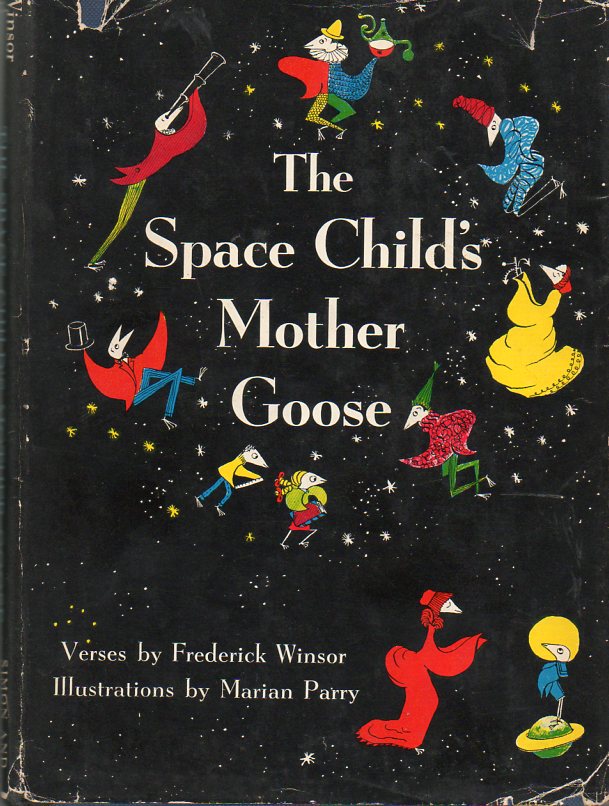
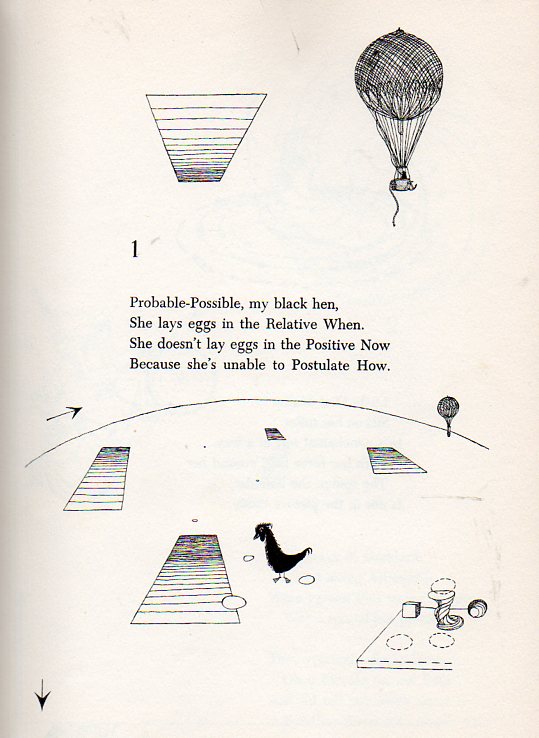
    Mother goose932The history of Mother Goose–but real and imagined–is a long and winding story, the blending of the old stories to more modern times almost as odd as the stories themselves.  This entry is what I think is the first “Space Age” version of the tales, though mostly it concerns itself with the ideals of Mother Goose more so than the stories themselves. 

    The physics-esque approach to the old idea rests in the verses of Frederick Winsor in his The Space Child’s Mother Goose, printed by Simon and Schuster in 1958, the stories helped along by some fine and tech-intricate drawings by Marian Parry.  The poems are occasionally delightful as works in themselves; but when you grade the work on a curve of science poems/funny science, it gets an even higher grade.  Let’s face it–there weren’t that many works in this genre in the 1950’s/’60’s, so it gets a little help just for being a friend to the lonesome in the pop-science-poem arena.  (The text for the volume can be found here; and if you wanted to own it you may purchase it from our blog bookstore, here.)


    Mother goose930

    ·Posted by :

    ·in:


  • Classifying Human Failures, 1487

    JF Ptak Science Books  Quick Post

    Penitence hell c

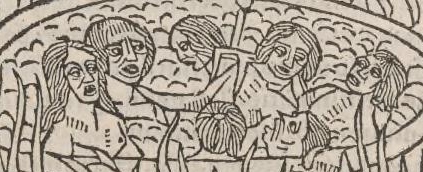
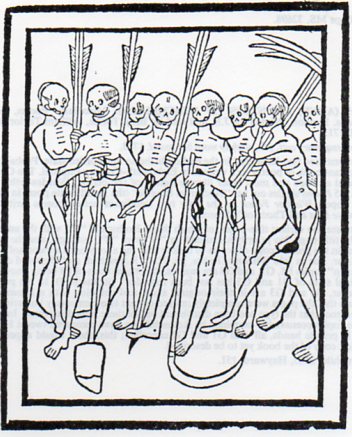
    This image was one of the promises to the readers of the Eruditorum Poenitentiale (printed in Paris by Antoine Cailhaut in 1487), a book of penitence, a manual for seeking forgiveness and avoiding sin, showing what end awaited those who would disappoint the Creator.  The work was a devotional of frailty, a register of sin, an insistent call to the things that could and will go wrong throughout the course of a human life, and what the costs of those shortcomings would be.  [Images from Bibliotechque St.Genevieve, here.]
    Penitence926

    ·Posted by :

    ·in:

    —

  • Building On Beyond Big–the Great Pyramid in Detroit, 1908

    JF Ptak Science Books   Post 1633

    “My alphabet starts with this letter called yuzz.  It’s the letter I use to spell yuzz-a-ma-tuzz.  You’ll be sort of surprised what there is to be found once you go beyond ‘Z’ and start poking around!” ~Dr. Seuss

    “The lunatic, the lover, and the poet, are of imagination all compact.”  ~William Shakespeare, Mid-Summer Night’s Dream, 1595

    Blogprymmidelevtion216 

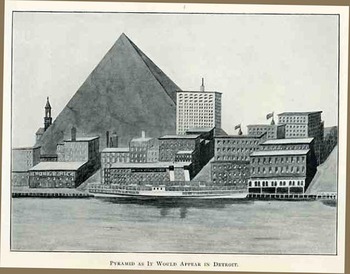
    And so it came, somehow, to be that E.S. Wheeler, president of the austere and august Association of Engineering Societies, presented a paper at its annual meeting in June 1908, on building an exact replica of the great pyramid of Gizeh.  I suspected that because of the intentionally fantastoid title that Mr. Wheeler intended the paper as a show, exhibition, to the younger engineers in the audience about how one might approach an unusual engineering problem, as an imaginative course of instruction.  That would be quite nice. 

    Except though that Wheeler presented the paper as though he was serious.  He delivered  it evidently with a high dryness, and people took him seriously.
    Blogprymmidpln215
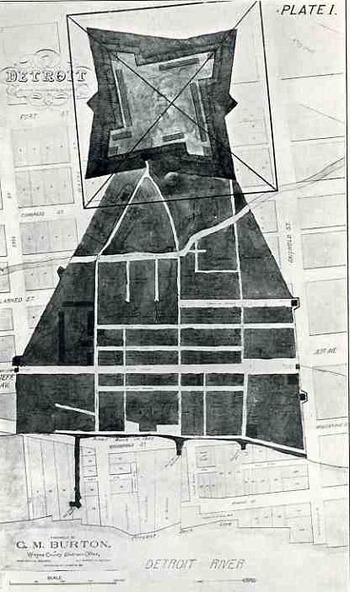
    The pyramid was to be built on the site of the village of Cadillac (of 1701), in central Detroit, occupying that site and then some, covering it with 13 square acres of stone.  Oh, yes, and it was also to be excavated, scooped first into a shockingly cavernous prism 759’ on each side and 120’ deep, or about 2.6 million cubic yards of stuff.

    The pyramid itself was to be built almost entirely of limestone, 760’ on each side, and 485’ high, set on the 13 acre base—where those 13 acres in the center of Detroit was left open to debate. Wheeler also intended to reproduce the interior of the pyramid as well (so far as it was known in 1908), and had a set of plans to accomplish that goal. 

    Wheeler figured that the material cost (exclusive of the base), would be $36,000,000 1908 dollars, which he considered a fair price.  The conclusion of his paper was a superb slash of logic and possibilities—he calculated that if each person in the United States contributed the equivalent of a day’s labor on the building of the pyramid, that the great structure could be built in a day and a half.  Wheeler closes with this superior gem, a sentence unlikely to be repeated in any subsequent technical journal”  “If the United States should stop all other work and devote itself entirely to building pyramids, as was probably the case in Egypt, it would, after it got fairly running, be able to turn out two every three days.