A Daily History of Holes, Dots, Lines, Science, History, Math, Physics, Art, the Unintentional Absurd, Architecture, Maps, Data Visualization, Blank and Missing Things, and so on. |1.6 million words, 7500 images, 4.9 million hits| Press & appearances in The Times, Le Figaro, Mensa, The Economist, The Guardian, Discovery News, Slate, Le Monde, Sci American Blogs, Le Pont, and many other places… 5000+ total posts since 2008.

Author: JF Ptak

  • Land Mines in the Sky, 1913-1919

    JF Ptak Science Books   Quick Post

    With the beginning of the aviation age in warfare came the anti-aircraft era.  In the first years of WWI opposing forces knew that aircraft would be coming but didn’t quite yet know how to deal with them. Some of the results of thinking about how to stop marauding aircraft can be seen below in a few examples of patents taken from the U.S. Patent and Trademark Office.  All of the following examples employed balloons–balloons that stationary and rigged in one way or another so that a passing plane that snagged this line would cause the explosive device that moored the balloon to swing up and detonate on or near the aircraft.  That means that a great many of these devices were needed to be an effective deterrent against aircraft. (I had written earlier in this blog about barrage balloons proposed for use in/around London in 1938, here.  This mode of anti-aircraft balloon was static, though, and at least in this circumstance the balloons were meant to snag and not necessarily try to blow up anything caught in its cable.)


  • On Words: Fining (and Refining), 1683

    JF Ptak Science Books   Quick Post

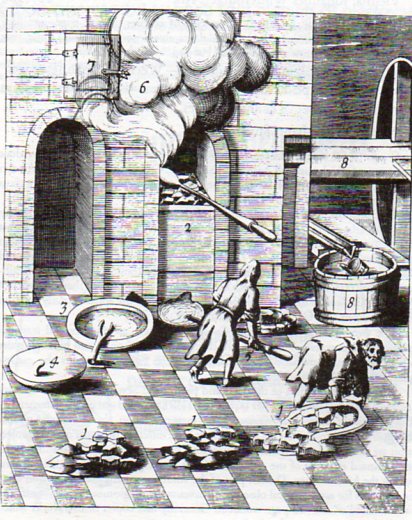
    We hear daily reports referring to refining, but there are very few about fining.. But there the word was, (appropriately) stick in the title of John Petrus’ translation of Lazarus Ercker’s classic work, Fleta minor: the laws of art and nature, in knowing, judging, assaying, fining, refining, and inlarging the bodies of confin’d metals. In two parts / the first contains assays of Lazarus Erckern … in V books : originally written by him in the Teutonick language, and now translated into English ; the second contains essays on metallick words, as a dictionary to many pleasing discourses, by Sir John Pettus … Knight .  (See the Richard Westfall entry at the  Galileo Project on Erker, especially on how he was able to support himself.  The book itself is an engineer’s delight, with applications of practical experience on all aspects of mines, mining and working with mined products.  It turns out that the original work by Ercker was so useful and popular that it was still around more than a century after Ercker’s death.  Oh yes–the original German editions were also among the first technical books to be supplemented by illustrations of the topics.)

    Fining425
    The story of iron is very old in Europe–and much older in China, older by more than another thousand years or so.  In Europe, though, iron from a blast furnace that has a high carbon content and a low melting point is called cast iron, and is quite brittle and cannot be worked by a smithy; fining is the process of cooking that cast iron up to its boiling point and skimming away the carbon, thereby giving the iron a higher melting point and a great capacity to be worked by a smith.  This product is called wrought iron, and it was a major step forward. 

    Which really does have something to do with a more popular definition of “fining”, which for the sake of simplicity would mean just to make something, well, “finer”.  I can imagine an eight-year-old figuring that out when aged six. A good, no-nonsense, perhaps 400-year-old word. 


  • On Bombing the Sky with Bone (1914) and Making the Sky Bomb Us (1967)

    JF Ptak Science Books   Post 1774  [Part of the Strange Things in the Sky department]

    I’m not at all sure when the first stories were told on the implosion of the sky, or when the sky was peeled away like a layer of mica, or when an expanding hole was punched into the blue, or when the sky dissolved, or when it simply fell to the ground, or when it was simply exploded, any of which would leave a shambles of broken stars and a boring nothingness.

    Visions of the coming of hell or the apocalypse or the end of existence or the exaltation of duration were certainly depicted in art at least during the high Medieval period and the Renaissance, though I am uncertain of ever having noticed the sky on fire or facing obliteration. Perhaps the implications of its destruction would be clear in the symbolic representation of The End, the evidence of a smoking atmosphere in an infinite hole was just implied, Dr. Pangloss at play with Mr. Leibniz over paint and canvas.

    Heaven opened and stars fell in various texts, not the least of which is the Book of Revelation (6:14, KJV, “And the heaven departed as a scroll when it is rolled together; and every mountain and island were moved out of their places”). Imaging this part though was another story, especially when considering that destroying the sky was a secular event, and not driven by the great deities.

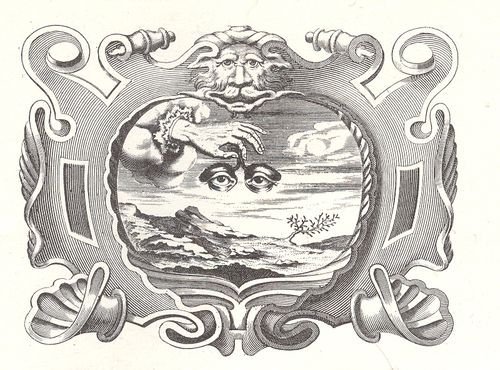
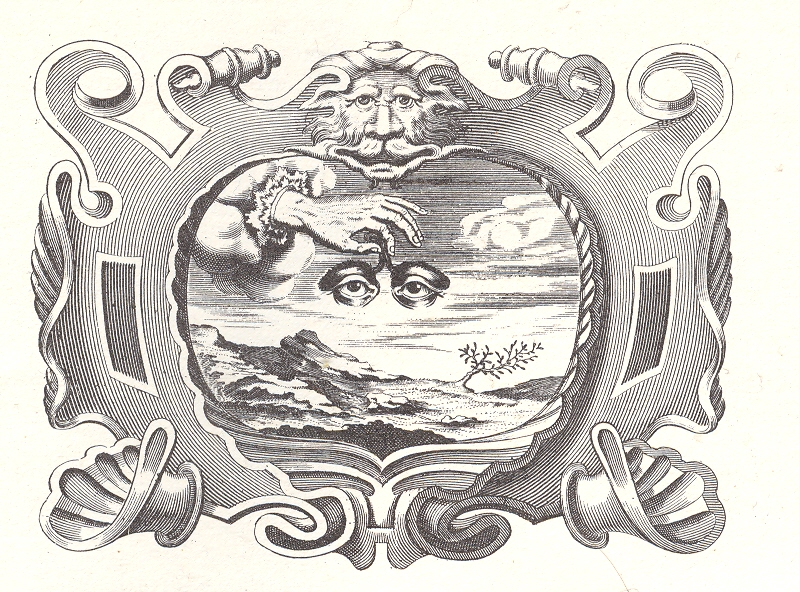
    Now holes do appear in the sky in Renaissance images, but they open to allow the hand of the creator to reach through it from the nether world, or heaven, or the infinite.  In the many examples of these holes that I have seen the background within the hole is entirely blank–plain white, no detail, no peek into heaven.  Then again, these are holes, and not a wholesale destruction of the sky.
    ++ Nov 26 eyes in sky

    As an example I’d like to point out the work by the Jesuit Franciscus Nerrincq (1638-1712), De goddelycke voorsienigheydt, in which there are several odd eyes that burn their way through the atmosphere.   Eyes/eye of the creator occur frequently in religious presentations and emblems, but not so very often as hands holding a pair of eyes.  I know all of this is very heavy stuff in the history of Christian iconography and the progression of emblemata, but I’d rather deal with the images out of context here and have them stand on their own without interpretation. 

     Of course the answer for the modern equivalents of this blowing-up-the-sky adventure must have deep and varied roots in the sci-fi canon, though presently they remain a mystery to me.  It is interesting to note that at one point in June 1945 in the Jornada del Muerto/the Dead Man’s Walk, at the Trinity site in the desert near Alamogordo, a group of scientists were placing bets as to whether or not the test explosion of the world’s first atomic weapon would set fire to the atmosphere. 

    In a way Tycho Brahe brought down the sky with his (naked eye) observation of a super nova on 11 November 1572. With the exception of comets and eclipses the sky had remained immutable, a perfect score of the creator’s creation, until Tycho Brahe noticed something new in Cassiopeia, something that was not a comet—a “something” that was a star. This was momentous because the night sky had been seen for centuries as being complete—a new star, the Nova of Brahe, contradicted this high belief, offering the possibilities of newness where there had not been one previously.  And so too with Kepler’s new star of 1602. This wasn’t perhaps a tearing-away of the old sky, but it certainly questioned the sky that was seen. 

    I should also point out that perhaps a reverse of the destruction of the celestial ceiling came about when Galileo turned his telescope to the sky and found to the astonishment of nearly everyone that there was an order of magnitude more stars in the heavens than anyone had ever experienced before. This in a way collapsed the old sky with its perfect and unchanging number of stars, showing that the creator of the universe had indeed provided more stars than anyone had ever imagined, though for reasons not yet known had kept that knowledge from humanity.  By 1610 Galileo had produced his fifth and most powerful telescope, allowing things to be seen one thousand times closer, using it to make enormous discoveries–discoveries so big in fact that their towering significance is a but hard to understand today in the context of early 17th century knowledge. It was all published in his fantastic Sidereus Nuncius on March 4, 1610—the extraordinary title page1 of the book proclaiming some of the great discoveries of Galileo’s adventure. One of the things that Galileo brought to the world was this entirely new sky, revealed to him through his telescope—so many stars that he could only guess (though he reckoned that there was an order of magnitude more stars than previously known “stars in myriads, which had never been seen before…and which surpasses the old, previously known, stars by ten times”). In a way Galileo introduced the sky-above-the-sky, available only to people with a special instrument to see it–the new reality.

     This is what I had in my mind when I saw this unusual patent application (above and below). Just weeks before the beginning of WWI, two weeks before the assassination of Archduke Ferdinand, followed quickly by a cascade of war declarations a few days after that, came this rather footloose idea for bombing the atmosphere

    J.M. Cordray came up with and patented this notion–a barrage of balloons, heavily armed balloons, sent aloft with dangerous cargo to be exploded in the atmosphere, which was supposed to initiate a chain-reaction of some sort which would end in supplying rain for the rest of us. Theoretically, anyway. The unspecified number of balloons would be sent aloft, laden with large amounts of crushed bone and concentrated sulfuric acid (to be combined to produce nitrogen), potash, water, and large amounts of crude oil for the fire’s fuel.  And a candle to light it all.

    It seems that the attempt to blow up a part of the sky with bone and sulphuric acid to make rain just didn’t work, though I cannot (easily) find a record of the experiment being attempted. 

    Mr. Cordray presented himself at the top of his patent as “J.M. Cordray/Rain Maker”.

    The one thing that is for certain is that Cordray’s attempt at weather modification was quite early–it would be another three decades before pioneering work of Kurt Vonnegut’s brother, Bernard, was published (beginning in 1947, finding the ice-nucleating properties of silver iodide, AgI),  which established the very real possibilities of altering the weather.  This practice was employed in the U.S. military’s Operation Popeye, which used cloud seeding to prolong the rainy seasons along the areas covered by the Ho Chi Minh Trail in Vietnam from March 1967 to July 1972.  This sort of weather warfare is now prohibited by international convention.

    And so in a way by employing weather modification as a tool of war we’ve been able to turn the sky into a weapon, which means that this post has followed the bombing of the sky to the sky bombing us. 


    See an interesting article at Paleofuture on the Cold War weather modification attempts here.

    Notes

    1. The title page in full reads:  Great and very wonderful spectacles, and offering them to the consideration of every one, but especially of philosophers and astronomers; which have been observed by Galileo Galilei … by the assistance of a perspective glass lately invented by him; namely, in the face of the moon, in innumerable fixed stars in the milky-way, in nebulous stars, but especially in four planets which revolve round Jupiter at different intervals and periods with a wonderful celerity.
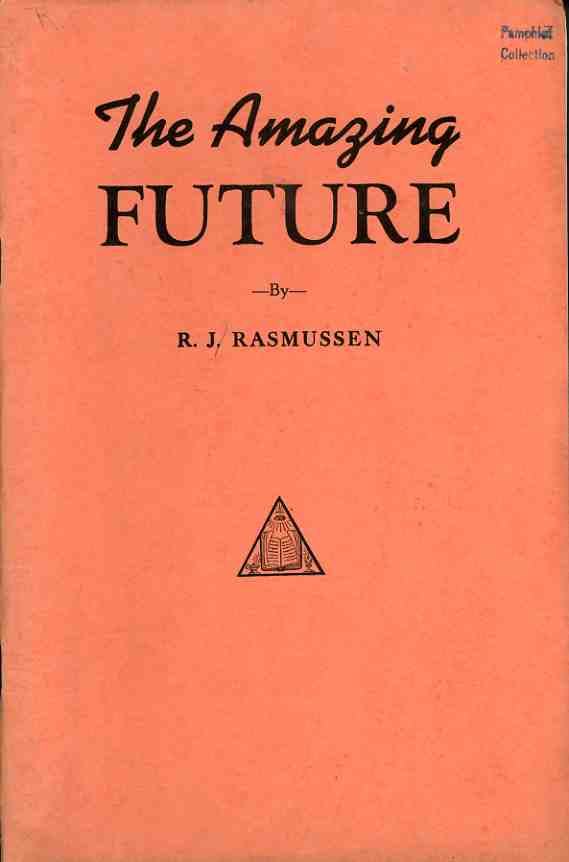
  • Anti-Prediction: On Being Horribly Wrong in Predicting Next Year’s Future (1938)

    JF Ptak Science Books   Post 1773 [Part of the History of the Future series.]

    Sometimes as the saying goes a bad answer isn’t right; and sometimes it isn’t right so much that it isn’t even wrong.  Here we have a collection of not-even-wrongs, tidily collected in one pamphlet.  It is a booklet of “predictions” that are so deeply off the mark that I suspect the author would not even be able to make post facto predictions. 

    0 blog jan 16 future388Had  author R.J. Rasmussen (The Amazing Future, 1938) real powers of diving the future he should’ve been able to see that choosing to be so dreadfully wrong about the events of 1939 was a truly bad thing to do–of course, if there was some sort of unknown and spectacular power in his brain to see what was coming, the least he could’ve been was right.  But he wasn’t, and he wasn’t right very widely, and very widely not right almost all of the time.  To give the devil his due, Rasmussen did get some broad images correct–like in 1939 a world leader will get sick and die.  (Actually, the world leaders dying in 1939 weren’t current leaders, but that is a particular that escapes detail when thinking about stuff that will come to pass.) And then there’s the bold “a high ranking officer in the U.S. army will pass away”. But those broad brushes are about as close as it gets to “prediction”.  He was right that there would be a year 1939.

    The rest is “anti-prediction”:  “I want to advise all pilots and their aides in the United States…to use utmost good judgment in flying your planes”.  And “again I say that no war will be declared on or with Germany”, cancer will be cured on or before August 26, 1939, and there will be an increase in textile production in the U.S.  The Japanese war against China “will be over by August 21, 1941”, though the cost will be monumental to the Japanese, somehow; Germany “will continue to forge ahead” (?),  the map of Africa “will be completely and totally changed” by 1942, and “during this period there will be increased interest shown in higher lines of thought”. And so on, on and on–by the hundreds.

    Finally, among everything else that the author didn’t see was the following:  “the persecution of the Jewish people in Germany will gradually grow less and less that they have ever know in the past thirty years, and before the year 1939 has passed it will have practically ceased in Germany”.  I must say that of all the minor pamphlets like this that I have seen Mr. Rasmussen made the most detailed and incorrect predictions of anyone that I have ever seen–the only further step backward he might’ve been able to make was to have written this book in 1941 and gotten all of the history wrong. 


  • Poemology of a Patent for Making Stuff with Human Ashes, 1927

    JF Ptak Science Books   Post 1772

    I found this rather, well, remarkable American patent by Albert Vanderlaan for 30 August 1927, which described the inventor’s idea for the utilization of human remains.  Vanderlaan found it distasteful to have cemeteries, which only served the function of keeping rotting bodies together until they were forgotten, and suggested that we put the dead to work.  That is, the dead should be cremated, the ashes mixed with a building material of some sort, and then the whole made into something and put to use. 

    Vanderlaan’s prose is 19th century–perhaps he was instructed in school by an older person educated in 1840 for his own late 19th century education.  The sentence structure and vocabulary suggest this–or perhaps he was just a poor writer and found difficult words to stick together.  In any event, I thought that the prose sounded (and looked) better if made into a poem, or at least given the structure of a poem.  And so here it is.  The entire poetized patent is presented without interruption, and  all of what follows are the words of Albert Vanderlaan. 

    Bethlehem graveyard and steel mill. Pennsylvania

    Method Of Perpetuating Human Remains And Article Made Thereby.

        Prologus

    This invention relates to the art of perpetuating human remains

    and more particularly

    relates to a method therefor and article made thereby.


    The ugliest phase of civilized man’s career on earth

    is not so much his inevitable physical expiration

    as the manner in which it became the custom to dispose

    of his mortal remains by burial in earth.

    ·Posted by :

    ·in:


  • History of Dropping Things: Electro-Punk Machine for Waking/Smothering People

    JF Ptak Science Books    Quick Post

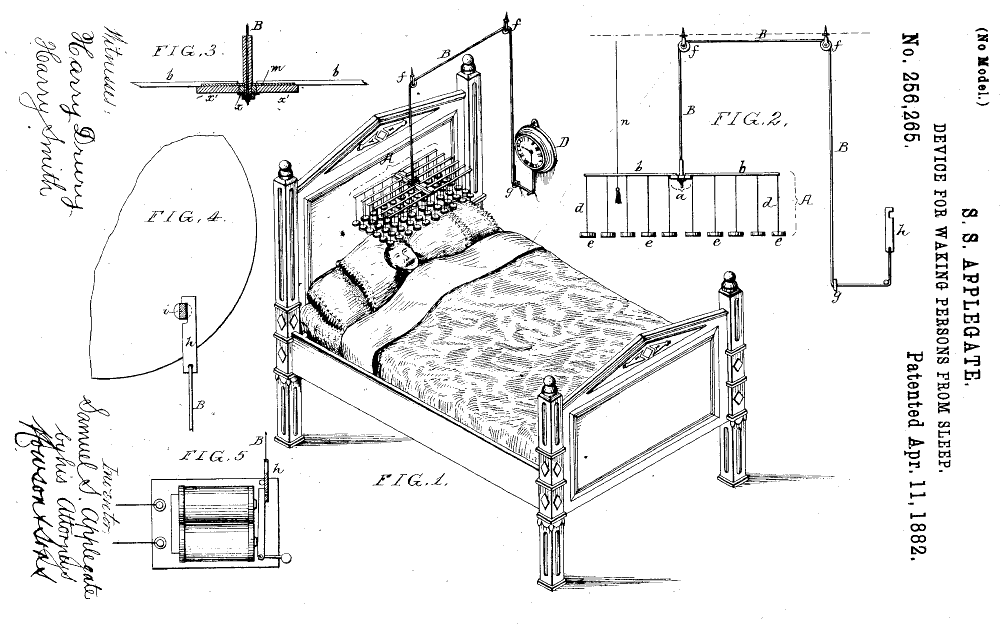
    Here’s an ambitious alarm clock that I stumbled across–something designed so as to not be ignored, something for the people who regularly sleep through simple alarm clocks.  This device, patented by Samuel S. Applegate in 1882, woke the sleeping client by dropping that cage-resembling apparatus on the sleeper’s head.  Evidently the ends of the suspension were soft, but hard enough to cause the sleeper to get straight-away back into the waking world. There’s probably nothing quite so like being slapped awake every morning.


    Patent waking people up
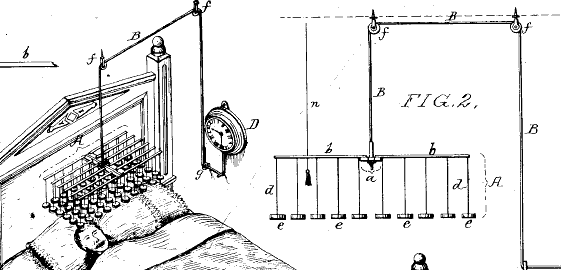
    The apparatus is seen better here–it is an unusual contrivance:

    Patent waking people up_edited-1

    Such a pretty picture of the sleeper, though I must admit the perspective would’ve been a bit of a challenge especially to a challenged  artist. 


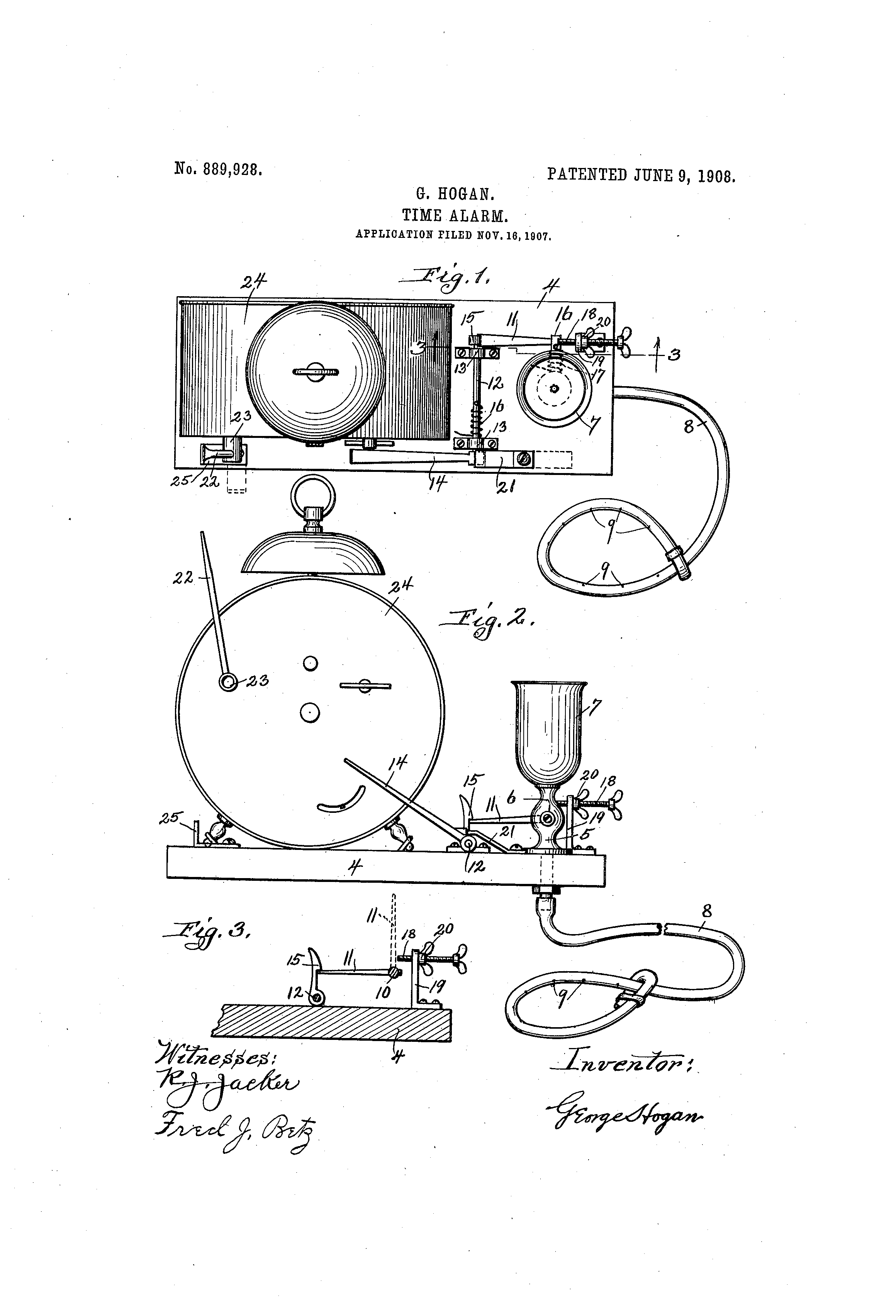
    Okay, this one is walking people using water dropped on the sleeper’s neck:

    Patent--time alarm


  • Balloons I Know But Do Not Love–Deaths from Above, Ads and Bombs

    JF Ptak Science Books   Post 1771

    In the early days of aviation aerial assault must have seemed incredible–and an abomination.  Hurling stones and other offensive weapons by trebuchet and catapult is one thing, and  launching balls and shot from cannons and mortars is quite another–but actually having your weapon flown over an enemy’s position and dropped, remotely or via cable, must have been ab excruciating achievement, militarily speaking.  To be able to direct an explosive charge over a position not reachable by an infantry (say in 1915) must’ve been a short-lived comfort on the offensive end, though the user of such a technology would also have to contend with the contrary, as the enemy would be able to do the same thing themselves. 

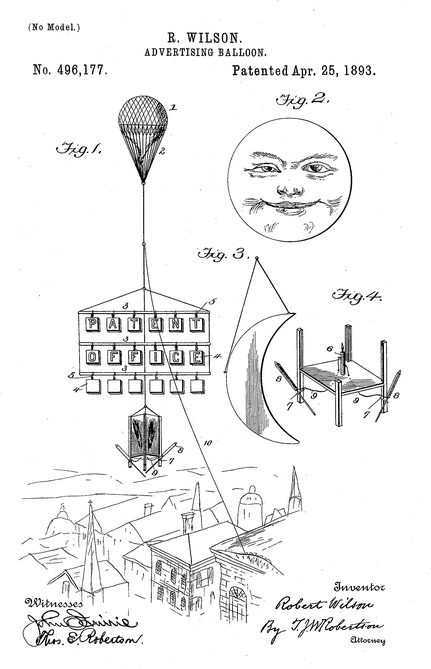
    This idea was not limited to just military purposes.  Companies could now wage an advertising war war against competitors  in a thee-sky’s-the-limit campaign, hoisting their ads on balloons anchored over a city, making it possible for the first time to have your message so universally read, a pre-intertubes version of smoke signals. 

    Patent balloon advertising 1893[Source:  Google patents, http://www.google.com/patents/US496177?dq=balloon]

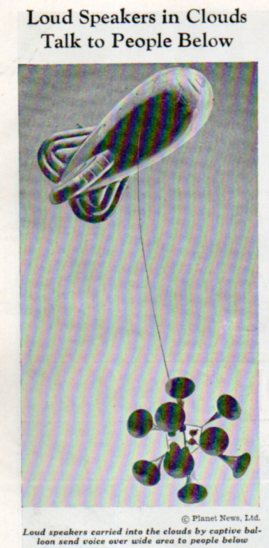
    Sky speakers413

    And this, seeming more on the Orwellian/1984 side, or perhaps more contemporary as an instrument of the Dear Leader in North Korea (left, from Popular Mechanics, July, 1939).


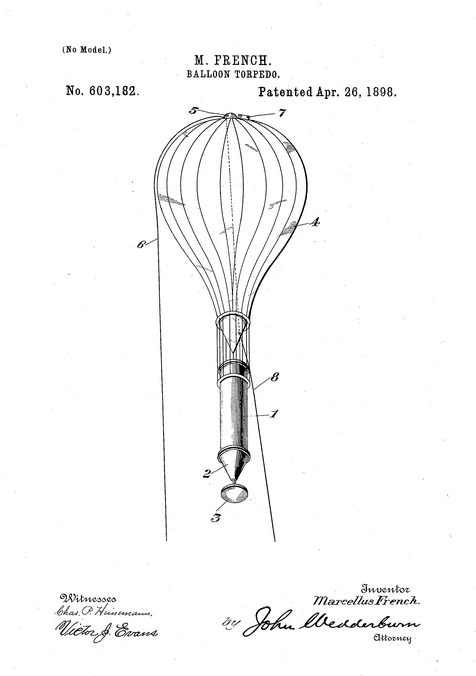
    Here’s an interesting, pre-airplane, airship-delivered explosive device: floated over an enemy’s position, the chord would be pulled at the desired time to create a tear in the balloon’s top, sending the craft down, with the bomb exploding on impact:

    Patent balloon torpedo[Source: Google patents, http://www.google.com/patents/US603182?dq=balloon]

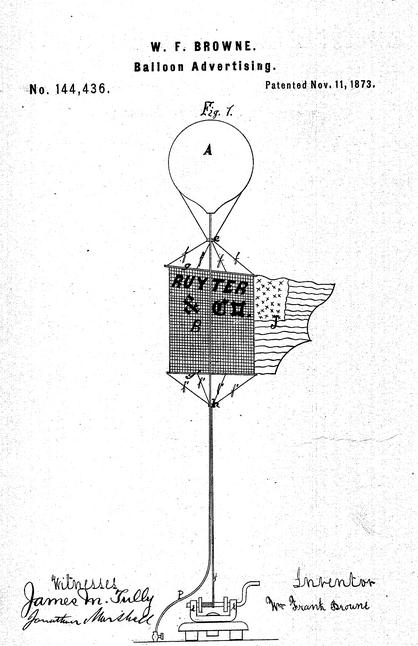
     Another sort of slow death from above advertising scheme:

    Patent balloon 1873

    [Google patent:  http://www.google.com/patents/US144436?dq=balloon]

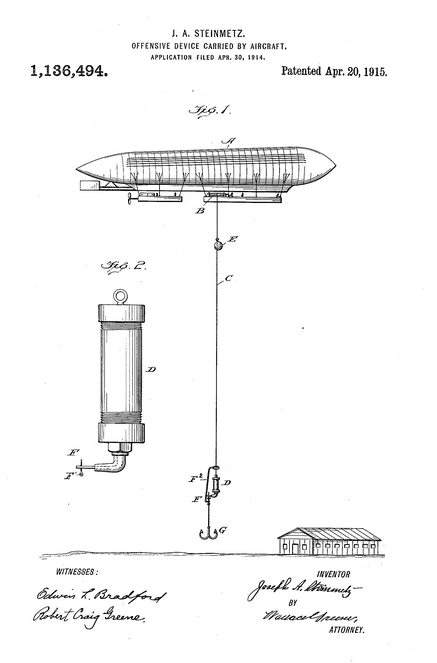
    In this device patented by Steinmetz the explosive device is still actually attached to the aircraft when exploded–not a very common way of delivering your weapon.  The airship would advance on the enemy, with the bomb  attached to a cable just above an anchor at bottom; the anchor would grapple the target, and the bomb detonated from the  gondola of the airship:

    Patent Balloon gondola


  • Alan Turing–Report Card Teachers’ Comments, 1926-1931

    JF Ptak Science Books   Post 1770

    Turing

    Image source:  www.thegalleryofheroes.com

    There is a terrific find on Alex Bellos’ website exhibiting Alan Turing’s “report cards” for his time at the great Sherborne School from 1926-1930 (and which were transcribed by archivist Rachel Hassall), from the time when Turing was 14 to 19 years old. Turing (1912-1954) I think needs no introduction for his importance to mathematics and computing (and code breaking during WWII), and it is very interesting—thrilling even—to see how his instructors were coming to grips with the developing genius. Even at such a school as Sherborne (a very old school with 39 headmasters overseeing the place since 1437) where the teachers were I am sure familiar with gifted pupils, The comments on the reports of Turing’s progressed showed that many weren’t quite sure about what Turing was all about. Obviously Turing as a boy was very gifted, but many instructors reported as many hindrances to his intellectual development as there were advances—more, even.

    Perhaps people at the school didn’t know exactly how to deal with him; perhaps they did, but still at the end of the day Turing had to meet the common standards of the school. Or perhaps not—I really can’t tell from the transcripts presented by Bellos and I don’t know the intricate history of the school. But certainly as time progressed Turing’s abilities were more readily recognized, but early on it seems that his talents didn’t overwhelm his many supposed shortcomings, the faults of the parts larger than the whole of what he could accomplish. In instructors’ comments across all of his disciplines, Turing was “capricious”, “untidy”, “lacking in life”, “need(ed) concentration”, “depressing unless it amuses him”, “careless”, “absent minded”, “un-methodological”, “slovenly”, (made) “mistakes as a result of hastywork”, and so on. He “could do much better” though one instructor felt that “he may fail through carelessness”. All of which may well have been true—from the outside. These statements may have simply been the result of teachers not being able to reach a boy genius, and perhaps the boy couldn’t be reached, at least early on in his academic career.

    The statements in general—especially in the maths—I think are fascinating things. It may be easy to judge some of the remarks as intemperate, the teachers unable to clearly see the genius-in-the-making who (70 years later) we can so clearly see today. I think the remarks need more careful consideration than that, and that is where they become interesting.

    Here are some selection from reports on Alan Turing, 1926-1930, below; a more full list exists at the Bellos site, here.

    Subject: Mathematics

    1926. Works well.  He is still very untidy.  He must try to improve in this respect

    1927. Very good.  He has considerable powers of reasoning and should do well if he can quicken up a little and improve his style.

    ____. A very good term’s work, but his style is dreadful and his paper always dirty.

    ____. Not very good.  He spends a good deal of time apparently in investigations in advanced mathematics to the neglect of his elementary work.  A sound ground work is essential in any subject.  His work is dirty.

    ____. Despite absence he has done a really remarkable examination (1st paper).  A mathematician I think.

    ____ I think he has been somewhat tidier, though there is still plenty of room for improvement.  A keen & able mathematician.


  • Modest Expectations–Engineers Stand in the Shallow End of the Future Pool

    JF Ptak Science Books   Post 1769

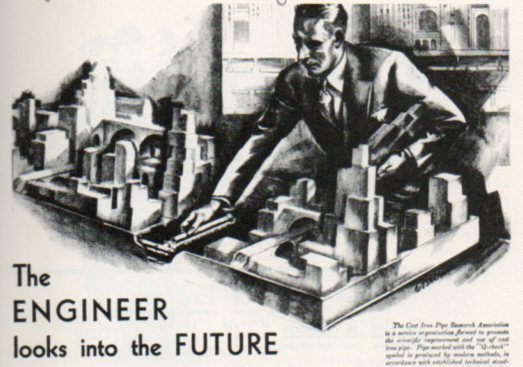
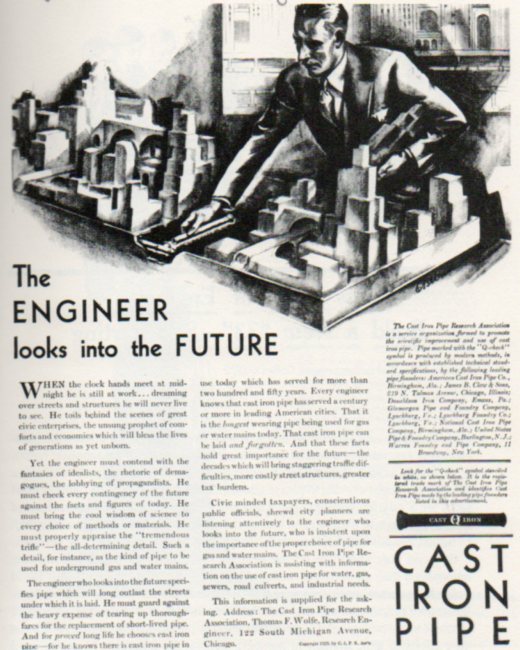
    The novel underneath its title can be good or bad in spite of it, independent of the flag under which it flies. Its just helpful, usually, if the title is as good as the book—better even, because, after all, Modest Expectations isn’t quite as good as the real thing. But “Modest Expectations” seems as thought hat would be the title of future vision in this advertisement that appeared in 1929. It is an advertisement in Collier’s magazine by an engineering company during the time in which The Engineer and the possibilities of engineering were running full-blaze in the United States. There was a belief in the idea of engineering as a cure-all to present and future problems, and the word was as prevalent in the sphere of social interaction as the prefix “e-” was in the early days on internet business and communication in the 1990’s.

    Engineer future410
    It seems as though there were few occupations immune from the “-engineer” suffix, whether they had anything specifically to do with engineering, or not. The “control safety engineer” described a crossing guard; “sanitary engineer” referred to what was known as a garbage man; “nutrition control engineer” was a food server, and so on, position names changed by the hundreds if not more, elevating the status of a profession by simply applying the meme’s suffix to the job title. IF you judged the overuse of the term by the actual accomplishments and achievements of engineering of the times, it was probably justified, give the enormous progress of engineering. In just the first decade of the 20th century enormous change were made in the way life was/would be lived with the introduction of the steam turbine generator, the internal combustion engine, heavier-than-air powered aircraft, the audion, the vacuum diode, the thermionic valve, Bakelite, and so on, all of which would soon bring technological change to create revolutionary changes in the way life was structured in the U.S. And worldwide.

    But given the gigantic changes in the first 30 years of the 20th century, what was it that the engineer was seeing in this advertisement, “The Engineer Looks into the Future”? What was it in the hand of the engineer in the illustration, what was he placing down in the city of tomorrow, today? A faster train, or space ship or part of a vacuum tube people-mover, or what?

    Engineer future411It turns out that this engineer didn’t have such lofty future-vision plans—in fact, the vision was subterranean, and the thing in the engineer’s hands was cast iron pipe. Yes, the future was in materials, and that material manifested itself in cast iron pipe, courtesy of the Cast Iron Pipe Association.

    Now cast iron had been around for a long time before 1929—even used as pipe the idea goes back into the 16th century. There were bridges made of cast iron in the 18th century, and the movement towards the modern skyscraper maybe traced back to cast iron facades and construction in the 1850’s. I’m not so sure why cast iron pipe was so significant in 1929—perhaps it wasn’t so very widely used. But I must admit to having a “moment of discovery” while I tried to reason why the future of engineering looked into a hole in the ground filled with cast iron pipe.

    Engineer future409
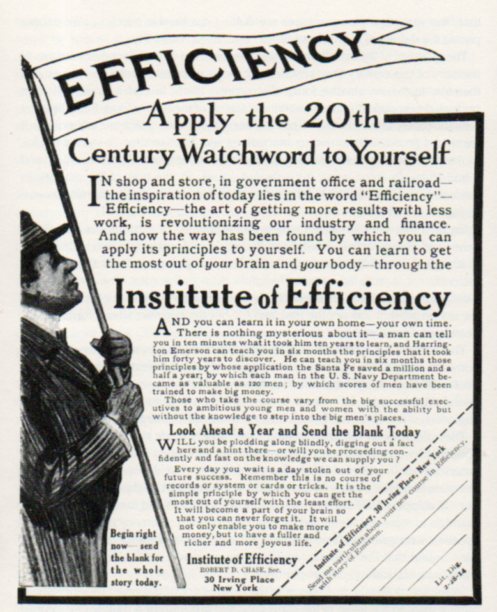
    Engineer future412Another interesting image that comes a little earlier on is this advertisement for the “Institute of Efficiency” (in 1917), which in effect takes the running-rampant ideas of engineering and applies it to the ways in which people ran their personal lives. Efficiency was as much a catch-word as “engineering”, and it was in this decade that saw the appearance of Scientific Management (Fred. Winslow Taylor) and its numerous offshoots. What bothered me about this ad marshaling the positive factors of the study-at-home courses in efficiency was its inefficient use use of space and communication of the idea. Not the least of which was the very odd bit in the bottom right corner, which the reader was supposed to fill in and clip off and send to the Efficiency people. There’s really no room to write, and you can’t actually mail the thing—and, if I was trying to get someone to purchase something about improving their efficiency I might have wanted to make it much easier for them to send me something with their name on it.  The whole effort just seems not very efficient.


  • Geology of Images: Finding Pre-biotic, Neo-Dadaist Images in Antique Astronomy Prints

    JF Ptak Science Books  Post 1768Astro mictroscope--6b943

    Sometimes when you look hard enough you will see (if not actually “find”) what you’re looking for; determined to  make a discovery, you can sometimes force yourself into believing that what you’re seeing is what it was that was needed to be seen .

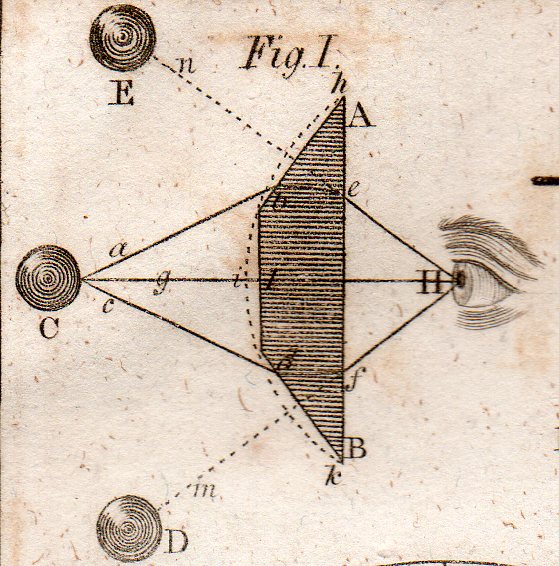
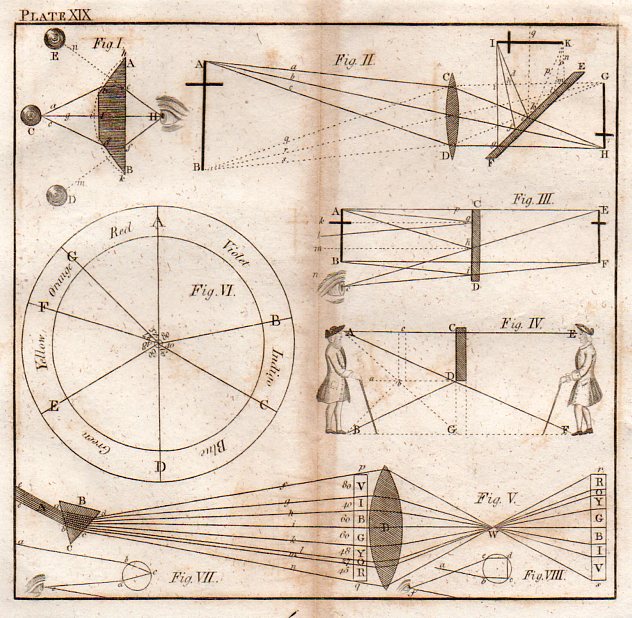
    The  microscopical world of astonomical antiquarian prints is an interesting one–and in some ways, modern ways, are  on the Robert Hooke/Micrographia magnitudes for the remarkable magnified worlds that their detail reveal–but mostly right now I’m interested in the odd/beautful designs that are hidden in larger scientifc engraved presentations.

    Astro mictroscope--6942 [Even in fairly famous scientific images lke the one above–explaining the rainbow–there are all manner of unexpected artistic finds outside of their significant scientific contributions.]

    These images from the title of this post, on the other hand, are just simply “there”–all you need is a little magnification and some sharp vision, and the things come to life.  When looking hard at these images and seeing the teaming non-representational artforms that swim through so many of them it seems remarkable to me that these things weren’t seen as art before Kandinsy finally “discovered” this  artform in 1911.

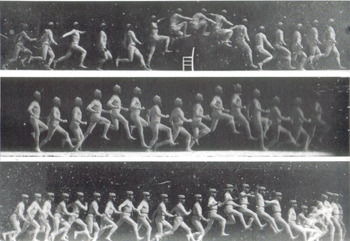
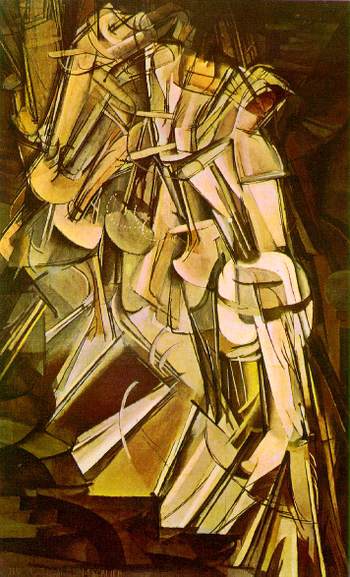
    (For example Mr. Marey produced a very remarkable Nude descending-like series of photographs 40 years before Duchamp–but the Marey images were observed scientifically, and I’m unaware of anyone who ever wrote an artistic appreciation of that work before 1900.  [Marey left, Duchamp right.] But that is another story.)

    Blogfeb_22mareyBlog_feb_22_nude

    For us today with almost 100 years of Kandinsky/Klee/Duchamp/Braque/Malevich under our belts it is relatively easy to see the artfullness of the pieces and bits of these engravings–not so a hundred-plus years ago, and harder yet for 200+. 

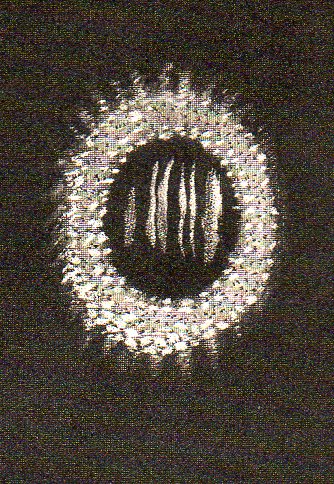
    For example, there are some things that take on an absolutely pre-biotic flavor, like material that we’d come to see a half-century ago, as in these details from an 1850’s  French lithograph on nebualae:

    Astro mictroscope--3b931