A Daily History of Holes, Dots, Lines, Science, History, Math, Physics, Art, the Unintentional Absurd, Architecture, Maps, Data Visualization, Blank and Missing Things, and so on. |1.6 million words, 7500 images, 4.9 million hits| Press & appearances in The Times, Le Figaro, Mensa, The Economist, The Guardian, Discovery News, Slate, Le Monde, Sci American Blogs, Le Pont, and many other places… 5000+ total posts since 2008.

Author: JF Ptak

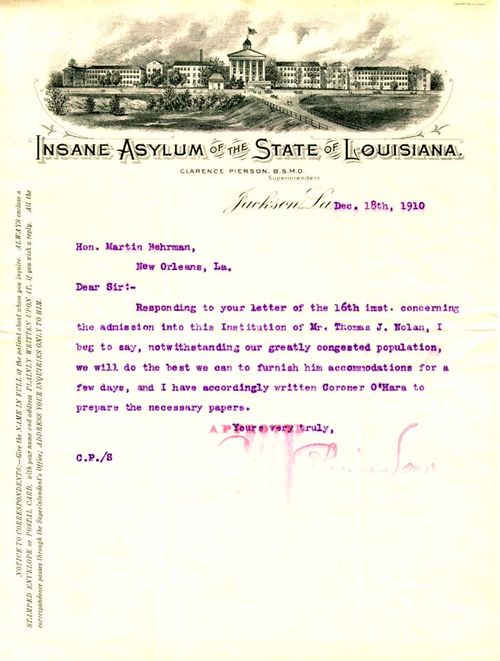
  • Listing Illnesses and their Causes of Inmates of the New Orleans Insane Asylum

    JF Ptak Science Books   Post 2072

    Following a posting from a few days ago listing the causes of admittance of children to an insane asylum in Powick, U.K. from 1854-1900 comes this find–a rather extraordinary find, regarding the causes for admission as an insane person to the City Insane Asylum of New Orleans. This site has an incredible (and indelible) record of  the patients admitted from 1882 through 1916 (“Orleans Parish (La.) Civil Sheriff Register of patients transported to the State Insane Asylum, 1882-1917”), including the reasons for confinement, as well as the causes of the debility, plus the age of the person and their occupation. 
    Insane asylum NO

    Following the link will get you to the year-by-year index of admittance–there is no standardized set of instructions or rules to identify the illness or supposed illness, so the way that the physician factored the mental disabilities of the patient was open to some wide interpretation.Some of the reasons for admittance included stupidity, alcoholism, idiocy, epilepsy (still about the leading “cause” for admission), imbecility, insanity, dementia praeox,hysteria, “delusional about Italians”, religious mania, and so on.

    “Responsibility for insane patients (particularly the
    indigent insane) housed in the City Insane Asylum (or in various
    hospitals after the city facility closed) fell to the City Physician,
    who was to visit patients at least once a day and to discharge those
    patients who had sufficiently recovered. He also identified those
    inmates who had remained in the asylum “over the time prescribed by law”
    and reported their names to the sheriff of Orleans Parish, who arranged
    their transfer to the State Asylum at Jackson, La.
    “–Source

    The major subset of the diagnosed diseases and illness was the “-mania”. Aside from a general mania, there was an alpabetization of the competing manias, including religious-, chronic- , kelpto- , furious- , erato- , raving- , homicidal- , acute- , indcenidary- , puerpueral- , mono- , recurring- , delusional- , suicidal-, and a few others. 
    Insane asylum SIA  LA
    It is the “causes” of these challenges that seem to be the most viciously interesting part of this record.  Stuff that sent people into maniacal flights or rages or depressions and other anti-social behavior included but was not limited to alcohol, syphilis, weak mindedness, heredity, drugs-in-excess, old age, “womb trouble”, “attack of gripe”, “poverty and want”, jealousy, sunstroke, onanism, menopausia, hallucinations, masturbation, “mental worry”, “family troubles”, tobacco, softening of the brain, and so on.

    There is room for someone here to go through the 30-odd years of entries to see what were the most/least common causes of mental instability–it would be an interesting list to see someone else generate. 

  • Deeply Articulated Anatomical Engravings

    JF Ptak Science Books   Quick Post

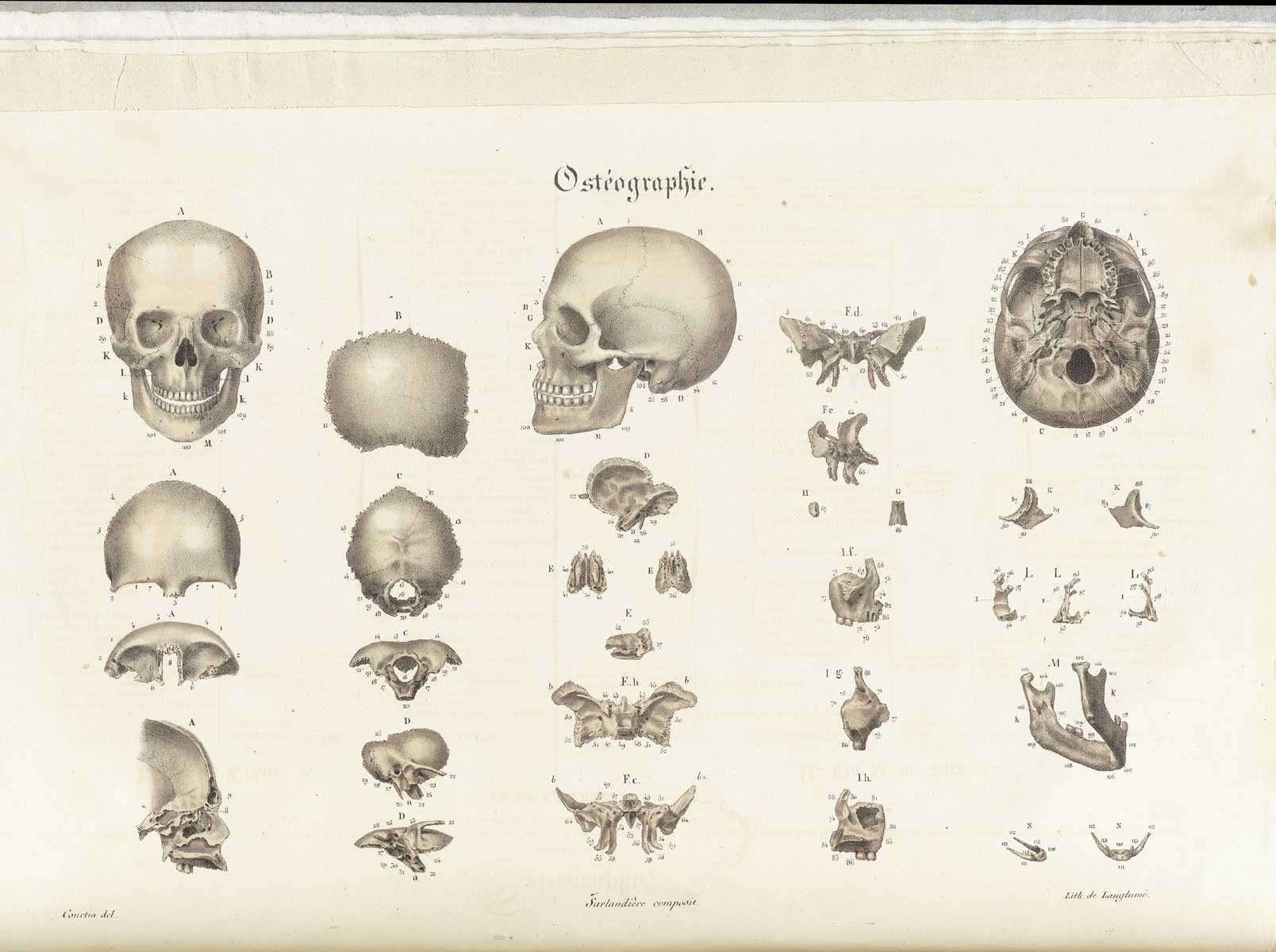
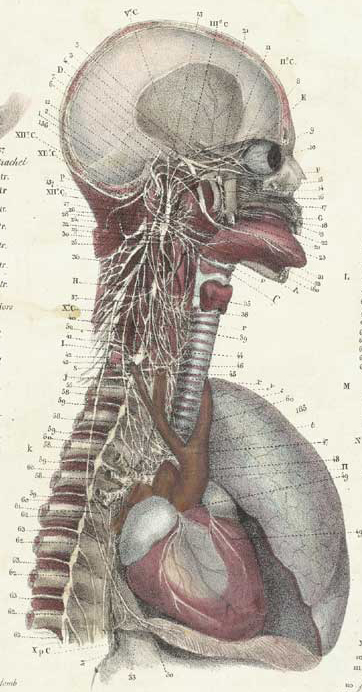
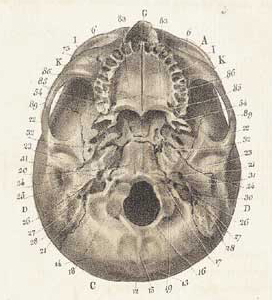
    Old bonesv detailThere is a real fabulousness in design for these images made by anatomist/physiologist Jean-Baptiste Sarlandiere (1787-1838) in his anatomy of 1829 (Anatomie méthodique, ou Organographie humaine en tableaux synoptiques, avec figures. Paris: Chez les libraires de médecine, et chez l’auteur, 1829). Or at least the organize has achieved some high order of merit, both in the lettering/numbering  and display of the anatomical object…and in their placement and arrangement on the sheets of paper.  They’re just very pleasing:  the very detailed and complex images are stuffed but concise, and the multiple-image placements are composed of very detail small bits with plenty of free space.  They’re just very well-designed. 

    [Source:  National Library of Medicine, here.]

    Old bones

    Old bones 2 det


    ·Posted by :

    ·in:


  • Children in Insane Asylums, 1854-1900

    JF Ptak Science Books   Post 2071

    I came upon this remarkable article, written by Kate Gingell, on the reason for admitting children to insane asylums between in the middle/late 19th century. The article, “The forgotten children: children admitted to a county asylum between 1854 and 1900”, appeared in The Psychiastrist1 in 2001, and stipulates the causes for admittance, as well as the causes for the mental disorder2.  It is all quite upsetting, in a quiet and determined way, even when presented in tables–even without Gingell’s commentary and conclusions. It is really the stuff of nightmares3.

    A total of 195 case notes were identified from a total of 6573 admissions to the Powick Asylum in the years 1854-1900. (Powick, Worcestershire, was founded in 1847 as the Worcester County Pauper and Lunatic Asylum, and had a long life, closing only in 1989.)

    “During the 19th century the attention paid to the mental health of children was influenced by the physical health of the population, the cultural climate of the day and beliefs about children and child rearing. The fact that children were admitted to an asylum for years and frequently died there without apparent contact with their family must be set in the context of a high infant mortality (156 per 1000 live births in 1897) and difficulties in travel and communication among pauper families…”

    Explanation given for the cause of some admissions  (Table 2)

      n

    Mania

    63
    Sunstroke 1
    Measles 1
    By being thrown from a trap 1
    Fright and uterine derangement 1
    Loss of employment 1
    Abdominal tumour 1
    Fright by a dog 1
    Over study 1
    Non-appearance of menses 1
    Uterine functional derangement 1
    Frightened by a cow 1
    Epilepsy 86
    By being put inside a recently killed pig 1
    Scarlet fever 1
    Worms 1
    Fright of mother during pregnancy 2
    Tossed by a cow 1
    Imbecility 21
    Cutting teeth 1
    Fright at being almost drowned 1
    Idiocy 54
    Enlarged thyroid gland

    1


    Diagnostic categories used on admission notes (from Table #1)

    Diagnosis Age 4-10 (n=34)* Age 11-16 (n=161)*
    *70 children were given more than one diagnosis.
    Epilepsy 22 64
    Idiocy 20 34
    Mania 3 60
    Dementia 6 28
    Delusions — 4
    Moral imbecility 1 1
    Melancholia 1 —
    Imbecility 3 18

    “It is highly unlikely that asylums provided a sympathetic environment for children. Children were treated in exactly the same way as adults, with the difference that boys were kept on the female wards until they were about 7 or 8 years old. Admission procedures were identical for adults and children. The method of assessment of dangerousness is not detailed, but children as young as 4 were identified as dangerous and this is recorded in the same way as for adults.”

    Notes

    1.  The Psychiatrist (2001) 25: 432-434 doi: 10.1192/pb.25.11.432, and located here.

    2.  See also the lists of patients and their aliments and the causes of same in the New Orelans Public History website, 1882-1908.   See also: http://nutrias.org/inv/cityinsaneasylum1_50.htm 

    And also, the long and reworked list of the Trans-Allegheny Insane Asylum, located here.

    3. “It is not possible to equate the diagnoses of the day with recognisable contemporary diagnoses. The very high prevalence of epilepsy (Table 1) may be a real finding, indicating the high level of organic disease causing behavioural problems, or may be a misdiagnosis. Idiocy was found to be a common diagnosis for those under the age of 10, but does not necessarily indicate cognitive deficits. Idiocy was a term given to less dangerous inmates, whose cost on the public purse was less because they could contribute to the functioning of the hospital by doing jobs such as gardening or working on the farm. Some of the children diagnosed as idiots could read and write, and were thus discharged cured. The general view was that idiocy was an example of reversion to a lower type in the evolutionary scale. Another reason for diagnosing most children as idiots was the prevailing belief that insanity only occurred in those who could lose their reason. Children were considered to be born without reason, which gradually grew in them as they developed to adulthood. They could not then, by definition, be insane.”

    ·Posted by :

    ·in:


  • An Interesting 3-Section Perspective, 1560

    JF Ptak Science Books    Post 2069


    Cousin_p09 det
    [Detail from engraving in the seventh image, below]

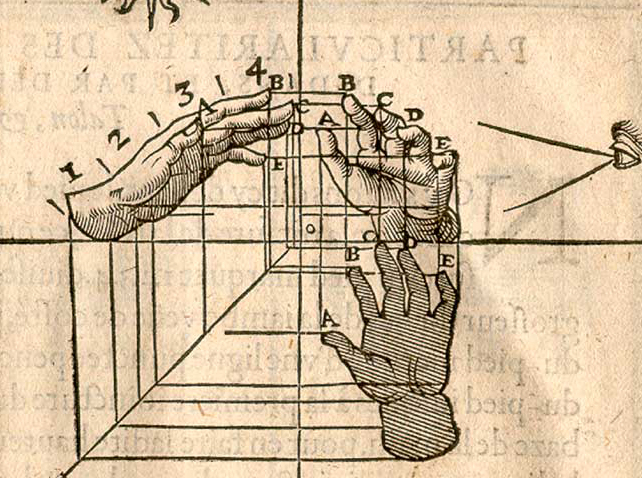
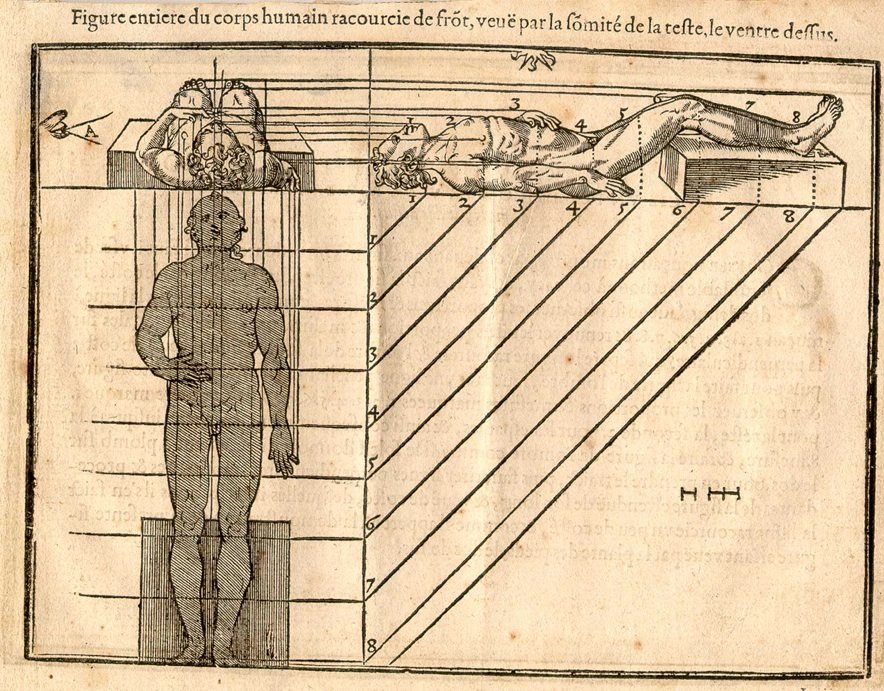
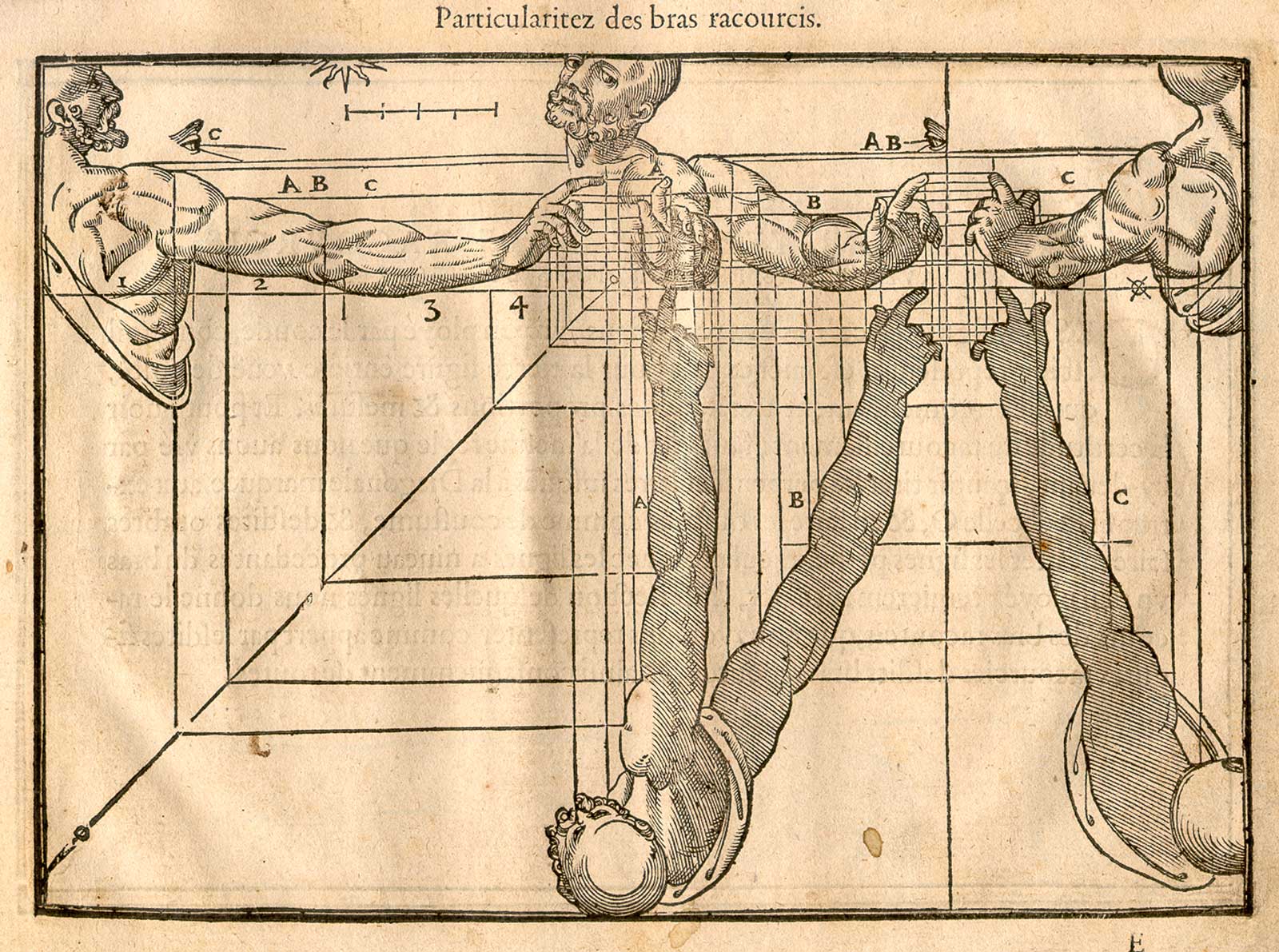
    I’m not sure if I’ve ever seen a 16th century human perspective drawing showing the body in plan and elevation and cross-section.  Jehan Cousin the Younger (1522-1595, in France), the son of Jean Cousin the Elder 91490-1560), a painter and sculptor, produced such an image in his Livre de Perspective, which was published in 1560. Well, the image definitely was published in 1560, though the artist may have been father and it may have been son–they worked closely together, and the Younger was taught at great length by the Elder, so much so that their work became indistinguishable. Nevertheless, the images I think are quite extraordinary, as we see below: 


    And so by Andreas Mantegna, a classic example:

    The following images come from the 1608 edition of the Cousin Perspective. a number of which are fairly unusual (all from the Library of Congress site, here):
    Cousin_p16


  • Inventing Aged Tone in New Violins, 1903

    JF Ptak Sciecne Books  Quick Post

    First page clipping of GB 190303723 (A)

    Patent
    #190303723  issued in Great Britain to R.H. Payne and T. Broadbent,
    February 17, 1903. It really doesn’t have anything to do with creating
    patina/lustre in the tone of a new violin via artificial means, but it
    does have that scent to it, and sometimes that all anything needs to do,
    provide the aroma of an interesting idea.

    ·Posted by :

    ·in:

    —

  • Things That Almost Were but Weren’t: a Photographic Image (1839) and Radio Television (1928)

    JF Ptak Science Books  Post 2068

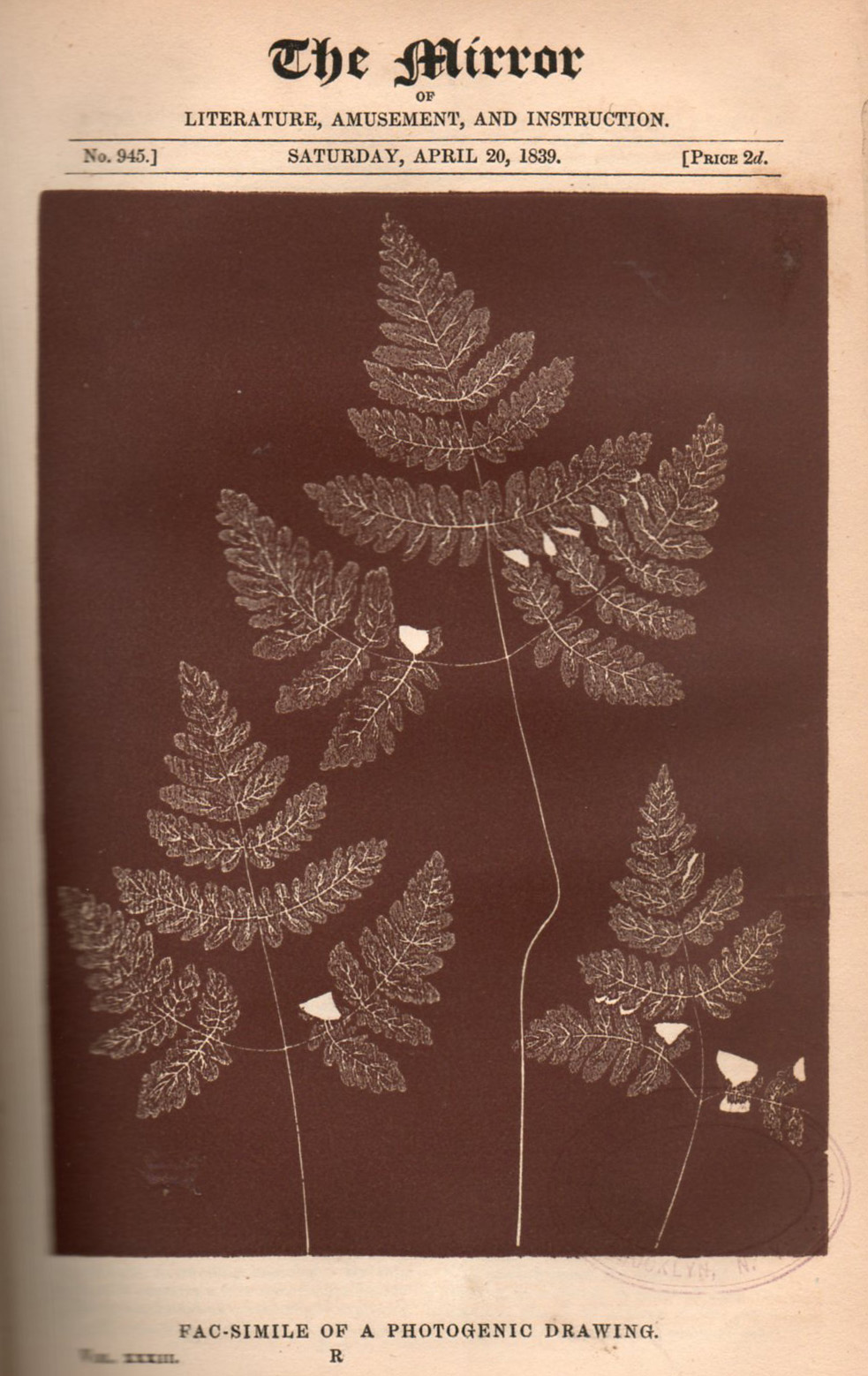
    Here are two examples of Things That Almost Were But Weren’t:  Photography (1839) and Television (1928). The first item contains a woodcut of a heliotype (being the first image of a photograph produced by non-photographic means); the second displays the method for receiving images of radio shows but is not a television. 

    First:  The first published non-photographic image of a non-photograph or “sunpicture”, 1839


    Bird photograph148


  • Buying a Stocked Country Store, 1836

    JF Ptak Science Books   Post 2067

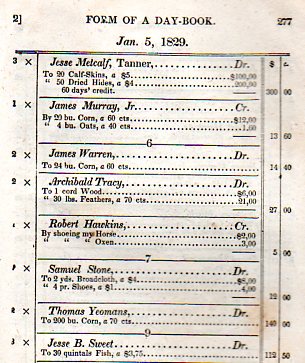
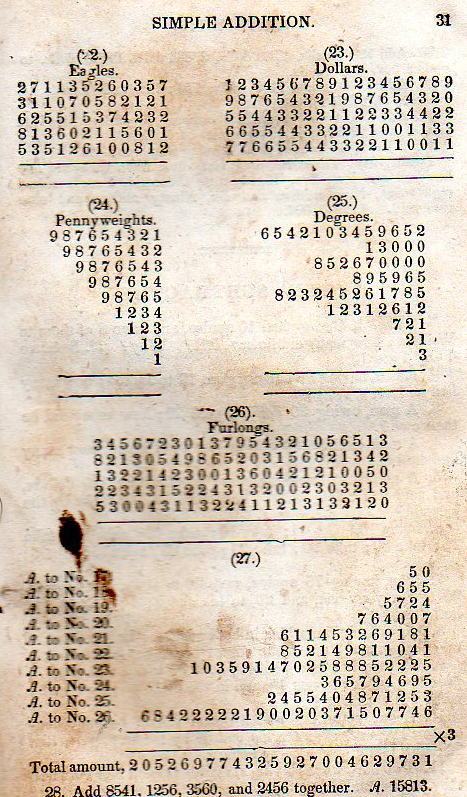
    MATH day bk407There are times when a reader can get a little piece of social history in an unexpected place.  For example, in the math text book that was just addressed on this blog1, there is a short anterior section called  “A Practical System of Book-Keeping for Farmers and Mechanics”.  It is here where the reader is introduced to the keeping of a Day Book (which is different from a  ledger and a cashbook) where the merchant would keep a record of what was sold to whom and for how much. To that end the author includes three pages of a sample Day Book, which displays a host of information for the modern reader about what could be expected to be found in the generic cash-and-carry trade in the U.S. in 1836.  Most of the goods sold would have been purchased to make something else–there were not many items that would be considered to be a product for end use. So someone might not buy a carriage though they would buy the stuff that would go into making a carriage, or the ingredients for making beer rather than the beer itself, and so on.

    And so, some of the entries from this practice Day Book: 

    6 yards of calico ($2.65), 2 yards of  broadcloth ($3.25), 217 pounds of iron @ 8cents/pound= $17.36, 37 pounds of cheese ($3.70), 41 pounds of feathers ($28.70), 32 gallons of molasses, 300 pounds of pork (at 7 cents/pound), 30 bushels of corn ($13.50),1 cask of nails (225 pounds for $18), 32 gallons of molasses ($8), 30 pounds of harness leather ($16), 17 brooms ($2.08), 7 pounds of butter ($1.40), 7 tons of hay ($70), 50 dried hides ($200), 4 bushels of oats ($1.50),  1 cord of wood ($5),  28 pounds of lard ($4), 3 bushels of salt ($1.98), 75 yards of brown sheeting ($10.50), 500 pairs of men’s shoes ($475), 120 pounds of blistered steel ($3.88), 100 pounds of Russia iron ($5), 300 pounds of bacon ($40), 3 pounds of coffee (48 cents), and 6 pounds of raisins ($1.99). 

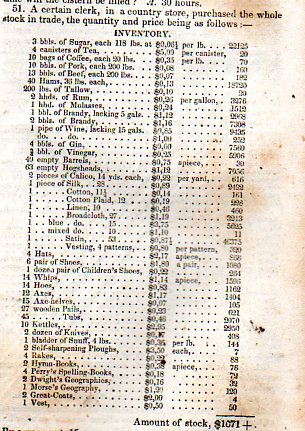
    Fascinating–but even more so from a bit found earlier in the book–an interesting and longish example for practical mathematics, a very detailed question for addition. The presentation is a nearly full-page list of the contents of a country store, the inventory of which was being purchased by “a certain clerk” thus giving issue to the addition problem as well as a hint to what was found in a general store in 1836. 

    MATH406
    In this addition problem (which is somewhat problematic in that in the overall price column there is no differentiation between dollars and cents, so “4” means $4.00 anfd “50” can mean $50 or 50 cents) there are 46 entries, almost all of which are standard necessaries, with a few luxury items tossed in for  the benefit of those who would have the occasional disposable income for such a thing.  Overall the list is dominated by basics: sugar (354 pounds worth), tea, coffee, pork, beef, ham, rum, brandy, wine, vinegar, (40) empty barrels, (63) empty hogsheads, vinegar, axes, whips, wooden pails, kettles, tubs, ploughs, and rakes, and more (as we can see below).  Less common was the book stock:  2 Hymn Books, 4 Perry’s Spelling books, 2 Dwight’s Geographies, and one copy of the iconic Morse’s GeographyAnd it looks as though the buyer purchased everything for about $1071.00—which was a considerable sum. The average farm laborer was paid about $10/week, plus room and board in 1840; a carpenter might make $1-1.50 per say, while laborers in manufacturing (glass, iron, wool, cotton) all made about 80 cents-1.00 per day2.  That means it would take the average man four years to save  $1000, and probably more. In order to start this business to make money, you certainly needed to have some money to get started in making it.  In the meantime, this is an interesting peep into what people bought in country stores in 1836. 

    Notes:

    1. Rosell C. Smith, Practical and Mental Arithmetic, on a New Plan, in which Mental Arithmetic is Combined with the Use of the Slate… which was printed in Hartford beginning in 1829 (my copy being printed in 1836).

    2.  See here for a decent look at what wages were like over decades in the 19th century. 


  • The Sense of Old Numbers & the Geometry of Squirrel-Shooting

    JF Ptak Science Books   Post 2065

    Old math400

    There is something enormously appealing in the general nature of old numbers, numbers written or printed long ago, numbers making an appearance in the general sense of ordinary and commonplace, everyday garden variety numbers (like the example above and it continuation below), as well as in more famous numbers, numbers that present a concept for the first time, or offer a proof in thought and conjecture (as seen further below with Mr. Stevin).

    The first example is from a worn copy of a common early-ish 19th century American math textbook by Rosell C. Smith, Practical and Mental Arithmetic, on a New Plan, in which Mental Arithmetic is Combined with the Use of the Slate… which was printed in Hartford beginning in 1829 (my copy being printed in 8136).  It was a popular book, and it claimed to make math more useful by using calculations for problems to be figured in terns of dollars and cents, thus giving the exercises the chance of direct application to the daily grind.  My copy of this book is very worn–not the worn that comes from mistreatment, but rather use-worn, the book being smooth and lustrous from repeated and deep use, handled so much over the years that the paper covers have a very definite and smooth patina. 

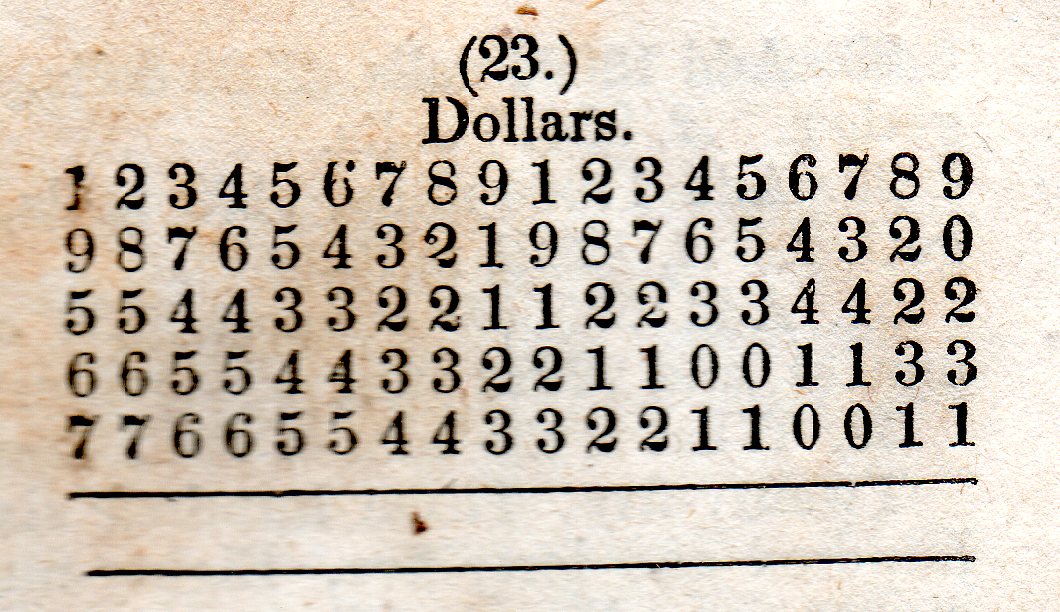
    In any event Mr. Smith’s numbers have a special bit to them, something nor-quite-like-everything-else. The care and the design and placement of the numbers is very attractive, even if it makes the numbers sometimes a little illegible. 

    The numbers have a certain beauty to them, as does the space aloted for their answers:

    Old math399

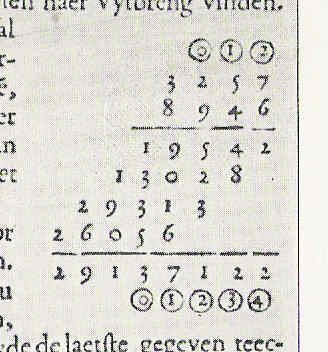
    Famous numbers have a distinct beauty as well, in the more refined and exalted antithesis as those numbers for a simple sum problem:  from two ends of the spectrum ,sometimes, though they both meed in the middle where the numerological beauty occurs.  A great example f famous numbers might belong with Simon Stevin (1548-1620), who introduced the idea of decimal numbers in his 36-page De Thiende (‘The Art of Tenths”)
    in 1585  His was an idea that replaced much more cumbersome earlier methods of
    representation.  So, the number 3.14159 would be written in the Stevin
    notation as (where in this case numbers enclosed by brackets, i.e. “[9]”
    would have been represented in print as a 9 within a circle)
    3[0]1[1]4[2]1[3]5[4]9[5].  It is also seen here:

    Stevin decimal

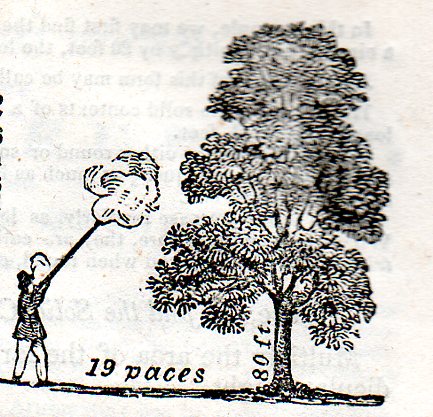
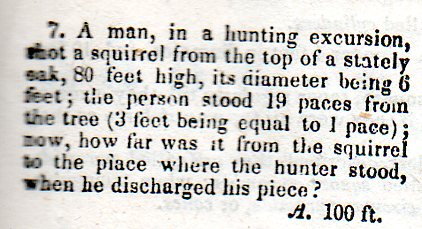
    One item that attracted my attention–easily so–was the following problem:

    Old math shooting tree401

    Old math shooting tree402
    It was also the only illustration in the 284-page book.  And it makes sense, I think, because squirrel hunting is just what people did at this time, and the calculation could be a useful one.  Still, it is an unusual image to set to work illustrating a math problem–and interesting. 

    ·Posted by :

    ·in:

    —

  • The Endless Immensity and Finite View of the Infinite of Thomas Wright, 1754

    JF Ptak Science Books   Post 2064
    Follow Me on Pinterest

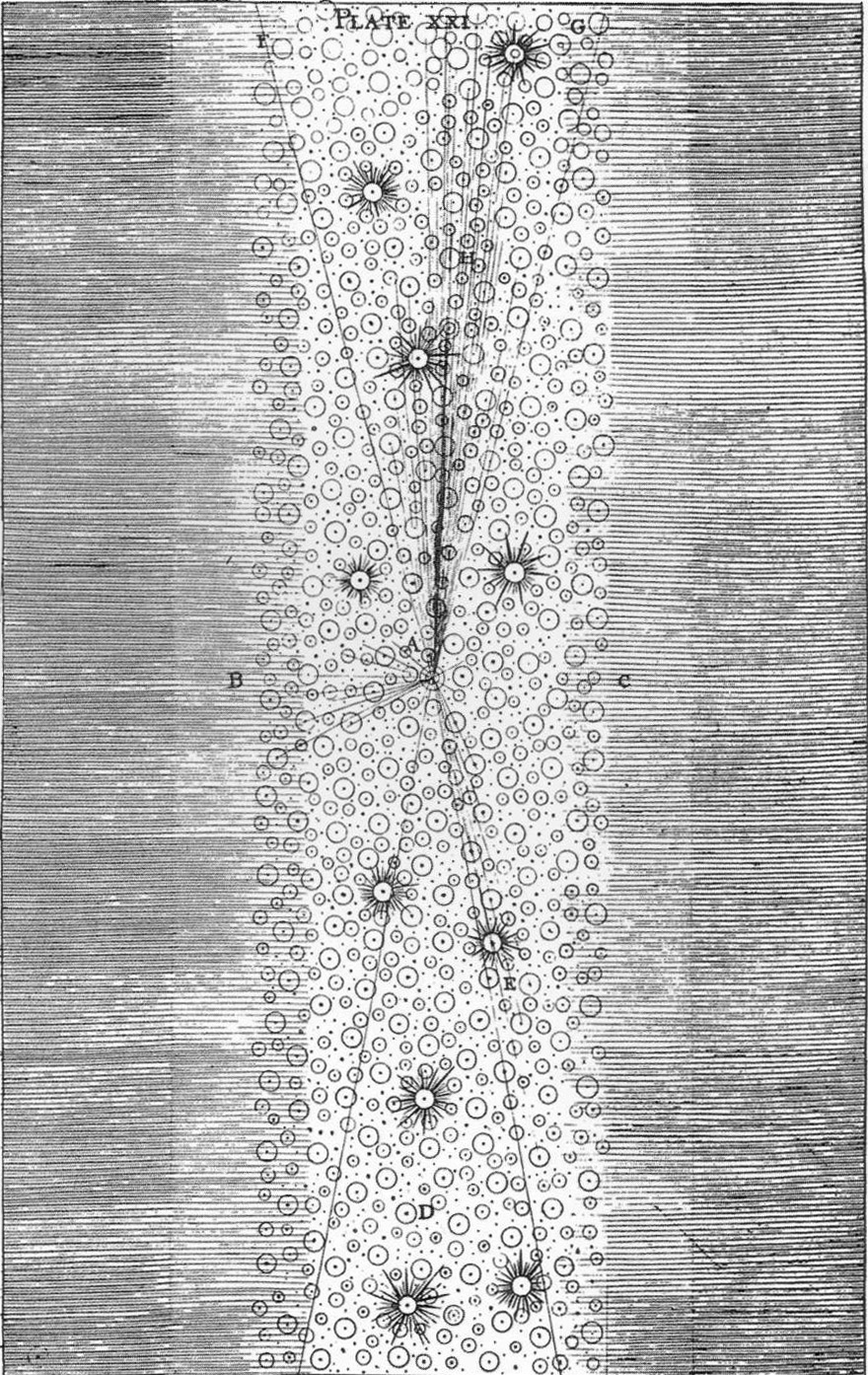
    Thomas Wright (1711-1786) saw about as deeply into the deep as just about anyone else–he looked into the night sky and pretty much saw all of it. In his book, An Original Theory or New Hypothesis of the Universe, Founded upon the Laws of Nature1, he described a version of the universe that was influential in the thinking of Kant and Herschel, finding a rectangular/squashed “finite infinity” of stars, “a vast infinite Gulph, or
    Medium, every Way extended like a Plane,
    and inclosed between two Surfaces”.

     
    Wright thomas [plate 23

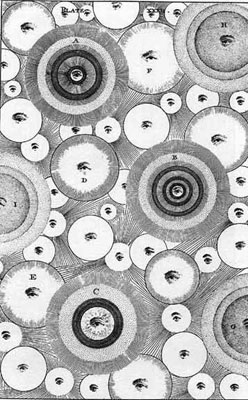
    Our Milky Way, which at the time was thought to be the entire universe rather than a galaxy as it was later discovered to be–one galaxy in a seemingly endless sea of galaxies–was presciently seen by Wilkins as being but one assembly of stars in an “endless immensity” of stars:

    “And farther since without any impiety; since
    as the creation is, so is the Creator also magni-
    fied, we may conclude in consequence of an in-
    finity, and an infinite all-active power; that is
    the visible creation is supposed to be full of si-
    derial systems and planetay worlds, so on, in
    like similar manner, the endless immensity is an
    unlimited plenum of creations not unlike the
    known Universe.”–page 143. (Again, the “Universe” eferred to here is the Milky Way galaxy.)

    Wright’s vision of this plethora of Universes, in which each creation is one like the Milky Way–a radical thought in 1750:


    Wright 32

    [Part of me wants to include the first Wright engraving in this blog’s series on the History of Lines, seeing as how they represent the great Something that seem to be infinitely binding the infinity of universes…]

    Wright also writes on the minuteness of the human condition, of the perfect sense of nothingness that is the Earth in a sea of infinite possibilities of other earths and earthy creations, which was definitely an outpost of thinking in 1750:

    “In this great celestial creation, the catastro-
    phe of a world, such as ours, or even the to-
    tal dissolution of a system of Worlds, may pos-
    sibly be no more to the great author of nature,
    than the most common accident in life with us,
    and in all probability such final and general
    doom-days may be as frequent there, as even
    birth-days, or mortality with us upon the Earth.
    This idea has something so cheerful in it, that
    I own I can never look upon the Stars without
    wondering why the whole world does not be-
    come Astronomers; and that men endowed with
    sense and reason, should neglect a science they
    are naturally so much interested in, and so ca-
    pable of enlarging the understanding, as next to
    a demonstration, must convince them of their
    immortality, and reconcile them to all those lit-
    tle difficulties incident to human nature, with-
    out the least anxiety.”–page 132


    Notes

    1.  The full title:  An Original Theory or New Hypothesis of the Universe, Founded upon the Laws of Nature, and solving by Mathematical Principles the General Phenomena of the Visible Creation ; and particularly the Via Lactea. Comprised in Nine Familiar Letters from the Author to his Friend. And illustrated with upwards of thirty graven and mezzo-tinted Plates by the best Masters. London, MDCCL.” Full test, here.

     2. An odd note about Thomas Wright’s personal history, from Science, 1902: “A word, in passing, about Wright. Like many another, so unfortunate as to live ere the
    times were ripe, he has been consigned to unmerited oblivion. Even the writer of the entry upon him in the ‘ Dictionary of National Biography ‘—a work so uniformly accurate — is unaware of the sources from which information could have been obtained, and so has nothing to tell, — does not even know the dates of his birth and death, or why he was called ‘of Durham.”–[Science, N. S. Vol. XIII. No. 321. 2-22-1902

    An interesting poem by Rafinesque to start of his edition of Wilkins:

    “Where ends the range and limits have been set
    To mortal eyes, there mental sight begins
    To fathom space, and worlds invisible
    Surveys, admires
    The mind must feel that space can have no bound*,
    Whatever number be of things or thoughts
    Others may be beyond—and thus behind
    The Nebulas and Belts, our Galaxies
    Of stormy clouds and oceans
    There stands the central land and throne
    Of our wide Universe, the home of Angels,
    The seat of Love Divine”
    Rafinesque, Poem on Instability, found at the beginning of Rafinesque’s 1837 American edition of Wright’s 1750 work. 


  • Some Interesting Links for Antiquarian Slang Dictionaries and the Like

    JF Ptak Science Books  Quick Post

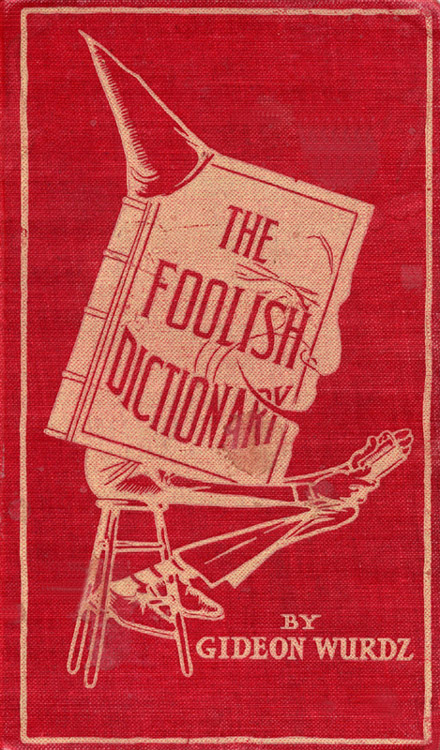
    Dictionary foolish

     DICTIONARY OF THE VULGAR TONGUE. A
    DICTIONARY
    OF
    BUCKISH SLANG, UNIVERSITY WIT,
    AND
    PICKPOCKET ELOQUENCE.

    [Here]  UNABRIDGED FROM THE ORIGINAL 1811 EDITION WITH A FOREWORD BY
    ROBERT CROMIE COMPILED ORIGINALLY BY CAPTAIN GROSE. AND NOW CONSIDERABLY ALTERED AND ENLARGED, WITH THE MODERN
    CHANGES AND IMPROVEMENTS, BY A MEMBER OF THE WHIP CLUB. ASSISTED BY HELL-FIRE DICK, AND JAMES GORDON,
    ESQRS. OF CAMBRIDGE; AND WILLIAM SOAMES, ESQ. OF
    THE HON. SOCIETY OF NEWMAN’S HOTEL.

    “The merit of Captain Grose’s Dictionary of the Vulgar Tongue has
    been long and universally acknowledged. But its circulation was
    confined almost exclusively to the lower orders of society: he
    was not aware, at the time of its compilation, that our young men
    of fashion would at no very distant period be as distinguished
    for the vulgarity of their jargon as the inhabitants of Newgate;
    and he therefore conceived it superfluous to incorporate with his
    work the few examples of fashionable slang that might occur to
    his observation….”–from the preface.