A Daily History of Holes, Dots, Lines, Science, History, Math, Physics, Art, the Unintentional Absurd, Architecture, Maps, Data Visualization, Blank and Missing Things, and so on. |1.6 million words, 7500 images, 4.9 million hits| Press & appearances in The Times, Le Figaro, Mensa, The Economist, The Guardian, Discovery News, Slate, Le Monde, Sci American Blogs, Le Pont, and many other places… 5000+ total posts since 2008.

Author: JF Ptak

  • The Written Test of the Dead and the Bump Map of Crime

    JF Ptak Science Books   Post 2062 
    Follow Me on Pinterest

    Thanks to the always-fascinating book by Jan Bondeson, Buried Alive, the Terrifying History of our Most Primal Fear (W.W. Norton, 2001), which excited this interest in Dr. Severin Icard. 

    The determination of the occurrence of death was a major medical feature of the 19th century, the French in particular waging a fight for how this to be so.  Briefly
    put, for centuries even before Pliny death was described as the absence
    of an audible heart—the crux of the sentence being the word “audible”,
    so that the end of life was dependent upon being a physician’s/person’s
    capacity to hear the heart beating.  This might be very
    problematic if the person listening for that heartbeat had faulty
    hearing from defect or age, as the listener would place his/her ear on
    the chest of the patient to determine if the heart was functioning or
    not.  The stethoscope wasn’t invented until 1816 by Rene
    Laennec–who produced a monaural device much like a primitive hearing
    horn made of solid wood—which was a vast improvement over no stethoscope
    at all, by again was very crude compared to early 20th century devices.  It
    was much more preferred by most doctors (though there were contingents
    who distrusted the instrument and wouldn’t use it and still others who
    thought it an insult to their person insinuating defective hearing
    capacity) compared to the ancient hairy-ear-on-chest method.  It was also, in a small way, a kind of auditory x-ray.

    There were other ways to make the sometimes very difficult determination of actual death.  Some methods seem extreme, and a little barbaric, and at the very least, “odd”, but they were also effective to some degree.  For example, Leon Collongues believed that he could hear the capillary functions of a possibly-dead person’s fingers if placed in his ear; Jules Antoine Josat
    invented a nipple-pincher (“pince-mamelon”) life-rejuvenation device,
    operating on the assumption that a deeply sedated person could not
    resist a strong pinch of the nipple and would have to wake up if alive; the tongue-pulling idea of Dr. J.-V. Laborde; Christian August Struwe’s electrical device that delivered a dual shock to the eye
    and lip that was supposed to result in a twitch in the supposed-departed’s eye or lip; the tobacco enema of Antoine Louis; Barnett’s scalding death cure, which recommended burning the skin of the
    arm to see if it blistered (no blister/no life); and so on, deep into the fearsome, troubled and death-filled night.

    There was one death test, though, that went beyond the others, if only because it employed a “written test”.  This was the invention of Dr. Severin Icard, who devised a putrefaction test where the words “I am really dead” on a piece of paper written in acetate of lead would be placed under the note of the “deceased” where the words would appear if they came into contact with putrefaction gas dioxide of sulphur.  So, the “breath” of the dead would force the letters to announce their death.  Unfortunately the test was not fool-proof and the not-dead could sometimes produce dead results, which would be highly unfortunate in the premature burial kind of way…which is somewhat ironic, because that is how many of these dead tests came into being. 

    I should point out that Icard had another outre idea for the physical determination and identification of criminals.  He proposed that a substance be injected into an unidentified part of a felon to identify the person as a criminal.  the injection would produce a visible bump or lump on the person, somewhere; multiples were also possible, as were the locations of the bumps, so that a trained eye could determine the crimes committed by the Bump Map of Crime on the victim. 


    [Source: Journal of the American Medical Association, volume LVII, July-December 1911.]

  • The Batmobile of Teacher’s Desks, 1898

    JF Ptak Science Books    Daily Dose from Dr. Odd
     
    Follow Me on Pinterest


    Sometimes there are certain things that must not be refused–this is one of them.  St. Jerome may have had a number of interesting  and complex desks granted him during his imaging heydays in the late Medieval through Renaissance periods, and  there have been fabulously simple approaches like the table-top/lap desk of Thomas Jefferson or the Easy-Boy arm desk of Roald Dahl, and there have been desk/floors like that of Albert Einstein, and desk beds like George Costanza‘s, and refigerator-desks like Thomas Wolfe’s, and standing desks like Winston Churchill’s, and non-desks of Sherlock Holmes, and so on; but I think given all of those I’d rather have the desk below, patented by M. McC. Parr in 1898.  It seems to have it all, including a possible built-in bed–the only thing it is missing is an engine and a driveshaft and some wheels…you can add the brakes later on.  

    ·Posted by :

    ·in:


  • The Excellent Smokeless City

    JF Ptak Science Books   Quick Post  
     
    Follow Me on Pinterest


    This interesting image appeared in Electrical World in 1894, introducing the concept of the cleaner city, one that is run by electricity:

    December 8, 1894

    ·Posted by :

    ·in:


  • Ars Morendi

    JF Ptak Science Books   Post 2061   
    Follow Me on Pinterest

    Ars398
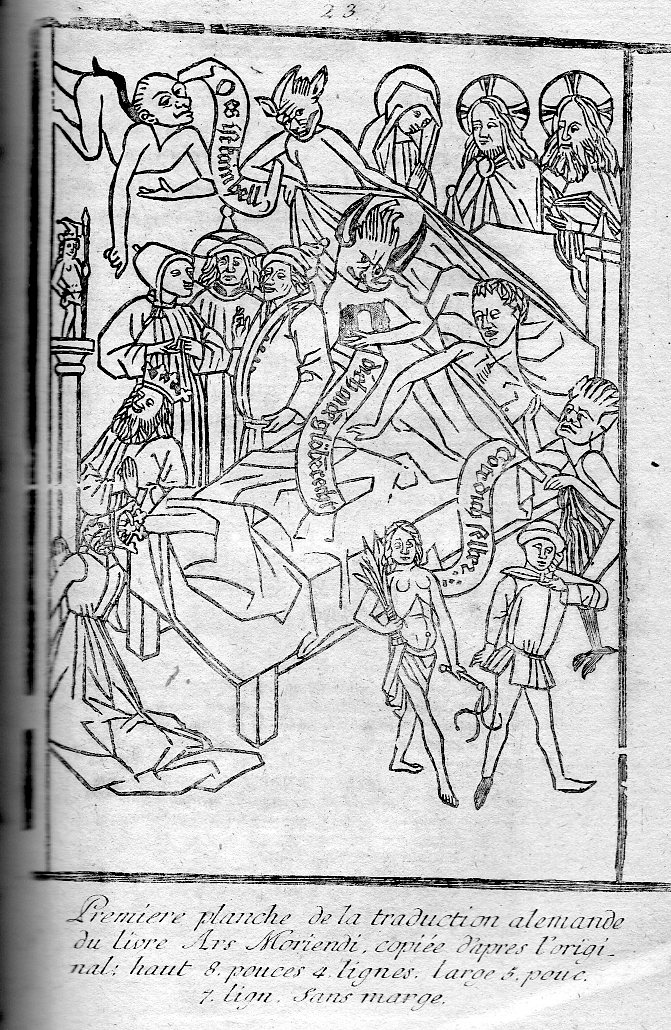
    The late Medieval/early Renaissance Tractatus artis bene moriendi was a work book of the dead–rather, a book for those about to be dead, an instructional for the process of dying the good death along the (loose) order of the Tibetan Bardo Thodol and the Egyptian book of the dead.  The Ars was written in the early the 15th century (some sources say 1415) and began appearing in some of the earliest illustrated printed books by about 1450–it was a wildly popular/necessary book, going through some 100 editions by 15001. 

    The books basically readied the dying for death, for a holy death, a death filled with high possibilities of a rewarding afterlife, for dying in the good graces of Christ and the christian ideals.  The images were such that non-readers could understand them–and this is still pretty much the case.

    Many of the variants of this work include a dozen or more woodblock illustrations, an example of which is found above.  We see the soon-to-be-departed at the very last instant before death, surrounded by all manner of distractions and entertainments aimed at luring the person to an earthly- rather than holy-demise. Demons, conjurers, makers of greed, and devils surround his bed in temptation, all while the Virgin Mary, Christ and the creator look down upon the besieged from behind the top of the bed. 

    Death was not an uncommon visitor in Europe in the early/mid 15th century, and perhaps this book served some in the way it taught people how to die a noble and religious death, especially when clergy may not have been so available. 

    (We offer a version of this print–printed in 1771 in Leipzig, and published in Heinecken’s Idee Generale d’une Collection Complette d’Estampes.  True this woodcut comes some 200 years or so after the original, but it still has a flavor of substantial age, of one of the earliest images to ever appear in a printed books.) 

    Here’s another example, this time the dying man is beign attacked by agents of pride and greed.  The images are genuinely upsetting–scary even.

    ·Posted by :

    ·in:


  • Tuscan Ruin in Building the Tower of Babel

    JF Ptak Science Books   Quick Post  
    Follow Me on Pinterest

    Babel anonymous
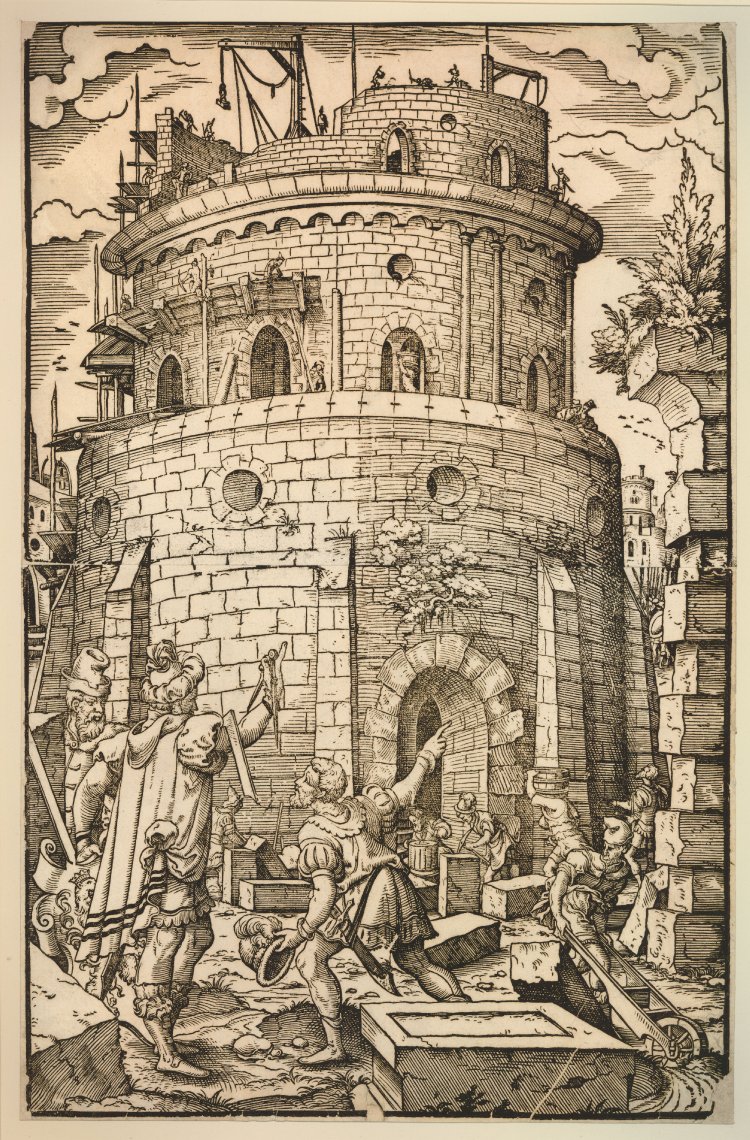
    This image of the construction of the Tower of Babel is interesting in a number of ways. For example, the general overt busyness of the construction sight is bright and refreshing, and the designer/architect seems enormous, and holds a compass skyward as the foreman (hat in hand) approaches with some skyward concerns of his own.  The skinny wheelbarrow at right is quite fine, as are the Renaissance cranes and scaffolding.   And as new as this building is, it seems to have some age built into it, what with the small trees and shrubs growing from it at different levels, a kind of Tuscan deteriorated elegance as the building is being built. This was not an uncommon motif seen in the engravings and woodcuts and paintings recording architecture during this period, but it is unusual to see it in a building under construction. 

    The print is identified as Anonymous, and a source says that it was printed around 1500, but it looks slightly newer than that to me, maybe more mid-century. 

    ·Posted by :

    ·in:


  • History of Lines–Atomospheric Electricity

    JF Ptak Science Books   Quick  Post    
    Follow Me on PinterestPart of the History of Lines series

    Hermann Plauson, a German engineer and director Fischer-Tropsch Otto Traun Research Laboratories of Hamburg, Germany (in the 1920’s)  built on an idea of N. Tesla to “convert alternating radiant static electricity into rectified continuous current pulses”. It was an expansive idea of at least artistic merit, as seen in his patent application (below) and visualization of the completed installation. 

    “For many years electrical engineers have endeavored to devise some means  whereby it would become possible to utilize the free electrical energy ever  present in the atmosphere, but they were not successful, as every now and then an extra heavy surge of static current would rush down the elevated conductor and endanger the lives of the experimenters, or else destroy the apparatus  connected with it. A German engineer has, however, devised the somewhat  elaborate scheme here shown in brief, and he has succeeded, at least so his  report states, in safely extracting several kilowatts of electrical power from  the atmosphere with metallic surfaced balloons, elevated to a height of only 1000 feet.”–Hugo Gernsback, “Power from the Air (II)”, in Science & Invention, March 1922.


  • A Remarkable Confederate POW Newspaper, 1865

    JF Ptak Science Books   Post 2060    
    Follow Me on Pinterest

    Prison times 5
    [My thanks to Rebecca Onion at Slate Vault for finding and surfacing this incredible document]

    “One of the most remarkable productions of Fort Delaware was the
    Prison Times, a newspaper published in April, 1865, by Capt. Geo. S.
    Thomas, 64th Georgia Regiment, and Lieut. A. Harris, 32d Florida. It was
    written in a small but very clear handwriting by Capt. J. W. Hibbs, of the
    13th Virginia Cavalry [sic], who proved himself a most expert
    penman.” –from Edward R. Rich, Comrades! page 120, a small but dense 167-page book printed in Easton, Maryland, and published by S.E. Whitman, in1898, containing his recollections of his experiences in the Union prison.


    Prison times 1
    [Source: the Library of Congress, here.]

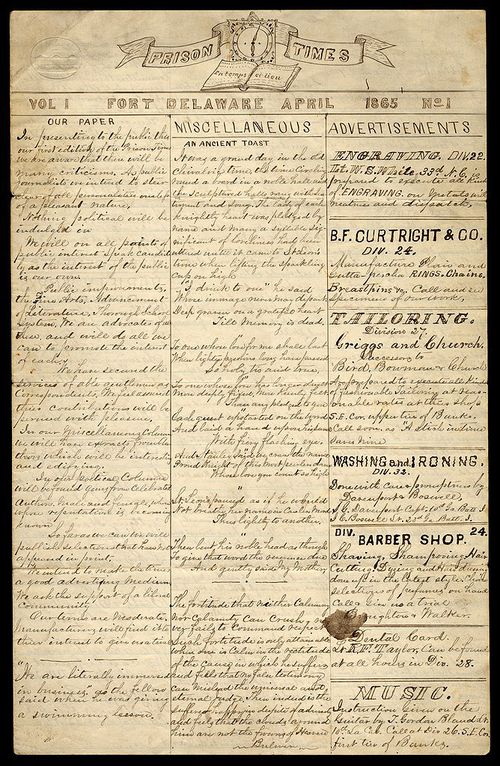
    The Prison Times was a hand-written, four-page newspaper produced by Confederate prisoners in April 1865 in the Union prison at Fort Delaware on Pea Patch Island in the Delaware River.  It was a short lived effort, the war ending just weeks after the paper appeared1. As a matter of fact the editors hoped that the newspaper effort would not have to last very much longer, longing for the end of the war and to return home:

    “Trusting that the difficulties of conducting an enterprise of
    this kind under the circumstances are duly appreciated by an intelligent
    public, we send forth this our first number hoping that ere we can have
    time to issue many numbers our prison times will be discontinued forever
    and our patrons and ourselves be far away in our
    loved Sunny South.”

    Prison times 6
    It is a remarkable document, enlisting the hope for normalcy of the 33,000 (or so) prisoners2.  The newspaper made a statement of intent (and to avoid political
    discussion), and displayed useful information like barracks directors
    and a short piece on “our prison world”.  There were also interesting
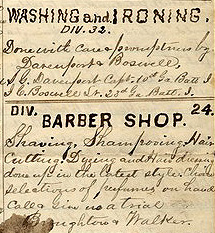
    short advertisements which were apparently real:  folks placed their
    services into play in the newspaper for engraving, jewelry (rings,
    chains, gutta percha), tailoring, washing & ironing, barbers,
    dental, music instructions, and shoe-making.  There were also a few
    short notices for debating and chess clubs, as well as a few pieces of
    poetry.  Overall, there was a lot of information packed into four 12×8″ pages, an effort that showed that in this town-sized prison that there were definitely some forms of society and commerce taking place.   


    ·Posted by :

    ·in:

    —

  • Nonsense and the Fourth Dimension, 1899

    JF Ptak Science Books   Post 2059 
     
    Follow Me on Pinterest

    Burgess, gelett
    Gelett Burgess (1866-1951, a Boston high-ground MIT grad poet/critic/all-around lit figure who wrote a lot and created an important Little Magazine called The Lark) continued his work in humor and nonsense and future-vision with his The Lively City O’Ligg, a Cycle of Modern Fairy Tales for City Children,  in 1899.  There’s a lot in this squarish book to suggest itself as a sort of farcical-absurdist tomorrow’s retro-vision fiction–its only his second book, and not the work he is most famous for, and it was written for the amusement of kids, but really for kids of all ages, and very funny. (Full text here via Internet Archive and prettier edition here via Hathi Trust.)

    Burgess387
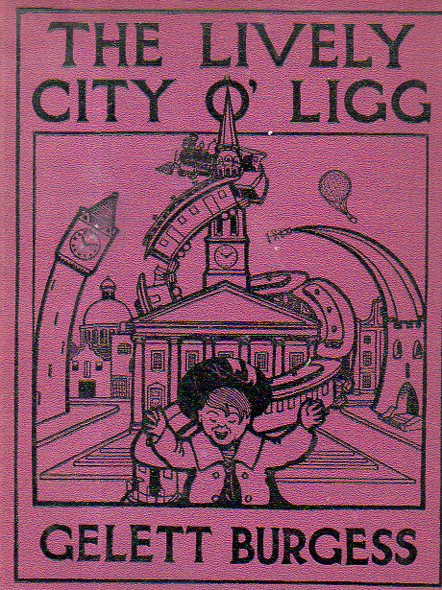
    And it has great illustrations. For example, the front cover artwork (for the edition here) suggests a dimension of space/landscape and how it changes as a moving body viewing that scene approaches the speed of light–this is Burgess’ art, and it is amazingly prescient of the modern art that was fast approaching in the next decade or so, only Burgess’ name isn’t very commonly associated with the precursors of displaying the fourth dimension in art. [He is there, though with early associations with Stieglitz at 291 and Max Weber.  When I think of these early names it is generally of the more-obscure but very early W. Stringham in his “Regular Figures in n-Dimensional Space”, published in 1880, followed by the great Jouffret in his geometries of four-space (published in the 1900-1905 or so), and then of course Charles Howard Hinton and the hyperspace philosophy of Claude Bragdon, followed by H.P. Manning’s Geometry of Four Dimensions in 1914.  But in between Jouffret and Manning there is also the artwork of Picasso and Braque and Metzinger Gleizes and Le Fauccionier and Gris and Kupka and Duchamp, all of whom addressed this issue of space and time and the fourth dimensions in their work, seminal pieces all and created between 1909-1912.  Burgess himself came to the attention of the Stieglitz group by 1910 or so and was given an exhibition of his watercolors at 291 in 1911.)

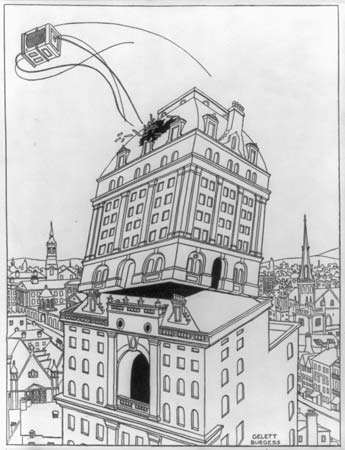
    The image illustrating the chapter three, “The Three Elevators” (above), just shows one of them bursting through the roof of an “immense building in the City of o’Ligg” “Twenty-seven stories high (!)”. (At the time the world’s tallest building wasn’t in O’Ligg but in NYC: in 1890, it was the New York World Building, New York City (309 feet, from 16 to 26 stories, but that is another story; closer to the time of the Burgess book it was the
    Manhattan Life Insurance Building, again in New York City which was 18 stories and 348 feet high. So the Burgess building was a big one by world standards in 1899–and of course there would be no tall structures like this without steel framing, or elevators, or for that matter fool-proof elevator emergency brakes. In any event the elevator spikes through the roof of the o’Ligg building, looking for all the world like one of the aliens from Wells’ War of the Worlds, which was published a year earlier than this book, in 1898. (I should say the appearance was suggested by the first edition of Wells’ 1898 book, as it was not illustrated.)

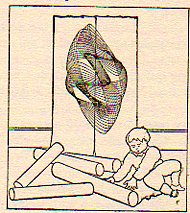
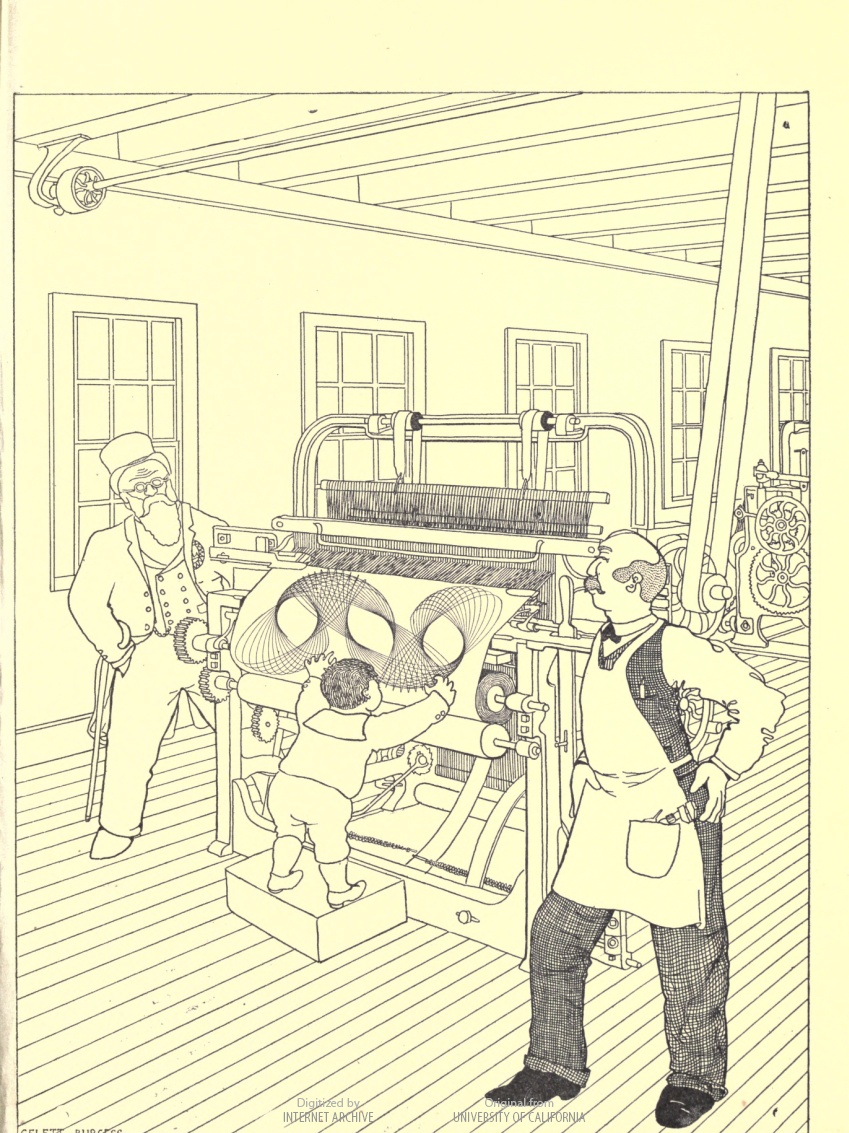
    Another surprising example of found-modern art occurs in the final chapter, “The Eccentric Loom”, when loom No. 7–like the other machines and implements in these stories–has a mind of its own and produces “something queer”, a “crazy design” producing an “insane tapestry”.  The loom is “either crazy”, or “it is a mighty clever machine; altogether too clever for me”.  But the design as an intentional piece of art for 1899 is pretty extraordinary–and the underlying premise, that the machine might be producing the art on its own, is exceptional and early.                           

    Burgess loom388

    To put the artwork in a more machine-creative-context, here’s teh Burgess image that starts off the “Insane Loom” chapter:

    BURGESS LOOM B

    There’s much more in the Burgess book to discuss, particularly in the anthropomorphization of objects, as in the chapters dealing with a sleepwalking house, the boldness of a balloon, the laziness of o’Ligg lampposts, a flying stable, runaway chairs, and the like1. It is very enjoyable to watch Burgess breathe life into these objects, and give them personalities and lives.  But it is a true joy to see him present some of the objects as the “artist” and not just the tool, as we see here in the opening paragraph of the chapter “The Blind Camera”:

    "THERE were many Cameras living in the Ligg Photo- 
    graphic Parlours, artists who looked down with scorn upon 
    all other machines, not only upon the manufacturing 
    or working members of the community, but upon such 
    aristocrats as the Bicycles and Balloons as well. The 
    musical instruments they recognized as artists, it is true, 
    but it was the Cameras' opinion that most musical instru- 
    ments were a bit mad. Even the Very Grand Pianos 
    often got out of tune ; and, besides, they were all totally 
    blind, from the Penny Whistles to the Church Organs. 
    The Cameras themselves were deaf and dumb, but they 
    never thought of that, as they had the best eyes of all 
    the objects in the City o' Ligg, except the Telescopes, 
    and the Telescopes didn't count ; they were not artists- 
    they were merely elaborate tools."


    Perhaps our future Robot Overlords (a phrase taken from Mr. Eugene Krabs in
    Spongebob
    Squarepants) will one day in the future look backwards and find
    the beginning recognitions of the creative souls of machines in the work of
    Mr. Burgess.


  • Earths-Out-of-Place Department: Superman and Atlas and a Doubly-Out-of-Place Earth

    JF Ptak Science Books   Quick Post  
     
    Follow Me on Pinterest 

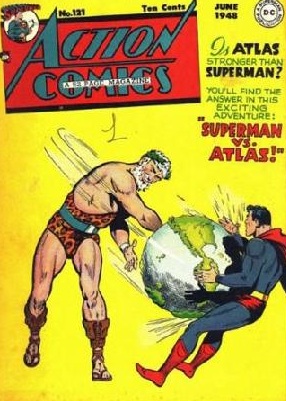
    The expenditure of one thin 1948 dime would answer that age-old question: IS Atlas stronger than Superman?  That interrogatory pales though in comparison to the business of what exactly is going on with the Earth, though we can guess that Atlas has decided to use it as a weapon, which I think is the first time that I’ve seen an image turning the Earth into an offensive tool.  The Earth is also doubly out-of-place in this image because Atlas was condemned by Zeus for his role in the Titans vs. Olympians struggles not to hold up the Earth on his shoulders, but rather to support the celestial sphere–the sky–so that the Earth and Sky did not meet. So Atlas shouldn’t be throwing the Earth at Superman if he wanted to keep a little true to his own mythology, because according to legend Atlas carried a bigger burden. 

    https://historyofideasblog.com/a/6a00d83542d51e69e2014e8839b25e970d-pi

    ·Posted by :

    ·in:


  • Towards an Alphabet of Trades–“Snapshots” from 1568

    JF Ptak Science Books    Post 2058  
     
    Follow Me on Pinterest 

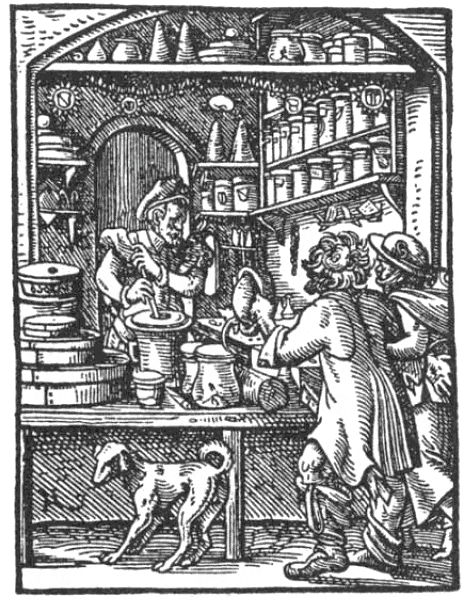
    The great Jost Amman (1533-1591, Swiss book illustrator and one of the last major production artists working with woodcuts) didn’t set out to create a simple alphabet of trades, but did  record them, and did so with great clarity, basically creating a 16th-century pre-photographic “snapshot” of the ways in which people conducted their business and livelihood.  The illustrations come from his work with Hans Sachs,  Eygentliche Beschreibung Aller Staende Auff Erden, published in  Frankfurt am Main in 1568 (the full text here from Bibliothek des Seminars für Wirtschafts- und
    Sozialgeschichte, and another useful full-text here that indexes the images and another here for an English indexing of the trades). The images are precise and sparse, and endlessly interesting, an  uncommon peep into the common past that was n

    Also useful: Dictionary of Medieval and Renaissance occupation, here.

    A.  Apothecary

    Amman apoth 

    ·Posted by :

    ·in: