A Daily History of Holes, Dots, Lines, Science, History, Math, Physics, Art, the Unintentional Absurd, Architecture, Maps, Data Visualization, Blank and Missing Things, and so on. |1.6 million words, 7500 images, 4.9 million hits| Press & appearances in The Times, Le Figaro, Mensa, The Economist, The Guardian, Discovery News, Slate, Le Monde, Sci American Blogs, Le Pont, and many other places… 5000+ total posts since 2008.

Author: JF Ptak

  • Black Holes as Dark Stars, 1784

    JF Ptak Science Books  Quick Post

    Just a very short note here, as I was doing a little work on black holes, and read the earliest recognizable scientific papers on the idea of the black hole (I almost wrote black “whole” which is an interesting concept that I guess might be sort of the same idea as a black ‘hole” if the notion existed), and thought to reproduce parts of them here.  The paper is by John Michell (mind the ‘t”!, 1724-1793, pioneering/filed creator of seismology and magnetometry, and one of the first people to competently weight the world) and exists in this long but beautifully titled work found in the Philosophical Transactions in 1784:  
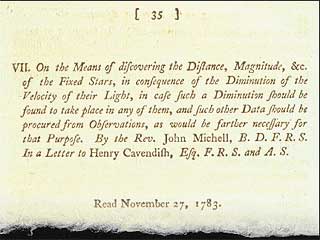
    Michell_001

    [Image source: American Museum of Natural History]

     Here’s a good quote from that work:

    “If the semi-diameter of a sphere of the same density as the Sun were to exceed that of the Sun in the proportion of 500 to 1, a body falling from an infinite height toward it would have acquired at its surface greater velocity than that of light, and consequently supposing light to be attracted by the same force in proportion to its inertia, with o ther bodies, all light emitted from such a body would be made to return toward it by its own proper gravity.” (Michell, Philosophical Transaction of the Royal Society of London, January 1,1784.

    He came up with the beautiful idea of “dark stars”, and even how to find them–it is unfortunate how (and also a function of the times) that his work would go basically unnoticed until a time when it could be better understood, but only so far as historicism is concerned.  Michell however was rescued in the 1970s at least in bibliographies, lifted from his parson’s grave of scientific anonymity.  
    ·Posted by :

    ·in:

    —

  • The Many Names of the Philosophical Transactions (1665-2014)

    JF Ptak Science Books   Reference Tools series

    Just a note here on the names of about the greatest English-language scientific journals of all time, the Philosophical Transactions… (“Phil Trans”). Like the great Annalen der Physik, which also had its fair share of name changes over the centuries (see here), the Phil Trans had a number of incarnations since it began in 1665.  The list below is just a thumbnail reference for the proper name of the journal at the proper time, and it might make searching for things a little easier. 

    Philosophical transactions[Image source]

    1665-1678  Philosophical Transactions, Volumes 1–12

    1683-1775  Philosophical Transaction, volumes 13-65

    1776-1886  Philosophical Transactions. Volumes 66-177

    1887-1896  Philosophical Transactions of the Royal Society of London A, volumes 178-186

    1887-1895  Philosophical Transactions of the Royal Society of London B, volumes 178-186

    1896-1934  Philosophical Transactions of the Royal Society of London. Series B, Containing Papers of a Biological Character,. Volumes 187-223

    1896-1934  Philosophical Transactions of the Royal Society of London. Series A, Containing Papers of a Mathematical or Physical Character,. Volumes 187-223

    1934-1990 Philosophical Transactions of the Royal Society of London B, Biological Series, volumes 224-338

    1934-1990  Philosophical Transactions of the Royal Society of London A, Mathematical and Physical Series, volumes 224-332

    1990-1995 Philosophical Transactions of the Royal Society, Physical and Engineering Sciences, volumes 332-353

    1990-1995 Philosophical Transactions of the Royal Society, Biological Sciences, volumes 338-353

    Currently: Philosophical Transactions of the Royal Society A: Mathematical, Physical and Engineering Sciences

    Philosophical Transaction of the Royal Society B: Biological Sciences


    ·Posted by :

    ·in:


  • The Smell and Cheapness of Communist Dreams, 1942

    JF Ptak Science Books Post 2243

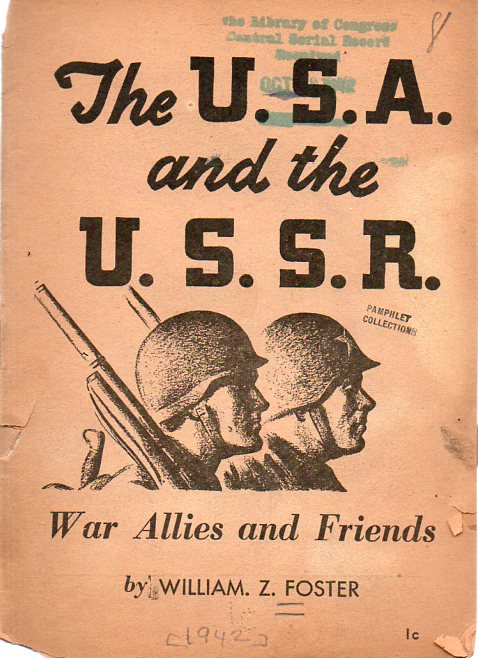
      Foster082

    William Z. Foster. Great name, interesting history, but also Joe Stalin supporter of high order who ran for president of the U.S. in ’32 as a Communist (and got 100K votes). Foster does have organizational chops, working for unions and union organizing for several decades. In the mid-1920’s and beyond he was interested in the Soviet Union and Communism, and published many small works of wonder, many of which had interest cover illustrations, pushing the penny publication.

    Many of these publications also had that particular feel of cheapness to them, as well, as with the pamphlet I’m sharing above. They feel cheap because they were cheaply printed, written bits made to be whispers into any listener’s ear, and then dissolve after the need was perhaps filled and perhaps not.  They turned brittle after just a little while, and nowadays just crumble into flaking slivers of bad paper that suck the moisture right out of your fingers.  

    This hopeful pamphlet addressed the very tenuous amity between the United States and its mew-ish ally, the Soviet Union. This was printed in 1942, a third of the way through the Nazi invasion of the Soviet Union, an operation that caused the deaths of about 5 million Soviet soldiers and dozens of millions of civilians. Of course the Soviets weren’t always on the side to the U.S. And the Allies, far from it. 23 August 1939 is when Stalin signed the Non-Aggression Pact with Hitler (the Ribbentrop-Molotov Pact) , foreign up Hitler to move against Poland, which is did on the first of September. On the third the British declared war on Germany, and on the 17th The Soviets rolled into the eastern part of Poland, taking what it wanted, as per the agreement in divide and conquer.

    The honeymoon between the two states wasn’t to last long, because Hitler could not stand the Russians, who he felt were an inferior, servile people, holding much-needed natural resources for the Reich, deserving death or slavery. And so on 22 June 1941, the agreement was annulled when the Nazis undertook a full-out-mega-frontal attack on the Soviet Union called Operation Barbarossa. It was a massive campaign, and the Soviet Union reacted slowly to it, given Stalin’s insistence that such a thing as Nazi subterfuge and betrayal was not possible.  The plan was quite nearly successful, with tremendous progress made in the first few months (due to Nazi strategy and surprise as well as Stalinist purges of top Soviet military figures and mismanagement) but then the Soviet Union grew into the necessity of stopping the onslaught, and wound up destroying the German capacity for the two-front war.

    In any event in 1942 Foster made a play for American-Soviet friendship just at the time when the Nazi invasion was being turned around, falling short of Moscow, engaged in awfullness in Crimea, and just about to get into Stalingrad (mid-’42), Hitler’s dream repackaged by an extraordinary effort by the Soviet army. We absolutely needed each other at this point in the war, because the Soviet Union basically killed much of the Nazi war effort, and the U.S. was the seat of fantastic resources. But before the war was out, the Foster’s plea for the beacon of light of Super Friends was not much more than a wet stubby candle in a closet.

    ·Posted by :

    ·in:


  • (Erasmus) Darwin and Powered Flight

    JF Ptak Science Books  Post 2242

    There’s a pair of short notices in two consecutive issues of Nature (September 22 and 29, 1910) that brings up a probably mostly-overlooked bit of thinking by Charles Darwin’s (and Francis Galton’s) grandfather, Erasmus Darwin (1731-1802).  Way before Charles (born 1809) and Francis (born 1822) Erasmus was a powerhouse Darwin, and a powerhouse-in-general. He was primarily a physician, but was also an inventor, physiologist, abolitionist, botanist, and inventor, among other things.  He famously speculated on evolution, and less-famously on the coming of the steam age.  

    In the first article here, pointing out a piece in The Times by R. Meldola, it is shown that Darwin saw the coming of steam from a good distance away: “As the specific levity of air is too great for the support of great burthens by balloons, there seems to be no probable method of flying conveniently but by the power of steam, or some other explosive material, which another half-century may probably discover”.)  The editors of Nature included the notice to provide a bit more evidence of Darwin’s vision via his poetry, stating that he “foretold, in the following lines, the advent of aerial navigation”:

    Soon shall thy arm, UNCONQUER’D STEAM! afar
    Drag the slow barge, or drive the rapid car;
    Or on wide-waving wings expanded bear
    The flying-chariot through the fields of air.
    — Fair crews triumphant, leaning from above,
    Shall wave their fluttering kerchiefs as they move;
    Or warrior-bands alarm the gaping crowd,
    And armies shrink beneath the shadowy cloud.

    In the next issue of Nature there’s a short notice by Arthur Platt, “Erasmus Darwin on Flying Machines”, (page 397 of September 29, 1910), where he quotes Dawin on the coming of powered flight:  “As the specific levity of air is too great for the support of great burthens by balloons, there seems to be no probable method of flying conveniently but by the power of steam, or some other explosive material, which another half-century may probably discover”.

    That’s pretty good.  Over at the Erasmus Darwin House site is another interesting side of Darwin’s interest in flight, where it is found in hi snotebooks a good and early understanding of teh mechanics of bird flight:

     “In the 18th century there was still no satisfactory explanation for the mechanics of flight and, inquisitive by nature, Darwin appears to have set himself to the task. Sketched out in his commonplace book in 1777 at the height of the 18th century quest for automata and artificial life, the bird (technically a goose) will be brought to life in a steam punk style reminiscent of the era. Using a small reservoir of compressed air as the in-flight rewinding mechanism in the book, Darwin’s description of a bird’s flight is very close to reality, and appears to be the first complete account of a power-plant and the necessary cycle of the wings’ movement…”–Erasmus Darwin House, here.


  • The Blank Day Bombing of Sunday–an Odd Moment in the History of Calendars

    JF Ptak Science Books  2241

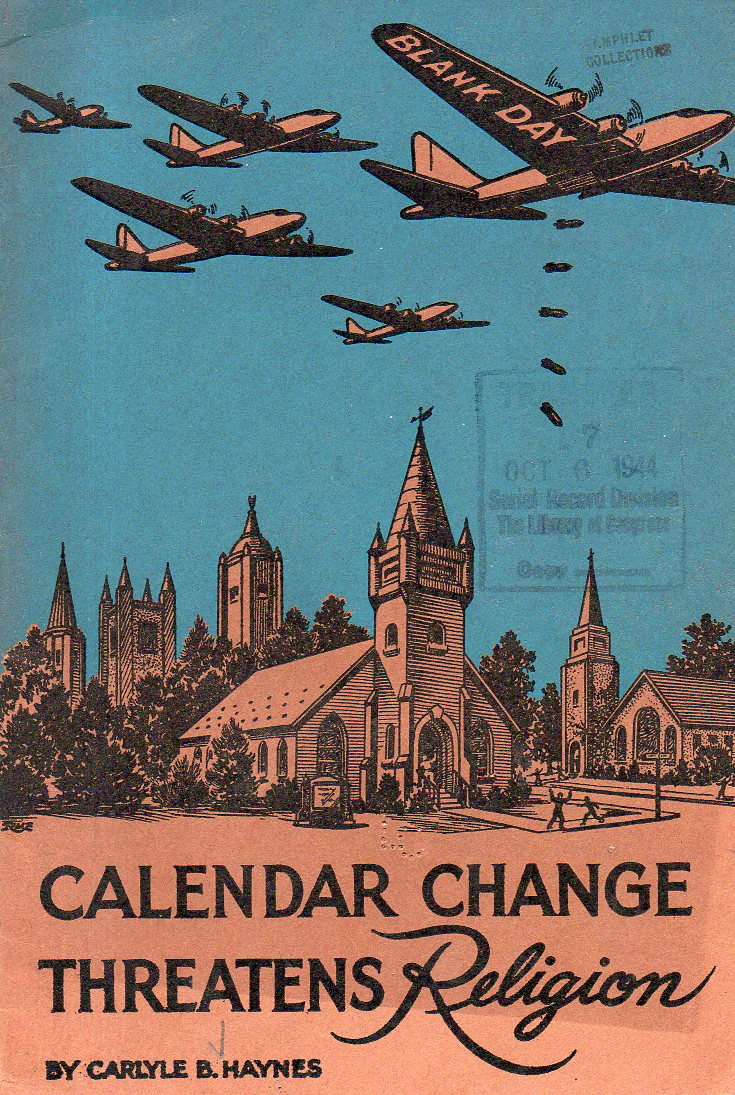
    Calendar Day079

    It was a secret mystery as to what might be hidden in this pamphlet with the striking and unusual cover…I had a hard time imaging what the work was about, and never did really come close.  It turns out that the bombers dropping their payload on a skyline of churches from an impossibly low altitude in a Seussian-blue sky were dropping “missed Sundays” on churches.  

    Carlyle B. Haynes, the author of the work, was warning religious people about a movement at work to change the calendar of the world–in effect, it would “even out” the months, and the quarters of the year, so something more, well, “efficient”(?)  And to get there it would entail “kicking out” the last day of the year of 1943–a Sunday, the “blank day”.  The fear here was that Sundays from then on into infinity or as long as this new calendar was being used would be upset, and that Sundays would no longer be so, the calendar upsetting a calendrical system that “stretched back to Creation”.  

    It seems that the main fear would be that the “true Sunday” would be somewhere else in the calendar, that Sunday would actually be Monday or any other day in the week, and thus an attack on religion, in general, by a “wandering” religious day. 

    Mr. Haynes wrote a number of pamphlets on religion (including another work similar to the above called World Calendar Versus World Religion), and seems to have had long evangelical roots.  But in knowing a little bit about the history of recording and keeping time, and dates, and the calendar, and the history of the seven day week and the long international history of the observance of the seventh day for religious purposes, I am having a hard time understanding exactly what Mr. Haynes was trying to say in this work.  

    ·Posted by :

    ·in:


  • Bitter Cold Edvard Munch Weather Maps, 1896

    JF Ptak Science Books   Quick Post

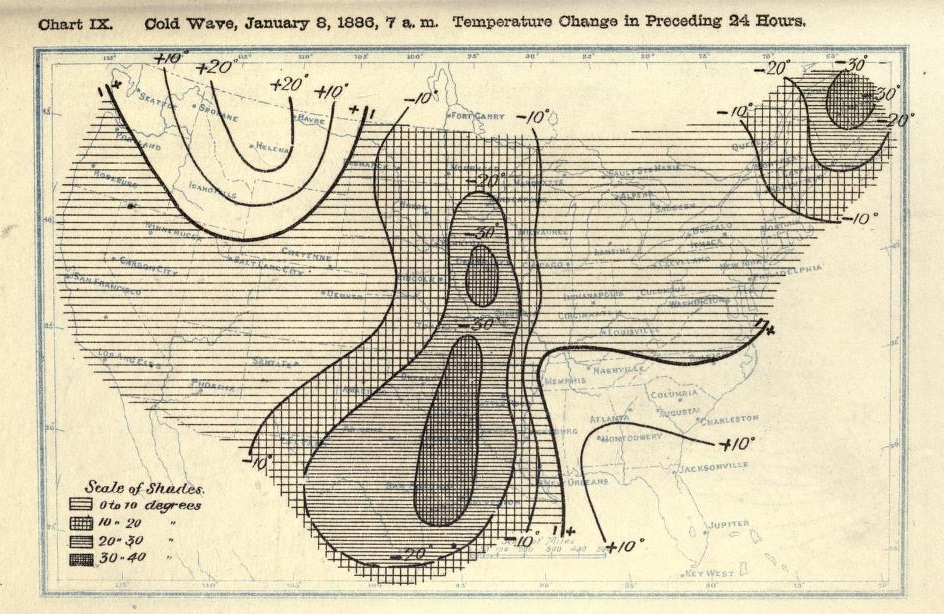
    Weathermapsillus00moorrich_0015

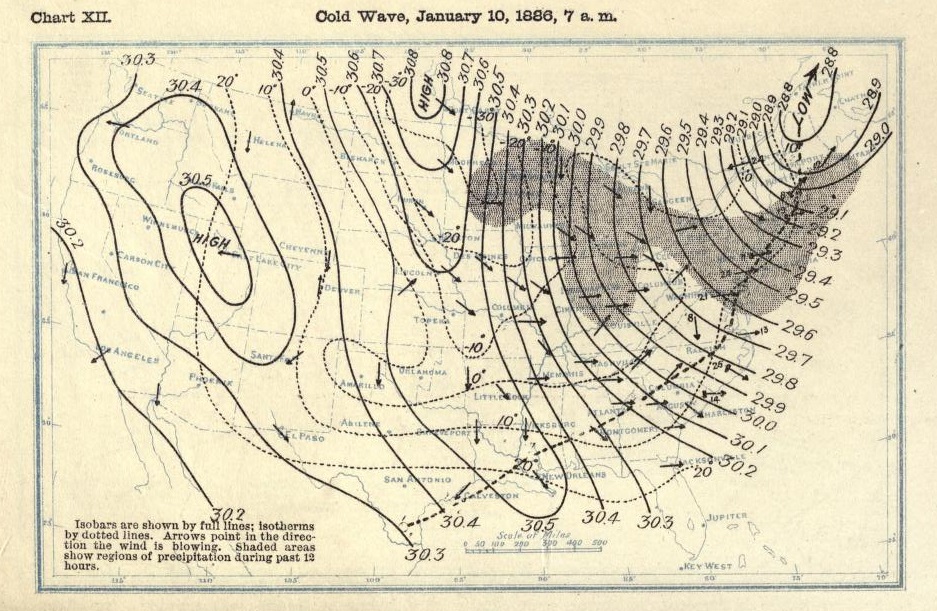
    Munch–that is the first thing that came to mind on seeing these maps from Willis Luther Moore’s Weather Maps Celebrating s Lecture on Storms and Weather Forecasts (“Delivered under the auspices of the Men’s Association of the Brown Memorial Presbyterian Church…Baltimore, Maryland, Monday, November 16, 1896, P.M.”)  Others may not see it, but I do see “The Scream” in there, in America’s heartland, in glorious black-and-white.  And screaming they should have been–that winter in January 1886 was brutal, calling for 30 below zero in places like the appropriately-named Jornada del Muerto in Texas. In any event the maps are really quite lovely, and not really “early” anymore for weather maps of such detail (these maps beginning to appear in the 1840’s and becoming pretty accurate placeholders of weather memory by the 1880’s. 

    Weathermaps cold front


  • The Newspaper Frontier, 1880: Cutting Texas (Almost) in Half

    JF Ptak Science Books   Post 2240

    The idea of the frontier in American history has been around for quite some time, made famous and mostly-invented (and closed) by Frederick Jackson Turner in 1893, and expanded, imagined, enticed, magnified, micro-analyzed, and  generally messed with ever since.  There have been all sorts of frontiers introduced into the study of the birth, expansion and filling-up of this country, from the very earliest colonial periods of Indian frontiers, “far-western” river frontiers of the Connecticut, Delaware, Hudson (!) and Susquehanna, to the Appalachian frontier of the early western reaches of the colonies, to the transportation frontier, the slavery frontier, the gold and mining frontier, the gun frontier and so on.  

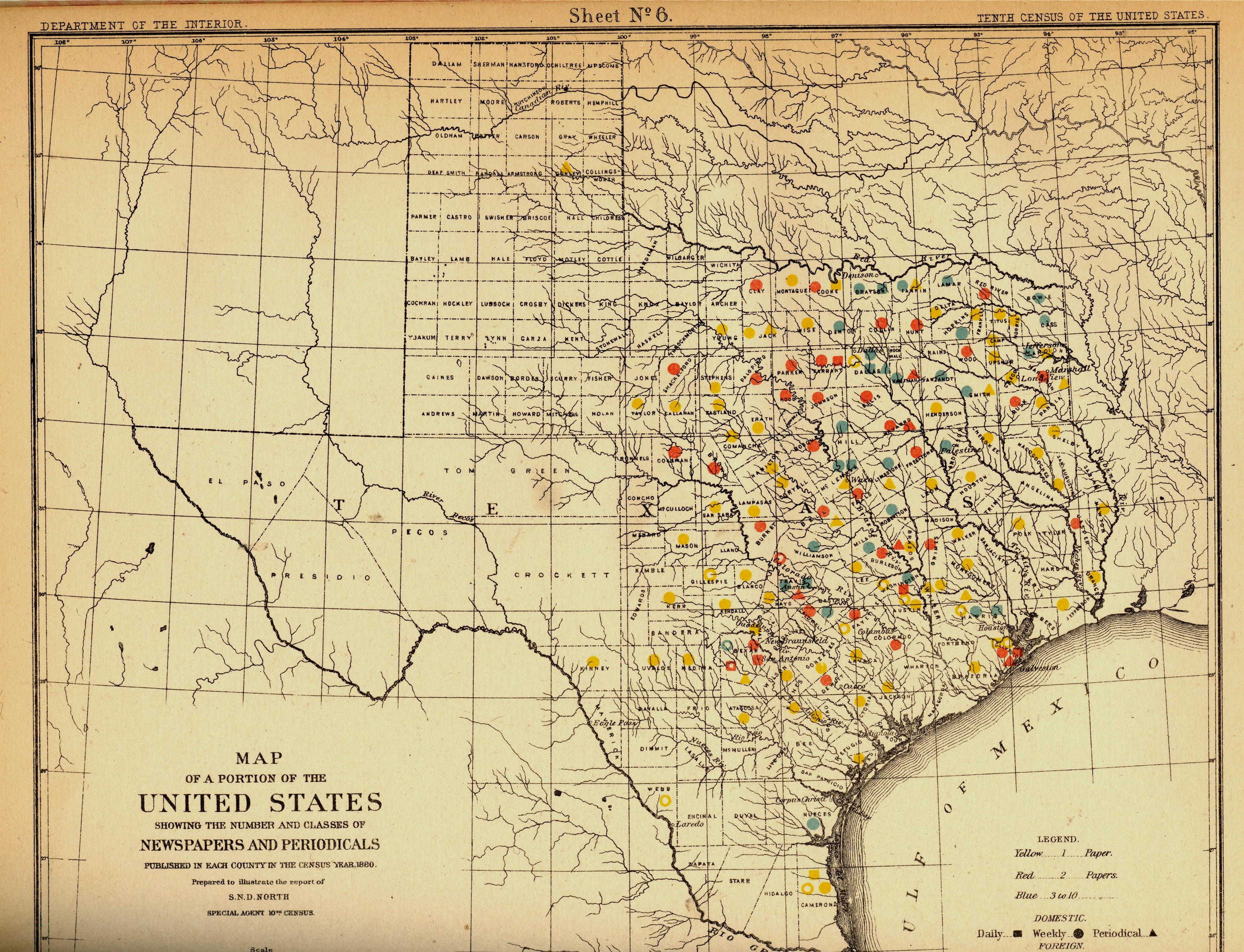
    TExas newspaper

    I’ve got another bit to add:  the newspaper frontier.  

    I just happened upon a volume of the US Census of 1880, with a special report by S.N.D. North entitled History and Present Condition of the Newspaper and Periodical Press of the United States…and published in 1882.  What provoked me was the map of Texas newspapers for 1880.  It very clearly, and like no other map of its kind, delineates a fantastic line/frontier between the Texas with newspapers and the Texas without newspapers. We see very clearly that the frontier of the newspaper stops fairly abruptly (and wonderfully) at the 100th meridian, with only two newspapers in all of the rest of Texas found beyond that point (and those just barely beyond the 100th.  And it’s the 100th meridian that mostly marks the vertical middle of the country, running through North and South Dakota, Kansas, Nebraska, the Texas/Oklahoma borders, and so into Texas—if you folded this map vertically in half it folds virtually on the 100th meridian.  An odd bit, it is, half of the country and then approaching half of Texas. 

    I should report that the newspapers west of the 100th meridian were in Kinney County (population 4,440) with the Fort Clark News (established in 1880, at exactly the year of census) and Donley County (population 160, with the monthly Clarendon News and a 50-cent annual subscription rate).  The newspaper development also sort of followed the frontier fort development, almos tall of which (but four) were east of the 100th. 

    Of course the population and easier-natural-resources are located east of this point, I know, but it is still quite a jolt to see the line of newspapers get drawn in the sand so vividly.  There isn’t anything else quite like this so far as the newspapers go, except, a little, for Florida, where the line gets drawn north and south, splitting the peninsula roughly in half, the southern part holding only five counties at this point..  But it is a much more robust image for Texas given the number of newspapers that were being published—280 periodicals and newspapers for Texas versus 45 for Florida, with 11,374 in the entire country*—so that the difference between the have-newspapers and haven’t-newspapers in Texas is that much more vivid. 

    Texas needed more papers:  there were 1.5 million people living in the massive state in 1880, almost twice as many as there were in 1870, and almost half of what there would be there in 1900. That was another story, entirely—even in 1880, which is only 130 years ago, there were only 270,000 people living in the entire state, not even close to half of the county population of Pinelas today.I’m just enjoying the surprise of the straight-edge frontier in Texas. 

    The deal too was that Texas wasn’t at the top of the lisst for average area for each publication per square mile, with each periodical providing coverage for 936 miles. But that again is for Texas east of the 100th meridian–throw in the rest of the state, and that number skyrockets. (There were 13 states with a higher mileage distribution than Texas, topped by Indian Territory,m with basically nothing, with each paper servicing an area of 21,000 square miles.  

    Also, Texas’ 225 counties had 119 counties publishing newspapers and/or peridoicals, compared to the national figures, which were 2,605 counties and 2,073 publishing papers.  

     *Just for the sake of comparison, the number of newspapers and periodicals per state for 1880 was as follows: Illinois, 1017; New York, 1411; Pennsylvania, 973; Ohio,  774; New Jersey 215.  Also, oddly, the average circulation of the Florida and Texaspapers was roughly the same: 1,282 for Texas and 1306 for Florida (with an average for the country at 4137). 


  • German Propaganda in Sweden, 1943

    JF Ptak Science Books   Post 2239

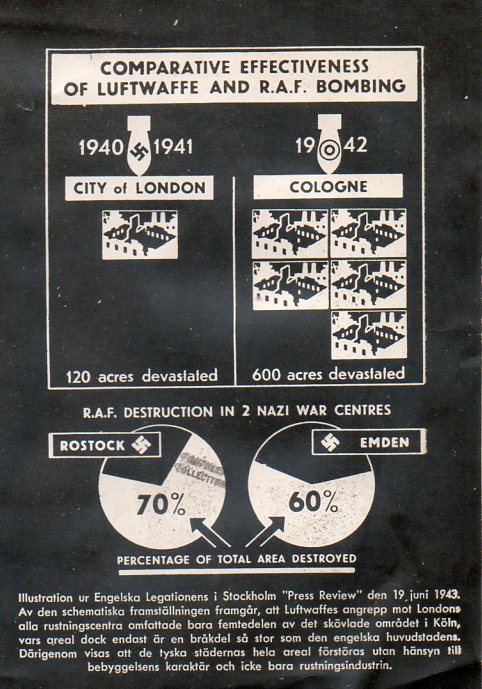
    “Sveriges folk vet inte mycket om alt detta”/Swedish people do not know much about this…” 

    This is an unusual graphic–or at least a graphic display of information found in an unusual location, a publication in Swedish quoting sources from the Free Press from Stockholm (19 June 1943) on the effectiveness of Luftwaffe vs R.A.F. bombing.

    It is supposed to be a graphic proof for the ferociousness of the Allies, published in a pamphlet called Konst i  spillror (roughly, Art and Rubble, or Art in Rubble, something like this) which I believe was a German attempt to win Swedish hearts and minds by displaying the destructive force of teh other side of the war. The subtitle of the pamphlet is on the destruction of European cultural treasures in Antwerp, Nuremberg, Koln, Lubeck, Karlsruhe, Munich…plus bombed cemeteries, schools, hospitals, and so on. The locations are in Germany, mostly, or German-held areas, and decry the barbarity of the war in the hands of the British, Canadians, and Americans.  

    WWII graphic077

    I do not have proof of this as propaganda, but it certainly feels like it.  Sweden was a neutral country during WWII, managing to maintain its neutrality for the entire conflict. There were evidently soem concessions made to both sides–for Germany the major bit seems to have been allowing the German 163rd rail transport across Sweden in the attack on the Soviet Union (which I imagine was an enemy of my enemy move). On the other hand the Swedes accepted Jewish refugees from Norway and accepted all of the Danish Jews who were supposed to be sent to concentration camps.  I can understand the Nazis wanting to try to make inroads into the national psyche, but I have a hard time imagining that this campaign succeeded on any level. 

    My copy is a photographic negative of the original, made during the war, and was once part of the Library of Congress Pamphlet Collection.  As I said, I could be wrong in this interpretation, but I feel fairly confident that it is so.


  • Criterion of Reality, 1880 and 1935

    JF Ptak Science Books  Quick Post

    On a graze through the journal Nature (still the same Nature as today’s publication, the journal at this point being already 12 years old) looking for an article by the great W. Stanley Jevons on the aurora borealis (and the fluctuations of magnets), I bumped into the following short notice:


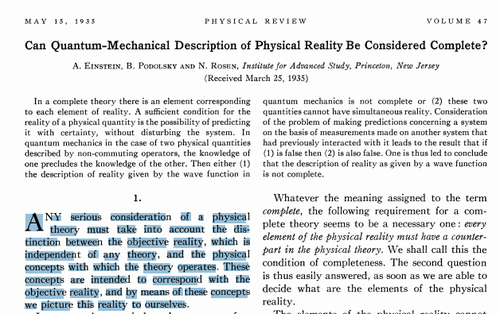
    And this, from one of the most-cited articles in the history of the Physical Review:

    “If, without in any way disturbing a system, we can predict with certainty (i.e., with probability equal to unity) the value of a physical quantity, then there exists an element of reality corresponding to that quantity.”–Einstein-Podolsky-Rosen,”Can Quantum-Mechanical Description of Physical Reality Be Considered Complete?” Physical Review, volume 47, May 15, 1935, page 777. Full text via the American Physical Society.


    EPR


    ·Posted by :

    ·in:


  • Ghosts and Neutrinos, 1930

    JF Ptak Science Books  Quick Post

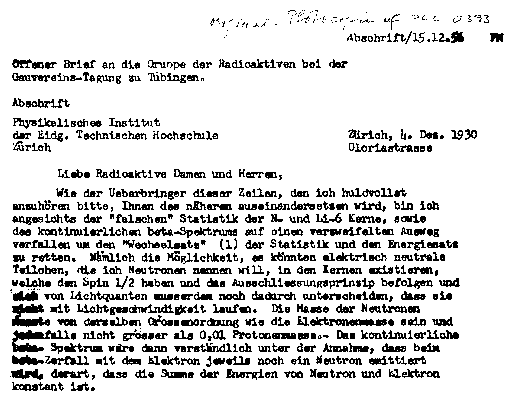
    I wanted to reproduce Wolfgang Pauli’s letter of 4 December 1930–in it he thinks very widely of missing stuff, of some of the basic bits of the universe, in a rather open and guarded way, about the ghost of the neutron.  He didn’t feel very comfortable with his ideas yet, at least for professional consumption–that would have to wait another three years when it was discussed at the 7th Solvay Conference (1933) and another three when it first came into print (1936). The name “neutron” would also be changed to the familiar “neutrino” (“little one”) by Enrico Fermi in 1933 to differentiate it from the much larger nuclear particle discovered the year earlier by James Chadwick–Chadwick’s paper was published in Nature, which would reject Fermi’s paper in 1934 as too radical a leap. 

    Pauli letter

    [Source: Exhibition of the ETH-Bibliothek to the occasion of the 100th birthday ofWolfgang Pauli  http://www.library.ethz.ch/exhibit/pauli/neutrino_e.html]

    ·Posted by :

    ·in:

    —