A Daily History of Holes, Dots, Lines, Science, History, Math, Physics, Art, the Unintentional Absurd, Architecture, Maps, Data Visualization, Blank and Missing Things, and so on. |1.6 million words, 7500 images, 4.9 million hits| Press & appearances in The Times, Le Figaro, Mensa, The Economist, The Guardian, Discovery News, Slate, Le Monde, Sci American Blogs, Le Pont, and many other places… 5000+ total posts since 2008.

Author: JF Ptak

  • Abbreviating Auschwitz: the Construction Contract for the Building of Auschwitz III

    JF Ptak Science Books 

                        1blogsept_23_astro_det641_2

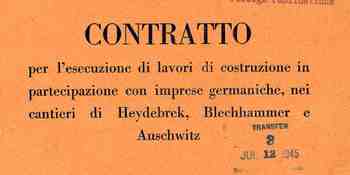
    This document of death, this pamphlet is the Auschwitz III Construction Contract between IG Farben and the Confederazione Fascista degli Industriali for Construction of the Buna Works at Auschwitz III, as well as construction at Heydebrek and Blechhammer, and was printed in 1942.  I’ve only been able to scan five pages as the document is fairly weak and I have a flat bed scanner–I just don’t think it would take much more abuse without falling out of its binding.  But I have scanned some of it, notably the participatory Italian companies and some of the allocation of workers to the different concentration camps.
    1blogsept_23_astro_cvr_detail643

     
    The full title reads of the work reads:

    Contratto per l’escusione di lavori di construzione in partecipazione con imprese germaniche, nei cantieri di Heydebrek, Blechhammer e Auscwitz. It was printed by Tipografia del Gianicolo, in Rome, 1942, by the Confederzione Fascista degli Industriali, Federazione Nazionale Fascista Raggruppamento Germania.  The document measures a fragile 30.5 x 21 cm,  and is 29 pages long.  Like dozens of thousands of other things here at the store, this was formerly in the “Pamphlet Collection” of  the Library of Congress (which received the publication 12 July 1945) until we purchased the collection at the end of 1999.   
    Auschwitz_12map

    This is also probably the most awful thing I own.  Its like looking at those blueprints for the crematoria and the barracks–so precise, swimming in their blue pool, these concise, sure, white lines; designs for one of the worst things built in the 20th century–just drawings, lines on a long sheet of paper, for building something.  Completely removed from the breathing world, just cold logical constructions for someone else’s end.  That’s the feeling I get from handling this thing–the Italians and Germans figuring out where to put the thousands of workers, making sure that they get paid, providing for some sort of maintenance for the workers’ health, salaries, benefits, work schedules, breaks, vacations, incentives, mailing and the post, and so on.  All of the bits of the most mundane things that go into a large construction projects, like building a highrise, or a tunnel, or a highway, or a bridge to hell.  This contract could’ve been for just about anything at all.  But it isn’t.  Its for building a part of Auschwitz when anyone with any sense whatsoever knew what was already going on there.

    Of the many terible things in this document I was really bothered to see Heydebrek, Blechhammer and Auschwitz abbreviated at the top of some of these pages.    This is just so wrong. Wrong on every level, being an attribute of the nothingness, of the emptiness, of this document. 

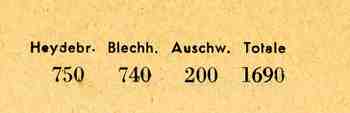
    It is a simple, basic document on one of the least simple and basic things of the 20th century.  The contract detailed labor expectations, needs and regulations from both the German and laboring Italian sides for the construction of these three concentration and slave labor camps in 1942.   Subjects of interest in this document include salaries, housing, vacations, health care and insurance, as well as the application of German laws to the workers, qualifications, and classification of occupations.

    Perhaps the part of most interest is the short list—reprinted below—on pages 3 & 4 of the firms and engineers taking part in this agreement..

    ***

    The names that are attached to this document and signing off on the contract of this agreement (of 2 March 1942  which provided 8,636 Italian laborers for this construction) include:

    1)    for IG Farbenindustrie AG, Heydebreck, Heydebreck OS
    Adolf Mueller and (Hans) Deichmann

    Hans Deichmann served as (senior) legal representative for IG Farbenindustrie in Rome and Milan from 1942 to 1945 and in 1942 was responsible for recruiting Italian workers for construction in the above-named concentration camps.

    2)    for Oberschleische Hydrierwerke AG, Blechhammer, Kreis-Consei       
    Schlick

    3)    for IG Farbenindustrie AG Auschwitz, Auschwitz OS
    Adolf Mueller and (Hans) Deichmann

    The signatures representing Italian interests include:
    Aurelio Aureli
    Giacomo Milella

    Notes:
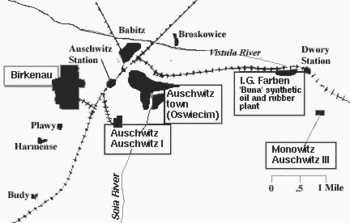
    –Blechhammer was a satellite camp of Auschwitz III (Monowitz)
    –Auschwitz III, also called Buna or Monowitz, was established in nearby Monowice to provide forced laborers for the Buna synthetic rubber works. The German conglomerate I.G. Farben established a factory in order to take advantage of cheap concentration camp labor and the nearby Silesian coalfields. It invested more than 700 million Reichsmarks (about 1.4 million U.S. dollars in 1942 terms) in Auschwitz III.

    On Italian labor being used at Nazi Concentration camps, as found in Vol  VIII, pg 749, 
    Nuremberg War Crime Tribunals:

    Q. Did you go to ter Meer* to get Italian workers — I am thinking of a prosecution exhibit, the one which was shown to ter Meer on cross examination.

    A. I was told at the time by an official source that Italian industry, after the collapse, would no longer produce because there was no coal, no current, or something. I was also told that since the Italian State obtained goods from Germany — buna, for example — the Italian State would be willing to enter into an agreement with Germany to make labor available, as was always the case from Italy. I said to him: “In case that is so” — neither ter Meer nor I knew whether that really would be the case — I said, “help the people at Auschwitz; help them to get workers if now” — I believe this was in 1944 — “the plants gradually go into operation.” For in these plants we wanted to have skilled workers — as I said yesterday, it is very important whether or not the man in charge has knowledge of the work he is doing.   –Vol  VIII, pg 749,  Nuremberg War Crime Tribunals. 

    *”Fritz ter Meer served on the IG Farben [Farben was Hitler and Hitler was Farben. (Senator Homer T. Bone to Senate Committee on Military Affairs, June 4, 1943.] board of directors from 1926 to 1945 and was the head officer directing the operations of the IG Farben factory at Auschwitz. The Nuremberg War Crimes Tribunal sentenced him to seven years in prison. He was released after serving only four years. Not long after, in 1956, Ter Meer was elevated to the chairman of the supervisory board at BAYER, a position he held for seven years. His grave in Krefeld has a meter-high wreath on it – donated by BAYER in recognition of his services.”

    ·Posted by :

    ·in:


  • An American Exodus

    JF Ptak Science Books  Post 2244

    LAnge migrant detail

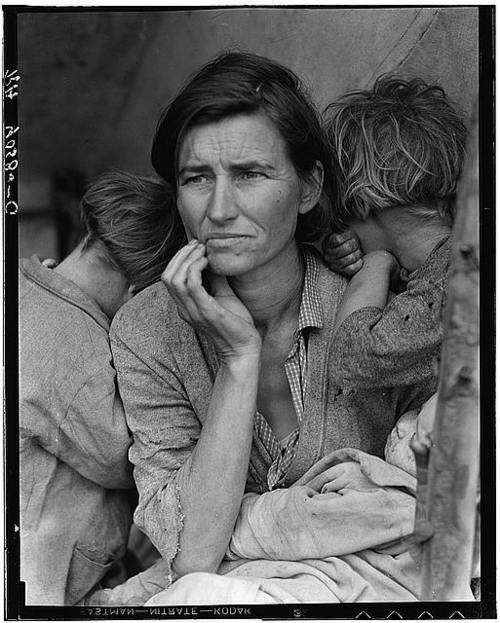
    Everyone knows this image: the Madonna of the American 1930’s, the Migrant Mother, a photograph made by Dorothea Lange, a photographer for the Federally-funded Farm Security Administration. Lange was still very new to the FSA project when she made this photograph in the spring of 1936. On the tail end of a month-long road trip she was nearing the end of her day when she spotted a hand-lettered sign “Pea-Pickers Camp” by the side of the road. Lange briefly considered stopping but went ahead, questioning her judgment continuously for the next 20 miles, when she finally turned around to find the turn-off for the camp. She drove down the dirt road and found a ramshackle assembly of tents, one of which contained “an exhausted mother sitting forlornly with her children”. Lange spent only 10 minutes with the woman, making five exposures. She learned that “the crops had frozen, and the woman and children were living on vegetables scavenged from the fields, and the few birds that the children managed to catch. The mother could not leave; she had sold the tires from her car”.  It was published almost immediately and quickly became one of the great iconic images of the Depression, as well as for the American century.  

    Lange migrant mother

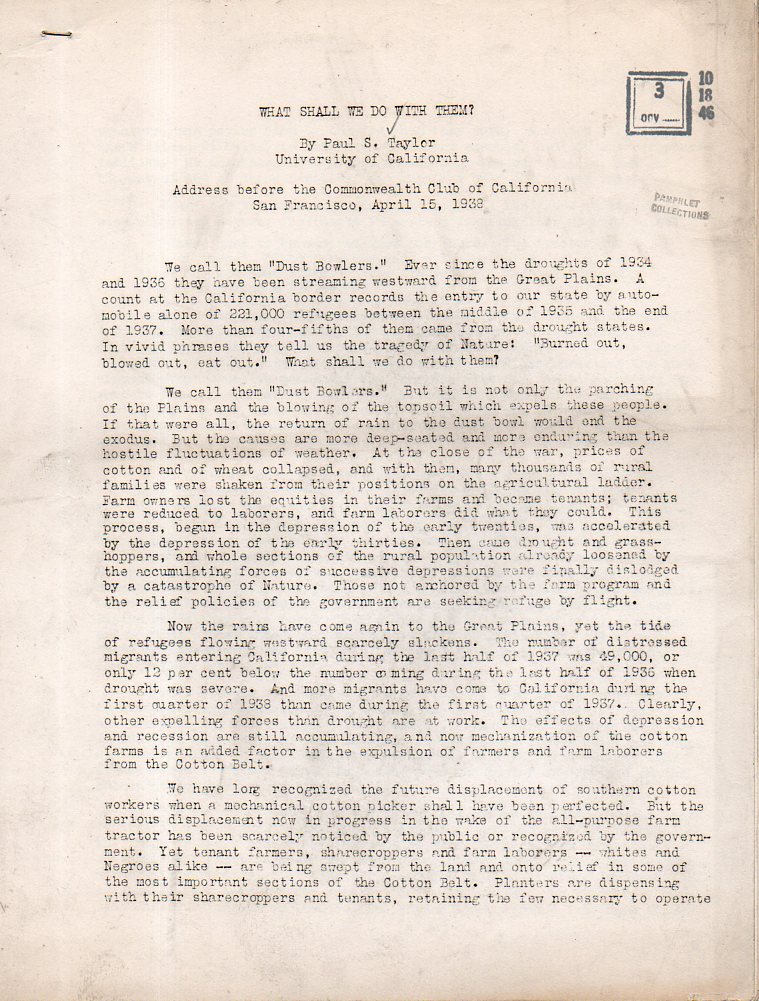
    I was thinking about this because of a typewritte, offset-printed pamphlet I bought written Paul S.Taylor, “What Shall We Do With Them” ( an address before the Commonwealth Club of California, San Francisco, April 15, 1938)–the “Them” being the dustbowler, the migrant workers, the disposed.  Paul Taylor was at this time three years into his marriage with Lange—he was a progressive thinker and a FSA operative who helped Lange land her job and was a part of an extraordinary team of very expansive ability that documented a pivotal period in American life. He was also co-creator with Lange of their great documentarian centerpiece of the 1930’s, An American Exodus, a Record of Human Erosion, which was published in 1939, the same year as the publication of The Grapes of Wrath and the release of the Wizard of Oz and Gone with the Wind. (Two years later–1941–James Agee (text) and Walker Evans (photographs saw their long-developing Let Us Now Praise Famous Men was published.)

    In this pamphlet Taylor gave testimony on migrant workers and nearly the height of the Depression—he was an expert, having traveled and lived among them and written academic papers on what he found. He outlined possible answers to the question, which had mainly to do with stability, which of course was the primary concern for the many of thousands of individuals and families who were once-stable but now very mobile, not having place to live or places to go. Taylor thought that opening dams and supplying irrigation and affordable government-owned houses would be the first of many steps to take to relieve the widespread suffering.  In all of the alphabet-soup programs uundertaken by the Roosevelt administration, none were nearly as “successful” in ending the national social erosion as the events that were to unfold less than a year later.

    Lange travel sleep

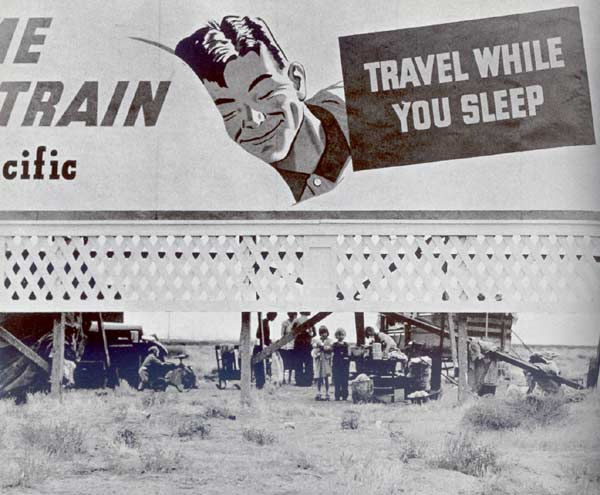
    Dorothea Lange “Three Families, 14 Children” US 99 San Joaquin Valley, California, November 1938. An American Exodus

    Taylor dustbowl092

    Notes:

    Lange describes her encounter with the Migrant Mother as follows:

    “I saw and approached the hungry and desperate mother, as if drawn by a magnet. I do not remember how I explained my presence or my camera to her, but I do remember she asked me no questions. I made five exposures, working closer and closer from the same direction. I did not ask her name or her history. She told me her age, that she was thirty-two. She said that they had been living on frozen vegetables from the surrounding fields, and birds that the children killed. She had just sold the tires from her car to buy food. There she sat in that lean- to tent with her children huddled around her, and seemed to know that my pictures might help her, and so she helped me. There was a sort of equality about it”. (From: Popular Photography, Feb. 1960).


  • A Beautiful Idea: the Knight’s Magical Magic Square Tour (1888)

    JF Ptak Science Books  Post 2243  
    Follow Me on Pinterest

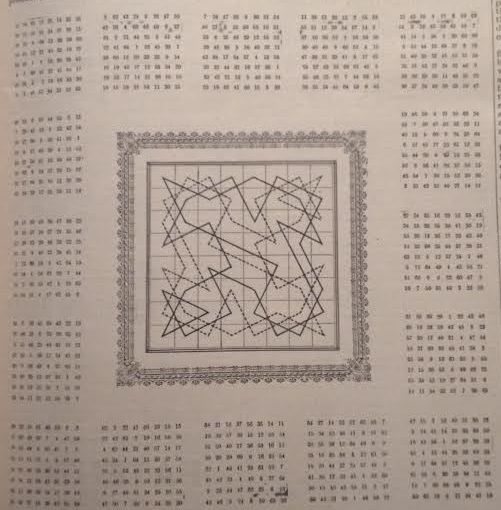
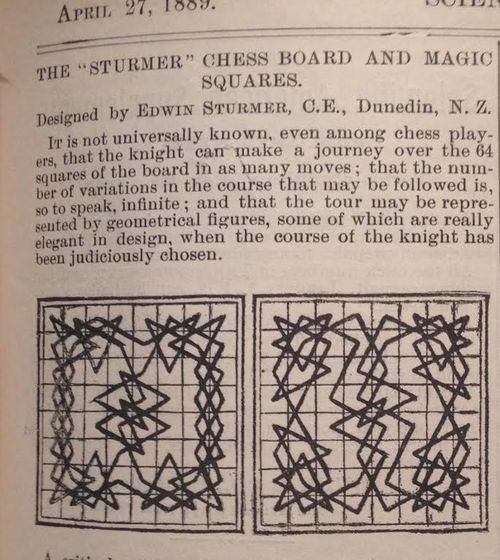
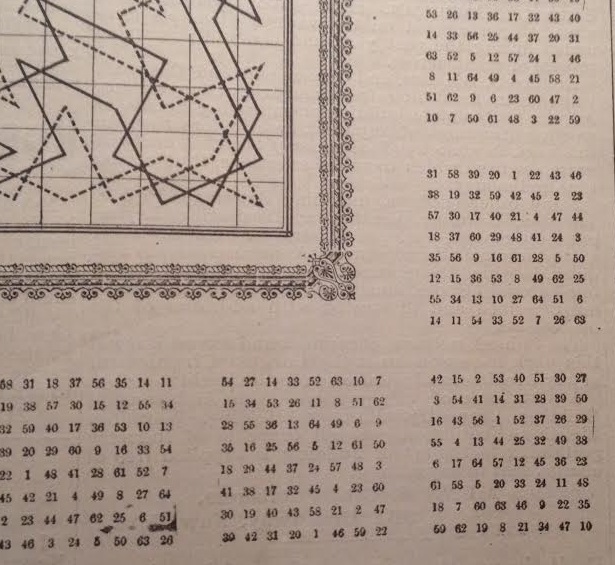
    The idea behind this extraordinary image below is the construction of an 8×8 magic square capable of describing BOTH the Knight’s tour (” a sequence of moves of a knight on a chessboard such that the knight visits every square only once…if the knight ends on a square that is one knight’s move from the beginning square) WITH the resulting moves forming a series of magic squares. It is the product of a Kiwi engineer named Sturmer, and appeared in the Scientific American Supplement for 1888.

    Sturmer2

    Eric Weinstein says in his article “There Are No Magic Knight’s Tours on the Chessboard” on Wolfram’s Mathworld site says, well, such a thing is not possible. “After 61.40 days of computation, a 150-year-old unsolved problem has finally been answered. The problem in question concerns the existence of a path that could be traversed by a knight on an empty numbered 8 x 8 chessboard.”

    Weinstein is concise: “Not surprisingly, a knight’s tour is called a magic tour if the resulting arrangement of numbers forms a magic square, and a semimagic tour if the resulting arrangement of numbers is a semimagic square. It has long been known that magic knight’s tours are not possible on n x n boards for n odd. It was also known that such tours are possible for all boards of size 4k x 4k for k > 2. However, while a number of semimagic knight’s tours were known on the usual 8 x 8 chessboard, including those illustrated above, it was not known if any fully magic tours existed on the 8 x 8 board.”

    Source:  http://mathworld.wolfram.com/news/2003-08-06/magictours/

    Sturmer


    Sturmer 3

    And this, from the British Chess Maagzine, 1888, page 278: 


  • Typewriter Art, 1899, and Kids with No Hero to Sing To

    JF Ptak Science Books  Quick Post

    Dewey090

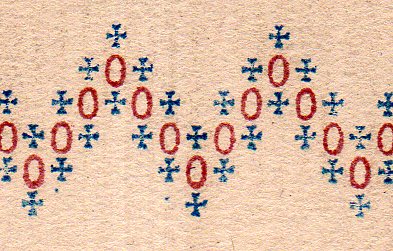
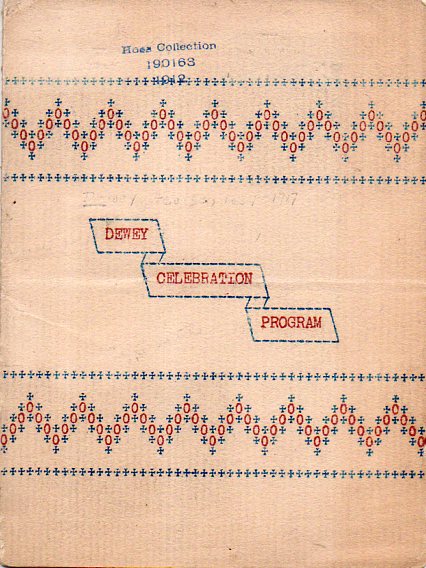
    I almost didn’t make a note of this pamphlet, interesting as it was for its design, until I found an associated New York Times article relating to it.  The work is only a small piece of standard paper folded in quarters snd containing the outline of the celebration of Admiral Dewey’s arrival at Staten Island, New York (October 29, 1899) and the parade and official bits that followed later in Manhattan.  Dewey is one of those historical figures who achieved massive rock stardom in his Dewey089day though that appeal did not translate much at all into our future.  Anyway this bit of ephemera is graphically decoration using just “+”, “0”, and “-“, which made it pretty unusual–I’ve seen some earlier examples of typewriter art, but suffice to say that after all of these years there have not been many.  

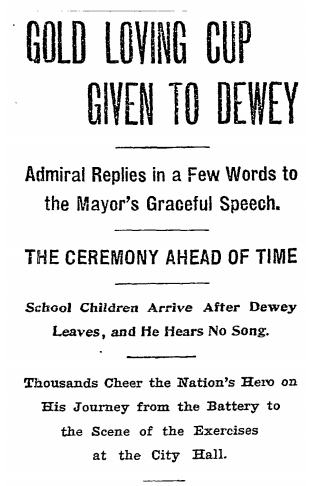
    In any event, checking out the story for the year (the pamphlet doesn’t mention one) I came into the NYT article with the catching and proto-poetic sub-sub-head, “The Ceremony Ahead of Time/School Children Arrive After Dewey Leaves, and He Hears No Song”.  There were 2,500 kids on their way to sing to the admiral, but he started early and finished quickly with his remarks, and then pressed on for the rest of the day.  The kids got there on time to no avail.  


    Dewey


    Dewey091


  • A Magazine By and About “Factory Girls”, 1845

    JF Ptak Science Books   Quick Post

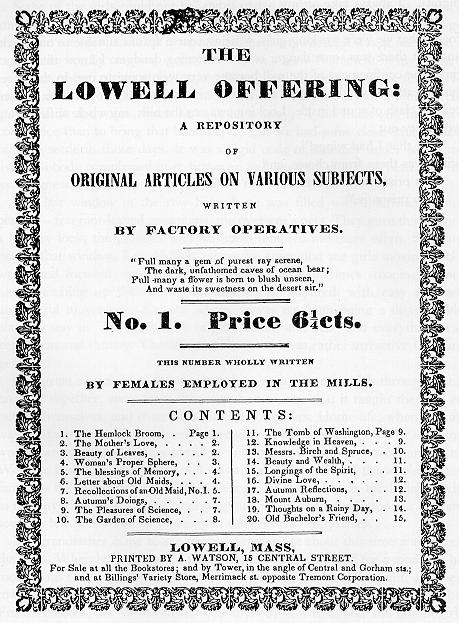
    The Lowell Offering is an extraordinary publication, featuring in its editorial and production and writing staff the women who worked in the many factories in Lowell, Massachusetts.  It didn’t start out that way–it was an ordinary-ish journal begun by Reverend Abel Charles Thomas (1807-1880, and pastor of the First Universalist Church) in 1840 and filled with popular notions and polite works by the locals.  The tables changed in 1842/3, and the writing was switched, the stories and fictions and observations made by the women of the factory, and the journal stayed that way until it folded in 1845. Women had been working in the mills of Lowell since it was Lowell, created by Francis Cabot Lowell, who got the place up and running in about 1823 as a model working community that hummed with hundreds of looms, making the area one of the leading textile producers in the world.  Actually, “hummed” is a poor selection of words–it was really more like a noisy bedlam, a cacophony of metal and leather, the background radiation so to speak of several generations of workers in America.  

    Lowell_Offering_1[Source:  Wikipedia.]

    “Lowell Massachusetts was founded in the 1820s as a planned manufacturing center for textiles and is located along the rapids of the Merrimack River, 25 miles northwest of Boston. By the 1850s Lowell had the largest industrial complex in the United States. The textile industry wove cotton produced in the South. In 1860, there were more cotton spindles in Lowell than in all eleven states combined that would form the Confederacy. Mind Amongst the Spindles is a selection of works from the Lowell Offering, a monthly periodical collecting contributed works of poetry and fiction by the female workers of the textile mills. The Lowell Mill Girls, as the workers were known, were young women aged 15-35. The Offering began in 1840 and lasted until 1845. As its popularity grew, workers contributed poems, ballads, essays and fiction. The authors often used their characters to report on conditions and situations in their lives and their works alternated between serious and farcical…”

    To the Factory Girls

    “We cordially invite the Factory Girls of Lowell, and the operatives and working people generally, whether they agree with us or not, to make the Voice a medium of communication; for it is your paper, through which you should be heard and command attention. The Press has been too long monopolized by the capitalist non-producer, party demagogues and speculators, to the exclusion of the people, whose rights are as dear and valid.”1845.11.07 Source:  Industrialrevolution.org, which has MUCH else of interest. 

    A good introductory selection from The Lowell Offering is TALES OF FACTORY LIFE, No. 1 [from Lowell Offering, 1841], here.

    Workingmen Publishing a Paper?

    “What! Those Workingmen Publishing a Paper?—Yes, friends, as strange as it may seem, “Those ignorant Workingmen” have come to the singular conclusion, to do some of their own thinking, reading, and talking. We have lived long upon the dear bought teachings of those who measure cut their knowledge according to our goal, and as this is getting rather scarce we think duty demands, that we should stir up our ideas, and see what things we have stowed up rusting away, which may be of some little value to ourselves and a portion of the community. Will you allow it?”  Source:  Industrialrevolution.org, again, 1845.05.29

    A very useful index with occasional links to articles can be found at the University of Massachusetts, Lowell  

    And Life Among the Spindles, located here.  And also here: http://www.gutenberg.org/files/37471/37471-h/37471-h.htm

    It is interesting reading, if not syrupy at times, and very highly sentimental (Dickens, in his tour of America in 1842, commented “Of the merits of the Lowell Offering as a literary production, I will observe…that it will compare advantageously with a great many English Annuals.”)–nevertheless there’s much in there to give an idea of what it was like as a lower-middle-class working stiff woman. Bottom line, it is a fabulous thing.  

    ·Posted by :

    ·in:


  • Fantastic Image of Germans on the Moon, 1918

    JF Ptak Science Books  Quick Post  WWI Photos

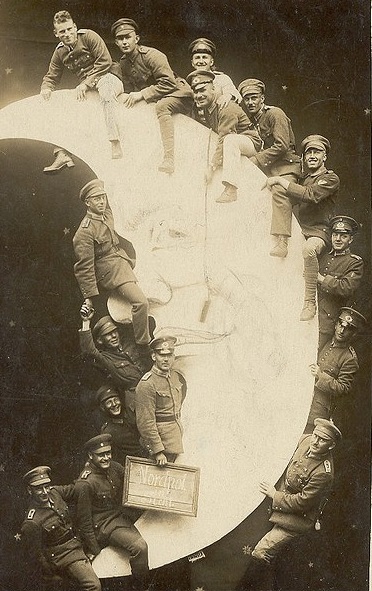
    Nearly all of the WWI photos that have appeared on this blog are from my own collection–this one, this fabulous one below, is not.  It is a fantastic image that I think would bring up notions of crazy proofer types looking to establish the idea that Nazis actually went to the Moon and have been hiding there since 1945–but no. it is just a great photo.  Also:  I’ve seen a number of photographic postcards like this from folks at a country fair or some such thing, having their picture made sitting with the Man in the Moon–soldiers included.  But I’ve never seen one with this many people involved.  

    WWI--soldiers on moon[Source: Odd History, Pinterest account, here.]


    ·Posted by :

    ·in:


  • On Obviousness–a Very Obvious and Empty Not-Magritte’s Hat

    JF Ptak Science Books  Quick Post

    ABsurdist HAt

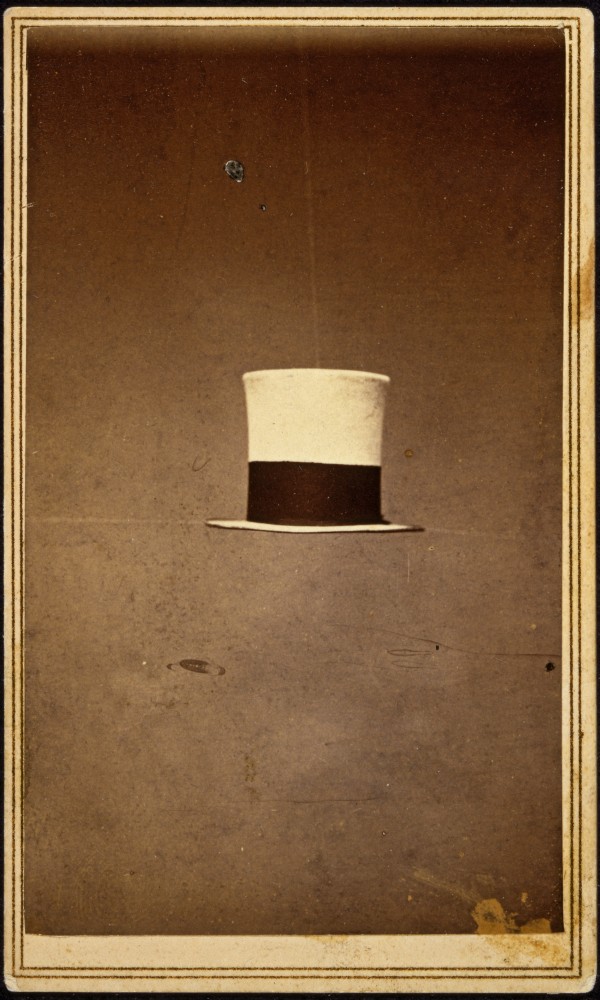
    [Source: “Eli W. Buel (American, active ca. 1870) Top Hat, ca. 1870, albumen print carte-de-visite, museum purchase, George Eastman House”, here.]

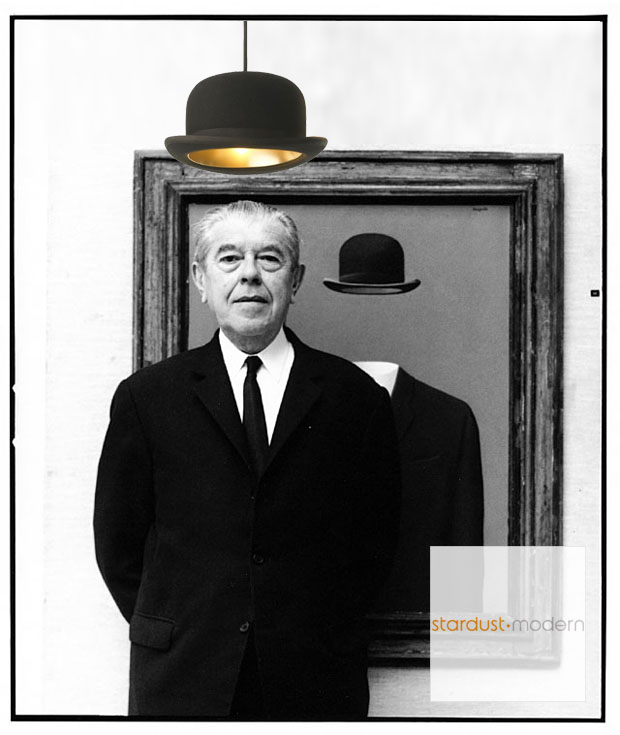
     This is a great example of “everyday objects shriek aloud” as Magritte said somewhere along the path of his life.  I thought about him right away seeing this much earlier vision of a floating hat and that it fit somehow into a Melville (“I would prefer not to”) Duchamp (“This is not a pipe”) and Magritte continuum:

    Magrittwe[Source:  Stardust Modern Design]


  • Broadcasting Close-ups of pre-Chuck Close, 1923

    JF Ptak Science Books  Quick Post  Part of the History of Dots series

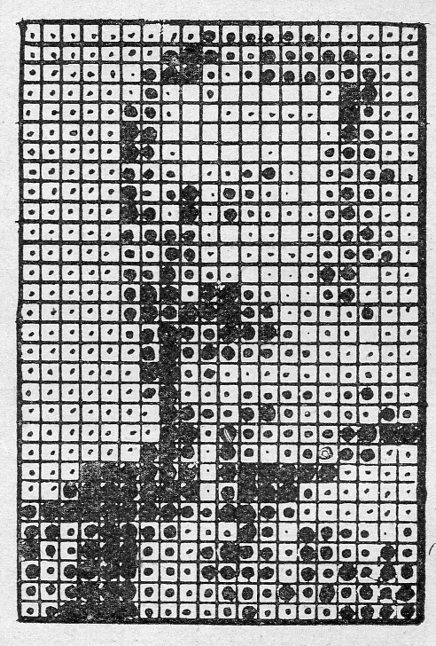
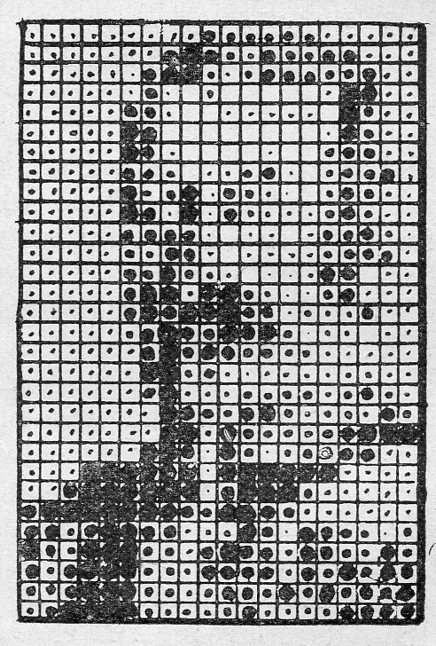
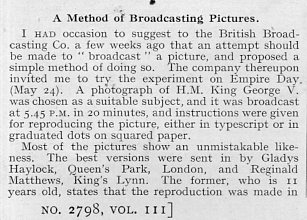
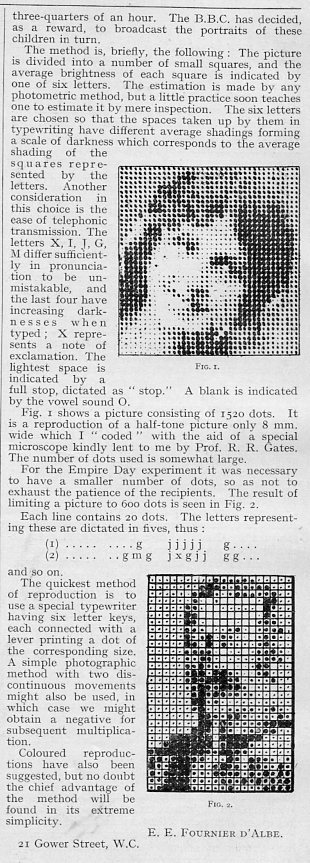
    Well, that’s a tricky title, and not quite right, but bits and pieces of it are.  Chuck Close up-close looks much different than this–more likely this image looks more like an early half-tone.  (You can really say that it looks like Seurat [dead at 32!] because it is in black & white and he was all about color.) What the story is is that this tells part of the story of broadcasting pictures by wireless–and the picture below, the picture that will develop after a little bit of removal and a lot of imagination, is that of King George V, the product of disseminating 1,500 dots in a 15-minute broadcast.  The full not-easily explained explanation is below, starting in the third paragraph.  

    Broadcasting pictures085[Source, Nature, June 16, 1923, page 811.]

    Which is a big enlargement of the following, which moving back from it begins to come together like backing away from a close-up of a Chuck Close:

    Broadcasting pictures085

    The original is only about an inch tall–when seen in context, the picture becomes clearer:

    Broadcasting pictures083

    Broadcasting pictures084


    ·Posted by :

    ·in:


  • Fantastic Fish-Eye Portrait of Scientists, ca. 1855

    JF Ptak Science Books  Quick Post

    Scientist photo portrait

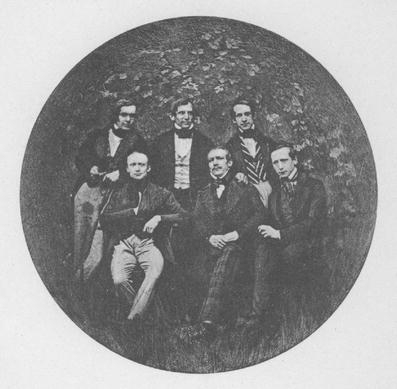
    The founders of the Physikalische Gesellschaft zu Berlin (1845, “Physical Society at Berlin”, which would become  the Deutsche Physikalische Gesellschaft (“German Physical Society”) in a lovely and very uncommon perspective, taken ca. mid-1850’s.  These founding membership pictured above included some first-class heavyweights in their fields:

    Top row: Gustav Karsten, Wilelm Heintz, Carl Hermann Knoblauch.

    Bottom row: Ernst Brücke, Emil du Bois-Reymond, Wilhelm von Beetz.

    [Source: a very interesting paper by Fritz Scholz, “From the Leiden jar to the discovery of the glass electrode by Max Cremer” published in the Journal of Solid State Electrochemistry  (Springer-Verlag, October 29, 2009, online). Apologies for not being able to link to this article behind the paywall.]


    ·Posted by :

    ·in:

    —

  • Early Bibliography for the History of Relativity, 1921

    JF Ptak Science Books     Reference Tools series

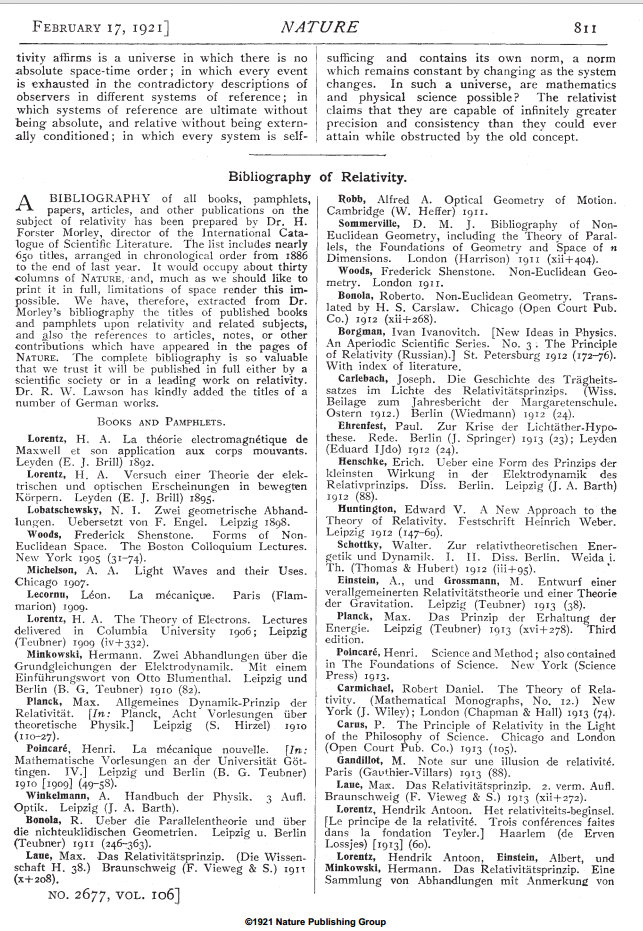
    This is a very unexpected find in the journal Nature for 1921–a selection from a bibliography by Forster Morley for early works in relativity, in this case limiting the number of selections from the full 650 Morley numbers to only those that appeared in some way in Nature.  Truncated or not, it is an interesting and early read in the area.  

    Relativity Nature Bibliog 1

    ·Posted by :

    ·in: