A Daily History of Holes, Dots, Lines, Science, History, Math, Physics, Art, the Unintentional Absurd, Architecture, Maps, Data Visualization, Blank and Missing Things, and so on. |1.6 million words, 7500 images, 4.9 million hits| Press & appearances in The Times, Le Figaro, Mensa, The Economist, The Guardian, Discovery News, Slate, Le Monde, Sci American Blogs, Le Pont, and many other places… 5000+ total posts since 2008.

Author: JF Ptak

  • Buck Rogers and the Failure of Imagery in WW-Last, 1946

    JF Ptak Science Books  Post 2246  [Part of the series on Atomic Weapons]

    Atomic war buck rogers683
    Atomic war buck rogers685
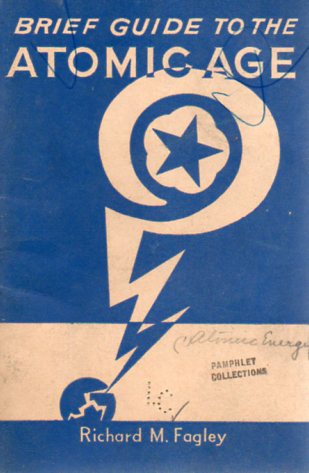
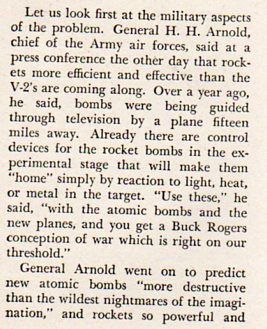
    Richard Fagley–author of Brief Guide to the Atomic Age, 1946– took a sleepy, elementary side step through the coming decade or so in the future of atomic weaponry.  The thing is, he got a bunch of it right.  But where he took a wide and missed turn, where he misunderstood the power of atom weapons, was that they would provide the future us with a “Buck Rogers” style of war.

    Now of course in 1946 the Soviets hadn’t developed a Bomb, but anyone who knew anything knew that it would be just a matter of time before they did.  Smart estimates were coming in at a decade or more–few people were prepared for the Soviet announcement in 1949 that they had achieved that goal

    Fagley missed the impact of atomic warfare of the future not on his own accord–he was quoting someone who knew far more and knew better–General Hap Arnold, the Commanding General of the U.S. Air Force.  But as it turns out, Arnold really didn’t have the vocabulary or this discussion, and couldn’t really estimate the “effectiveness” of the use of the new weapons. 
    Atomic war buck rogers684

    So far as I know, Buck Rogers didn’t have weapons like atomic bombs, at least I think in his original appeaarance as Anthony (and later “Buck”) Rogers in Armageddon 2419, back in 1928, when he made his first appearance. As it turns out Buck was born in 1898, and owing to a mining disster breathed in some radioactive gas that put him to sleep until the 25th century. He wakes up in a very jaundiced post-Yellow-peril world in which America has been defeated by the “Mongols” of the East (who had beaten the “Russian Soviets” who had in turn had conquered Europe), wherein begins his mighty struggle to get America back on its feet and defeat the great menace.  The idea of Rogers becomes very popular in popular culture, and he moves from this story into many other print versions, getting movies and a radio show (from 1932-1947) in the process. Somewhere in there is where he acquires his atomic pistol (called “U 235”), though the thing necessarily does not come close to what the real stuff would bring in the very near future.

    In Fagley’s war of the future there wouldn’t be many survivors, though his vision of the massive atomic bombing outcome seems not very proximate to what the horrible coarseness of what the real thing could be–perhaps because that amount of destruction was still unimaginable when the pamphlet was being written in 1946. Buck Rogers didn’t have the vocabulary for such enormous power and mass destruction, either. In any event, words to describe the coming possibility of vast annihilation just didn’t seem to be at hand in 1946–the words and ideas, and the weapons, would soon (in the Ulam-Teller hydrogen bomb, 1951) be at hand to flesh out the possible true-to-life nightmares of the nuclear future. Even in a 25th century armageddon, old Buck’s idea of power and devastation couldn’t come close to imagining the power of the real thing.  

    Buck Rogers Will Wake Up In A 3D Future image


  • Camouflaged Manhattan–a Map of Nationalities, 1895

    JF Ptak Science Books    Post 1343–expanded

    Frederick Erastus Pierce (1878-1935), is the creator of  The Tenement-House Committee Maps, with two maps on one sheet, showing the densities of Manhattan populations (on top) and the distribution of nationalities (at bottom) which was published in Harper’s Weekly for 1895.1 

    And a detail:

    Manhattan nationalities110

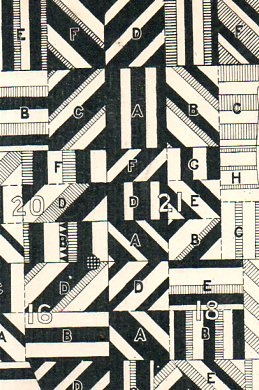
    The distribution of nationalities exhibited in this half-crazy quilt of varying blocks and densities reminds me a lot of the “razzle dazzle” camouflage used in WWI, as seen here:

    http://upload.wikimedia.org/wikipedia/commons/3/3d/SS_Empress_of_Russia_1918_cropped.jpg

    actually appiled on a ship, as well as this interesting artistic representation of the practice by Edward Wadsworth, Painting of Dazzle-ships in Drydock, 1919:

    File:Dazzle-ships in Drydock at Liverpool.jpg

    This sort of display of information has been around for quite a while–perhaps no example mor edistinctive than that found in the U.S. Census volumes for the 1880 census, a small detail of a chart showing the rise and fall of the populations of American states and territories over ten censuses (see an earlier post on this blog regarding this census atlas):

    Blogaugust_24_statesd_detail442_2


    [Please note–the images I’ve used for the post here–save for the details ahown above–are those for the copy at the Library of Congress.  My copy is actually a little nicer than these; I’ve used the LC images because the  map is just too big for the scanner.] 

    Text on verso:

    There’s a significant amount of crowded, complex information exhibited here, some somewhat more successfully than others.  The population density map is pretty straightforward.  The distribution of nationalities, however, is another story–there are eleven groups followed here, each given a bit of a confusing flavor, given that the representations are done in black-and-white.  Its difficult data to present, especially considering that the groups shown could vary block-to-block, and that the population of Manhattan at the 1890 showed 76% with foreign-born mothers and 40+% of the city foreign-born themselves.  (It should be noted that only the groups with 2/3 of the base of any particular zone has bene plotted.)

    Detail of bottom map:

    Much of this population–a good chunk of the city’s 1.9 million people–were housed in tenements, a pre-high-rise pre-elevator version of the highrise.  They were six or seven story walk-up buildings that were narrow (usually about 25-35 wide) and long (100-125+ as an average). There were 10-14 rooms per floor, and were generally packed with families.  A massive expose on the tenement house was photographically depicted in “The Tenement House Exhibition of 1899”, the un-pretty picture described below by Lawrence Veiller in Charities Review   in 1901: 

    “It has shown, step by step, the different changes that have taken place in New York tenement houses, and by means of 1,000 photographs has illustrated nearly all the evils of the present tenement-house system. Special emphasis has been laid upon the terrible evils of the dark, unventilated airshafts, which are the chief characteristic of the present type of buildings. There are over forty-four thousand tenement houses in the boroughs of Manhattan and the Bronx, and in the year 1899 about two thousand new tenement houses were erected. These, as a rule, are built on lots twenty-five feet wide by one hundred feet deep, and are planned to accommodate four families on a floor. The buildings are six or seven stories high, and each floor generally contains fourteen different rooms.”

    “Only four of these rooms on each floor have direct light and air from the street or the small yard. The other ten open on a narrow “air-shaft,”which is a well hole closed at both ends, seldom more than five feet wide, when between two buildings, and often only two feet six inches wide, varying in length from forty to sixty feet, and being generally from sixty to seventy-two feet high.”

    “The first of the accompanying illustrations represent a typical airshaft. As usual, it is closed at both ends. It is two feet ten inches wide, forty-eight feet long, and seventy-two feet high. Forty-two windows open upon it, the sole source of light and air to the rooms. Rents in this building run from$10 a month for three rooms to $17 for four rooms. The baby’s bathtub is hung out of the window because the rooms are so small that there is no place to keep it inside. The shaft is only a little wider than the tub.”–Charities Review, 10 (1900-1901), 19-25.

    Mr. Pierce did a commendable job in exhibiting some difficult quantitative stats in a fairly restrictive medium. 

    Notes:

    1.  The map sections are entitled: No. 1. Map of City of New York showing densities of population in the several sanitary districts, June 1, 1894 . And No. 2. Map of City of New York showing the distribution of Principal nationalities by sanitary districts.  On verso: text, two smaller maps “Map of the of City of New York”, showing density of population by wards, and then an unrelated but interesting  A bird’s-eye view of the Cotton States and International Exposition, Atlanta, Georgia; image of C.A. Collier, President and Director-General of the International Cotton State Exposition.  2 maps : on 1 sheet ; 14 x 48 cm. and 17 x 48 cm.

    ·Posted by :

    ·in:


  • Glorious Book Cover Design

    JF Ptak Science Books   Quick Post

    Follow Me on Pinterest


    I’m introducing some of the images from my 3,500-item Pinteret collection.  The following is a subset of the Department of Book Cover Design. The original sources for the images can be found in the links in the Pinterests categories.  

    74e6956b8e877bab0ca65f8461df2185


    Ed66b32b61e17c28d118c520384c08bf


  • Salvage! (1943)

    JF Ptak Science Books

    00-blog-Oct 25 salvage922

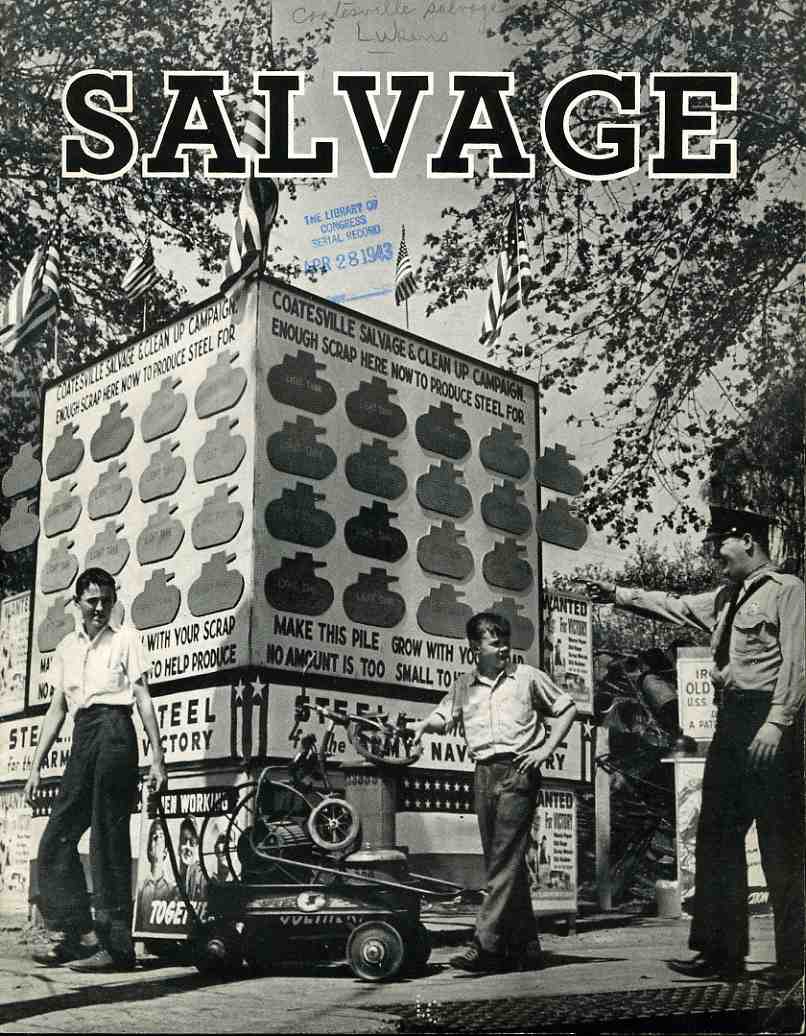
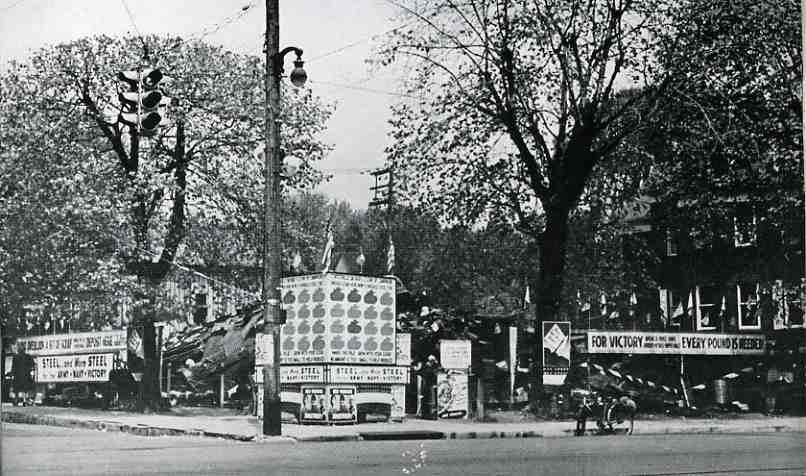
    Now for an example of something fantastic: Salvage (1943) is just brilliant!  It is a superb  design, getting its inelegant point elegantly across to the reader, making the collecting of junk  a bona fide war effort, triumphant, superior; it delivers the message gorgeously.  Who wouldn’t want to rush out and look for some metal scrap and bits and grow a neighborhood junk yard so that the community could build a tank?  Certainly these two boys–under the watchful guidance of a smiling cop in a black tie–couldn’t resist, and from the looks of the progress billboard behind them, nor could anybody else in the neighborhood, as the community collected enough metal junk for 14 tanks.  (Or at least pieces and chunks for fourteen tanks.)

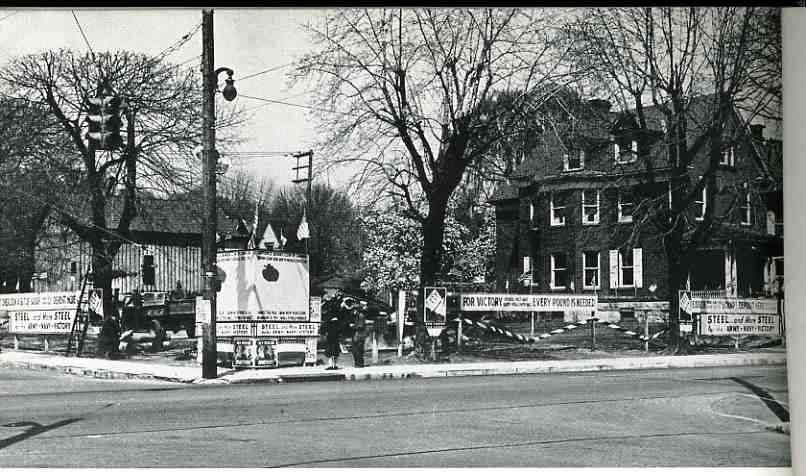
    The community was Coatesville, Pennsylvania, and they certainly did their collecting-best.  The two photos below show (top) the scrap yard after two days of collecting, and (bottom) the end of the campaign two months latter.

    “One pound of fat contained enough glycerin to make a pound of black powder, enough for six 75-mm shells. Twenty three hundred old nylon stockings contained enough nylon to make one parachute.
    Thirty thousand razor blades contained enough steel to make fifty 30-caliber machine guns.”   (Lingeman, Richard R. Don t You Know There Is a War On? The American Home Front, 1941-1945. New York: G.P. Putnam’s Sons 1970, 254-55).  When you have an entire town doing this, you can build tanks; when you have millions of people throwing together to collect this “junk”, then you get part of a war effort.  It is also part of a giant propaganda hearts/minds machine, especially for the U.S., which was (and I use this word with some hesitation) cushioned from the effects of the war by two oceans–it reminded people who hadn’t contributed a life to the war that there was actually something tangible going on, and that they could do something to help.  It kept peoples’ minds in the game.  Rubber was another big concern, as was silk (the controlling exporter of both coming largely from overseas, and in the case of silk, the exporter was Japan.)  Of course there was the introduction of synthetics for both silk and rubber, but the point in fact was that there was indeed a shortage, and the donated and salvaged stuff was necessary. 

    Here’s a beginning picture for the burgeoning community scrapyard:                                                                                                                                             00-blog-Oct 25 salvage before923

    Some interesting works relating to salvage drives:

    Barringer, Edwin C. The Story of Scrap. Washington D.C:Institute of Scrap Iron & Steel Inc., revised edition, 1954.

    Cohen, Stan. V for Victory: America’s Home Front During World War II. Missoula Montana: Pictorial Histories Publishing Co., Inc., 1991.

    And afterwards:

    00-blog-Oct 25 salvage after924

    Hoopes, Roy. Americans Remember the Home Front: An Oral Narrative. New York: Hawthorn Books, 1977.

    Lingeman, Richard R. Don t You Know There Is a War On? The American Home Front, 1941-1945. New York: G.P. Putnam’s Sons, 1970.

    O’Neill, William L. A Democracy at War: America’s Fight at Home and Abroad in World War II. New York: The Free Press, 1993.

    And here’s one I’d like to see (the cover of):

    Wolf, Howard. The Story of Scrap Rubber. Akron, Ohio: A.
    Schulman, Inc., 1943.


  • Tables of Periodicals of Relativity Interest, 1896-1924.

    JF Ptak Science Books   Reference Tools  

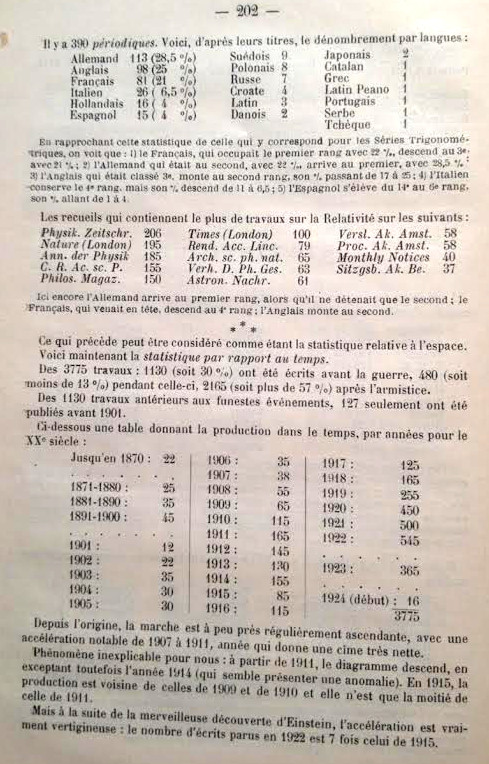
    Earlier in this blog I posted a great graph on the publications on relativity from 1896 to 1924 as published in Maurice Lecat’s Bibliographie de la Relativité, suivie d’un appendice sur les déterminants à deux dimensions, le calcul des variations, les séries trigonométriques, et l’azéotropisme (published in Bruxelles by Lamertin in 1924). Preceding that graph are a few tables of interesting bits on the history of relativity. though I can say that there aren’t too many surprises–the information is still very interesting.  The Physical Review does not make the top-14 list (in the middle table). [Also see here for a good summation of a 1921 bibliography of relativity.]

    Relativity Periodicals2

    The second set of tables shows the distribution by nationality of the contributor–it is interesting to note that the Americans made up 11% of the authors while the Physical Review came nowhere close to that percentage, meaning that the PR hadn’t yet come to its place of high regard as a premium publishing vehicle, though that would come soon enough, particularly by the early 1930’s.  

    ·Posted by :

    ·in:

    —

  • Slow Lightning–a Pollockless Event from 1881

    JF Ptak Science Books   Quick Post

    When I saw this letter to the editor of Nature (in the May-October 1881, volume 23, page 284) I thought immediately of Jackson Pollock–but of course he wasn’t even close top being born yet. The boy from Cody, Wyoming was born in 1912, and he went from a Western no-longer-frontier-town to his greatest period of production in about 37 years.  Those three years, from 1948-1950, were like lightning, but slow…like seeing the progression of a lightning strike from the ground up, then replayed again backwards, and then faster.  And with many more than just a single strike.  That isn’t what W.M. Flinders Petrie of Bromley, Kent, was talking about of course–still 25 years and a world removed from non-representational painting–but that is what his title excited in me, here in his future.  In any event, the article is an interesting read, Pollockless and all.   (Another piece of long and interesting reading is found here, with Richard Taylor’s theory on Fractal Expressionism and the fractal dimension of Pollock’s painting.)

    "Having just seen the statement of Prof. Tait (Nature, 
    vol. xxii. p. 341) quoted, as a final authority, against the possi- 
    bility of distinguishing the source from the termination of a 
    lightning flash, I wish to record a storm that I saw. 

    ·Posted by :

    ·in:


  • WWI Ads–Gallipoli Coal Tar Soap, 1915 (?)

    JF Ptak Science Books    Quick Post

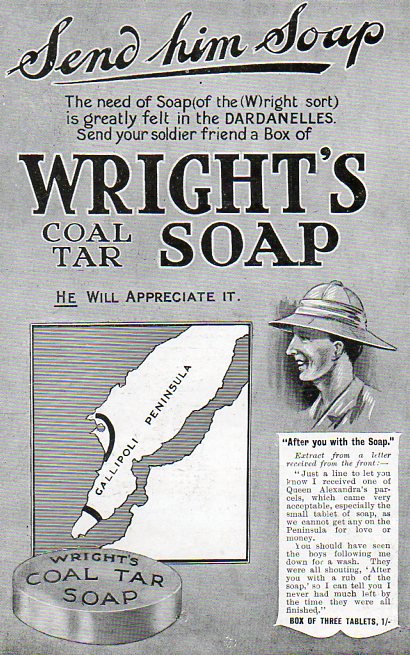
    These ads are interesting and take a bite, both ways.  For example, the first–for Wright’s Coal Tar Soap–uses the background of the enormous struggle in Gallipoli to sell itself.  The ad appears in the 9 October 1915 issue of The Illustrated London News, and stresses the fact that the troops were badly in need of, well, soap, among other things, not the least of which was forward motion, or victory.  

    WWI--e---galipolli640 

    But the fact of the matter is that this relatively cheery image of the actions at Gallipoli looks entirely misplaced, especially at this point in the campaign when things were going badly.  The battle took place at Gallipoli peninsula in Turkey from 25 April 1915 to 9 January 1916, and the conditions were deplorable: massive heat, rotting corpses, poor sanitation, dysentery, flooding and then frostbite and bitter cold in the winter–that, plus the killing part, with 392,338 killed and wounded on both sides of this one campaign.  There’s much more to this campaign, of course–especially for my New Zealand and Australian friends–but this is not the place for it.   I was just taken by the spectacularly mundaneness of this ad for selling soap on the back of a terrible campaign, and an eventual disaster for the Allied forces. 

    ·Posted by :

    ·in:


  • Beauty Pageant Panoramic Photos & Found Serendipities, 1920’s-’30’s

    JF Ptak Science Books  Post 2246                                                                 Follow Me on Pinterest

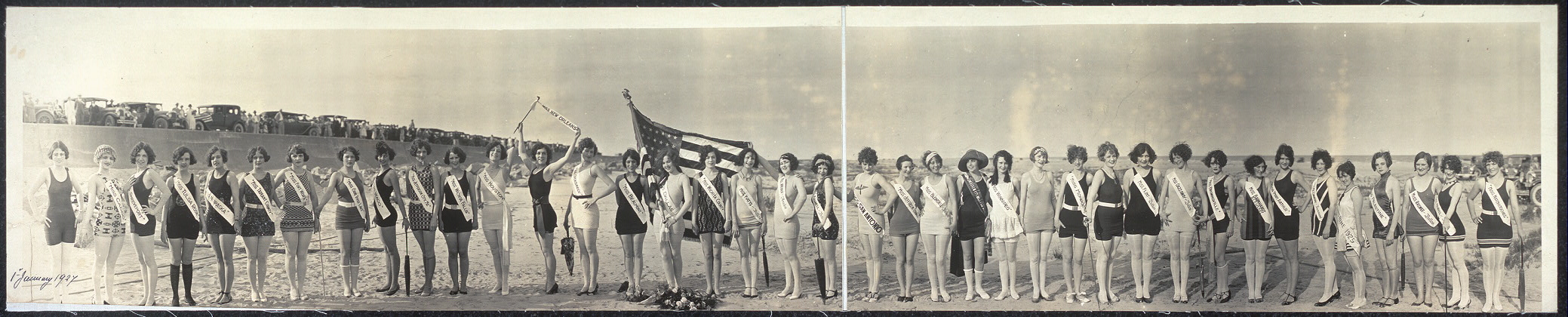
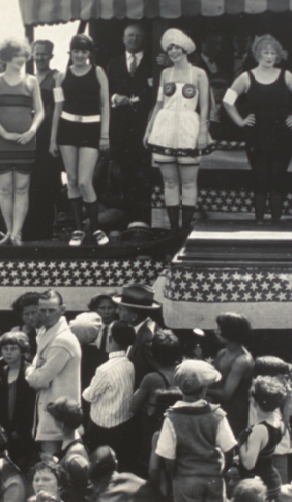
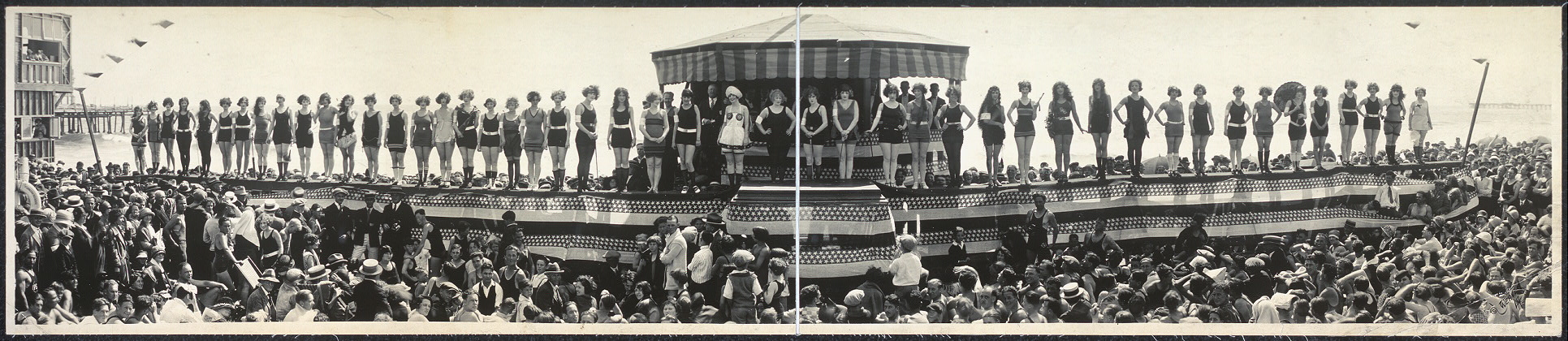
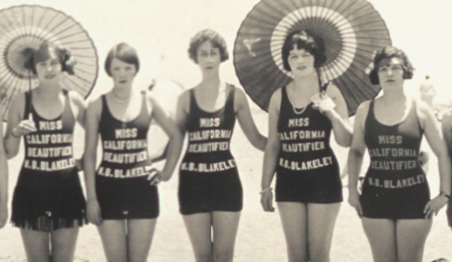
    These images come from the Library of Congress website–many of them wound up in my pinterest account.  The link for both for each image are found below.  Photographs like this–wide panoramas of big groups of people–are fascinating for the collection of moments that it captures, wall-to-wall serendipities.    [See the  Library of Congress panorama collection.]

    Beauty Galveston Detail

    Galveston Beauty Review, 1927 [detail]


    Beauty Galveston 1926


    Beauty--0crystal piuer detail


    Detail of below, featuring an unfortunate bath suit selection and a clump of men and boys.  Perhaps it is more “wad” than “clump”, like a murder of crows.   

    Beauty Crustal piuer

    Bathing Girl Parade, Crystal Pier, California 

    BEauty balboa beach detail

    Balboa Beach Bathing Beauty Parade, 1925 (detail from below) 

    Beauty balboa beach


    ·Posted by :

    ·in:


  • 1950’s Atomic-Spawn Monsters “As Evil Atom-Age Scientists…”

    JF Ptak Science Books   Post 2245

    I’m unsure of how I came to post this–maybe it is all the result of the one still from The Werewolf from 1956 with its dynamite phrase:

    Evil as atom-age scientists

    I guess the “atom scientists” were evil because the monsters depicted in these movies were a result of atomic/radiation somethings gone-wrong. Thus: evil. Of course some of these scientists were Commies, and some just Brand-X Evil (a good band name).  All-in-all though there’s really nothing in any of these films that comes remotely close to the horror of The Bomb.

    Here’s a few more examples of quick/bad/cheap Atomic Movie Weirdnesses brought about by the bliss of evility inherent in some “atom-scientists”: 

    The Beginning of the End (1957) Republic

    Evidently this film–“starring” Peter Graves–defines what might be the bottom of thehole-filled-hole filled with bad sci fi films. Poorly acted, badly written, with very little direction and astonishingly bad special effects, this film had nothing going for it. From what I’ve seen of it it moves beyond the so-bad-its-good category to so-bad-it-really-is-bad category.  Gigantism pops up again here, with scientists producing mega-foods via “radiation”–unfortunately the foods are eaten by grasshoppers, and then other stuff happens.  


    Atomic horror--Beginningoftheend


  • On the Continued Rediscovery of the Horizontal Pendulum

    JF Ptak Science Books   Quick Post    

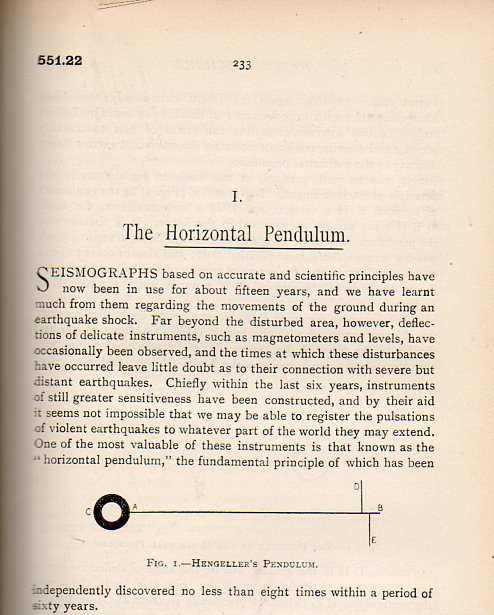
    I found this lovely little article in the not-terribly-common Natural Science for April 1896 while looking for an article on the nearly still brand-new discovery of X-rays. “Natural Science” was really more like natural philosophy than the biological stuff, as a quick breeze through any of its volumes shows, though there is plenty of high-Victorian interest in all aspects of living sciences found here. What was so interesting about the horizontal pendulum was how the author (C.Davison of “King Edward’s High School, Birmingham”) traced down its history of having been independently discovered (and forgotten) “no less than eight times within a period of sixty years”. As with other inventions that were “in the air” (like the telephone, and the electric telegraph, and the television, and so on, where a number of people were working independently at the same time) the horizontal pendulum was that too–except that the process of discovery continued for quite a long time.  

    Pendulum096

    I don’t mean to go into this at all–I just liked the wonderful research and presentation in this little five-page article.  And for anyone who cares, C. Daivson’s (not C. Davisson as in Daivsson and Germer) references are included below.

    ·Posted by :

    ·in: