A Daily History of Holes, Dots, Lines, Science, History, Math, Physics, Art, the Unintentional Absurd, Architecture, Maps, Data Visualization, Blank and Missing Things, and so on. |1.6 million words, 7500 images, 4.9 million hits| Press & appearances in The Times, Le Figaro, Mensa, The Economist, The Guardian, Discovery News, Slate, Le Monde, Sci American Blogs, Le Pont, and many other places… 5000+ total posts since 2008.

Author: JF Ptak

  • On Historical Equalities of Garbage

    JF Ptak Science Books   Quick Post

    I wonder if we can speak of units of measurement for the stuff that we throw out in terms of some amount of industrial production of a country for a given period of time?  Like, do we here in the U.S. throw away enough stuff in one day/week/month to equal the total yearly production of some/all (?)  manufactured goods produced in fill-in-the-blank-country in 1850?  A figure such as this probably does not add to our understanding of, well,  anything at all–but maybe the discussion of what that number might be could be interesting. Or perhaps the very notion of even entertaining that such an equality is possible is enough for that unit of measurement to have done its job without even being established by simply bringing up the subject of vast waste.

    Our vast waste is vast.

    There are estimates that the average person (excluding businesses and corporations and such, strive as they may for personhood) in the U.S. throws away between 4 to 7 pounds of garbage a day.  (This according to Edward Humes in his new book, Garbarology–the author believes that the lower estimate by the EPA of about 4 pounds/daily is too low, and prefers the numbers of BioCycle magazine and Columbia University’s Earth Engineering Center, which give us the 7 pound figure.) Given, say, 300 million people in the U.S. that makes for about 7.6 trillion pounds a year, or about 2.1 billion pounds per day.  

    7.6 trillion pounds of garbage is more than double the world production of steel in 2011.(Source.)  

    This is also more than ten times the amount of all food produced in the U.S. per year. (Source.)

    But getting back to the historical aspect of the original question, in 1913 the total amount of pig iron produced by the chugging mills of the United States and Great Britain was about 84 billion pounds.  That’s 40 days of garbage today.  

    So, I’m not sure how many decades we need to go to get close to the Tonnage of All Manufactured Good in One Year = The Amount Americans Throw Out Each Day. My off-the-shelf approximation gets us close to the first industrial revolution period, which probably makes sense, but is difficult to imagine.

    It would be better for everyone involved if garbage was treated more as an energy source than it is, rather than shipping off huge tonnage of scrap iron and waste paper in enormous cargo ships to China, or burying it.  

    It seems incredible that in our enormous consumption of stuff that in the end the most popular thing to do with the shells of our wants is to make mountains of waste with it. 
    ·Posted by :

    ·in:


  • On the Surprisingly Recent History of the Surgical Glove

    JF Ptak Science Books    Post 2256

    It is almost always the case that when you look at paintngs of surgeons at work—standing by or with or in their patients, surrounded by assistants and with a small crowd in attendance—and especially before say 1895 (the year of discovery of the X-Ray by Wilhelm Roentgen), that you will almost never see anyone wearing surgical gloves. And there’s good reason for that—surgical gloves really didn’t make a general appearance until right about that time.

    The idea of hyper-clean in the OR didn’t really exist until Joseph Lister began his practice of antispesis in the 1860’s—introducing washing surgical instruments in carbolic acid, and keeping the operating area clean and somewhat sterile. He used it in prep, and on the incision wound, and dressings, and instruments, and the effect was enormous. By what we take today as a “given” was a revolutionary advance when Lister started the practice in the 1860’s. People today think of his surname in connection with something different but somewhat related, and from exposure to television commercials for a certain mouthwash, but this would be like knowing the importance of Isaac Newton from those figgy cookies—and that just isn’t right.  Lister (1827-1912) figured out—through exposure to ideas by Ignaz Semmelweiss and Louis Pasteur, among others—that the infections in wounds that caused so many surgical deaths was not caused by the miasma in the air, but by something entirely different. 

    In his article in The Lancet of 21 September 1867 (and in his subsequent publication in book form later that year called Antiseptic Principle of the Practice of Surgery) he explained what he thought was the cause—microorganisms that traveled (at least) from the surgeon’s hands onto the wound, and not by something floating around in the air.  

    And thus the carbolic acid (phenol) and its application and miraculous results in operative and post-operative infection. This is one of the reasons why Lister is considered to be one of the founder of modern surgery.

    It is a little odd (at least from today’s viewpoint) that it would take several more decades for the next major step to be taken—the introduction of the rubber glove in the surgical arena. Rubber capable of being used for gloves hadn’t been around for all that lone a time, though there are some instances of surgeons using partial gloves made of sheep innards that reach back in the 1730’s. But it just didn’t happen–at least until nearly the turn of the next century.

    Well, there was some slight use in the 1830’s, but it wasn’t until 1893 that the wonderfully-named  Dr. J.C. Bloodgood insisted on glove use by his entire surgical team, though that was still fairly localized.  It was W.Steward Halstead’s adoption of the surgical glove at Johns Hopkins that really gave the idea national exposure, and so he is generally credited with the glove’s “discovery”, which is not true; it is true that he was responsible for the glove’s widespread use.  Halsdtead is a giant in the history of medicine, and although this is not among his great discoveries in medicine, it did probably save more lives than anything else he ever did.  

    Also consider:

    A good background on the rubber glove used in medicine is found at the Kiwi blog From the Nest, here. http://www.fromthenest.co.nz/2012/05/brief-history-of-the-surgical-glove.html

    J.C. Bloodgood http://www.ncbi.nlm.nih.gov/pmc/articles/PMC1390300/pdf/annsurg00536-0158.pdf

    ·Posted by :

    ·in:


  • A Big Popular Statement on How Small Small Is (1883) (2)

    JF Ptak Science Books   Post 2255

    In three issues1 of Nature (London) magazine in 1883, William Thomson (Lord Kelvin)–polymath of a great and inquisitive mind–tried to create a good reference point for the size of atoms, mainly to establish that their size while being incredibly small were not unimaginably so, and that even objects of this minor magnitude could be approximated and studied.  And he did so with great ease and in a popular general-audience sort of way.

    All told, this was a very good piece of thinking, especially referencing the estimates of Niels Bohr 30 years later, publishing in the Philosophical Magazine (volume 26, pp 1-25, 1913) and calculating the size of an atom at .5 x -10 meters. And even though Thomson is talking about his estimates in terms opf science in a post-Dalton and post-Mendeleyeef world, he is also pre-Stoney, and Roentgen and Curie and Soddy and everyone else, especially pre-atomic-nucleus, and pre-proton (1919/20 with Rutherford and Moseley) and pre-neutron (Chadwick 1932), which are smaller still than the atom. Way smaller.  It is difficult to put into understandable terms on how “small” that small is:  the atomic nucleus is sort of 1/10,000th of the atom, and a proton or neutron smaller still, and then the quark smaller than that, until perhaps it becomes a Seussian exercise with future discoveries showing that after everything is said and done that it is turtles all the way down.  

    But Thomson managed to put an understandable assessment on a very difficult visualization, talking in terms of an atom being “1/10,000,000 or from 1/10,000,000 to 1/100,000,000 of a centimetre in diameter”, or 1×10⁻⁷meters, which is just about the size of a cell nucleus or DNA; that’s in the neighborhood, especially if you look at the smaller number which is 10-8 meters, which starts to close in on the size of the massive carbon atom (10-10), but sorta not so close to the electron (10-12) , or carbon atom nucleus (10-14) or proton (10-15).  Small, hazy stuff indeed, filled with nothing.  On the other hand, if you proceeded in a space vehicle 1014 meters from Earth our Solar System would appear as just another fuzzy splotch in the sky.  1016 meters is about a light year, and then it would taken 10,000 of those “just” to get slightly outside our galaxy.  And then there’s the rest.  

    In any event, Thomson did okay. And as it turns out (as I just now learned) there was an earlier Nature article in 1870 (the inaugural year of the journal) by its editor Norman Lockyer who estimated the size of atoms at just about the Thomson scale.  

    "FOUR lines of argument founded on observation have 
    led to the conclusion that atoms or molecules are 
    not inconceivably, not immeasurably small. I u;e the 
    words " inconceivably" and "immeasurably" advisedly. 
    That which is measurable is not inconceivable, and there- 
    fore the two words put together constitute a tautology. 
    We leave inconceivableness in fact to metaphysicians. 
    Nothing that we can measure is inconceivably large or 
    inconceivably small in physical science. It may be diffi- 
    cult to understand the numbers expressing the magnitude, 
    but whether it be very large or very small there is nothing 
    inconceivable in the nature of the thing because of its 
    greatness or smallness, or in our views and appreciation 
    and numerical expression of the magnitude. The general 
    result of the four lines of reasoning to which I have re- 
    ferred, founded respectively on the undulatory theory of 
    light, on the phenomena of contact electricity, on capil- 
    lary attraction, and on the kinetic theory of gases, agrees 
    in showing that the atoms or molecules of ordinary matter 
    must be something like the 1/10,000,000, or from the 
    1/10,000 000 to the 1/100000,000 of a centimetre in dia- 
    meter."--Thomson, below. 

    Notes:

    1. William Thomson,  The Size of Atoms, I pp 203-205, June 28, 1883; Size of Atoms II, pp 250-254, July 12, 1883; Size of Atoms III, pp 274-278, July 19, 1883, earlier presented before the Royal Institution, beginning February 2, 1883.


    ·Posted by :

    ·in:


  • Table Top Calculator that is the Table, and the Top

    JF Ptak Science Books   Quick Post

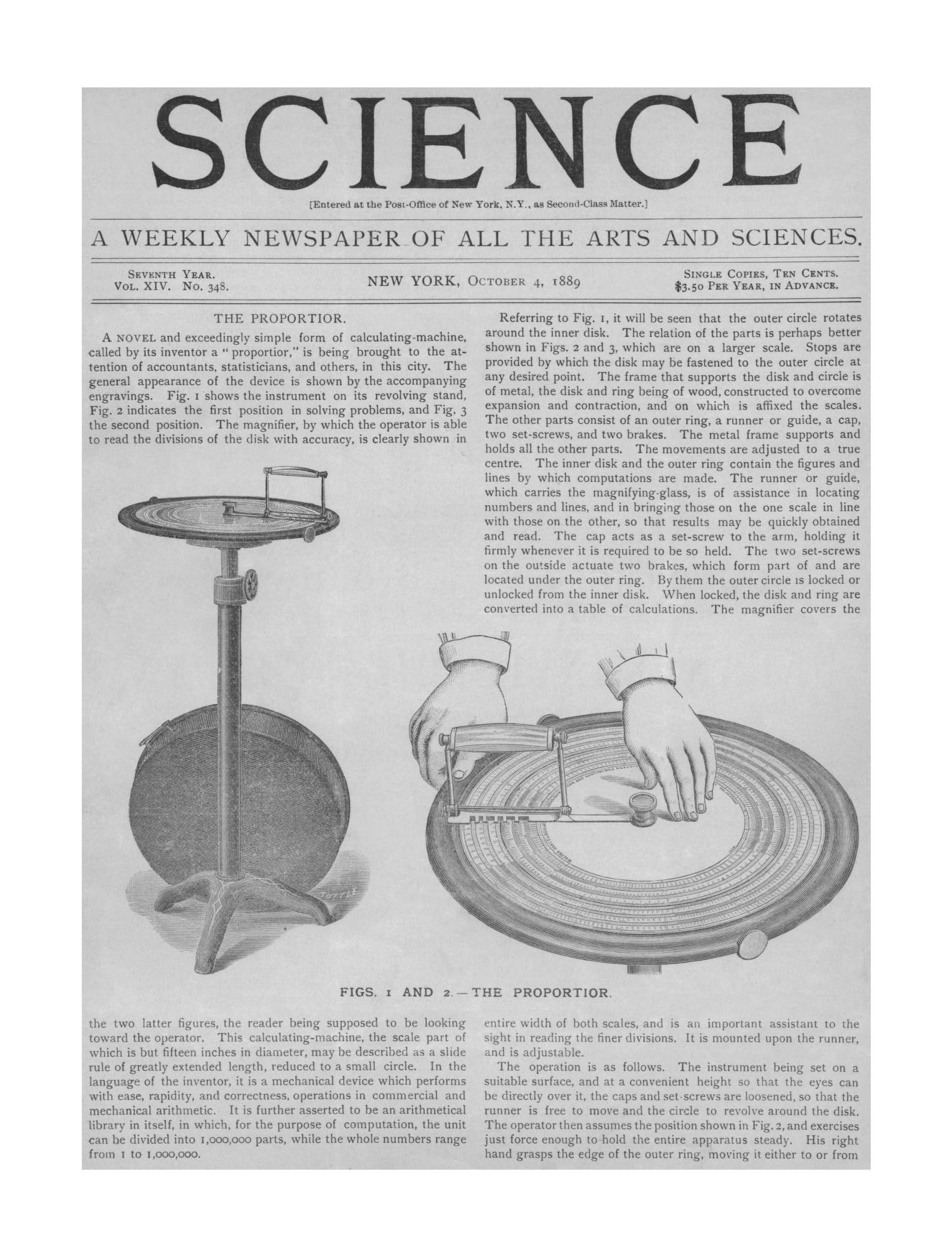
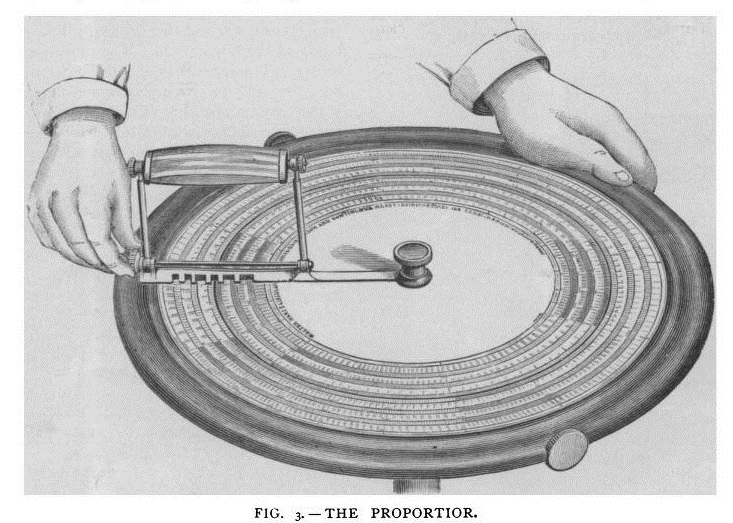
    The “Proportior” (sounding somewhat like an exclamation, like Excelsior!, and looking for all the world like it should be spelled some other more appropriate way) a fabulous desktop/tabletop calculator, as seen in the Science, October 4, 1889:

    Proportioner

    Proportioer2Thanks to Ray Girvan for the link to a successful download of images for this!


  • Flying But Not Flying in the Theatre, 1889

    JF Science Books    Quick Post    

    Sci am flotaing theatre 2

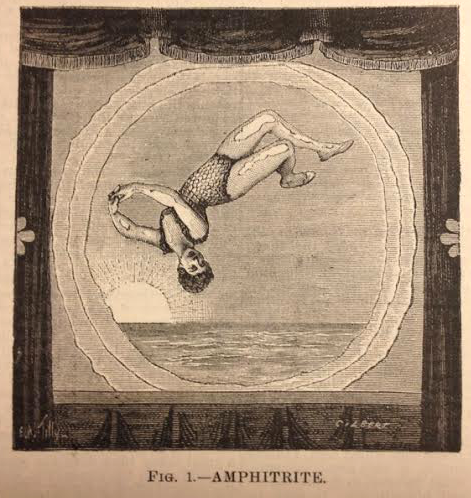
    The Montgolfier Brothers had taken to the air more than 100 years before this image, for the first real experience of humans flying, though through the centuries there have been stories and reflections on all manner of human flight, from Daedalus’ waxed wings to de Bergerac’s bird-power ship balloons.  And of course the intonations of flight have been around for nearly just as long, though much of that was accomplish via acting and not so much by theatrical machinery.  

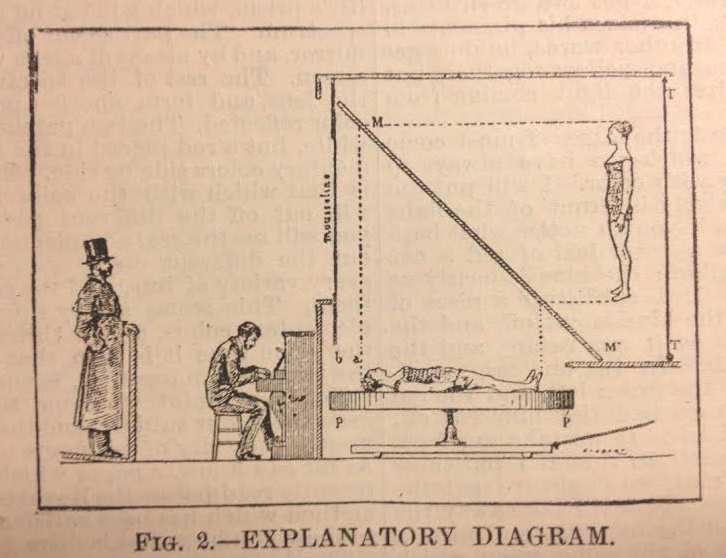
    A superior, and smallish, and elegant theatrical accomplishment in this area was tripped over by me in a browse through an 1889 volume of Scientific American Supplement while looking for an article about Tesla.  And there, in the issue of March 16, 1889 (on page 11008 (!)) was the Amphitrite.  Or at least the apparatus seems to be called by that name, I think, even though in Greek mythology it is the name of the sea-goddess and wife of Poseidon.   In any even it was an ingenious idea–the actor would be placed on a vertical rotating platform and by use of lighting and mirrors their form would be seen on a horizontal screen/background; so if the background was stationary and the actor was twirled on the platform, the effect would be a flying actor against whatever background was chosen. And so on.  That’s pretty good. 

    Sciam floating theatre

    ·Posted by :

    ·in:


  • Freedmen and Abandoned Lands Department

    JF Ptak Science Books  Quick Post    On Naming Things series

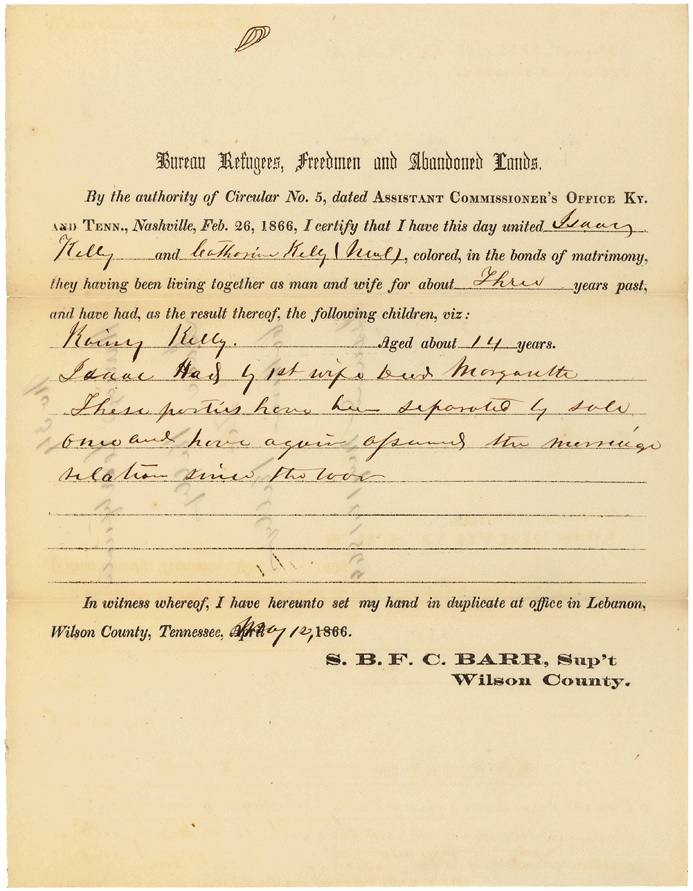
    Through the years I’ve known a little bit of something about the Freedman’s Bureau, but I think I’ve never known its full name:

    Freedman det

    This was an act of federal relief proposed by Abraham Lincoln in 18651 empowered to help the newly-freed slave transition to their new life.   The “Abandoned Lands” part was very unsettling, in a way equating refugees and newly-freed slaves with real estate.  But it was the language and practice of the time, and economy of presentation, and logic, I guess, that lead to this title.  The bureau here was the Military, which was run by General O.O. Howard.  The Bureau functioned from 1865 until it ran out of steam (along with other Reconstruction efforts and measures) in 1872.

    In a way it reminded me somewhat of the fight for the capitalization of the “N” in the word “Negro” (see here)–something that seems beyond the scope of thinking about nowadays, but it was a battlefield for decades after the Civil War, with that “N” not being decided positively until the 1920’s in common usage.  “Abandoned Lands” is not the same thinking-point as “N”, though it does make one think about what was in the common thinking that these three titles could be brought together as a single bureau, regardless of the hyper- and sub-text of the meaning associations via proximity

    Sec. 1. “…a bureau of refugees, freedmen, and abandoned lands, to which shall be committed, as hereinafter provided, the supervision and management of all abandoned lands, and the [92] control of all subjects relating to refugees and freedmen from rebel states, or from any district or county within the territory embraced in the operations of the army…”

    Sec. 2 “And be it further enacted, That the Secretary of War may direct such issues of provisions, clothing, and fuel, as he may deem needful for the immediate and temporary shelter and supply of destitute and suffering refugees and freedmen and their wives and children…”

     
    Freedman'

    [Source: with thanks to Rebecca Onion at Slate Magazine’s The Vault, who posted the original document earlier today and where the name of teh bureau struck me so heavily.]

    ·Posted by :

    ·in:


  • The Long Fight for Capitalizing the Letter “N” in “Negro”

    JF Ptak Science Books   


    N


    “I believe that eight million Americans are entitled to a capital letter.” W.E.B. BuBois

    The history of the power of words is long and complex, and for the most part is on one side or the other of the political and social mirror, at least in the United States. Controlling the meaning of a word or phrase controls the idea which alters the way people approach it, defining the very heart of what may control the impulse for war or peace, which means that people may die as much for words as they will for ideas.

    Sometimes the idea of control is even simpler than the word—it may be a simple letter.

    Like the letter “N”.

    Since the American Civil War (now in its 150th year as of last month) when the use of the word “Negro” was used to describe African Americans, it appeared in print overwhelmingly with a small “n”. The idea was simple—to use a capital “N” would give a certain amount of respect and social diligence in referring to this race of people with a proper salutation; the small “n” minimized all of that, a symbol that these people were not worthy of having the initial letter of their race capitalized, and that because of their inferiority.

    This was also the case with the word “Colored”, which was used in the decades before the Civil War and then lightly after that, giving way to for a short time to “Freedman” and then Negro–”Colored” appeared in print as “colored” in the vast majority of times.

    The capital N was a rallying point, a common point of singularity for a large percentage of the Black population in the U.S.–and a very tiny percentage of the White population. We can deduce this because major papers such as the New York Times did not adopt a policy of using the capital “N” until 1930. And as a matter of fact the federal government documents printed “negro” small “n” beyond 1930, even though heavily lobbied to use the more enlightened and respectful “Negro”. The issue was evidently sidestepped throughout the Hoover administration.

    There was in the country a racism so entrenched and engrained that African Americans were seen as being wholly unworthy of being dignified with a capital “N”, and it was the natural way of things. As the editor of the Eatonton, Georgia, newspaper Messenger said when asked about the capitalization issue, that he would not be a party to it, because “it would lead to social equality.”

    And that’s just what everyone ws trying to avoid. And like the federal government, the control of the capital “N” extended into historical control as well. When W.E.B. DuBois wrote an article for the venerable American Historical Review, the editor, J. Franklin Jameson, refused to allow the use of DuBois’ capitalized “Negro”. As the editor of the Dictionary of American Biography, Jameson refused the capital “N” in the publication until it was terminally embarrassed into doing so, in 1937.

    And so it goes, 60 or 70 years of fighting for the minimum respect of capitalization.

    And this doesn’t even address the use of the reviled “n” word, which is a story unto itself. And in which there was also debate over the years as to whether or not that be capitalized.

    Notes:
    The major source of the information in this post comes the fantastic article by  Donald L Grant (12/01/1975). “Some Notes on the Capital \”N\””,  Phylon (0031-8906), 36 (4), p. 435, who did a splendid job of research.  There’s also a bit of memory pulled from H.L. Mencken’s The American Language (4th edition), which was clear and concise, even though Mr. M. had a small social problem here and there with minorities.  It must be said in his defense that the magazine he edited, The American Mercury, “always” used the capital N. 

    ·Posted by :

    ·in:


  • Dorothea Dix’s Report on the State of the Indigent Insane in the U.S., 1848

    JF Ptak Science Books  Post 2254

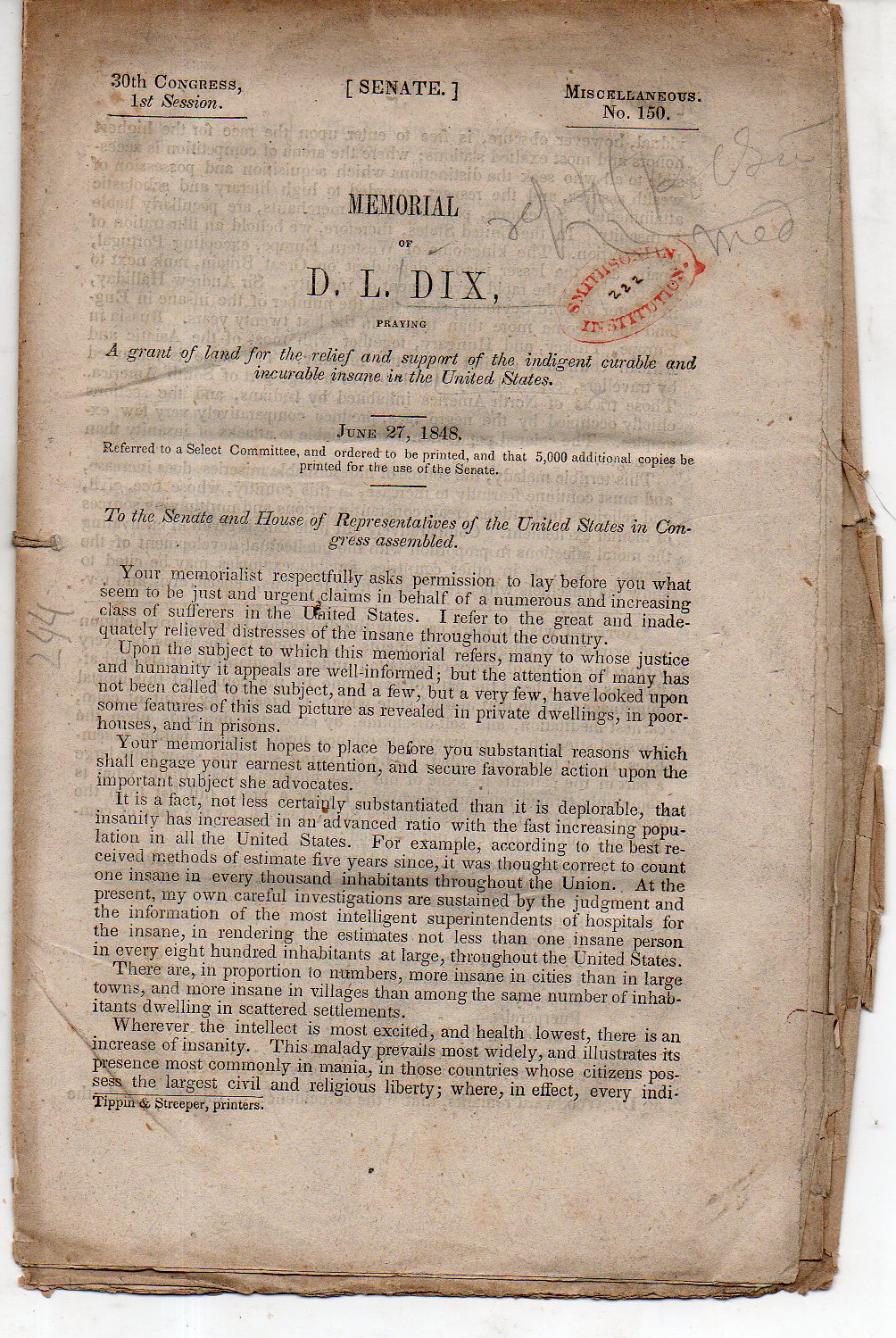
    Dorothea L(ynde) Dix (1802-1887) was an nurse and ultratrian, a very-much-practiced humanitarian who for years fought for the stabilized and just treatment of people with disabilities, mainly and for extended periods of time and travel for those suffering from mental diseases and development.  The pamphlet that I’ve reproduced below is a generalized statement for her appeal before the U.S. Congress based on her 30,000 miles of travels throughout the country, visiting nine states and inspecting the ways in which “the indigent curable and incurable insane” were treated.  She gathered data on how these people were kept–state by state–and also the reasons for their being admitted to whatever facility they found themselves in.  This is pioneering work on behalf of a class of people who really needed the help, and her report in general is not pretty story, a version of the Willowbrook story without the cameras, 120 years earlier. 

    DIx131

    I’ve linked the text from the copy from the National Medical Library (located here, though the front page above is from right here) which has a very elegant access to the 32-page document.  My own copy (available for sale via this blog’s bookstore, here) is a decent copy that was once in the library of the Smithsonian Institution before being sent to the Library of Congress, where it slept in a very dusty and unused assembly of odd and odder pamphlets (called The Pamphlet Collection) before coming to me.

    DIx130

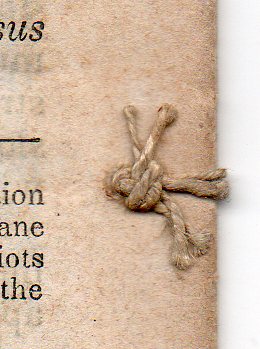
    I’m including an unlikely image from my copy–the bit of string and the knot that held the pages of this document together.  Rather than the stitching normally found in these pamphlets issued by U.S. goverment printers Tippin & Streeper (identified in tiny 3-point print at the bottom of the front page) this one has only a single side-saddled stitch, with a tenuous double knot, holding the sheets of paper together. It was almost as though the thing was constructed for impermanence–it wasn’t, of course; it was just bound quickly and with little thought.  Somehow it kept itself together.  

    Dix’s plea before Congress outlines very harsh conditions, as well as some of the semi-standards of the day for how a person could find their way into such a state to begin with, listing in the third page of teh work some of the reasons for commitment (in 1843) to the Massachusetts State Hospital (followed by the number admitted)

             Intemperance        239
             Ill  health       279
             Domestic  afflictions   179
             Religious   148
             Property  98
             Disappointed affections  64
             Disappointed ambition  33
             Epilepsy     45
             Puerperal      47
             Wounds on the  head    21
             Abuse of  snuff and tobacco     8

    And here an extract by Dix on some of what she found in Georgia (from page 22):

      "Georgia has, so far as I  have  been able to  ascertain, fewer insane, in
    proportion to population, than either North or South Carolina, but there
    is not less injudicious or cruel management of the violent cases through-
    out the State; chains and ropes are employed to increase  security  from
    escapes, in addition  to closed doors,  and the bolts and bars which shut
    the dreary cells and dungeons of jails and other receptacles.   I have
    seen the deep scars of former wounds produced by chains and blows ;
    and  those who have received patients  transported to  the State hospitals,
    are as  much at a loss for any decent language for describing  the condition
    of these unfortunate beings as myself.  Their condition is indeed inde-
    scribable.   Patients have not seldom been transported to the hospital in
    'open carts, chained and bound  with heavy cords..."

    The whole document is fascinating, and well worth a quick read.

    Notes:

    The document:  Memorial of D.L. Dix, Praying a grant of land for teh relief and support of the indigent curable and incurable insane in the United States, June 27, 1848, 30th Congress, 1st Session, Miscellaneous Document No. 150, 32pp.

    ·Posted by :

    ·in:


  • History of Boredom: “Nothing” in the Window

    JF Ptak
    Science Books  Post 802 (from 2009, revised and expanded)

    + window statrers

    Looking at little things has its rewards, though what rewards those are may be a little oblique.  Today’s post is relegated to looking at the sidewalk on a stroll rather than the surroundings, and the sidewalk view is more like Baudelaire’s sidewalk botanist than Proust’s golden Parisian sidewalks. So it goes.

    + window statrersdet

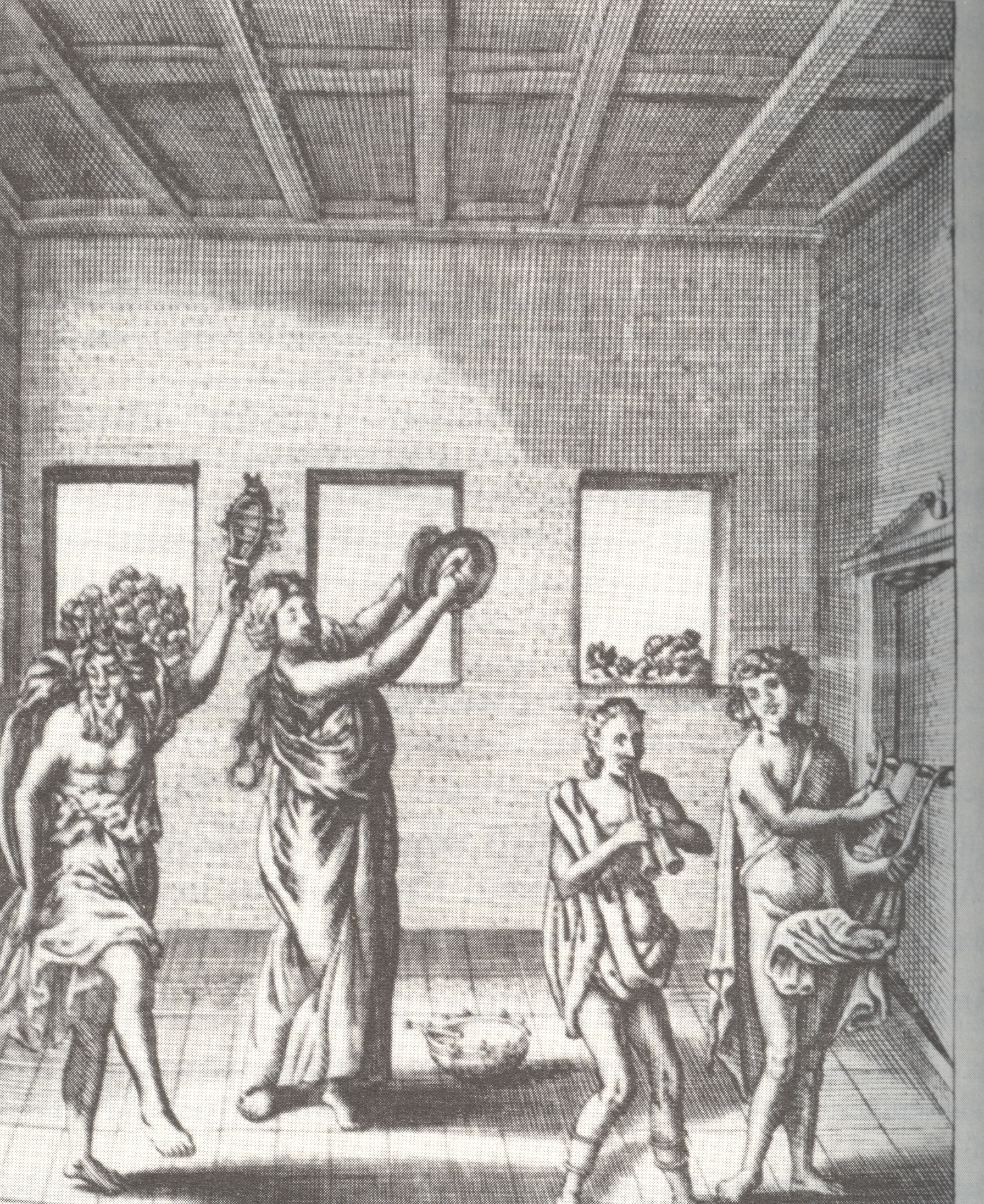
    Petrus Ciacconius Toledanus (Pedro Chacon,1525-1581) was a scholar who wrote on many things; this book, De Triclinio sive De modo co
    nvivandiapud priscos Romanos…(printed in 1664, 63 years after the author’s death) , takes a wide and classically scholarly look at bathing practices…and that includes bathing in water or in wine, and bathing once or six times a day, with dinner in the water or not, what to wear bathside, and all sorts of other bathing entertainments and necessaries.

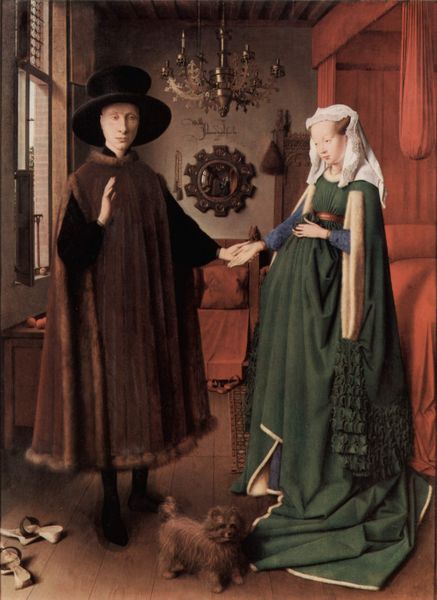
    Arnolfini

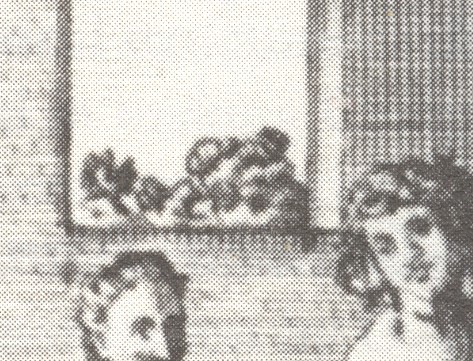
    But that’s not why I’m making this short stop here—it’s the odd bit in this illustration that has my attention.  I’m also not sure about the activity in the print—I’m fixed on the little bit of shrubbery that we can see in the background windows.  Having looked at thousands and thousands of images like this, I must say that seeing natural nothingness like this outside a window is very unusual.  In the unknown, unused and non-existent
    art appreciation genre of “Boring Things Seen Through Windows”, this print would be standard fare.

    But the real issue here for me is that the window is just a window in this print.  It doesn’t have any of the heavy significance associated with windows-in-art of the past, the window dripping with symbolic/spiritual significance (illumination, enlightenment, vision, godhead, divinity).  The window as a simple source of light or vehicle to relieve crowded interiors seems to be

    VanEyck_TheArnolfiniMarriage,detail

    overwhelmed by the religious/needy windows at least t
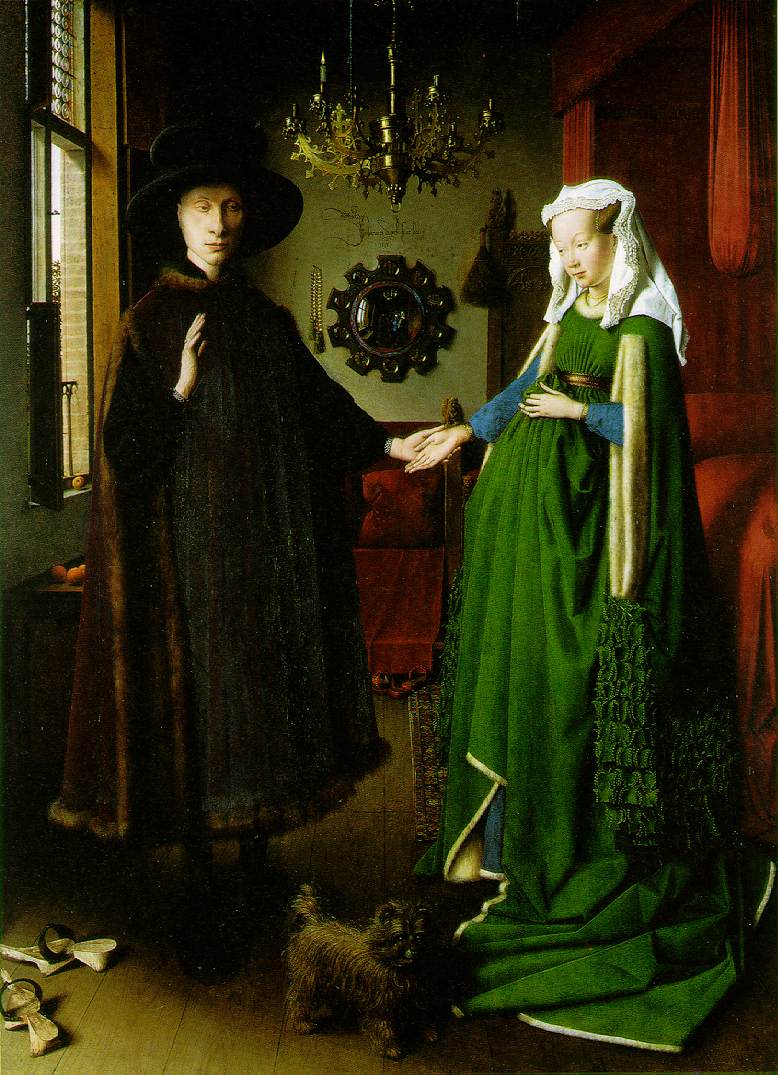
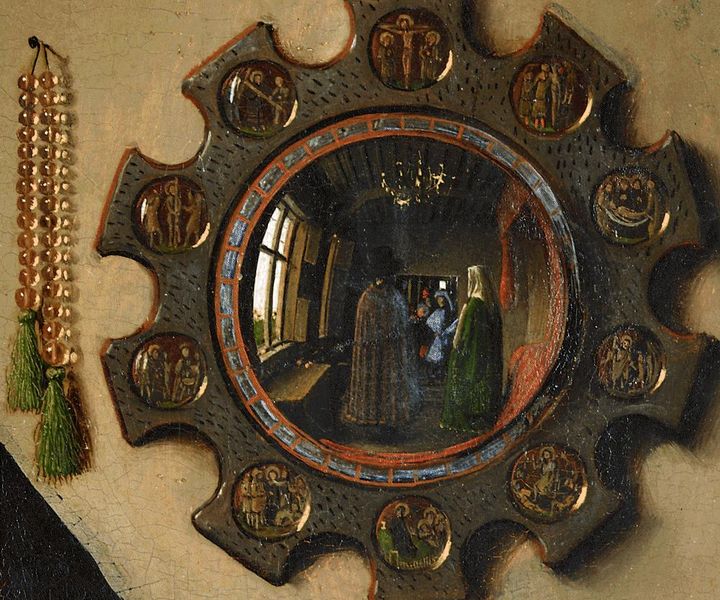
    hrough the first half of the 17th century.  (At least that’s my sense of it—I haven’t a single figure to back anything up.) The little windows that creep into the work of Van Eyck–especially in the famous “The Marriage of Giovanni Arnolfini and Giovanna  Cenami” of 1434—are interesting examples of the window as a simple source of light. (In the “Marriage” painting the window is much more visible in the iconic reverse double-painting seen in the mirror on the wall in the background.)

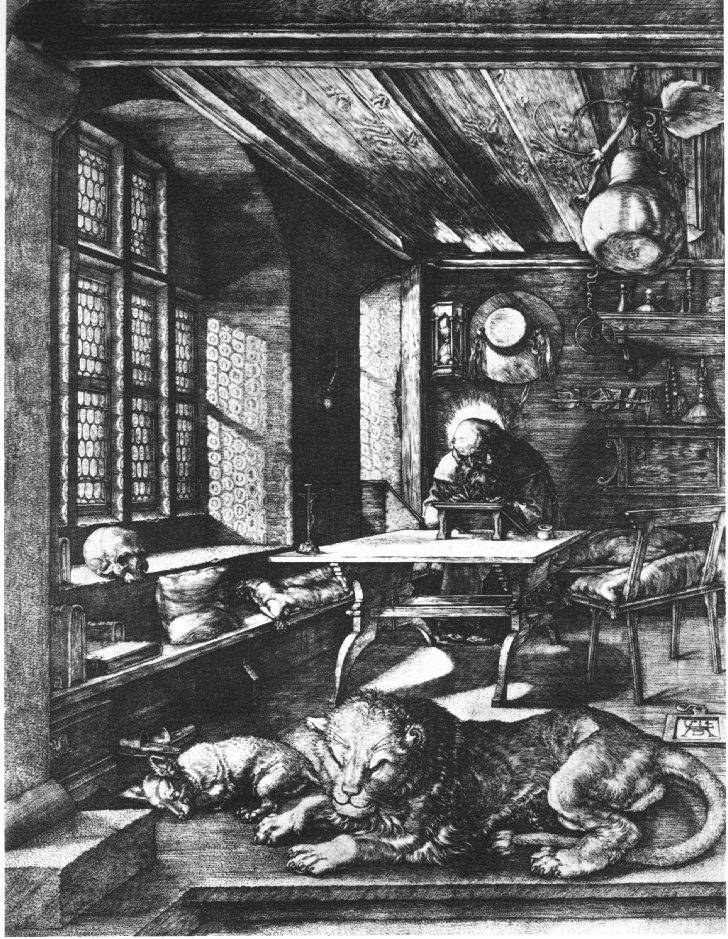
    St. Jerome

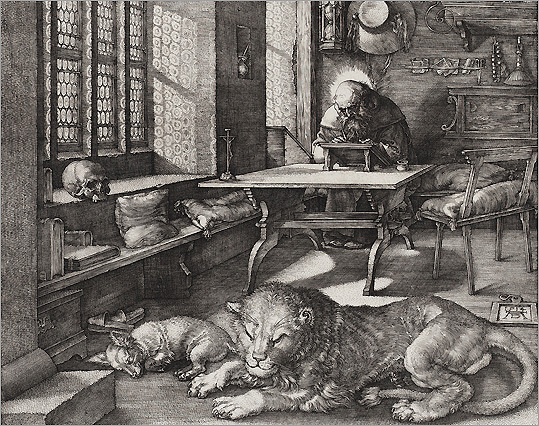
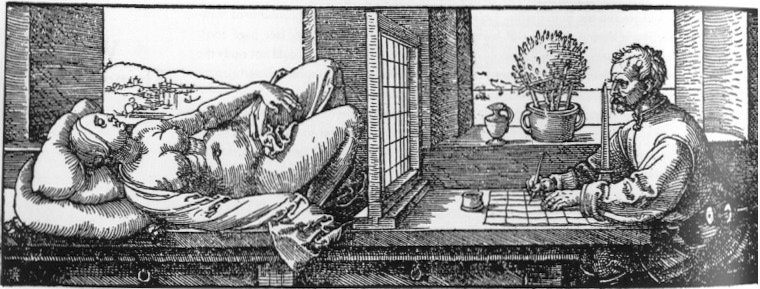
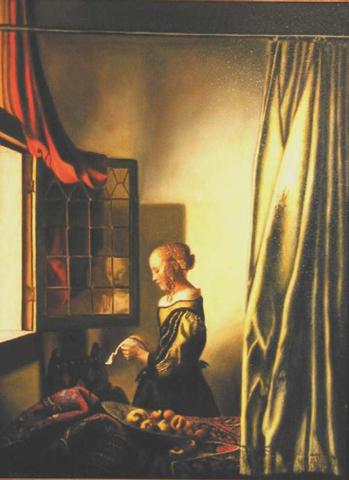
    Same too for the windows in some Vermeers, where you can virtually feel the breeze coming through them and into the  occasionally stuffy rooms.  And also for Durer:  while his great study of St. Jerome has a presiding possibility of Pure Holy Light coming into his room, it might also just be sunlight; on the other hand there is little doubt that the windows in his famous depi
    ction of an artist working a perspective study of a model through a dividing screen have nothing to do with the spiritual, and are just simple mundane windows.

    Durer


    By the 17th century there is a new genre of paintings having people looking out of windows (as with the case of Gerrit Dou, where we observe what seems like every one of his subjects looking out through a window),

    VermeerGirlAtOpenWindowLetter

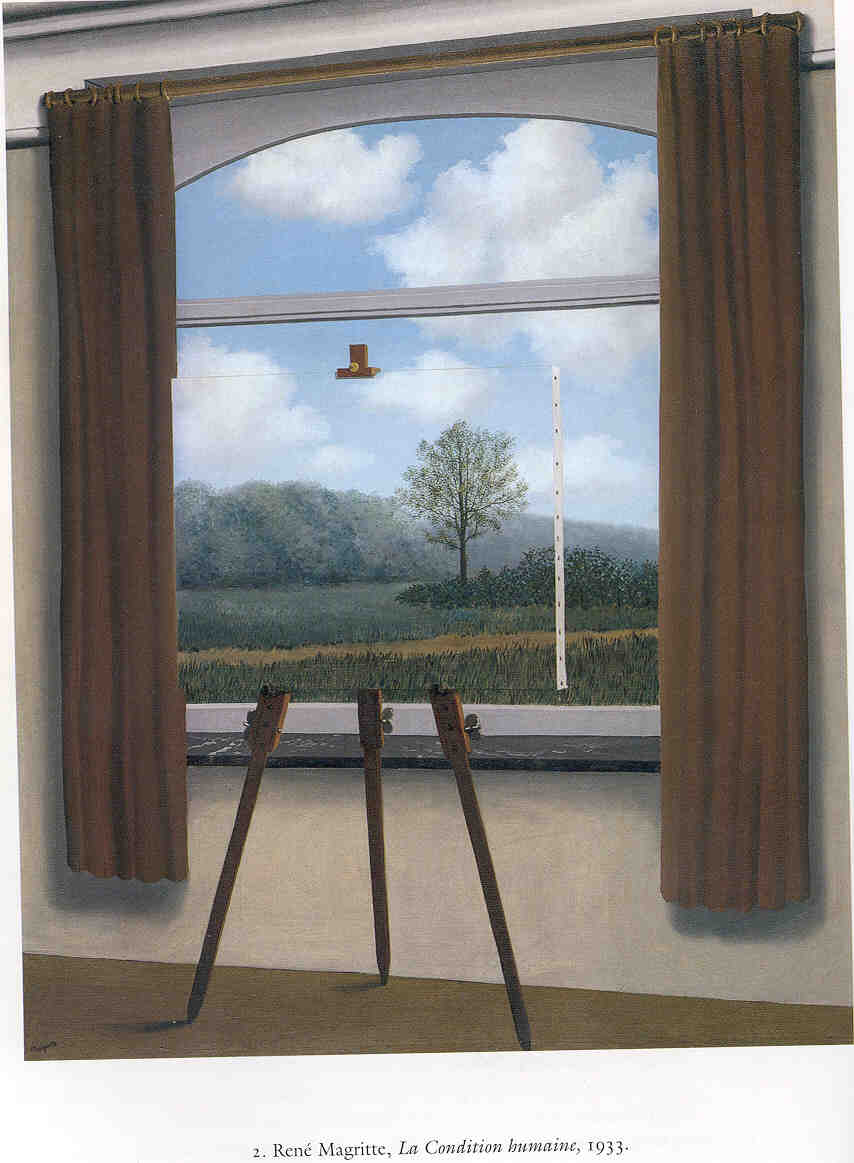
    which means I guess that the observer is the one who might shine in.  Enter the 20th century and the window takes on new meanings, as in bent/draped windows in Dali, or floating windows looking into the lonely world of Magritte, or the solitary nothing-but-a-window sculpture of Duchamp. 

    Magritte

    The unintended nothingness of the 16th century is what I think I like the best.

    Notes:

    For some pretty interesting books written on the window in art, see: Carlo Gottlieg, The Window in Art (University of Michigan, 1981, and which is a nice chronological treatment of the window, plus some psychological stuff) and Suzanne Delehenty, The Window in Twentieth-Century Art (1986), among others.  These will point the way.


  • Great Opening Lines of Fiction in Punch Card Form

    JF Ptak Science Books   Quick Post   History of Holes series

    Happily (!) featured today (14 July) on the blog of the 

    Paris review 2

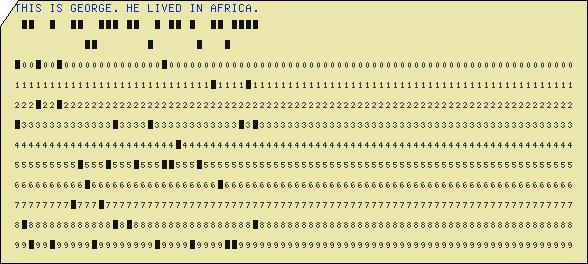
    Punch card georgeH.A. Rey, Curious George.  

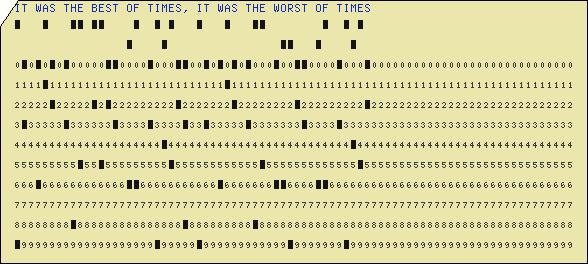
    Isn’t this great?  I bumped into a wonderful site called kloth.net  (http://www.kloth.net/services/cardpunch.php) that provides a free-to-all and unrestricted use of their punch card emulator.  It was found while looking for dating ideas for an IBM 5081 card that I have that has programming information for the BINAC computer (ca. late 1940’s), and kloth.net had info on the history of IBM cards as well as the emulator–plus other stuff. Completely distracted from the BINAC quest, I created some cards using some great first lines of literature.  You can play too!  


    Punch card dickens

    Charles Dickens, A Tale of Two Cities.


    ·Posted by :

    ·in: