A Daily History of Holes, Dots, Lines, Science, History, Math, Physics, Art, the Unintentional Absurd, Architecture, Maps, Data Visualization, Blank and Missing Things, and so on. |1.6 million words, 7500 images, 4.9 million hits| Press & appearances in The Times, Le Figaro, Mensa, The Economist, The Guardian, Discovery News, Slate, Le Monde, Sci American Blogs, Le Pont, and many other places… 5000+ total posts since 2008.

Author: JF Ptak

  • The Future: Floating, Shining Soot and a SteampunkGod (1834)

     JF Ptak Science Books   Post 2340

    [This is a version of an article recently published in the Mensa Bulletin.]

    The world of possibility is limitless when there are no limits and almost no impossibilities. The history of seeing possibilities in the future, the history of looking into the future, is vast (with exponential growth in publication for each of the last three generations), and organizing it for a limited discussion difficult—there is a general temptation to simply classify all of it according to an alphabet of “ramas” of all possible Futuramas.

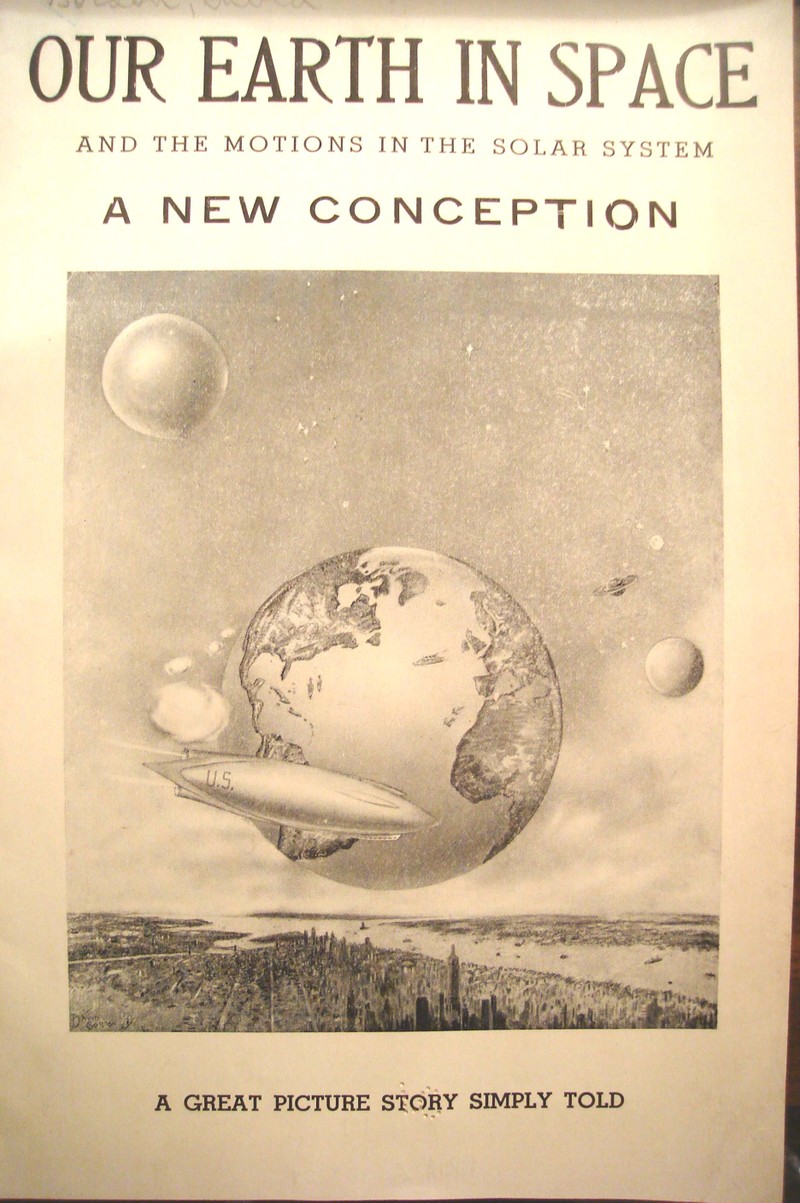
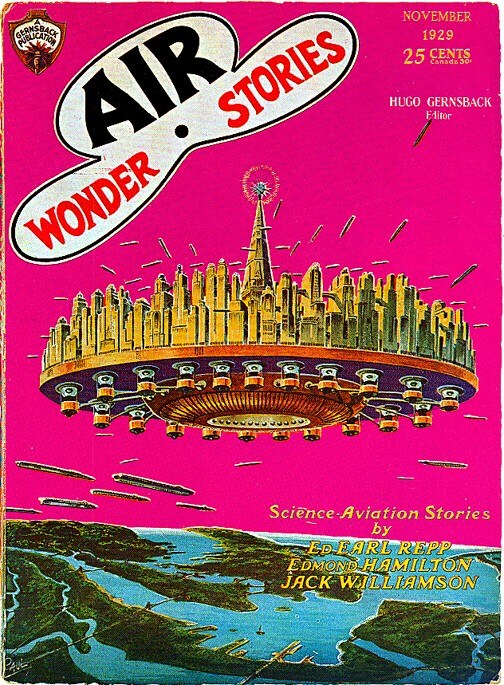
    How do we sort thousands of people writing about hundreds of thousands of future sightings in human development? Flying cars and people and cities and retrievable/liveable subconscious bits and dream, atomic blast guns, two-way wrist tv/radios, perfect places of nothing but intellect and floating intelligence, horseless cities, Soylent Green, personal computers small enough to fit into the trunk of your car, Edison’s anti-grav underwear, buffalo herding from nuclear-powered sports cars, Maginot Line-sized mobile tank-ships, rockets to the Moon, rockets to the Sun, and rockets to tomorrow and to yesterday. We have futures where Manhattan is completely covered by thirty-story skyscrapers by the social warrior Thomas Nast; where George Holmes kills off cities with airplane-filled suburbs in 1912; where electric titan tank monsters with canons instead of cigarettes crushed hopeless opponents in 1918; where atomic-powered dirigible airports free up land in 1946; where a floating NYC is moored above the hole-in-the-ground where it once stood. Where spacecraft of mega-sharp ultra-fins await their cigarette-smoking pilots in 1953 and out-Eiffeled mile-high vertical airport towers, and where an identical duplicate Earth floats serenely in place above a bird’s-eye view of Manhattan.
      Mensa extra earth

    Much of the early technical thinking on the future seems neither utopian (in the traditions of Thomas More, Francis Bacon, Plato, Robert Owen, and such) nor what we would consider today to be dystopian (as with visions of Capek, Bradbury, Orwell, Burgess)–it seems to tend more towards a neutropia. And this does not include the earlier attempts at predicting the near future by looking at frothy bits of entrails or the shades of urine, or the oracles of thrown dice bones or draw of playing cards, or following the implications of human mole maps or seeking guidance in the alignment of stars in the sky.

    And at the top and bottom of it all are the religious futures of endless pain and comfort and nothingness and repetitive existences—but that doesn’t feed into this topic, though the way time ticks through the reckoning of Brahma is very nicely suited to calculating versions of pieces of infinity.
      Mensa floating NYC

    This effort of looking at the history of the future is easier when there are bookends, and there’s no more a convenient end to the future as when it has a date. And in the past that date has often been the year 2000.

    Let’s look at two very unusual examples of future thought experiments—one of which visualizes life in the year 2000—and both of which entertain what may be one of the ultimate considerations for the evolution of humans.

    One aspect of thinking about the future is the opposite of trying to include a sense of the future in the present—instead, it can be about removal. Removal of the present, distancing it from the present and the past. Removal of practices, though not necessarily principles.

    And perhaps one of the greatest of these removals is that of the human aspect of humanity: people replaced by created entities. In a way, a sort of 19th century singularity.

    Mensa cigarette space jock

    A curious example of this can be found in the third edition of Jonathan Swift’s tales of Lemuel Gulliver, where we see a Jorge Borgesian library-producing machine, a 20′ square instrument made of cranks and cubes and turned by scribes producing an endless stream of knowledge. A wooden miracle replacing the human mind, an intelligent primum mobile with splinters.

    A great example of this high removal is found in “The century of invention Anno Domini 2000 or the march of aerostation, steam, rail roads, movable houses & perpetual motion,” a terrific lithograph, made ca. 1834, the handiwork and imagination of Charles Jameson Grant, a satirist and observer of high order. He tried looking into the future 165 years hence, and in some practicable ways he got a lot of it right–the imagery wasn’t there, but the iconic sense of what may come to be was.
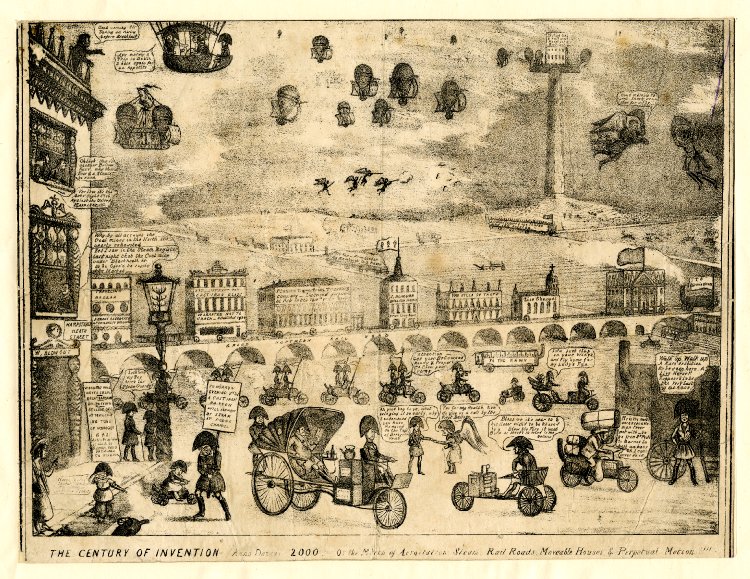
    Mensa Steam-powered pastor[British Museum, here.]


    We see small and large individual steam-powered four-wheeled vehicles, as well as plenty of balloons (in the spirit of aviation, at this point in its fourth decade and entering a great heyday) passing each other in every which way, off on adventures, or work, or in a race (as with the “out of Sight Club”). There are also numerous people flapping around in the sky (“winging it so early”) with their (something)-powered wings, some of whom are ironically hunting birds.

    The main sensation here is speed, though I would not say it was democratic–the means to go to Dublin in your balloon “for an appetite” and return later in the day would have been fantastic to the 1834 reader trying to imagine doing such a thing on such a whim, with a newspaper in your lap, but certainly it would be available to the leisurely class.

    There was also an idea for balloonic communication, as one man in a balloon shouts to another to “give me a call by the first balloon,” meaning perhaps a communication device, or a balloon-delivered letter.  

    The dialog certainly portrays an attitude of unremarkable observation, conveying how commonplace flight and mobile towns and steam cars would be in the year 2000. That’s where one of Grant’s the great insights comes into play–at lower left there is a person excitedly remarking about a race, and particularly on the great rarity of the exhibition of a live horse. That Grant would make this an issue is interesting, as it would certainly rub the 1830s consciousness the opposite way of what the brain expected to see in the street, and that was horses. Horses powered almost all transportation at this time—save for the invention of the railroad, some of which were horse-powered—and to imagine a world in which the horse would be gone would’ve been, well, unimaginable.

    Also, too, the great and extensive coal mines fueling the Industrial Revolution going dry, the coal consumed.
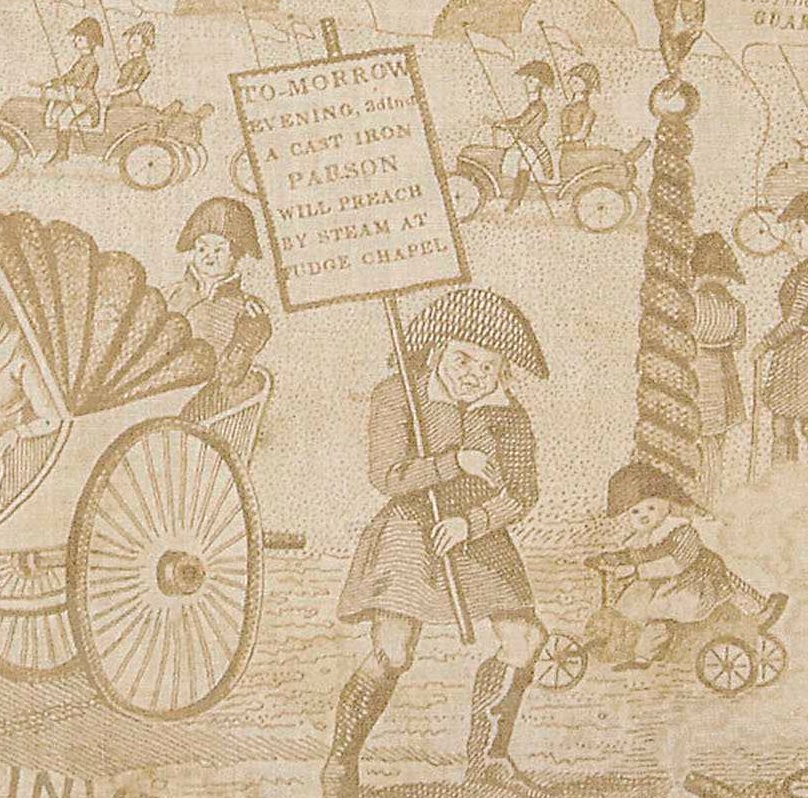
    MEnsa cast iron preacher[From Christie’s auction site, here.]

    At the bottom of the print is the prize, a very unusual placard concerning robotics: “a cast iron Parson will preach by steam at Fudge Church.” This is doubly intriguing because it not only invokes a steam-powered person—still fairly rare in the literature in the first third of the 19th century—but also a thinking one, a parson, a mechanical object trusted with the preaching and interpretation of a basic human belief system. This seems a bit on the primitive side in its display, but the intellectual imagery is pretty powerful stuff. I assume that the power of this would’ve been less so at the time of publication, guessing that Grant was making more of a not-so-subtle satire on the steam-driven puffery of some preachers with the creativity of kettles, and that in the future this would be magnified to the point of steam and smoke. But still the idea of placing the deeply emotional stuff of belief systems in the control of a machine is extraordinary for the time.
    Mensa article Heath March Intellect Robot (1)

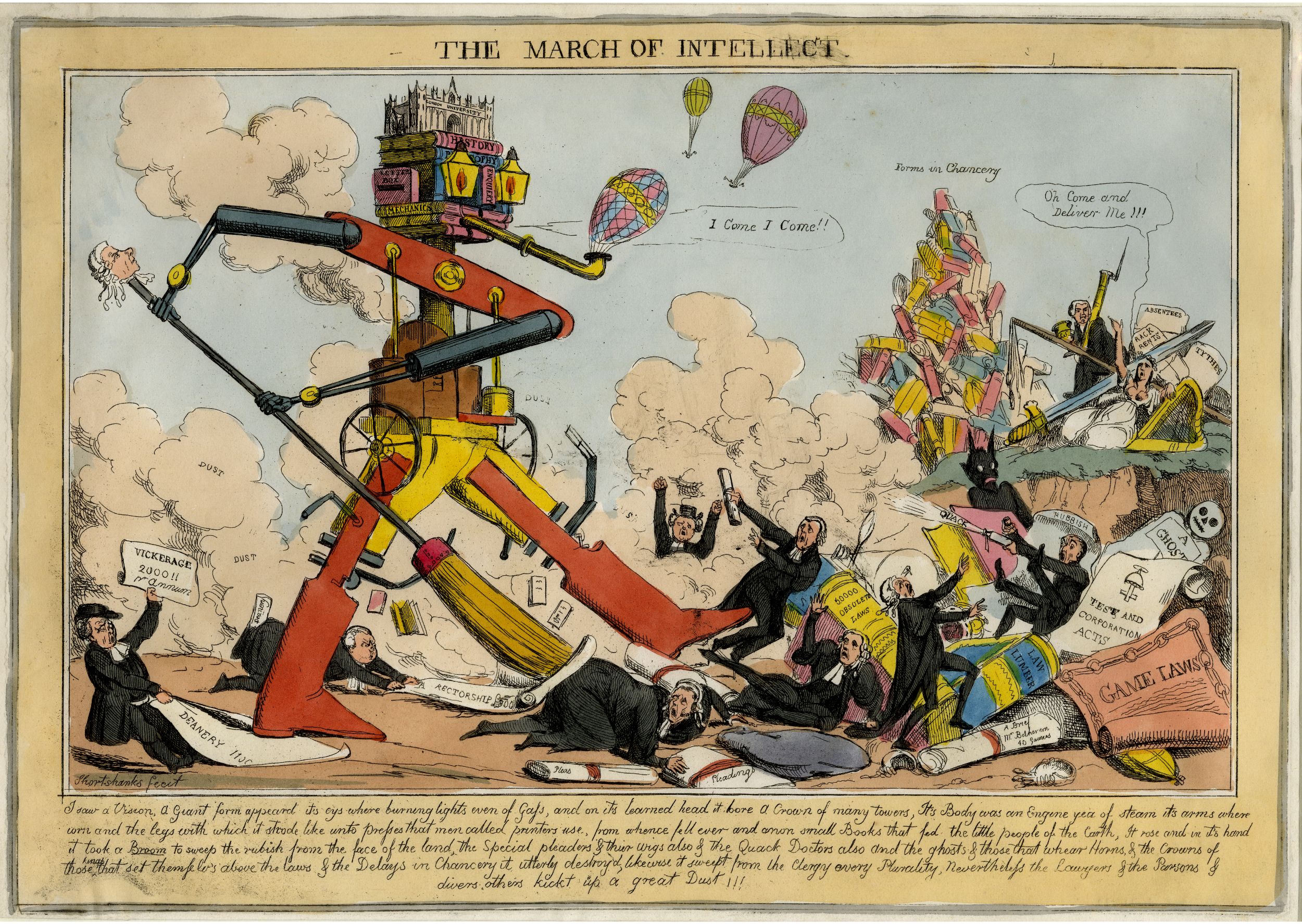
    A few years earlier William Heath’s March of the Intellect series (1825-1829) displayed another robotic entity witha book-driven intellect in its “crown of many towers” (London University) that swept up the great “rubbish” and “dust” of society. The robot was thinking in its way, distilling the promise of data and intelligence in its book-laden head, firing its set of gas-light eyes, iron arms, and legs made of printer’s tools, sweeping away useless and insulting lawyers and jurists and their legal wigs and obsolete and repetitive rules, medical quacks, and the dust of other official abuses, “sweeping rubbish from the land.” It was making decisions and acting on them, trumping the humans in its path.

    It is a remarkable leap, the consequences of which are difficult to put into perspective. I can think of an example from the novel Flatland, by Edwin Abbott, when its two dimensional characters first encounter a three dimensional figure—superbly incomprehensible at first, understanding following with some difficulty.

    Visualizing the assumption of a created intelligence developed enough to supplant or supervise human thought and activity was probably beyond the 19th century sensibility—just as its technical aspects are to us now.
  • A Room with a View: Hornor’s Panorama of London (1821) and its Cache of Irony

    JF Ptak Science Books  

    0 blog dec 30 room at the top328

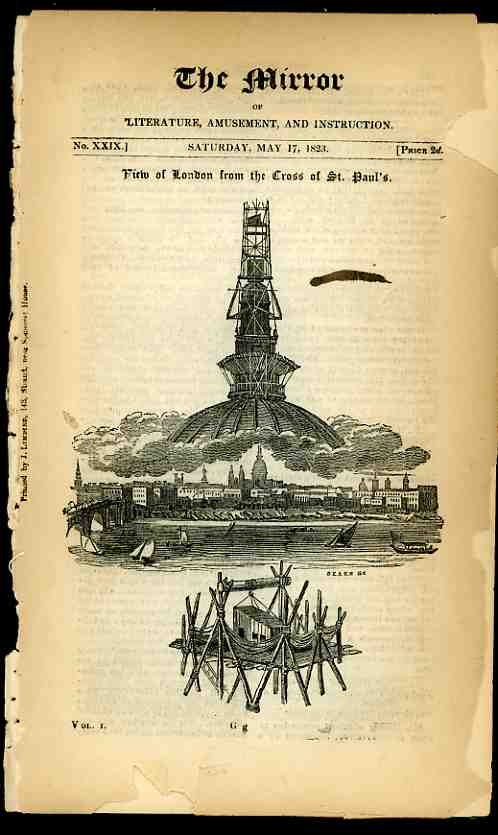
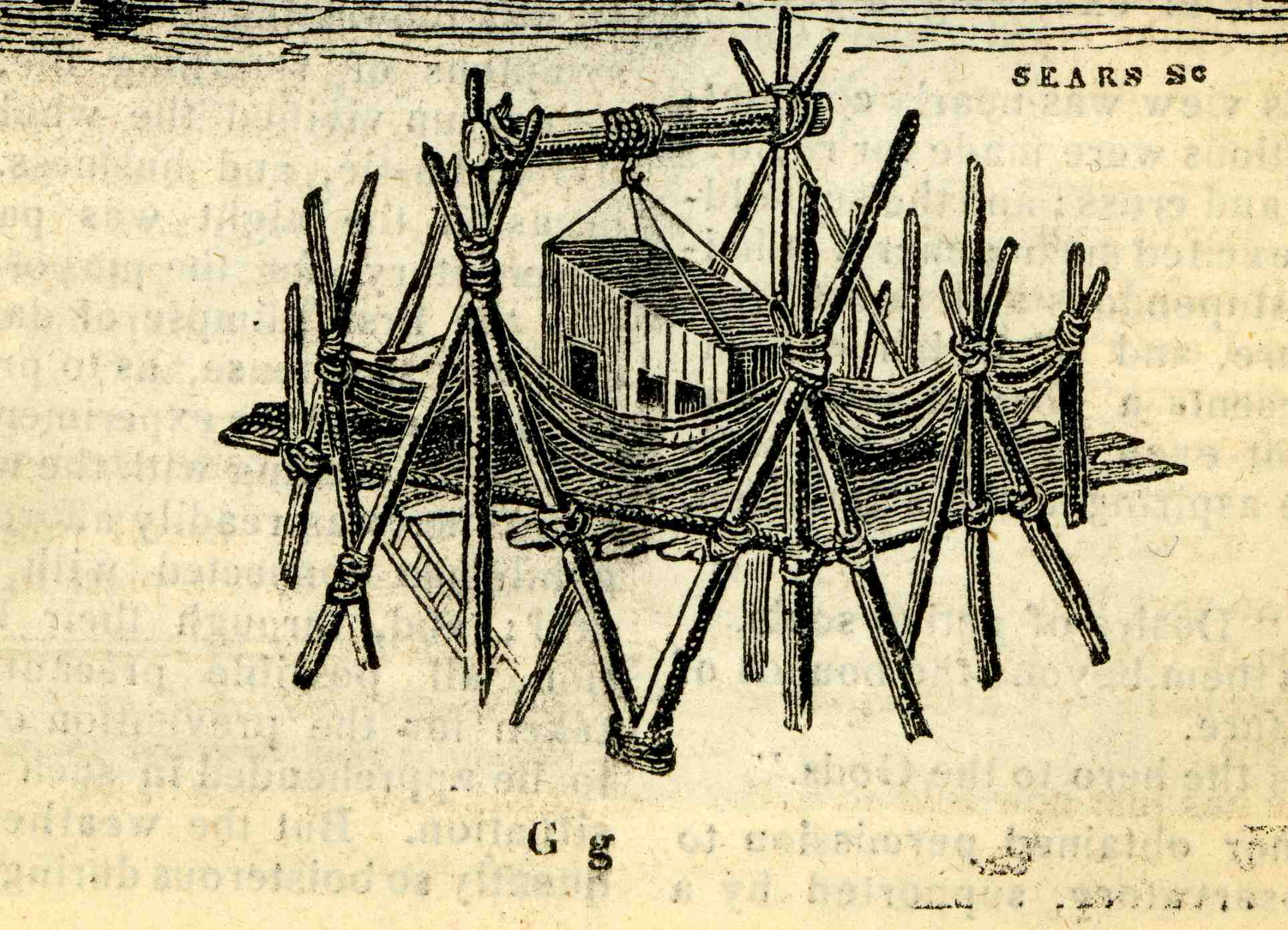
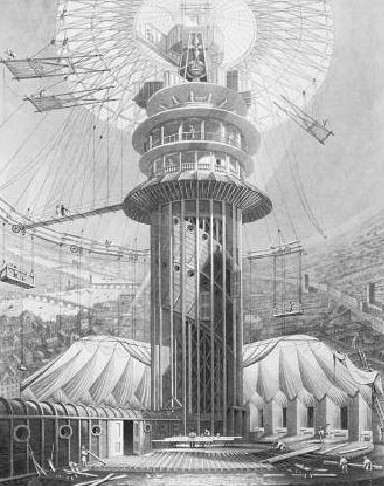
    Before satellite imagery, before airplanes, before balloons, and before photography, the only way of obtaining large-scale and factual panoramic views was to get to a good observation point and draw away.  Thomas Hornor (a surveyor and panoramist, 1785-1844) did just such a thing in 1821:  taking advantage of the cross being removed for cleaning from the top of St. Paul’s (London), he somehow convinced the powers-that-be to allow him to construct an observation post for himself in its place for  a long term, uninterrupted and altogether fabulous view of the city of London.  He set up shop up there, about 400 feet above the ground, and stayed, making minutely detailed drawings of the cityscape, working with a telescope and a great deal of reserve.  And some amount of courage–we can see from this detail of his story published in The Mirrour in 1823 that his shack was, well, not the safest-looking shack that has ever been built atop a cathedral. 

    The end result was an enormous, fantastically detailed acre-sized painting which was installed and displayed in Decimus Burton’s Colosseum. The installation was as much an artwork as the painting–it was affixed to the walls and people would view it from a multi-story observation deck in the middle of the building.  For those who didn’t want to climb the stairs to get to the viewing room,  an “ascending car” was fabricated, making the structure one of the earliest buildings to have an elevator.  There is some sort of irony in that:  people would pay to see a painting using London’s (perhaps)


    0 blog dec 30 room at the top329

    first elevator to get to the top of a small structure inside another structure to see a painting made from the top of a large structure of a scene that could be viewed for free by walking outside.  Nonetheless, the fantabulous painting was viewed by more than a million  people before moving on.

    I have a feeling that this may be an interesting category to develop (a “room with a View” that is), pursuing other rooms in other tall places.  
    For example the last little triangular window is the hole in the sky for something at the Chrysler Building in NYC.  I had heard that it was initially a bathroom that was built for the avuncular Mr. Chrysler, so that he could do his 

    Hornor2

    business higher than anyone else in the world, which seems to have fitted his personality.  After all, he did his fair share of this behavior, having dumped on people of all shapes and sizes, not the least of whom included thearchitect for his spectacular building, William Van Alen.  He was stiffed by Chrysler because of mysterious and misbegotten ideas arising from old Walter’s temperamental and stingy belly–that dear readers takes a lot of ____, not paying the architect who designed the world’s tallest building and then to put his name on it.  

    I should mention that this little room in the Chrysler building pops up every now and then, perhaps most famously in Kurt Vonnegut’s Jailbird, where beautiful Kurt stuffs the head offices of the American Harp Company.

    Check out Stephen Oetterman’s The Panorama, a History of a Mass Medium (1997) and Bernard Comment’s The Panorama (1995).


    ·Posted by :

    ·in:


  • Pig Iron vs. the Eiffel Tower

    JF Ptak Science Books   Quick Post  

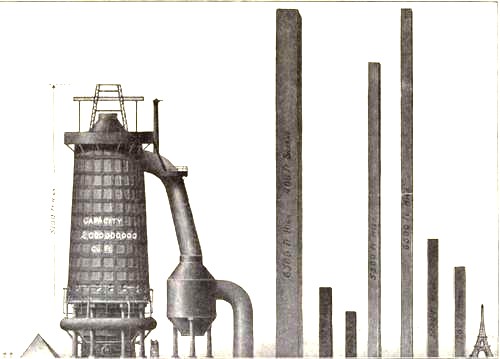
    Several years ago I wrote about some triumphantly unusual images (plus one on the 1891 10-ton Eiffel Tower bullet) of the Eiffel Tower–today I’d like to add another, a queer image which manages to loose the Eiffel Tower (and the Great Pyramid) in representations of pig iron production.

    Diagram steel eiffel 

    I love comparison like this, representing big, hard-to-associate  numbers of something against another quantity that can be instantly understood–the relationship between the two might be tenuous and complex, but at least it can give you some sort of handle on what would normally be an inaccessible, stand-alone number. Plus, any time that you can show what an ungraspable concept might “look like” and be explainable to a 10-year-old, well, you’ve got something. 

    ·Posted by :

    ·in:


  • A Deep and Happy Red–the Young Communist League, 1937

    JF Ptak Science Books   Quick Post–Poster Series

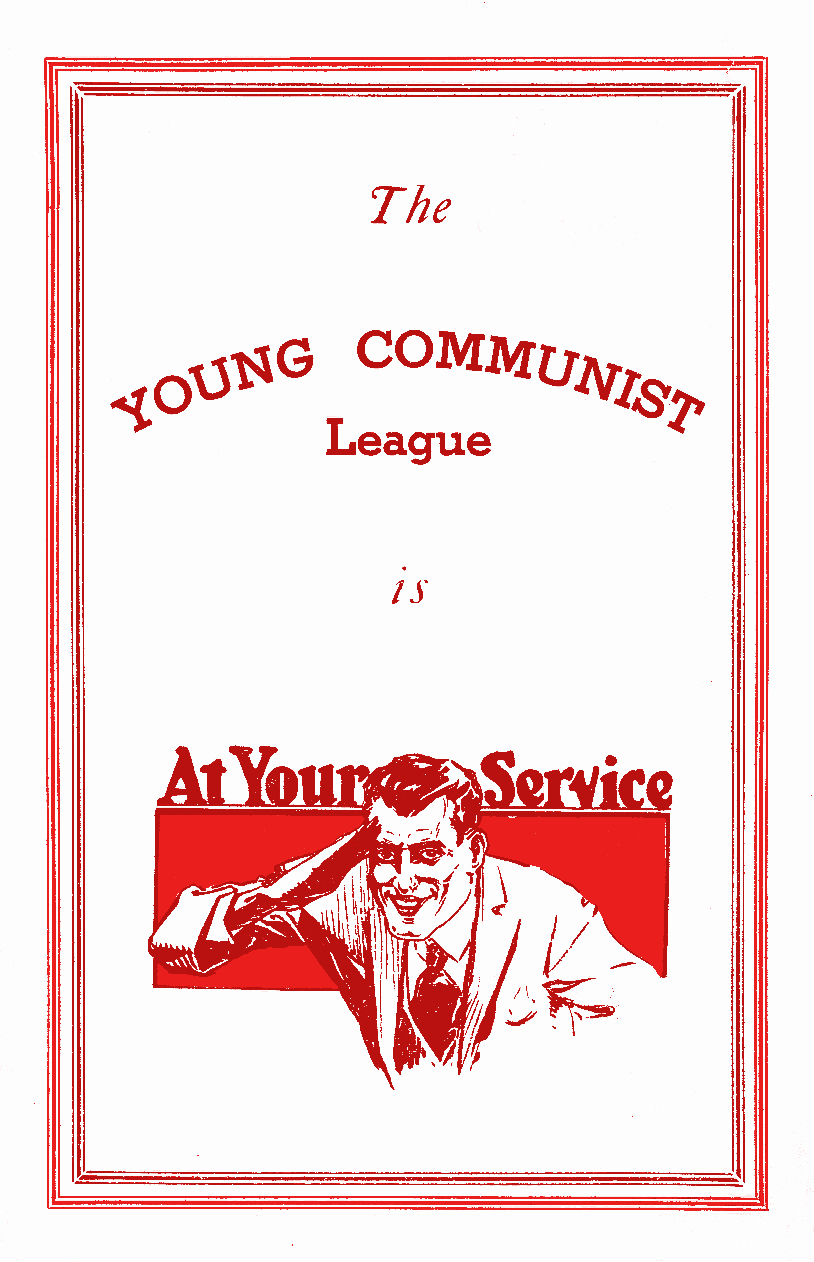
    In the wide and deep collection of social history pamphlets and ephemera that exists here cheek-and-jowl with the history of science material I have found one of the truly great pieces of cover art/design–it stands easily in the top percentile for overall design, and it does get its message across very quickly.  It is also evidently rare, as I can find no other copies of the thing.  It certainly seem to be the first time it has appeared on the intertubes.

    Poster Reprint Young Commie 150 dpi white 359

    [A fine 13×19 inch reproduction is available for purchase here.]

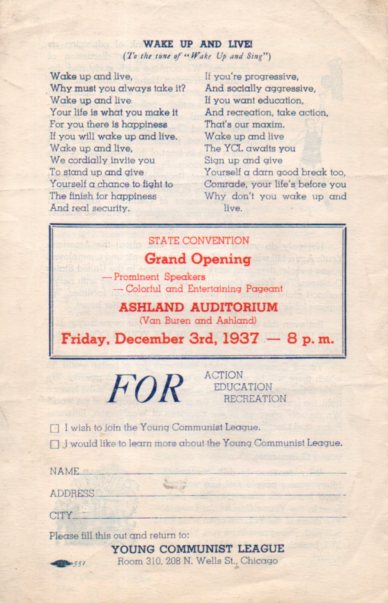
    The pamphlet was aimed at the “under 30” crowd, as we are warned right up front, in the first paragraph of the pamphlet, that if you are over 30, “we suggest you pass it along to someone under 30”–which is where the “Young” must come into play. 

    The essence of the Young Communist League is “ACTION  EDUCATION  RECREATION” and of course to teach their “Comrades” to “help understand the world we live in”.

    The bait was set for the young and restless–and probably unemployed–youth in the midst of the Great Depression of 1937.  War in Spain, a big war that not that many people were hearing about in China, a failing economy, falling prospects, and the rise of Fascism in Italy and National Socialism in Germany may have contributed to the growth in interest in this movement among the under-30 set in the great state of Illinois to attend the YCL state convention in Chicago.  There were a number of odd businesses located at “208 N. Wells St” in Chicago (the Loop), though fewer were less unusual than the Young Communist League in Room 310.  I’m sorry to say that I cannot determine how long they lasted there, though my guess is that Room 310 was occupied by someone else in 1942. 

    Young communist league little248


    ·Posted by :

    ·in:


  • Industrial Steampunk and the Menace of Corporate Reach

    JF Ptak Science Books   Quick Post–Poster Series #2

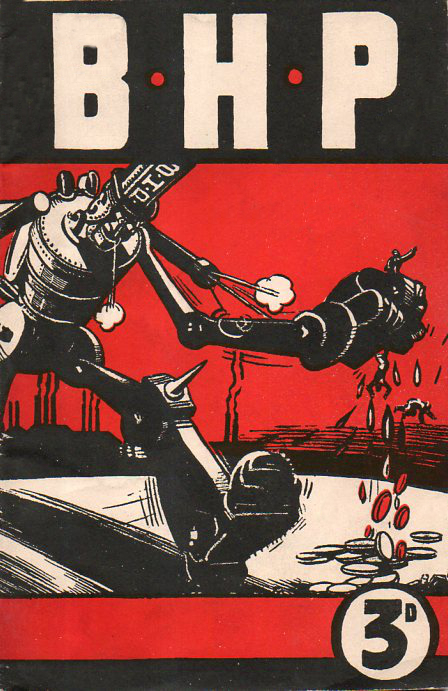
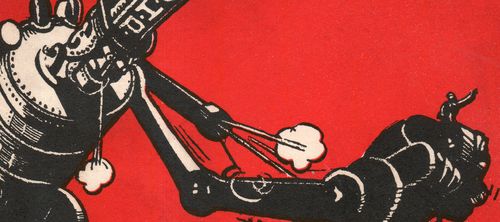
    This striking image is the cover of a pro-union pamphlet leveled at the Australian iron-producer, B.H.P. (Broken Hill Proprietary, a 150-year-old firm), and published in 1943 by the Federated Ironworkers’ Association of Australia. The great social observer and artist Thomas Nast was very aware that much of his “readership” couldn’t read, and so he made his work (which was usually text-heavy) completely understandable as a purely visual message.  So too for artists like the anonymous person who contributed this great cover–there is no question about what might be in the pages of the pamphlet.

    Poster Reprint BHP 96 dpi356

    It is also interesting to think about the “menacing” part of the title of this quick post–I would consider this still to be an early depiction of a robot (the term then still about a dozen years old) acting in a threatening manner towards humans–and in this case squeezing them until blood money is drawn.  

    This is a detail from the 600 dpi scan–click for an even larger image of this sample:

    Poster Reprint BHP 600 FINAL detail dpi357


    There is a very nice 13×19 inch 600 dpi poster being offered of this cover at the our POSTER Blog, here.  


  • Poster Series #1–Big Red Wobblies

    JF Ptak Science Books      Quick Post–Poster Series 1

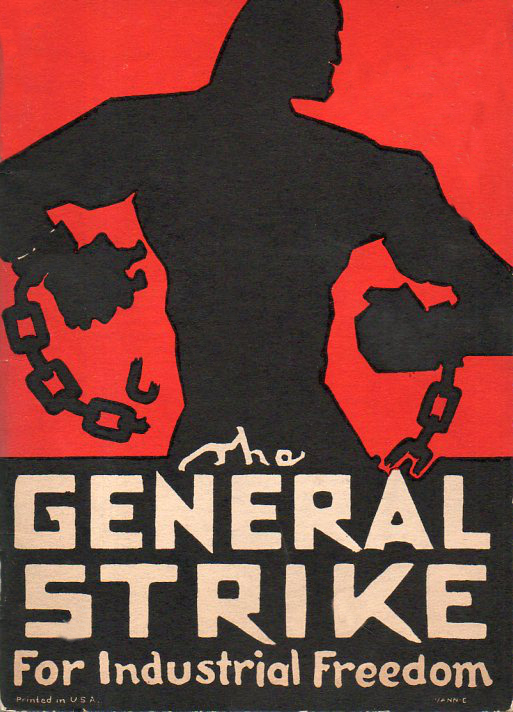
    Poster Reprint  General Strike Public[This is a 1 meg version of the 16 meg finished version of this cover art.]

    • This is the first of the newly-reinstated Poster Production part of this blog.  I did many of these some years ago, though they were mostly technical drawings of the B-17 (G!) and such.  
    • The new service offers 5-25 meg reproductions on 13×19″ professional matte photographic paper using pigment inks, which will last a long time without fading.  

    This is the fantastic artwork for the cover of the pamphlet The General Strike for Industrial Freedom which was printed in Chicago in January 1933 by the Industrial Workers of the World (the Wobblies).  The IWW was pretty far left–okay, very far–and was founded in 1905 by Eugene V. Debs, Mary Harris “Mother” Jones, William D. (“Big Bill”) Haywood, Daniel De Leon,  Thomas Hagerty, Lucy Parsons,  and others.  By the ’30’s membership in the organization was off probably an order of magnitude, its heydey more “dey” than “hey”, its flash gone. 

    This is available on the new Poster Blog, here.  


  • Blood Poison and its Non-Existent Mystery Cure, 1903

    JF Ptak Science Books   Quick Post

    See also the related post from 2012 “A Bloated Alphabet of Fat Cures: Strychnine Pills, Vibrators and Hope”, here.

    Blood poison352

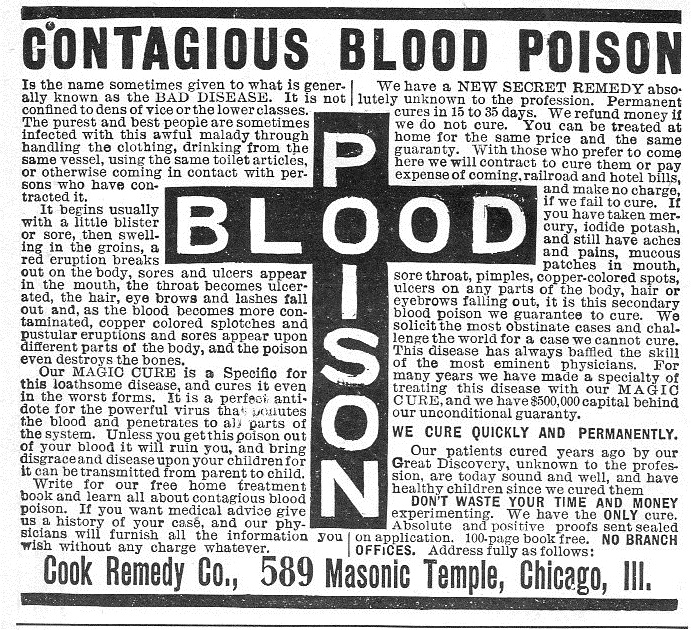
    Pushing its way past other adds in the back of the May 1903 issue of The Confederate Veteran is this contagiously interesting advertisement for a very loud quack cure for “blood poisoning”.  It was manufactured by the Cook Remedy Company of Chicago, Illinois, and offered their cure (“unknown to the profession”) to sufferers of “the Bad Disease”, which they say can affect anyone, not just confined to “dens of vice or the lower classes”.  “Our magic cure” they say, can help all sufferers, curing “quickly and permanently”–otherwise the bad stuff happens, not the least of which was bringing “disease to you and disgrace upon your children”, which is tough hardball stuff, especially coming from con-artist quick-thieves who would say anything and offer any hope to desperate people for a buck, trading on frailty, ill-health, and fear.  

    By Cook Remedy was identified as a quack organization by the federal government, having a not-so-pretty appearance in the 1912 Hearings on the Pure Food and Drug Act.  

    I suppose that the cross in “Blood Poison” was designed to resemble a cemetery/graveyard marker…

    ·Posted by :

    ·in:

    —

  • A Note on Hitler and Women, 1933

    JF Ptak Science Books   Quick Post

    I was reading in The Nation, 19331, and stumbled upon the article “German Culture in Exile”, which was poking through the brittle blocks of Hitler’s newly National Socialistically crumbling society.  What caught my eye in particular was this note about the role of women, which although I knew about this still put it all in a different light: 

    Nazi women351

    This was all quite different from the experience  of women in the Weimar society (1919-1933) where the new democratic experience resulted in numerous advances not the least of which was the right to vote.  Nazis in–women, out.  Except, really, for the home and hearth and reproductive part, substantially different from women comprising 35% of the workforce in 1925.   And just for the serendipitous aspect of it I checked out Mein Kampf on the Internet Archive: I did a text search and found only 22 mentions of “women” and eight for “woman”; on the other hand “men” occurs 2839 times, and “man” 2773.  Does this mean something?–well, yes.  But the question about what it means is quite something else, the answer to which I am not privy. But it does seem to support something obvious in and of itself.  


  • Fascist Anti-New Deal Propaganda, 1935

    JF Ptak Science Books  Post 2339

    Just a reminder that even blattant and bad propaganda has its sub rosa content…

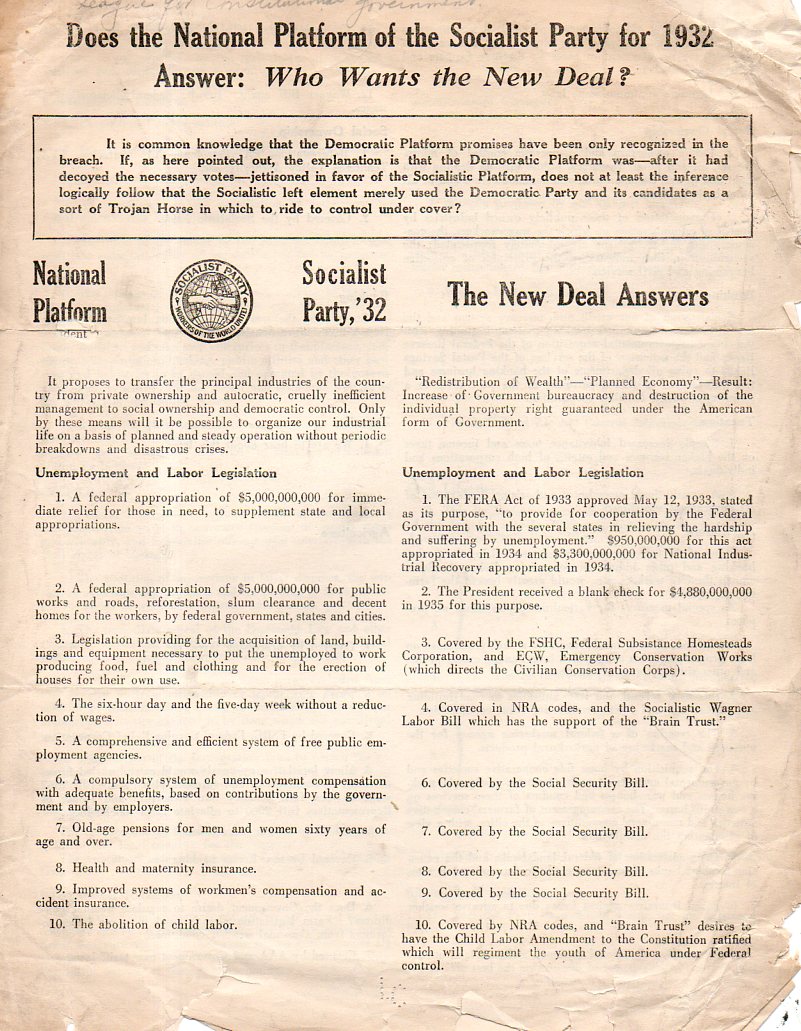
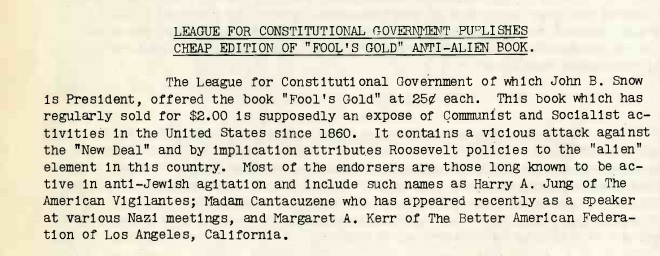
    This is a nasty (pronounced nazty) piece of work by the loftily-named League for Constitutional Government, comparing Roosevelt’s New Deal legislation and program to an overall regime for world domination under Socialist and Communist dictums/control. Everything is Communist, and whatever wasn’t Communist was Socialist, and there really wasn’t to much of a distinction in anything, except that under everything else were the Jews. It is rough and bumpy work, not well written, not well thought-out, though there was a lot of action that was taking place between the badly-formed lines, and if you looked a little hard at it everything starts turning up Fascist. 

    New Deal (anti)350

    It turns out that the League for Constitutional Government is a tough bit to research from home, with not that much written on the organization itself, though there is a fair amount of what can be learned about it by the company it keeps int eh histories of Right-Wing-Lugnut political movements from that period, and all of that association thus far is Fascist. It appears in lists along with the National American (“America’s National-Socialist Party”); “The American Guard, “The White Man’s Party”;  the German American Bund; America First; local bad boy Charles Pelley of Silver Shirts infamy; and in publications including The Revealer, a Christian News Journal, Social Justice, ( a Reverend T,. Coughlin organ), just to name a few.  It is in comfortable splendor with far Christian right organizations like the Christian Patriots (see Mark J, Mozzell, God at the Crossroads,  p.209), and evidently worked to gain control of the east coast section of the America First party (found via Ruth Sarlesp’s The Story of America First, page 28).  There’s also quite a spread on Fascist organizations in America that appeared in Life magazine (March 6, 1939, “Fascism in America: Like Communism It Masquerades as Americanism”). 

    And then there is this from the “Anti-Jewish Propaganda Front” issued by the American Jewish Committee in 1937 (here):

    League for Constitutional

    I had never heard of this  League for Constitutional Government before last night, and had a difficult time making my way through its somehow dense and loosely packed four-page contents–until it dawned on me that what I was really reading was Fascist propaganda–and that was surprising, mainly because it was so early on it the history of Fascist stuff going on in America.

    My copy of this document was once owned by H.L. Mencken, who gave the thing to the Library of Congress, which in turn decided it wasn’t worth having around (at least in duplicate). I don’t need to own it either, though as a piece of quiet-ish political junk it should be somewhere to remind people that even in flaming propagandistic rhetoric there’s more reading to be done between the lines.  

    ·Posted by :

    ·in:

    —

  • Propaganda and the American West, 1884

    JF Ptak Science Books    Post 2338

    Public Domain Map

    [Image source: Boston Public Library, here.]

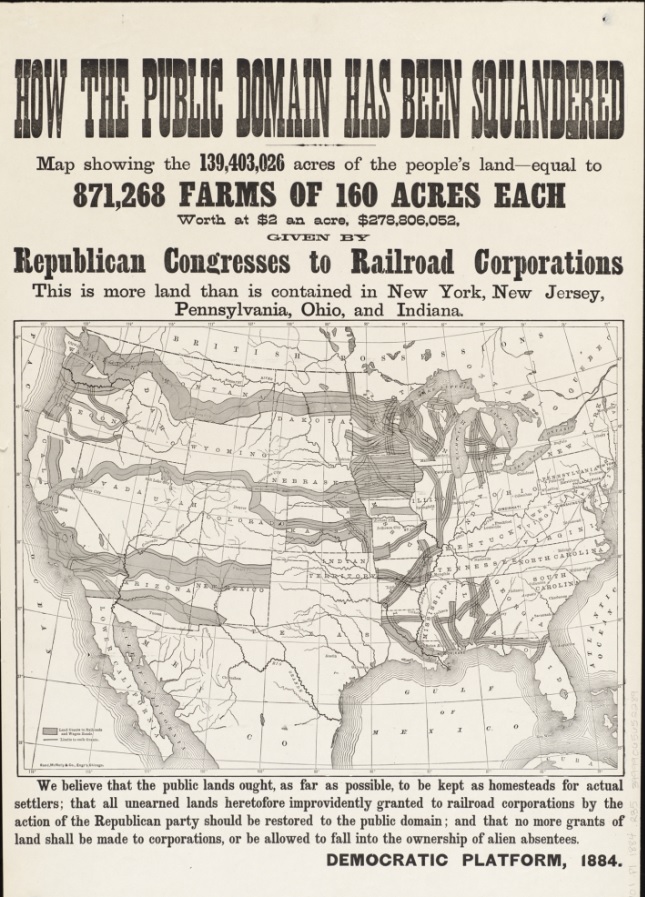
     This propagandistic political broadside and map had an influence in the thinking of voters in the 1884 presidential election–and in fact it was mostly wrong.  That “wrongness” was perpetrated for the Democratic Party at the expense of the Republicans, and held influence for dozens of years in helping to form the idea that the Republicans gave away huge chunks of American land to railroad companies in corrupt deals.  

    The map: How the public domain has been squandered, map showing the 139,403,026 acres of the people’s land – equal to 871,268 farms of 160 acres each, worth at $2 an acre, $278,806,052, given by Republican Congresses to railroad corporations , published by the Rand, McNally & Company, Chicago, 1884, is the culprit.

    Well, some healthy percentage of those land deals were rigged/crooked–but not nearly all; and in fact there were huge sums of money raised by the government in granting enormous land offerings to the railroad companies, who were also monetarily encouraged to continue making their ways west.   There were definitely multiple aspect in all of this.