A Daily History of Holes, Dots, Lines, Science, History, Math, Physics, Art, the Unintentional Absurd, Architecture, Maps, Data Visualization, Blank and Missing Things, and so on. |1.6 million words, 7500 images, 4.9 million hits| Press & appearances in The Times, Le Figaro, Mensa, The Economist, The Guardian, Discovery News, Slate, Le Monde, Sci American Blogs, Le Pont, and many other places… 5000+ total posts since 2008.

Author: JF Ptak

  • The Ghosts of Melville and Darwin at Tea

    JF Ptak Science Books   Post 2343

    “…a most Plutonian sight. In no world but a fallen one could such lands exist.”–Herman Melville on the Galapagos, in The Encantadas

    “It is utterly useless to say anything about the  Scenery…it would be as profitable to explain to a blind man colours, as to [a] person, who has not been out of Europe, the total 
    dissimilarity of a Tropical view.”–Charles Darwin in a letter not long after returning from his voyage on the Galapagos.–The Life and Letters of Charles Darwin, Volume I (of II), edited by His Son, Charles Darwin & Francis Darwin

    It is interesting to think of Charles Darwin and Herman Melville sharing tea prepared over a wood fire, stone chairs, looking out over the rough beach of one of the islands in the Galapagos chain from the top of the  Rock Rodondo.  And what I would have them talk about is their lives, reveiwed as spectres come back to Earth to see the advent of their careers as humans and what the future held in stock for them.

    They certainly had different views of the Galapagos–the Melville quote from his The Encantadas, which is the “Enchanted Isles/Islands” or Galapagos is pretty much what he thought of the place, which was a cruel and wrenching world.  Darwin, well… not so.  (I should also point out that there is a little bit of back-up in the Melville novella regarding ghosts–one of the stories is about the encounter of the War of 1812 USS Essex with a ghost ship.  And here are Dawin and Melville, two ghost ships passing in the night…)

    Here is the quote to start off the tenth of ten parts of the work, “Runaways, Castaways, Solitaries, Gravestones, Etc.”:

    “And all about old stocks and stubs of trees,
    Whereon nor fruit nor leaf was ever seen,
    Did hang upon ragged knotty knees,
    On which had many wretches hanged been.”

    The two men weren’t in the Galapagos at thew same time, though, during their living lives but did come within several years of one another on their respective voyages.  Both men went on great accomplishment, though Melville’s lasted only about five years, his writing and career falling out of the public eye soon after his fifth novel. Darwin was a different story.

    Melville key

    [Photo by JF Ptak of the front door keyhole at Melville’s house, Arrowhead, near Pittsfield, Massachusetts. The foundry work is old, the hardware is not.]

    Darwin became DARWIN  in 1859 and stayed there, and icon of thought. Melville achieved early fame but soon lost it. Melville’s career started out very strong in 1846, and had five successful novels in five years.  What he is remembered most for–Moby Dick–appeared in 1851, but the book was a critical and commercial failure. Pierre appeared in the next year, anf again very little success, and by just about that time his name as a highlight in the American literary world began to dim, considerably.  He lived until 1891 and spent the ’60’s through the ’80’s and into the early ’90’s as an obscure footnote int eh history of American literature.  As a matter of fact some of the short obituaries that appeared in New York papers had very little to say about him, and his great work in Moby Dick received scant (or no) attention.  Even the New York Times didn’t get the spelling correct of the title of the book1, referring to “Mobie” 

    Like the Mona Lisa, Melvillle didn’t become his famous-self until well after his death, and the Mona Lisa did achieve her iconic nature (it can be argued) for nearly two centuries.  Darwin became famous and stayed famous.  In repose, perhaps Darwin would have wished for less recognition and Melville a little more–or at least enough to allow his to earn a living from his writing.  

    Notes

    1. “Herman Melville died yesterday at his residence, 104 East Twenty-sixth Street, this city, of heart failure, aged seventy-two. He was the author of Typee, Omoo, Mobie Dick, and other sea-faring tales, written in earlier years. He leaves a wife and two daughters, Mrs. M. B. Thomas and Miss Melville.”–New York Times, September 29, 1891

    [Source: http://www.melville.org/hmobit.htm]
    ·Posted by :

    ·in:


  • The Lost Einstein Film, 1922

    JF Pak Science Books   Quick Post

    EInstein image

    [Source: http://www.kinematographie.de/EINSTEIN.JPG]

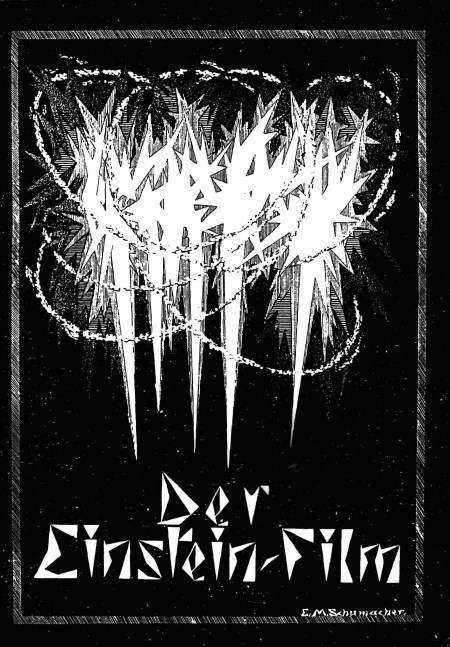
    Here’s a movie that no longer exists and that may not be such a great achievement but would also be something I’d like to see just because it suddenly existed again.  It was a movie called “The Basic Principles of Einstein’s Theory of Relativity” which premiered  at the Frankfurt  Trade Fair on April 2, 1922 and made by Walter Kornblum–it was about Einstein and relativity, and was about the first of its kind; it was a successful film, but with varying reviews, and then managed not to survive them. No copy survives, nothing left of it to speak of save descriptions of the film and the reviews that appeared in newspapers. There is however a terrific piece of research by Milena Wazeck1 that reconstructs the film from a number of different sources–it is really a very impressive piece of work, a wonderful thing to read, watching the lost history unfold.  (Full text here; and see the abstract2 below.)


  • The CowBot, 1888

    JF Ptak Science Books  Quick Post

    Robot Cow


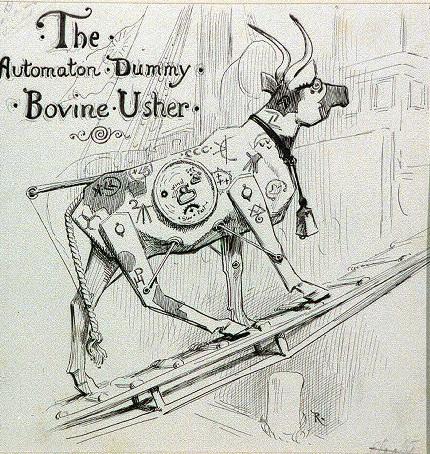
    I’ve been collecting images of 19th century robots and automatons and came across another–a very uncommon cowbot. “The Automaton Dummy : Bovine Usher” was drawn for Wallace Peck, created by William Allen Rogers (1854-1931)  and published in volume 8 of Life (July 8, 1886) and also in Peck’s The Golden Age of Patents (Frederick Stokes, 1888). [Image source: the Library of Congress, here, and for the Peck book, here.)  This is the only robot featured in the book, though there are many other fine illustrations of future techno whatzit bits.  The automaton beef was supposed to lead the other cows aboard a ship for shipment, the philosophy being that if one led the way that the others would follow.) The cowbot is also covered with brands, including a H.A.Rey-like Curious George techno bit in the midsection, the knobs and so forth forming an anthropologic face.  


  • The Language of Tree Structure

    JF Ptak Science Books 

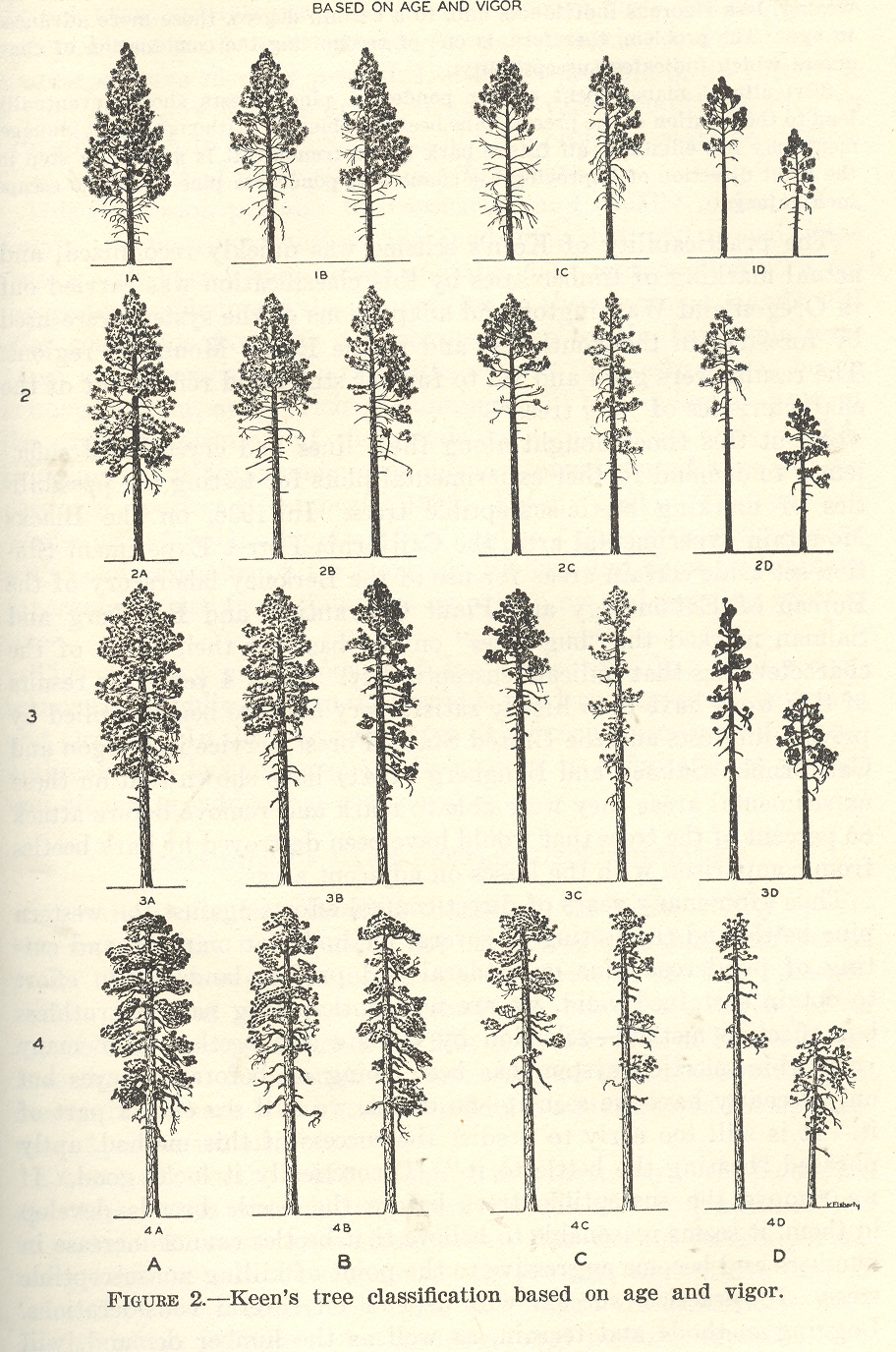
    Messages and information, silently displayed data and the announcements of the state of all things are everywhere, all of the time:  these things only become part of the language and systematically codified once they are recognized and understood, or at least once the thrust of the message becomes distinguished from the surrounding noise. 

    Blog--jun 8 tree
    One elegant interpretation of above-the-noise display was made by E.P. Keen in 1936 (“Relative susceptibility of ponderosa pines to bark beetle attack”, published in the Journal of Forestry)  who established a simple and practicable standardized vocabulary for the discussion and communication of tree health.  It is a relatively straightforward idea–based upon many years of keen observation and understanding–which used a pictorial schematic to establish a common baseline for the discussion of tree health/growth. Later on Keen would pioneer the use of aerial photography using various films and filters to determine the extent of damage done to stands of trees (and forests) brought about by drought, pests, diseases and other harmful stimuli–especially when the damage was done not in the visible spectrum. 

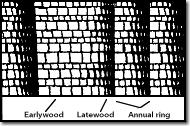
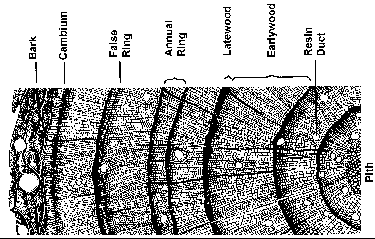
    The Blank & Empty part of tree language comes in the form of cells in the trunk of the tree which reveal–in cross section–the age of the tree and some climatic indicators of during the tree’s growth.  This comes in the form of tree rings–the rings are formed by the growth of the cells, the first of which in a new season respond with expansion, and depending upon water conditions will either grow somewhat less slowly than at first or stop growing altogether at the end of the season, and die; the new cells growing in the new season, and the demarcation being what we call a “ring”.  This was a fantastic idea, the brainchild of A.E. Douglass at the University of Arizona.  
    Blog--june 8--tree cell
    Andrew Ellicott Douglass (1867-1962)  was , ironically, an American astronomer at work at the Lowell Observatory in Flagstaff when, in 1911,  he began his experimentation with tree rings.. (I believe that he came to this end trying to ascertain terrestrial climatic conditions in his sunspot research.) The resulting effort was the clarification and near-founding of dendrochronology, with the resulting climatic understanding applicable across many different fields, and all from expanded/contracted cells.  Douglass perfected his observation and theory in a three-volume masterwork Climate Cycles and Tree Growth, which was published in 1936.
    Blog--june 8--tree 2

    For an interesting appraisal, see George E.Webb  Tree Rings and Telescopes, (the University of Arizona Press), Tucson, Arizona, 1983.


    ·Posted by :

    ·in:


  • Mud, Abstract Expressionism, and the Brick Color Field

    JF Ptak Science Books   Post 2342

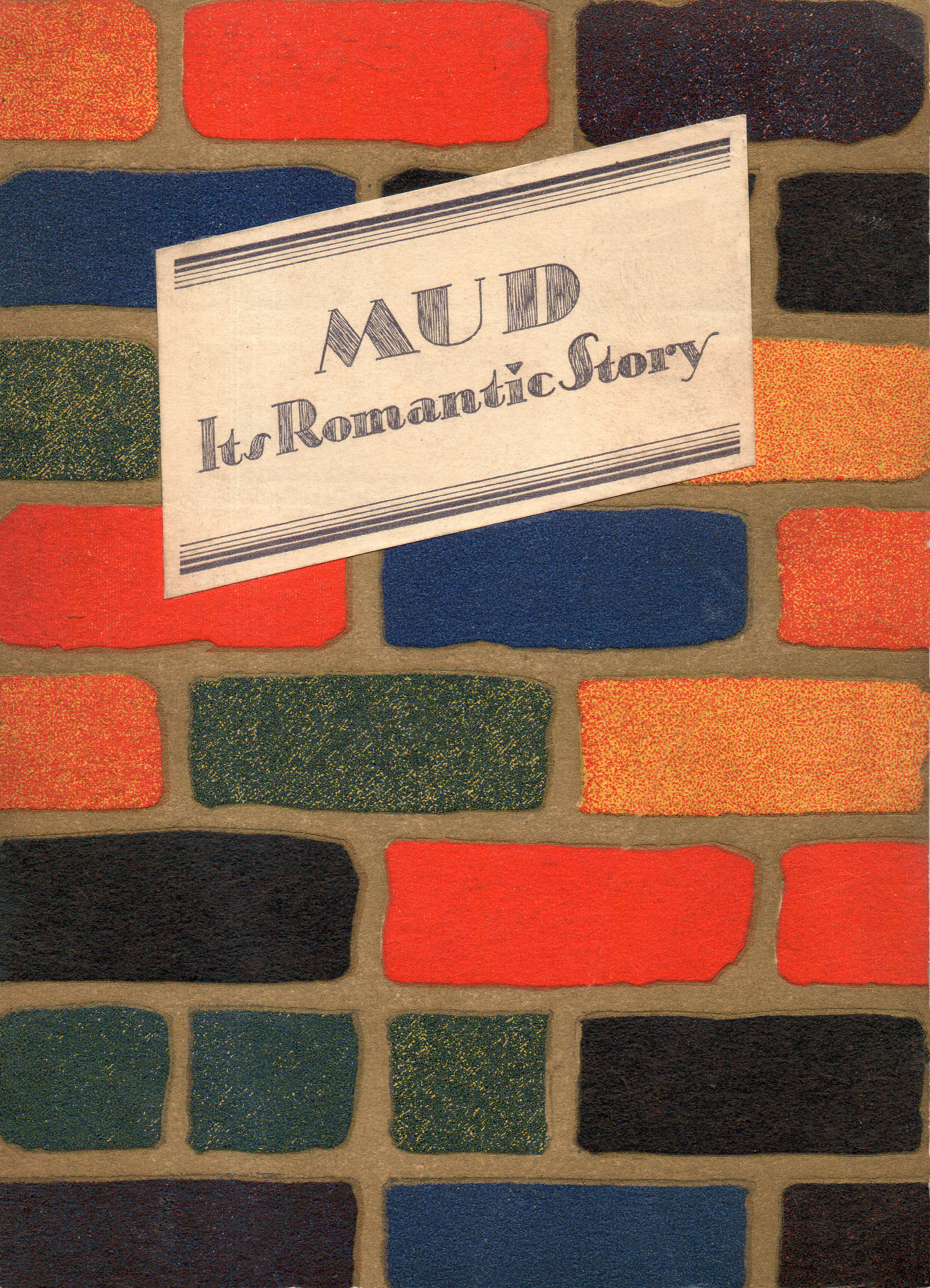
    Mud abstract


    Okay, so, this may only be a detail of a cover of a quietly-uncommon and proto-bizarre pamphlet on bricks, but when you look at it in a certain way, it may suggest a bit of found abstract expressionist art. Or even a Cubist-something.  I can see it as a color field–a very, very hard-edged Rothko detail comes to mind.  Perhaps if Pollock arranged entire bricks as his medium rather than dripped paint, he may have come upon an expression such as this. Or not.  

    Poster---MUD 364[This image is available as a 13″x19″ 600 dpi poster, here.]

    The pamphlet comes from my collection of fantastically-titled and creatively naive pamphlets and books.  After considering their reaching, speculative, bizarre, and surreal titles, they fall into a number of sub-categories, including:

    • titles with question marks “?” (like the two wonderful pamphlets simply entitled “What ?” and of course the two that have no titles but question marks);
    • titles with exclamation points “!” (these two marks actually don’t occur very often at all in titles, especially when the title itself already has a built in question/exclamation mark); 
    • titles that include the phrase “the history of…” or “the story of….” so long as that history/story is (very) unusual; 
    • titles that demand something or other of  “America”  (i.e., “Will America be Invaded?” or “America, Mussolini or Moscow” or “Sandbags, Worms and America”);
    • title pages with American flags.

    This excludes a lot of the general naïve-surreal and historical pamphlet collection, but these, I think, would make a great exhibition of book of books, simply because so many of them have an unquestionable “what in the _” reaction capacity to them.

    The found-abstract detail comes from Mud, its Romantic Story, (by Richard G. Collier, for the Common Brick Manufacturer Association of America, Cleveland, Ohio) and is a prime example for the collection:  a terrific title and a beautiful design that offers a lot more than a simple story about bricks (even though it does contain a lively little history of brick making in America–the good content almost takes away from the fantastic title, but so it goes).


  • Books with Titles that Cannot Be Ignored

    JF Ptak Science Books  Quick Post

    “‘Any book that is worth reading once, is worth reading twice”--B. Franklin.

     “Read much, but do not read many books”–Pliny

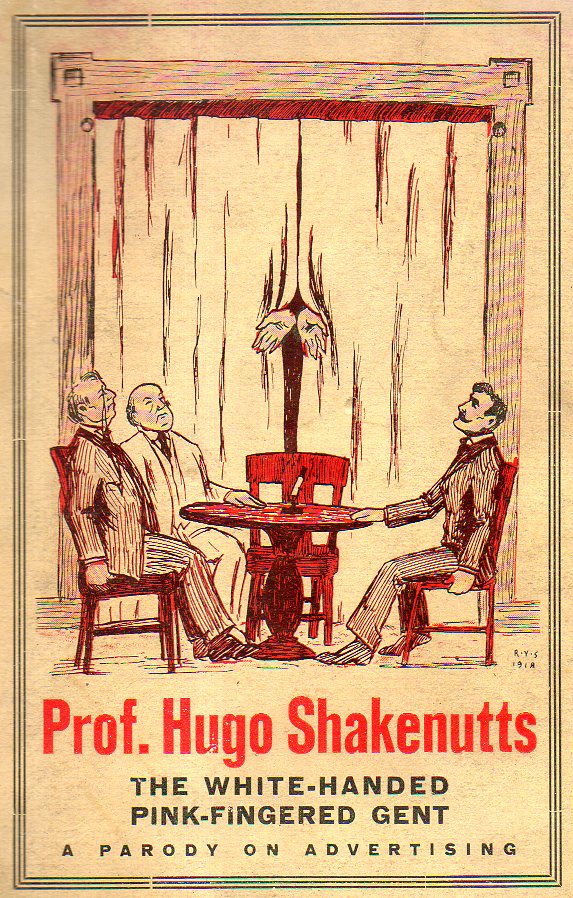
    SHakenuts360

    In my recent history there are many works whose titles I cannot help to ignore because they are, frankly, impenetrable for me–Nature has partially become that way for me, particularly with the biological sciences. In an extreme show of what I do not know, there is an entire legion of them that are published every day whose titles are so distant from my knowledge base that they might as well be invisible.  There many others titles that almost call out for unknown infamy, like John Jeb, of Calhoun County and My Search for Truth by any number of people, and on into the immobile night, widened by an entire new galaxy of the self-published.  Of course, if there were slight changes in those titles, like, say John Jeb, of Calhoun County, Me or My–My!–Search for Truth they become instantly interesting.

    On the other hand there are those books whose titles simply cannot be ignored because they are weirdly inflammatory, or coyly hyperbolic, or halfway unintentionally and trippingly absurdist, and the like.  The Story of a Ripe Banana is one such title for me, and is a fine example for the category of books whose titles are far more interesting than the work they describe.


    ·Posted by :

    ·in:


  • Social-Techno Anthropomorphy

    JF Ptak Science Books  Post update

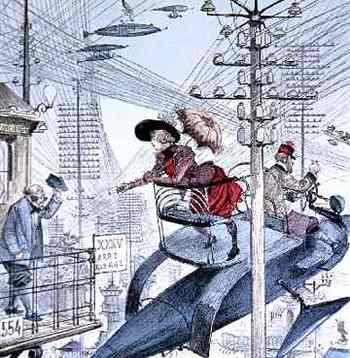
    Robida

    My friend Jeff Donlan sent along a suggestion for reading Michael Graziano’s Consciousness and the Social Brain—I don’t know anything about the book, but the title has done its job in provoking the imagination.  What the title asks me (apart from whatever the book might be about) is this: how long have people thought about some aspect of a “social brain” and what has that looked like over the decades (or centuries)?  “Social” and “brain”, like society, or Earth, or some definition or classification of people, have made for themselves something much larger than the ordinary collective.  It is a very useful tool, this simple metaphor–in it are a wellspring of ideas.

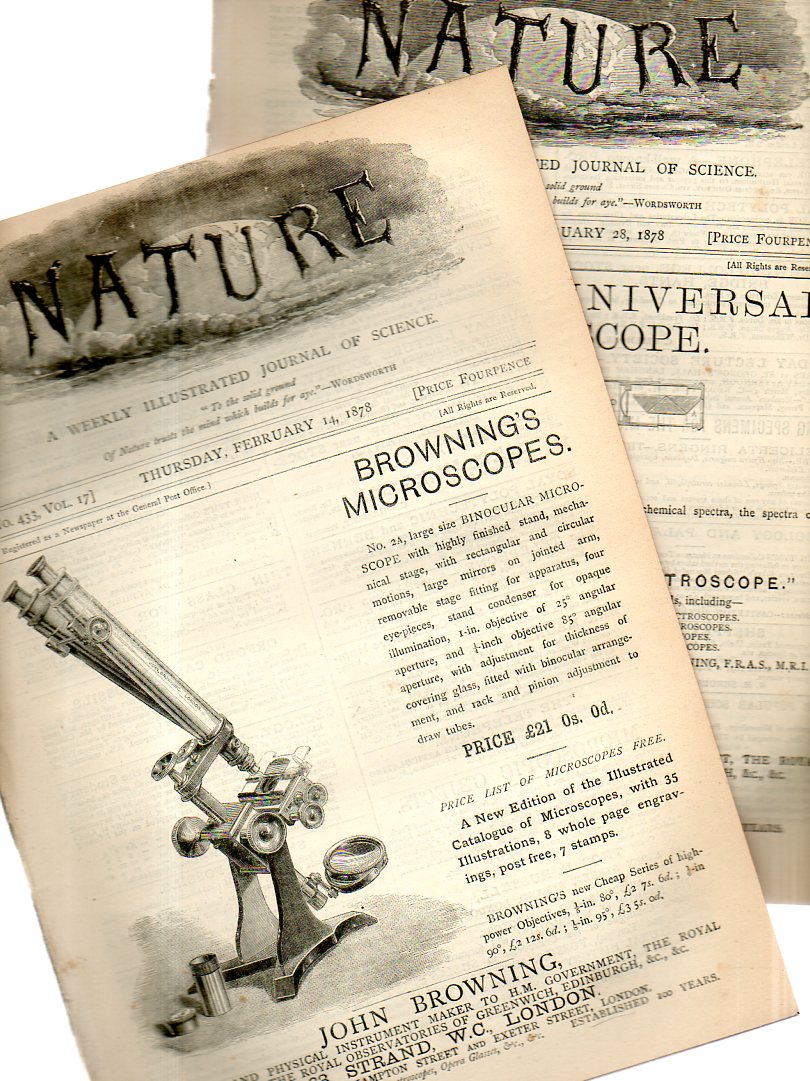
    I’m also interested in what anyone might know about the early use of metaphors (and analogies) relating large-scale societal techno advances and biological functions?  I have no doubt that they go back to modern-ancient times (say to William Gilbert (1544-1603)  and his vis electrica) and that some old mechanical/anthropomorphic examples are still in everyday use (“horsepower”)—but I’m stopped today by seeing this paper by J. Norman Lockyer called “Social Electrical Nerves” (in two issues of  Nature for 14 and 28 February 1878).  In this paper the great astronomer (and the editor of the journal) looks at elements of the “grid” as it was and seeing how the new networks of police and fire communications via telegraph  interacts with the existing electrical systems.  It seems to me an early use of  nervous system/electrical analogy, in spite of the fact the first “electrical highways” (as Lockyer puts it 120 years before our own “information superhighway”) appeared in England 32 years earlier though apparently without these biological metaphors. 

    Robidatelephone_lines
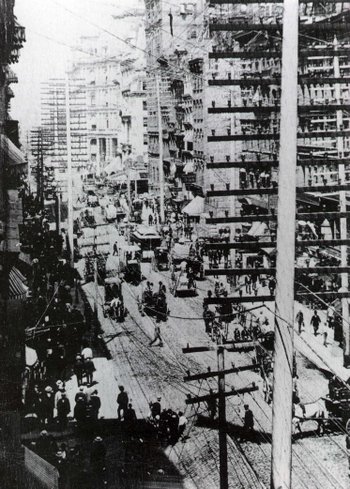
    The work pictured above is the electrically-draped world of the future, at least according to the vision of the wonderful Albert Robida, who was actually at work on these visions just at the time of the publication of the Lockyear paper . (Robida produced at least a trio of interesting and lovely and occasionally prescient works:  Le Vingtième Siècle (1883);  La Guerre au vingtième siècle (1887); and Le Vingtième siècle– La vie électrique (1890)).   Many of Robida’s visions of electrical connectivity seem to me to move beyond the nervous system metaphor and become a kind of societal “skin”—which is not terribly far from the truth, especially when looking at images of congested metropolitan centers ca. 1910, when utility poles fairly well sagged under 20 (!) horizontal crossbars carrying a dozen lines apiece.   At the very least, you knew that something or other was happening (fast forward to the massive ductworks of Terry Gilliam’s masterpiece, Brazil.) 

    Social electric616

    And now that the wireless age is starting to get ridges in its fingernails (the “wireless” age being at least 115 years old, beautifully borne by Heinrich Hertz and Marconi), where are our bio-electrical  metaphors going?

    Philosopher of science Rom Harre is one among very many who have written on the use of metaphor in science–he finds the practice an “indispensible element…to scientific creativity and imagination”.1 And he is certainly correct–the recognition of the Lockyer metaphor is instantaneous today, and must’ve been quite a shocking thing to see in 1878.  

    I know that this is just a nibble around the edge of a vast amount of thinking on this subject, and perhaps I don’t want ot do this so “out loud” in the public forum, but I am interested in a dialog on this, if anyone is interested in participating.

    Notes: 

    1. Harre’s reasoning is nicely summed up here in “The Function of Scientific Metaphors: An Example of the Creative Power of Metaphors in Biological Theories”,  by Xavier de Donato 
    Rodríguez and Alfonso Arroyo-Santos:
     
    “(1) New scientific theories try to provide a better understanding of reality.(2) In order to do that, these theories must be intelligible.(3) That intelligibility must ultimately derive from the intelligibility of the novel entities and forms conceived in the creative scientific imagination.(4) The novel entities and forms introduced by the theory become intelligible only if we interpret them in terms of the old entities and forms already available.(5) But, the only way to do this is by means of metaphors or analogies taking the entities and forms already available as a basis.(6) So, analogies and metaphors are indispensable for scientific theories.”

    ·Posted by :

    ·in:


  • Alan Turing and How the Chicken Gets Inside the Egg

    JF Ptak Science Books   Quick Post 

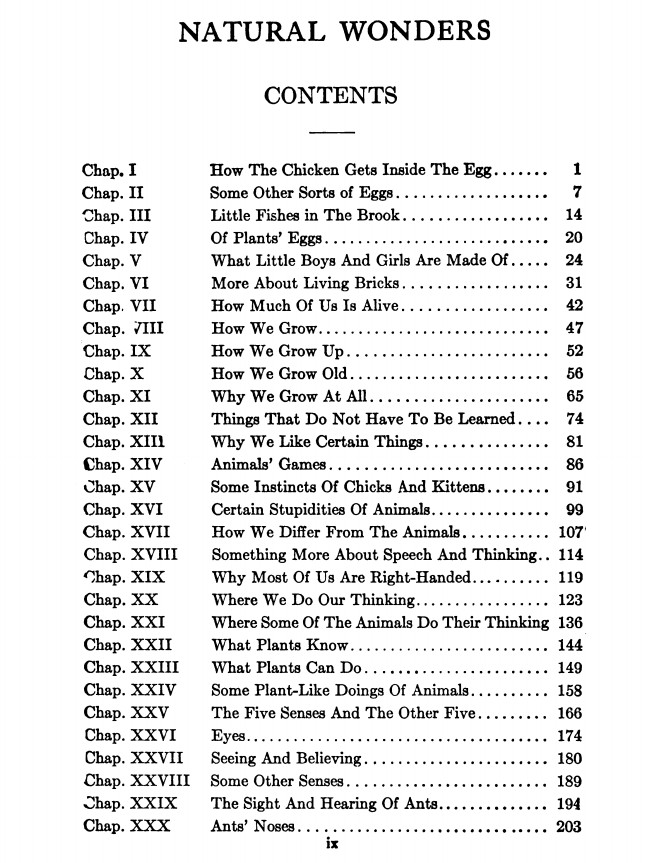
    Turing as a childThe most influential book in the young life of Alan Turing is said to be What Every Child Should Know Library–it is a six volume work1, and it seems as though the volume of interest was Natural Wonders Edwin Tenney Brewster2 printed in 1912 (and 1927, 1928, and 1939). David Newton3 believes that Turing’s fascination with the book was in part due to a statement by Brewster discussing the machine aspects of the human body. Andrew Hodges in his own biography of Turing (Alan Turing, the Enigma) wrote elegantly that the joy in the book was Turing finding that “such a knowledge of ‘science’ could exist”, which is a great and arching statement and also as broad as it was concise, and poetic.  

    [Turing image via ComputerWorldUK.]

    I’m going to side with poetry on this one.  And I do so because of the extraordinary structure of the book and its lovely chapter headings, the table of contents as elegant as a poem itself. They are an invitation to wonder, these thoughtfully prodding and engaging statements, and I can easily see how a creative child could react very positively to them.  

    Turing reading


    [Full text available via UC Davis, here.]


  • A Quiet Image of Unusual Provocation (1942)

    JF Ptak Science Books  Quick Post   (Poster Series)

    Poster--Men you like to meet b+w detail363

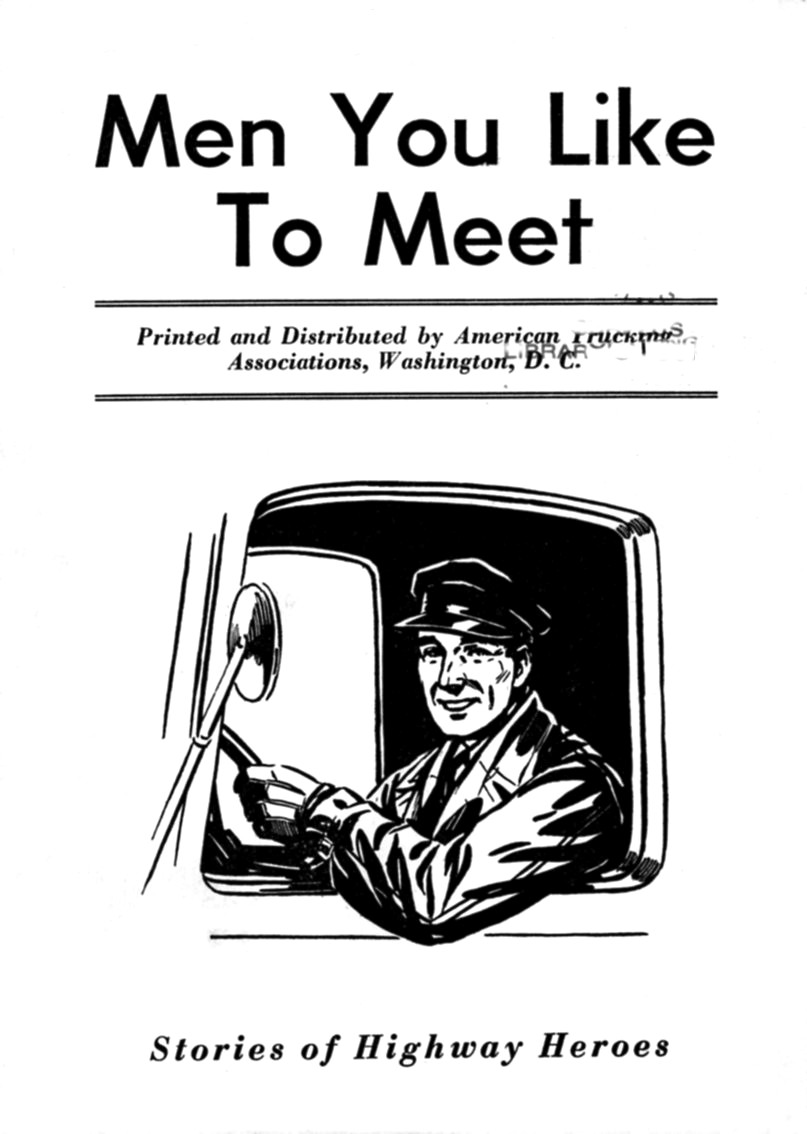
    This is a detail from the cover to this oddly safe but slightly sotto voce absurdly-provocative Men You Like to Meet, a little pamphlet of happy tales published by the American Trucking Associations, published in 1942.  There are a few stories of known and unknown truck driving heroes, saving people, helping stranded motorists, so on–some quiet, some gallant, some ambitious, and all humble.  Just the sort of modern Cowboy you’d like to have on the highways. The full image is below (a poster of which is available from our Poster store, here):  

    Poster--Men you like to meet b+w362


  • Diagrams of Outsider Logic, with Synesthesic Angels (1925)

    JF Ptak Science Books  Post 2341  (Poster Series 5)

     [A cleaned-and-colorized 13×19″ version of this cover design is available in the new Posters section of this blog.]

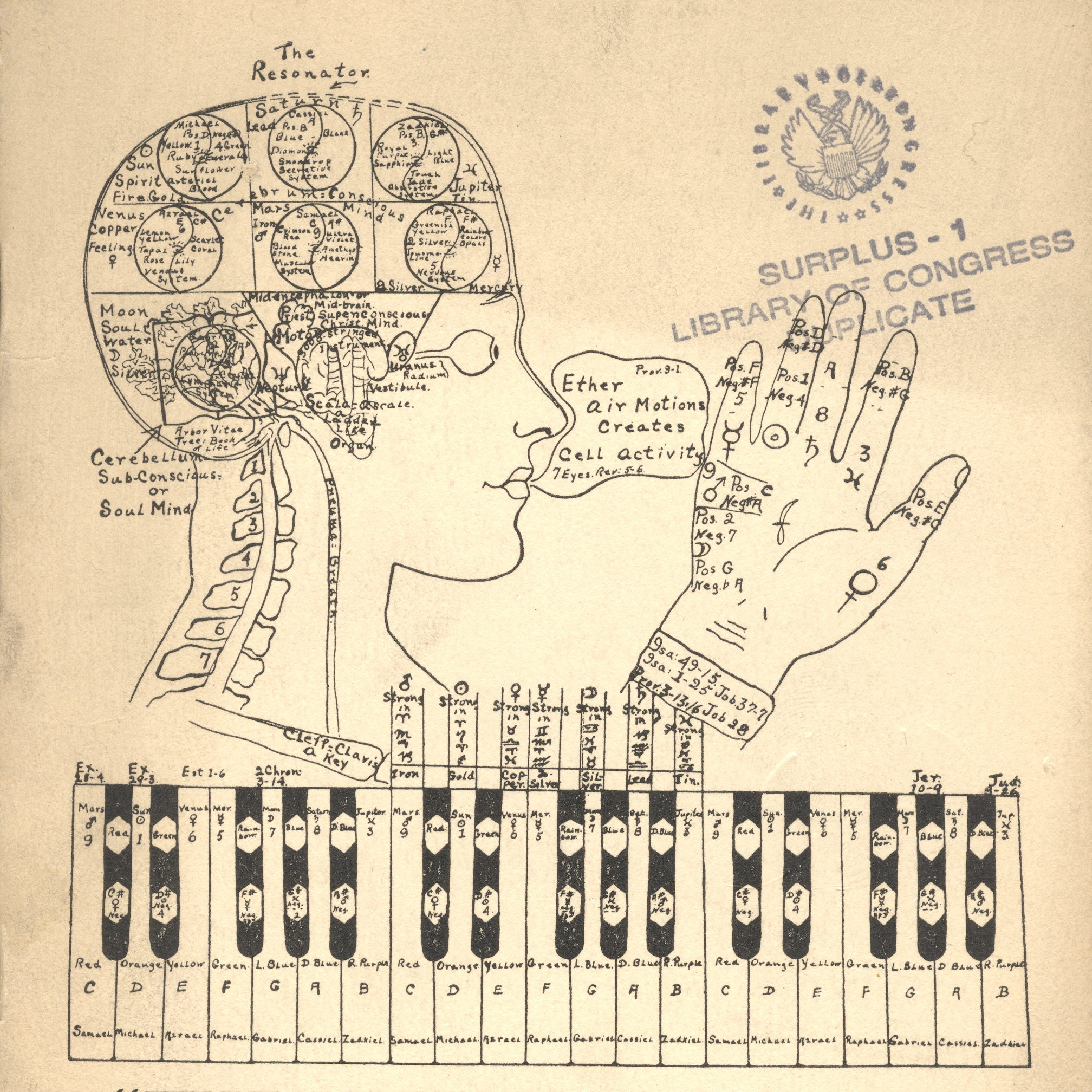
    +()+outsider cover

    There are some other more recent contributions in our Outsider Logic collection that reach the limits of outside, reaching far into the aspects of knowledge that lies more or less completely hidden and inaccessible to the vast majority of readers.  Sometimes bumping into outré thinking like this is very useful because it is just so very different; and sometimes this thought process is just and only that: very different.

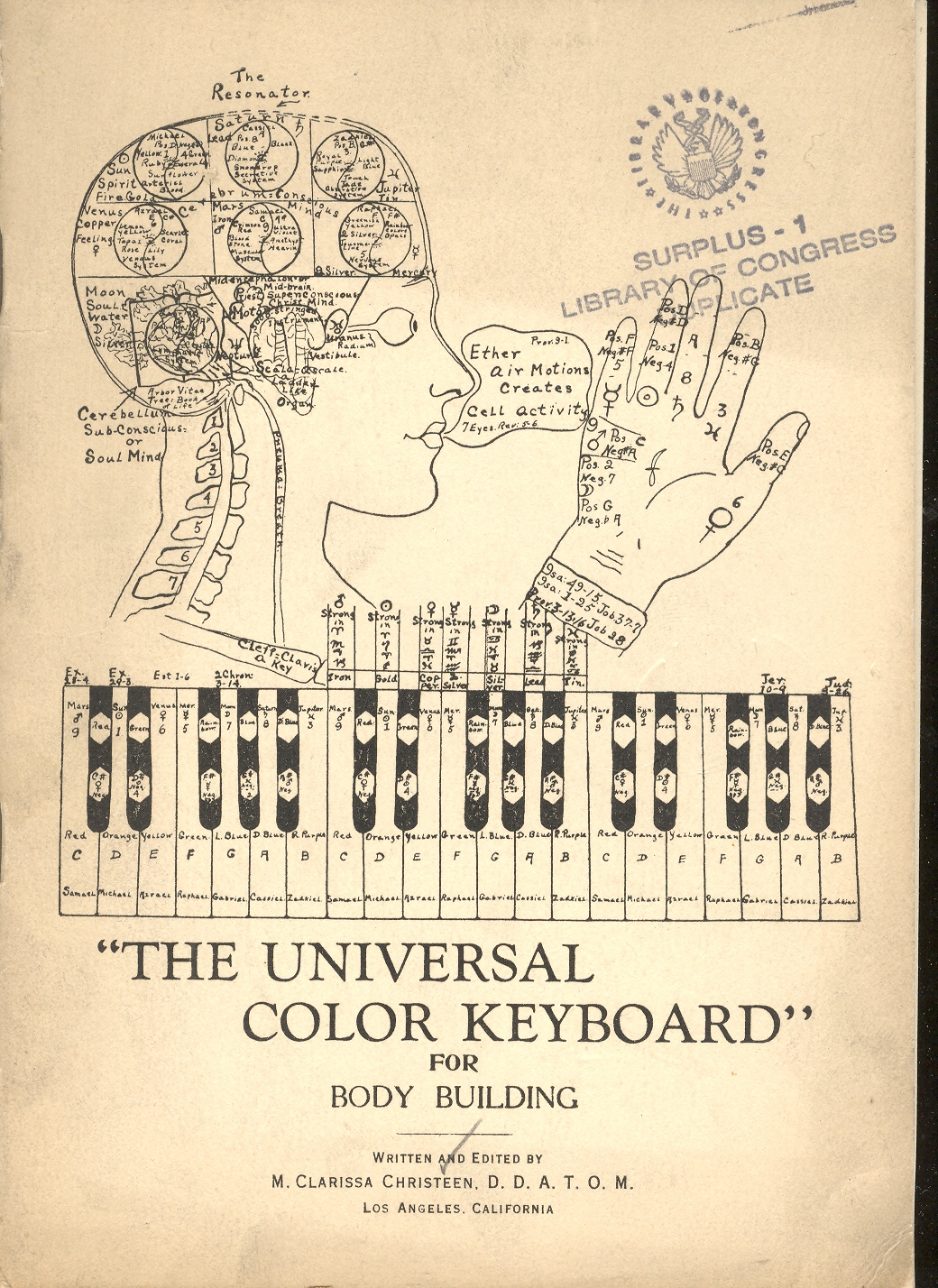
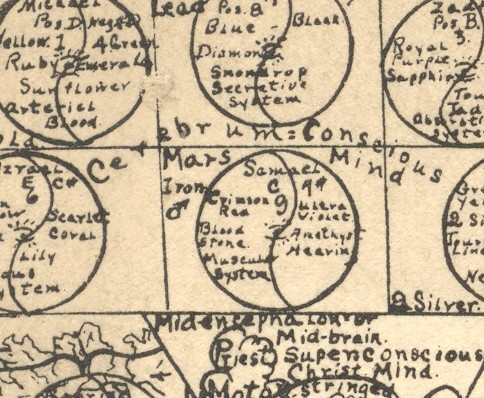
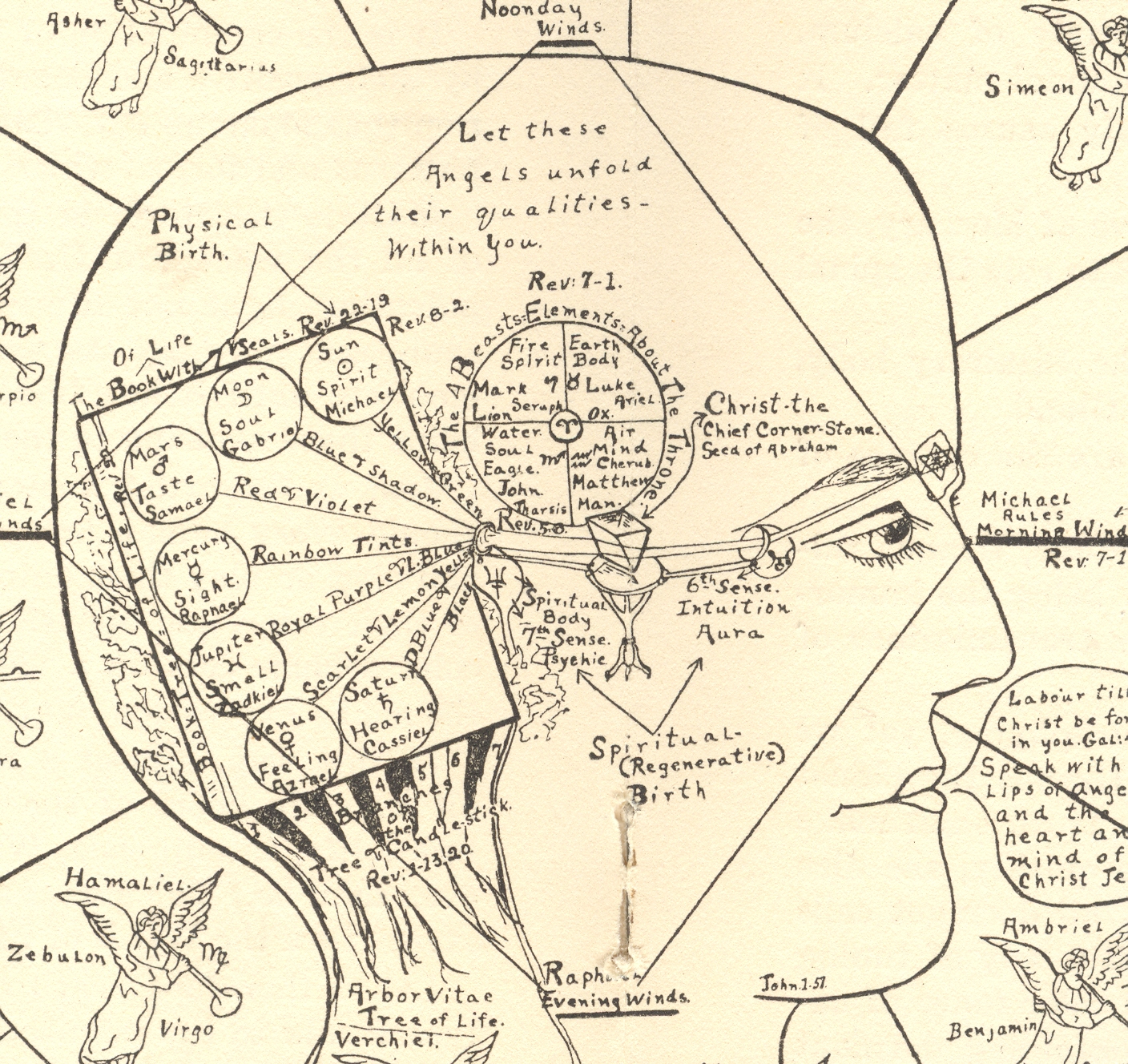
    This last bit is probably the case for W. Clarissa Christeen’s  (“D.D.A.T.O.M.”)The Universal Color Keyboard for Body Building, published in beautiful Los Angeles in 1925. In the many eyebrow-raising and vastly unexpected segments that she manages to share in her thin pamphlet she certainly strays into many unknown conclusion-processes and uniquely personal observations about the physical and spiritual world, testing the reader’s patience in many ways in 16 pages. But what Ms. Christeen absolutely does have going for her is her and which is easily appreciated is her artwork, which is, in its own special way, quite sensational—I’m really sorry that the pamphlet is limited to only two pieces of her work, as I’d really like to see more.  +()+outsider cover det

    Her philosophy is at the very least odd, though it may spring from a synesthesia.  Or not. 

    “Syn” (Greek, “together” and “Aisthesis” (“sensation”) combine to form this very interesting word and ability, being an automatic response to a stimulus by one sense when that stimulus is usually associated with another sense.  For example, there are “synesthetes” who perceive color as an auditory input, basically hearing yellow and so on; more famously are the musicians composing tone poems associating sound with color.  There are letter-color and number-color associatons, as well as taste-senses from colors and sounds and so and on.  For example in Kandinsky’s On the Spiritual in Art there is an attempt to relate color theory to touch and smell; Franz Liszt wrote color music; Isaac Newton attempted to establish the common distribution and association between color and tone frequencies; Rameau constructed a clavencin oculaire while Rimington made a color organ; Richard Feynman spoke of colored equations, and Nabokov recorded  (Speak, Memory) letter/color visions.  These are just a few examples of some of the more well-known practicing synesthetes. 

    In any event Ms. Christeen may be of that mold, and is attempting the universal perfection of mind and body through the combination of color and music (and scent), which “is valuable in building body-tissues of a harmonized order…the music chosen for social functions, the key notes being for the planet ruling or governing the day or the hours etc..  This brings celestial and terrestrial vibrations in direct contact, without interrupted angles which produce in harmony; in other words the creative powers which produce these various waves f light and sound or color or tone, acts upon the lower octave, matter or material manifestations recreating it, transforming it, and raising the vibrations of the said matter or material manifestations, thus, refining the temperature and quality of germ or tissue, etc.”

    This is a long passage, but I include it because, well, I just had no idea when an abrupt turn was going to be made in the discourse; nor did I have any idea of what the principles were of what was being discussed.  And this is still all on page one.  Sometimes passages like these are breathtaking, as in leaving you without breath, because their foundation for understanding is so elusive.  All you’re left with, sometimes, is a “wow!” reaction, like appreciating a pitcher who has just struck you out on three roughed-up-greasy-spit-laden nastiness pitches that were invisible and illegal, and didn’t matter at all.(What the figure in the cover illustration is saying. by the way, is “Ether air motions creates cell activity”, with a couple of Biblical references, somehow.)

    +()+outsider cover ultra det


    +()+outsider insideI do know that the major divulged secret is the Universal keynote (and “keyboard”) and its control through music and fragrance of all that is, “each individual is to harmonize his or her astral colors to the universal keynote that he or she may be surrounded by a correcting aura, which sends out its streamers of light rays into the cosmos”.  Things get more deeply possessed after this, stretching into the Old Testament and astrology, which we don’t need to get into here.  

    +()+outsider insidedetAs I said, perhaps Ms. Christeen was a synesthete, and perhaps multiply so.  In 1925, when this book was written, there mayn’t’ve been a place for people to go who had advanced sensibility of seeing colors in music, and perhaps colors in fragrance. Perhaps Ms. Christeen was working out there in Los Angeles completely alone, trying to figure out just what her special and very different gift actually was.  Perhaps her life was greatly enlivened by her synesthesia, and sent herself out on a mission to the world to have other people experience it, too,, with the help of her color-relational charts.  I do feel for her, though I have absolutely no connection to what she was trying to explain.  I do find the artwork fascinating—a true “outsider” contribution. 

    (By the way, I don’t think that we ever got to the “body building” part in this work.  Also, I think the “DDATOM” after Ms. Christeen’s name meant something like “Doctor of Divinity of the Atom” or something like that–it wasn’t mentioned in the text.)

     And so there you have it.  I think that I’m just making the point that the outcome of some of this very provocative work doesn’t necessarily come into play in its ultimate evaluation, and that it should all be judged by what short of thinking that it excites in its reader.