A Daily History of Holes, Dots, Lines, Science, History, Math, Physics, Art, the Unintentional Absurd, Architecture, Maps, Data Visualization, Blank and Missing Things, and so on. |1.6 million words, 7500 images, 4.9 million hits| Press & appearances in The Times, Le Figaro, Mensa, The Economist, The Guardian, Discovery News, Slate, Le Monde, Sci American Blogs, Le Pont, and many other places… 5000+ total posts since 2008.

Author: JF Ptak

  • The Federal Minimum Wage–Past and Present (Present Passed)

    JF Ptak Science Books   (An extension of a post from 2010)
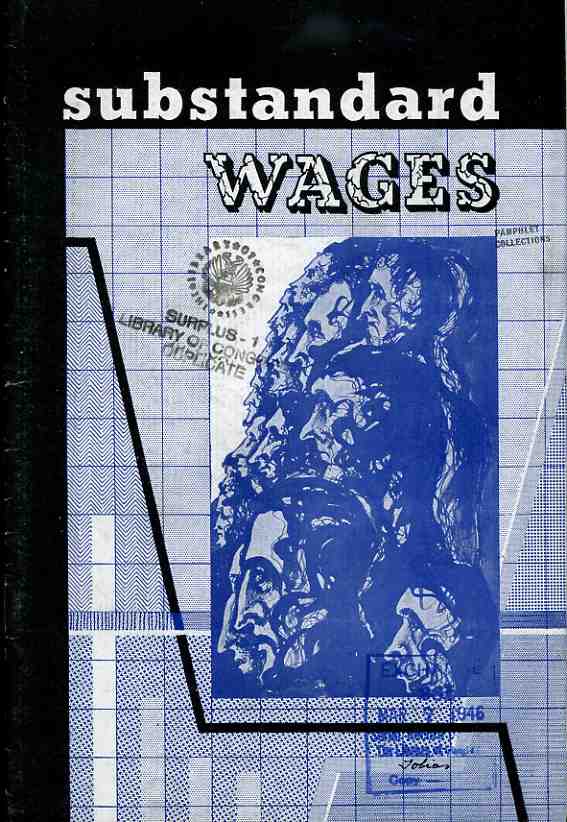
    0 blog jan 30 substandard489I’ve included this post in the Blank/Missing/Empty thread of this blog because the Federal minimum wage has been proportionally increased more so in th e last two years than at almost any time in its history, the increases really only get it up to what it niormally has been, maybe a little higher, with CPI-adjusted. This post is in response to an article in the New York Times today saying that the new minimum wage is equal to that of 1968, which is probably accurate.  The real point is that during the mid- Clinton years and the early Bush yeras the minimum wage languished during a time of tremendous growth for those who already had money–the poor for the years of 1992-2005  were left largely unprotected, unmolested by fortune.

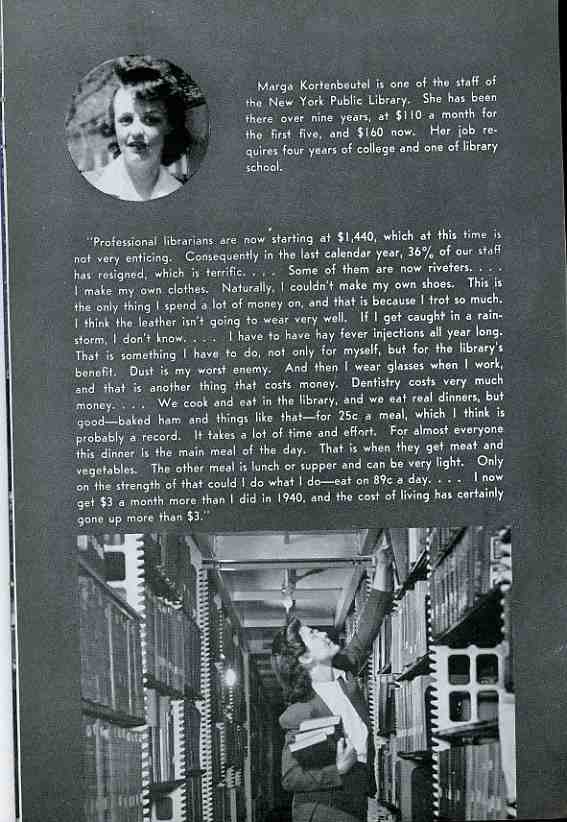
    Leafing my way through this interesting pamphlet, Substandard Wage, an Analysis of their Extent and Effect, and What Must be Done to Establish a Higher Wage Level, design “and presentation” by Abraham Joel Tobias for the Textile Workers Union of America, CIO, and for the Congress of Industrial Organizations, I found some very interesting bits.  First of all, the work was done to aid the working poor, people who were employed and making a wage, but the wage just wasn’t enough necessarily to being them out of poverty.  (The poverty line wasn’t invented as an economic bell weather until 1959.)  The first of the working poor that I read about was a librarian, Marga Kortenbeutel* (of the NYPL) who was working for $1,440.00 a year in 1945, which was just keeping her barely afloat, what with cutting out her 89-cent lunches and all.   That’s the equivalent (CPI adjusted) to about $17,500 a year in 2008 dollars.  Of course, the general economy was not doing well during the war, though it would rebound substantially by the late ‘40’s. The minimum wage, first established in 1938, was equal to about $3.50 2008n dollars in 1945. By 1950 this jumps to $6.25, and from there to about 1988 the minimum wage stays at at least that rate, with the period 1958-1978 soking aqt an average of about $8.hour.  From 1988 forward the minimum wage falls, winding up at about 5 dollars/hour in 2008, with the period 2003-2008 being the lowest level of real wages since World War II.0 blog jan 30 substandard490
    But what was this in terms of the rest of the population; what did these figures for minimum wages mean in the  society at large?  Was this a livable wage?  If we define “livable” as above what the government considered to be the “poverty level”, and “working” is a 40-hour work week and a 50-week working year, the answer is a quick “no”.  In 1959, when the poverty level was established, the minimum wage for the working person brought them to 67% of the income necessary to be “poor”; that left a gap of 33%, and that isn’t good.  That gap continued to close to 1968, when minimum wage go to within 10% of the poverty level, and then it began a slow and steady-ish decline.  The spiral down bottomed out for a bit in 1989, when it hit 52%,   building back up to just a touch over 60% in 1997.  From 1997 until the new minimum wage was instituted in 2006, the gap widened steadily, hitting 50%.  In 2008, with the new minimum wage in place , the gap is still at 41%, meaning that the new wage levels still only come to within 59% of what is supposed to be the poor line in the United States.  59% stops things from being a ridiculous slap in the face of American working poor, but not by much.  And it affects too few:  the minimum wage applied to a high of about 17% of the entire working population in the U.S. in 1979; today, the minimum wage which gets the working poor a little more than half-way to poor, applies to only 2.5% of the population. 

    *As it runs out, I found a little bit about Ms. Koretenbeutel; at the time of the publication of this pamphlet, Margathe was 35 years old.  She married someone named Voorhis in 1960, and died in 1971.  That’s all I’ve got.

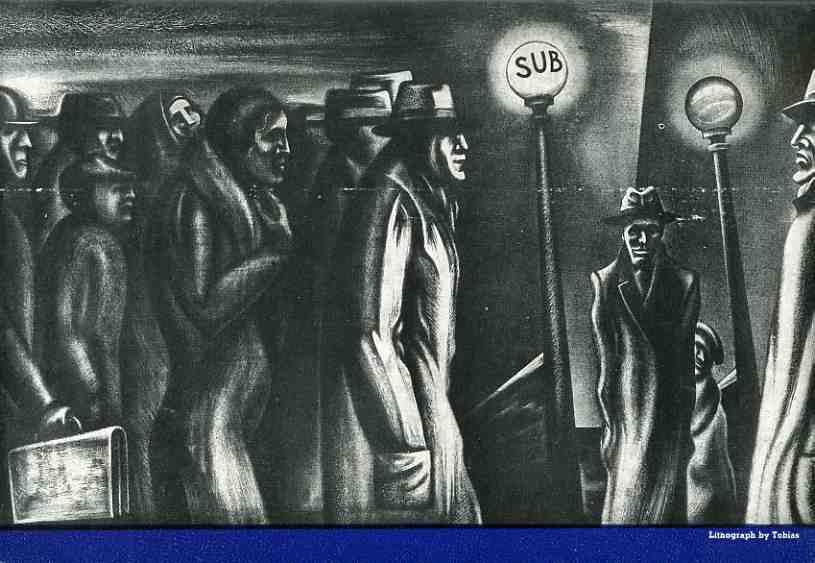
    The image below is from the back cover of the pamphlet, described as a “lithograph by Tobias”. 
    0 blog jan 30 substandard491


    A Timeline of Minimum Wage Levels, 1938-2009  (in continued reading section)
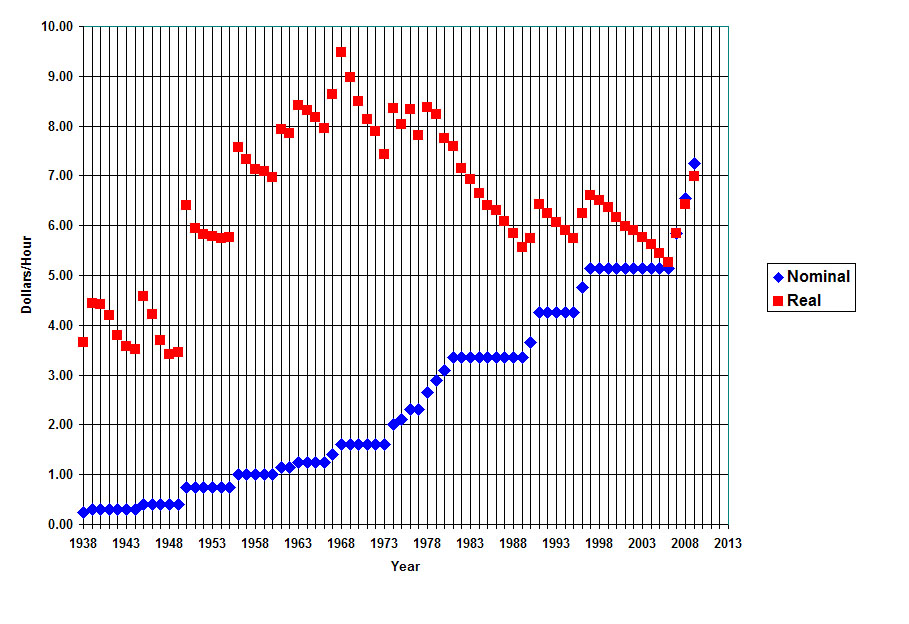
    Minwage The graph, above, is from Oregon State University website on the history of the minimum wage.  The accompanying text to it is also below.  The graph depicts “nominal” versus “real” minimum wages by year, the red dots (the nominal) showing what the original minimum wage translated to in 2008 dollars.

    A federal minimum wage was first set in 1938. The graph shows nominal (blue diamonds) and real (red squares) minimum wage values. Nominal values range from $0.25/hr in 1938 to $6.55/hr as of July 2008. The graph adjusts these wages to 2007 dollars (red squares) to show the real value of the minimum wage. Calculated in real 2007 dollars, the 1968 minimum wage was the highest at $9.47. The real dollar minimum wage (red squares) falls during periods Congress does not raise the minimum wage to keep up with inflation. The period 1997-2007, is the longest period during which the minimum wage has not been adjusted. The minimum wage increases in three $0.70 increments–to $5.85 in 2007, $6.55 in mid 2008, and to $7.25 in mid 2009. The real values after 2007 are projected for future decline in purchasing power. 
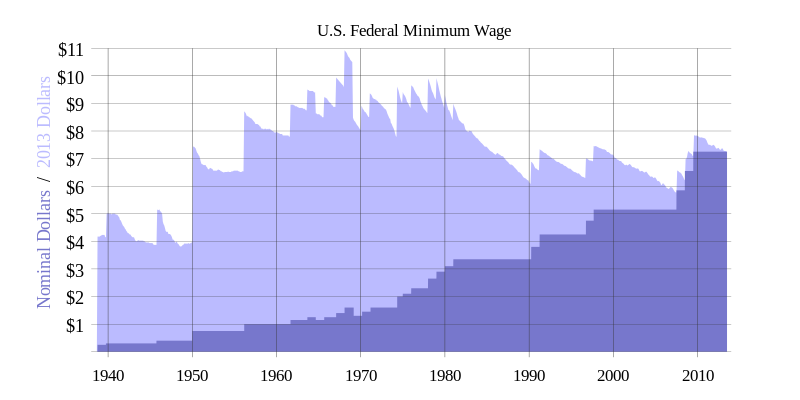
    Minimum wage History_of_US_federal_minimum_wage_increases


    [Graph from Wikipedia on the minimum wage, here]

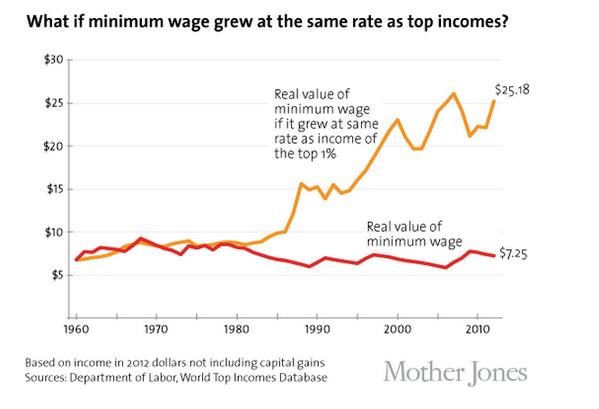
    And this interesting graph from MotherJones, showing what the minimum wage would look like if it had kept pace with the salary increases for the top one percent:
     

     Minimum wage top income

    ·Posted by :

    ·in:


  • A Catechism of Communism, 1936

    JF Ptak Science Books   Quick Post

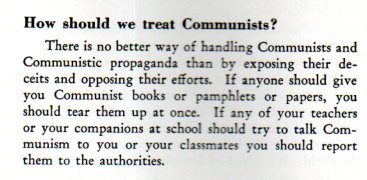
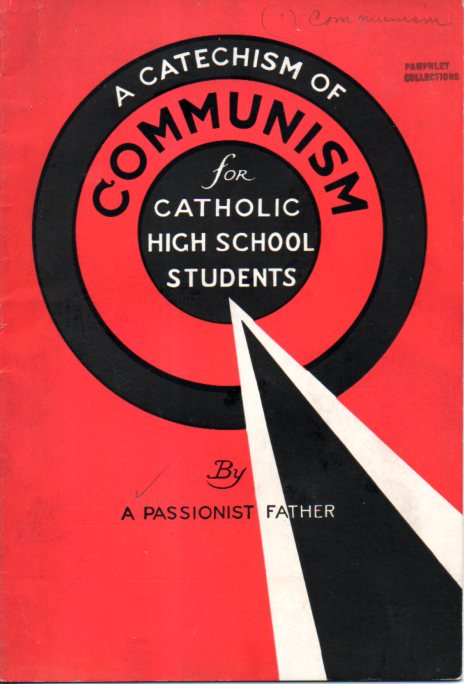
    This is a beautifully design object, and for a moment I thought that this might actually be a sympathetic-Communist pamphlet–something from the Paulist Press, for a Catholic high school system, and from 1936 when there were still plenty of Reds running around the U.S.–so I needed to look around the booklet a little bit. 

    Communism in catholic school009And of course I found out what it was really about just about instantly, and so there was no mistake about what the Passionate Father was really passionate about:

    Communism in catholic school text010

    This is pretty strong stuff considering that Communists weren’t terribly uncommon in the U.S. half-way through the Depression, though that can be mostly due to the absence of the real story about what was going on in the Soviet Union under mega-murderer Joseph Stalin.  But really it is more the Socialists who were more popular in the off-party politics in America in the mid-’30’s.  In any event the author hit the Communists pretty hard based on their anti-god and anti-Catholic positions, so, naturally, there was very room left at the table of philosophy for the Communists. 

    ·Posted by :

    ·in:


  • Chess Shorthand

    JF Ptak Science Books Quick Post

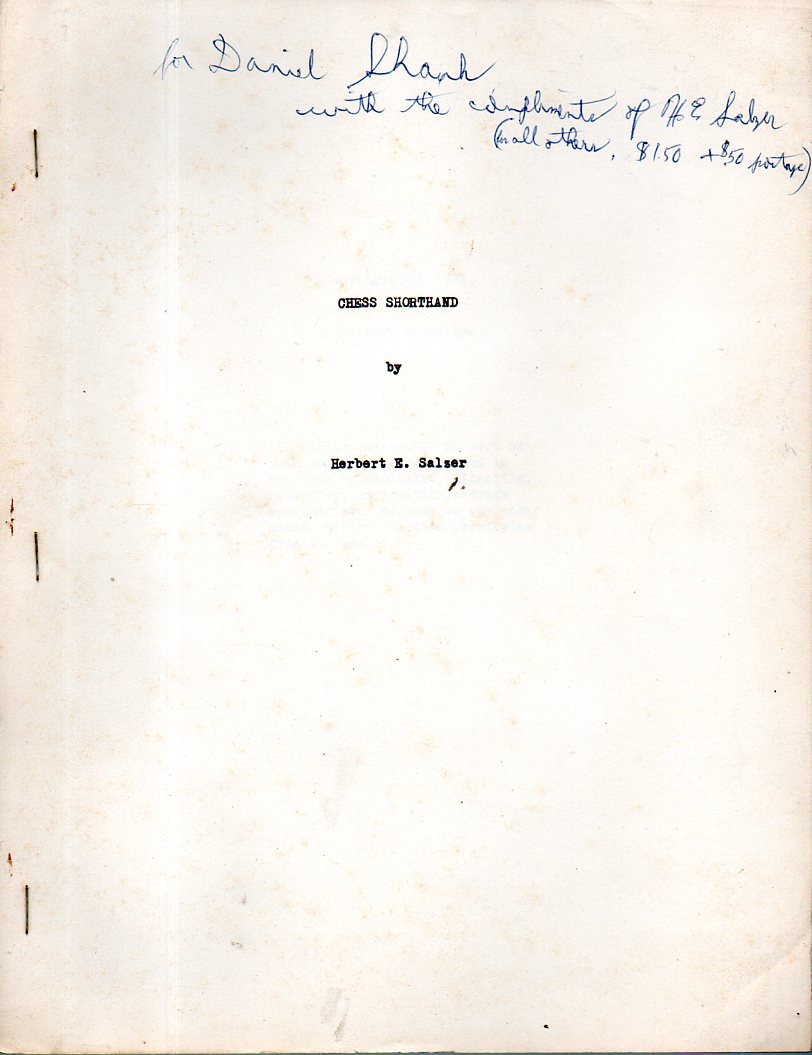
    Chess shorthand558In the occasionally speedy and occasionally not world of chess, it may sometimes be necessary to take speedy-or-not notes.  Chess notation–like algebraic notation (in different iterations), English notation, ICCF notation, and so on–=can reach back hundreds of years. Even the shorthand approach tried out here in mathematician Salzer’s short work dips back into the 19th century (‘Shorthand Notation” by M. Barnard, a short entry in  Chess Player’s Annual and Club Directory, 1893-94 by Mr and Mrs T.B. Rowland (London, 1893)). But the Salzer work is really pretty interesting, and so I thought to at least surface the work.  

    ·Posted by :

    ·in:


  • Bibliography of Bell’s Theorem

    JF Ptak Science Books   Reference Tools series.  

     Bibliography on Bell’s Theorem.

    This is simply a list of the bibliogrphy from the article on Bell’s Theorem by  Abner Shimony  as found in the (online) Stanford Encyclopedia of Philosophy. I found it useful to segregate the bibliography, and so I include it here.  Again, this is a simple copy-and-clean effort on my part–all of the intellectual work that went into creating this list is the work of Abner Shimony.  

    Aspect, A. [1983], Trois tests expérimentaux des inégalités de Bell par mesure de corrélation de polarization de photons, Orsay: Thèse d’Etat.

    Aspect, A. [1992], “Bell’s Theorem: the naïve view of an experimentalist,” in Quantum [Un]speakables,, R.A. Bertlmann and A. Zeilinger (eds.), Berlin-Heidelberg-New York: Springer, 119–153.

    ·Posted by :

    ·in:


  • An Obscure Reference to the Enigma Machine (1942)

    JF Ptak Science Books  Quick Post
     
     
    Books--hagelin


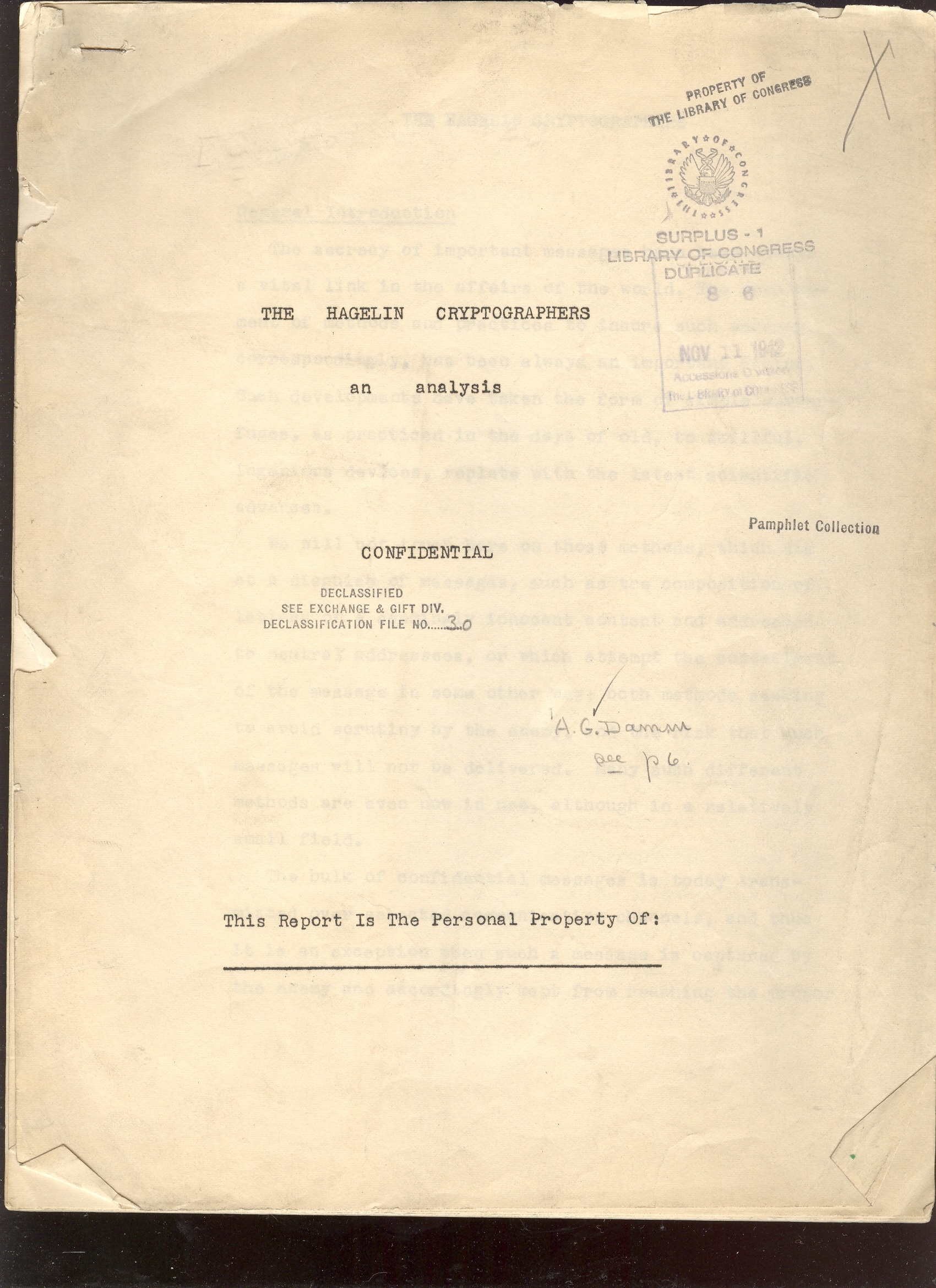
    This is a general report on the origin, development and status of the Hagelin “cryptographers”-a word used here to describe the physical machines used in encoding messages (rather than the people working on codes). It is an internal and “confidential”  report, slender and to the point. Its sections include “Models Built at Express Demand of the French Authorities”, “Evolution of Hand Cryptographer Type C-362”, “Hagelin Cryptographer Models” (BC-38 and C-362), “Methods of Operation”, “Superiority of Hagelin Cryptographers over Competing Makes”, and others, including “How to Sell Cryptographers”. Of particular interest to this post is the mention on page 14 of the “Enigma”, which is really just a very lonely statement, limited to mentioning that the machine is not sold outside of Germany. Of course we well know that the Enigma (which is one of a family of related electro-mechanical rotor cipher machines) was being used very heavily inside of Germany–and France, and the Soviet Union, and several other countries, though it was in fact being used by the Nazi military. It just feels odd and uncomfortable to see this ordinary commercial mention of the machine whose working and transmission was known to the Allies, a knowledge that may well have been one of the great turning elements of the war. And there it is, on page 14, in a restrictive distribution announcement.  


  • Old Electronic Brains: 1950

    JF Ptak Science Books   Post 2349

    Berkeley simon915

     
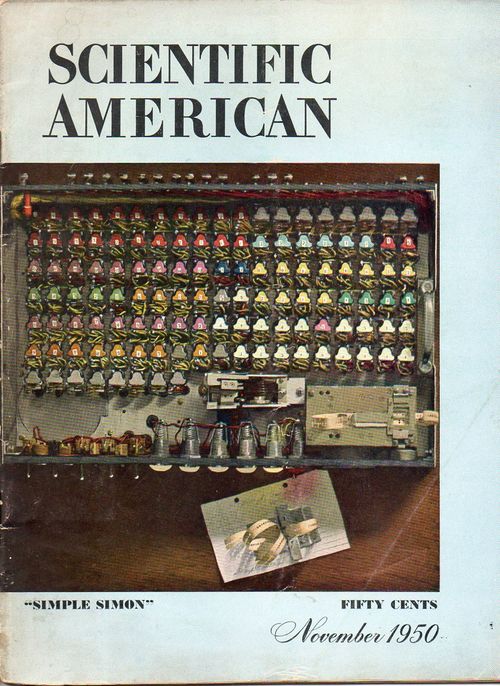
    The first exposure of the American public in general to a “personal computer” may have been in this issue1 of the Scientific American for November 1950–an article called “Simple Simon” by Edmund Berkeley.  ( Berkeley also wrote a book called Giant Brains, which seems to me to be the first mass-consumption book–written in terns for the general public–on how the computer works, and the design of “how a machine will think”.  Berkeley looks at the MIT Differential Analyzer #2, the Moore School ENIAC, Bell Labs’ General-Purpose Relay Calculator, and the IBM Automatic Sequence-Controlled Calculator.) 

    The Simon was a five-hole paper tape (which was its data entry and memory) 2-bit storage relay-based computer that could use numbers from 0 to 3.  It was extremely limited, but it worked, and it was real.  And affordable.  And a baseline for things to come.

    Berkeley introduced the idea for Simon in Giant Brains:

    “We shall now consider how we can design a very simple machine that will think.. Let us call it Simon, because of its predecessor, Simple Simon… Simon is so simple and so small in fact that it could be built to fill up less space than a grocery-store box; about four cubic feet….It may seem that a simple model of a mechanical brain like Simon is of no great practical use. On the contrary, Simon has the same use in instruction as a set of simple chemical experiments has: to stimulate thinking and understanding, and to produce training and skill. A training course on mechanical brains could very well include the construction of a simple model mechanical brain, as an exercise…”–Edmund Berkeley, in Giant Brains, 1949, p. 22 

    In the Scientific American paper Berkeley introduced the machine and how it functioned; he also described three  three outcomes for Simon:

    • First: “Simon itself can grow.  It possess all the essentials of a mechanical brain…”
    • Second: “It is likely to stimulate the building of other small mechanical brains.  Perhaps the simplicity and relatively low cost of such machines may make them attractive to amateurs as the radio set and the small telescope.”  [The “low cost” in 1951 was $600–equal to about $3000 today.]
    • Third:  “It may stimulate thought and discussion on the philosophical and social implications of machines that handle information…”

    Berkeley finishes the three-page article with the following paragraph, looking into the not-too-distant future:

    “Some day we may even have small computers in our homes, drawing their energy from electric-power lines like refrigerators or radios … They may recall facts for us that we would have trouble remembering. They may calculate accounts and income taxes. Schoolboys with homework may seek their help. They may even run through and list combinations of possibilities that we need to consider in making important decisions. We may find the future full of mechanical brains working about us.”

    Scientific American in that same year published another early computer effort of high marks: the great Claude Shannon’s “A Chess-Playing Machine.” This is the first (and popular) appearance of Shannon’s technical paper (which would appear a month later in the Philosophical Magazine), and it is the earliest appearance of an attempt to understand the necessities of a computer for playing a game of chess.

    “Since the mid-1940s, scientists had aimed to create a thinking machine, an apparatus that could compete with or even surpass the human brain in logical operations, pattern recognition, problem solving and even language. Chess was found to be a useful testing ground because of its combination of simple rules and mind-bending complexity… Shannon was fascinated by chess’ potential in the pursuit of what he called ‘mechanized thinking.’ But he became convinced that computer chess and other AI pursuits should not be modeled on human thought… Computers, at least as they were understood then, could calculate very quickly, following programmed instructions. This particular strength—and limitation—of computers suggested a different route for AI, a new sort of quasi-intelligence based on mathematical computation. Chess would be a central proving ground for this new type of intelligence. Theoretically, at least, the game could be fully converted into one long mathematical formula” –David Shenk, The Immortal Game of Chess, pp 201.

    This was another fantastic advance in thinking about computers and their applications at a very early stage of the computer game–perhaps more so with Berkeley than with Shannon, at least for the popular consumption end. In any event, they are both very interesting papers.  

    Notes

    1. Berkeley, E.C. (1950). “Simple Simon” in Scientific American No. 183, November 1950, pp. 40-43. 

    2. Shannon,  Claude E. “A Chess-Playing Machine.” New York:  Scientific American,  1950. Volume 182, No. 2, February 1950, pp 48-52.


  • The Physics and Non-physics of Catching a Baseball

    JF Ptak Science Books  Post 2348

    If I was a Nazi going back in time and given the opportunity to assassinate five allied leaders to change the direction of the war, I’m pretty sure that one of my choices would be Vannevar (that’s “van ee var” Bush (not related to you-know-who).1  He was the head of the Office of Scientific Research and Development (OSRD) for the U.S. for World War II, which is saying A LOT.  It was his responsibility to determine where and how to apply effort and brainpower and money for the best outcome to win the war–and he did a fabulous job.  Wasted effort/money/power/intelligence costs a lot, especially during wartime, and Bush did an absolutely superior job in performing this task. He was also a great engineer, a fine creator of analog calculators; he was a visionary and often is referred to as the grandfather of the internet; he was VP of MIT, and many other things, on and on.  

    However, in his grand opus one thing he wrote was that baseball was not a scientific game.

    I’m pretty sure he was joking around because the game is all angles of motion and repose (and a lot of the later), of effort and response, and in the immortal words of the Great Beakman (of TV science show for kids fame), “everything goes somewhere”.  

    Bush chose to leave a little mystery in the game when he wrote about it in Science is Not Enough, (1967) in the essay “When Bat Meets Ball”. The pitch, the crack of the bat,the flight of the ball, the outfielder turning instantly to get to the place where he thinks he needs to be, calculating all of this on the fly so that he can catch the ball, is in some sense like tracking enemy aircraft or an ABM.  The outfielder, running along, has sorta figured out the velocity of the pitch and the angle at which the ball leaves the bat, figuring out acceleration, elevation, and manipulates it all in his head to sand in a certain grassy spot to be in exact location to interfere with the ball’s response to all of the vertical and horizontal displacements and the work of gravity to return it to its initial altitude of 0 (+the distance of the glove to the ground).  Which is all pretty cool stuff, and it happens it the rain or wind or whatever conditions and perhaps with a hurt ankle, all of which get tossed into the equations.  

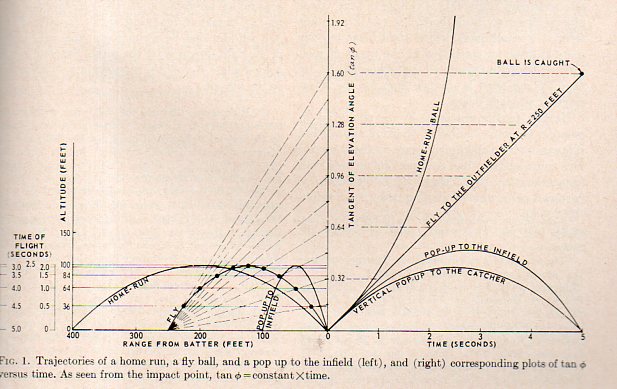
    This is all beautifully addressed in a short article called “Catching a Baseball”, by Seville Chapman of the Cornell Aeronautical Lab in the October 1968 issue of the American Journal of Physics.  Dr. Chapman also offers up the following figure, which is helpful and pretty, but which would have bounced off completely of the invisible shield of fielding mediocrity that enveloped the otherwise fantastically gifted Manny Ramierez (or Ted Williams or any other number of great hitters who were not so much interested in fielding because it wasn’t hitting).  

    Anyway, here’s the illustration from the Chapman article:  

    Baseball physics368

     Notes:

    1.  Some of the others would have ot be Churchill (probably my first choice, because he held everything together from 1940-1942 and created an effective war machine…without him the war may well have been lost, well before the U.S. would have become involved; also of course F.D.R., and probably Eisenhower for his superior handling of the Invasion  and for the push east.  I am not sure about who I might choose on the Soviet side.  I wouldn’t choose them in the first rank, but I’m not sure who I would choose first to do in between Montgomery and Patton–it is easy to neglect Montgomery for all of the obvious reasons, but when everything is said and done he was very effective and successful given his own plodding and unpleasant way)…


  • Motorheads: H-D Engine Overhaul, $47.50 (1948)

    JF Ptak Science Books   Quick Post

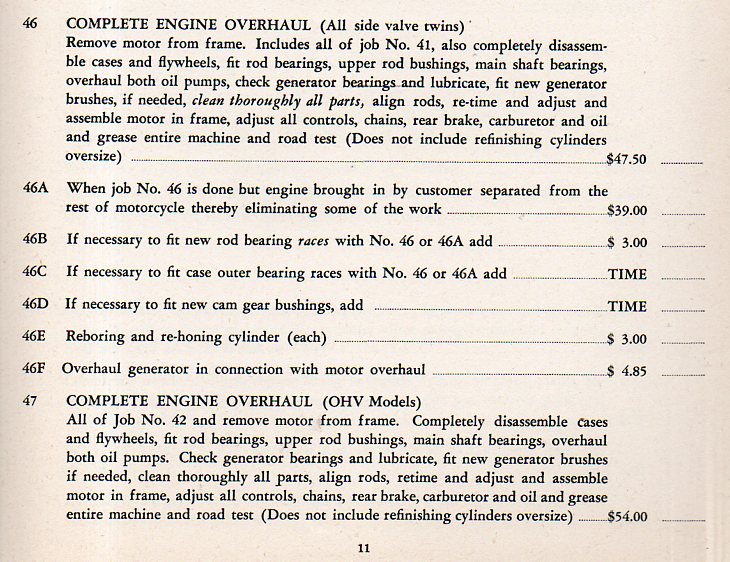
    Harley370Okay, so they were diferent times, and the money was different, and the different was different.  Still it is surprising to see in Floyd Clymer’s (of L.A.) Flat Rate Service Charge Manual for Harley-Davidson Motorcycles listing an off-the-shelf engine overhaul for $47.50–especially when Mr. Clymer’s paper manual of pricing suggestions cost two bucks, which was about 5% of the Harley engine work, parts and all.

    The average yearly salary in 1948 was about $3,600, or about $35k translated into today’s buying power–which means the overhaul was costing 1.5% of the yearly salary, or about half a week’s salary. Not bad. 

    Also: “rewire complete all big motors”, $10; “remove and install ignition coil”, $2.60; “remove transmission and clutch”, and clean and fix it, $16.50.  And on and on. There are 64 repairs and sub-repairs, and it all looks pretty remarkable to me.  


    Harley369

    ·Posted by :

    ·in:


  • Controlling Space and Time–Early Human-Replacement Robotics

    JF Ptak Science Books 

    “When I call a business, I like to talk to a human” – Gordon Matthews (Inventor of “voice mail”, patent # 4371752, “Electronic audio communication system”, “An advanced electronic telecommunication system is provided for the deposit, storage and delivery of audio messages”. See here.)

    I can understand Mr. Matthew’s frustration, even if he was the co-inventor (along with Thomas Tansil and Michael Fannin) of one of he great time manipulators in history. Speaking to a robot is a disconcerting thing. 

    Is the telephone answering machine the greatest non-transportation contributor to expanding human motion and time in the 1850-1950 century?  Certainly photography (from an earlier period, invented in 1839 and more or less popularized by the mid-1840’s) should be considered in this category, what with the visual capture of a moment in time and all; Marey/Muybridge and their primitive photographic motion studies is another; George Carey’s prehistoric selenium/light sensitive “seeing by electricity” invention and the more modern television by Jenkins and Farnsworth are others. And of course there is the invention of the telephone itself by Alex Bell  in 1876 (and a man whose house and lab was only a few blocks removed from where my store used to be on Volta Street in Georgetown DC many years ago) as another paramount example.

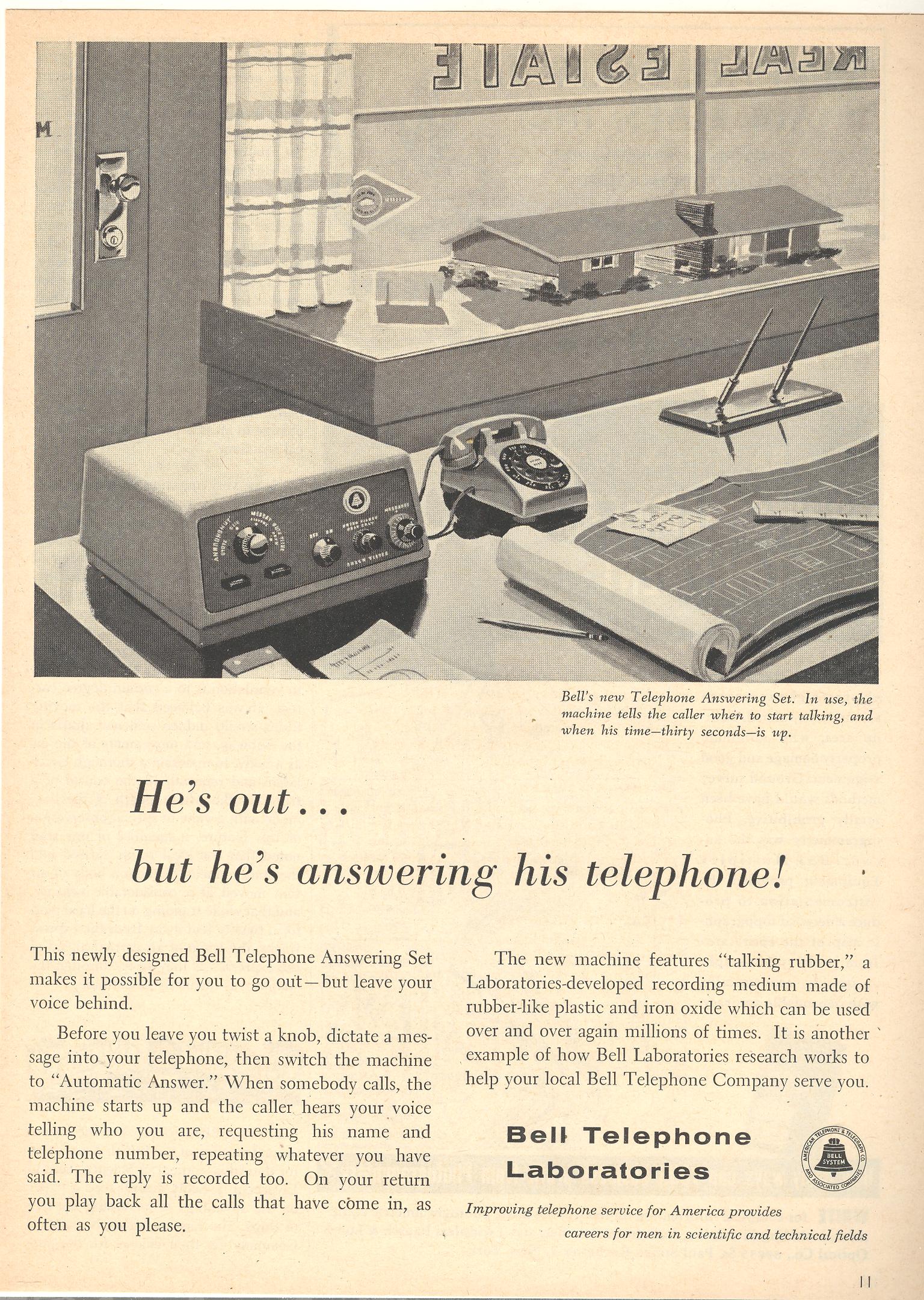
    Telephone answering

    But I think the telephone answering machine is certainly one of them, I think, and not a modest example either.  The answering machine (for “him”, of course) allowed a person to be in two places at one time, allowing the telephone to function not only as a communication device but as a secretary, liberator, device as well.  Now (in 1958, when this ad appeared) that people had completely embraced the phone for business and for pleasure, it added immeasurably to the well of free time.  The telephone enabled immediacy; but for that immediacy to work, a person had to be there to tend it.  With the answering machine, however, a person could in a way save that immediacy for a more convenient time, liberating their necessary presence the telephone experience. 

    The telephone allowed as person to instantaneously be in two places at the same time, basically; the answering machine contributed a third (or more) place, and freed up the time element. 

    In effect the thing was/is a time machine, making it possible to either instantly speak with someone 12,000 miles away, or save the conversation for a more convenient time, sort of going back into the past to replay the communication..(Or dump it, extracting the necessary info or whatever without having to actually interact with the caller. ) 

    Its easy to slip and refer to the machine as simply “an answering machine”, leaving out the “telephone part; it would be nice to have a machine that could reliably answer questions like that (though I think that this is what Google imagines itself to be).  The “answering machine” four generations or whatever from now may be something that is today unimaginable.  Maybe there will be a general death of the question, because everything has been answered.

    Maybe the greatest machine in the future will be the questioning machine, something that skirts all of the known answers in whatever earth-sized database exists at the time.  Something that asks for information or for a synthesis of answers that doesn’t (yet) exist. 

    Anyway, I like what I think is the great importance of the telephone answering machine.  And I don’t know how The Rockford Files would’ve functioned without one.  Actually old Jimmy used a very early device, coming just a few years after the first successful mass-marketed device hit the streets in a wooden box and weighing ten pounds–the PhoneMate Answering Machine Model 400, which started to appear in 1971.


    ·Posted by :

    ·in:


  • The Writing Remains

    JF Ptak Science Books   Quick Post

    I was performing a little forensic test on a sheet of book design elements and noticed this little fella in the corner–it is only about 1″x2″ and the motto is a little difficult to read, but segregated and brightened up a little it reads loud and clear.  “Das man schreibt das beleibt”, or “the one who writes, remains” or more simply and carrying things to their logical conclusion, “the writing remains”. (It is similar to the proverb “Wer schreibt, der belibt” which is something along the lines of “Who writes, remains”.)   [Source: Decorative Vorbilder eine Sammlung von Figurlichen Darstellungen… fuer Zeichner, Maler, Graphische Kuenstler, published in Stuttgart, 1897, volume II.)


    Elements Owl365 darker

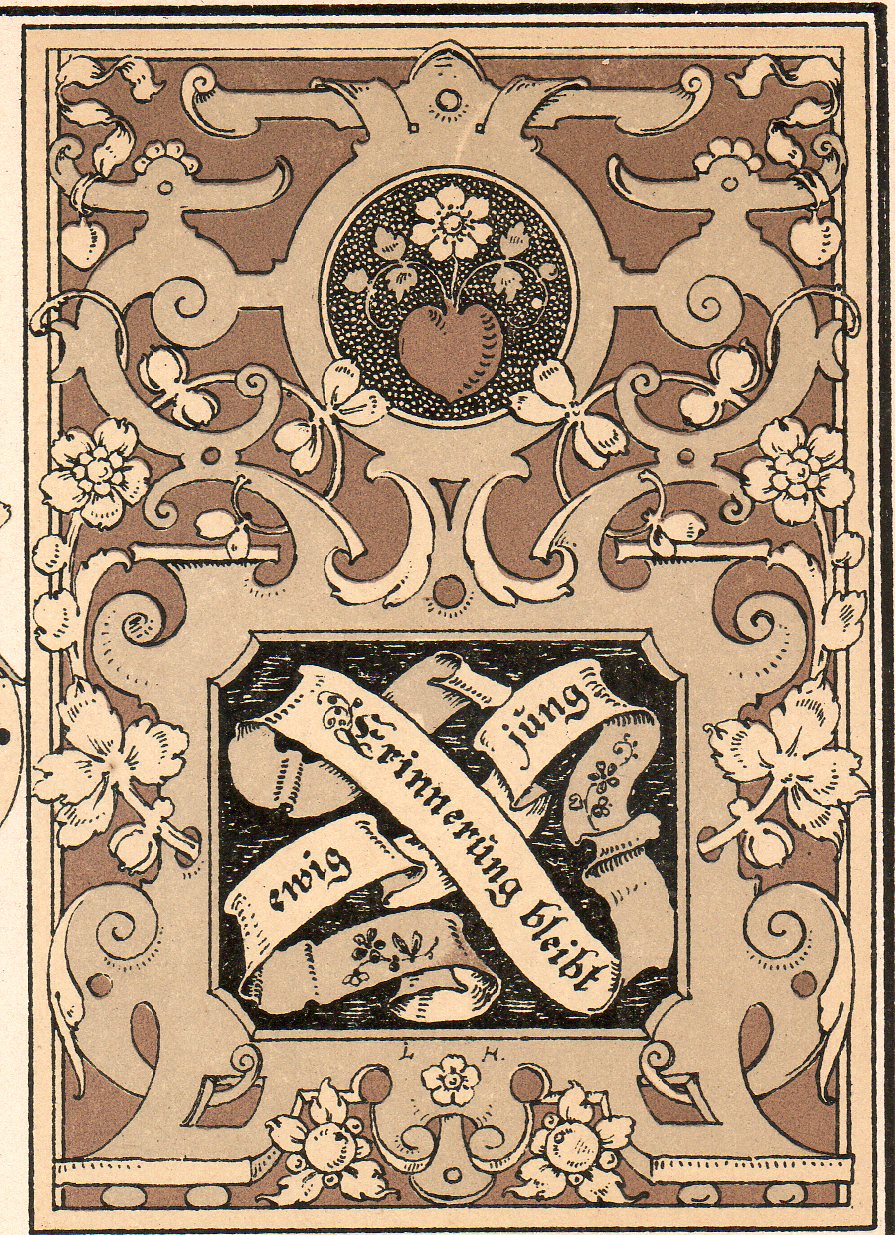
    And then there is this, to, well contradict the writing verdict?  Another very small bit from the same series.  This one says “Erinnerung bleibt/Ewig Jung”, which is something like “Memory Remains Forever Young”, which could alsdo be interpreted as memory/never/aging, which would place it alongside the above, except that it makes its statement regarding memory, which does not explicitly include writing it down. And of course we assume with the top motto that the writer remains with the writing somehow, though really for the most part all they are at the end of it all is a name.  So the two are either very similar or polar opposites–take your pick.  

    Elements Forever young366

    ·Posted by :

    ·in: