A Daily History of Holes, Dots, Lines, Science, History, Math, Physics, Art, the Unintentional Absurd, Architecture, Maps, Data Visualization, Blank and Missing Things, and so on. |1.6 million words, 7500 images, 4.9 million hits| Press & appearances in The Times, Le Figaro, Mensa, The Economist, The Guardian, Discovery News, Slate, Le Monde, Sci American Blogs, Le Pont, and many other places… 5000+ total posts since 2008.

Category: Social History

  • A Note on Overcoming Hindsight: on Sending Japanese “evacuees” Home, 1945/6

    JF Ptak Science Books   Post 1779

    On Evacuees, Excludees, and “Segregees”: Closing an Ugly Chapter in U.S. History–the Japanese Internment Camps, 1942-1945

    As of April 30, 1945, the U.S. government allocated a total of $39 million to relocate 120,000 or so Japanese “evacuees” from “evacuation centers” back to their “normal homes”.  That comes to about $275.00 per person:  but that is mostly allocated to payment for personnel, because, really, all that was happening was that these people were being sent back home somewhere, or if their homes/farms had been undersold from under them, to somewhere not-their-home.  Of course the figure is slightly inflated, because of all of those Japanese interred during this time nearly 10% of them volunteered to fight in the U.S. Armed Forces, so for those who survived after serving in some of America’s most highly-decorated units of all time, Uncle Sam was paying the bill to send those young men home.  But offsetting the Americans of Japanese decent who fought in the war were about another 10,000 babies born in the “segregation centers”, so the numbers stay fairly-well the same.  (I cannot offhand find any numbers on the numbers of people who died in the camps, or for that matter what happened to their remains after the camps (and camp cemeteries) were closed.  I do not know if that was a government expense–to move the coffin and pay for reburial–or if that expense became a private affair.)

    Dillon Myer, who was the director of the War Relocation Authority,  testified in Congress on 30 April 1945 that it was time for the “relocation centers” to be closed, and for the “evacuees” to go home.  And to go home on schedule. 

    “Not later than 15 months, after revocation of the general exclusion orders, all evacuee property services to persons other than excludees (including segregees) will terminate, and all evacuee property warehouses not utilized for the property of such persons will be emptied…”

    I expect that few of the American Japanese wanted to linger. 

    ·Posted by :

    ·in:

    — —

  • How Much it Cost to Clothe the Working Poor of London, 1854

    JF Ptak Science Books  Post 1761

    The “working poor” of England may have been half of that–working, that is, and hard at work, though not being paid even enough to be considered poor. Their story has been told in many ways, of course, the backbone of the Industrial Revolution succeeding on their bones, observed and recorded and shared by Charles Dickens and others, and on and on, told elsewhere in brevity and quick detail better than I can do so here.

    I did want to make a quick comment about a very small detail in the state of those poor people, found in Charles Kingsley’s  Cheap Clothes and Nasty, printed in 1850.  It is quite a documentarian’s tour of the plight of the poor, written by a very able observer.  (Kingsley is a very interesting person–an historian, priest in the Church of England, social commentator, and novelist.  As a matter of fact he was exceptionally prolific, producing during his lifetime (1819-1875) a fine long list of accomplishment, three of which have survived to this day as sorts of minor classics.  But what he did with great regularity was publish books–34 of them in 25 years between 1850 and 1875, including 15 during the decade of the 1850’s, 11 in the 1860’s, and 8 in the 1870’s to his death in 1875.  Perhaps as important as all of that was the role he played in the arrival of C. Darwin’s On the Origin of  Species…, as Kingsley wrote one of the earliest reviews of the book and defended it strongly.)

    But getting back to the poor,  Kingsley made a very strong case for the poor being less so than that, as we see here:

    “Folks are getting somewhat tired of the old rodomontade that a slave is free the moment he sets foot on British soil! Stuff! – are these tailors free? Put any conceivable sense you will on the word, and then say – are they free? We have, thank God, emancipated the black slaves;  it would seem a not inconsistent sequel to that act to set about emancipating these white ones.Oh! we forgot; there is an infinite difference between the two cases – the black slaves worked for our colonies; the white slaves work for us. But, indeed, if, as some preach, self interest is the mainspring of all human action, it is difficult to see who will step forward to emancipate the said white slaves; for all classes seem to consider it equally their interest to keep them as they are; all classes, though by their own confession they are ashamed, are yet not afraid to profit by the system which keeps them down…”–Charles Kingsley, Clothes, Cheap and Nasty, 1850

    Kingsley continues on with the stuff of research, uncommonly sharing the lot of what a vast section of English society experienced daily though mostly in silence.

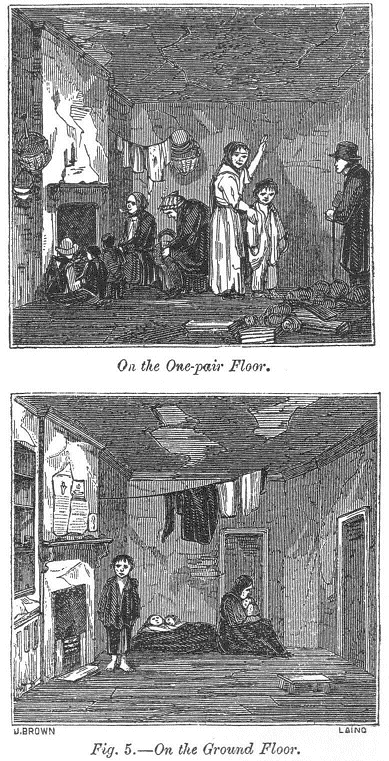
    Another excruciating and interesting report was made by George Godwin in his London Shadows, a glance at the “homes” of the thousands of 1854 (the whole work found on the wonderful Victorian London blog, here and about which I posted about here).

    Godwin–an influential architect and editor of the very influential The Builder  as well as a social reformer, who lived from 1813-1888) wrote an expose of how so many Londoners lived at the middle of the century. It is also illustrated with woodcuts of the places in which people lives–artwork in wood and ink that have a very definite quality of the unforgiving cameras of Life magazine a century later.  The images are awakening and abrupt–all the bitter observation of George Orwell, only told much more quickly, like a person trying to describe a raging house fire before the thing burned itself out.  Its a powerful work, and I can’t help but think that those reading it in 1854 must have been appalled not only by the deep visualization of the state of the working poor, but also by its scope, and the possible revelation of England’s basic bedrock.

    Here is an example of Godwin’s work, which includes observations on not only housing the poor, but clothing them as well, and published in the editorial pages of journal The Builder. He presents one aspect of their lot by discussing their clothing and its purchasing, bought for what the polite reading circles who would find The Builder  to be almost for no money at all, though the few pennies spent on a pair of shoes or shirt were a major factor in the weekly ration of the working poor., particularly if they were making 5 or 10 pounds per year.   It was an interesting way for Godwin to present to the non-poor what the other-half really had to live like, and perhaps by reaching out to the population that did the building-of-London he probably hoped to affect some sort of reform in the way in which the poor had to live and work.  An example of the Godwin work:

    “One of the London missionaries (a body whose valuable services can only be properly appreciated by those who understand the nature and extent of the evil to which we are directing attention) says:-
        “Persons who are accustomed to run up heavy bills at fashionable tailors’ and milliners’, will scarcely believe the sums for which the classes we are describing are able to purchase the same articles for their own rank in life.”
        A missionary who recently explored Rag-fair, reported that a man and his wife might be clothed from head to foot for from 10s. to 15s. Another missionary stated that 8s. would buy every article of clothing required by either a man or a woman, singly. In Pennant’s time it was less. He says (speaking of the other Rag-fair), that the dealer pointed out a man to him, and said: “Look at him. I have clothed him for fourteen-pence. A third missionary reported : “There is as great a variety of articles in pattern, and shape, and size, as I think could be found in any draper’s shop in London.” The mother may go to “Rag-fair” with the whole of her family, both boys and girls,- yes, and her husband, too, and for a very few shillings deck them out from top to toe. I have no doubt that for a man and his wife, and five or six children, £1 at their disposal, judiciously laid out, would purchase them all an entire change. This may appear to some an exaggeration: but I actually overheard a conversation in which two women were trying to bargain for a child’s frock; the sum asked for it was 1½d. and the sum offered was a penny, and they parted on the difference…”
    http://www.victorianlondon.org/publications4/shad-06.gif


  • A Temple of Texts–Steampunk Victorian Printing Cathedral

    JF Ptak Science Books  Quick Post

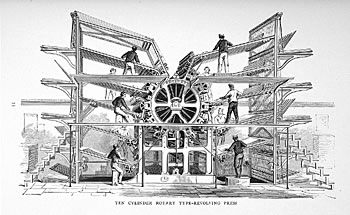
    This is what printing looked like, once upon a time, a great and giant mass, tended by works, massive sheets of paper flying this way and that, smoke from a steam engine drive (somewhere)–heavy, loud. Accurate.  A temple of texts (apologies to William Gass).  The illustration is from Robert Hoe’s A Short History of the Printing Press and of Improvements in Printing Machinery from the Time of Gutenberg up to the Present Day (1902) and exhibits a ten cylinder rotary type-revolving press

    Pritning machine[Source: Harry Ransome Center, here.]

    In addition to being a state-of-the-art (and above that, really) printing press it is in image a generator of metaphors–there’s certainly plenty to go around, even on just a surface investigation of the woodcut.  You can easily see a feeding-the-beast scenario in there–for news or for technology or steam or motion or whatever else), as well as darker interpretations, making the printing press into a spider as well; also, there’s humans being subservient to the god of technology from whom all good things come, and so on.  I’d really just like to feel one of those gigantic newspapers in my hands, fresh off the press…


  • Travel Time in the Young Republic, 1800-1857

    JF Ptak Science Books   Post 1738    [Part of a series on the Display of Quantitative Information]

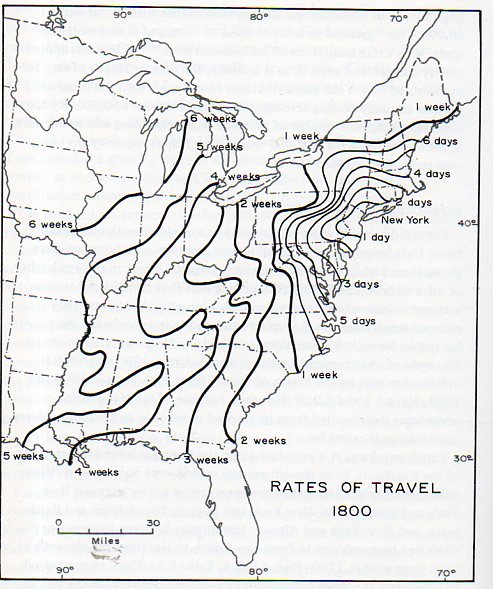
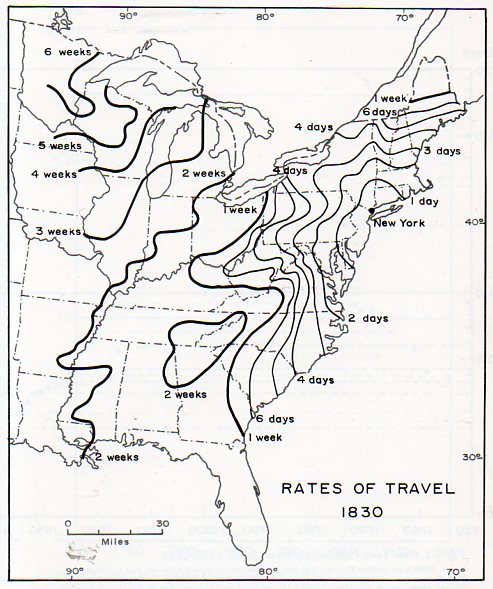
    I wanted to pass along these very interesting maps that appear in Allan R. Pred Urban Growth and the Circulation of Information, 1790-1840 (Harvard, 1973) because they give a quick and elegant view of how long it took to get to various parts of the country in the first part of the 19th century. 

    First, Rates of Travel, 1800:

    Travel time 1317
    and its complement, Rates of Travel 1830:

    Travel time 2316[Note:  all travel time based on starting  point in New York City.]

    Its interesting to see with just improvements in travel excluding the introduction of railroads and (for the most part) canals that travel time was basically cut in half in about thirty years’ time.  For example, in 1800 it would take roughly four weeks to get to New Orleans, and then six weeks to arrive in Iowa and the Upper Peninsula.  By 1830, that time was two weeks to NO, and three for the other two locations.  In 1800, it was a five day trip to the northern Outer Banks in North Carolina; that would be cut to two days by 1830.  The trip in 1800 to the vicinity of Savannah and the northern part of Florida was a two week ordeal; by 1830, that time had fallen to 6/7 days.  The Mississippi was reachable in five weeks in 1800; in 1830, that time was cut to two weeks.  This as I said would all change drastically over the next three decades, once the railroad system became slightly mature.

    And here, expanded to 1857:

    By 1857 one day’s travel time has been blasted to a ring encompassing the southern half of Maine, partially into Ohio and south into the northern part of North Carolina.  Two days of travel will get the traveller deep into Michigan and parts of Wisconsin, and half-way through North Carolina and South Carolina (excluding the mountain region in Western NC).  Three days will now get us to northern Florida, halfway through Georgia and Tennessee, and into the Midwest, past the Mississippi River. Beyond the basic reach of the railroad at this point is the rest of the country, and harder going, though one week of travel will get you deep into the central part of the country, where with some difficulty you would be able to find your way to southern California in three weeks, and the Pacific regions of Washington Territory in six weeks–basically, an entirely new world of travel and the spread of goods, service and information, not the least of which was aided by the spread of the railroads, which increased from 3,000 miles of track in 1840 to more than 30,000 in 1860.

    Again, I really just wanted to share this display of information because I have found them to be useful in the past, and the info doesn’t seem to be all that wide-spread. 

     My source for the maps has been varied from web sources, but the original work seems to have been published in Charles O. Paullin and John Wright, Atlas of the Historical Geography of the U.S., published by the Carnegie Institute of Washington, D.C. (1932), pages 138a, 138b, 138c, 138d.


  • Singular Placards and Perhaps a Singular Christianity?

    JF Ptak Science Books   Quick Post

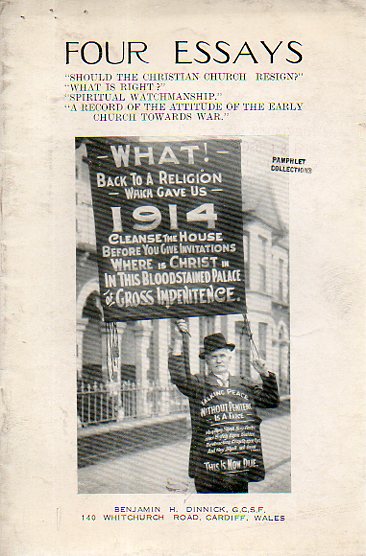
    I found this rather, um, provocative pamphlet that asks, right up front on the cover of the thing, “Should the Christian Church Resign?”  The author, who I think is the man holding the placard on the cover, is Benjamin H. Dinnick (Cardiff, Wales) who published the work in the 1930’s. 

    Dinnick286
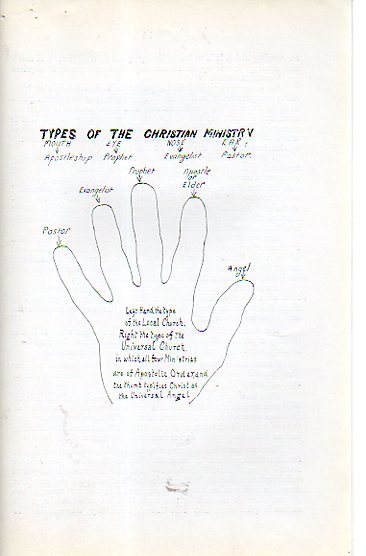
    I’m reproducing the cover and one of Mr. Dinnick’s impenetrable diagrams–I can’t really say what he was after or what he was for, but I find the images interesting. 

    Dinnick287


  • The Great Passaic Textile Strike of 1926

    JF Ptak Science Books    Post 1734

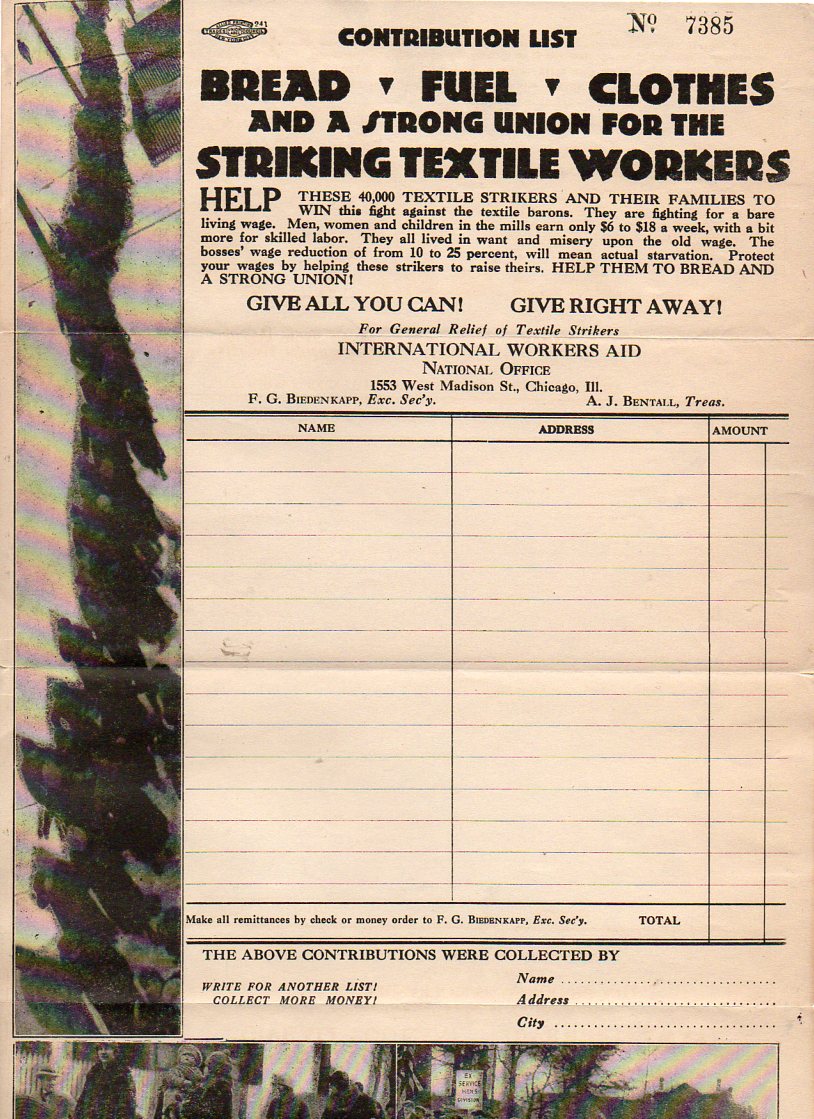
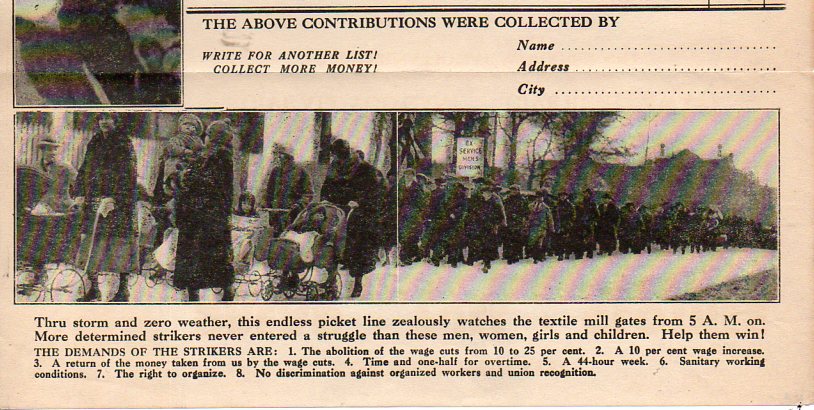
    This broadside was an appeal to like-minded people to contribute to a fund to help relieve thew dire conditions of textile worker strikers in Passaic, New Jersey, in 1926.  There were more than 16,000 people involved in this sometimes-brutal strike, people who were trying to stay even in their lives, looking for a little more money and a little better working conditions than what they had.  The Passiac (a working city just south of Patterson in an industrial triangle section of the state) strikers were moving against a number of textile (wool and silk) mills there, trying to force management to pay them something closer to the $1400 annual income for a family of four to survive. 

    Passaic strike277

    [This great piece of American ephemera is available for purchase from our blog bookstore, here.]

    Most workers there were making $1,000-$1,200 a year ($800-$1,000 if the worker was a woman, and about half of them were) for 50+ hours of labor per week.  The result was that the workers could not afford good housing and food, and those disadvantages paid off in high rates of tuberculosis, very high incidence of child mortality, and a low average life expectancy.  The strike began slowly in January 1926, with the mills responding with vicious attacks by paid thugs and by police.  IT was a long and involved process for the strikers, with the strike lasting its way for another 14 months, finally getting choked out in March 1927.  It looks like there were some victories, but those seem mainly pyrrhic to me–at the end of the process many of the strikers were hired back but soon terminated, replaced by other workers who agreed to work for less.

    Passaic strike278
    There’s quite  a bit written on this strike, and most seem to say that it was an important event in the history of “labor relations”, and that it was the first time that a Communist-led strike succeeded in the United States, (There is a complex legacy as to who the leadership was for this strike, but the end result is that, at the end, the Communists were in charge.)

    But what I wanted to say here about this broadside was the communal effort involved with keeping the strikers (and the strike) going.  The strikers needed money to live, as there was certainly no money coming in, and since there was obviously no union, there was no general fund from which any of these families could draw food money from). they needed money just to buy food and pay for housing.  SO the call for “Give all you can!” and “Give right away!” were as desperate as they sounded.  My guess is that there would be a representative of the International Workers Aid society national office going from factory to factory, or door-to-door, soliciting for money for the Passaic workers’ relief.  The strike was no doubt a very nasty business, with a victory only a victory once there was more food on the table, less illness, and far fewer babies dying from preventable causes. Probably this looked like a victory to others so far as the future of fair labor/pay was concerned, but not so much for the strikers who brought this about. 

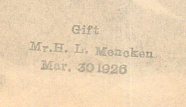
    It is also interesting to note that this copy was given at some point to H.L. Mencken, who gave it right away to the Library of Congress, where it wound up in a forgotten “Pamphlet Collection”, and then sold to me (years afterwards).

    Passaic strike279


    ·Posted by :

    ·in:


  • Empty Memory: Telephone Number 20080 (Warsaw), Nazi Occupied Poland and the Holocaust, 1941 (Expanded)

    JF Ptak Science Books –continuation of Post 298 from 2008

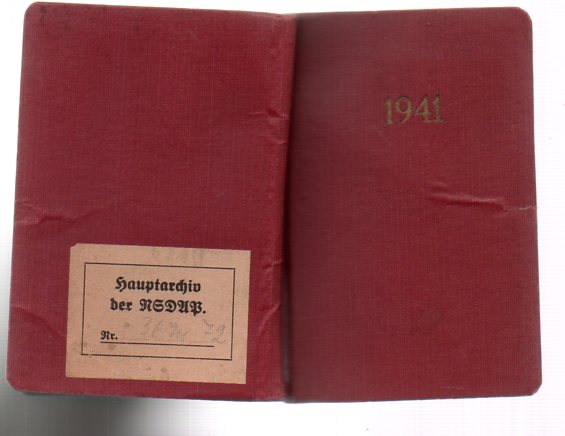
    Empty diary150
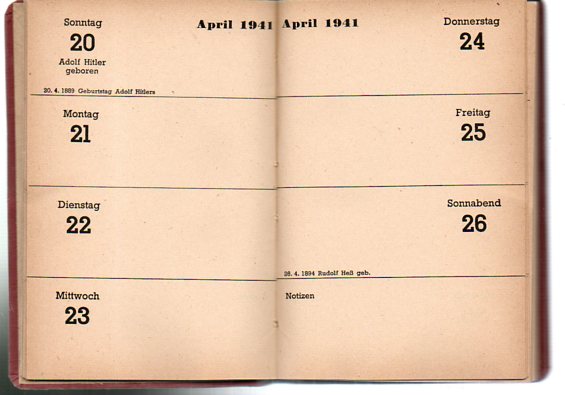
     I’ve felt that a great history lesson for school kids would be to make them keep a diary for some other kid from some other time, introduce them to the minutiae of life from another time and perhaps another place.  With some guidance they could make interesting entries in their diary for, say, 15 June 1897, writing about chores, the daily schedule, what they studied in school, how they were dressed, how they got food on the table and kept the house clean, how they would spend 25 cents, what they would see from some given vantage point, and on and on.  This could take place in their very own home town; it could be multi-generational, requiring them to talk to the scary white hairs, or it could reach far back into history and be of an entirely different place altogether.  After they were assigned a particular place in time and space, you could give the kid subtle hints, like this one (below), asking them what they thought it might mean by dialing the phone number 200 80 in Warsaw in 1941.  And what did that pair of lightning bolts mean, anyway?  I think that once they were made to figure it out for themselves, as though they might’ve been there, and then could record their feelings and observations in a diary might actually bring history to life (especially once they had their “holy crap” (and probably worse) moment at what these numbers implied). 

    1ebay_oct_3_1941_diary739_2

    This is one of the ideas that came home again uncovering this odd booklet, which is a Nazi diary for those stationed in the Generalgouvernement (Tascehnjahrbuch 1941 fuer den Deutschen im Generalgouvernement) ,  for the year 1941. The General Government (or more fully the Generalgouvernement für die besetzten polnischen Gebiete) was one administrative section of occupied Poland, the country being divided in 1939 after the German invasion of 3 September 1939, with the western section being retained by the Germans and the Eastern given over to occupation by the Soviets via the Non-Aggression pact between the USSR and Germany.1

    Empty diary149
    This looks like an every day diary for the period, except for the Nazi (or NSDAP) regalia and German imprint of Generalgouvernement in Krakau.  And, all of the annotated high points of the year for the most overly voracious parts of German militarism as well as for the hot points of Nazi history.  Hitler, (above) Goering, Goebbels and other leaders’ birthdays are highlighted, not to mention seminal points in the development of the Nazi party and party-adoptees (Richard Wagner has a number of entries for suggested celebrations). 

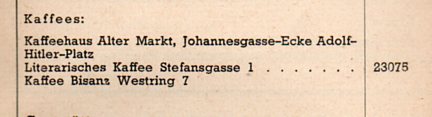
    There are also helpful directories in the back pointing to any number of cafes located in a growing number of “Adolf Hilter Platz’s” throughout Poland (including three in Radom), as well as fares for the use of the railway and postal system.

    We also see the following telephone number:  23075.  That’s for the Literarische Kaffee Stefansgasse I, Krakau. This is the location that the Reichsminister and administrator Hans Frank (about whom we’ll read in a moment) decided to hold a chess tournament in 1941, to satisfy his own need for chess while freshly in the pursuit of the murder of millions of people.

    Empty diary cafe151
    ‘Frank was extremely interested in chess. He not only possessed an extensive library of chess literature but was also a good player, and he even “received” the Ukrainian chess master Bogoljubow at the castle. On 3 November 1940 he organized a chess congress in Cracow. Six months later he announced the setting-up of a chess school under Bogoljubow and the chess master Dr Alexander Alexandrovich Alekhine, and he visited a chess tournament in October 1942 at the “Literary Café” in Cracow.”–Hans Frank (subtitle: Hitlers Kronjurist und Generalgouverneur) by Dieter Schenk (Frankfurt am Main, 2006) “and quotes a reference to chess on page 177 (given below in our translation)…”[Source: Chesshistory.com., here.]

    Continue reading here.


  • A Managerial Directive on How to Present War News: PM Newspaper, 10 Dec 1941

    JF Ptak Science Books   Post 1694

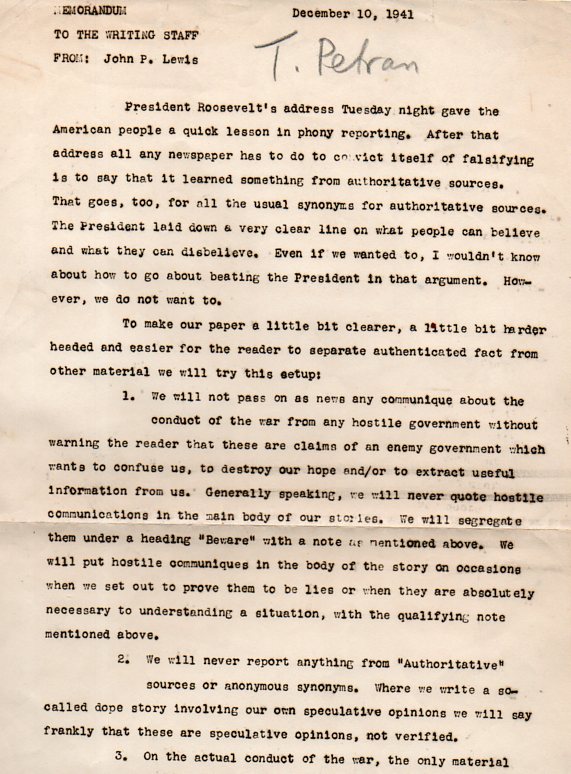
    PM (short for “Picture Magazine, evidently) newspaper1–begun 18 June 1940 and ended 1948–was a very strong, left-wing newspaper in NYC, a short-lived daily with a long pedigree of contributors2.  The “Memorandum” reproduced here, sent by the Managing Editor John P. Lewis “to the writing staff”, was a powerful and interesting directive on how to present the news, and addressed the speech of President Roosevelt of the night before. 

    Lewis felt that here, at the beginning of the American end of the fighting war, was the appropriate place to set out a war strategy for reporting and publishing regarding information received from overseas, or unverified sources, or from dispatches from the countries against which we were fighting.  He was clear and very concise–the whole of the memorandum fitting on one side of a single sheet of paper. 

    PM Newspaper136
    [This piece of ephemera may be purchased through our blog bookstore, here.]

    The Roosevelt speech of  9 December 1941 can be found  here.  Some interesting extras as follows:

    “Your Government knows that for weeks Germany has been telling  Japan that if Japan did not attack the United States, Japan  would not share in dividing the spoils with Germany when peace  came. She was promised by Germany that if she came in she would  receive the complete and perpetual control of the whole of the Pacific area…This alone if true could be a justification for war with Germany.”
    //
    “Our policy rested on the fundamental truth that the defense of any country resisting Hitler or Japan was in the long run the defense of our own country.”

    But the main thrust that Lewis was addressing was this:

    “I cite as another example a statement made on Sunday night that a Japanese carrier had been located and sunk off the Canal Zone. And when you hear statements that are attributed to what they call “an authoritative source,” you can be reasonably sure from now on that under these war circumstances the “authoritative source” is not any person in authority.”

    “Many rumors and reports which we now hear originate, of course, with enemy sources. For instance, today the Japanese are claiming that as a result of their one action against Hawaii they hare gained naval supremacy in the Pacific. This is an old trick of propaganda which has been used innumerable times by the Nazis. The purposes of such fantastic claims are, of course, to spread fear and confusion among us, and to goad us into revealing military information which our enemies are desperately anxious to obtain.”

    Lewis was quick to the point:  “President Roosevelt’s address Tuesday night gave the American people a quick lesson in phony reporting.  After that address all any newspaper has to do to convict itself of falsifying is to say that it learned something from authoritative sources.”

    He continued: “The president laid down a very clear line on what people can believe and what they can disbelieve…” and then outlined four major points for his writers to follow:

    “1. We will not pass on as news any communique about the conduct of the war from any hostile government without warning the reader that these are claims of an enemy government which wants to confuse us…

    “2. We will never report anything from “Authoritative” sources or anonymous synonyms. 

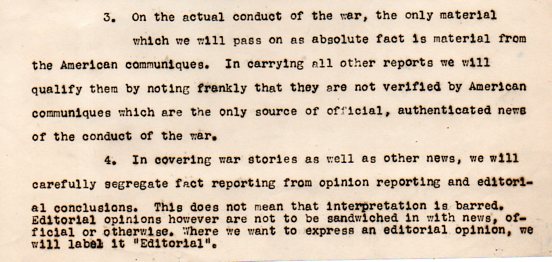
    “3. On the actual conduct of the war, the only material which we will pass on as absolute fact is material from the American communiques.”

    “4. In covering war stories as well as other news, we will carefully segregate fact reporting from opinion reporting and editorial conclusions.”

    PM Newspaper137

    Lewis was also particularly demanding in his policy regarding personal opinion in news stories: “Where we want to express an editorial opinion, we will label it “Editorial.”

    And Lewis meant it, too. Unlike almost all newspapers, PM editorials  were signed.  The newspaper also took no advertising, hoping to keep the paper running on sales and subscriptions.  And so it did, for eight years–not long by long-running standards of  newspapers, but fairly long for the times, and for the type of business plan practiced. 

    In any event I enjoyed the crispness and clarity of Lewis’ directive.

    Notes:

    1. The publisher was Ralph Ingersoll (1980-1985), who before coming to PM was the managing editor of Time-Life, and who was also the business plan designer and then managing editor of Fortune magazine; and the silent partner in the whole thing was MArshal Fields III, who pretty much bankrolled the newspaper from a distance.

    2.  It was a very considerable staf.  From Wiki:  “Journalist I. F. Stone was the paper’s Washington correspondent. His award-winning series on European Jewish refugees attempting to run the British blockade to reach the Jewish homeland in Mandatory Palestine became the book, Underground to Palestine. Staffers included theater critic Louis Kronenberger and film critic Cecelia Ager. Weegee, Margaret Bourke-White and Arthur Leipzig were the photographers. The sports writers were Tom Meany, Tom O’Reilly and George F. T. Ryall (who covered horse racing). Elizabeth Hawes wrote about fashions, and her sister Charlotte Adams covered food. Other distinguished writers who contributed articles included Erskine Caldwell, [Myril Axlerod], McGeorge Bundy, Saul K. Padover, James Wechsler (eventually the paper’s editorialist); Penn Kimball, later dean of the Columbia University School of Journalism; Heywood Hale Broun; James Thurber; Dorothy Parker; Ernest Hemingway; Eugene Lyons; Ben Stolberg; Malcolm Cowley; future Speaker of the House Tip O’Neill and Ben Hecht.


  • The Discovery of Salad–the First Salad Cookbook, 1627.

    JF Ptak Science Books   Post 1690

    ===blog==aug 19==salad  I was looking for an antique recipe for pesto and came across this remarkable book by Salvatore Massonio, Archidipno overo dell’insalata e dell’vso di essa, published in Venice by Marc’Antonio Brogiollo in 1627. It is in short a philosophical cookbook for salads—and the first of its kind dedicated solely, devoted entirely, to the salad.  It must have been a revolutionary publication, and probably intended for the very wealthy, given that the vast majority of people in Europe didn’t have money for a book, and many couldn’t read, and lettuce and its makings were outside the standard diet for the working poor.  The book is no slim effort: 68 chapter and 425 pages long, it describes the stuff of the salad and its dressing. Unfortunately there are no illustrations, no images on presentation–not even the new chapter capital letters are designed in a food motif.  Nothing.  (The full text is available here.)

    Actually salad wasn’t limited to just greens in this book, and his quasi-vegetarian sentiment was tested by including cold salted meats, cold salted tongue, livers and such in the mix.  But Massonio was definitely far ahead of anyone else at the time dealing with the benefits of the salad for both health reasons, as well as for making the salad not a meal in itself but an appetizer for something larger to come.  In another great possible “first”, the wonderful Massonio seems to be the first to describe the use of garlic in a sauce. 

    Now. About that pesto recipe…all I need is some stuff from Italy and a special-marble mortar and I’ll be somewhat on my way, at least as the purists are concerned. The birthplace of pesto, Liguria, takes its position as the originator of the great green delicacy very seriously, legislating exactly how and with what peso should be made.  And that is as it should be.  Maybe I’ll just buy the pesto…

    (Robbing Peter website has taken a translation of the cucumber salad from Massonio and created it here–looks pretty good.)


  • Art of Labor–Ralph Fasanella

    JF Ptak Science Books    Quick Post

    Ralph Fasanella (1914-1997) was a self-taught artist who included minute details in his large canvases in which he re-created New York City, vast scenes of industry and celebration, and in general anything having a lot of people in it. He was if not in fact then at least in his head a Wobbly, a left-of-left deeply-pro-union socially-consciousness commentator, the son of a button-hole making mother and an ice-seller father. Ralph was a machinist and gas station owner, and in there somewhere in mid-life he became a painter.  I like his work quite a bit.

    This (above) is one of his most well-known works, and it portrays the famous IWW strike in Lawrence, Massachusetts in 1912, (see the Great Strike.), also commonly known then as now as the Bread and Roses Strike.  What differentiated this strike from others was the very large involvement of women, minorities and immigrants.  Old Ralph wore his leftie heart on his sleave.
    Here’s some photos of the real thing:

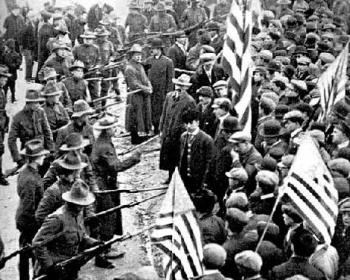
    Strikers face off with militia in Lawrence
     As usual the strike was about more humane working conditions, more light, better air, fewer hours, decent livable wages.  When the main employer in its town influences the flow of 85% of all of the town’s income, it is difficult for people to resist demands from that business which might not be reasonable.  

    Up20


    Lawrence strike meeting, New York

    [Photo shows group of men gathered outdoors, probably in New York City, to hear about the textile strike in Lawrence, MA. (Source: Flickr Commons project, 2008)]

    Guarding approach to mills, Lawrence, Mass.

    [Photo shows the Lawrence textile strike of 1912, also known as the “Bread and Roses” strike.  Source:  Library of Congress.]

    And from the introduction to the Report on Strike of Textile Workers in Lawrence, Mass., (U.S. Bureau of Labor, 1912) we read:

    "In Lawrence, Mass., fully one-half of the population 14 years of 
    age or over is employed in the woolen and worsted mills and cotton mills, and approximately 60,000 (including employees and members of their families) of the 85,892 people living in Lawrence are directly dependent upon earnings in these textile mills." "The textile strike in Lawrence and the conditions which followed were not primarily due to any condition peculiar to Lawrence. The general conditions of the industry in Lawrence are more or less typical of the textile industry in all of the large distinctly textile towns, and the strike in Lawrence and the conditions attending it might just as easily have occurred in any other of these towns."

    In short, a standard bit.
    Here are some other examples of Fasanella's work:

    ·Posted by :

    ·in:

    —