A Daily History of Holes, Dots, Lines, Science, History, Math, Physics, Art, the Unintentional Absurd, Architecture, Maps, Data Visualization, Blank and Missing Things, and so on. |1.6 million words, 7500 images, 4.9 million hits| Press & appearances in The Times, Le Figaro, Mensa, The Economist, The Guardian, Discovery News, Slate, Le Monde, Sci American Blogs, Le Pont, and many other places… 5000+ total posts since 2008.
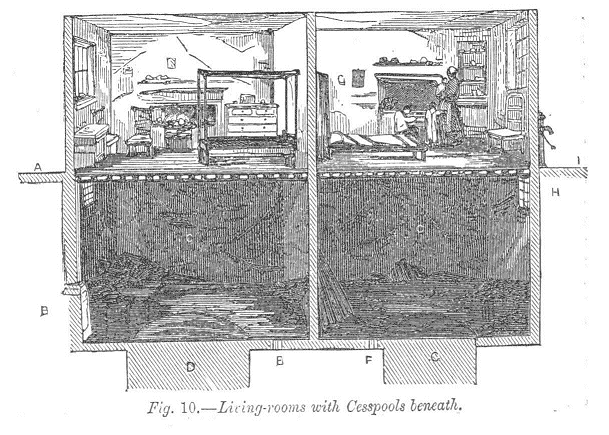
Reading Dickens now and stopping for a view of socially-conscious England via the excellent Victorian London website in the work of George Godwin’s 79-page critical exposition London Shadows, a Glance at the “Homes” of the Thousands (1854). The images are awakening and abrupt–all the bitter observation of George Orwell, only told much more quickly, like a person trying to describe a raging house fire before the thing burned itself out. Its a powerful work, and I can’t help but think that those reading it in 1854 must have been appalled not only by the deep visualization of the state of the working poor, but also by its scope, and the possible revelation of England’s basic bedrock.
There are any more works to chose from at Victorian London–I decided to pry out the images from the Godwin work along with his commentary on them. It is truly a stunning work.
“When every man is his own end, all things will come to a bad end.” COLERIDGE.
“….there must be a point beyond which there may be no abridgement of civil liberties and we feel that whatever the emergency, that persons must be judged, so long as we have a Bill of Rights, because of what they do as persons. We feel that treating persons, because they are members of a race, constitutes illegal discrimination, which is forbidden by the fourteenth amendment whether we are at war or peace.”–– A. L. Wirin, Counsel for the Southern California Branch of the American Civil Liberties Union, speaking on the internment of Japanese-Americans, 1942
“We make these statements, not because we fear evacuation, but because we believe, to the bottom of our hearts, that the best interests of the United States, our nation are to be served by being permitted to stay, work, fight, and die for our country if necessary here where we belong.“–Response by the Japanese American Citizens League to Internment Camps, 1942
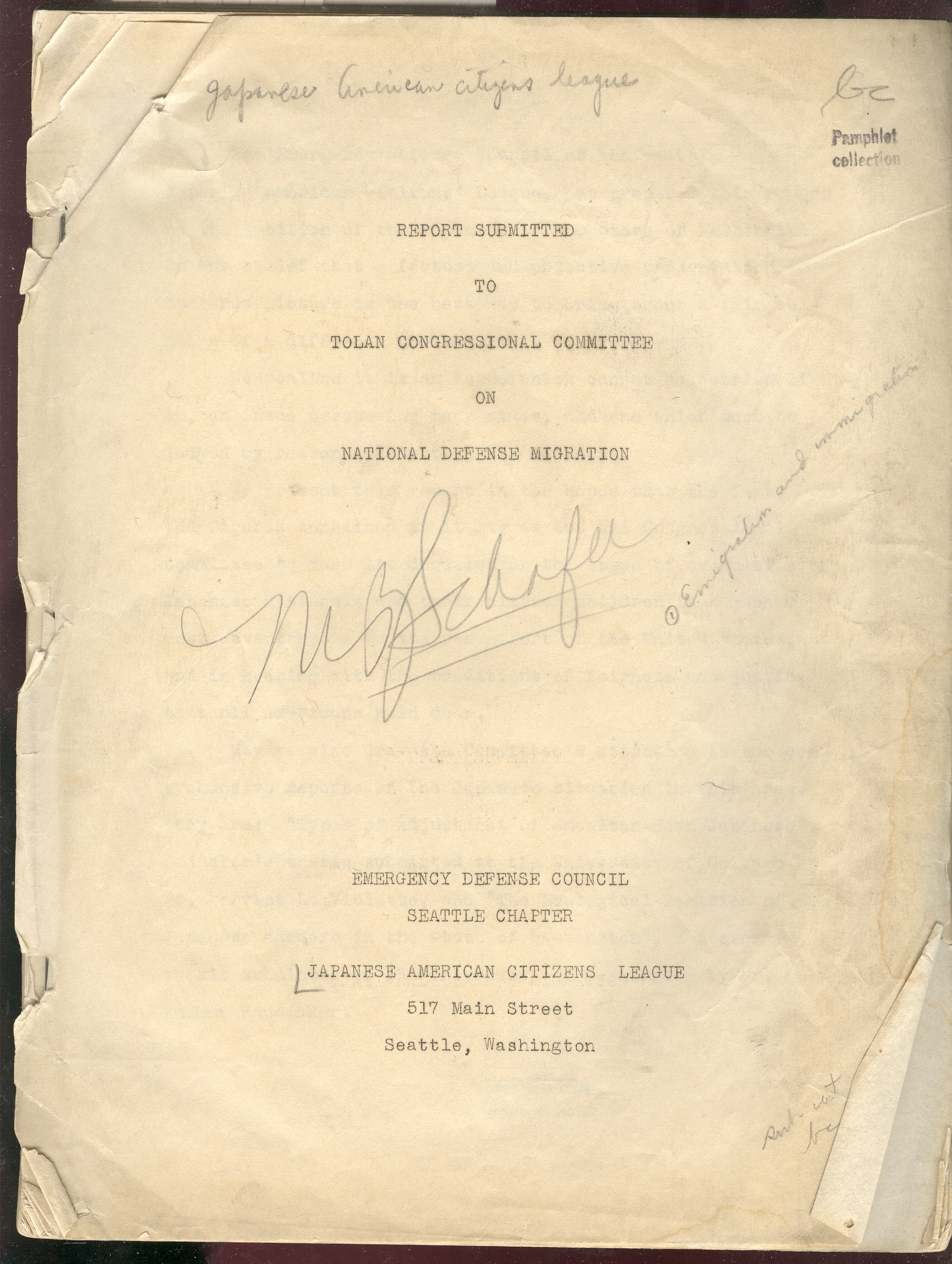
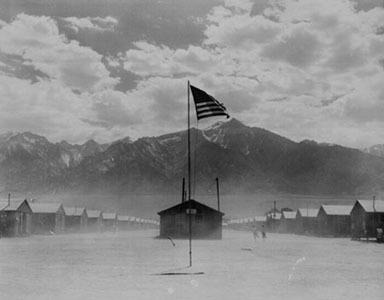
This excruciating, heart-rending 1942 document was submitted by the Japanese American Citizens League (of Seattle, Washington) to the Tolan Congressional Committee with recommendations, proposals and requests in the event of the removal of Japanese citizens from “sensitive” areas in western America It is an exceptional report, a well-reasoned response to the developing and calamitous American fear of Japanese fellow-citizens; a fear which was swiftly leading itself to xenophobic actions the result of which was the internment of 120,000 American citizens in internment camps.
The Roosevelt administration’s Executive Order 9066 was the legal bombshell that gave the War Department the authority to authorize the removal of the Japanese (19 February 1942) and theoretically prevent those people from engaging in sub rosa and fifth column activities asd wartime terrorists fighting for Imperial Japan. The Tolan Committee was that of Congressman John H. Tolan (CA), chair of the House Select Committee Investigating National Defense Migration (!), undertaken at the request of Carey McWilliams (chief of the California Division of Immigration and Housing) who was trying to prevent or at least delay the coming removal of the Japanese. Needless to say, the operation backfired
The document is “heart rending” because Executive Order 9066–at its base terribly wrong, a weakness exhibited, a moral embarrassment of the highest order–was addressed by its authors in a logical, clarifying and accommodating fashion in a noble and valiant attempt to negotiate an untenable situation while making every effort to appease the aggressor without judgment and offense. It was an attempt at maintaining dignity and some sense of Constitutional freedoms for a group of people in a situation in which their dignity and freedoms were being withdrawn….at least their freedom was.
In the introduction to the document (titled Report submitted to Tolan Congressional Committee on National Defense Migration Emergency Defense Council Seattle Chapter Japanese American Citizens League, and published April, 1942) we read that people are willing to go and abide 9066, but that one of their main issues was where exactly it was that they were going, where they were being taken. That hadn’t been established yet, and it makes me shake my head to think of the government establishing this order without a clear indication of any (?) of its consequences.
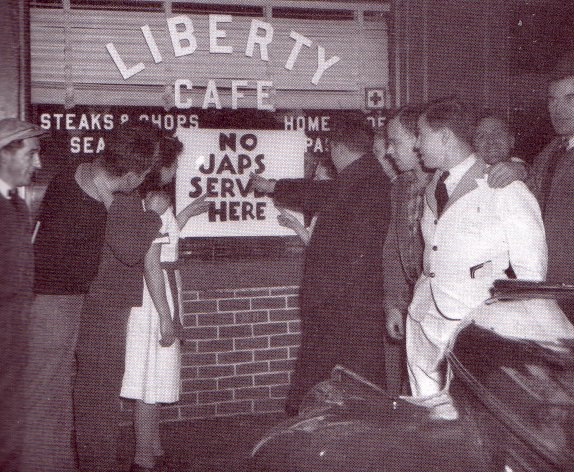
“[Introduction] A large number of people have remarked that they will go where the government orders them to go, willingly, if it will help the national defense effort. But the biggest problem in their minds is where to go. The first unofficial evacuation announcement pointed out that the government did not concern itself with where evacuees went, just so they left prohibited areas. Obviously, this was no solution to the question, for immediately, from Yakima, Idaho, Montana, Colorado and elsewhere authoritative voices shouted: “No Japs wanted here!””
“[Resettlement] What will the government’s policy be? Will communities be shifted as units to other sections? Will the Japanese be re-settled as family units? Will men and women be segregated and families split up? Will Japanese be scattered at random in the interior? These are questions that are arising in the Japanese communities in this area.”
Already thinking of the future and the end of the war, the authors wondered about the prospects for the return of the Japanese people to their former residences:
“[Return] “It is necessary to think of the future, of the day when this war will be over. Could the Japanese people, once evacuated, return to their homes? There is the great possibility that once the Jap-haters and outspoken opponents of the resident Japanese were successful in driving the Japanese out of this area, they would never permit them to return. A post-war campaign of hate and vilification when resident Japanese tried to get back to their homes and investments here, is a definite possibility should these elements score an initial victory.”
The idea for a “model city” was proposed, or at least opened for discussion, as a possible place for the interned Japanese to go:
“[Model City] This is an ambitious plan entailing the creation of an all-Japanese city somewhere in the interior of the country, able to sustain itself as a self-sufficient unit. It would be financed originally partially by the Japanese themselves, partially by the government. Some important defense industry would be set up to give employment to Japanese labor, preferably one calling for skill and efficiency which Japanese workmen possess. The city would be governed by American citizens, who would elect a mayor and council, just as other American cities, and the Japanese, both American citizens and aliens, would be given an opportunity to practice the American ideals of democratic government which they have learned.”
“After the initial investment, the city could be expected to become self-sufficient and a center for the hinterland. It is altogether likely that such a city, as an experiment in democracy would be so progressive and would provide such advantages that friends of the Japanese would desire to share its benefits.”
“This would be a long-range project, to be continued in perpetuity. The objection of the time required to set it up would be overbalanced by the permanent nature of the project.”
After 38 pages of questions and planning, the authors of the report declare that the Japanese Americans affected by 9066 would comply (“to the best of our ability”) with whatever was demanded of them. They felt very strongly though that they could do more for their country by staying in their homes and fighting Japan just like any other American.
“[Conclusions] If it is for the greater good that evacuation be decreed, we shall obey to the best of our ability. But we are convinced that here in our homes and in our community is where we belong, where we can lend every ounce of our strength, and every cent of our resources, in creating the sinews of war so necessary to total victory. We are Americans. We want to do our duty where we can serve best. We make these statements, not because we fear evacuation, but because we believe, to the bottom of our hearts, that the best interests of the United States, our nation are to be served by being permitted to stay, work, fight, and die for our country if necessary here where we belong.”
[This document is for sale in our bookstore, here.]
JF Ptak Science Books Quick Post [Part of a new series on the History of Fear]
There just seemed to be something going on with women and clothing and sex and fear and sci-fi trouble, or at least so on the covers of a spectrum of pulp publishers in the 1930’s-1950’s. Perhaps this had nothing more to do with anything than having a pretty woman posing next to the UNIVAC II in a 1959 issue of Computers and Automation. In any event, I stockpiled some of these images and collected them under the Fear-Sex heading, and for right now all I’m going to do is pass them along.
Are they really sexualizing danger? I have no idea what the content was of these issues, but from the looks of things, I’d throw hazard to the wind and say “yes”, at least to the visual aspect.
(Don’t forget to have a peek at an earlier post on Women in Sci-Fi Past-Future Distresses, here.)
JF Ptak Science Books Post 1680 Part of a new series on the History of Fear
Perhaps you become scared of what is taught you or is available to you, or made available, or dreampt. Perhaps you can dream not-so-terrible things unless you have been exposed to them in one form or another, already. I can certainly recall from my childhood things that made me feel fear, and they weren’t very fearful–not really–at all, though they were at the time, because there was no way for me to process the weird adaptations to my imagination.
Certain things are taught to children as a matter of course, I guess, certain fearful things, like for example the oldish child’s prayer ruminating on a sleeping death, or some exacerbating tale from the brothers Grimm–how else are children to come up with the ideas of not waking up or being boiled alive or eaten by a witch?
And so I wonder about the fear factor imaged and implied in these early wonder/sci-fi magazines, meant for distribution to high-adolescents and adults. They simply do not look so terrifying, though I guess it is because the true business end of FearSell USA Inc had not yet been prioritized in the national economy–and certainly it was orders of magnitude away from approaching anything that we have today. Even the constant state of storm/terror available to us in a relentless flow from a simple avenue like The Weather Channel must be a testament to the dept of our fear depravity.
The stories–or the ideas of the stories, anyway–seem scarier to me now than the images of them on the covers of these magazines. It would be an interesting thing to make a timeline of fearful images to see how these things changed over the decades. Or centuries.
I’m working right now on a post utilizing a classic story from the history of childhood, Pinocchio. No doubt everyone had some sort of classic image of this scamp in mind, but if you’ve ever read the whole thing the little non-wooden boy really was a bit of a terror, far removed from scampdom. Its probable that we have different images of some classic tales–in particular from the Brothers Grimm–where our minds have filled in the forgotten nasty parts of the classic tales with more child-friendly versions.
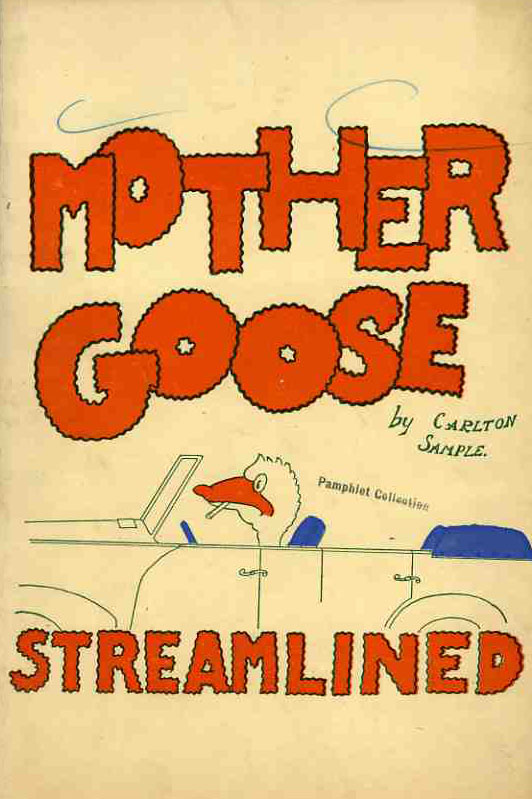
Which brings me to Carlton Sample, a lansman of mine over in Wilmington NC, who had a somewhat different vision for the old standby Mother Goose, and (self) published it in 1947. We’re seeing the best part of Mr. Sample’s work right here, what with the inside dripping with gooey doggerel (I swear that when you stand the book upright that one or two letters slide out of the bottom of the book every minute or so…its important to keep the book flat or the thing will be blank in about two days.) But his Mother Goose Streamlined is only necessary for his snapshot of the cigarette-smoking goose, driving blankly along behind the wheel of a convertible.
Sometimes a picture really IS worth a hundred and twenty-five words!
I have made numerous posts on this blog using images from my archive of American news service WWI photographs, though there are few depicting scenes just after the end of the war’s end on 11:00 a.m. on 11/11/11. These photographs below do so, and all come from the National Library of Scotland (which can be accessed here). They are all “British Official War Photographs”, which was a service similar to its American cousin–various news and photo agencies were given access to images produced by a pool of photographers, all of which passed by the eyes of a military censor. They were for the most part aimed at the “correct” version of the news, though given the subject matter there were plenty of images that were extremely powerful. In a war that claimed 100,000,000 casualties, the photographic image was a powerful war-time propaganda tool.
[Original reads: ‘SCENES ON THE WESTERN FRONT. WAR TROPHIES SECTION. German trophies from Vimy Ridge and Messines. In centre is Prussian Guards drum.’]
”[Smoking is] a custom loathsome to the eye, hateful to the nose, harmful to the brain, dangerous to the lungs, and in the black stinking fume thereof, nearest resembling the horrible Stygian smoke of the pit that is bottomless.”–King James I, in “Counter Blaste To Tobacco”:, published 1604
James I hated tobacco. He hated every aspect of it, particularly since some smokers favored the stuff because of its purported medicinal and curing qualities–but for James it all led to vile stink, Devil worship and deep sin. He just simply hated the whole idea–that and the person who introduced the notion and practice to James’ fair island, who was Sir Walter Raleigh. And what did Raleigh get out of that deal? Well, he certainly over the course of tars-filled time introduced the possiblity of grim, cancerous death to a billion practicers and had a miserable pipe tobacco named for him. And he also was beheaded. I can’t help but think that the smoking business had something to do with pulling James’ head into pulling Raleigh’s head off. (Well, it was actually “chopped” off, his bodyk buried and his head treated and stuffed and kept by his wife for the next 29 years. In his prison cell in the Black Tower, Raleigh left a small container of tobacco, with the sentiment Comes meus fuit illo miserrimo tempo (It was my companion at that most miserable time) engraved upon its lid.)
And so James wrote this piece in 1604, a thin 32-page evisceraton of tobacco and tobacco-users. It is an antiquarian rush to righteous vindication, and it in no small measure helped James’ cause that he was right on a lot of his viciously-placed claims.
The sins and vanities of the filthy use of tobacco were many but evidently described in three layers, like a good cake, though he does make a good case for the habit’s vileness. Tobacco is mainly a sin of guilt and selfishness, of drunkness which is one of the great malfactors of all bad things, and of course the greatest sin of all in that it would impede the protection of the King and the realm. James makes the case for tobacco use being an indolent, sick-making, vile producer of impotence and uncaring, driving all manner of sin that would lead to personal downfall and to the general “mollicie and delicacie of the wrath of overthrow” of kingdoms.
First are you not guiltie of sinnefull and shamefull lust? (for lust may bee as well in any of the senses as in feeling) that although you bee troubled with no disease, but in perfect health, yet can you neither be merry at an Ordinarie, nor lasciuious in the Stewes…
Secondly it is, as you vse or rather abuse it, a branche of the sinne of drunkennesse, which is the roote of all sinnes: for as the onely delight that drunkards take in wine is in the strength of the taste, and the force of the fume thereof that mounts vp to the braine: for no drunkards loue any weake, or sweete drinke: so are not those (I meane the strong heate and the fume), the onely qualities that make Tobacco so delectable to all the louers of it? …
Thirdly, is it not the greatest sinne of all, that you the people of all sortes of this Kingdome, who are created and ordeined by God to bestowe both your persons and goods for the maintenance both of the honour and safetie of your King and Commonwealth, should disable yourselves in both?
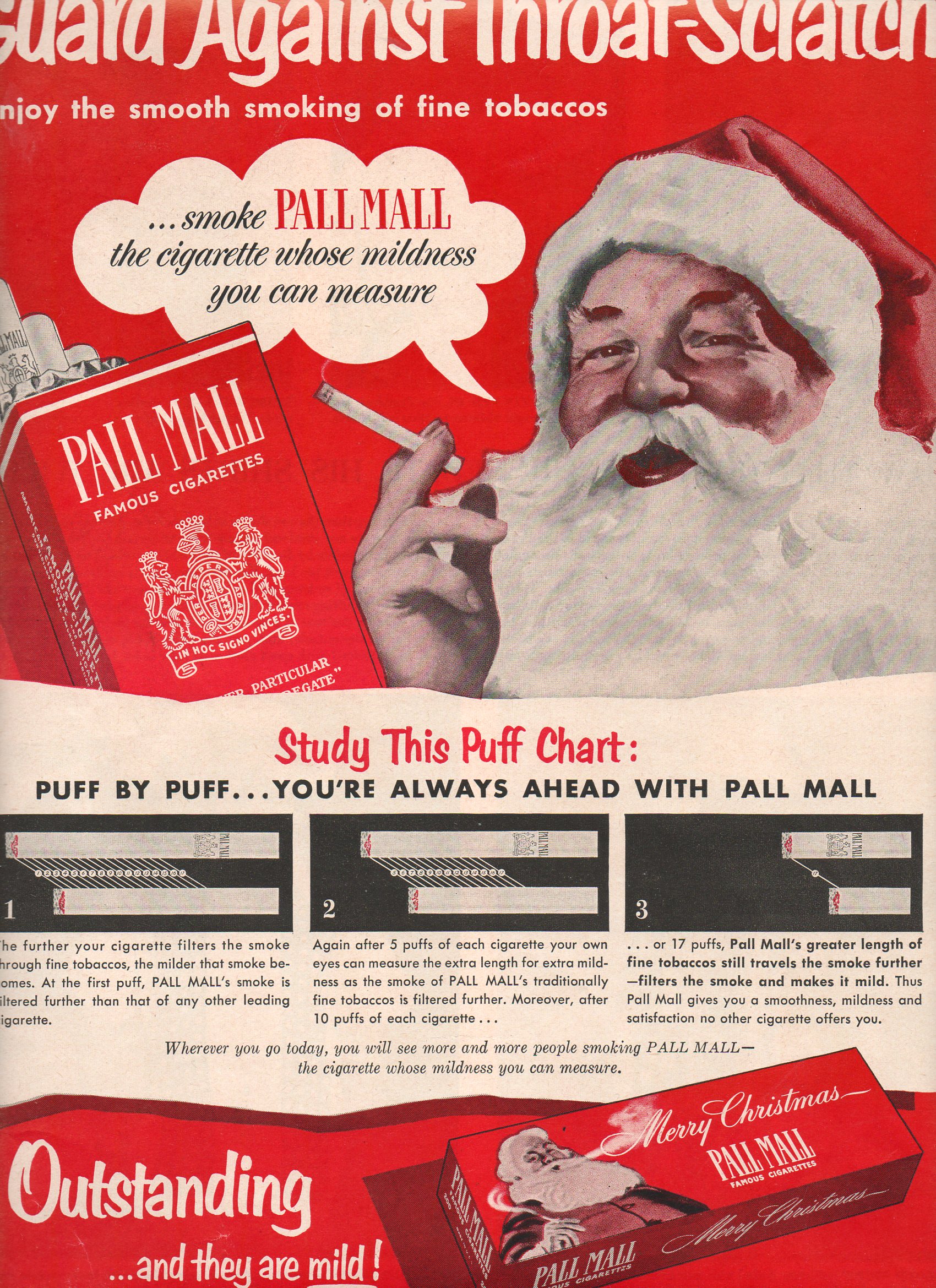
The King also attacks the attractive and bogus medicinal properties of tobacco, and he takes care to list some of its precious capacities, from ridding people of the gout (instantly), to wakening the brain, to pox-curing, and even having the ability to cast out devils. Of course this belief was sustained as semi-fact for hundreds of years now, eventually worming its way into the all vast pockets of the Middle Class via print and other media as advertisements with doctors, dentists, nurses, pilots, sports figures, politicians (most famously perhaps being R. Reagan), and of course Santa Claus extolling various curative properties of cigarettes. In the 20th century there was also the strong influence of Sexerettes–the possibility of sexiness curled around languid figures selling cigarettes to the young and old alike.
JF Ptak Science Books Post 1335 On “the Privilege of Sterilization”
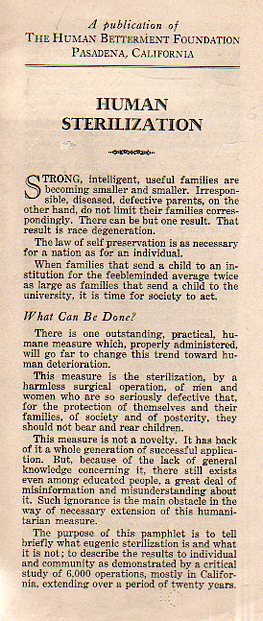
There are so many ways of spelling “n-a-z–i” without using a “z”. Or the “n”. The vowels come in handy, though. The Human Betterment Foundation of Pasadena, California did just that, as did the Association of Ontario Mayors, the Eugenic Society, and many other correct-thinking associations and societies. What these people had in mind was the raising of the genetic good through the malleable confusion of human rights issues resulting in the forced “asexualization” of the lesser elements of society–forced sterilization of inmates in state-run mental and correctional institutions, (I’ve written about sterilization and eugenics earlier on this blog, here, though the pamphlets I’m writing about today are different.Today’s pamphlets are available for purchase at our blog bookstore.)
To paraphrase the good doctor Hunter Thompson, (“when the going gets tough the weird turn pro”), the Nazis did that, becoming complete beasts, horrors even to their own horror, almost unimaginably so. (As a matter of fact, they were so bad that a certain percentage of the population believes that the Holocaust and the Nazi experimentation didn’t happen because, among other, race-hating reasons, the crimes were just too enormous to be true.) But before eugenics studies were molded into what the Nazis needed they provided ample justification to other groups. before the Nazis were elected to power in 1933. These American groups weren’t nearly on the same level as the Nazis, but they did create their own levels of hell, just not as deep and as profoundly grotesque as the Nazi-version. But it was something very deeply disturbing.
The Human Betterment Society put the issue quite simply in their slim little pamphlet, Human Sterilization–to save ourselves from “race degeneration” society had to act and restrict ‘defective” men and women from bearing and rearing children. There aren’t that many pages in this publication but they each present some astounding assertions, perhaps the most shocking of which is that this society had its eyes on a larger prize–the country was burdened by as many as 18 Million people with mental disease, who “put a charge and a tax on the population” and who would “cost a billion dollars a year” to take care of. The Human Betterment people do not say outright that 18 million people should be sterilized, but the statements come in the middle of a pamphlet making the case for sterilization, so we are left with the determinant that riding this people from the gene pool would be a desirable outcome.
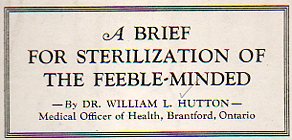
Dr. William Hutton makes the case for the humanitarian treatment of the treatment espoused in the title of his A Brief for the Sterilization of the Feeble-Minded (1936). “It would be unjust and anti-social to withhold the privilege of sterilization from the victims of mental disorders (the insanities)…”(emphasis mine). He dives into the deep-end of the sterilization issue, making the cse for dealing with the “blind, deaf-mutes, haemophilicacs and brachydactyly (deformed fingers)” in the same manner.
Of course the Nazis performed all manner of sterilizations before 1939 and before they started to simply exterminate entire populations of who they considered to be human beings unworthy of life. The eugenics people didn’t want to kill people–they just wanted to take away all of their reproductive rights, forever.
As it turns out, the list of the types of people who were subject to enforced, state-organized sterilization got a little shadow-y around the edges, enough so that prisoners or mental patients accused of “moral terpitude” could include, say, poor women forced into prostitution. The lateral motion of these sorts of issue were decided by different state agencies–in New Jersey for example it was the Board of Examiners of the Feeble-Minded; in Indiana, it was a board of “eugenics experts” (who were to be paid no more than $3 per case).
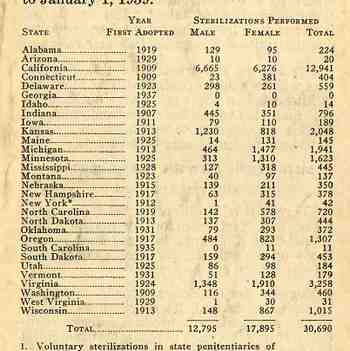
The reach of sterilizations varied by state–some states did not have any laws regarding enforced sterilizations, though most did–the reach of the practice varied from state to state as well, some (like New York) reaching beyond the state penal institutions, mental hospitals and “homes for the feeble-minded”, and then right down into reform schools for boys and girls (with Michigan looking into industrial schools as well). Some states–like Kansas–reached across these lines into the lives of epileptics; Michigan did not hunt for epileptics but did so for “imbeciles”. Oregon seemed to cast the widest net, including the “feeble-minded, insane, epiletpic, habitual criminals, moral degenerates, and sexual perverts” found in any institution maintained at the public’s expense who condition was found to be “inadvisable for procreation”. Maine on the other hand simply included “other forms of mental disease”.
By 1933 state-sponsored sterilizations of these classes of people reached the following totals:
And so it almost ends, the story of sterilization growing weak and stale by World War II, exhausted and failing under its own exhaustion and failure. The sterilization of sterilization really begins with the Supreme Court Decision of 1942, the Court finding unanimously that (in Skinner v Oklahoma) that Mr. Skinner’s–a chicken thief–right were being violated when faced with castration. Justice William O. Douglas wrote: “[S]trict scrutiny of the classification which a State makes in a sterilization law is essential, lest unwittingly, or otherwise, invidious discriminations are made against groups or types of individuals in violation of the constitutional guaranty of just and equal laws.”The practice continued with less abandon and more restrictive uses into the Nixon administration, which even as late as 1970 increased Medicaid funding for sterilizations, a weirdly appropriated funding that seemed to dramatically increase the sterilization of poor blacks. Forced sterilization breathed its last in Oregon in 1981.
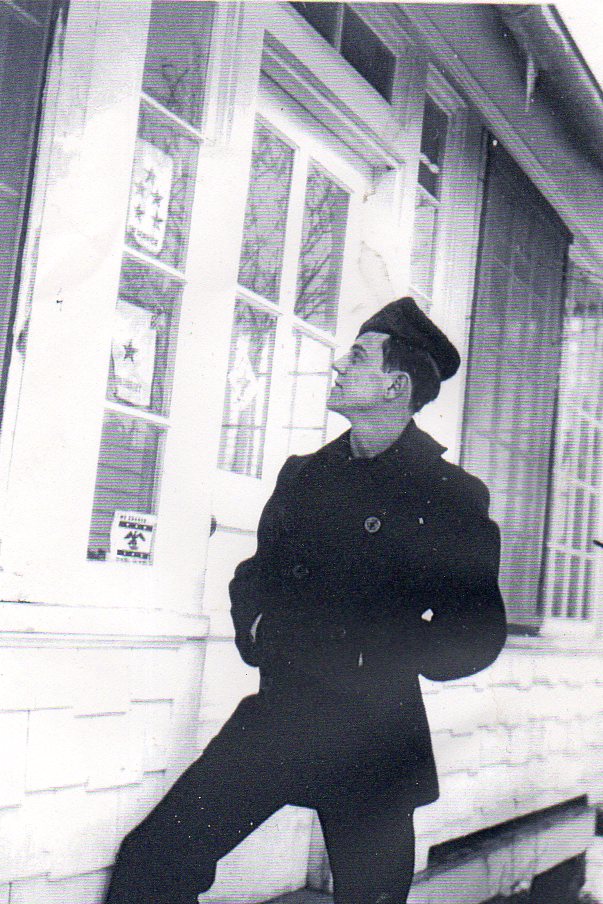
I want to thank all Veterans today, all of our Veterans everywhere, for all of your sacrifices. I particularly want to say to say how much I appreciate the members of our family who have served: Uncle Pete (USMC, WWII), Uncle Ray (RCAF, RAF+USAAF, WWII), Uncle Stan (Navy, WWII), Uncle Alex (Army, WWII), Uncle Joe (Army, Korea), Uncle Jerry (Army, WWII), Uncle Frank (USAAF WWII), Uncle Walter (Navy WWII) and my other Uncle Stanley (Army, WWII), Uncle Francis (Army, WWII), Uncle Vincent (Army, WWII), cousin Billy (USMC, Vietnam) and Grandpa (Army, WWI); Patti’s father Melvin Lonnie (Navy, WWII) and stepfather Boyce (Army, 2nd US Cav WWII), Uncle Guy (USMC WWII), Uncle Max (Army WWII) and her four relatives in the CSA. Nearly everyone was in battle, and nearly everyone came home. [Image: Uncle Walter looking at the 5-star Blue Star flag, Housatonic, Mass, 1943.]
JF Ptak Science Books Quick Post (An addition to the post on George Orwell and his descriptions of the working poor miners of England.)
Friedrich Engels (1820-1895) traveled to England to work for the English subsidiary of his family’s textile business, settling into Manchester (and Salford) in with a keen and ravenous eye. He didn’t have the eloquence of a George Orwell, but he had more than enough to capture the essence of what he saw and to see deeply into what he suspected; and what he saw of course was not very pretty so far as the condition of the working poor was concerned.
So when he was in his early twenties, Engels researched and wrote about what he saw in the Industrial Revolution in the great smoking city of Manchester, grown from a city of 79,000 in 1811 to nearly 300,000 in forty years, seeing for himself the class struggles that he (and his new friend Karl Marx) would write about in Das Capital just four years later. What came of his work in Manchester was The Condition of the Working Class in England. Dedicated to the people of England, it would not be available in English for another 43 years (at which point the “in 1844” was added to the end of the book’s title). [The images above and below of Manchester show the city ca. 1840, when the life expectancy was around 30.] He probably would have been very surprised to see that the revolution he wrote about didn’t take place in England; and doubly so to see that the home of the revolution was Russia.
Working Conditions is seen as one of Engels’ greatest achievements, both for his insight and reporting and of course for what the work would contribute to Capital. [The full text is found here.]
He writes:
“But these are not all the evils which descend upon the head of the coal-miner. In the whole British Empire there is no occupation in which a man may meet his end in so many diverse ways as in this one. The coal-mine is the scene of a multitude of the most terrifying calamities, and these come directly from the selfishness of the bourgeoisie. The hydrocarbon gas which develops so freely in these mines, forms, when combined with atmospheric air, an explosive which takes fire upon coming into contact with a flame, and kills every one within its reach…”





 And so it almost ends, the story of sterilization growing weak and stale by World War II, exhausted and failing under its own exhaustion and failure. The sterilization of sterilization really begins with the Supreme Court Decision of 1942, the Court finding unanimously that (in Skinner v Oklahoma) that Mr. Skinner’s–a chicken thief–right were being violated when faced with castration. Justice William O. Douglas wrote: “[S]trict scrutiny of the classification which a State makes in a sterilization law is essential, lest unwittingly, or otherwise, invidious discriminations are made against groups or types of individuals in violation of the constitutional guaranty of just and equal laws.”The practice continued with less abandon and more restrictive uses into the Nixon administration, which even as late as 1970 increased Medicaid funding for sterilizations, a weirdly appropriated funding that seemed to dramatically increase the sterilization of poor blacks. Forced sterilization breathed its last in Oregon in 1981.