A Daily History of Holes, Dots, Lines, Science, History, Math, Physics, Art, the Unintentional Absurd, Architecture, Maps, Data Visualization, Blank and Missing Things, and so on. |1.6 million words, 7500 images, 4.9 million hits| Press & appearances in The Times, Le Figaro, Mensa, The Economist, The Guardian, Discovery News, Slate, Le Monde, Sci American Blogs, Le Pont, and many other places… 5000+ total posts since 2008.

Category: Militaria

  • Unusual WWII Maps by a Significant Soviet Intelligence Agent

    JF Ptak Science Books  

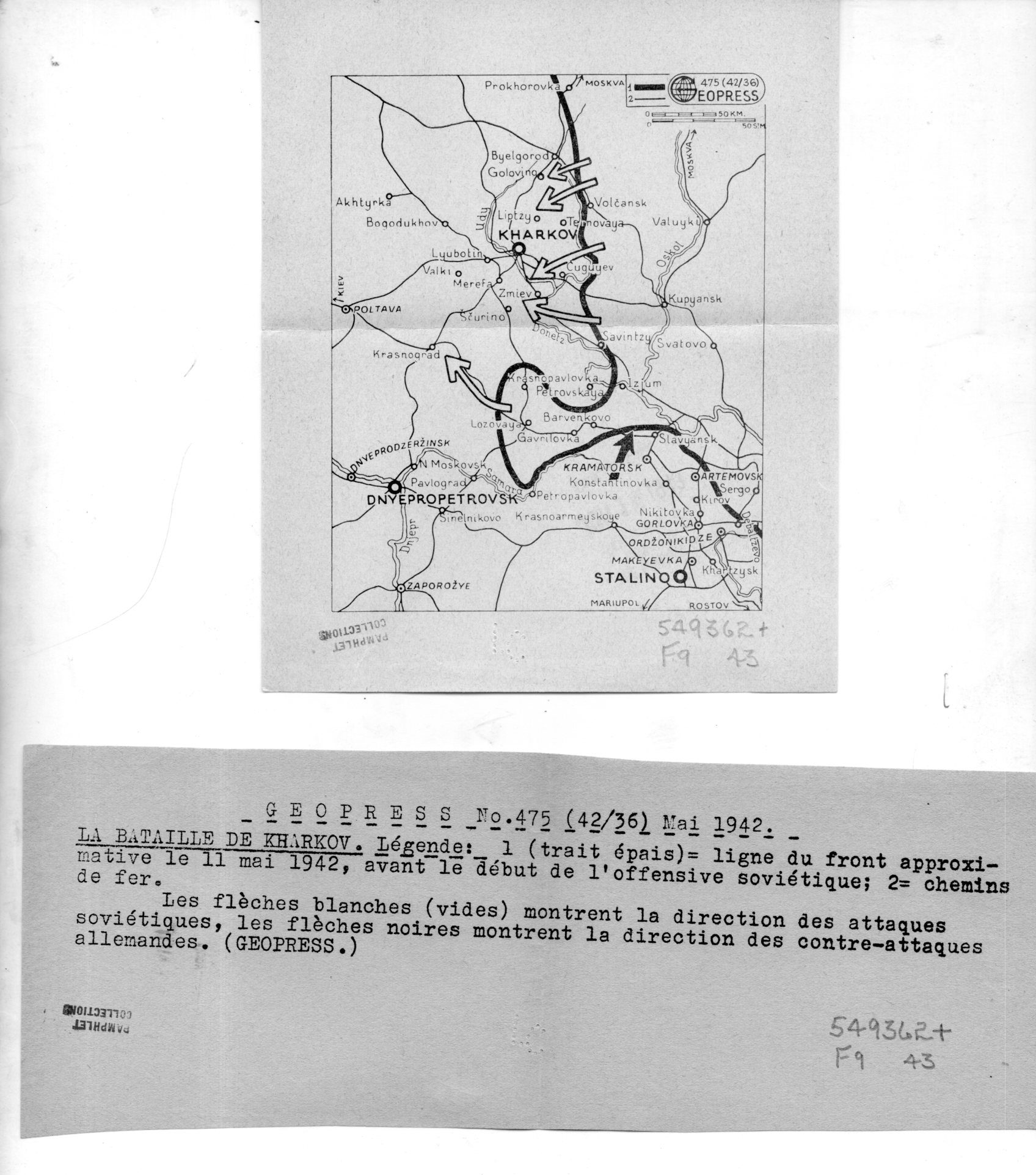
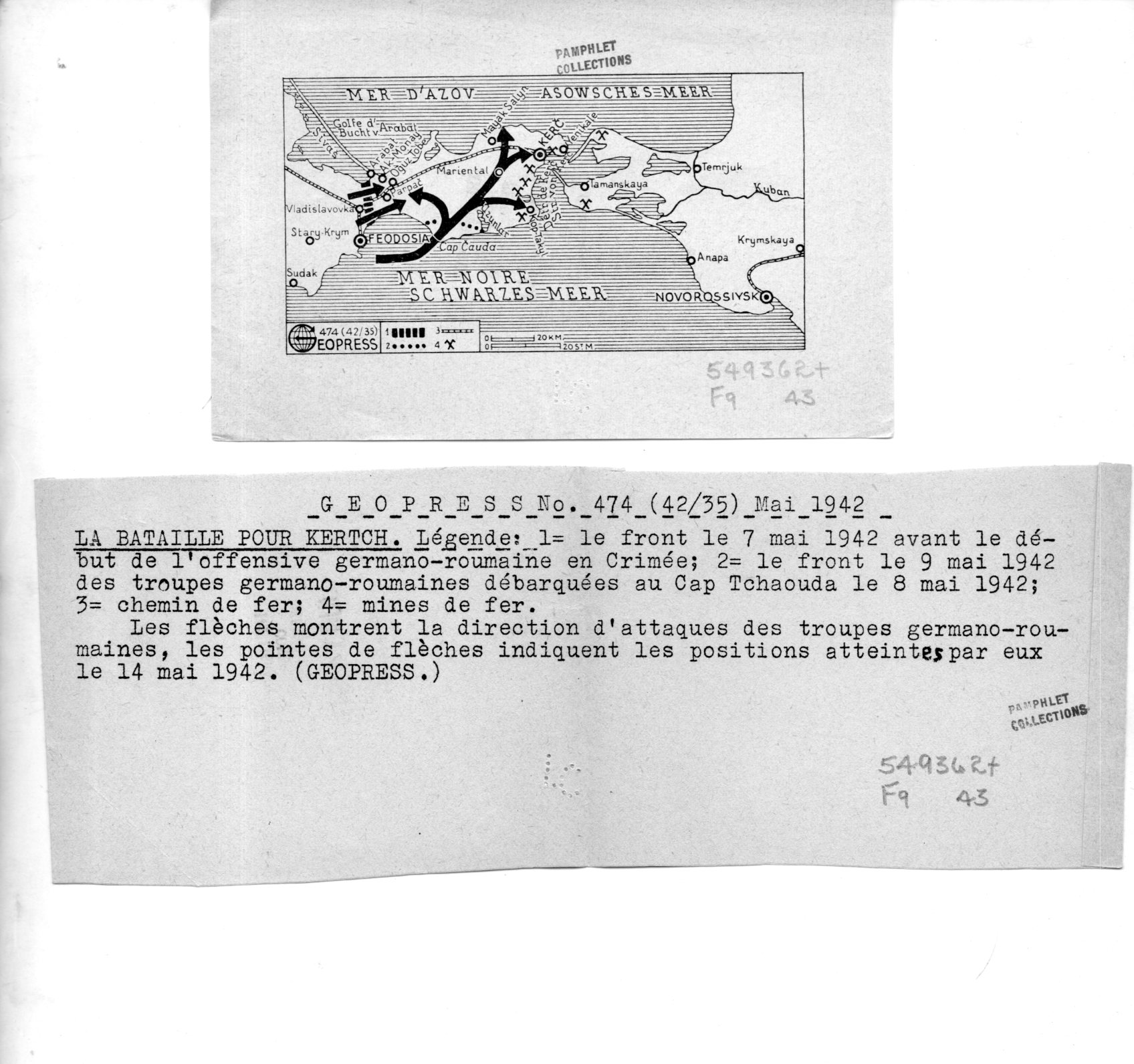
    I’ve found a number of interesting maps in the pamphlet collection here–these are highly unusual to my experience in that they were the work of a firm called “Geopress”, which was an active business and cover for a significant intelligence agent for the Soviet Union, operating in Switzerland, collecting data relating to German activities during WWII. There’s nothing I can add beyond the information that I quote extensively below from the CIA website on Rado–except that I cannot find images/examples of his Geopress work. So it seems the most efficient thing to do here is to simply quote the known sources and reproduce the images of the 18 maps and their accompanying texts.  
    Geopress _4_080

    As I said Rado operated Geopress as a news/cartographic service, and Rado was an accomplished cartographer, so the mans in and off themselves as maps are perhaps not a singular issue.  Their evident scarcity, however, does seem to be an issue. Also I do not understand why these maps are so small, some of which are just 1″x 3″; also the uneven;y cut/torn text sheets that are made to accompany the maps are also puzzling in their own way.  I do not understand the format–someone out there in Weblandia no doubt will.  

    All of the maps shown below are from 1942. They were received by the Library of Congress in June 1943 and stamped so on the backs of the maps.  (They lived for some time in the “Pamphlet Collection” at the LC before being purchased by me in 1998.)  

    The following quotes come from the CIA website, the Center for the Study of Intelligence, here:  https://www.cia.gov/library/center-for-the-study-of-intelligence/kent-csi/vol12i3/html/v12i3a05p_0001.htm]

     “Alexander (Sandor) Rado, Alexander Foote’s chief in the Swiss-based “Rote Drei” net that in 1941-43 supplied Moscow with detailed information on German order of battle… His activity in intelligence, mapping, and related fields has lasted nearly 50 years and may earn him a place in the pantheon of major intelligence figures of the times.”

    And this:

    “In 1936 or 1937, with Soviet funds and having a Swiss citizen as silent partner, Rado organized Geopress, a news agency specializing as Inpress had in maps and geographic background data. Geopress was more successful than Inpress because of better organization and the increased demand for news maps in the advancing shadows of World War II. As cover for an intelligence operation it proved ideal. Its normal activity—news collection and dissemination—provided justification for contacts with businessmen, officials, diplomats, journalists, and military leaders, some of whom became intelligence sources. It also justified a large volume of telephone and telegraph traffic, extensive postal business, and the maintenance of a courier system.”

    And so:

    “While building up his Geopress cover Rado also developed his sources, organized communications, and summarized for transmission the reports collected by his growing network. And he even found time to maintain through publications his image as an internationally known geographer.”

    And:

    “24 Feb. 1945.  During the German occupation of Hungary, (Rado) lived in Geneva where (he) published geographical maps for the Allied Governments until 1943; discovered by the GESTAPO and consequently his relatives in Hungary were murdered/ went with family to Paris in September 1944 and continued his work/summoned to Russia to report on his activities with the Free French Organization and left on 8 Jan. 1945 by special plane for Moscow/suspecting a trap, he got off the plane in Cairo where he remained/received no news from his wife in Paris and suspects that she might have been deported/he was formerly a Fellow of the Geographical Society in London, New York, Paris, Geneva, Rome and Washington, D.C.  OFFICE OF CENSORSHIP, Egypt, 11 April 1945.”

    [Again, the source for this and the above quotes:  https://www.cia.gov/library/center-for-the-study-of-intelligence/kent-csi/vol12i3/html/v12i3a05p_0001.htm]

    The maps:
    Geopress _3_079


  • Captain Marvel and the V-1

    JF Ptak Science Books  Quick Post

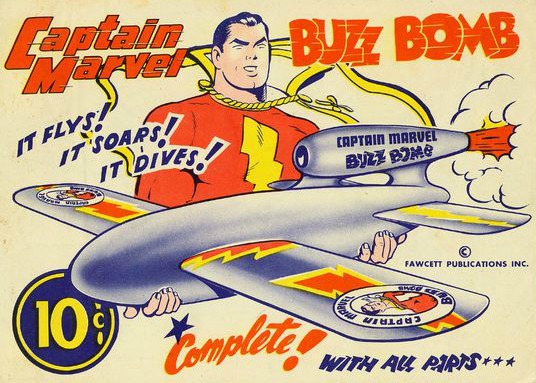
    Captain Marvel was once upon a time in the 1940’s a superhero more popular than Superman, though Superman is the obvious victor over time (and a long time at that). I don’t know what Captain Marvel is doing here hawking a paper punch-out flying “buzz bomb”, particularly since it seems to have been produced during WWII.1 It does seem unlikely to me that a flying toy modeled on the buzz bomb would be sold to kids during the war. After all, the “buzz bomb” was the German advanced weapon called the V-1, or Vergeltungswaffe 1, (“retaliation”, or “vengeance” weapon), or Fieseler Fi 103,  or Doodlebug, and was a flying bomb (on the order of a very primitive cruise missile guided by a gyroscope autopilot) launched against population centers in England by the Nazis during the June 1944-January 1945 period.  The bomb was about 27’ long and 17’ wide, weighed 4,700 pounds, and reached 400 mph with an 1,800 pound warhead.  Thousands of people were killed in the 8,000+ sorties of this foul-sounding beast–there was only a general sense of where it was going and where it might land, so the death and destruction it caused was indiscriminate.  Given all of this I’m assuming that the guesses on the year of production of this are wrong, and that it is a post-war bit, which would be in less bad taste than had it been actually produced in wartime.  It seems to me that most superhero/action hero types were busy punching Hitler or some such thing, and not selling a toy based on Hitler’s weapons when they were actually killing thousands.  In any event, I’m sharing this unusual image with its unusual story. 


    Buzz Bomb Capt marvel cover

    Notes:


  • St. Peter Judges the Loyalty and Eternal Possibilities of the Confederate Soldier (?)

    JF Ptak Science Books   Quick Post

    Confederate st. peter

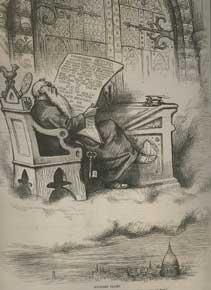
     This provocative image by the redoubtable Thomas Nast (Harper’s Weekly, 15 February 1879) shows St. Peter (with his keys to Heaven’s fortress gates dangling at his side) reading the Congressional Record’s report of Louisiana Congressman (Ezekiel John) Ellis. Ellis, a New Orleans native who served in the Confederate Army and was Congressman from 1875-1885, wrote that the Confederate soldier served in loyalty to his country and to his God. The Northern (and German-born) Nast seems to have taken exception to that, giving St. Peter the inclination to judge these soldiers for himself once their ultimate calling came.


    ·Posted by :

    ·in:

    —

  • The Coming Threat from the Air: Austria, 1935

    JF Ptak Science Books  Post 2582

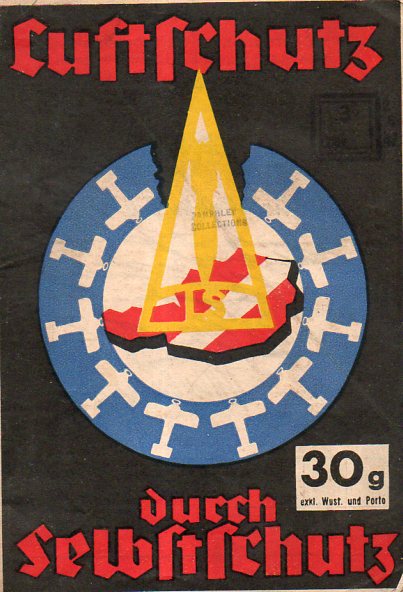
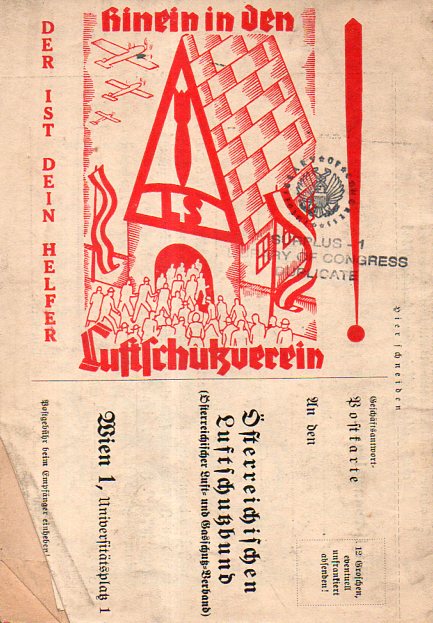
    1935 was not a particularly good year for Austria.  The country was fighting off the threat of Anschluss–the occupation of Austria by Nazi Germany–for several years, the cause hurt by the infamous assassination of the federal chancellor Englebert Dollfus in July 1934.  When this pamphlet was printed in 1935, the threat to Austria from Germany was real and advanced.  This publication, Luftschutz durch Selbstschutz (“Self Protection by Anti-Aircraft Defense” or so) addressed part of this issue. It sounds more militarily-based than it is; the story though is that the pamphlet was intended as a sort of civilian defense piece, for example, asking people to join an air defense club (“hinein in dem Luftschutverein”) for the protection of all (“Schutz fuer jedermann”) and to be general aware and prepared for the possibility of air raids.

    Austria air defenses cvr map001

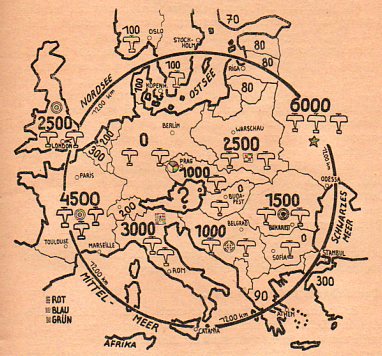
    What attracted me from the outset was the cover design which at first doesn’t actually appear to be a map, though it is–and an effective one at that.  In the middle of the circle is a red Austria with a white bar; on top of that, in yellow, is a bomb in a triangle; and surrounding Austria in a blue circle are the possible approaching/attacking/threatening air forces of its neighbors. Inside the pamphlet is another, more detailed map (below) showing the disposition of opposing air forces. It is interesting to note here that Germany is shown as having zero aircraft as dictated by the Treaty of Versailles, though it was in February of this year (1935) that the Luftwaffe was organized thus disbanding part of the treaty–at this point in 1935 the threat from Germany was not presently from the air.

    The pamphlet runs 64 pages and contains information for Austrians in preparing for aerial assault, in general: what to do when the bombs fall, how to prepare, what sort of supplies are needed to survive a sustained attack, and the like–plus ads for gas masks, survival goods, and such.  

    In the end, Germany did not bomb Austria–it disappeared as part of the Reich in March 1938 as a result of intimidation, embargo, political subterfuge, and finally the threat of war.  

    Austria air defenses cvr map003


    Austria air defenses cvr map004


    Austria air defenses cvr map002


  • A Note on Franklin Roosevelt and the Holocaust, 1942

    JF Ptak Science Books   Post 2564

    FDR Jews secret

    For all of the greatness of the man, Franklin Roosevelt for whatever reason came up decidedly short on the issue of accepting German Jewish immigrants seeking to escape Nazi Germany (in the 1930’s) and then later, during the war, having a terrible record in the response to the concentration camps (1940-1942) and (somewhat later) on the identification of the extermination centers.(1943-1945).  It is certainly a large stain on this legacy, a despondency that is confused, confusing, and highly open to debate. 

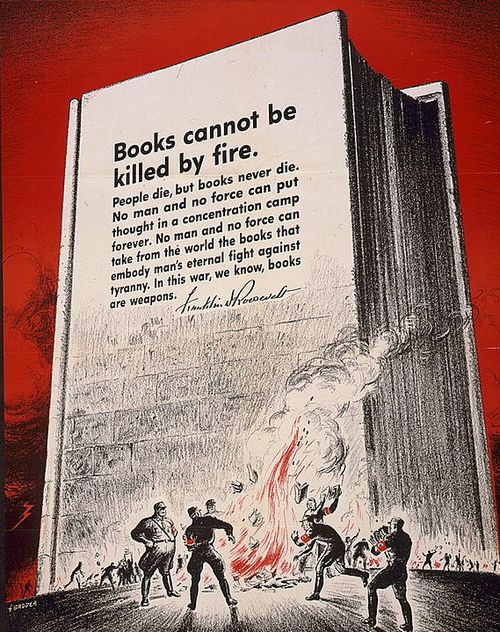
    This came to mind when I reviewed an older post on this blog on books/propaganda issued by the government printing office–in particular, the “Books are Weapons” series, which is a collection of strong images used in connection with Roosevelt’s statement about books/weapons:

    Books are weaponsWhat struck me today for the first time is FDR’s use of “concentration camp”, which is surprising to me–at least the “me” at my level of understanding FDR and the Holocaust–because when this poster was issued by the Government Printing Office in 1942 Roosevelt had spent very little public time on the issue.  And in the course of the next 24 months or so, Roosevelt had more evidence of the gigantic crimes being perpetrated by Germany but still had very little publicly to say on the matter.  1942 though seems to be early for this sort of statement–and to find it in a mass-produced vehicle like this poster was a jolt. 

    The text on the monolithic book that stand free and tall and immobile in spite of the Nazis in the foreground and their small pyre of burning books:

    • “Books cannot be killed by fire. People die, but books never die. No man and no force can put thought in a concentration camp forever. No man and no force can take from the world the books that embody man’s eternal fight against tyranny. In this war, we know, books are weapons.” –Franklin D. Roosevelt. 1942 (the date referenced from the Library of Congress page on this poster http://www.loc.gov/pictures/item/96502725/   Another post on this blog shows two other variations on this poster:  https://historyofideasblog.com/thesciencebookstore/2014/09/books-are-weapons-in-the-war-of-ideas.html)

    This is a very long story, but for right now it seems a relatively certainty that the situation of the Jews in Germany and the rest of Europe was fairly well known and established within the Roosevelt White House, and even so too to some extent in the popular press. By 1943 there was probably no doubt whatsoever with what was going on–in an example of Roosevelt’s association with the contemporary knowledge of the Holocaust the FDR Presidential Library offers the following O.S.S. document on the destruction of the German Jews:


  • Illustrating the Effect of Destructive Capacity: August, 1914

    JF Ptak Science Books  Quick Press

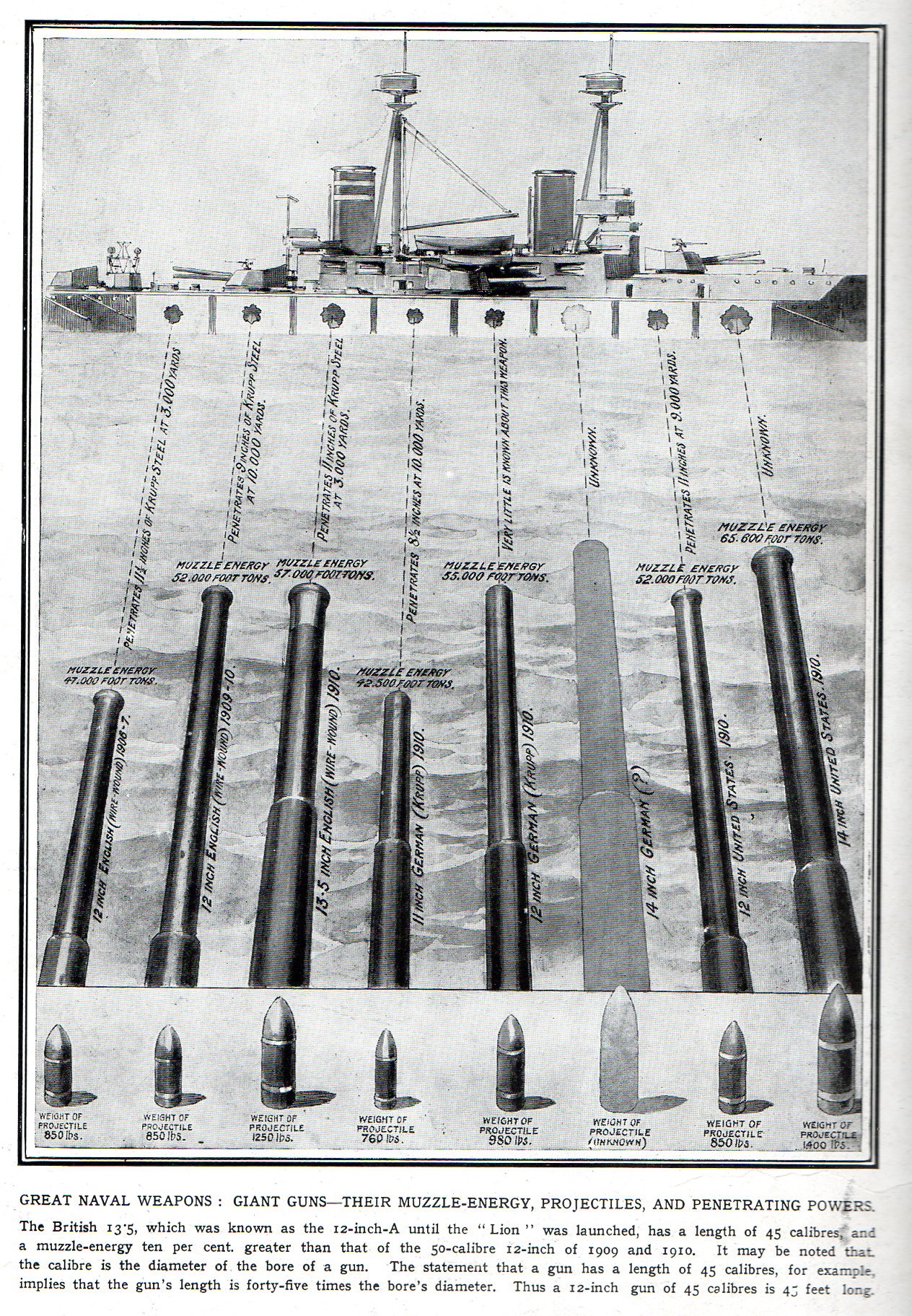
    I found this lovely infographic in the August 29, 1914 issue of The Illustrated London News, coming a little more than three weeks after the beginning of WWI.  It is one of the earliest issues almost fully dedicated to war coverage, and in its many articles covers the fall of Namur, the fight at Mons, the destruction of the HMS Amphion, and images of long lines of Belgian refugees, the fight at Haelen (and the dog-drawn heavy machine guns), and the first drawing of the BEF in action in France. The image below addresses what was seen early on as the war’s premier issue in military strength, which was seen in the power of navies, and hence the depiction of the relative “strengths” (projectile weight (760-1400 lbs), barrel length, “muzzle energy”, steel penetration) of the big shells:

    Schematics naval guns 416

    I think I’ve never seen a display quite like this one, before.

    And just for the fun of it, “caliber/calibre” from the Oxford English Dictionary:


    ·Posted by :

    ·in:

    —

  • Map of the Confederacy-Crushing Anaconda Plan, 1861

    JF Ptak Science Books   Quick Post

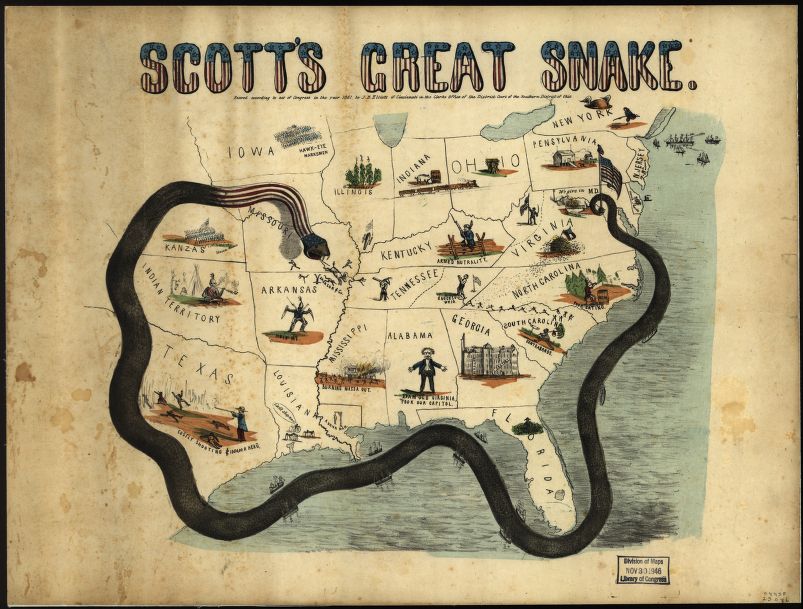
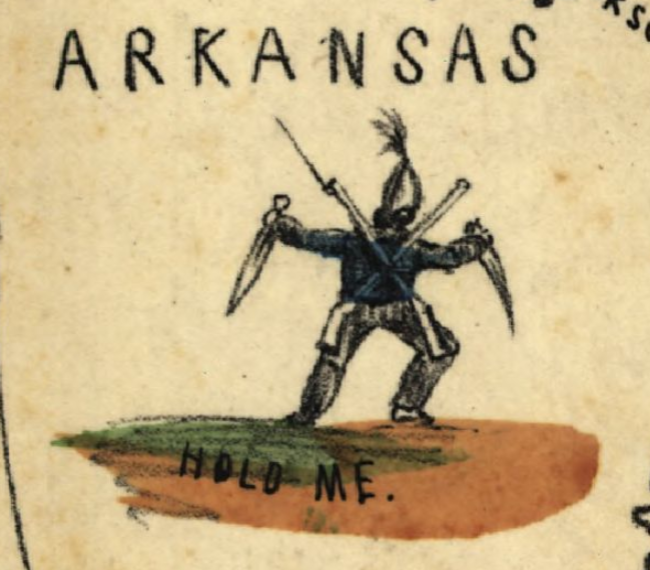
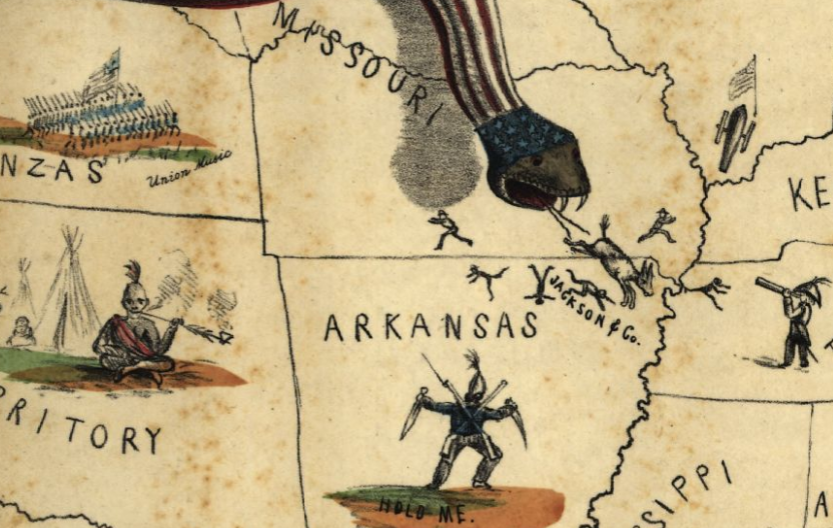
    This very graphic allegorical map was published at the beginning of the Civil War in 1861 and was intended to depict General Winfield Scott’s not-bad plan for the eventual destruction of the Confederacy. He called for isolating the Southern states by a naval blockade and by a push from the West and also an advance up the Mississippi River. The problem with the plan for most people was that Scott saw correctly that the new war was going to be long and costly–this at a time when most saw the conflict as a months-long affair. Part of the correctness of Scott’s recognition of a long war was that the Northern states had fewer than 20,000 troops, and that many more would be needed and that the army would need to be gathered, trained, and built, none of which would happen quickly. But the general faults with the plan do not diminish his important contribution that the Civil War would a total war, and that the conflict would not be over any time soon.

    • [For a good and concise article to get you started in understanding Scott’s’ plan, see B. Wolfe, “Anaconda Plan”, (2011, May 9), in Encyclopedia Virginia: http://www.EncyclopediaVirginia.org/Anaconda_Plan.]
    • (I bumped into the Anaconda Plan map on cnn.com or something like that, in a piece on 15 great maps or some such, but there was almost no backstory…)

    Maps Scotts great snake large

    [Source: the Library of Congress, http://www.loc.gov/item/99447020/]

    Maps Scotts great snake arkansas

    And:

    Maps Scotts great snake detail


  • The Coming Storm: a Map of the French “Drole de Guerre”, September, 1939

    JF Ptak Science Books   Post 2582

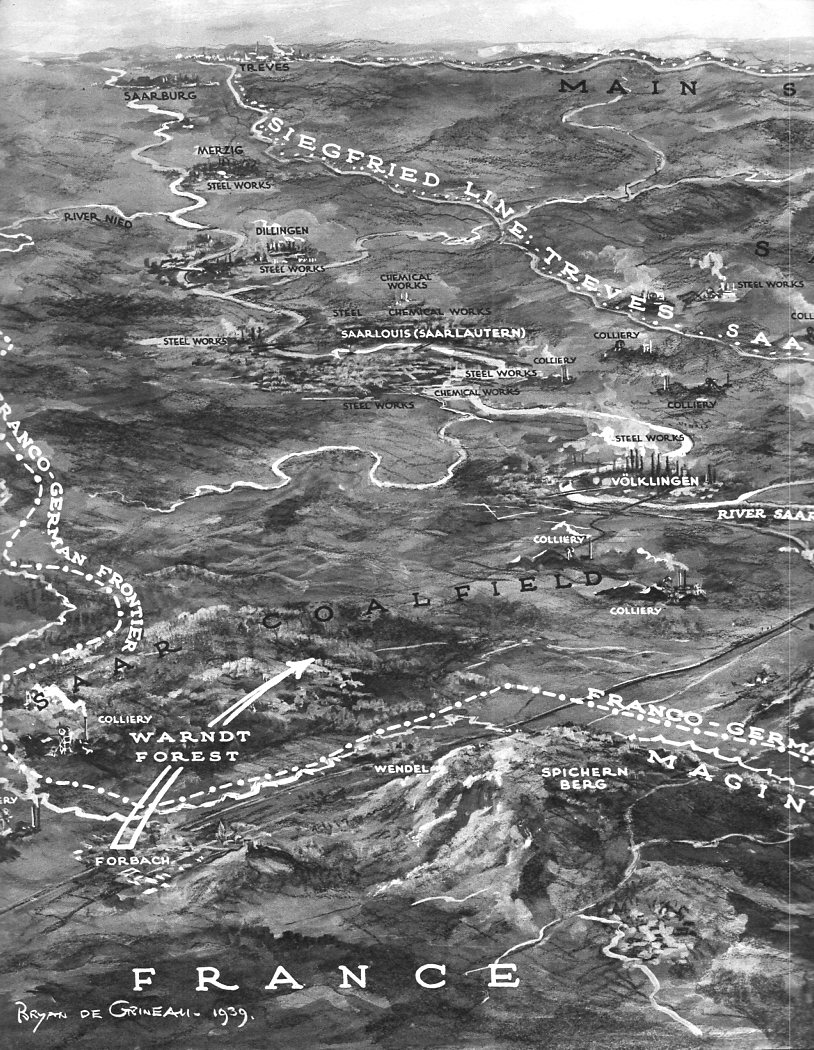
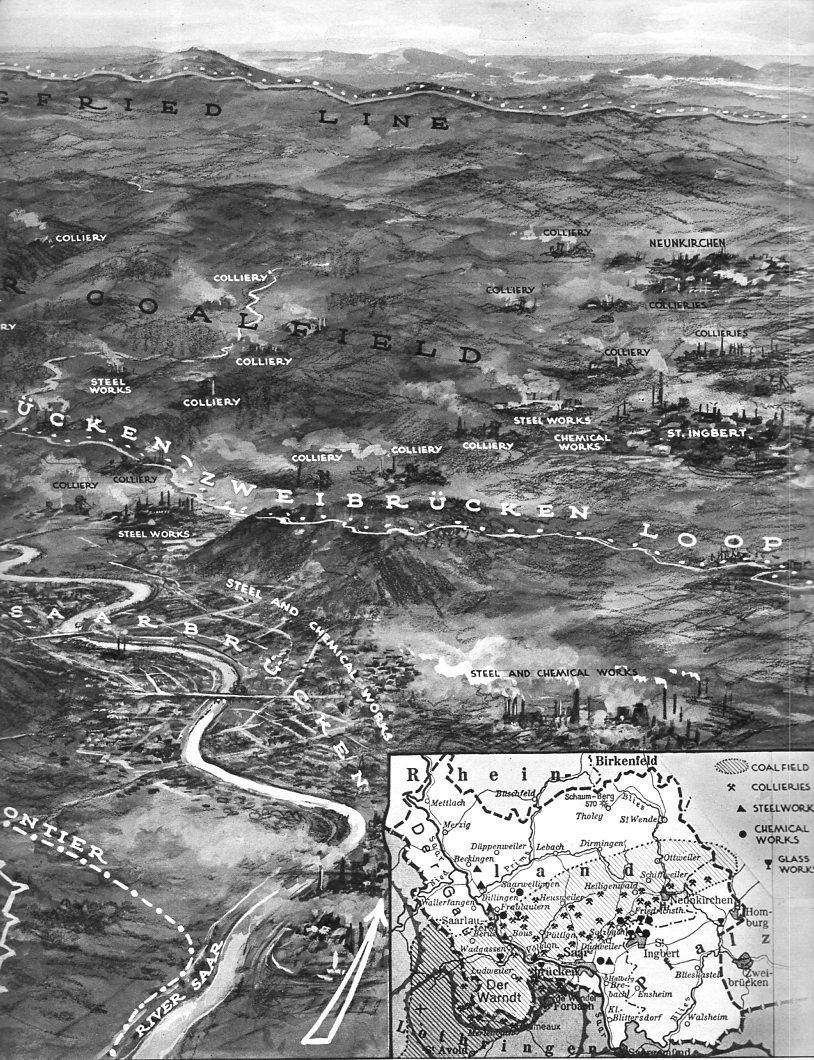
    This orderly and  semi-pastoral bird’s-eye view of the earliest part of the war in the west of WWII appeared in The Illustrated London News on September 30, 1939, three weeks or so after the Nazi attack on Poland.  The foreground shows about 40 km of the front from the river Nied to the Saar and south to Saarburgken, with the Siegfried Line in the distance.  The map shows the region into which 40 French divisions advanced from September 7-16, meeting little resistance from the outnumbered German troops who by and large fell back to more defensible positions. 

    Not much happened.

    This period of the war has often been referred to as the “Phony War” due to the lack of action, though it wouldn’t seem so “phony” if you were killed in the process, as thousands were.  Winston Churchill referred to it more as the “Twilight War”, which is far more appropriate–and this no doubt more meaningful to Churchill int he light of the HMS  aircraft carrier “Courageous” being sent to the bottom by Nazi torpedoes with the loss of more than 500 sailors…there was certainly not a bloody thing “phony” in that. 

    The French referred to this period as the “Drole de Guerre”, which they really shouldn’t’ve done–their Saar offensive of mid-September being stunted and odd, came to a halt, and the troops called back to the doomed Maginot in October. 

    The Twilight War continued until late April, and then in May, it was certainly all over, as the Nazis attacked Belgium, Luxembourg, and the Netherlands. And then of course came France.  In just about the same amount of time that the Saar Offensive occupied, the Germany advanced and forced France to surrender, the curtain coming down on June 22.   Calm before the storm, and all that–the rest of the war was more storm before the storm, until there was storm no more.


    Siegfried line _1_375 Siegfried line _2 _380


    And the text accompanying the maps:

    Siegfried line _1 text_376

    Siegfried line _2  text b_379


  • WWI Editorial Cartoons–More Editorials Than Cartoons (1918)

    JF Ptak Science Books  Post 2581

    Judge magazine (1881-1947) was a U.S. satirical weekly that for several decades published insightful/devastating political cartoons of the highest caliber. (Judge was a sort of knock-off of Puck magazine, started by writers and cartoonist/artists dissatisfied with that fine journal; Judge itself was done in in the same way after a fashion–Harold Ross, who served as editor of Judge for a few months in 1924 went off and started his own magazine, The New Yorker, which slowly and then rapidly cleaved away readership and talent from Judge until Judge was no more.)

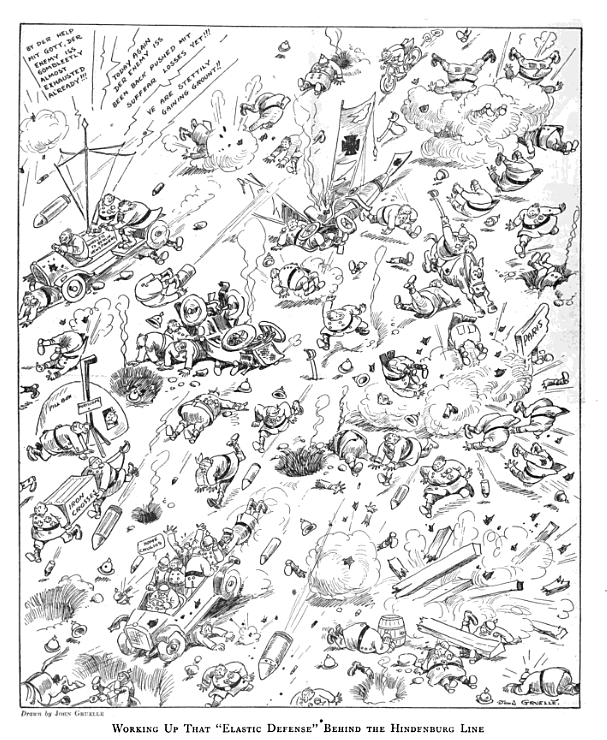
    It seems to me that when leafing through a volume for 1918 that Judge published more cartoons and sketches relating to World War I than cartoons for any war that I have seen in any magazine. I’m not that familiar with Judge relative to other magazines, and was very surprised to see that nearly every page has some sort of illustrated war content.  In the issue for October 12, 1918–just four weeks before the end of the war–I found this image:

    WWI cartoon 1918 GruelleIt is complex and at first looks to be very layered, but I think that it turns out to be not so, that it is flat, and uni-dimensional, and not very satirical–it is however very pointed, and barbed, and makes its case very quickly, in a sort of way that makes you begin to chuckle until you realize just what the content is.  The work is by artist/illustrator/designer John (Johnny) Gruelle, who in the same year introduced the world to his creation of Raggedy Ann (patenting the design a few years earlier, in 1915, https://www.google.com/patents/USD47789.)

    [The Judge was located at 225 5th Avenue, the Renaissance-style 13-story building converted into condos where the active selling price is about $2,670/sq foot1, or about 3.5 million/unit, somehow making this property worth a combined $600 million or so.]

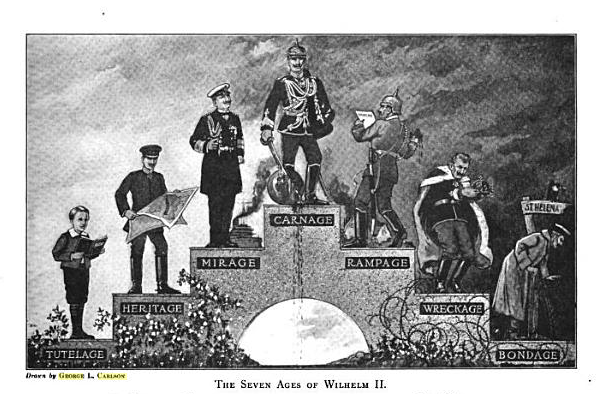
    The very next page comes this condemnation of the German leader Kaiser Wilhelm II, employing the very well worn “Ages of Man” scenario:

    WWI cartoon K Wilhelm

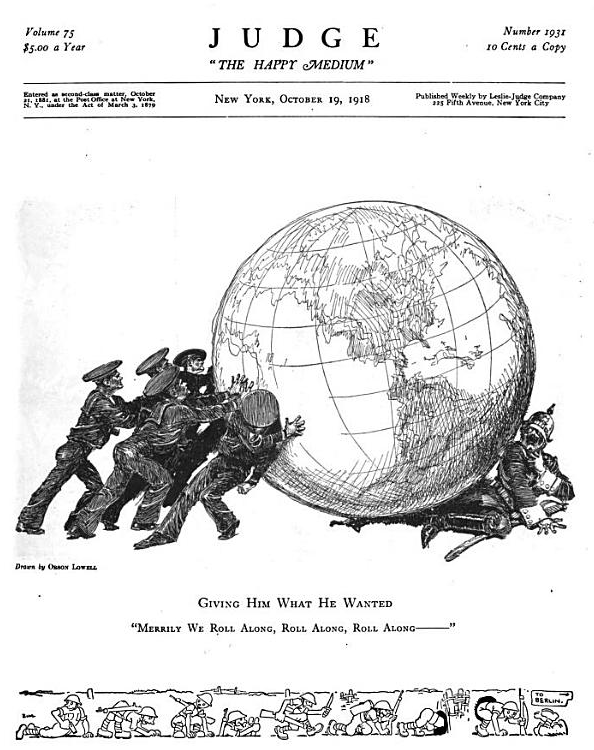
    And just a few pages later, another interesting image, this one being another entry in this blog’s collection of images of the world used in advertising/cartoons:

    WWI World Map

    There were many more war-related illustrations in these few dozen pages, with these three having the most appeal and greatest impact–pretty good stuff spread out over just two or so square yards of magazine pages.

    Notes:

    1. See http://streeteasy.com/building/the-grand-madison


  • Gears, Teeth, Minie Bullets, Cloth Bindings (1864)

    JF Ptak Science Books   Post 2575

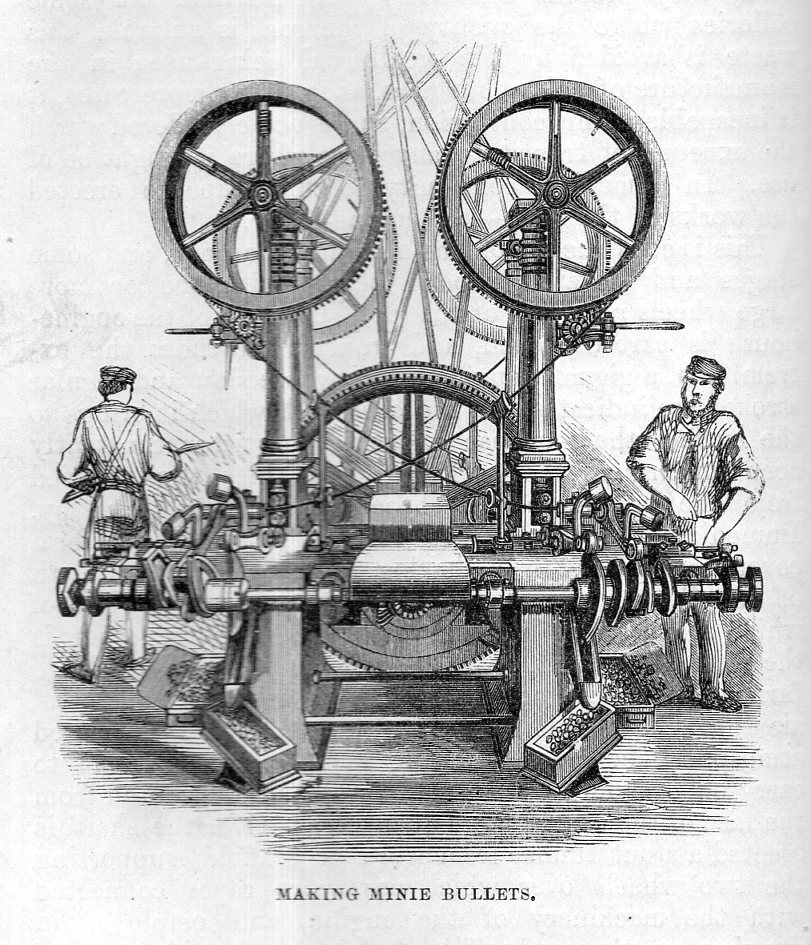
    Claude-Étienne Minié (1804-1879) was an influential military designer and French officer who designed what was to become know as the “Minie ball”. This was a cylindrically-shaped conical-pointed bullet the design of which greatly increased fire at long ranges. The bullet was designed in 1847 and soon became standard issue in Europe and (especially?) in the U.S. during the Civil War.  I’m taking notice of these projectiles after having made this very accidental discovery of the machine that formed them in the Victorian review of technology and invention, Great Inventors, the Sources of their Usefulness and the Results of their Efforts, printed in London in the rockingly good year of 1864.  It makes me think about the fabulous machinery that produces stuff like bubble gum–glorious metallic ideas for production and packaging, all combined in effort to produce a piece of fluff that you chew on and then discard.  With the Minie Ball, though, you have a massively-geared machine used to produce little bits of metal meant to pass more efficiently and with more accuracy through a body. (Also it is another representative of a genre of illustration of looking at the object straight on.)  

      Minie balls318

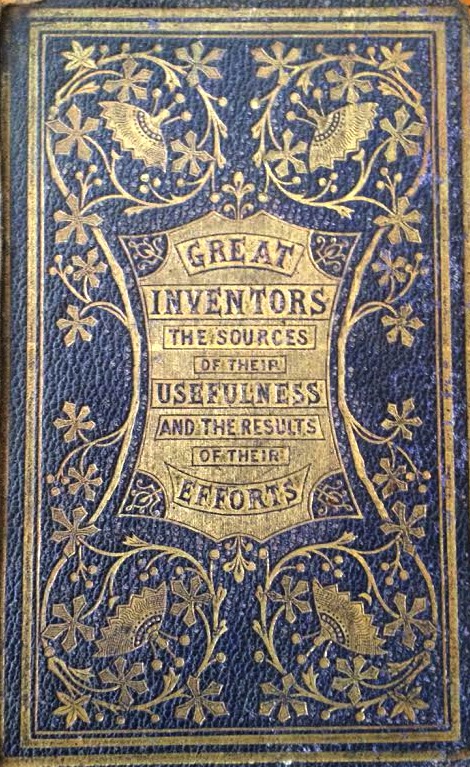
    The cover of the book is interesting in its own right, being bound in an elaborate publisher’s cloth with gilt-stamped decorations.  Books before, say, 1800, were almost entirely bound according to the wishes of the customer, who would/could purchase the sheets and have them bound according to their wishes.  That, or booksellers would offer the book for sale in a small election of available bindings.  The cloth binding that we would recognize today really didn’t start to make an appreciable appearance until the 1830s, when a simple cloth cover replaced its more-elaborate brethren, making things much easier for the publisher and the bookbinder, allowing for much less expensive production and a quicker turn-around time.  It also brought in a far greater distinction in the now-divergent industries of bookselling and publishing–and of course bookbinding.  So the entry of the semi-standard plain cloth binding also brought in the possibility for design and art in standard book production, with less to the introduction of the decorated cloth cover.  

    The cover for the book described here comes from about the second full decade of a standardized-luxury of decoration in cloth-bound books.  Over the years I’ve paid only a little attention to the decorated cloth bindings of scientific books, but never collected them, something I somewhat regret at this point. In any event, Great Inventors… is a good example of a relatively inexpensive but nicely-designed book cover.  

    Binding great inventors