A Daily History of Holes, Dots, Lines, Science, History, Math, Physics, Art, the Unintentional Absurd, Architecture, Maps, Data Visualization, Blank and Missing Things, and so on. |1.6 million words, 7500 images, 4.9 million hits| Press & appearances in The Times, Le Figaro, Mensa, The Economist, The Guardian, Discovery News, Slate, Le Monde, Sci American Blogs, Le Pont, and many other places… 5000+ total posts since 2008.

Category: Medicine, History of

  • Mapping Humans, 1400-1759: Bloodletting, Moles, Bumps and the Stars

    JF Ptak Science Books   Post 1123

    The history of mapping the goods and ills, the past and present and the future on the human body must be about as old as writing, or older.  Ever since you could draw geometric proofs in the sand people have been mapping out the connections (or lack of) the parts of the human body, their relations to one another, the influences of the stars on them, the control of dermatological deformities on the health of the system, the lump and pits and dings on the cranium as an indicator of intelligence and prospects for the future, connecting the lines of electroshock results on facial contortions with the inner musings of the criminal brain, and on and on.  What brings my attention to this though are the overall full-body indexes, the general NYC subway map-like overlays on the entire body, and what they look like out of context. 

    For my purposes here, it really is just the out of context element, the found art, the pre-Absurdist, pre-Dadaist images that they maps create.  Granted the real stuff behind these images are by far more interesting, but I wanted to add these pictures to the blog’s alternative art category before their Duchampian attraction left me. 

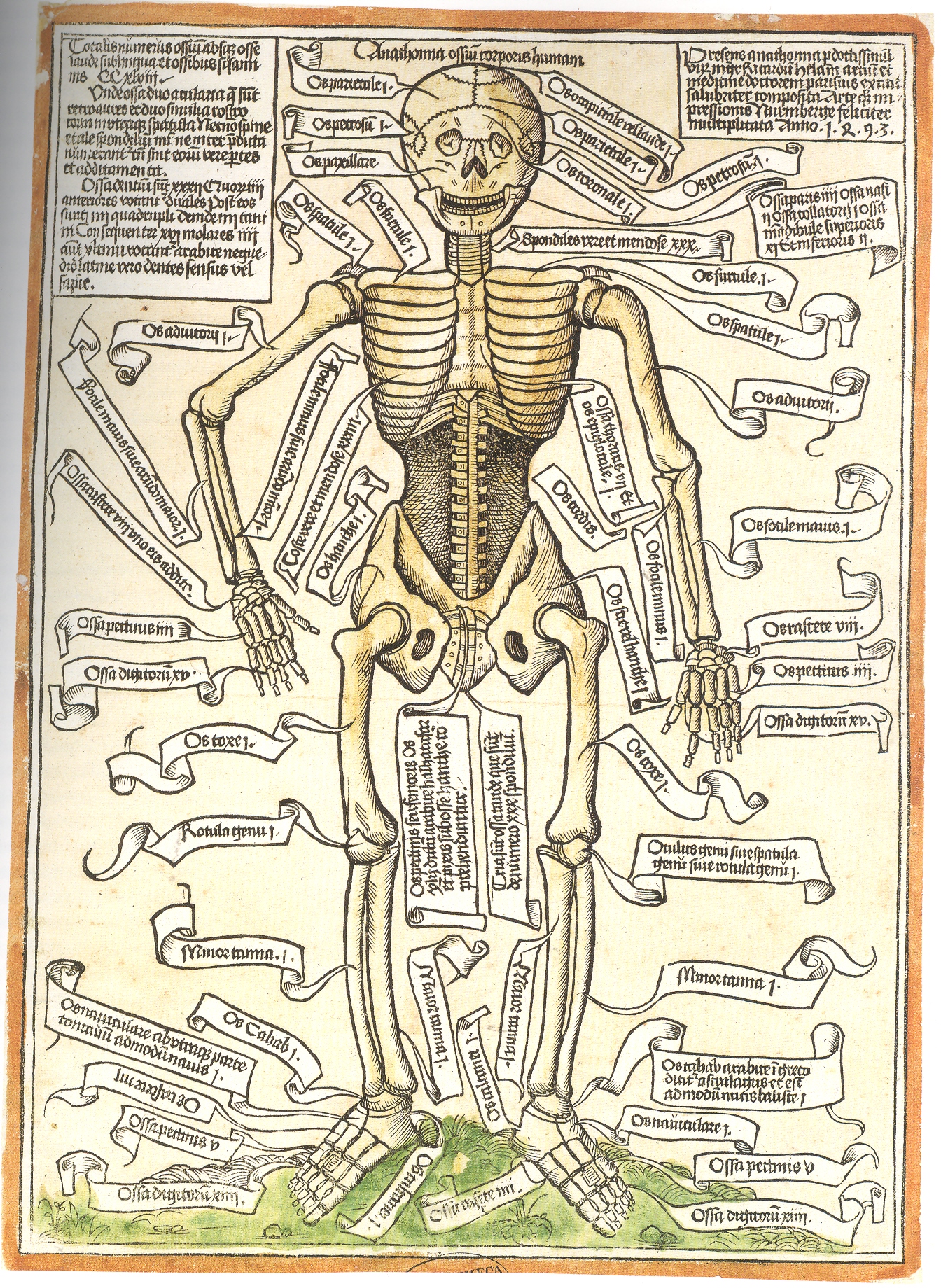
    To start with, for example, in this very breezy survey is the indexing of the very first illustration of a human skeleton. from Anathomia ossium corporis humani, printed the year after Columbus arrived in the Americas–this was the first revelation to the real world of science following a sleepytime of about 8oo years under the very heavy gaze of institutional religions. 
    Blog--may 5 skeleton

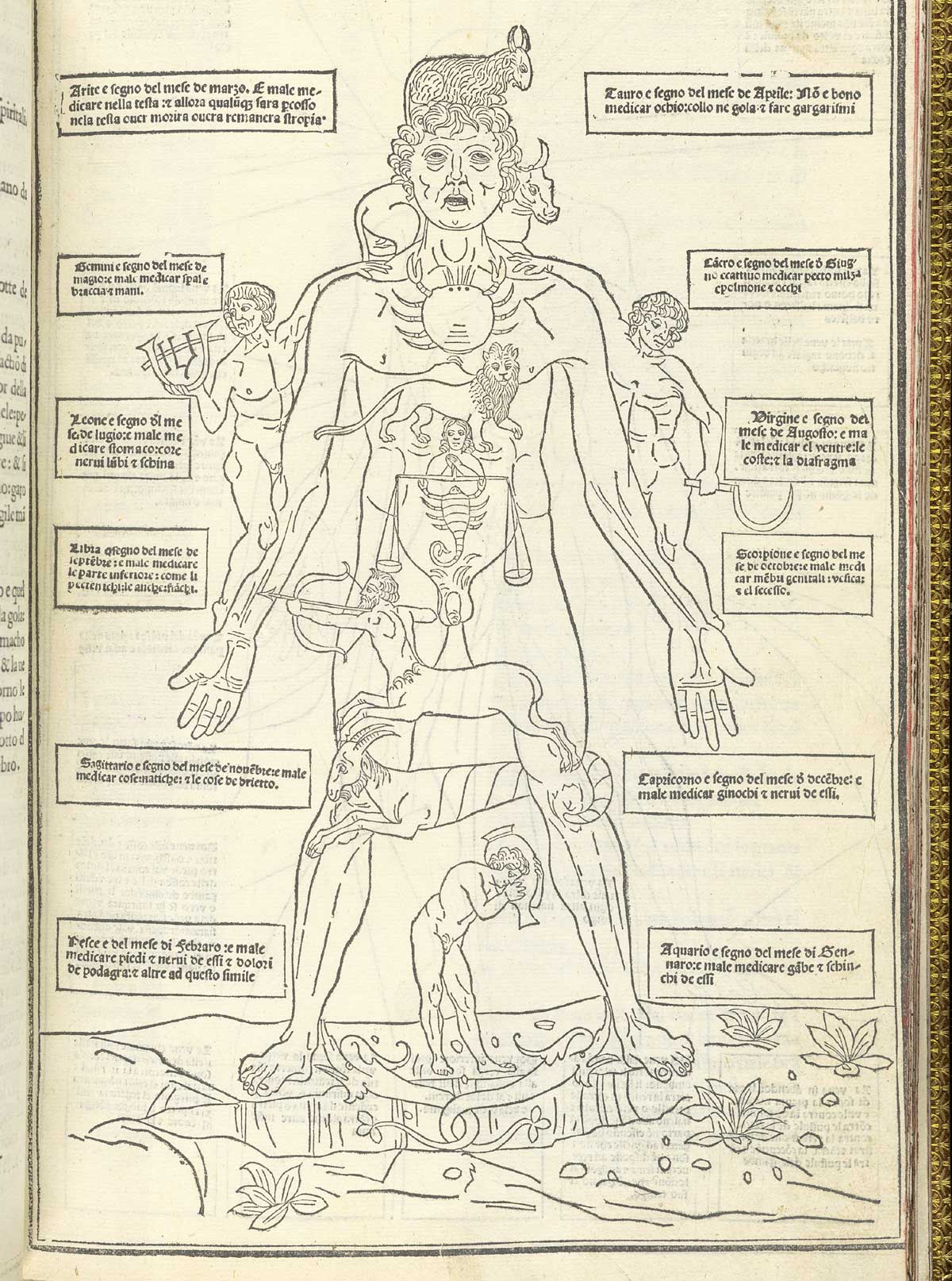
    Human map ketham_p15 In the same year that Columbus set sail for India came the anatomical publication of John de Ketham, with his overall map of astrological influences on the body, followed by a pretty-useful treatise on the treatment of war wounds, as well as the decidedly less-useful map of his locations for the best place to bleed a person of their bad humours. 

    Well, it really wasn’t like that, not how I mean by by snippy modernist viewpoint looking back on medical history with no contextual appreciation.  Bloodletting was an approach to healthfulness, as blood was seen as one of the four major elements (or “humours”) of the human body that needed to be kept in balance.  This was
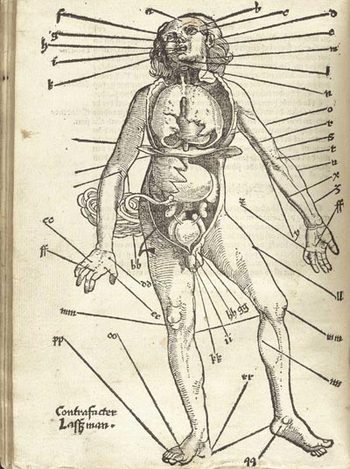
    Gersdorffx400jpg_other_2accomplished via the application of leeches or by the more common (and quicker) practice of venesection, or opening a vein to allow the blood to come out. (Let’s reference Steve Reich’s magnificent “Bruise Blood” creation of 1966 at this point—I don’t think that I’ll ever have a better chance to drop a reference to this piece of revolutionary music in regards to venesection again.)  Thus this map was map for the practiconers of bloodletting—the physicians, and more probably the barbers and other assistants who would inherit this lesser procedure from the more-busy doctors.  In the history of maps of anatomy and the general practice of mapping the human condition, this woodcut x-ray of the best places to drain human blood would not survive close to the age of modernity, disappearing almost entirely by the 18th century, and becoming much more scarce well before that.

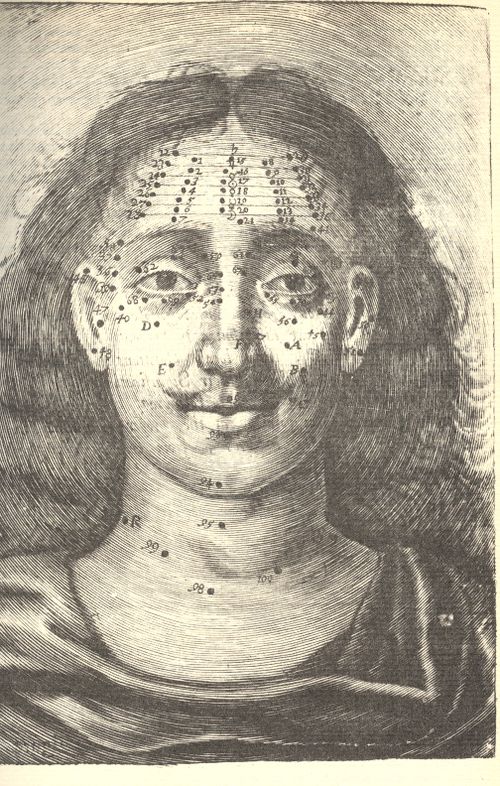
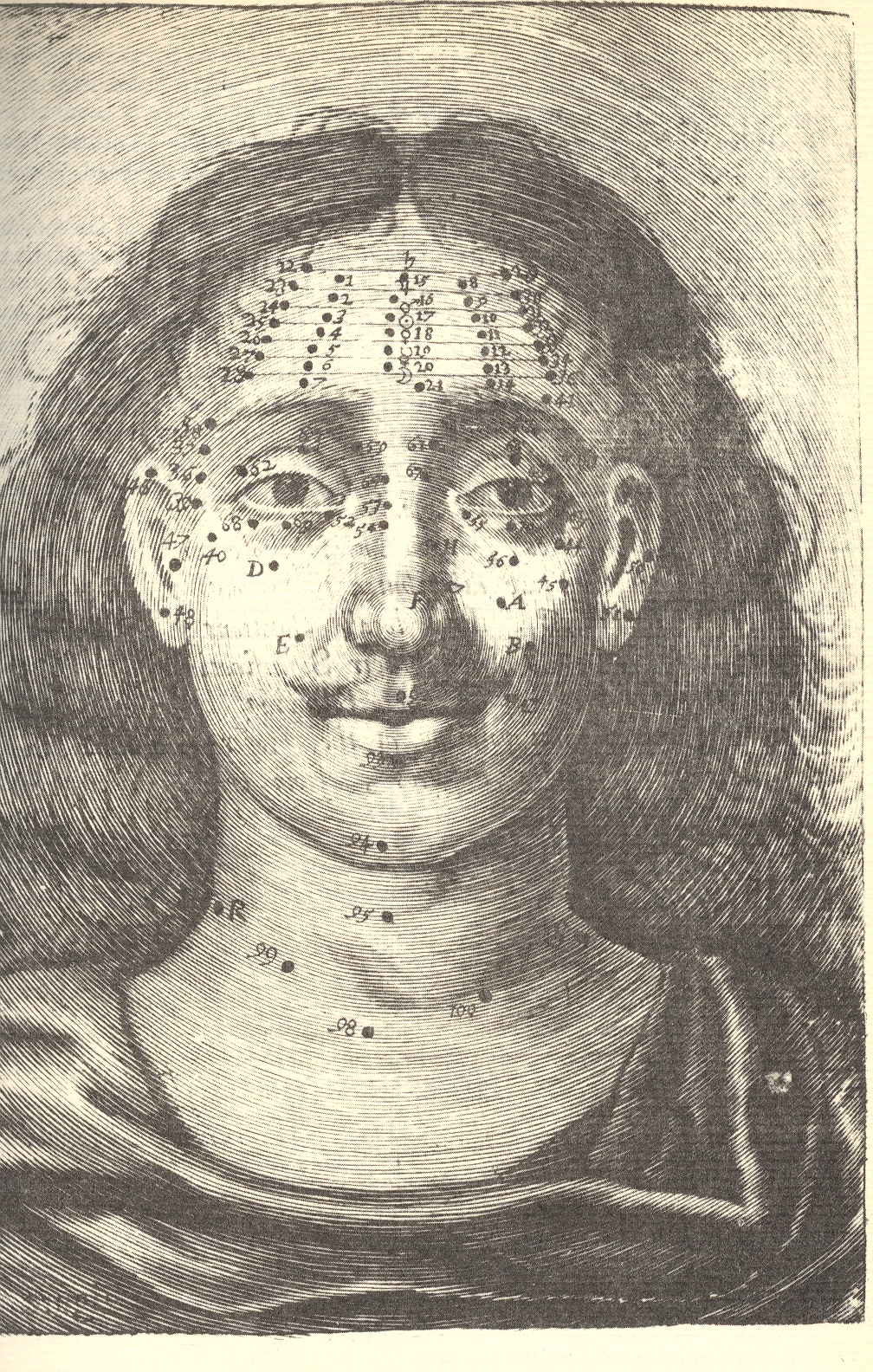
    Moving on to Richard Saunders (who I wrote about more fully here)continued a very ancient tradition into England, deep into modernity, by mapping the divine cosmos of moles and other facial extras for the purposes of health and prophecy:
    Blog--jun 11 circ mole


    Richard Saunders.  Physiognomie and Chiromancie, Metroscopie, the Symmetrical Proportions and Signal Moles of the Body, Fully and Accurately Explained; With Their Natural Predictive Significations Both to Men and Women (published in London, 1671, by Nathaniel Brook).in which he divines the psyche and the future with peoples’ moles. 

    [graphic]

    Visceral Anatomy From Reisch’s “margarita Philosophica,” Johann Schott, 1503
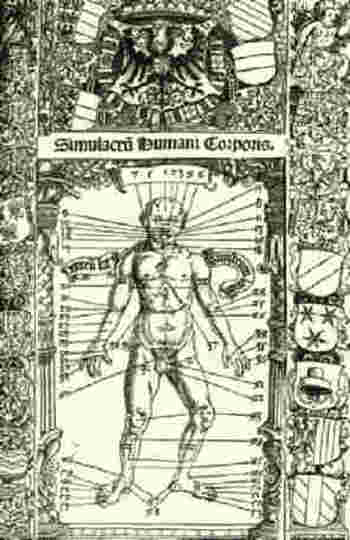
    Blogbloodletting_stoefflerI couldn’t let the above-mentioned  bloodletting image pass without reference to this excellent woodcut for Johann Stoeffler’s  Calendarium Romanum Magnum, printed in Oppenheym by the redoubtable  Jacob Koebel, (24 March) 1518.  It is a glorious display (entitled Simulcarum humani corporis) of seasonal (!) purgative and bloodletting locations on the body, meant to accompany a longish essay by Stoeffler on the practice in general.  The bulk of the book, however, had very little to do with this practice and was actually commissioned as a reform to the Julian calendar, provided with the impetus of the Lateran Council (1512-1517).  The result was a series of forty-one  propositions on the calendar and calendar-related practices, including work on eclipses, the zodiac, the occurrence of leap years, the Alexandrine and Roman calendars, the calculation of the occurrence of Easter, and so on, including the seasonal practices of bloodletting.

    I enjoyed this torso map by Salomon Alberti  in his Historia plerarumque partium humani corporis, in usum tyronum edita. Vitebergae (p1583, 8°; ibid., 1585, 8°; enlarged, ibid., 1601, 8°;(published from 1583 to 1630) for it simplicity.

    The rest of the images I’m going to have to show here as a simple Image Dump, at least for the time being:
  • History of Dots #28: Cellular, Topical and Astronomical (1512-1888)

    JF Ptak Science Books  Post 1074


    Dots--koch175 This is  the 28th installment in the history of dots series, looking at dots big and small, existent and non-existent, cute and level, individuals and groups.  This selection looks at some dots on the micro/cellular level, the tactile visible level and the astronomical level. 

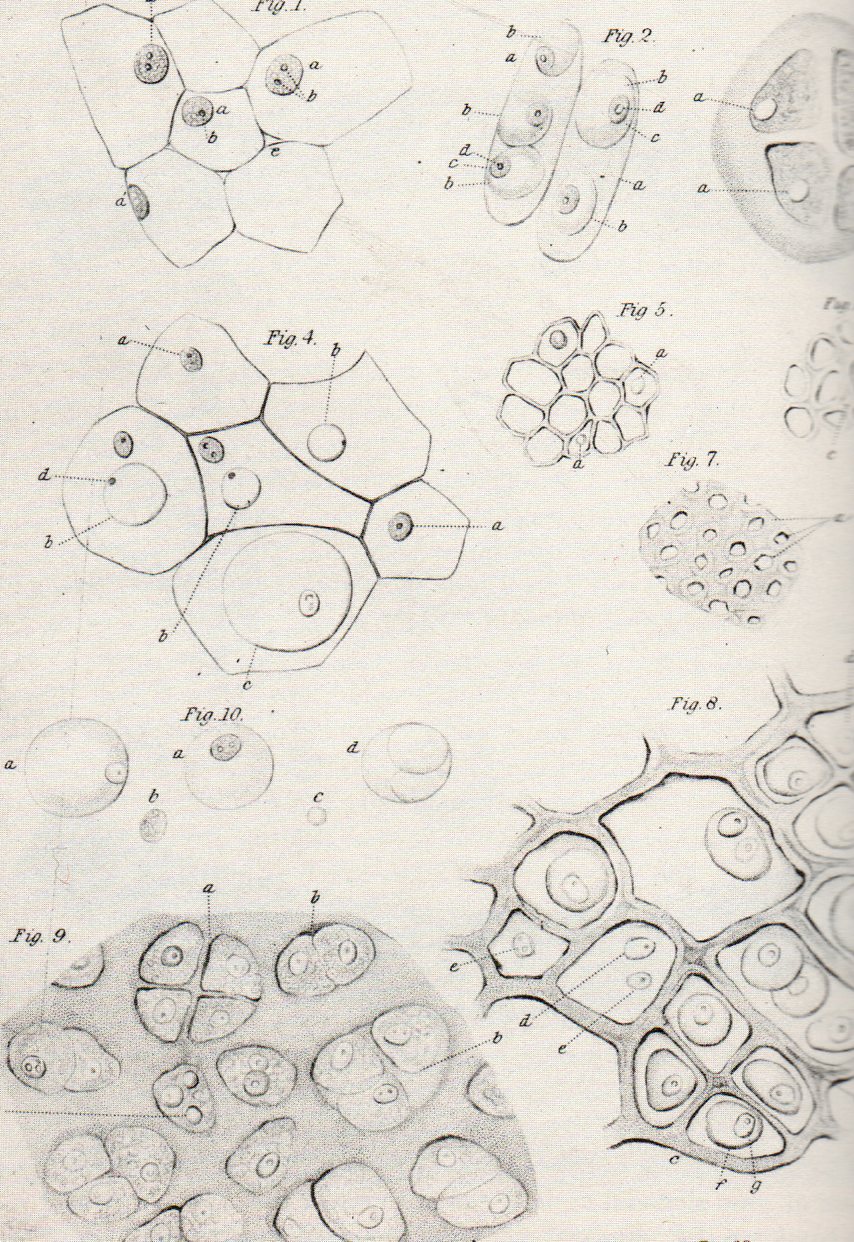
    Theodor Schwann (1810-1882) entered his contribution to the history of dots with his Mikroskopische Untersuchungen ueber die Uebereisnstimmung in der Struktur und dem Wachstum der Thiere und Pflanzen1 published in 1839, the same year as the announcement of the invention of photography by Daguerre.  Schwann–a young experimenter and theorist and former pupil of the great physiologist Joahannes Peter Mueller– generalized Matthias Schleiden’s general and evolutionary-necessary idea of cell-formation2 and developed it into an overall theory for the basis of life. 

    Dots--schleiden178

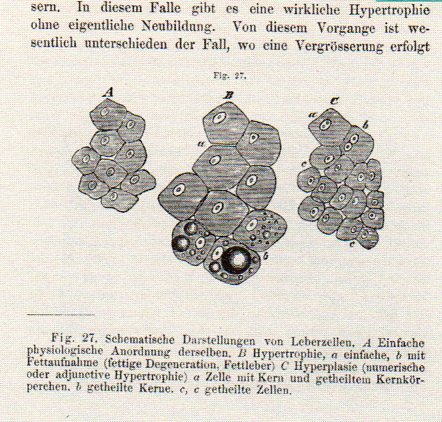
    Rudolf Virchow (1821-1902) looked at cellular dots and determined (with enormous interest) that they were very significantly altered with the introduction of disease.  These images from his Die Cellularpathologie (published in 1858)–a major work which basically founded the field of cellular pathology and introduced a rigorous new approach to scientific medicine–show the differences between normal and abnormal liver cells after having been subjected to disease. 

    Dots--kelendar176

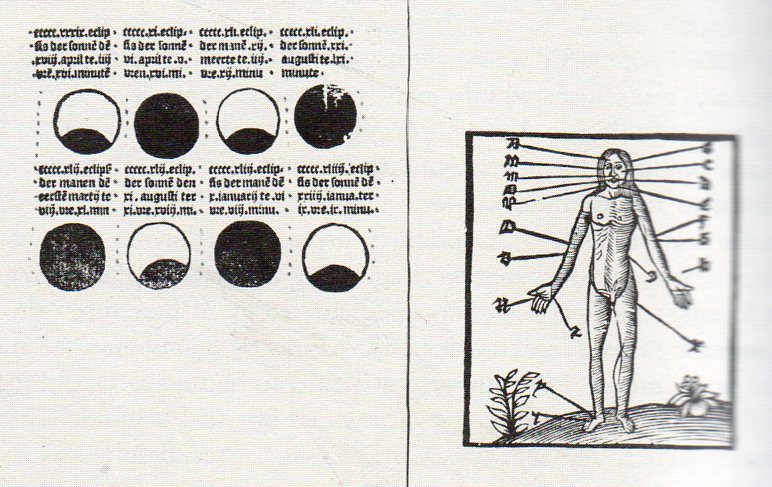
    A less-necessary but much larger dot that filled in the spaces of medical service to humanity is found in Der scaepherder Kalengier (“The Shepherd’s Calendar”), a beautifully-designed book printed in 1512.  The book was an encyclopedic compendium of contemporary medicine, but it also contained s little less than that, having a section of zodiacal dots and semi-dots in relations to principal points on the body that could be used for bloodletting. 
    Dots--jenner177
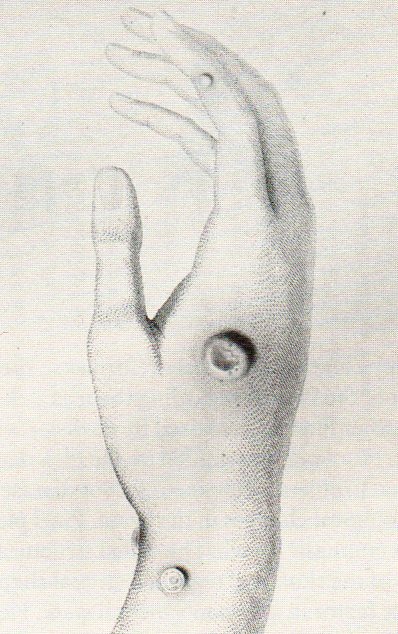
    Between the images of the sun/moon and the cell fit the dots of cowpox blisters on the hand and fingers of Sarah Nelmes, famously and inspirationally observed and understood by the Edward Jenner (1749-1823)3.  He extracted fluid from the blistered hand of Sarah the milkmaid and injected them into a very young “assistant” named James Phipps–essentially it was human experimentation carried out by a country doctor far removed from the culture of London, but who had a brilliant idea.  He continued extracting the injecting the pus from the blister until it came one day that Jenner tried the efficacy of his anti-small-pox innoculations with the real thing, exposing the boy to the dreaded disease.  Phipps did get sick but recovered in a few days4, documenting the revolutionary idea of Jenner and taking a great step forward in the treatment of disease. (It took years, by the way, for Jenner’s discovery to be recognized by the medical elite, whose opinion of Jenner was low given his simple medical life as a country doctor.)

    Notes

    1.  An English edition was published in London in 1847 under the title Microscopical Researches into the Accordance in the Structure and Growth of Animals and Plants
    2. For example, a plant is a community of cells and the cell is the essential unit of the individual plant.

    3. Famously reported in his 1798 publication An inquiry into the causes and effects of the Variolae Vaccinae, a disease discovered in some of the western counties of England, particularly Gloucestershire, and known by the name of the cow-pox.
    4. Described by Jenner so: “On the seventh day he complained of uneasiness in the axilla, and on the ninth he became a little chilly, lost his appetite, and had a slight head-ache…..” but on the 10th day he was perfectly well….    In order to ascertain whether the boy, after feeling so slight an affection of the system from Cow-pox virus, was secure from the contagion of the Small-pox, he was inoculated the 1st of July following with variolous matter (Small-pox matter, ed.) immediately taken from a pustule……No disease followed…. Several months afterwards, he was again inoculated with variolous matter, but no sensible effect was produced on the constitution.”


  • The Medical History of Curing Cancer with Limburger Cheese, Glycerin and Alcohol.

    JF Ptak Science Books    Post 1064

    “The bees were made of sugar and honey, and so made them sting so sweet…” Billy “Craggy” Muffle singing on the French Broad River , 1935.

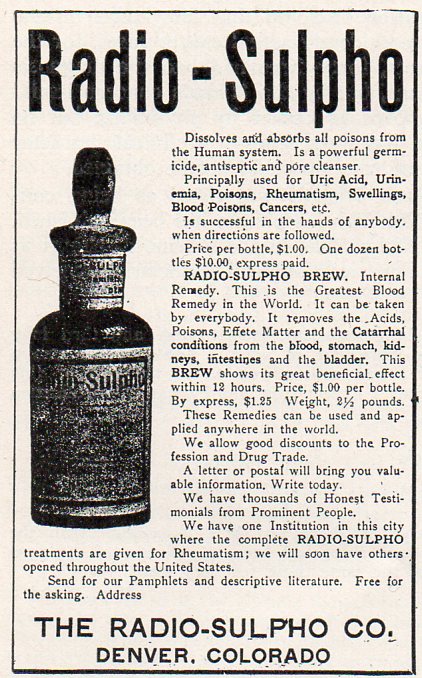
    Punched into the New York Times for 24 October 1909 was this weird Sunday filler on page 11:  “LIMBURGER AS CANCER CURE.; Denver Chemist Says That Cheese May Conquer Leprosy, Too.”  It was a true story, the quackery produced by the Radio-Sulpho Company by Philip Schush, Jr., a man who preyed on sick people and who is now dead and probably in some Hell.  Schush couldn’t leave well enough alone, claiming that his valueless concoction could smite leprosy as well–evidently his range wasn’t wide enough and needed something more, something extra, to fatten his pillow for his fetid night’s sleep.  Somehow Schush chose leprosy.

    Quackery--radio155 The article comes from a time when the American Medical Association was working in a new alliance with the Food and Drug Administration and the U.S. Post Office to identify worthless and fraudulent products like this and to protect consumers from vulture companies like Schush’s.  This was a new practice with Federal teeth for enforcement, and the amount of quackery it exposed in the medical field was staggering—which I guess is the case when you shine a bright light on anything for the first time, like discovering teeming cold  life at the bottom of the sea. 

    The temerity of so many of these products was astonishing—it seems that absolutely anything could be said, and fortunes would be made, the little-regulated market of medical cures had an enormous population of the sick and frightened to pull form, people who would supply their own truths and beliefs where there was none.

    The Radio-Sulpho Company is a prime example:  Schush claimed that cancer was caused by germs in vaccines, and that by applying a Limburger cheese poultice to the affected area and drinking his concoctions (“the greatest internal remedy in the world”, which were mainly sulphuretted hydrogen and water) every twelve hours, the cancer would be cured. For a steep $25 a month (“and upwards”) the Radio-Sulpho Company would take care of business, “cancer of the womb and breast (were) the is simplest, easiest and quickest cures made”.  Schush Jr. would also come out to treat you personally with his nostrums for $100 a day—but would visit “the white race only”. He died under mysterious circumstances in 1911—some say murder and some say a heart attack (though a heart attack caused by a bullet would’ve been more in line with what the man deserved).

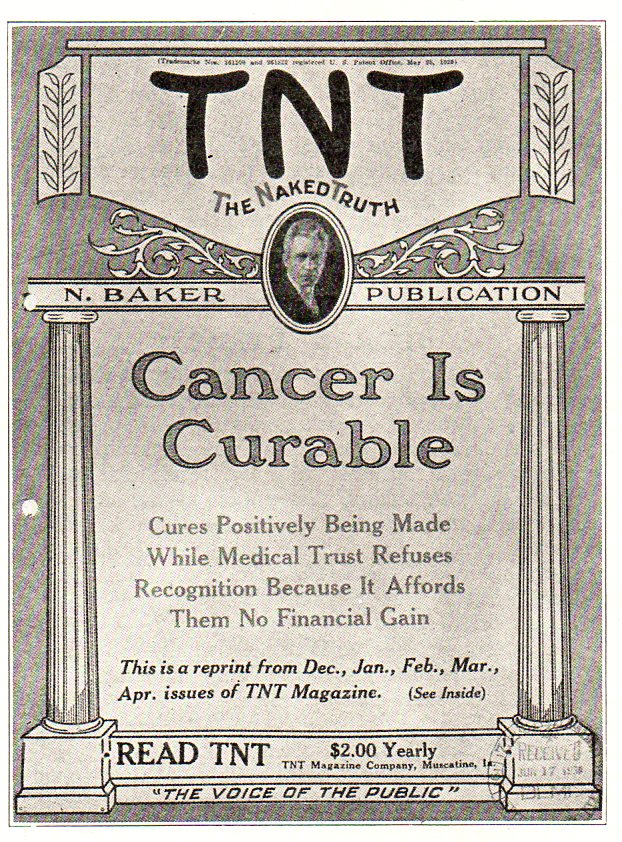
    Another example of extruded quackery is the continuing downward spiral of Muscatine, Iowa’s Norman Baker, whose long line of fraudulent products attracted the attention of The AMA early on, and whose exploits lead to longer and harsher judgment under the law. He treated cancer sufferers in his own hospital at a cost of $1000 (in the 19-teens), treating “external” cancers with a cure of arsenic powders (which had been stolen from another quack, Harry M. Hossey) and internal cancers with glycerine..  He abetted his “cancer is conquered” claims with his magazine TNT (The Naked Truth) and his radio station, KTNT. 
    Quackery--tnt157

    There were hundreds of others:  S.R. Chamlee (Chamley) promised a unique and infallible cure of cancer that amounted to 90% water, “benefited” with strychnine and saccharine.  G.M. Curry (Lebanon, Ohio) claims to have discovered the germ of cancer (ca. 1910) which was cured with his elixir of water, sugar and opium.
    Other cancer cures used plaster applications (at the Gast Sanatorium, Columbus, Ohio); sugar water (“B.H. Green’s Wild Woods Cancer Preparation and Female Tonic”, Bessemer, Alabama); “radium oil” (James Harris, Tulsa, Oklahoma);chiropractic (David Hestand, Sherman, Texas; “liquid laboratory products” (a mixture of water an d zinc chloride (Indianapolis Cancer Hospital); “cancerine tablets” (95% sugar and 4%’inorganic material’, Johnson Remedy Company); “blood Purifier (20% alcohol, 25% sugar, plus glycerine and licorice, the Johnson Remedy Company).  Koch’s Synthetic Anti-toxin (Detroit), William F. Koch) involved “secret remedies” for a starting point of $200 which according to the AMA “was a gruesome spectacle causing a large number of deaths”, the Journal of the A.M.A.); the Lamotte Caner Institute in the U.P. didn’t actually cause people’s deaths but led them to their ultimate cancer-y demise by treaty their illness with bark; L.T. Leach’s “Healing Oils” were widely used at one point by tens of thousands of cancer victims, the remedy containing nothing but cottonwood oil; the “Drs. Mixer”, a cancer cure business run in Hastings, Michigan by C.W. Mixer and other assorted non-medical relatives, sold various products containing mostly alcohol and glycerine, plus “Cancer Paste”, which was nothing but petroleum jelly,  “Cancer Salve”, which was made of Vaseline and lanolin, plus powdered opium, and an anti-cancer soap, “Cleanoine Soap Powder”, which was made of borax and animal thyroid.

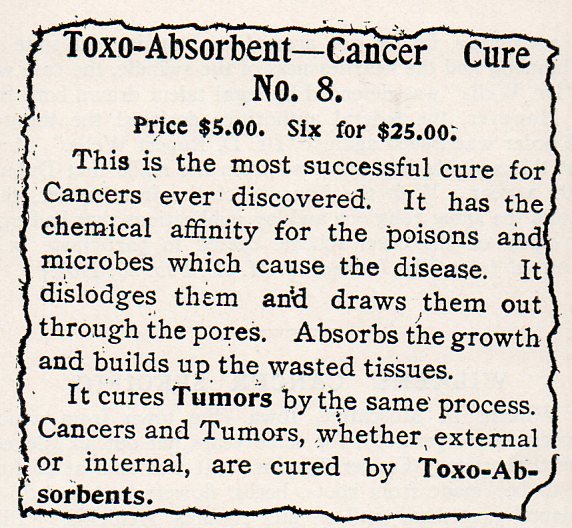
    Quackery--toxic156 These cures range wide and deep, a huge trough of wasted hope—its just tough to see the end of the list. 
    But one last one:  the Toxo-Absorbant Company of Rochester, N.Y., run by Frederick Welles Warner, who claimed an assortment of cancer cures whose “chemical affinities…draws (cancer) out through the pores” of the skin. For $10 (in 1910 money, which was considerable) he would send one treatment which consisted of (1) a  “Toxo-Absorbant Pack”, being a cloth that was to be placed on the affected area (containing a powdery mixture of nothing but clay, pulverized earth and charcoal), “Cancer and Tumor Tablets” (made of milk sugar) and “Cancer Ointment” , which was a topical made of Vaseline and oil of tar. 

    When finally restrained by the A.M.A. and prohibited from selling his stuff through the mail by the U.S. Post Office, Warner’s  defense for his worthless products was not that they were actually curing cancer and that he was being defamed, but that the laws restricting their sale did not pertain to him because he was selling his products before the laws existed.  This was a surprisingly common approach to legal defense in many cases that I have read, and of course did not hold—otherwise, for example, cigarette manufacturers would have been immune from any sort of regulation. The history of medicine is plagued with this sort of deception, but perhaps the period 1880-1930 was the highest stage of this kind of fraudulent-medicine capitalism, if for no other reason than the newly-established and semi-monied working classes could actually afford to buy the stuff.  

    I’m not sure what sort of weight will be brought to bear on our own medical practices a hundred years from now–copper bracelets, shoe magnets (for example) and other obvious modern quack stuff will certainly make it to the condemned list, but I also wonder about stuff like cosmetic plastic surgery.  And then of course there’s Dr. Freud….

    ·Posted by :

    ·in:

    —

  • Selling & Curing Sexual Ennui & Fixing the Fainting Woman, 1920

    JF Ptak Science Books   Post 1025

    There’s seems little more appealing to the false-chaste medical interests of 1920 England than helping fainting women, all to the betterment of social relations, clean houses and vibrant sexual partners.  The heritage of patriarchal piety’s rejection of sensual pleasure that was so common in England and Europe for many hundreds of years filed its way deeply into the 20th century.  Suspension of sexual discussion and understanding aside, it was well understood that women’s sexual nature was completely repressed unless in response to the pleasure of men.  It was a story of submission and subjugation, with all responsibilities for failed masculine sexuality falling to the shoulders of women (as clearly stated in the still-popular Stall’s marriage manual, a 19th century piece of rusty thinking still serving as the standard bearer in the early 20th century).  The manual is a codex of denial, submission, ignorance, boredom, tiredness, exasperation and triviality so far as sexuality is concerned for women–there is no hint of pride, or of enjoyment.  


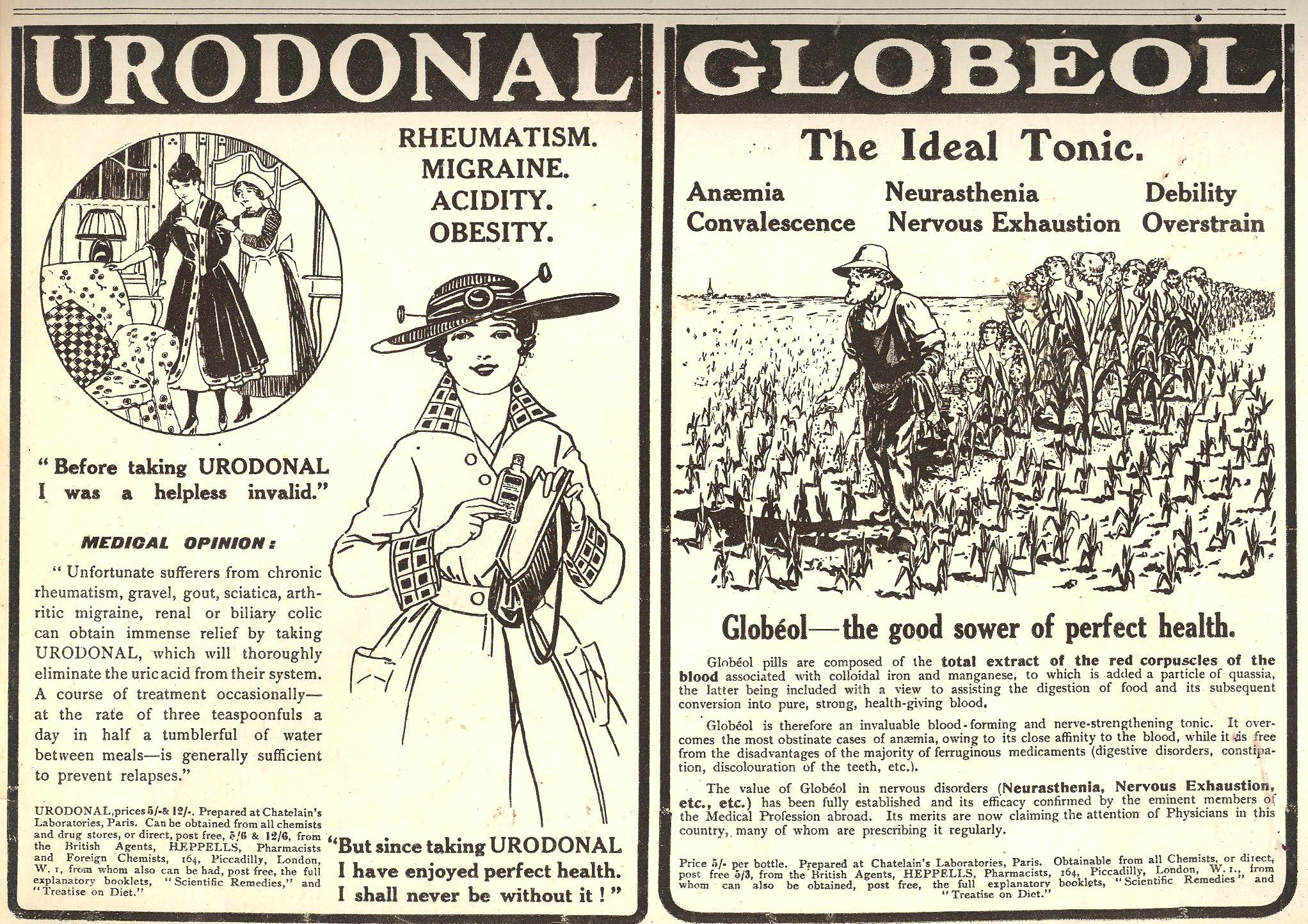
    1--may 11 globonol urodonol

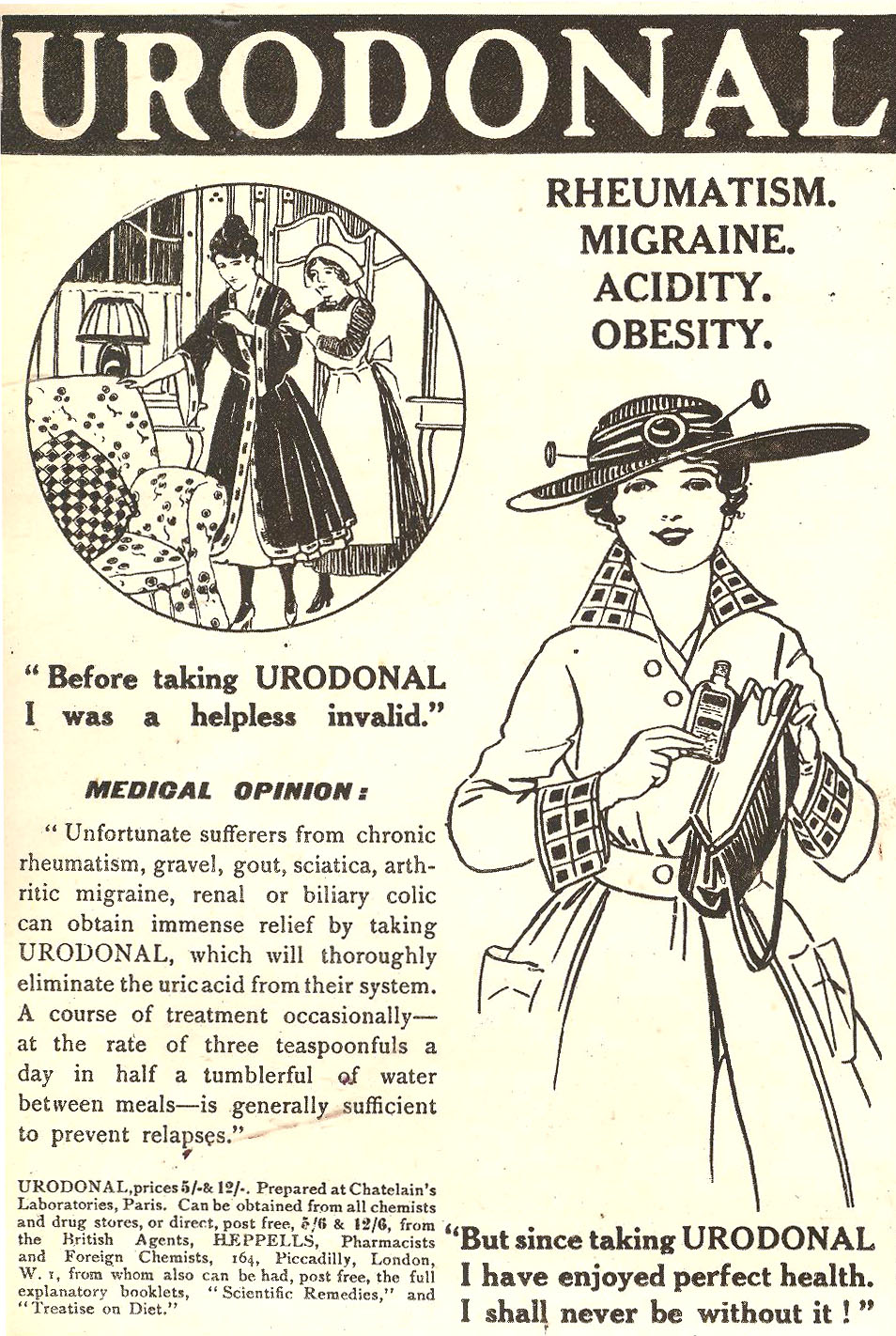
    Urodonol was a product in long use in Europe and England, a quack medicinal of little harm that plagued the hopes of people with aliments elusive to medical detection, especially that of the greatly secret ennui and fatigue in response to sexual relations.  It claims to have cured rheumatism, migraine, acidity, gravel, gout, sciatica, arthritis, biliary colic and of course obesity, all taken care of with teaspoons and thimbles.   The most that it did perhaps was to not cause any of these aliments. But it did paint a picture of the failing, fainting woman being restored to stature so common to the pages of advertisement in The Illustrated London News (this issue for 5 June 1920).  Pre-Urodonol the lady is being assisted by the nurse to the well-pillowed fainting coach–“ahh” she says, her arms outstretched looking for balance, faking a tottering in her high heeled shoes.  The coach was a step away. 
    Urodonal was the cure, as we see Her refreshed and elegant in new hair and hat, rushing to get home to the man who now needn’t worry about not being cared for.

    1--may 11 urodonol

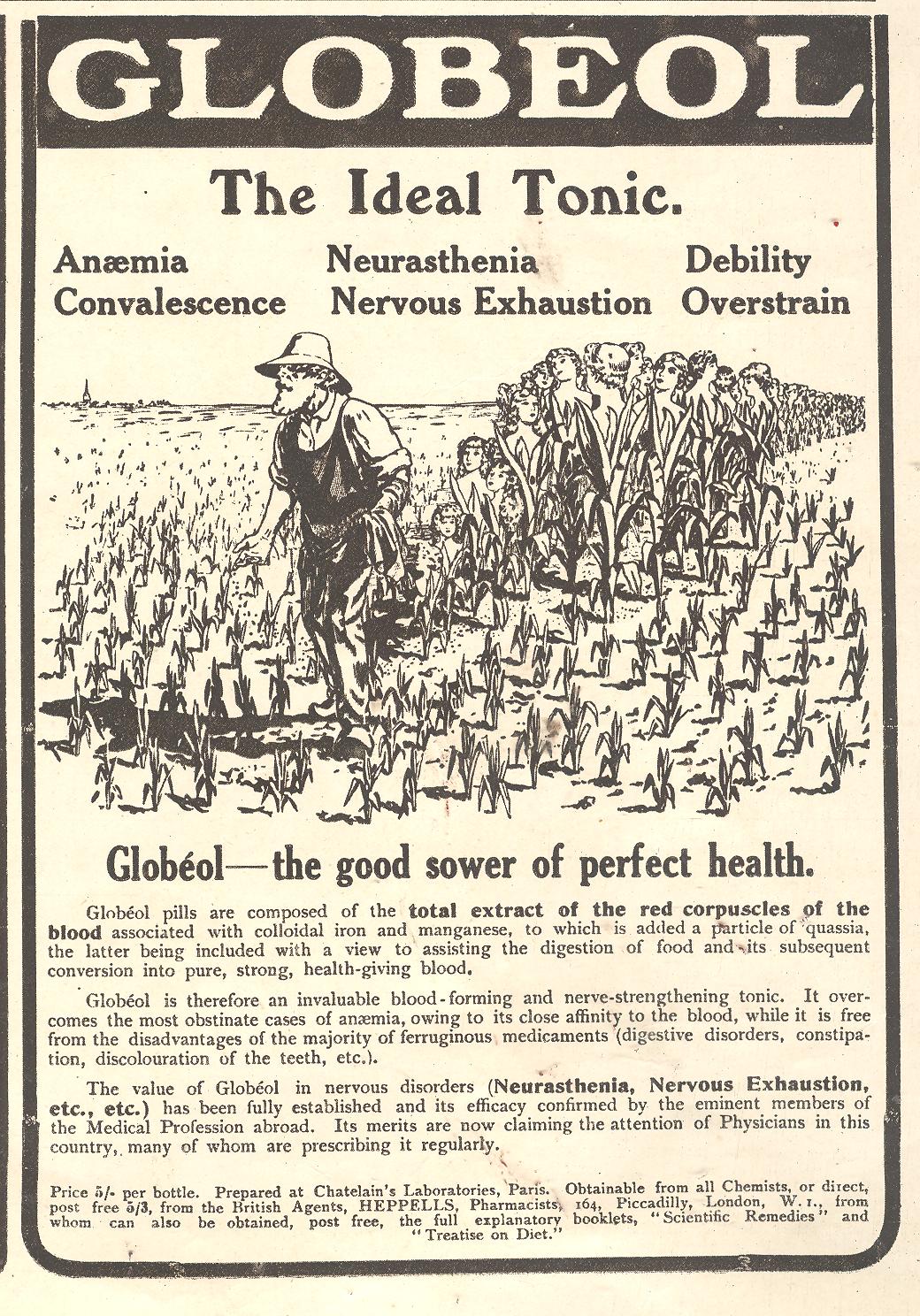
    Curiously the ad next to this one–same size, same typeface–is for another quack medicine for men whose seed is evidently growing moldy in the bottom of their sowing sack.  Globeol addresses the keyword problems for sexual malaise:  “debility, overstrain, anaemia, nervous exhaustion” by “conversion into pure, strong, health-giving blood”. Lest the use of STRONG BLOOD PURE BLOOD-FORMING HEALTH-GIVING GOOD SOWER be lost there is always the Johnny Appleseed person above, casting about his seed, growing children instantly.

    1--may 11 globonol

    If sexual malaise be, then Urodonol and Globeol is there for some sweet, secret sippings; a little shot here and there will bring the sexes together. Or not. 

    I might be completely wrong on this but, really, I like the possibility of this weird approach’s explanatory power–it doesn’t take a philo-shrinkologist to see the conjoined symbolisms in this set of ads and the approach to unmentionable complaints, and that’s what I think is exactly going on here.


  • The Call for the Elimination and Destruction of the Beggar and Tramp Classes, 1926

    JF Ptak Science Books LLC  Post 1022

    The once-esteemed journal, The Eugenics Review (1909-1968, published in London by Macmillan & Co., with  Darwin’s son Leonard as it president and guided by a very well placed “consultative council”) is an issue-to-issue marvel of dead and repugnant ideas.  It seems more now an encyclopedia of The Great Ill Wind than anything else, and this of course ironically in spite of its own sterling pedigree.1


    Eugenics10b
    I occasionally pick up an issue an graze, and usually something strikes the sensibilities immediately.  Today it was the issue for April 1926, and the article “The Merxplas Beggar Colony”.  I had never heard of a “beggar colony” before this, today, and was surprised to learn that there were six of them in Belgium , one of which was Merx plas, with many of them established beginning in the 18th century.  Merx plas was a physical entity, a containment camp (or perhaps better a “concentration camp?”) where tramps/beggars/the habitually unemployed/thieves/pimps were sentenced to between two and seven years’ stay.  People went in, and they could not come out–so although not a prison, it seems more a communistic prison setting with an post-dated exit sign.

    The Eugenics Review took a quick view (in this four page article) of places like Merx plas Belgium) as social engineering tools, with heavy medical/biological/pathological metaphors.  The author, J.G. Pringle, quotes a “M. Le Jeune” who found the sound idea in his statement: “this (habitually unemployed) class could be eliminated by a process of segregation” leaving the real unemployed a chance to find work once removed from this “contagion”. Mr. Pringle agrees: “While segregated they would not reproduce either their species, their diseases, or their vices”.  

    Indeed.  Merx plas was also opened not only for these above-mentioned people, but was expanded to include “convicted epileptics, tuberculous persons and mentally deficient persons”.  He continues: “it would appear that this further classification of inmates will make possible the selection of individuals for whom any liberation whatsoever could be shown to be inadvisable”. 

    There were generally about 5,000 people at Merx plas–a quick look at  the stats reveals that at any given time 75% of the population had made at least one previous tour there; 25% had been there at least three times. I’m not so sure what that means in terms of anything save that the state prevented these guys from reproducing.

    In general Mr. Pringle likes what he sees and wants the communal work farms to be instituted in Great Britain.  He closes:  “The measure of success achieved at Merx plas in dealing with a type of parasite which is also a source of social contamination would form a happy precedent for a similar experiment in this country”.

    Such imaging of a class of people in terms of disease, contagion, social contamination and the “correcting” of their behavior in terms of “segregation”, virtual sterilization and “elimination” takes me immediately to the question:  what’s left?  Once they began to creep in TB persons and the “feeble-minded” and not let them out, how else best to deal with beggars and tramsp who continue to abuse the system, especially once you’ve already introduced the idea of these folks being disease/contagion and that their incarceration is a form of segregation and elimination?  I guess they could talk about not letting anyone out again, but, well, it sounds like Merx plas was already an economic drain and stain; how much could it support?  The math starts to look big and bad and bloody at this point. 

    In general though the road to a conclusion to these unhappy thoughts was sterilization (which I wrote about a little here and elsewhere on this blog)–but this is a story for another day.

    Notes

    1.  The eugenics people identified their intellectual foundations in the work of master multi-tasker and genius Sir Francis Galton, and had much help along the way with the likes of the superior R.A. Fisher, Charles Davenport, Henry F. Osborn, Bernhard Mallet, R.W. MacBride, Julian Huxley, W.P. Pycraft, Francis and Leonard Darwin, and many others.


  • Propaganda Maps of a Different Sort–Health Advertisements & Carto-Weirdia

    JF Ptak Science Books LLC  Post 1021

    “When I’m playful I use the meridians of longitude and parallels of
    latitude for a seine, and drag the Atlantic Ocean for whales.”
    –Mark Twain (Life on the Mississippi, 1883) 

    1--may 5 world map cleaned

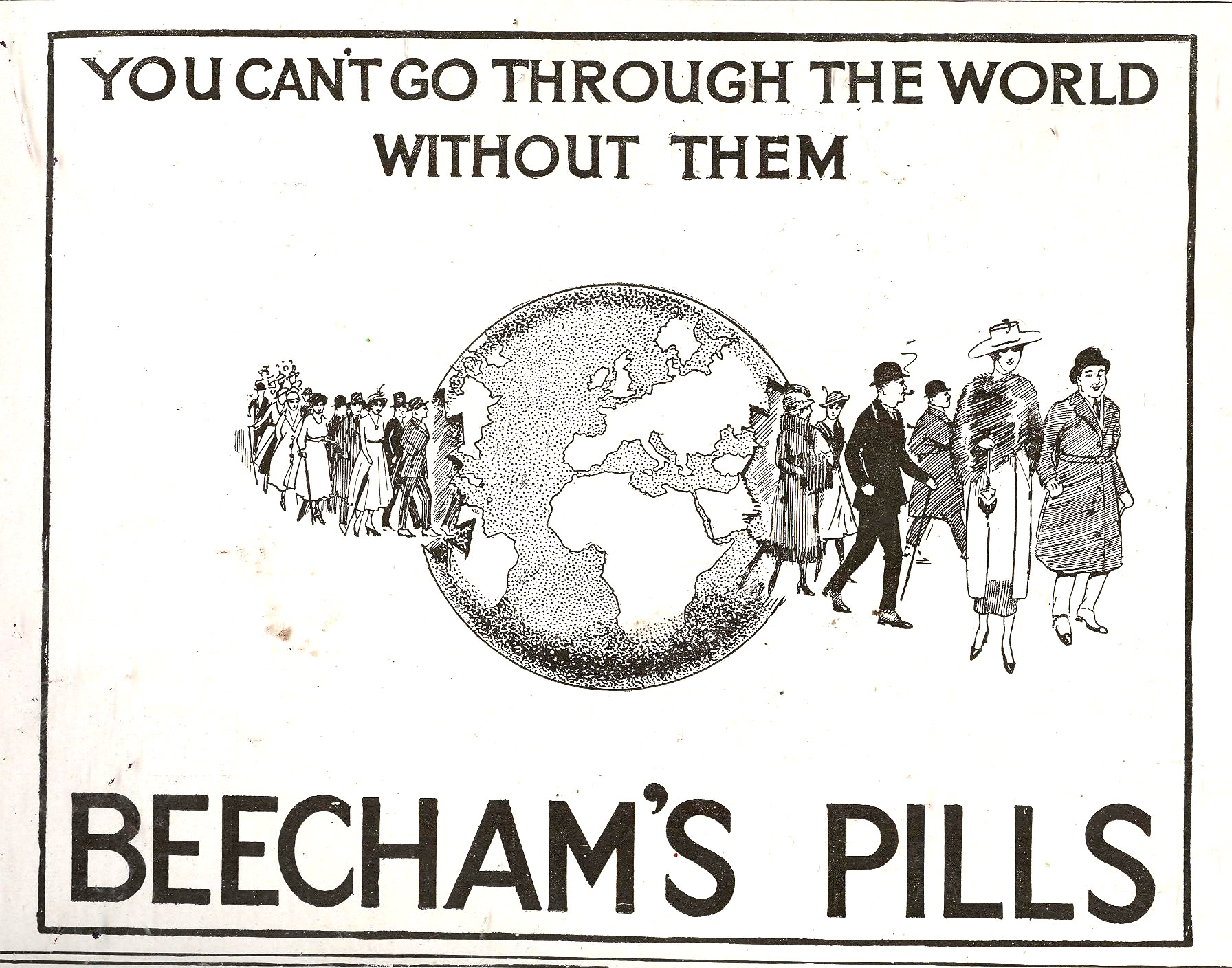
    1--may 5 world map In this blog’s continuing series on maps and propaganda come these two interesting and appealing examples, both appearing in England in the late ‘teens though their histories are older than that. They do come from a much longer tradition of finding physical landmarks of the body by which to navigate biological and mental needs–bumps and blemishes of the head, “reading” blood and urine,  general mechanical measurements of all sorts, and on and on, even so far as to include mapping the significance of the appearance and proximity of body moles and warts. (I addressed this earlier in a post on Mapping the Human Cosmos via Mole1--may 6 mole maps, here.)

     
    The first image belongs to Beecham’s Pills, long a staple of chemist/pharmacy and general goods sellers, which were basically patent medicine cure-alls composed of aloe, ginger and soap, and which found a happy market for more than 150 years (1842-1998).  Evidently Beecham’s did do something right in there somewhere, as they had some sort of positive effect on digestion.  Other than that I don’t know, though the little pills seem to not have caused any direct harm.

    The company has a long and huge advertising history, though one of the favorites that I’ve seen from this early part of the 20th century had folks marching through the globe, and happy to be doing so so long as they had their care trusted to Beecham’s.  

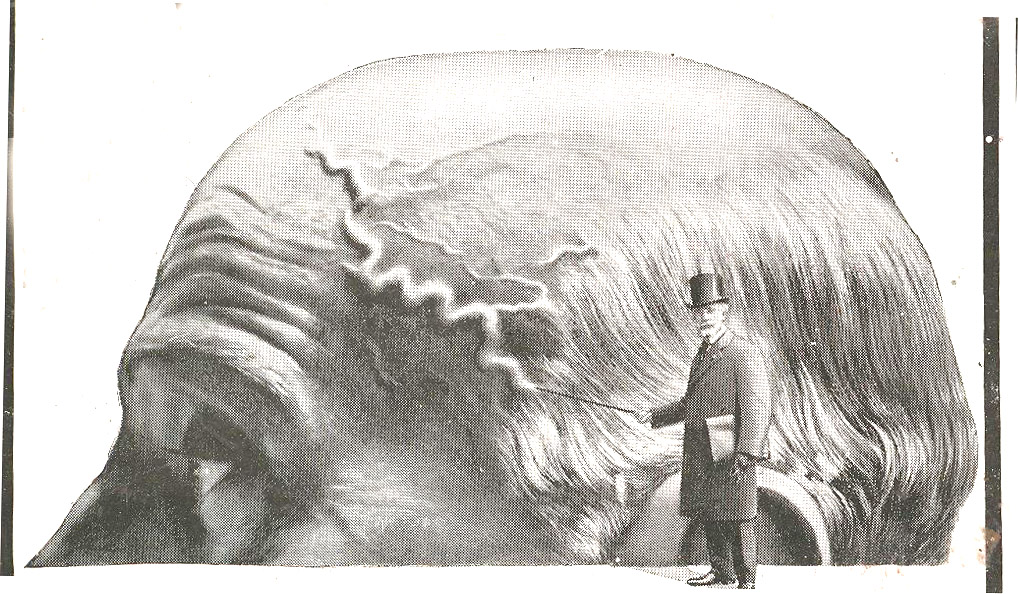
    Secondly is this odd bit that locates the center of one part of human health in the veins of head, showing that if you can indeed follow them like a map, then you’re in trouble and need to ingest the product sponsoring the scare measure, Urodonal (“dissolves uric acid”). Urodonal is of French origins and dates back to at least 1874; it was a quack medicine composed of “pleasant herbs” which would cure all sorts of aliments relating to kidney distress, plus fatigue, tired feet, aching back and of course obesity. 

    1--may 6 map weird
    The man in top hat was pointing to the Vesuvian vein with his cane, just in case you missed the thing.  But I guess in the modern age when everyone must “take” something, the nonsense concoction of Urodonal was better than most because it–like Beecham’s–didn’t actually do anything nasty to your body.  Unless of course you self-administered your medical care and relied solely on these agents for your necessary treatment for a real illness, which would mean trouble–and which is an entirely different story. 


  • Giant Airship as a Floating Tuberculosis Hospital, 1930

    JF Ptak Science Books LLC  Post 1010

    Tuberculosis has been killing people in its nasty, eat-you-alive-from-within way, for thousands of years.  TB (for tubercles bacillus), also known as consumption (for just those properties mentioned), phthsis and scrofula, was the cause for every fourth death in early industrial age England (1815), and tended to nest among the urban poor.  It really wasn’t well understood until the 19th century. when it was first actually named as a disease (by J.L. Schoenbein, 1839), and it wasn’t identified as contagious for another 42 years or so.  The bacillus causing

    April 21 dirigible
    tuberculosis wasn’t identified until 1882 (by Robert Koch, who wound up
    getting the Nobel Prize in Physiology or Medicine for his work in 1905),
    and although some early forms of immunization began as early as the
    first decade of the 20th century, it really wasn’t until just after
    WWII that immunization and antibiotic treatment bean in earnest.

    There have been many ways of dealing with the disease in the history of man and mythology, but prior to the late 1940’s the mainstay of effective treatment for TB was isolation (or collection of affected in “clean air” sanitoria) or penumothorax–there wasn’t much that could be done with this mass murderer. 

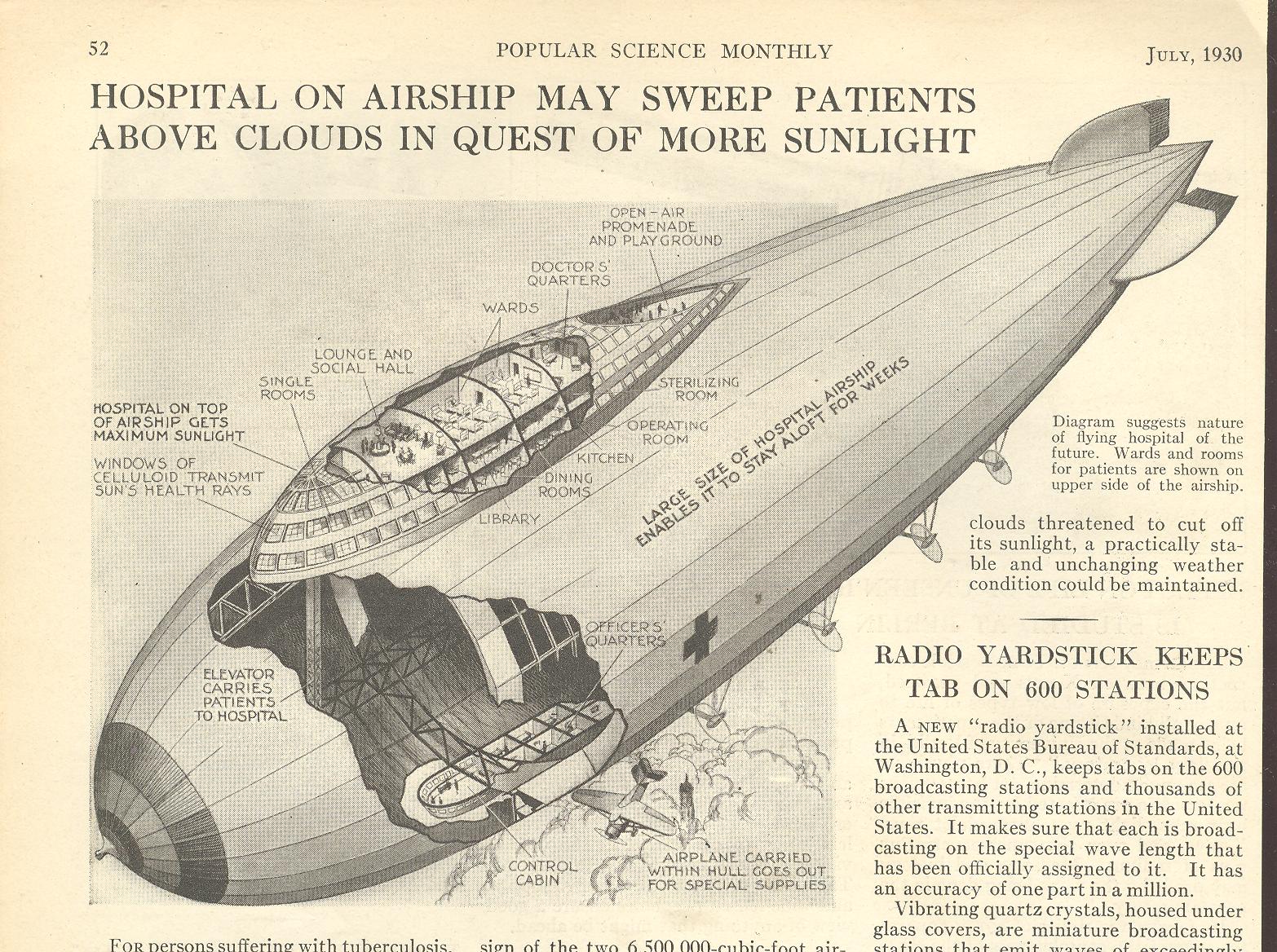
    And so it came to be that  Dr. Karl Arnstein (a significant engineer and  the chief designer of the U.S. Navy airships USS Akron and USS Macon) proposed this flying hospital ship—a 6.5 million cubic foot airship, actually. The hospital was “a blister on the skin” of the airship, occupying very little of the entire surface area, looking as though it might be able to accommodate 75 or so patients, staying aloft for weeks at a time–there would even be an aircraft in the belly of the beast that could be released to fetch supplies from time to time (though I don’t kow how  the whole return trip would work).  The airship was intended to follow the sun, skirting clouds and bad weather, keeping the TB patients “in the health rays of the sun” to help cure them of their disease.  It was an odd and desperate idea, which seems on one level to be a good effort, the best that could be done with the data available. 


  • Monetizing Madness

    JF Ptak Science Books LLC  Post 1004

    Hail, horrors! hail
    Infernal world! and thou profoundest hell,
    Receive thy new possessor, one who brings
    A mind not to be chang’d by place or tie.–Milton

    I wonder when it was that people began to institutionally
    capitalize the monetary value of madness? 
    People of course have been “mad” for as long as there have been people;
    but the issue of centralizing them, of locating people with mental disorders,
    or collecting folks who displayed far-ranging attributes of the norm, I think
    is relatively recent.  Certainly it is a
    more modern invention of capitalizing on madness, as “hospitals for the insane”,
    “institutions for the feeble-minded”, “lunatic asylums” and so on are mostly an
    invention of the 17th century. 

    In many instances these institutions were for-profit
    ventures, and most of these were run for the benefit of making money more
    helping the people who would be confined there. 
    It was certainly not pretty.

    The conditions for being sent to one of these places varied
    from country to country, region to region, judge to judge.  Insanity was not a necessary condition,
    either—many wives who stood in the way of mistresses wound up conveniently
    out0of-the-way in mental institutions; it was also a way to gain control of a
    relative’s estate.

    The later may be true in the very celebrated case of William
    Belcher, who spent seventeen years in a private asylum (from 1778 to 1795).  Belcher wrote (as “a victim of the trade of
    lunacy”) about his experience with vindictiveness and vitriol in his Address to Humanity: Containing a Letter to
    Dr. Thomas Monro, a Receipt to Make a Lunatic and Seize his Estate, and a
    Sketch of a True Smiling Hyena
    (1796, which can be seen in full here).

    Another famous case was that of John Perceval, who recounted
    his story in his 1838 book, A narrative of the treatment experienced by a
    Gentleman during a state of mental derangement designed to explain the causes
    and nature of insanity, and to expose the injudicious conduct pursued towards
    many unfortunate sufferers under that calamity.
     Perceval did actually have some
    sort of something going on, a suspension of his normal facilities, as he says
    in the first lines of his book: “
    “In the year 1830, I was
    unfortunately deprived of the use of my reason. This calamity befel me about
    Christmas. I was then in Dublin.
    The Almighty allowed my mind to become a ruin under sickness – delusions of a
    religious nature and treatment contrary to nature. My soul survived that ruin.”  But the base of it all was  the seizure of his considerable property,
    against which he could barely fight. 
    Perceval continued his fight against the lunacy trade for the rest of
    his life (he died in 1876). As a matter of fact Perceval was one of the founders
    of one of the first patients’-advocacy groups, the very bouncily-named Alleged Lunatics’ Friend Society. 

    Evidently the was a
    certain porosness to the definitions of “normalcy” and “lunacy”, the
    distinctions between the two sometimes settled for a cool lump payment. 


  • Artistic Nothingness: Cosmic Panspermia, Spermatozoa and Neurons.

    JF Ptak Science Books LLC  Post 964

    In
    the history of life there is a virtual geology of buried ideas of how living
    things came to be.  The belief in
    spontaneous generation is ancient and evidently still holds a comforting sway
    (in a scrubbed-up way) among some moderns. There was a lot written on the
    subject over the centuries: for example, Virgil (Georgics) gives us directions
    on how to make bees, and the great mathematician Cardan/Cardano passed along
    instructions on how fishes are made of water, no doubt drawing on the more
    ancient moisture-related beliefs of Anaximander (600BCE).  Aristotle was more circumspect on the issue
    of

    March 6 sperm

    spontaneous generation, though he did cast a fairly wide and more cautious
    net:  “sometimes animals are formed in putrefying soil, sometimes in
    plants, and sometimes in the fluids of other animals.” Even the beautiful,
    polymathic and occasionally very wrong (but way ahead of his critics) Jesuit Athanasius
    Kircher stated (in his masterwork Mundus
    Subterraneus
    , 1646) that he had seen mice generated out of nothing but
    plants and water.  So it goes. 

    The
    more modern variations on this theme attract a varied collection of some very
    big names. Though the spontaneity now takes place in the extraterrestrial realm,
    with comets and meteors and such impacting with the earth with life debris from
    god knows where (literally), seeding life on earth—though the theories usually
    beg the question of where the stuff on the meteors and etc. came from.  These names include Svante Arrenhius, Lord
    Kelvin, the beautiful Hermann von Helmholtz, Fred Hoyle, and many others.

    Generally
    the more-modern view is attributed with the name of cosmic panspermia (it seems
    to my memory that the first of the most modern life-generating panspermia
    theories is published in the Comptes
    rendus
    in the id 1850’s but I cannot right now remember who it was that
    wrote it).  And it is this cosmic seed
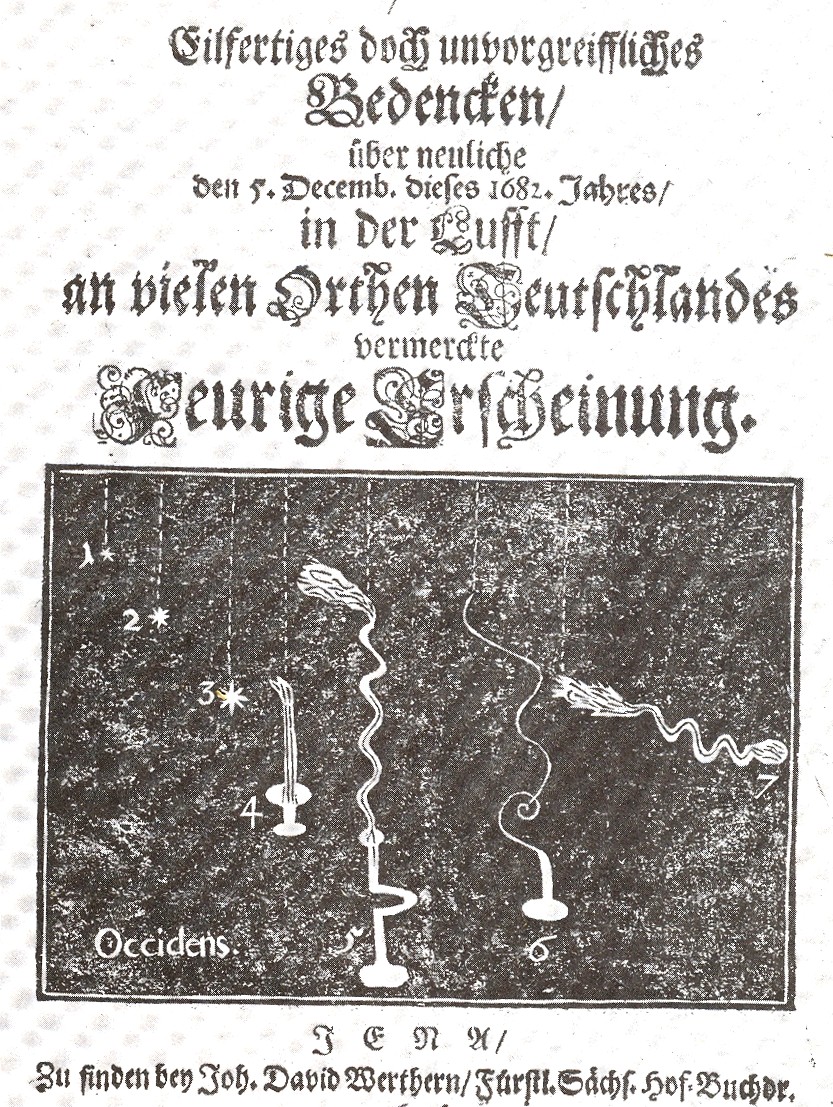
    bit that struck me when I first saw this title page (above) of a very rare work by
    Caspar Posner (1626-1700)—Eilfertiges doch
    unvorggreiffiches Bedencken…
    published in 1682.  It seems that Posner recorded these verities
    of “shooting stars” in Jena
    on the night of 5 December 1682, quickly writing this four-page work describing
    them.

    March 6 sperm leeuw

    The
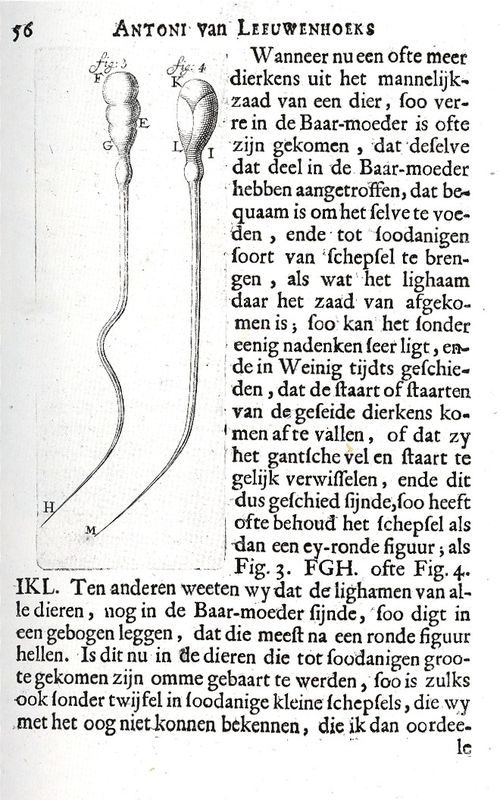
    images reminded me instantly of the first spermatozoa images published by Anton
    von Leeuwenhoek (1632-1723)—and actually they were the first images of live and
    dead (left and right, respectively) dog spermatozoa.  He did absolutely superb work, a great
    pioneer working with a hand-held single-lens (barely recognizable as a) 200x
    microscope.

    And
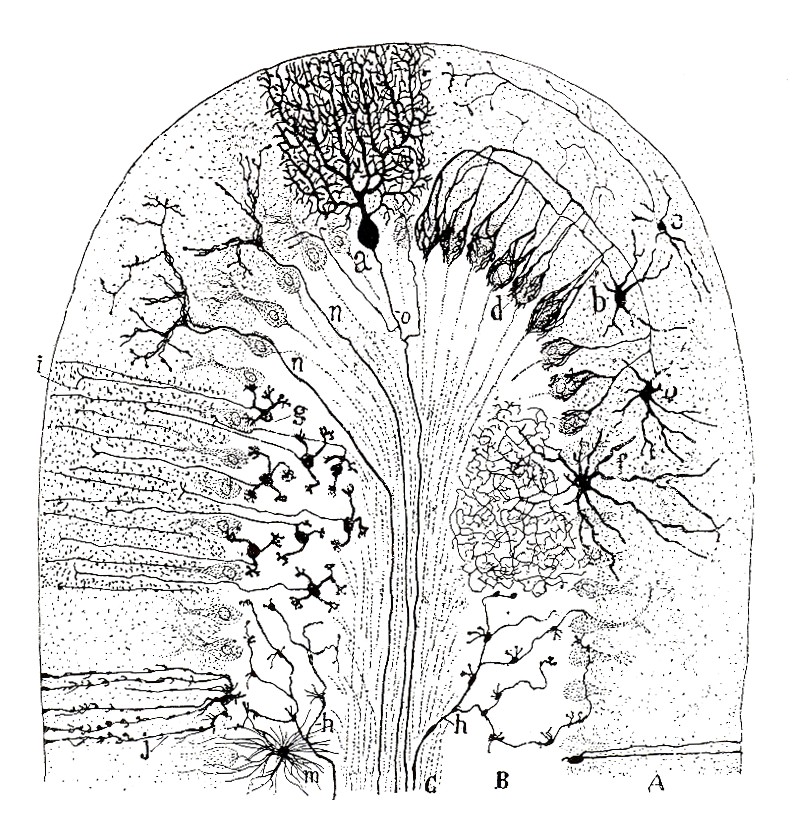
    there too there’s the detail in this image by the great Santiago Ramon y Cajal
    ( 1852-1934), who drew the first accurate picture of nerve cells in the
    cerebellum (found in one convolution of a mammalian cerebellum), which helped
    formulate his theory that the basic structural unit of the nervous system as
    the neuron. 

    March 6 sperm cajal


    Perhaps
    it is a simple artistic fittingness to connect the 1682 meteorite shower with
    cosmic panspermia and Leeuwenhoek and Cajal; in a squinty-eyed way they look
    pretty good together.  On the other hand
    of course these are just random bumped-together thoughts having nothing to do
    with one another.  I vote for artistic
    nothingness.


  • Medical and Liturgical Cardiac Pathology, 18th Century: Scarpa & Senac vs. the Throne of Satan

    JF Ptak Science Books LLC  Post 952

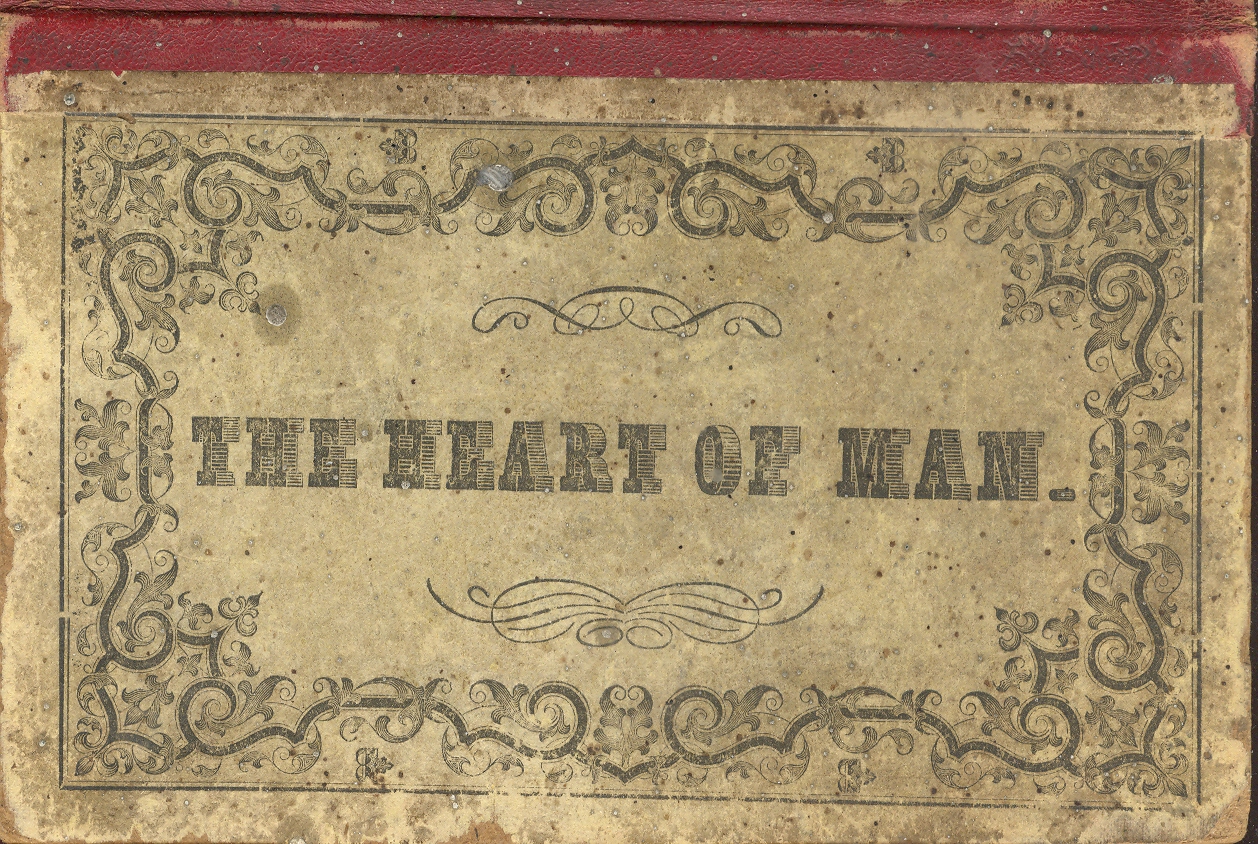
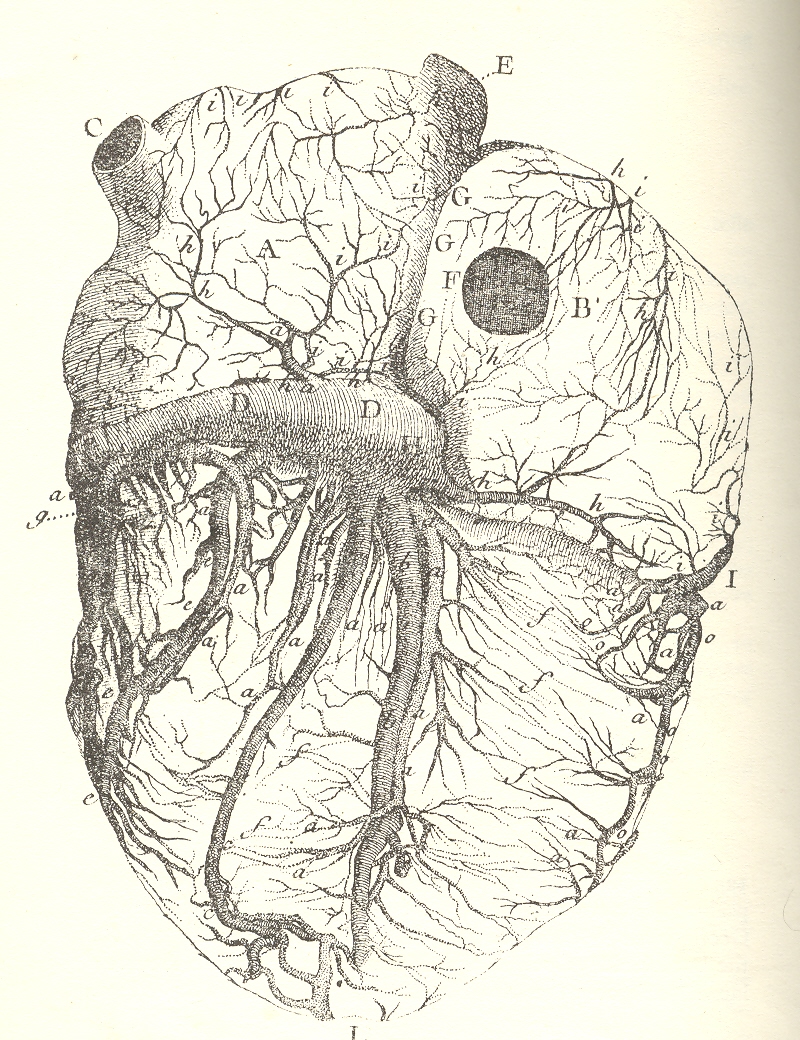
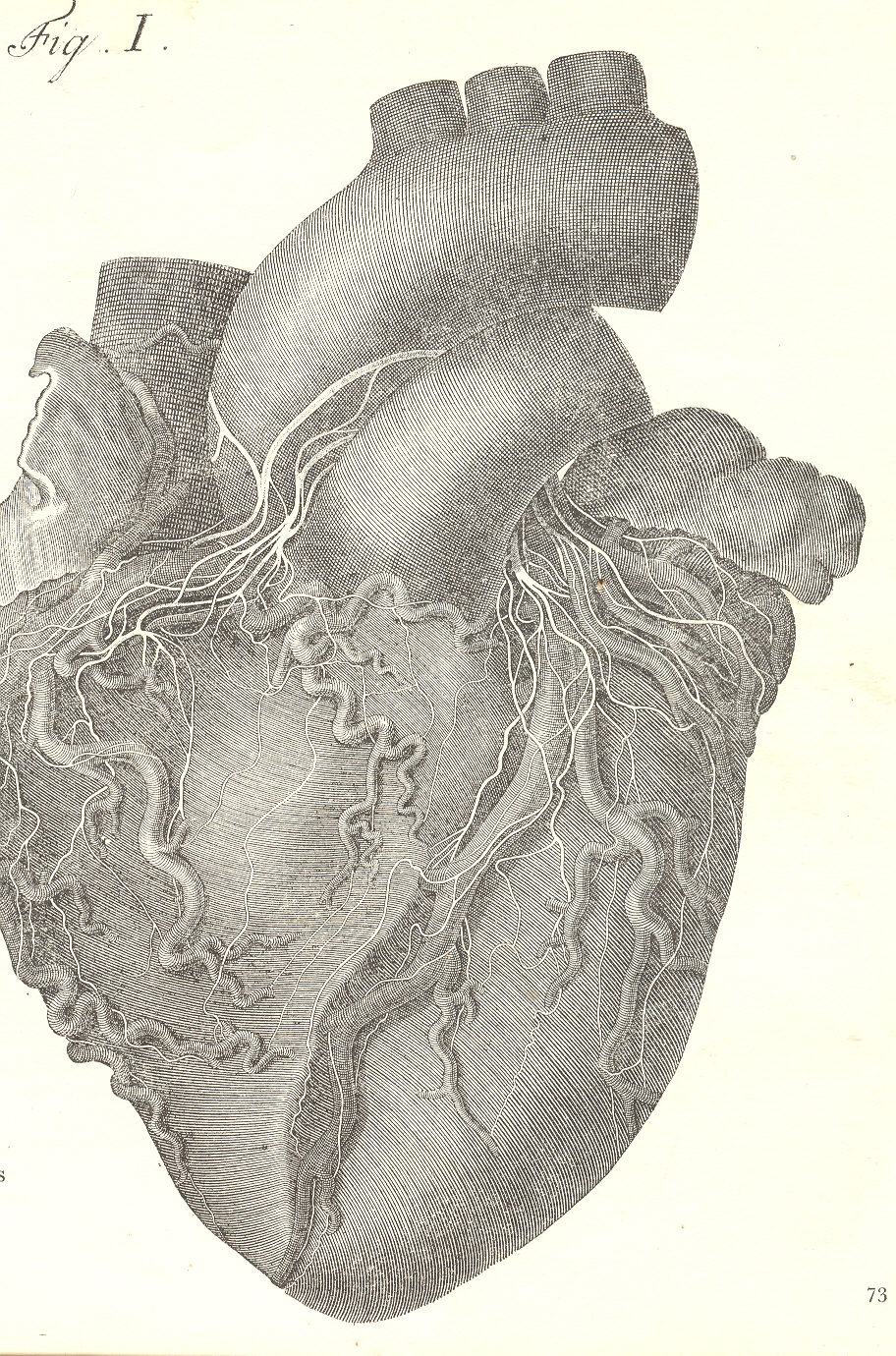
    0--heart of man 1 It is a bit odd to compare these three relatively contemporary
    works on the human heart and to see their points of correlation and (vast)
    departure. The first belongs to Jean Senac, whose Traite de la Structure de Coeur…(published in 1749) was one of the
    most valuable works on the 18th century on the heart, laying a firm
    foundation for the study of its pathology. 
    Senac

    Senac  

    (1693-1773, born in Gascony
    and later physician to Louis XV) was the first visitor to many aspects of the
    heart’s physiology, describing delation (as the most common evidence of cardiac
    pathology), correlated hydrothorax with cardiac failure, pericarditis, and much
    more—he also published exquisite illustrations by Jacques Poitier to accompany
    his text.

    The next image is the first to properly describe the nerves
    of the heart, and was published in the magnificent Antonio Scarpa’s Tabulae neurologicae ad illustrandam
    historiam anatomicam cardiacorum…
    in 1794. 
    Scarpa was a monumentally

    Scarpa

    accomplished anatomist who was also a gifted
    artist, and it is his own work that illustrates this masterpiece.  The original edition of this work is huge,
    atlas-sized, and the images of the heart are life-size and float in plenty of
    free, very wide and perfect margins.


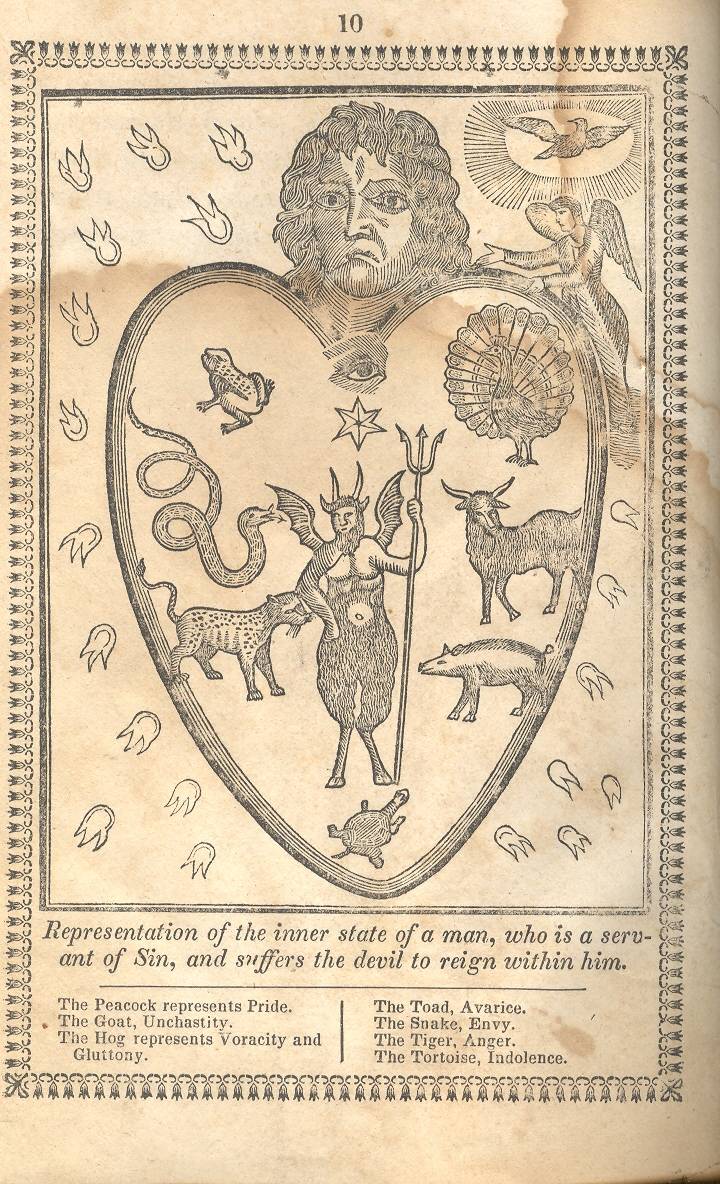
    On the other end of the spectrum we have this liturgical
    philosophical anatomy of the stages of the heart in grace and disgrace.  Mostly I’m interested in the foul part, which
    shows the advanced mortification of the organ in seating the throne of Satan. The
    edition here is The Heart of Man, either
    a Temple of God or the Habitation of Satan1,
    and
    is a very heavy-handed 1842 illustrated edition from Harrisburg (PA) version of
    a French text of 1732.  It is illustrated
    with ten versions of the state of the heart, ranging from perfect grace to the installation
    of the Beast, and several points in between, the degrees of gaining and losing
    each station. 

    0--heart of man satan 1

    The first image shows the heart of man completely dominated
    by Satan, with Man the sinner’s troubled face (along with the mark of Cain (dominating
    his wayward organ.  The emblematic
    animals infesting his heart include the peacock (with its misleading
    haughtiness), goat (“a lascivicious, stinking animal” representing “unchastity”
    and impurity), hog (gluttony and intemperance), snake (seducer), tiger (cruelty
    and ferocity) and tortoise (indolence). They chase from the hear the holy ghost
    and an angel, and allow the presence of Satan (front and center). 

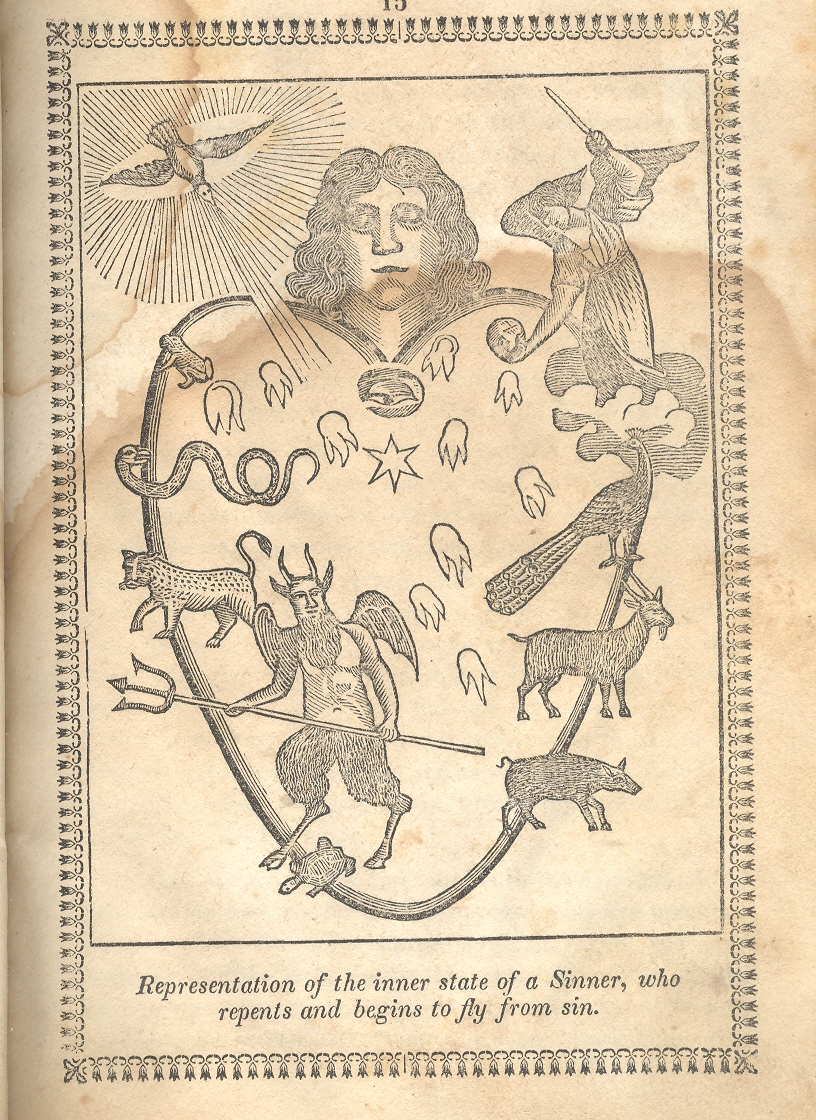
    The second image is interesting in that it shows the
    movement of a bad/evil/wicked heart to a more pious one, though it is just in
    the transition stages.  In my experience
    it is uncommon to see an emblematic illustration of a half-way point of, well,
    anything; this woodcut seems to capture, to be a snapshot so to speak, of the
    human heart undergoing transformation. 


    Notes:0--heart of man satan 2

    1. The original title was something along the lines of Spiritual Mirror of Morality, in which every
    Christian, who desires his salvation, may view himself, know the state of his
    soul, and profitably learn to regulate his life according to it
    . Hardly gender-neutral,
    the title makes four specific gender references to men. 

    ·Posted by :

    ·in:

    — —