A Daily History of Holes, Dots, Lines, Science, History, Math, Physics, Art, the Unintentional Absurd, Architecture, Maps, Data Visualization, Blank and Missing Things, and so on. |1.6 million words, 7500 images, 4.9 million hits| Press & appearances in The Times, Le Figaro, Mensa, The Economist, The Guardian, Discovery News, Slate, Le Monde, Sci American Blogs, Le Pont, and many other places… 5000+ total posts since 2008.

Category: Medicine, History of

  • Fun in the 16th Century Bath: Minerals, Spirits, Frolic and Ennui

    JF Ptak Science Books LLC  Post 790  Blog Boosktore

    + bathing 001

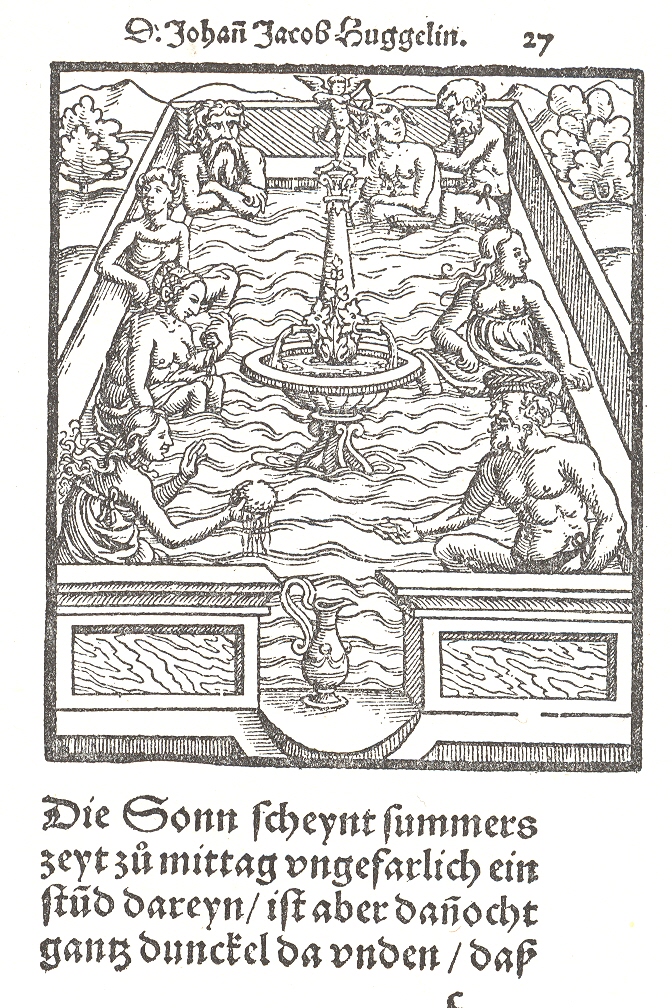
    There’s much real and important content in this woodcut, but I focused first
    on the few semi-entertaining and problematic figures positioned at the corners
    of this bath.  First things first: it
    appeared in Johann Jacob Huggelin’s Von
    heilsamen Baederndes Teuschenlands
    …, published in Mullhausen in 1559, which
    was a treatise on the mineral baths of Germany and their medicinal and
    therapeutic claims.  This woodcut occurs
    in the title page—and as a matter of fact, the exact image appears three years
    later in one of Paracelsus’ principal works, Baederbuchlin… published in Mullhausen, again, in 1562.  (This is one of Paracelsus’ most well-known
    efforts, and is seen as being one of the earliest works on hydrotherapy, but it
    is definitely predated by Huggelin.)  

    There is a gauzy modesty to the bathers, the men wearing a skimpy Euro-covering (with a nice bow), and the women a flouncy covering that is pulled down under the breasts.  The pair in the front look to be sharing a sponge, while another pair (towards the middle of the bath edges) are contemplating the landscape.  One of the pair in the rear right corner is getting  a nice scrubdown, while the most interesting-looking of the bath crew sits opposite, arms folded, looking sullen or filled with lost hope or just left out. 

    + bathing 2

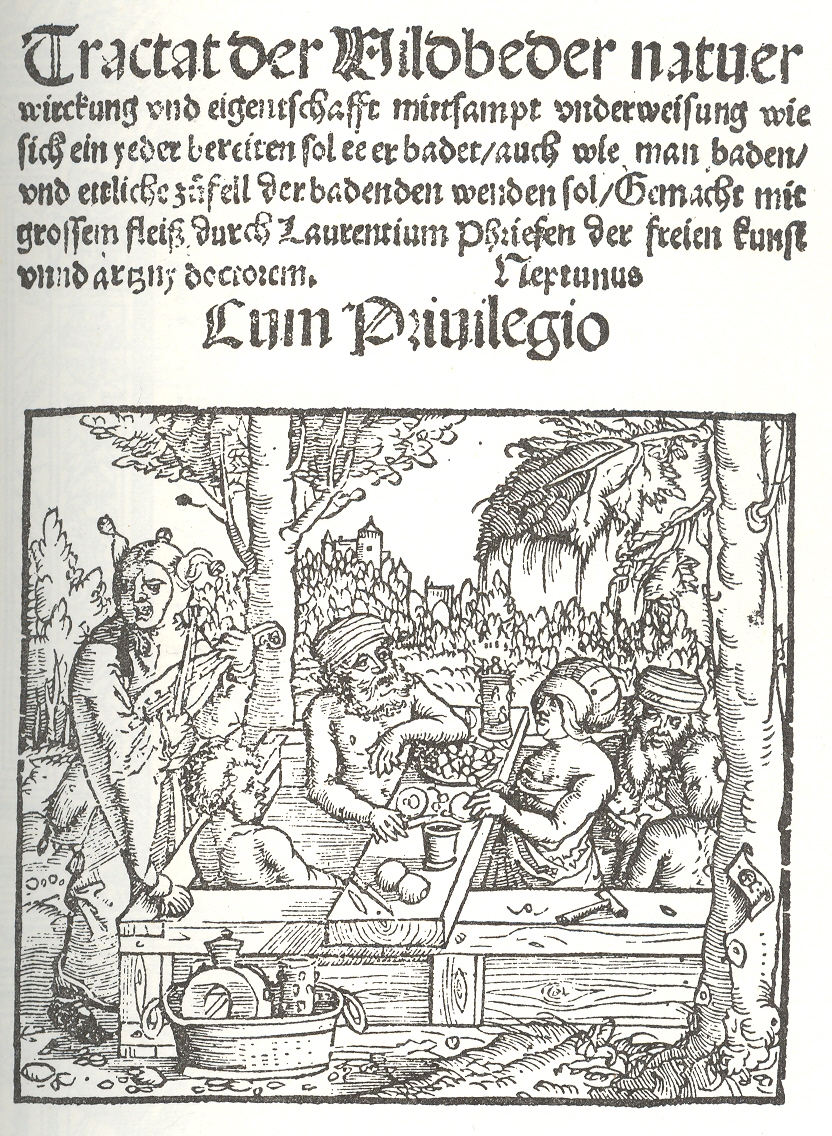
    More fun and more unbalanced is this image from Lorenez Fries, Tractat der Wildbeder, printed in
    Strassburg in 1519,  where those taking the
    baths for the medicinal spirits of the water to wash away their medicinal grit,
    and gout and grimes tried to help the water with food and alcohol.  There’s nothing wrong with that so far as I
    know, and evidently there’s nothing written about despoiling the massaging/washing
    powers of the bath in the Handy Handbook
    of Balneological Rules and Regs.
    As in the first image, the bathers are
    decently and modestly clad, only here they are enjoying fruits and meats, and have
    a jester/fool entertaining them with a viol. I imagine that if you were gouty or had the flu, an hour or two in a bath filled with music and food and spirits wouldn’t do too much damage.


  • The Worst Job of the 19th Century? Tongue-Pullers, Nipple-Pinchers & Anal Tobacco Blowers Try to Revive the Dead.

    JF Ptak Science Books LLC  Post 781   Blog Bookstore
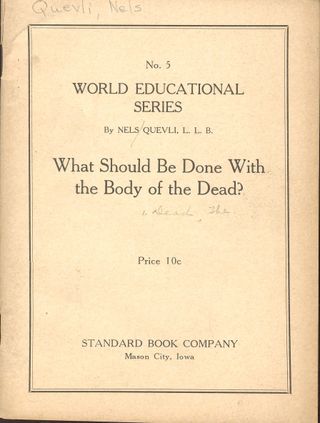
     

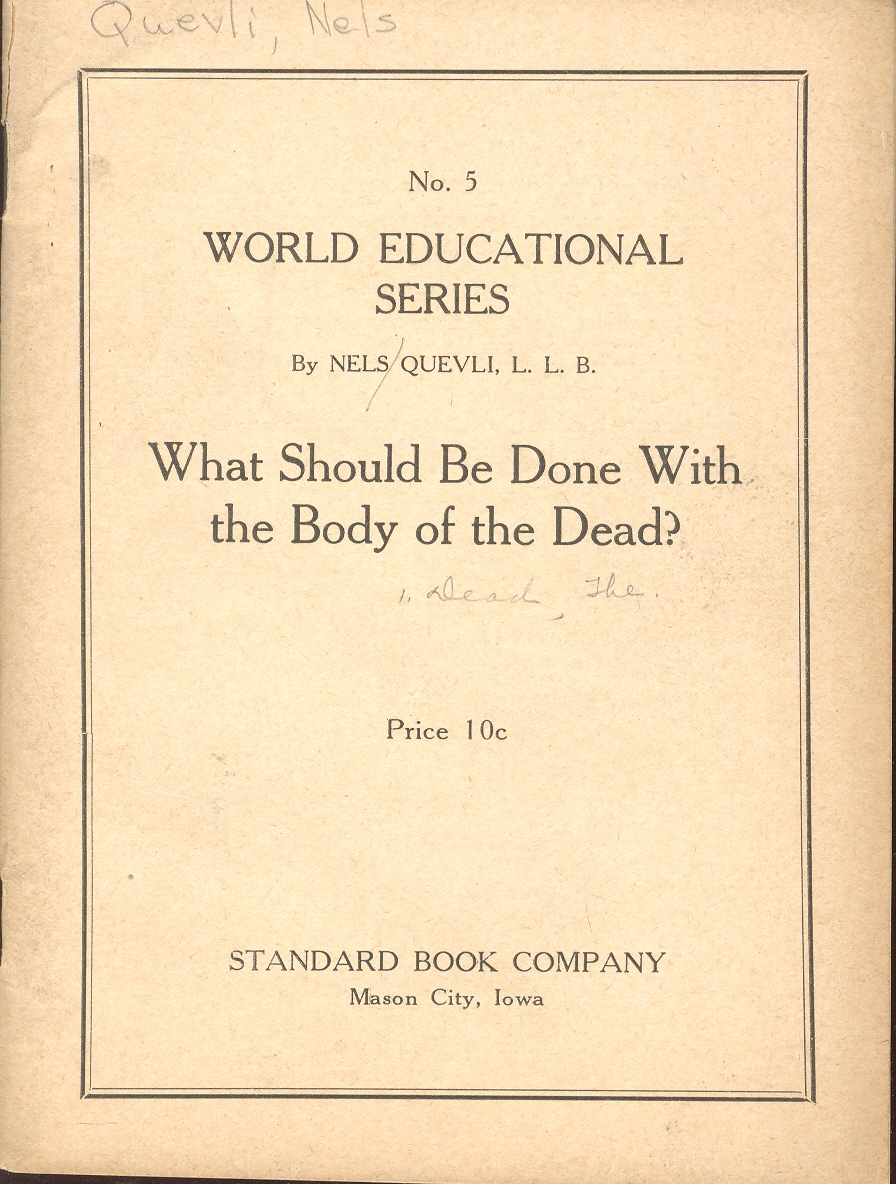
    + buried alive Nels Quevli, the Mason City, Iowa author of  the oddly-titled What Should be Done with the Bodies of the Dead (1936), does indeed have a point that rises above his oddly-titled, laugh-imminent pamphlet..  It is a little laborious getting there, and the 71-year old ex-pharmacist and “science writer” with “fifty years” of studying death really could’ve used a little editing in his 47-page exegesis, but a five-minute scan gets you past the grueling set-up to what the man is really worried about:  being buried alive. 

    This is a great and grand old issue in the history of medicine, and it turns out that what Mr. Quevli was asking for was old-fashion simple: this was to put the newly “dead” into a Dead House1 for three days or more at 85 degrees to wait and see if the body began to putrefy, purification being (in 1936) still about the only infallible indicator that death had occurred (scaling beyond the family of  mortises (morti ?) including pallor, livor, algor and finally rigor).  The body was still being tended to some degree while in the death house, though nothing is said of water; and after three days or so without hydration a person is going to be in very rough shape anyway particularly if they were traumatized to begin with.  But this solution for Quevli was much better than the alternative of being sent to autopsy while alive or being buried while still shallowly breathing. 

    The determination of the occurrence of death was a major medical feature of the 19th century, the French in particular waging a fight for how this to be so.  Briefly put, for centuries even before Pliny death was described as the absence of an audible heart—the crux of the sentence being the word “audible”, so that the end of life was dependent upon being a physician’s/person’s capacity to hear the heart beating.  This might be very problematic if the person listening for that heartbeat had faulty hearing from defect or age, as the listener would place his/her ear on the chest of the patient to determine if the heart was functioning or not.  The stethoscope wasn’t invented until 1816 by Rene Laennec–who produced a monaural device much like a primitive hearing horn made of solid wood—which was a vast improvement over no stethoscope at all, by again was very crude compared to early 20th century devices.  It was much more preferred by most doctors (though there were contingents who distrusted the instrument and wouldn’t use it and still others who thought it an insult to their person insinuating defective hearing capacity) compared to the ancient hairy-ear-on-chest method.  It was also, in a small way, a kind of auditory x-ray. 

    It was also more elegant than other methods, the following examples referenced from Jan Bondeson’s delightful Buried Alive, the Terrifying History of Our Most Primal Fear (Norton, 2001):

    –Christian Friedrich Nasse’s Thanatometer was a long thermometer  that was inserted into the stomach, supposedly measuring a core body temperature that would determine if life was possible (and published in 1841);

    –The (Englishman’s) Barnett scalding death cure, which recommended burning the skin of the arm to see if it blistered (no blister/no life);

    –the German Middeldorph invented a heart flag, a needle device that would be thrust into the heart, which if functioning would trigger something or other that would cause a flag to be released at the top of the needle (a very Victorian and visual one, this);

    –Christian August Struwe’s interesting Lebenspruefer (1805) was an electrical device that delivered a dual shock to the eye and lip, the logic here being that if the person was still alive that there would be a resulting twitch;

    –the nameless tobacco enema, which blew smoke…(delivered in the beginning by breath through a tube and improved later to replacing the lips with a bellows, this secondary improvement by Antoine Louis2 and furthered by Dr. P.J.B. Previnaire’s much more powerful anal tobacco furnace.  [Now there’s three words I’ve never strung together before].)

    –Leon Collongues believed that he could hear the capillary functions of a possibly-dead person’s fingers if placed in his ear;

    –Jules Antoine Josat3 invented a nipple-pincher (“pince-mamelon”) life-rejuvenation device, operating on the assumption that a deeply sedated person could not resist a strong pinch of the nipple and would have to wake up if alive.

    Perhaps the most spectacularly extension of the nipple-pincher was the tongue-pulling idea of Dr. J.-V. Laborde4 (1830-1903), a research physician with wide credentials, who reasoned that a continued regimen of advanced and strenuous pulling of a patient’s tongue would over time bring them back to life if alive.  This is what leads us to the point of this post:  Laborde established a mortuary, and in this mortuary, where the dead were waiting to die, he employed a man whose job it was to pull the tongues of these bodies.  In the misty picture of all of this that is painted in my mind’s eye, the fellow working his way from body to body pulling their tongues with a heavy pincer seems far worse than nipple squeezing or even being an anal smoke blower, though to choose between the three in a twisted Purgatorial mandate would be hard to so.  Although the nipple pincher wasn’t replaced by anything mechanical, the smoke blower was (by a powerful bellows), and so was our friend the tongue puller, who after complaining of the boredom of his task was pushed aside by an electrical device.  I am loathe to report that I cannot find a picture of the machine. 

    Notes:


    1.  This was not an uncommon practice.  for example Munich and Frankfurt had their Leichenhaus in which the dead were allowed to putrefy, as did Vienna its Zentralfriedhof.

    2. Antoine Louis.  From the Bondeson book, page 156: “Antoine Louis had also proposed another method of testing life, or at least stimulating the vital spark in the apparently dead person: with a powerful bellows, he administered an enema of tobacco smoke. One of the pipes of this remarkable apparatus was thrust into the anus of the apparently dead person; the other was connected, by way of a powerful bellows, to a large furnace full of tobacco (reference 5). Such enemas of tobacco smoke were thought to be very beneficial and were used to try to revive not only people presumed dead but also drowned or unconscious individuals. In 1784, the Belgian physician P.J.B. Previnaire was given a prize by the Academy of Sciences in Brussels for a book on apparent death, which described and depicted an improved bellows for enemas of tobacco smoke, which he called Der Doppelblaser (reference 6). These enemas were regularly used well into the nineteenth century, particularly in Holland; modern science has discerned no physiological rationale for their use, except the pain and indignity of having a blunt instrument violently thrust up one’s rear passage must have had some restorative effect (reference 7).”


    3. Josat.  From Weird Universe.net I found the following, quoting Death and Sudden Death, by Paul Brouardel and F.L. Benham:

    “Josat invented a pair of forceps with claws, with which he proposed to pinch the nipples of persons whose death has to be ascertained. Josat obtained the first prize of the Academy, but Briquet, repeating the same tests on the hysterical subjects under his care, proved that they did not react under Josat’s forceps any more than the dead.”

    4. M. Laborde won a 2500 franc prize for his innovation in 1894 (as reported by the Revue scientifique.  He sounded like an interesting man:  according to the British Medical Journal (in reporting his death 25 April1903) upon his own death in that year Laborde: “as a freethinker had a civil ceremony; as an hygienist was cremated; as a member of the Societe Mutuelle d’Autopsie willed his body to be dissected; as an anthropologist willed his brain to be preserved at the Anthropological Museum…”

    Some of Laborde’s works include    Le traitement physiologique de la Mort. And Les tractions rythmées de la langue, moyen rationnel … de ranimer la fonction respiratoire et la vie … Avec … dessins, etc   And:  La traitement physiologique de la mort (Paris , 1894) And: La signe automatique de la mort reelle (Paris, 1900). And  “Les Tractions Rhythmees de la Langue”, VIII, pp. 76 ff, ed. 2, Paris, 1897, and VIII, 2d part, pp. 406-510. And commented upon in some number, for example:  Le Traitement physiologique de la mort par les tractions rythmées de la langue. Le tracteur lingual automatique Laborde, by Alix Hache.
     

    ·Posted by :

    ·in:


  • Preserving the Dead in a Formaldehyde Mist, 1899

    JF Ptak Science Books LLC  Post  749  Blog Bookstore


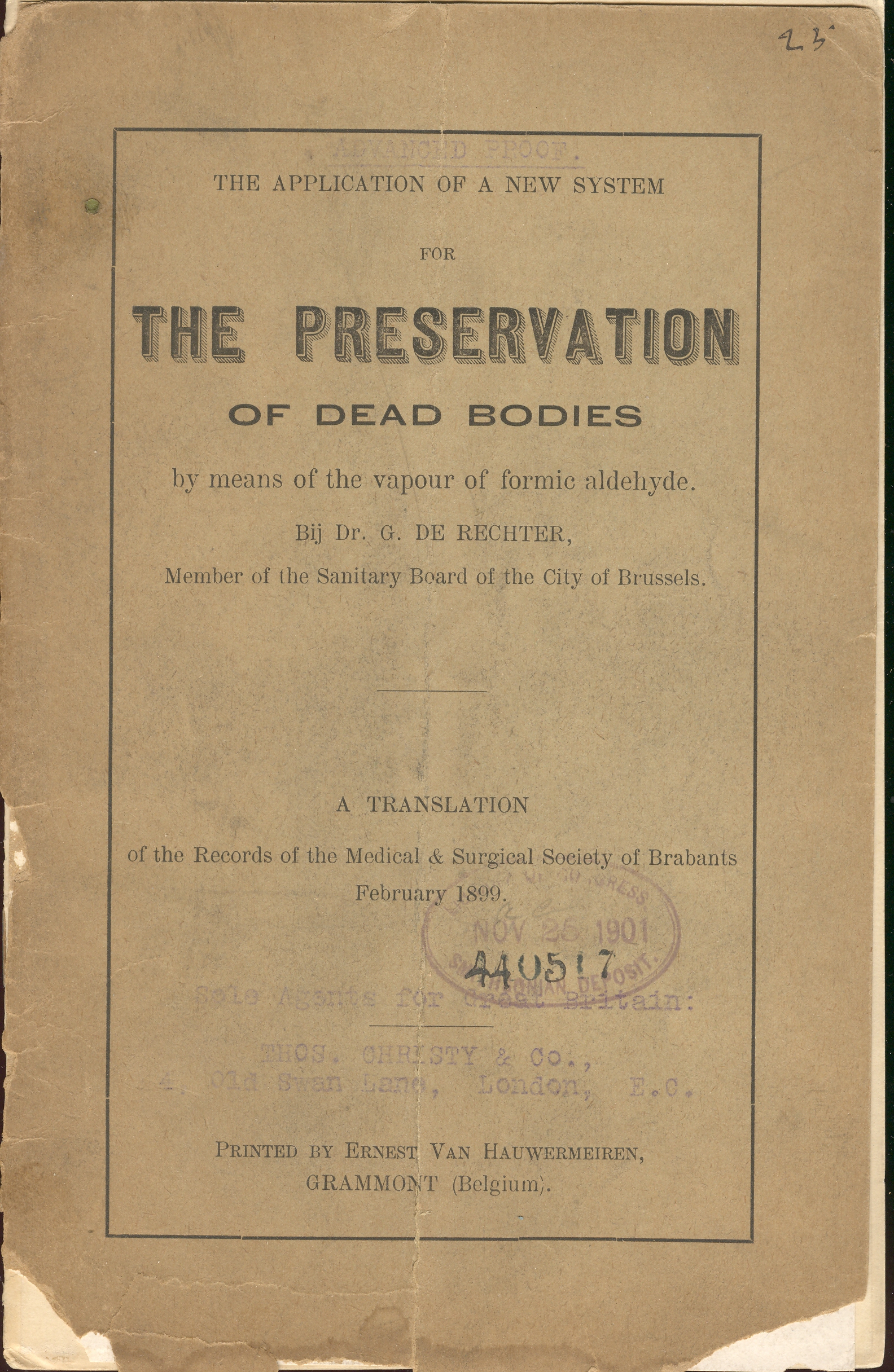
    Gustave de Rechter, the author of this pamphlet (The Application of a New System for the Preservation of Dead Bodies, Grammont, Belgium, 1899) had, as you might guess, a very specific reason for keeping the dead from being entirely, decomposedly, dead.  As the director of the School of Criminology and of Scientific Police of Belgium, Dr. de Rechter tried to find a way of preservation of bodies for forensic and legal purposes.

    +()+ebay dead bodies blog

    He  followed  in the footsteps of people like Alphonse Bertillon (France) and Hans Gross (Austria) in helping to establish a scientific basis for criminology in the late 19th century. In his case, the preservation of the dead would allow the bodies (of the murdered or suspiciously departed) to be re-examined at a much later date (at least months down the road) should the defense in a murder case challenge the original findings of the medical examiner. 

    +()+ebay dead bodies photo1

    As de Rechter points out, this was particularly true in the case of poisoning, where in 1899 the evidence would be all but dissipated
    from the body following even a week of death—he maintains that his new method of preservation (via an incubated spray of formic aldehyde, or formaldehyde) would enable further inspection even months after death. De Rechter manages to forestall the inevitable, the great crumbling that awaits everything, everyone, at some point, the “distinguished thing” of Henry James’ (last words), to return everything to the earth, to what Larry McMurtry (in Lonesome Dove) refers to as “nothing but a boneyard”. 

    +()+ebay dead bodies photo2

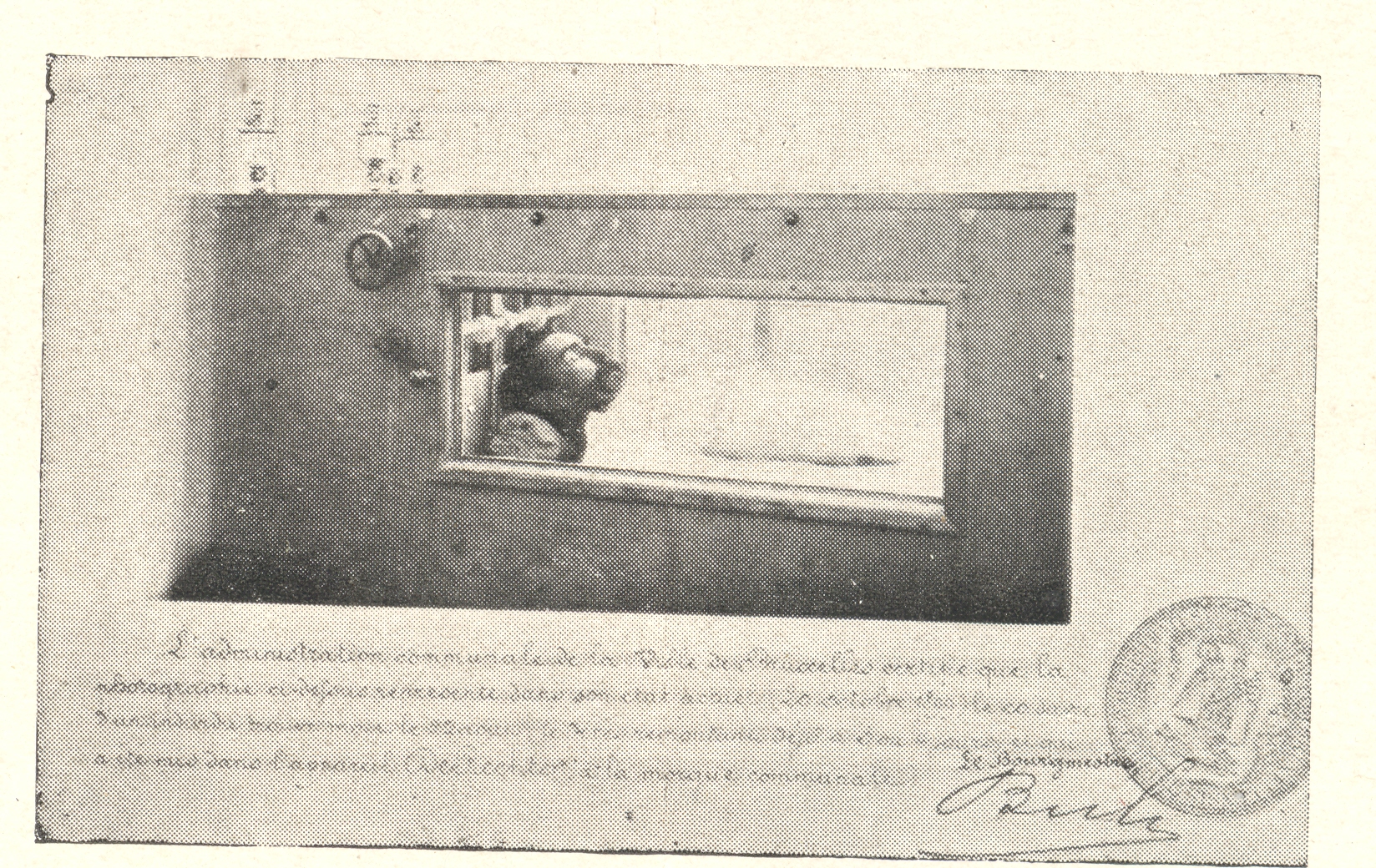
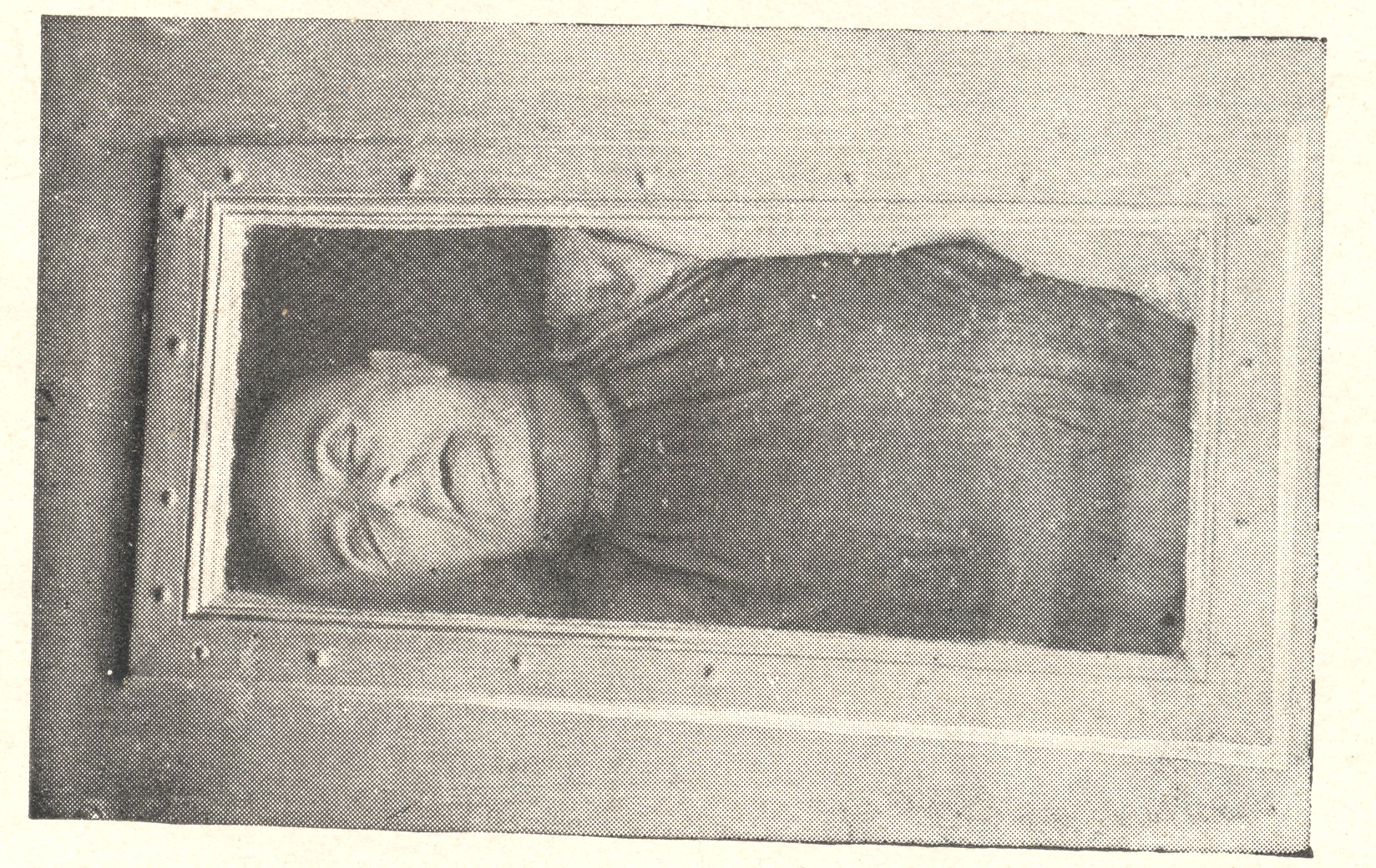
    (The images here are from the pamphlet, with de Rechter showing the effects of his nasty spray on corpses and what they looked like after some months sleeping in their formaldehyde cocoons.)


    ·Posted by :

    ·in:


  • Medical Quackery: the Invention of Baldness and the Testicular Electrical Suspenders

    JF Ptak Science Books LLC  Post 747  Blog Bookstore

    ++blog++baldness Well. 
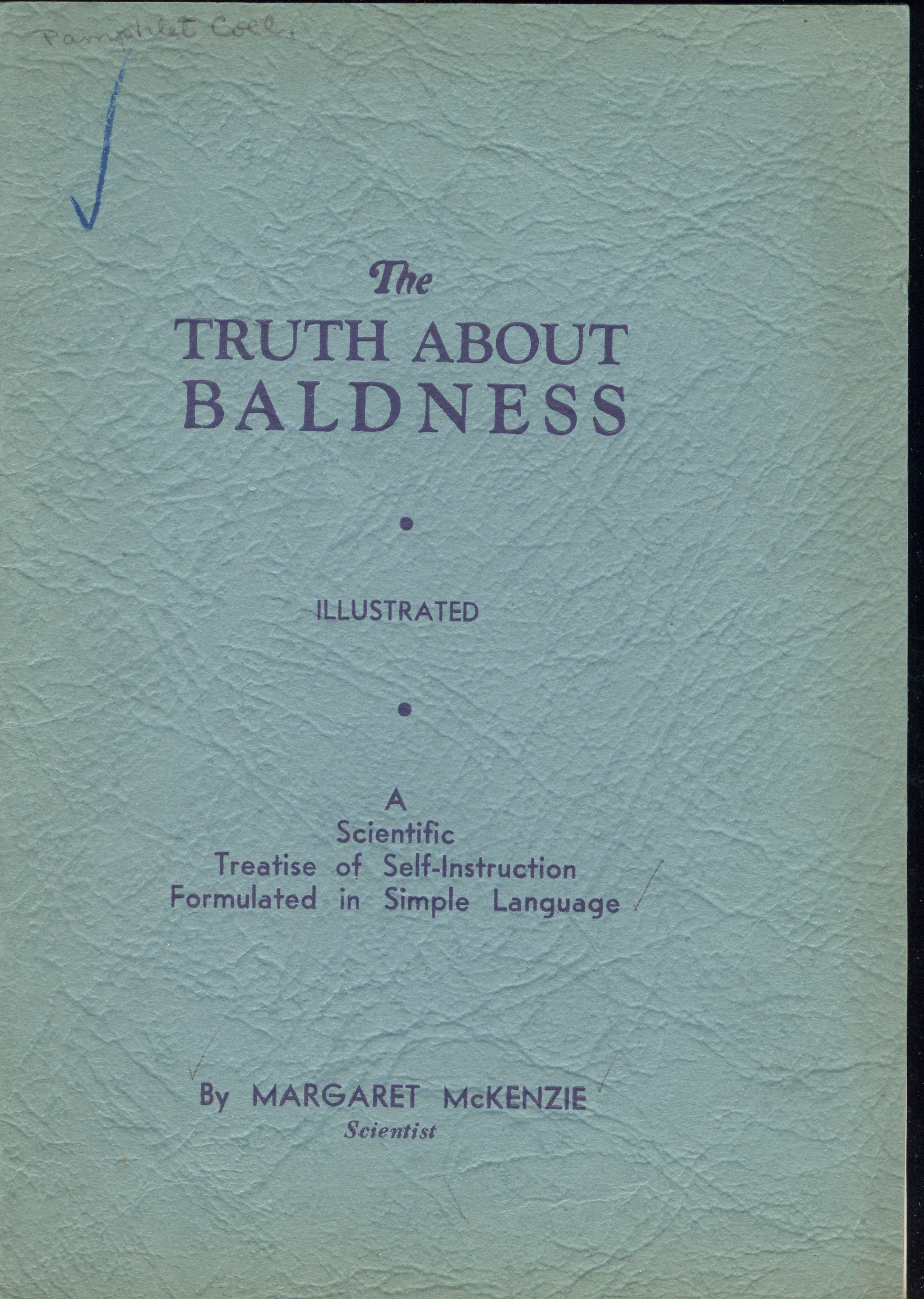
    Margaret McKenzie (“Scientist” with a capital “s”) wrote this simple
    treatise in 1934, claiming that she had discovered what caused baldness and
    knew how to “grow hair with ‘Natural-Science’ ”.  Answering her own call to baldness, and “after
    eighteen years of exhaustive study”, Margaret “emerged triumphant…and uncovered
    this thing baldness [sic]” with her discovery which would “banish baldness
    forever and thus wipe out the bald head which is my aim [sic]”.   Margaret’s
    gift to “Man-Kind”, her discovery, boils down to fifteen  words: 
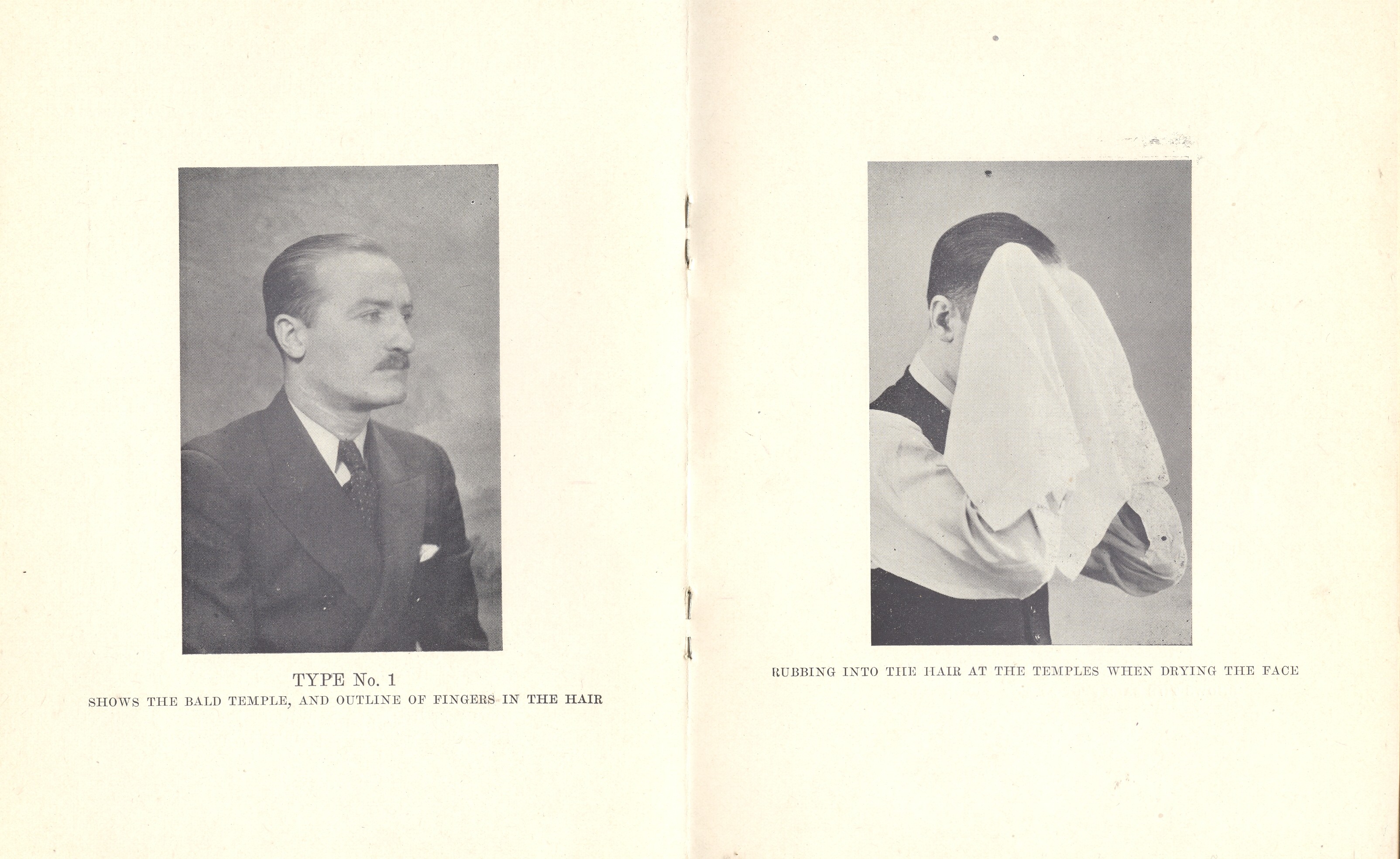
    don’t rub your hair when washing your face, and do not smooth your hair
    down with your hands.  That’s it.  Or almost it:   we are told later that it is best to shampoo
    your hair in a sink, and then if one must shower or bathe to use “a rubber
    shower cap so as to not expose your hair to water”.  I’m not sure how that holds together. 

    ++blog++baldness pics

    The great art of Margaret McKenzie is that that
    like any great salesperson she was able to spread this tidy discovery over 15
    pages.  She strays off-topic only a few
    times, once when discussing her cure for dandruff, and another when she states
    with sublime magnificence that “the bald head era dates back to the 15th
    century”.  The cause of the great onset
    of baldness, by the way, was the invention of the haircut, which led to
    smoothing down the hair and to rubbing the scalp (at the temples) when drying
    your face after washing.  Evidently haircuts
    didn’t exist before 1400. 

    Sometimes all one can do is say “wow!”.

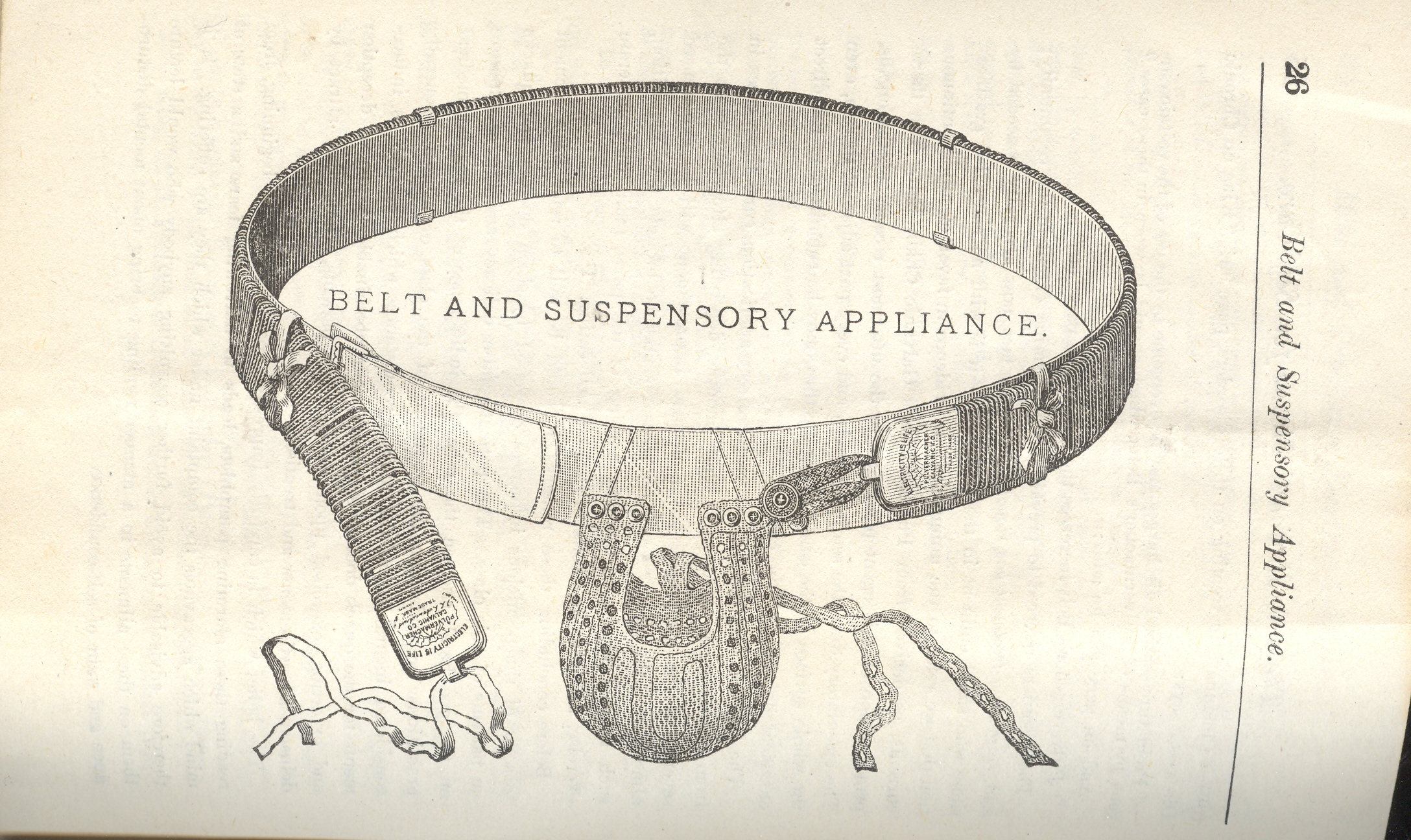
    ++ebay--testi belt 1 And a trailing, eyebrow-arched, questioning  “wow…” is about all you can say about Pulvermacher’s Electric Belts &c/ Electricity Natures Chief Restorer, Self-Applicable for the Cure of Nervous and Chronic Disease without Medicine (printed ca. 1880), which features an electric “chain” in a belt connected to a “suspensory” for a man’s vitals. It is one of many, perhaps hundreds, of electrical geegaws that climbed aboard the principles of Michael Faraday’s monumental invention of the induction coil (1831)–one can hardly imagine what Mr Faraday would’ve thought of this application of his great addition to the history of technology. This electrical stimulus was supposed to cure all manner of unspeakably lingering medical tragedies, including spermatorrhea, exhausted vital energy, female complaint, inflammation of the prostate gland, seminal weakness, kidney disease, cramp, lost manhood, paralysis, indigestion, dyspepsia, spinal complaints, nervous debility, and of course the “debilities of sexual self-pollution” (“the sexual sin (which) is the most destructive of all human vices…the greatest outrage against Nature’s sexual ordinances that man can possibly perpetrate”.  Isaac Pulvermacher’s (which is German for “gunpowder maker”) electrical medico-contraption was popular for several decades in the mid/late 19th century until it faded and trailed away at the turn of the century, though it was not for the lack of trying.  Pulvermacher had all manner of glowing letters of support for his product, though one wonders if they

    ++ebay--testi belt 3

    weren’t mostly cooked up on the back burner of a two-burner stove top, much in the way he invented this bizarre electrical device and pathologized aspects of male sexuality. 

    ·Posted by :

    ·in:

    —

  • Sarah Mapp, Shape Mistress: a Bone-setting “Osteopath” of the 18th Century

    JF Ptak Science Books LLC  Post 723  Blog Bookstore

    Bibliodyssey, a fantastic, unstoppable resource for endlessly interesting images and ideas, celebrates its 1000th post today.  Its creator and master, “Peacay”, has provided a tremendous visual resource to those interested in history and design and art and all manner of oddiana, important and not, big and small, significant and ephemeral.  I estimate that in his 1000 posts that there must be 10,000-20,000 images.  It is a beautiful and exhaustive site of high quality, it is hard to think of it all being created and maintained by one man.  It exposes its readers to such a expanded selection of very highly unusual sources that it is impossible not to come away from each post with an idea.  

    ===blog==aug 22==sarah map

    Looking at his post today—which is a review of the most popular/interesting posts, I worked my way through the “remarkable people” segment and came across some extraordinary, outsider-y, edge-of-society folks.  There were those more interesting than Sarah Mapp—the person I’m choosing to write about right now—though I think none have  a more curious, ethereal or causative descriptor than she.  She is referenced as a shape mistress.  

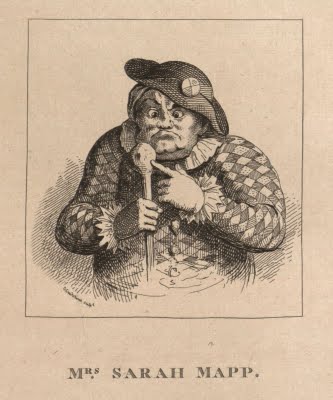
    Sarah was one of the most famous of the 18th c (ca. 1730’s) women “doctors”/quacks/potent peddlers/pill makers/medicant dabblers, and was evidently a “colorful”, unique package of a person.  A daughter of a bone setter, Sarah was described as one herself, as well as a “shape setter”, which is just simply a beautiful term. She was born Sally Wallin until her marriage to Mr. Mapp, who beat and abused her soon after marriage, after which, evidently, she took to London to ply her trade.  Ms. Mapp rode in a glorious chariot pulled aby a four-horse team, charging 20 guineas a session (at times), and would make her return trip with the crutches of those she had cured displayed proudly on her coach. She was successful—I’m not sure what that actually means, probably that she reset broken bones without causing deformities—and then not so.  Forty years after her death, aristocrat and physician Percival Potts sought to scrub Ms. Mapp (also known as “Crazy Sally of Epson”)  from medical memory, calling her “an ignorant, illiberal, drunken female savage”. (This sentiment was echoed in an 1884 edition of the American Journal of Pharmacy, vol 93. page 534, which less fluently descirbed her as an drunken, ugly, gross and cross eyed sot.)

    Ms. Mapp was a (wild?) maverick in a very small field of women practioners, a collection without collective, never joined or organized.  High case of weird or not, she was a significant figure in getting women into a more public place, dealing with women and men, a certainly uncommon occurrence. 

    See:  Power and the Professions in Early Industrial Britain, by Penelope J. Corfield, 1995.  http://bibliodyssey.blogspot.com/2007/05/remarkable-persons.html

    ·Posted by :

    ·in:


  • Asclepius, Modern Medicine and Health Reform

    JF Ptak Science Books LLC  Pos 698  Blog Bookstore

    Our exhausted elected servants have
    retired to their native haunts, spent perhaps by their efforts to noodle
    through a desperate plan to reform our national health care mess. It may be
    that they’ve retired to make good on their wakening efforts on health care, and
    go full throttle into sleep-and-dream efforts. 
    They might be able to find something there. At least for some of them
    there may be not a great difference between their awake and their asleep
    reasonings, so few will get injured. 

    ==jblog==july 26==ascelpius

    This is not without precedent; and as
    a matter of fact dream mental and physical therapy is far older than any sort of
    medicine that we recognize as “moderns”. 
    The dream temple was in extensive use in Egypt some 4000 years ago; people
    attended the temple and through various means entered a trance state, after
    which their visions/dreams were analyzed for medical benefit.  It was in many respects a hospital of dreams,
    with treatments ranging through the expansive gamut of sacrifices to the appropriate
    deities, sweating, fasting, bathing, meditation, sleep, and of course, more
    sleep.

    But the one degree of separation business
    connecting health care reform with sleep-thinking is Asclepius, on whose pillow
    the legislators can feel safe and comfortable. 
    In ancient Greece

    The connection between modern
    medicine and sleep and dreams is the staff of Asclepius—a snake-entwined staff,
    which is the very symbol of modern medicine. 
    In ancient Greece
    ,
    people in need would go to their Asclepieion and take their treatment, again
    consisting of fasting, prayers, meditation and sleep.

    The connection between modern
    medicine and sleep and dreams is the staff of Asclepius—a snake-entwined staff,
    which is the very symbol of modern medicine. 
    In ancient
    Greece
    the first step in attending the benefits of an Asclepieion was to sleep in its
    outer courtyard, waiting for a vision of the great Asclepius, who would be recognized
    by this very staff.  Once the pilgrim
    achieved this first level of dream/sleep/vision they could proceed to the
    interior of the temple and seek their treatment.  Perhaps now that the Congress is on vacation
    they might be more attuned to the possibility of entertaining a helpful sleepytime
    vision from the iconic benefactor of modern medicine, and  proceed accordingly.


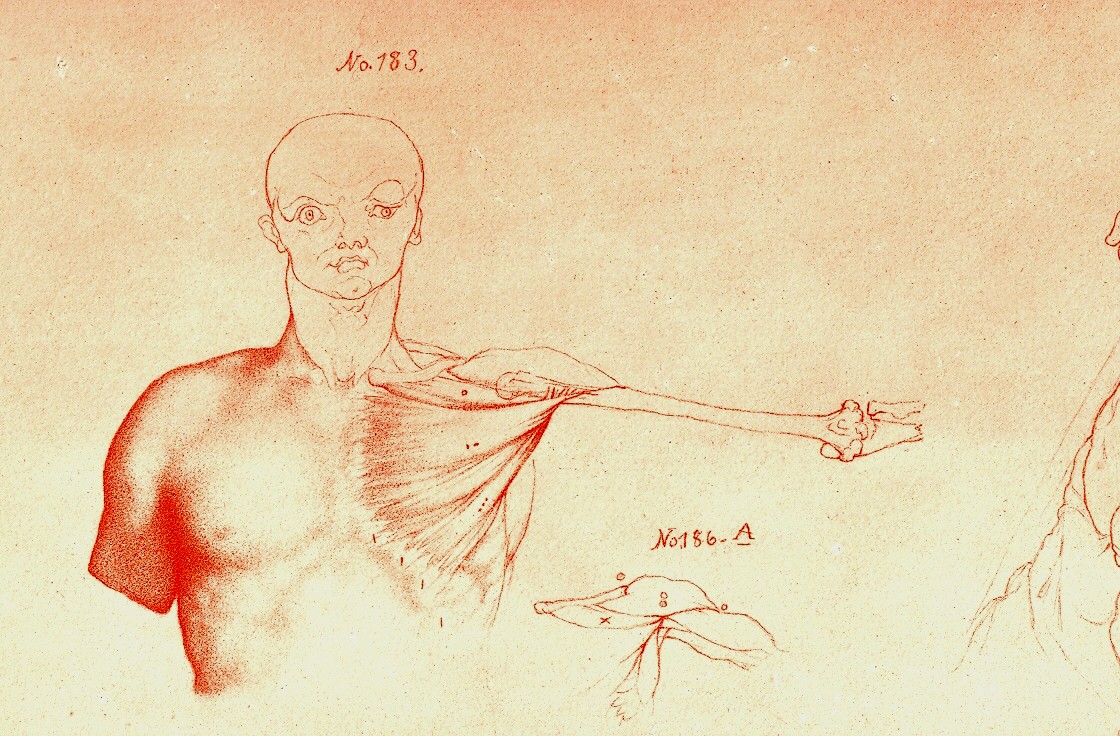
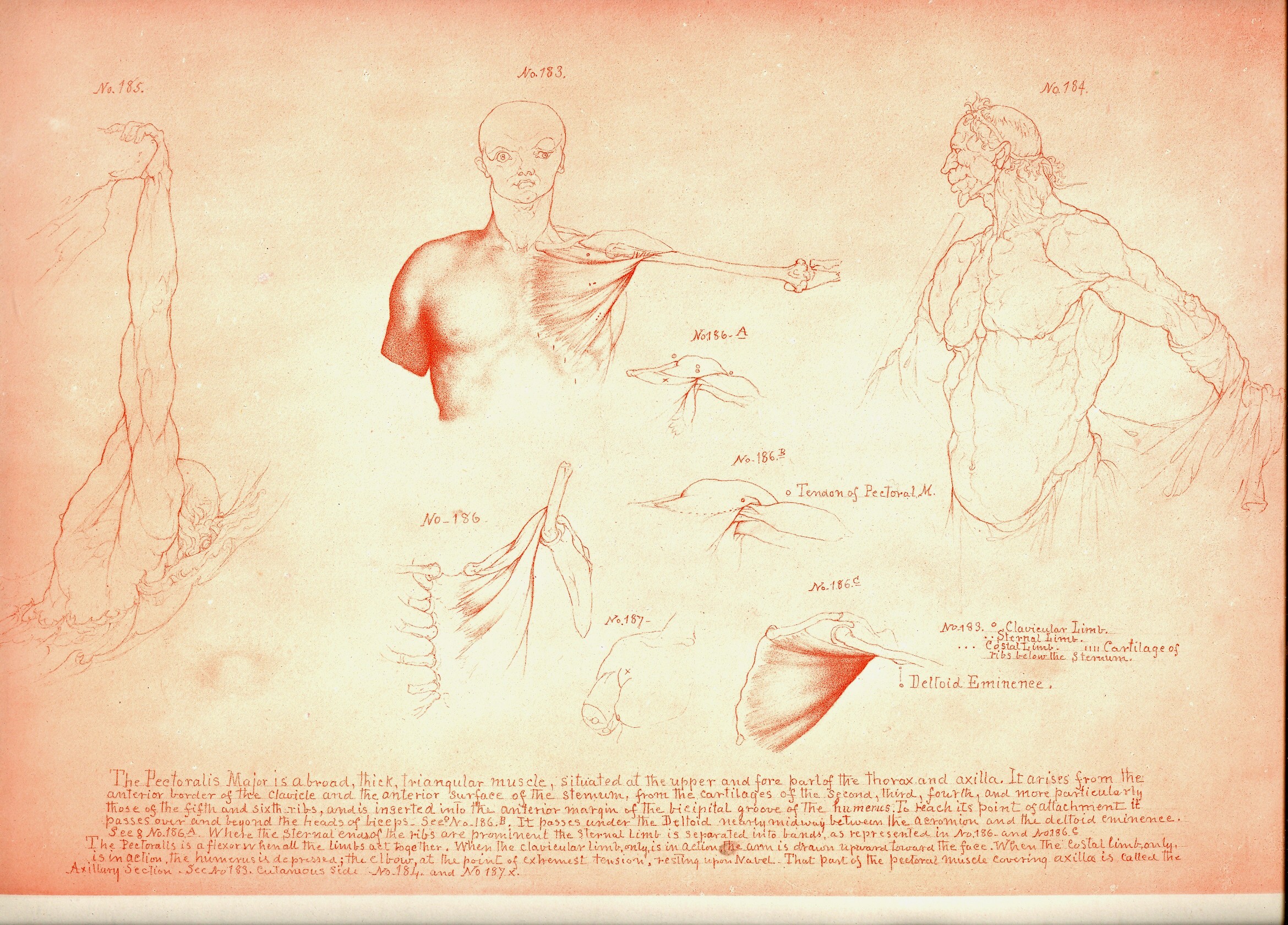
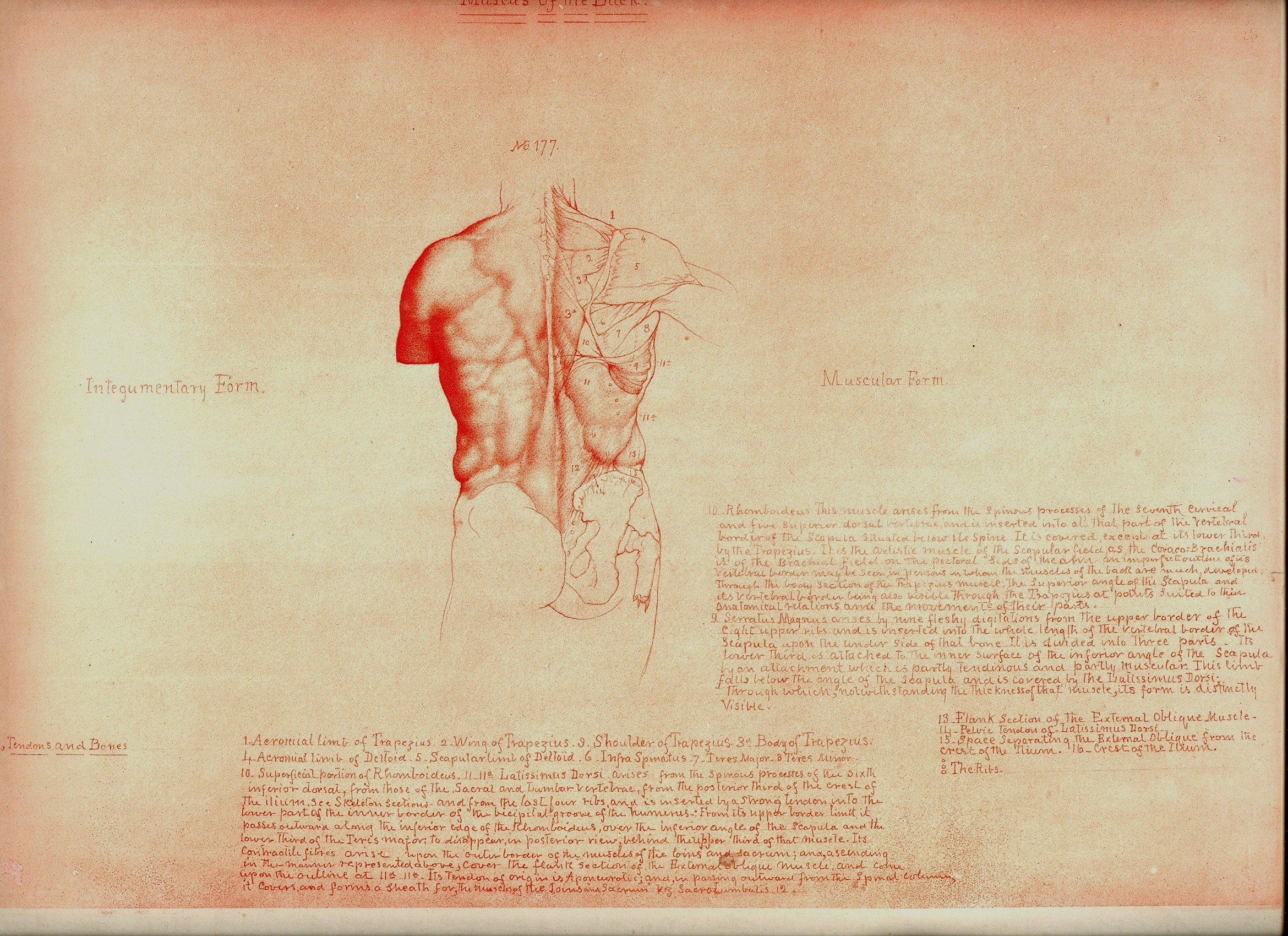
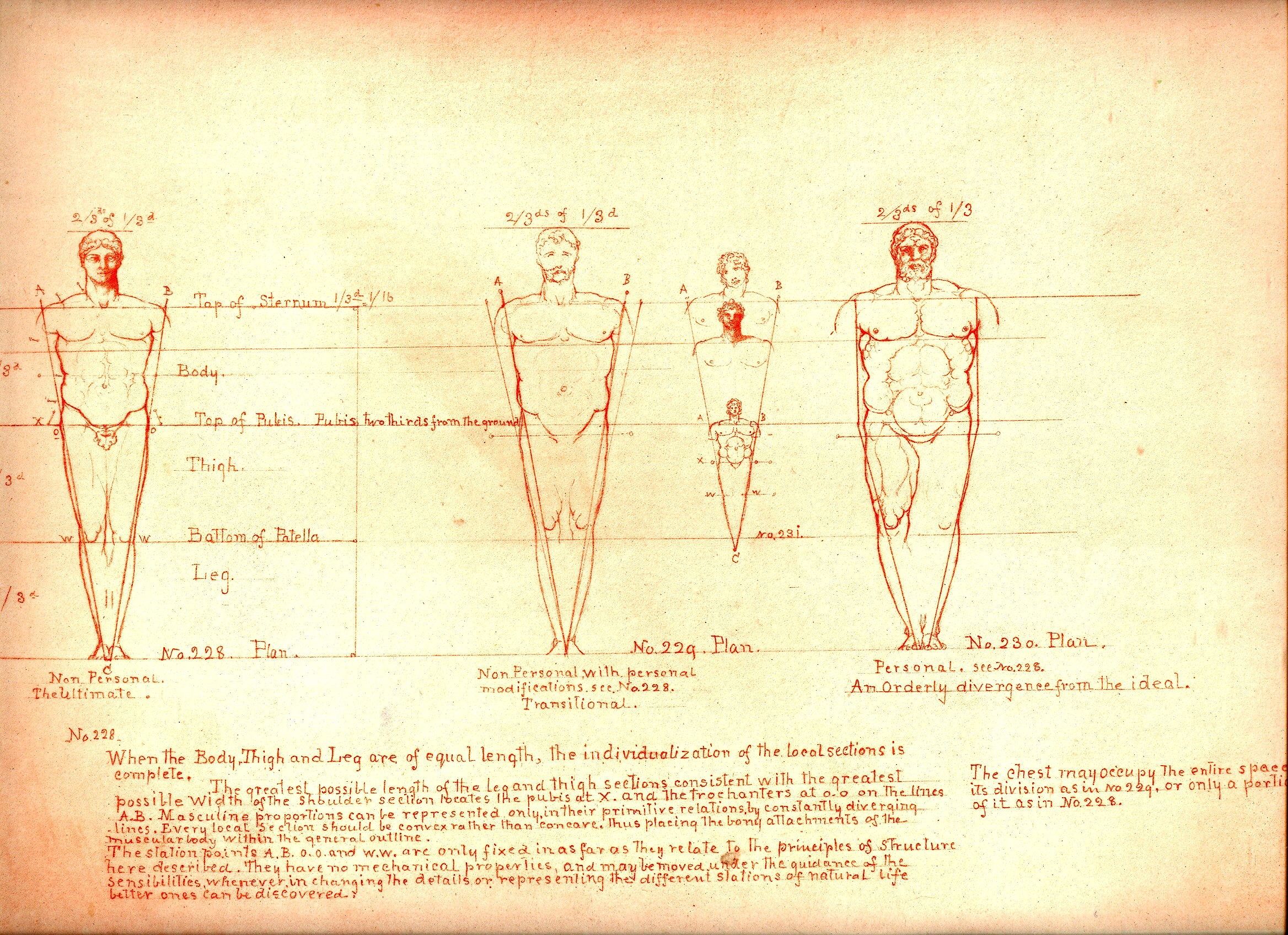
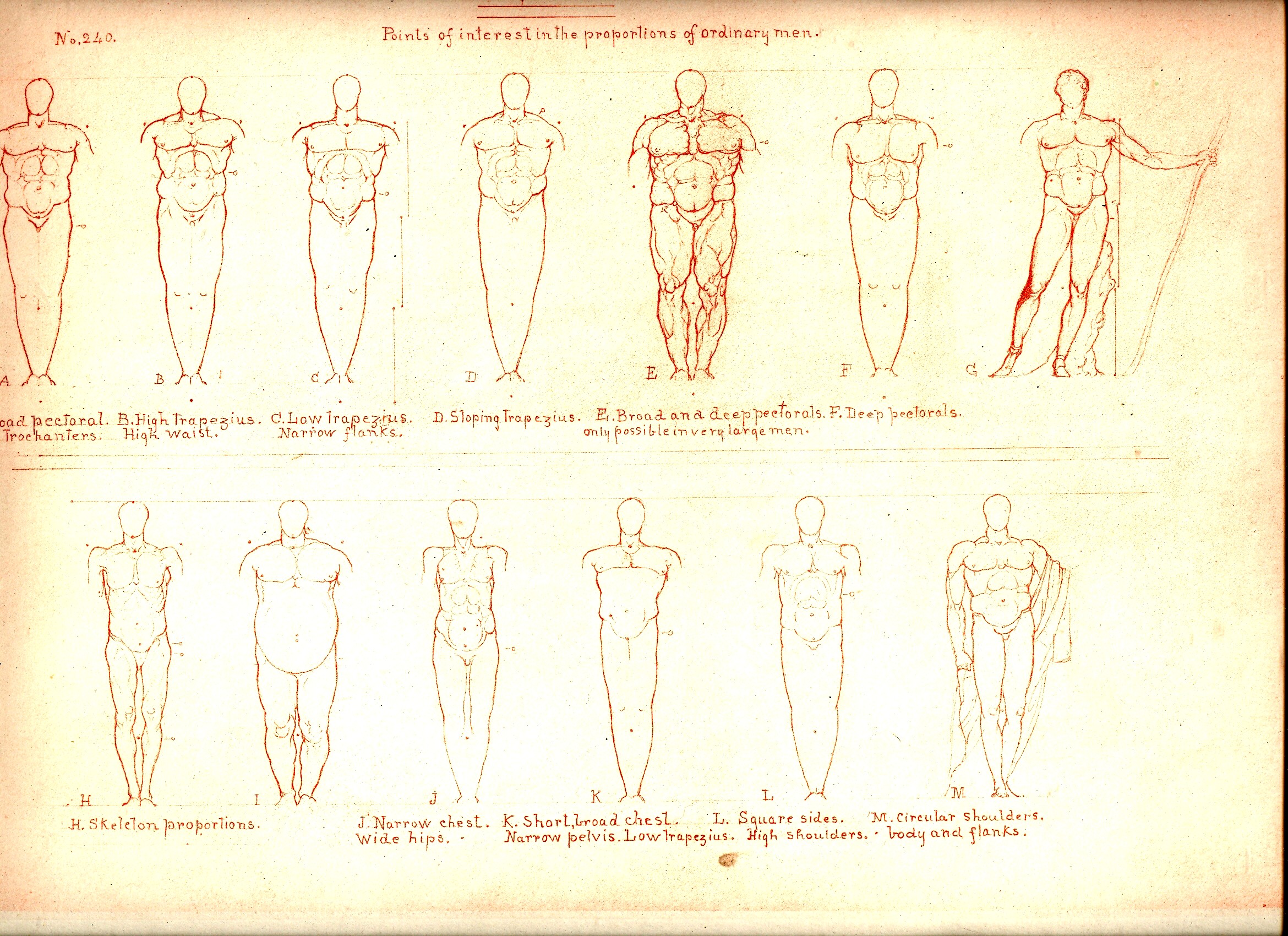
  • Dadaist Images in 19th Century Prints: William Rimmer’s Artistic Anatomy, 1877

    JF Ptak Science Books LLC  Post 667

    Blog==June 29--rimmer pecs det Looking at old prints sometimes reveals more
    than just their own history, simple or not: 
    there are, from time to time, subtle bits of otherness that creeps into
    the image, if you allow yourself the time to see it.  And sometimes looking at images of the past
    reveal a little of the future, or the possibility of the future.
    Blog==June 29--rimmer pecsBlog==June 29--rimmer backdet

    I wrote a little about this in the odd
    art/color textbooks of the pre-Kandinskian Emily Vanderpoel , about whose color
    theory I still understand not at all, though the images that she produced as
    illustrations to these bizarre theories are stunning, pre-modernist, and unintentional
    creations.

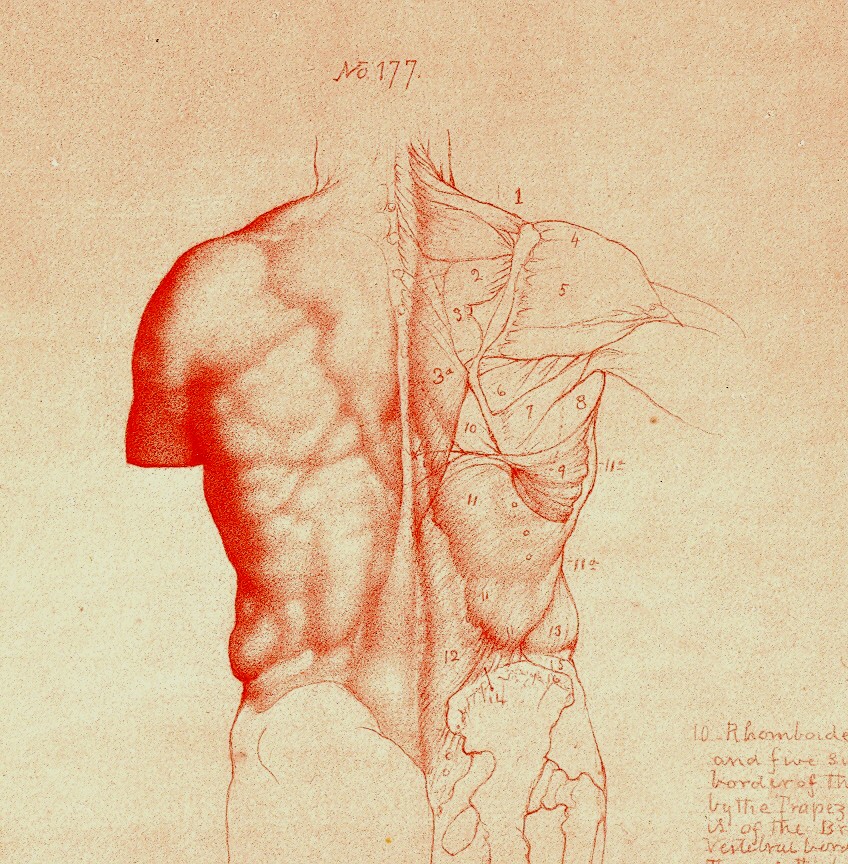
    William Rimmer’s (1816-1879) Art Anatomy (1877 and subsequent
    printings) is another such adventure. 
    Rimmer was a very accomplished artist, and was also a fine
    anatomist.  He was very concerned and
    interested in what happens to the skin, forced into action by all of the stuff
    underneath it.  He pursued the movement
    of muscle, and bone, and the interplay of the two, and produced a wonderful
    exponent of artistic anatomy. 

     And inside
    of these images is something else, sometimes. 
    There is an undoubted Leonardoesque quality to many of his drawings, the
    figures appearing with deft lines and interesting shadings, many times

    Blog==June 29--rimmer back

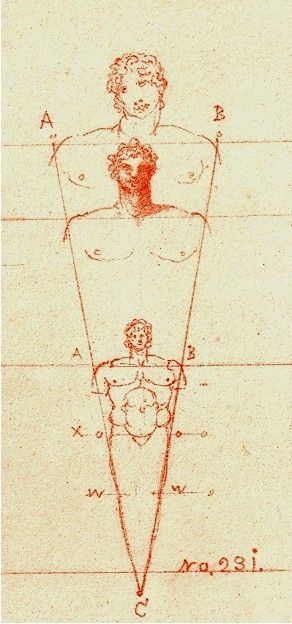
    surrounded by the author’s notes and explanations  But there’s also something else—some of the
    images are just, well, a little bizarre given the time in which they were
    executed.  Some of the details are
    positively modernist, begging to be identified as a 1920’/1930’s creation, or
    Dadaist, or something—just not 19th century.  I’ve included some further examples below

    Blog==June 29--rimmer little man .

    Blog==June 29--rimmer muscle


  • The Physician Discovers the Patient: Paul Barbette 1675

    JF Ptak Science Books LLC  Post 648  Blog Bookstore

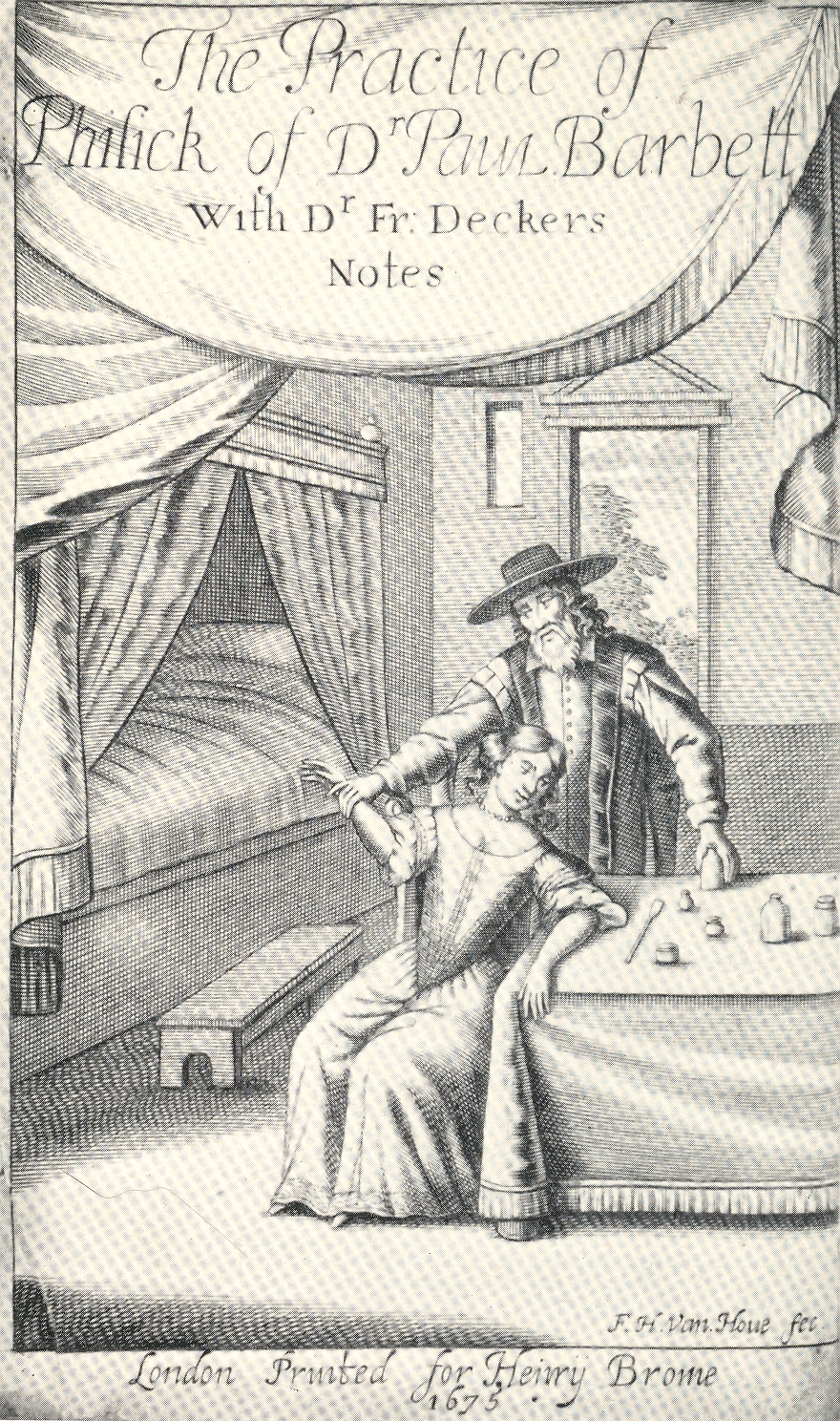
    Blog--jun 12 barbette Paul Barbette was an accomplished physician with a good touch for his patients, as we can see here in the title page illustration of his The Practice of Physik of Dr. Paul Barbette…, published in 1675.  Barbette (1620-1666 or so) was a celebrated Dutch physician whose many works were more a collaboration of experiences in his practice and classic works in medicine than they were of his own thought and creation.  The image of the physician interacting with his patient seems to me to be much more charitable than in other Doctor-patient images of these times. 

    Barbette certainly was a product of his time, writing of diseases of the upper body and treating them in the sustained manner of the mid-17th century, plus that of superstition and ancient herbals.  For example, the mugwort’s “old roots pulled from under the root of the mugewart” was a good curew for falling sickness, and must be harvested on the eve of St. John the Baptist “about twelve at t he night”.  He was also not afraid to use and apply “Crab’s eyes” and hog’s blood.  One thing he was not in favor of, however, was bleeding.  Sweating, yes, but not bleeding.  Perhaps though his most important contribution beyond accumulating a vast amount of medical information was his collection o patient histories and his interactions and interviews with them during the course of treatment.  A good idea today, not much practiced or so it seems.

    (Yes, the physician is determining the pulse of the patient in this image.  The idea of the pulse is as old as Galen but not understood until about 40 years prior to the publication of this picture with the work of William Harvey (1578 – 1657). Well it was understood about a century before that with the work of Michael Servetus, but his publication on pulmonary circulation was almost completely destroyed and its author burned at the stake for his religious temerities, so it remained for Harvey to rediscover in another century.)

    ·Posted by :

    ·in:


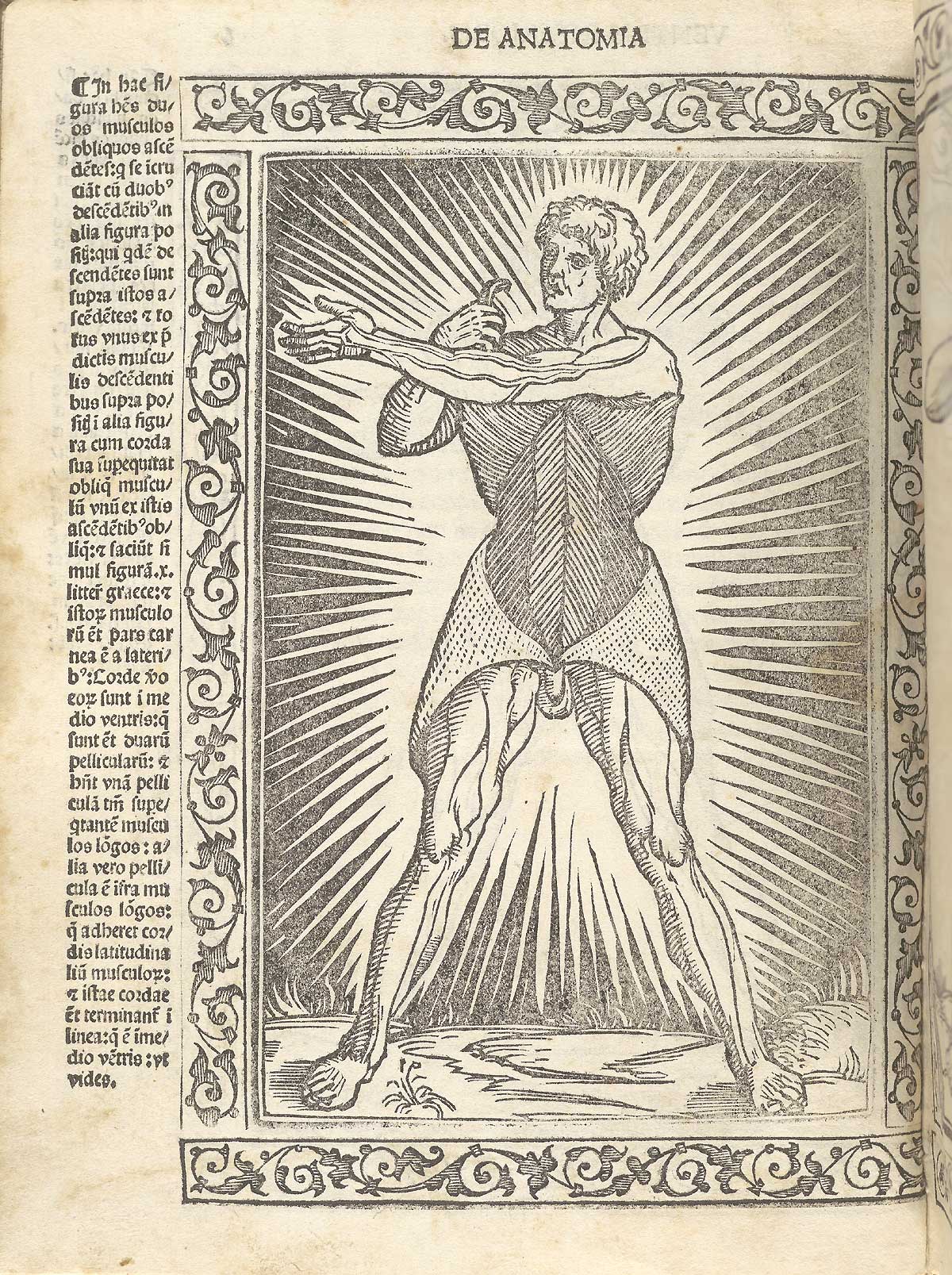
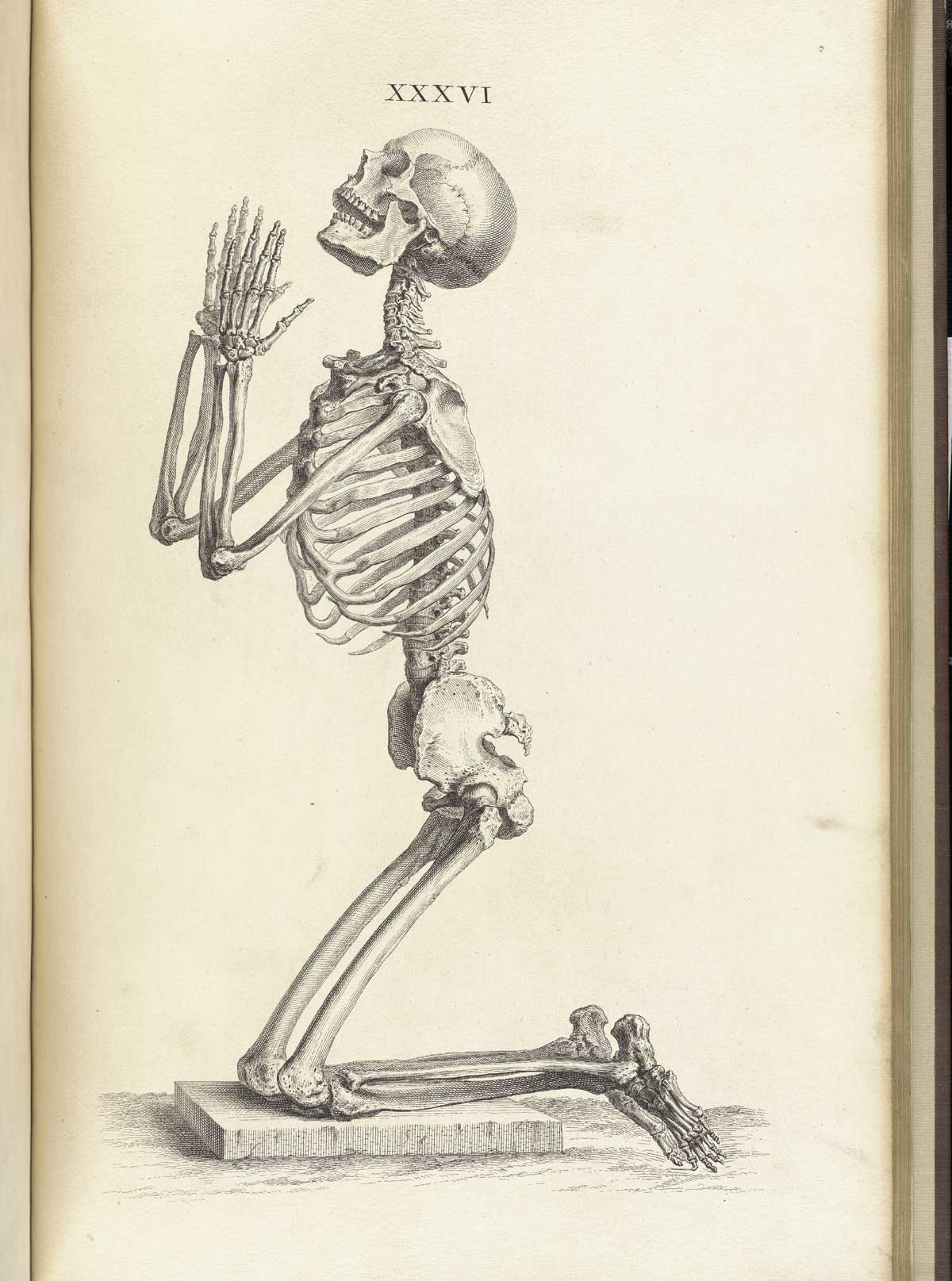
  • A Bit on the History of the Insides of Things: Renaissance Anatomy

    JF Ptak Science Books LLC  Post 604   Blog Bookstore                                                      

    Much of human intellectual history has been dedicated to looking inside, seeing
    the unseen, the stuff underneath, the invisible, the clouded, the inscrutable, the
    things-behind-something-else.   If you could somehow weigh all of the stuff that
    we know that is “visible” versus all of the other stuff that is not, I think that
    the scales would fly over instantly into the world of the unseen. Some of this
    material though does not have a measure:  for
    example, numbers are part of the unseen world, ideas made of nothing, points
    and lines in an imaginary series of planes and dimensions, and so have no mass
    themselves. Everything that is alive on and in our bodies, on our skin,

    Blog--may 5 skeleton

    in our
    water and food, and which were all basically unknown until the invention if the
    microscope, have little weight in and of themselves, but when  you add the whole biota together…well, then
    you’ve got a whole weighty lot of nothing  Then there’s the stars unseen beyond the six
    or eight thousand that we can see without a telescope, the rest of the universe
    waiting, discovered only 400-odd years ago, a very weight affair (and that’s not counting the dark matter). 
    I know that this is sort of a horrible argument, a beery and inelegant way
    to describe the path of human knowledge, but it strikes a (dis)chord with me.  

    One part of this invisible empire is within us—the elements of our bodies.  The Egyptians knew enough to do very simple
    surgery and to perform a more-complicated mummification ritual, but in general
    the body remained fairly well undiscovered until relatively recent times.  Publishing findings on those dark
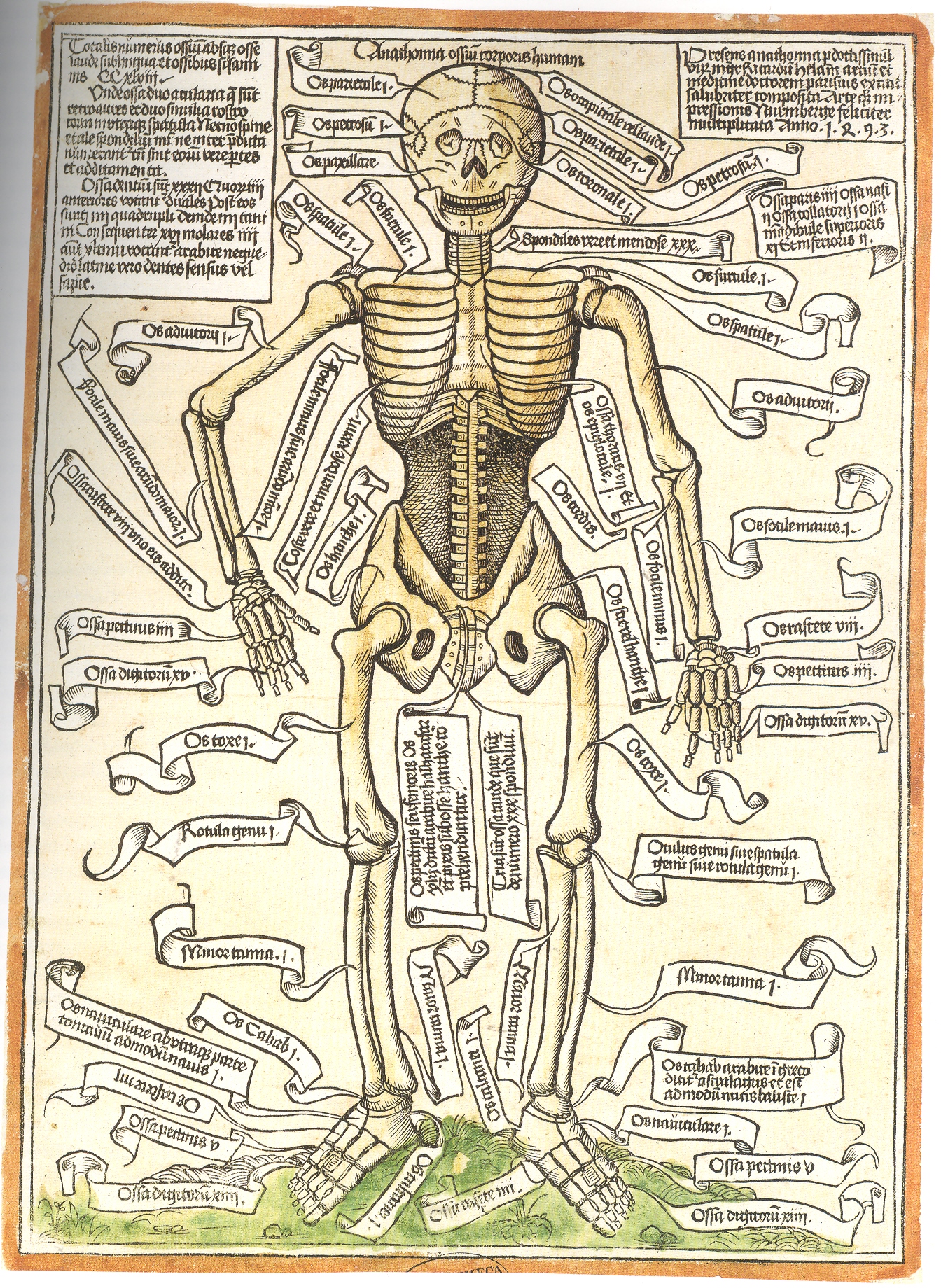
    explorations was another matter, the first image of a human skeleton not
    published until 1493 (shown here, the Anathomia ossium corporis humani)–this was the first revelation to the real world of science following a sleepytime of about 8oo years under the very heavy gaze of institutional religions. 

    This all changed in 1543 with the publication of the first modern anatomy , Vesalius’s revolutionary De Humani Corporis Fabrica—it proved to
    work as a template for the display and presentation of anatomical practices and
    medical rigour for many years to come, solidifying the pursuit of the knowledge
    of the human body into a discipline.  

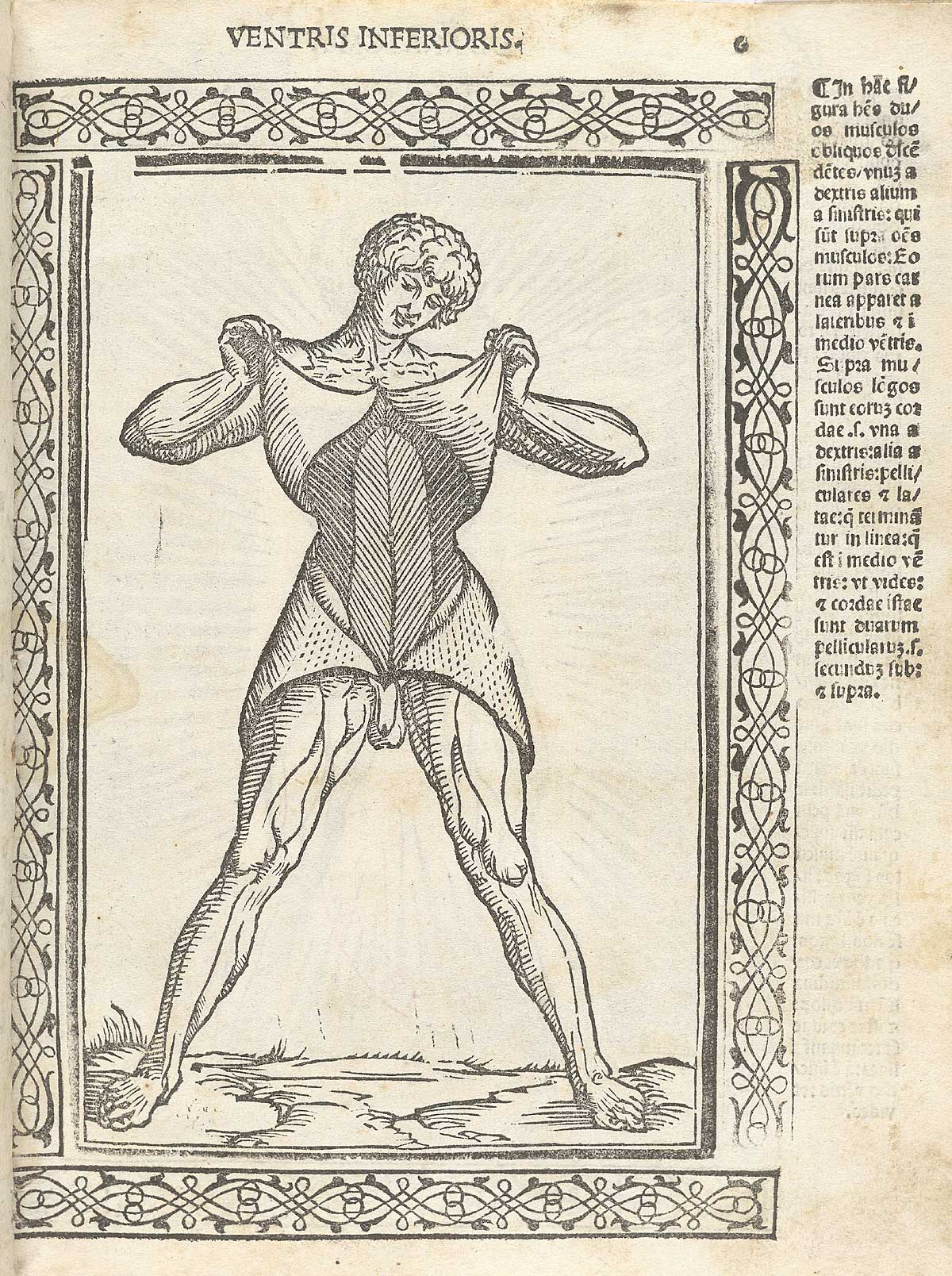
    Berengario_p06r Some of the predecessors weren’t
    so rigorous, as with 
    Jacopo Berengario
    da Carpi’s (ca. 1460-ca. 1530)
    Isagogae breues, perlucidae ac uberrimae in anatomiam humani corporis, who used several of the same images to illustrate different anatomical aspects.  (In  the  two examples right and below show the same anatomical display–the difference is the rather extraordinary background, and that’s it.) An
    other example is 
    Charles Estienne’s 1545
    De dissectione
    partium corporis
    (“On the dissection of the parts of the human
    body”) who simply ran out of scientific steam int the preparation of some of its
    many (lavish) illustrations—he used existing artwork of torsos and simply performed
    a printectomy on them, replacing some of the sections of the print with some anatomical
    detail.  The practice worked well enough,
    but the overall effort did not make it a landmark in the history of medicine. 

    Berengario_p06v

    I just wanted to touch very briefly on the rediscovery of the body in the 1490-1535 period.  To that end I’ve constructed this  table with data  pulled directly from the National Library of Medicine pages
    for anatomies on the web–all I did was place the records in a table so
    that they could be listed chronologically.  The numbers at left are
    clickable
    and will take you directly to the images of the work at the
    NLM site.  This is just a sampling of anatomies, though it may prove to
    be highly useful for folks in the science and the arts. 


    Chronological list:

        Author: Mansur
    ibn Ilyas (fl. ca. 1390).
       Title:
    Tashrih-i badan-i insan. [Anatomy of the Human Body].  Publication Information: [
    Iran, ca. 1390].            

       Author: Ketham,
    Johannes de (15th century).
      Title:
    Fasiculo de medicina.   Publication
    Information:

    Venice: Zuane & Gregorio di Gregorii, 1494.                 

          Author: Hundt,
    Magnus (1449-1519)
    Title:
    Antropologium de hominis dignitate…                          Publication Information:
    Leipzig: Wolfgang Stöckel, 1501.                              

        Author: Berengario
    da Carpi, Jacopo (ca. 1460-ca. 1530).
    Title:
    Isagogae breues, perlucidae ac uberrimae in anatomiam humani corporis.              Publication Information:
    Bologna: Beneditcus Hector, 1523.        


  • A Proficiency of Insult: a Biting Poem on the Medical Profession, 1736

    JF Ptak Science Books LLC   Post 595   Blog Bookstore

    “For even they who compose
    treatises of medicine or natural philosophy in  verse are denominated poets…” Aristotle’s Poetics
    [Translated by Thomas Twining, New
    York 1957]

    Skeleton Edward Baynard (1641-1719) of  London must have been a pinchy/gouty 
    physician.  Or not.  Perhaps he was an overdressed, deeply-dimpled
    fop.  Or perhaps he was skinnily
    invisible, a plain, vanishing custard of a man, scrupulously clean and who
    saved all money, deeply in love with his chambermaid, sleeping on a mattress of
    gold. 

    But what he
    was a definite cynic, occasionally cranky to his own reaching profession.  His poem, Health, a Poem, Shewing How to Procure,
    Preserve and Restore
    It, was a best-selling book, reaching at least
    ten editions during his lifetime.   It evidently contained a number of frugal
    dispensations on achieving health, most of which involved  purging. Or sweating.  Or vomiting. 
    Such was the state of the art, much like our own when viewed from the
    year 2109.  (I overheard a conversation
    this morning in a hot dusty field, a physician saying that we would never simply
    ingest a plil that would render us a new liver. 
    Well.  How would the
    contemporaries of the newly discovered X-Ray have viewed the peek into the
    future of the “discovery” of DNA in 1953, only 59 years later?  And what about the enormous difference in the
    state of medicine and imaging capacities in the 56 years since then?  Phenomenal. 
    It would be nearly impossible to say what developments in medicine await
    the grandkids in their late years?  Or in
    300 years?  Hypo-livers in
    Dixie  cups, I say.)

    Returning
    to Dr. Baynard—he summarized the ten most important words and concepts in
    medicine in the second  poem of his book, as follows.  He held little in
    reserve.

    “For some
    of the ten are always advised:

    Piss,
    spew and spit

    Perspiration
    and sweat

    Purge,
    bleed and blister

    Issues
    and clyster

    These few
    enunciations

    Cure all
    the doctor’s patients

    If
    rightly applied

    By a wise
    physic guide”

    Indeed. 

    [“Clyster” is
    an enema;  “an  ‘issue’ refers to
    the Galenic practice of creating an infection at some designated spot on
    the body because of the belief that some kind of ‘sympathy’ between the illness
    and the localized pool of pus would draw the illness out of the body”. ]

    ·Posted by :

    ·in:

    —