A Daily History of Holes, Dots, Lines, Science, History, Math, Physics, Art, the Unintentional Absurd, Architecture, Maps, Data Visualization, Blank and Missing Things, and so on. |1.6 million words, 7500 images, 4.9 million hits| Press & appearances in The Times, Le Figaro, Mensa, The Economist, The Guardian, Discovery News, Slate, Le Monde, Sci American Blogs, Le Pont, and many other places… 5000+ total posts since 2008.

Category: Future, History of the

  • The Computer Cyborg of 1867–the Typewriter

    JF Ptak Science Books   Post 1635

    “The most ignorant person at a reasonable charge, and with little bodily labor, may write books in philosophy, poetry, law, mathematics, and theology, without the least assistance from genius or study.”   Jonathan Swift, in Gulliver’s Travels (actually called Travels into Several Remote Nations of the World, in Four Parts. By Lemuel Gulliver, First a Surgeon, and then a Captain of Several Ships, printed 1726).


    https://historyofideasblog.com/a/6a00d83542d51e69e20133f2973d9a970b-pi

    Every age, every generation has a calling to the future that once that particular future arrives looks sometimes strangely like a past that was much further away than it was. Such is the case here, in September, 1867. in the pages of London’s Punch Magazine, when Mr. Punch rhapsodized on the future possibilities of the new invention, the typewriter. [Related items are available at our blog bookstore, here.]

    “Good News for Bad Writers” announced to the readership:

    “Writing Superseded.—Mr. Pratt, of Alabama, is the inventor of a typewriting machine, lately exhibited to tho London Society of Arts, which is said to print a man’s thoughts twice as fast as he can write them with the present process. By a sort of piano arrangement the letters are brought in contact with carbonised paper, which is moved by tho same manipulation,”

    The editor of Punch sniffed out a deeper deal in the typewriter than simple legibility:

    “Every author his own printer! What a happy state of things! No more struggles to write legibly with nibless tavern-pens: no more labour in deciphering the hieroglyphs of hasty writers. Literary work will be in future merely play—on the piano. The future Locke may write his essays by a touch upon the keys.”

    But the disappointments of the possible future wouldn’t stop there, and would or could or should go screaming into the dark night, the invention marking time in the brain of the writer, making able for him or her to compose without thinking, pillows taking over for the mind:
    “In this inventive age there really is no saying where discovery will stop. Now that authors are to put their thoughts in print with twice the pace that they can write them, perhaps ere long they will be able to put their works in type without so much as taking the trouble to compose them. A thought-hatching easy chair may very likely be invented, by the help of which an author may sit down at his ease before his thought-printing piano, and play away ad libitum whatever may occur to him. Different cushions may be used for different kinds of composition, some stuffed with serious thoughts, fit for sermons or reviews, and others with light fancies, fit for works of fiction, poetry, or fun. By a judicious choice of cushions an author will be able to sit down to his piano, and play a novel in three volumes twice or thrice a week, besides knocking off a leader every morning for a newspaper, anil issuing every fortnight a bulky epic poem, or a whole encyclopaedia complete within a month.”
    https://historyofideasblog.com/a/6a00d83542d51e69e20133ed533188970b-pi
    This is not too terribly off the mark from the conversation/writing machine from Swift’s Gulliver in Laputa, except of course that this device (that I wrote about here) came 161 years ealrier.  But then again even the framework for this machine didn’t exist; the typewriter did, which at least got the science fiction aspect of its prospective powers going in the right direction in the real, three-dimensional very mentally High Victorian world.
    The typewriter was just another in a series of “robots” from antiquity, of the creation of moveable type printing taking over the job of scribes and scribes over the jobs of story tellers, of fabrications of automata, of rudimentary calculating machines of the 17th century, of the creation of the lighted semaphore, of the electric telegraph, of the telephone, of the wireless, of the radio, television, computer, internet.  Each offered a similar challenge to the people of their day and a similar challenge to their future–some of which came true, some didn’t. I know that Punch was kidding–mostly. 

    Photo

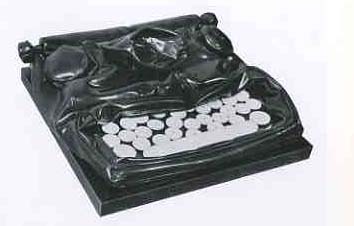
    [Claes Oldenburg’s “Soft Typeewriter, 1963.]


  • Things Not Built: Liberty Landing and Closing NYC Harbor, 1935

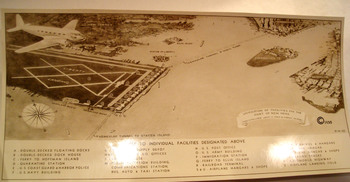
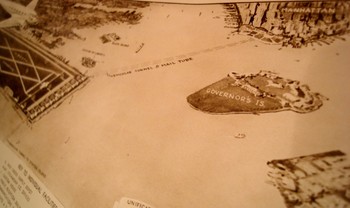
    Dsc04768 I recently uncovered an interesting, unpublished and probably not-acceptable engineering report to extend the ports capacity in the Hudson River at New York City–the ports of the  area being famously over-busy for a long period of time, especially right before World War II.  Charles Palliser and Frederick W. Capon presented a proposal in 1935 for a unification of the port and airport facilities to take care of the overcrowding and overworked problem.

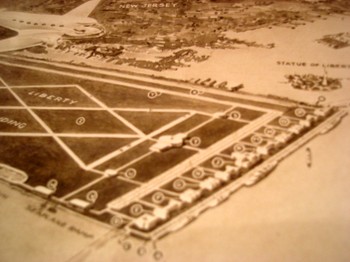
    What they came up with was Liberty Landing, a mile-long and half-mile-wide facility that nearly bumped into theDsc04769 Statue of Liberty (and hence its name).  The plan called for backfilling the “flats” that were just south of Jersey City, as “the natural formation of these were very favorable”, which meant that the airport-port combo would extend all the way into the harbor to the edge of the channel, which would put it further out than the Statue of Liberty, which would also be just hundreds of feet away from the end of the north runway.

    Also attached to the backfill and new land would be a one-mile-long floating dock.  Oh my!

    The floating island would also have vehicular tunnels that connected it to Staten Island and the Battery.  There were facilities for seaplanes, airplanes, railroads, dirrigbles, and trucks, plus a military installation, a custom’s house and the US Mail Service, so that all commerce would converge at this one point, which sounds interesting (for about 20 seconds). 

    Dsc04773
    This is a good candidate for the “Better Left Undone” award for 1935.

    As I look at the photograph of the aerial view of the plan it strikes me that if the designers increased the surface area by only 125% or so they could’ve connected the new facility with Governor’s Island AND Brooklyn, building a land bridge from Jersey City to Coney Island—a superbly bad idea to cap an already strongly bad idea. 

    The report is called, simply, Liberty Landing, and published by the architect in Jackson Heights, NYC, 16 Septmeber 1935.  This is also the U.S. Copyright Deposit copy (accepted 10 October 1935), which is where the history of this project ends.


  • More of NYC Destroyed in Explorations of the Future–“The Last American”, 1889

    JF  Ptak Science Books   Post 1615   Part of a series on destroyed New York City that includes New York City: Attacked by Tentacled Flying Saucers, Giant Flying Snakes, Glaciers, and Mining Missile Space Aliens, 1929-1941 and H-Bomb Wipes out Brooklyn, among others.

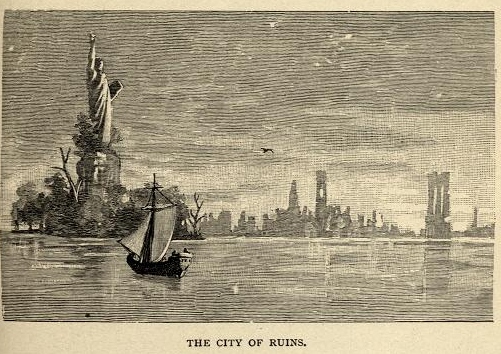
    NYC in ruins  statue lib
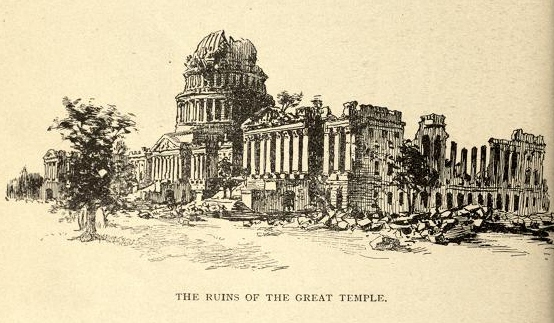
    John Ames Mitchell created quite a world for himself in 1889.  The world he saw in the year 2851 turns out not to support America, or Americans, seeing as how we ran out of luck and envy and possibility and Life.  It is slightly ironic that Mitchell (1844-1918) would write so much about dystopic views of America’s dead culture, as he was the creator and first editor of (the first) Life magazine, a journal dedicated to far less weighty matters (and an early popularizer of populist views of American culture by Dana and Rockwell). 

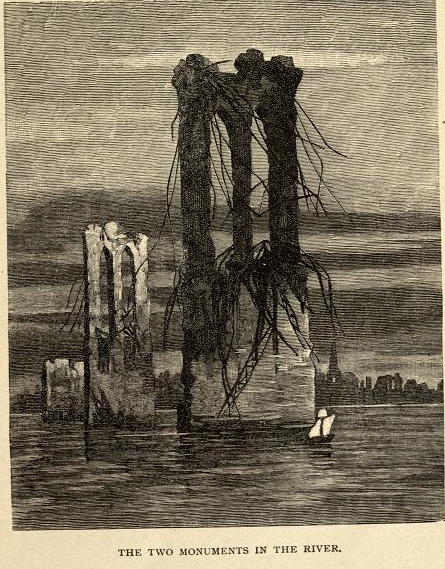
    NYC in ruinbs  Brooklyn bridge
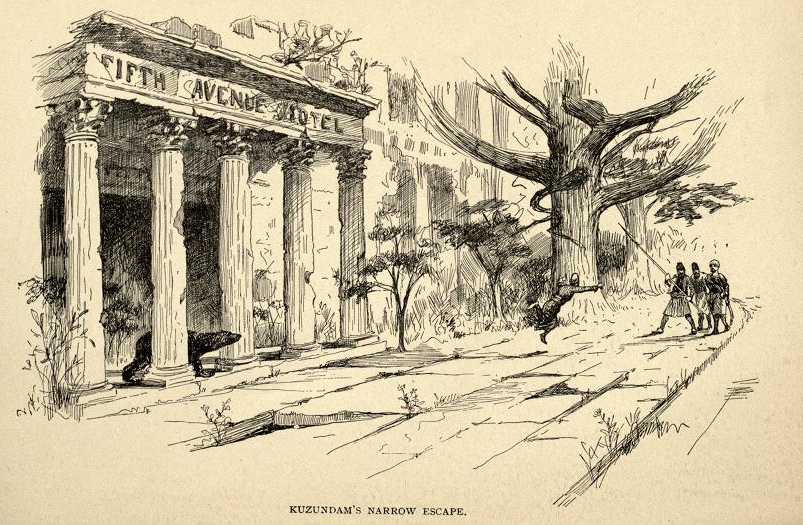
    The Last American (a slight book of 28 pages) is presented as the journal of a Persian explorer (Kahn-li)  a thousand years or so into Mitchell’s future, set off to explore the outer reaches of at-that-time known world, rediscovering the Americas, again.. Kahn-li was intrepid and accomplished:

    “…Curator of the Imperial Museum at Shiraz, and (a)uthor of ”’The Celestial Conquest of Kaly-phorn-ya” and of “Northern Mehrika under the Hy-Bernyan Rulers” The astounding discoveries of Khan-li of Dimph-yoo-chur

     have thrown floods of light  upon the domestic life of the Mehrikan people. 
    "He little realized when he landed upon that sleeping continent what a service he was about to render history,
    or what enthusiasm his discoveries would arouse among Persian archaeologists.
    Every student of antiquity is familiar with their history.
    "
    NYC in ruins  wall st
    The images of New York City in ruin, in advanced decline, in an imagined future of slow death, have always
    seemed haunting to me. The images in The Last American are drawn by the author, and in some later editions
    of the work are supplemented by occasional designs and a few extra images. But Mitchell's work is
    pretty impressive. And daunting.

    NYC DC

    Mitchell also has a nice way of showing how his explorers were trying to make sense of the ruins, figuring out what their intended uses were.  For example, the ruins of the Brooklyn Bridge were more a monumental temple, because the distance between the giant structures and the shore were (for them) to great a span for the things to be part of a bridge.  There’s some good, solid, imaginative imaging going on here. 


  • The Future of War (1888)

    JF Ptak Sciene Books    Quick Post   (Part of the History of the Future series)

      Future Punch Dissolving Views detail
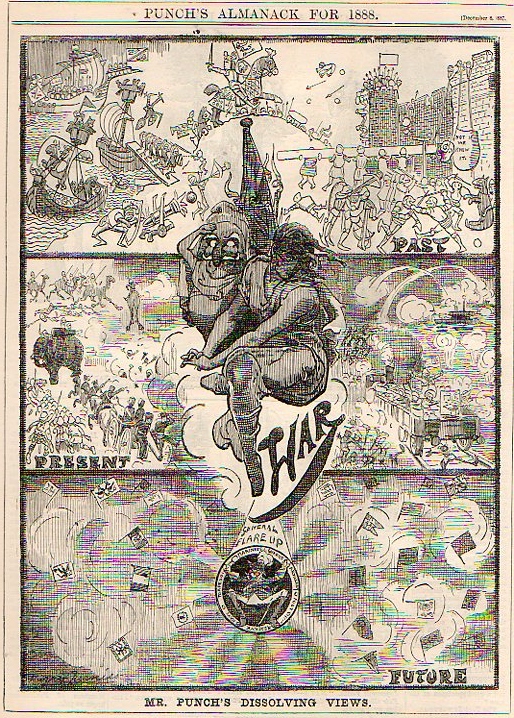
    People really started to understand the future of war at the end of the 19th century.  It was a time during which there was a high altar to high technology, and the industrial/tech/electrical revolutions were well on their way; it was a time in which people felt the enormous weight of advancing technology.

    This image appeared in the 8 December 1888  issue of the London Punch magazine, and foresaw the complications of global conflict in terms of global conflagration. 

    Future war punch845
    This was before the epochal events of 1895 and the X-Ray and the before the understanding of atomic structure (in the work of Thomson and then Rutherford and Curie and Soddy and Planck and Millikan, all of which would take place between 1897 and 1909) that would eventually lead to the unleashing of enormous energy in the form of atomic weapons.  Here, in 1888, we’re till dealing with conventional weapons and their near-future, and the Punch artist, the great Harry Furniss, still saw an exploding world for the next global conflict.  (In 1914 H.G. Wells (in his The World Set Free)  released “atomic bombs” on the world, but his weapons were still measured in terms of conventional explosive, except that they would explode for days on end.)  Furniss’ world-at-war would be a world war, and it wouldn’t take too much time to see that such an insight was correct.


  • The End of the World, Part 6–The Earth as a Bomb

    JF Ptak Science Books  Post 1601

    [I’ve written a number of times on this blog on the depiction of the end of the Earth–as it turns out, it is an uncommon subject for illustration before, say, 1950.  One in the series can be found here, with links to others.]

    Nd world maxim725
    Hiram Maxim–the inventor of the Maxim gun, almost-inventor of the light bulb, and general creative genius–wrote this article, “How the World Will End” around 1905.  He was a man with many answers to his own many questions, and here he Q-Aed himself about the end of the world.  He imagined the end coming in a number of different ways, one of which was set up by the Earth’s own mighty innards.  He imagined large-sale earthquakes and gigantic volcanoes, Krakatoa-sized volcanoes and then some, that would rend the Earth to pieces.

    Nd world maxim726
    But he starts that vision with a very odd inspiration, thinking about the power of the 1883 eruption of Krakatoa, and trying to equate the enormous explosive mission of the thing with something that was somehow doable, somehow understandable in human terms.  And what he comes up with is this–that if all the people in the world working  all time through all time in producing gunpowder and TNT, spending all of their time doing nothing but making explosives, that all of this gathered and ignited would approximate the energy of the Krakatoa eruption.

    Nd world maxim727
    He was wrong on this calculation, as smart as he was–I think just running some numbers in your head would put this thing to sleep.  But there wasn’t very much for him to compare Krakatoa to in 1905, or certainly nothing that he could compare it to that was produced by humans.  In our recent past, though–in a world that would be Maxim’s near-future–human beings have managed to manage Krakatoa-type releases of energy, namely in the form of nuclear weapons.  If we cobbled together 1,400 of the Hiroshima/Nagasaki bombs from August 1945 and detonated them at once, the amount of energy released would approximate Krakatoa.  This explosive force has since been rolled mostly into one bomb–the Tara Bomb, or Kuzka’s Mother–which was released into the world in a test shot in 1961.  That bomb was calculated to be a 50 megaton weapon, scaled down from its projected 100 megatons, and released 1.74×10¹⁷ J(oules), coming close to what some people have calculated the energy of Krakatoa to have been, at 8.4×10¹⁷J  (In a what-the-hell moment of calculation, someone reckoned the output per second of Star Trek’s U.S.S. Enterprise 1701-D to be 1.27×10¹⁹ J–an enormous number.)

    But it is an interesting form to fill up for a short scifi story.  Imagine a worldwide society which, for its entire existence, has done nothing but make the means for its own violent destruction, stockpiling fantastic amounts of explosives in a series of connected locations, waiting for the time in their history to end.  Imagine that generations would spend their time, doing nothing but producing the means for their own destruction that would come at some time.  The entire output of the combined civilizations banded together, branded for annihilation.  All working to a literal common end. 

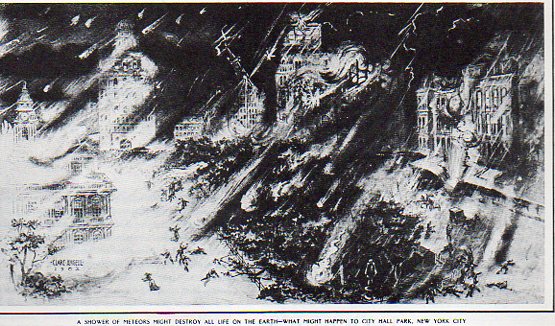
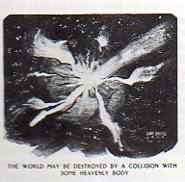
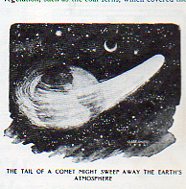
    Maxim saw other bits too in that firey end, as we see in the above illustrations:  for example, in the first image, we see the results of a meteor shower striking City Hall Park in New York City…a big “meteor shower”, a really big one.  Then there’s the possibility of a “collision with some heavenly body”, and of course the tail of a comet sweeping away the Earth’s atmosphere.  For all of his good thinking, though, I can’t get much past the image of societal bomb making…


  • Battle of the Future: a Note on the Value of Women from Two Different Utopian Novels of the Same Title

    JF Ptak Science Books    Post 1599
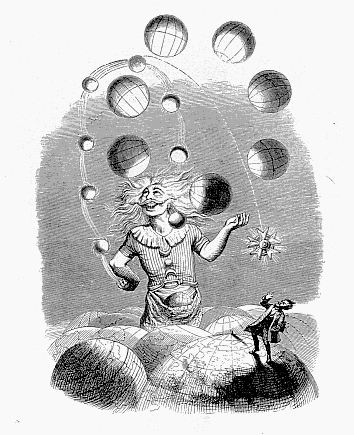
    http://afflictor.com/wp-content/uploads/2011/02/Grandville_-_Un_Autre_Monde_-_Juggler_of_Universes-J.-J.-Grandville.jpg

    This is a short tale of two novels of the future.  They both speak of utopias, they both were written in the 19th century, and (unusually) they both have the same title–but so far as the future of women goes, they have little in common.

    Three Hundred Years Hence, the novel title in question, was first published in 1836, and was the property of  Mary Griffith (1772–1846) who presented what was at the time a strongly pro-woman utopia set in the future, –and which was also as it turns out the first novel of its kind written by a woman in the United States.

    A lesser and unhappier story for women of the high Victorian mold belongs to William Delisle Hay1, whose own Three Hundred Years Hence, a Voice From Posterity (published in 1881) , elevates females to a supreme position, though without any real power or effect.  (Hay has a difficult history, or so it seems to me; he also wrote on mushrooms and other fungi, as well as the Maori “problem”, and had a wide strain of white suprematist running through his works.) In Hay’s future, in the 23rd century, there would be a global community, and at the head of the global body would be a perfect woman, a woman who would serve a ten-year term of glory and grandeur. She would not have any real duties, however, because she was didn’t have the intellectual powers of man, and so her brain would no tbe called on to perform tasks outside of womanly chores. He writes:

    “…the Empress does not possess one particle of actual power…for the facilities of women are not capable of following out the highest intellectual processes, since she has a less degree of pure Reason than the man.”

    And:

    “…Woman (is) most emphatically fitted to display in herself the ornamental part of government…and…she is manifested as the proper director of all that relates to domestic life”.

    This of course is 1881.

    Hay hardly stands alone in his misanthropic approach to women.   Percy Greg’s tale of the future in his Across the Zodiac, the Story of a Wrecked Record (1880) shows the extent of the intellectual calamity and inferiority of women extending to Mars.  In this novel2 Greg’s Martians have come to realize that it is not possible to elevate their women to the intellectual status of men, and that their grand experiment of equality was a failure.  There were many others, of course, like  Walter Besant (The Revolt of Man, 1882), who could not abide the thought of equality. 

    And according to the wonderful I.F. Clarke (The Pattern of Expectation, 1644-2001), there were many more who looked into the future and saw greatness and expansiveness in the equality of women.  There was E.B. Corbett (New Amazonia, 1889), H.R. Dalton (Lesbia Newman, 1889), Lady Dixie (The Revilution of 1900, 1890), G.N. Miller (The Strike of Sex,1891), A.G. Mears (Mercia the Astronomer Royal, 1895), R. Buchanan, (The Rev. Annabel Lee, 1898), and Sir Julius Vogel’s (Anno Domini 2000, or, Woman’s Destiny, 1889), where “woman became the guiding…force of the world”. 

    I think, that, overall, the people who saw the restriction of women in the future (near and distant) held sway, or at least the majority, of writers envisioning the sexes int he future. 

    Notes:

    * The first image is by the great and prolific and short-loved  J.J. Grandville (1803-1847) for his Autre Monde (1844).

    1. I have found another reference to a bitter world of the future written by Hay in the excellent Airminded blog, which records his effort at a novel of doom and destruction of the overtaken London of the future.

    2. Greg’s characters visit Mars via the benefits of a sort of anti-gravity spacecraft called the Astronaut, and, interestingly, the Martians had seem themselves as the only life forms in the galaxy.  It is also in this novel that the first attempt at creating an alien language appears.  There was also another science fiction effort by this title as well, though it really doesn’t apply to what we’re talking about, here.  (I wonder how prevalent duplicating titles is in the sci fi genre?)

  • The SteamPunk Clown Spoiler of Future ElectroPunk Technology, 1866

    JF Ptak Science Books  Post 1598

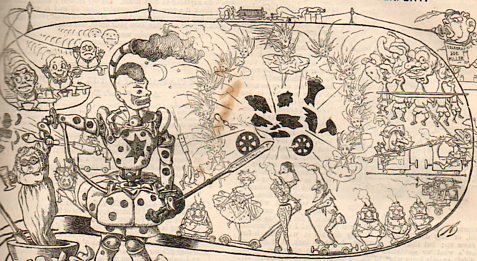
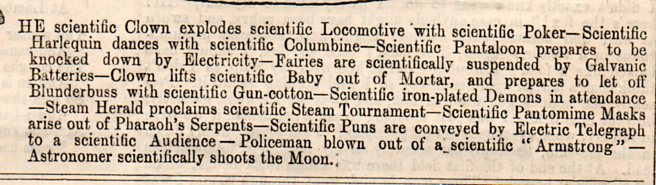
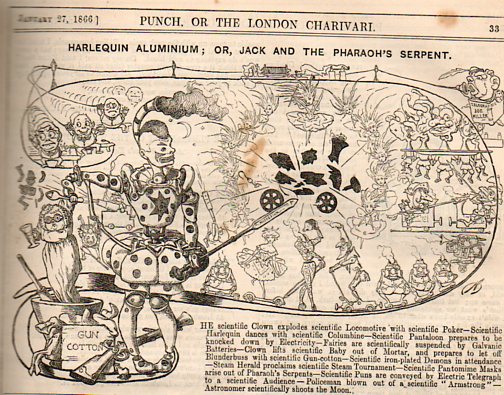
    Punch, or the London Charivari published this delightful and somewhat prescient illustration in its 27 January 1866 issue.  It is for me an excellent, sort-of early depiction of a steam-man, a steampunk man, a steam-driven clown:  deeply and frequently hinged, smoke belching from a curved smokestack coming from the back of its head, and controlling its own destiny.

    Sci clown694
    And what it seems to be doing with its poker in controlling its steam technology is busting the new technologies of the era, a rub and at the same time a statement of hope or expectation in a high-Victorian manner, a rationalism of all things via technological means.  And at this time, in the mid-1860’s, the new wellspring of hope was being found in electricity-based solutions–moving away from the pervasive steam-driven technologies–though as the cartoon suggests those expectations might be too soon, too fast and too deeply placed.  After all, these things are being exploded by a “scientific clown” with a “scientific poker”–and that clown is being driven by steam. 

    Sci clown695

    Sci clown692


  • History of the Future–Advertising in Yellowstone, 1905

    JF Ptak Science Books  Quick Post

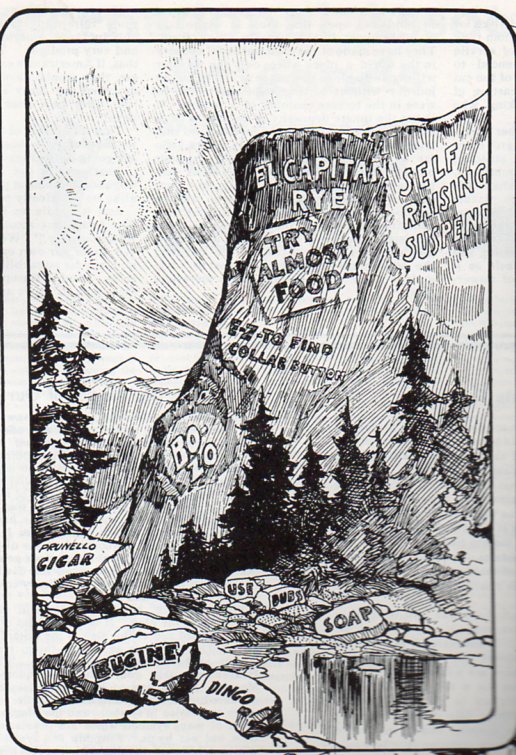
    Ads future662

    The way of the new world, the spread of commercialism and of consumerism, the increase in the size of a middle class that was actually approaching what we today would think of as a middle class, the wanting rise of places for disposable income to go from millions of new people with spare money to spend, led the sellers of stuff-immemorial to start advertising their bits on the side of out-of-doors everything. The fight for the attention span of the new consumer went from the newspapers and magazines to the side of buildings and then, as the motor car began to proliferate, to thousands of miles of roadway. 

    But when these cartoons appeared in (the first) Life magazine in 1905, the car was still a distant image so far as common ownership was concerned, so the competition for the visual space of the new buying market was center on outdoor displays wherever people might happen to be outdoors.  (Remember, there’s no radio or television to absorb advert money and viewer attention, so efforts were magnified on billboards.)

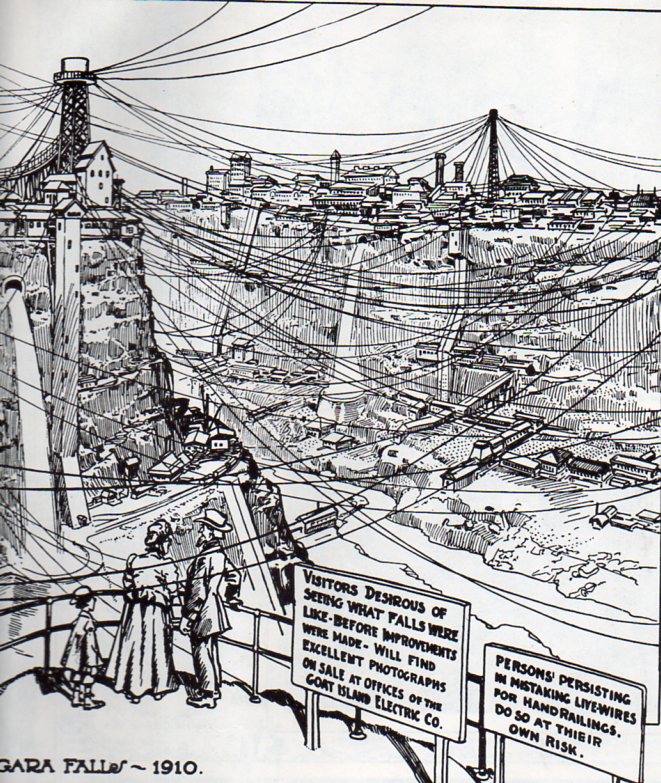
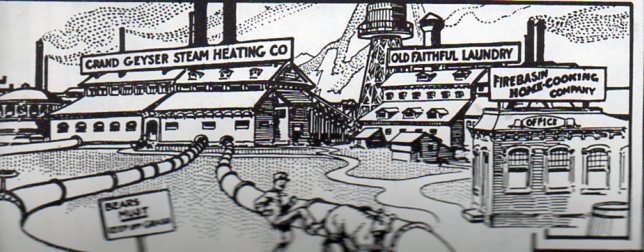
    So Life took a peep into the future and didn’t like what it saw: the possible vast expansion of ugliness in the pursuit of whatever dollar might fall out of whatever pocket.  Just a little warning to America is all–the future of the country might not look as pretty it used to be, what with millions of new billboards to place. 

    The future Niagra Falls, five years hence:

    Ads future660
    Old Faithful, Yellowstone, as it could be in 1910:

    Ads future661


  • Apocalypse Then–World War III, The 36-Hour War of 1948

    JF Ptak Science Books   Post 1585  [Part of a long series on atomic and nuclear weapons]

    This is also part of a sub-series on the invasion of attack on America; examples of other posts include: Mapping the Invasion of America, 1942 (which is the most-viewed post from this blog, with over 500k readers), The Invasion of America, 1935,  Bombing Manhattan and the Amerika Bomber, 1943, and The Invasion of America, 1942, Part II .

    In the very near wake of the bombing of Hiroshima and Nagasaki, the editors of Life magazine published a prescient bit of propaganda on the coming of the Cold War.  I guess though that the Cold War had already begun by Yalta1, when the sick and basically-terminal FDR seems to have been corralled by Bloody Joe Stalin, leaving the new President Truman on alert for the possible coming aggressiveness of the Soviet Union.  The article appeared in the 19 November 1945 issue (pp 28-39), and it was a longish one, with nine illustrations (by A. Leydenfrost), and as articles go in Life from this time, this one was heavy. 

    It built itself up on a report generated from the offices of General Hap Arnold, and reckoned a new war, a New War, World War III, to occur in 1948–except that this time there were no natural difficulties that the U.S. could hide behind. (Arnold said: “…with present equipment an enemy air power can without warning, pass over all formerly visualized barriers and can deliver devastating blows at our population centers”.) The threat would come from above, and there would be little accurate defenses against them. 

    There would be survivors but massive destruction and death–and remember that this was at the point of the simple atomic weapon, before the development of the big stuff.  In the opening images of the article, a chilling two-pager showing eight major American cities being struck by atomic weapons, resulting in at least 10,000,000 casualties.

    But as grisly as all of this was, the American reader was told the the United States would prevail, and that our rockets “would lay waste” to the enemy’s cities; “the U.S. wins the atomic war”.

    [Image sources:  I’ve used the image from the Drexel University site as my copy of this issue of Life is in a massive half-yearly bound volume, impossible to scan.]

    This is what New York City was supposed to look like, afterwards, with inspectors sizing up the radiological waste of what was left of the NYPL at 412nd Street:

     Notes:

    1. The Yalta Conference was the third meeting between the leaders of the U.S., the United Kingdom and the Soviet Union, held 4-11 February 1945.  It came after the Tehran and Cairo Conferences, and preceded the final Potsdam Conference on 17 July- 2August 1945.

    More illustrations:


  • Prometheus Unbound; or, the Triumph of Science in Olympus (1879)

    JF Ptak Science Books   Post 1571

    The wonderful Punch, or the London Chiarivari strikes again for the year 1879.  The quick-browse is seldom complete, as I’ve witnessed again and again; 1879 revealed several fantastic images that were posed to this blog last week (here, for the Technology Museum of the Future and also here for Thomas Edison’s Anti-Gravity Underwear and Kite Babies), and as it turns out just a few pages away, there existed a larger, two-page illustration that was again on the triumph of science, and which I missed completely, twice.

    The message in this cartoon is the glory of “science”, which was flying very high indeed in the newly-electrified times of 1879.  Dominating the image is Mr. Punch himself, holding the electrical sun in one hand, illuminating everything.  To his right, Mars and Heracles stand before an enormous cannon, with different reactions; Bacchus sits astride a barrel of coffee of all things with Pan enjoying a short cup of Joe, while in the lower left corner Hades himself is making a photograph of Eros (?), an hourglass slung across his back, finally coming to grips with capturing change.  In the right corner at bottom is a young man who is intent perhaps on reporting on the situation via a handy public telephone–such things didn’t yet exist in 1879, the telephone being just three years old, but the artist thought enough of its future power to add it into this scene of the triumph of science and technology over the panoply of gods and demigods.

    On the right ide of the image the gods make no further advance against science and technology.  Ares-as-workingman is puzzled by the giant Nasmyth hammer, with the Cyclops in the background a little more concerned, disbelieving what their eye told them.  Poseidon is shuttled away in the lower left, accompanied by what looks to be a weeping mermaid., hustled to the exit by a torpedo, a diver in a deep sea suit, and what I think is a special life-preserving inflatable suit.  In the middle of the image we see two women dressed in legal and academic garb, looking determined before a finicky Hermes; and above them, lording over it all, is a very dissatisfied Zeus, and a headache-y Hera.

    Since the image is entitled “Prometheus Unbound, or Science in Olympus”, I guess that Zeus must be reacting to electricity as the unbound Prometheus, a modern version of a kind power given to humankind via electricity.  It is this new Prometheus that is the undoing of the god’s retreat.

    Overall, this is a very plain Victorian view in the trust of science and technology to lead in all things, even the very basis of much of European mythology.   [I hope that I haven’t abused the mythology too much.]