A Daily History of Holes, Dots, Lines, Science, History, Math, Physics, Art, the Unintentional Absurd, Architecture, Maps, Data Visualization, Blank and Missing Things, and so on. |1.6 million words, 7500 images, 4.9 million hits| Press & appearances in The Times, Le Figaro, Mensa, The Economist, The Guardian, Discovery News, Slate, Le Monde, Sci American Blogs, Le Pont, and many other places… 5000+ total posts since 2008.

Category: Future, History of the

  • Flying Tanks, 1930’s-Style

    JF Ptak Science Books   Quick Post

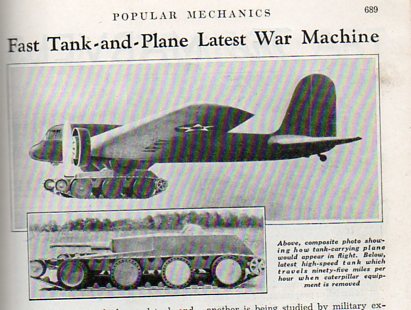
    There wasn’t much pretty in the physical outcome of this thinking–to construct “flying” tanks for quick maneuvers into battle situations–but I think that I like the thinking in it, especially as it seems that the aircraft-end of the tank was re-usable. Still, there was the whole “landing” part of the operation, which meant that (at this time, anyway) the tanks had to be placed and not parachuted to the ground, which also means that the armor would be relatively removed from the field of battle.  But this would be better than driving the things there, or hauling them all on a train  for quick transport.

    Ank158
    [Source:  Popular Mechanics, vol 65, 1936.]

    Also I guess I’m partial to the design of the tank–which I’m guessing was a fixed-position mobile canon–because it seems so strikingly modern. (Except for the tread and wheels part, which is the place where battles are won and lost, at least according to Heinz Guderian.)  But I like the design, which at first glance reminded me of the great T-34, the Russian workhorse of WWII, sort of, at least for its low-profile sensibility, but really more like the contemporary   The Russian Chyorny Oryol (“Black Eagle“).  It really looks a lot more like the STUG assault gun, here:

    [Source: combatreform.org, here; a truly excellent site.]


  • The Invasion of America (Part III)

    JF Ptak Science Books   Post 1688

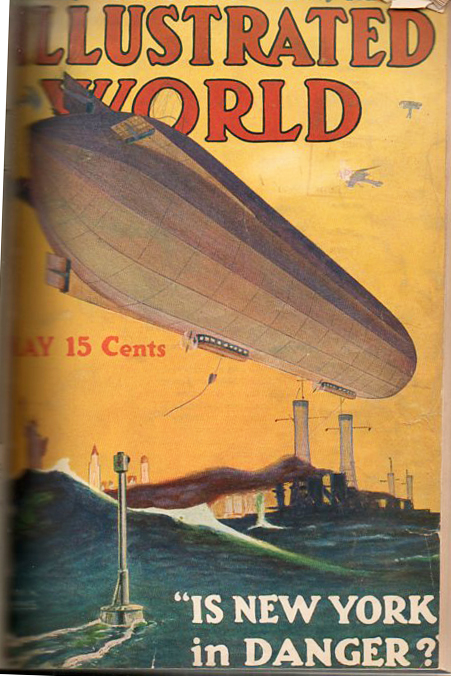
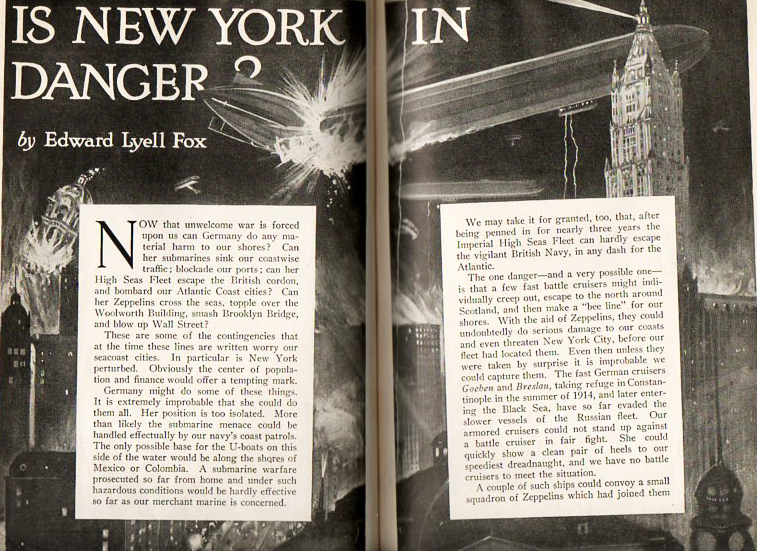
    The New York City harbor looks pretty rough in this picture, tall whitecaps with surprising little reflected in what should be pretty choppy water, meaning that light should be reflecting everywhere, a difficult collection of reflected reflections. 

    America invaded086[Image source:  May 1917 issue of the uncommon magazine, Illustrated World.]

     The submarine, battleship  and zeppelin menaces were real, at least in Europe or in the Atlantic–the aeroplanes far less so1.  But the applications of these fears directly to American shores were still very distant things, particularly when it came to an attack on New York City–except of course that the U.S. had just declared war against Germany, finally, just a few weeks before this issue was published.

    America invaded b088
    The war began for real in Europe in August, 1914, so the fighting had been going on there in fratricidal earnestness for two and half years, costing millions and millions their lives and limbs.  America had been isolationist and non-interventionist up until this point, remaining sweatily on the sidelines, until the capture of the infamous Zimmerman telegram2, which was a coded message sent from Germany (the German Empire) to Mexico (and taken by the Brits as it was sent, the crypto-boys of Room 40 breaking the thing) suggesting that Mexico join in a war against the U.S.  It hit the American press on 1 March, and the story exploded–literally. This is what the beginning of war looks like, sometimes:

    File:Zimmermann Telegram.jpeg

    So perhaps there was some amount of yellow journalism involved here, and some inflationary propaganda as well, and some good-old profit-taking on a half-sci-fi story–on the other hand, the German Empire did just sink 800,000 gross tons of shipping during the 30 days of April (1917), so sub fears were in general real and palpable.  The issue of them sighting the Staten Island Ferry though was quite another matter. 

    The first American soldiers would arrive for fighting in June.  The whole thing would be over in 17 months, which is well less than half of the time that the U.S. spent in WWII. 

    The United States would suffer 116,000 military deaths during its part of the war–a small fraction of the overall military deaths (9 million) and a smaller part still of overall deaths including civilians (totaling 16 million).  There would be 205,000 American wounded in this conflict, a little less than 1% of all war military casualties. 

    It would be interesting to see the coverage in England of the American invasion fears.

    Notes:

    1.  This was not so much a war of bombing than it was for air-to-air combat; bombing became more of a realm of aircraft in the suppression of indigenous populations by occupying powers in the 1920’s, and then in Fascist Spain in the mid-1930’s, and then graduating as it were in WWII. 

    2..  The telegram was named for the Foreign Secretary of the German Empire, Arthur Zimmermann,, who sent the thing out on January 16, 1917.  President Wilson delivered his war address to Congress on 2 April 1917. 

    A military death pie chart for the Entente Powers [source, Wiki]:

    File:WorldWarI-MilitaryDeaths-EntentePowers-Piechart.png


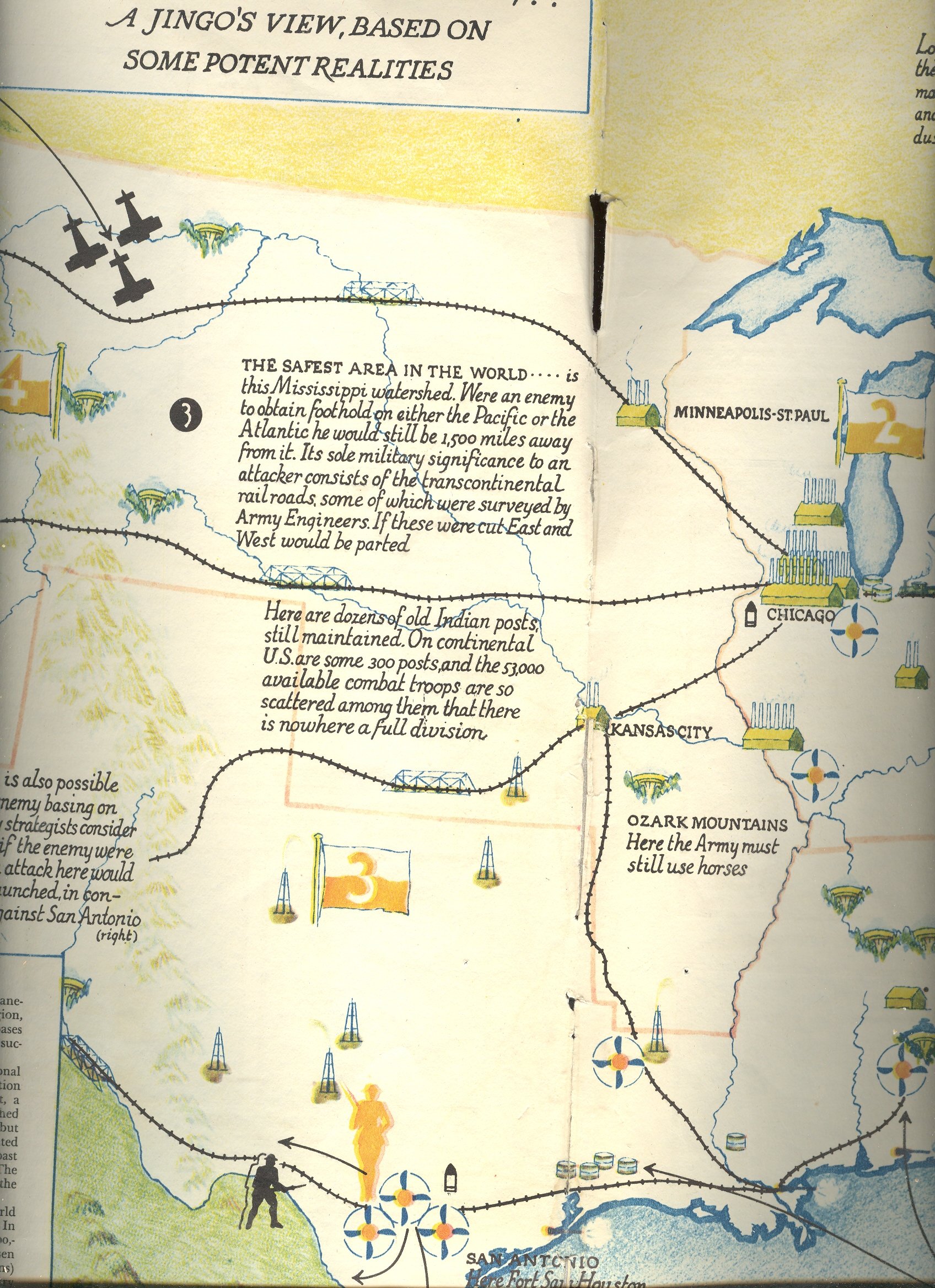
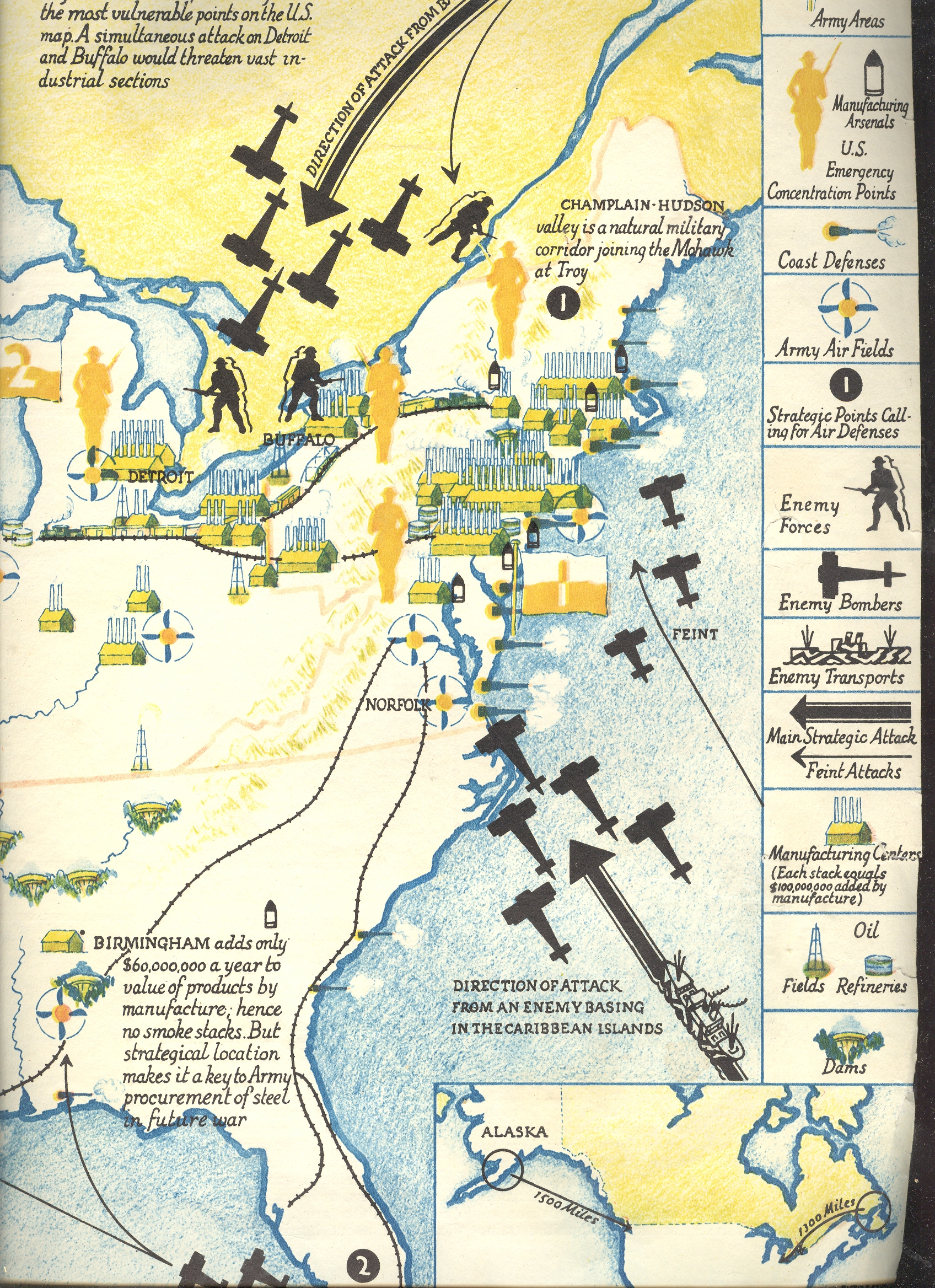
  • On the Invasion of America, Part I

    JF Ptak Science Books  Post 1687

    See also: Invasion Routes to the U.S.  and this blog’s most-viewed posting (with over 500k hits) Maps of the Invasion of America, 1942 . 

    America has almost never been invaded. I should clean that statement up a bit: the United States has almost never been invaded.  America–which included North/Central/South once upon a time long in the dim past–was constantly invaded until the invasions no longer counted themselves as such, which I guess means that the “invasion” forces became  “resupply”. (Perhaps an invasion is over once you surpass a certain ratio of houses : forts.)

    “Invasion” does not include “attacks”.  A few guys getting off a Nazi sub and wandering around until they got picked up (with some (all?) being executed) does not an invasion make.  9/11 was not an invasion, though the subsequent invention of impending and pervading fear was–that’s why we have “storm centers” rather than “weather reports” on broadcast news–but even that fear business was more home-grown than anything else.

    The Japanese Army were on two small islands in the Aleutian chain (which may have been closer to Tokyo than NYC) for a bit in WWII–also does not make for an invasion, even if they were there for a long time.  Or even if they were still there.  Nor does sending hundreds or thousands of paper incendiary balloons across the Pacific an invasion make. 

    UFOs don’t count, either.  (I still find it remarkable that such a large percentage of the hundreds of thousands of “sightings” has the UFO with landing or whatever lights on it. I figured out at one point that there has been a report on one of these critters every ____ minutes since Roswell. And in all of those hundreds of thousands or reports, if you took them all and stacked them one on top of the other, they would reach perhaps the height of a grain of sand.)  The Beatles don’t count, either.   

    What also doesn’t count (but probably should) but which is not military–not really, though it may have the impact of a military force at some time in the future–are Chinese-made imports of, well, everything.   At Thanksgiving I wondered how much of a dinner could be composed of foods that were shipped from China and to no great amazement an almost-complete table of food could be set, plus napkins, flatware, plates, candles, tablecloths, tables, chairs, paper turkey decorations, carpet, flooring, wallpaper, paint for the walls and ceiling, screws for the Chinese-made door hinges, lighbulbs, tubes for the McIntosh preamps, all of the clothing worn by the guests, and so on.  The electricity is still American-made. The fact that Mott’s Apple Juice is coming from Chinese apples is a bad sniff of the future. The country of origin is usually on juice bottle necks-check it out.)  

    Certainly something that does count is the invasion by Great Britain of the United States in the War of 1812–they invaded long and deep enough to burn the White House and cause general havoc.  We won that one.  But of course the Brits were otherwise involved on the Continent.

    Perhaps this non-invaded bit explains why the most-viewed post on this blog (with at last 500,000 views, 340k alone coming from the post being carried by IO9.com) was a LIFE magazine article from 1942 on the possible invasion routes to the U.S.  Maybe the volume was driven by war-gamers, though I suspect it was made up largely of the curious who weren’t used to seeing “Invasion of” and “America” together in a military sense.

    Maps from 1942 of the never-was Nazi invasion of North America
    Maps from 1942 of the never-was Nazi invasion of North America
    Maps from 1942 of the never-was Nazi invasion of North America


    sending request

    (An another set of maps from Fortune magazine for September 1935, a predecessor to the above,  and from my post here):
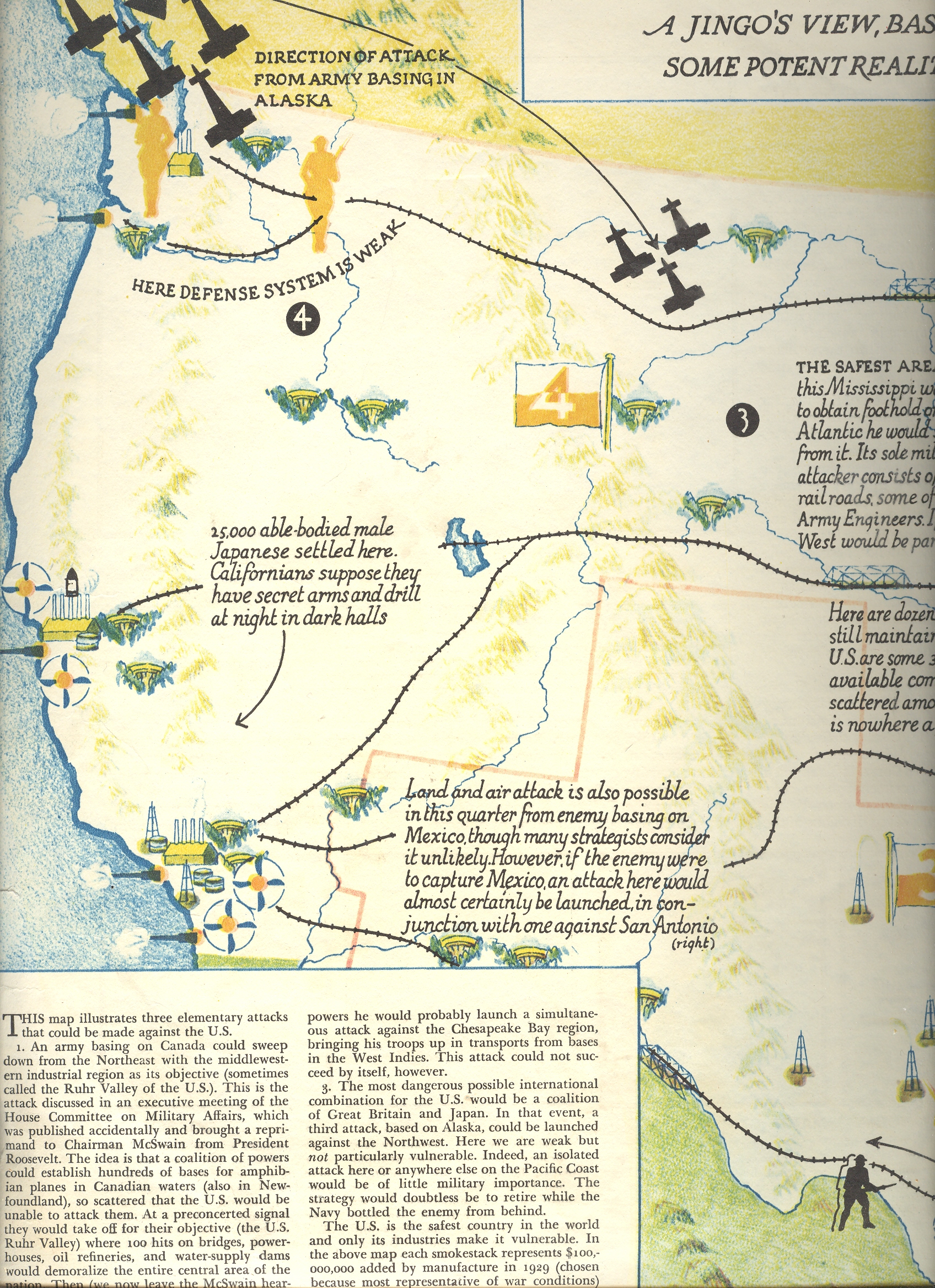
    https://historyofideasblog.com/a/6a00d83542d51e69e20120a7a3225e970b-pi

    https://historyofideasblog.com/a/6a00d83542d51e69e2012876a5a4b4970c-pi

    https://historyofideasblog.com/a/6a00d83542d51e69e2012876a5a5e4970c-pi

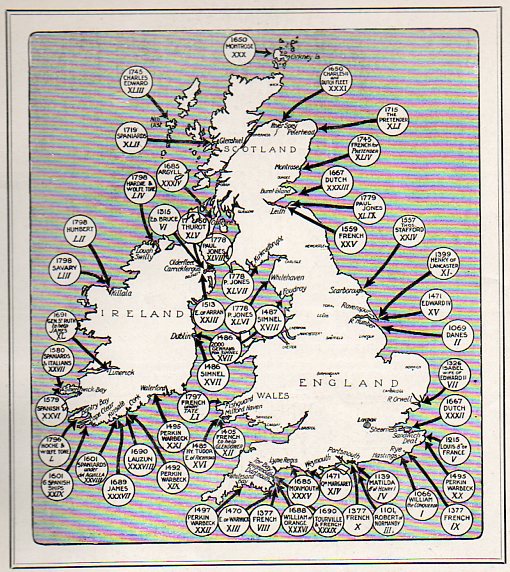
    But now for the  real stuff:  a map of the 54 invasions of Great Britain (and “the places at which foreign troops have landed on British soil since 1066 (and all that), seen in the Illustrated London News for 27 March 1909):

    Invasion--Us and England120

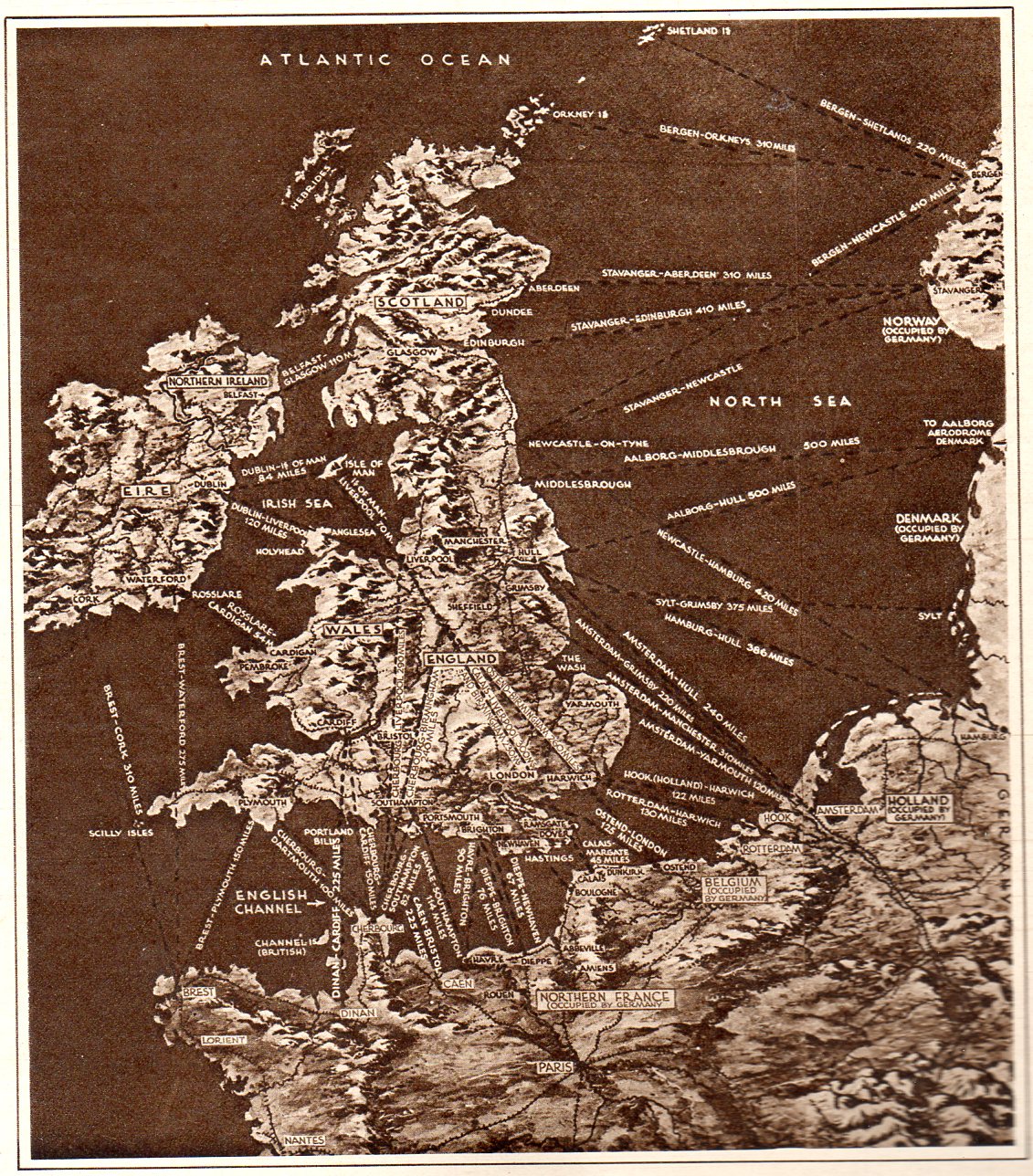
    And then this, where the WWII invasion routes were turned around: 
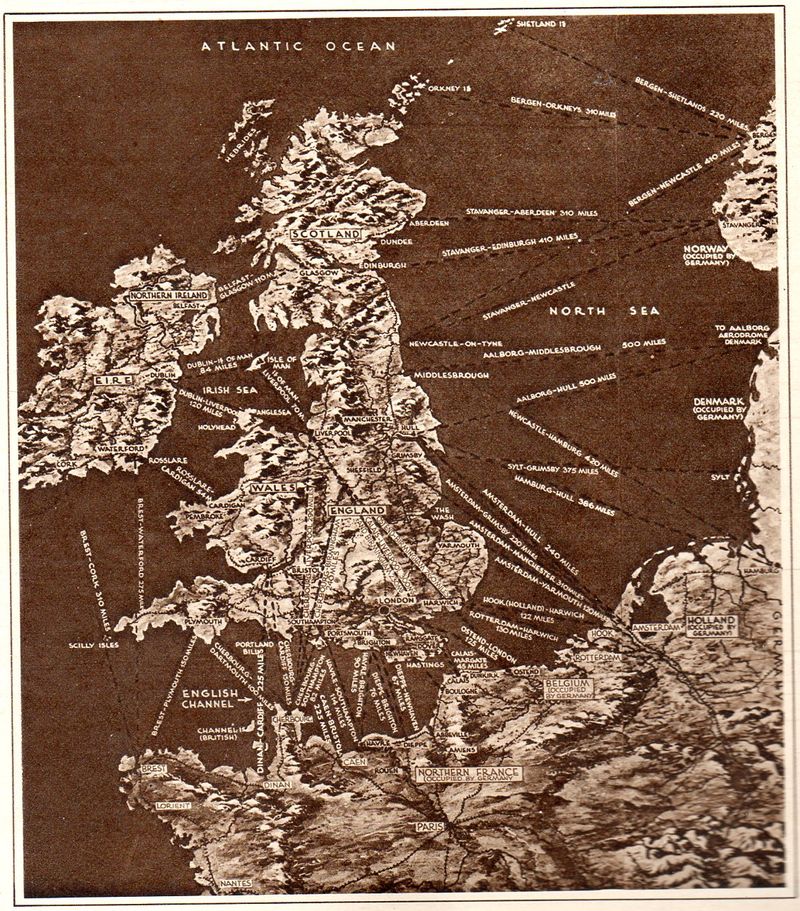
    Dunkerque124

    This map pretty well tells the story of the perilous situation of Europe and England at the beginning of June, 1940.  It appeared in the Illustrated London News on the heals of Churchill’s “Blood, Soil, Sweat and Tears” speech, and was a very frank presentation of the wearing of the war.  By this point in the war Nazi Germany had successfully invaded Belgium, France, Luxembourg and the Netherlands, sweeping across Europe in a broad westward movement, backing up British and French troops all the way to the sea at Dunkerque, where a monumental rescue operation (“Operation Dynamo”) saved them.  (There was an enormous amount of materiel left there on the beach, a devastating loss for the British Expeditionary Force, nearly crippling it.) This was a bad time for the Allies, this part of the war coined by Winston Churchill in 18 June 1940 in the House of Commons by:  “The Battle of France is over. I expect the Battle of Britain is about to begin”. There was very little good that came of these few months for the U.K and the Allies, though four things do stand out: (1) as I just mentioned, the saving of 300,000+ troops at Dunkerque; (2) the resignation of Neville Chamberlain, (3) the coming of Winston Churchill  as Prime Minister of the U.K., and (4) the first deciphering of the Enigma at Bletchley.  Other than that, the situation was dim, and these invasion routes (published at t he very time that Germany was studying such a feat in its “Operation Sea Lion“, or “Unternehmen Seelöwe”). The endgame at Dunkerque took place almost four years to the day of the invasion of Europe, when the intent (though not placement) all of these arrows were turned around for the Allied operation at the Normandy beaches on 6 June 1944..

    And so, there it is–a presentation of several maps showing invasions, real and imagined 

  • History of Fear: the Lure of High Sci-Fi Sexual Danger

    JF Ptak Science Books   Quick Post   [Part of a new series on the History of Fear]

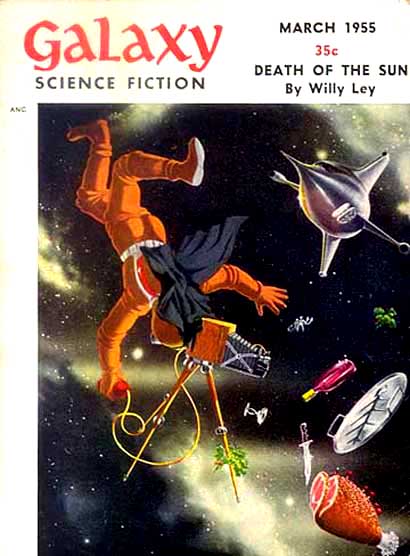
    There just seemed to be something going on with women and clothing and sex and fear and sci-fi trouble, or at least so on the covers of a spectrum of pulp publishers in the 1930’s-1950’s.  Perhaps this had nothing more to do with anything than having a pretty woman posing next to the UNIVAC II in a 1959 issue of Computers and Automation. In any event, I stockpiled some of these images and collected them under the Fear-Sex heading, and for right now all I’m going to do is pass them along. 

    Are they really sexualizing danger? I have no idea what the content was of these issues, but from the looks of things, I’d throw hazard to the wind and say “yes”, at least to the visual aspect. 

    (Don’t forget to have a peek at an earlier post on Women in Sci-Fi Past-Future Distresses, here.)

    http://farm1.static.flickr.com/48/188844234_b5a2d881a5_o.jpg


  • Stuff-out-of-Place Department

    JF Ptak Science Books    Quick Post

    I’ve been on a bit of a run on science fiction pulp covers of the 1930’s-1960’s, and I’ve collected some in this catch-all category of “Huh?”  These are wonderful images, and I have no idea what they represent, except that the image transcends its intent, in a way, and stands strongly for itself in some sort of Found Absurdist kinda way.  And once you look at it, most of all that one can say is “Well, there it is”.
    . 

    http://static.flickr.com/72/184347617_9e4c03889b_o.jpg


  • Life Elsewhere: Europa, 1940.

    JF Ptak Science Books   Quick Post

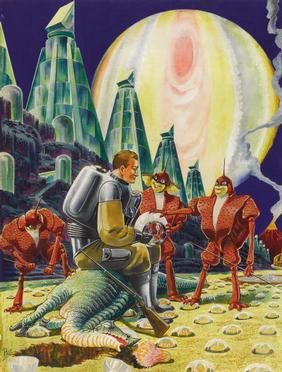
    After watching a BBC series on the planets on Netflix, and having the idea of life on Jupiter’s moon Europa addressed, it occurred to me that I’ve seen the answer to this before.  And here is is, by Frank Paul, “Life on Europa”, created for the back cover of Amazing Stories, September 1940. (From the Frank Wu website, much of which is dedicated to Mr. Paul. 

    Sci fi art--europa
    Mr. PAul settled the issue, which he perhaps made up just that morning–I am particularly impressed by the globular units on t\he surface, plus, of course, the very interesting beings talking with the human explorer. 

    But in general Paul had a very large landscape for his deep well of life forms, sometimes seeming as though they were infinite.

    And all of this done without the benefit or cause of Roswell.  It seems to me, though, that if offered the choice between believing in a universe of teeming life versus just that which we experience here on Earth, I’d choose the former instantly, and get right on board the Frank Paul train. 


  • Episodes in the History of Dropping Things–Baby Bombs, Bomb Babies and Dropping Women on Manhattan

    JF Ptak Science Books   Post 1670

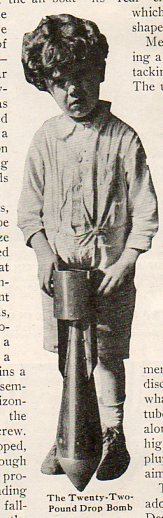
    Dropping things036In the history of dropping things–as distinguished from simple falling things–it must be said I think that this is the easiest of all human activities ever invented, and people have been trying to improve on this creation ever since.  After all, almost anyone can do it and–if you include pushing things over a ledge so that they might fall–most complex life forms can do it, too. 

    Of course there have been intellectual and technological adaptations, particularly when you include throwing and shooting things so that the objects have been charged with a “created height” so that they will be dropped in the designated location.  Cannons have been particular benefit to this aspect of advanced dropping.  And then of course there are the “Galileos” of dropping–like Galileo–and Jonas Moore and David Letterman and of course Seinfeld’s Kramer, and to a lesser extent there’s also every other person from the Boston area who represent hundreds of millions of people who drop a letter from somewhere in their spoken vocabulary.  There are people who drop their accents altogether, and of course politicians who drop the truth, and the tantilizers who drop suggestions, and paid-for pharmaceutical consultants who drop the untoward test results and their accountants who drop a zero when necessary.

    [Image source:  June, 1936, Popular Mechanics.]

    People drop options, they drop in and out and off, pennies and dimes, lawsuits and dumplings, coverage and names and the f-bomb.  They also drop dead and bombs, the last two being closely related, though more people “drop dead” when bombed because they are killed. 

    Bombs seem to be the biggest of all dropped things, especially bombs dropped by airplanes, and especially those bombs dropped on collections of people, which are called cities.

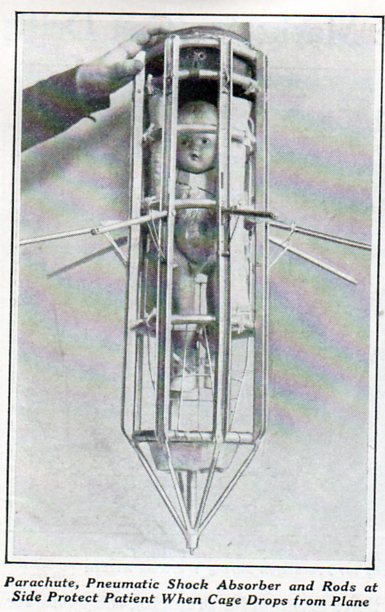
    Perhaps one of the strangest things to be dropped, though, is the following, found in  the September 1935 issue of Popular Mechanics

    Dropping things 2038This was a model of sorts for a critical-care-parachute-gurneystretcher, or something, for when a crew member of a U.S. Army Air Force aircraft was injured and needed care, though the article doesn’t specify where the person would be dropped. Overall it seems not the height of workable ideas, and suffered no doubt from its model using a baby doll, which just looks altogether wrong. 

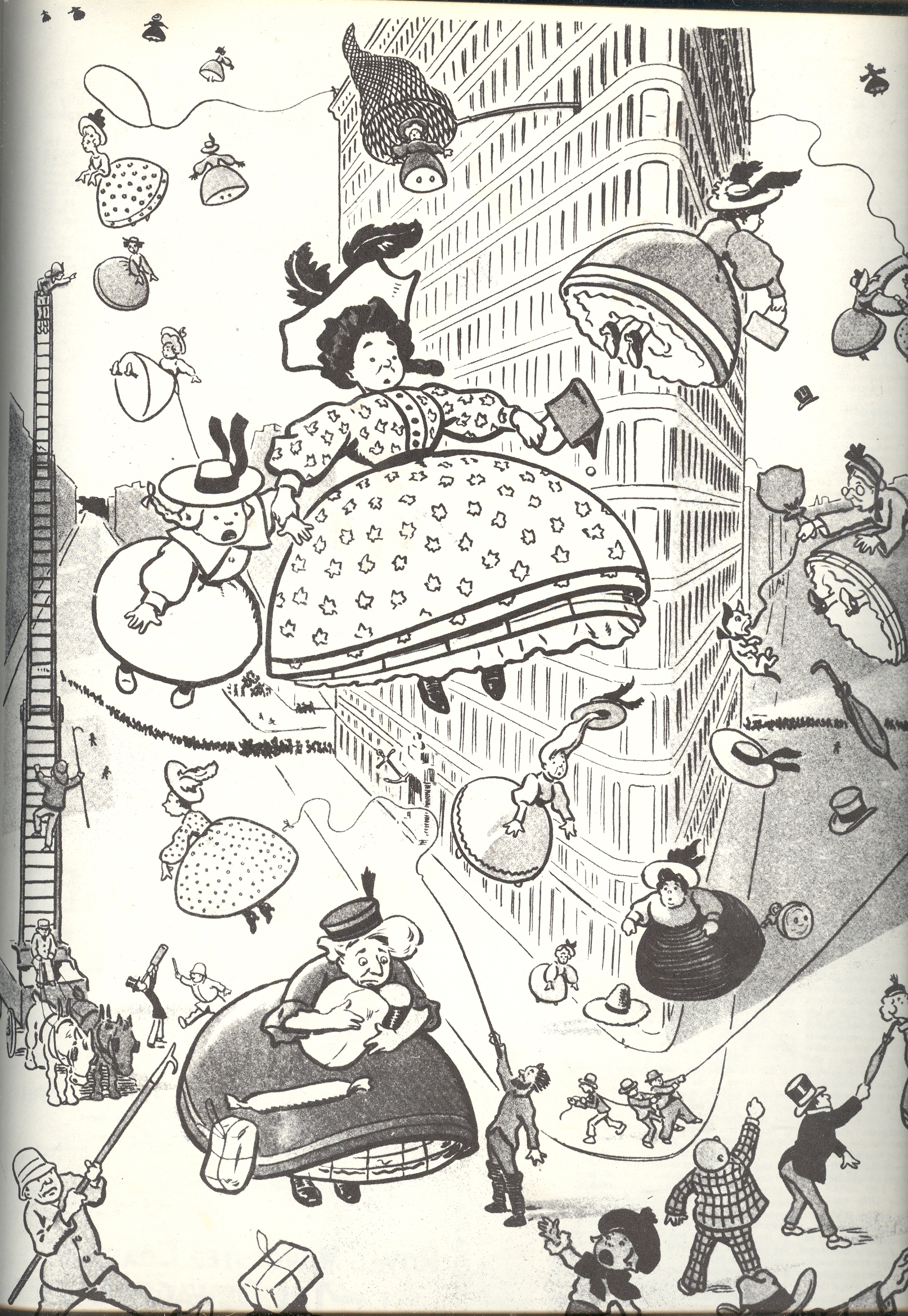
    And the last part of this episode is another strange bit:  dropping women on Manhattan. The  image comes from 1904 and–when taken out of context–it seems as though Manhattan is in for the worst of it, with a view in front of the Flat Iron Building of an aerial bombardment of women.  This is probably one of the few bad things that weren’t done with/at women, and would actually significantly predate the first use of explosives being dropped from aircraft.  Unfortunately the original, intended image was a poke at  crinoline  and featured women being blown up into the air rather than the other way around, though I like my interpretation better.

    5-women


  • Technoarchaeology: Images of the Fabulous Past Futures–Streamlined Ice Cream

    JF Ptak Science Books Very Quick Post

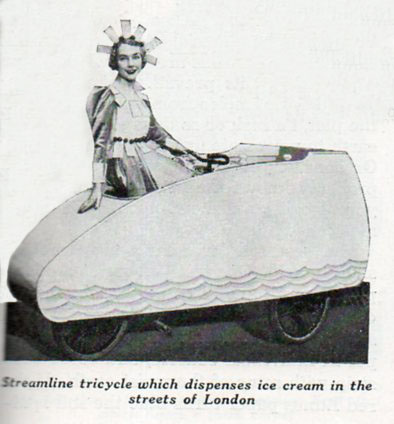
    Some things just don’t need to be streamlined, especially when they’re designed to be very slow.

    Pop mech logo027May, 1936 issue of Popular Mechanics


    Pop mech aero dyn026

    Pop mech ice cream028


  • Rooftop & Floating Airports -and!- Rooftop Airports in a Levitating NYC, 1929

    JF Ptak Science Books   Post 1652  (Part II of an earlier post on Rooftop Airports, here.)  Part of this blog’s History of the Future series.

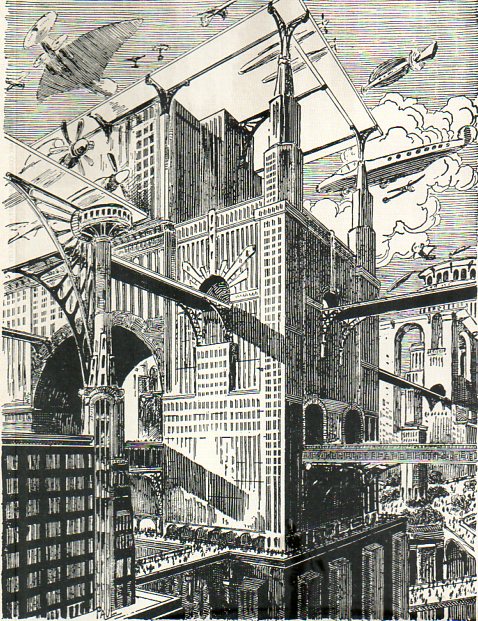
    I really just wanted to post these two images before I lost them again. I’ve written earlier here about high-rise, in-town/downtown airports settled on the tops of buildings (or loaded onto newly-constructed structures over rivers and etc.), but these two images offer a nice distinction on the height’s of elevated airports of the coming future.  The first is by the great Paul Frank, and appears in Amazing Stories for 1928:

    Airport981
    The taller of the two airports seems to be 75 stories above the ground, maybe more–its hard to tell.  It is interesting to see that there is another (of no small size) right next door, but not quite so high.  The 500′-tall elevated walkways/roads are impressive.

    In April, 1936 another artist saw an even taller airport, which caps off an enormous building that seems at least not only twice the height of the Empire State Building (just newly completed), but also far wider.  If you made the “…tropolis” airport signifier on top the midway of the landing field, I calculate the width of the building to be at least 600′, meaning it would be something like 250×600′, or about four acres (or more) per floor.  Big building, with an enormous volume. 

    [Picture source:Modern Mechanics, April 1935, as pictured in Dark Roasted Blend]


    [Picture source: Paleofuture.com]

    And here, another big rooftop creation of a 16×17 checkered grid, complete with, well, nothing at all, not even guard rails or fences–this would be rooftop-airport-landing Old School.  The runways aren’t even particularly long, though I have no doubt that the magazine’s cover space dictated most of the size, anyway. 

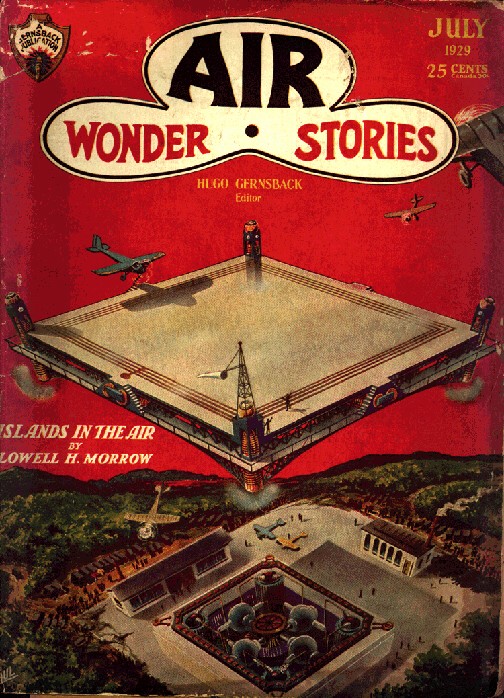
    Of course the idea of very-elevated high-rise airports become secondary when you introduce the idea of floating/flying airports, as we see in this fantastic idea by (again) Frank Paul in the July 1929 issue of Air Wonder Stories. (This image and next from frankwu.com website dedicated to the artwork of Frank Paul, a great and wonderful thing.)

    And of course when the idea of the flying airport fails, you can always go for the flying city, with airport:


    This is again Frank Paul, from November 1929’s Amazing Air Stories, and depicts–of course–New York City removed from the ground to levitate, above its former self. Luckily there isn’t just a hole in the ground where is used to be, the rock and bedrock picked up along with the buildings and the rest of the (non bridge) infrastructure.  It is still a busy place. I presume that given the crowding of the place that there are still high-elevation rooftop airports in the floating city. 

    There are other sorts of air-borne airports, though they are mainly built on/in large airplanes and airships, and really don’t qualify for a post on the simple rooftop airport.  Perhaps it is time now for an all-inclusive Odd Places for Airports post to appear here…

    For example:


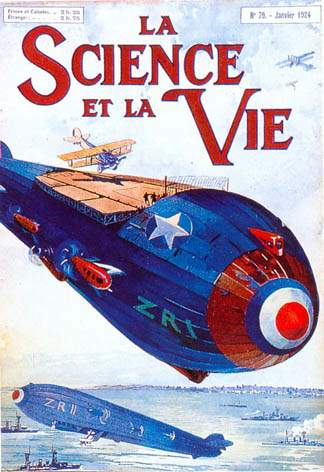
     The magnificent possible, 1924, saw another kind of airborne airport:

    https://historyofideasblog.com/a/6a00d83542d51e69e2012875ea3636970c-pi


  • Postcards to the Future–the year 2000 in 1910

    JF Ptak Science Books   Post 1646   [Part of the  History of the Future Series]

    This entry is a simple exhibit of French postcards from the edge–of the near-future.  The future that they spoke to wasn’t all that far away standards of change in the history of history–they called out to a history 85 years away from 1900, 85 years to the great beginning of where the future would take new and entirely different steps up from Victorian discovery and breakthroughs.   There are some novel intuitions, including electrically-induced knowledge, production-line robotics, and television, but overall the thinking being done and displayed on these postcards wasn’t very edgy.

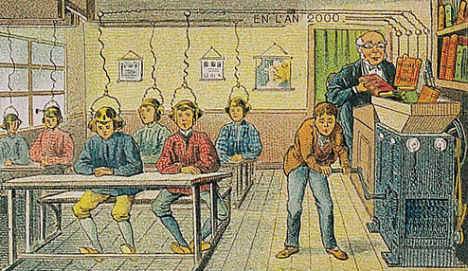
    Electricity, perhaps the defining improvement of the 19th century, would still be a main source of power and energy, though with new and incredible products. For example , the classroom in the year 2000 would distill information directly into the minds of students by some sort of electrically-based information crunching apparatus, which would evidently grind the good stuff from the pages of books and be electrically implanted directly into the brain.  Why the machine was manually operated is a mystery.

    Future postcard 9

    Artificial or synthetic food–or food, at least, as we do not recognize it now, here being consumed like vitamins.  Even though the food-ness of food is gone, the social ambition of replacing spent energy resources has not changed, the coming-together at the dining table remaining intact as a practice even without the demand of the time it once took to actually eat food. [Image source and notes, below.]