A Daily History of Holes, Dots, Lines, Science, History, Math, Physics, Art, the Unintentional Absurd, Architecture, Maps, Data Visualization, Blank and Missing Things, and so on. |1.6 million words, 7500 images, 4.9 million hits| Press & appearances in The Times, Le Figaro, Mensa, The Economist, The Guardian, Discovery News, Slate, Le Monde, Sci American Blogs, Le Pont, and many other places… 5000+ total posts since 2008.

Category: Future, History of the

  • The Moon Made of Brick, 1869

    JF Ptak Science Books   Post 1795

    In 1869 Edward Everett Hale (author of “A Man WIthout a Country” in 1863 and also one of the earliest pieces of fiction regarding alternative worlds in”Hands Off” in 1883) wrote a piece of speculative fiction called “The Brick Moon”, a story told int he form of a journal of Capt. Frank Ingham, relating the story of the launching of a satellite that was to be an aid to navigation.  The construction was fantastic–a sphere made of concentric rings of brick enclosed by an outer layer of brick, reaching 200 feet in diameter, to be hurled into space by two gigantic flywheels on a polar orbit 4,000 miles high, providing a new bright shining star as a means of determining longitude.

    “Any section through any diameter looked like an immense rose-window, of six circles grouped round a seventh. In truth, each of these sections would reveal the existence of seven chambers in the moon,—each a sphere itself,—whose arches gave solidity to the whole; while yet, of the whole moon, the greater part was air. In all there were thirteen of these moonlets, if I am so to call them; though no one section, of course, would reveal so many. Sustained on each side by their groined arches, the surface of the whole moon was built over them and under them,—simply two domes connected at the bases. The chambers themselves were made lighter by leaving large, round windows or open circles in the parts of their vaults farthest from their points of contact, so that each of them looked not unlike the outer sphere of a Japanese ivory nest of concentric balls. You see the object was to make a moon, which, when left to its own gravity, should be fitly supported or braced within. Dear George was sure that, by this constant repetition of arches, we should with the least weight unite the greatest strength. I believe it still, and experience has proved that there is strength enough.”   [Full story here.]
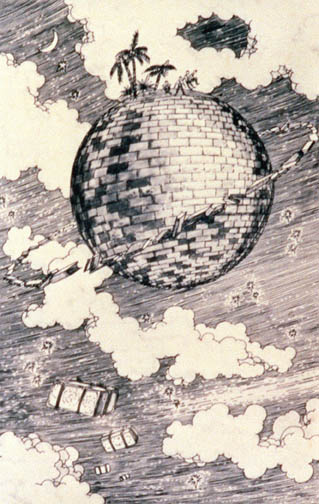
    illustration from Hale's Brick Moon

    [Image source: here, from the Encyclopedia of Science website.]

    Getting the enormous and fantastically heavy “moon” not only off the ground but into space would be an enormous and fantastic mystery–solved here by Hale by the thing being “left to its own gravity” and the two giant flywheels. 

    It was in this story, published in serial form in the Atlantic Monthly, that the idea of the artificial satellite was introduced.  Actually, it was also more than that, because a foul-up caused an early launch of the sphere, launching it into orbit with people on board, making it the first space station.  And it was certainy the first collection of space bricks. Of course this took an enormous leap of imagination and insight, and Hale’s effort must be applauded as a visionary work.



  • 1902’s Women of the Future Trading Cards

    JF Ptak Science Books   Quick Post

    Again from the interesting and charming La Boite Verte website I’ve found an interesting suite of French photographic postcards.  This set concentrates on the possible occupations of women in the  future (“avenir”/”future”), and printed in 1902 by A. Bergertet in Nancy, France.  The images are slightly odd, most tbeing a little on the “swimsuit issue” side, but then again not without the women exhibiting a kind of coy pride in spite of what they looked like.  In spite of the attire, the women depicted as the “general”, the firefighter (“pompier”), student (complete with a jauntily-held cigarette), and the sailor (“marin”), for example, are all taking their future positions seriously, even though their uniforms have been arranged for a 1902 man’s viewing pleasure. 

    Its interesting to see that seeing into the future of professions and callings for women didn’t habe to “see” all that far, with all of the professions being attained within the next 50-75 years. Of course the pay is largely still not same for women as it is for men, nor is women’s percentage share (for most) anywhere close to a proportional share, but it is a good start. 

    [Image Source: Le Boite Verte and Fantasies Bergeret]

    les femmes de lavenir phototypie bergeret 13 Les Femmes de lAvenir   1902


  • Anti-Prediction: On Being Horribly Wrong in Predicting Next Year’s Future (1938)

    JF Ptak Science Books   Post 1773 [Part of the History of the Future series.]

    Sometimes as the saying goes a bad answer isn’t right; and sometimes it isn’t right so much that it isn’t even wrong.  Here we have a collection of not-even-wrongs, tidily collected in one pamphlet.  It is a booklet of “predictions” that are so deeply off the mark that I suspect the author would not even be able to make post facto predictions. 

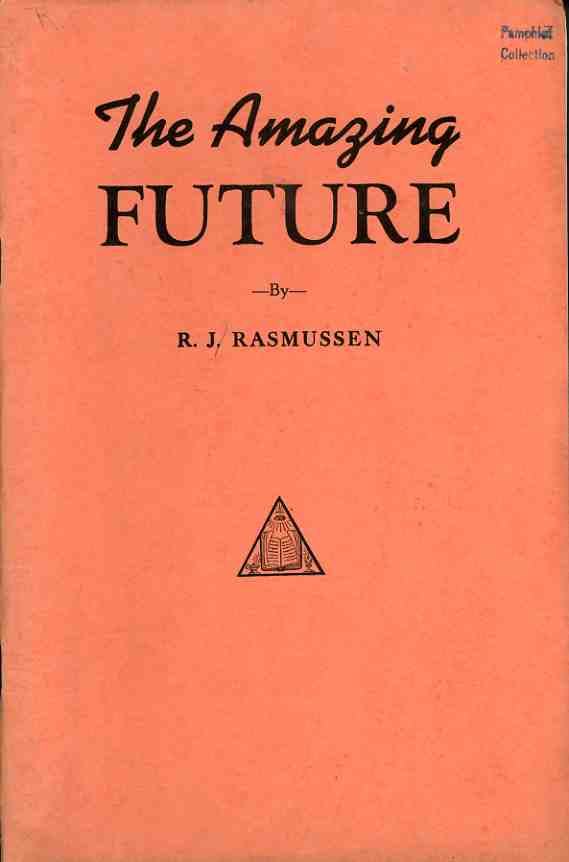
    0 blog jan 16 future388Had  author R.J. Rasmussen (The Amazing Future, 1938) real powers of diving the future he should’ve been able to see that choosing to be so dreadfully wrong about the events of 1939 was a truly bad thing to do–of course, if there was some sort of unknown and spectacular power in his brain to see what was coming, the least he could’ve been was right.  But he wasn’t, and he wasn’t right very widely, and very widely not right almost all of the time.  To give the devil his due, Rasmussen did get some broad images correct–like in 1939 a world leader will get sick and die.  (Actually, the world leaders dying in 1939 weren’t current leaders, but that is a particular that escapes detail when thinking about stuff that will come to pass.) And then there’s the bold “a high ranking officer in the U.S. army will pass away”. But those broad brushes are about as close as it gets to “prediction”.  He was right that there would be a year 1939.

    The rest is “anti-prediction”:  “I want to advise all pilots and their aides in the United States…to use utmost good judgment in flying your planes”.  And “again I say that no war will be declared on or with Germany”, cancer will be cured on or before August 26, 1939, and there will be an increase in textile production in the U.S.  The Japanese war against China “will be over by August 21, 1941”, though the cost will be monumental to the Japanese, somehow; Germany “will continue to forge ahead” (?),  the map of Africa “will be completely and totally changed” by 1942, and “during this period there will be increased interest shown in higher lines of thought”. And so on, on and on–by the hundreds.

    Finally, among everything else that the author didn’t see was the following:  “the persecution of the Jewish people in Germany will gradually grow less and less that they have ever know in the past thirty years, and before the year 1939 has passed it will have practically ceased in Germany”.  I must say that of all the minor pamphlets like this that I have seen Mr. Rasmussen made the most detailed and incorrect predictions of anyone that I have ever seen–the only further step backward he might’ve been able to make was to have written this book in 1941 and gotten all of the history wrong. 


  • Modest Expectations–Engineers Stand in the Shallow End of the Future Pool

    JF Ptak Science Books   Post 1769

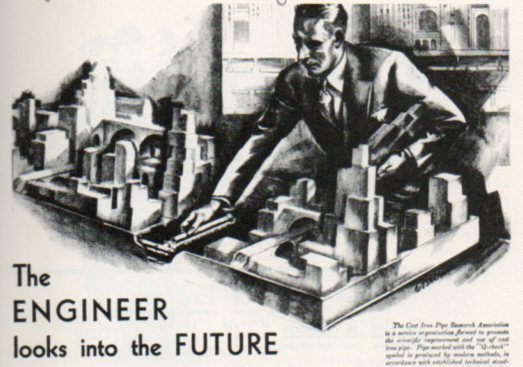
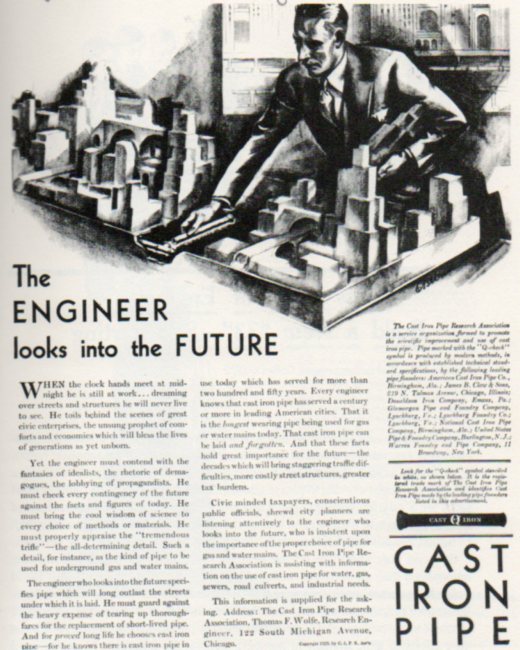
    The novel underneath its title can be good or bad in spite of it, independent of the flag under which it flies. Its just helpful, usually, if the title is as good as the book—better even, because, after all, Modest Expectations isn’t quite as good as the real thing. But “Modest Expectations” seems as thought hat would be the title of future vision in this advertisement that appeared in 1929. It is an advertisement in Collier’s magazine by an engineering company during the time in which The Engineer and the possibilities of engineering were running full-blaze in the United States. There was a belief in the idea of engineering as a cure-all to present and future problems, and the word was as prevalent in the sphere of social interaction as the prefix “e-” was in the early days on internet business and communication in the 1990’s.

    Engineer future410
    It seems as though there were few occupations immune from the “-engineer” suffix, whether they had anything specifically to do with engineering, or not. The “control safety engineer” described a crossing guard; “sanitary engineer” referred to what was known as a garbage man; “nutrition control engineer” was a food server, and so on, position names changed by the hundreds if not more, elevating the status of a profession by simply applying the meme’s suffix to the job title. IF you judged the overuse of the term by the actual accomplishments and achievements of engineering of the times, it was probably justified, give the enormous progress of engineering. In just the first decade of the 20th century enormous change were made in the way life was/would be lived with the introduction of the steam turbine generator, the internal combustion engine, heavier-than-air powered aircraft, the audion, the vacuum diode, the thermionic valve, Bakelite, and so on, all of which would soon bring technological change to create revolutionary changes in the way life was structured in the U.S. And worldwide.

    But given the gigantic changes in the first 30 years of the 20th century, what was it that the engineer was seeing in this advertisement, “The Engineer Looks into the Future”? What was it in the hand of the engineer in the illustration, what was he placing down in the city of tomorrow, today? A faster train, or space ship or part of a vacuum tube people-mover, or what?

    Engineer future411It turns out that this engineer didn’t have such lofty future-vision plans—in fact, the vision was subterranean, and the thing in the engineer’s hands was cast iron pipe. Yes, the future was in materials, and that material manifested itself in cast iron pipe, courtesy of the Cast Iron Pipe Association.

    Now cast iron had been around for a long time before 1929—even used as pipe the idea goes back into the 16th century. There were bridges made of cast iron in the 18th century, and the movement towards the modern skyscraper maybe traced back to cast iron facades and construction in the 1850’s. I’m not so sure why cast iron pipe was so significant in 1929—perhaps it wasn’t so very widely used. But I must admit to having a “moment of discovery” while I tried to reason why the future of engineering looked into a hole in the ground filled with cast iron pipe.

    Engineer future409
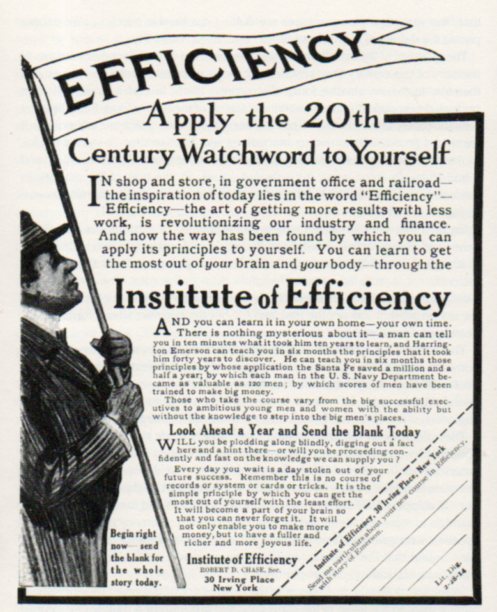
    Engineer future412Another interesting image that comes a little earlier on is this advertisement for the “Institute of Efficiency” (in 1917), which in effect takes the running-rampant ideas of engineering and applies it to the ways in which people ran their personal lives. Efficiency was as much a catch-word as “engineering”, and it was in this decade that saw the appearance of Scientific Management (Fred. Winslow Taylor) and its numerous offshoots. What bothered me about this ad marshaling the positive factors of the study-at-home courses in efficiency was its inefficient use use of space and communication of the idea. Not the least of which was the very odd bit in the bottom right corner, which the reader was supposed to fill in and clip off and send to the Efficiency people. There’s really no room to write, and you can’t actually mail the thing—and, if I was trying to get someone to purchase something about improving their efficiency I might have wanted to make it much easier for them to send me something with their name on it.  The whole effort just seems not very efficient.


  • The Past’s Future: a History of Fashion 1893-1993, Written in 1893.

    JF Ptak Science Books  Post 1766    [Part of the History of the Future series.]

    • Thanks to 2NerdyHistoryGirls (here) who introduced me to Forgotten Futures (here) who reproduced the article of today’s attention. The article in the original format is located here.

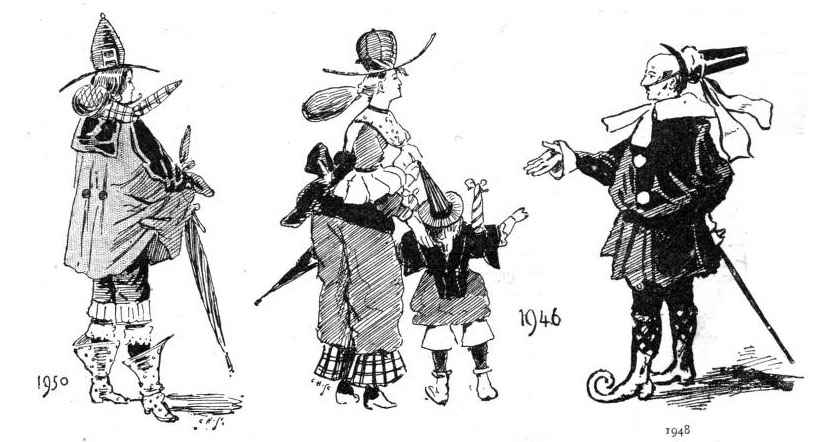
    Fashion 1993

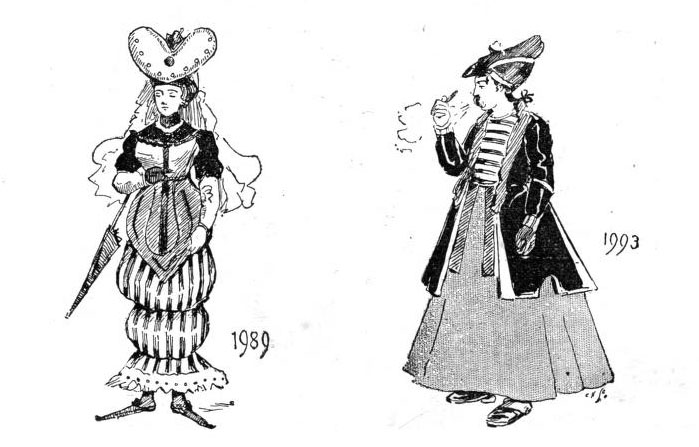
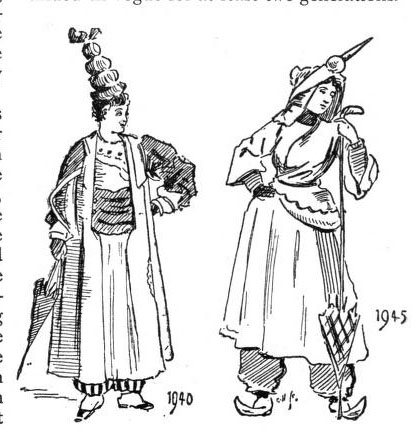
    At the end of the century the very popular British journal Strand Magazine published a marvel of a short story on the history of the future and the future of clothing and fashion.   (The Strand published Conan Doyle’s Sherlock Holmes stories and as a matter of fact would publish the for-a-short-while the last of them in December, the famous “The Final Problem” adventure, perhaps better know today in a variant form for Sherlock Holmes BBC viewers as “Reichenbach Falls”.)
    Fashion 1946

    The article–the “Future Dictates of Fashion”, and published in January 1893 by W. Cade Gall–was an interesting look into the past’s future.  The story is in which an elderly gentleman of 1893 finds a book published in 1993 about the history of modern fashions from 1893-1993, The Past Dictates of Fashion, by Cromwell Q. Snyder, “Vestamentorum Doctor”.  Dr. Snyder of the Future presents the logic of fashion, a fashion powered and governed by immutable laws, trends discernible by deduction and logic, except of course in the (future) present, where things have made a turn into the indefinable.

    Fashion women 1945

    Its a amusing story, and the fashions are bizarre and have a weird alien/Buck Rogers/Dr. Seuss/Wizard of Quality, all of which goes for naught, as the story of the history book of the future is part of an old man’s dream, and the old man wakes up at the end of Gall’s own story. 


  • History of Fear: Science Fiction Images–the 1950’s.

    JF Ptak Science Books   Quick Post  [Part of the History of the Future series.]

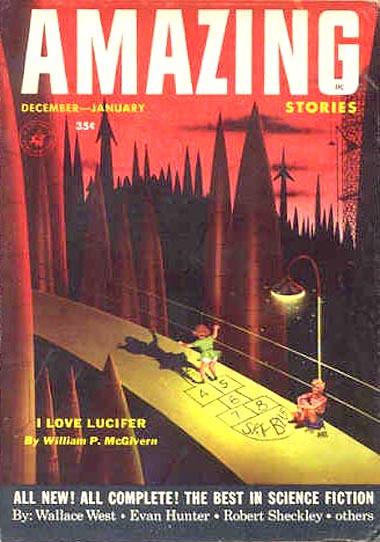
    This cover of Amazing Stories is really very gripping, very cold in a Red Nightmare way, filled with fear and the possibility of mega-death.  The cover was made at the very beginning of the real fear of Soviet attack with nuclear weapons, made just months after the first hydrogen bomb detonation by the Soviet Union (a 400 kt device on 12 August 1953).  (The Soviets made their entrance into the nuclear endgame four years earlier, in 1949, years before most informed speculation had placed their weapon potential.)

    http://static.flickr.com/48/182497900_9cb5a7ebcf_o.jpg


  • Strange Things in the Sky Department: the Exploding Moon.

    JF Ptak Science Books    Post 1763   [Part of the Strange Things in the Sky Department.]

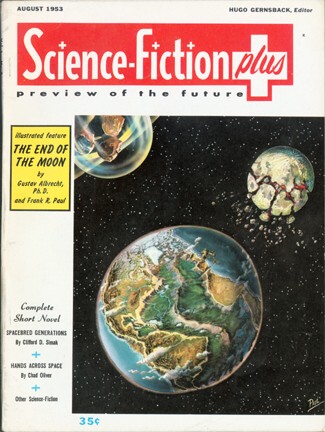
    Moon exploded[Cover art by the great Frank R. Paul for the August 1953 issue of Science Fiction Plus.]

    In my experience of Strange-Things-in-the-Sky Department,the idea of the exploding Earth is far more popular and more illustrated than that of the Exploding Moon.  So far as I can recall Moon doesn’t explode in most cases of early sci fi, including the earliest case of Lucian’s Icaromenippus and his great True History (a satire on outer space travel and interplanetary warfare between the kings of the Moon and the Sun over possession of the Morning Sat (Venus).  Nor does the Moon explode in the other very early efforts of de Bergerac (1657), Francis Godwin (Man in the Moone, 1632, where Our Hero gets to the Moon on a goose-powered aerial something), Johnannes Kepler (Somnium, 1634) and others.  The Moon gets into trouble enough, but not so much trouble to lead it to blow up. 

    File:Le Voyage dans la lune.jpg

    (I can’t leave this without mention of Robert Heinlein, who wrote many short stories addressing the Moon, many with fantastic titles and even better story lines:   “Columbus Was a Dope”,  1947;  “Gentlemen, Be Seated!”, 1948, about a lunar tunnel;  a Boy Scouts on the Moon, “The Black Pits of Luna”, 1948;  “The Man Who Sold the Moon”, a 1949    “Nothing Ever Happens on the Moon”, 1949 (future Boy Scouts on the Moon);     “The Menace From Earth”, 1957, (Lunar teenager angst and a muscle-powered space ship); “The Moon Is a Harsh Mistress” (1966), (and a Lunar penal colony)–lovely titles for some superior writing.

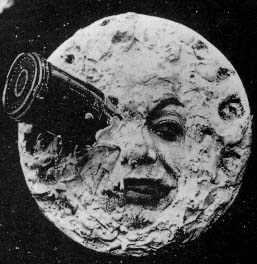
    The Moon certainly takes abuse here and there, ranging from cloud attack (in Lucian) to colonization to this very memorable (and frightening/disturbing, as I found as a child)  as in the case of the Man in the Moon being shot in the eye with a space ship (George Melies, Le Voyage dans la lune (A Trip to the Moon) (1902)). 

    Frank Rudolph PaulAnd of course there’s always the runaway Moon and the havoc that it would soon cause to the Earth, though then again this is not an exploding Moon, except it seems as though it might soon be so. 

    And so in a bit of rambling about the Moon that has gone on in this blog, there are no other mentions of the Moon exploding, though there are some other strange things going on there.  Just not “exploding” strangenesses.

    And especially not Laurie Anderson’s “The Exploding Moon“.


  • A Note on the Future of Computer Demand, 1957

    Computer survey227JF Ptak Science Books  Post 1723

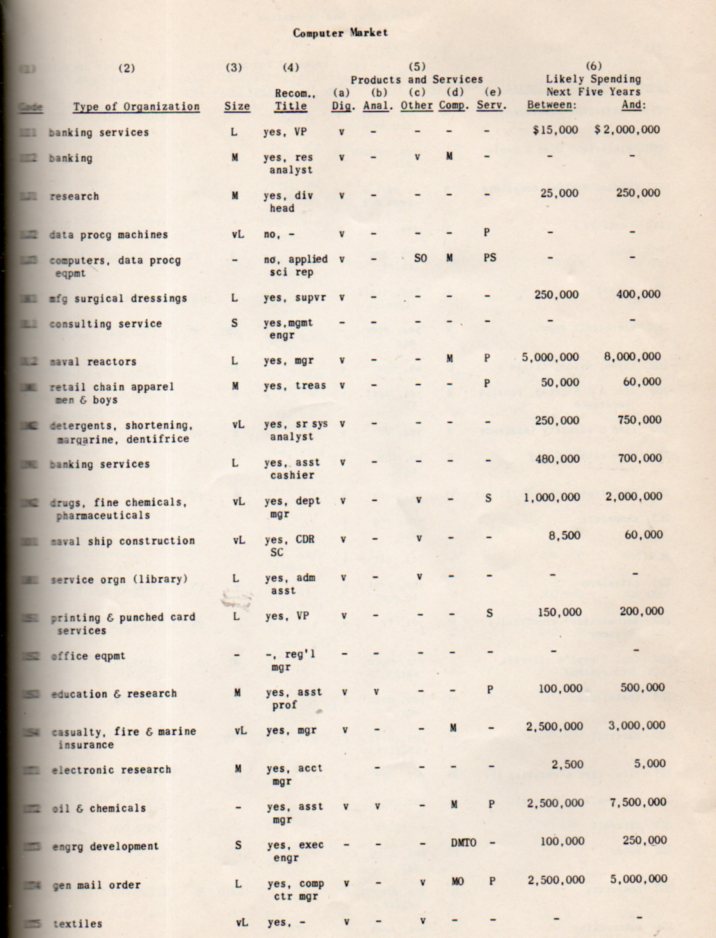
     This computer market survey (“Computer Market Survey—Report No. 1”), authored by the editor of the journal in which it appears—Computers and Automation, May 1957—is one of the earliest of its type. It takes a peek into the future demands on the computer industry, looking at different industries, their growth potential their products and support, and the amount of money that they might be spending (“on products and services in the computer field in the next five years”).  And what Edmund Berkeley saw in the next five years or so was–according to his survey–about $400,000,000 to $750,000,000 worth of computer sales. 

    The numbers come from a survey mailed to the subscribers of Computers and Automation: about 2200 were mailed out, and about 200 forms, or 9%, were returned. “The replies contain interesting, important and extraordinary information, showing the nature and size of the current market for computing and data processing machinery”, and it is upon these replies that the iterations of the report were established.

    The categories that I’m interested in here are the types of organization, its size, and the possibility and computer/data processing purchases.

    Some of the largest customers  in the future for computers and data processing were reckoned to be:

    Air transportation, ($2-4 million); electrical machinery ($1-6 million); “chemicals” ($10-15 million), “electrical apparatus and equipment” ($25-35 million); “gen(eral) mail order”, $2.5-5 million); “naval reactors”, ($5-8 million); “oil and chemicals”, ($2.5-7 million); “maps”, ($3-10 million); “petroleum, ($2-4 million); “research and atomic energy”, ($5-7 million); “airplanes, missiles, reactors”, ($35-50 million); logistics, ($4-6 million); “airplanes”, ($7-10 million); “core memories, matrices, buffers, data processing”, ($10-25 million); “airplanes, ($5-10 million); “computers”, ($15-30 million)

    The elephant in the small pink room stood to be “business machines”, which came in at a whopping $100-200 million), which was about a quarter of the entire plausible expenses in the coming five years. 

    And some of the smallest:

    “Naval ship construction”, ($8,500-60,000); “rubber, plastics, etc.”, ($100-200,000); “energy consulting services”, ($80,000-120,000); “retail chain apparel, mens & boys”, ($50-60,000); “basic agricultural) and industrial chemicals”, ($180,000-200,000); “research & development”, ($25-50,000); “data processing”, ($100-300,000); “research & development” ($25-50,000); “aircraft components”, ($10-40,000)

    And “electronic research”, ($2,500-$5,000)

    Somewhere in the middle, but not yet discernible needs fell to: 

    “banking services”, ($15,000-$2 million); “research”, $25,000-$250,000); “custom design processes and systems”, $1,000-500,000; life insurance, ($600-700,000); “department store”, ($17,500-225,000)

    And of course, “banking”, ($15,000-$2 million).

    This was all in 1957, fifty-five years ago.  Perhaps a “computer year” is equal to something along the lines of a “dog year”, like a 7:1 ratio, so perhaps when folks were trying to see ahead in 1957 in reference to the computer and computing needs it was sort of like trying to make a political prognostications for 2012 in the year 1662.  It was just too much. 

    And that $450,000,000-$750,000,000 figure would be worth about seven times that, around $3-5 billion.  Still a small figure, especially when you compare it to the defense budget for 1957, which was about $45 billion, which would make that figure just a few percent of the money spent on defense, and nowhere near what the amount would become.  Still of course Berkeley was on the right path, its just that the potential for the use of the computer hadn’t yet come to be realized. 


  • A Peek into the Future of Modernist Painting–1863

    JF Ptak Science Books   Quick Post   [Part of the History of the Future series.]

    I’ve written on this blog on a number of occasions about the coming of The Modern, about the coming of many modernisms that came to life in the extraordinary period of 1885-1925 (which could even be shaved perhaps to  1895-1920), when nearly all things “modern” in nearly all fields came to be.  Sometimes though one can see a hint of the future, even though it might not necessarily be recognized at the time.

    Punch modern231_edited-1
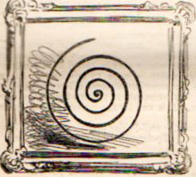
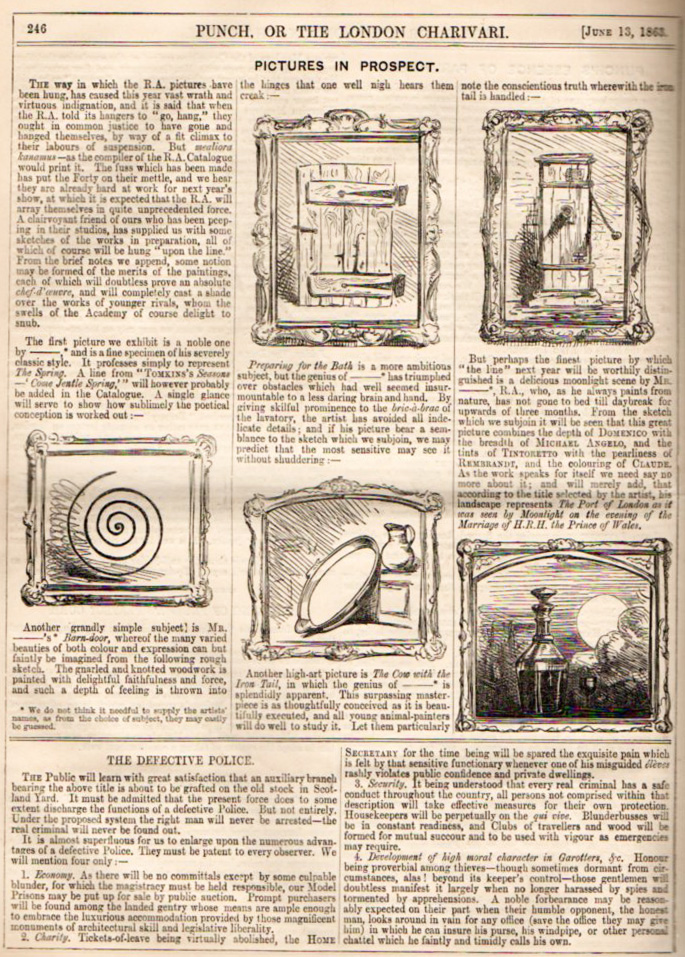
    Such is the whisper of the future in this humorous, somewhat mocking piece on art in the 13 June 1863 issue of Punch, or the London Charivari.  Overall its pretty funny in a 19th century fashion, but what I am taken with most of course is the first piece, the framed non-representational artwork, a taste of the future that wouldn’t arrive for another 50 years with Wassily Kandinsky.  But here it is, or here is something, presented as art, in 1863, and with no discernible, naturalistic subject matter. 

    Punch modern231
    Even in satire, seeing such a picture give sone pause–if for no other reason, that even here in the early stretch of Impressionism, that such an image would appear in a very popular journal and have (a) no impact  and (b) not an ounce of staying power. 


  • Flying Tanks, 1930’s-Style

    JF Ptak Science Books   Quick Post

    There wasn’t much pretty in the physical outcome of this thinking–to construct “flying” tanks for quick maneuvers into battle situations–but I think that I like the thinking in it, especially as it seems that the aircraft-end of the tank was re-usable. Still, there was the whole “landing” part of the operation, which meant that (at this time, anyway) the tanks had to be placed and not parachuted to the ground, which also means that the armor would be relatively removed from the field of battle.  But this would be better than driving the things there, or hauling them all on a train  for quick transport.

    Ank158
    [Source:  Popular Mechanics, vol 65, 1936.]

    Also I guess I’m partial to the design of the tank–which I’m guessing was a fixed-position mobile canon–because it seems so strikingly modern. (Except for the tread and wheels part, which is the place where battles are won and lost, at least according to Heinz Guderian.)  But I like the design, which at first glance reminded me of the great T-34, the Russian workhorse of WWII, sort of, at least for its low-profile sensibility, but really more like the contemporary   The Russian Chyorny Oryol (“Black Eagle“).  It really looks a lot more like the STUG assault gun, here:

    [Source: combatreform.org, here; a truly excellent site.]