A Daily History of Holes, Dots, Lines, Science, History, Math, Physics, Art, the Unintentional Absurd, Architecture, Maps, Data Visualization, Blank and Missing Things, and so on. |1.6 million words, 7500 images, 4.9 million hits| Press & appearances in The Times, Le Figaro, Mensa, The Economist, The Guardian, Discovery News, Slate, Le Monde, Sci American Blogs, Le Pont, and many other places… 5000+ total posts since 2008.

Category: Future, History of the

  • A Note on Music of the Future and Wagner’s Trashbin Philosophy, 1879

    JF Ptak Science Books  Quick Post

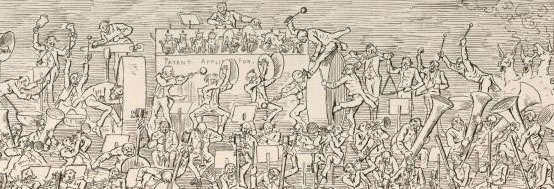
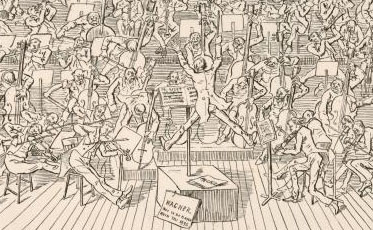
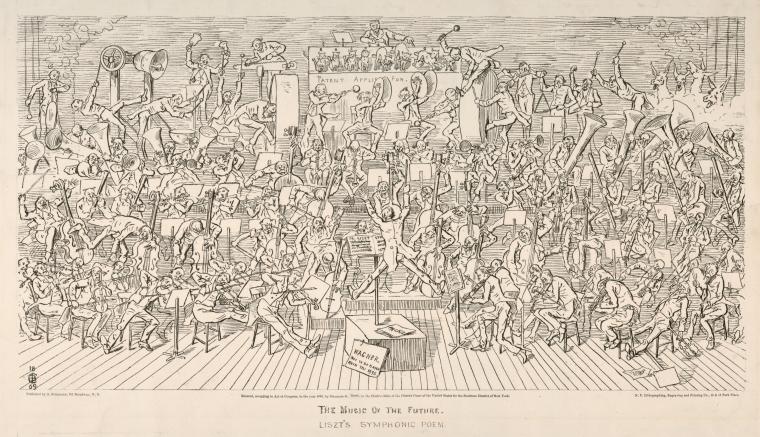
    This cartoon appears in Punch in 1879, and it clearly show’s the bitey Mr. Punch’s proclivities towards the rise of the “music of the future”.  Over the years Punch had seen little value in the new music possibilities, the form and function of which is on display in this kinetic appreciation of a hyper-functioning orchestra.  There is a considerable stab made at Richard Wagner (as we can see in the scores on the floor), the composer who perhaps (along with his considerable supporter, Franz Liszt) was at the deepest heart of the publishing end of the “music of the future”.

    The Music of the Future. Liszt's Symphonic Poem.
    Wagner published his views on the development of music and art in general for the future in Das Kunstwerke der Zukunfts (1849), and then more specifcally to music in Zukunfstmusik (“La Musique de l’Avenir”) in  1850.  But little of that feels like very much to me at all, given the other work he was completing in 1850–Das Judenthum in der Musik.  In some circles the work is translated as “Jewishness in Music” and also “Judaism in Music”, but this is far too polite–what Wagner was talking about was “Jews in Music” or “The Jew in Music”, as it was a savage attack on the place of Jewish people in music and of Judaism as a whole.  It is a virulent and nasty work, first published anonymously to protect Wagner’s “freedom” (as he called it) and then again–unable to leave it alone–in 1869, proudly under his own name.  The work is widely seen as a hallmark of German antisemitism and an embarrassment to Wagnerians, and in some editions of Wagner’s complete collected works, it is forgotten.  On the other hand, it wasn’t just here that Wagner’s antisemitic views are made known–he was a prolific writer, and his work against the Jews appeared numerous times in newspapers and other periodicals, playing the same tune.
    I’m okay with the man’s name on the floor. 
    Dailydose--music of future
    Daily dose--music future 2


  • The Future of Building in Manhattan, 1875

    JF Ptak Science Books   Post 1828

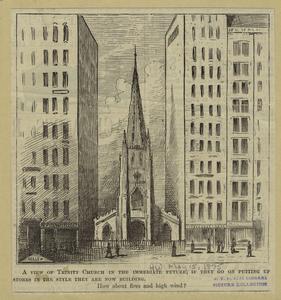
    This is an interesting and somewhat reserve view of the future of Manhattan, as seen from the pre-Centenniel eye of 1875, showing Trinity Church bookended by high-rise structures:

    A view of Trinity Church in the immediate future, if they go on putting up stores in the style the are now building.[Source: Harper’s Weekly, via the New York Public Library Digital Collection, here.]

    It would have been difficult to imagine structures of any greater height here in pre-elevator (and pre-elevator/Westinghouse brakes)  and early post-iron-structure days than the spire of Trinity Church. This Trinity (the third and current occupiers of an old spot at 79 Broadway, the first of the Trinitys going up in 1698 with the help of he block and tackle of Capt. William Kidd, privateer/probably-not-pirate) was the tallest building in Manhattan when it was built in 1846 (at 281′ to the tip of the spire), and remained so the tallest until the construction of the New York World  Building (305′) in 1890. (The World building was torn down in 1955 to make room for another on-ramp for the Brooklyn Bridge.)  So when this image was published it was still another 15 years away from anything being taller than the Trinity tower, which meant it was a pretty fair leap of faith to assume department stores crowding out the church’s airspace back in 1875.

    It is a pretty good approximation of what actually happened, though the canyonesque feel for development is more on Wall Street than it was here contiguous to the church grounds, though almost no one could imagine the dense high-rise growth that is there today:
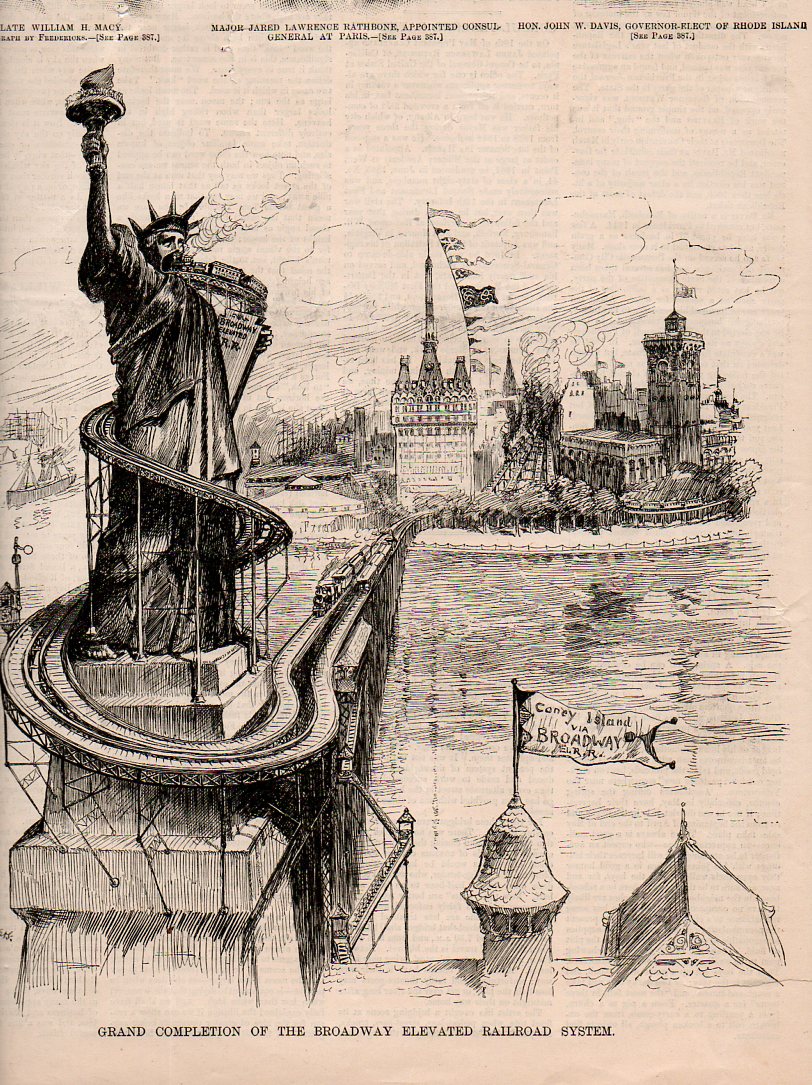
    There are many more colorful approximations of what might happen in Manhattan, one of which I’ve included below, showing the full and complete development of downtown, with trains leading away from the city right through the Statue of Liberty. This peep into a possible future appeared in Harper’s Weekly on 18 May 1887.  It is the work of artist W.A. Rogers and depicts a filling-up lower Manhattan, complete with broad avenues lined by elevated trains whose reach evidently knows no bounds. The new elevated subway winds its way across the harbor to Liberty Island, where it wraps itself around the feet and up the body of the newly–dedicated Statue of Liberty (opened in October of the previous year).  In the foreground is the cupola of a transit station with a fluttering flag advertising “Coney Island via Broadway”–I’m not sure what this is all about, as the placement of the island has nothing to do with anything except making a point in the cartoon.
    https://historyofideasblog.com/a/6a00d83542d51e69e2014e87fca7be970d-pi
    It is interesting to see though that the Trinity spire is still very visible.

  • Daily Dose of Dr. Odd–Future of Air Travel, ca. 1900

    JF Ptak Science Books     Daily Dose of Dr. Odd 2

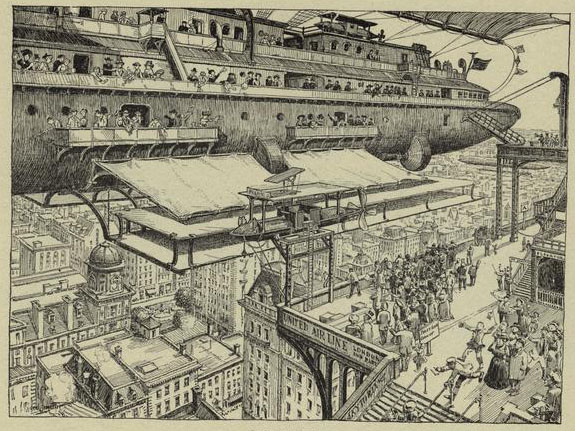
    In today’s quick dose from Dr. Odd we find the “United Air Line” (so close to the name that actually came into being), ca. 1900, featuring an enormous and extraordinarily heavily-bodied airship of a construction of pure speculation.  It is gigantic and weighty, and it seems as though the thing is powered by pulsating awning-like wings and a series of covered propellers, all under what seems to be sail. 

    The crowds bustling beneath the behemoth seem as any other crowd waiting for the subway, or third class, or, well, whatever sort of mass transport would await and was taken for granted.  There are no bands, no fireworks, no fanfare, just the arrival/departure of yet another airship leaving for London from New York City, as much a cause for attention as any airliner traveling overhead.

    Dailydose airship

    Source:  New York Public Library Digital Collections, here.

    Source:  New York City Digital Collection, here.


  • Daily Dose from Dr. Odd–Future of NYC Underground

    JF Ptak Science Books        Daily Dosage from Dr. Odd 1

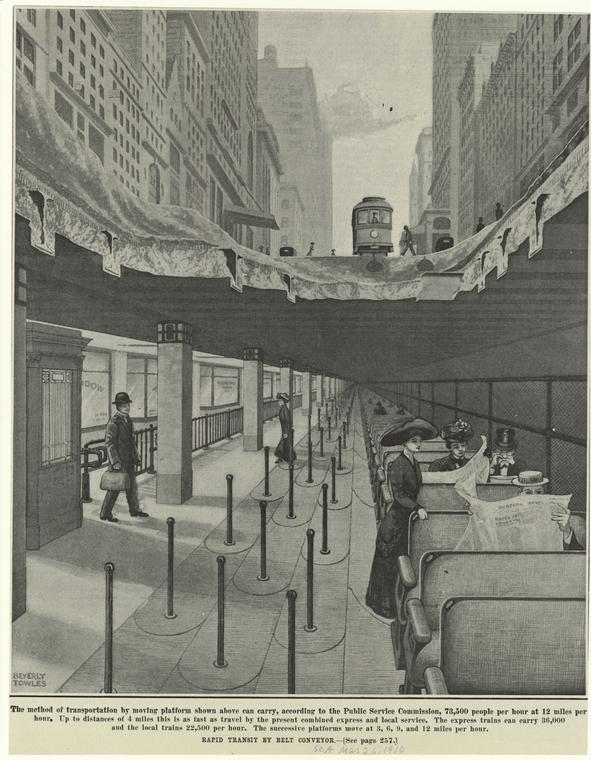
    Rapid transit by belt conveyor.
    This remarkable cutaway (1910) shows what might have been considered a possible future for the future of possible New York Citys .  This one features a very highly respectful continuous conveyor belt of humanity coursing through the Great Underneath, replacing the ideas of subway transport.  A seat would always be available if it was so, just a=one giant beltwork of seat stretching from SOuth Ferry to Uptown and to Brooklyn and so on.  But since it was always moving it would have to move a little slowly for people to hop on and off, so a trip to the then-Uptown might take some time. 
    Source:  New York Public Library Digital Collection, here.
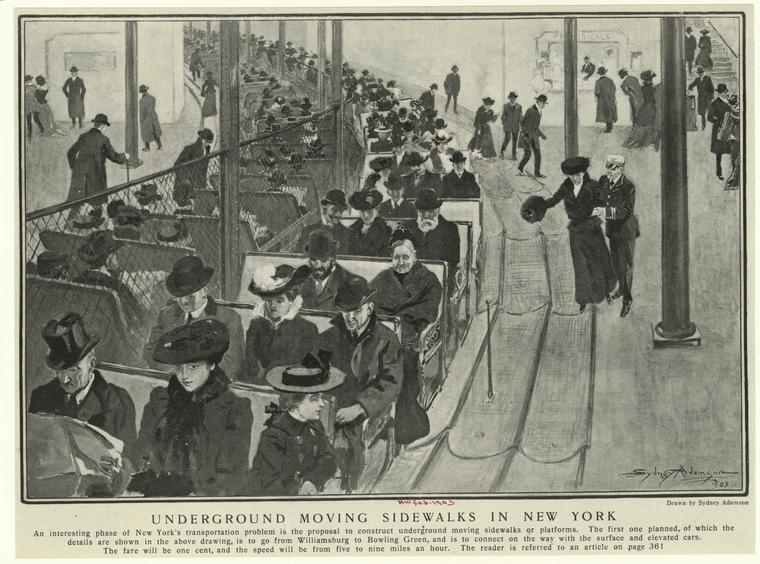
    Not to be out-belted, there was also an image of moving sidewalks (1903):
    Underground moving sidewalks in New York.
    Source:  New York Public Library Digital Collection, here.

  • What a Biologically-Downloaded Intelligencer Virus Might Look Like in 2112.

    JF Ptak Science Books   Quick Books

    Somehow, in some way that is difficult for us to imagine in 2012, these ads were attractive enough in the mid-last-century.  Of course we have our own examples of this behavior, only more-so, I expect, given the vast multiples of advertising we undertake today.  Somehow it feels as though there just isn’t enough space in our own year for the sheer weight and smell of ads, and that some of them must be occupying and stealing oxygen from our time in the future.  Then again, in the future maybe we will all be paying for quiet in our brains so as to not be subjected to nothing but constant streams of commercialism, perhaps inherent in our neurons, ads becoming a part of the very part of the thought process, commercials interrupting our creative process, and popping up at appropriate times in the process of recollection. (Happy thought, that). 

    And so this might look to be an unbelievable, incoherent way of attracting someone to eat pork bellies and eyelids–but at least it appeared in a print ad in 1948 (or whatever), and that was the end of it.  In the future if this was seen once it might be possible for the thing to be incorporated in a memory process that had anything to do with the letters “p” “o” “r” “k” when put together in a row, frontwards or backwards. That’ll be when we have to pay for our memories to be cleaned of commercial sponsors.  

    I can see a short story developing from this, of a person in the year 2112 (on 11 November) having a problem with the artificial memory intelligencer–the things that would make us “smart” in the future–where the biologically-downloaded data contained a virus (literal or figurative) that caused the man to think about this image every time a thought was thunk.  And there was nothing that could be done for him, short of him raising twice the labor exchange units that he had access to in order for this image to be expunged.  No ransom payment meant seeing this pig a thousand times a day.  And so a new crime is born. 


  • Telling the Future with Urine and Bones: the Lyricism of Urine Wheels

    JF Ptak Science Books   Post 1820

    For many centuries people have been trying to control the future, seeing into future’s past, using tea leaves, foreheads, palm prints, brain bumps, nose angles, the position of the stars, rolled animal bones and printed interpretations of the creator of the universe.  Some of these have faded into embarrassed obscurity, but only some; some methods are present today, stronger than ever. 
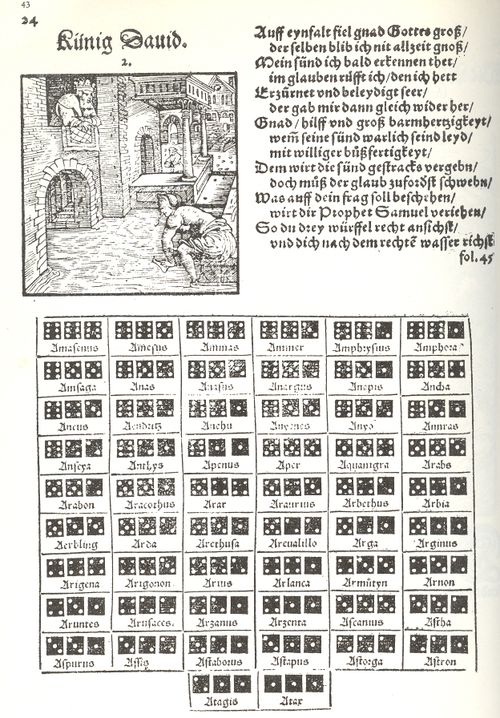
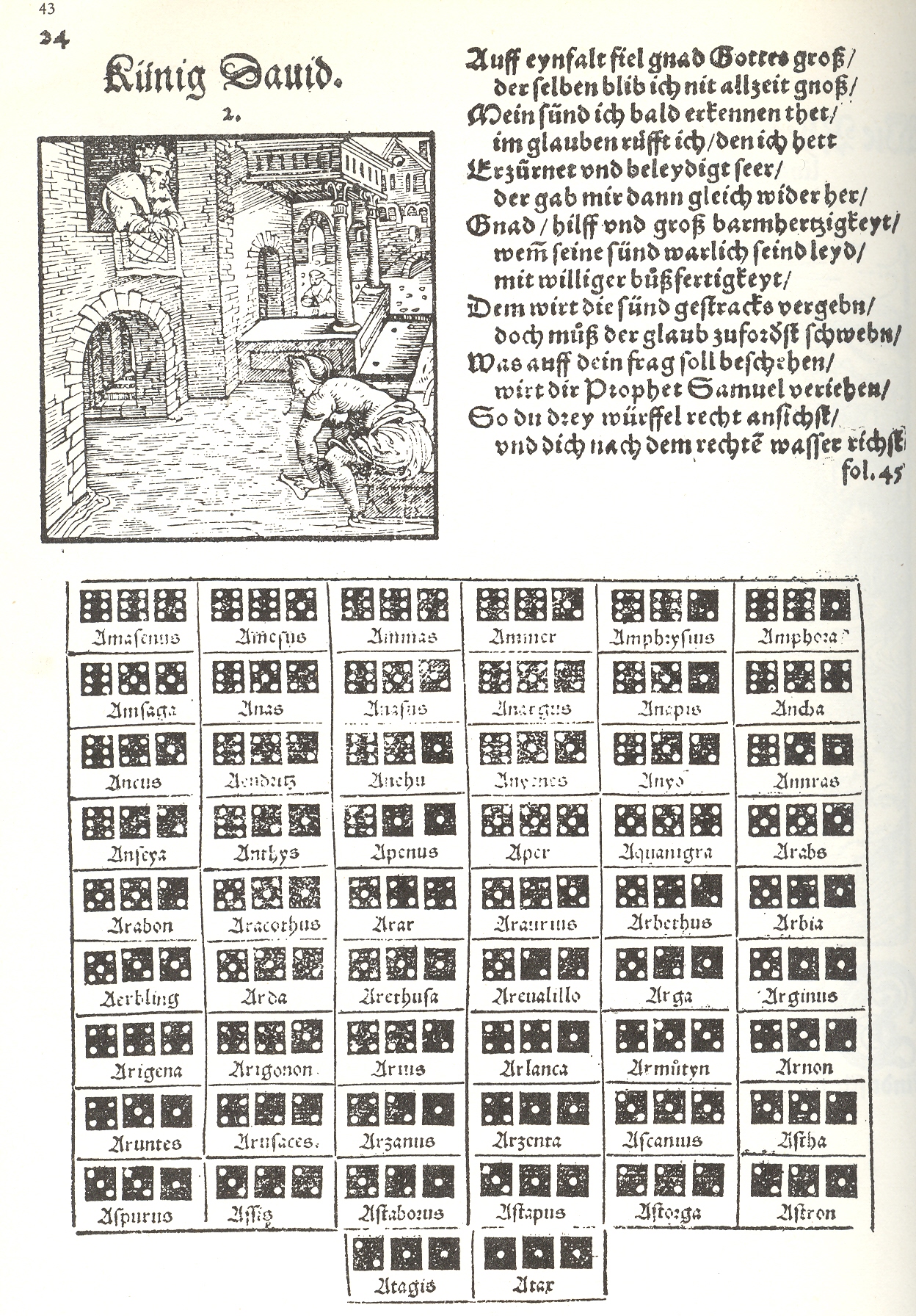
    + blog dice The rolled bones part of this makes the prettiest pictures, I think: for example, this image from Paul Pambst1 (published in 1546) shows some of the dice combinations and what they would correspond to in the revolving paper disks and columns of interpretations in the body of the book, a simple throwing of shaped animal residue somehow laying claim to predictive power.  Not that it is much different from any of the other divination methods. 

    One such method that had been in strong and continued use for thousands of years and is now mostly relegated to dust is the heated up and swirling inspection of urine.  It was thought for millenia that pee held secrets to what was going on inside the body, and that was mostly true, except that given the state of medical knowledge the only thing that the practioner could do with the sample was hold it up to the light and make good solid guesses on how color/consistency corresponded to the patient.  A reddish tint (as we see here in this painting by Gerrit Dou (1613-1675, and who made an appearance in yesterday’s post) might suggest that the (female) subject was suffering from morbens virginus (uterine hysteria, “a signifying of too much concoction in the body”), which, when the imaginary disease/unease was diagnosed would’ve led to lead consumption and a good bleeding.

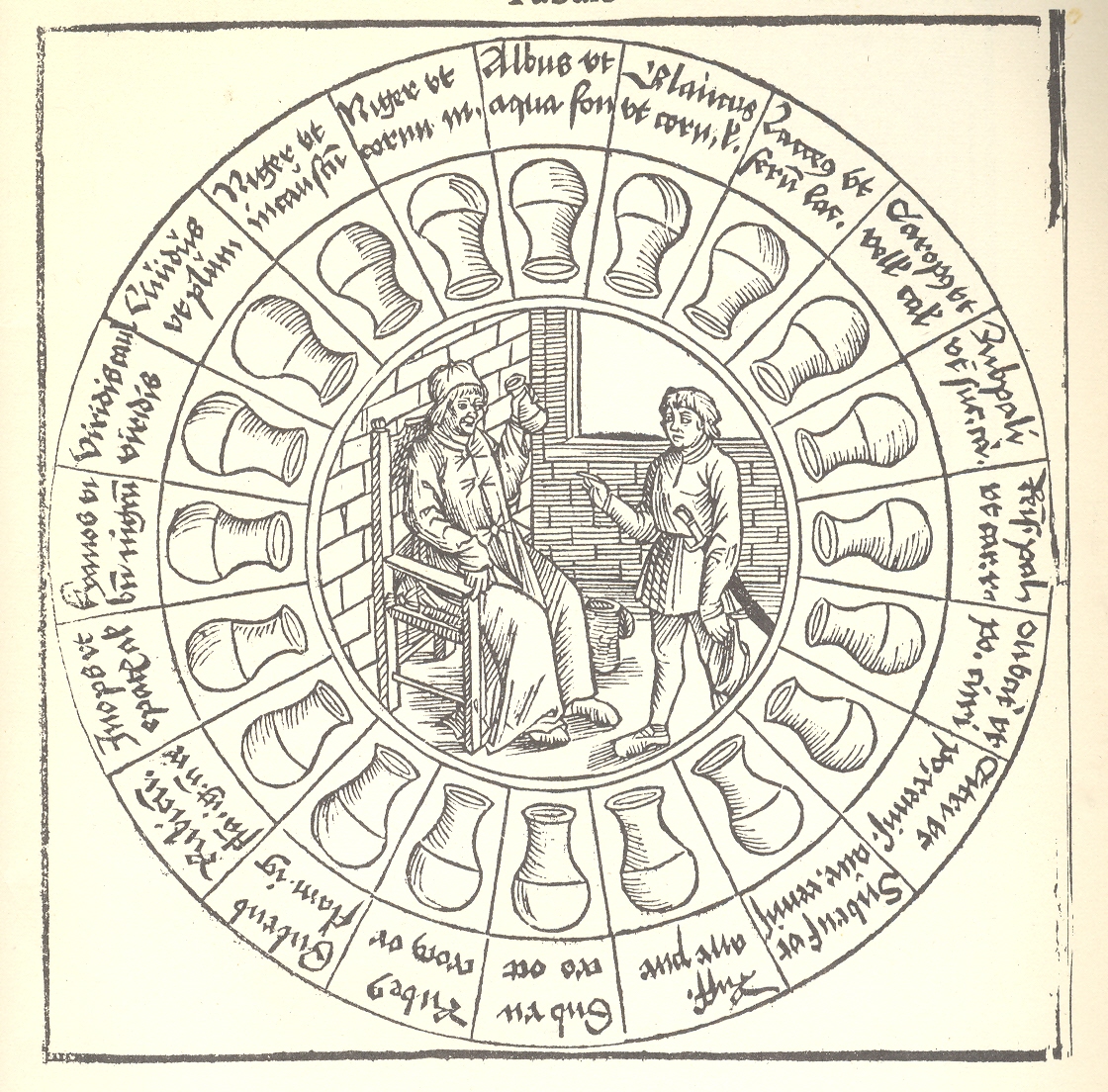
    + blog dou urine  Moving slightly up the alpha from Pambst is Udalr Pinder, whose Epiphanie Medicorum…2 (published in Nurnberg in 1506) is a state-of-the-art disposition on urine inspection, complete with this pee color wheel.  This idea is as interesting as it is entertaining, because at its base is a scientific aspect of trying to establish a common (color) base for discussion of specimens.  The color descriptions (taken in translation from Kirsten Jungersen’s  (MA, classical philologist, visiting scholar, Medical Museion, University of Copenhagen) “The relation between text and colours in medieval urine wheels” (here) are poetic, lyrical. They are also a small insight into common things of the 15th century, the author selecting colors from things that were ubiquitous and known to everyone, and so in this way could be used as a basis for the common understanding of a given color.  + blog pee
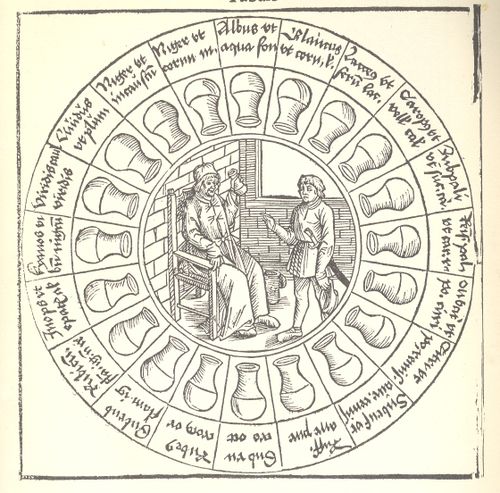
    And so here are the glorious colors (complete in “extended reading” below with the Latin above), most of which I’ve never heard as descriptors…and would love to see as an adopted sub-there by Crayola (“Crayola Urine Wheel Colors”):

    “Bluish-grey as camel skin; White as wellwater; Light blue/green/grey as lucid horn; Milky as whey of milk; Slightly pale as a not reduced juice of Meat; Pale yellow as of a not reduced lemon; Wine-red as of animal liver; Black as very dark horn; Ruddy as pure intense gold; Green as green cabbage.”  And of course:

    “Slightly red as a lowered flame of fire”

    and

    “Red as a flame of fire not lowered”

     They’re lovely!

    But of course none of this was actually going to help anyone very much, especially when you moved from uroscopy into urinomancy (not a word one gets to use very often), where instead of trying to diagnose dis-ease the urinomancer would try to diagnose the future.  Often heat was applied to the jar (matula) of urine, which would do, well, I don’t know what.  It certainly looks dramatic, and makes for some excellent opportunities for artists to discern candle-lit color and wonderful reflections (as in Dou). + blog dou urine det Actually, it was in this way that the golden color of urine was determined (poor alchemists!) not to come from gold at all—urine was finally boiled away until its component urea was discovered (in 1773)3. So heat did have a real and important function, but it took hundreds of years to get there properly.

    And so it goes that predicting the future with urine was swept into histories dark places, though somehow bone throwers and astrologers managed to escape this fate. 

    Notes:
      1. Paul Pambst. Loozbuch zu ehren der Roemischen…published in Strassburg in 1546.  The Robert Sabuda website for popup books ahs a very good short essay on this book, here.

    2. Epiphanie Medicorum. Speculum videndi urinas hominum. Clavis aperiendi portas pulsuum. Berillus discernendi causas & differentias febrium.

    3.  H.M. Rouelle first discovered and isolated  1773, and then synthesized by Friedrich Woehler in 1828. This was big and important stuff.
     

    Color Wheel Colors, continued below:

  • Some Very Big, Sky-High Airborne Thinking, pre-WWII.

    JF Ptak Science Books  Post 1807   [Part of the History of the Future series]

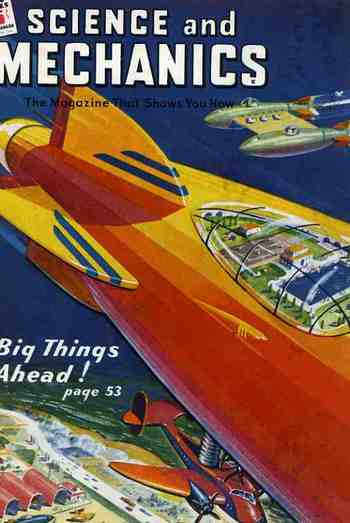
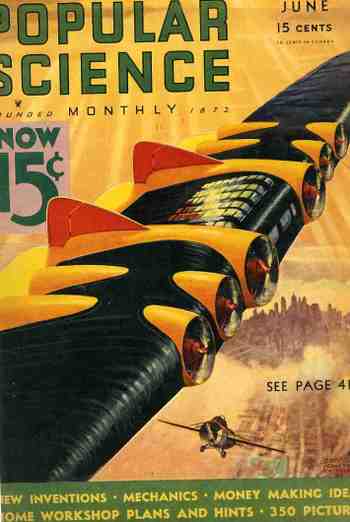
    Blogaugust_16bigflying_wing_detail3Once upon a time, engineers could do anything, especially in the first third or so of the 20th (American) century. The hopes for technological superstar were often on display in popular and illustrated magazines, though much of the times the dreams were more dreamy than they were engineering possibilities.   Some of my favorites among these hopeful projections of the future involve Big Thinking, and floating above these images of great possibilities and reluctant possibilities are thoughts on flight and of luxurious flight, or perhaps even continuous-flight-living. These three images were covers on some of the most popular of the popular sci-tech mags for this period:    Science and Mechanics, Popular Mechanics, and Popular Science Monthly. 
    Blogaugust_16bigflying_wing395

    All three of these examples show (in insets) some sort of large, encapsulated, living section that exists somewhere in the superstructure of the aircraft. The first example comes from Popular Science (15 June 1937), and depicts what I think is a large living area under a grid of 54 large glassy roofs—it is not possible for me to estimate the proportions of the craft, though I think it pales in comparison to the next two examples.

    Blogaugust_16bigflying_dirigible399

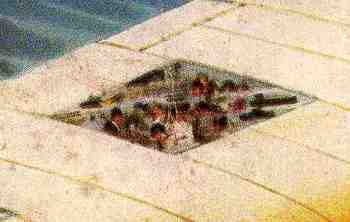
    In both instances the encapsulated areas have trees and roads. In the case of the Science and Mechanics contribution there seems to be six (?) of these large enclosures, the detail of which shows a large swimming pool, a club house, two tennis courts, and some other sporting area, all of which are surrounded by trees. Multiply this structure by six and what you’ve got is one really really big aircraft, which is somehow jet/atomic powered–in any event it is a gigantic craft and it is somehow staying aloft.

    Blogaugust_16bigflying_wing_wite_de


  • The NCC-1701, 1930: the pre-Starship Enterprise

    JF Ptak Science Books   Quick Post

    Uture plane519

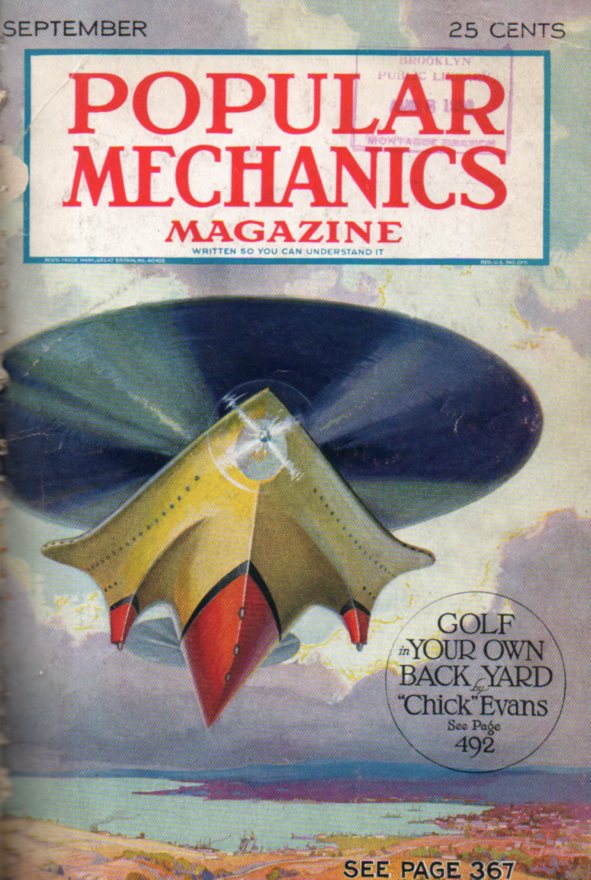
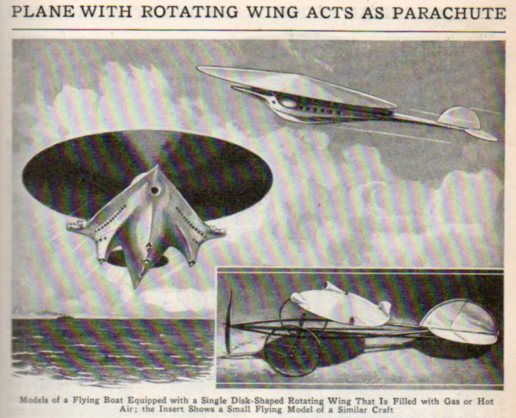
    Well, what is really was, or what this was intended to be in this memory of a possible aviation future–or naval future, as this airship was really a flying boat, an “amphibian, a dirigible, a gyrocopter ….an airplane”.   A ship, really, trying to judge the size of the thing by the position of the portholes/windows–the thing was big, and the “single wing, rotating disk-shaped affair filled with gas or hot air” was even bigger.   We read here that the disk was “turned by a gasoline engine” which was located in the center of the ship, leaving still plenty of room for “quarters” for the crew and passengers, making for what the inventor thought was an easy ascent and then, using the lifting device as a parachute, and then having a parachute-y descent, soft and simple.

    Its hard to judge the size of the machine, but it looks like there are 40-50 portholes or windows running the length of the ship, and so I’d guess that the fuselage of the craft was 150 feet long, which was about half of its overall length, making it about 300 feet overall.  The disk then could be 150-200 feet in diameter, giving it an area of close to one acre.  Big. 

    And so:

    Uture plane520


  • The Rolling Houses and Glass Homes of Futurlandia

    JF Ptak Science Books   Post 1806  [Part of a series on the History of the Future]

    The rolling house of the future (offered in the September, 1934 issue of Everyday Science and Mechanics) promised at least one thing–the ability to be towed by a tractor.  (And seeing that the thing is being pulled along by chains, let’s make sure that there’s no downhill towing, yes?) Rolling_house_large


    The spherical houses seemed to come with their own railroad tracks for easier motion–a continuously self-laying track, which would make the new American suburbs a Suburbia Mobilia.  Cheap cars, cheap houses, and a Great Depression might have made for a picture of the future that was very self-sustaining.  On the other hand, the one thing that would not have been in the gunsights of the American manufacturing center is the size of the houses, which seem to me to be on the order of 500 square feet or so, which does not make for a lot of room to store all of the consumables that were waiting just around the next decade or so, waiting for the first real generation with a large amount of disposable income to loosen on all manner of never-to-be-purchased-before-by-the-working-classes consumers.  In this respect I am sure that these small buckets for human life would seem unacceptable, leaving little room for purchases. 

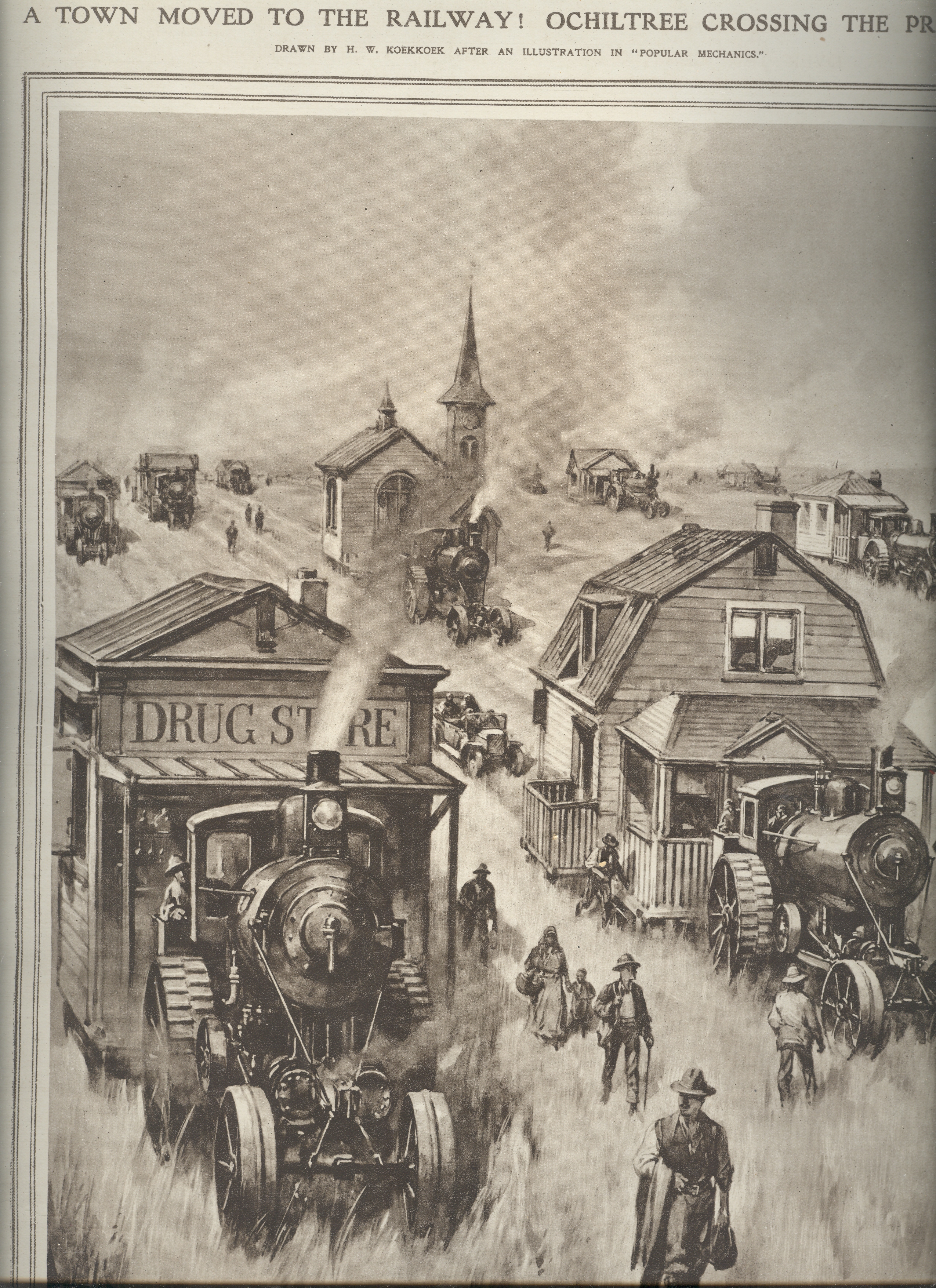
    ++00++ 9.25 ochiltree, texas

    It does remind me of wholesale town-moving, but from the past–real-life stuff, things that happened.  Like here, for example, in  Ochiltree, Texas, 20 October 1920.  This was a rare occurrence–to move a town–though it is hardly unique, particularly if moving the town closer to a railroad line that had decided to pass it by meant the difference between life and death of the town, then, well I guess you moved the town if you could.  Cemeteries included, sometimes; and sometimes not.

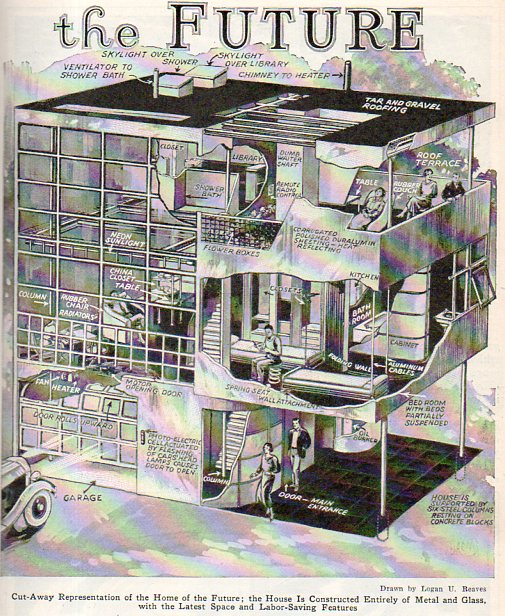
    A memory of another image of a futuristic future house of the future pulled my recent memory to a volume of Popular Mechanics for 1931, the August issue, featuring a “Home of the Future” speculation–this one was also small, but far less mobile, being constructed of metal and glass; and from what I can see, the common home’s exterior walls were mostly glass.

    Future house514

    It looks like a small place–I’m not sure that the car would actually fit in the glass garage.  And it doesn’t look all that comfortable, either, especially in regard to having no walls for bookcases.  (A wall of shelving for a collection of Kindles?)  There *is* a “skylight over the”library”, but it looks like the library isn’t more than a half case of books.  But perhaps in the future we are all entering a world where something is whatever we call it.  Oh, yes, I think that part of the future has already arrived in 2012, and I doubt seriously that the folks writing this article for a popular audience had anything more than a droll popularity in mind in their authorship.  In any event, this future house wasn’t mobile, was small, and looked pretty uncomfortable. And I also bet that the roof gave them problems up there in Futurlandia. 


  • The Stages of Human Life–Illustrated

    JF PTtak Science Books      Post 1796    [Part of the History of the Future series.]

    I came across this fantastic representation of the stages of human life in the beautifully-named book by Bartholomaeus Anglicus, All the Properytees of Thyings, which was published in Westminster in 1495 (and also known as De proprietatibus rerum, also translated as On the nature of things, or On the properties of things), and which was originally written around 1225).  The book was a bestiary, a marvelous encyclopedia, a collection of all things as known in the 13th century–it would be interesting to represent all that is know today and compact it into a workable, logical, usable (printed !) book of a thousand pages.  One of those many images was this:

     File:Stages of Life by Bartholomeus Anglicus 1486.jpga simple, compact reminder to the book’s readers about the progression of life.  Infant, toddler (in a Renaissance walker), child (at games), teen (adopting some of the trappings of adulthood), prime-of-life, middle aged and then the leaning elder. 

    It strikes me that the idea of “stages” is what most of what experience might be–the ideas of “stages” and “progression” are everywhere, even perhaps in the places they shouldn’t be.  There are simple things like rockets that keep releasing smaller and smaller stages of itself until it gets down to the (satellite etc.) nub; sleep has its five stages resulting in the final resting state of r.e.m.,; there are recognized stages of  development for psychology (Erikson), and cognition (Piaget) and need (Maslkow) and  moral (Kohlberg), and spiritual (Fowler), and  economic (lots) and on and on into the progressive stages of the sunset. Progression and series belong in arithmetic and geometry (and etc.) and in the scientific method, as well as music (succession of chords) and disease (more so than health).  Examples are limitless.  But for right now, I just wanted to post a few images of these antique reminders of progression and mortality…

    The Stages of Life, broadside published by James Catnach, London c. 1830. British Museum.

    File:The Stages of Life BM 1992 0125 31.jpg