A Daily History of Holes, Dots, Lines, Science, History, Math, Physics, Art, the Unintentional Absurd, Architecture, Maps, Data Visualization, Blank and Missing Things, and so on. |1.6 million words, 7500 images, 4.9 million hits| Press & appearances in The Times, Le Figaro, Mensa, The Economist, The Guardian, Discovery News, Slate, Le Monde, Sci American Blogs, Le Pont, and many other places… 5000+ total posts since 2008.

Category: Future, History of the

  • Future of Flight, 1836

    JF Ptak Science Books   Quick Post 
    Follow Me on Pinterest


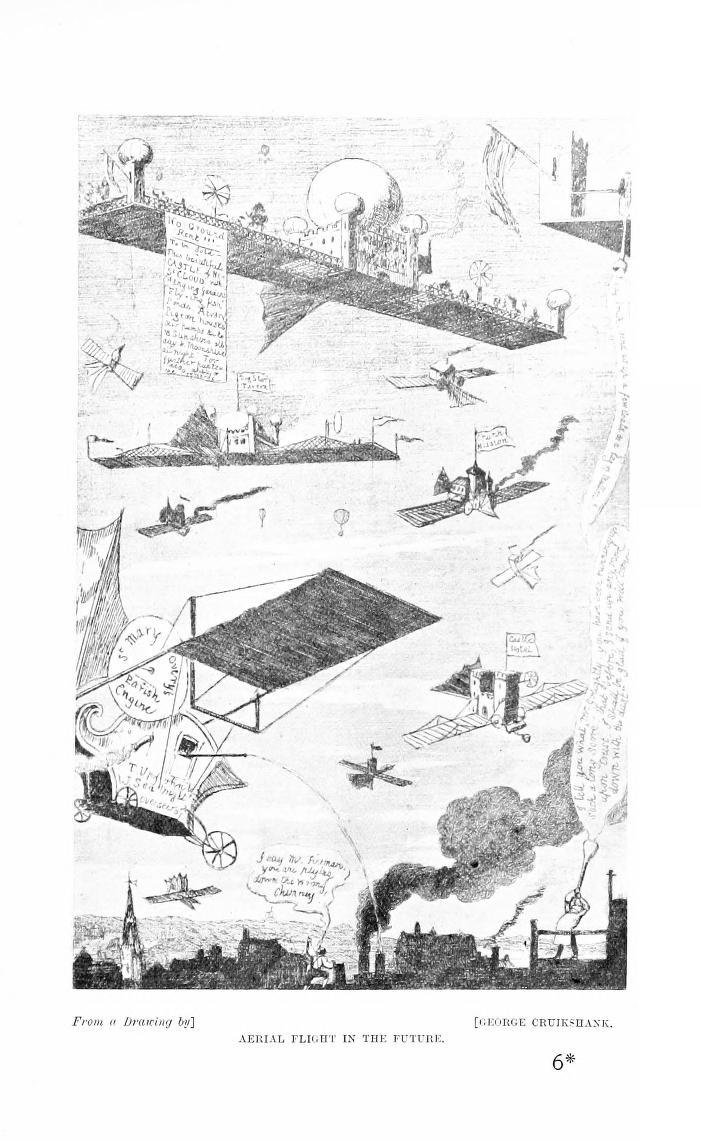
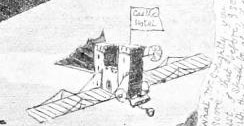
    This lovely image of the possibilities of future aerial flight was made by the celebrated caricaturist and illustrator George Cruikshank, and was printed in 1836.  The aircraft at top is a massive affair (the selling of the “beautiful Castle in St. Cloud”) offered great possibilities along with “no ground rent”.  It is absolutely a castle int he sky, literally and figuratively, and must’ve seemed to be something of a possibility to Cruikshank in the fifth decade following the first balloon ascension.  Of course he was having a turn at aviation, but I think he also saw the bits of the feasible within his hopeful caricatures. 

    Aviation of the future[Source:  E. Seton Valentine, Travels in Space, a History of Aerial Navigation, 1902.  Here.]
    Details below:Aviation of the future--house in sky


  • Fabulist Images from an Accomplished Genre-ist

    JF Ptak Science Books  Quick Post

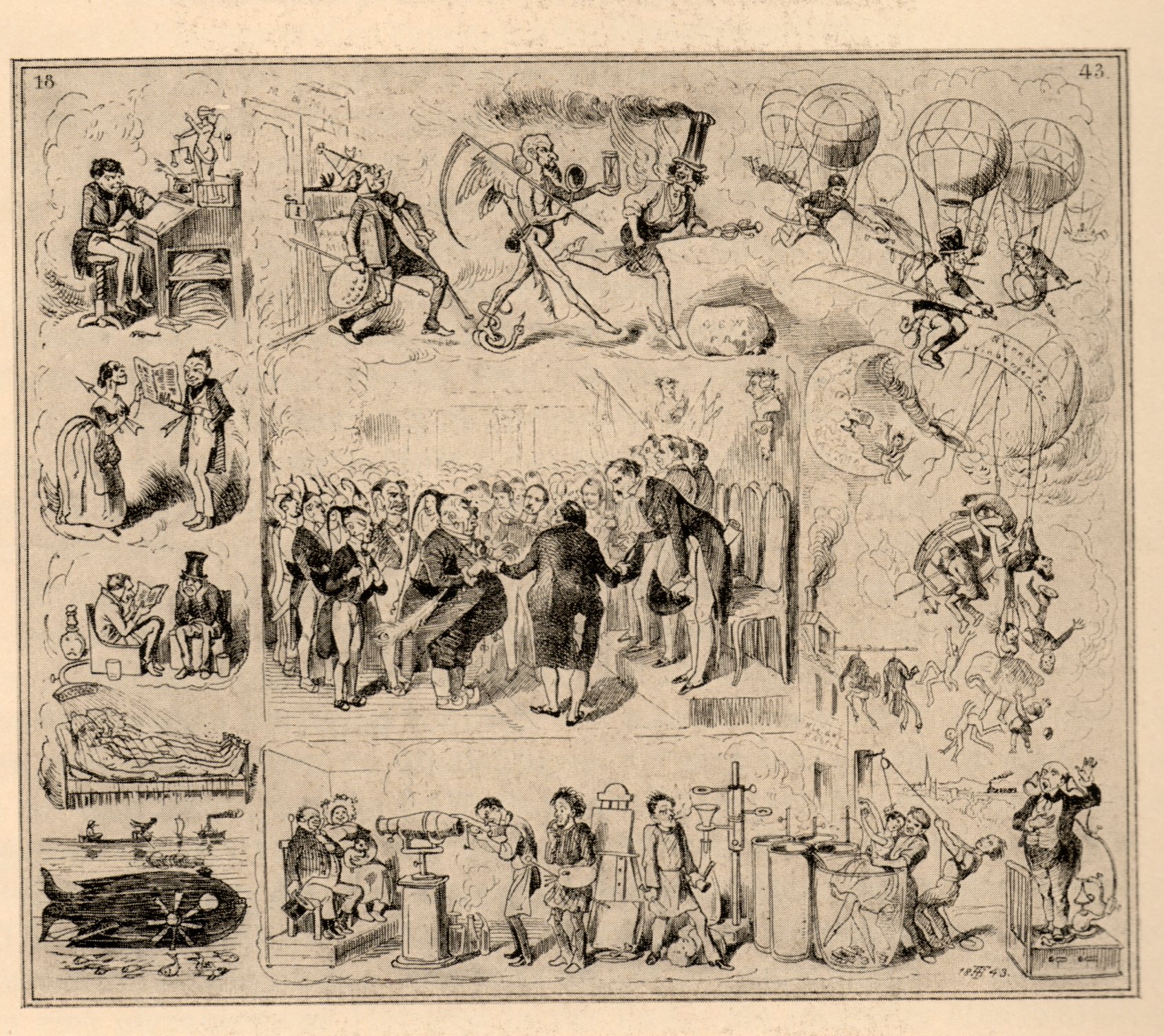
    I stumbled upon these very inventive, peep-into-the-future of  imagination images by Theodor Hosemann in journal Exlibris Buchkunst (for the year 1910).  Hosemann’s (1807-1875) name came into a blurry recognition as a leading genre painter and very busy illustrator in mid-century Germany, but certainly not for these images, which remind me very much of J.J. Grandville, one of the leading imagist illustrators of the 19th century.  (Grandville has been a subject in this blog quite often; for example, see here.)

    Hosemann908
    The originals were completed in 1847 and depict some of the trials demanded of future vision, looking into the year 1947. I particularly like the steam-driven horse-mobiles and the steaming-hatted Mercury laughingly outrunning a grimaced Time. 


  • The Battle of the Extra Earths: Mini-Extra-Earth Vs. Full-Sized-Standrard-Earth (?)

    JF Ptak Science Books  Quick Post     Part of a series on Strange Things in the Sky

    Follow Me on Pinterest

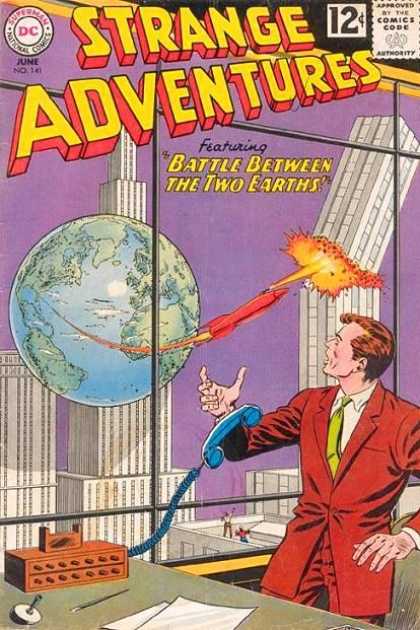
    This is a quick addition to the Extra-Earth category of this blog–and an amazing one. In the other examples the extra-Earths appear simply appear , with little or no interaction between the two. In this instance we have one Earth attacking the other. 

    Extra earth

    There is no necessity for this to make much or any sense, what with the purple sky and, of course, the extra-Earth–but the attacking rocket taking off from the extra-Earth extra-Florida (or thereabouts) seems to grow in size as it gets closer to its target.  After all, the attacking extra-Earth is less than 300′ away from what has become an enormous and marauding space vehicle (judging from the distances in relation to the buildings) which is now longer than the extra-Earth-America is wide.  But in the world where a miniature extra-Earth can attack a standard-sized-Earth, this would be a minor quibble. 

    Honestly, I think I like to write about such things for the joy in having to think of a title for the post. 


  • On the History of the Weight of Unknown Things

    JF Ptak Science Books LLC  Post 1922

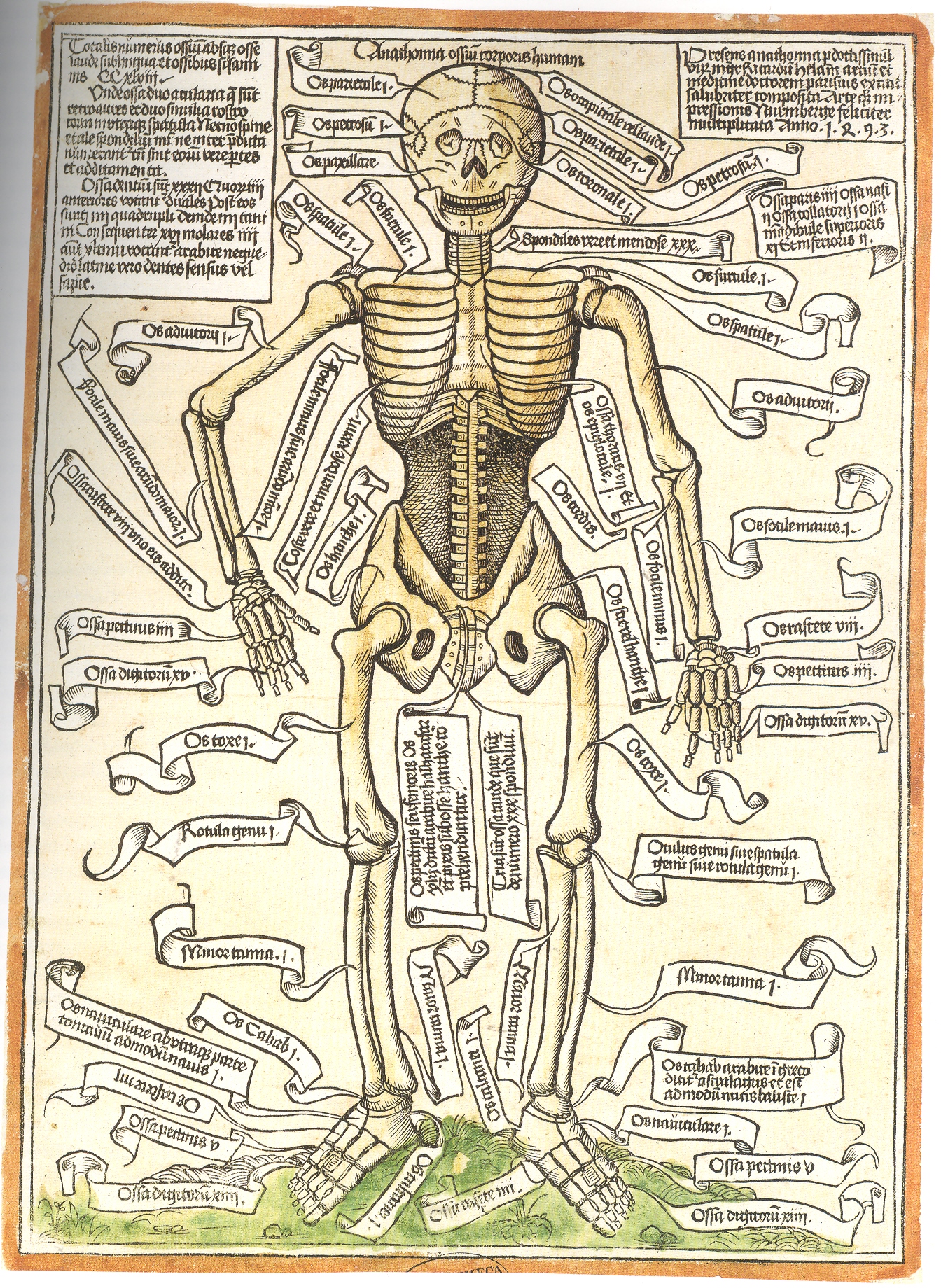
    Blog--may 5 skeleton

    Much of human intellectual history has been dedicated to looking inside, seeing
    the unseen, the stuff underneath, the invisible, the clouded, the inscrutable, the
    things-behind-something-else.   If you could somehow weigh all of the stuff that
    we know that is “visible” versus all of the other stuff that is not, I think that
    the scales would fly over instantly into the world of the unseen. Some of this
    material though does not have a measure:  for
    example, numbers are part of the unseen world, ideas made of nothing, points
    and lines in an imaginary series of planes and dimensions, and so have no mass
    themselves. Everything that is alive on and in our bodies, on our skin, in our
    water and food, and which were all basically unknown until the invention if the
    microscope, have little weight in and of themselves, but when  you add the whole biota together…well, then
    you’ve got a whole weighty lot of nothing  Then there’s the stars unseen beyond the six
    or eight thousand that we can see without a telescope, the rest of the universe
    waiting, discovered only 400-odd years ago, a very weight affair (and that’s not counting the dark matter). 
    I know that this is sort of a horrible argument, a beery and inelegant way
    to describe the path of human knowledge, but it strikes a (dis)chord with me. 

    What is the history of the unknown, anyway? Its seems like an infinite volume in Borges’ infinite library. After all, at any given point in time it would not be possible to know what the things unknown in your universe were, though you could guess at the absence of things by the changes they brought to the known stuff around you.  And to go back and write a history of the unknown would probably show an expansion of the topic rather than its collapse. However, if we are dealing in a Borgesian vocabulary we could establish that The Unknown at some point in the future becomes finite, and that a human-techno-cyborg race was closing in on the concept of the unknowable unknown having somehow established its parameters, and that at some point in the prickly future, the end of the unknown was in sight. As a matter of fact, it could be stipulated that the concept of the Unknown would cease to be in existence on 26 March 3012.  Then it would become time for a special assortment of people to work together to create the unknown, even as galactic brain churned in the background producing all of the possible works of literature/art/music, filling up the gap between the known and the unknown. 

    Creating unknowables in a time of the Post-Unknown would be, um, problematic.


  • Smart Machines, 1950

    JF Ptak Science Books   Quick Post

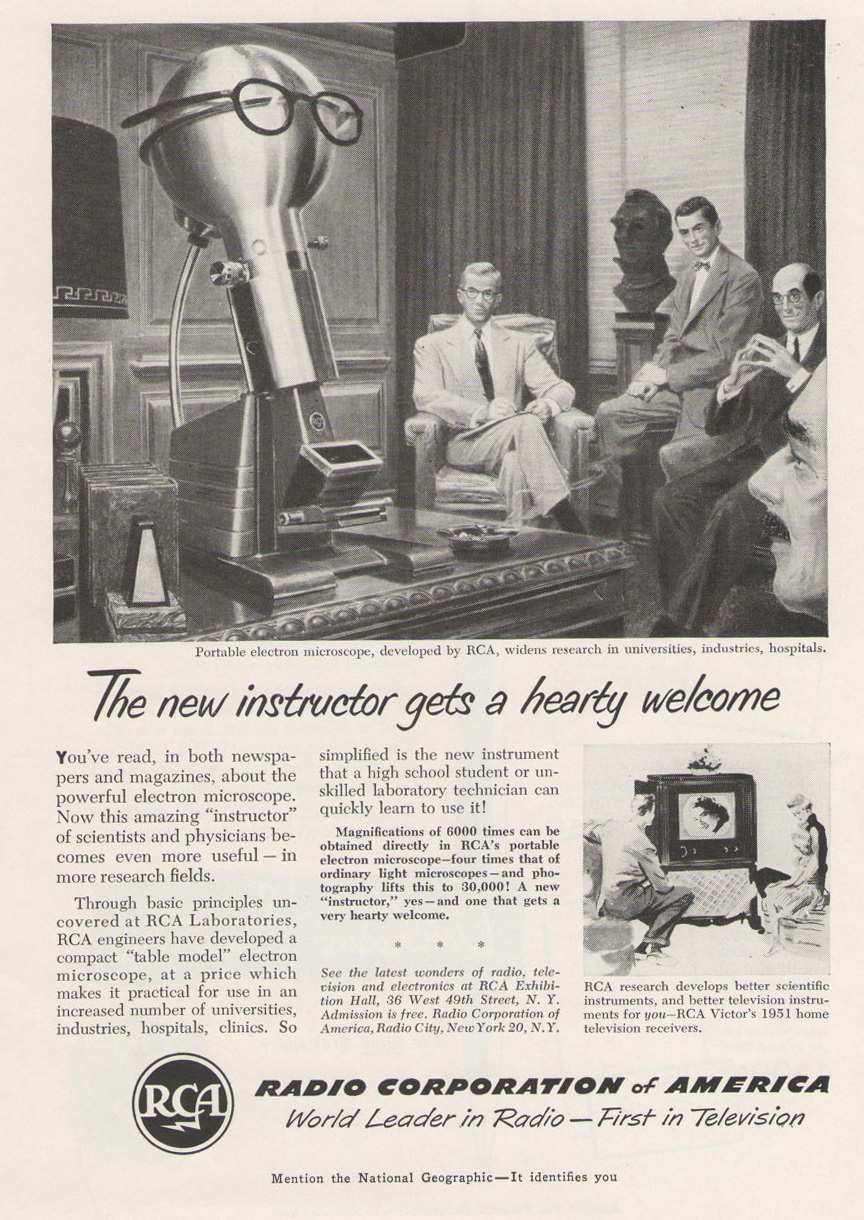
    Robot--electron micrscope
    This image of an electronmicrscope for 1950 gives a new “twist” in thinking about smart machines, the metamorphsis taking place in a front-line microsocpe more so than in the regular metalman of the period. 


  • Interesting Images of Renaissance Hell–on Title Pages

    JF Ptak Science Books   Post 1917

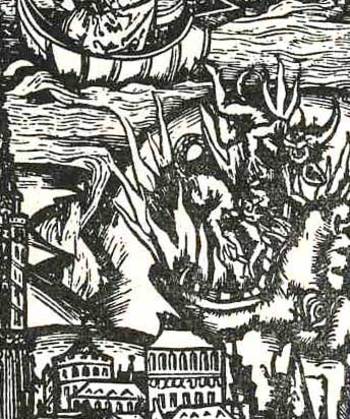
    Bloghelltp078Images of Hell do not often appear graphically depicted right on the title page of books, even though books speaking to Hell and warning us of its coming number in the hundreds of thousands, if not more, particularly if you interpret religion as the means for keeping people away from the ring of fire.    Few people are shy about depicting Hell in general, though there evidently is some reluctance (or forbearance, or oversight) to showing it front-and-center on the title pages of books.

    A terrific exception to this rule is Jacobs de Voragine’s Passional, Hyr hewrrey sick an dath winter deel, printed in Basel in 1511, and illustrated by various and unidentified Strassburg woodcut masters.  In this extraordinary title page we see the vision of the adoration of the Virgin Mother and child supported in a rose of light, aided by guiding winds and various floating saints, and shown lowering the holy book directly to the city of Strassburg. In either corner positioned above the temporal city and below the firmament are two visions of hell, one less vicious and the other more so:  to the left we see some of the pious praying for better judgment as they are about to be consumed by the background flames, while to the right is a far more ambitious and morbid vision of hell featuring the famous Hellmouth.  The Hellmouth makes appears all throughout the history of art (as we can see in this Brueghel painting, for example), but it is a little curious that, outside of the mention of Leviathan (translated from Hebrew, Job 41:1), Hellmouth (as the entrance to hell) doesn’t make an appearance in the Bible.
    Bloghelltpdetail
     

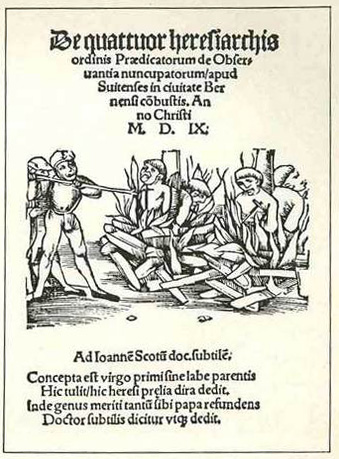
    What is more easily found, at least in the artwork on title pages throughout the Renaissance and the Baroque, are images of people about to be sent to hell. A good and chilling example of this can be seen in the artwork for Thomas Murner (1475-1537) De quattor heresiarhis ordinis Praedicatorium de Observantis nuncupatorum…, printed (again) at Strassburg in 1509.  The pamphlet tells the story of Johannes Jetzer and his accomplices (including four monks) who were tried (under torture) for blasphemy after it was revealed that they colluded to defraud people with a bogus story of religious visions, employing the bloody tear of Mary.  All were found guilty and the four monks were burned alive at the stake—Jetzer having escaped—and sent immediately to the deeper, more fiery, pit.

    Hell on title page
    This isn’t quite showing the coming of hell as in the first case, but it is getting close.  In any event, I found it interesting to see the depiction of the Bad Place right there on the title page of the Murner bokk.


  • A Note on the History of Not-Straight Pre-Telephone Poles

    JF Ptak Science Books    Post 1914

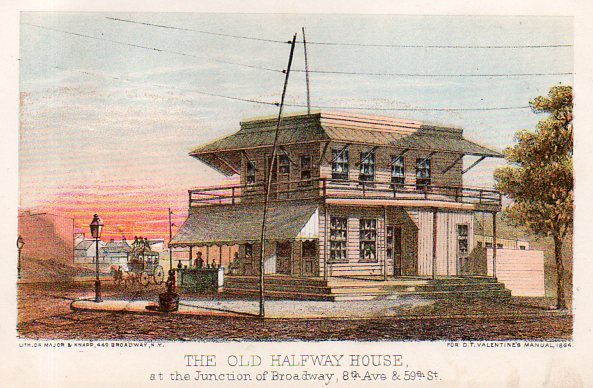
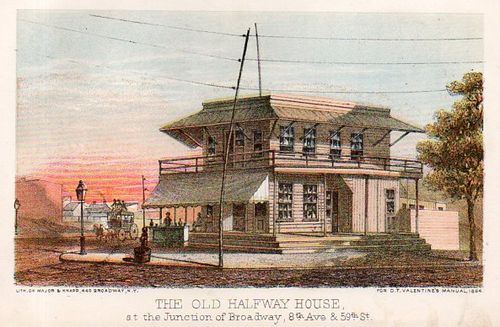
    This is one of those images in search of a story, and as it turns out the story is actually pretty long and involved. The image is this fantastic lithograph from Valentine’s Manual of the City of New York (a sort of annual review/directory of the city that ran on-and-on from the 1850’s to the 1920’s), this one being from the 1868 edition.
    Telephone poles865

    It also is a very stark reminder about how we still deliver power and communication in the United States, still via insulated wires strung along cross beams on what are mostly dead trees–pretty much the way the business has been done for he last 160 year.s  That the backbone of the American energy and communication grid is still transferred on wire/cable strung over the street and exposed to everything on cultivated and treated sticks from the forest is an irony that we live under every day, and that beginning with telegraph poles.

    That said, I like this image because the pole n the picture is so curved.  Perhaps it was the way the tree was; perhaps it was rendered that way when it was treated with creosote. I don’t know.  But the folks at Valentines liked it, otherwise they could have ignored its crookedness or used another angle on depicting the Old Halfway House.

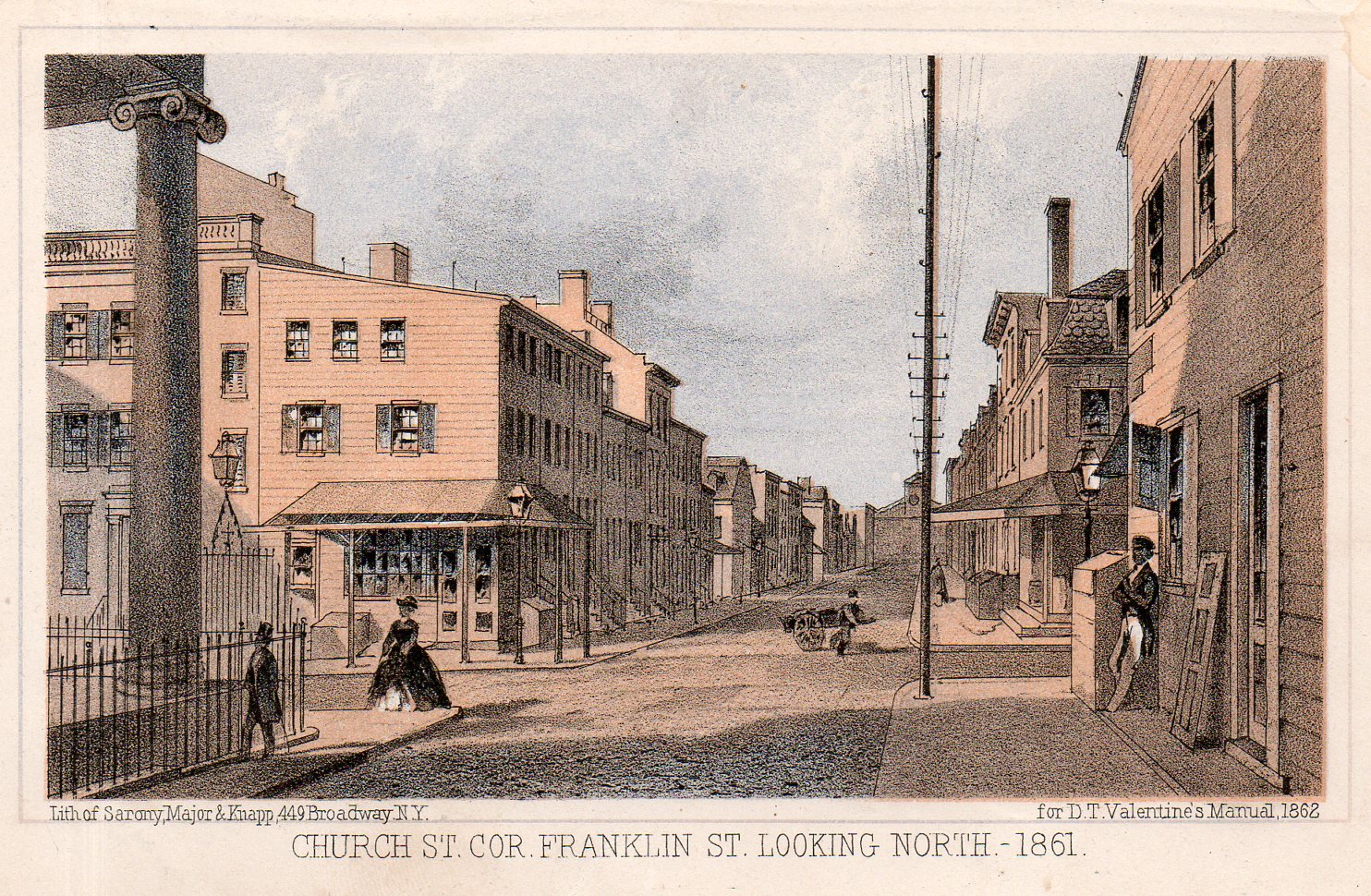
    Judging from many other examples, it seems that the artists at Valentines had a taste for the subtle and obscure.  There are plenty of cases of the depiction of the quietly uncommon, as with another unusual image, showing Church street looking north and showing a long line of telegraph poles, all of which are squarely behind the other so that only the initial pole is visible, though you can see the cross-beams and insulators of the others, the brace getting “lower” and “smaller” behind the first pole.  It is just extremely uncommon (in my experience) to see a long line of anything depicted in this way.
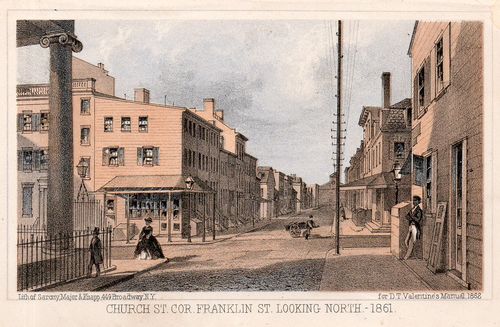
    Telephone poles866

    The artists/lithographers at The Manual seemed to enjoy their work.  For example, in the above image in addition to teh lined-up telegraph poles we have some other very uncommon small elements. No doubt the view was true–which was the intent of the book, to accurately portray the city–but the small elements were creative, quiet and incisive.  Perhaps it is also just exactly what the artist saw when the view was made.  For example, the woman
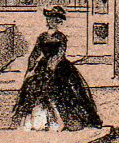
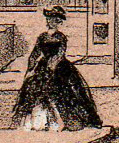
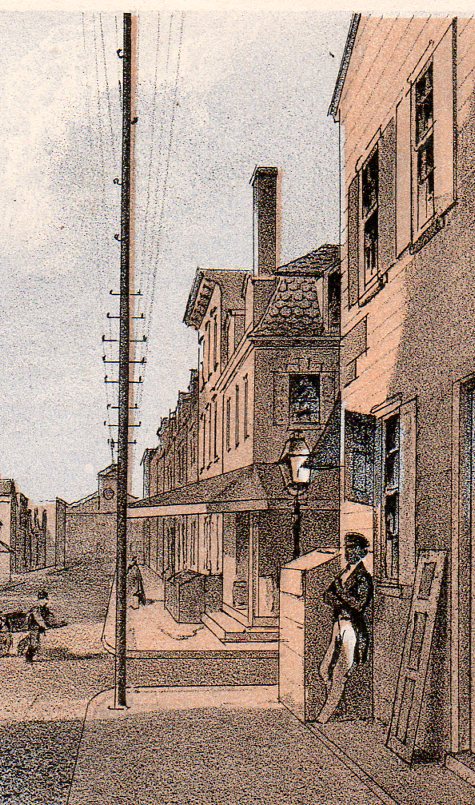
    Telephone poles skirtcrossing the street us stepping up on the curb and raising her skirts slightly–it would’ve been easier to just have her standing there, as with the gentleman immediately in front of her, but for some (creative) reason she is shown in an unusual pose.  Ditto the guy leaning against the building at right–he’s out of proportion with the other two figures, unless he was a giant, but he’s just, well, leaning there.  He’s also standing next to a shutter, which is down and also leaning against the building.  A peddler makes his/her way across the street in the background with a large cart. And the windows in the buildings are unequally decorated, with interior window dressings at different stages of being drawn and not, and with different treatment, and in different states of repair. In short, the image is really a snapshot.
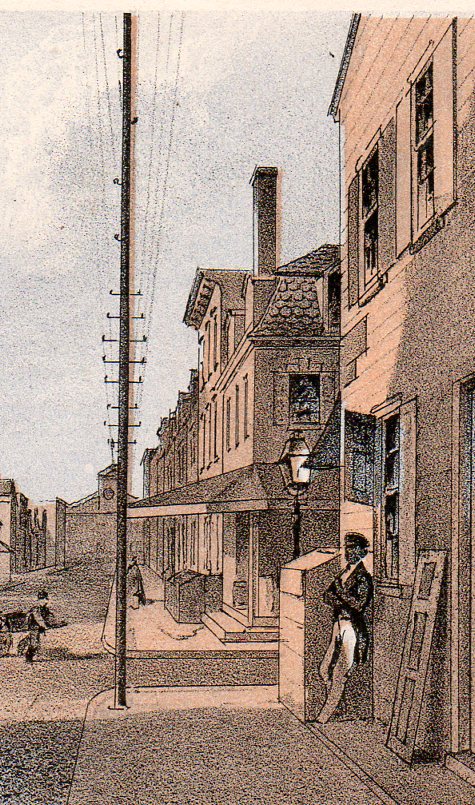
    Telephone poles867
    I imagine that somewhere here in this country there could still original telegraph poles standing–the originals started out generally as chestnut, and then force treated with creosote, and were intended to stand for 50 to 100 years. Under favorable conditions in which they were just simply not replaced, it is conceivable that some could have lasted for 150 years. 


  • Robot Roundup: Edenless Eve (1927) & the Great Texas Robot (1936)

    JF Ptak Science Books  Post 1909

    Robot tx820

    [Image source: Popular Mechanics, September 1936, page 400.]

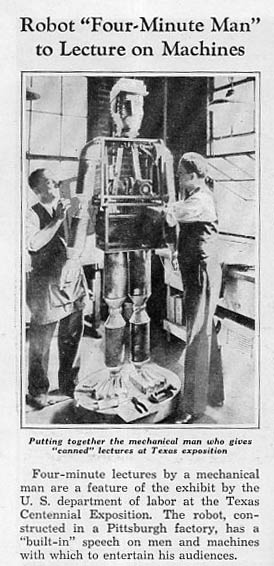
    Robots, or mechanical beings, or mechanized forms of humanity or from the animal kingdom have been around in popular literature for many decades by the time this giant robot appeared in Texas in 19361. (The idea is old though the name “robot” didn’t appear until Karel Capek invented it for his book on the future called R.U.R in 1920.  Actually the human-like forms created by Capek in this early scifi work were biotech, and not fully mechanized.) The form of the robot stretches back hundreds of years, in a way–if not the exactly the idea of a robot, but at least with the appearance of one.

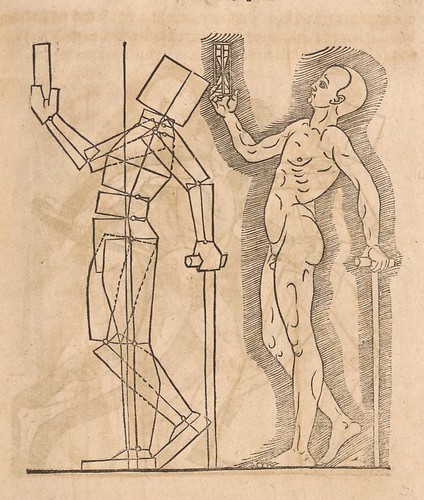
    Such is the case with Albrecht Durer’s (1471-1528) revolutionary drawing of a geometrical man, compartmentalizing the bodyd into distinct chunks–these and other woodcuts appeared in his Symmetria partium…humanorum corporum and must have been an amazing, startling site for the new reader to such things in 1537.To me this looks like visionary thinking in trying to understand the motions of living beings with no actual way of capturing the image in motion. 

    Perspectiva (Lautensack) 1564 e

    [This and many other images from the fabulous Bibliodyssey website, here.]

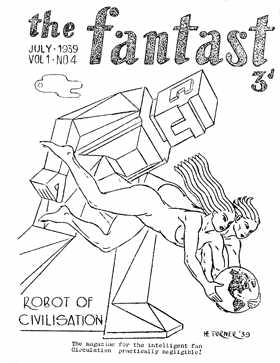
    All of which are retro-reminiscent of early robots, like this from The Fantast in 1939:

    Robot durer[Image source: the wonderful Cybernetic Zoo website, with loads of images and timelines, here.]

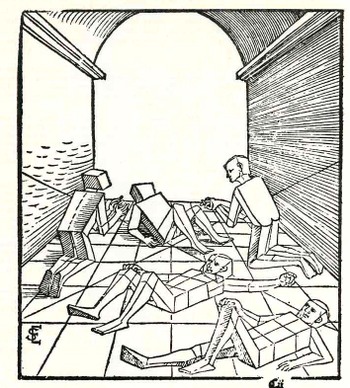
    Seven years late in Nuremberg Erhard Schoen published Unnderweissung der proportzion unnd stellung der possen, liegent und stehent…, which  followed Durer showing that the human form was reducible to connected but discrete Euclidean solids:

    Blogmissing_peopl_2e077_2


  • Out-of-Place Department: the Moon as Debris Ring Around the Earth

    JF Ptak Science Books   Quick Post

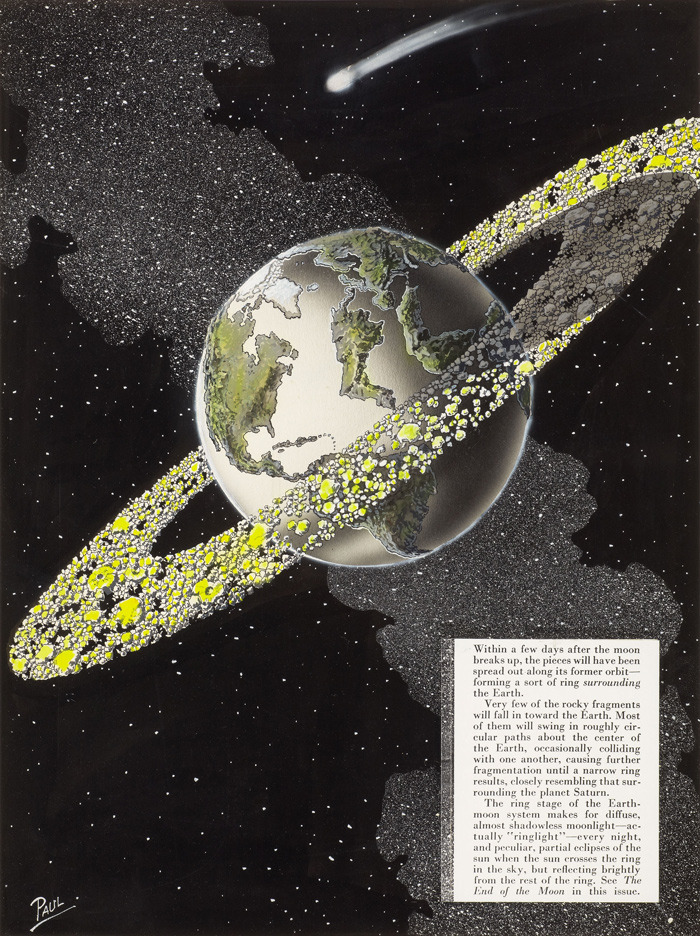
    Moon gone earth belt
    [Source: 50watts.com, “Tetrahedra in Space”, Frank R. Paul series, here.]

    See also an earlier post, “Things out of Place Department: the Moon”, here.

    This is certainly the work of a delightful and bouncing imagination, more so with the illustration by the great Frank R. Paul.  The image is found on the back cover of  the August 1953 issue of Science Fiction Plus for the short story “The End of the Moon”.   And what we see–at least from the artwork as I cannot find an online version of the text–is a not-convincing result of the Moon going away.  I’m not an historian of the idea of the vanishing Moon and how early writers have imagined it ailing/disappearing/exploding/imploding, though I’m fairly well sure that the scifi wasn’t keeping up with the 1953 science of it all, at least with what I can see and understand.

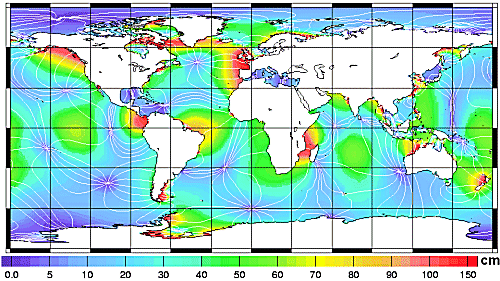
    If there was no Moon.  What if the Moon never existed? What if the Moon existed but vanished?  I guess it would all depend on what exactly happened to the Moon to figure out the disposition of its remaining assets.  The Moon removed certainly would effect changes in the tides, though I think not in the way depicted above. There would substantial changes  though I think not enough to cause a new continent to rise out of the middle of the Atlantic, or to flood all of northeastern Africa.  “If  We Had No Moon”, an essay by Bernard Foing in Astrobiology Magazine, here, provides an interesting tidal change map (below) which shows a projection of the main hotbeds of tidal change. 

    Since I have no access to the text of the scifi article I don’t know if the story addressed changes to the weather and migratory patterns of animals in response to tidal changes, or what happens to large coastal cities, or the influence of a more volatile seasonal change, or changes to the Earth’s orbital parameters, and so on.

    Its the “and so on” part that is the most interesting left-out bit.

    Bottom line here is that I just like the great cover art for the story

    
    Moon gone map of tidal changes

    Another interesting article from ScienceNordic, here.


  • New York City Under Attack–Additional Images

    JF Ptak Science Books   Quick Post

    New york city attacked
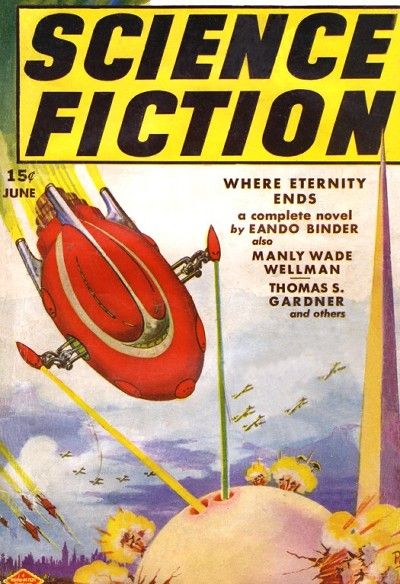
    The Binder brothers (Earl Andrew [1904-1965] and Otto Oscar [1911-1975] under the pseudonym Eando Binder (E and O Binder) wrote “Where Eternity Ends”, a story which appeared in the June 1939 issue of Science Fiction magazine. The cover illustration was by the great Frank R. Paul, and it depicted a savage attack upon the iconic New York City World’s Fair building, the perisphere (the trylon is in the background), and what looks like the rest of NYC as well. 

    It is also part of a continuing subseries on this blog relating
    images of antique images showing NYC destroyed, and include the
    following posts: