A Daily History of Holes, Dots, Lines, Science, History, Math, Physics, Art, the Unintentional Absurd, Architecture, Maps, Data Visualization, Blank and Missing Things, and so on. |1.6 million words, 7500 images, 4.9 million hits| Press & appearances in The Times, Le Figaro, Mensa, The Economist, The Guardian, Discovery News, Slate, Le Monde, Sci American Blogs, Le Pont, and many other places… 5000+ total posts since 2008.

Category: Future, History of the

  • Bubbles of Cubist and Steampunk Dada Futures from 1812

    JF Ptak Science Books   Post 2105

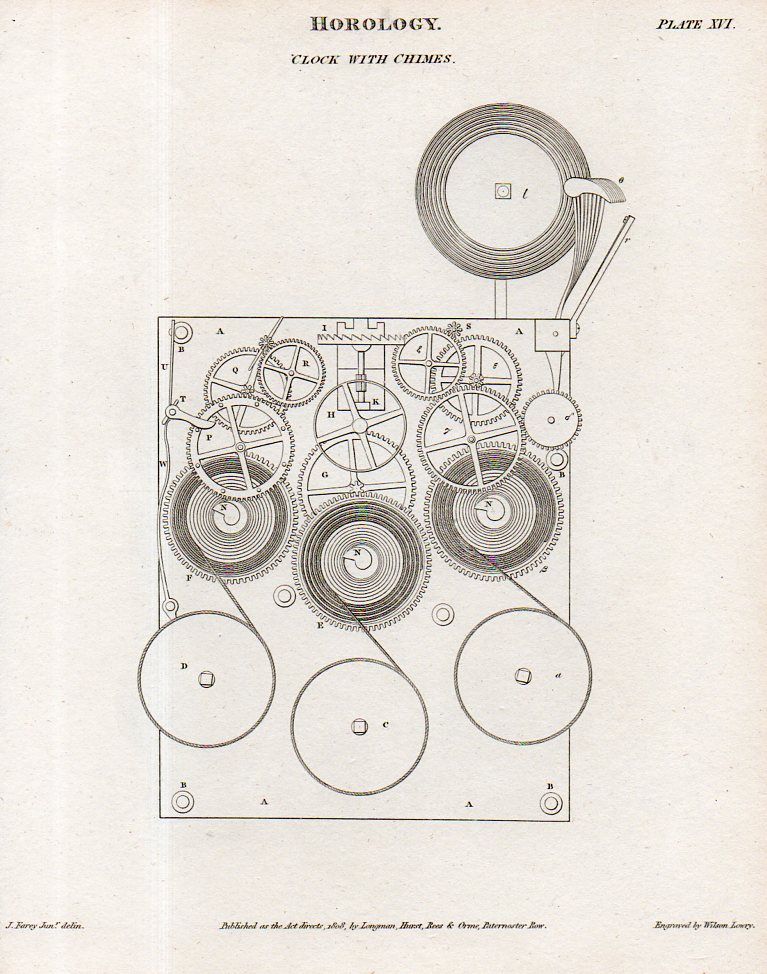
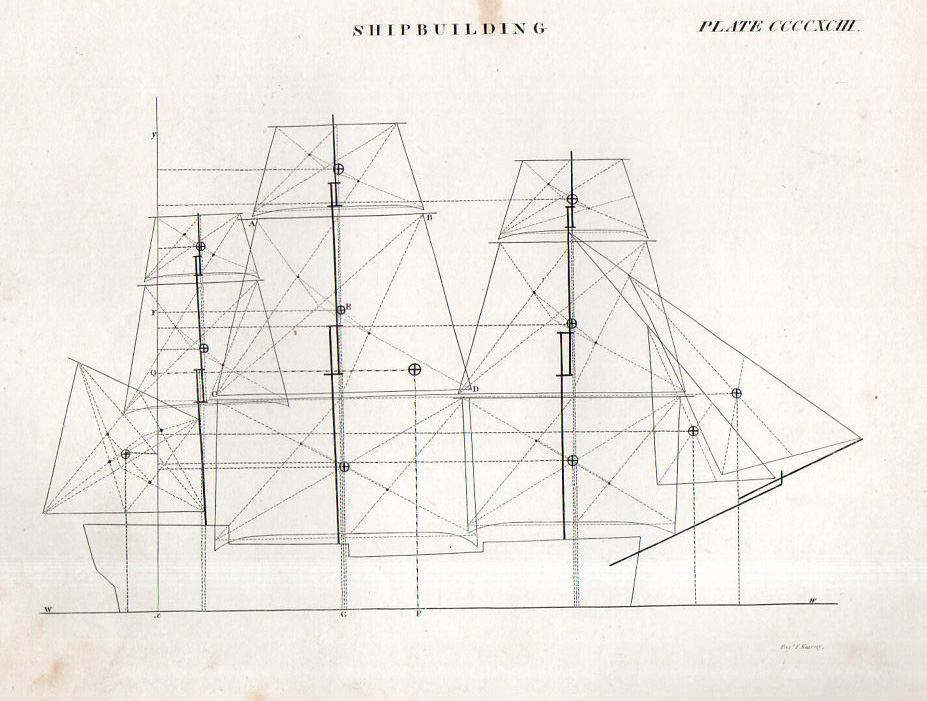
    I think that a pre-proto-neo-antiquarian or whatever Cubist representational form is very clear in the 1812 engraving, which was a relatively simple formulaic presentation of ship/sail construction found in Rhees’ Encyclopedia.  “Clear” of course to someone here in the print’s future, seeing what that form could actually become apart from showing the naval necessaries.  But it always puzzles me how an image like this could appear and someone didn’t take the next step and turn the thing into “art” of some sort.  That would all happen soon enough, the loosening of form and its representation via impressionistic and geometrical ways–Mr. Turner was already 37 years old when this print was published, and on his way (at least intellectually) to his magnificent Romantic career. 
    Cubist653

    Why wasn’t this art in 1812, aside from people not being quite ready for it?  Maybe there is no other “thing” apart from that.  It would take nearly another hundred years before the representational form of say a ship was lessened and stripped away, softened , modified, rubbed, erased, into something that is the object but really isn’t.

    Perhaps what we have here is a peep (like with Durer’s geometric man) into the future at modern art, a dissonance between abstraction and realism.  There is a regeneration of form taking place in this image, but it is only something on its way to creating a more idiomatic engineering representation of naval needs, and not a new art form–that would have to wait for Braque and Gris and Leger and Delauny and Villon and Picabia and Duchamp and the rest.  So this pre-non-Cubist engraving is not a key to a new vocabulary of vision–it is just a drawing of ship’s sails. 

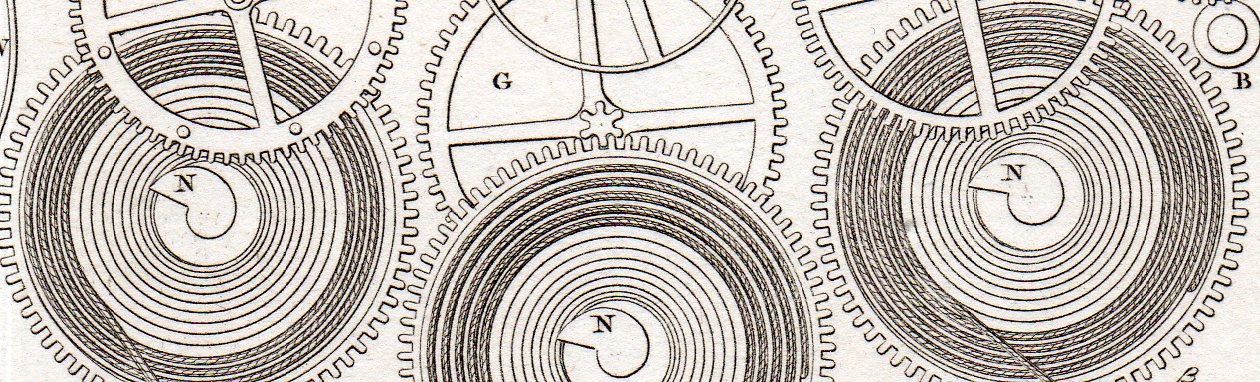
    Here’s another example of pre-modern art peeping out from the pages of this same encyclopedia, this one being a Prehistoric Rayograph, or a proto-non-photographic example of Man Ray, but from 1810 (and which I wrote about here):
    Cubist-Dadaist655

    Which is a detail from:

    Cubist-Dadaist654

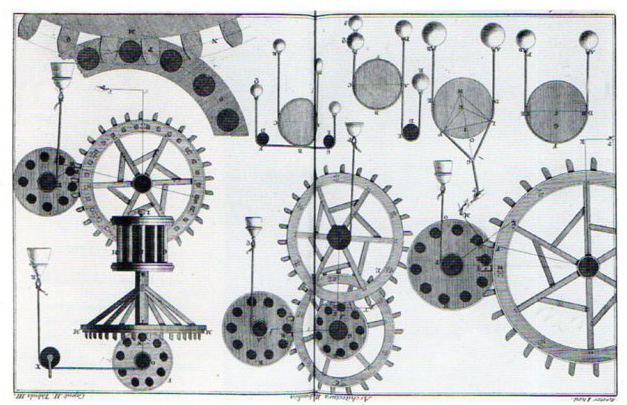
    The engraving below is another fine example of futuristic bubbles, this one a possible example of Steampunk Dada, and appears innocently (and beautifully, and importantly) in Architectura Hydraulica (1740),
    and titled “Demonstration of Friction”.  I’ve simply inverted it and
    removed some of the numerical notation–and then, suddenly, it becomes a
    sort of Steampunk Balloon Machine–a lovely collection of small
    balloons lifting large wheels and cogs, assembling some sort of
    something in mid-air, demonstrating very little friction, of lightness
    and airiness.
    Belidor upside down

    Seems to me that if you look hard enough that these examples are, well, kind of everywhere.  They just aren’t yet what they could’ve been.

    Notes:

    Here’s another example:  Geology of Images: Finding Pre-biotic, Neo-Dadaist Images in Antique Astronomy Prints (here)

  • Futurology: a 1916 Report on the 1950 Death of American Cities

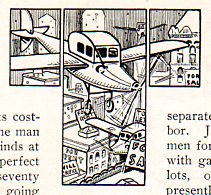
    Airplane city630JF Ptak Science Books  Post 2098   History of the Future series  

     
    Follow Me on Pinterest

    “If a city can be unmade, it will not stay so.”

    That’s the hopeful outcome in the opening paragraph of this urbano-centric tale.

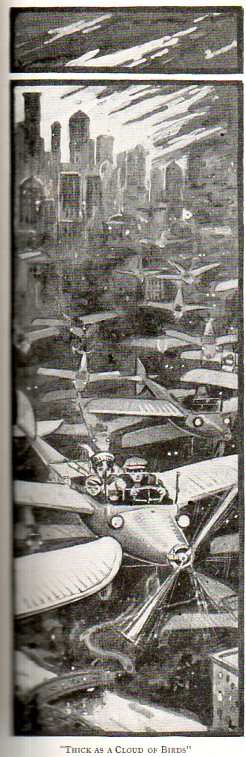
    In the piece of speculative fiction, “The Man who Unmade Cities” by George Holmes (found in Illustrated World, May 1916), a Mr. John Watterson becomes the ultra-Ford of aviation.  Watterson introduces massive reform in airplane design and production such that the new machines are available to, well, everyone–instead of selling thousands of the new planes, millions are sold.

    The story begins with Watterson in childhood, developing his flying interests and, by 1950, andhe becomes a world-beater, and destroyer of cities.  The plane allows people to fly off, leaving the cities in swarms, and “within three years the motorcar was on its way to oblivion”.

    The revolutionary planes were “flimsy-looking”, “dwarfish contraptions”, “spindle-shanked”, and so light “that a man could carry it” and “sold for a song of one’s own singing”, and were collapsable, carry-able, and capable of reaching speeds of 70mph.

    And at the outset of this triumph “the great city was killed; John Watterson was triumphant”.

    But the article, reporting from somewhere in the near-future, reported that the city would return, benefiting from the need for closer stores, and the want for a walk, and the plummeting prices of evacuated city spaces–people were drawn back into the city in much the same way they were drawn out to the suburbs.

    Airplane city631


  • The Illuminated Artifical Hand-Held Hand Directional for Cars, 1916

    JF Ptak Science Books   Daily Dose from Dr. Odd

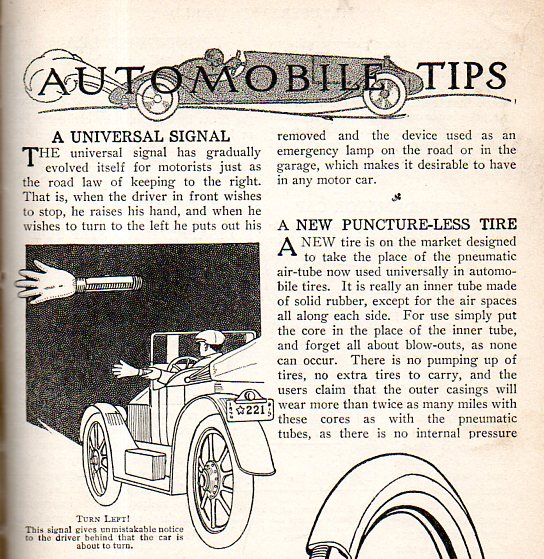
    In general I’m not in favor of left turns for autos in cities of a size where traffic congestion is an issue.  It seems that from a main thoroughfare that three rights should make a left, easy congestion in the center of a busy street, eliminating lines of cars waiting behind a left-turning car waiting for a break in oncoming traffic, and so on.  This semi-crackpot notion was just sparked after seeing this As Seen on TV-style pre-televsion promotional for an artificial hand for a left-turning hand-directional 1916 automobile.  The hand is actually illuminated, which would have made it more effective than a stark hand in the night.  It seems that they were just about <this close> to figuring our a less mechanical-anthropomorphic and more elegant solution than the illuminated artificial hand-held hand.

    Left turn629[Source: Illustrated World, 1916, page 257.]


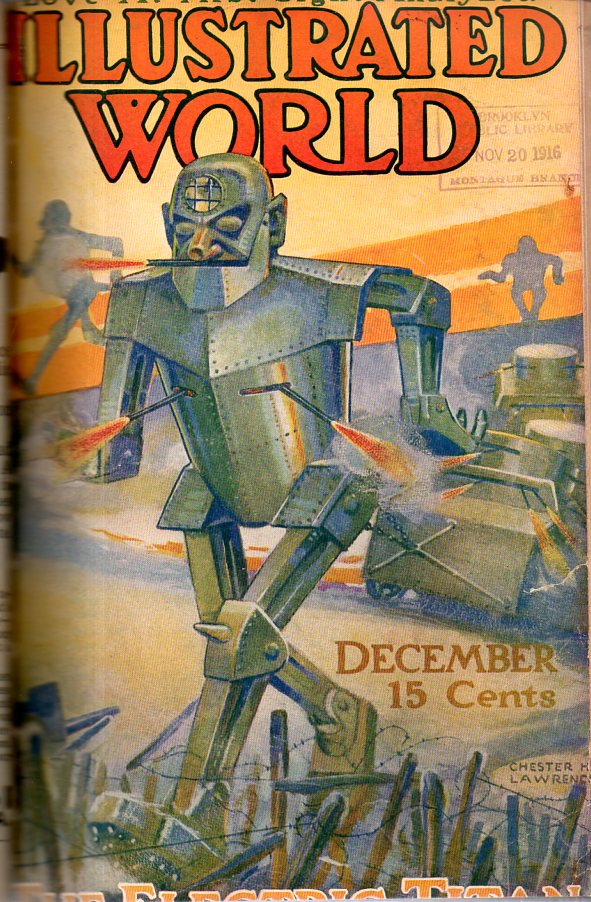
  • The Electric Titan Robot Tank Monster, 1916

    JF Ptak Science Books  Quick Post

    “The Electric Engineer”, by Herbert C. Crocker, was an article in the December 1916 issue of Illustrated World, and featured this extraordinary idea:

    Robot tank627
    “This mechanical marvel may furnish the warring armies of Europe with a new engine of destruction”, page 504.

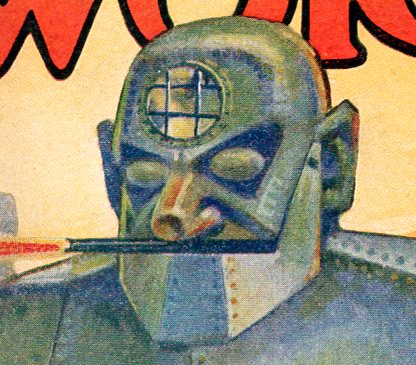
    “King Grey”, the creation of Vern Pieper of Alton, Illinois, turns out not to be an extraordinary giant as depicted in the cover art, but a giant on the humanish scale, topping out at nine feet tall and 750 pounds, “a marvel of steel plates, knuckles and cog wheels”, that would have its own guns and haul a small armored cart. It looks quite a bit like a more-famous British steampunk version of this idea from mid-century.

    Robot tank626


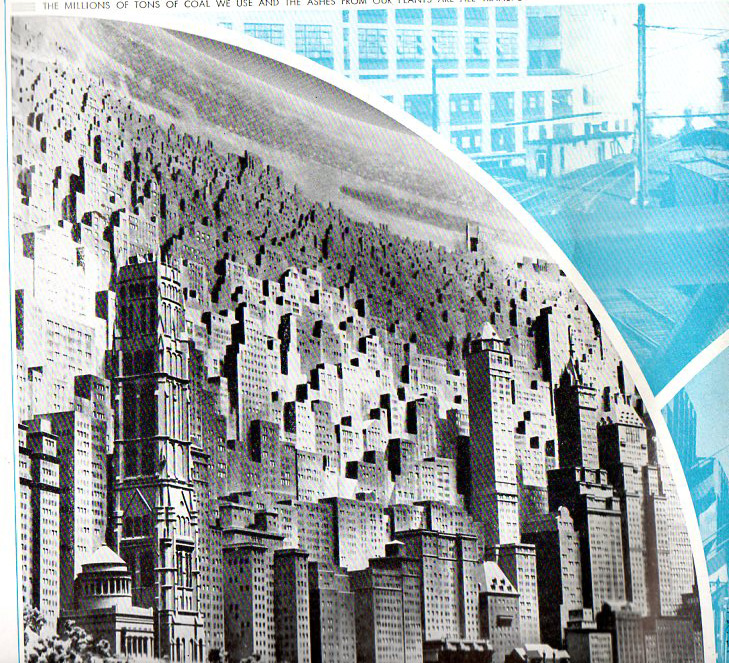
  • Imaginary New York City Landscapes from CON-ED, 1938

    JF Ptak Science Books  Quick Post  

    Follow Me on Pinterest

    These lovely images are found in a long, shining and slightly darkroom-smelling The City of Light, which was a pamphlet made for the Consolidated Edison exhibition at the New York City World’s Fair of 1939.  Con Ed I think just wanted to get the point across that they saw into the future and were getting ready for it, NYC being stuffed to the gills with buildings and each window stuffed and outlined in Con Ed-supplied electric light.  The vision is vaguely threatening to me, though, the buildings in a stadium-seating arrangement that is unsettling, like they’re part of our robot-overlord future–someone or something must be living in those room filled with Con Ed light, though…

    Nyc544


  • Robot Man, 1915

    JF Ptak Science Books      Quick Post   
     
    Follow Me on Pinterest

    Robot man437

    The Burroughs Adding Machine company did about as much as anyone to objectify the worker in America during the 1880-1915 period, making the worker a part of a machine within the machine. In a way it was like creating the Ford assembly line for people sitting down. 

    The company was founded on the work of William S. Burroughs’ grandfather, William Seward Burroughs (1857-1898 and native son of Rochester, NY), who created a mechanical calculator to help him add long columns of numbers in his job as a bank clerk. American Arithmometer Company was founded by him and others in 1886, later evolving into Burroughs Adding Machine Company (1904), Burroughs Corporation (1953), and then into Unisys (combining with Sperry Univac in 1986) before sliding away.

    In any event the adding machine connected millions of people to a mechanizing process of what had previously been a mental operation–the flywheel in the side of the head of the clerk/accountant in this add for Technical World (More Fascinating than Fiction) for August 1915 wasn’t too terribly far from the truth. Interesting that on the other side of the head of this fellow, behind the other ear, is a pencil. 

    Robot man438


  • Electro-Punk Memory, 1929

    JF Ptak Science Books   Quick Post  

     
    Follow Me on Pinterest 

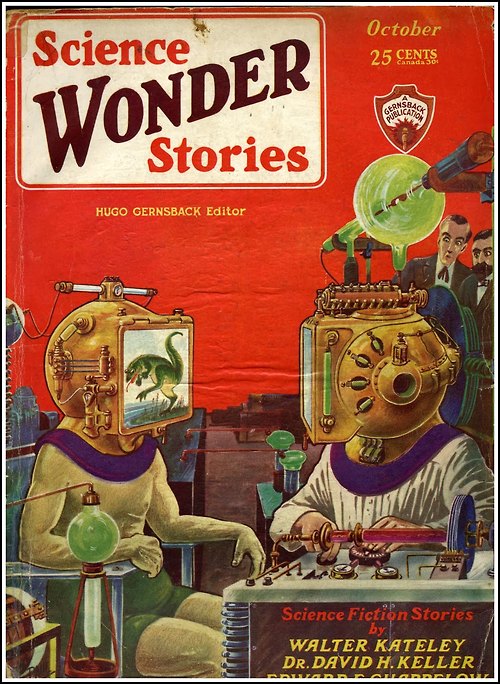
    Gernsback memory machine
    [Image source: the wonderful Frank Wu (sci-fi fanasy artist) website, here.]

    This is the delightful and reaching cover art by the great Frank R. Paul for the October 1929 Science Wonder Stories, illustrating “Into the Subconscious” by Ray Avery Myers, a story of a physician/shrinkologist/physicist who concocts a way of reading into the memories of his subjects–long, deep, ancestral memories. The doc (Macey) is seated at right on the cover, somehow retrieving images from the patient–an idea that has had long legs, and seen famously in the end-all road movies,  Wim Wender’s 1991 PunkNoir film, Until the End of the World. Or perhaps its  more future-driven than that, where each viewer is viewing the other’s memories or dreams or visions, rather than their own, the images flickering to life onto the monitors, initiated by the simple proximity of another person…all memories available, nothing secret.

    At least in the Wenders portrayal of the dream-end of this idea, there was precious little time for anything but dreams.


  • City Plans and Snowflakes, 1842

    JF Ptak Science Books  Quick Post  
     
    Follow Me on Pinterest


    (Jean Baptiste) Amedee Couder wrote L’Architecture et l’industrie comme moyen de perfection sociale, which was published in Paris (by Brockhaus et Avenarius) in 1842. (Its actually a fairly scarce book, with only two copies found in the WorldCat directory.) I was surprised by this lovely plan among its slim 52 pages–it reminds me of a snowflake. (See also Snowflakes and Fort Construction, which appeared earlier on this blog, here.)

    Projet d’un palais des Arts et de l’industrie.  18×14 inches. 

    L'Architecture et l'industrie comme moyen de perfection sociale, par Amédée Couder. Plus bas dans la page de titre (n° 12.474) :

    [(Please not that the image below is from http://gallica.bnf.fr/ark:/12148/btv1b530065524–I’ve used their digital image rather than my own because my copy is folded in quarters and is too large and too-attached-to-the-book to get a decent image of it.]


  • Recognizing the Agony of the Absurd–Aircraft, 1912

    JF Ptak Science Books   Post 2035  

    Follow Me on Pinterest


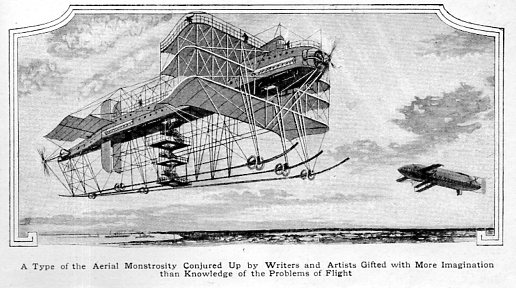
    Airplane futuro335
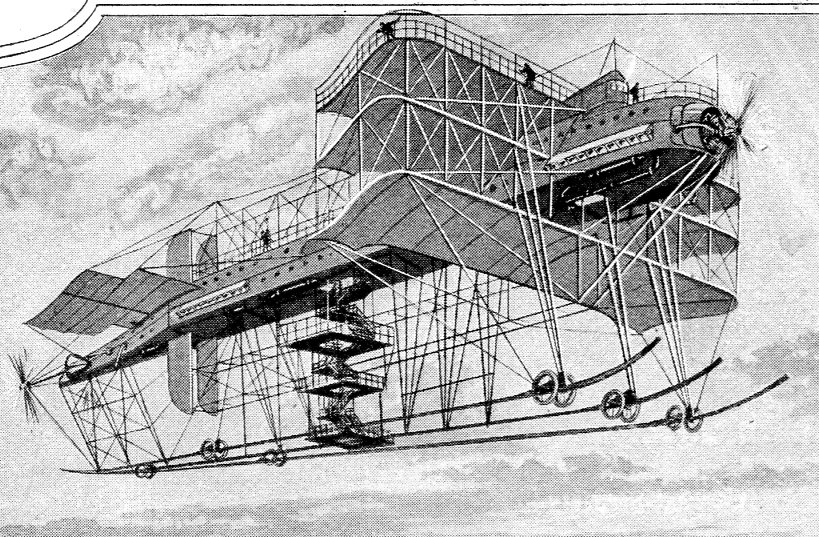
    Nothing exceeds like excess, and the excessful is not often successful.  Victor Lougheed saw this in the first decade of powered heavier-than-air flight in a homey and sensible article in Popular Mechanics in 1912.  He had a nice touch in trying to reign-in the impossible stuff that was happening in imagining flight, saying “it is safe to give to fancy only when fact is far away”–and that imagination is perfectly fine, but now that “human flight is a thing accomplished” that the issue of future aircraft should be one of engineering. Thinking big is fine just so long as you have those tools in the box.

    Lougheed offers the above illustration as an example of big-and-bad thinking, though he unfortunately does not credit the thinker or the artist.  Too bad–it would have made a nice follow-up.  That said, as a casual reader in early flight I have rarely seen someone taking on what are clear excesses of expectation–Lougheed is an interesting exception. 

    Airplane futuro336

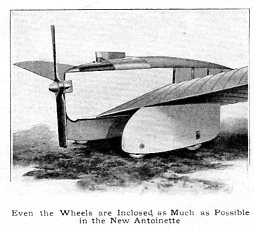
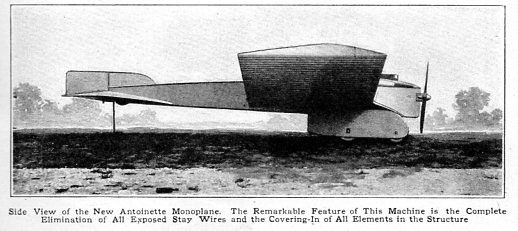
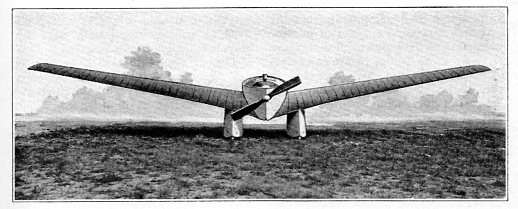
    He does go on to give an example of possibly-flyable future aircraft and presents the remarkable New Antoinette–a fantastic and prescient design for a plane only nine years removed from the Wrights’ flight, a streamlined monoplane that seems to come from reasonable future, which it sort-of does.  This plane evidently was too heavy for the 100-h.p.engine, but the engineering was at least definitely “there”.

    The Antoinette:

    Antoinette342
    Antoinette341
    Antoinette340
    Here’s a very long and very illustrated thumbnail site for French pre-WWI aircraft: http://flyingmachines.ru/Site2/Arts/Art4743.htm


  • The Electronic Beds of Electronic Dreams, 1945

    JF Ptak Science Books  Post 2019   (expanding an earlier post)

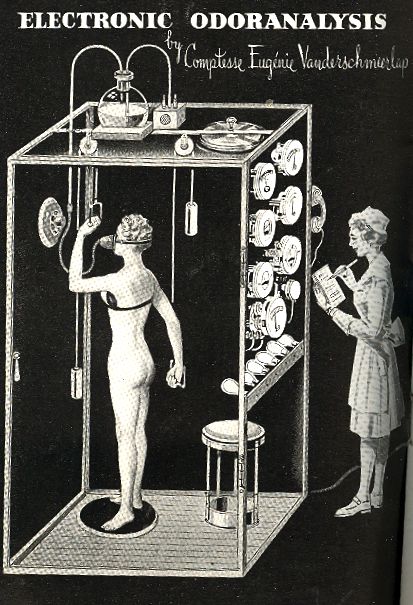
    Electronic odoranalysis

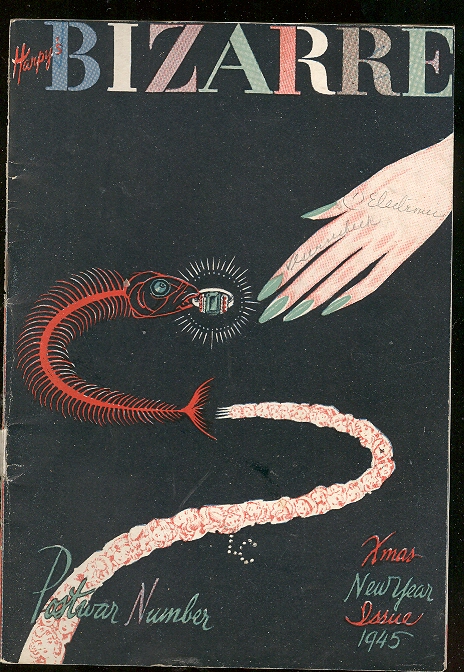
    I am very attracted to the innocence and softly bizarre category of my store’s Outsider Logic Collection, like this little pamphlet that was published in  New York in 1944.   The pamphlets in this category are odd but still understandable, and the “what the ____!” response to the subtle ones isn’t quite so high and the exclamation points not so many as in the cases of the Outsider Logic titles.  Bizarre is different from that, certainly not hiding behind any lesser or ambiguous title–it stretches the category a bit as it is intended to be a parody of the more-popular magazines and their advertising sponsors, but it is really quite a bit different from a simple humous and pun-laden trip into dead-end future visions.  It was copyright by the very far-reaching Hugo Gernsback, who in 1926 started the first magazine dedicated to the genre of science fiction (Amazing Stories) and for whom the World Science Fiction Society’s annual award for Science Fiction Achievement is named (the “Hugo”).  Gernsback evidently had a taste for cheeky parody, producing similar magazines to this called Quip, Forecast, Jolliers, Tame and Newspeep–it seems though that Bizarre may have ultimately morphed into Forecast.Blog--may 11--odd 002

    I guess that this was deeply weird for mass-production publication, and it was probably funny–now it is just weird, odd, and somewhat discomforting–a successful and intentional reach for being part of the Uninentional Outsider right from the start.

    Most of the magazine is dedicated to imaginary electronic delights–analog electronics (though it is still fairly early to be having such dreams and using the word “electronics”, as it was just barely two decades old at this point).  One of the oddest of these inventions of the near future was the Electronic Odoranalyzer, which was necessary for reasons I couldn’t discern. (I’d like to assume that odors are calculated and calibrated and a scent is chosen specifically for them, or it.)  

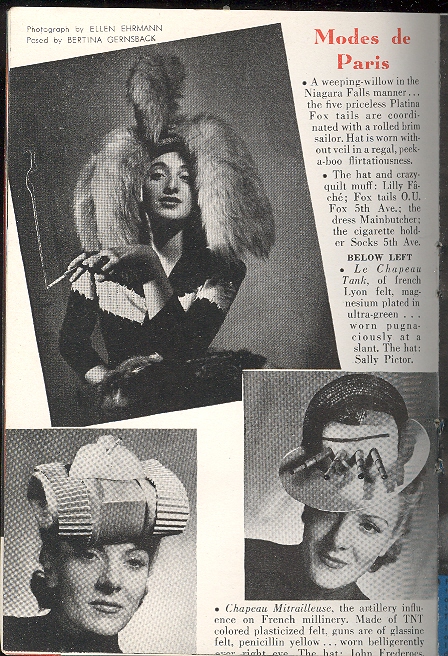
    The advertising was unusual as well:  there were hats you could potnetially purchase of weeping willow Platina fox tails; some hats had tanks (as with the Le Chapeau Tank hat, modeled for the magazine and “worn pugnaciously at a slant”), and other hats had simple canons (as with the French Mitrailsuese).  While wearing your tank hat you could also theoretically relax to your favorite tunes in style with a $125,000 radio–it was made for war profiteers who couldn’t find banks enough to hold their cash and was billed as too expensive to steal.Blog--may 11--odd 006

    Then there’s the EBC–the Electronic Bed Company–with their magnificent new product, an invention “by the great sage of Hackensack” so spectacular  as to make ordinary sleeping obsolete.  The bed was an air-conditioned, self-washing, self-adjusting, self covering, fiberglass-cushioned, telephone-capable, air pillowed, air conditioned masterpiece that looked like it was about ready for anything but sleep, which I guess would make it revolutionary.