A Daily History of Holes, Dots, Lines, Science, History, Math, Physics, Art, the Unintentional Absurd, Architecture, Maps, Data Visualization, Blank and Missing Things, and so on. |1.6 million words, 7500 images, 4.9 million hits| Press & appearances in The Times, Le Figaro, Mensa, The Economist, The Guardian, Discovery News, Slate, Le Monde, Sci American Blogs, Le Pont, and many other places… 5000+ total posts since 2008.

Category: Bad Ideas

  • When Things ARE Better in Glorious Black & White: Color Detonation and the Invention of *More* Primary Colors, 1942

    JF Ptak Science Book Post 316

    Well: this is a variation of yesterday’s post on the two opposite edges of color in oddly-applied scientific/technical manners. In unwittingly responding to the question “when is color-use bad?”, the answers were found in these room decorations from 1942, all of which come from a pamphlet entitled Ideas for Old Rooms and New, extracted from the mind of  Hapel (?) Dell Brown.  It is a tidy book with ideas that are anything but tidy;and  as you scroll down you’ll see that the room solutions suggested by Hapel Del are anti-tidy; clutterous (no, not a word but could be).  Everything about these creations speaks to the annihilation of visual resting places; everything seems to be an affront to the concept of causal emptiness.  The weird thing is that there aren’t very many objects in these rooms at all (at least comparing these rooms from where I’m sitting)–the visual complaints seem all rocketing from the abuse of colors found in the fabric of the furniture and walls and floors and window treatments.  The eye gets no rest–and as a matter of fact, the cones of the eyeball are impaled on the rods as a result of the author/decorator  desperate attempts to invent three more primary colors. 

    00blogoct_14color848

    Believe it or not we don’t really get the full flavor of the color cacophony because the floors in these picture look sort of benign, fading away into themselves–which they are not, according to  the description in the text, because they are all high-gloss linoleum rolls or tiles (“efused [sic] with deep wondrous color”.  And that means not only are these floors adding sheen and color to the rest of the incredibly colorful–an effect fairly lost in these photos–they are also cold.

    One thing that I haven’t pointed out in this peon to syrupy/pastel-y/techno-gelatinous-chromodrama is that they were all done in response to a re-decoration of a perfectly nice-looking house, with all of the former “bland” colonial-style rooms presented in glorious black and white.  I’d rather live in Maison Noir than in this happy nightmare.


  • The “Tom Thumb”, Calves’ Foot Hair, Mrs May Wait, the Fridaire & General Foods Corp. Common Denominator: Jell-O.

    JF Ptak Science Books  Post 307

    As a vegetarian of 16 years living in a house of life-long vegetarians, the antiquarian recipe that I stumbled upon in a “Lady’s Book” (of 1885) called for scraping the hair from calves’ feet–it gave me consider pause.  But from such humble beginnings (like William S. Burroughs Naked Lunch grandfather’s small business bumping itself up and along to become IBM) are bigger things born.

    1blog_oc_t10_dessert802_2

    And that’s been the story of Jell-O, a product of extraordinarily modest and not-pretty means, morphing itself and the Postum Company over a relatively short period of time (from 1895 to1925) into the megamonolth:  the General Foods Corporation.  “America’s Most Famous Dessert” got its third (or better) start on life in Le Roy, New York, under the creative hands of Mr. & Mrs. Pearle B. & May Wait (true!), who took sugar, powdered gelatin and artificial fruit flavors to make a concoction May called “Jell-O”.  But her reach was none-too-grand compared to that of Frank Woodward, who bought the company from her and created the demand for this ‘food” and who ultimately created General Foods with it.  (Its an old story:  consumable and sellable product with no consumers:  Marlboro cigarettes started out as a specialized cig for “ladies” and failed; the same cigarette was then re-marketed as a testosterone-laden product and then succeeded beyond all wild expectation, killing millions of its consumers in the process.)  In any event Ms. Wait trumped another New York state resident, Charles Knox,  in the race to develop a pretty and tasty  granulated/[powdered gelatin desert mix.  “Knox’s Gelatine”, originally made with calves’-foot jelly, was a little earlier to the table than Mrs. Wait, but failed to properly develop his product. It also suffered its own “purity” by not having any sugar in it. 

    Jello

    Jell-O-like bits have been around for a long time—but creating this sort of  gelatin (and “delicacy”) was a time-consuming task, involving the above-mentioned scraping unpleasantness, long boiling of the scraped stuff, filtering and so on to achieve—once cooled and dried—sheets of clearish delight that would look like what we call Jell-O.  But as I said the history of this product is quite extended—for example there is a long Renaissance culinary sculpting history of gelatin, but that piece of history still awaits its vast chronicler.  And illustrator:  evidently the molds for the gelatin product were extensive and the creativity for its use boundless, with castles and communities and portraits being produced out of.  The use of gelatin as a binder and preservative is actually ancient, and finds itself at least as far back as ancient Greece. 

    Our Tom Thumb connection with Jell-O  comes in the form of Peter Cooper, who   is generally seen as the American manufacturer of the first steam locomotive (The engine ran successfully on the Baltimore and Ohio Railroad on August 28, 1830), and who (around 1845) was in fact very interested in processing different sorts of gelatin consumables in addition to creating the first locomotive, and also running for the presidency and many other things…the gelatin creation had to wait.

    But the broadest brushwork on the developing history of Jell-O is that same brush that basically closed the American West and ended the cattle drive and most of the great Lonesome Dove cowboy traditions.  No, not barbed
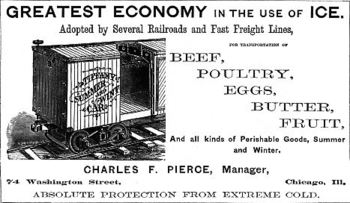
    Refrigerator_car wire—it was refrigeration.  The creation of refrigerated railroad cars meant that all that the cowboys needed to do was get their stock to a nearby railhead and modern technology would do the rest, the RR pulling the slaughtered stock to St. Louis or (more likely) Chicago, thus ending the Long Drive.  The home refrigerator enabled the creation of Jell-O much as we see it today.    (And I say that with as little inflection as possible, as hundreds of millions of people have enjoyed this sugary dried gelatin ensemble, so it must work to the good somewhere, at least as a cheap sugar delivery system)

    Homer_muumuu

    As for me, if it isn’t a liquid, I don’t want the food on my plate to continue on in its own expectant dance after I get through moving it myself. I also don’t want my food to behave like the coming-to-rest motion of a beloved (?) American TV icon.

    But that doesn’t mean that I can’t take a moment here to stop and appreciate the bizarre connections between Jell-O and the Outside World. 

    Visit the Jell-O Museum/Gallery HERE.

    ·Posted by :

    ·in:


  • God’s Atomic Bomb: the Divine, the Infinite, and its “Gift” of the Bomb, 1946

    JF Ptak Science Books  Post 234

    Blogsept_2_atomic_bomb_god481

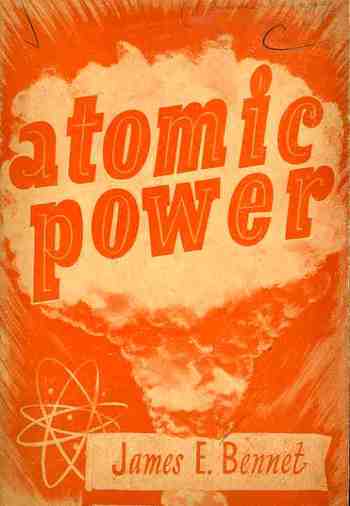
    I’d like to say that this was a class-of-its-own sort of work, but as it  goes this is hardly the case.  If I cared a little I guess I could establish a collecting sub-category in the nuclear fission–atomic–nuclear weapon collection for the popular belief that god ordained and transmitted the atomic bomb.  There are at least five other pamphlets like this floating around in the store, and I am certain that there must’ve been dozens of other grabby little publications like this proclaiming Almighty Influence in the creation of the atomic bomb.  I can understand the reasoning behind the power grab:  the bomb ended the war a week after its second use, sparing the lives, perhaps, of a million soldiers (American and Japanese) and years of societal/infrastructure rehabilitation by eliminating the need of an American invasion of the Empire.  So the denominator was simply the “saved (American) lives” part. 

    Blogsept_2_atomic_bomb_god_2482

    Again, I can understand how this felt in 1945/6, but I still feel that getting the suspected creator of the universe involved in the making and use of the bomb was ill-advised.  The author of the first pamphlet reached back into history and credited god with simple solutions to complex situations:  employing the more modern political technique of controlling language in the Tower of Babel case (wher he also said that since Babel was only 105 years after the flood that Noah was still alive, and that certainly Noah “would’ve voted ‘No’” for the building of the tower); and using “Johnny Snowflake” to stop the “non-satanic” Napoleon from reaching “Britain’s doorstep (and obviousy not the Soviet Reds).  Bennet also  credits god with giving “Dr. Currie” (sic) the genius to “split atoms” in 1896. 

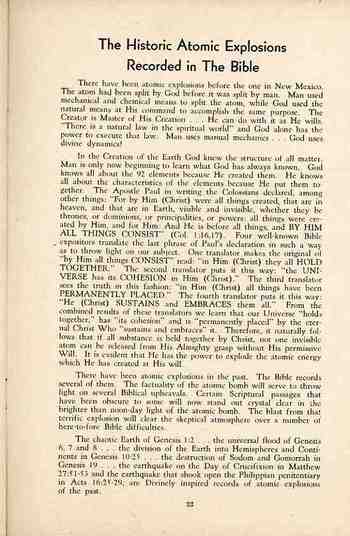
    The second pamphlet uses the atomic weapon a little more figuratively.  The author, Mel Morris, published this in 1945, which means he must’ve worked a little feverishly to pump up his bible prophesy and history to include the new atomic weapon to replace whatever else he had been using as a prophecy for end of times.  (As it turns out, “God’s Atomic Bomb” was more tempest and disaster in the bible, and not (whew!) the bomb itself.  Though as we’ve learned from scientologists and the sort-of creative mind of Ron Hubbard, a civilization came to the earth thousands of years ago and pummeled it with “atomic bombs” and other nastiness, polluting humans for milennia to come.  But that’s another story–suffice to say that Morris found many dozens of examples of “God’s Atomic Bomb” being used in the deep biblical past, and that the use of the real atomic bomb in 1945 was pre-ordained, and not without its figurative historical counterparts.  I’m not sure why any of this was necessary outside of proving to some small minority that these preachers could at least be contemporary and topical. 

    Blogsept_2_atomic_bomb_god_2txt483


  • Atomic Bomb Protection: Blast Briefcases and Anti-Heat Linen, 1950: What to Do When the Big Ones Come

    JF Ptak Science Books Post 282

     This anti-CYAG plump-piece comes to us by virtue of the helpful folks at LIFE magazine in their issue of 18 August 1950.  The article”Atomic Handbook is a Best-Seller/New Government manual tells what will happen and what to do if A-bombs fall on U.S. cities”.

    1ebay_sept_26_atomic_2676

    But what excellent material to work with when multi (multi) megatons come raining down from over the Pole. 

    Here are the helpful hints that were being sold to the American public in a family magazine:

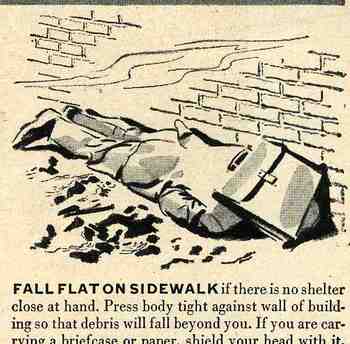
    1)  If there is nothing to hide in, put your face in the crack where the sidewalk and a building meet, and put your attache case over your head.  Too bad the case wasn’t bigger–like a few tons of lead and concrete. Make sure the metal clasp is facing out, rather than in, otherwise it will fuse with your skull, if there was any skull left.

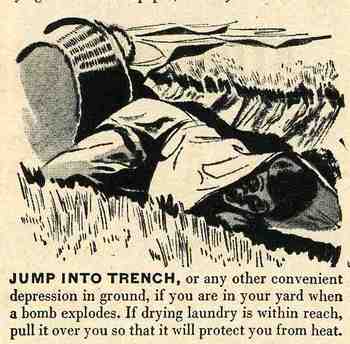
    2)  So, if you’re hanging up the laundry in the backyard when the bombs go off, get into a

    1ebay_sept_26_atomic_3677 trench (that just happens to be there in the middle of the yard) and cover your head with a sheet “to protect you from heat” (“if your drying laundry is within reach”).  I hope that its an Oxford double weave.
    3) (Illustrated below.)  Find a doorway to hide in, and hope that you’re not within two miles of the blast, otherwise you’re a part of the rubble.

    4)  (Illustrated  below.)  If you’re within two feet of a tree, hide behind it. Honestly  The warning is for two feet:  if you’re three feet away, you might be toast.  That’s the message.

    5) (Illustrated below.)  Crawl under a table and cover yourself with the table cloth to “ward off glass splinters”.  That was a real suggestion.  Somehow the cotton of tablecloths and linens and such had magical anti-glass and heat-reductive power brought on only during a nuclear holocaust. 

    The trick to all of this is to put yourself fifty years into the future and try to look back at whatever these LIFE images might be here in 2008. 


  • “Why is England in the Pyramid?”– A Question That Has Never Been Asked Before (?); or, FInding Pi in the Pyramid

    JF Ptak Science Books  Post 272

    Blog1sept_16_england_in_egypt_tp559“The lunatic , the lover and the poet,
    are of imagination  all compact…”
        Midsummer-Night’s Dream act v sc 1

    “Great ideas sure to madness near allied
    and thin partitions do their bounds divide”
        Dyden, Absolom and Achtiophel, part i, line 163.

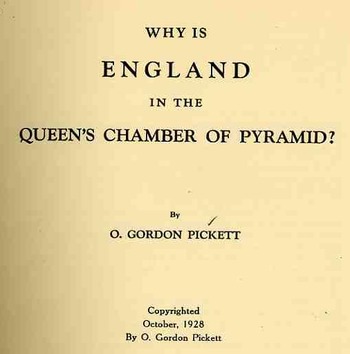
    I am pretty sure that O. Gordon Pickett, the very dedicated and serious author of this work, may well have been the only person to put the question forward of “why is England in the Queen’s Chamber of [sic] Pyramid?”  Isn’t the ability to ask an uncommon question one of the sources of innovation and genius?  Mr. Pickett, of Los Angeles (of course (?)), tried mightily in this 1928 publication to make his case for predetermination of the Anglo Saxon race by assembling and interpreting lost angles (sorry), implied geometry, found numbers, ratios, perspectives, and the like, endlessly, to find the outline of the England in the Queen’s Chamber of the Great Pyramid.  Almost all of this was invisible, a kind of outsider-logic-x-ray brought to bear on pyramid architecture–and when the picture clears, what the x-ray reveals,somehow and incredibly, is England.  And Christ.  And Pi. And although he was dedicated, and insightful, and capable of long sitting time, he probably was not a genius as we would recognize today, testing perhaps what Charles Lamb called the “radical sanity of genius” (“Sanity of True Genius” in Last Essays of Ella). Sometimes, having the ability to ask an unrecognized and first-time question doesn’t mean that the there is an ability to discern a place for the thing in a shining logical kingdom.  I do appreciate though that Mr. Pickett was a considered and discerning thinker, though to what non-personal end it all came to, I don’t know.

    Blog1sept_16_england_in_egypt558_3 But Mr. Pickett did evidently assemble ALLOT of data and drawings and plans and renderings of the pyramids in the course of looking for the secret strings  which would alter the known into the secret and unknown.
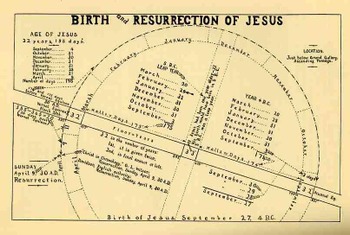
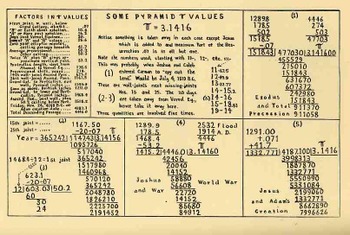
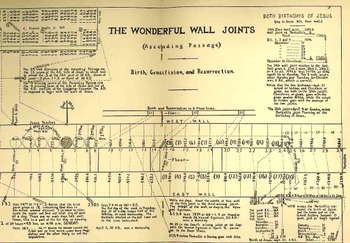
    I think what is most revealing about the way that he is going with his hard-thunk hard data is particularly revealing, and may also be, in their own way, some of the most uncommonly-titled visual displays of “quantitative” data that I’ve encountered:   “The Wonderful Wall of Joints, Ascending Passage, North, Crucifixion and Resurrection”, “(Pyramid) Passages and Planetary Rotation”, “Birth of Jesus at Entrance” and “Some Pyramid Pi Values” are all unexpected constructions.   Well, hard work does not necessarily make for good thinking, and though Mr. Pickett did allot of thinking on this…

    Blog1sept_16_england_in_egypt_jesus


    Blog1sept_16_england_in_egypt_pi561


  • Where are the Dead? When is a pit a hell, a hell a grave, a grave a pit, and Hades not Hell?

    JF Ptak Science Books  Post Post 271

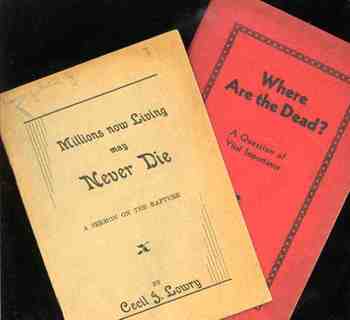
    Blogsept20_where_are_th_dead612 Oscar Lowry attempts to answer the question in the subject line of this post in a very red book of 46 shouty pages.  What he’s really concerned with, in Where are the Dead (1930), and what he maintains is of “universal interest to the saved and unsaved, the hearers and nonhearers”, is what happens to people after they die; more particularly though, Mr. Lowry is interested in differentiations in eternal damnations versus eternal doom.  And there is evidently a very wide difference here, as people in Hades are just in “prison”, waiting for their final judgment which will fling them into Mr. Cash’s ring of fire (well,”lake” of fire, actually).  There’s also little chance that the snakey charms of Orpheus’ poetry will ever change anyone’s mind at the gates of Sheol-Hades, leading anyone away from the firey pit.  The discussion of Hades and Hell and Sheol is interesting if not scary in Mr. Lowry’s hands, describing “Sheol-Hades” as a “prison”, its occupants waiting for final disposition to Hell.  Strong’s Hebrew opens the possibilities of definition with a number of translations for Sheol: the underworld, the abode of the dead, place of no return; without praise of God; wicked sent there for punishment; righteous not abandoned to it; of the place of exile; of extreme degradation in sin.  The most troubling of these in my book is the definition of what it is not, as in “when the righteous are not abandoned to it”, which seems both reassuring and really terrifying.. 
    Millions now Living May Never Die (1939)  is  a great title which leads ultimately to a not terribly interesting pamphlet about The Rapture.  Its also very badly timed for such a title–1939–as 20 or 30 million extra people would die who shouldn’t’ve by 1945.  I’m not sure why capitalization is required for the rapture, as it will probably not be confused with Another Rapture, or the Pseudo Rapture or even the Pre-Rapture–I must admit though that the mechanics of the rapture are not obvious to me, coming as it does after the Advent and Second Advent (which comes after seven years of Tribulation, or something like that).  The author, another Lowry , this one a Cecil from the Southwestern Bible School of Enid, Oklahoma,  writes with an abundance of capitalization about the impending “return of Jesus for His Bride”, and how the rapture will take you where you are, leaving the righteous to live on the earth, and others, well, not. The word “doom” appears more often than a semi-colon.  “Because the world is round, it will be night on one side of the earth and day on the other.  So many will be translated [i.e. “terminated”] that the great newspapers of the earth will carry in their headlines words similar to these:  ‘Millions have mysteriously disappeared from the earth’.  I am told that a certain large newspaper already have their type for for that event.”  The rapture will take you from “Satan’s slime pits” wherever they are, “at beach bathing and beer parlors ” to name a few, though I think that one can stop reading at being sucked into oblivion for sitting in the sand at Tybee Island, particularly if you’re five years old.  Be that as it may, probably everyone who read these the works when they were first published are now probably dead, enraptured or not.

    ·Posted by :

    ·in:

    — —

  • Towards a History of Horses in Flight in the 19th Century.

    JF Ptak Science Books  Post 270

    Balloon

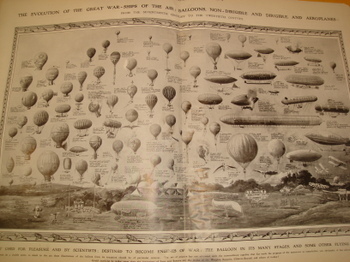
    Here’s a great opening sentence:  “Images of 19th century flying horses have always been difficult to find”.  And, since this is a serious issue, it really is a true statement, until today, when I noticed them in a little project I was dong.  I found a lovely history of balloon and aeroplane flight published in The Illustrated London News for 3 July 1909, called “The Evolution of the Great War-ships of the Air:  Balloons, Non-Dirigible and Dirigible, and Aeroplanes, from the Seventeenth Century to the Twentieth Century.  Its a big, double-page spread of a picture, featuring 60 or so of these flying machines–its so wonderful that I decided to reproduce the thing in a large format (35 x 45 inches), and it was then that I noticed something quite strange, at least to my experience.

    Blogsept19_horses_in_flight607
    .
    There were flying horses.  And one flying stag.
    Men on horseback in balloons.

    Actually, 8% or so of the images in the display involved horses. 
    Now perhaps men on horseback in balloons in the 19th century is a well know bit of aviation history; however, not being an historian in this area I’ve got to admit that I was very surprised (!!) when I first noticed these horses.
                                                                                                  
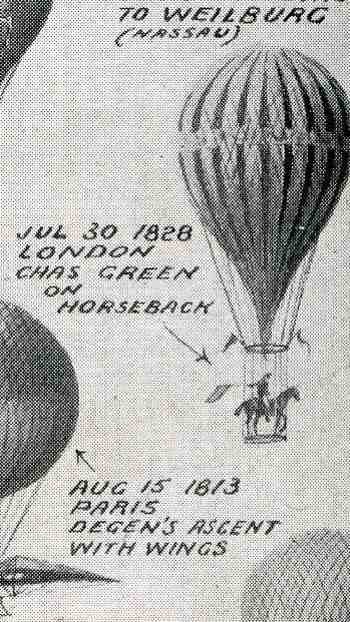
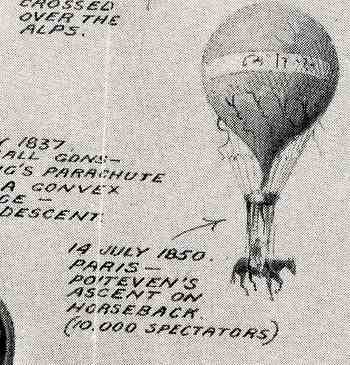
    Blogsept19_horses_in_flight609Missing them is understandable if you weren’t looking closely at the image’s little bits and pieces, what with the horses occupying something like 1/1,000 of the print’s surface.  But there they are, clear and bright as day:  “1798, Ascent by Testu-Brissey”, and “1828 London Chas Green on horseback”, and “1850 Paris Poiteven’s ascent on horseback (10,000 spectators)”. 
    In what is certainly a very uncommon notice there is also “Sep 1850 English Aeronaut Gale on horseback suffocated Bordeaux”.  Is this the first man-on-horseback-in-flight death? And death by suffocation? (?)  I’m not so sure that the ascent records for 1850 would’ve made allowance for running out of oxygen at high altitudes–if not, then how did this man suffocate? According to the Dictionary of National Biography, which, somehow, admitted (George) Gale (1797-1850) to its pages, reported that he died as a result of a misunderstanding of language, sent back into the heavens after landing with his pony, his balloon mistakenly released with none of its ballast remaining, with him attached to it still.  It was his 114th flight, which was quite allot, but not evidently enough.   Gale was a very colorful character, being an actor, then finding his way out to the American west and returning with several of the Indians he encountered and “exhibiting” them at the Victoria Theatre, and then becoming an Irish blockade defender before turning to ballooning. 

    Then there is the utterly fantastic “1804 Paris Margat on a stag”.  Somehow I guess M. Margat thought that being on a horse just wasn’t quite enough, and elected to ride a stag.  I’m not sure what to say, exactly, except that all of this renders “1836 Surrey Gardens–monkey “Jacopo” & parachute (with a little monkey dropped/thrown from the balloon in an experimental parachute device) somewhat anti-climactic. 

    What I was really after in this print and which I’ll get to in another post–sidetracked as I am by the horse issue–is found in the subtitle: “first used for pleasure and by scientists, destined to become engines of war…the balloon”, about the short but furious transformation of the aeroplane into a machine of war, all of which takes place in about a five-year period.  But that’s for another day. 


  • Methods for Solitary Self Crucifixion: the Case of Matthew Lovat, 1822

    JF Ptak Science Books LLC Post 266

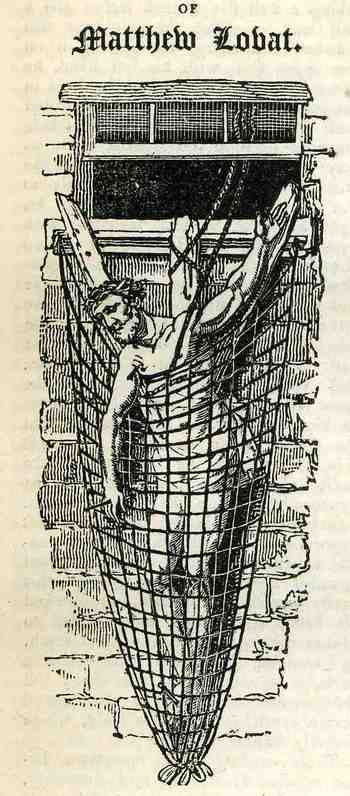
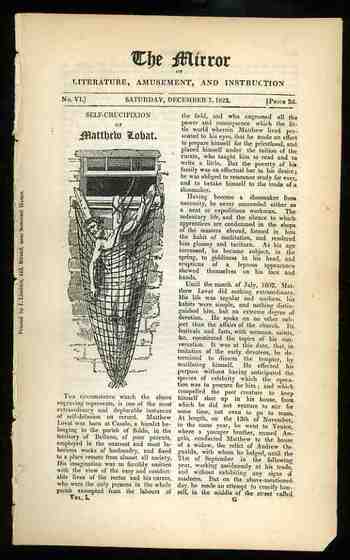
    There are no doubt many instance of voluntary crucifixtion by religious zealots–the case of Matthew Lovat, seen here in an issue of the compact London-based polite journal called The Mirrour (of Literature, Amusement and Instruction) is particularly pungent because he figured out a way to crucify himself without the help of others.  If you allow yourself to think about this a bit–and I must admit, the thought of self- and un-aided crucifixion had never entered my head before now–it really is a difficult procedure to implement.  Mr. Lovat seems to have thought it out and conquered the lowly demons that stood between him and him cross.  I’ve reprinted some of the explanation of how he undertook this adventure in 1802, included in the continued reading section below. 

    I should quickly point out that Lovat, a shoemaker from Italy (“born of poor parents, employed in the coarsest and most laborious works of
    husbandry, and fixed to a place remote from almost all society”), survived himself and after having his health restored escaped into the city wearing nothing but a shirt.  He was brought back into custody (“by the servants”) and remanded to the Lunatic Asylum of San Servolo, in Venice.  This was no doubt an unhappy situation, for anyone, crazy or not.  Lovat expired himself finally in 1808, evidently from taking too much sun. 

    Blog1sept_6_self_crux507
    Blog1sept_6_self_crux_det508

    ·Posted by :

    ·in:


  • A Map of a Fortune in Frogs (1936)

    JF Ptak Science Books Post 263

    Blog1sept_16_frogs_detail555

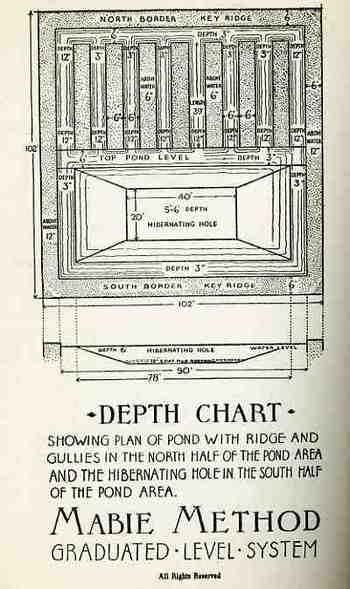
    This is the great promise of this remarkably mundane and contemporarily-wholly-removed pamphlet, which promises rewards and riches to be made in even the simplest backyard frog ranch, and all done with water, cement and no secret decoder ring. I mean, good night! I really had no idea whatsoever about such frog-goings-on in the depths of our country, even if the “depths” was Ridgewood, New Jersey, and it was the Depression (this pamphlet published in 1936).  I don’t have too much else to say about this remark effort except that–for all I know and I am not going to research it–this may well be the earliest Frog Ranch Plan published in the U.S.  There.  I said it (though my “key words” section says it all: “Frog farm, frog ranch, frog raising, frog map”).

    Blog1sept_16_frogs554_2

    Blog1sept_16_frogs_map556

    Blog1sept_16_frogs_contents557


  • Dropping Boxes Filled With Soldiers: a Bad Technical Idea but a Great Strategic One, 1928

    JF Ptak Science Books, LLC Post 260

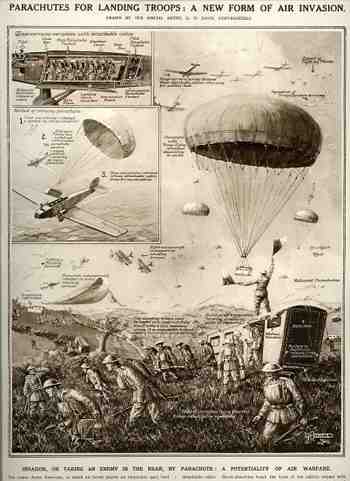
    This may not be the best idea I’ve seen–in principle this works fine for dropping tanks and other ordnance, but it seems to run against common sense when applied to delivering soldiers to a combat area.  This was of course just ten years after the end of WWI, which saw a spectacular increase in aircraft and aeronautical knowledge, and only 25 years after the Wright Brothers’ powered heavier than air flight at Kill Devil, so the lessons on paratrooping were just now being learned.  (By the way, what was the most significant militarily-based discovery in aviation between 1914-1918?  Could it have been the invention of the “barrel roll”, which instantly changed all concepts of aerial strategy?)                                                                                                    
    Blog1sept_15paratrooper553 Now what was going on in this display–appearing in the Illustrated London News on 8 September 1928–was the idea that a group of soldiers  (14 in this case) could be seated in a cushioned/springed box which would be parachuted onto a battlefield.  The idea of getting troops into a tight or difficult spot by a parachute is a very good one, a brilliant step forward really in the history of military strategy–but doing it in this fashion, by these means, was just not correct.  First of all the whole thing looks way too heavy for the aircraft to leave the ground to begin with, at least with those engines; then it looks too heavy for the chute to pull it out of the plane (and looks as though it would act as an airbrake more than anything else, as the chute seems to be gigantic, fully half the width of an already-wide aircraft. I reckon that given space for seven seated men that the cabin would have to be at least 25′ long, meaning that the parachute seems to be 10 cabin-widths in the larger image, or 250′ in diameter…in the smaller image the chute is only 4 times the length of the cabin or so, meaning it is a hundred feet across.).  The intention was for the chute to be deployed and for it to somehow lift the big box up and out of the plane, without dragging into or across the tail and etc. Then there’s the issue of landing, which, springs or shock absorbers or not, looks to be very problematical. 

    The technical part of the strategic idea just wasn’t going to work–the idea would, of course. 

    I should point out that this image was drawn by G.H. Davis, who made hundreds of images like this for the ILN over a four decade career–we’ll be seeing more of his work in the months to come.  Usually the work of Mr. Davis was spot-on, and he seemed to flourish in the “exploded view” and cut-away schematic.  This drawing was from the earliest part of his career, and I think he didn’t have much to work with–it seems an idea with a lot of leftover and abandoned Edwardian sensibilities.

    ·Posted by :

    ·in:

    — —