A Daily History of Holes, Dots, Lines, Science, History, Math, Physics, Art, the Unintentional Absurd, Architecture, Maps, Data Visualization, Blank and Missing Things, and so on. |1.6 million words, 7500 images, 4.9 million hits| Press & appearances in The Times, Le Figaro, Mensa, The Economist, The Guardian, Discovery News, Slate, Le Monde, Sci American Blogs, Le Pont, and many other places… 5000+ total posts since 2008.

Category: Bad Ideas

  • The Transformation of Animals into Man–Peter Camper’s Bad Idea of 1778

    JF Ptak Science Books LLC  Post 184
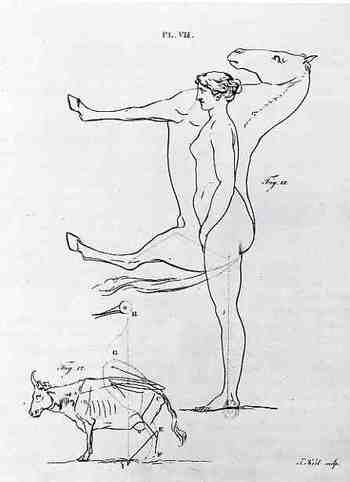
    Blogjuly_29camper360Peter Camper (1722-1789) was educated by some of the most gifted minds of the mid-18th century (and standard, daily-occurrence names in the history of science) including  Willem Jacob ‘s Gravesande (1688-1742) and Herman Boerhaave.  Camper made very substantial contributions during a long and varied career (as an anatomist, anthropologist, naturalist, paleontologist) one of which., perhaps, was the originated of the idea and practice of the study of comparative anatomy.  He was very highly gifted, talented, capable, insightful; he was an excellent observer, and was also an able and capable researcher.   

    Unfortunately there were some stumbles along the way, or at least which look to me like stumbles; some minor, some great. 
    The relatively minor one is exhibited here, to the left–to me, this seems like a “what in the name of sweet holy Neptune is going on here?’ category member.   It occurs in his  On the Points of Similarity between the Human Species, Quadrupeds, Birds, and Fish; with Rules for Drawing, founded on this Similarity (1778), and in general is an attempt at localizing, generalizing the study of anatomy, making it understandable in what seems to be multi-dimensional ways—or at least in ways that I cannot frankly understand.  In this image he tries to show the similarities in the bodies of the horse and wo/man, transforming the horse into a woman by virtue of a tremendous range of allowances:  dropping the hip of the horse, straightening the horse’s back, standing it upright, shortening and straightening the legs, shallowing the chest, losing the tail, straightening and shortening the neck, and so on and on…until, voila, a woman is made, showing the basic samenesses in all mammals.  I think that you could also work this magic with a (green, four door) 1960 Rambler—perhaps not, and perhaps this is no doubt a cheap shot, but the engraving, the image, is just so incredible I really don’t know what to do with it. 

    His greater, post-creation stumble is one that he is probably best known for today—the facial angle.  Ever more so than the transformation angles, the facial angle found its way into repugnant uses in the “scientific” racialist circles—it was a study of the so-called progress of nature exemplified in the visual rise of the slope in the profile of man and beast, the slope of the profile from the top of the lip to the forehead.  It was a geometry of dominance employed by the dominant race against those who were different—the more “backward” the angle between the lip and forehead leaned, the closer to the baser breads and the animals one was.  As a matter of fact Camper uses a progression of eight profiles to delineate changes between simian and the “ideal” man (?), the assertion being that the greater the angle of regression the greater the closeness was to the monkey.  In Johann Caspar Lavater, perhaps the best known of the physiognomists, would publish a 24-profile version of Camper’s idea, showing the progression from frog to Apollo (?!).  Scientific fallacies such as these would be investigated and employed with increasing venom over the 15 decades—they are largely gone now as junk science, but they still exist as mis-remembered proof in some racial thought.  It would seem as though Camper’s work in this theory of types (yes he was an influence on Goethe) gave much of this thought scientific credence. 

    ·Posted by :

    ·in:


  • Crazy-Insane Eyes Selling Mercedes, 1924. Bad Ideas #22

    JF Ptak Science Books  Post 182

    Mercedescrazy

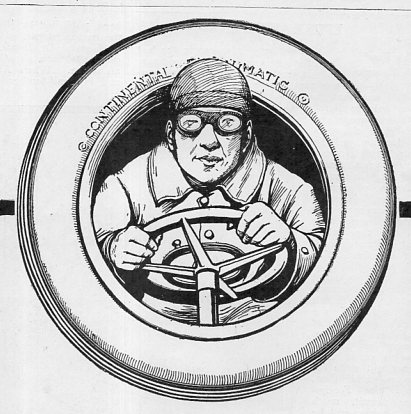
    I must say that when I first saw this advertisement for Mercedes (1924?, in the Illustrirte Zeitung from Leipzig) that I couldn’t really remember seeing someone looking this crazy trying to sell something, to anyone. This is particularly so when you take a look at a similar design for Continental Tyres, except that this ad appeared 14 years or so earlier, in 1910 (and in The Illustrated London News for May 14):

    Crazy driver not043

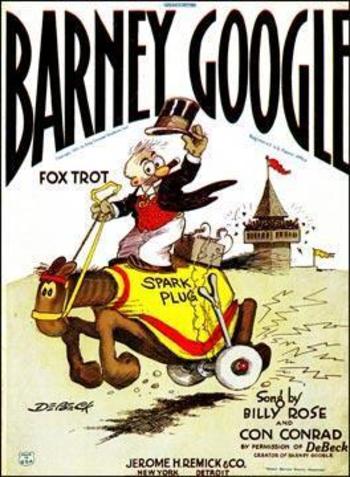
    Then I wondered about insane/laser eyes in general, and couldn’t come up much there, either.  Barney Google certainly had “goo goo googly eyes” but they weren’t necessarily crazy/insane.

    Classics_barney_google_sheetmusic

    Superman on the other hand did have laser eyes, and sometimes he was (made to be) crazy–still not quite up to the Mercedes guy, and he wasn’t trying to sell anything but himself and the comic that he was in.   I think that the Mercedes Man might be in his own category, and I’m not so sure how successful this ad campaign could’ve been, especially in the Weimar/Schacht era in hyper-inflated Germany.  

    Crazyeyesblank

    ·Posted by :

    ·in:


  • False Vertical Comets, Interior-Earth Asteroids, and Shoemaker-Levy as a Military “Bomb”. Bad Ideas, part 21.

    JF Ptak Science Books LLC  Post 178

    Blogjuly_22asteroid358
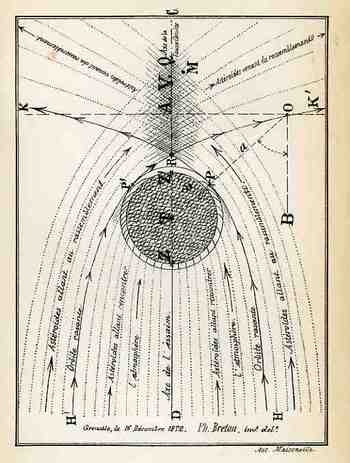
    My friend Marty Weil, the Ephemera Emperor and connoisseur of liminal sublimities at ephemera.typepad.com wrote a way-too-nice post about the BAD IDEAS section of this blog.  There’s thankfully not enough time to deal with the bad idea magma broiling away beneath our feet, but I do like to occasionally pick out some of the pretty ones and surface them from what is generally a deeply deserved dark place in the history of ideas.  And what came up this afternoon–and in honor of Marty’s effort on my behalf– was this little wonder (left): the title of this interesting, odd beauty is “Formation d’une Fausse Comete Verticale”, and it looks as though it was published in the 1872 or so, and engraved in Grenoble by Ph. Breton (for “aut” or the author of the paper, Maisonville (?)).     The nature of this illustration has flipped around quite a bit—the initial translation of the title sends it to the heights of uncompromising weirdness, “On the Formation of a False Vertical Comet”, except that the “false comet” part was really, I think, referring to an asteroid more so than, well, I don’t know.  (This “I don’t know” part can get very weird, as we’ll see below.)   So the title kind of gets back into line with the world of the possible (except for the “vertical” part); but from my reading, the content of the illustrations takes it back out, again.  The round object in the middle is the earth; and the curved parabolics leading towards it, and inside it (deep inside it), leaves me only with wonder, and without explanation.  It is entirely possible that I’m just not up to the task of interpreting this image, but the inner-earth cross-hatchwork of asteroids leaves me baffled, as does the “axe de l’essaim” (“stacked axis??), and the trailing atmosphere, and so on.  I really can’t find any key to this image. 

    Getting back to the unforeseeable weirdness that “explain things”, I found the following statement from a website explaining the “true” nature of the Shoemaker-Levy comet—the writer claims that it wasn’t a comet, not a comet at all, but rather a false comet (“une fausse comete” redux), and actually a series of “bombs” built by the U.S. Army and delivered to the surface of Jupiter by NASA disguised “as cometary collisions”.  (“En 1997 parait sur le forum fr.sci.astronomie un étrange document anonyme. Ce texte soutient que l’étrange série d’objets appelé “Comète Schoemaker-Lévy 9” ou SL9, qui a frappé la planète Jupiter en juillet 1994 en provoquant des explosions colossales était en fait une expérimentation de bombes d’antimatières misent au point par l’armée américaine, lancées par les navettes spatiales de la NASA et déguisées en collisions cométaires.”)  I must say that this explanation stumped me—sounds like a long, long way to go over a long period of for an experiment to blow up gas on Jupiter, if you ask me…

    ·Posted by :

    ·in:


  • Atomic Bomb Graffiti

    JF Ptak Science Books Post 173

    Blogjuly_18_drop_atomic_bomb342

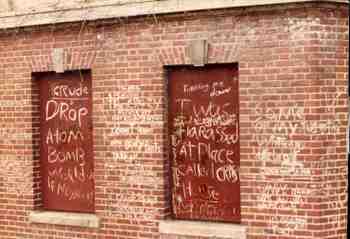
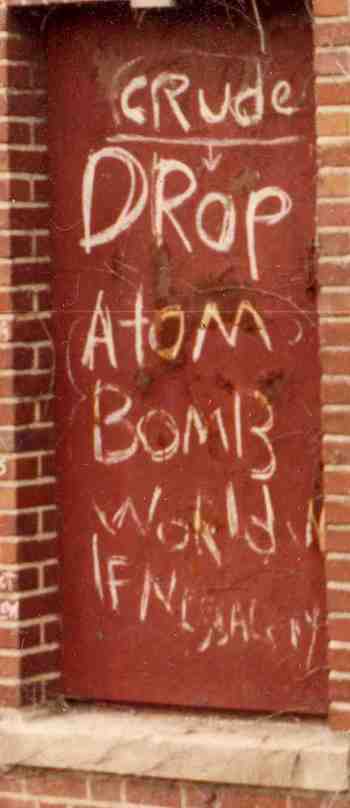
    Back in the days “when it was a long time ago” (in the words of my five-year old, Tessie) I found this artwork covering a Washington D.C. water department structure near the Whitehurst Freeway, down near the waterfront in Georgetown.  It was a six-sided structure, brick, with boarded up windows; all of the windows and most of the brick in between  had been used as a political/personal diary by one of the free-rangers who lived under the highway.  It was very creative, with parenthetical statements, asides, and even one footnote (I’ve still not seen another footnoted work of graffiti).

    Since I’ve made a few short posts about the Trinity Test and the coming of the use of the atomic bomb, I thought to include this, as I think the use of “atomic bomb” in outside/public diaries is still pretty rare. 

    The panel reads:
    CRUDE//Drop/Atom/Bomb/Worldwide/If Necessary

    The “if necessary” part I think was a stroke of pure genius.

    Blogjuly_18_drop_atomic_bombdetail3

    ·Posted by :

    ·in:


  • Nazi’s and the(ir) Display of Quantitative Information: Displays of the Big Lie, 1928-1940

    JF Ptak Science Books LLC  Post 168

    Bloggermany_surrounded328

    These two displays come at different ends of the beginning of WWII and, in a way,
    couldn’t be further away from themselves in the stories they were trying to tell
    (some truth, some fiction), and were separated in time by  11 years or so.   The
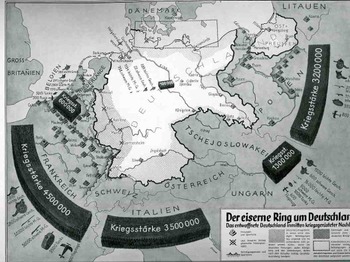
    first “Der eiserne Ring um Deutschland” (“The Iron Ring and Germany”) shows Germany surrounded by imaginarily aggressive (and aggressively-portrayed) neighbors nine years after the end of WWI.  They both display subsets of the Big Lie superset described by Hitler in 1925 in Mein Kampf (actually, sort of better described by the German term Lügenfabrik, or “lie factory”, used by Goebbels in his descriptions of the British).  The “Big Lie” was basically a lie so big and so preposterous, so outrageous, so impossible, that it was believed.) 

    This representation depicts the threat posed to Germany-making an iron ring-by the
    potentially hostile French, Italians, Belgians, Czechs and  Poles.  It shows the
    ring composed of a combined army of 13.1 million men versus the standing army of
    Germany, which in 1928 was given as 100,000, and listing virtually no heavy weapons
    and no air force whatsoever.. (The interesting bit here is that neither the Soviet
    Union nor Great Britain is included in these aggressive forces, the Soviets less-so
    than the English.)   The designer goes so far as to shade in areas of Germany that
    were under immediate threat, extending from the Donau to the Rhine, to a
    50-mile-wide area all around the country, with East Prussia almost entirely
    consumed.  (Certainly the Treaty of Versailles was a very troubling document closing the end of the war and, it cam be argued, opening the door for the next one.  It took six months to sign the peace treaty following the cessation of hostilities in November 1918, and the troubled negotiations produced a troubled treaty, ripping Germany up and saddling it with unrealistic retributions that began to wither in only four years, with the treaty virtually dissolved by 1935.)

    Blognazi_brit_aircraft325

    It is no wonder when looking at propaganda such as this that Germany was immured
    with fear of national collapse at the hands of land-hungry neighbors, and that there
    was a huge need to re-instate the army and a system of “self protection”.    (By
    1936, only 8 years later, it was beyond question about what Germany was up to-I can
    say that after having at least breezed through every page of the Illustrirte Zeitung
    (Leipzig)  from 1930-1940, that even a very casual reader could’ve tracked,
    graphically, the interest in military reporting and militarism in the page’s of what
    would’ve been the German equivalent of LIFE magazine.  By 1935 there was so much
    glorification of weapons and the Nazi manifesto that it should’ve been a surprise to
    no one when the Germans moved into their neighboring countries.)  This was by no means the earliest depiction of this rampant sale of fear or fear mongering (a design which has existed for thousands of years and not at all a creation of the present republican administration), but it is a very big and bald one, a somewhat staggering one, a bright shining lie.  (A Bright Shining Lie by John Paul Vann is by the way a great book on American involvement in Vietnam.) 

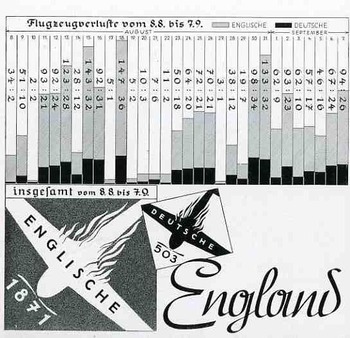
    The second image, a graph showing the successes of and very limited damage to the
    German Luftwaffe at the beginning stages of WWII, in August 1940.  This was a bad
    time for the Allies, this part of the war coined by Winston Churchill in 18 June
    1940 in the House of Commons by:  “The Battle of France is over. I expect the Battle
    of Britain is about to begin”.  Hitler’s Luftschlacht um England would start by air,
    where the Brits were far less the equal in military capacity, rather than by a
    land/sea assault, which would’ve tested the British at their strengths.  This
    second part of the assault on England was Unternehmen Seelöwe, or “Operation Sea
    Lion”, which would’ve begun the land assault following the victorious air campaign. 
    The graph shows aircraft losses from 9 July to 8 August, 1940, the German losses in
    black, and the British in gray.  As you can see, it was a pretty lopsided affair,
    made even more dramatic by the fictitious number of English planes being destroyed..
    This would all change, of course, with the Germans losing this battle, in a big
    way, with a resulting decisive victory for the Brits. (Who would of course muscle
    their way through the war another seven months before the U.S. was attacked and
    entered the war.) . It would coming to a screeching and collapsing reverse for the
    Germans by May 1941.  The results of the battle, in terms of aircraft and humans,
    were,  for England: 1,023 fighters: 376 bombers, 148 coastal command aircraft  for a
    total of 1,547 aircraft and  544 pilots and aircrew killed.  There were also 27,450
    civilians killed and 32,138 wounded.  The Germans lost 873 fighters and 1,014
    bombers for a total of 1,887 aircraft and  2,500 pilots

    I could find no graph of course showing the results of the endgame in the Zeitung.


  • The Tree of Life and Coal’s Phylogeny–a decent Diagram but a Bad Idea

    JF Ptak Science Books LLC  Post 165
    Blogcoal_tree318

    Even though this is a simple classification scheme, and a
    very-well designed graphic at that, the use of the tree describing the genealogy
    of coal by-products just seems, well, wrong. The use of the tree in defining a visual phylogenic interrelatedness of
    living things appears pretty much for the first time in the first edition of the
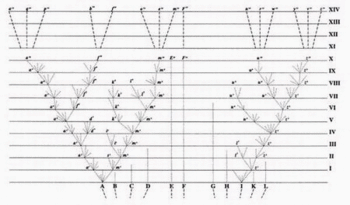
    Origin of Species in 1859, and it is the only diagram that appears in the
    book. (And by this I mean the use of the tree-scheme for scientific purposes:  the tree of life of course has been used for many, many centuries, the philosophical design woven into the fabrics and incised into the stone of many cultures.  It sort of appears in print in classification usage at least by the wily and polymathic Athansius Kircher, who used it to display the elements in a Kabbalistic Tree of Life some 350 years ago.)
    The Verkaufsvereinigung fuer
    Teererzeugnisse (of Essen) used this idea in
    1922, publishing the ad for their company in the Illusrtriete Zeitung (Leipzig). The great tree spring from a bed of coal (“kohle”)
    exhibiting the “stammbaum der nebenerzeugnisse” (roughly the “pedigree of our
    product”), with the trunk being gas, branching out into tar, coke and cyan and
    so on.  Even though it’s the lifeblood of
    the continuing industrial revolution, and even though we’re hundreds of years into
    a deep need with the products, the use of the tree just seems antithetical to it
    all on all levels of recognition, especially now. 

    (The Darwin tree of life is below.)Darwintreeoflife


  • The Worst Picture of Santa, Ever: Selliing Cigarettes, Post WW2

    JF Ptak Science Books  LLC  Post 164

    Blogsanta_cigs317
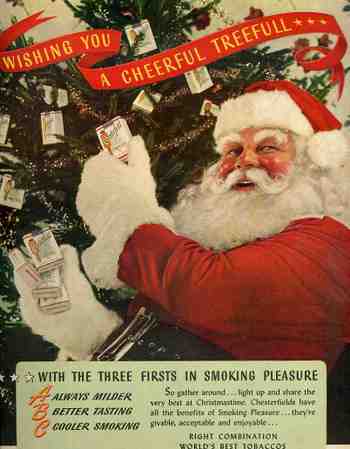
    Could poor old Santa get any lower than this?  Out of all the things he has carried in his sack over the years, Chesterfield Cigarettes may very well be the worst of them.  Plus, not only is Santa delivery them as presents, he’€™s decorating the tree with them as well, and hardly acting the camera-shy sort that he is.  Chesterfield (Leggett & Morris Tobacco Co.) combined some of the best loved elements of childhood (the ABC’s “€œAlways Buy Chesterfield”) and Santa Claus to not only convince adults to think of the product as a Gift(ing) Unit, but also to lull children into a sleepy, memory-clouding  impression of Chesterfields being somehow good (what with these two primary associations and all).  “€œChesterfields have all the benefit of Smoking Pleasure (capitalized in the original) “they’re givable, acceptable and enjoyable¦”  I wonder what they, meant, exactly, by using the word “€œacceptable”? 

    I’€™ve seen Santa in other embarrassing poses like this in the pages of LIFE magazine for this period:  €”flying through the air in his sleigh loaded down with boxes of cigarettes, placing boxes of them under the tree, stuffing stockings with cartons, and the like.  I’€™m sure that he regrets it now, though.

    All sorts of people were pressed into the service of selling tobacco products like this—sports figures, movie stars, doctors, adventurers; an entire alphabet of personalities and personality types got into the act.  A sitting president had never been involved, though a person who would become president was. Blogsanta_lreagan_chesterfield_ad

    I’m sure Ronald Reagan regretted this ad at some point in his life as well (“beautiful Christmas Car Carton” or not), though I suspect that he would’ve kept that close to the vest. 

    ·Posted by :

    ·in:


  • Big Weirdness: Eating Glaciers AND Moving Glaciers Cross-Country (??) 1921

    JF Ptak Science Books LLC   Post 162
    Astrography311

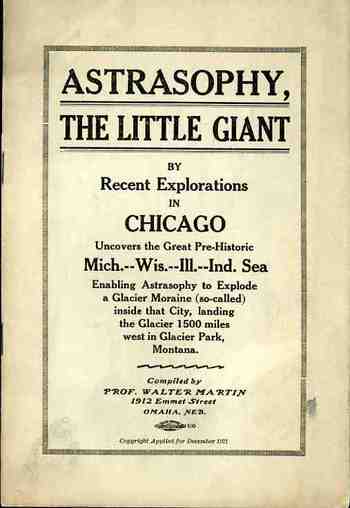
    So, in a collection of thousands of odd pamphlets with categories and sub-categories which are in themselves odd (“History of Biological Transformation”) there occasionally springs from the well a particularly singular effort that doesn’t fit anywhere:  when I can’t find a place to put something in a collection (read “assemblage”) that has a place for everything, I know its really weird. 

    And so we have the singular tale of “Prof.” Walter Martin, author of Astrasophy, the Little Giant, by Recent Explorations in Chicago Uncovers the Great Pre-Historic Mich.—Wis.—Ill.—Ind. Sea Enabling Astrasophy to Explode a Glacier Moraine (so-called) inside that City, landing the Glacier 1500 miles west in the Glacier Park, Montana.

    Sometimes you have to read something to find out what its all about; other times, like here, the whole thing gets pretty much told in the title.  Once inside, there’s no trail of words to describe exactly what Prof. Martin had in mind with the exploding Chicago glacier; the trail picks up and disappears all over the place, leading even the best tracker to stand and scratch, lost.  (I should point out, too, that the glacier is not only “exploded”, but it is placed “whole”, somehow, in Montana from Chicago.  That’s really not a lot of ‘sploding, if you ask me.). There’s talk about stars, and the “future Chicago”, the tilting of the continents, “slipping earth”, and disappeared “drift piles of ice”, punctuated with wonderful non sequitors like “Yes with my heart all gone I had to eat two glaciers and put one in my pocket”, and then right back into star control,  earth miasmas,  solar system electricity, and other cloudy things. 

    Only eleven pages long, the pamphlet reads as though it were several pages shorter.  On pages 7-11 is a “University Short Course in Astrasoph”, and seems to explain all things in seven quick points.  In #2, we read “space is matter in its utmost expansion”, which is a tricky statement (in that we usually think of matter “taking up” space, but never mind), which we can get by quickly with #3:  “matter is the result produced by creation pressure upon the Eotonic Sea of space, condensing to the fifth form”.  This somehow forms the “four nebulas”, the fourth of which “when enlarged, is a divine message to inform us of the existence of other universes”  In this part I think he’s dealing with the idea of the powers-of-ten type, where, Zeno paradox-like, the greater the detail the more is revealed in that youi never actually get “there”.   I do like though that he gets into alternative universes back there in 1921
    Astrography312
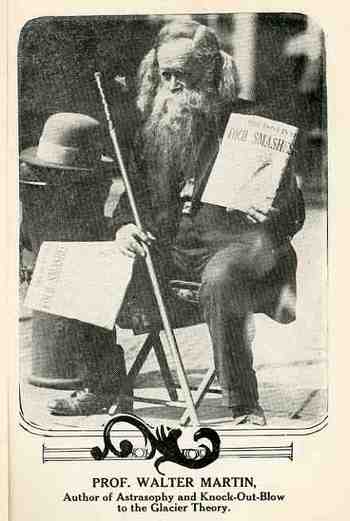
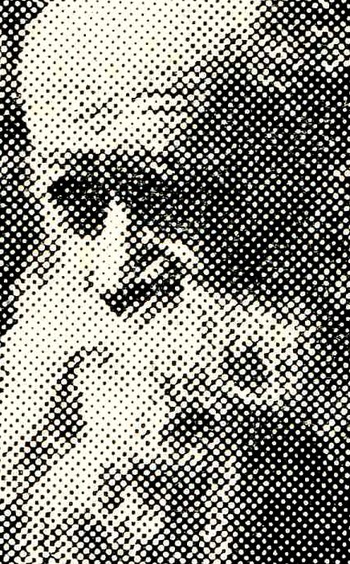
    I know that “astrasophy” has an astrological sumpin’ sumpin’ going on nowadays, but that is a slow boat with a fast terminal leak that I have no desire to board.  Mr. Martin got his hands on the term pretty early from what I can tell, and made it his own.  I’d like to celebrate him a little for his singular, spectacular view of the world, but I don’t quite know how, except to say that he came up with a unique set of ideas, and if you squint hard he looks a little like Leonardo, if you pixilate him some. The picture of Mr. Martin seems to show him sitting on the street in a folding chair, evidently selling newspapers (“Foch Smashes…” reads the headline, relating to WWI.)  I hope that he had the chance to proselytize as he dispensed the other worldly news.  In those wily pre-mega-treatment days, Mr. Martin found voice for his dreams and put them in print, and so they exist to this day, if only here—and now he belongs to the web.

    Astrography_det_por314

    ·Posted by :

    ·in:

    —

  • Food Packaging, Plastics and the New Desire: the du Pont Company, WWII.

    JF Ptak Science Books LLC Post 159
    Blogcandy282

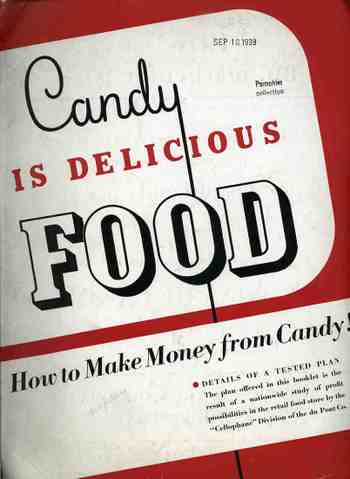
    I was initially drawn to this small collection of pamphlets because of the very provocative assertion that candy is food (but is food candy?) which, I guess, it is, technically speaking.  (Maybe we should determine what food is on a sliding scale of what we would take to a deserted island somewhere and have to depend on those foods for survival.  I don’t think that I’d have a trunk full of Mounds bars with me.  Evidently if you had to choose one food product (and one product only) to survive on for a year it looks like the best thing to select is dry dog food.)

    The Candy is Delicious Food pamphlet was published in 1939 with the intent of instructing the grocer how to better sell candyFood—expressing the ease, storage and profit margin.  Curiously, the thing was published in September  1939, a few months into the war—I wonder if the publisher (saved for naming below to more effect) was prescient in determining the coming problems with food, and that candy would certainly not have those issues during a global conflict? 

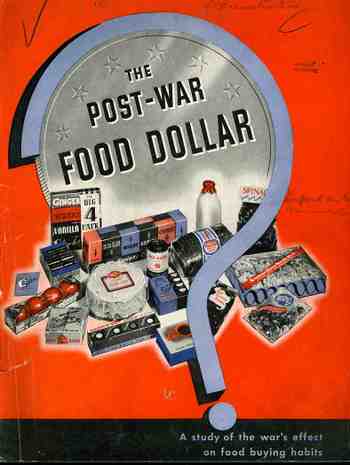
    The Post-War Food Dollar was also the product of the same publisher.  Published in 1943, this pamphlet exhorted the grocer to prepare for the coming peace, explaining where the new dollars might be spent once the war (and the supply and ration problems) was won.  Blogcandy_post_war287

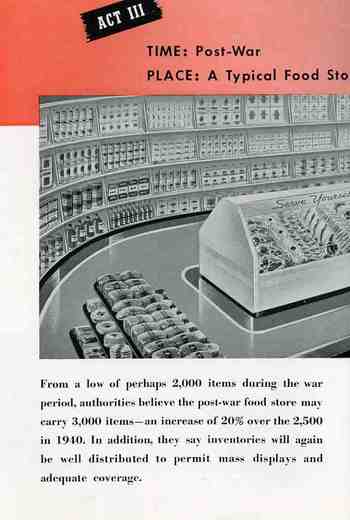
    As it turns out these pamphlets were mostly about display and merchandising, and finding the goods that looked best on the shelves—and evidently that which looked best was that which the product could be seen.  And the way that the product could be seen was with the use of the “new”packaging filament, cellophane, produced in the United States (almost exclusively) by du Pont (E.I. du Pont de Nempours & Co. with  their chemist William Hale Charch figuring out how to make cellophane moisture –proof, which led to very large-scale good packaging using the product.)   Another very big bit which turns up unmentioned but illustrated in this pamhlet is seen in this The Future is Now! scene of a modern supermarket–the “SERVE YOURSELF” butcher/meat section, which was a new idea in the early 1940’s, and one that was not at all common in the consuming world.  This idea wasn’t as big a deal as the invention of mass produced sliced bread (or, as Squidward Tentacles encountered in one episode of SpongeBob, “Bread in a Can–the best Thing Since Sliced Bread”), but it was a very important de3velopm,ent in marketing–and also another gargantuanly consumptive venue for the sale of the packaging element, cellophane.

    It was DuPont who published this series of pamphlets for the sole purpose of marketing foods and ideas to grocers that were almost entirely dependent upon cellophane, and DuPont manufactured 75% of all cellophane made in the U.S.  So, to me, it seems as thought all of this business about Food being Candy and the Post-War food spending dollar was really just about selling cellophane—the food was incidental, which is why the cellophane-encased candy was called “food” to begin with.  (It was Whitman Candies who first used cellophane in the U.S. , in  1912, to package their goods for retail.)
    Blogcandy_post_war285_2
    As an aside it is interesting to note that du Pont was brought to court in 1947 over their alleged monopolization of cellophane manufacturing in the United States.  Thus was the U. S. v. DUPONT (THE CELLOPHANE CASE)  filed December 13, 1947, which “charged Du Pont with monopolizing, attempting to monopolize and conspiracy to monopolize interstate commerce in cellophane and cellulosic caps and bands in violation of Section 2 of the Sherman Act”.   DuPont successfully defended themselves in this case.

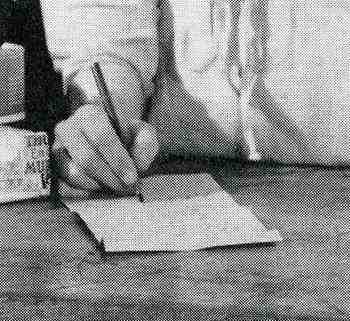
    The other, minor, thing here that really caught my attention was on page 10 of the Candy is Delicious Food pamphlet—an innocent picture of the grocer tallying up the customer’s purchases, sure enough, but if you look at the detail you can see the grocer writing it all down on the bag that he’d use bag up the purchases.  I have a dim memory of seeing this done in the across-the-street-from-the-A&P Mom & Pop grocery sawdust-strewn store (on Main Street, of course) in Great Barrington, Massachusetts, when I was a kid in the early 1960’s.  I
     
    don’t recall this being done after that, what with real cash registers and then, much later on, with more sophisticated inventory control hardware.  I’m sure that I recall this being done in hardware shops (almost all gone), and my Mother recalls this more recently—in the 1970’s—in butcher shops, but I think this recording practice was pretty much extinct by the mid  1960’s.  I know that this means nothing, but the picture of this guy writing on the bag was so sharp in my memory that I needed to record the emotion.
      Blogcandy_bag283Blogcandy_bag284


  • Subduing Insanity with Narcotic Induced Sleep: Mental Illness Treatments in 1845

    JF Ptak Science Books Post 153
    Blogdrugs_crazy254
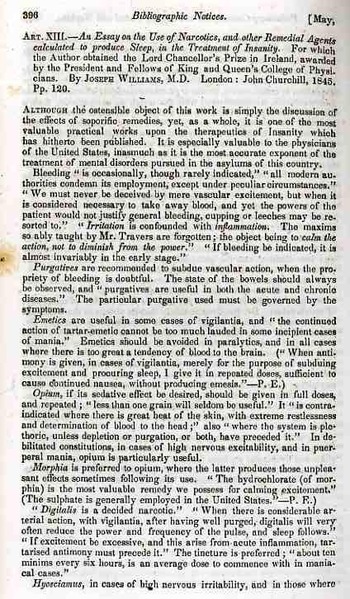
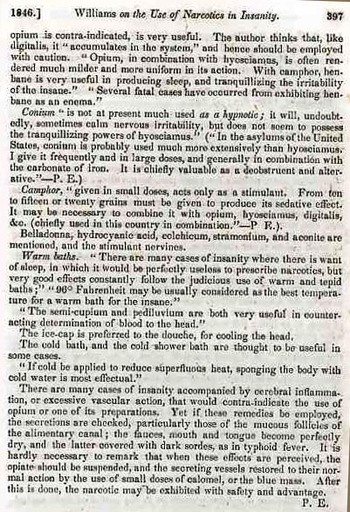
    This book review on the use of narcotics in treating the insane appeared in the New York Journal of Medicine for 1846.  The book, “An Essay on the Use of Narcotics, and other remedial Agents calculated to produce Sleep in the Treatment of Insanity….”, by Joseph Williams, M.D., and published in London in 1845.  The theory behind the sleep treatment was that the basic mechanism of insanity was “cerebral inflammation” or “excessive vascular action” in the brain—inducing deep sleep, evidently, was a good way to combat the over-active brain.

    The article itself comes at an odd time in the history of the treatment of the insane.  It came almost 40 years after the establishment of  McLean Hospital (first known as the “Asylum for the Insane,” a division of the Massachusetts General Hospital), which opened on Oct. 1, 1818, and was the first hospital dedicated to the treatment of the insane in the U.S.  It came 70 years after the great advances of Benjamin Rush, who elevated the “Mental Patient” from chains on the floor to the status of medical or nervous illness or disease.  The use of narcotics over this period seems to have surged and waned.  In 1879, in an article in the New York Times, the reputation of the Asylum for the Insane on Ward’s Island in NYC was considered—and one of the high points was that it had (largely) discontinued the use of narcotics. (There were still problems, of course, what with the asylum being overcrowded, housing 1100 in an institution meant to house 700, and where the chores and even nursing positions were staffed by the inmates, who were feed on 32 cents a day.)  As late as 1921, though, Jacob Alter Goldberg notes in his Social Aspects of the Treatment of the Insane, that there was a new, sharp increase in “toxic narcotic” treatments of the insane.  Of course, I guess one could replace “narcotic” with some sort of other misplaced treatment, like shock therapy, or Freudian mélanges, or something.  Each age must necessarily have their entry in the encyclopedia of embarrassments
    Blogdrugs_crazy255 . 

    In this article we find sleep assaulted by the use of the following:  purgatives (“to subdue vascular action when the propriety of bleeding is doubtful’), emetics, opium (to be used “in cases of high nervous excitability and in puerperal mania”), morphia (“the most valuable remedy for calming excitement”), hyosciamus (“to produce sleep, tranquilizing the irritability of the insane”).  It is weird to see that the last sentence in the description of hyosciamus reads “some fatal cases have occurred from exhibiting henbane as an enema”.  A narcotic enema?  Still to come in the review is conium (“I have used it frequently and in large doses…it is chiefly valuable as a deobstruent and alternative”, followed by camphor, Belladonna, hydrocyanic acid, colchirum, stramonium aconite, and others.  “Warm baths’ makes an appearance (“90 degrees may be considered to be the best temperature for a warm bath for the insane”), as do cold baths, and the applications of ice caps. 

    I’m not so sure about what to make of it all, the sleep treatment of insanity I mean—after all, Joseph Lister only makes his epochal pronouncements on cleanliness in the operating theatre 15 or so years after this paper, which seems today to be the most rudimentary thing that one could do in treatment in the surgical room, so treating extra blood in the brain through drug-induced sleep doesn’t seem all that far away from the realm of possibility back there in early Victorian England.

    I don’t think I’ll forget the toxic narcotic enema any time soon, though.  Or the word “deobstruent”.