A Daily History of Holes, Dots, Lines, Science, History, Math, Physics, Art, the Unintentional Absurd, Architecture, Maps, Data Visualization, Blank and Missing Things, and so on. |1.6 million words, 7500 images, 4.9 million hits| Press & appearances in The Times, Le Figaro, Mensa, The Economist, The Guardian, Discovery News, Slate, Le Monde, Sci American Blogs, Le Pont, and many other places… 5000+ total posts since 2008.

Category: Bad Ideas

  • Fantastic and Unreachable Intellectual Claims: Psychology and Dr. Strangelove


    JF Ptak Science Books LLC  Post 141

    Ranoe903 det

    Blogpychologrnoefull

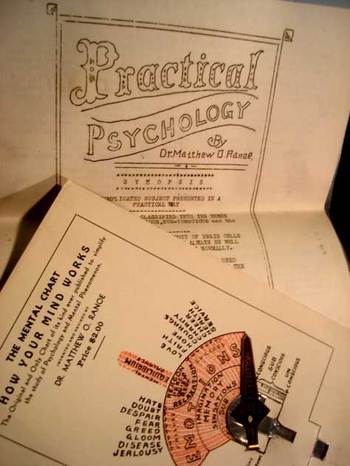
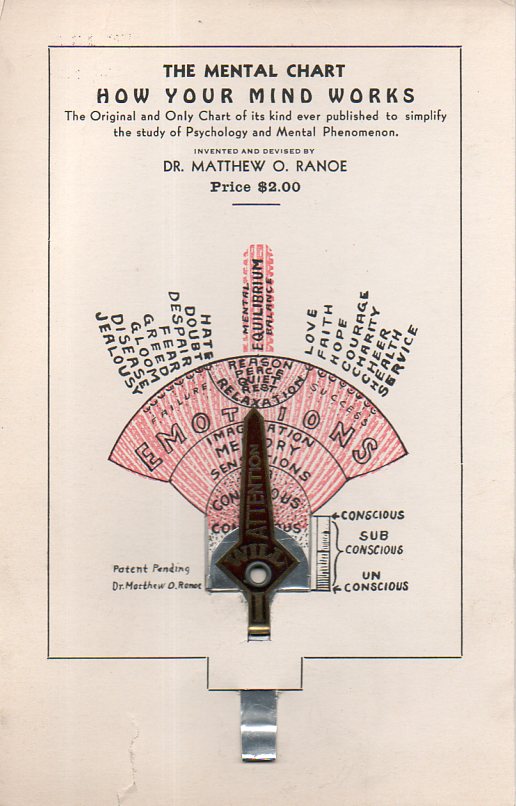
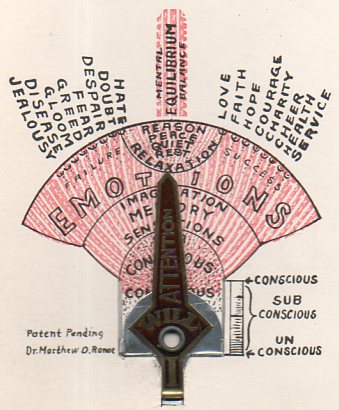
    How could one argue with the simplex simplicity of this slightly mechanical reader’s aids, “The Mental Chart, How Your Mind Works”?  It continues “The Original and Only Chart of its Kind Ever Published to Simplify the Study of Psychology and Mental Phenomenon”.  Indeed.  It was issued to simplify the ideas contained in the 1936 pamphlet entitled “Psychology Simplified”, by Dr. Matthew Ranoe, itself a pretty uncomplicated and unpaginated affair of 18 pages.  I bought it and 94,000 other or so pamphlets from the Library of Congress some years ago, which explains why I have this table-top production copy sent by Dr. Ranoe to secure and protect his copyright; and it also explains why any copy of this exists at all, as the pamphlet/screed/contemplation never did get published. 

    Somehow it was Dr. Ranoe’s idea that since the brain was a mysterious formulation of ethery-directional electrical cells not necessarily connected to intelligence that it somehow was associated with the photo-electric cell—Ranoe claims that this is the first use of the photoelectric cell to explain the organization of human brain cells, and was not the last. (I’m not sure how this works given the “photo-” aspect of the thing, and it doesn’t really fit with what I know of the hisory of photo-voltaic cells and the effect, and that stretching back to Antoine Becquerel in 1839…1)   It is also associated in an odd, Dr. Strangeloveian, General Jack (“precious bodily fluids”) Ripperian way, discussing  the dissipation of our vitality during our conscious state” as it was affected by “tissue fatigue” and low-running “vibratory force”.  And so on runs Dr. Ranoe into the distant night. 
    Ranoe901
    [In Stanley Kubrick’s brilliant 1964 film Dr. Strangelove, actor and squealer (he did badly with HUAC) Sterling Hayden’s insane character General Jack D. Ripper seeks to protect his “purity of essence”, his “precious bodily fluids” from Soviet fluoridation attack by ingesting only distilled water and grain alcohol.  This diet does not serve him in a sprightly way, as he winds up starting WWIII, destroying all humankind.]
    Ranoe902
    [Everyone must know this by now but I’d still like to point out that most of the characters in this movie have sexual, excretory or depraved names. For example:  Jack D. Ripper, Mandrake, Buck Turgidson, Merkin Muffley, Col. ‘Bat’ Guano, Dmitri Kissof Desadeski (De Sade ski),  Maj. T.J. “King” Kong (who rides the hydrogen device named “Dear John” that would ignite the war) are all pretty clear. This is a picture of Hayden’s General Ripper.]]

    Kubrickrippper

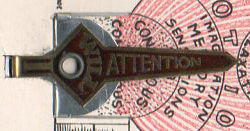
    The “calculator” included with the pamphlet doesn’t calculate anything, so far as I can see.  It does have a great pointer though—made of metal, and labeled “WILL ATTENTION” on the top with “I” on the bottom, it makes pointerly exaltations tosixteen different types of emotions, and that’s about it.

    The device is “patent pending”.
    ·Posted by :

    ·in:


  • Bizarre Thinking and a Towering Classic of Lost Logic: the Japanese War Lords and Kaiser Wilhelm, the “True Kidnappers” of the Lindbergh Baby and the Beginning of World War Two

    JF Ptak Science Books LLC Post #122
    Lindberh_japanese168

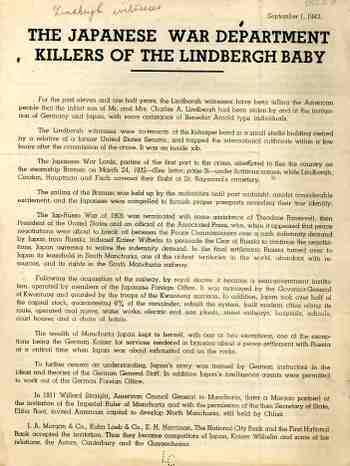
    This four page pamphlet, received by the Library of Congress (and probably nobody else) on 1 October 1943, divines the origins of World War Two and the kidnapping of the Charles Lindbergh baby to a complex and impossible cabal of Japanese “War Lords”, Kaiser Wilhelm of Germany, the assassination of Leon Trotsky, the League of Nations, Elihu Root,  “3 cent gallon kerosene”, the South Manchurian Railway, and some sort of “historical documents of posterity countersigned by Tokyo and Berlin” in the possession of Mrs. Renee Valentine (“Secretary”) of Staten Island, New York. 

    The entire affair began with “co-tenants of the kidnappers band in small studio building owned by a relative of a former U.S. Senator” under the instigation of “Germany, Japan and certain Arnold Benedicts types” brought about by the end of the “Jap-Russo” War of 1905.

    We are told it was an “inside job”.

    Somehow Teddy Roosevelt gets involved with Kaiser Wilhelm in arranging for the Russians to pay indemnity to the Japanese in terms of a land agreement of Southern Manchuria, opening the way to exploitation of China by the Japanese.  Something else happens, the South Manchuria Railroad gets thrown in as well as four competing U.S. banks and Elihu Root and a failed League of Nations agreement which upsets a balance of power and brings “the Astors, Canterbury and the Guggenheims” into competition with the Japanese and Kaiser Wilhelm, doing something to the Treaty of Washington.

    After this incredible and unconnected and partially non-existent series of events is both untangled and entangled before our eyes, the writer reaches the lonely and very solitary conclusion that “the necessary documents to prove these charges (??) could be secured through the kidnapping of the Lindbergh baby”.  I was waiting for the  author to make a case for Lindbergh’s real-life (and long held) Nazi sympathies, but that just didn’t happen. 

    I really have no idea of what the writer is talking about, but the failure of making any connection whatsoever with any of the “facts and circumstances” is magnificently appalling, and has moved itself from the realm of being so bad that it isn’t even “bad” anymore.  It is that singular sort of “badness” that makes the printed words seep into the paper and disappear before your very eyes, and the only thing that you can say is “wow”. 

    ·Posted by :

    ·in:

    — —

  • Visionary Architecture and a Falling Man Prank–E. Hebrard’s Tower of Progress, 1913.

    JF Ptak Science Books   Post 118 (expanded)

    Dsc00013

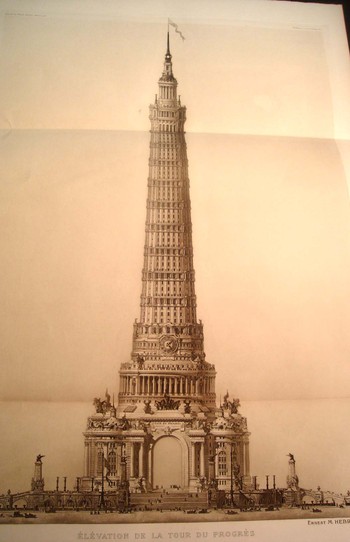
    This image has two things going for it, one obvious, the other not (and just about hidden, until you see it, then you can’t help not seeing it all of the time).  It comes from an unusual, somewhat pretty/bizarre visionary work privately printed in Paris in 1913.  The lead author, Hendrik Christian Andersen, along with Ernest M. Hebrard (and his brother, Jean Hebrard, who we saw in an earlier post), collaborated on a project (ungainly) called Creation of a World Centre of Communication1, a deeply complex, very detailed, and just plain weird offering for building a sprawling extraterritorial city dedicated to “oneness”.  The drawings and plans were lush and lovely, with a lot of thought in their execution but actually very little into how everything might actually be pulled together into some sort of working whole. 

    Dsc00012

    And so it goes.  I imagine that if the beautiful Etienne Boullee thought in terms of cities rather than in single structures, he might’ve produced just the same sort of gorgeous, unconnected thing.  After all, just because you draw a plan with a lot of buildings almost touching each other doesn’t necessarily mean you’ve drawn a visionary city. 

    This is one of 22 large images (in real life this print, a heliogravure, measures about 28 inches tall) showing different structures from an art center to a fountain of life.  This is the “Tower of Progress”—I don’t know what sort of progress as there’s really nothing to go by, except for the big 100’-tall clock, so at the very least it is a celebration of the progression of time, which needs no monument outside of the trillions and trillions of trillions (or centillions, or 10303?) of bones it has distributed around the planet over the millennia. But for Hebrard it formed the locus of the  “a fountain of overflowing knowledge to be fed by the whole world of human endeavour in art, science, religion, commerce, industry, and law; and in turn to diffuse throughout the whole of humanity as though it were one grand, divine body conceived by God, the vital requirements which would renew its strength, protect its rights, and enable it to attain greater heights through a concentration of world effort.” Whew.

    I figure that the tower was to be about 1,500 feet tall (scaling it by the 2mm tall figures scampering around in the image)—a giant tower perched on top of a rotunda placed on top of a table-like something, looking terrifically fake, but lustrous.

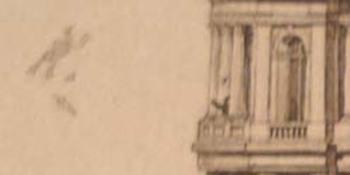
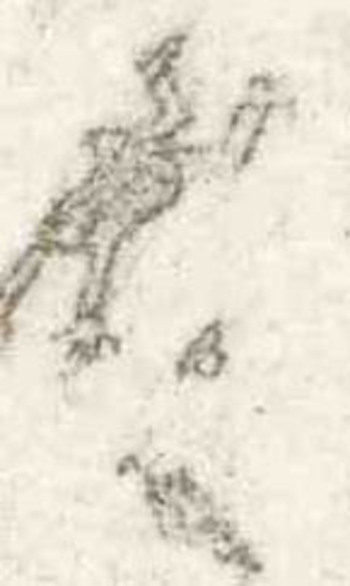
    The prize though in this portrayal of the “Tower of Progress” is a little smudge-like thing to the middle-left of the tower.  Under magnification, we see that it is a man, with a bowler and an umbrella, hurtling down, falling from somewhere way on high in the tower.  It is of course a very unexpected feature of this visionary architectural rendering, a hidden joke (perhaps?).  These sorts of additions—the work of a disgruntled/drunk/humorous engraver—pop up from time to time in the history of printing.  Perhaps the most famous intentional example of this graffiti is found in the earliest copies of the first edition of Twain’s Adventures of Tom Sawyer, where a male character is featured with

    a very large, very lumpy, very noticeable, erection; a proof reader spotted the embarrassment, and the plate was reworked to rid the character of the Natural Function.  I’d guess offhand that this was the case with the Hebrard heliogravure, even though there is a second figure in the tower pointing at the figure hurtling past, implying a little more thought in making this a more cohesive joke.   

    Notes:  An interesting review of this work appeared in Town Planning Review for 1914, here. 

    Falling_man_super_detail


  • Atomic Weapons, Eniwetok Atoll, and the Most Obscure Reference to America’s Entrance into Vietnam

    JF Ptak Science Books Post #117

    Atomic_times_detail_masthead159

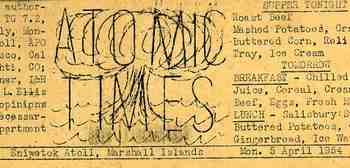
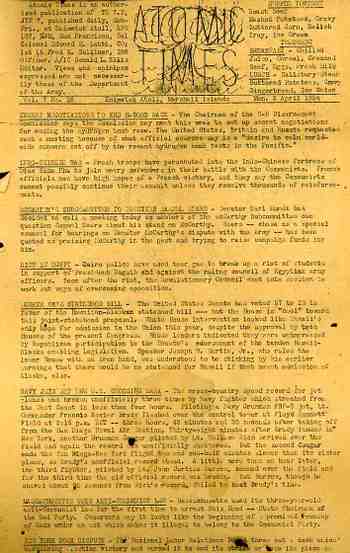
    This issue of the Atomic Times was issued Monday through Friday by the U.S. Army on a mimeographed, single-sheet page, and published at the tip, or bottom, of a very skinny piece of nearly-circular land far out in the Pacific Ocean at Einwetok Atoll, 5 April 1954.  The Marines fought a battle and beat the Japanese Army for possession of the atoll in 1944, and the U.S. government stayed. In 1954 most of it was controlled by the U.S. Army, and the place was being used as a nuclear bomb testing zone for a decade, experiencing 43 tests from 1948 to 1958. The most famous of these test shots was “Mike”, part of Operation Ivy, which was the first detonation of a hydrogen bomb, in 1952. There would be subsequent tests there that, by themselves, represented in a single instance all of the chemical fury unleashed in all Allied bombing in Europe for the entire course of World War Two.

    Atomic_times157

    “The Atomic Times” was a sheet of the daily grind at this remote, if not bustling, outpost of nuclear prolificacy. “Supper Tonight” was announced in the upper right corner (roast beef, mashed potatoes, gravy, buttered corn, relish tray, ice cream”), plus “tomorrow’s breakfast and lunch”; there was a fair amount of reporting on local softball, boxing, swimming and basketball, pus some major league baseball scores. On the front side was the news, with what may well be the loneliest announcement of the coming of America’s involvement in Vietnam. This was the second entry in the news, “Indo-Chinese War”: “French troops have been parachuted into the Indo-Chinese fortress of Dien Bien Phu to join weary defenders in their battle with the Communists. French officials now have a high hope pf a French victory, and they say the Communists cannot possibly continue their assault unless they receive thousands of reinforcements”

    And so it ended, and so it began.

    The siege of   Dien Bien Phu started just a week later or so, on the 13th of March, and lasted 57 days, ‘till May 7th, 1954. The commanding general of the Viet Minh forces, Vo Nguy Giap, achieved an enormous victory over the French—the first time a guerrilla force readjusted itself into a conventional force to defeat a Western army. It was the end of the line for the French, and it just so happened to be the beginning of American involvement

    Dien bien phu

    Just a week after this notice appeared, Dwight Eisenhower made his domino speech:

    “Finally, you have broader considerations that might follow what you would call the “falling domino” principle. You have a row of dominoes set up, you knock over the first one, and what will happen to the last one is the certainty that it will go over very quickly. So you could have a beginning of a disintegration that would have the most profound influences.conference…”


  • Gigantic and Unbuildable Architecture: Philip Johnson and the Walled “Third City”

    JF Ptak Science Books LLC   Post #116
    Big_arch_city_johnson137

    Philip Johnson, the enormously influential, selfish and neo-fascist architect once remarked of his profession that “architecture was too important to be left to the architects”, and I agree, especially if it was Johnson who was signing off as architect.  Johnson was more interested In building great rooms; some people see Johnson’s greatest room as the Crystal Cathedral that he designed for the television minister Robert Shuller (Garden Grove, California), a very shiny one-acre metal/mirror tent-like structure that from the inside looks like, well, a tent; from the outside it looks pointy and block-like.  (I’ve never understood the fascination with the work of Johnson.)
    Johnasonkowloon_ii

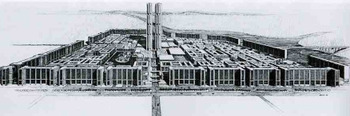
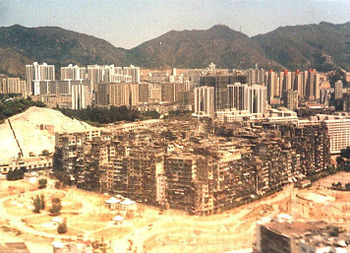
    But some of the ideas of Johnson’s that I’ve least understood are his big ones—city design and planning, the oddest of which (pictured here) is the design for Third City (1966).  This essentially was a city re-design, constructing something else over/within the existing street grid and transportation systems, and adding a surrounding layer of “low” and middle-income housing, and which included at its nexus a giant skyscraper.  Aside from a decidedly cellular appearance, this work by Johnson also reminds me of classic medieval walled  cities, though not those with crenulated fortifications, like Basel, but rather more like the truly ancient cities like the Sumer Uruk, or Lahore, or Starard Szczecinski.   In Johnson’s design the defensive perimeter is a chain-like linkage of apartment blocks filled with families of modest means, and the thing really most reminds me of the infamously spectacular walled city of Kowloon (Hong Kong), a high-rise slum that was formed of concentric blocks of itself.

    Johnson’s stylistic references have almost always felt “mean”, to me, and Third City is no exception.


  • Gigantic and Unbuildable Architecture: Bucky Fuller’s Midtown Manhattan Dome, 1968

    JF Ptak Science Books LLC  Post #115
    Big_arch_city_fuller139

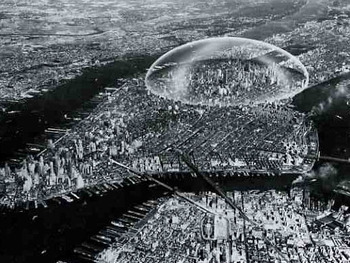
    Buckminster Fuller had a lot of good ideas but I’m not so sure that this is one of them.  I don’t have much doubt that versions of domed cities will exist in the not-dim future, though I do have doubts that they would be constructed to preserve the bones of antiquated ideas.  It seems logical to me that the retrofit of untold millions of cubic feet of city life just couldn’t make sense, even if the square footage was in Manhattan.

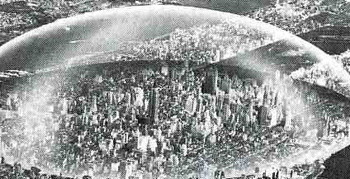
    Fuller’s idea is multiple orders of magnitude removed from the original idea of the arcade, constructing a dome to encapsulate NYC from the East River to the Hudson along 42nd St, and from 64th to 22nd St:  that’s two miles in diameter and, plus a mile high (or about five Empire State Buildings pile one on top of the other).  I’m not so sure how this would be built, or how things would be heated or cooled, or what the construction material was for the skin of the dome, or how people get in and out, or how you deal with heating and cooling, or how any noxious chemicals are expelled—but Mr. Fuller thought that the savings alone from snow removal from NYC streets would pay for the dome in ten years. 
    Big_archfuller_detail141

    Mr. Fuller also thought that the dome would protect the city (or this part f the city) from radiation fallout.  That could be true, assuming that of all the hundreds of nuclear warheads that the Soviets would’ve launched against NYC alone none of them would’ve found their target, except perhaps for the Ridgways or Staten Island, where the shock wave or winds produced by ensuing firestorms would not have disturbed the dome.  Of course if a warhead actually came close—or actually hit—the dome, the protection from radiation would be moot. 

    Source:  Buckminster Fuller in Think magazine, vol 34, Jan/Feb 1968.  AND of course the lovely work by Alison and Sky Michele Stone, Unbuilt America, McGraw Hill, 1976, pg. 99.


  • Weird and Bad Ideas Department: Shell’s Happy Herbicide, 1960

    JF Ptak Science Books  Post 150
    Blogbizarre_shell_mower244_2

    This image appeared on the inside cover of Scientific American for May 1960.  Our happy diver (with a mask but no way for air intake) is mowing some sort of nefarious weeds in a pretty and clear environment.  This was Shell Chemical Company’s advertisement for their new chemical herbicide Aqualin, sort of an underwater napalm.  Of course the human weed eater wouldn’t want to be around (see below) when the liquid mower was applied, but he surely gives a homey, care-free face to their new acutely toxic chemical application. 

    Here’s some interesting, acute data on this amazing New Mower! (from  the Cornell University website):

    • Aqualin (product discontinued by Shell Chemical Co., Chemical Intermediates); Magnacide H Herbicide. FORMULATION(S): 92% acrolein, 0.78 kg ai/l (6.5 lb ai/gal.
    • Important Weeds Controlled: Used to control submerged and floating aquatics as well as algae.  Also kills snails.  Toxic to seeds.  Some fungicidal effects.
    • ACUTE TOXICITY/DERMAL:  LD50 = 50 mg/kg (rat); 30 mg/kg (mouse); 562 mg/kg (rabbit, undiluted); 1022 mg/kg (rabbit, 10% aqueous solution).  Severe skin irritant. Causes vesiculation and a chemical burn if not removed immediately.  1 ppm of acrolein in air produces detectable nose irritation in 2 to 3 min and is intolerable in 5 min.
    • FREQUENT SYMPTOMS AND SIGNS OF POISONING: HEADACHE, DIZZINESS, NAUSEA, and vomiting are prominent early symptoms of excessive exposure to these gases.  Acrolein is a strong irritant causing BURNING SENSATIONS in the nose and throat, TEARING,COUGH, and sometimes hoarseness and wheezing.  DROWSINESS, TREMORS, double vision, and weakness are the common early manifestations of central nervous system impairment.  Tremors may progress to myoclonic movements, then to generalized SEIZURES, UNCONSCIOUSNESS, and death.


    ·Posted by :

    ·in:


  • Weird and Bad Ideas Department: Scientific Comb Fingers and Hair Restoration, 1936

    JF Ptak Science Books LLC   Post 147

    Blogcomb_hair230

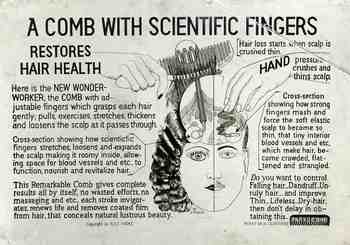
    Well. This item is of
    course lost on me, but the new “wonder-worker comb” somehow did an
    anti-crushing  something to the scalp and
    the hair root that promoted/restored and fictionalized hair health. The secret to understanding  it all, evidently, is that “bad scalp” is “crushed thin”.  This is brought about by “HAND pressure”, from  “strong fingers that
    mash and force the elastic scalp to become thin and such” causing  hair to be “more
    crowded, flattened”. For some reason the
    inventor didn’t speculate on whether other sorts of combs did this, or not; it looks as
    though he/she was targeting only those who combed their hair with their own
    non-plastic fingers, clearly elucidating this primal contest in a “wonder worker comb” vs. crushing/flattening comb fingers vocabulary.

     The comb with the adjustable fingers “pulls, exercises,
    stretches, thickens and loosens the scalp as it passes through” (the hair, the
    scalp?). It makes the scalp “roomy
    inside”, allowing the extra room that the hair needs “to function”. These hair restorative miracles is the result
    of the simple use of the comb, providing “complete results all by itself, no
    wasted efforts…”.

    The comb also, it seems, controls dandruff, and improves “thin,
    Lifeless, Dry-hair (sic)”.
    That’s a lot to ask of a piece of plastic.

    This  somewhat-scary item is a photographic postcard sent to the Library of Congress as a Copyright Deposit copy–part of the process of securing protection from intellectual theft via American copyright.  One is set to wonder about who–and why–this idea would be stolen.

    ·Posted by :

    ·in:


  • Weird and Bad Ideas Department: The Skinny on Fat and Vice Versa, 1936

    JF Ptak Science Books LLC   Post 146

    Bloghow_to_reduce235
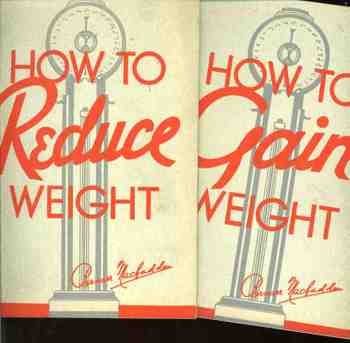
    Here’s a pair of somewhat-suspect publications, written by Bernarr Macfaddon,  which taken separately would seem perfectly fine according to their times, but together, well, they just won’t “do”.  The problem is that not only is their exterior and interior design identical, and that they were both printed in 1936, and that they both had 48 pages, but they both used the same photographic illustrations preaching and instructing opposite results.  (Both pamphlets were published in NYC, and were received by the
    Library of Congress Copyright Deposit section on 22 May 1936, and were
    given copyright deposit control numbers of 205,406 and 205,407,
    respectively, or irrespectively, as the case might be.) They are not the same book, exactly, but reading them side by side for about 15 minutes makes me think that one book is the anti-book of the other.  It might not make for good thinking, but it does make for fast writing. 

    I’d include a category here for books-and-their-exact-opposites, but I’m not sure how many more entries like this stunner that there can be.

    Each is entertaining in unintended ways, and have a number of  blatantly hidden gems:  for example, in the GAIN book, we are faced with a subject heading of BATHING AND UNDERWEIGHT, and are told that “another cause of underweight not infrequently met with…is the injudicious use of water in bathing”.   Within 200 words of each other we are also told that “eyestrain taxes the energy” and causes underweight, as does “sexual over-indulgence” because of “over stimulation of certain of the glands of internal secretion”.    Part of the author’s recommendations for weight-gaining foods as part of his program include bananas, white bread, butter, cornstarch pudding, cream, egg yolks, hominy, white macaroni, whole milk, oatmeal, pop corn, white potatoes, prunes, white rice, white corn, and tapioca custard.   Basically, if its white, its right. 

    On the “Surplus Flesh Can Be Reduced” side of the Reducing Book’s anti-book we find that although fat is “an enemy of beauty” and “causes more friction as you pass through life”, it can also give back, as it also may “develop keener mentalities due to physical inactivity”.  (Does that mean that skinnier people are less intelligent?)  The author contradicts himself almost immediately, saying that ”the mind tends to become as sluggish as his body, and often he cannot defend himself mentally…he is slow in his mind as in body”.  This all seems to be because the brain is “more or less” overwhelmed by “an excess of food elements” coursing their ways through the body.  Macfaddon’s sub-chapter heading on page 7 screams “FAT PERSONS TO BLAME FOR OBESITY and then, on page 10, and even more National Inquirish FAT CANNOT EVAPORATE THROUGH THE SKIN.  There’s much more, but since there’s a time limit on dealing with these sorts of nonsensical nostrums, we’ll stop right here.   

    ·Posted by :

    ·in:


  • Weird and Bad Ideas Department: Animal Pus as the Cause of Cancer and the Plagirized Wrongness of Louis Pasteur, 1938

    JF Ptak Science Books LLC   Post 145
    Blogand_they_dont_cancer229
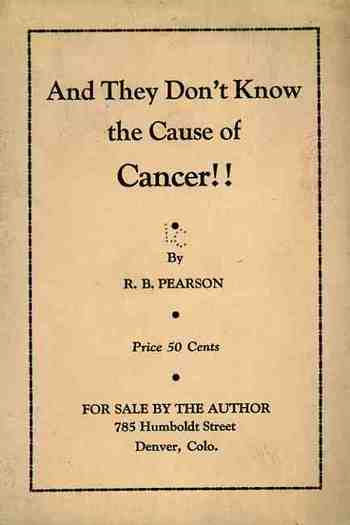
    R.B. Pearson (of Denver,Colorado), the author of this neglect (published in 1938), makes the claim in 24 sparse pages that cancer is caused by vaccination.  In the thousand words that are thinly spaced over this small pamphlet (held together by two staples, which must’ve been embarrassing to them), Pearson’s posts his quantitative evidence in a  graph he constructed showing the steady climb of cancer rates following the introduction of Jenner’s vaccine.  And nothing else.  In fact all he did was plot the number of cancer cases against the flow of time, and that cwas it–no aknowledgement of, say, an increase in general population leading to more cases o fcancer or anything subtle like that.  (This may be one of worst uses of the graphical display of data that I have seen.) Pearson makes a graphic display and explanation that cancer dramatically increased after Jenner’s introduction of vaccination.  He nails this loose statistic to the mast of the Pequod, and proclaims vaccination to be a crime.  His claims are supported by almost nothing save for a few specific and inapplicable cases:  for example, he “cites” a nameless family, distributed over a great distance, where one branch is vaccinated and the other, not; the vaccinated branch all get cancer while the vaccinated-free people don’t; ergo, vaccinations cause cancer.

    Pearson’s publishing life makes him seem a humbug and a scamp.  He would write a little later, in 1942,  a book called Pasteur, Plagiarist, Imposter--a title that bears the entire story of the book’s contents, which runs an impossible 352 pages (!?!)  Pearson complains in the opening sentences:  “The writer has made an effort in his prior books and pamphlets to show that the germ theory is false, and that illness was practically always due to errors of diet or manner of living, the germs being present solely as scavengers of dead and waste tissues and foods, and not as the cause of the disease.”  And that he was writing the book to expand the mind of his reading universe:  “the erroneous belief that germs cause disease and must be controlled or eliminated before it can be cured is so widespread as to close the minds of many people to any other ideas on this subject.”  Indeed,  the man was very cranky. He didn’t read French, either, and for his translations of Pasteur’s work he relied on the work of Miss Ethel Douglas Hume’s Bechamp or Pasteur? (1923), who claimed that Pasteur stole all of his ideas from this fellow Bechamp.  Oy vey.

    In his double-exclamation-pointed boisterously-titled “And They Don’t Know the Cause of Cancer!!” Pearson claims that cancer cells, the “animal-pus biologicals” are “equivalent to the cells of an animal lower down in the evolutionary scale…I believe they actually are cells from the tissues of a lower animal introduced into the human body in the guise of various biologicals”.  He continues, “cancer may arise OUT OF CLUMPS OF SIMPLIFIED CELLS.”   And, incredibly, (with the exploratory words left intact): “Would it be lese majesty” and ter-ril-la-bly wicked to hold that these degenerate cells are nothing more than animal pus cells introduced into the body as or with some so-called biological?”

    As it turns out the author had cured himself of a tumour of twenty-years standing with a thirty-day fast (“with enemas”) following a fruitarian diet, allowing the “clean and healthy blood” to “absorb and eliminate tumourous growths”.

    The one good thing that can be said about this effort is that the author didn’t try to sell anything except this pamphlet. Of course he did try and convince the reader not to be vaccinated, so he might as well have told them to start smoking cigarettes.  

    ·Posted by :

    ·in: