A Daily History of Holes, Dots, Lines, Science, History, Math, Physics, Art, the Unintentional Absurd, Architecture, Maps, Data Visualization, Blank and Missing Things, and so on. |1.6 million words, 7500 images, 4.9 million hits| Press & appearances in The Times, Le Figaro, Mensa, The Economist, The Guardian, Discovery News, Slate, Le Monde, Sci American Blogs, Le Pont, and many other places… 5000+ total posts since 2008.

Category: Bad Ideas

  • Invisible Evolution of Meat, continued.

    JF Ptak Science Books LLC  Post 795  Blog Bookstore

    + meat pork chop team

    Related Posts:

    Meat “Packing” Industry, 1917:
    “The String Department” and “Curled Hair Machines” at the
    Meat Plant
      (here)

     Spam, Smeat, Spic, Prem, Mor & Arf: Food
    by Any Other Name  (here)

    Food, Food Packaging and Creating Desire: the
    du Pont Company, WWII. (here)

    I wrote yesterday (The Importance of Bridges in the Invisible Evolution of
    Meat) about the invisible evolution of meat from range to plate, but mostly about
    what happens in those big building with no windows.  The wide solitary middle of this food chain
    exists almost not at all in the popular mind, most folks choosing not to think
    of the gruesome process of “processing” animals into the plastic-protected deli
    selections.  + meat pork chop

    The middle killing & etc. part has been generally very well hidden from
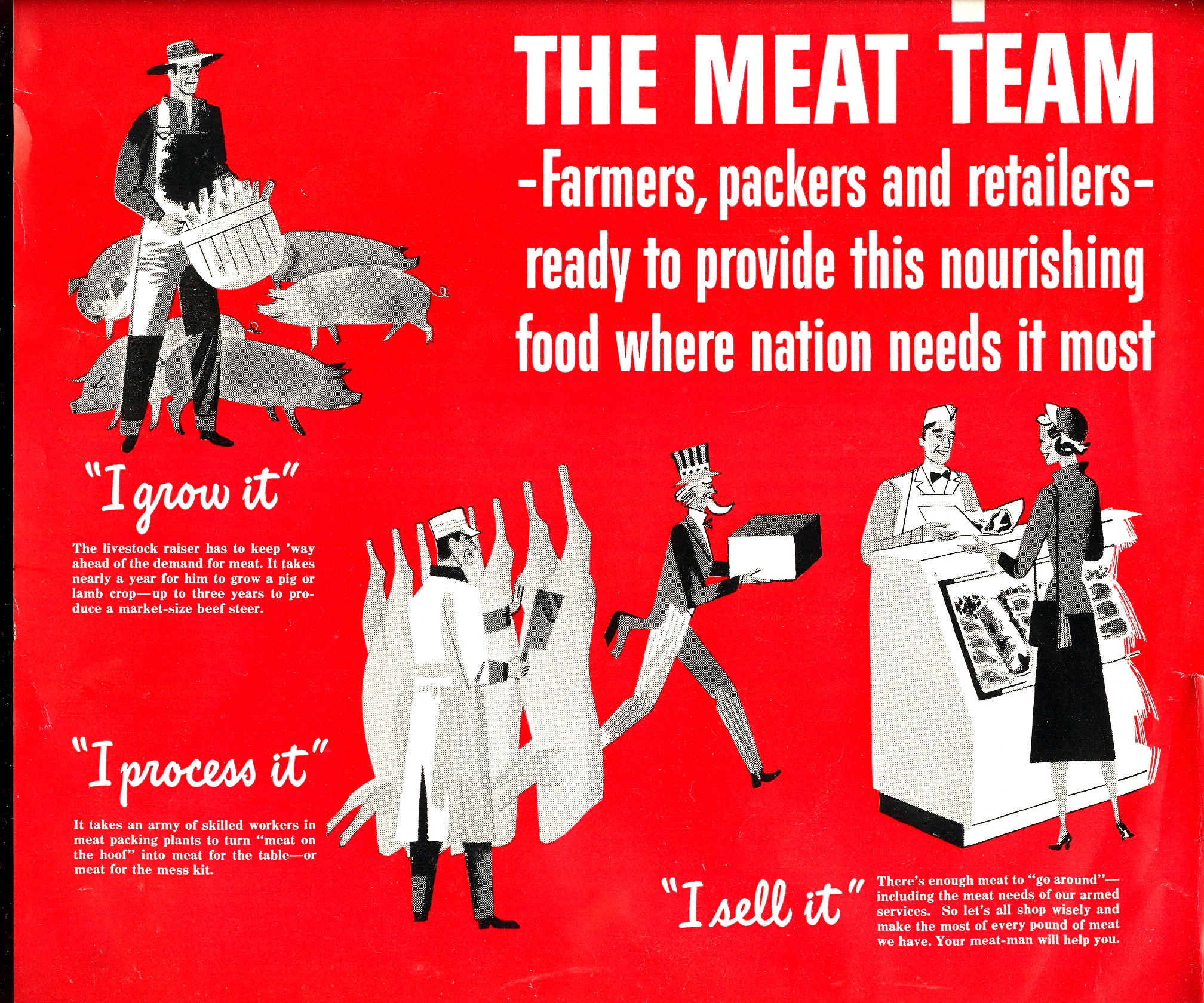
    public view, at least for the 20th century.  For example, this 1949 ad from LIFE magazine
    introduces the “Fall Pork Chop” with the evolution of meat summarized in those
    three small pictures.  The processing guy
    is starched and white and pure standing there before the non-detailed,
    smoothed-out carcasses.  He even has a
    little white cap.  The interesting part
    here is the Uncle Sam delivering the boxed final product.  Uncle Sam? 
    How did he get into the picture? 
    He certainly sanitizes the whole procedure, what with the imprimatur of
    the U.S.
    government and all, and even suggests a slightly patriotic aspect to the food
    chain. The odd thing here though is the blood-red background color, which was a
    common practice for selling dead flesh in LIFE for many years.
    + meat pork chop 001 The middle killing and scooping part of this is basically nothing that would
    ever be broadcast on television, and certainly it is nothing that parents would
    want their kids to see.  Don’t people
    turn in horror and disgust when those undercover videos of processing
    plant  practices make it to youtube?  So if these images are too fabulously
    gruesome for children (and adults) to watch, why take a benefit from them?  I’d say that if the process of producing your
    benefit is too horrible to watch  you
    shouldn’t  be able to enjoy the outcome.
    ·Posted by :

    ·in:


  • The Importance of Bridges in the Invisible Evolution of Meat

    JF Ptak Science Books LLC  Post 794  Blog Bookstore

    I wonder when it was that humans developed the extra senses that were able to “intuitively” determine (1) when
    something is missing, and (1.5) when something is just wrong?  I’m sure that these blood-bumpers were developed
    soon after the recognition that the face in the primordial goo staring back at
    its owner wasn’t something drowning. 

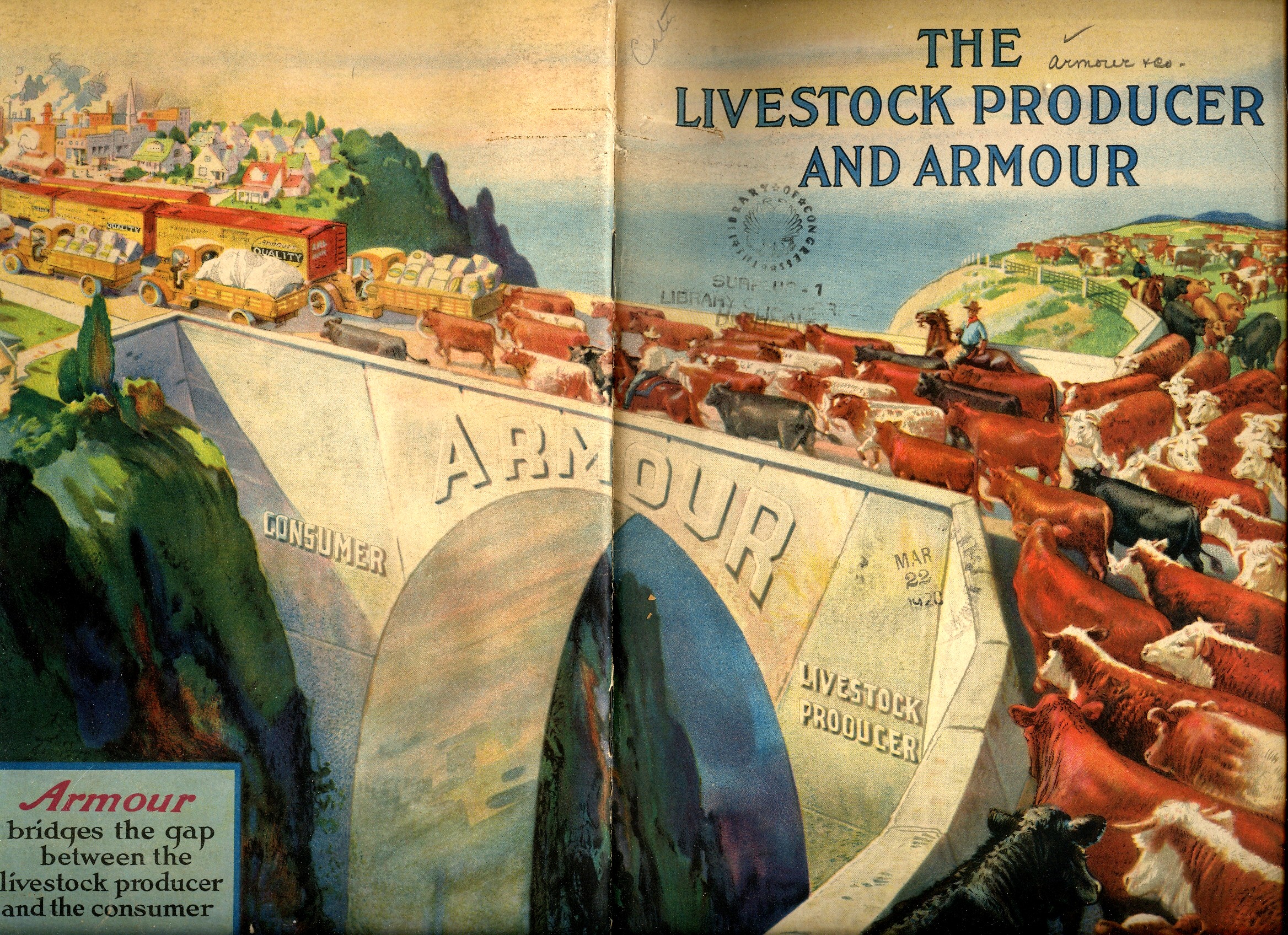
    + The Kodacolor Bridge of Evolving Meat

    This fast-forwards us through Wilberforces ultradense 6,000 years to the
    near-present: when looking at the explosively chromaticized picture of the progress
    of meat, brought to you by the invisible packing empire of Armour & Co. (of
    Chicago, of course), one gets the ancient immediacy of something being missing
    and just plain wrong.

    The cows being herded from their pastures are being led to the Armour bridge
    of Meat Evolution, where by some miracle the process of turning cows into
    packaged goods—like Leda and the swan—takes place over the “A” in Armour, three-quarters
    of the way over the bridge.  This process
    is wholesome in its invisibility, the walking product on the one side of the
    bridge getting ready for transubstantiation for the nested hu+ The Kodacolor Bridge of Evolving Meat 2manity on the
    other side.

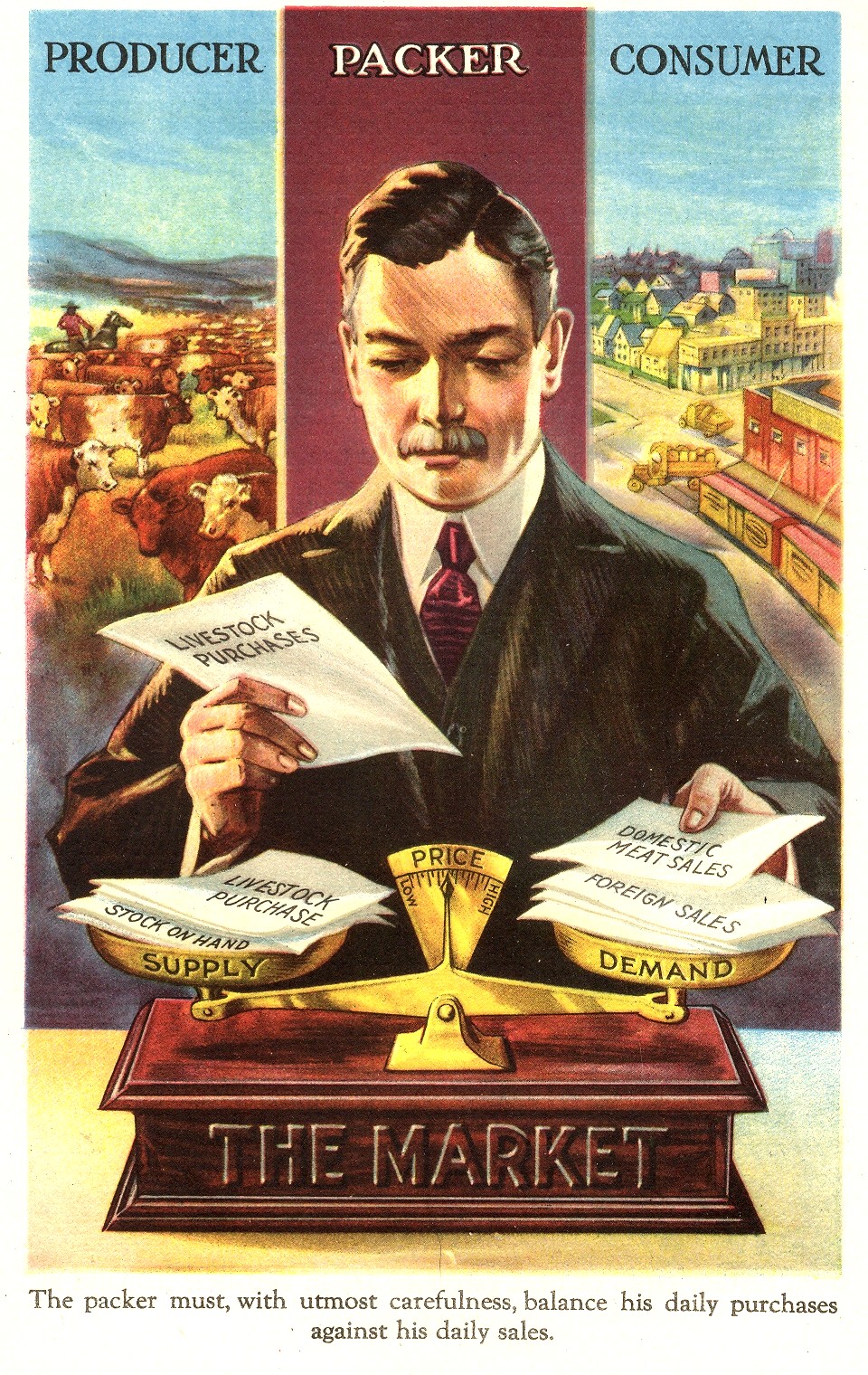
    The picture of the packer weighing the elements of the mysterious
    gold-plated market rams this invisibility home as well:  the “producer” and “consumer” columns behind
    him are prettily illustrated with referential scenes, while the “packer” column
    just gets a single slab of color.  A
    singularity of nothingness in regards to what goes on behind the packer’s head
    is all the consumer would want, then and now, ‘cause certainly nobody wanted to
    know what the hell was going on in the packer’s den to hasten the evolution of
    cows from muddy hooves to the dinner table–especially in 1926, when this
    pamphlet was printed.  The vast
    conspiracy of people not-wanting-to-know-what-happens-at-the-packing-house continues.

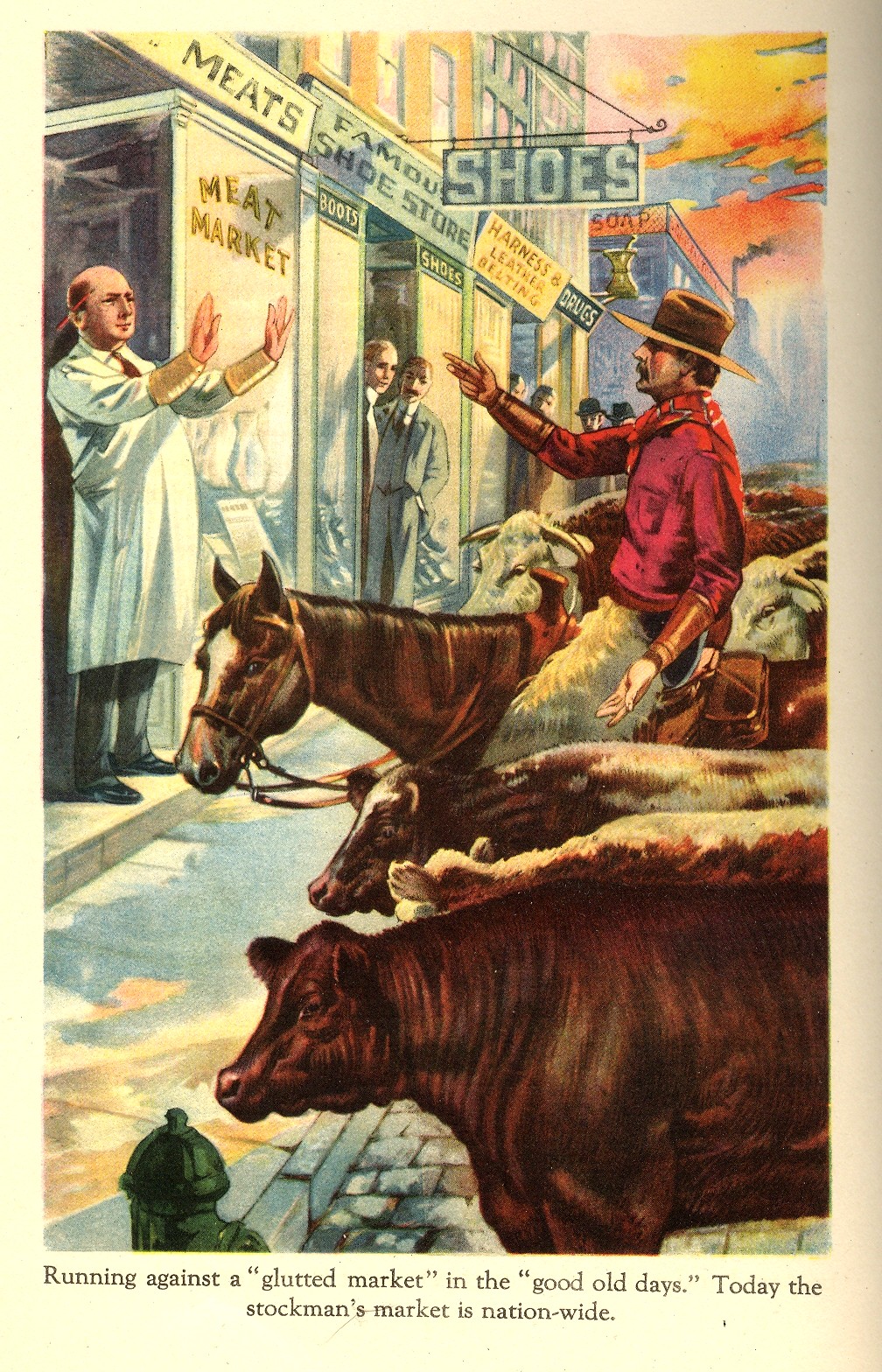
     + The Kodacolor Bridge of Evolving Meat 3 I can’t leave this short post without a nod to another extraordinary image
    from the Armour pamphlet:  the butcher
    waving off the drover and his herd because of a glutted market.  The “good old days” here doesn’t look very
    much like the 1870’s to me:  I can’t
    recall a single drover/cowboy image in my  very long experience that showed a cow
    sniffing a fire hydrant.  Plus everything
    else in the picture is pure 1920’s, except for the drover, who—although wearing
    skins in the city for some unknown reason—at least looks mostly like he should
    and isn’t packing an endlessly bouncing-on-your-thigh revolver.  Sorta. 

    The horse looks embarrassed and surprised at the same time. Is there an English word for that?  


  • Einstein as Subverting Flag-Burning Commie? What his FBI Files Look Like

    JF Ptak Science Books LLC  Post 793  Blog Bookstore

    Einstein--FBI detail 21950

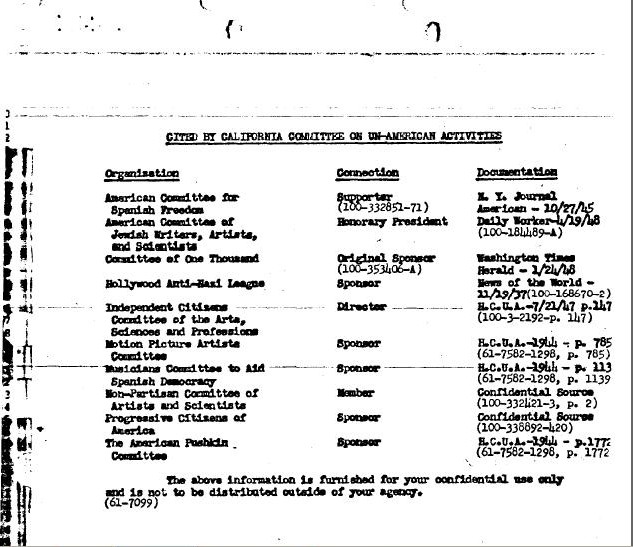
    While looking at the FBI files for Leo Szilard, a great physicist who had liberal-left ideas about peace and strategy and the use of the atomic bomb (in June 1945), I stumbled onto the files for one of the people sought by the Bureau to talk about Szilard:  Albert Einstein.  He and Szilard went back a long way, and Szilard’s advanced physics supra-intelligence and illuminated social outlook was instantly recognizable to Einstein, making it easy for Einstein to give him an excellent recommendation.  Which of course is something the FBI didn’t want to hear, as Szilard was mucking around in the national will to use the ultimate weapon, among other things.

    I knew a little about the FBI’s interest in Einstein, but I had never actually looked at any of the declassified files, which as it turns out live at the FBI site, all 1600+ pages of them.  Hoover had some sort of special need to fill with looking after Einstein, whose nearly 20-year-long file is just not pretty. The Director was sniffing around the edges of Einstein’s social life, trying to make them into centers to do god knows what with them.  One of the files details the subversive organizations that Einstein was associated with–some of the hundreds and hundreds of groups that he lent his name to over the years. 

    Einstein--fbi--bad association

    Here’s some of those threatening organizations:

    Einstein--fbi--bad groups list 2 

    Not much to look at, really.  

    But it is this gentle, subtle, horrible document below that causes real grief, the “under investigation” part at the end is just heartbreaking, a Lilliputian effort to control forces beyond their comprehension.  Such is the power of ignorance.

    Einstein--FBI 1950 

    Einstein--FBI detail v 1950


  • Selling to “Simple” Women, 1939: “She’s Not Interested in Bloody Meat”

    Post 882 (revised; part of the History of Women Series; also see Women Meat Pioneers.)

    Women--bloody meat
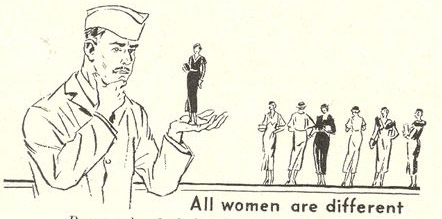
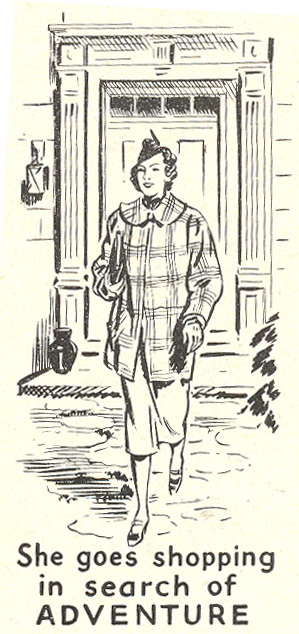
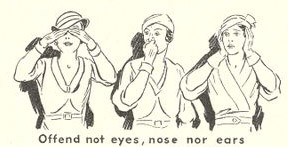
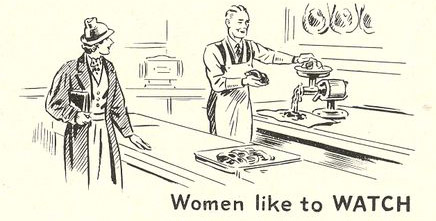
    These sales-happy customer relations images from a  modern food merchandising catalog (Modern Merchandising, 1939) come at an interesting time in the history of eating—or lesser yet, the history of buying food.   The pamphlet addresses the growing idea of the super market, a notion still new in the minds of consumers —it seemed as large to the consumer familiar with the 1920’s concept of a market as it seems tiny to the megamarket people of the present.The illustrations–all quite small, margin-inhabiting affairs, space killers, no bigger than 1×2 inches–are there to help the grocer deal with women customers and better understand “them”. 


    Women--all different 

    Women--shopping


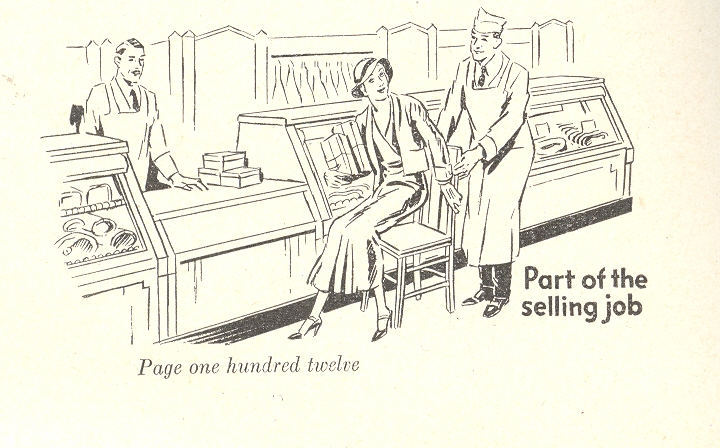
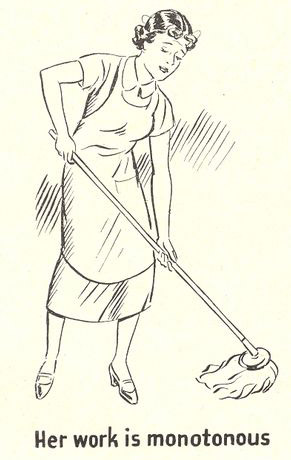
    I’ll address the interesting merchandising changes here in another post—right now I’d like to focus on the marginal drawings in the bottom corners of the text.  They may be small and offhanded–generally they are less than two square inches–but the messages they delivered, marginalia or not, were very strong.  Over and over again these bits demand the sub-class of women, emphasizing their trivial, ephemeral interests—bits of Nothing reinforcing large bits of Something.  

    Women--offend not eyes

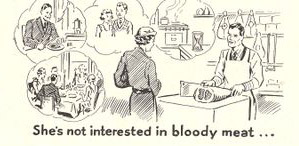
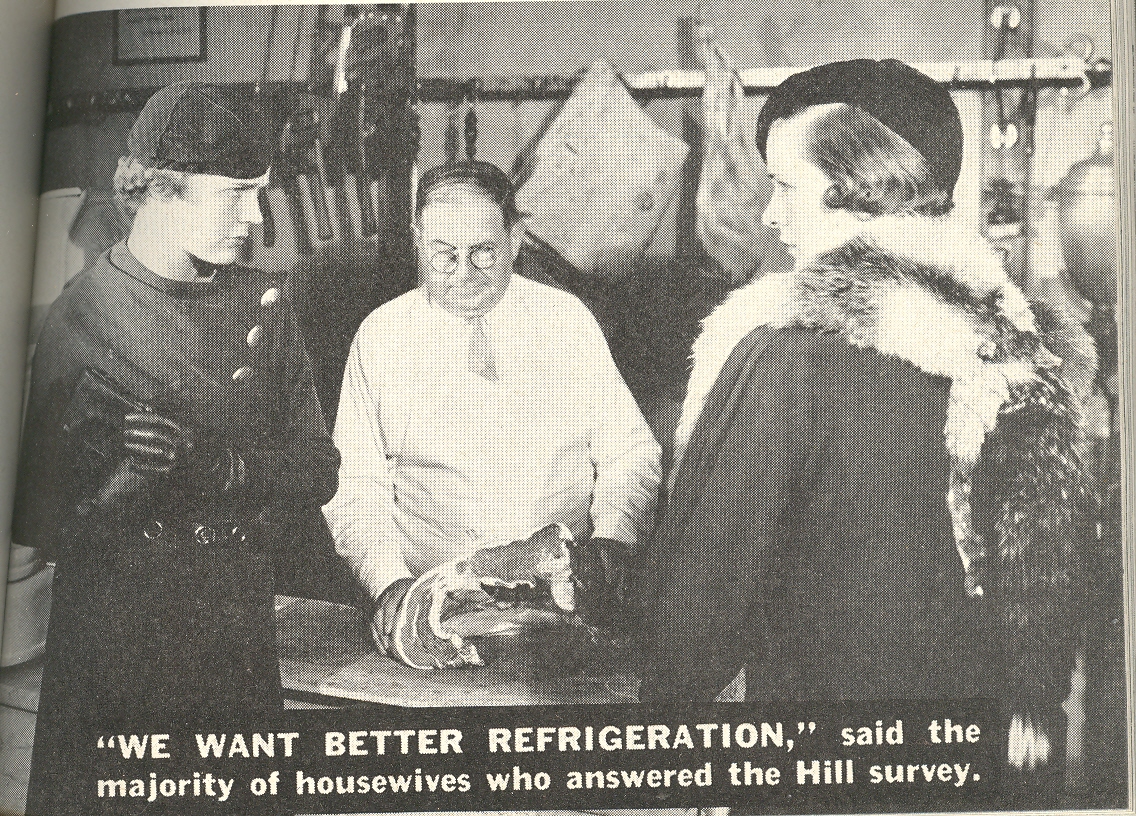
    The messages beneath the images, collectively: “women judge meat by appearance:; “there a little bit of the monkey in all of us…we like to see and handle”; “offend not eyes , nose nor ears”; “part of the selling job”; “women like to WATCH”; “her work is monotonous”; “she goes shopping in search of adventure”; “she’s not interested in bloody meat”. They present cascading reactions: they’re somewhat funny to my eyes, and then uncomfortable, and outrageous, and then simply sad that their solemn pronouncements on the status of women would be so acceptable, their as-yet unidentified sexism and bitter “racism”a non-sequitur.

    Women--like to watch
    .

    + women monkey 


    + women sitting down 


    Women--her work


    + women want more refrig


  • Subjugation of Women 1938: “They DO as they are Told”

    JF Ptak Science Books   Post 777   Blog Bookstore

    The modern/antiquarian and very long history of the subjugation,
    control and disenfranchisement of women slips not so silently into the present
    here in the USA; elsewhere around the world this idea isn’t so “antiquarian” at
    all and this presence is heavier still. 
    The morality of the capacity that restricts access to education, and
    voting, and access to work, and equal rights in the control of a family, seems
    slow in catching up to modernity. 

    + chatterbox

    This concept
    of control struck home again while looking through a selection of CBS documents
    on the state of radio in 1938. They seemed benign though ruthless in what they
    were trying to accomplish: a simple objective and complex way of reaching it—the
    sale of advertising on the radio.  Looking
    for comparisons between radio and the rest of the information-control market, I
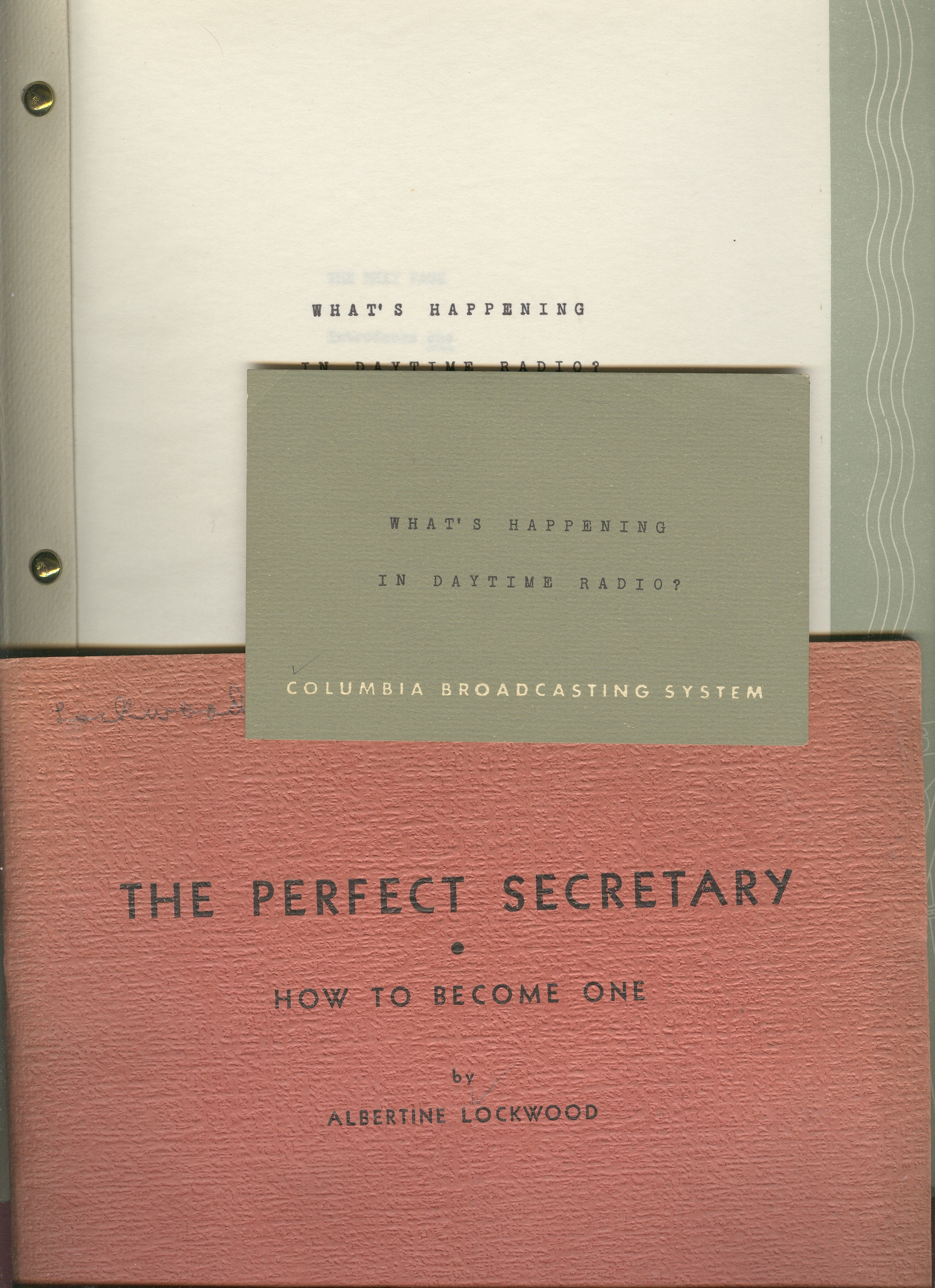
    came upon thin volume entitled What’s
    Happening in Daytime Radio?
    , which for the most part was taking an historic
    early stab at directing advertising at the women who were evidently
    relentlessly following the soft romantic exploits of some of the fifty or so “soaps”
    that were broadcast in 1938. (These very mild romantic adventures were called
    so because of the soaps and detergents that sponsored and advertised on these
    shows, directed of course at the target female audience.)  The opening section started “The Women (God
    Bless ‘em)”, wound its way through every manner of inferiority-inducing female
    imagery: “the women, god bless ‘em, are not always chatterboxes.  They do like to listen. And listen
    carefully.  They do what they’re told…by
    radio.”  It is still shocking though, in
    an odd way, not at all surprising, to see this sort of copy printed at the
    highest levels, and taking place within the lifetime of my still
    extraordinarily full-of-life mother.


    In this same pile was another bleak remembrancer of the
    still-alive past, The Perfect Secretary,
    a bleak messenger from 1938.  In addition
    to the de facto class and sexual
    regulation of the structure of the business world and the woman’s
    hardly-existent role in its formulation,  we are introduced to the concept the most
    basic mechanisms and elements of the control of a subjugated group.  The pamphlet attempted to conform the
    personality and character of the woman to her job as secretary.   The
    unannounced writer states that “it would be a mistake to overlook the
    importance of the personality of a secretary. 
    What makes personality? Manners and dress produce personality.”  He then moves on to specify the fat middle of
    the correct mode of dress, reminding the secretary or secretary-to-be that it
    was not only the “slovenly, unkempt” girl who lacked personality, but also the
    overdressed girl was well “who adopted the undignified style of costume”.  But correct dress and coifed hair wasn’t
    enough: “with poise there is no personality”. (“An attractively dressed girl
    without poise is unfortunate.”)  “Conspicuously
    colored nail polish is not becoming to a secretary in the better offices.”  “Flippant and unreliable manners bury the
    finest personalities.” And lastly, “it is one of the first duties of a
    secretary in an office to be ever conscious of avoiding body odors”.  There are another 34 pages of correctnesses
    that follow, to painful to specify. 
    These attempts at control at the most basic level of a person’s identity
    were “normal” for their time, and a remarkable testament to advances (thus far)
    in equalizing the world of men and women.


    “When we consider the positive evil caused to the
    disqualified half of the human race by their disqualification — first in the
    loss of the most inspiriting and elevating kind of personal enjoyment, and next
    in the weariness, disappointment, and profound dissatisfaction with life, which
    are so often the substitute for it; one feels that among all the lessons which
    men require for carrying on the struggle against the inevitable imperfections
    of their lot on earth, there is no lesson which they more need, than not to add
    to the evils which nature inflicts, by their jealous and prejudiced
    restrictions on one another. Their vain fears only substitute other and worse
    evils for those which they are idly apprehensive of: while every restraint on
    the freedom of conduct of any of their human fellow-creatures (otherwise than
    by making them responsible for any evil actually caused by it), dries up pro
    tanto the principal fountain of human happiness, and leaves the species less
    rich, to an inappreciable degree, in all that makes life valuable to the
    individual human being.”
      John Stuart
    Mill, The Subjugation of Women, 1869

    ·Posted by :

    ·in:


  • The Indredible and Useless Dog Engines of 1895 and 1939

    JF Ptak Science Books   Post 797 (Sept 2009) Extended. 


    ++00++ 9.22 dog det


    In 1702, at the beginnings of the Industrial Revolution, Thomas Savery (c.1650 – 1715) began the idea of calculating the work done by steam engines over that done by horses, writing in his book, The Miner’s Friend:

    “So that an engine which will raise as much water as two horses, working together at one time in such a work, can do, and for which there must be constantly kept ten or twelve horses for doing the same. Then I say, such an engine may be made large enough to do the work required in employing eight, ten, fifteen, or twenty horses to be constantly maintained and kept for doing such a work…”   But it was James Watt who first introduced the term ”horsepower” while trying to advertise and place forever the idea of his steam engine over than of the earlier Newcombe engine and, of course, horses.”

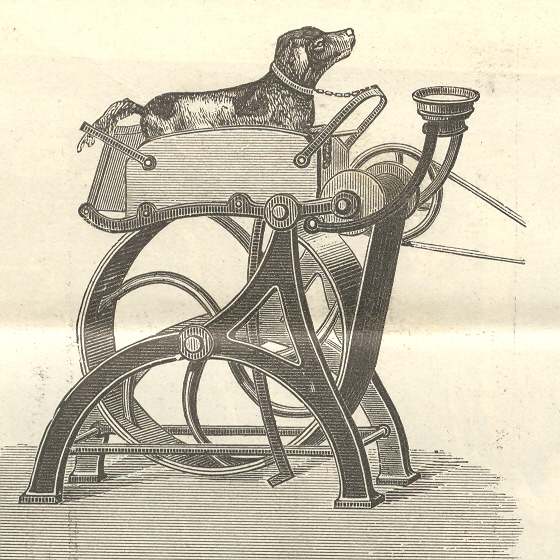
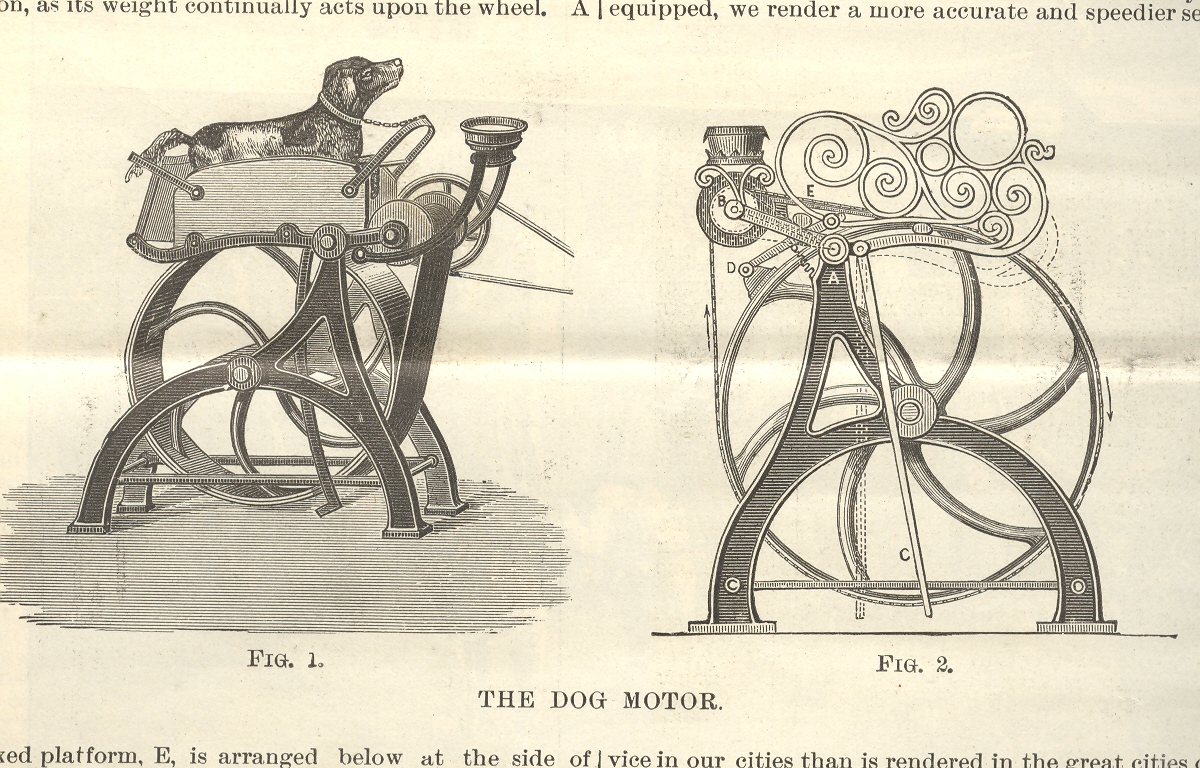
    ++00++ 9.22 dog


    James Watt (1736-1819), Scottish inventor and “re-inventor” of the steam engine, the man who put the ‘power” into “horsepower”, determined that a horse could turn a mill wheel (of a 12-foot radius) about 144 times in an hour (about 2 ½ times a minute), traveling 2.5x2pix12 per minute.  It has been shown though that on average a horse will work at about 1.5 horsepower like this for an hour on and off; and less than 1 horse in other times; a man could work at 1.5-2.5 horsepower for a short time, but generally would pull about a tenth of that for an extended time.


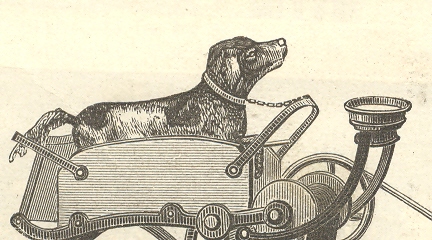
    And so we come to the crux of the biscuit of this post:  a dog motor.  This entirely, utterly, unconvincing and thoroughly bad idea was fully fleshed out by a M. Richard (naturally of Paris) for the Agricultural Exhibition and re-published from La Nature in the Scientific American Supplement  on 10 August 1895.  It is slightly lovely in its high Victorian way, or at least so until you consider that an animal goes in side the thing, working its way along an infinite belt, a cup of water just within reach.  The dog would power the large wheel, which would turn a smaller wheel and belt, which in turn would be connected to smaller, and so on, until it reached whatever it was it was powering, which is left entirely to our imagination.  Even when I squeeze my eyes in a telescoping effort, I cannot see what it is that this poor doggie might power.  Given the descending orders of radii of the wheelworks, perhaps the tenth-horsepower dog engine ran a fan, or something, something remarkably insignificant.  It does tell us something about over-design, like buying a ten dollar bill with a twenty. 


    ++00++ 9.22 dog det 2


    Another, more recent but less serious attempt at utilizing canine power was found in Popular Science for 1939:


    The thing that really bothers me is that both of these really bad ideas occurred in years where there were fantastic ideas in the history of physics–1895 being the home to the discovery of the atomic world in the work of Wilhelm Roentgen, and 1939, well, more of the same plus making the atomic world go “boom”.

    In this same vein, and keeping with the highlight-year-for-physics theme, is this thing, created in the 1880’s but published in Popular Science in 1933:

    With the help of Laura Massey (Bookn3rd !), from the wonderful bookseller blog, The Cataloguer’s Desk at the great Peter Harrington Rare Book Shop (London), I’m including an 18th century version of sweating dogpower called the Turnspit:

    File:Turnspit Dog Working.jpg

    I’m not sure what it is that would keep the dog running after it realized in the first half-minute that it will never be able to retrieve that hanging thing set out in front of him/her–maybe things got poke-y. 


  • Visionaries, Ice People, and the Marriage of Stupid and Brutal.

    JF Ptak Science Books LLC  Post 759  Blog Bookstore

    The ‘twenties is know as the “speed” decade—everything was
    going faster, increasing its speed, expanding to the limit:  this was true for the ability to communicate
    via telephone, the appearance of commercial radio, the great increase in the
    speed of trains and planes and automobiles; the music was fast, the movies were
    talking. 

    ++00++ 9.17 otto gail

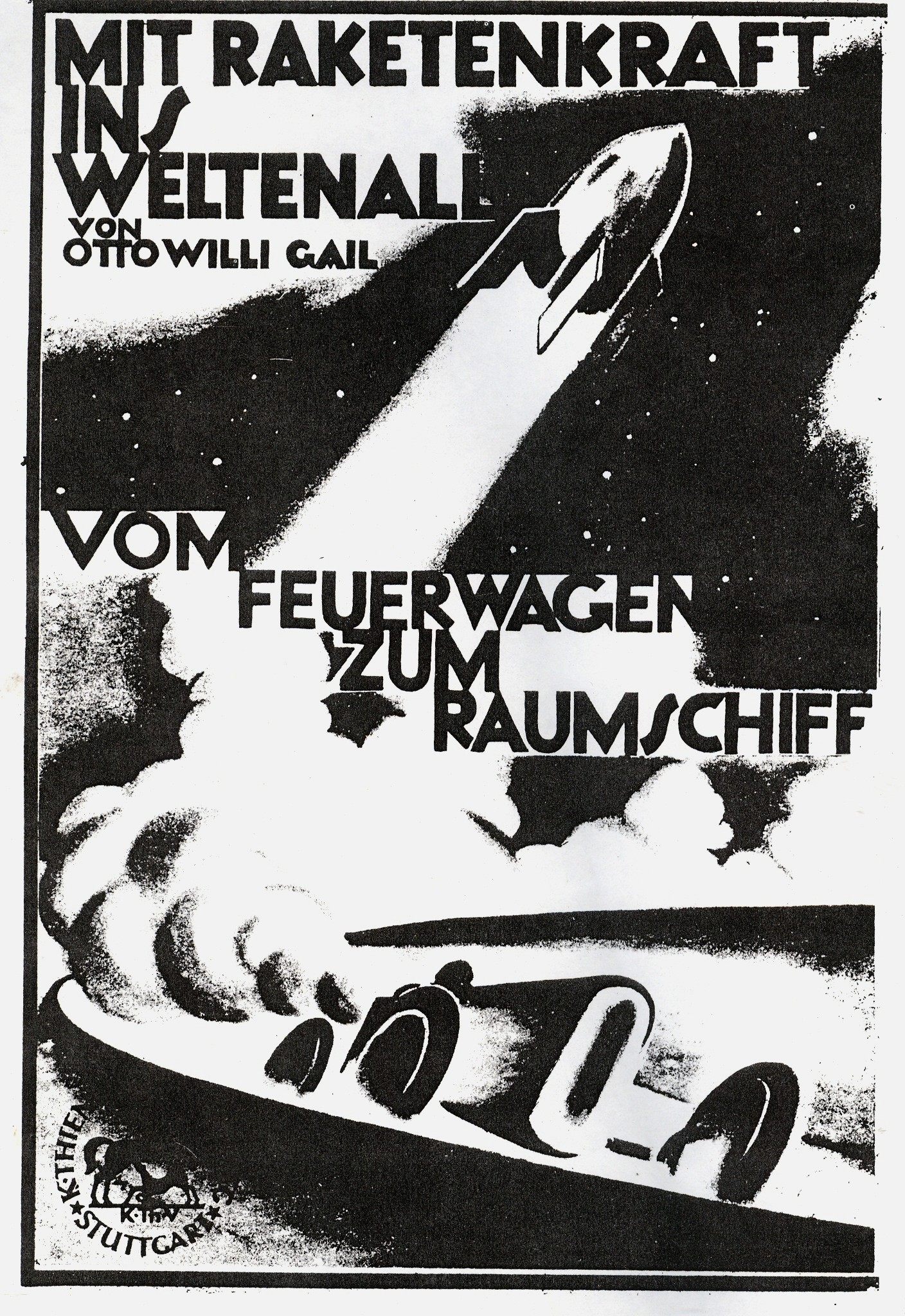
    There are many iconic images relating speed and the roaring twenties—generally
    though this spectacular cover for Otto Willi Gail’s Mit Raketenkraft ins
    Weltenal…vom Feurerwagen zum Raumschiff
    (1928) is much less frequently seen, though it
    certainly does get the message across. 
    Otto Gail was a creative German science fact and science fiction writer
    with a strong background in following the scientific and technical
    accomplishment in rocketry of the age, especially the works of Max Valier1 and Hermann
    Oberth2. Raketenkraft was more a peek into the future and pop techy work for
    kids than a straight-out scifi novel like his The Moon Stone, which was a story
    that brought us Atlantis, space travel and hidden ancient culture in the
    underground Ice World.Gail, ott--stone moon

    It’s the unfortunate Ice World that attracts my attention
    around Gail, swimming around his interesting and tech-involved scifi world like a
    melting and failing Moon made of hundred-year NYC garbage scows, the idea of a
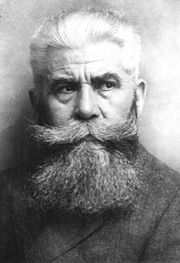
    good engineer-turned-trash cosmologist named Hans Horbiger, whose ideas wound
    up being whispered into the ears of many monsters. Horbiger had some sort of
    vision-dream about stuff in 1894 and spent the next 30+ years fleshing out the idea,
    which sounds bad from the very start when the author admits to finding “Newton wrong”.  Anyway without losing too many minutes
    thinking about this time-hole, Horbiger’s theory worked ice up to being the
    primary and primordial ingredient of all processes in the universe, with ice
    planets circled by ice moons, and some sort of gooey ice ether to make it all
    go ‘round. Oh yes: there were superior ice people living in the interior of the
    earth.  Horbiger died in 1931, but his many
    followers managed to work the theory into a presentable Jewish-baiting
    anti-relativity Deutsche Physik form
    for the new government of Adolph Hitler in 1933, and it was there that his
    ideas took hold in the cancerous Himmler and Hitler and others, a happy
    marriage at last, the ridiculous to the unspeakable. I’m not sure where the
    ice people are today, but I did saw some awful History Channel show that
    stated that Hitler never did die in the bunker and was removed by submarine to
    the interior ice people of earth, flying around the insides of our globe “in a
    UFO”.

    And so I associate poor Gail (1896-1956) with the Horbiger
    mess, and not his good work in science reporting and popularization.  So it goes.

    Gail, otto ice theory

    The other thing that you can say about Horbiger—he had a
    full-out behemothian mustache.  That’s
    about it.

    Notes

    1. Valier seems to have been the first person  killed in a rocket-related incident, blistered by his exploding rocket-car.

    2.  Oberth is another one of those Germans working at Peenemunde (along with Wernher von Braun and a great host of others)  trying to kill as many people in the UK as possible who wound up in Huntsville, working for our government.  It is all so problematic.  It is interesting that there is little in the Air and Space Museum (as part of the Smithsonian system)  that mentions von Braun.  He is burioed in a simple grave in a cemetery next door to a Jewish cemetery in Alexandria , Virginia.  I also remember going to some restaurant in the diamond district that, in very high bad taste, served up a beer called the Wernher von Brown–von Braun certainly had his hands covered in Jewish blood at least to the wrists, and to have a product so stupidly named as that in that place was just one of those impossible things that happen every day.

    ·Posted by :

    ·in:

    —

  • Medical Quackery: the Invention of Baldness and the Testicular Electrical Suspenders

    JF Ptak Science Books LLC  Post 747  Blog Bookstore

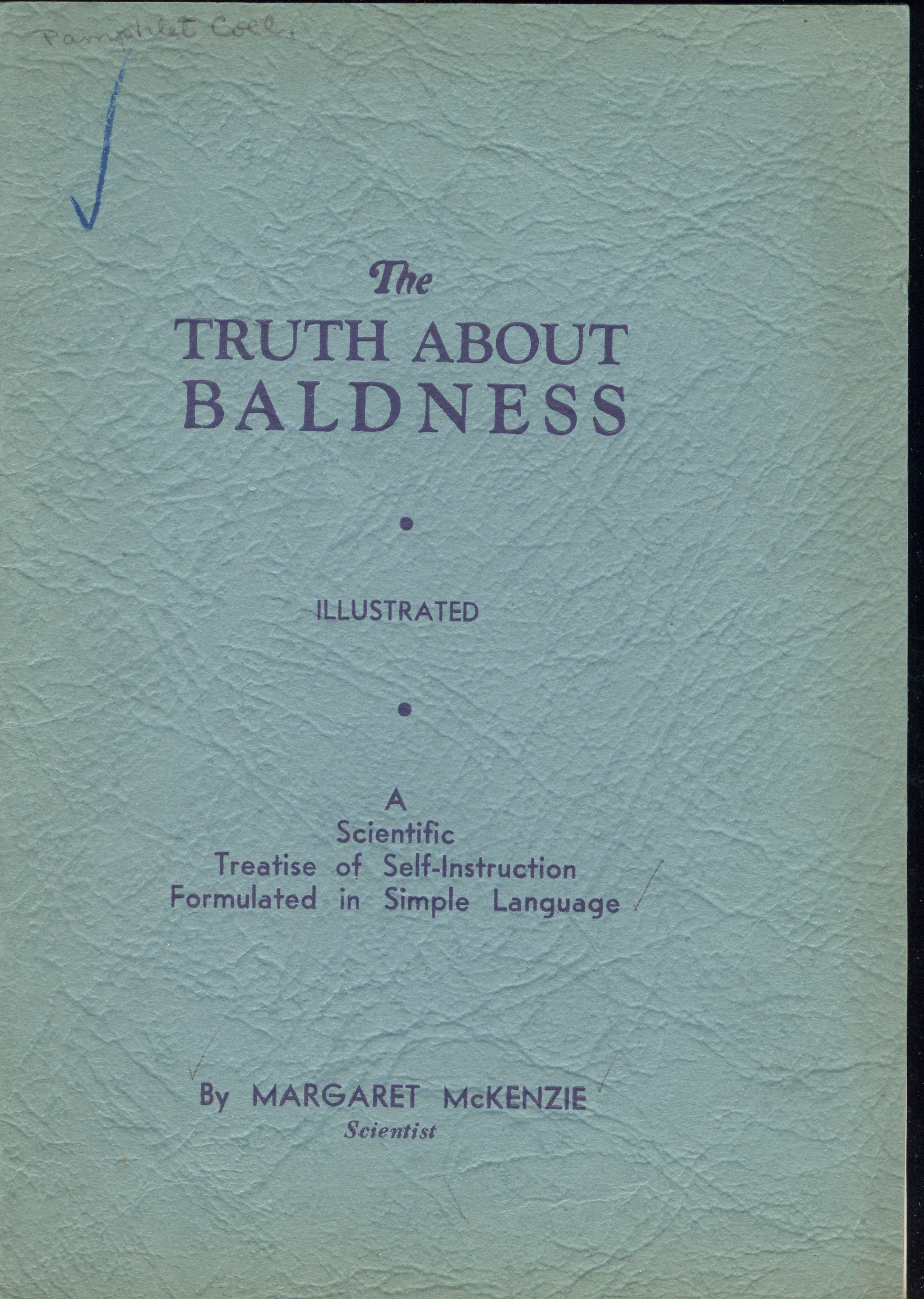
    ++blog++baldness Well. 
    Margaret McKenzie (“Scientist” with a capital “s”) wrote this simple
    treatise in 1934, claiming that she had discovered what caused baldness and
    knew how to “grow hair with ‘Natural-Science’ ”.  Answering her own call to baldness, and “after
    eighteen years of exhaustive study”, Margaret “emerged triumphant…and uncovered
    this thing baldness [sic]” with her discovery which would “banish baldness
    forever and thus wipe out the bald head which is my aim [sic]”.   Margaret’s
    gift to “Man-Kind”, her discovery, boils down to fifteen  words: 
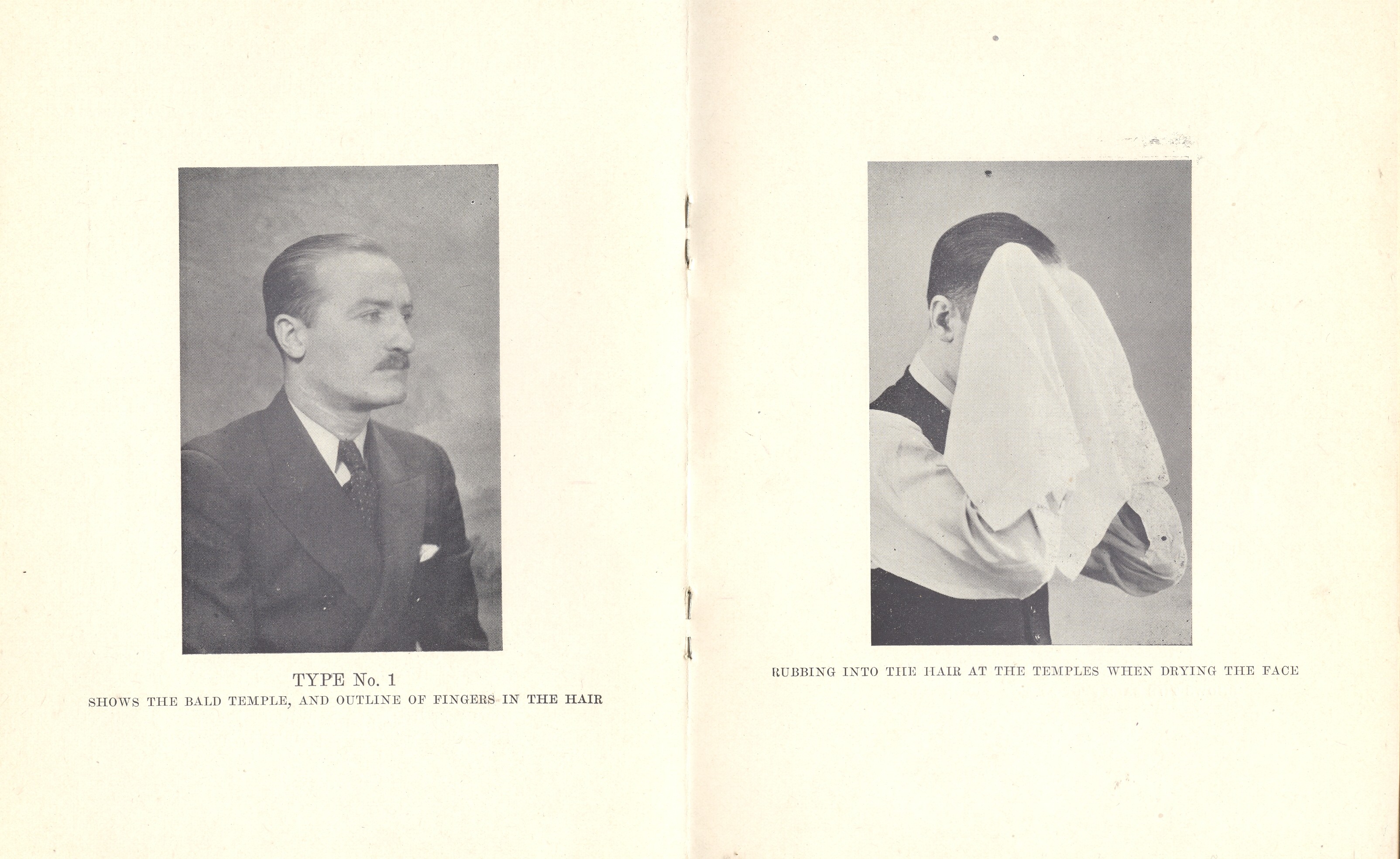
    don’t rub your hair when washing your face, and do not smooth your hair
    down with your hands.  That’s it.  Or almost it:   we are told later that it is best to shampoo
    your hair in a sink, and then if one must shower or bathe to use “a rubber
    shower cap so as to not expose your hair to water”.  I’m not sure how that holds together. 

    ++blog++baldness pics

    The great art of Margaret McKenzie is that that
    like any great salesperson she was able to spread this tidy discovery over 15
    pages.  She strays off-topic only a few
    times, once when discussing her cure for dandruff, and another when she states
    with sublime magnificence that “the bald head era dates back to the 15th
    century”.  The cause of the great onset
    of baldness, by the way, was the invention of the haircut, which led to
    smoothing down the hair and to rubbing the scalp (at the temples) when drying
    your face after washing.  Evidently haircuts
    didn’t exist before 1400. 

    Sometimes all one can do is say “wow!”.

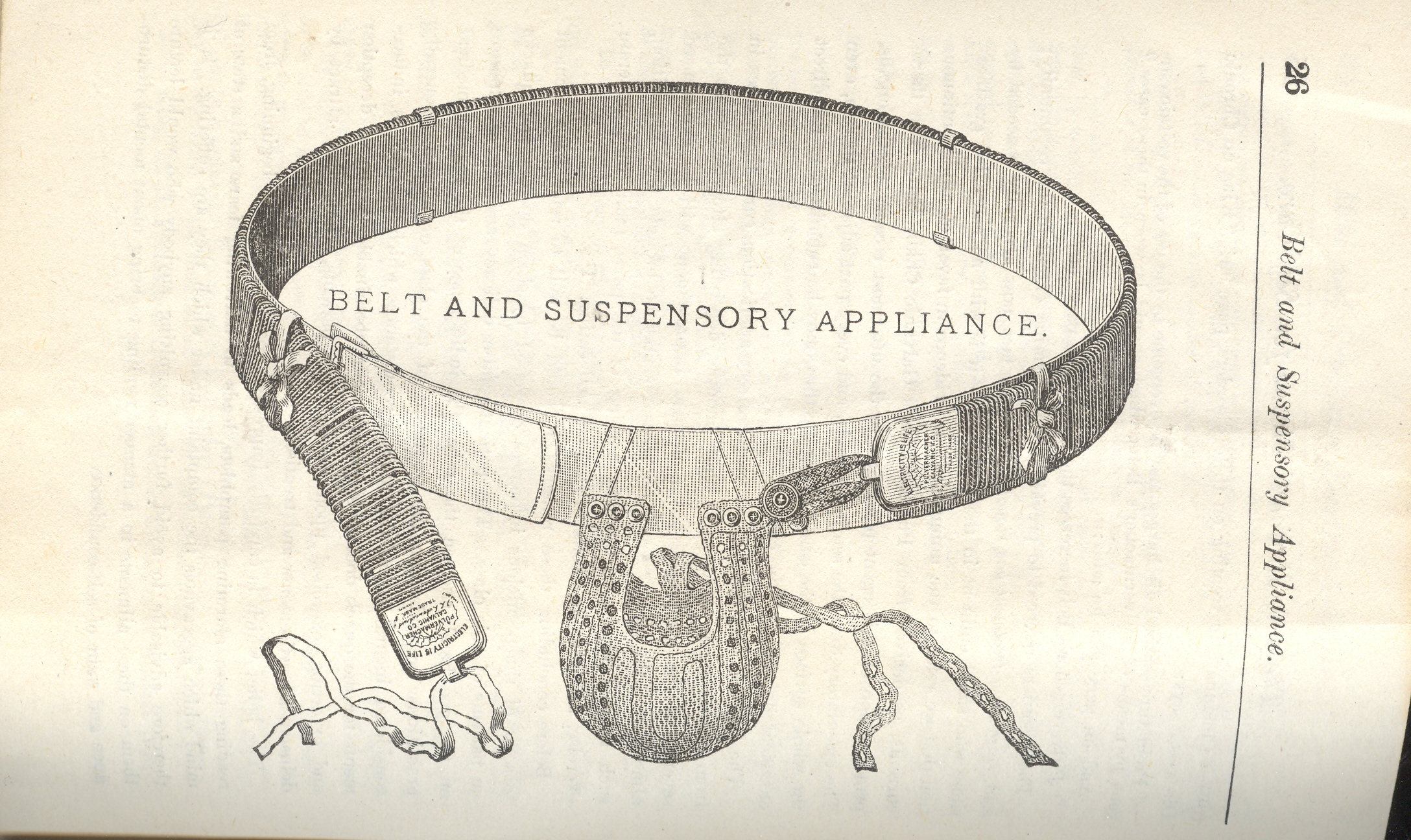
    ++ebay--testi belt 1 And a trailing, eyebrow-arched, questioning  “wow…” is about all you can say about Pulvermacher’s Electric Belts &c/ Electricity Natures Chief Restorer, Self-Applicable for the Cure of Nervous and Chronic Disease without Medicine (printed ca. 1880), which features an electric “chain” in a belt connected to a “suspensory” for a man’s vitals. It is one of many, perhaps hundreds, of electrical geegaws that climbed aboard the principles of Michael Faraday’s monumental invention of the induction coil (1831)–one can hardly imagine what Mr Faraday would’ve thought of this application of his great addition to the history of technology. This electrical stimulus was supposed to cure all manner of unspeakably lingering medical tragedies, including spermatorrhea, exhausted vital energy, female complaint, inflammation of the prostate gland, seminal weakness, kidney disease, cramp, lost manhood, paralysis, indigestion, dyspepsia, spinal complaints, nervous debility, and of course the “debilities of sexual self-pollution” (“the sexual sin (which) is the most destructive of all human vices…the greatest outrage against Nature’s sexual ordinances that man can possibly perpetrate”.  Isaac Pulvermacher’s (which is German for “gunpowder maker”) electrical medico-contraption was popular for several decades in the mid/late 19th century until it faded and trailed away at the turn of the century, though it was not for the lack of trying.  Pulvermacher had all manner of glowing letters of support for his product, though one wonders if they

    ++ebay--testi belt 3

    weren’t mostly cooked up on the back burner of a two-burner stove top, much in the way he invented this bizarre electrical device and pathologized aspects of male sexuality. 

    ·Posted by :

    ·in:

    —

  • History of the Future: Farming and Vertical Integration, 1940

    JF Ptak Science Books LLC  Post 745  Blog Bookstore

    This 1940 pamphlet, published by the Texas State Research
    Foundation, is a relatively young, paleo-futuristic view of the coming of the
    vertically integrated food production business in the United States .
    Its title (Building an Agricultural and Industrial Empire through Research)
    directly relates the idea of a grand agricultural/industrial alliance, with the
    contents pointing the way to far more than simple “research”, as the cover
    intimates.  There is a giant series of
    silos, and even a barn (in the top right corner), but the image

    ===farming here is pure smokestack-encrusted
    agribusiness.  The simple farmer on his
    tractor makes his slow way through his high-bound and gross techno skyline—of course
    the visual message implies that the family farm would be aided by “research”,
    but it also opens the door wide into the future to what the American farm would
    become.  The family farm would be
    absorbed by the skyline of major business: 
    at the time when this pamphlet was published some 22% of the American population
    was directly involved in farming; by 2002 that figure had genocidally dropped
    to about 1.5%.  The small, independent farms
    had been replaced by global conglomerates who are centralizing food production,
    controlling the distribution of fertilizer and seeds, causing massive soil
    erosion, destroying aquifers, depleting the soil, polluting with toxic
    chemicals, and on and on.

     So the image of this puffy pamphlet’s cover turns out to be
    prescient after all, and pretty much true: 
    except for the farmer-on-the-tractor part, as that guy got pretty much
    absorbed into a corporate Farmer Entity.


  • Spam, Smeat, Spic, Prem, Mor & Arf: Food by Any Other Name

    JF Ptak Science Books LLC  Post 743  Blog Bookstore

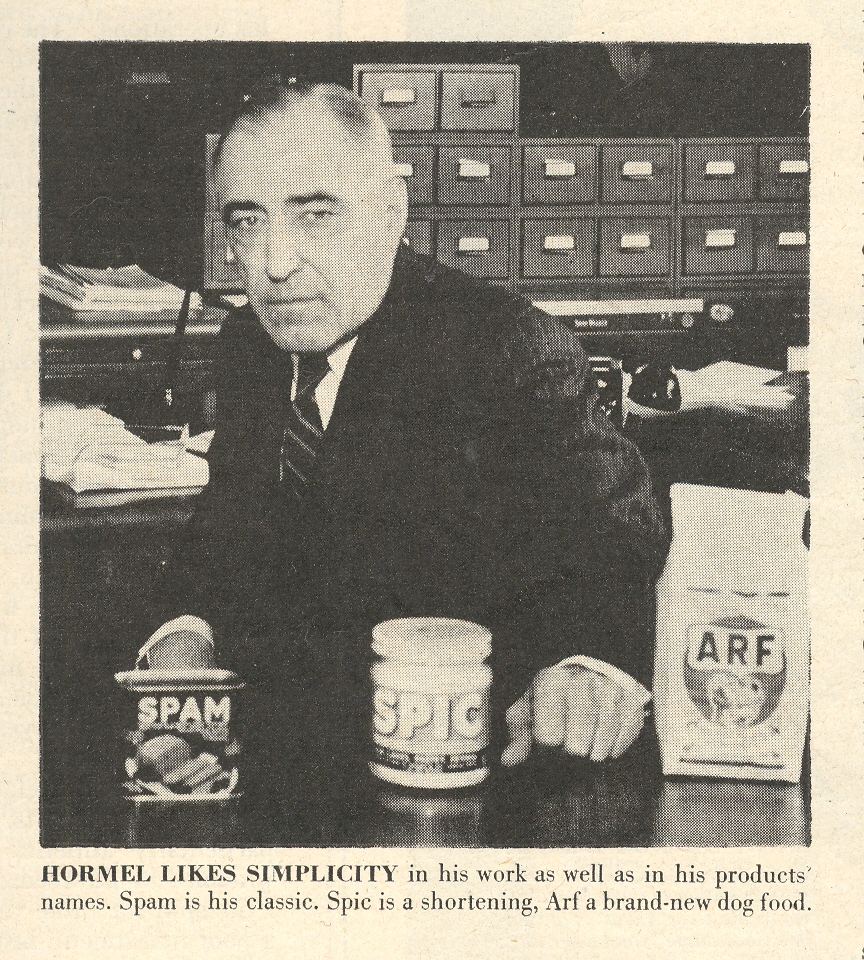
    This photo launched itself up to me while looking through
    the 11 March 1946 issue of LIFE magazine for a depiction
    of an atomic attack on NYC.  It was Joe
    Hormel who found me first, fistily challenging me to look at his food products,
    a proud manager with his best stuff, presiding over his world of tinned meat
    with steely Elmer Ganty-like broke-bone determination.

    +++hormell

    Joe ran his father’s “butcher business” and brought Spam to
    the world in 1937, trying to find an end run around the shrunken Depression
    food allowances, and pretty much succeeded.(Spam may also have been the first “singing
    commercial” in what the LIFE article called “the earthiest, corniest and most
    successful campaigns in U.S. advertising history.”)  When the meat shortages spiked during WWII,
    Spam found its way overseas via Lend-lease arrangements, feeding millions of British
    and European people..  The consensus was
    that Spam was mysterious and unpretty,  but did deliver something like 15-grams of
    protein per tin, which made it some sort of factor in waging the successful
    war.  US soldiers also received smeats
    called “spam” though they weren’t necessarily Hormel’s product—just another in
    a long line of monosyllabic imitators whose quality and zestyness didn’t come
    close to the real thing, though this time prepared in the millions of pounds by
    Army cooks who banked on the Spam name more so than the actual preparation.   Or so I read. 
    In any event it was a real issue for Hormel who “insisted that Spam was
    a high-grade compound of ham and pork shoulder” and that the [real] “dainty,
    tasty Spam retained liquids in the meat, whereas the bulky Army preparations
    was guilty of the worst sin the in the tinned meat world…” floating away in “loose
    juice”.  As a vegetarian, neither sounds
    very appetizing.  And the anti-Spam
    stories and songs and newspaper articles and art and editorials of complaint
    and disgust coming from US soldiers during the war are endless and legion and
    iconic. 

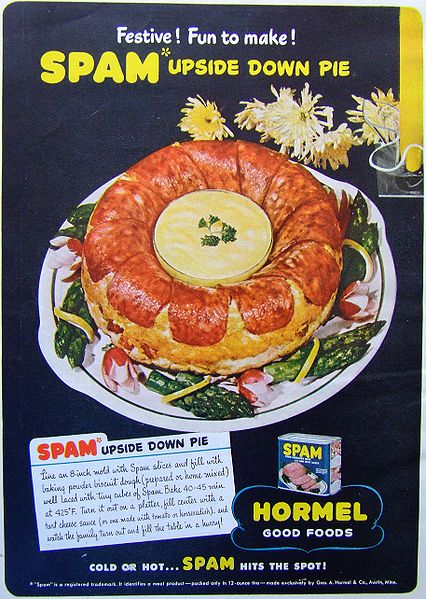
    +++spam ad

    Spam seems impervious to the barbs and arrows and boulders
    hurled its way over the last 72 years, still chugging along in its tinned meat
    way, 6 billion sold units and growing. 

    [Note:  “Spic” was
    actually a shortening, and “Arf” was a dog food.  I just couldn’t resist putting their names in
    the title.]


    Also, I include some of the recipes from the Monty Python
    (170) skit on spam:

    • Egg, bacon, and spam
    • Egg, bacon, sausage, and spam
    • Spam, bacon, sausage, and spam
    • Spam, egg, spam, spam, bacon, and spam
    • Lobster thermidor aux crevettes with a mornay sauce
      garnished with truffle pate, brandy, and a fried egg on top and spam.

    ·Posted by :

    ·in: