A Daily History of Holes, Dots, Lines, Science, History, Math, Physics, Art, the Unintentional Absurd, Architecture, Maps, Data Visualization, Blank and Missing Things, and so on. |1.6 million words, 7500 images, 4.9 million hits| Press & appearances in The Times, Le Figaro, Mensa, The Economist, The Guardian, Discovery News, Slate, Le Monde, Sci American Blogs, Le Pont, and many other places… 5000+ total posts since 2008.
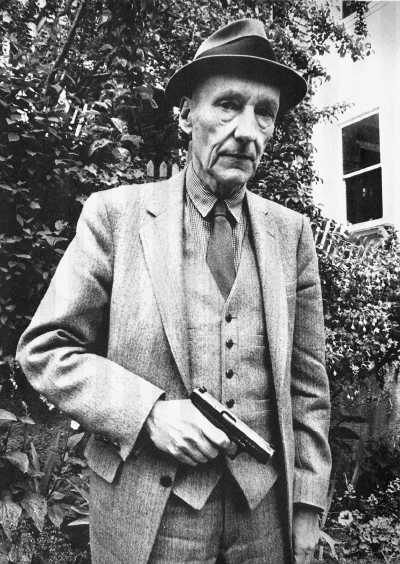
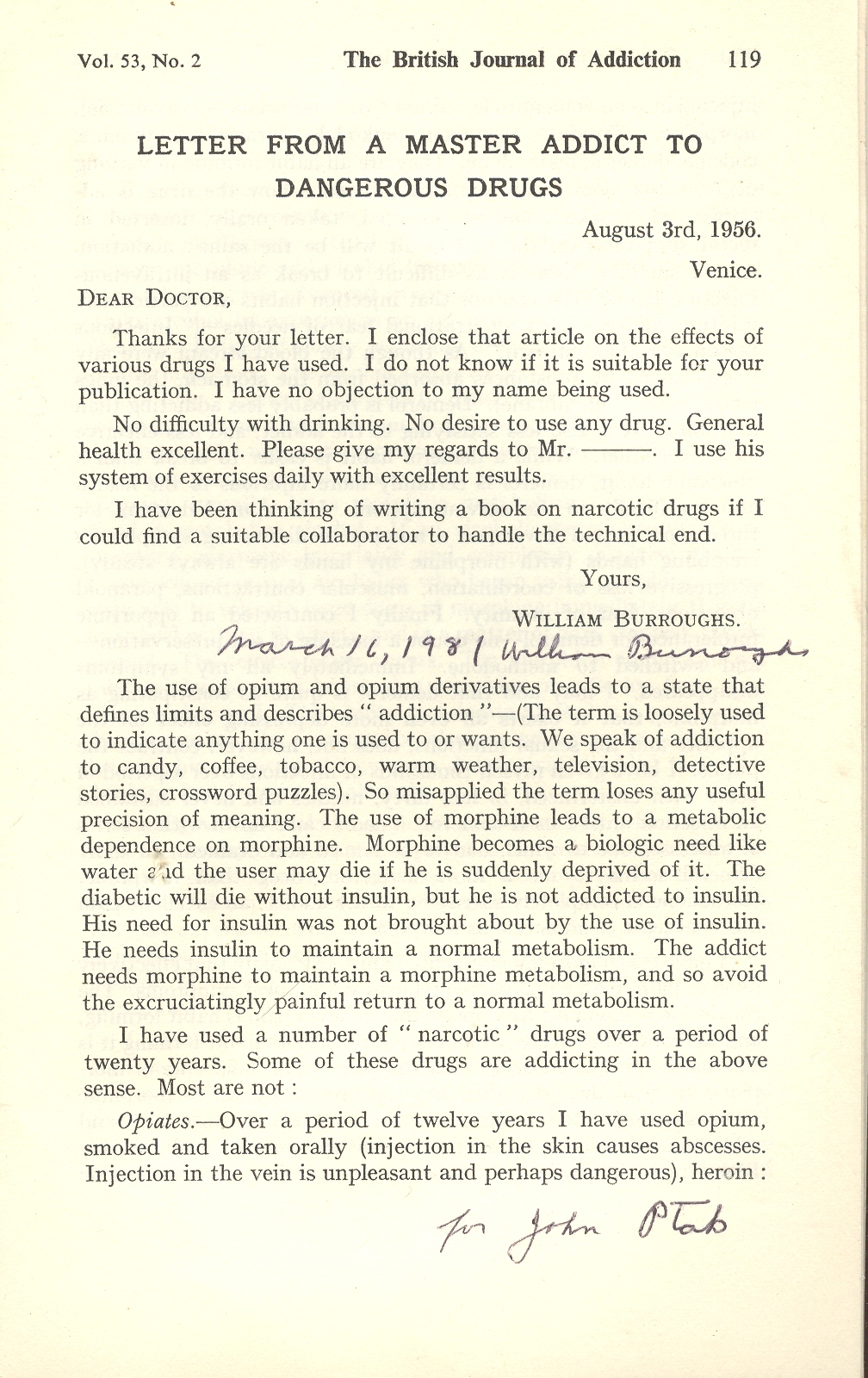
William Burroughs—one of America’s
great 20th century humorists (closer to Bierce/Mencken than
Thurber/Woollcott, like Twain with a rainbow coalition of nasty addictions and outré
social habits)—wrote this cookbook article of drug addiction in the British Journal of Addiction in
1956.Considering it is only twenty-two
pages long, it is an Encyclopedia Brit-burroughanica for its quick
contents.
“Letter from a Master Addict to Dangerous Drugs” is crisp
and concise, a clinical horror story of addiction and cure.I say “and cure” because of the low trials
Burroughs went through in some of the ten attempts/cures he experienced to
clean himself up.(Burroughs had already
been using narcotics for twenty years by 1956. By a mixture of good genetics and miracles Burroughs (1914-1997) made it to his 83rd year.) Burroughs describes one of the treatments, the “prolonged sleep” cure, (excerpted below),
in singular terms, revealing a particularly gruesome adventure into lost
health:
“Prolonged Sleep.–The theory sounds good. You go to sleep
and wake up cured. Industrial doses of chloral hydrate, barbiturates,
thorazine, only produced a nightmare state of semi-consciousness. Withdrawal of
sedation, after 5 days, occasioned a severe shock. Symptoms of acute morphine
deprivation supervened. The end result was a combined syndrome of unparalleled
horror. No cure I ever took was as painful as this allegedly painless method.
The cycle of sleep and wakefulness is always deeply disturbed during withdrawal.
To further disturb it with massive sedation seems contraindicated to say the
least. Withdrawal of morphine is sufficiently traumatic without adding to it
withdrawal of barbiturates. After two weeks in the hospital (five days
sedation, ten days “rest”) I was still so weak that I fainted when I
tried to walk up a slight incline. I consider prolonged sleep the worst
possible method of treating withdrawal.”
If as Burroughs says, all pleasure is nothing but
relief, then this cure didn’t offer any, and certainly must rank high in the Bad Ideas Department of Caustic Non-Cures.
Self- and purposefully-deceptive belief in spectacular
and unsupportable scenarios espoused by governmental leaders which affect the
lives of hundreds of millions of people deserve their own Dante-esque categorization:and that’s one that I haven’t come up with
yet.This post is one of a continuing thread on the history of atomic weapons.
I wonder how it was that we humans didn’t blow ourselves
into melty dissolving bits during the Cold War. Somehow all of those thousands of megatons of disastrously radioactive
explosives that were completely and reliably deliverable didn’t get
launched—not even by accident, not even during all of those hot itchy-finger DEFCON 2 situations.Did MAD (Mutually Assured Destruction )
actually work?Did the attempt at making
a winnable nuclear confrontation keep people from actually trying to do
so?Did the overwhelming and insane
buildup of weaponry actually have so much enormous and foul intellectual weight
that no one could actually make the decision to use the weapons for fear of
snuffing out all human life?
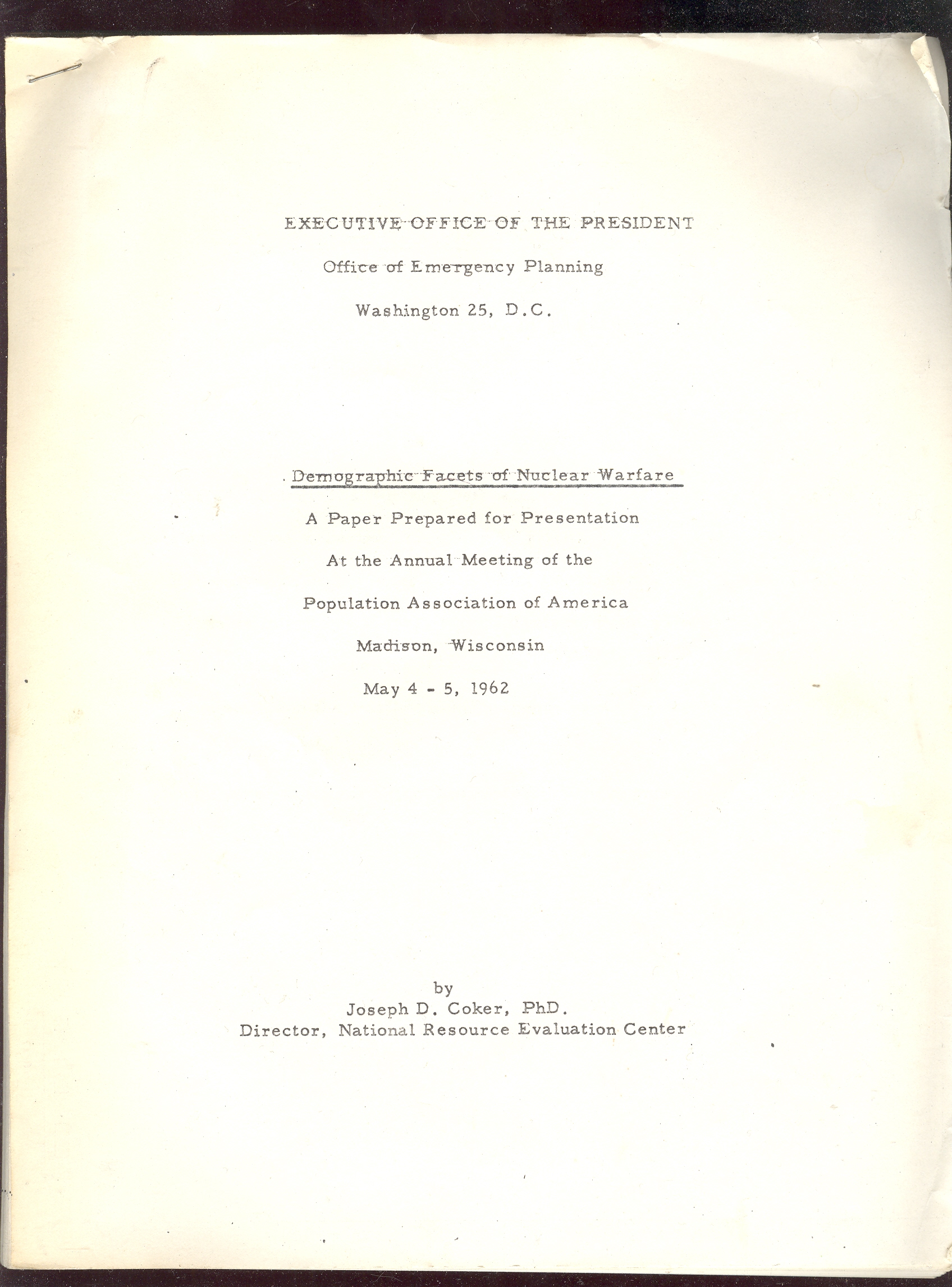
Here’s an embarrassingly shining case in point: Dr. Joseph D. Coker’s paper to the Population
Association of America representing the thinking of the Office of Emergency
Planning and the Executive Branch in general, which freely discussed the survivability
of the United States
following even a post-massive nuclear exchange. Dr. Coker was the director of the National ResourceEvaluation Center, which tried mightily to figure
out how/where /what/how the essential ‘stuff” of America could be saved/stored/allocated
after the end of the world.Actually,
Dr. Coker said that the big attack wouldn’t be the end of the world, so we needed
to plan for surviving.
A few cases in point, some of which, I must warn you, are
breathtaking and Strangelovian in their myopia:
Since Dr. Coker was addressing the Population Studies people, he
related much of what he had to say (regarding national resources) to the
American people.He found that millions
of people could be saved if they built a blast shelter (not a fallout shelter)
that was covered with mounds of heavy material and outfitted for an extended
stay of two to 22 days.The unfortunate
part of this scenario, Coker says, is that these shelters work best when 10
miles or more away from a detonation zone. And since these zones were all over the country targeted by thousands of
warheads, very few people (especially in cities) would be outside the 10-mile
ring, which made the blast shelter basically useless.
Coker notes that if an attack of 1000 megatons
[a limited exchange] was aimed exclusively at U.S.air bases, “total fatalities
will approximate 10% of the U.S.
population”.If this attack was aimed at
population centers rather than the air bases, it would kill 40% of the
population. A 5,000 megaton attack on air bases would produce 50% overall
fatalities in the U.S.;
if that amount was centered on large populations, the number would jump to 80%
of the population.10,000 megatons would
yield 75% and 95%, respectively.“A
50,000 megaton attack would kill almost all U.S. citizens under either
targeting assumption”.These figures
didn’t include radiation deaths.
A big variable here not controlled for was the distribution
of population at the time of attack.The
numbers that were used were compiled by the census and counted folks who would
be at home.So, the numbers above worked
if and only if the Soviets attacked after dinner when everyone was at home for
the night.Since it would make sense to
attack when people were at work at their industry or job or whatever during the
day—thus maximizing the effect of the bomb—the casualties would actually be higher.
And what does that mean? Dr. Coker relates this gem (on page 21): “The post-attack labor force
available thirty days after the attack probably will represent a significantly
lower fraction of the population than does the preattack labor force….” And
this: “A nuclear attack can be expected to alter the occupational composition
of the labor force.”
This sort of thinking overtakes the factual aspects of
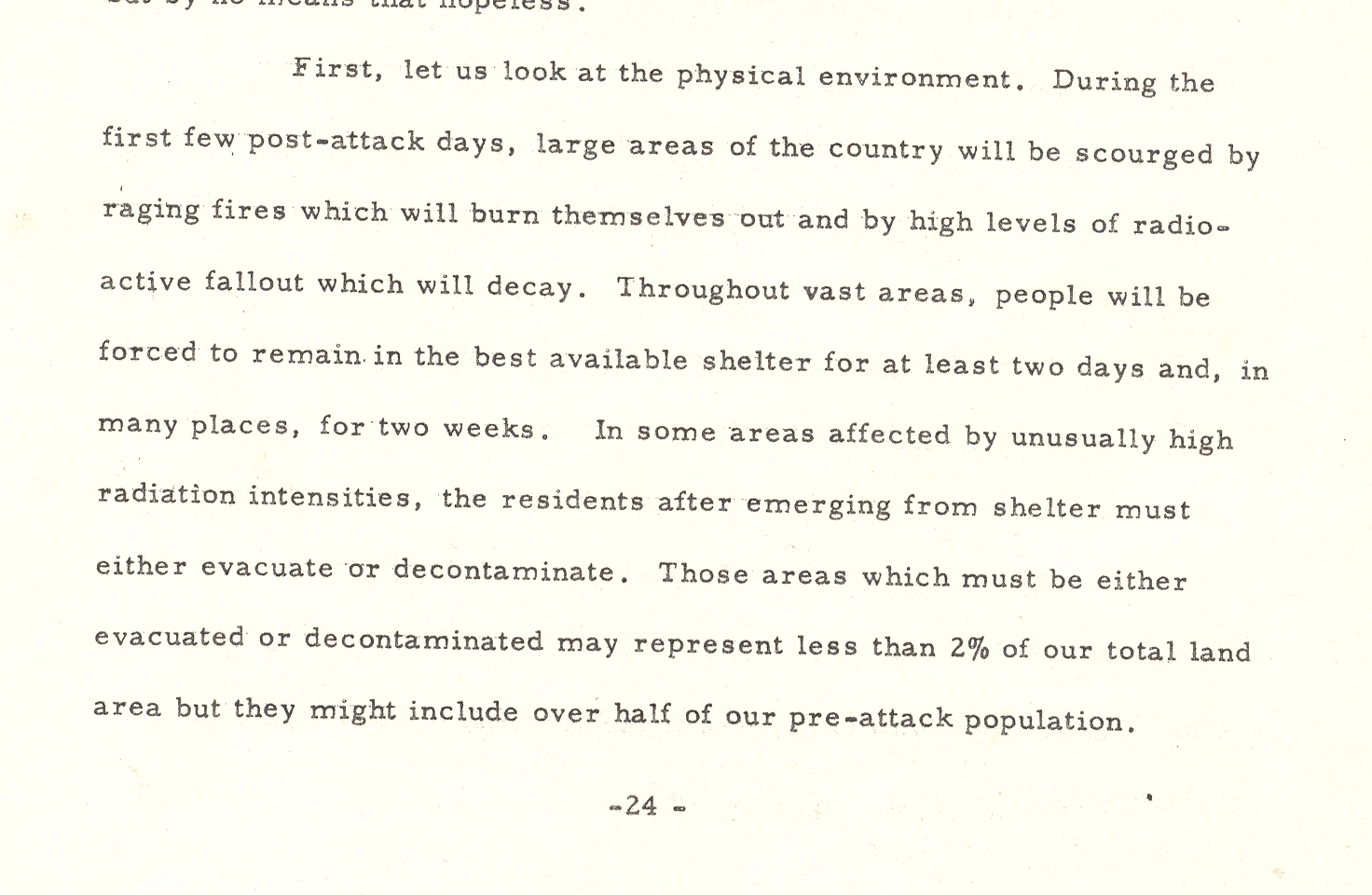
massive attack, with Coker stating on page 24 “I wish to sayemphatically that it [post-attack America] will
not be anything like that depicted in Neville Shute’s On the Beach.It will be bad enough, but not that
hopeless.”
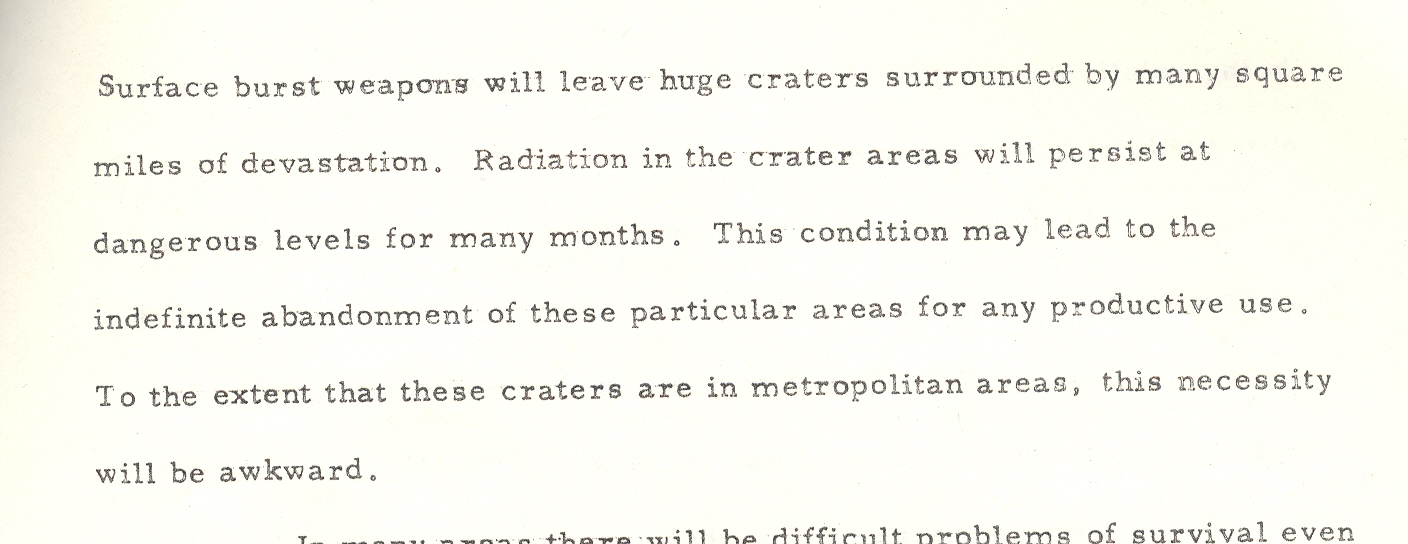
And this absolutely incredible/horrendous and perhaps worst-use-ever
of the word “awkward”:
For the love of King Neptune’s Pants:Awkward? How in the name of _______ could someone in such a high position and
authority relate massive attacks on every major American population center
which would cover the area in fire and thousands of gigantic highly radioactive
craters in which a city used to exist be called “awkward”?How great a sin was this, to influence
opinion on holocaust via pathetic and unreasonable means?
And then this, on the survivability of our governmental and
economic institutions:
“The post attack institutional environment will depend on
the continuity, resourcefulness and general effectiveness of our leadership and
the survival and resilience of pre-attack institutions…”
Hm?The post-attack
institutions will depend on themselves?
This of course is followed by a major plug for Dr. Coker’s own
work, because the preparations undertaken by the NREC will directly affect the
survivability of post-attack America.So don’t stop the funding.“The more complete and realistic our
preattack [sic] planning and preparations have been and the more effectively
the government is at all levels in inspiring and retaining the confidence and
support of the population, the less drastic institutional changes will
be.”So it is the mealy aspect of
inspiration that will direct the survivability of whatever it is that makes America
so.
I should point out that Coker’s use of “post attack” and
“pre attack” appear as two words, one word and a hyphenated word, depending on
nothing. This is only a forty-page document.
Another nugget on the post-Armageddon future on the
distribution of wealth, mostly hinging on blast shelters:“Per capita wealth in material terms may or
may not be reduced by attack.”There
will be a relatively proportional number of people who emerge from the smoking holes to staff surviving industry,
and so per capita wealth will stay about
the same.If, on the other hand,
people build more blast shelters, then the proportion of surviving workers to
factories will increase, and “the surviving plant capacity will be spread more
thinly among them”. It is left unstated, but what that means is that more successful implementation of blast
shelters would mean a reduction in per capita wealth. Dr. Coker also
forgets what he said earlier that the blast shelters really didn’t work unless
they were more than ten miles from a target. Considering that the industrial workers would be living close to, um,
industry, they will no doubt be (in 1962) in a ten-mile radius to where the
blast would be.Then of course there
would probably be more than one bomb, so the blast area would be more than a
ten-mile circle, and so on and so forth.
In the following paragraph, Dr. Coker somehow draws all
manner of feel-good high-probables around him, encasing himself like a sandman
in a thin layer of improbability, to come to the following conclusion:
“…few of the analysts who have studied carefully these
post-attack [sic] survival and recovery problems take any stock in the
oft-repeated theory that the survivors will envy the dead.On the contrary, after a very rough year or
two, the surviving population, if it so
chooses, can begin to enjoy the advantages of a social structure and a
physical environment not so very different from those which prevailed before the
attack.” [Emphasis mine.]
This is an astonishing work of incredible deceit, and may be
the worst quote of the lot.But it is so
difficult to choose between unacceptable bits of thinking like this, raking out the horrible from the terrible.
Here’s another deceit that was absolutely better understood in 1962
than the writer acknowledges:“The
long-term effects of radiation are subject to much less understanding and
certainty than are the short term effects. There is some evidence that increased radiation exposure results in
reduced life expectancy and increased evidence of leukemia and various
degenerative diseases…”And this:“Genetic effects are more
controversial.”Than what?! And this: “Studies
of the Hiroshima and Nagasakiexperience are said thus far
to be inconclusive.” Honestly this was
very well understood in 1962, and statements like these were enormously
irresponsible if the data were actually misunderstood and criminal if they weren’t.
There are many more examples—I’d say actually that the
entire paper was at the level of Apocalypse Fairy Tale—but I’d like to
close with just one more, this one using another fanciful version of the
possible post-nuclear future and another highly insulting euphemism.On transportation:“We hope in the near future to develop a
family of network and transportation models to estimate capabilities to move
surpluses into deficit areas in
order to cover deficits during each time period and to support the use of more
ambitious resource management techniques focussed [sic] on recovery problems.”Aside from bad sentence structure and
misspellings I could hardly imagine sitting through a presentation where a
person thought this stolen undercooked tripe. What we have arrived at here at the end of the paper is references to
smoke-in-a-hole cities being “deficit areas”, and the successful removal of
human consideration from the conversation—strange as Dr. Coker was addressing the
Annual Meeting of the Population Association of America.(I’d love to know what the association
members thought of the talk afterwards.)
And so what can we draw from the experience of knowing
thinking like this?Is it as sterile as
it might seem, so distant from our experience? The scenarios have changed, as have the leaders and delivery systems,
but the insatiable stupidities have evolved and morphedinto our own time.Its easy to raise our eyebrows now on the
whole MAD approach and the writings of people like Dr. Coker.The truth of the matter is that we have
plenty of this sort of thinking going on right now, big head-waggers that will
loom in our futures with the attached questions of “how could this have happened?”.WMD is one of the many examples of this, a
Big Lie that was repeated for years and which ultimately cost the lives of many
thousands of people and a great perpetuator of the culture of fear.President Bush
drove that one into the ground and so far as I know still employs it when
necessary, threatening listeners with fear of those three letters like they
were a practice hand grenade.(I recall
that a far-right radio personality filled with afterbirth
blood and urine eyes said that he would resign his show “in a year” if WMD were not found in
Iraq; that was five years ago, and of course he is still there, bloated and
ponderous and mostly violently wrong as ever.) The Savings and Loan debacle.The
deathly ambitious practices leading to our recent depression. The billion malnourished and desperate children in the world.And so on. The point is that there is no
paucity of thinking displayed by Dr. Coker in the past, and there is definitely
no lack of it right at this very moment.The
problem is seeing it for what it is in the present and to not have to wait for the future to get to the truth of the matter.
[And how can I end this discussion without a bit more of Stanley Kubrick’s magnificent Dr. Strangelove.., who pointed out these absurdities better than,perhaps, anyone?]
Ah, don’t fret! The ending is just below (and just when you are about to laugh (“Mein Fuhrer, I can WALK” the other and last shoe drops.).
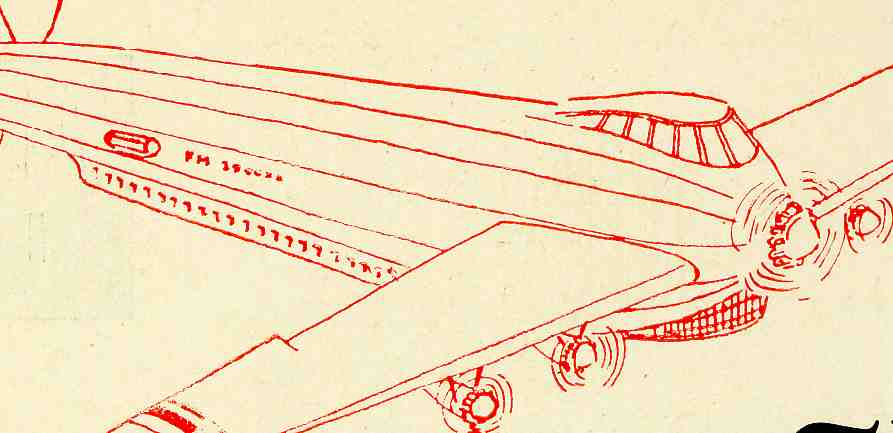
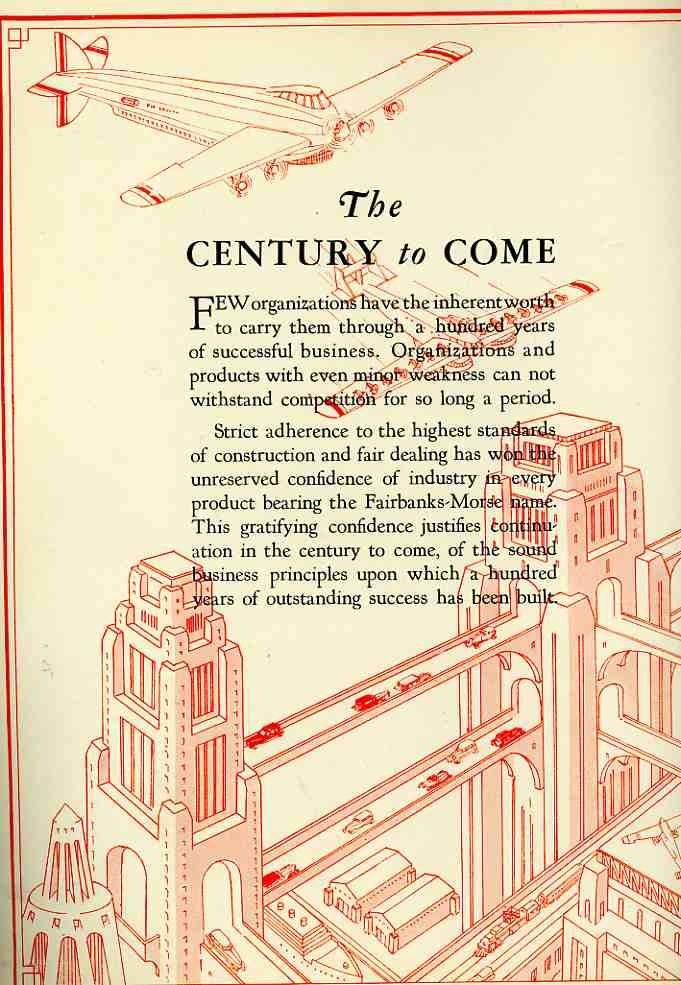
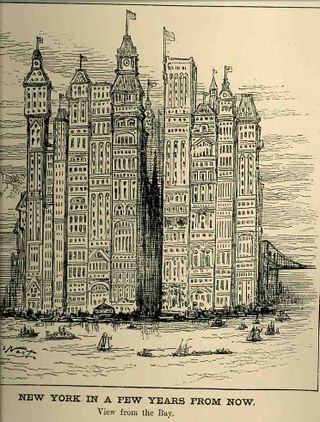
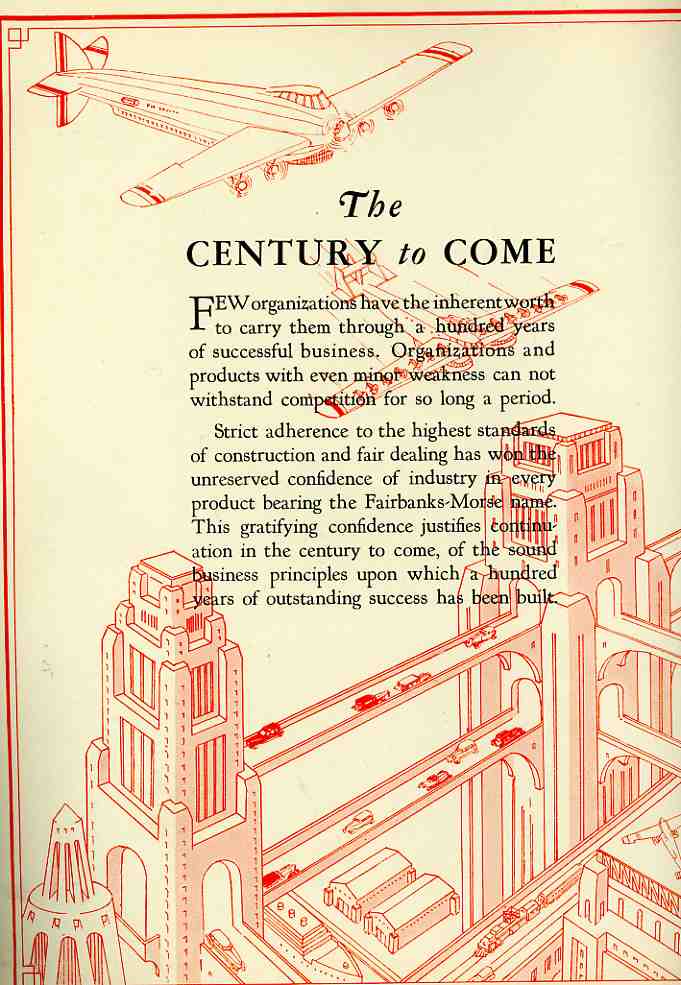
In an earlier post here I wrote about living a big life in a big airplane–I saw this weird little print and was attracted to its unrepentent awfullness and the sleeky bulbous nature of this exotically unflyable aircraft. I guess it bothered me becuase even though it was unsupportably big it didn’t bother to have any of the luxurious features that other, similarly bloated-enormous aircraft had at the time: swimming pools, greenhouses, landing strips for other planes… This one didn’t have anything like that, and didn’t really seem to make any sense, unless that big belly part was actually a zeppelin or something like that, filled with helium–but even that doesn’t make sense. Perhaps we need to assume that it is supported in the air by something yet named and unknowable, powered by engines that were far advanced. But what is more interesting in the print are the multi-tiered auto-skyways and suspended nonsensical roads that hang between the skyscrapers like a gravity marble game.
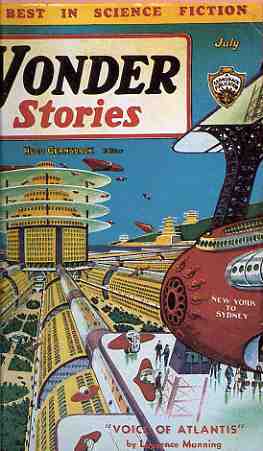
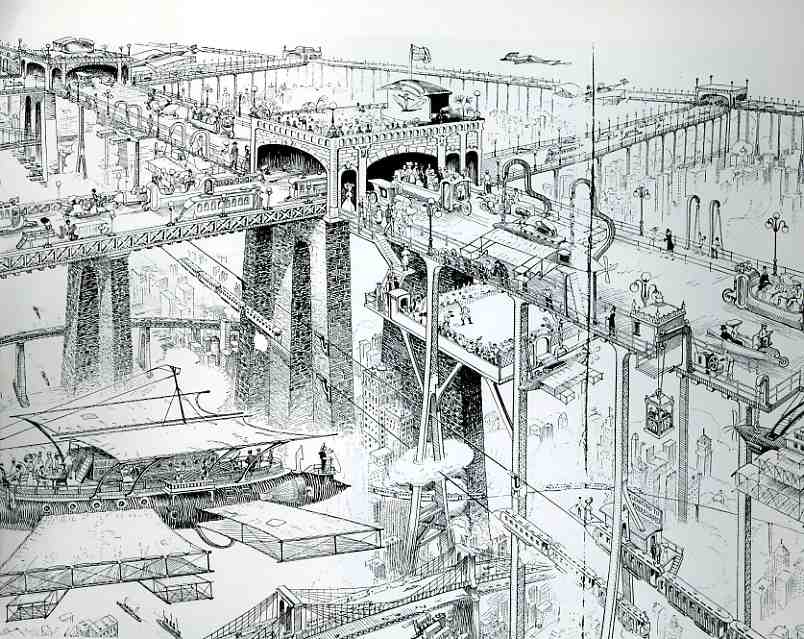
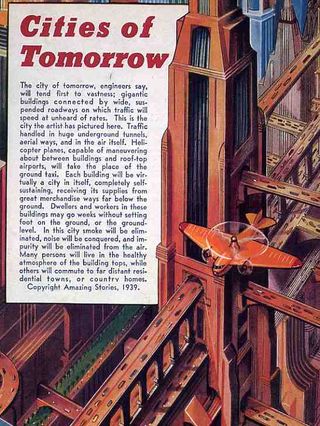
These other cities of the future at least take a greater leap of faith in the belief of extraordinary inventions and abandon the generally stylized shape of known aircraft and propulsion systems. At least for the next two images, even the architecture is mostly new. What I’d really like to know is what people were doing in those buildings and where they were going in those hover cars. For the most part in stories of the future like this people were simply going to work as they would in 1937, driving off with anti-gravity sumpin’ to Spacely Sprockets to do office work as it was in the past.
For the most part future vision seemed grounded in the past, techno-wizzardry carved into the fabric of existing society. I’m not so sure what was so “futuristic” about elevated railways stacked up on top of each other like flapjacks, but to someone there in the 1930’s past it looked like a great thing about to happen….in 1965.
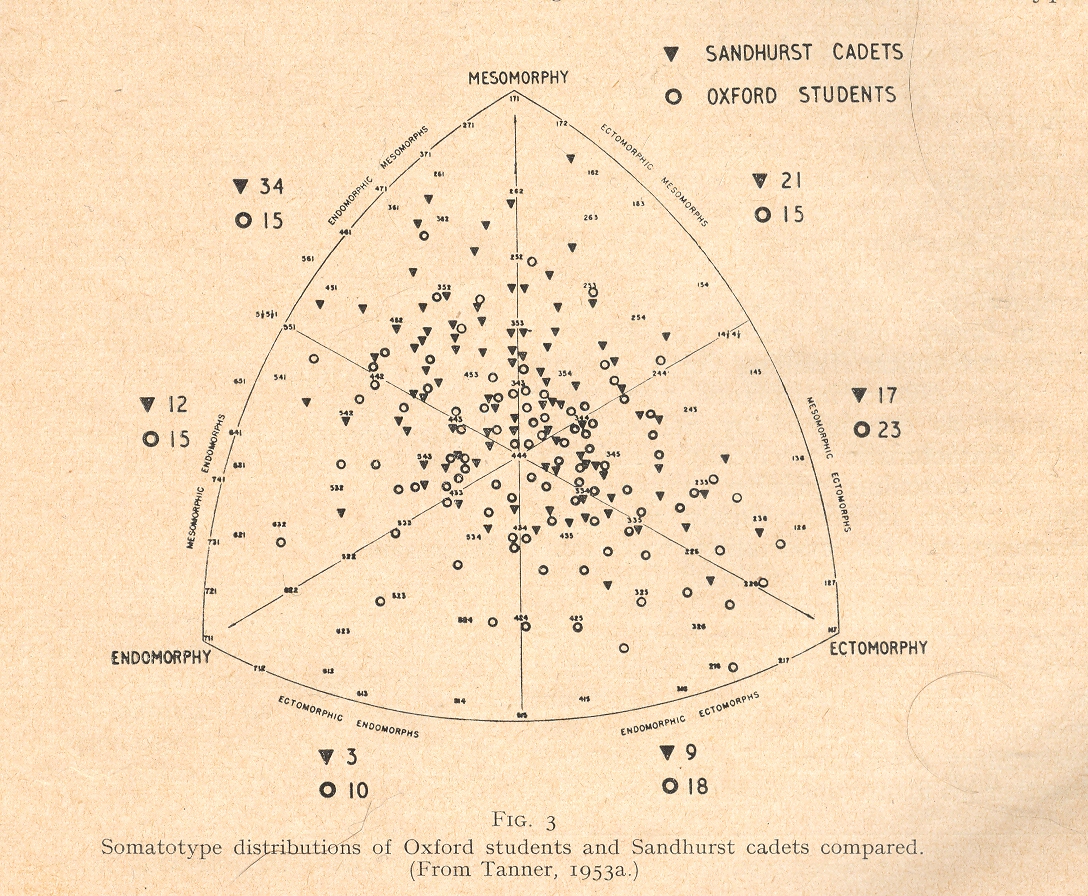
JM Turner (an M.D. and a Ph.D.) wrote “Physique and Choice of Career” for The Eugenics Review of October 1954. He reported on the statistical survey correlating body type and profession, one in a considerable line of such statistical drunkenness which found pseudo-scientific results from closeness of fit between fat, muscle and criminality and professions. I really don’t want to get very much into the details of this story because it just isn’t worth it–simply put, the doctor was finding correlations between some body types and students at an officers’ training academy and Oxford. The military officers in training were heavier than the Oxford students. The end. [Interestingly the author references an earlier study from 1939 which found correlations between body types and different sorts of crimes among 17,000 incarcerated juvenile offenders. Turner uses the results to support his own but also finds fault with the earlier study, stating that it lacked “any very workable classification of physique…his study was more of a high altitude aerial survey than a detailed map of the ground”. This doesn’t prevent the use of the findings, however.]
It was this sort of thinking that the sniffy and in-its-own-peculiar-way venerable The Eugenics Review (1909-1968) its influence, a cancerous spittle which found its way all over the globe. Eugenics was seated in the work of the very formidable work of the polymathic Sir Francis Galton (the word coined in his Inquiries into human faculty and its development
in 1883), and found its way into some deep scientific corners until its
was generally rejected at about the same time of the journal’s death.
The influence of eugenics reached far and deep and wide, finding its place even here near
where I live–deeper here, and later than expected, as it turns out.
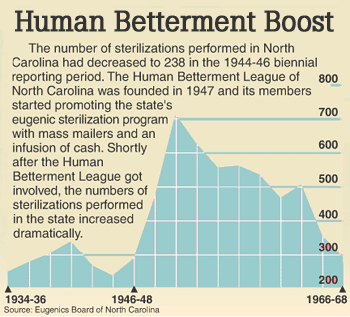
The Human Betterment League, started in 1947 in Winston-Salem (North
Carolina) with the influence and money of James G. Hanes (of the Hanes
hosiery and underwear fortune), instituted a vicious resurgence of
interest in eugenic sterilization just at the time when this practice
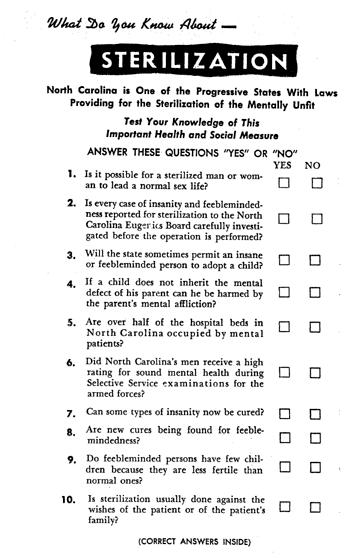
was beginning to come to its end in other places. As you can see, eugenic-based sterilization in North Carolina was sliding into social consciousness and decline just at the beginning the the Human Betterment reign of terror, spiking to over 700 sterilizations in just a few years after its underwear-y inception. The majority of the victims of this social cleansing, of this cleaning of the gene pool, of this save-us-from-“them” mentality,were black. SOme of these people were classified as “morons” according to standardized testing that many were never before exposed to; some were classified as deviants and defectives ready for sterilization if they chose to have a baby produced by rape. The road to racial purity was a wide one for the Betterment folks; fortunately, it was not a long road, though they were able to force sterilizations of thousands of unfortunate victims and did so until the late 1960’s. This is a bad story for the history of this state and one which is not frequently discussed, though reparations discussions are underway, cushioned by a very skimpy installment of 250,000 from the state coffers to establish offices and a board and bureaucrats to study the issue. This is many millions of dollars off the mark, but it does benefit some mid-level manager somewhere in the state capital at Raleigh…
[Source for sterilization pamphlet and graph: Against Their Will–the North Carolina Sterilization Program.]
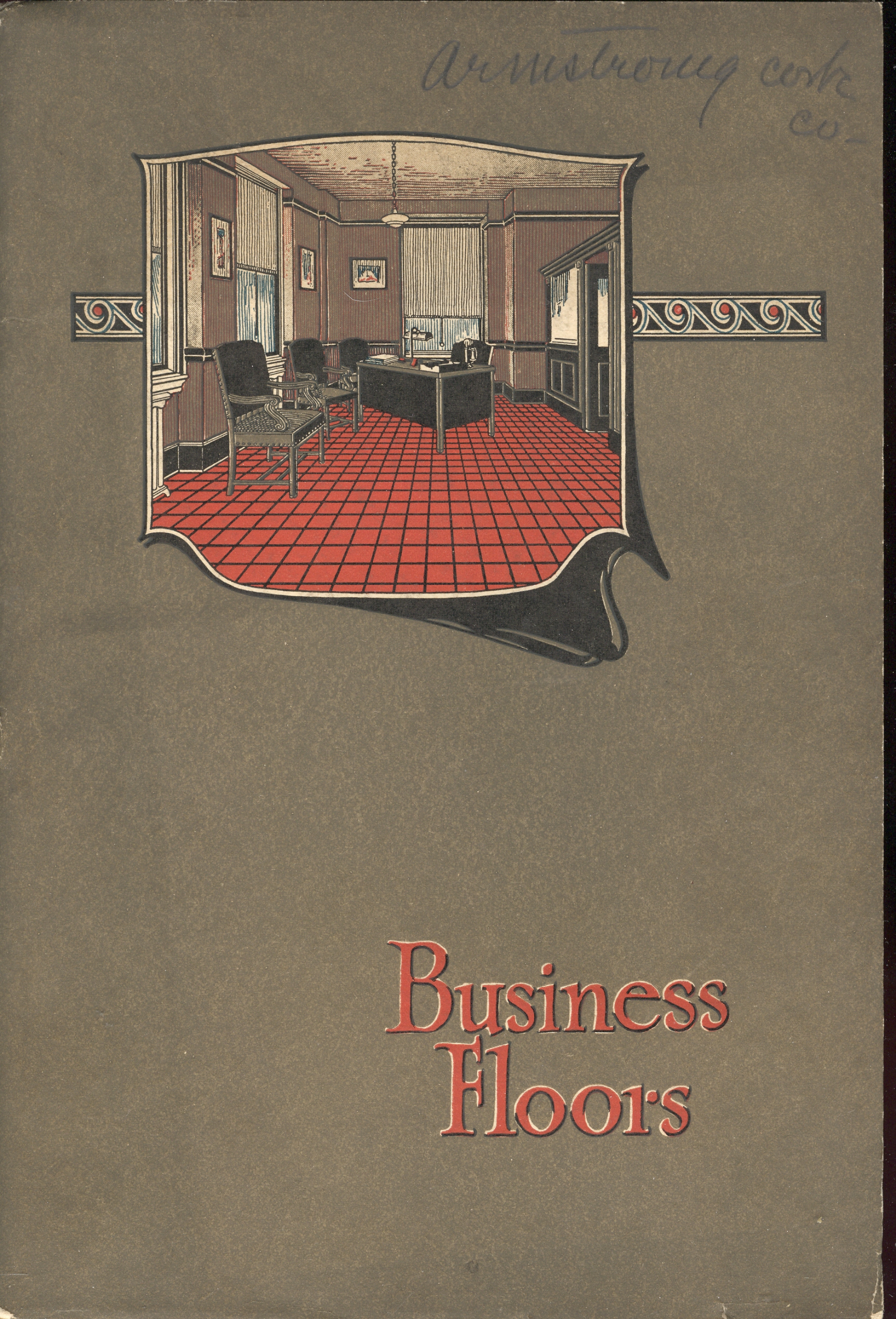
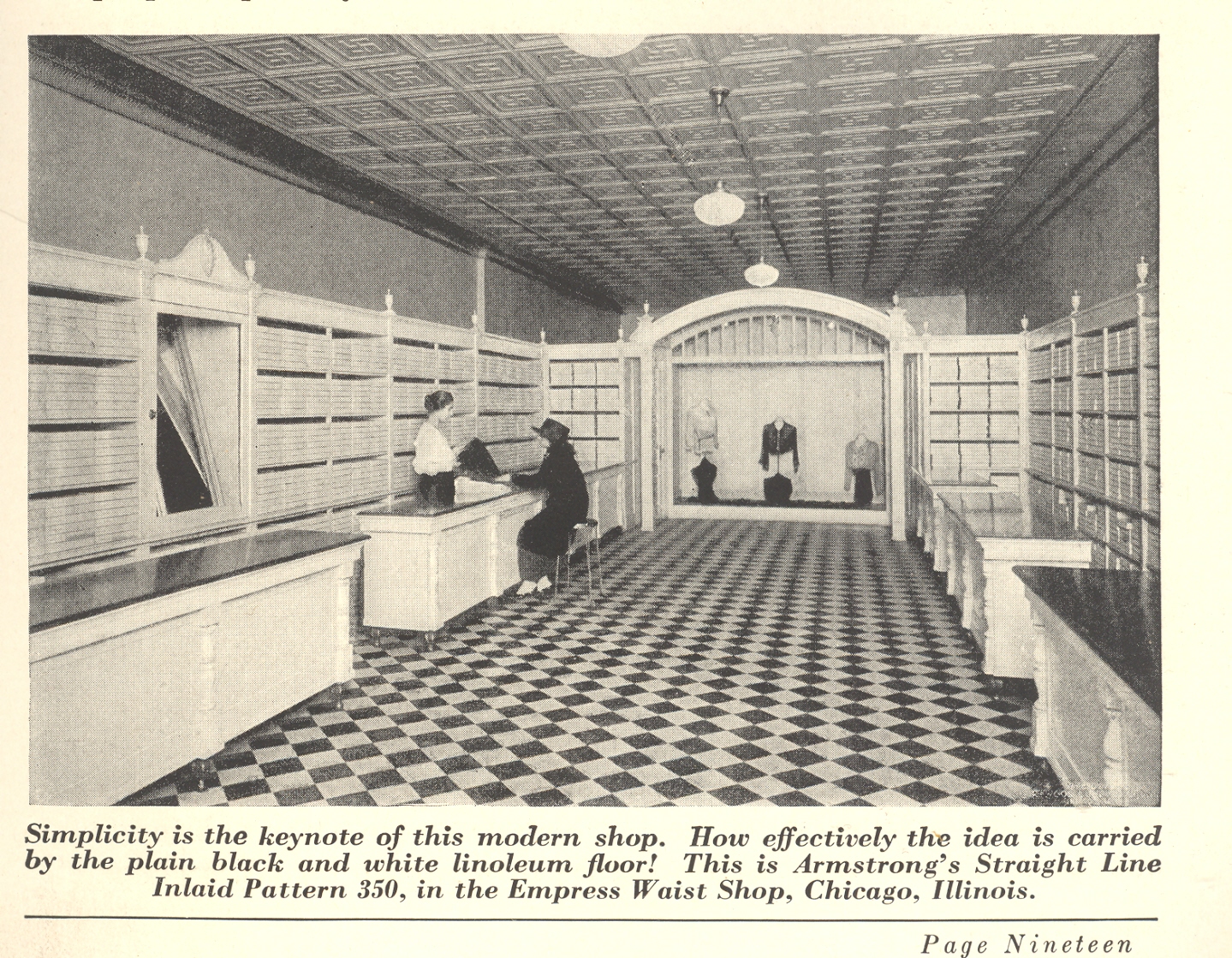
But this sentiment is just a function of its time—for example, in this
glorious manufacturer’s catalog by the Armstrong Cork Company (of Lancaster,
PA), the incredibly-titled Business Floors, there simply aren’t enough rectangles
to go around.
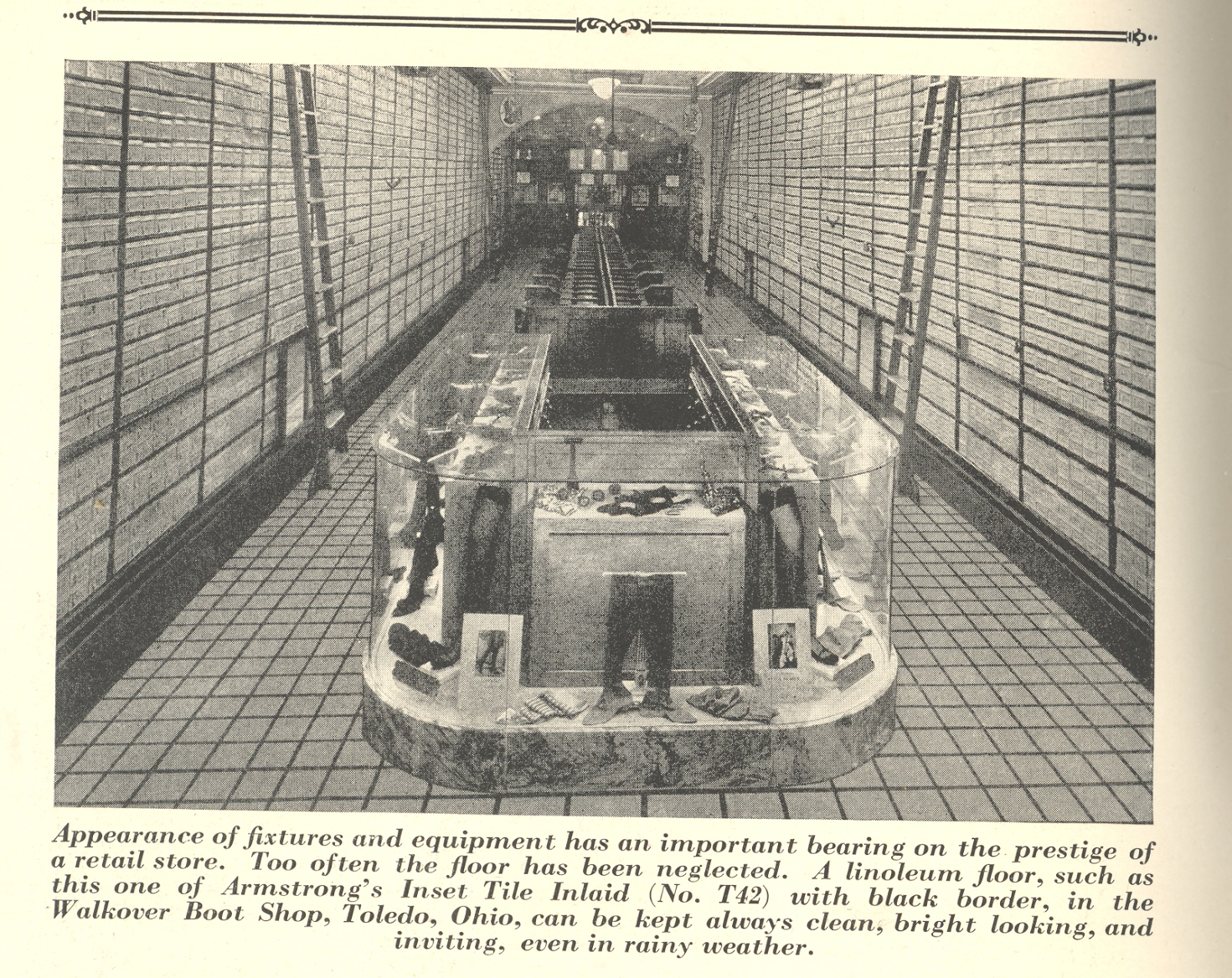
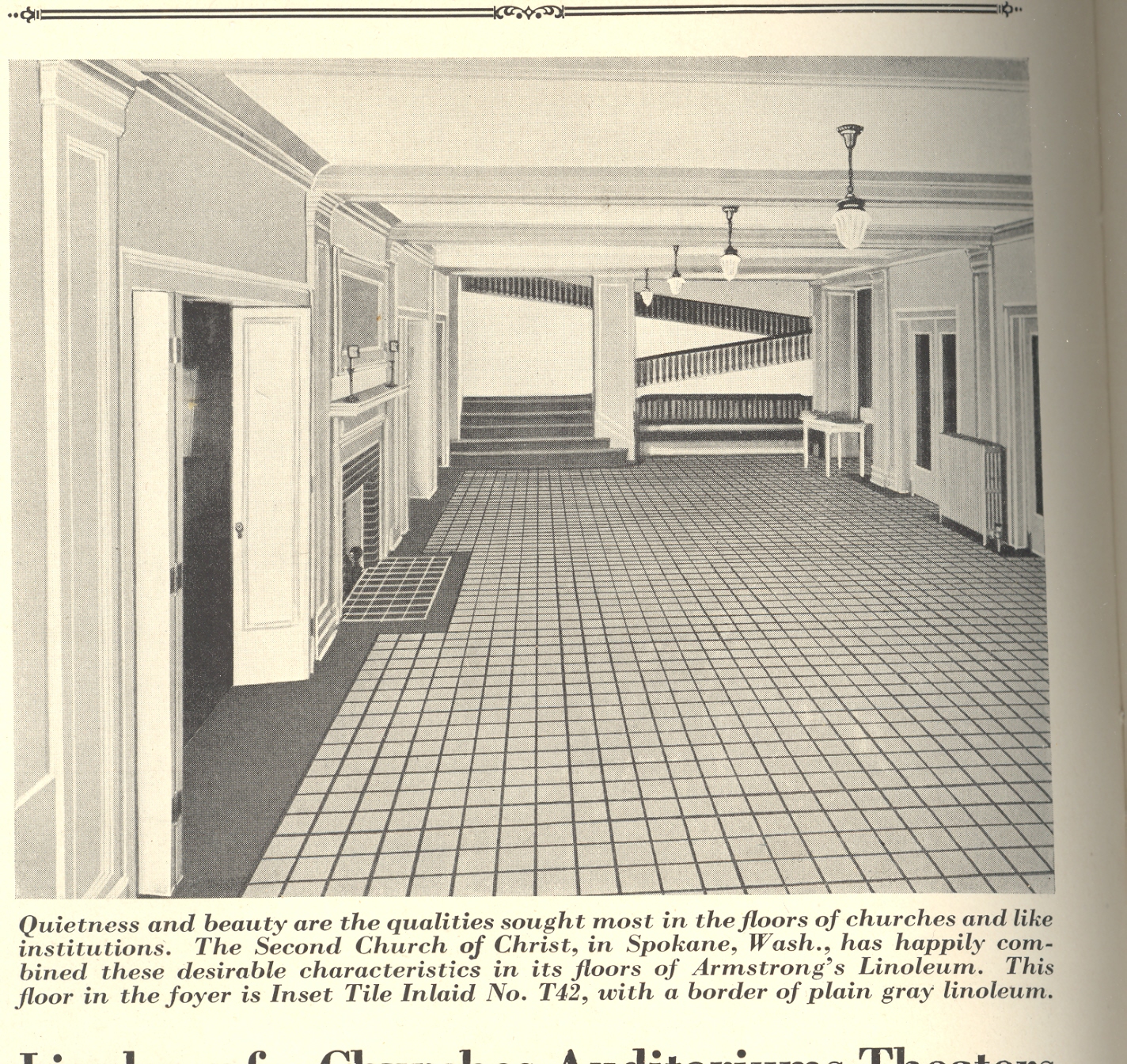
For example:
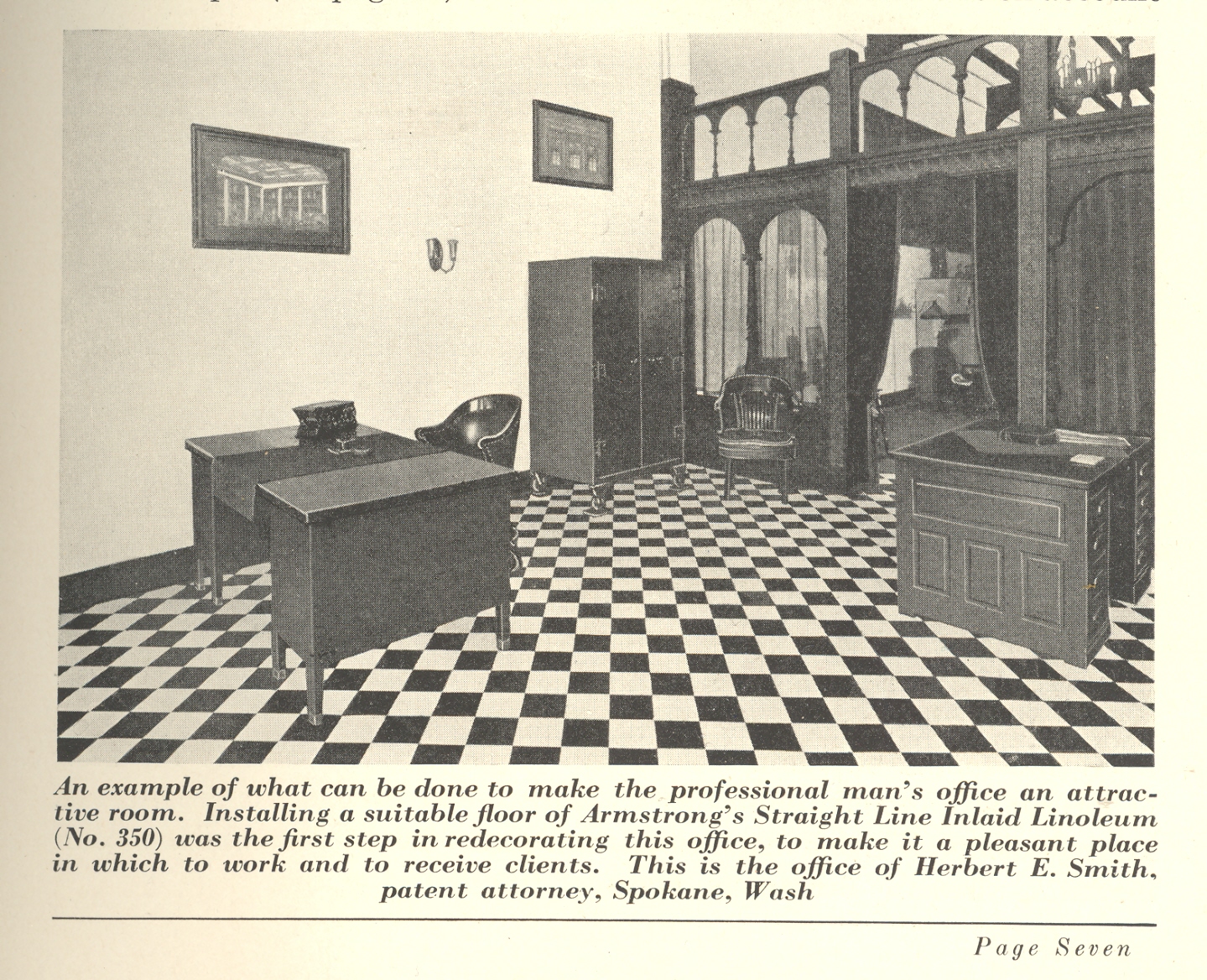
And the perspective-bending distortions of this office, the point of view pulling the squares into rectangles before your eyes:
And this mysterious masterpiece, which the cork company calls “simple”. It is true that there is virtually nothing in this shop that draws the eye of the customer away from the clerk (the goods are stacked away perfectly in uniform boxes around the walls of the store), but the hundreds and hundreds of rectangles do nothing but confuse. And aggravate. A little Einstein on the Beach on the PA system and there would be no customers at all.
Adolf Ehrt (1902-1973) was a twice-born Nazi who in 1935 let
his 3-year membership in the party lapse so that he could do better work for
Hitler from the “outside”.In short, and
to skirt some very interesting detail (over which I really don’t have much
expertise), Ehrt felt that there was too much influence from the Church and government
sources to fuel his unrequited need for purity in the party.
Ehrt wrote this anti-Communist propaganda (Der Weltbolschewismus ein internationales
Gemeinschaftswerk über die bolschewistische Wühlarbeit und die Umsturtzversuche
der Komitern in allen Ländern) from an imaginary perch in something called
the Anti-Kominetern, but was really nothing more than an arm of the Nazi party.Appearing in Leipzig
in 1936, this book savaged communism, communists and the Soviet
Union to no end.I own it
because it is an interesting document and speaks to its period, and also has
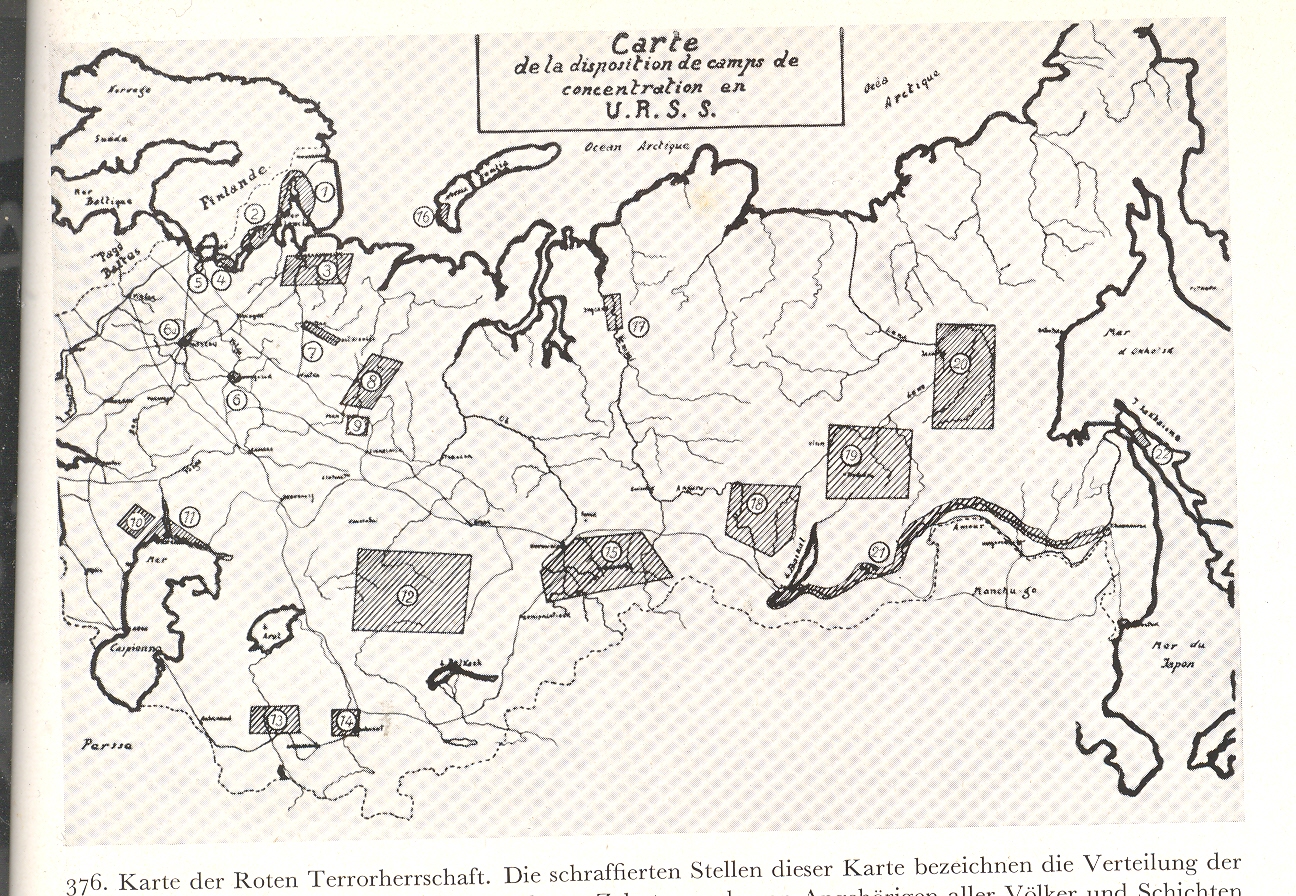
hundreds of unusual photos, giving it a documentary appeal.What I noticed just recently though was a map
on part of page 481 in the weirdly skimpy section on the Soviet Union—a reproduction
of a French map showing the distribution of concentration camps in the USSR.I cannot remember seeing such a map in
English during this time period.
(Clickable/expandable image)
Ehrt was a Nazi painting with broad historical/Nazi strokes
across a Communist canvas, and did get a lot of stuff right in his attacks; but
considering the source his book is useless except for its pictures.The USSR was a wicked place to be at this time; the
bestial Joseph Stalin busy killing hundreds of thousands, imprisoning more—but
this was in general not the story reaching folks in the United States.
That this French map (source not given) showed two dozen or so concentration
camps (Gulags, work camps) is remarkable; and of course it is just the tip of
the Gulag system iceberg.It was at
least a start. It was also just the beginning of a particularly nasty period
for the Russian people, who staggered under the weight of an edict called Article
581 that sent millions of people to their doom. This map was also published just before the Great Terror2, a
spectacularly bad war of internal doom that tore millions from their homes and
hundreds of thousands from the
earth.
The map, rare as it is in appearance and sentiment,
seriously underestimated the extent of the barbaric Soviet existence of the
time.
1. “One can find more epithets in praise of this
article than Turgenev once
assembled to praise the Russian language,
or Nekrasov to
praise Mother Russia: great, powerful, abundant, highly ramified, multiform,
wide sweeping 58, which summed up the world not so much through the exact terms
of its sections as in their extended diacritical interpretation.Who among us has not experienced its
all-encompassing embrace? In all Truth, there is no step, thought, action, or
lack of action under the heavens which could not be punished by the heavy hand
of Article 58” Aleksandr Solzhenitsyn, The Gulag ArchipelagoSee “Article 58″ http://en.wikipedia.org/wiki/Article_58
2. NKVD Order no. 00447, 1937, directed against
“ex-kulaks”
and other “anti-Soviet elements” (such as former officials of the Tsarist regime,
former members of political parties other than the communist party, etc.)See http://en.wikipedia.org/wiki/Great_PurgeGenerally, any unfriendly could be uprooted and shot or sent off to Siberia. .The operative made it easy for local justice
units to identify trouble makers and shoot them.
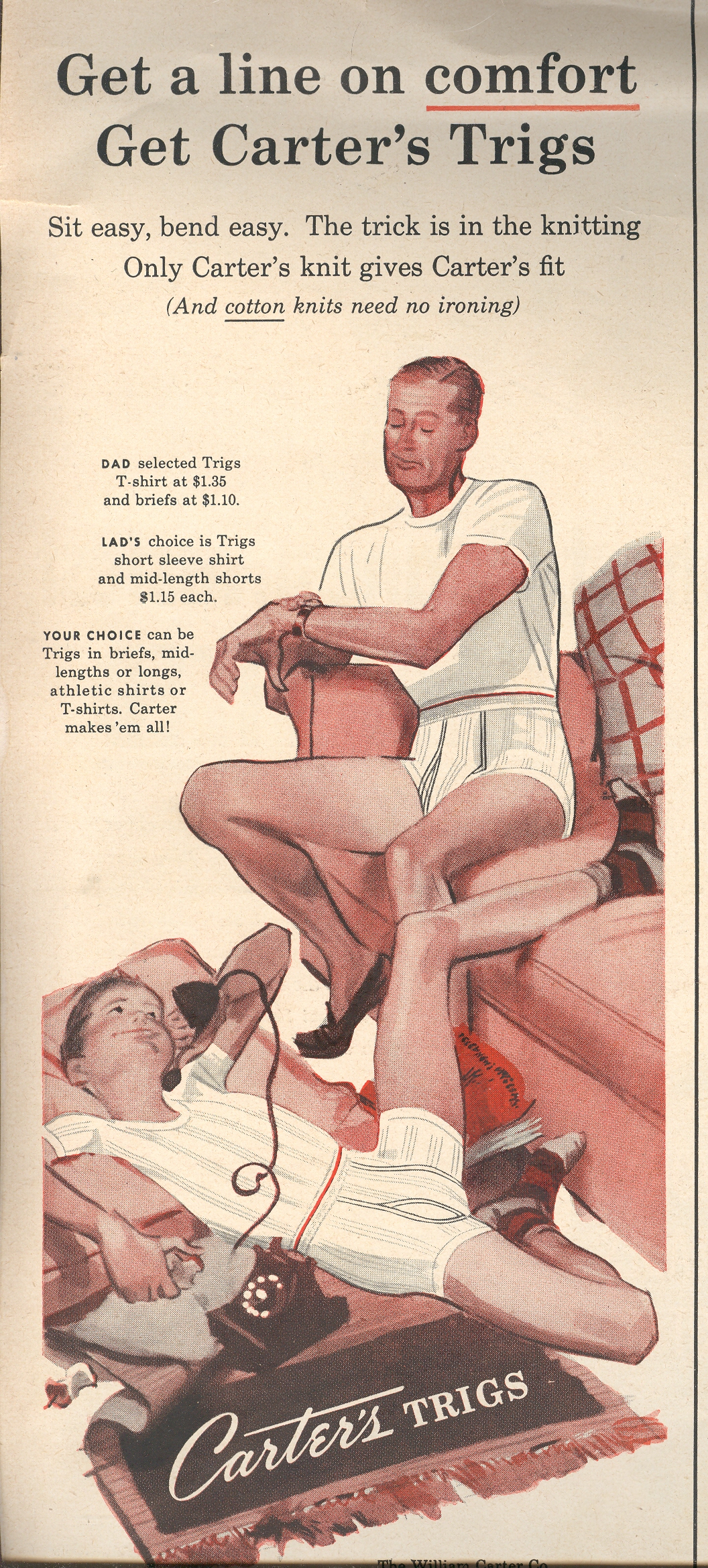
This Carter’s underwear ad from LIFE magazine (1950) makes a weird pronouncement—it
is behavior and body language that was evidently entirely appropriate for the time, that there
was nothing amiss or untoward or askance or unusual in the position or the
glances of the two models.Now, today,
the whole scene is at least unsettling, squirmy.
Meat “Packing” Industry, 1917:
“The String Department” and “Curled Hair Machines” at the
Meat Plant (here)
Spam, Smeat, Spic, Prem, Mor & Arf: Food
by Any Other Name (here)
Food, Food Packaging and Creating Desire: the
du Pont Company, WWII. (here)
I wrote yesterday (The Importance of Bridges in the Invisible Evolution of
Meat) about the invisible evolution of meat from range to plate, but mostly about
what happens in those big building with no windows.The wide solitary middle of this food chain
exists almost not at all in the popular mind, most folks choosing not to think
of the gruesome process of “processing” animals into the plastic-protected deli
selections.
The middle killing & etc. part has been generally very well hidden from
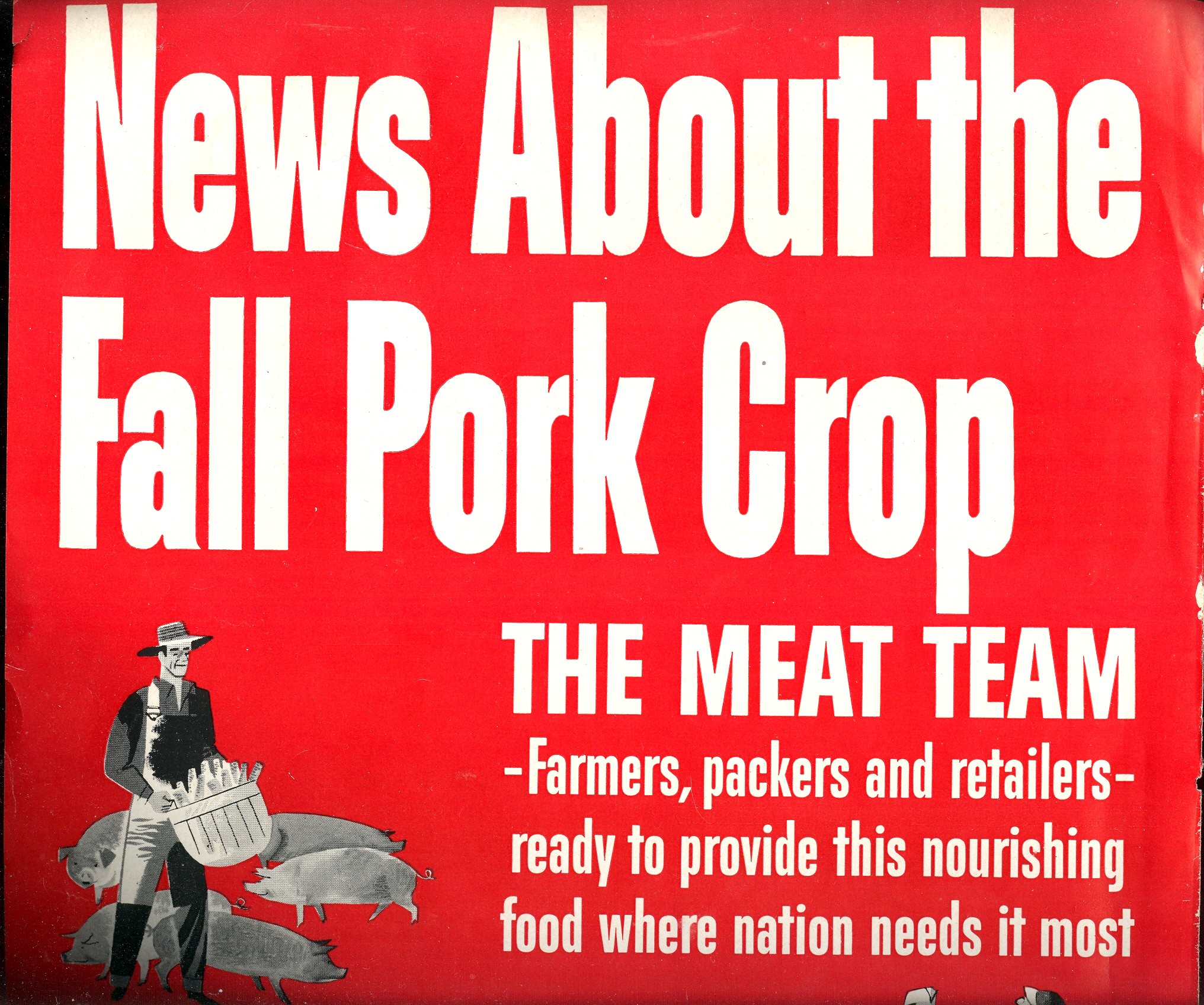
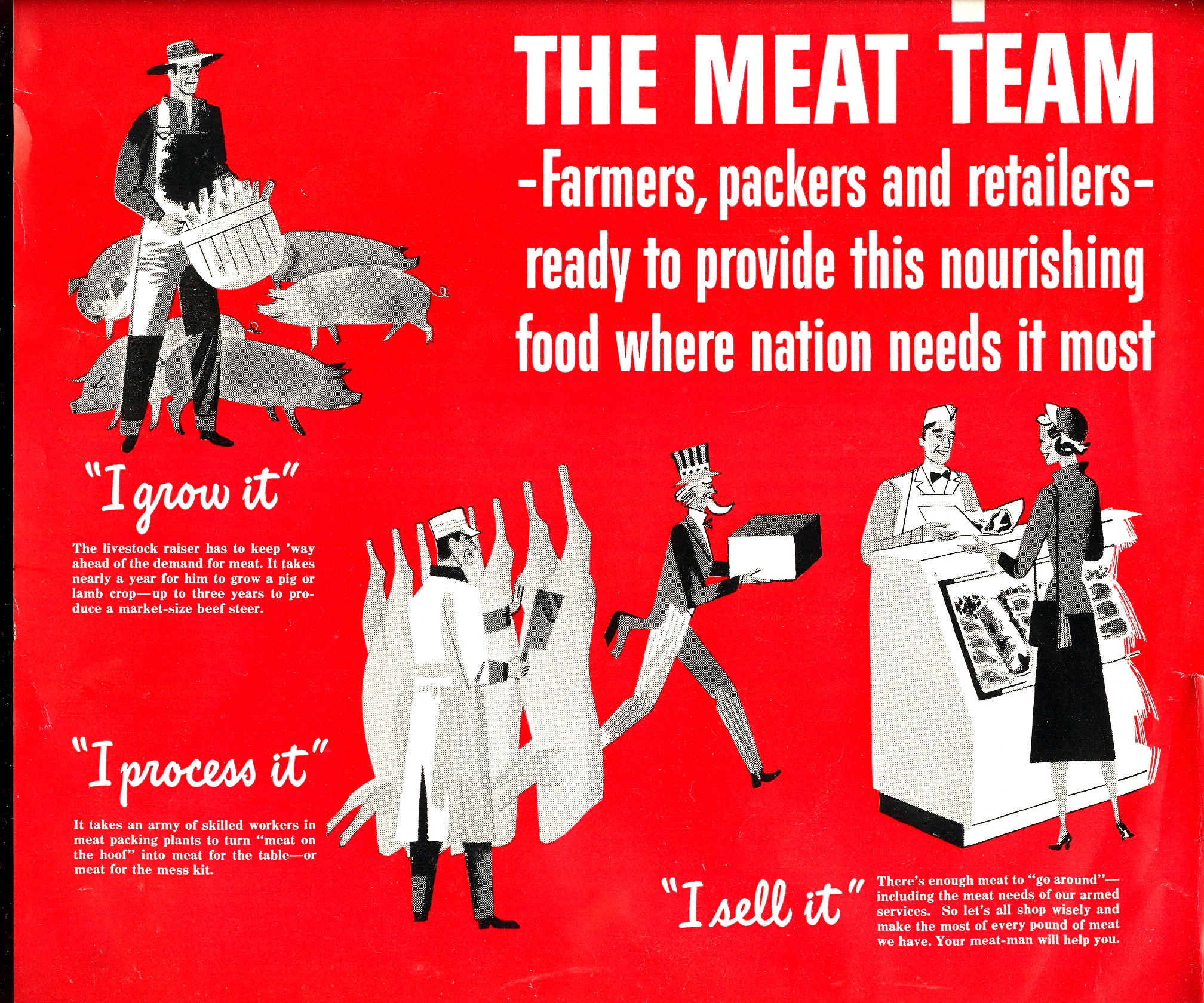
public view, at least for the 20th century.For example, this 1949 ad from LIFE magazine
introduces the “Fall Pork Chop” with the evolution of meat summarized in those
three small pictures.The processing guy
is starched and white and pure standing there before the non-detailed,
smoothed-out carcasses.He even has a
little white cap.The interesting part
here is the Uncle Sam delivering the boxed final product.Uncle Sam? How did he get into the picture? He certainly sanitizes the whole procedure, what with the imprimatur of
the U.S.
government and all, and even suggests a slightly patriotic aspect to the food
chain. The odd thing here though is the blood-red background color, which was a
common practice for selling dead flesh in LIFE for many years.
The middle killing and scooping part of this is basically nothing that would
ever be broadcast on television, and certainly it is nothing that parents would
want their kids to see.Don’t people
turn in horror and disgust when those undercover videos of processing
plantpractices make it to youtube?So if these images are too fabulously
gruesome for children (and adults) to watch, why take a benefit from them?I’d say that if the process of producing your
benefit is too horrible to watch you
shouldn’t be able to enjoy the outcome.
I wonder when it was that humans developed the extra senses that were able to “intuitively” determine (1) when
something is missing, and (1.5) when something is just wrong?I’m sure that these blood-bumpers were developed
soon after the recognition that the face in the primordial goo staring back at
its owner wasn’t something drowning.
This fast-forwards us through Wilberforces ultradense 6,000 years to the
near-present: when looking at the explosively chromaticized picture of the progress
of meat, brought to you by the invisible packing empire of Armour & Co. (of
Chicago, of course), one gets the ancient immediacy of something being missing
and just plain wrong.
The cows being herded from their pastures are being led to the Armour bridge
of Meat Evolution, where by some miracle the process of turning cows into
packaged goods—like Leda and the swan—takes place over the “A” in Armour, three-quarters
of the way over the bridge.This process
is wholesome in its invisibility, the walking product on the one side of the
bridge getting ready for transubstantiation for the nested humanity on the
other side.
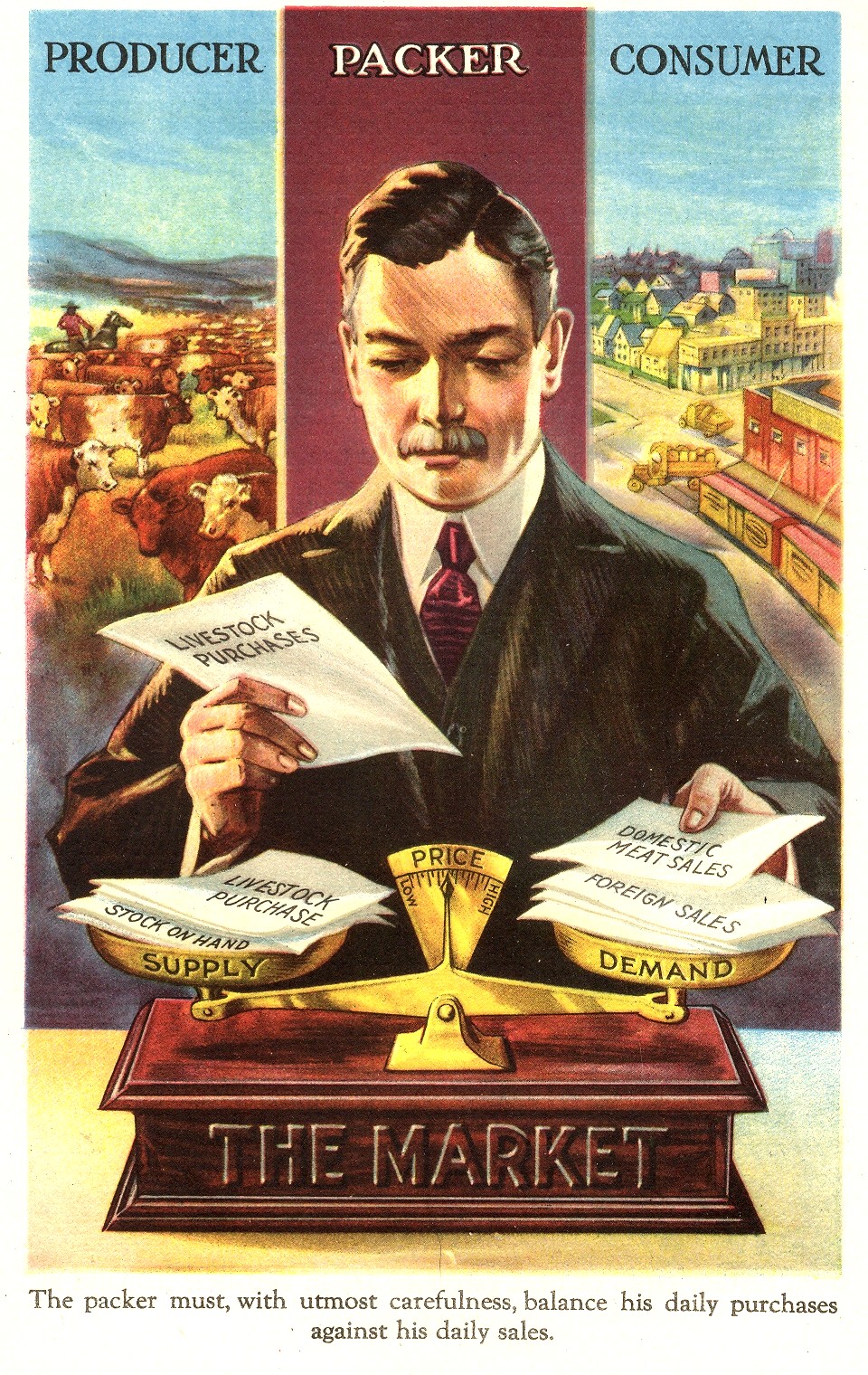
The picture of the packer weighing the elements of the mysterious
gold-plated market rams this invisibility home as well:the “producer” and “consumer” columns behind
him are prettily illustrated with referential scenes, while the “packer” column
just gets a single slab of color.A
singularity of nothingness in regards to what goes on behind the packer’s head
is all the consumer would want, then and now, ‘cause certainly nobody wanted to
know what the hell was going on in the packer’s den to hasten the evolution of
cows from muddy hooves to the dinner table–especially in 1926, when this
pamphlet was printed.The vast
conspiracy of people not-wanting-to-know-what-happens-at-the-packing-house continues.
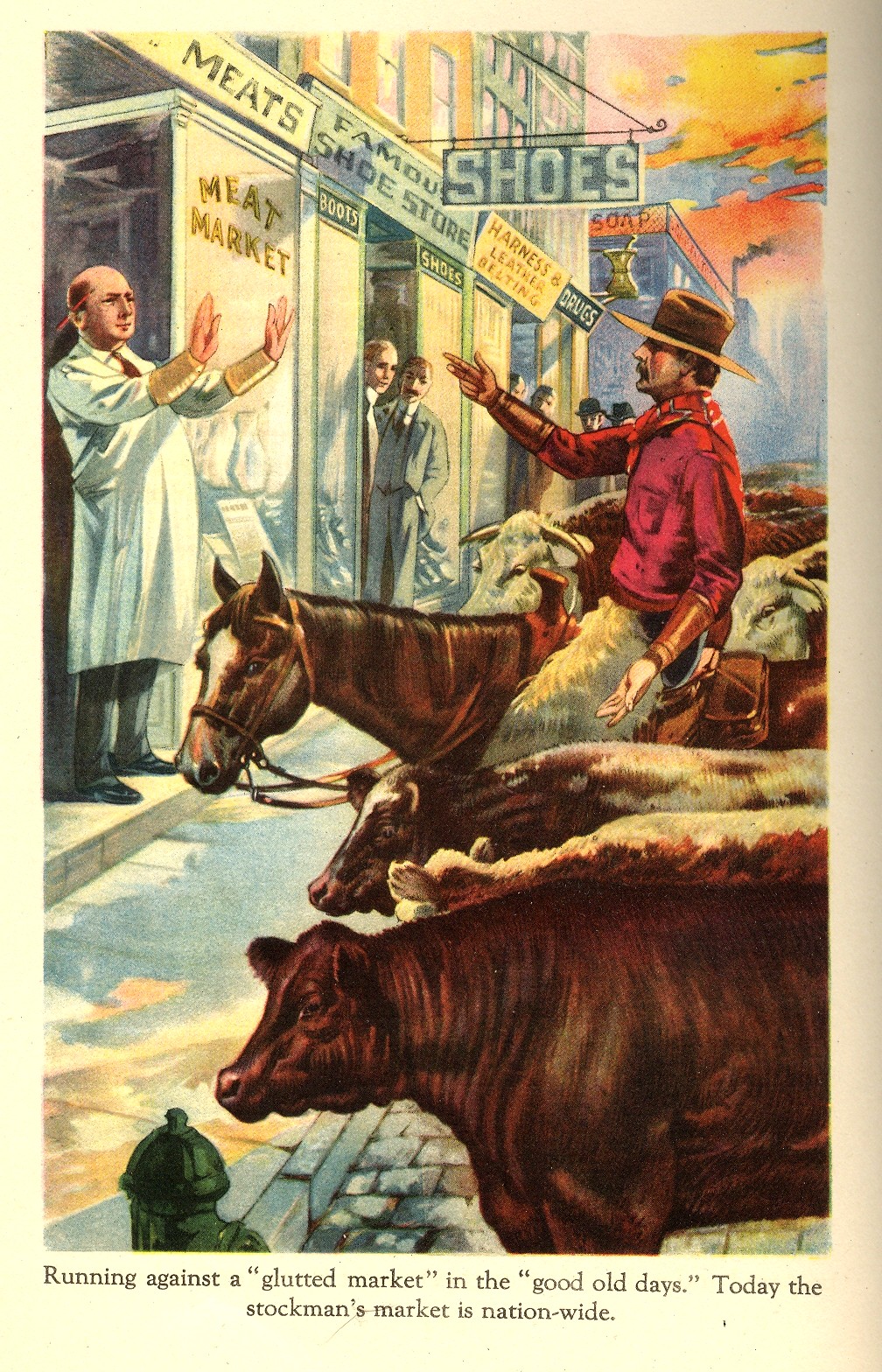
I can’t leave this short post without a nod to another extraordinary image
from the Armour pamphlet:the butcher
waving off the drover and his herd because of a glutted market.The “good old days” here doesn’t look very
much like the 1870’s to me:I can’t
recall a single drover/cowboy image in my very long experience that showed a cow
sniffing a fire hydrant.Plus everything
else in the picture is pure 1920’s, except for the drover, who—although wearing
skins in the city for some unknown reason—at least looks mostly like he should
and isn’t packing an endlessly bouncing-on-your-thigh revolver.Sorta.
The horse looks embarrassed and surprised at the same time. Is there an English word for that?
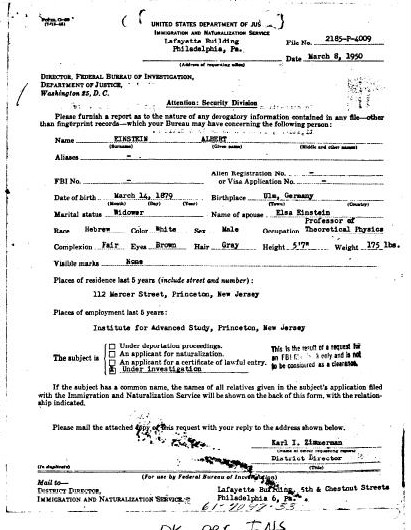
While looking at the FBI files for Leo Szilard, a great physicist who had liberal-left ideas about peace and strategy and the use of the atomic bomb (in June 1945), I stumbled onto the files for one of the people sought by the Bureau to talk about Szilard: Albert Einstein. He and Szilard went back a long way, and Szilard’s advanced physics supra-intelligence and illuminated social outlook was instantly recognizable to Einstein, making it easy for Einstein to give him an excellent recommendation. Which of course is something the FBI didn’t want to hear, as Szilard was mucking around in the national will to use the ultimate weapon, among other things.
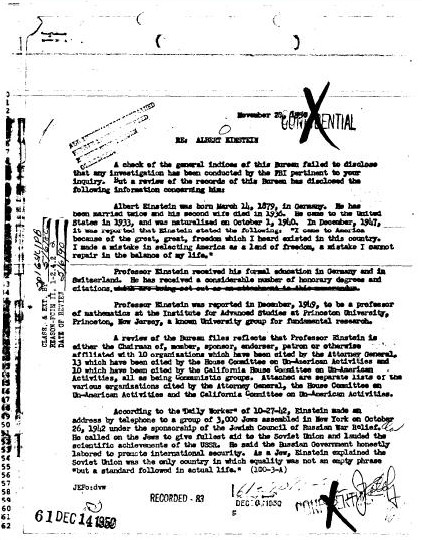
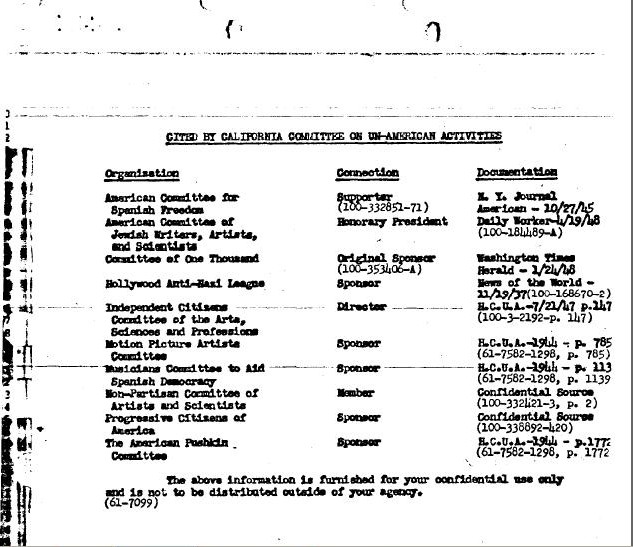
I knew a little about the FBI’s interest in Einstein, but I had never actually looked at any of the declassified files, which as it turns out live at the FBI site, all 1600+ pages of them. Hoover had some sort of special need to fill with looking after Einstein, whose nearly 20-year-long file is just not pretty. The Director was sniffing around the edges of Einstein’s social life, trying to make them into centers to do god knows what with them. One of the files details the subversive organizations that Einstein was associated with–some of the hundreds and hundreds of groups that he lent his name to over the years.
Here’s some of those threatening organizations:
Not much to look at, really.
But it is this gentle, subtle, horrible document below that causes real grief, the “under investigation” part at the end is just heartbreaking, a Lilliputian effort to control forces beyond their comprehension. Such is the power of ignorance.
 William Burroughs—one of
  n supervened. The end result was a combined syndrome of unparalleled