A Daily History of Holes, Dots, Lines, Science, History, Math, Physics, Art, the Unintentional Absurd, Architecture, Maps, Data Visualization, Blank and Missing Things, and so on. |1.6 million words, 7500 images, 4.9 million hits| Press & appearances in The Times, Le Figaro, Mensa, The Economist, The Guardian, Discovery News, Slate, Le Monde, Sci American Blogs, Le Pont, and many other places… 5000+ total posts since 2008.

Category: Bad Ideas

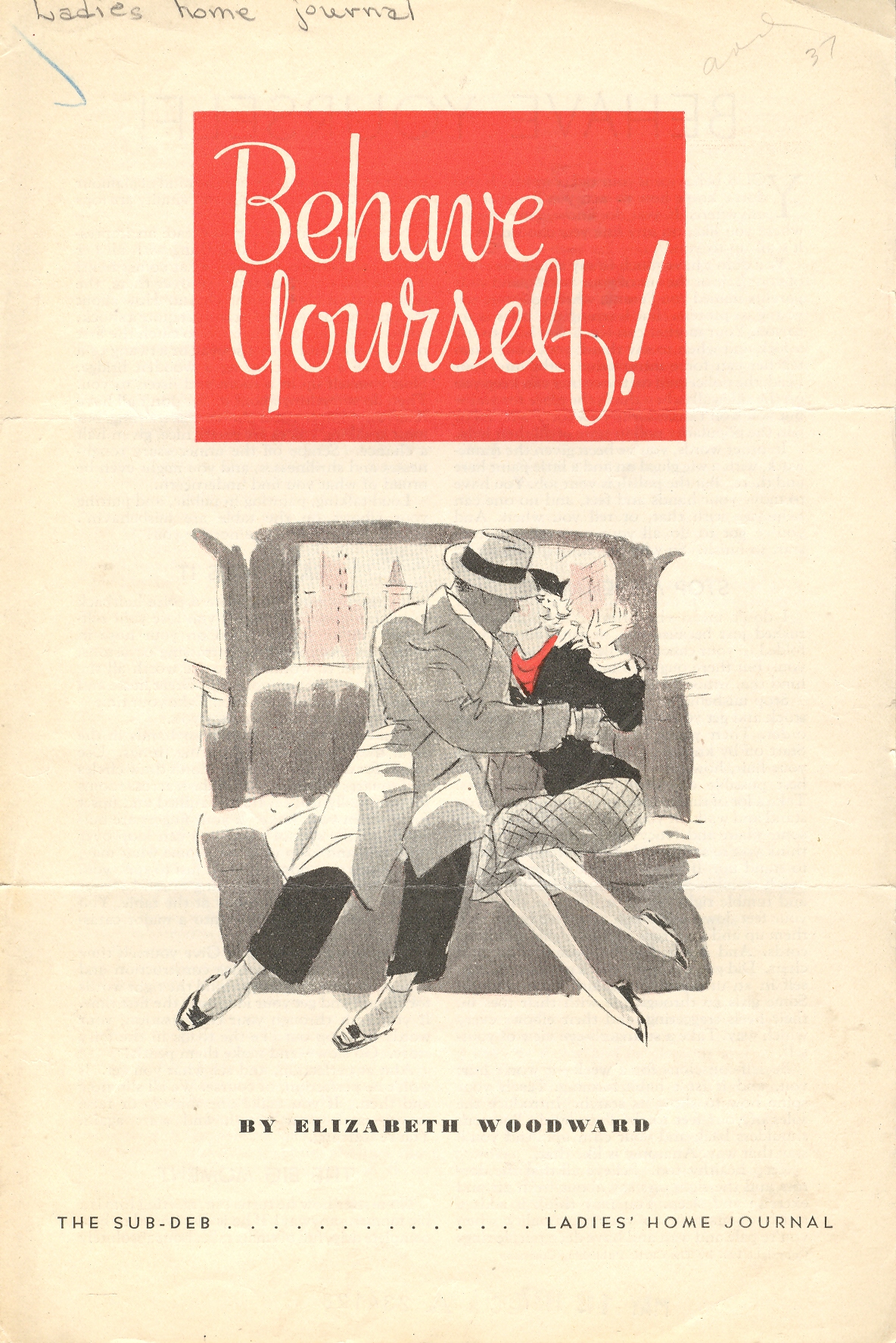
  • “The First Thing is to Find Some Men” How to Get a Boy-Date, 1941

    JF Ptak Science Books LLC  Post 914

    [Continuing the posts “What Makes Human Robot Girls, 1941” and The Missing Pieces of Women, Pope Joan and the Proper Girl]

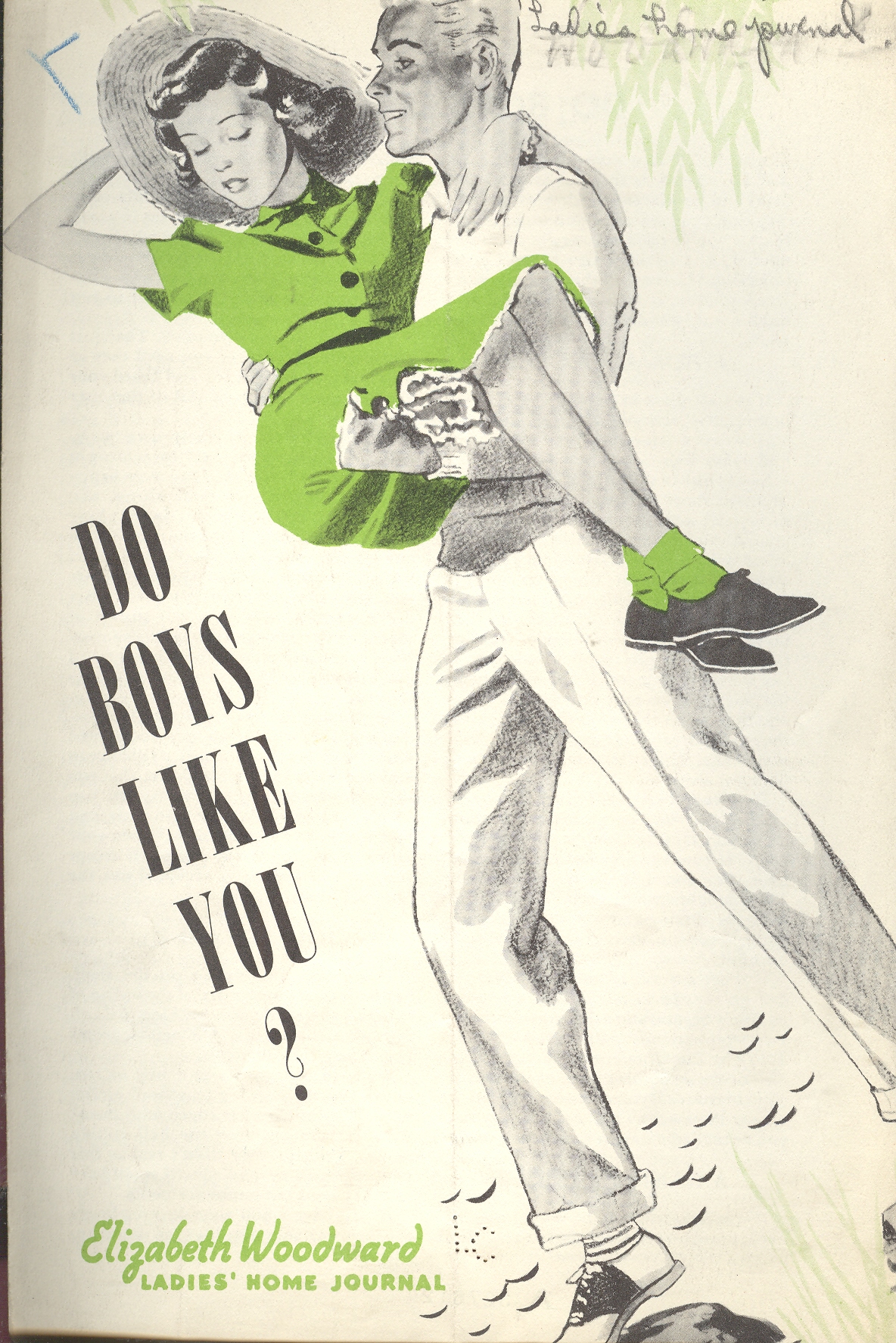
    Do Boys Like You? is
    the name-of-the-game for girls, evidently (“set out to make yourself worthy of a boy’s
    affection.  Just one boy—any boy…”),
    brought to you as a part of a long, continuing series by Elizabeth Woodward in
    the Ladies’ Home Journal in the early
    1940’s. Blog jan 20 boys like you
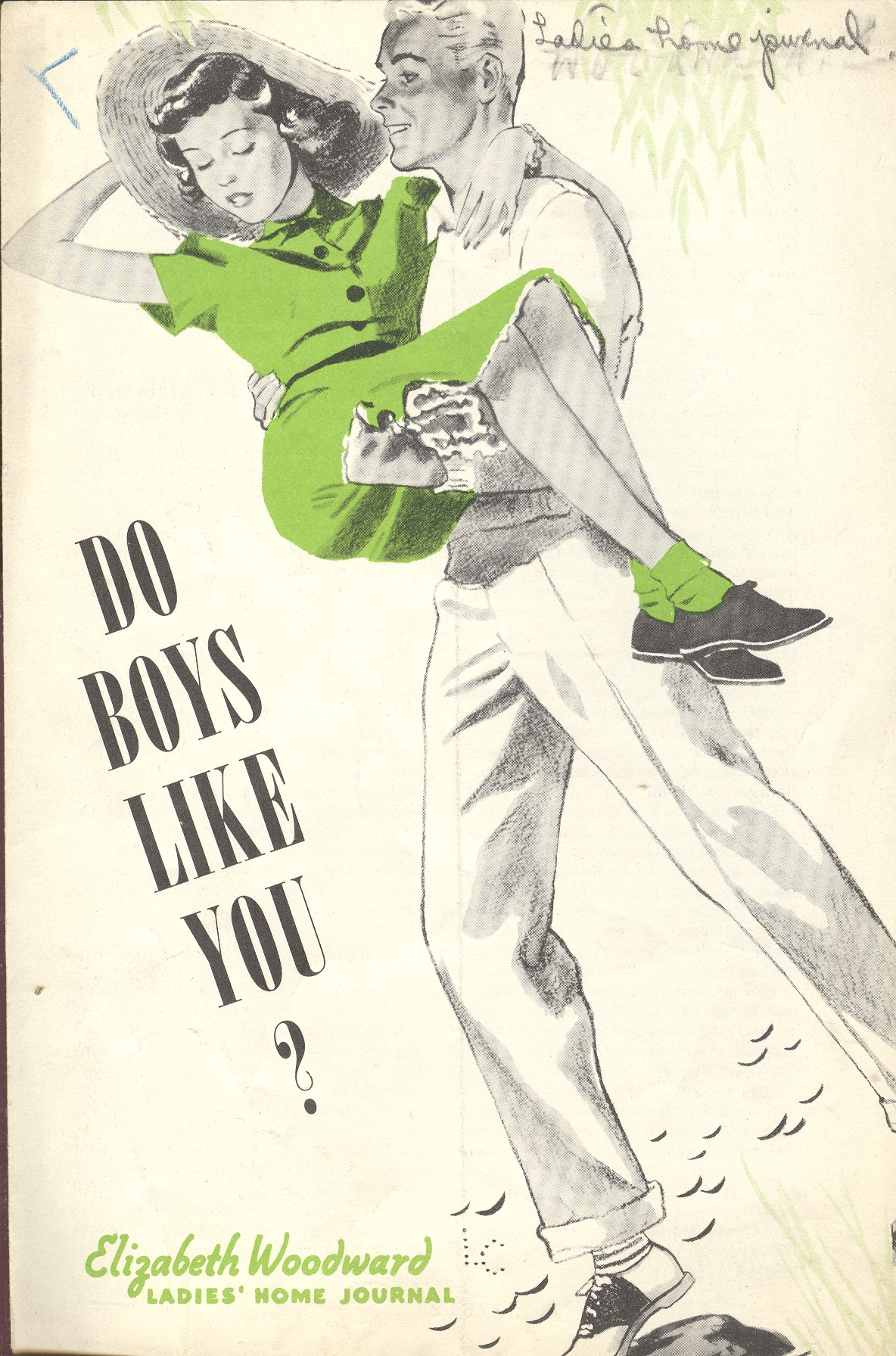
    This installment is about getting a boy for a date, and how to make
    oneself getable and datable and boy-friendly, all while maintaining the
    thinnest veneer of self-acknowledgment (“be adaptable as a chameleon”) as possible while staying true to “yourself”.  It is a cocktail of overall old-lady sense
    and deep ruffled bows writ by the hand of gender entrapment and not-so-subtle
    subjugation. Let’s get to it with some of the more archaeologically-interesting
    statements of this social-norms-establishing pamphlet:

    Paragraph: (Intro):

    “Do boys like you, or don’t they? Its as easy as that!  Either you have dates and go places with lots
    of boys, or they don’t pay any attention to you at all.”

    Paragraph: “A Female World”

    “…the first thing is to find some men.” (Which is odd
    because “men” is used only one other time beyond this reference—its all boys
    and nothing but boys.)

    “Short of throwing yourself on their (boys’) mercy, see if
    you can’t wrangle an introduction out of the girls who do know boys…”

    “Your parents could invite their friends over for dinner and
    ask them to bring along their son. And you do a good job on him!” (I’m not sure
    what that “job” is.)

    “They (boys) can’t find you if you’re packed away in a mob
    of females.”

    Paragraph: “A Rank Outsider” (on being the new girl in a
    community):

    “The girls have things under control and they don’t want any
    interference from you.”

    “You might know more than they do, and you just might talk
    down your pug nose at them.”

    “…you’d better get accustomed to traveling alone…”

    “Give them every chance to find out that you aren’t high
    hat, that you like the same things they do, that you aren’t out to sniggle
    their men away…”

    “When they (the girls) accept you, the boys will too…”

    Paragraph: “an Old Story”

    “(Boys) are so used to looking at you that they think of you
    as furniture.You’ve got to be new!”

    “If you’re fat and pudgy, make yourself lean, sleek and
    smart.”

    Paragraph “Take it Easy”

    “…its going to take practice to make boys like you. Take it
    easy. Set out to make yourself worthy of a boy’s affection.  Just one boy—any boy…”

    Paragraph “A Few Gentle Hints” (Seems that we’ve gone way beyond this by now.)

    “Don’t run around with girls who are dud.”

    “Don’t go in pairs with a girl who is overwhelmingly popular…Better
    pick a girl who will give you an even break.”

    “Don’t languish for some local ‘hero’ who is sought after by
    all the girls in town.  He may be
    good-but he’s far out of reach…”

    “Don’t pick on a lad who has never had a date with a girl.”

    “Don’t be careless or sloppy when you’re talking with boys…”

    “Don’t expect (or even hope) that every boy you meet will
    ask you for a date.”

    And (not quite) lastly, but should’ve been:

    “Don’t go around thinking about boys constantly.”

    But lastly thus:

    “Act as though you are having fun. Be alive, gay and enthusiastic. Be interested in what’s going on. Be sweet, tactful, and adaptable as a chameleon. Have definite likes and dislikes, but don’t be so rigid
    that you are stubborn, opinionated and difficult to get long with. Be carefree,
    casual, easy, willing to play and fun to play with. And don’t be shy about
    liking the boys.

    THEN THE BOYS WILL LIKE YOU! [Emphasis in the original.]

    My poor mother would’ve been reading this…

    (Thanks to Jeff Donlan for pointing out that the chap on the
    cover carrying the girl away has joined the fabric of her skirt to (1)  hold
    onto and steady her and (2) make sure her skirt doesn’t fly up and out and is not actually touching her thigh…)


  • Missing Pieces of Women: Pope Joan & the Proper Popular Girl of “The Ladies’ Home Journal”

    JF Ptak Science Books LLC  Post 910Pope joan weltknronik

    Listening
    to these dreadful stories this morning on NPR about the Vatican’s relations
    with the Roman Jewish community and the abortive WWII papacy of Pope Pius XII—the
    papacy of blank and missing compassion—I thought about the missing Papacy of
    Pope Joan.  Whether or not she existed is
    a question of debate; whether she was a pope or not is perhaps even less
    debatable.  What seems not impossible
    though is the ability of a large institution like the Catholic Church to make
    the entire issue of unwanted history or legacy to go away. 

    The
    historicity of this papacy is long and shows the murkiness of the earliest
    writers on Joan. She was supposed to have served as pope between Leo IV and
    Benedict III around the year 850.  The
    fuller versions of her history turn up in the 14th century, although
    the earliest mentions of a female bishop of Rome go back to the 9th
    century—Joan remains unnamed though until the 13th century when
    Martin of Opava’s Chronicon Pontificum et Imperatorum1(referring to
    Joan as “John Anglicus” or “John of Mainz”) does so for the first time.

    Joan apocJoan
    escapes the Middle Ages with a little flair, but doesn’t do so well in the
    Renaissance.  As a Missing Piece in the
    history of the Papacy she turns up not-so-well represented:  for example, she is seen here looking good
    but turning up bad overall as the Whore of Babylon2.  She was treated as a disgrace, and impostor,
    someone who demeaned the Catholic institution by her sex and deception, though
    god knows that the history of the papacy is filled with horror stories3 that
    far exceed the reach of mere deception.

    So
    I was thinking about the piecing-together of the Pope Joan jigsaw and
    remembered an actual “womanly” jigsaw that could actually be pieced
    together.  This bit came together as a
    result of a post I did here just two days ago (What Goes Into Making Human Robot Girls, 1941), and was one of a series of
    intolerably heavy eight-page pamphlets cementing the structure of female social
    intercourse at the hands of the magazine The
    Ladies’ Home Journal
    . 

    Blog jan 13 Puzzle cvr

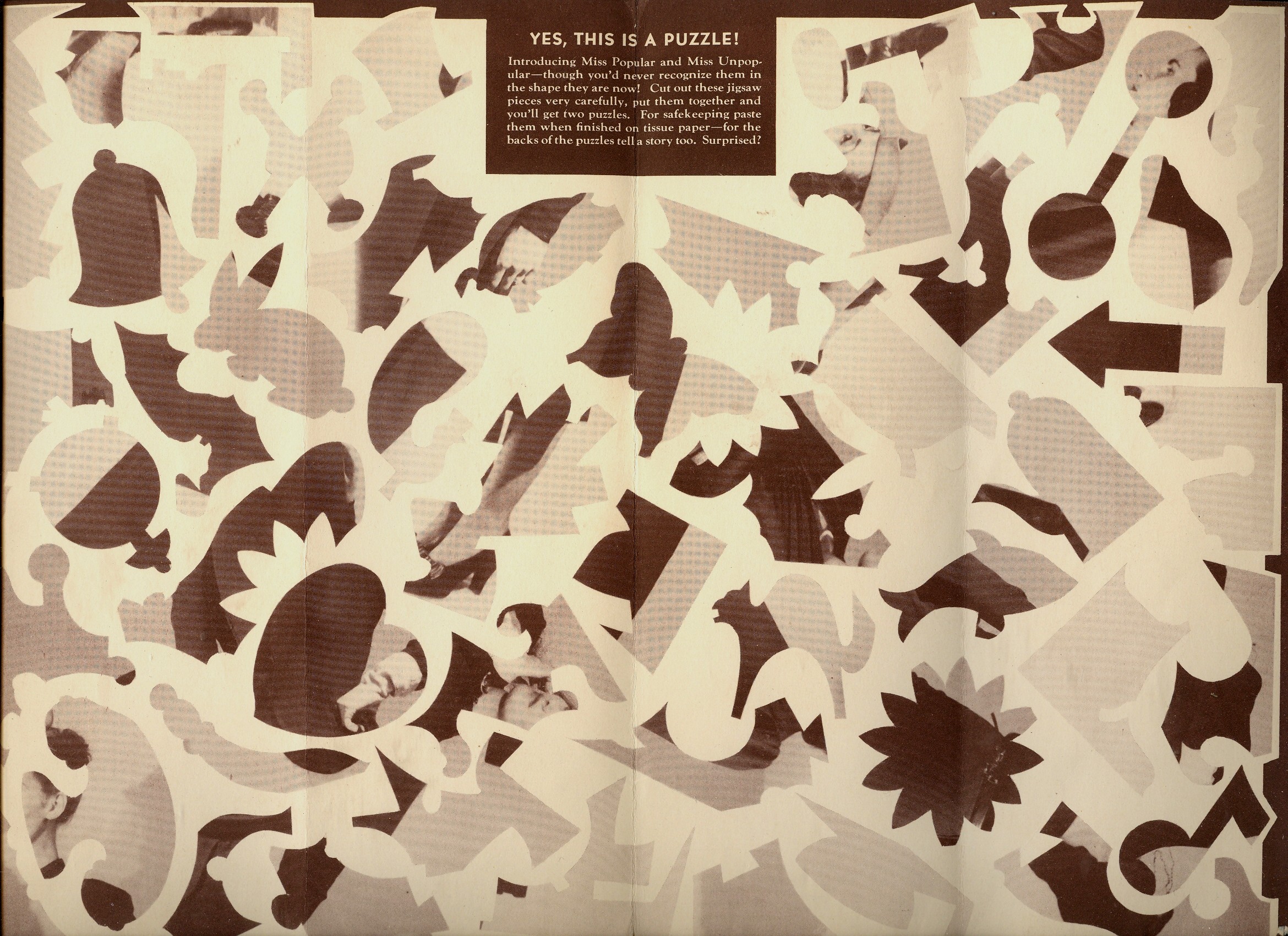
    One of these
    publications—hardly a pamphlet per se, just a folded 11×8 inch sheet of heavy
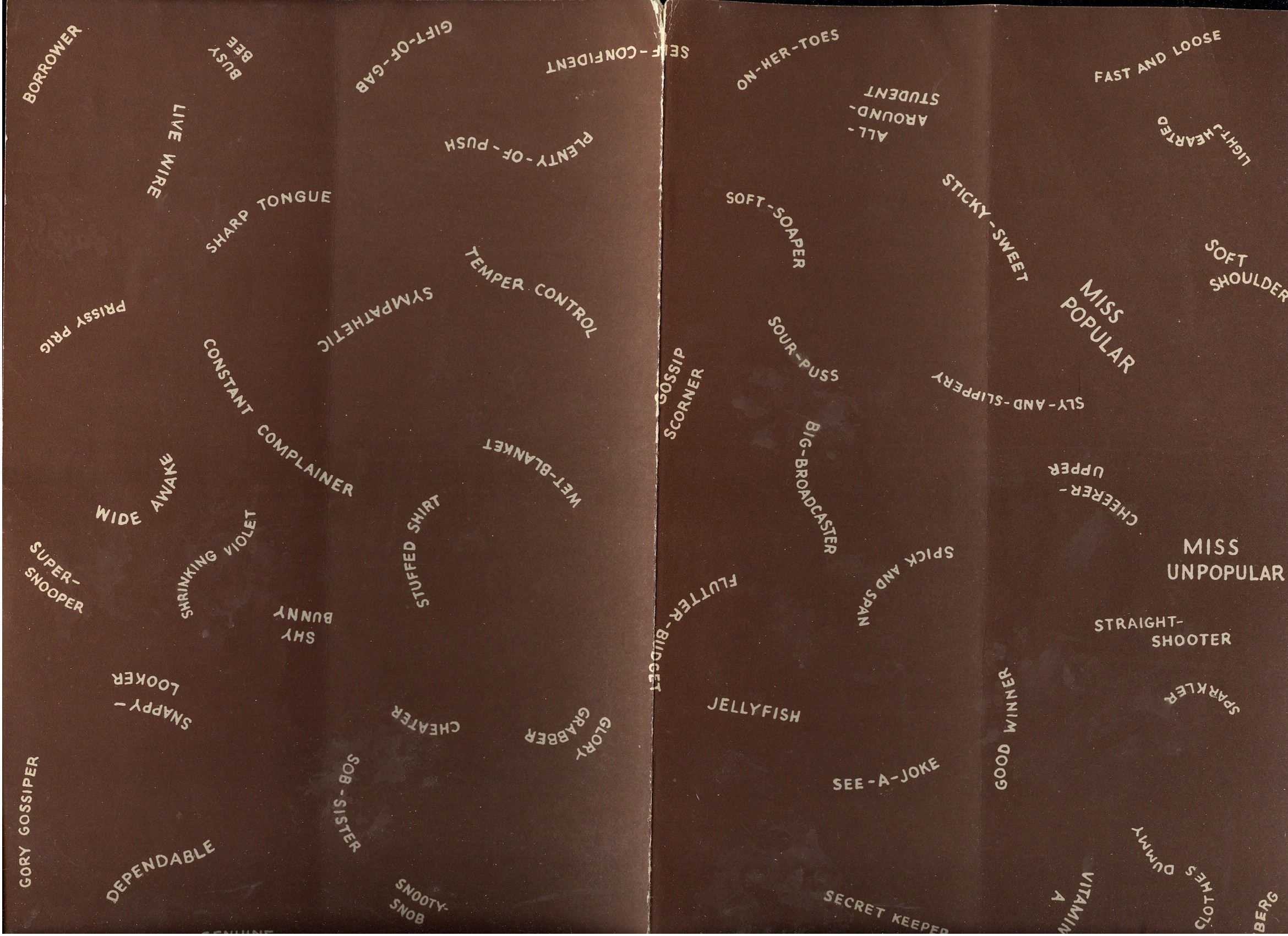
    stock—came without a title, presenting itself as a puzzle. The puzzle pieces
    are parts of two women, “Miss Popular” and “Miss Unpopular”: the reader was to
    take the publication, cut out the pieces, and reassemble them into hidden role
    models, with phrases describing each on the back of each puzzle piece, all done
    without the slightest possible understanding of metaphor or irony.

    Miss
    Popular phrases/descriptors
    : live wire, plenty of push, wide awake, snappy
    looker, dependable, genuine, secret keeper, on-her-toes, spick and span, light
    hearted, all-around-student, straight-shooter, gossip scorner, sympathetic,
    cheerer-upper, sparkler.

    Blog jan 13 Puzzle pzl

    Miss
    Unpopular’s phrases/descriptors
    : glory grabber, sour puss, cheater, sob-sister,
    snooty-snob, wet-blanket, borrower, prissy prig, sharp tongue, gory gossiper,
    clothes dummy, iceberg, sly and slippery, jellyfish, sticky-sweet, soft soaper
    (?) and of course fast and loose.

    And
    so girls—or young women—picking up this publication in 1941 were expected to
    cut this thing up and piece together the proper (paper) role model using the
    reinforcing traits of meager acceptance printed on the back of the puzzle
    piece. And poor Pope Joan, whether she was real or not, whether she was
    imagined or sunk purposefully away into the Pandora’s sisters’ boxes of forced
    forgetfulness—it really doesn’t matter—is just another woman or part of woman’s
    puzzle whose blank or missing piece has been extruded, forced into a form more
    friendly to a world less friendly to women. 

    Notes

    1.According
    to the Chronicon:  “John Anglicus,
    born at Mainz,
    was Pope for two years, seven months and four days, and died in Rome, after which there
    was a vacancy in
    the Papacy
    of one month…” [See continued reading section below for more]

    2.
    Babylon was the
    representation of the seat of evil on the Earth.  From the “Book of Revelation” (17:3–4):
    “And I saw a woman sitting on a scarlet beast, full of names of blasphemy
    with seven heads and ten horns. The woman was garbed in purple and scarlet, and
    gilded with gold, gems, and pearls, and bearing a golden goblet in her hand
    full of abominations and filthiness of her fornication.”

    3.
    Borgia and the Medicis not being the least of the story: see E.R. Chamberlin’s The Bad Popes, (1969)


  • What Goes into Making Human Robot Girls, 1941

    JF Ptak Science Books LLC  Post 907

    [See the follow-up post “First Thing to Do is to Find Some Men”; How to Get a Boy-date, 1941]

    An
    old friend of mine, Dr. Sam Koslov, was  brilliant, accomplished and polymathic, with
    great senses of wonder, inquisitiveness and humor.  He spent many years in research and as a
    long-time editor at Johns Hopkins APL.  He was a delightful and serious man, though
    one of the projects he worked on sounded much more like squeaky scifi than pure
    sci. That was Project Pandora, and science fiction it definitely wasn’t—it was
    an attempt at a form of control over human behavior via low level microwave radiation1. 

    This
    came to mind as I was leading through some very low level, high impact behavior
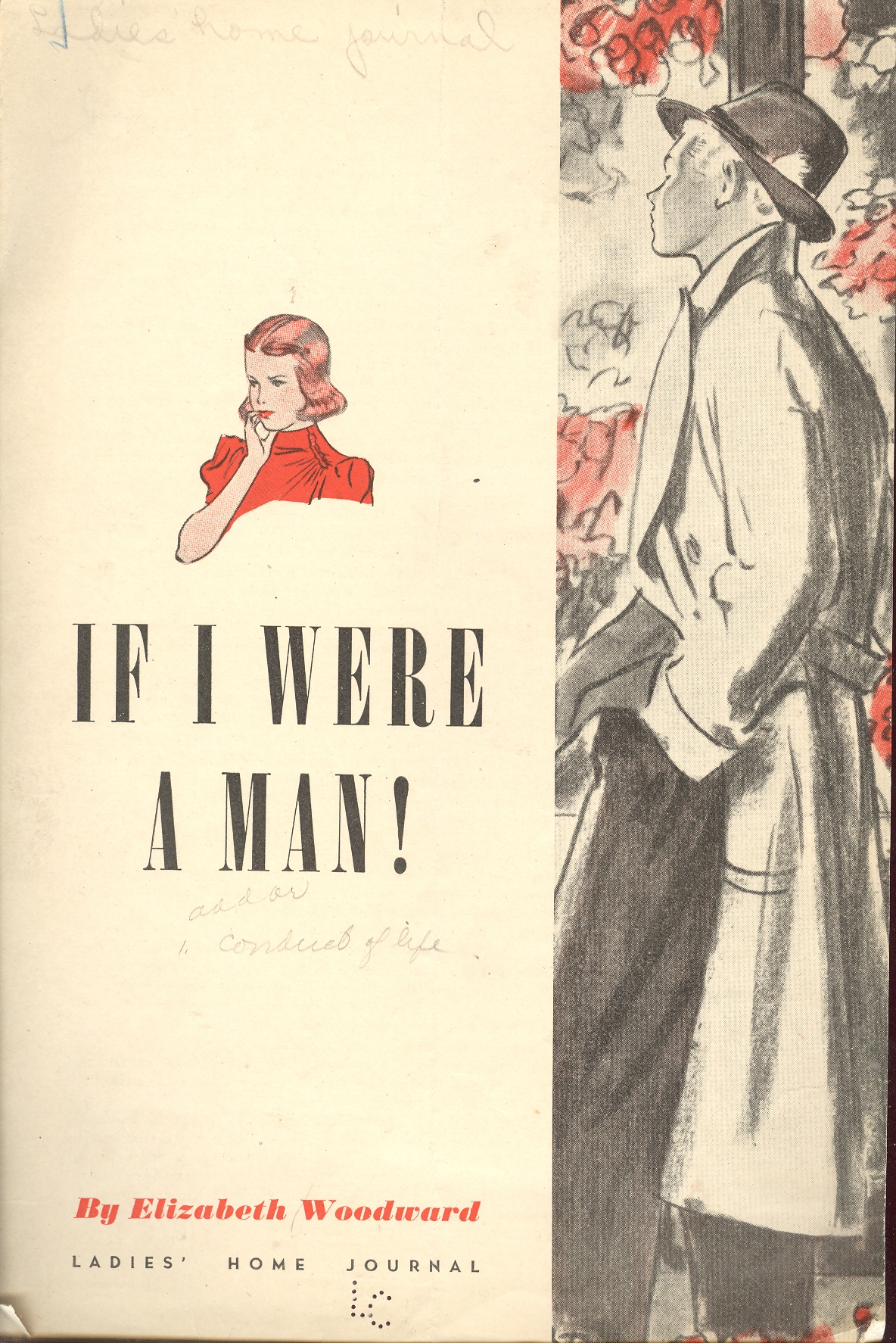
    control exhibited in a series of social engineering pamphlets published by the Ladies’ Home Journal in the early 1940’s. Blog jan 12 girlz--if i were a man It is heartbreaking, really, to think of people
    like my mother reading these things and being inundated by cultural architecture
    that left little to the imagination.  It
    seems so terrifically outrageous in 2010; and of course it makes me wonder
    about what things that seem so de rigueur
    today will be the Ladies’ Home
    Embarrassments
    of 2050Blog jan 12 girlz--ggnetlman preffered . 

    Granted, nobody’s corneas were being shaken loose via this method, but the effect of the sentiments of control in these pamphlets still seem eye-poppingly
    strangulating.  I’ve included only a few
    examples here, but there are at least a hundred others to choose from.

    Blog jan 12 girlz--behave yourself

    Perhaps
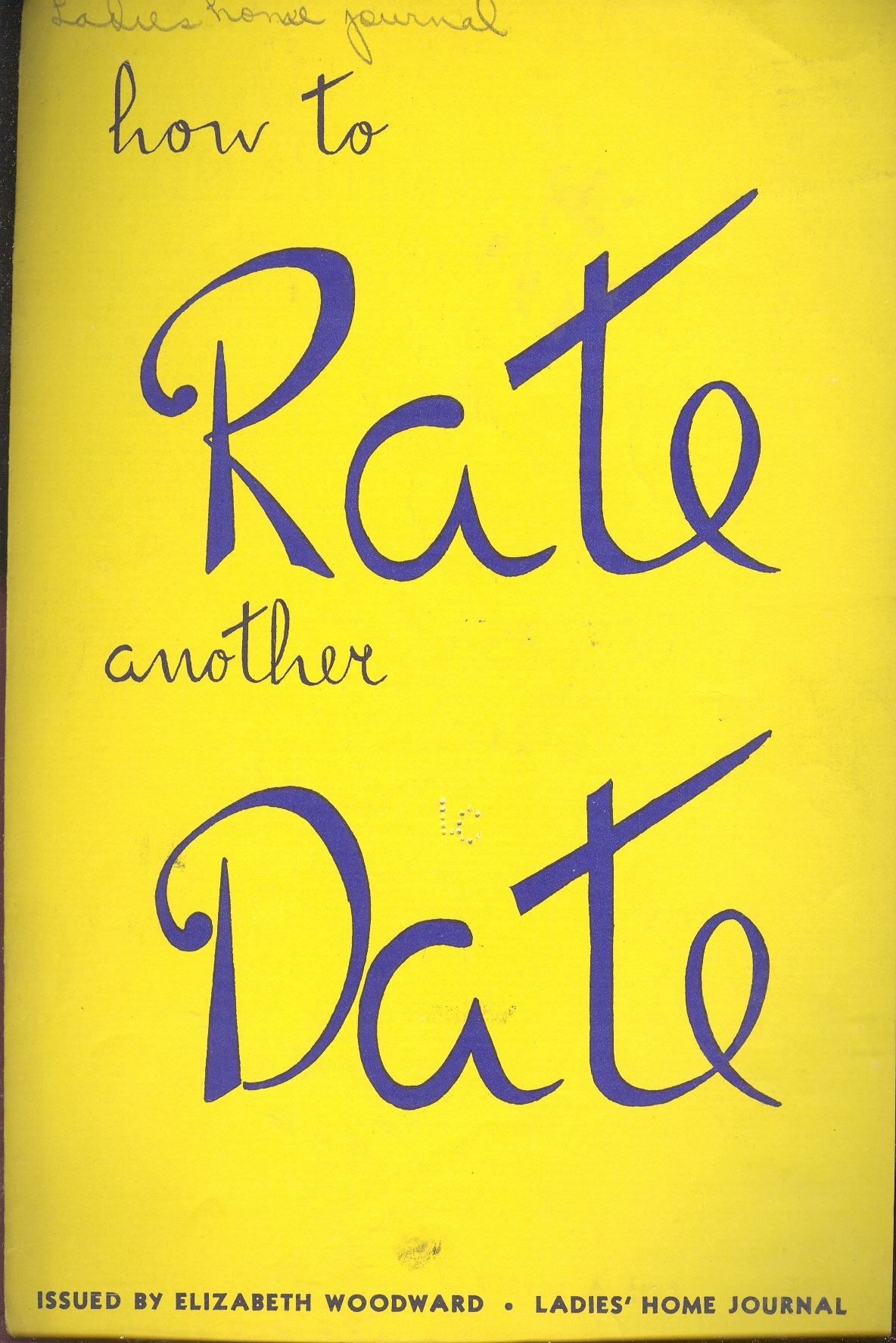
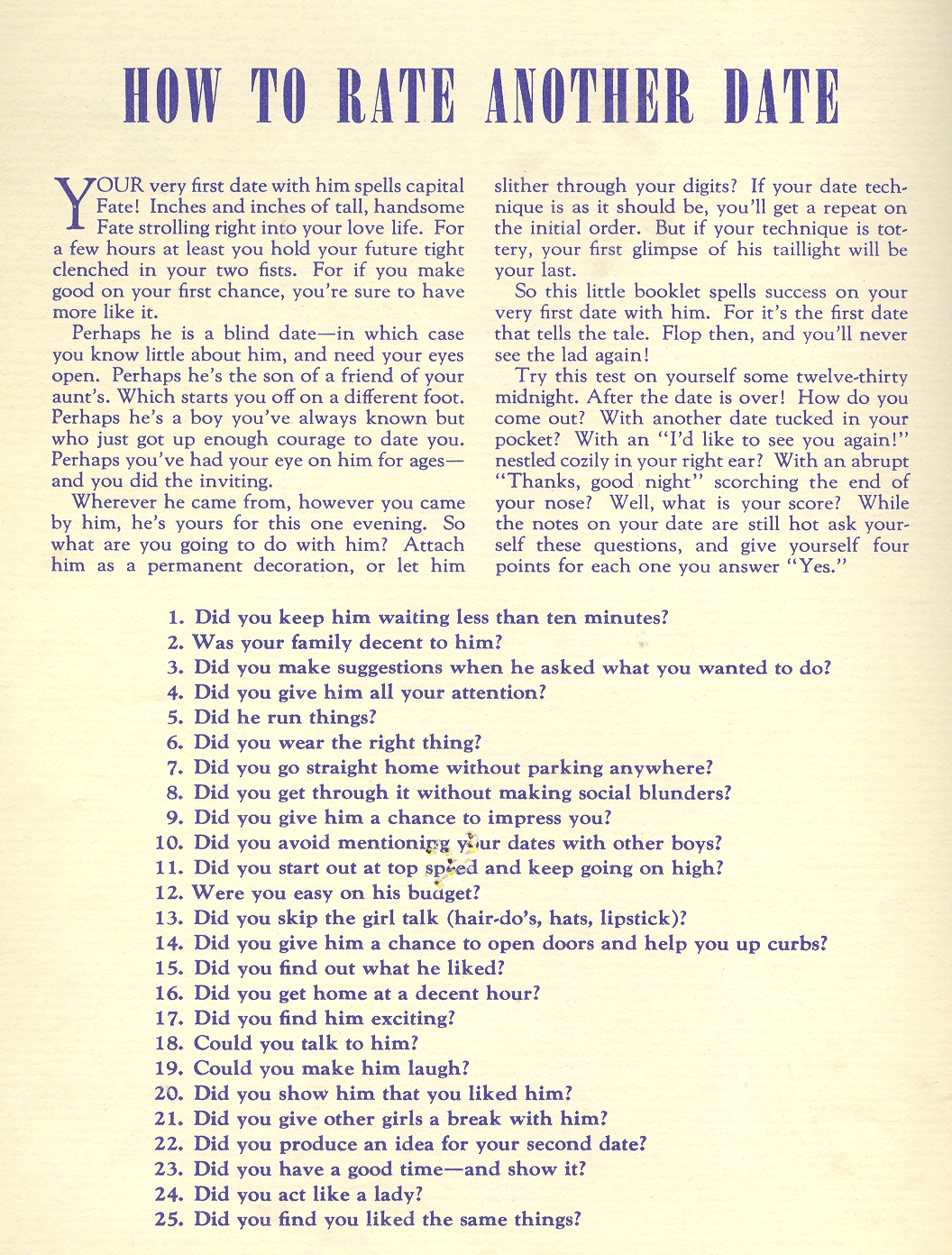
    it was the Date-Rate pamphlet that caused most of my teeth to fall out—it is
    sheer and painful, offering virtually nothing to the young women reading it and
    practicing its morality play but gender obedience and servility.Blog jan 12 girlz--rate a date

    “Did you give
    him all your attention?” “Did he run things?” “Did you give him a chance to
    impress you?” “Could you make him laugh?” 
    It isn’t until the final rating question (#25) that we get to something that
    opened the possibility of a two-way interest in the relationship, but only
    barely: “Did you find you liked the same things?”  Its sad, really. 

    Blog jan 13 RAE DATE txt

    When I read some of this to my 17-year-old
    daughter, she just looked at me with an open mouth and eyebrow furrows:  it was simply beyond listening to, for her,
    and certainly not anywhere near worthy of a response. 

    Blog jan 12 girlz--do boys like you 

    Of course this is just the tip of the tip of the tippity tip of the iceberg on the control of social thought and the keeping of the male-dominated social order, and its only one part of a very wide spectrum of overall codifications, much of which seem pretty much left to history within two generations.  

    Blog jan 13 do boys girl like u

    Blog jan 12 girlz--whAT shall

    Blog jan 12 girlz--going steady

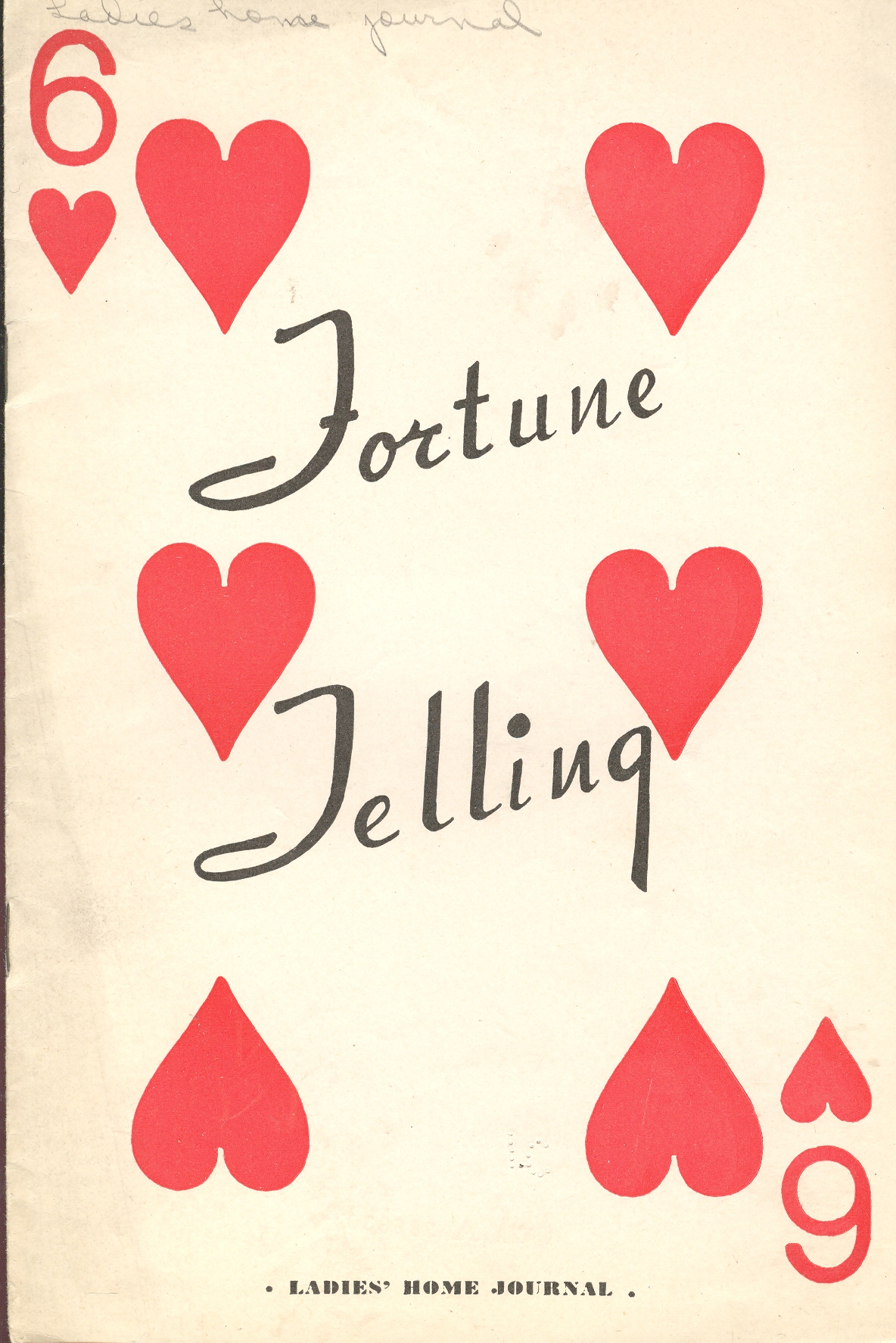
    Blog jan 12 girlz--fortune telling  

    Blog jan 12 girlz--awhat did you say

    Blog jan 12 girlz--act yer age


  • Big Planes: Aircraft with Dining Rooms in Their Wings

    JF Ptak Science Books  Post 906

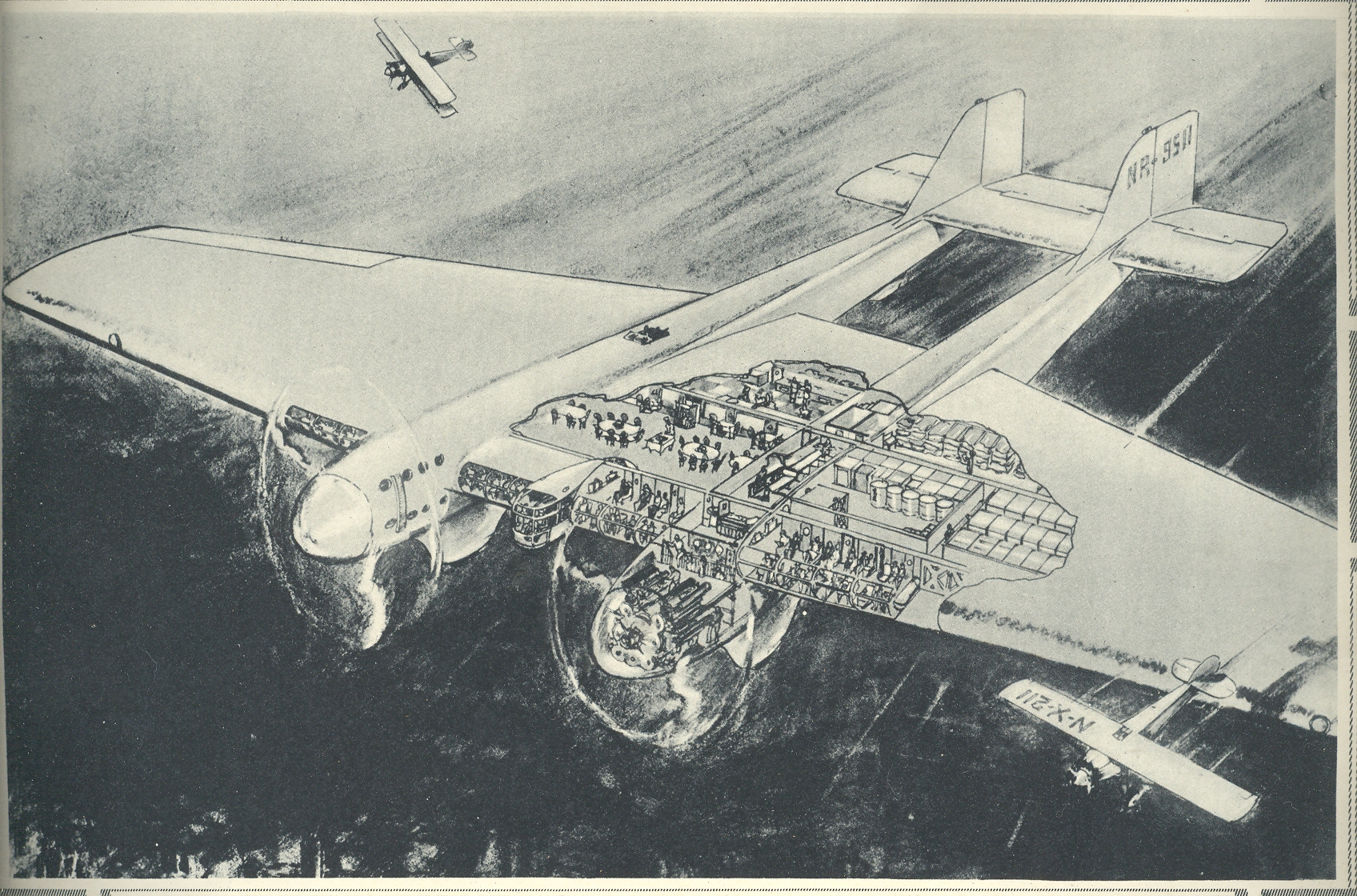
    Is it just me, or do the rest of you see Cary Grant at a teeny-tiny table when looking at this aircraft? There’s just something so horribly wonderful about the excesses washing over the passengers of high privilege in this airplane.[Source: The Illustrated London News 21 Dec 1929.] 

    Blog jan 11 big plane


    And the airplane has a name—Christmas, named for the man who provided its inspiration, Dr. William Whitney Christmas1–and was a paper plan to produce the world’s largest airplane.


    It would’ve been so by leaps and bounds.  The Christmas was to have a 262’ wingspan and a gross weight of 142,000 pounds at the time when one of the largest planes aloft—the Patrician Keystone K-78—had a wingspan of 86’ and carried 18 passenger, 2 pilots and an engineer. It also held the world’s record for hauling the heaviest payload, which for some reason was “33 girls”.  It was bigger still than the largest thing in the air, Lufthansa’s Dornier DO.X –this was an aircraft capable of moving 60-100 passengers (serviced by a crew of 10-14), a flying boat with 12 (Curtiss Conqueror 610hp) engines on wing sections 157’ long. (Was this a mile-a-minute fuel consumer?) The Dornier plane didn’t last long in service due to operating costs (1929 was a bad year to undertake an expense like this, especially in the hyperinflated Germany) and was in an aviation museum by 19342. (This plane—one of three constructed—was destroyed in a RAF bombing raid in 1943.)

    Blog jan 11 big plane 2

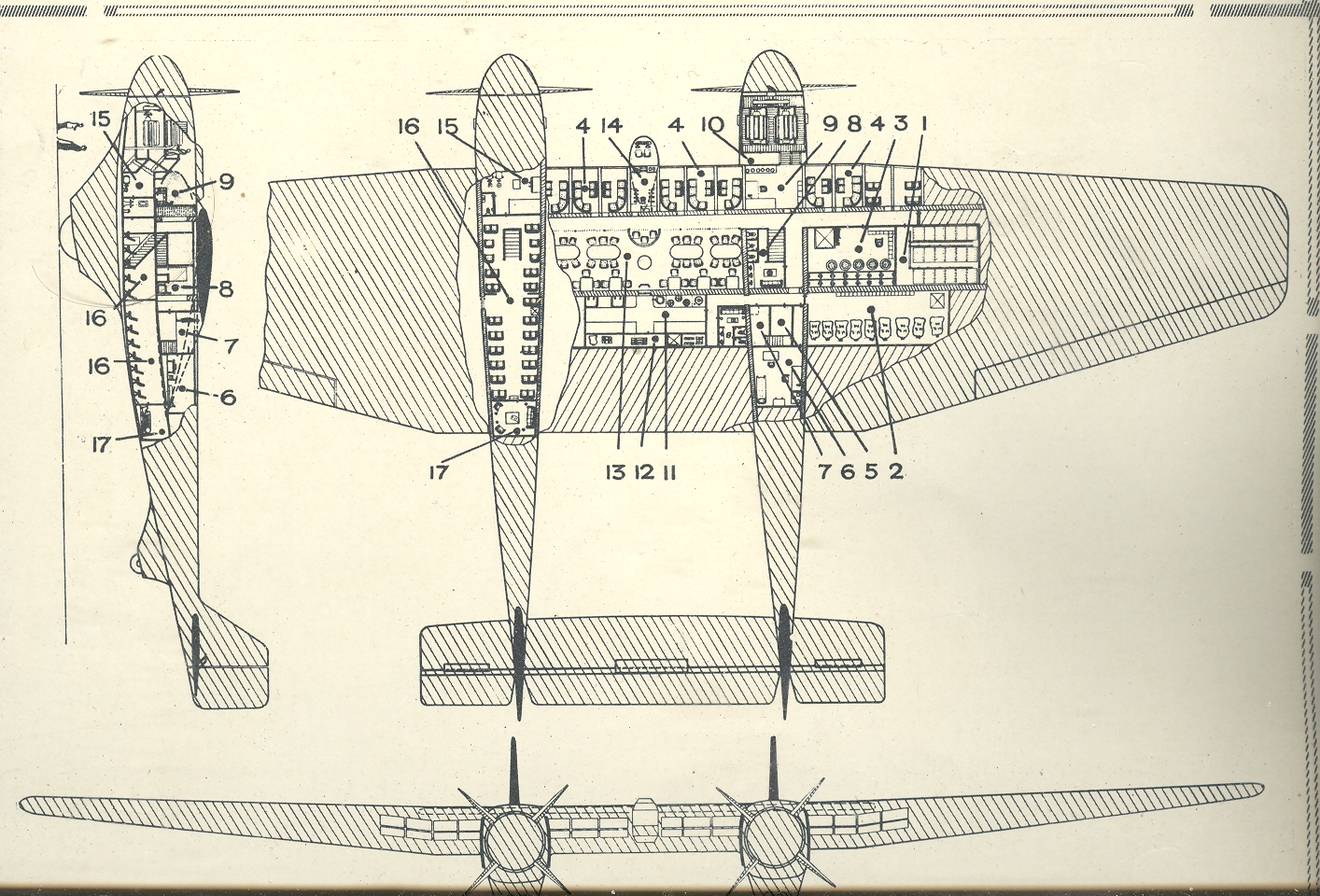
    Here’s something extraordinary about the Christmas:  it had a dining room (actually, a “dining saloon”) that took up 15% of the plane’s floor plan.  There was also the spacious smoking room, the crew and officer quarters, the machinist’s shop, engine room balconies (?), and of course the staterooms that seem to run along most of the front of the plane. The side elevation shows not very much space at all allotted to what must’ve been some massive engines, seeing as how there’s only two four-blade props. (The small lateral cross section shows two people against the plane for scale—these folks must’ve been giants; I figure they should be a little more than 75% of the manikins.  I make each prop blade to be about 10 foot (?))

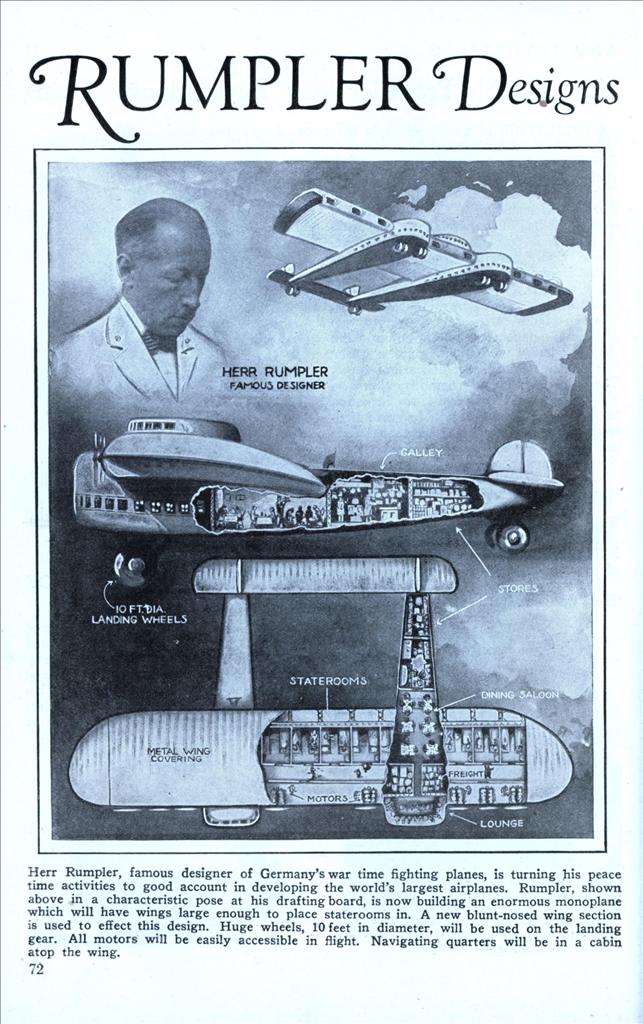
    As it turns out this aircraft looks a lot like Edmund Rumpler’s3 (1872-1940) giant.  Outfitted with a long row of staterooms along the front edge of the large wing and a huge dining room, it doesn’t seem to be equipped with an area for the engines.  Maybe this was an endemic flaw among older fast-thinkers…  

    Notes:

    1. Dr. Christmas (1865-1960) was the third American to fly and was the first to design a plane with aerilons.

    Blog jan 11 rumpler

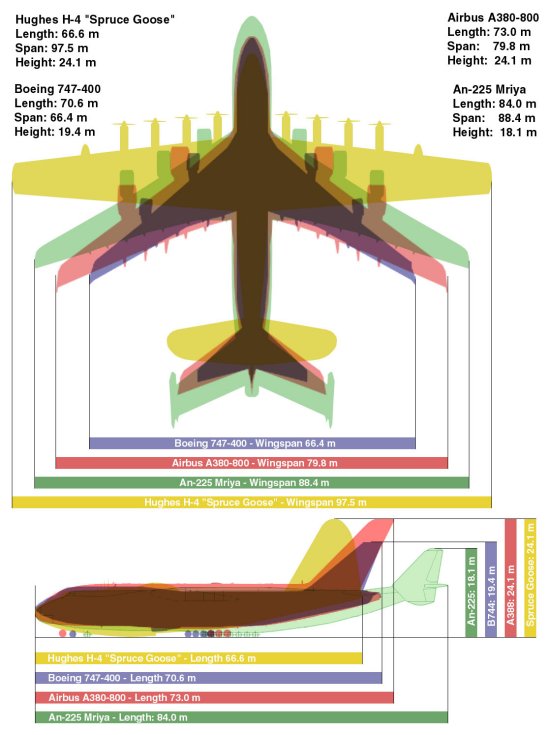
    2. Compare this to the Antev An-225, a modern very-,limited-production monster that could haul 1.3 million pounds of cargo, and the 747 (hauling up to 900,000 pounds) and the mammoth Airbus A380—all relatively the same size but with fabulous design and power.

    3.Rumpler made very significant aeronautical contributions to the German effort in WWI, as well as designed the first aerodynamic auto—his military planes though during the war were  great triumph, partially because they were also Germany’s first mass-production-possible aircraft.  This didn’t help him much when Hitler came to power—being Jewish, Rumpler was arrested, and then released by Goering who at least could find a small part of himself to save this one Jew who served Germany so well.

    4.  Source for the Rumpler image is the wonderful ModernMechanix site here.


    Interesting comparison chart for big planes: [Source]


    Blog jan 11 aircraft size-comparison


  • The Oldest Image of a Flying Pig? An Adynaton Antiquarian Illustration, 1687.

    JF Ptak Science Books LLC  Post 905Blog jan 11 dalence pigs fly

    How
    old is the  saying, or rejoinder, “…when
    pigs fly”?  I dunno, and frankly it
    doesn’t really matter. Except for right now, when I found this rather
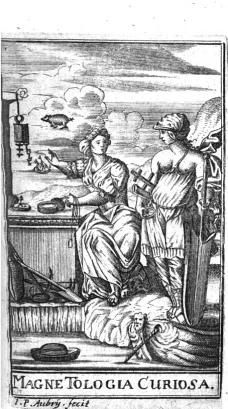
    extraordinary image of a pig-in-the-sky from 1687.  It isn’t a flying pig, but I’m not sure what
    it is:  the origin of the image is from
    J.de  Dalence, Traite de l’Aiman (publihsed in Amsterdam in 1687), a book about the history
    of magnetism.  But nothing else matters,
    just the flying, atmos-floating pig, right there in the sky, perfect against a
    puffy cloud. 

    I
    suspect—without any intention of doing any research on my suspicion—that this
    may very well be the earliest depigtion of a flying pig.  And it just so happens to have appeared in
    the same year of Newton’s great Principigia. 

    And
    just for the record, I wonder how often anyone sees an image 300+ or more years
    old of any of the other great adynations? For example, “It is
    easier for a camel to pass through the eye of the needle,
    than for a rich man to enter into the kingdom of God”  from the Book of Matthew,
    19:24, just doesn’t seem to lend itself to empirical description, as it would
    pretty much lessen and defeat the purpose of the literary description.

    The flying pig, though, may be a horse of a different
    color, so to speak.


  • The Architect’s Lament (Writ in Stone): Stockholm, 1914

    JF Ptak Science Books LLC  Post 870


    Blog 12 8 archiects complaint

    Years ago when I lived in DC,  a neighbor in Georgetown who was suitably
    upset about being told how he could decorate the front of his townhouse spray-painted
    the rules and regs of private house decoration right on the front of his
    home.  In colors, urban-graffiti style, about
    10 feet high.  As it turns out, his (influential)
    neighbors were wrong about how restricted the colors were that he had chosen to
    paint his house, and that he was perfectly within his rights to answer his
    complaint by painting that n the front of his house.  He made his point.  For several years. 


    An extreme case of venting and protest—in the pre-mass
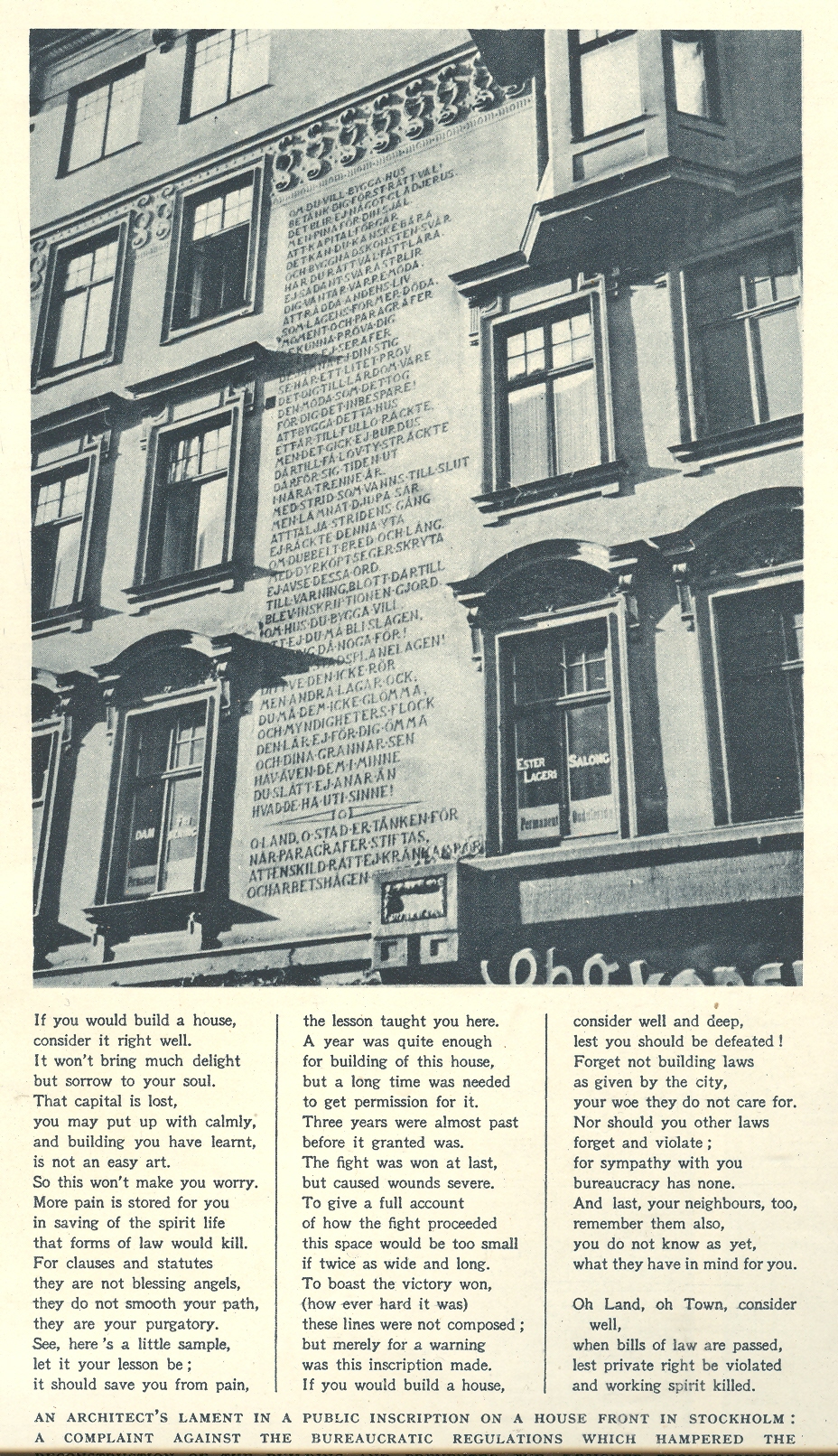
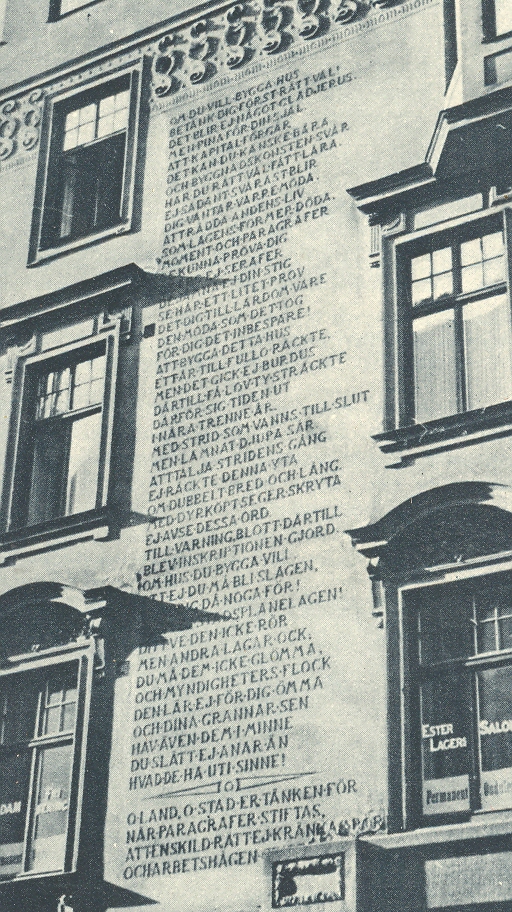
    communication era—was found in Stockholm.  The façade of the house designed by the
    architect Klemming is decorated with his 40-foot high incised complaint against
    the building bureaucracy of the city.  As
    it turns out Klemming was not allowed to proceed as he wished, running into
    regulations preventing him from carrying out the design that he wanted.  Defeated, he built what was allowed, and then
    found a way to revenge—ironically, there was no regulation to keep him from his
    permanent, stone-cold anti-reg voice. 


    I suspect that few architects, or builders, would disagree
    with Kemmling’s sentiments.

     (The text is clickable)Blog 12 8 archiects complaint 2

    The rant reads, in part:

    “A year was quite enough

    For the building of this house,

    But a long time was needed

    To get permission for it.

    Three years were passed

    Before granted it was.

    The fight was won at last,

    But the wonds caused were severe.

    To give full account of

     how the fight
    proceeded

    this space would be too small…”

    And ends:

    “Oh Land , oh Town, consider well,

    When bills of law are passed, lest private right be violated

    And working spirit killed.”


  • Time’s Bad Hair Day: 1540

    JF Ptak Science Books Post 863

    Blog 12 4 time hair detail


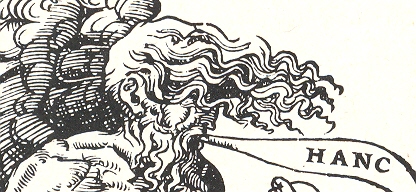
     This image proves that even Time itself can have a bad hair day, from time to time.  The woodcut image appears as the printer’s mark (of Simonem Colineum, or Simon de Colines) in the second volume of Johann Arboreus’ Theosophia, complectens difficillorum…, which was printed in Paris in 1540. 

    Blog 12 4 time hair

    Time isn’t very pretty here, and is made to seem a little Satanic, what with cloven hooves and the legs of some animal, strong torso and swift wings—the hair hiding the eye(s) completes a picture of damnable doom, and of whatever end we’re coming to.  Except for the righteous, though not quite: the word balloon describing Time’s spoken admonition is “Hanc Aciem Sola Retundit Virtus”, which means “only good deeds dulls the blade”.  That doesn’t necessarily mean “stops” the blade, which is bothersome.  I think that if someone were coming for me I’d like the blade as sharp as could be…

    ·Posted by :

    ·in:

    — —

  • A War-ready Submersible Aircraft, 1920: the Tessaurian

    JF Ptak Science Books LLC  Post 892

    DARPA
    has had a long-standing Christmas wish—a high-speed, durable, fast, agile tacticly-beautiful
    submersible aircraft.  Such a thing has
    evidently been on the wish list of many agencies in many countries for many
    years. 

    I
    found the Royal Navy’s version of the DARPA wish in the 24 January 1920 issue
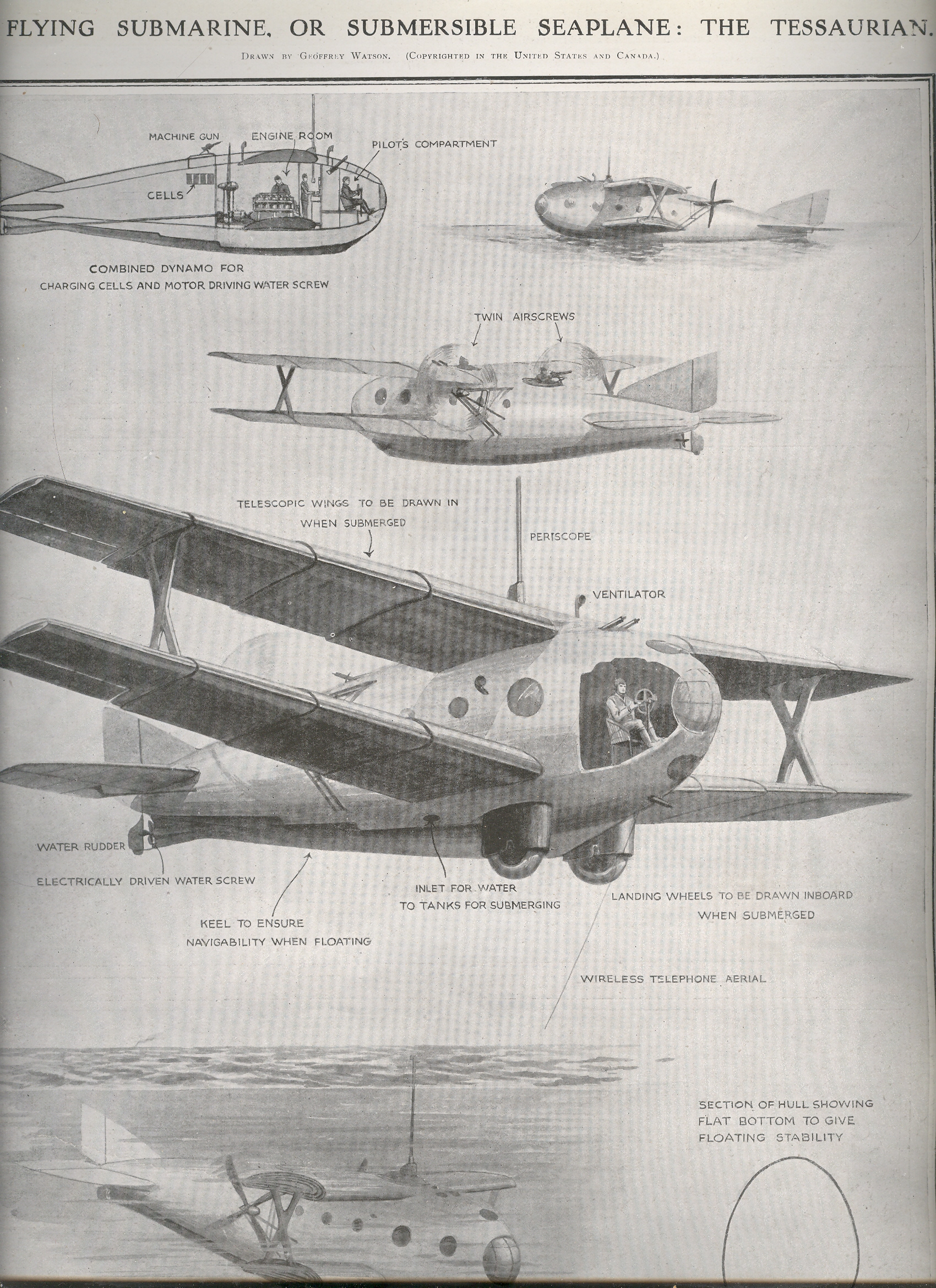
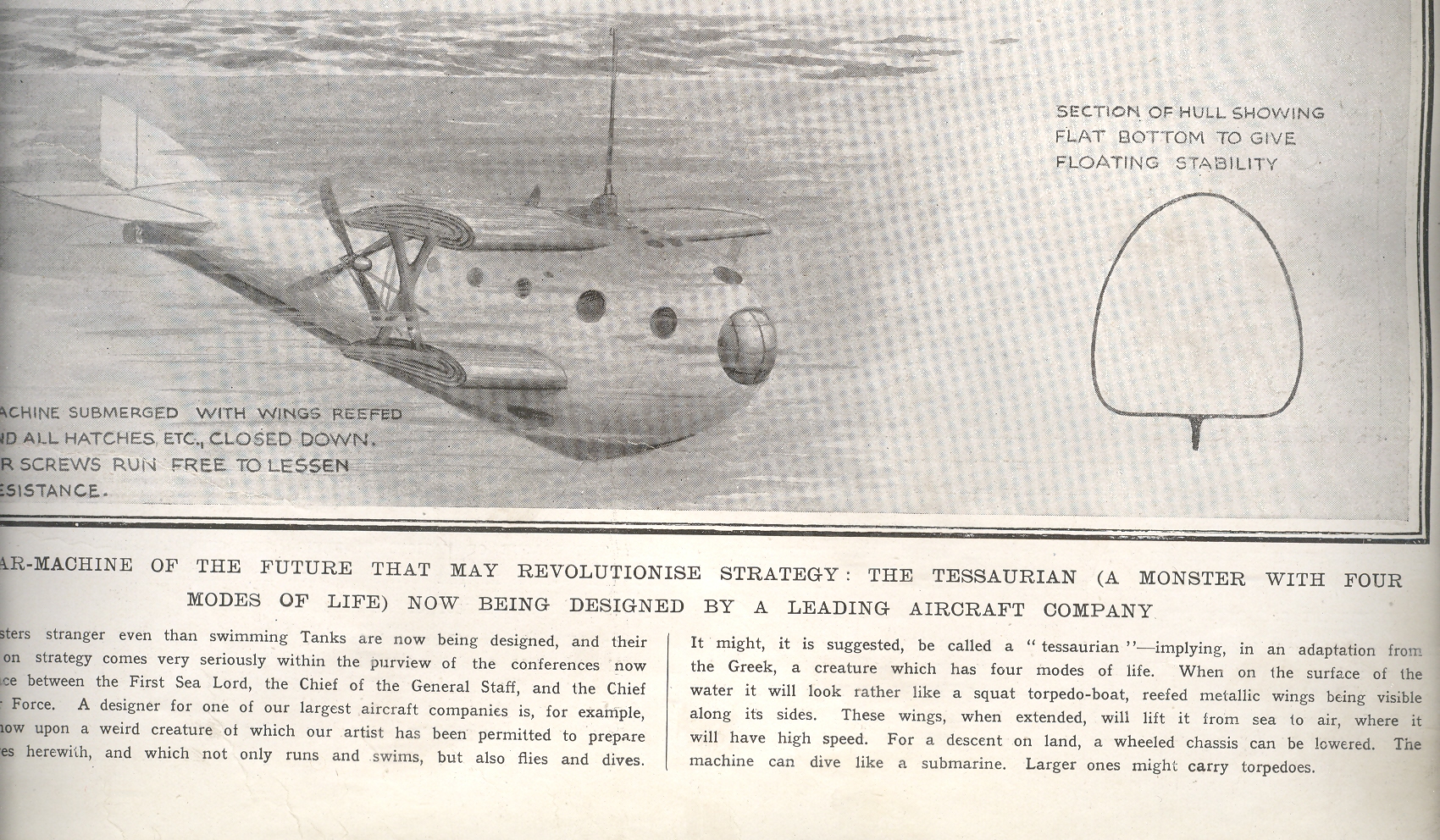
    of The Illustrated London News—the Tessaurian, a dreamable plane capable of
    long flight and long trips under the sea, as well as being able to float on the
    water and land on dry earth.

    Blog dec 30 subplane

    Even the modern Tessaurian has been evasive—certainly
    this 1920 version is nothing short of nothing. 
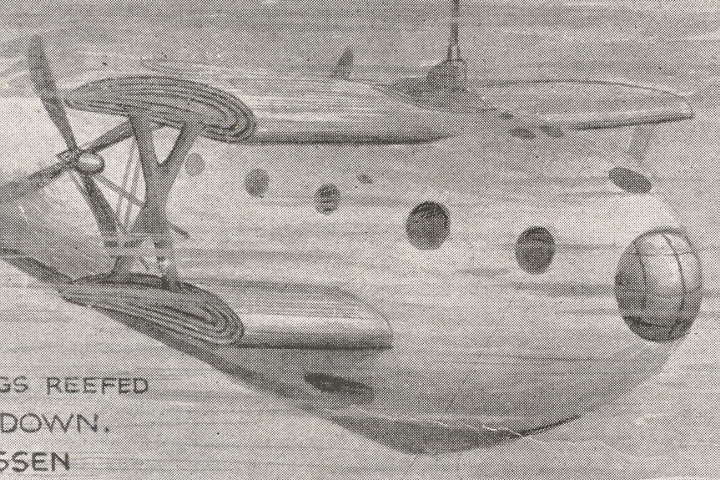
    The craft just looks too bumpy to do well in any sort of fluid environment,
    air or liquid, the thickness of its skin (necessary for the heavy undersea
    pressures) looking just too heavy to lift off the ground.  Of course the powertrain is suspect, and the
    retracted wings don’t look like they would do anything to glide the beast
    further underwater, assuming it got there (on purpose) to begin with.  Even though I doubt that it could fly, it may
    be able to float a bit—I do think that it could sink like a champ.  

    And
    so I reproduce these heady, unacknowledged and unclaimed drawings (“designed by
    a leading aircraft company”), as I can’t find anything offhand online that
    comes remotely close to its age and concept. 

    Blog dec 30 subplane det

    An
    undergraduate (!) team (headed by Daniel B. Coltey et alia )at Auburn came up with
    the following research paper earlier this year: “Conceptual Design of a
    Submersible Tactical Insertion Aircraft” “This…senior design program…the
    creation of a conceptual design for a submersible airplane is being undertaken
    as a response in part to a challenge by the Defense Advanced Research Projects
    Agency (DARPA).” The authors then state the checklist of DARPA’s needs:  “The design is expected to be a clandestine,
    coastal insertion vehicle with specific abilities of an airplane, surface ship,
    and submarine vessel, which would greatly increase the tactical ability of the United States. The
    aircraft is expected to accommodate eight passengers, including any necessary
    equipment and operators, and an additional 2,000 pounds of cargo, and also to
    have an unrefueled range of 1,000 nautical miles in cruise flight, 200 nautical
    miles surface transit or very low altitude flight, and 24 nautical miles of submerged
    travel. The aircraft requirements also include the ability to complete one
    tactical transit (1,000 nautical miles airborne, 100 nautical miles surface,
    and 12 nautical miles subsurface movement) in a time limit of eight hours. This
    concept also addresses challenges in the areas of structural design, effective
    propulsion in dual fluid flow regimes, and control surface duality…”  I’d want one, too. 

    Blog dec 30 subplane det 001

    SOURCE


  • Shakespeare’s Renaissance Wisdom and the Turtle Dove

    JF Ptak Science Books LLC  Post 887

    Thinking about the second day of Christmas brought me to the turtle dove, and then almost immediately to William Shakespeare, and on to H.W.
    Seager’s delightful Natural History in Shakespeare’s
    Time
    being Extracts illustrative of the Subject as he knew it
    (London,
    1896)1.  Seager got to the point right
    away, quoting the turtle dove’s appearances in Winter’s Tale and Merry Wives
    before moving on to quote fabulous passages from Bartholomew de Glanvile and
    Albertus Magnus. 

    WINTER'S TALE, iv. 4

    FLORIZEL:

    “I think
    you have

    As
    little skill to fear as I have purpose

    To put
    you to’t. But, come; our dance, I pray:

    Your
    hand, my Perdita; so turtles pair

    That
    never mean to part.”

    MERRY WIVES OF WINDSOR, iii. 3, 44. 

    Henry VI, Part IDuke of Burgundy:

    “Myself, as far as I could well discern
    For smoke and dusky vapours of the night,
    Am sure I scared the Dauphin and his trull,
    When arm in arm they both came swiftly running,
    Like to a pair of loving turtle-doves
    That could not live asunder day or night.
    After that things are set in order here,
    We’ll follow them with all the power we have.”

    Then on to the 13th century Bartholomew de Glenvile, ostensibly a compendious theologian but who was also a general encyclopaedist who provided one of the widest views on the known natural history of the thirteenth century, drawing together all manner of facts and fictions from Greek, Arab and Jewish sources.  He was translated into English (On the Nature of Things)  and published in a spectacular volume in 1494 following the first printing of the work (Paris) in 1470 (De proprietatibus rerum).
                                                                                                                                 
    “THE Turtle hath that name of the voice, and is a simple bird as the culvour, but is chaste, far unlike the culvour, and if he loseth his make [i.e., mate], he seeketh not com- pany of any other, but goeth alone, and hath mind of the fellowship that is lost, and groaneth alway, and loveth and chooseth solitary places, and flieth much company of men…”

    And this:

    “He cometh in springing time and warneth of novelty of time with groaning voice. And in winter he loseth his feathers, and then he hideth him in hollow stocks. And against summer, in springing time, when his feathers spring again, he cometh out of his hole in the which he was hid, and seeketh convenable place and stead for to breed in. The Turtle layeth eggs twice in springing time, and not the third time, but if the first eggs be corrupt. Also the blood of her right wing is medicinable, as the blood of a swallow, and of a culvour or dove.”

    And further, describing a magical, fireproofing stone that could be found in the mouth of the Turtle Dove: 

    “Amatides is a precious stone ; if a cloth be touched therewith, the cloth withstandeth fire and burneth not, though it be put therein ; but it receiveth brightness and seemeth the more clear. And withstandeth all evil doing of witches…IT is supposed that in the maw of the cock Turtle-dove this stone is to be found, and hath virtue to increase concord and love…” 

    And from “Albertus Magnus” (though probably by a follower of his), The Book of Secrets: Of the Virtues of Herbs, Stones, and Certain Beats, Also a Book of the Marvels of the World, the use of the Turtle Dove’s heart: 

    “IF the heart of a Turtle-dove be worn in the skin of a wolf, the wearer will never thenceforth be wanton. If its heart be burnt, and put on the eggs of any bird, never will it be possible that they should be hatched. And if its feet be hung on a tree, from thenceforth it will not bear fruit.  And if a hairy place be anointed with its blood, and the water in which a mole has been boiled, the black hairs will fall off.”  

    Notes:
    Seager’s work was meant to be a polite background to the natural history of the time, and not an exhaustive treatise.  He says in the preface: “this book presents in a convenient form for reference a collection of the quaint theories about Natural History accepted by Shakespeare and his contemporaries. The work is meant to be rather a sketch than an exhaustive treatise, otherwise it would fill many volumes. The plan of the book is to give some illustration of each word mentioned by Shakespeare when there is anything remarkable to be noted about it. The term ” Natural History ” has been taken in its widest sense, as including not only fauna but flora, as well as some precious stones…”


  • Bad Ideas Department: Underground Cities, 1934

    JF Ptak Science Books LLC  Post 880

    Blog Dec 17 underground city

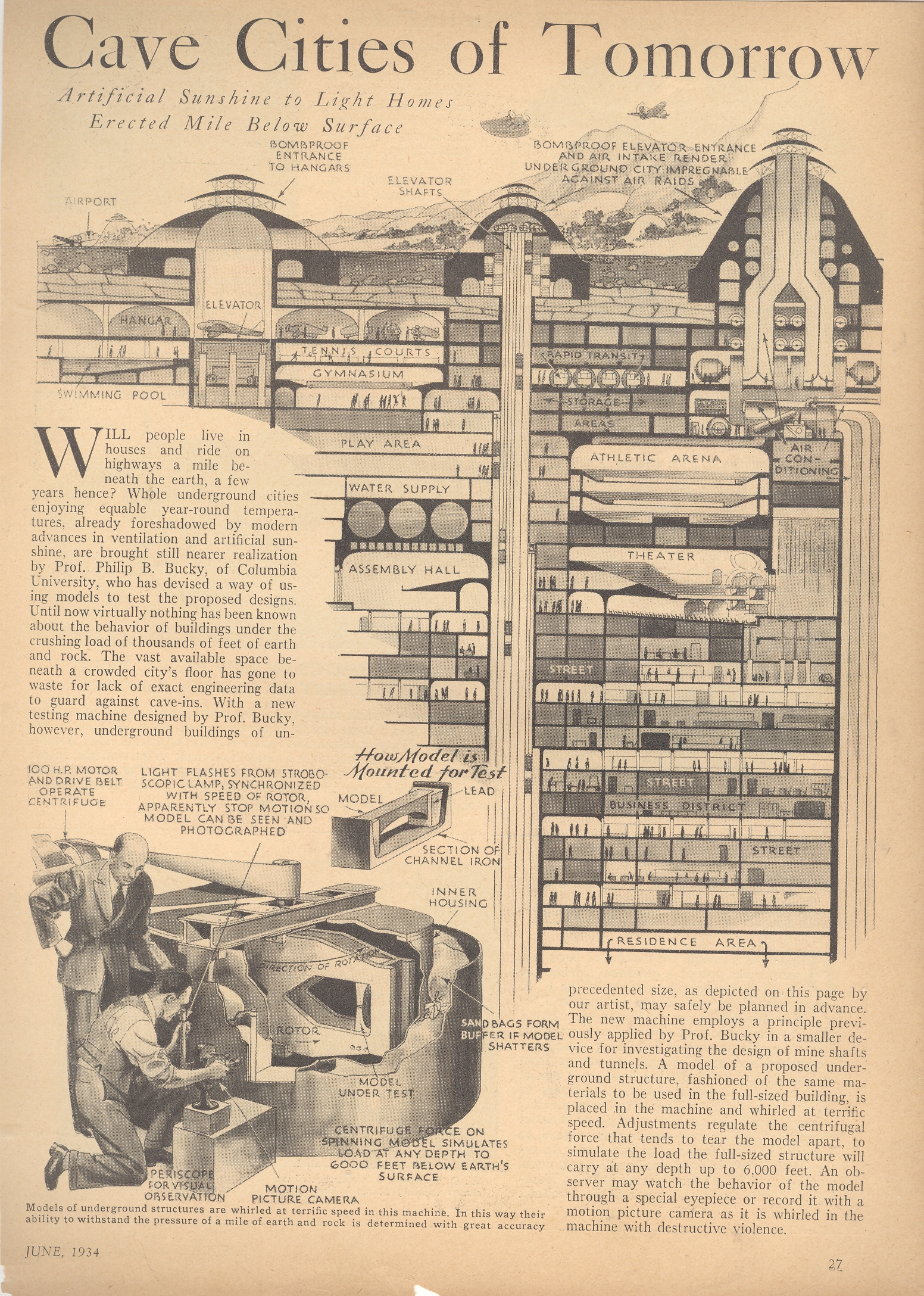
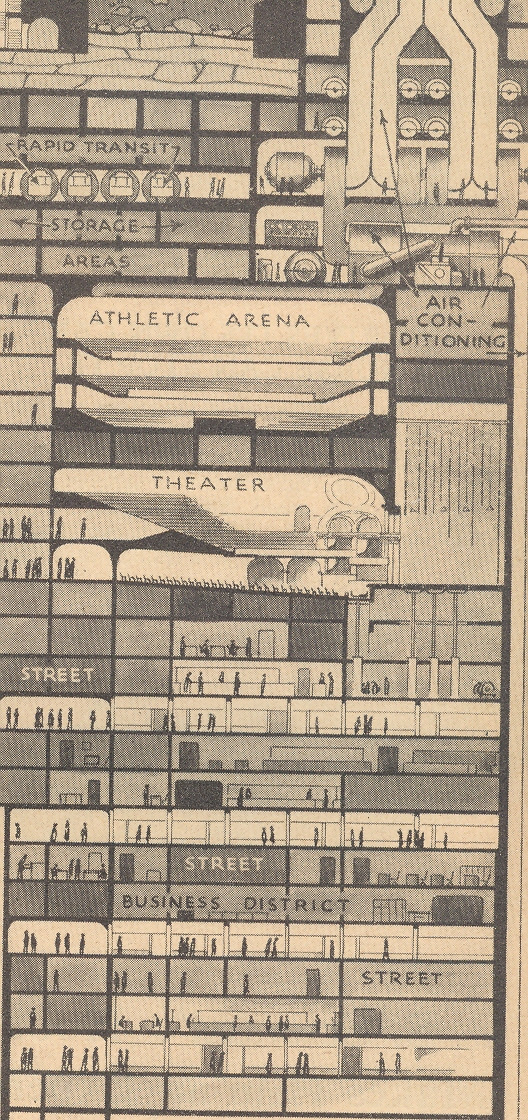
    I’m a sucker for cross sections, and this one has it all—nicely drawn, a glimpse into the possibilities of the future, and technoid removed from the realm of possibility.  This article appears in Popular Science Monthly for June, 1934, and presents the possibility of extending downward into the earth for future city development. (as a matter of fact, the fabulous  Modern Mechanix site has a similar story on display, asking the question “Are Skyscrapers Doomed?” for the same year, with the same engineers.) Well. It seems as though in this cross section that residences for people begin below the thirtieth floor, making living quarters starting at about 350’ down.  The story goes that it would be possible to dig these cities up to about 6,000 feet into the earth, which of course is a long way down.  Its difficult enough to drill an oil well hole to this depth; its difficult to imagine digging/outfitting/removing the earth from something—I’m not even sure what to call it—that was, potentially, thousands of feet deep and miles wide and long.   That’s playing with figures hundreds of billions of cubic feet. Of construction. Underground.  Well, I guess it wouldn’t be necessarily underground–it could be an excavated hole that is a mile or two wide and across and down, which would make the hole itself several times larger than the largest whole ever dug by humans, which is the Bingham Canyon Mine, a pit slope mine that is about .5miles x 2.5 miles. And then construction would begin after which the remaineder would be covered by earth.  

    Anyway, it is a big hole and a lot of construction, the volume of it at the beginner phases of say a cubic mile would be equal to the volume of 25,000 Great Pyramids or 5,400 Empire State Buildings.  It would be easier probably to build a vertical city in part of the Grand Canyon and then cover it up–that’s an idea ou won’t see in print too often. 

    Blog Dec 17 underground city det