A Daily History of Holes, Dots, Lines, Science, History, Math, Physics, Art, the Unintentional Absurd, Architecture, Maps, Data Visualization, Blank and Missing Things, and so on. |1.6 million words, 7500 images, 4.9 million hits| Press & appearances in The Times, Le Figaro, Mensa, The Economist, The Guardian, Discovery News, Slate, Le Monde, Sci American Blogs, Le Pont, and many other places… 5000+ total posts since 2008.

Category: Bad Ideas

  • Odd Things on Title Pages Department: Circumcision, 1507

    JF Ptak Science Books LLC  Post 722  Blog Bookstore

    When Johannes Pfefferkorn (1469-1523) was released from prison he rushed himself into a conversion to Christianity (having come from a Jewish family in Nuremberg) and published a notorious diatribe against his former people.  Speculum Adhhortationis Iudaice ad Christum, which was published in 1507, savaged the Jews, calling for immediate

    ===blog==aug 22=pfefferkorn

    conversion to the recognition of Christ as savior, giving up all banking concerns, and throwing out the Talmud.  It packed a lot of sneering speculation into a mere twenty pages, and was one a of a number of anti-Jewish pamphlets (also including his en ihr Ostern halten (1508); Judenbeicht (1508); and Judenfeind (1509)) in which Pfefferkorn unleashed horrible prescriptions.  He came to believe that the best way to deal with the Jews was to kill them, convert them, expel them, or enslave them; that was about it.  He waged a successful campaign against the Jewish intellectual life by convincing the Emperor to allow the confiscation of all Jewish books (except for the Old Testament), embarking on an extended tour of Germany to do so.  At the bottom of it all, he thought that the best way to deal with theological issues that opposed his own was to crush the believers and steal their books. 

    ===blog==aug 22=pfefferkorn 001

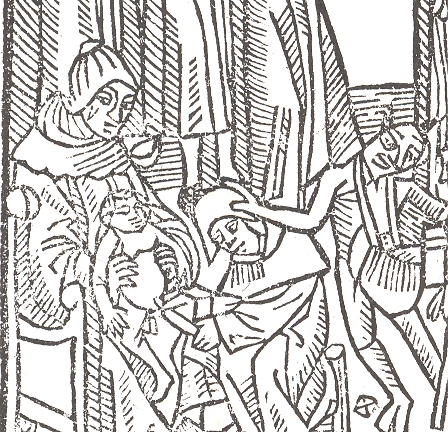
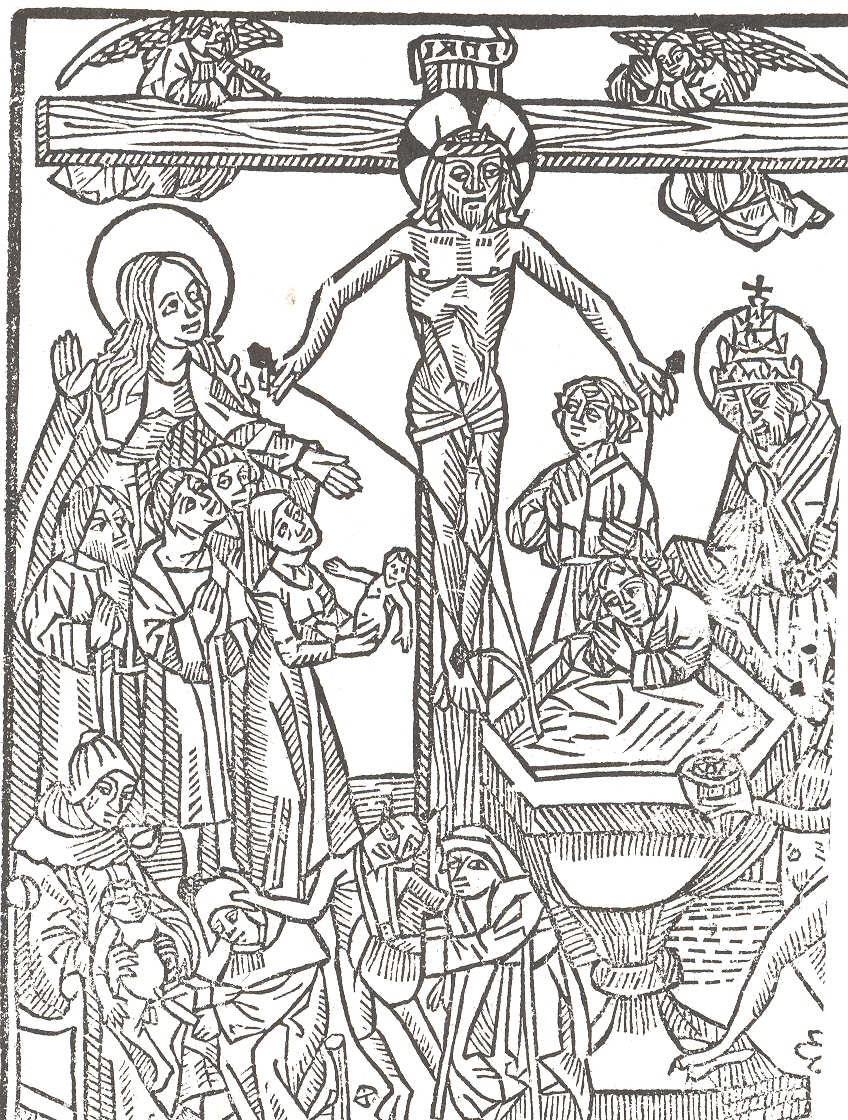
    Of interest to me here though is the remarkable woodcut on the title page.  On a very wide crucifix we see the blood of the bleeding wounded Christ pouring itself into a baptism font, with eight (or so) praying people waiting to avail themselves of it, including the onlooking attention of the Virgin Mary and a Pope (Peter?).  In the foreground is a dismal portrayal of a group of Jews, showing them small, gnarled, without benefit of vision and legs.  At the extreme bottom left is the circumcision, he only time I can remember seeing such a thing on a title page.  It was an awful visual propagandistic  juxtaposition, a fitting illustration for an awful pamphlet.


  • Fundamentals of Irony in Bombing: Tybee Island, 1862 and the French in Damascus, 1925

    JF Ptak Science Books LLC  Post 704  Blog Bookstore

    [on vacation, Tybee Island, Georgia]

     I have a hard time remembering the correct version of this twisty tale—are we in a post-irony age or the post-ironic irony age?  Is a double-irony an irony at all?  Actually I think that instead of our society having moved into a post-irony stage, it seems that the apparent lack of irony seems only so because all we have is irony, which of course is ironic.  Which may be an illustrative answer to my second question;  a double-irony is indeed a bigger irony, not a smaller (or null) one.  

    This came to mind vacationing with my family; actually, it came while building a sand castle at the lip of the advancing tide, building it up as the water tore it down.  That’s the fun of it, even with my six-year old: watching things get made and watching them get unmade, as the getting-unmade part will tell you a whole heck of a lot about the successes and failures of what went into the thing’s making.

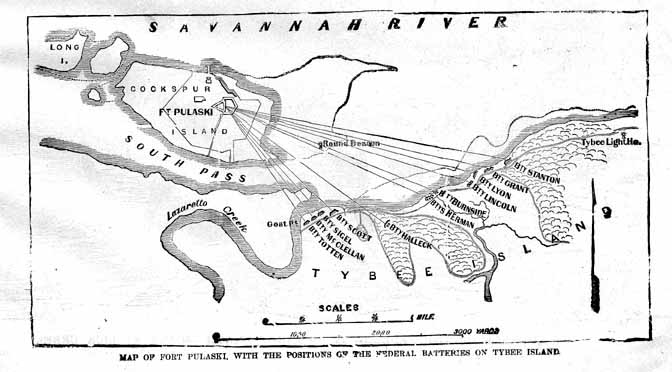
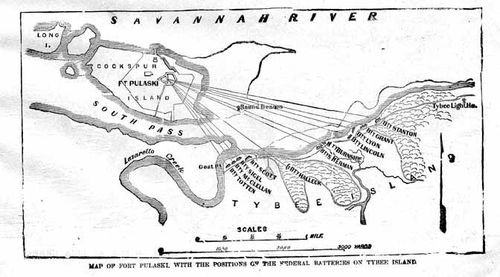
    Watching the walls of the fort tumble reminded me of the real-life version of this event, something that happened about two miles away and 147 years ago.   For Pulaski  was built on the Savannah River to protect the approaches to Savannah and Charleston from the angry reaches of the Spanish and British; in 1862, it was in the hands of the Confederates, and was being used to protect Savannah from the very government that built it.    
    ==blog==august 2==tybee

    Even while under the direct commander of General R.E. Lee, thing did not go well for Fort Pulaski and the garrison within.  At the end of 1861, the CSA was getting ready for an extended siege of the fort as the Union forces found victories north and south of it.  They withdrew their forces from Tybee and threw them into the fort, leaving the Union army a free and insatiable hand to get their hand ready on the other side of the Savannah pass.  That said, that’s what pretty much happened:  Union forces dragged their cannons through the surf and across the sand, getting them in place around newly-built batteries.  This all happened at night so that the Confederates in the fort couldn’t see what was going on, what with all of the evening’s doings camouflaged once the sun came up.  (This was still possible at t he time, to keep a secret like this in almost plain view, only a mile away from where the opposing cannons were aimed. The guys in the fort were pretty much cut off from everyone and everything, with only the occasional courier being able to make it through.  The garrison was, after all, equipped with enough provisions to last through a siege of 8 months or so.)   What happened, finally, was that with the Union cannon in place, the assault began.  And instead of a siege lasting for two seasons, it ran about two days.  The difference was in the new cannons that were being used the boys in blue—the rifled cannon was brought to play against the massive walls of the fort, and the masonry didn’t stand a chance against the new technology, which as it turns out was first displayed to the world in this battle.  And so the ironies:  a fort that was built to protect the United States from foreign invaders was used to protect the Confederate States from the United States; and the fort fell not to a sea-based barrage but a land-based one.  And after all of this, even though the Pulaski fell in April 1862, Savannah wasn’t captured by the union until December 1864.  

    An encyclopedia could no doubt be written on nothing but the ironies of bombing.  And for another example of this I turn to the French, who can supply more than their share, per capita, pound-for-pound, and percentage of GDP, whatever.  No, not the French return to Indochina in 1945 (after having done business with the occupying Japanese forces for the entire war) and their resurgent colonialism as practiced against the Vietnamese, or the heinous practices against the Algerians just prior to that country’s independence:  it is their bombing practices in Damascus. Not the Syrian bombings of 1945 (which also included many other places like Aleppo, Hama and etc.) but the French civilian bombings of Damascus in 1925.  For it was in that year that the League of Nations found that the French really weren’t bombing and killing civilians indiscriminately when they were doing so; they were, ironically, bombing themselves, and so their actions were not illegal.  (It was problematic, identifying “civilians”, as the League didn’t necessarily grant the same sort of “humanness” to all human, finding categories for barbarians and savages.  It was acceptable to bomb those later two categories, but not the first.) So the French sought to subdue a rebellion against their oppressive rule in that country, identifying the Muslim population centers in Damascus as probable hotbeds of activities for the “bandits” that were causing them their problems.  October 18, 1925 is when this particular outrage occurred; the Syrians protested, and the League considered.  And that was about the size of the story for the Syrians, because as it turns out, the French were just maintaining an order that for them was a simple police action; civilians populations could not be bombed in the eyes of international law, if the bombing was being done to a foreign people; since the French were there and occupying the country, they were conducting a police action, and in a sense were merely bombing themselves, loosening them from the barriers of whatever international law could be applied to their actions by the League of Nations. 

    So there is hardly any shortage of bombing ironies, as we can see here with the null-irony of the French bombing themselves while killing Muslim civilians.  When you start looking for irony, sometimes that’s all you can see. 
    ·Posted by :

    ·in:

    —

  • Dreaming of the 10-Ton Eiffel Tower Bullet, 1891

    JF Ptak Science Books  Post 736

    ===blog==aug 30--eiffel People find inspiration everywhere, insight to creativity in the obvious and not so.  Great statues have been envisioned in the depths of slabs of marble, solutions to mathematical problems in the step of a bus, the beginning of a new physics in the rolling ball in a wagon.  Its an old and very warn cliché, but the world can be seen in a grain of sand if you could just pieces together the bits of glass:  just as pointillism was seen in the not-simple intercession of two colors and cinematography in the latent image and the structure of the universe in a patch of dancing dust.

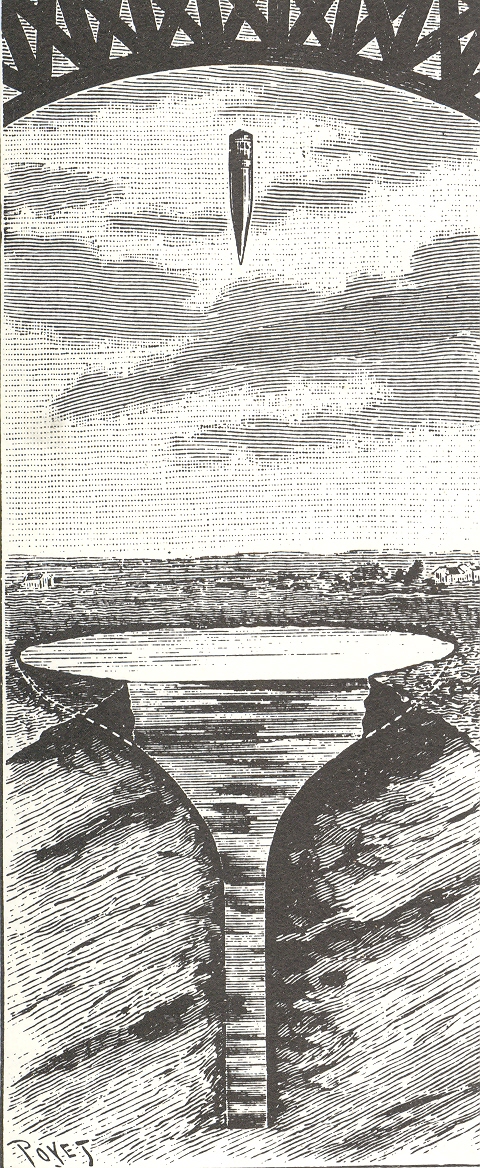
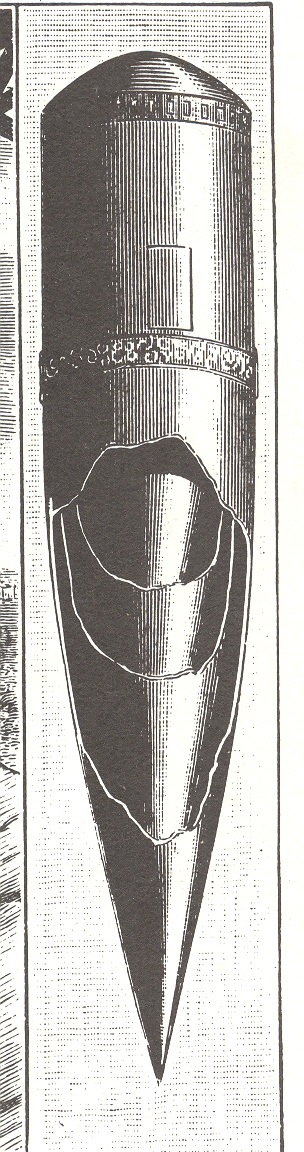
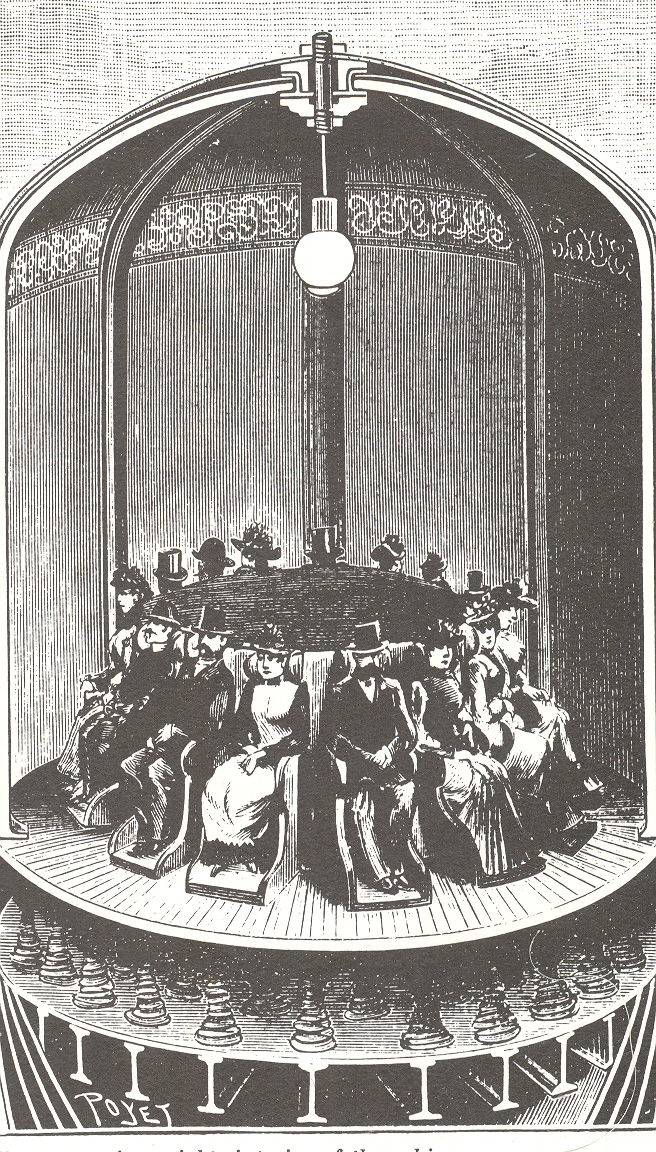
    The Eiffel Tower has had its own way with the visions of people, from it representing the birth of The Modern, to an icon of passion, to architecture and engineering innovation, and to general  adventure and the call of possibility.  It has moved other people to think “special” thoughts:  like, for example, what a lovely canvas it would be to place a 700’-tall electrified sign.*  And to M. Carron of Grenoble, who may have the most unusual inspirations from M. Eiffel, the tower was the perfect place to drop a 40-foot tall, 20,000-pound bullet filled with 20 people in leather armchairs into a 200-foot deep champagne-glass pool.

    ===blog==aug 30--eiffelbullet

    This is certainly a singular insight.  But in 1891 it represented something a little more than just giving people a thrill ride.  Physics of impact aside for the moment, M.Carron’s bullet capsule would be released from the top of the interior of the Tower, about 1000 feet high, and released to fall into an excavated pool 150’ across and 200’ deep.  The idea was that in addition to the springs inside the capsule, the water would act as a “shock absorber”, and so “the shock felt by the occupants on landing will be in no way unpleasant”.  

    [Okay, so the thing would hit at 178mph or so, and, assuming that the whole thing didn’t get completely crushed on impact, I’m not so sure that 200’ of depth is very much wiggle room for the thing to come to a halt (if it didn’t deform).  I Also it would have to not have any wind deflection so as to not veer off its perfect entry into the water.  And so on.  Calculating the force of impact is difficult without knowing how far down the bullet would go, but hitting the water at 80 m/s and stopping at 30 meters would yield something like 28,600,000 KE and 1,274,000 N. There are lots of problems….]

    ===blog==aug 30--eiffelinside

    The thing is, though, the thing that made this so appealing, is that for the 20-francs that get a person a seat in the bullet, that they would each get to go twice as fast as any human had ever traveled before ( 65 miles per hour was about the speed of the fastest train constructed).  So it was an extraordinary claim, an done that doesn’t get made all that often in the history of locomotion.

    And so this wasn’t a practicable or workable idea; but, well, so what?  It was an unusual idea, inspired by some sort of different thinking, which are both good places to be in according to the Gazetteer & Atlas of Ideas.  Sometimes thinking like this is just prelude to something else, thought avenues that had to be explored before the real thinking could get done, introducing you to a new geography of thought.  That’s what M. Carron had going for him; the newness of his thinking was much more important than the wrongness of it.

    *This story comes at the end of a post called Bad Ideas Department:  the First Image of a Hypnotized Chicken, so in spite of the title you’ll wind up in Paris.


  • “Total Atomic Defense”: Moving DC to Idaho and Letting the Nukes Fly 1952

    JF Ptak Science Books LLC    REPOST

    One of my favorites from the “What the Hell?” Department:

    Also see my series Atomic and Nuclear Weapons

    Blog--untinkable tp
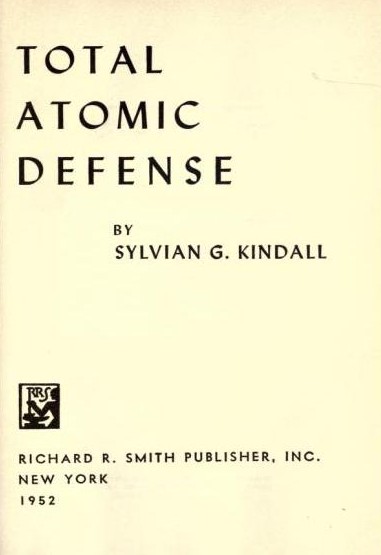
    Sylvian Kindall’s Total Atomic Defense (published
    by a very severely right-wing publisher in 1952) is one of a series of
    books made for a deceived American population, offering the general
    reader both fear and hope, often from the same, exact source. But
    Kindall has a  somewhat diffident approach, offering his belief that
    the country and its population can largely  survive an all-out nuclear
    war–intact.  Of course the “intactness” is dependent upon massive
    internal change of the social and industrial fabric of the country,
    which would have to transform in ways as to make it largely
    unidentifiable from that which we would quickly recognize.  A quick
    look at the table of contents tells the story in miniature, with the
    exception of the solution to the problem, which was generally to build
    underground.  (The neutron bomb would soon complicate this solution.) 
    Suffice to say that Dr. Strangelove would approve of the publication of
    such a work though would hardly believe in any of it for himself…
    [read the rest of the story here]


  • Cruising Down the Cigarette Highway, 1950: the Unlimited Reach of Tobacco

    JF Ptak Science Books LLC  Post 699  Blog Bookstore

    See also my related posts:

    The Worst Picture of Santa, Ever 

    and 
    Deathly Equality: Liberty and Lung Cancer

    This is a simple ad for a butane-based lighter (appearing in LIFE magazine for 18 December 1950), lighting the
    way down Cigarette Road.  Actually,
    it was more a highway than a road, and a superhighway at that. Government-sponsored warnings about tobacco health issues was still more than a decade away:  medical doctors were part of the advertising machine, as were actors (including RWR), sports figures, and virtually anyone else with a mouth.

    ==Blog July 27=cis It seems to me that there are about 300
    cigarettes in this ad, and that looks like a lot—point of fact though is that
    in 1950, the average American (of 18+ years) smoked about 3,522 cigarettes a
    year, which means about 10 cigarettes a day for everyone in the country.  Not 10 per smoker; 10 for everyone in the entire country, smoker
    or not, who was over 18 years of age.

    The average smoker in 1950 smoked about 2.5 packs a day, or
    50 cigarettes or so—that’s equal to this line of cigarettes being smoked every
    six days. 
    There were virtually no brakes.

    Even Santa (a pipe smoker) got into the business. This was a standard, acceptable, vanilla-packaged advertisement.

    ==Blog July 27=cigs xmas


    United States Cigarette Consumption, ,
    1900–2007

    First number is total consumption in billions; second number
    is per capita yearly consumption for people 18+.


    1915   17.9   285

    1920   44.6   665

    1925  79.8  1,085

    1930 119.3 1,485

    1935 134.4 1,564

    1940 181.9 1,976

    1945 340.6 3,449

    1950 369.8 3,522

    1955 396.4 3,597

    1960 484.4 4,171

    1965 528.8 4,259

    1970 536.5 3,985

    1975 607.2 4,123

    1980 631.5 3,851

    1985 594.0 3,461

    1990 525.0 2,827

    1995 487.0 2,515

    2000 430.0 2,092

    2005 376.0 1,716

    2007 360.0

    Source: Tobacco Outlook Report, Economic
    Research Service, U.S. Dept. of Agriculture.

    JF Ptak Science Books LLC  Post 699  Blog Bookstore


  • Connections: from Plugging Gibraltar to Shakespeare’s Memories in One Step

    JF Ptak Science Books LLC  Post 691  Blog Bookstore

    “Simply the thing I am shall make me live.”

    –from Jorge Luis Borges, “Shakespeare’s Memory”


    ==Blog July 21==shakespeares memorie It is interesting to pursue a loose thought to its not-necessarily
    logical end.  Such is the case with the
    Paneuropic ideas of Hermann Soergel (1885-1952). Soergel was a Bauhaus
    architect and author of a number of works on design and far more ethereal,
    floating-castle ideas. His most spectacular contribution—incubated in the
    mid-1920’s and still clinging by its fingertips as an idea among some current
    thinkers—was to put a dam across the straights of Gibraltar.  The dam would generate electricity of course,
    but most importantly to Soergel, it would also empty an enormous amount of
    water from the Mediterranean leaving vast new
    expanses of land to be developed and colonized over generations into the
    future.  The master plan at work was that
    the world would be divided into three economic spheres in the future, all
    beginning with the letter “A”:  American,
    Asia, and the new land to be created by Soergel, “Atlantropa”, which was the
    former Europe expanded into the new dry beds of the Mediterranean and North Africa.  And also
    of course Egypt,
    which would be covered with canals and semi-submerged by the new borders of the
    meandering sea.  This would be the way
    for Europa to compete with the rest of the world in the future. 


    Perhaps it is actually three steps to get from the idea of
    damming up the straits of Gibraltar to the osmosis of Shakepeare’s memories into
    someone else’s brain—a squinting acquiescence of the middle touch being the
    brilliant Jorge Luis Borges.  You see it
    was in the Argentine master’s last published story, “Shakespeare’s Memory”, that
    we meet Herr Soergel (as Hermann Sorgel) again. 
    But so far as I can remember Soergel exists only as a fictional
    character, with no reference to his real-life self.  In this wonderful story, Soergel inherits the
    memories of William Shakespeare—these bits come to him slowly but surely, until
    they start to conflict with his own memory, and things get difficult.  The man with Shakespeare’s memories winds up
    phoning strangers on the telephone, giving them away at random, until Soergel
    is left with his own mind again. 
    Superior as Bill’s memories were, they still weren’t Hermann’s, who
    wanted his own life back in the end. 


    And so from the titanic, pan-europic technodream of
    Bauhausian Hermann Soergel to the dead brains and living memories of William
    Shakespeare, all through the fingers of the beautiful Jorge Luis Borges.  

    I should point out that the image above comes from the Illustrierte Zeitung (Leipzig) for August 1931, and is a drawing by an artist named “AS. Christ” after Soergel’s Panropa’s ideas.


  • Creating in the Last Moment of Life: Archimedes

    JF Ptak Science Books


    ==blog==july 8==arch 2
    The Death of Archimedes images (at NYU, here)
    “…with his blood he confused the lines of his art”
    On the death of Archimedes, in Valerius Maximus

     
    [The excellent website dedicated at Drexel is the source of all of the quotes below]
     
    I’ve had this image in the back of my head for quite some time now–the image of the great Archimedes having his head cleaved in two by an attacking Roman soldier during the Battle of Syracuse

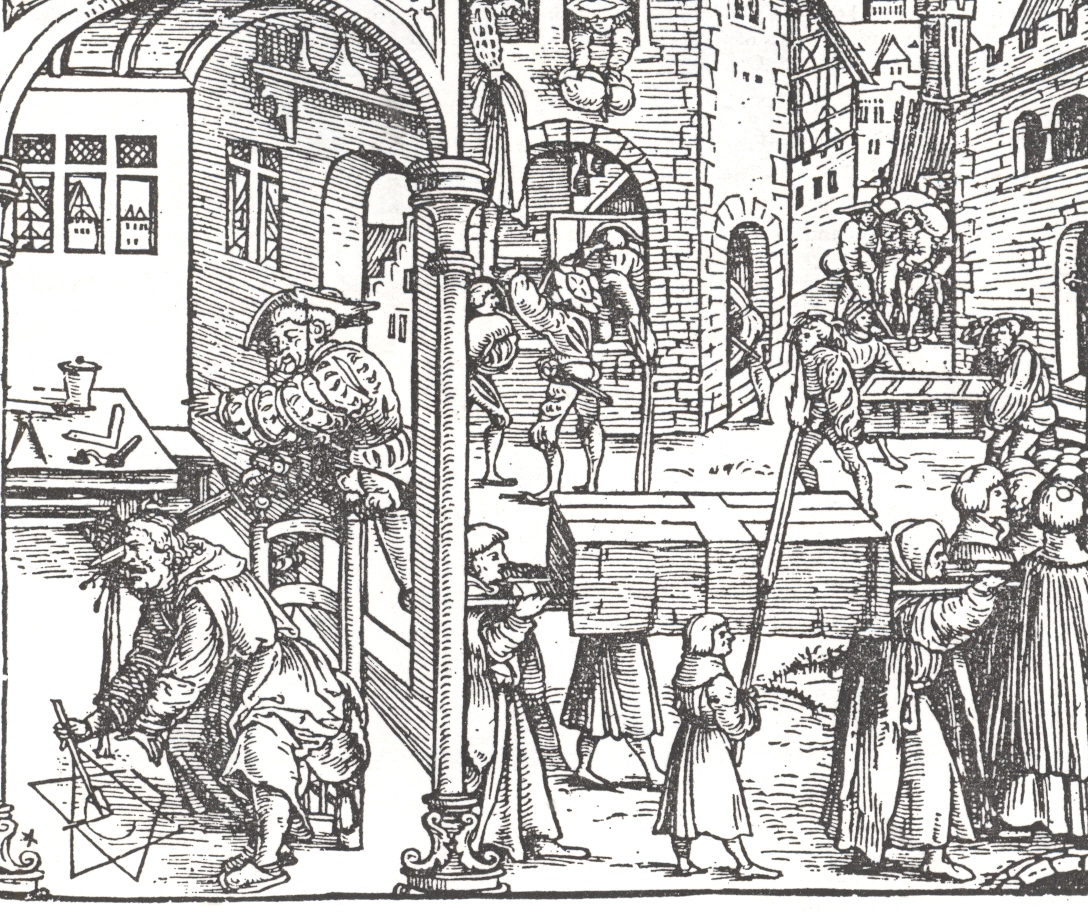
      Seldom do we see a maxim so vividly depicted as with these lines from Valerius Maximus:  Archimedes trying to hold a thought in his head while a roman soldier comes tugging at him, Archimedes pushing the soldier away to protect the geometrical work that he was scribbling in the sand, and then having his head full of thoughts spilled onto the drawing he was trying to protect.  What we see in the detail is almost exactly (or on the verge of being exactly) from the Valerius quote fragment  “…with his blood he confused the lines of his art”:  Archimedes has spoiled his geometry in the moment before his cleaved head releases the control of his muscles.  It is a nasty image, the pissed-off Roman soldier—who theoretically was just looking for spoils in the looted city of Syracuse—having had enough of the three-second hesitation by the old man and reacts badly, beheading him the hard way.

    ==blog==july 8==arch I include the following few quotes from classic sources relating this final scene:


    “But as Archimedes was drawing diagrams with mind and eyes fixed on the ground, a soldier who had broken into the house in quest of loot with sword drawn over his head asked him who he was. Too much absorbed in tracking down his objective, Archimedes could not give his name but said, protecting the dust with his hands, “I beg you, don’t disturb this,” and was slaughtered as neglectful of the victor’s command; with his blood he confused the lines of his art.” Valerius Maximus (c. 20 BC-c. AD 50 ), Memorable Doings and Sayings, Book VIII.7.ext. 7

    “Many brutalities were committed in hot blood and the greed of gain, and it is on record that Archimedes, while intent upon figures which he had traced in the dust, and regardless of the hideous uproar of an army let loose to ravage and despoil a captured city, was killed by a soldier who did not know who he was.” Livy (59 BC-AD 17 ), History of Rome from its Foundation, Book XXV.31

    “a Roman soldier, running upon him with a drawn sword, offered to kill him; and that Archimedes, looking back, earnestly besought him to hold his hand a little while, that he might not leave what he was then at work upon inconclusive and imperfect; but the soldier, nothing moved by his entreaty, instantly killed him.” Plutarch (AD 45-120), Parallel Lives: Marcellus

    “a Roman came up and began to drag him away to take him prisoner. But he, being wholly intent at the time on the diagram, and not perceiving who was tugging at him, said to the man: “Stand away, fellow, from my diagram.” John Tzetzes (circa twelfth century AD), Book of Histories (Chiliades), Book II, Lines 136-149 

    “He was constructing some figure or other, and hearing that the enemy were at hand, exclaimed: “Let them come at my head, but not at my line!” John Zonaras (circa twelfth century AD), Epitome ton Istorion, 9, 5

    “The death of Archimedes by the hands of a Roman soldier is symbolical of a world-change of the first magnitude: the Greeks, with their love of abstract science, were superseded in the leadership of the European world by the practical Romans”. Alfred North Whitehead (1861-1947), An Introduction to Mathematics

    “. . . he was a callous, obdurate, conceited midshipman, intent on his own discoveries, and caring as little for what went on about him, terrestrially, as Archimedes at the taking of Syracuse.”  Charles Dickens (1812-1870), Dombey and Son, Chapter 19, (1846-48) 

    ·Posted by :

    ·in:


  • Alpabetical Doomsday Introduction: Welcome to the End of the World

    JF Ptak Science Books LLC  Post 678  Blog Bookstore

    Here’s a very abbreviated overview to a vast literature of the end of times/apocalypse/technocaust/end of the world themes.  This is just a short working list, really, and includes only short stories or novels.  In many cases there is just one example (where there could be hundreds).  There are no movies or television shows listed, though I think that they must be enormously outnumered (and the scale of orders of magniutue) by the print media. 
    Apoc

    Alien
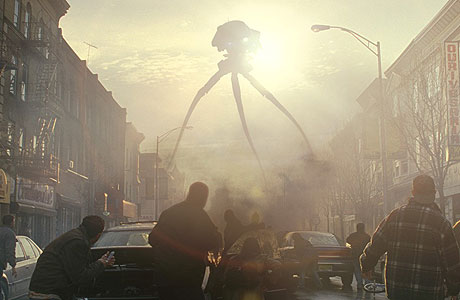
    Invasion:  The War of the
    Worlds
    1898, H. G. Wells; The Moon Men 1926, Edgar Rice Burroughs; The Puppet Masters,
    1951, Robert A. Heinlein

    Botanical endgame virus destroying all plant life:
    The Death of Grass by John Christopher  On the opposite end is  1962 novel Hothouse by Brian Aldiss
    where the plants take over everything.

    Climate Change: The Drowned World by J.G. Ballard
    1962.  Conversely Ballard wrote the novel The Drought  in 1964 about all of the water on earth
    drying up.

    Crystallization (!):  this one sounds
    painful:  The Crystal World
    by J.G. Ballard
    1966. Everyone and everything begins to form into crystals.

    The Drought by J.G. Ballard
    A super drought evaporates all water on earth.

    Dying Sun:  The World in Winter
    by John Christopher 1962

    Earthquakes: A Wrinkle in the Skin, John Christopher, 1965

    Environemntalism and Rush’s dream-come-true: The Bridge
    by D. Keith Mano (1973)
    envirofascists exterminate humans to save the world.

    Extraterrestrial Threat:  When Worlds Collide by Philip Wylie,
    1933

    Flood: Flood by Stephen Baxter
    (2008) gigantic underground oceans seep to the surface and inundate the world.

    Human general
    malaise, dystopia, ennui:
    Arthur C. Clarke‘s
    Childhood’s End
    ; City
    (1952) by Clifford D. Simak; Friday  by Robert A. Heinlein;. Galápagos by Kurt Vonnegut.;
    Planet of the Apes by Pierre Boulle;l
    H. G. Wells‘
    The Time Machine

    Human Wars:  After London 1885 Richard
    Jeffries; Ape and Essence 1948 Aldous  Huxley ;
    Do Androids Dream of Electric Sheep?
    1968 Philip K Dick,.; The Last Man
    1826 Mary SHeley.

    Ice Water catastrophe: Cat’s Cradle
    by Kurt Vonnegut,
    1964:  Time of the Great Freeze
    by Robert Silverberg , 1964 and in 1969 The Ice Schooner by Michael Moorcock

    Insect extermination: Charles Pellegrino’s Dust, 1998.  The ecosystem collapses after bugs disappear.

    Infertility caused by nuke power plant
    meltdown:  1946 Mr. Adam
    by Pat Frank
    Also the infertility endgame in Greybeard by Brian Aldiss,
    1964.

    Meteor: Survival 2000 1991, James McPhee;  Titan
    1997, Stephen Baxter; The Day of the Triffids 1951.

    Monsters: Skeletons,
    (1992) by Al Sarrantonio.  The Earth is
    ravaged by a raised-from-the-dead society of super monsters comprising all
    animals that ever lived, ever, but in super-skeleton form. Yikes!

    Nature’s Death: Nature’s End by Whitley Strieber and James Kunetka. (1986)

    Nuclear-bomb-induced-methane-fueled superhurricanes. Mother of Storms by John Barnes
    – 1995

    Nuclear weapons: 
    too, too many to reckon with here. 
    Ray Bradbury famously ends the world at the same instant via an exchange
    in Fahrenheit 451, for example. Mordecai Roshwald‘s
    Level 7,
    Nevil Shute‘s
    On the Beach and Pat Frank‘s
    Alas, Babylon,

    Overpopulation and mass famine:  Anthony Burgess’ The Wanting Seed 1962. Also
    1966 novel Make Room! Make Room! by Harry Harrison
    (made into Soylent Green). The Handmaid’s Tale, by Margaret Atwood,
    tale of developing underpopulation caused by infertility caused by
    pollution. 

    Petroleum-eating microbes: Ill Wind (novel) by Kevin J. Anderson
    and Doug Beason
    1995.

    Plagues:  The White Plague
    1982 Frank Herbert; The Scarlet Plague 1912 Jack London; Oryx and Crake
    2003 Margaret Atwood; The Children of Men 1992 P.D. James

    Pollution Children of Morrow
    by  H. M. Hoover.

    Religious: Book of Revelation, the Book of Daniel,
    the short story The Nine Billion Names of God by Arthur C. Clarke (1953), and on and on.

    Robot Revenge/Overlords: Erewhon‘s
    section The Book of Machines (1872);
    The Machine Stops 1909,by E. M. Forster
    ; The Mind Machine (1919)
    by Michael Williams;  R.U.R. (play, 1921), by Karel Čapek,
    The Metal Giants
    (1926), by Edmond Hamilton ; Automata
    (1926 short story) by S. Fowler Wright

    Snow: The Snow by Adam Roberts
    (2004) everyone buried under lots and lots of building snows.

    Space-based: Aftermath
    by Charles Sheffield, 2004, supernova
    causes cataclysmic climate change. 

    Space-based (civilization
    collapse): Against the Fall of Night by Arthur C. Clarke
    ;Gene Roddenberry‘s Andromeda ;The City and the Stars by Arthur C. Clarke
    ; The Dragon Masters, by Jack Vance

    Volcanic eruption: The Purple Cloud
    by M.P. Shiel,
    1901.

    Windstorms: The Wind from Nowhere by J.G. Ballard,
    1961.

    ·Posted by :

    ·in:


  • The “Is This Really Necessary” Department 2: Flying, Sommersaulting Elephants

    JF Ptak Science Book LLC  Post 672

    Last week I made a post regarding a fish-throwing apparatus installed at a zoo–honestly I didn’t anticipate that there would be a folloAnimal throww-up post on another animal-throwing machine, but, well, unfortunately, here it is. 

    Eduard Wulff, a circus manager and resident of Bruxelles,
    was granted this patent in 1904 for a device that would “project horses,
    elephants, monkeys etc into the air” so that they would perform a sommersault.

    Elephants?  Flying, somersaulting,
    elephants?

    The abstract from the British Intellectual Property Office is reprinted below:  

    ·Posted by :

    ·in:


  • Thomas Edison’s Dreams and Why You Can’t Always Be Right: Television, 1880

    JF Ptak Science Books LLC   Post 671

       “Seeing
    by telephone or by telegraph may be within the range of the possible. I say
    that because nothing is impossible until it has been demonstrated so to be.
    Seeing by either of these instrumentalities, however, is, as I look upon it, so
    far removed from the field of probability that I should treat any report of
    this character as an absurdity.”
    T. Edison


    I wonder what it was that Thomas Edison dreamt about—I
    suspect that like most folks he dreamt about himself, though perhaps everyone
    else in his dreams were him, too.  Mr.
    Edison was a fabulous inventor and thinker—he wasn’t the best person he
    could’ve been, and even though he had an enormous grasp on the whole of things
    and ideas about him, he also seemed to grab a little bit more, and a little too
    much.  Which sounds like gluttony. 

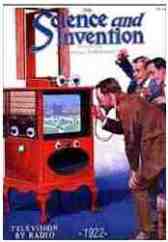
    Television

    I’m not so sure why Edison was given to such overstatement on “television”—he just about contradicts his
    own rule of thumb in doing so, as though he was going far out of his way to say
    something anti-prophetic.  Perhaps it was
    because “seeing by wire” at this point did not belong to him, like so much
    else—which is possible, because Edison did not
    play well with others, at all. 

    The possibility of interesting dreams swimming around Mr.
    Edison’s sleeping head was very high, though he may have been one of those poor
    unfortunates who dream about watching someone else sit in a chair and for hours
    on end stare at a wall—sounding more like a nightmare than a dream to me. 


    Good dreams, bad dreams. 
    History is certainly ankle-deep in literature about the dream, and the
    anthropology of dream states must be wide and deep.  Dreams don’t show up all that much in the
    Bible, though, which seems odd to me—there are 40-odd references to dreams in
    the Old Testament, and only nine in the New. 
    And in the NT five of the dreams come in Matthew (with four of those
    referencing the birth of Christ), and another four coming in the Acts of the
    Apostles, all of which relate to St.
    Paul.  The most
    interesting of the NT dreams sounds like that of Claudia, the wife of Pontius
    Pilate, who warned her husband that Christ was probably not the person that he
    should be messing with. That is I think her entire existence in the Bible, the
    dream, and the warning to her husband.  What
    seems to happen though is that dreams in the Old Testament seem to be rather
    benign entities, while in the New things happen that turn the dreamscape into a
    possible entrance way to Hell, the unconscious thought world becoming the
    property of the Church. And speaking of Hell and dreams, I believe that it was
    the dream sequence in the Aeneid where
    the truth and falsity of dreams were put to the test—or at least the dual
    possibilities of the divergent nature of dreams—imaging dreams emerging from
    the Ivory Portal in Hades to be false dreams while those issuing from the Pearl
    portal were good.  Problem is here that
    with all of that smoke and bother in the Underworld, wouldn’t Ivory and Pearl look pretty much the
    same?  Among the ancients it was
    Aristotle who was among the first to dispense with the soft/spiritualistic/astrobabble
    interpretation of the dream, approaching the issue with rationality.  Hippocrates also tried to lift the idea of
    the dream up and away from those (Like Hesiod, for example) who would see them
    as ritualistic and meaningful indicators of endless bric-a-brac.  But the ancients didn’t do a great job of it
    given the vast limitations, nor did the moderns (as Dr. Freud certainly still
    has major game in this post-ironic department).


    Back to the TV:   the truth of the matter is that in spite of
    the Edisonian condemnation there was real discussions and experiments regarding
    mechanical (not electronic) television in the late 19th century, and
    they went a pretty long way towards achieving images by wire. Alexander Bell
    nearly brought about an image-sending device based on his successful photophone
    (in 1880), and in that same year George Carey built a primitive sort-of system
    with light-sensitive cells.  Paul Nipkow
    came the closest of these early pioneers in 1884 with a techy rotating-disk apparatus
    that successfully achieved an 18-line visual image. 


    I’m just saying that Mr. Edison had to have been dreaming of
    other things that he had more control over. 
    From where I sit, it seems to me that opportunities for the electrical
    transmission of images were quite ripe by the 1890’s.  It took another 25 years or so to bring it
    all to fulfillment, with a cascade of very successful developments occurring in
    1927/8/9.  It is a little mysterious to
    me why he had such a low opinion of the possibility of television given the electrical
    environment of his day. 

    ·Posted by :

    ·in:

    —