A Daily History of Holes, Dots, Lines, Science, History, Math, Physics, Art, the Unintentional Absurd, Architecture, Maps, Data Visualization, Blank and Missing Things, and so on. |1.6 million words, 7500 images, 4.9 million hits| Press & appearances in The Times, Le Figaro, Mensa, The Economist, The Guardian, Discovery News, Slate, Le Monde, Sci American Blogs, Le Pont, and many other places… 5000+ total posts since 2008.

Category: Bad Ideas

  • “Total Atomic Defense”: Moving DC to Idaho and Letting the Nukes Fly 1952

    JF Ptak Science Books LLC    REPOST

    One of my favorites from the “What the Hell?” Department:

    Also see my series Atomic and Nuclear Weapons

    Blog--untinkable tp
    Sylvian Kindall’s Total Atomic Defense (published
    by a very severely right-wing publisher in 1952) is one of a series of
    books made for a deceived American population, offering the general
    reader both fear and hope, often from the same, exact source. But
    Kindall has a  somewhat diffident approach, offering his belief that
    the country and its population can largely  survive an all-out nuclear
    war–intact.  Of course the “intactness” is dependent upon massive
    internal change of the social and industrial fabric of the country,
    which would have to transform in ways as to make it largely
    unidentifiable from that which we would quickly recognize.  A quick
    look at the table of contents tells the story in miniature, with the
    exception of the solution to the problem, which was generally to build
    underground.  (The neutron bomb would soon complicate this solution.) 
    Suffice to say that Dr. Strangelove would approve of the publication of
    such a work though would hardly believe in any of it for himself…
    [read the rest of the story here]


  • Cruising Down the Cigarette Highway, 1950: the Unlimited Reach of Tobacco

    JF Ptak Science Books LLC  Post 699  Blog Bookstore

    See also my related posts:

    The Worst Picture of Santa, Ever 

    and 
    Deathly Equality: Liberty and Lung Cancer

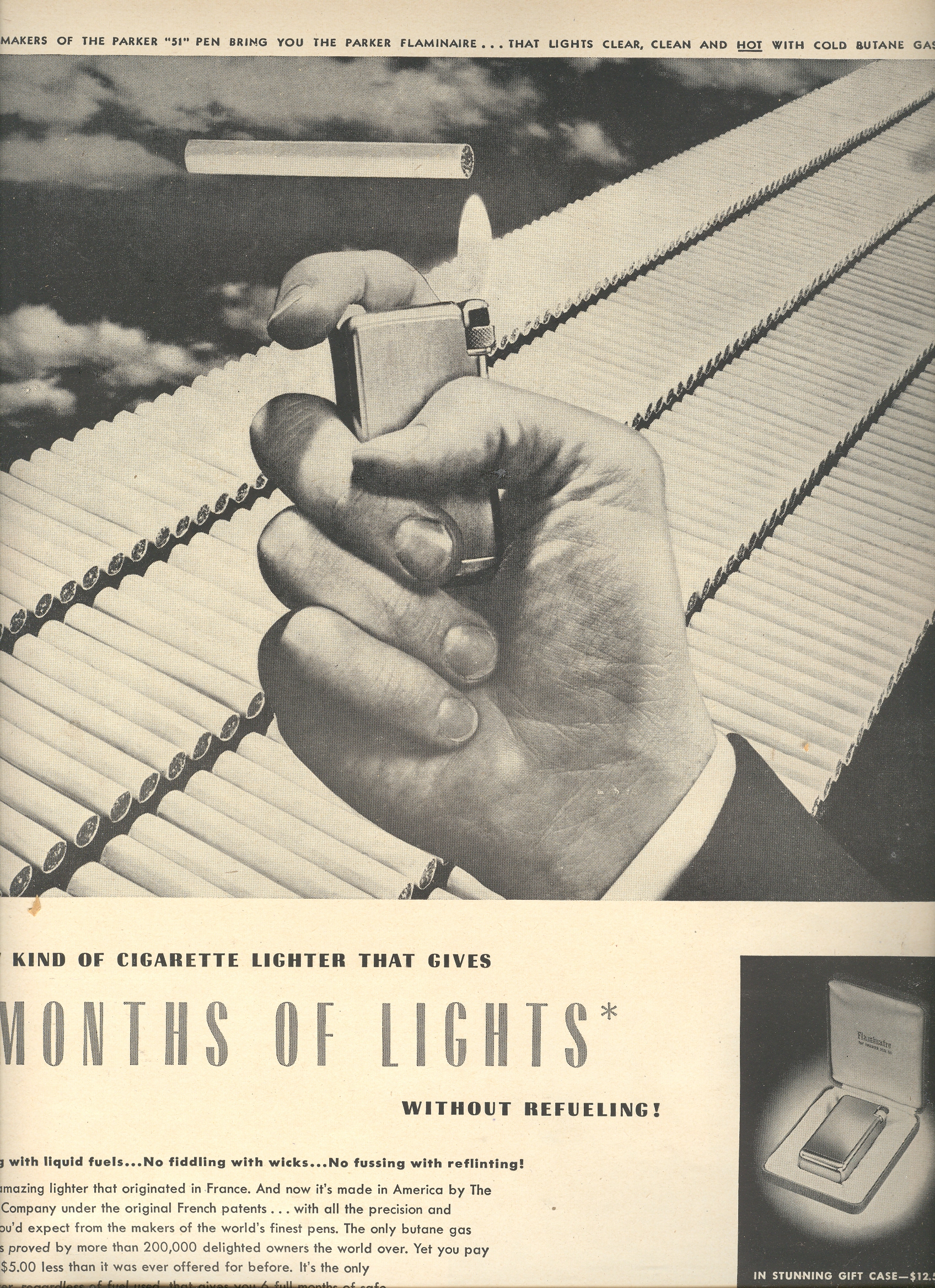
    This is a simple ad for a butane-based lighter (appearing in LIFE magazine for 18 December 1950), lighting the
    way down Cigarette Road.  Actually,
    it was more a highway than a road, and a superhighway at that. Government-sponsored warnings about tobacco health issues was still more than a decade away:  medical doctors were part of the advertising machine, as were actors (including RWR), sports figures, and virtually anyone else with a mouth.

    ==Blog July 27=cis It seems to me that there are about 300
    cigarettes in this ad, and that looks like a lot—point of fact though is that
    in 1950, the average American (of 18+ years) smoked about 3,522 cigarettes a
    year, which means about 10 cigarettes a day for everyone in the country.  Not 10 per smoker; 10 for everyone in the entire country, smoker
    or not, who was over 18 years of age.

    The average smoker in 1950 smoked about 2.5 packs a day, or
    50 cigarettes or so—that’s equal to this line of cigarettes being smoked every
    six days. 
    There were virtually no brakes.

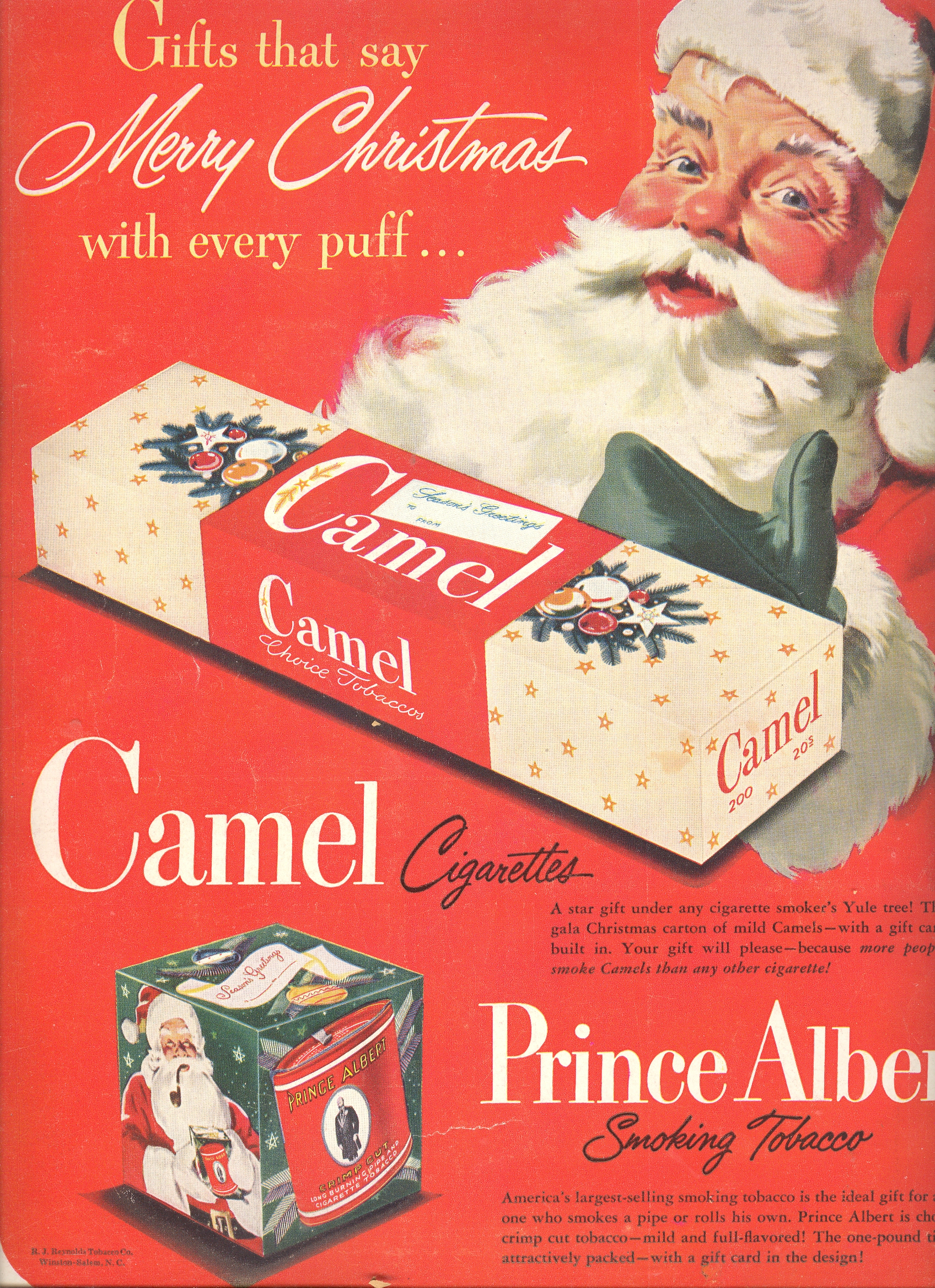
    Even Santa (a pipe smoker) got into the business. This was a standard, acceptable, vanilla-packaged advertisement.

    ==Blog July 27=cigs xmas


    United States Cigarette Consumption, ,
    1900–2007

    First number is total consumption in billions; second number
    is per capita yearly consumption for people 18+.


    1915   17.9   285

    1920   44.6   665

    1925  79.8  1,085

    1930 119.3 1,485

    1935 134.4 1,564

    1940 181.9 1,976

    1945 340.6 3,449

    1950 369.8 3,522

    1955 396.4 3,597

    1960 484.4 4,171

    1965 528.8 4,259

    1970 536.5 3,985

    1975 607.2 4,123

    1980 631.5 3,851

    1985 594.0 3,461

    1990 525.0 2,827

    1995 487.0 2,515

    2000 430.0 2,092

    2005 376.0 1,716

    2007 360.0

    Source: Tobacco Outlook Report, Economic
    Research Service, U.S. Dept. of Agriculture.

    JF Ptak Science Books LLC  Post 699  Blog Bookstore


  • Maps of the Cosmos of Moles, 1671: Astrology, Pseudoscience & Furious Belief

    JF Ptak Science Books LLC  Post 646  Blog Bookstore

    “The first principle [in science] is to not fool yourself.”  R.P. Feynman

    “The Woo-woo
    is all the same, everywhere, anytime, everytime.”
    —James Randi on the
    history of   the pseudosciences .

    Self-deception and belief in Woo-woo (spurious pseudo-scientific beliefs) is some of the stuff that separates humans from animals.  And not in a good way, unless it was all chalked up to an expression of creativity and imagination.  I started this post as an entry in the History of Dots category, then in the Blank and Missing Things department, and then simply to the Bad Ideas category.  But the more I thought about mole mapping and how extraordinary it was, the less extraordinary it became, especially once the veil of age has been removed. As it turns out, mole mapping is neither more nor less extraordinary than any other system of belief.

    Here’s
    a sentence one doesn’t get to write very often: 
    Richard Saunders (1613-1692) was perhaps the foremost historian, astrologer and seer
    of human moles and their predictive forces who ever lived.  He was far from being the solitary member of
    a one-unit class:  the use of moles as
    predictive and interpretive agents stretches back dozens of
    Blog--jun 11 circ mole

    centuries, so the
    claim of Saunder’s being its most famous practitioner is not empty,
    mega-pseudo-scientific or not.  The
    mystical commentary on the Torah, the Zohar (a part of the Kabbalah), gets
    right to the point of the significance of moles (“the stars of the body”),
    transferring the structure of the cosmos and the constellations to the
    skin.  The seer and soothsayer Melampus
    from Greek mythology, in one of his necessarily pseudographic works, writes on
    the importance of moles of the face and their zodiacal relations—an idea that
    was picked up 2000 years later by the extremely significant mathematician
    Jerome Cardano.  There was a decent
    amount of argument regarding the location of zodiac symbols on the face, as it
    turned out.

    But
    the leading exponent of moles is Saunders, who was also one of the leading
    figures in a wide and very powdery period of European non-scientific
    sciences.  These wonderful images come
    from the second (!) edition of his cumbersome but accurately-titled work Saunders Physiognomie and Chiromancie,
    Metroscopie, the Symmetrical Proportions and Signal Moles of the Body, Fully
    and Accurately Explained; With Their Natural Predictive Significations Both to
    Men and Women
    (published in London, 1671, by Nathaniel Brook), in which he
    divines the psyche and the future with peoples’ moles. 

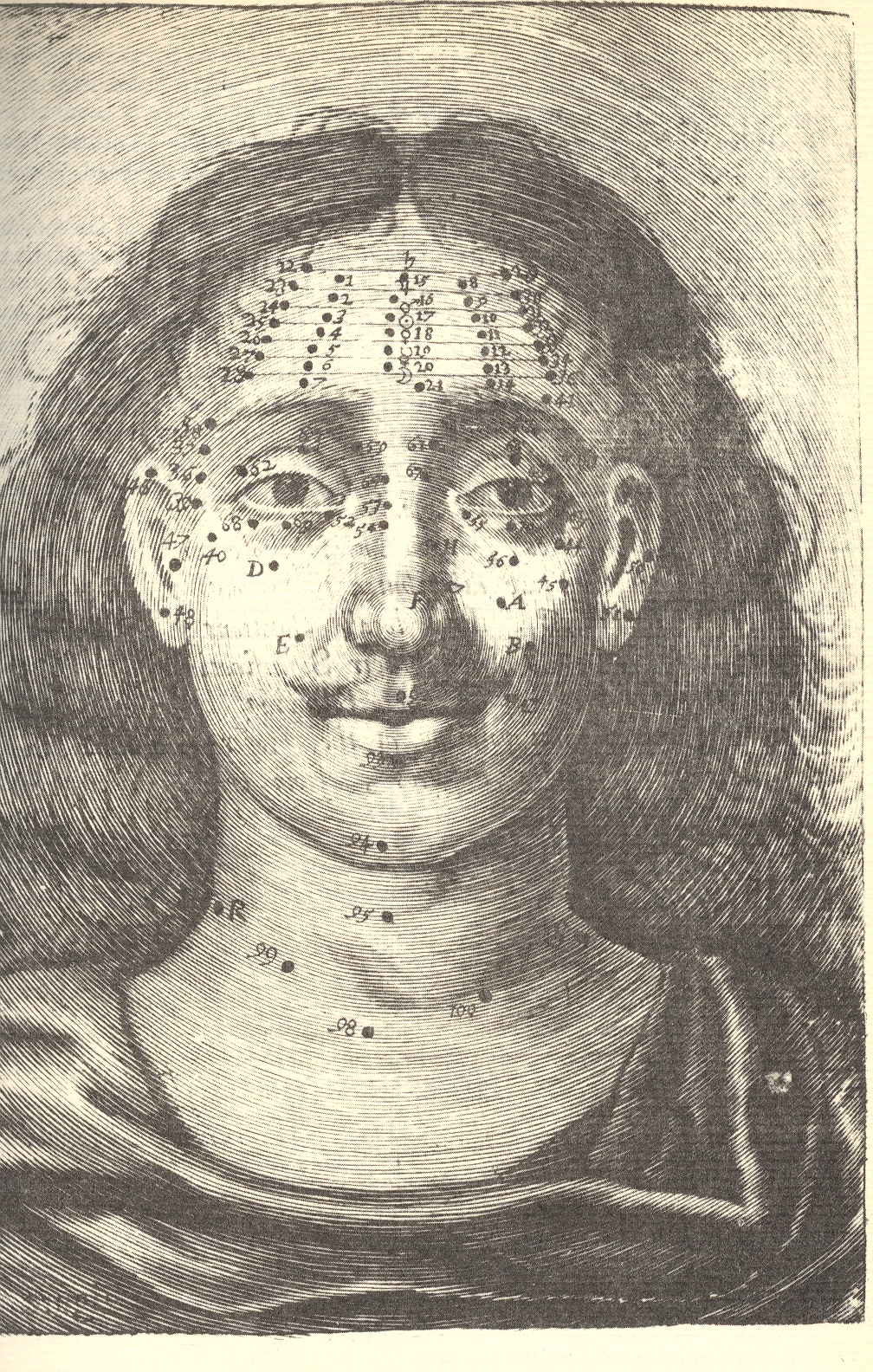
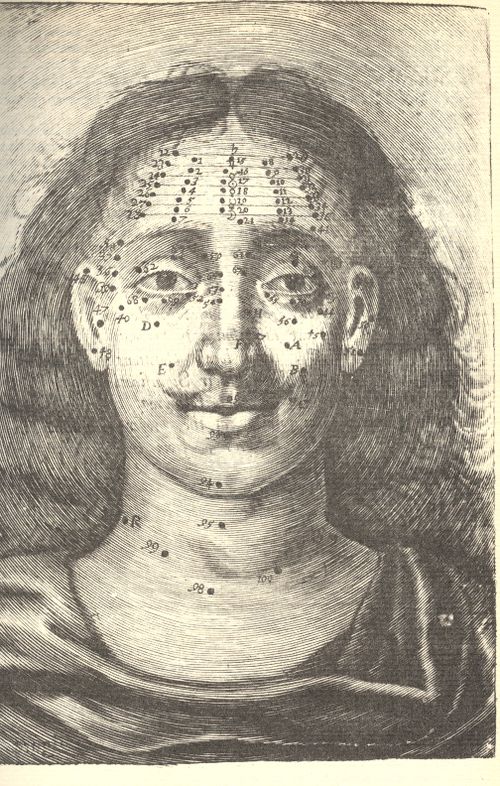
    The
    first figure, detailing the mole locations of a man’s face, is a remarkable,
    weird accomplishment, not only because of the exhaustive treatment that is
    given to every location of every mole (g_d help us), but also because of the
    manner of the engraving.  If you look
    closely, you can see that it is Fresnel lens-like—it is an engraving composed
    of (almost) concentric circles.  I cannot
    recall seeing such a thing before—needless to say the practice of engraving
    would be laborious, and not much practiced. 
    I’m not even sure what great good it causes, though it does give a
    little different idea of depth and dimensionality to the image.  The effect that it achieves here though is to
    give a solar-system-like background to the moles—something that is much more
    spectacularly achieved in the next image.
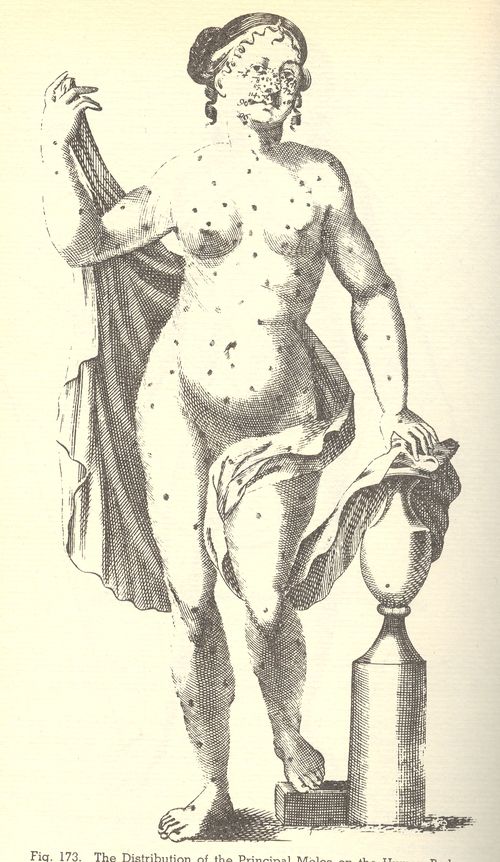
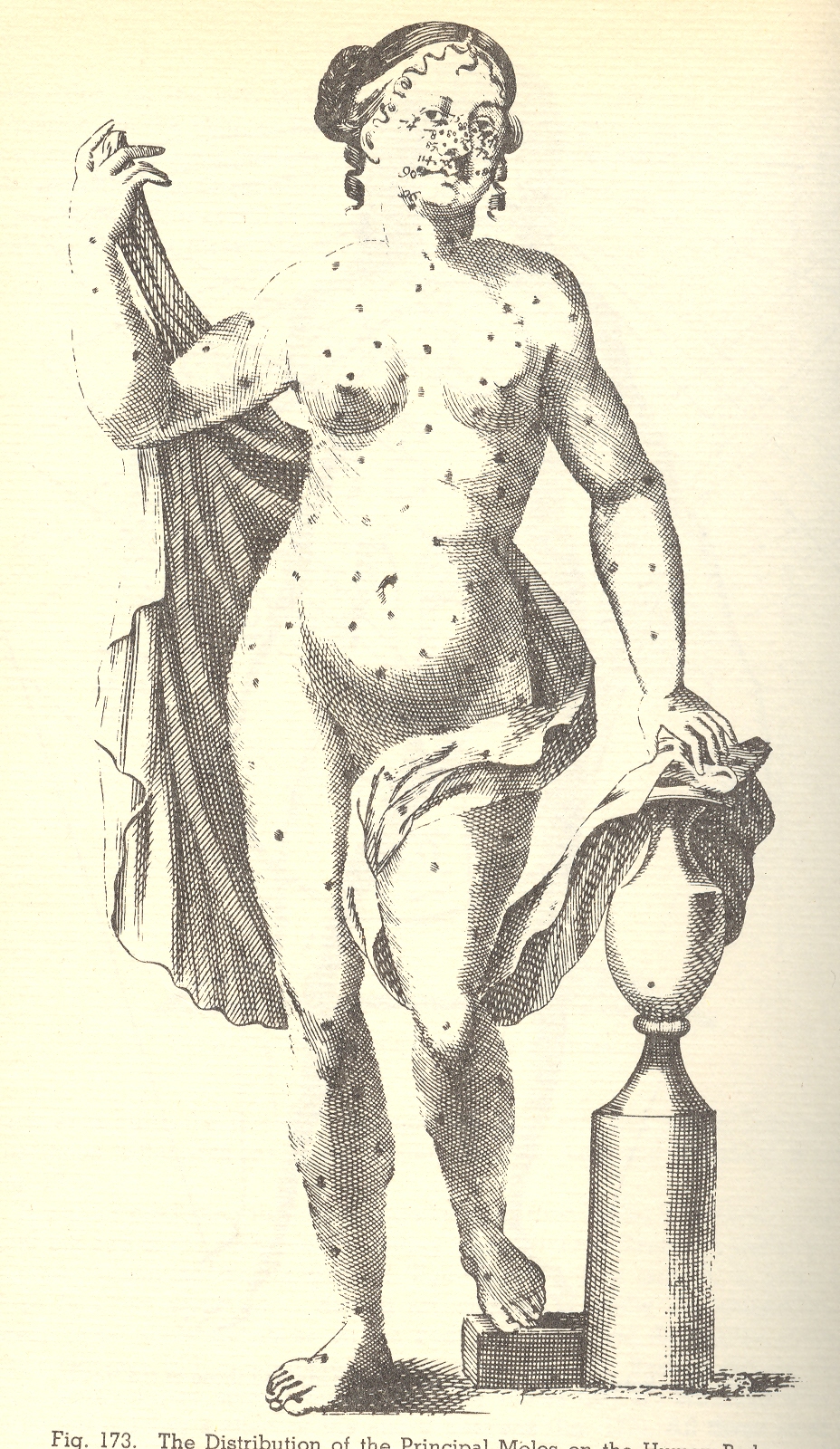
    Blog--jun 11 mole lcosmos The
    map of the moles of this woman’s body looks to me just like a constellation—and
    a constellation is just what they were for Saunders, who viewed the arrangement
    of moles on the body like an astronomer searching the night sky for a new
    comet.   But an astronomer would not be
    trying to force governing connections in the starry realms to occurrences on
    earth (or heaven, or whatever)—that would be the job of an astrologer, whose
    job would be enormously simplified since everything it conjures is
    fictional.  Had Robert Hooke been Richard
    Saunders-like when he made virtually the first microscopic investigations in
    human history, he would have been correlating the hairs and pores of the flea
    rather than making his minute and beautiful observations.

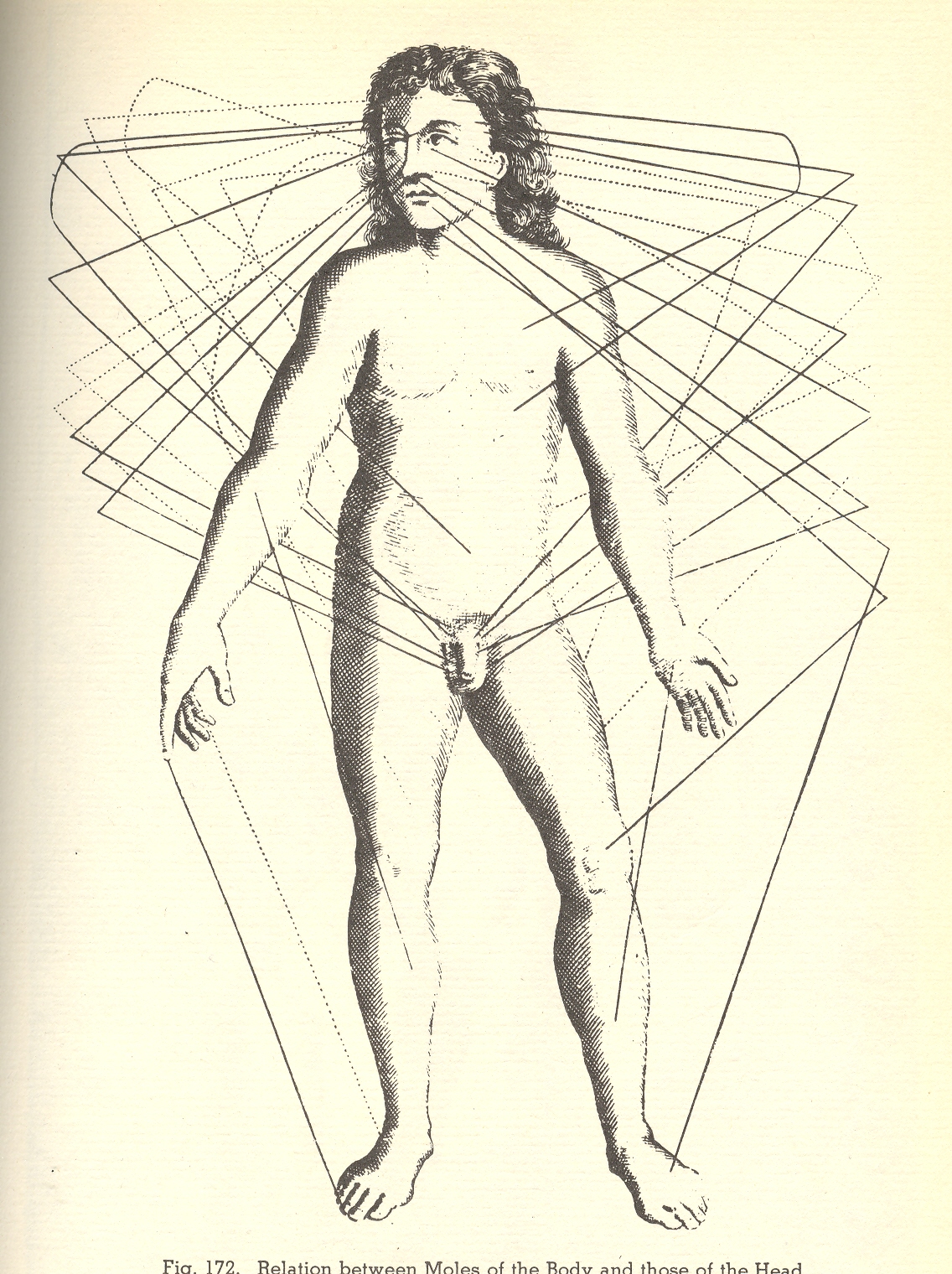
    Saunders
    sees mole connections everywhere, even developing sub-classifications to
    sub-classes: this is seen in the lovely relational map of face moles to moles
    on other parts of the body. (I like the spare curved lines most.)Blog--jun 11 mole lines
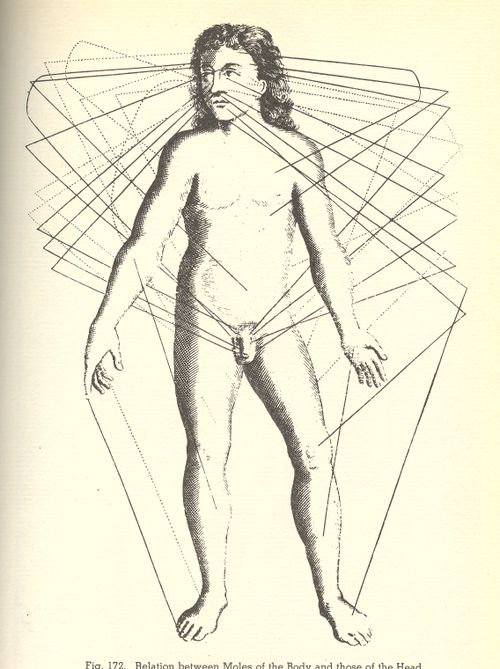
    This
    all looks perfectly phenomenal, unbelievable even,  from out here in 2009.  The fact remains though that the vast
    majority of newspapers in his country still carry horoscopes, and most Americans
    believe in UFOs, and a not-small percentage of those folks say that they’ve
    actually been abducted by Outer Space Aliens. (I calculate that from the
    “first” UFO sighting near Roswell 50 years ago that a sighting has been made about every ten seconds since
    then.  Why all of this interest?  And here’s a question among the many that I
    have about this stuff–outside the astronomical chances of actually
    encountering the other life forms in the universe that do undoubtedly
    exist:  why do these crafts, which have
    spectacular, beyond-physics capacities, have little dotty lights on them?)

    And
    so as bizarre as images like this might look, many (most?) folks in the present
    really haven’t left these ideas behind—they just get changed a little,
    upfitted, retro-ripped, and outfitted with flashing lights.

    In a
    very long career of getting people to think  in spite of themselves, James Randi (scientific
    investigator, keeper of the scientific method, head of the James Randi
    Educational Foundation
    , and formerly “The Amazing Randi” from years ago) has
    one particular mythbust-lecture that I find phenomenal, with a very large “oh
    my good god!” capacity for the students at the end of it–if they would but allow it.  Listen: 
    Mr. Randi would explore the possibilities of astrology, asking the group
    or class who there believed in it, taking a census of belief.  He would then make a very strong, convincing
    case for the application of this hope in astrology (he is a very determined and
    logical speaker), and then give astrological “readings” to each member of the
    group.  The readings would turn out to be exact and persuasive—a second tally would be taken of  believers, with
    the usual results being that (unless they knew who Mr. Randi was or was already
    a skeptic or logically un-needy thinker) the class would now consist of an
    overwhelming percentage of astrology-believers.

    Then
    Mr. Randi lets the high-wind boom swing free: 
    everyone received the same reading. (You can see a short snippet for one of these experience HERE–Mr. Randi has conducted this lecture many times for many different audiences.)  The shock of realization is palpable.

    On
    the telephone this morning Mr. Randi graciously explained this lovely lesson—he
    also explained that even after the key ingredient of the lesson was revealed,
    and even after he lectured on thought and belief and superstition and logic and
    so on, that the people who had already believed in astrology would almost in every circumstance still
    maintain that belief.  Even in the face
    of overwhelming evidence, the idea of belief was no match for fact.  Truth, fact, explanation, method, logic—none
    of these could put a chink in the armor of belief, and is no match for self-deception.

    “The
    Woo-woo is always the same, everywhere, all the time.  If its not astrology its something else, the basis for all of it is the same” (my
    paraphrase) says Mr. Randi. After approaching belief
    systems like UFOs and astrology and mentally bending spoons and mind-reading
    and on and on, Mr. Randi says that at their base, the stories have a common heritage of need.
    And they’re unbendable, and certainly unbreakable, for all of those who need
    the belief.  There’s no room for
    constructive debate and exchange in such belief systems, whether it is
    astrology or creationism (I just can’t call it by its other, cleaned-up
    name), as they cannot satisfy the basic tenets of knowledge growth and scientific inquiry which, according to RP Feynman, is the willingness to test your beliefs against falsity and to investigate all possibilities that might make them invalid.*  Mole mapping predictions and the
    fate of a life is no different from any of these other derivations in wishful/hopeful pseudosciences, either—just a different name
    for the same underlying system of beliefs, though the moles are a little long in the tooth. 

    Anyway, creationism or astrology or life-after death–they might as well all be mapping moles.

    As Feynman said:

    The first principle [in science] is that you must not fool yourself — and you are
    the easiest person to fool. So you have to be very careful about that.
    After you’ve not fooled yourself, it’s easy not to fool other
    scientists. You just have to be honest in a conventional way after that.

    * Feynman on the scientific method:  “It’s a kind of scientific integrity, a principle of scientific thought
    that corresponds to a kind of utter honesty–a kind of leaning over
    backwards. For example, if you’re doing an experiment, you should
    report everything that you think might make it invalid–not only what
    you think is right about it: other causes that could possibly explain
    your results; and things you thought of that you’ve eliminated by some
    other experiment, and how they worked–to make sure the other fellow
    can tell they have been eliminated “
    RP Feynman quoted by Ralph Leighton,  1985, p. 341
    ).


  • Naive Surreal Titles (Series #15): Antique Ideas About Womanhood

    JF Ptak Science Books LLC  Post 645  Blog Bookstore

    Blog--jun 9 odd titl ssh

    In a 
    continuing thread that I call The Naïve Surreal—common, ephemeral titles
    relating to subjects whose meaning has virtually no place outside its own era,
    creating art in their otherwise forgettable and forgetting covers and design—come
    these two examples relating to women and girls. 
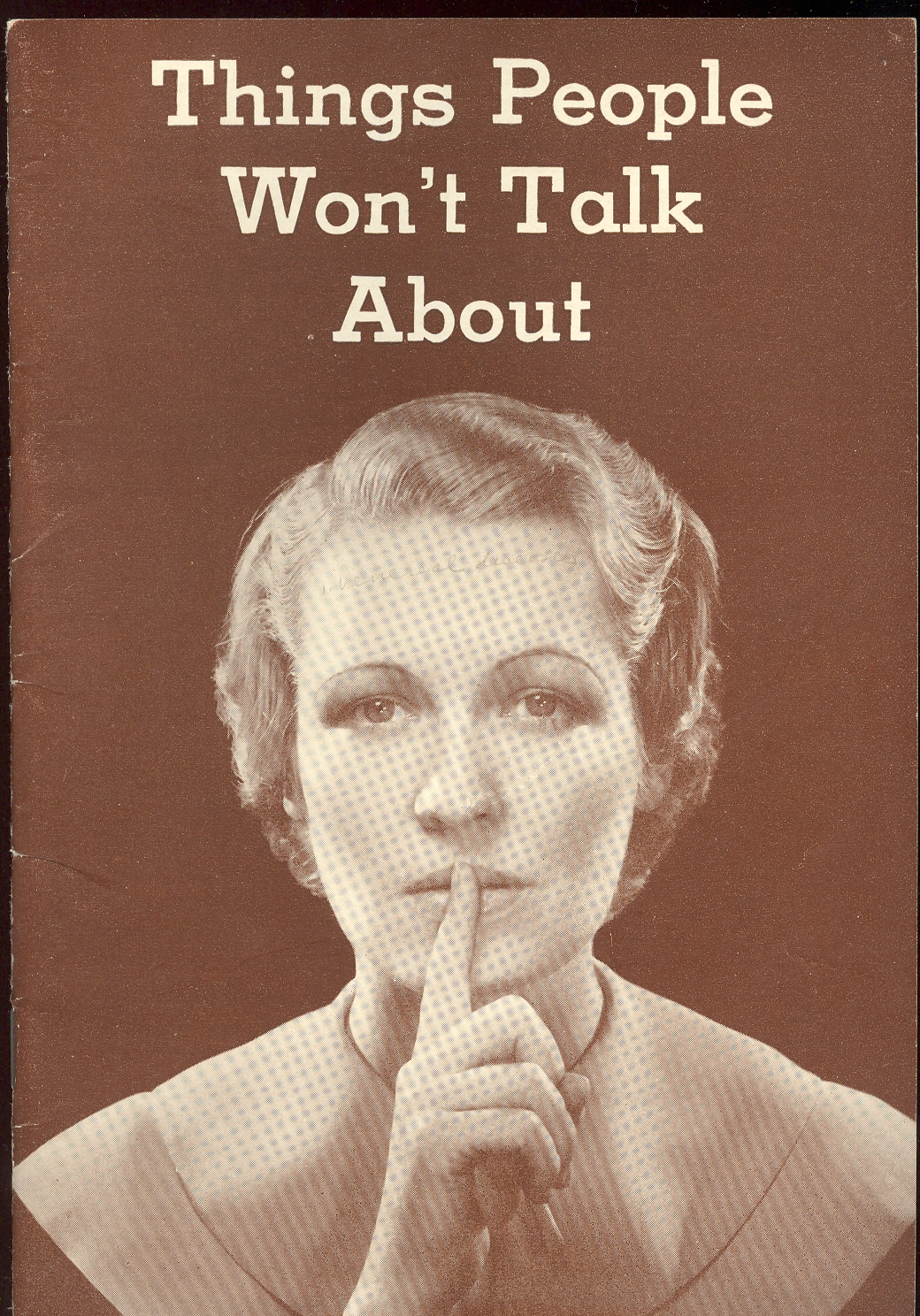
    There’s really not much to say about their contents, really—so much has
    already been said.  They’re just a standard
    of their time.  Things People Won’t Talk About (1937)  is [sic] venereal diseases,
    and is an appeal for actual public discussion (“the foolish secrecy surrounding
    (the diseases) is what makes them so destructive”.

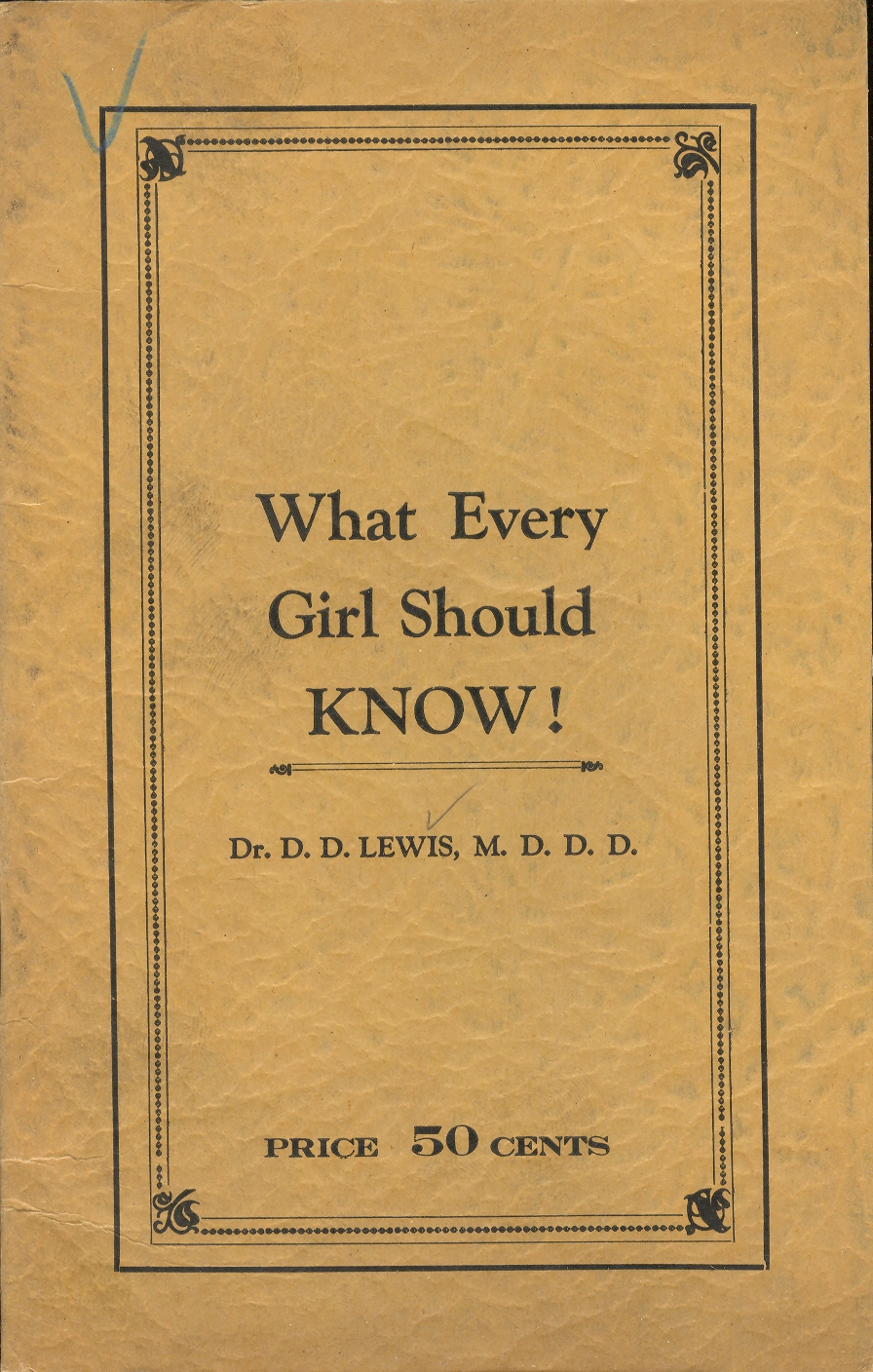
    Blog--jun 9 odd tevry grl
    What
    Every Girl Should Know

    (1928) contains nothing I think outside what everyone would expect it top say,
    except that it is rather well written, and also (in places) quite strongly
    opinionated.  The little pamphlet also
    assumes that its readers already know its complaints:  “the evils of self-abuse are so well known,
    that there is no need to elaborate further on this point”.    Its “chapter”
    headings tell a lot of the story, and probably enough of it to make their
    reading the only thing you need to read: 
    “Know Thyself”, :Know Thyself Spiritually”, “Woman’s Mission”, “The Age
    of Puberty”, “The Ovaries”, “Harmoul—its Importance”, “Rash Marriage”, “Freedom
    and More Freedom”, “Lust and Love”, “The Value of Chastity”, “Buying Popularity”,
    “Selling the Body for Clothes”, “The Tragedy of Dual Love”, Menstruation”, “Masturbation”,
    “Promiscuous Sexual Intercourse”, “Gonorrhea”, “Syphilis”, “The Dreaded Third
    Stage”.  So. There you have it.

    ·Posted by :

    ·in:

    — —

  • Bad Book Titles (and Worse Contents): Cruella DeVille and the Fur of Cats and Dogs, 1938

    JF Ptak Science Books LLC  Post 642  Blog Bookstore

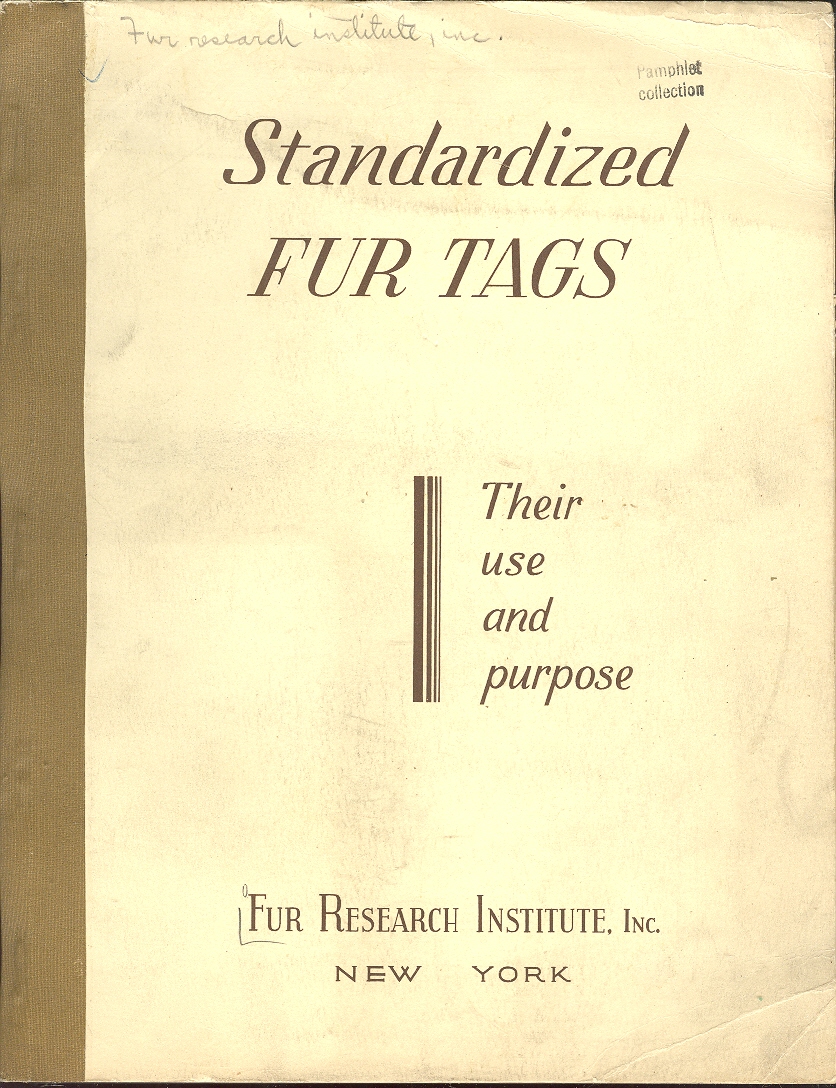
    Blog--jun 8 fur title How
    could one pass up the chance to browse through such a  compelling and revolting
    title such as   Standardized Fur Tags, Their Use and Purpose, (published in NYC
    by the Fur Research Institute in 1938)? 
    Titles like this cry out in equal parts of pity, shame and pride,
    calling to their readers like fur-lined Sirens beckoning to fur-encrusted
    sailors floundering in a fury sea, hell-bent to crash upon fur-slathered
    rocks.  In a world of covering things in
    fur that once belonged to another living thing, the thinking’s all over but for
    the process, pricing and standardization, so that the furriers were less
    inclined to cheat one another and focus on the fleecing of the buying
    public.Blog--jun 8 fur title 001  

     Opening
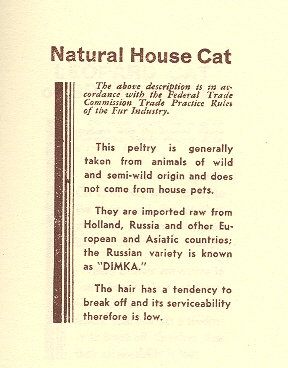
    this oversized pamphlet reveals the explanation of the fur identified by the
    tags that would appear on the interior-neck of the garment.  There are 125 descriptions and standardization
    of furs, though I must say that what caught my attention first was the fur of
    the “natural” house cat (followed by the “dyed” house cat)—they say that this
    was not an agoraphobic cat’s pelt used to make the apparel, but from cats “wild
    and semi wild”.  Like barn cats, I guess.
    (We are told that the fur “breaks off”, and is not a very good choice for
    outerwear, though it did seem to work for the cat.)

    Blog--jun 8 fur title 002

    Then
    there’s the “dyed Chinese dog” and the “dyed Mongolian dog”—I’m not sure who
    would need pelts made of dog (or cat, or anything else for that matter), but I
    guess that they were popular enough to be included in these furrier  guidelines. 
    And so the list goes on and on: dyed skunk, pieced skunk, natural skunk,
    dyed squirrel, dyed weasel, natural wolf, dyed opossum, etc. 

    ·Posted by :

    ·in:

    — —

  • The “Is This Really Necessary?” Department: Fish Throwing Machine, 1932

    JF Ptak Science Books LLC  Post 665

    Blog==june 25 ifish Our necessities are few but our wants are endless.
    Josh Billings

    “Necessity” is a fickle word and and even more elusive emotion, especially when discussing that quality in others.  But there are some things that look, well, just completely unnecessary; so very unnecessary that they are just plain wrong.  Hard to identify, difficult to codify–but everyone knows it when they see it.Blog==june 25 ifish 001

    Such is the case of this fish-throwing machine installed at the London Zoological Gardens.  The wooden tower seems to be 12 feet high or so, with a fish launched from its uppermost window once a zoo patron deposited their sixpence, eager to mechanically feed a sea lion.   Patrons to the zoo at Regents Park who were eager to see the sea lions fed had to arrive at slimly-appointed time; now, with the fish thrower, they could see the sea lions fed at any time, and do it themselves if they were so inclined.  I don’t know exactly what happened to these beats, but constant feeding would’ve have gone all that well.  

    And yes, you got three fish for sixpence.

    Source:  The Illustrated London News, 17  September 1932.

    ·Posted by :

    ·in:


  • Deathly Equality: Liberty & Lung Cancer, Cigarettes and Women’s Rights, 1929

    JF Ptak Science Books LLC  Post 662

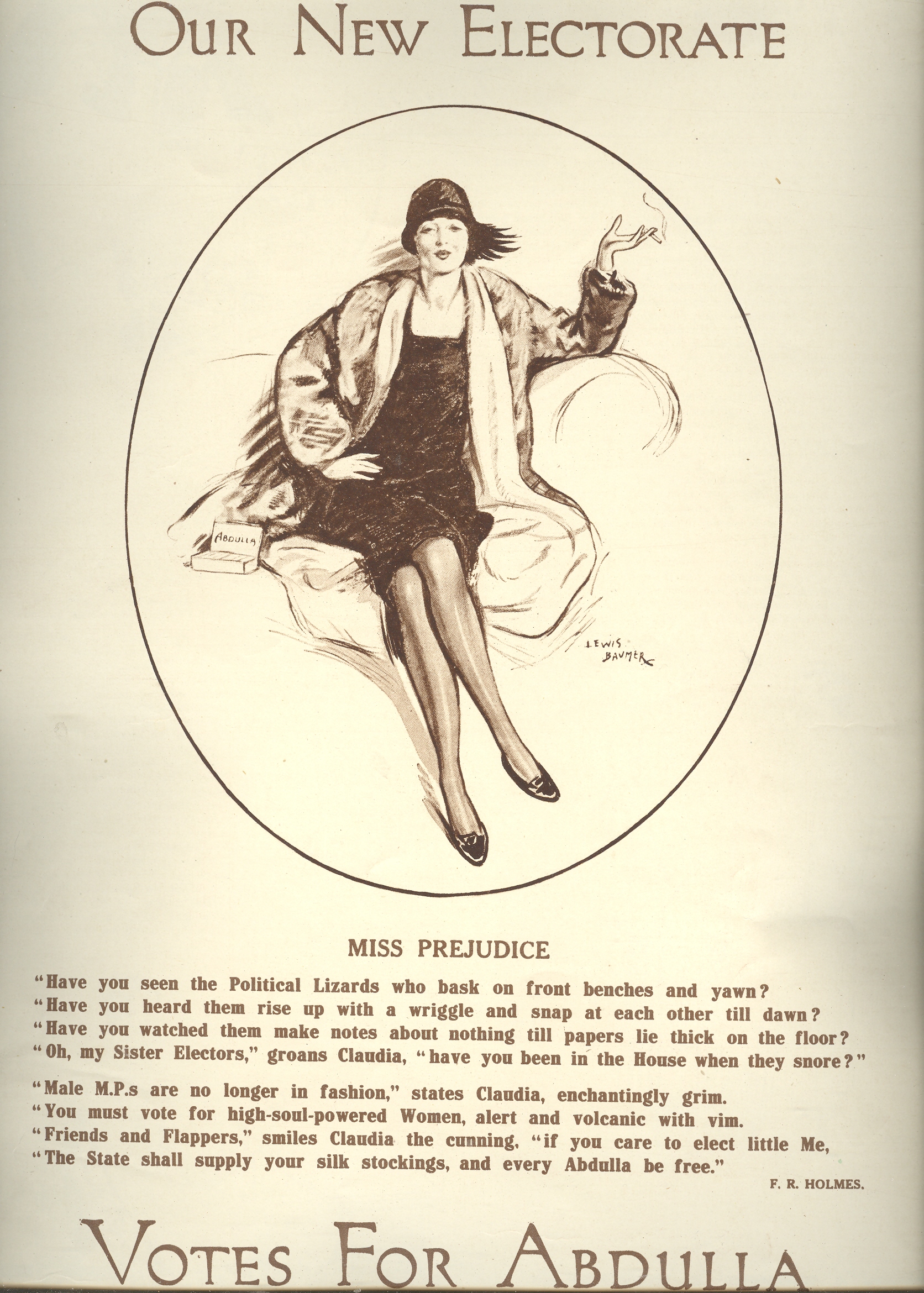
    Blog--june 23 electorate Abdullah Cigarettes has a twisted reliance with the recognition
    of the social equality of women and making money.  Mostly it was making money.  Someone there at Abdullah corporate figured out
    that there was an easy way of increasing their sales without spending huge
    amounts of money on market development—open their market interests to
    women.  And in the case pictured here,
    from The Illustrated London News of 1929, the Abdullah people were making a
    direct appeal to the literal empowerment of women via the national right to
    vote.  This came a little post facto, as
    women were given (?) the right in 1918*, though it seems that there were no ads
    reaching out to women in GB until 1926/7, voting rights or not. 


    There was very good money to be made with cigarettes, which were/are
    basically the non-kosher hot dogs (or worse) of the tobacco industry, the
    tobacco equivalent of the utilization of the pig’s squeal, the remnant of other
    products that was filled with profit.  For
    the overwhelming part of the history of tobacco smoking by the Western world,
    the tobacco that was gathered and stuffed into a paper roll and smoked was the
    lowest form of utilizing the product, the vice of the poor. This degraded
    spectacle was soon morphed into an enormous social advantage and gigantic
    economic opportunity for the producers.

    It wasn’t just Abdullah, of course; nor was Abdullah the
    first on the scene:  that “honor” belongs
    to Helmar Cigarettes, which in 1919 posted an advertisement for a  pack of its cigs buried in a sea of female
    faces. The tobacco companies didn’t embrace the notion of the growing
    recognition of women, but did follow it, taking advantage of the new and
    growing rights and their new marketability and giving everyone free access to
    the same deadly diseases.  Exploitation
    of the emergence of the new social power was the key to making money for those
    companies. 


    In the U.S.,
    Marlboro started mild ads directed at women in 1926, tempting its gentle
    readers with ad copy like this: “Has smoking any more to do with a woman’s
    morals than has the color of her hair? Marlboros now ride in so many
    limousines, attend so many bridge parties, and repose in so many
    handbags.” George Washington Hill followed this lead but was more bold,
    pushing Lucky Strikes right to the forefront (in 1927) of the menace.


    All of this worked very well:  tobacco revenues in the U.S. went from
    $12  million in 1926 to $40 million in
    1930, this based largely on the new female marketization, tempting women’s new
    economic and political power with the power of the cigarette, dressed in the
    fashion of subverting the power structure, just like flapper’s dress, bobbed
    hair and slacks. 


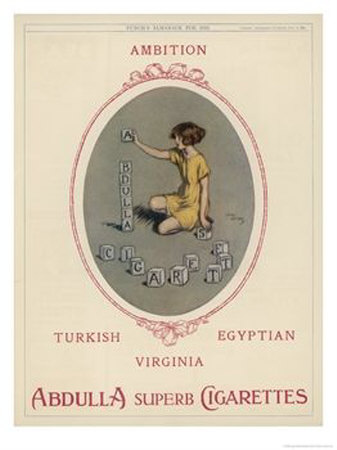
    Blog--june 23--abdulla kidAbdullah also blurred the age barrier for smokers by pushing
    their product with images of what seem to be ‘tweens, a move that expands the
    concept of nastiness. (It should be remembered that the baseball player Honus
    Wagner demanded that his picture be removed from the baseball cards distributed
    with Sweet Caporel cigarettes because he thought the tobacco company was trying
    to corrupt the young with it—the result was that his card is among the rarest
    and most expensive of all baseball cards.) I don’t think that there’s much room
    for negotiation in this image—it plainly is directed at the young.  But of course it was all a nasty business,
    top to bottom—even the American Medical Association got into the act, publishing
    their first cigarette ad in their journals in 1933—a practice that would last
    to 1952.  The cancer connections were
    there, but the lobby by the concerned national interests of the tobacco
    companies were fierce, and the first warning labels about the cigarette/cancer connection
    didn’t appear on packages of cigarettes until Surgeon General Jesse Steinfeld’s
    tenure in 1970.** (Fat and heart diseases kills more, but so do hospitals.  Lee Iococa fought seatbelts in his cars for
    years, and on and on into the night goes this song.)


    I wonder why there hasn’t been more recognition of the
    earlier history of lung cancer—particularly since it really doesn’t seem to
    exist in the 19th century and before.  The disease only starts to show up in the
    1920’s, after men had been smoking cigarettes for 20 years or so.  The epidemic of lung cancer rose with the
    consumption of cigarette–it is of particular forensic interest to look at lung
    cancer rates among men and women from 1950-1980.  These stats are a surprise to no one, the
    rate of cancer among women spiking in the 1950-1980 era, when their habits were
    mature from long use of the liberating agent. 
     Cigarettes was just one of many
    ways in which women expressed their modernism—but is almost certainly the
    deadliest. 

     *American women would get the vote two years later, in 1920;
    that follows the New Zealand
    lead, which granted women the right to vote in 1893.  Ah how many times the Kiwis beat the rest of
    the world to the punch for the correct political behavior!  On the other hand, women in Mexico got the vote in 1948; in Kuwait,
    they waited a little longer, until 2005. 


    ·Posted by :

    ·in:

    —

  • Animal Imitation, Tight Corsets, and Perdition: Physiognomy, 1873

    JF Ptak Science Books LLC  Post 658  Blog Bookstore

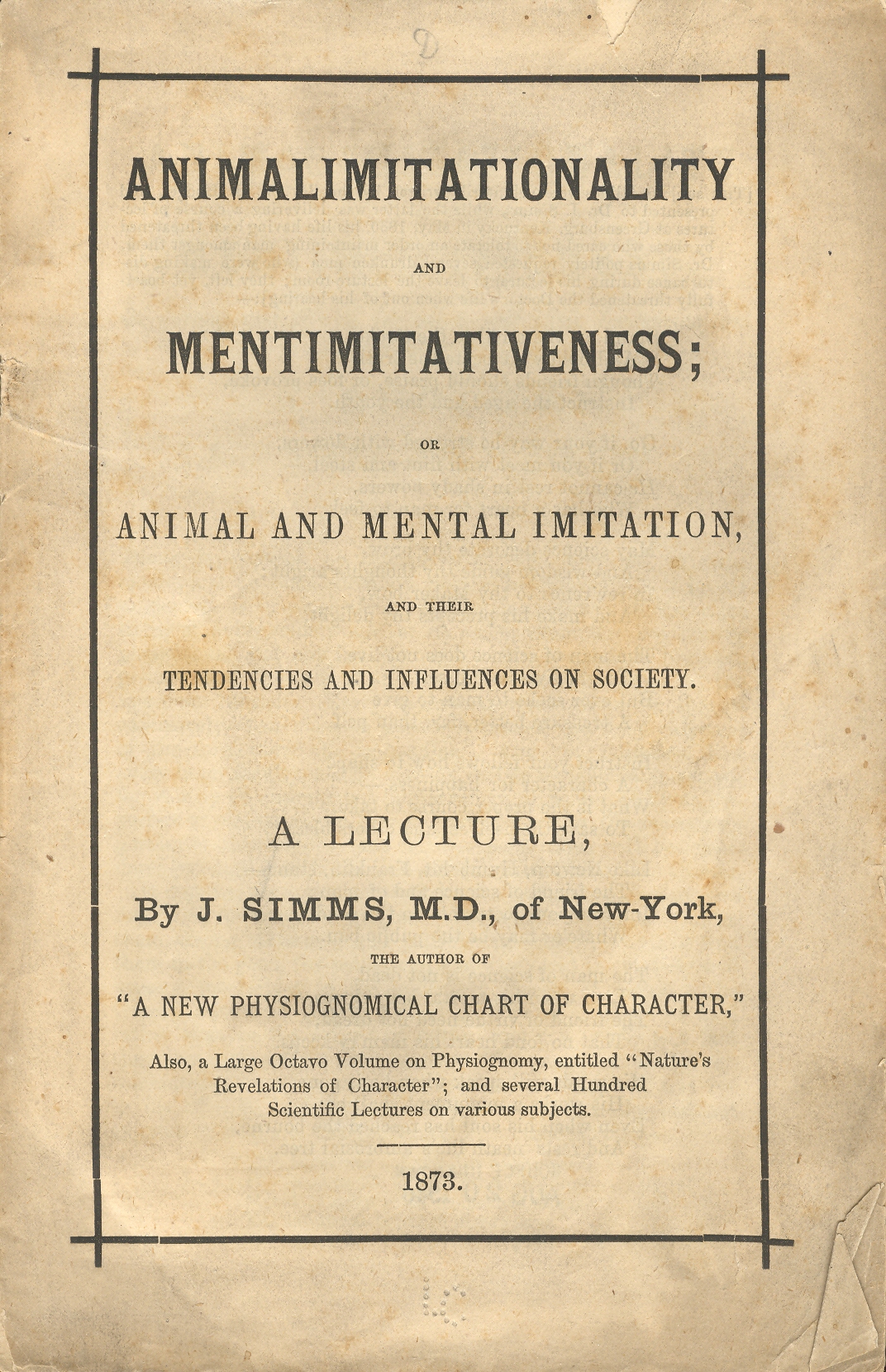
    Blog--jun 16--simms The fabulouslessness and learned foolishness of J. Simm’s horribly-named Animalimitationality and Mentimitativeness; or Animal and Mental Imitation and their Tendencies and Influences on Society, a Lecture, seems a poor-man’s ramble in a polysyllabic scribble.  At it base, J. Simms (listed as “M.D”., and who was also the author of A New Physiognomical Chart of Character) presents a two-paragraph idea and published it over twelve pages that seem twelve pages too many.  The idea is basically so:   humans at time resemble animals because animals imitate what they see, as do humans.  That is principally the entire deal, though it evidently was the cause of numerous lecture bookings for Mr. Simms.  And what Mr. Simms talks about are the problems of imitation, the results of which are found in tight shoes, tight corsets, big hats, and bad walking, all leading to debauched society and wrecked personal dreams. 

    There are many things the Simms work is not.  It is not a work that encompasses the social geometry found by other people later in the century–those who came across the study of people and immitation and the like legitimately, such as Gebriel Tardem Emile Durkheim, Scipio Sighele and Gustave Le Bon, for example.  These folks worked with capable data and reasonable assumptions in looking at how the transmission of data and knowledge takes place between people, and sought to explain the construction of the social membrane in logical and scientific ways.  They were trying to address what Marcel Proust would call (somewhat later) “a new distance between ourselves and things”. 

    Simms was interested in did this too, but did so in terms of how people imitated animals, and how that imitation spread to imitating people, and then fashions, and then resulting in too-tight corsets and too-tight shoes, and wanton neediness, all eading to advanced imitation and, finally, to perdition.  The man had an odd vision which obviously appealed to some. And so it goes.  There’s not that much difference in the set of assumptions of Simms and those of Dr. Freud, is there?


  • The Shotgun in the Service of Natural History–Shooting Flowers

    JF Ptak Science Books  LLC  Post 657

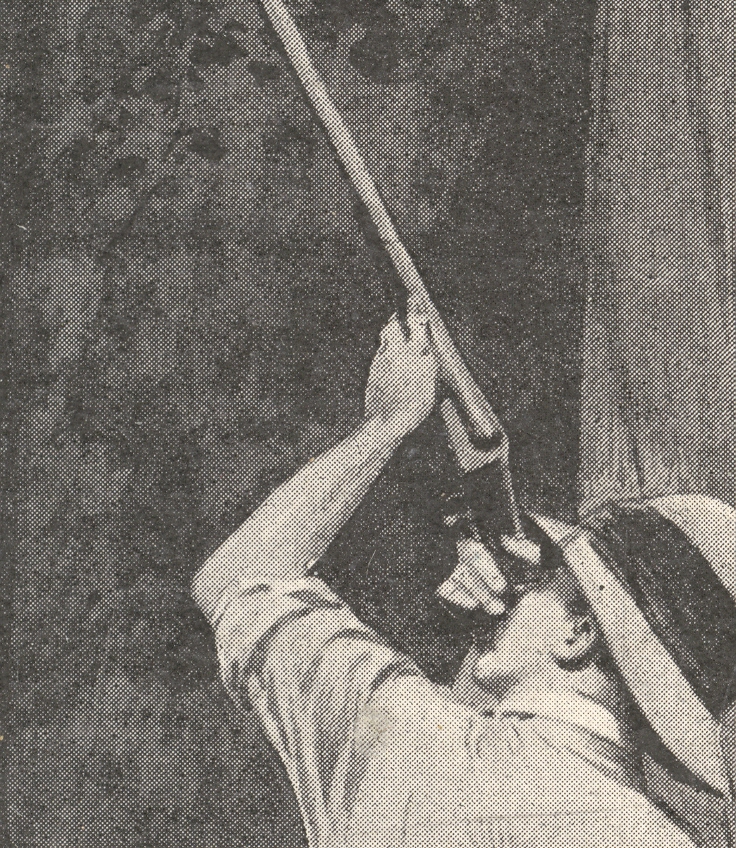
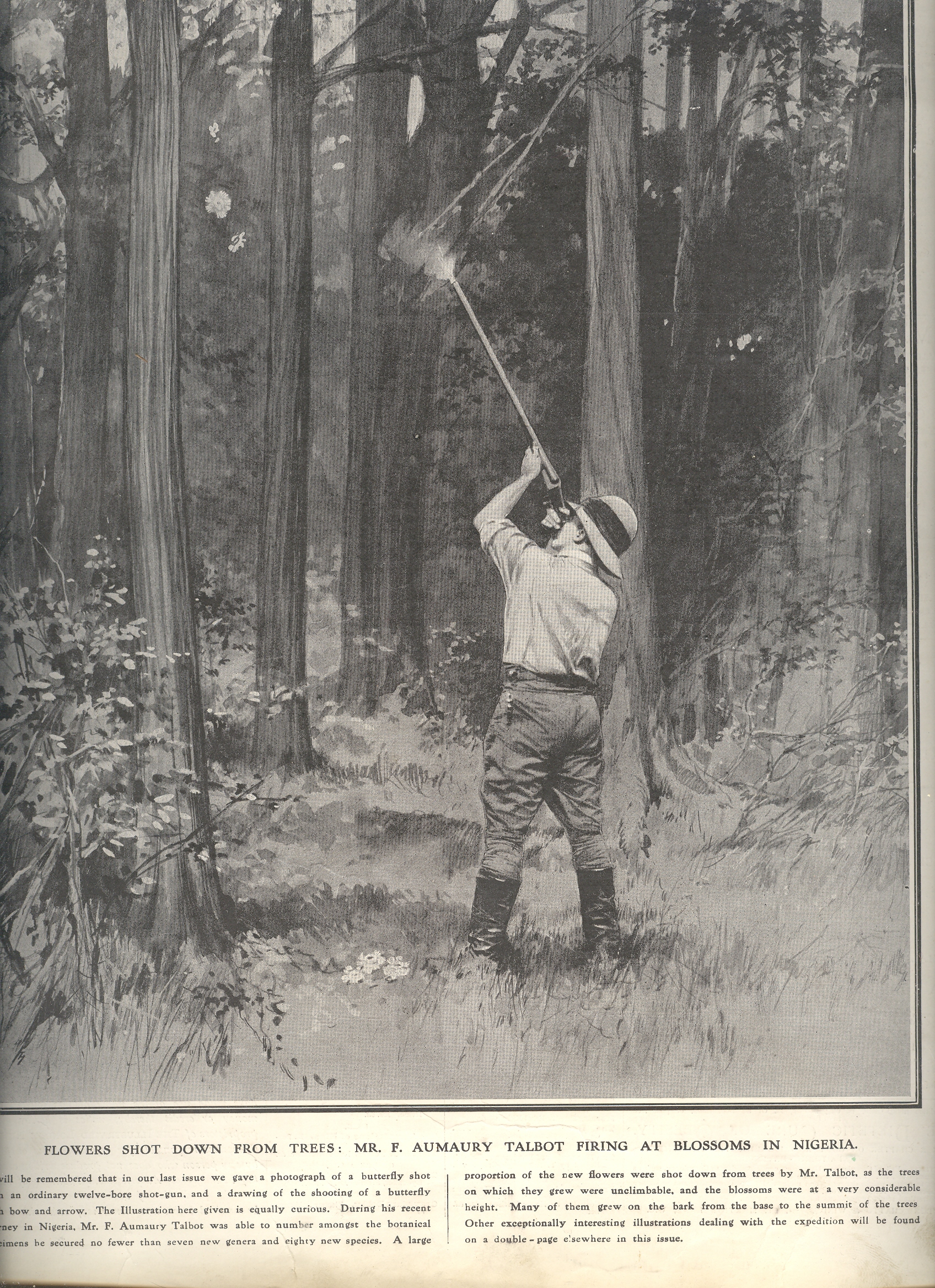
    In the always summery days of summer of 1912  , Mr.  F. Aumaury Talbot  went hunting in the wilds of Nigeria–not horribly unusual of course, except that the man was shooting flowers from trees.  

    Blog--june 19--detailBlog--june 19--detail 2

    I’ve never seen a picture like this, nor have I read anything about shotgunning blossoms from on-high in a tree canopy. And that’s what the man is doing–right down to the shotgun.   Mr. Talbot (for whom an estimable cash prize for academic work in anthropology is still named) was able to collect eighty (!) new species of flowers on this trip to Nigeria, many collected in this fashion. 

    We read in the story about this image (from The Illustrated London News of 8 June 1912) that in the 2 June issue appeared another shotgunning-in-the-service-of-Understanding-Nature:   this time shooting butterflies.  With a shotgun. 

    Blo--june 19--shooting flowers


  • Curious, Impracticable and Useless Inventions: Gun Hats and Steel Fish, 1920

    JF Ptak Science Books LLC  Post 655

    Blo--june 17--hat gun I had started out to write this post about the Sham Paris,
    the False Paris, that was being built outside Paris to deceive German bombers in WWI.  Now, that wasn’t a particularly bad
    invention, per se—a bit like the
    Maginot Line in is way—just too much, over-the-top, short-distanced and muddied
    sight. 


    But on the way to the images of non-Paris I came across
    these few inventions as reported in The
    Illustrated London News
    of Christmas Day, 1920.  These innovations look older than 1920, to
    tell the truth, but here they are. 

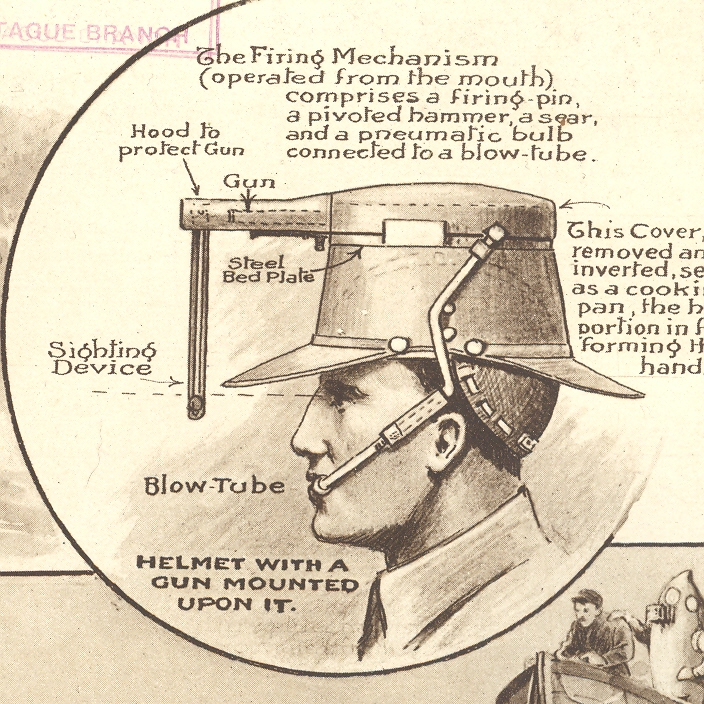
     First is the hat gun—or, rather, the helmet gun.  It look as though the whole affair would be aimed
    and fired hands-free.  By the look of the
    barrel, the thing in the helmet looks like 50-calibre, which might have an ill
    effect on the neck of the shooter.

    Blo--june 17--stubby

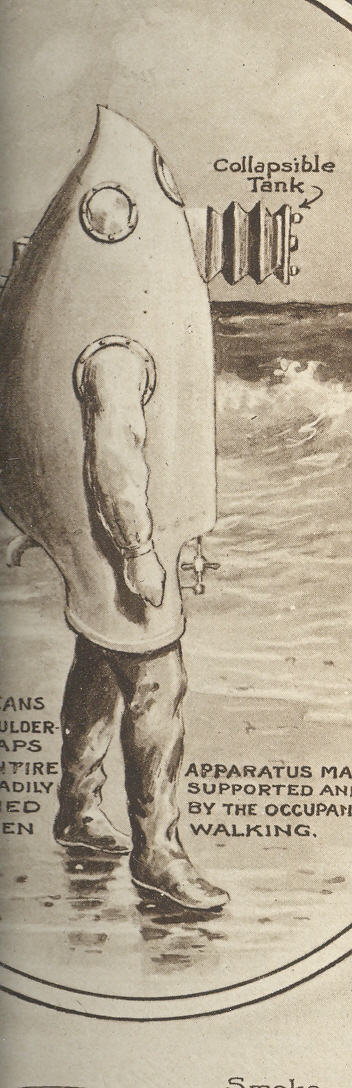
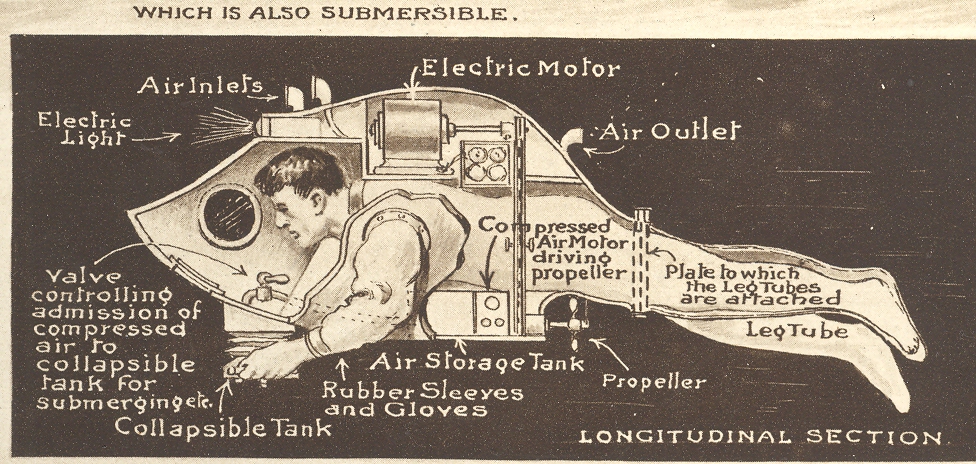
    The next few images illustrate an improbable, cartoon-like
    device for swimming in the high seas.  It
    is a ticklish-looking thing, with air outlets and propellers and such being in
    the rather tender areas of the internalized man. 

    Blo--june 17--horizontal


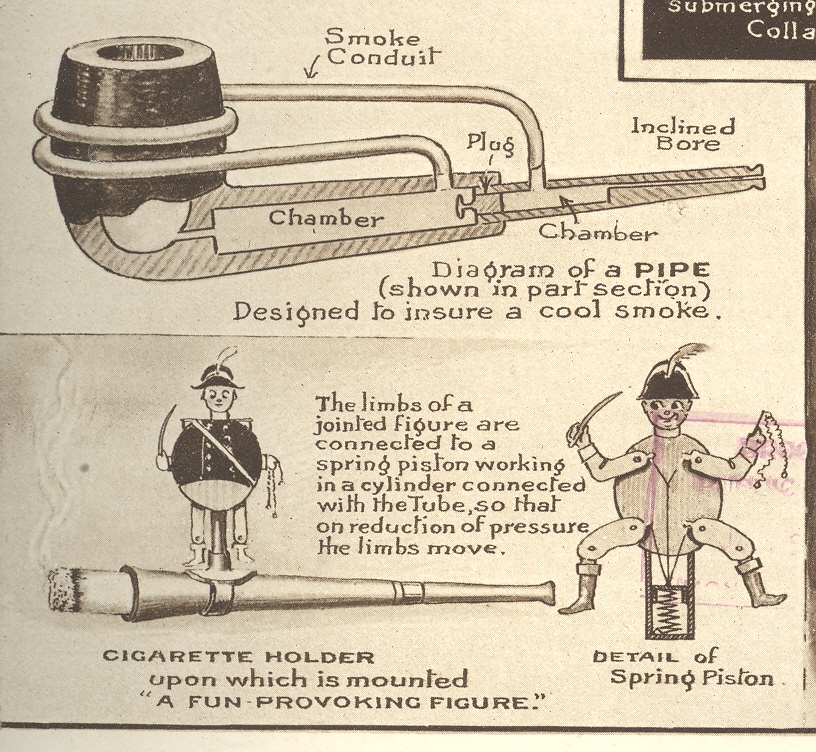
    Lastly we come to a pipe designed with too much duct work (a
    la the movie Brazil)
    to deliver a cool smoke from a hot bowl. 
    The device below that tries to bypass the entire hot smoke issue by
    distracting the smoker with a movable whirligig. I’m not so sure that Bogart
    would’ve been taken very seriously as Phi Marlowe had he been (a) smoking a
    ciggy with a holder, and (b) if that cig holder had a movable figure on it
    that raided a sword every time he drew smoke. 

    Blo--june 17--smoling


    ·Posted by :

    ·in:

    —