A Daily History of Holes, Dots, Lines, Science, History, Math, Physics, Art, the Unintentional Absurd, Architecture, Maps, Data Visualization, Blank and Missing Things, and so on. |1.6 million words, 7500 images, 4.9 million hits| Press & appearances in The Times, Le Figaro, Mensa, The Economist, The Guardian, Discovery News, Slate, Le Monde, Sci American Blogs, Le Pont, and many other places… 5000+ total posts since 2008.

Category: Bad Ideas

  • Letters from the Dead and Dead Letters, Part I: Letters from the Condemned, 1719

    JF Ptak Science Books LLC  Post 602    Blog Bookstore

    Hanging offenses in England  in the
    18th century reached considerably far down into common crime.   The practice of printing a broadside detailing
    the crime with the prisoner’s lament below was also a common practice—it fueled
    public introspection/fear about keeping the laws of the King, provided them an
    entertainment (as the hangings were public), and helped to sustain a minor
    industry of grubby little Grub Street presses that produced such things. Very
    early on in my bookselling career I sold a collection of upwards of 500 of
    these broadsides—I remember clearly that young boy(s(!) were hanged for the
    theft of handkerchiefs,  men hanged for
    the theft of a goat, a chambermaid for stealing some tableware; people were
    hanged for house breaking, “threatening”, shooting a stag, fraud, damaging
    public buildings, and the like.  Under
    James I in 1603 there were 50 crimes with punishments of death; by 1783 there
    were 200. As James Briggs (et al) wrote in Crime
    and Punishment in
    England ,
    an Introductory History, “the death penalty was a leading feature of penal
    thinking”. 

    Crimes against code, the basic public
    sensibility, and common discussion were also punishable by death.  Homosexuality was one offense in this
    category—in 1769 William Blackstone’s foundation work on English law  (Commentary….,
    chapter 15, Book IV, pp 205-217) described homosexuality as the “crime  that could not be named”, and both active and
    “passive” partners to such a crime were eligible for hanging.  I wonder about the statistics for crimes like
    this, and also about the number of Lesbians who were hanged for their love.

     Adultery was another crime for which one
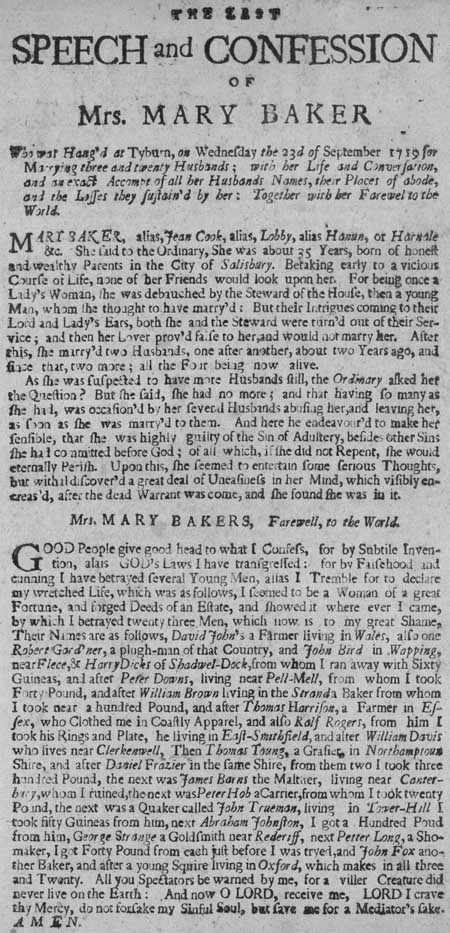
    could swing, and the broadside that I’ve reproduced here details just one such
    criminal.  It is the hanging confession
    of Mary  Baker , who was convicted  of defrauding “several” men of money, and
    also of the sin of multiple marriages, and adultery.  The case was quickly heard and the sentence
    quickly delivered
    Blog--may 4--
    Mary was interviewed and she allowed that she had taken two
    husbands; but the legal representative convinced her to tell the whole story,
    as she would be soon be judged by god. 
    This was sooner than she thought, evidently, because she was convicted
    on these two admitted counts (though she was suspected of many more).  Convicted and sentenced, and sentenced to
    death.  It was after she received the
    death warrant that she confessed to more than the original two.  As the broadside states: “She seemed to
    entertain some serious Thoughts, but withal discover’d a great deal of Uneasiness
    in her Mind, which visibly enereas’d, after the dead Warrant was come, and she
    found she was in it”.  Finding yourself
    in a death warrant would increase your uneasiness, I’m sure. 

    I’ve got no idea why Mary would go into
    such detail; perhaps it  was a natural
    reaction, trying to rescue the soul by confession; maybe she was enticed by the
    legals, somehow (threat against her, threat against family, a more “pleasant”
    (i.e. less painful, immediate) death at the hands of the hangman.  I don’t know. ) But this is the list of the
    men she married, or didn’t marry, outlined in her confession. 

     She starts with a general appeal to her readers:

    “GOOD People give good head to what I Confess, for by
    Subtile Inven-
    tion, alyis GOD’s Laws I have transgressed: for by Falsehood and
    cunning I have betrayed several Young Man, alias I Tremble for to declare
    my wretched Life, which was as follows:

    I seemed to be a Woman of a great Fortune, and forged Deeds
    of an Estate, and showed it where ever I came, by which I betrayed twenty three
    Men, which now is to my great Shame, Their Names are as follows:

    [And making a list of these names, we have:]

    David John’s a Farmer living in Wales,
    Robert Gard’ner, a plugh-man of that Country,
    John Bird in Wapping,near Flece,
    Harry Dicks of Shadwel-Dock, from whom I ran away with Sixty  Guineas
    Peter Downs, living near Pell-Mell, from whom I took Forty
    Pound
    William Brown living in the Stranda Baker from whom I took
    near a hundred Pound,
    and after Thomas
    Harrison, a Farmer in Essex, who Clothed me in
    Coastly Apparel, and Ralf Rogers, from him I took his Rings and Plate, he
    living in East-Smithfield
    William Davis who lives near Clerkenwell
    Thomas Young, a Grasier in Northamptoun Shire
    Daniel Frazier in the same Shire, from them two I took three
    hundred Pound
    James Barns the Maltner, living near Canterbury, whom I ruined,
    Peter Hob a Carner,from whom I took twenty Pound,
    Quaker called John Trueman, living in Tower-Hill I took
    fifty Guineas
    Abraham Johnston, I got a Hundred Poud
    George Strange a Goldsmith near Rederiff,
    Petter Lang, a Shoemaker, I got Forty Pound from each just
    John Fox another Baker, and after a young Squire living in Oxford, which makes in all
    three and Twenty.

    I don’t know anything about Mrs. Baker.  It does seem as though she was out and up to not-much-good, an defrauded a bunch of guys.  Seems that she met a very stiff end for what harm she actually caused.  Then again, when kids were hanged for plucking two hankies from a gent’s pocket, her crimes seem large in the redded eyes of the Bloody Code.  
    ·Posted by :

    ·in:


  • A Note on the History of Smiling

    JF Ptak Science Books Post 630  Blog Bookstore


    Where do exhausted 1951 smiles go?

    Blog--may 29--smile 7up det

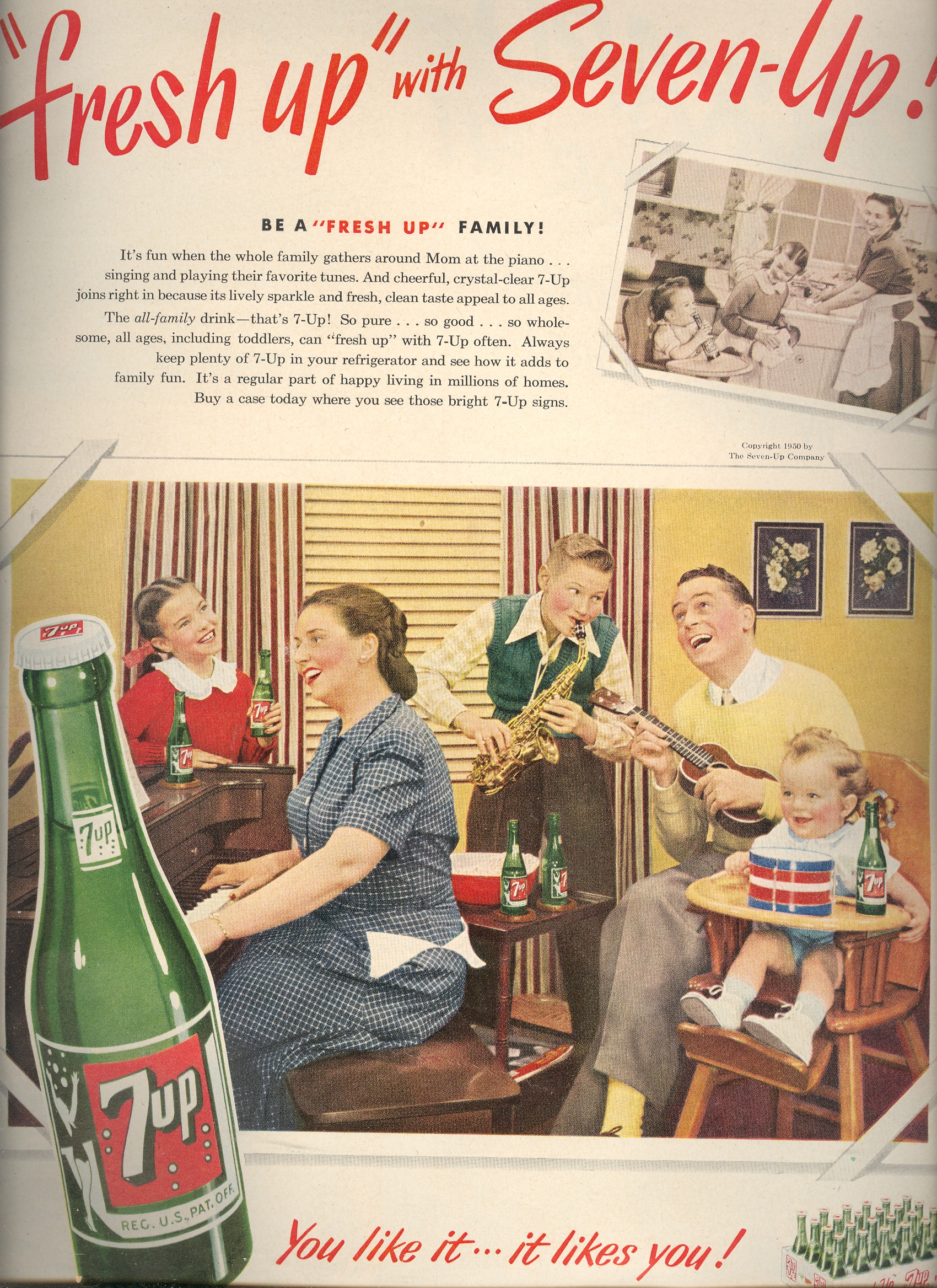
    I don’t know when the first illustrated advertisement appeared, and I don’t know when the first picture of a smiling human face was used in that in order to sell a product displayed in a mass market printed publication.  My sense though is that the smiling, happy (and too-happy) face was first used in the first or second decade of the 20th century, but that the general, templated use of the eagerly over-sized mega-toothed smile topped by wide-spirited painted eyeballs came into play in America right after the end of WWII.  The enthusiastic smiled-upon objects seem to become more slight and mundane as time passes, coming to a point fairly early on of the mysterious basis for this happiness over such modest products.  The smiles and happiness brought by these items was surely short-lived, the smile becoming a fossil, a relic, to simpler times and simpler consuming needs. 

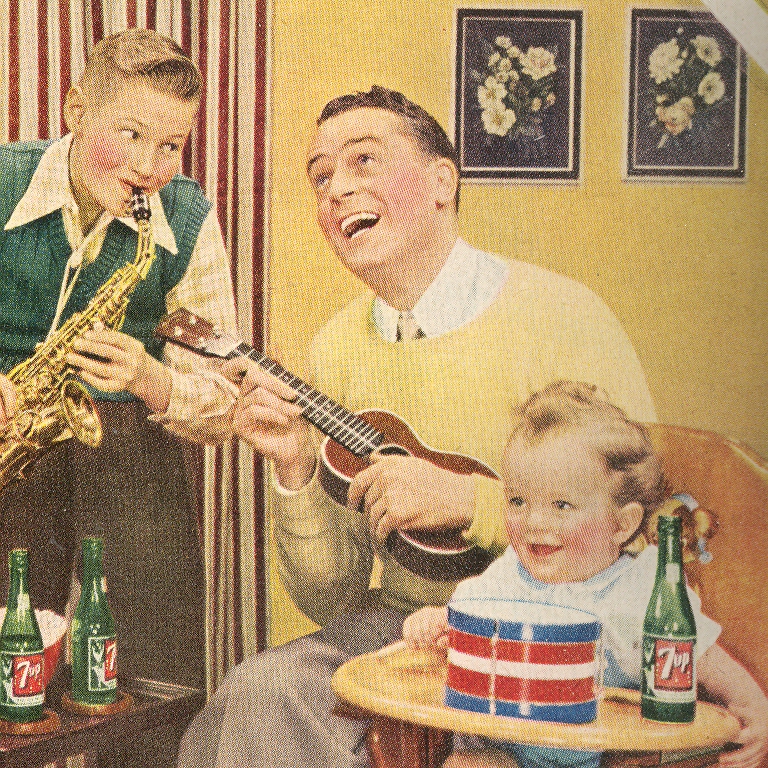
    Blog--may 29--smile 7up

    Breezing through a hand volume of LIFE magazine for 1951 finds many examples, and quickly too:    how exciting can a bottle of 7Up possibly be?  This entire family seems to be serenading the object of their collected desires, the father certainly being the most moved of the bunch.  Baby has its own bottle and, of course, drum.


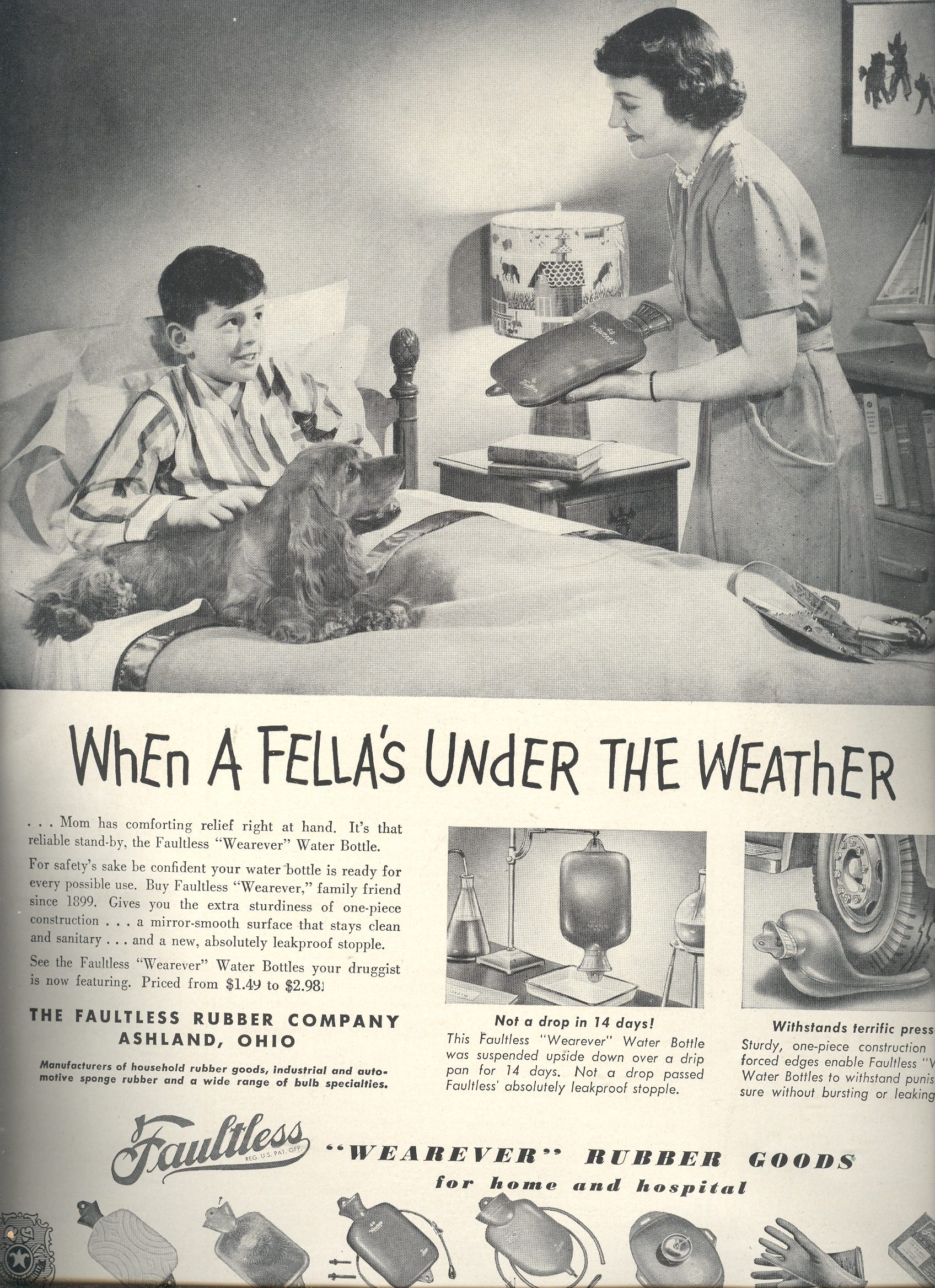
    Blog--may 29--smile water bott;e

    Is that Jerry Mathers smiling so contentedly at Mother brining in his hot water bottle?  (The doggie is staring at something to Mother’s left, probably focused on some trainer threatening/rewarding  it to make it seem  interested in the hot water bottle, too. )  It is hard to image this item bringing a smile to anyone’s face, at least from this standpoint in the future.  Its a simple rubber bag, brought to  a simple room.  In a weird and unexpected King of the Hill neighborhood sort of way,  the whole scene seems  very comforting. Maybe its the cowboy holster at the foot of the bed and the perfectly folded blanket that seals the deal.)


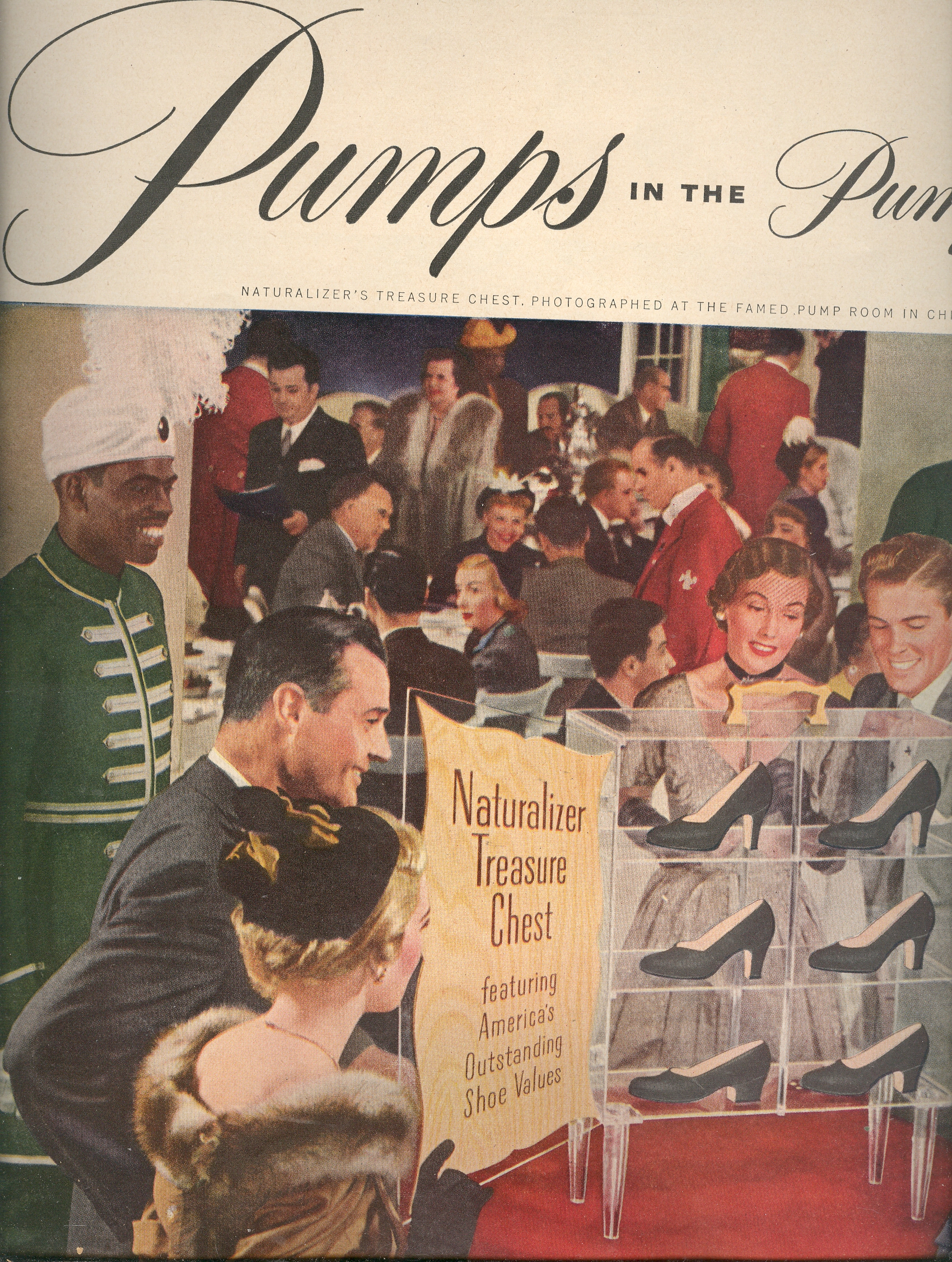
    Blog--may 29--smile pumps

    Pumps?  This is actually half of an ad featuring a number of very accommodating couples allowing themselves to be happy while looking at women’s shoes.  I can’t tell what is going on in the background, but in the foreground there are several of men infected with broad-beam smiles brought on by looking at a glass case filled with pumps.  The glass “treasure chest” seems to be guarded by garishly-festooned black men, a sign of the un-lliberated LIFE magazine times.  


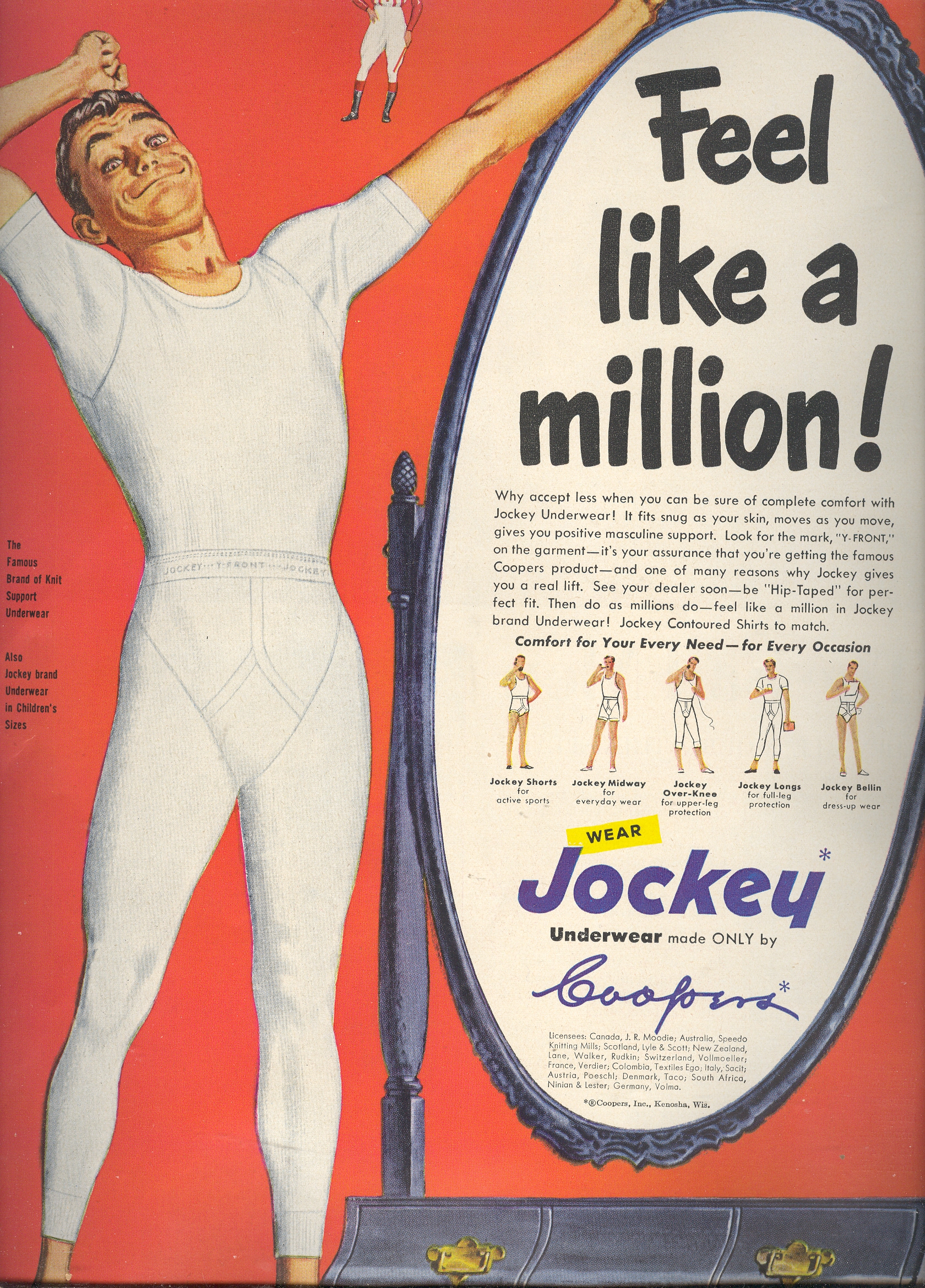
    Blog--may 29--smile underwear

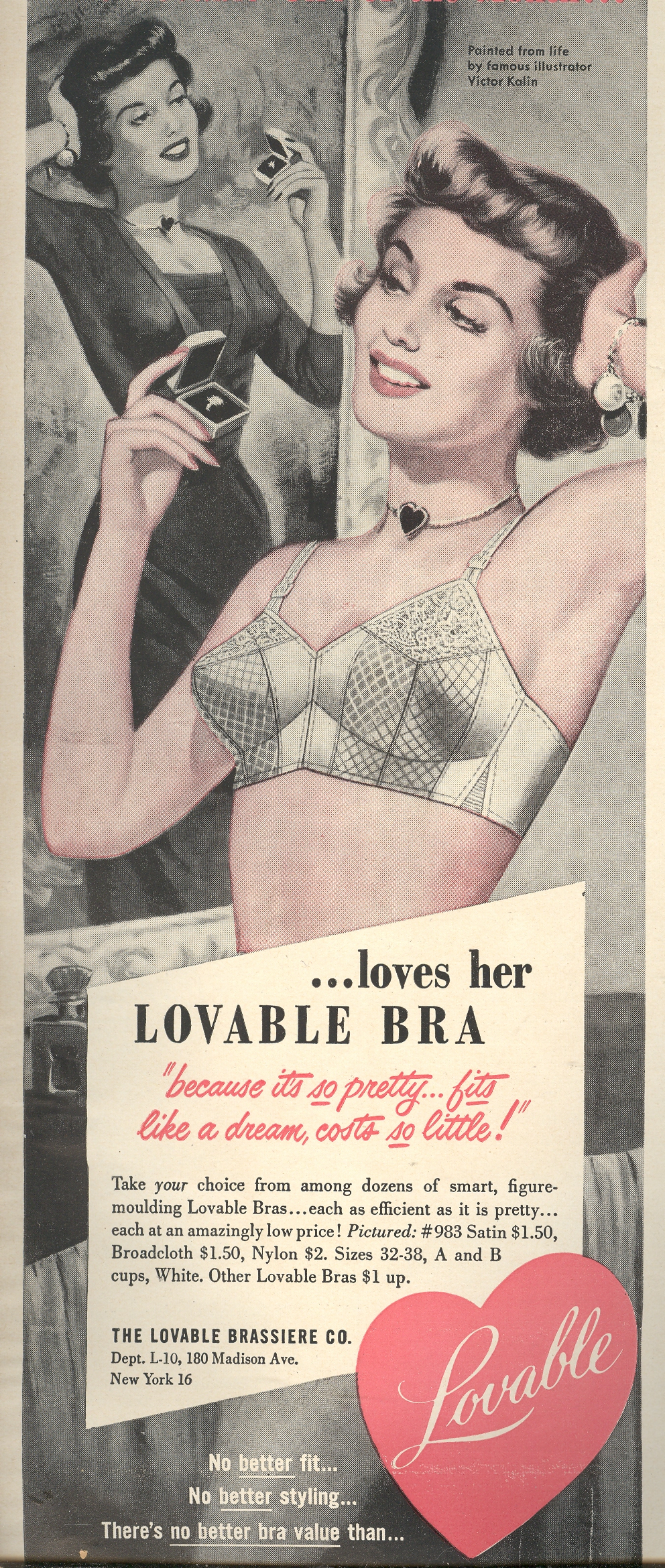
    This man seems overly exuberant with the pleasure brought him by his underwear, though he is at least alone while experiencing this private Underwear Emotion. (In many other ads by Jockey there’s a man & boy setting, each usually with big smiles, straddling things to show the comforts of their underthings, caught in what seems today to be pre-porny trash poses of extremely dubious ease…no one today would ever come close to publishing such a thing in today’s (legitimate) advert community.) So too for the woman who seems to match appreciation for her new engagement band with the fortitude of her bra–it isn’t exactly clear that the ad is celebrating  uplifted pointy breasts with  marriage proposals, but  it  doesn’t take too much  of  a  leap to get there.

    Blog--may 29--smile bra

    There was a time that the *something* that made us smile didn’t make us smile any longer.  The smile is gone, gone to where smiles go once they’re no longer needed, replaced by thin-lipped satisfied need.There was a time in 1951 when advertisers thought their products to be so appealing that they used monumentally misplaced smiles to convince the buying population of the United States to purchase their product, expecting I guess to produce that photographed smile onto the face of every purchaser, or at least to image the smile in the consumers’ noggins. That smile didn’t last long—after all, we’re just talking about 7Up and underwear. 

    I wonder about the issue of the  impossible smile of promised  pleasures like these, and how it changed over the years. As a casual observer of  millions (?)  of these  sorts of things over the years,  my own general impression is that the smiles are  era-dependent and semi-generational.  Or not.

    ·Posted by :

    ·in:


  • A Proficiency of Insult: a Biting Poem on the Medical Profession, 1736

    JF Ptak Science Books LLC   Post 595   Blog Bookstore

    “For even they who compose
    treatises of medicine or natural philosophy in  verse are denominated poets…” Aristotle’s Poetics
    [Translated by Thomas Twining, New
    York 1957]

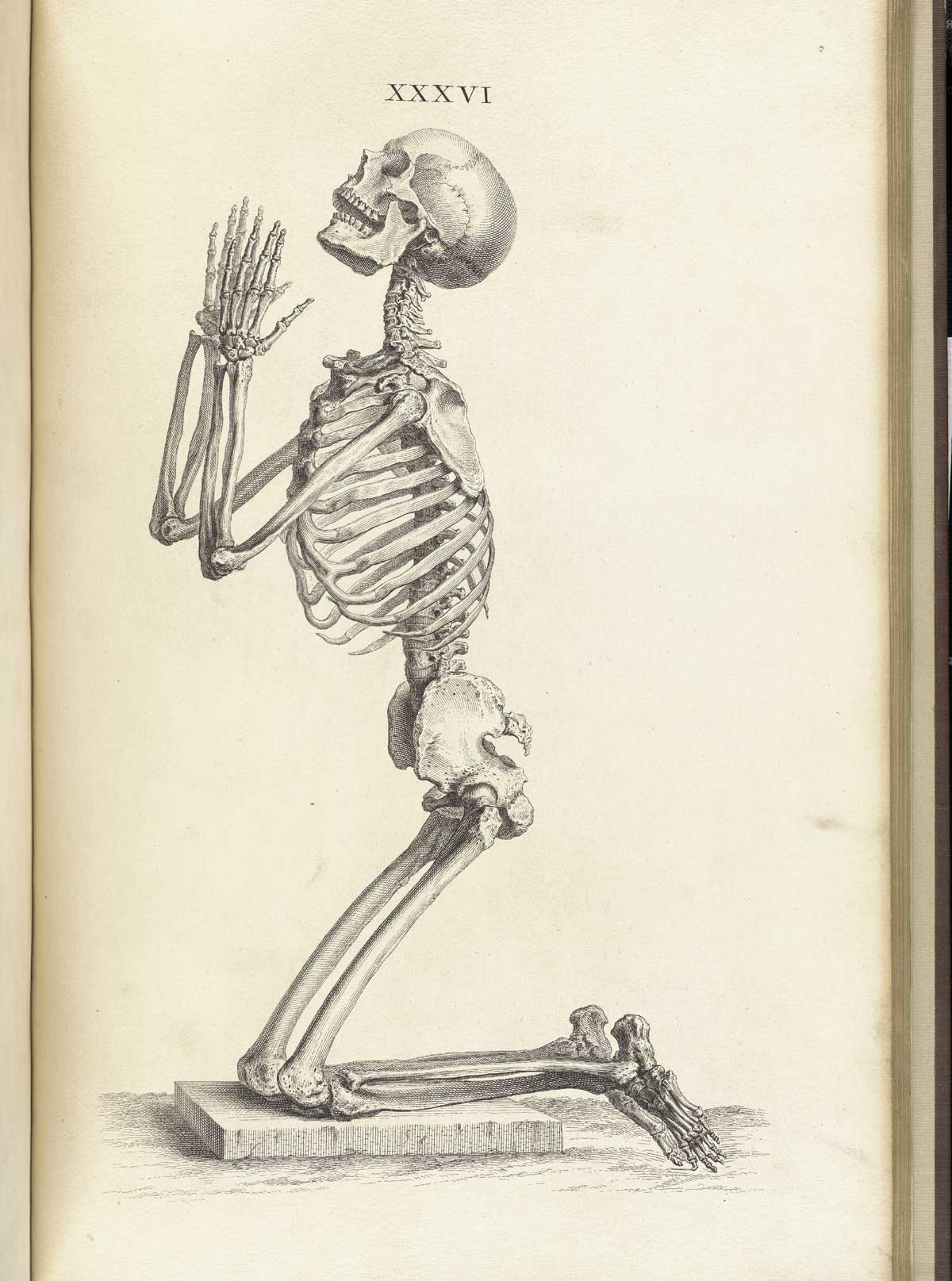
    Skeleton Edward Baynard (1641-1719) of  London must have been a pinchy/gouty 
    physician.  Or not.  Perhaps he was an overdressed, deeply-dimpled
    fop.  Or perhaps he was skinnily
    invisible, a plain, vanishing custard of a man, scrupulously clean and who
    saved all money, deeply in love with his chambermaid, sleeping on a mattress of
    gold. 

    But what he
    was a definite cynic, occasionally cranky to his own reaching profession.  His poem, Health, a Poem, Shewing How to Procure,
    Preserve and Restore
    It, was a best-selling book, reaching at least
    ten editions during his lifetime.   It evidently contained a number of frugal
    dispensations on achieving health, most of which involved  purging. Or sweating.  Or vomiting. 
    Such was the state of the art, much like our own when viewed from the
    year 2109.  (I overheard a conversation
    this morning in a hot dusty field, a physician saying that we would never simply
    ingest a plil that would render us a new liver. 
    Well.  How would the
    contemporaries of the newly discovered X-Ray have viewed the peek into the
    future of the “discovery” of DNA in 1953, only 59 years later?  And what about the enormous difference in the
    state of medicine and imaging capacities in the 56 years since then?  Phenomenal. 
    It would be nearly impossible to say what developments in medicine await
    the grandkids in their late years?  Or in
    300 years?  Hypo-livers in
    Dixie  cups, I say.)

    Returning
    to Dr. Baynard—he summarized the ten most important words and concepts in
    medicine in the second  poem of his book, as follows.  He held little in
    reserve.

    “For some
    of the ten are always advised:

    Piss,
    spew and spit

    Perspiration
    and sweat

    Purge,
    bleed and blister

    Issues
    and clyster

    These few
    enunciations

    Cure all
    the doctor’s patients

    If
    rightly applied

    By a wise
    physic guide”

    Indeed. 

    [“Clyster” is
    an enema;  “an  ‘issue’ refers to
    the Galenic practice of creating an infection at some designated spot on
    the body because of the belief that some kind of ‘sympathy’ between the illness
    and the localized pool of pus would draw the illness out of the body”. ]

    ·Posted by :

    ·in:

    —

  • “Enemy Aliens” and the Invisible Japanese, 1941

    JF Ptak Science Books LLC   Post 590    Blog Bookstore
    Blog--laguardia
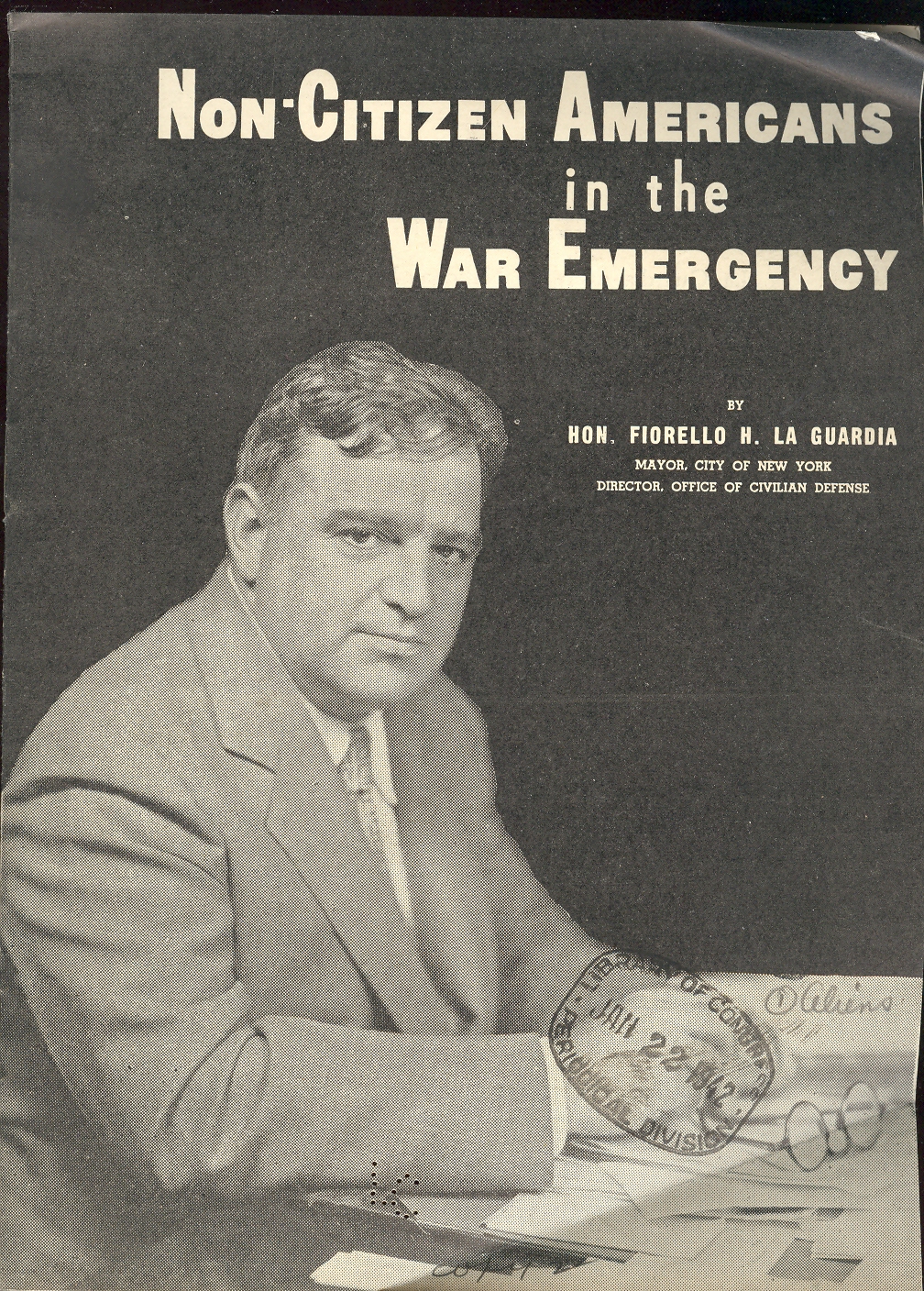
    The Little Flower was publicly coming to grips with “enemy aliens” in this small pamphlet, published in the last days of December 1941.  Laguardia–a Republican Congressman defeated for re-election in the Roosevelt landslide of 1932 and elected Mayor of NYC in 1933–was an outspoken critic of the Nazis and Hitler from his first day in Gracie Mansion.  In addition to being the first Italian-American elected to the U.S. Congress, Laguardia was also Jewish, and was a superb and constant speaker* against the monster in Germany. 

    In this pamphlet Laguardia outlined the legal implications of war and the non-citizen  German or Italian immigrant, and possibilities and consequences of their being declared enemy aliens, resulting in “arrest” and detainment.  (This applied to all “…natives, citizens, denizens or subjects…” of any foreign
    nation or government with which the United States is at war, and who could be “…
    liable to be apprehended, restrained, secured and removed as alien
    enemies….”.)  Attorney General Francis M. Biddle cited Department of Justice figures: “Of the 1,100,000 (sic) enemy aliens in the United States, 92,000 were Japanese, 315,000 were German, and 695,000 were Italian. In all, 2,972 had been arrested and held, mostly Japanese and Germans. Only 231 Italians had been arrested**”  (by 1943).  By the end of the war, there were fewer than 3,000 Germans and Italians who had been impounded (the Italians being released by October 1943 following Italy’s surrender). 

    There were upwards of 100,000 Japanese-Americans impounded, half of whom were American citizens.  For some reason there was not a single mention of the Japanese population in this pamphlet. 

    *In 1933, the year of Hitler’s major seating, Laguardia said: “Part of [Hitler’s] program is the complete
    annihilation of the Jews in Germany”, an uncommon and of course prescient point of view.

    **This authority was based on Executive Order 9066 (issued February 19, 1942) and Executive Order 9102 (issued March 18, 1942). These orders authorized the “removal from designated areas of persons whose removal is necessary in the interests of national security”.

    ·Posted by :

    ·in:

    —

  • When Bad Ideas Were “Good”: Just Say “No” to Fighting Fascists, 1938

    JF Ptak Science Books LLC  Post 589    Blog Bookstore

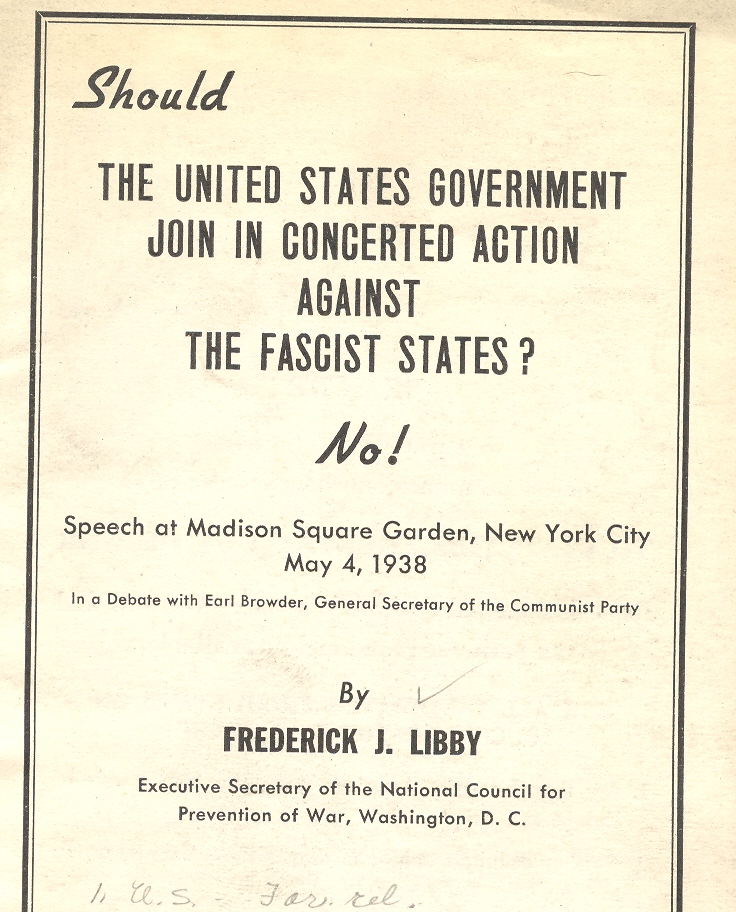
    Blog--fascist Sometimes the screaming done in pamphlet titles like this example are odd and outrageous and entertainingly naive and are often taken out of context.  This one isn’t.  It isn’t odd and it isn’t entertaining and it isn’t naive (at least in the outsider sense).  It is the effort of Frederick J. Libby (1874-1970) to convince Americans that it was against their morality and their best interest to engage in any war to stop fascist aggression in Europe or Japan.  The world was well on its way to total war–Japan had already been savaging China for five years at this point and Europe was sinking into the Styx.  (Just two months before Libby’s May 4th speech Hitler “annexed” Austria and in April had signed a pact with Franco. In the short months following the speech Hitler would mobilize the German army, sign the Munich agreement with the failed Chamberlain, occupy the Sudetenland, and initiate Krystal Nacht.)  The speech was given at Madison Square Garden, which in another years would see have an audience of 20,000 supporting the German American Bund, one of the limp pro-Nazi organizations which sought an anxious fifth-column foothold in the U.S.) 

    The biographical bits I’ve found on Libby support him as a a decent pacifist.  His National Council for Prevention of War–which hosted his speech at the Garden–was evidently his great achievement, though his subject matter was not.  Now it isn’t as though there was a spearhead movement to get the suffering U.S. involved in European activities in 1938–and remember it took 27 months  after the invasion of Poland to get the U.S. into WWII, and that took a massive attack by a non-European entity.  So Libby’s “No!” was really playing to the strengths of the majority.  The U.S. was still in the grip of the Depression–and had just suffered another fresh setback in that year–so there wasn’t much public concerted support for stopping the very visible spread of Fascism around the world.  So as eyebrow-raising as his immodest title might seem, it did reflect the answer that most people in the U.S would have given to that question in the spring of 1938.

    ·Posted by :

    ·in:

    —

  • The Measured Intelligence of the Letter “C”

    JF Ptak Science Books LLC    Blog Bookstore

    Dots I’m sure that by now everyone has seen those “are you
    smarter than____ (Barack Obama, 130 I.Q.)” pop ups seen on some news
    sites.  (I doubt that President Obama’s
    IQ would be that limited; his predecessor, well, let’s not comment on that.)  Giving in, and dumping twenty-five minutes
    that I’ll never get back, I took the test. 
    Three times.  The first time I
    filled in all the answers as “A”; the second time, “B”, and the third, “C”.  It turns out that the IQ for A was 80 and for
    B, also 80.  C, however, came in at
    90.  C seems to be the smartest of all of
    the first three letters of the alphabet.

    And what of lonely “D”?   I could not but forebear to press on with my life, leaving it an alpha-intelligent mystery. 

    Did I mention that I’ll never get those twenty-five
    minutes back?

    ·Posted by :

    ·in:


  • Bad Resurrections: 19th Century Cadaver Trade in New England

    JF Ptak Science Books LLC  Post 585       Blog Bookstore

    History of Missing Things Part XXXVII

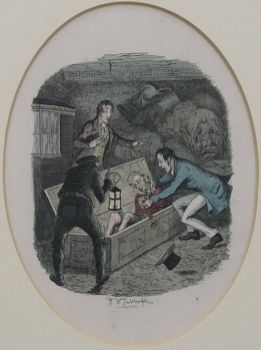
    Grave rob For some, “anatomy is
    destiny”, but not in the way the reach-y Sigmund Freud meant–their
    anatomy quite literally was their destiny, their bodies resurrected (in the bad
    way) from their coffins by chin hooks and sent to the local med school for
    quick and dirty study.  This night-time
    version of ice fishing for cadavers was addressed in a sniffily conceited but
    informative book by A.M. Lassek, Human Dissection:  Its Drama and Struggle (1958).  Lassek, professor of anatomy at Boston University ,
    presides over all aspects of the history of anatomy, but I somehow found my way
    instantly to the cadaver-catching mechanical operations end of it: specifically
    the work of American specimen providers in
    in the early part of the 19th century. 

    Listen:  if I found my way back in time in the Boston area in 1835 and
    was the night jobber and bad-‘un for the local apothecaries hunting down the
    lonesome freshly dead, I think–with praise to Lassek–that I’d be
    able/equipped to do the job.  I hadn’t
    really thought very deeply about the supply of cadervous specimen for the
    thriving medical schools before, but there are many considerations to the
    proper way of stealing a body. (And by “proper” I mean “not
    being caught doing it”.) First of all, there was a serious spike in the
    creation of medical schools, the number of recognized institutions in America
    increasing from seven in 1810 to 33 in 1840 (and 90 in 1870), with a huge new
    population of data-thirsty students to go along with it.  Human anatomy was an exceptionally difficult
    subject to demonstrate with actual specimens (due to moral and legal
    restraints), so the med schools (including the Harvards) had to resort to
    creative solutions:  the bodies had to be
    “found”. And finding bodies had more to do with stealing them than
    arranging for the corpse of a condemned criminal to be purchased from the
    sheriff. 

    The local townsfolk and neighbors of
    medical schools knew this all too well. 
    There were a number of precautions that the bereaved could undertake to
    prevent the resurrection of their departeds. 
    One simple way was to have a guard at the grave all night long–that
    would certainly cause some pain and consideration for the grave robber, though
    it has been the case where the guards were plied with money and alcohol to
    effect a soft gaze on the grave.  Since
    the newly interred laid under six feet or so of newly churned earth, there was some
    amount of extra stuff that was thrown into the pit.  Stones, and rocks and tree limbs were added
    to the hole to make a tougher and noisier go for the robbers; also, wide heavy
    planks were placed width-wise across the coffin and then covered so that the
    robbers would have to dig much wider in order to pull up the boards before
    getting to the coffin.  Another fantastic
    bit that I had never thought of but which falls into the category of branding
    cut lumber for the ride down the river: 
    intricate designs were placed on top of the grave with sticks and stone
    and such so that the family members would be able to detect a defiled
    grave site.  All of this attention would be
    heaped on the grave site for ten days or so–after that the body was deemed too
    far deteriorated as to he of any use to the medical school.

    “Detect?”  Yes, indeed. The grave robber needed to be
    stealthy, leaving no indication of the dark and stinking deed.  Working in very low or no light, the robbers
    would find their mark and lay at least two tarpaulins on the ground. they would
    collect all of the dirt in these catch-alls so as to not excite any attention
    that the grave had been disturbed.  They
    would dig a 3×4 foot hole towards the head of the casket, and, once reaching
    their prize, would drill holes (quietly!) into the wood, break it, and then
    attach a hook under the chin of the corpse and yank it out.  Placed on another tarp, the body would be
    stripped of all clothing, and then wrapped securely to prevent anything
    incriminating falling from it during the trip across town.  Once received by the medical school, the
    hair, teeth and other distinguishing characteristics would be removed to
    prevent detection and identification.  I
    imagine that the skin of the face would also have been peeled away, skillfully
    removed with one cut and a careful pull. 
    All of this was precautionary, in case the relatives of the now-specimen
    suspected foul play and came looking for their beloved.  It would be a corpse among other
    corpses.  Or not. Lassek writes that the
    bodies would be hidden, secreted in different and obscure places around the
    campus, in “domes, belfries and observatories”.  Observatories?  Well! 
    I’m not so sure about that aspect of Lassek’s report on grave robbing,
    but I was pretty impressed with his knowledge on the other aspects of the
    business. 

    I am
    indebted to Dr. Lassek for the image of the grave-marking anti-theft
    artwork.  I may have fabricate a grubby
    1837 cemetery keeper’s chapbook with drawings of their designs and make an
    entry for it in my imaginary museum catalog for
    things-that-don’t-exist-but-should.


  • On Degrees of Wrongness: Holocaust Denial and Checking Out a Footnote

    JF Ptak Science Books LLC  Post 572

    Extermination
    In researching an unusually early pamphlet on the
    extermination camps of Auschwitz and Birkenau (Les Camps d’Extermination Allemands Auschwitz et Birkenau, published
    in Paris in the July/August 1945) I stumbled upon—slid threw, I should say—a
    reference to it from a paper by Carlo Mattongo published by the Institute of Historical Review.  The IHR is a decades-old organization
    dedicated to the denial of the Holocaust (though they would call their work
    something different, like challenging plagued historicism and that sort of
    thing).   Now I’d soon as talk about this
    as I would the Creationist anti-evolutionary beliefs, but the author of the
    much-referenced  paper footnoted the
    scarce Camps publication, citing it
    as an example of incorrect reporting and thus supporting his Holocaust denial
    stuff.  Well, there are many dozens of
    footnotes like these in the IHR paper, but since I had the source reference
    right in my hand, I thought that I’d check out the scholarship a little and see
    what the complaint was all about.

    (The founders of the IHR had deep roots in such
    organizations as the (British) National Front (a white-only, far far right
    suprematist group which seems to spend a lot of time denying that they are
    Nazis) and the Liberty Lobby.  The
    Liberty Lobby was founded by a man who philosophy was absed onbt eh work of a
    disturbed Nazi-hagiograph named Francis Yockey (who wrote undethe name of Ulick
    Varange).  His own connections are a
    catechism of hate groups: he worked and had associations with The
    German-American Bund, the German-American
    National Alliance
    , William Dudley Pelley‘s Silver
    Shirts
    , Sir Oswald Mosley’s Union
    Movement
    , George Sylvester Viereck,  H.
    Keith Thompson
    , Gerald L.K. Smith, and James
    H. Madole
    ‘s National Renaissance Party. Such is the
    intellectual heritage of the IHR.)

    What Mattongo uses to bolster his anti-Holocaust claim is
    the Les Camps Exterminer description
    of the crematoria at Birkenau, which he says differs with another report (above ground
    versus underground crematoria). This difference in description is evidently a
    terrifically damning contradiction for that author, and in an O.J.-glove-like
    move uses it to question the entire edifice of the Holocaust.    

    The issue of the location of the crematoria is unclear in my
    reading of the document. 

    What is terrifically crystal clear is what comes on the very
    next page, just paragraphs down, from Mattongo’s citation:

    “En principe les Juifs seulement sont mis a mort par le gaz:
    les Aryens tres rarement, car on leur administer generalement le “traitement
    special” par fusillade..”  (p. 18). This
    states that it was pretty much only the Jews who were gassed, while everyone
    else was shot to death.

    I guess Mattongo
    liberalizes this statement to be inadmissible since the report had mentioned
    that the crematoria may have been underground rather than above ground.  What is more deeply remarkable is that this
    report is one of the earliest published documents to get a close estimate on
    the number of Jews exterminated:  there
    is a table on page 32 that calculates the number of Jews exterminated at
    Auschwitz and Birkenau from April 1942 to April 1944.  That number is 1.765 million.  It is 
    a big number, and it is a number dedicated solely to the Jews.  Even in the groundbreaking May 1945 report
    issued by the Eisenhower investigation the Jewish element of those exterminated
    in these camps was not emphasized.  For
    Mattongo and the Holocaust deniers, all of this becomes nothing, the fabric of
    history caught and unraveled, as it were, snared on a bit of a mostly-imaginary
    nail head. 

    The Holocaust deniers are deep in their own secret and dark
    world, inventing useful denying tools as they go along.  In this case, a reference is unclear, and the
    document was mined solely for supporting detritis, while ignoring every other
    remarkable item in it.  Here’s another example
    of their not-so-minor tricks that I’ve noticed in this journal—the overuse of
    quotation marks.  They are sometimes used
    properly, sort of, when quoting source material–but quotation marks are also
    liberally employed in general use, like when referring to words like “proof”
    and “murder” and “witness” and “Holocaust” when referring to them as ideas.  And so what happens is that the quoted and
    footnoted materials (however miserable and inaccurate they might be) are mixed
    in with the unattributed quotation marks, making them all look vaguely
    referenced in some way.  What the authors
    are doing is exterminating the value of the words used by others for ideas that
    they do not believe in. An inmate’s first-hand account of extermination at Auschwitz thus becomes a “witness”, and then becomes less
    than that, calling into question the absolute veracity of the first hand
    account.  Insidious, really. 

    I’m sorry to have spent time thinking about this.  But sometimes when you’re slapped in the face
    with a big paddle of Wrong you just have to react. 

    Here’s something else: when I went web-cruising for information on some of the founders of these IHR-like movements, I came across some very plain vanilla biographies of their Nazi/fascist heritage-makers in Wikipedia.  Obviously the entries were made by people who had some form of belief in their subject, and then granted the world access to their research via the online encyclopedia.  Now I know anyone can edit these entries to reflect a more more cogent, comprehensive, appraisal of founders of hate groups, but no one had.  I bump into questionable stuff like this in Wiki a lot.  My question is:  how much wrong must there be to make something valueless?  If the Encyclopedia Britannica was known to be 8% wrong, does it still have value?  If the PDR was 4% incorrect, would people still use it?  What about Wiki?  How wrong does something need to be before it needs to be started all over gain?

    ·Posted by :

    ·in:


  • Women Meat Pioneers, 1943

    JF Ptak Science Books LLC  Post 570

    (Science Book Blog)

    4-1 prop meat
    This simply irresistible, charmingly uncomfortable, and semi-surreal title is an excellent example of what I’ve come to know (and forget) in my  career of doing whatever it is I’m doing.  Generally though the thousand or so titles in my Naive Surreal collection belong to pamphlets and the occasional book, but the occasional advertisement makes its way into the fray.  (None really come quite close to the work of the immortal Otto Fleiss, who produced America’s greatest work on making art with fat,  White Art in the Meat Food Business.  A Practical Handbook for
    Butcher, Pork Stores, Restaurants, Hotels and Delicatessens on How to
    Make Lasting and Transferable White Art Decorations out of Bacon Fat
    Back for Window Displays, Ornaments on Meat Food Cold Buffets and for
    Exhibits and Advertising Purposes.  Enrich yourself with Personal
    Knowledge.
    It is a toweringly fantabulous work, and is one of this blog’s most-viewed posts.)

    This ad is innocent enough:  appearing in the 1 November 1943 issue of LIFE magazine, it was simply encouraging the modern housewife to go adventuring into cuts of meat that had been deemed unacceptable before rationing and the war, which brought about a meat drought.  (The Brits had a far worse time–this issue of LIFE also contained a photo of a leggy London showgirl posing with a “real lemon” which was being raffled off to raise hundreds of pounds for the general welfare.) 
    4-1 renaissance pandora
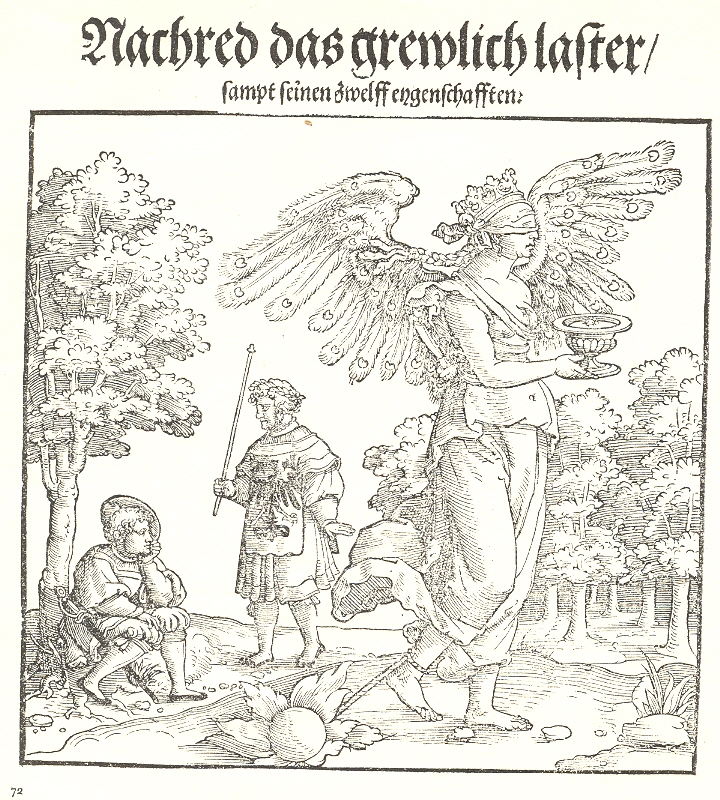
    I’m sorry to say that this image reminded me of an older, finer, more whimsical but far more damning and stern woodcut.  The two aren’t terribly-well related, I know, but as I shocked myself in being able to locate it I’m bound to use it now before it slips back into my misty print purgatory. 

    This image is probably the work of Georg Pencz and appeared in Hans Sachs’ Nachred das grewlihc laster...published in Nuremberg in 1535 The booklet was a work directed against the evils of libel and lying and spreading rumor.  Pencz’ woodcut personified all of this wrapped up in the form of a vice-charmed woman.

    The libel-charged rumor-mongre woman (watched from under a tree by a poet who is protected from her by a fellow with an imperial seal and stanchion) is outfitted with very feathery wings and a crowned seat on a collection of snakes.  She carries a lidded pot, an offering of some sort, while she hides a knife behind her back with her other hand.  She advances with a breast barred and another breast vut and bleeding, while she tugs along in her wake a ball and chain, which sets her traveled path on fire.  All-in-all, Pencz paints a dismal picture of womanhood. 

    As I said, it has little to do with the original image of a Pioneer Meat Woman, but they sort of looked similar in my memory. 


  • The Wartime U.S. Soldier as Advertising Commodity: Ads in LIFE, WWII

    JF Ptak Science Books LLC  Post 569

    4-1 prop meat 001
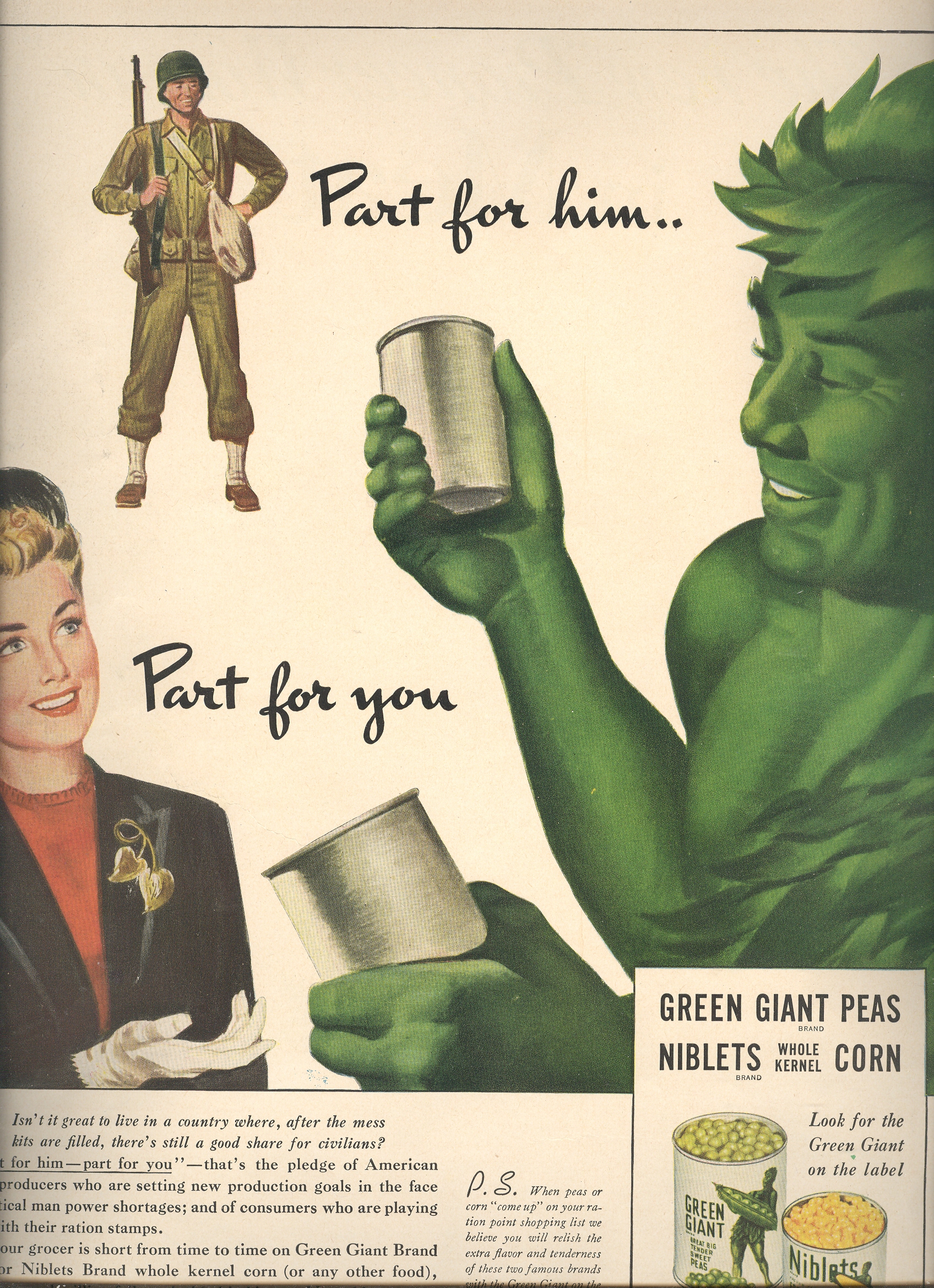
    I was making my way through LIFE magazine for 1943 and was struck by the ratio of the number of advertisements using the war as a backdrop (and American soldiers as convenient props) for sales against the actual space dedicated to war reporting.  Concentrating on just two randomly selected  weekly issues (November 1 and November 15 1943) I was surprised to find  28 ads (most of which were full-page); there was no war reporting in November 1 and just half a story (on the history of the Prussian General staff) in November 15.  Most of the ads were directly war-related, the companies mostly relegated to vast production of war goods, like General Motors, Cadillac and Boeing. The others were less clear, like the ad pictured here for Green Giant peas and corn.  This company was informing the home front that if there were shortages of their product it was because they were selling it to the Army or Navy–others were more adventurous for their spirited attempt at patriotism. I’m not sure that Wembly Ties really needed to include a GI in their ad, nor did I like the use of American soldiers to sell Interwoven socks. 

    There was a growing sense of sordidness to me, this use of images of wartime American soldiers, who were dying by the tens of thousands, being used to sell socks, ties and corn. This was particularly ironic since the magazine wasn’t finding anything to “report” in its full pages for the war for those two weeks–which is bizarre, because by that time in late 1943 there was a global FUBAR shitstorm happening to the east of NYC and to the east of San Francisco.  

    Some ads did have high propaganda value and were related to the general winning of the war.  The vast majority though were singling out their product for purchase.  4-1 prop blow up

    Just for the record, the advertisers employing an American soldier to help sell their product  for these two weekly issues included Goodyear, Cadillac, Alcoa, Scotch Tape (for sealing boxes of tank parts), Sperry, Old Gold cigarettes, Lockheed, Schaeffer pens, Victory Airpower, Excide batteries, Camel cigarettes, Electric Power and Light companies, Oldsmobile, Cashmere Bouquet, ANSCO color film, Pontiac, Willys JEEP, Vinco (foodstuffs), Cavalier Whisky, Interwoven socks,Texaco, Eversharp pen, Wembly ties, Boeing, Black and White whisky, Ray-o-Vac, and Coke.  Seems like a lot for two weeks, no?  I’m not doing content analysis on this, just a passing interest, really, but when you look at similar issues for The Illustrated London News there’s very little of this sort of thing going on; even less so for the Illustrirte Zeitung (Lepizig).  

    I’m curious now to check out popular magazines for WWI.  It seems to me that there was a bit of this going on then, too.  Outside of cigarette and whisky ads, a lot of this sort of advertisement drops off during Korea; and by the time of Vietnam, these sorts of images have all but disappeared. 

    4-1 prop Jap

    ·Posted by :

    ·in:

    —