A Daily History of Holes, Dots, Lines, Science, History, Math, Physics, Art, the Unintentional Absurd, Architecture, Maps, Data Visualization, Blank and Missing Things, and so on. |1.6 million words, 7500 images, 4.9 million hits| Press & appearances in The Times, Le Figaro, Mensa, The Economist, The Guardian, Discovery News, Slate, Le Monde, Sci American Blogs, Le Pont, and many other places… 5000+ total posts since 2008.

Category: Anticipation, History of

  • A Beautiful Confusion

    JF Ptak Science Books   Quick Post

    Time Germany 2

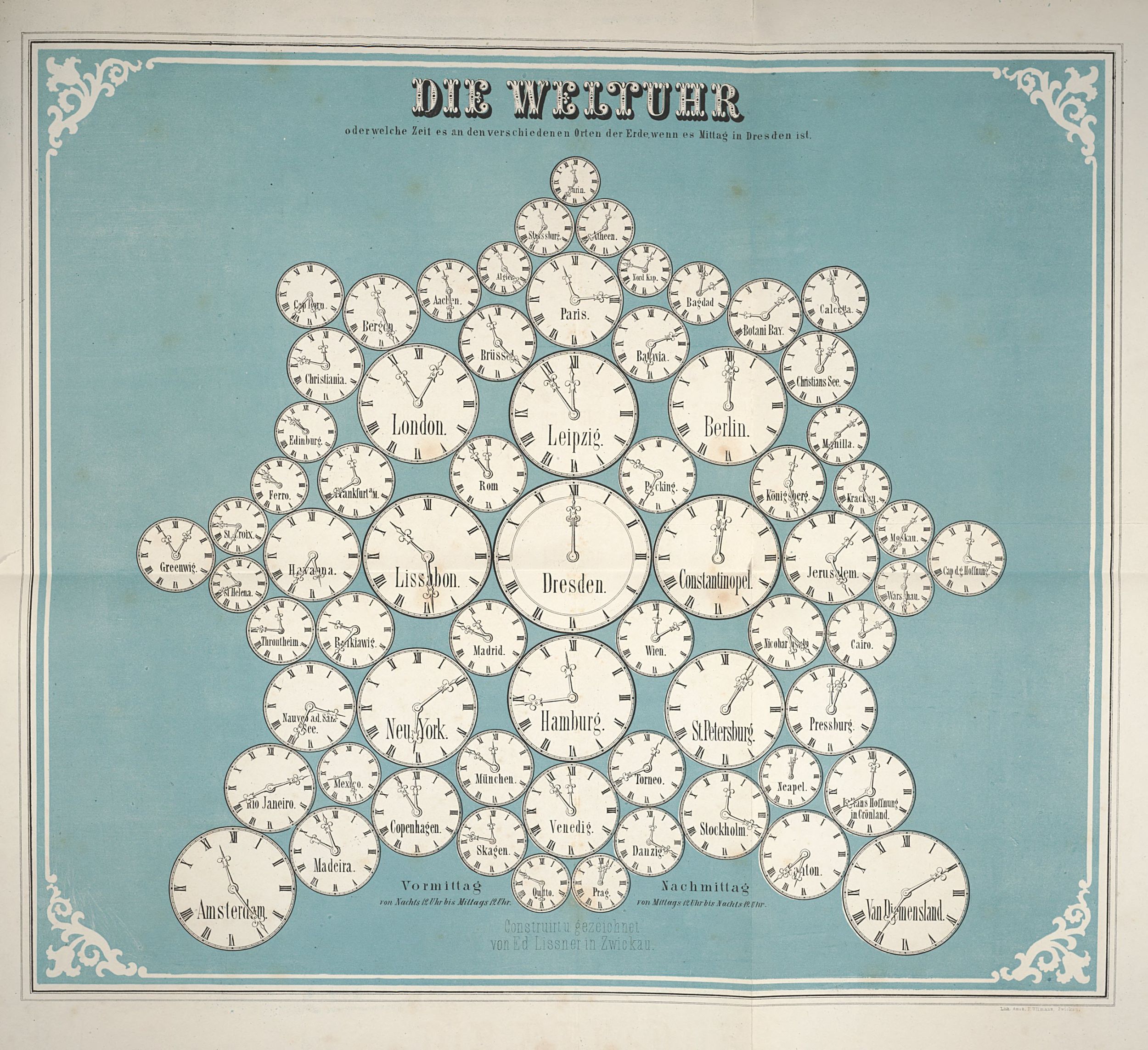
    [Image source: Bibliodyssey, 19th Century Infographics]

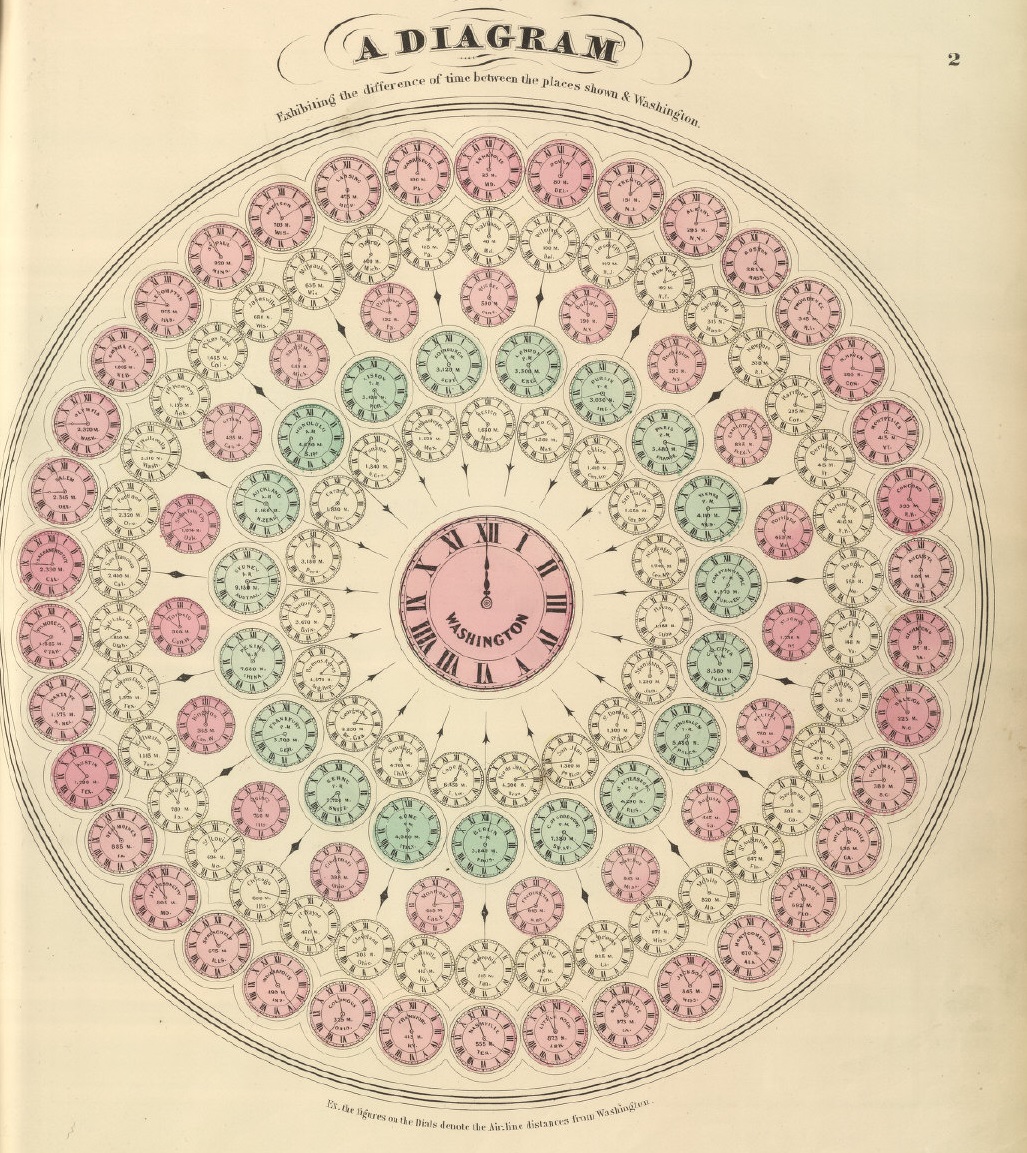
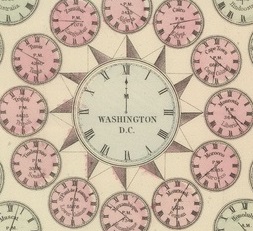
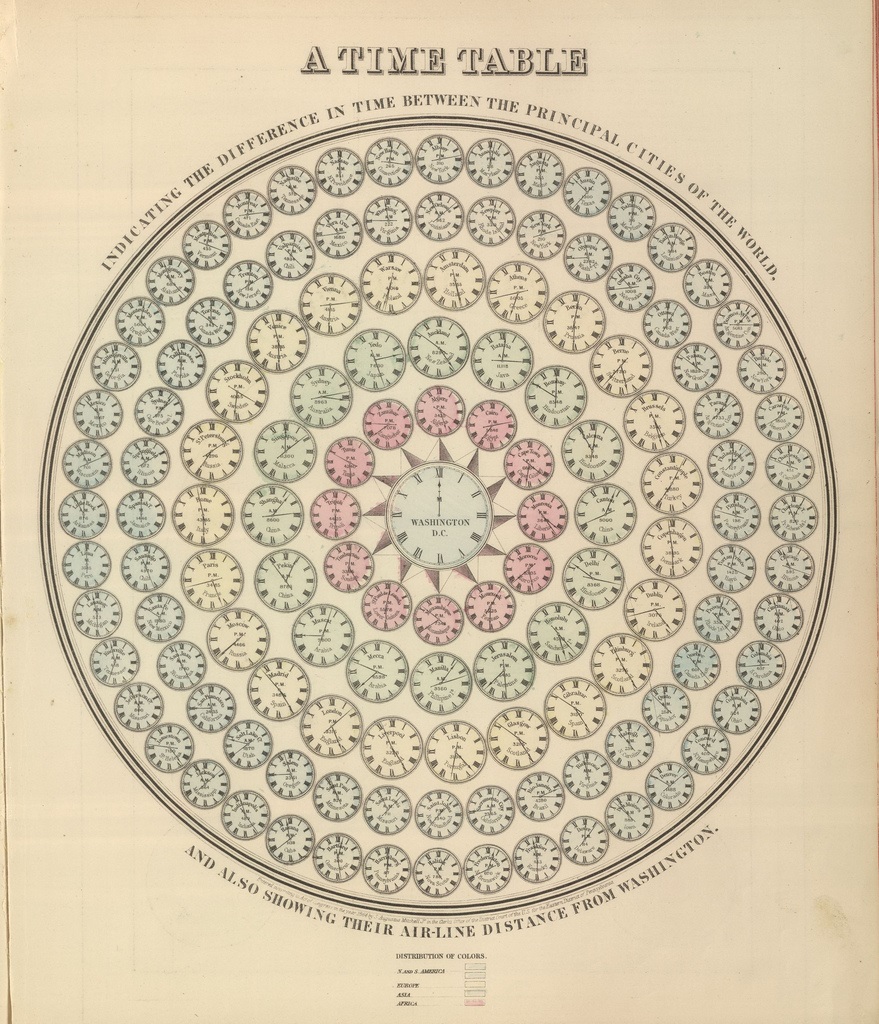
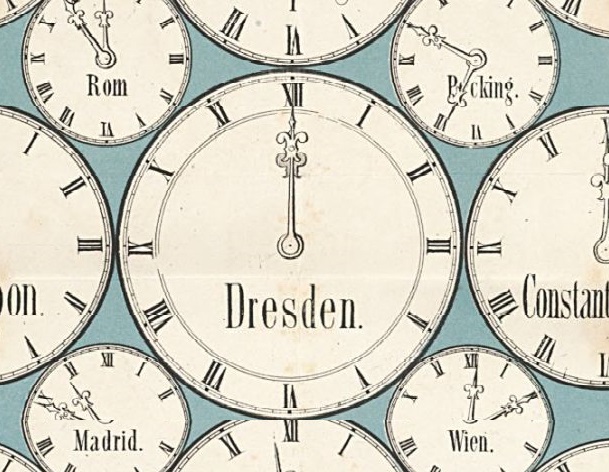
    Reckoning time from city to city before the adoption of Standard Time (1883/4) was a difficult and confusing process.  Local time was local, and usually dominated by a central timepiece located in a public area, as in a church steeple or town hall.  The problem is is that the foundation for this timekeeping–the zenith of the sun during the day–would be different from area to area. That’s not so bad when communication over periods of days was involved, bu tit was very noticeable to train travelers who would find their home-reckoned pocket watches to be not-quite-right when moving hundreds of miles over the course of a day.

    And that’s where these charts come in.  They were made before the institution of a standardized system for keeping time worldwide, and so the “Dresden Time” of new was actually equal to about 10:48 in Madrid or 12:02 in Vienna.  In the U.S. in the 1870’s there were hundreds of time zones (whittled down somewhat to 100 towards the end of that era) which made it a bit of a nightmare for maintaining railroad schedules.  Sanford Fleming fixed all of that (the end of a long line of people who attempted standardized systems) in 1884, and did away with the need for these beautiful but confusing time arrangements.  

    On the other hand the displayed results for dealing with the pre-standardized chrono-confusions are beautiful things…

    4574g(1)

    Image Source:  Johnson’s New Illustrated Family Atlas of the World, (1874). Source: David Rumsey Map Collection, here


    Time table 2


    Time table

    Time Germany

    [Source: Bibliodyssey, 19th Century Infographics]


  • The First Printing of an Interaction of a Child with a Telephone (1880)?

    JF Ptak Science Books  Quick Post

    The first practical and public and successful demonstration of a working telephone occurred on 10 March 1876. Four years and five months later, after an explosion of interest and use and application of perhaps the greatest technical invention of the 19th century, after many lawsuits and many different interpretation of patents and additions to the field of telephony, an unusual note appeared in the pages of Nature.  It is singular, I think–and I can say this after having read about the early years of the telephone for many years–that this article may contain the first conversations by a child on the new invention.  The conversation was all one-sided, and mostly imaginary, but still it must count for a first-something in regards to children. 

     [Source:  Nature, September 9, 1880, page 442.]


  • I Love “Nature” Magazine

    JF Ptak Science Books    Post 2199

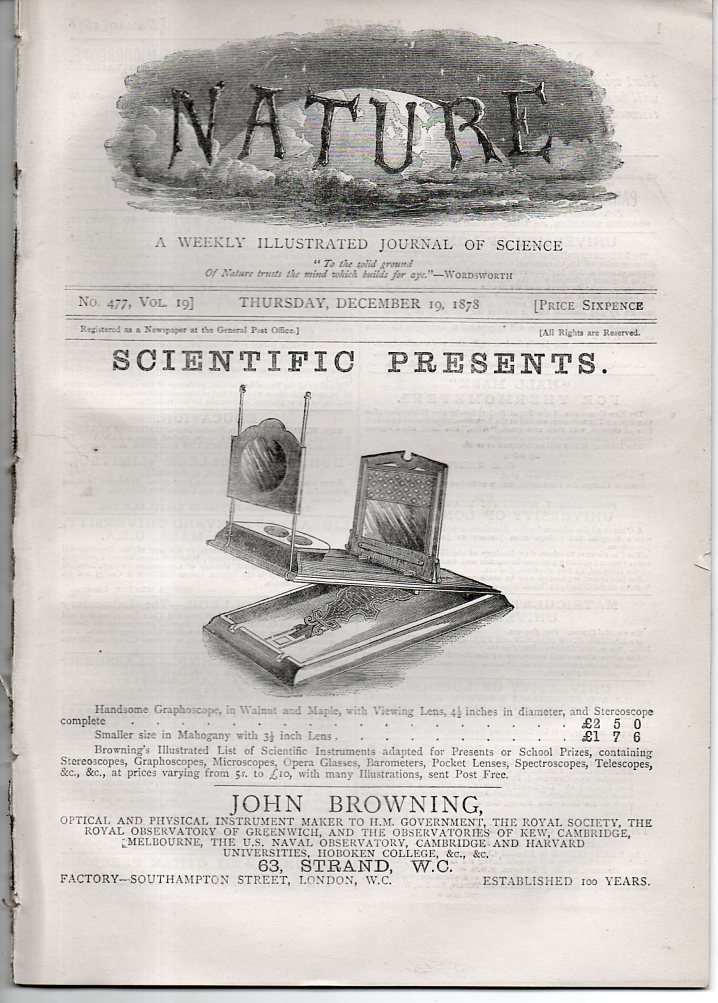
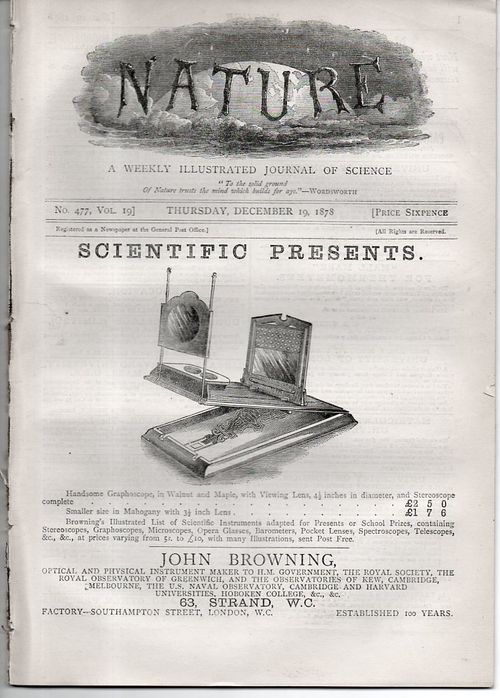
    One of the great pleasures in the business of antiquarian science book selling is the Advanced Ability/Capacity to Browse the books. Or Graze.  All in the semi-pursuit of an undefined goal that sometimes leads to something that leads to something else, and sometimes all of them get pulled together.  And so this came to be last night, working my way through an issue of Nature, a Weekly Illustrated Journal of Science, for December 1878–and yes, this is the same Nature that we know today, begun in 1869. The modern Nature is massive and perhaps one of the world’s foremost publications in the sciences–in 1878, the magazine was a semi-popular, quick-to-publication-and-print journal, usually less than two dozen pages long.  
    Thomson191

    The magazine was short and to the point, and it packed an enormous amount of material on a limited amount of paper–two columns of print per page, 7-10 words per line, 70 lines per column, or about 1500 words per page.  (An average novel has about 400 words per page.)  It attracted the attention of everyone, and virtually every big name in the sciences in the 19th century seemed to find their way into this publication: Darwin, Huxley, von Helmholtz, Thomson, Maxwell, Hertz, and on and on.  

    I admit that I was attracted to this issue by the beautiful engraved ad (“Scientific Presents” (!)) for a graphoscope, sold by John Browning (63 Strand) of London. (The graphoscope was an entertainment device created around 1860 and was an elegant/extravagant magnifying glass for viewing photographs and prints and such.  The base was lifted to meet the gaze of a seated viewer who would look through the large magnifying glass at an image that was placed on the theatrical/framework bit at the back of the device.)

    The contents are terrific.  The issue starts with a provocatively-titled work by James Clerk Maxwell, a review called “Paradoxical Philosophy”, which I like quite a bit–and it is rather long for Nature, and it was a joy to make my way through Clerk Maxwell as he makes his way through the story.  

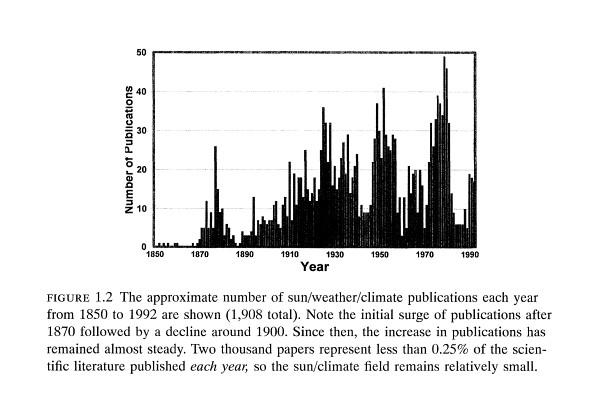
    And then:  a short piece by E.D. Archibald on “Locusts and Sunspots”, which fits nicely into the history of th esun and sunspots and cycles and weather, nicely into teh early-ish modern period.  That also brought me to a fascinating book with this great graphic on the history of publications dealing with what I just mentioned.
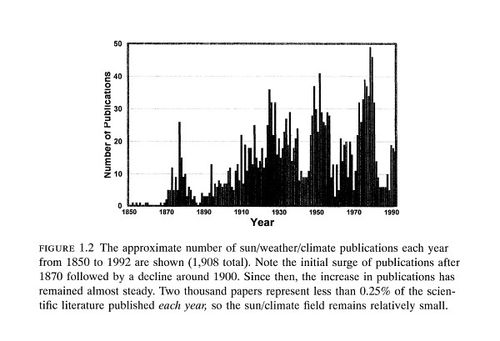
    Climate[Source: The Role of the Sun in Climate Change, by Douglas V. Hoyt, Kenneth H. Schatten Program Director of the Solar Terrestrial Research National Science Foundation.]

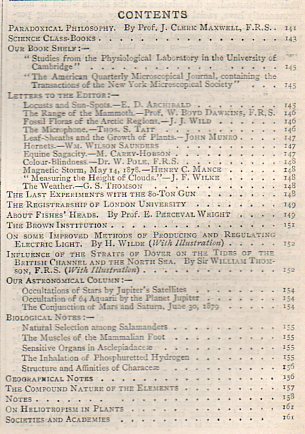
     The there is so much more, as we can see:
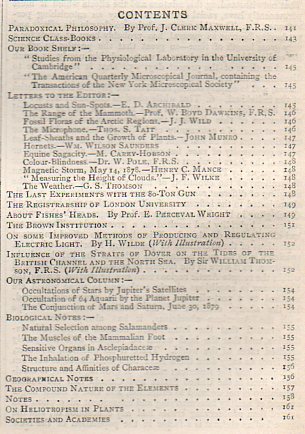
    Nature196

    Tait on the Microphone, Dawkins on the range of the mammoth, Wild on the fossil floras of the Arctic, Carey-Hobson on equine sagacity, Pole on colour blindness, and a beautiful effort by Wilke on measuring the heights of clouds–all lovely efforts.  

    And then, at the very end, under the unlikely title of “Societies and Academies”, emerged a magnificent effort by William Thomson, Lord Kelvin, another very major scientific name, and his effort at constructing a mechanical analog device, a very smart machine that wasn’t built until 1932.  His “On a Machine for the Solution of Simultaneous Linear Equations” is a remarkable effort, calculating its way through masses of numbers with pulleys and cords, as noted by Tom Woodfin of the MIT AI lab ( here):

    “Lord Kelvin proposed one mechanical system in 1878. Designed to solve sets of linear equations, it operated on a tilling-plate mechanism—essentially a collection of pulleys spaced along balanced plates and connected with rope. Coefficients of the linear equations would correspond to pulley placements, and the ropes would be tugged to balance the beams and hence the equations. Results would be read off as the lengths of loose ends of rope.”

    “Kelvin’s scheme had several advantages. First, it was based on rudimentary technology—within
    the capabilities of 19th century craftsmanship. Second, it was possible to increase the precision of a calculation through successive applications of the device, taking advantage of the characteristics of the linear equations it was designed to solve. Third, its mechanical nature made it ideal for “tweaking”—slight adjustments in inputs could be made quickly, and results obtained rapidly, without substantially reconfiguring the device.”

    All-in-all, the chance meeting with the graphoscope produced a number of very interesting finds, none of which really pulled themselves together in this context, but certainly could possibly play their role as missing pieces in some future puzzle–which is really what all of this is all about.  
     

    ·Posted by :

    ·in:


  • More Than Thunder: the Music of Niagara Falls, 1896

    JF Ptak Science Books  Quick Post

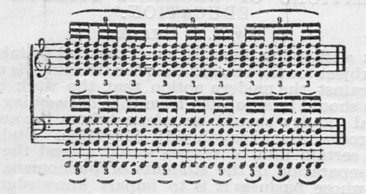
    I went searching in the 1896 issue of the Scientific American Supplement for early articles on  Roentgen’s x-rays (discovered just months earlier) when–flipping through the pages–I came upon this very impressive part of a score.  But what is more impressive is that it sets to music the sound of Niagara Falls–the music of the falls.

    Niagra167

    At least music is what Mr. Eugene Thayer heard when he listened to the falls, and apparently he heard what few others did.  


  • Found Poetry in the Words in Last Lines from Vincent van Gogh, 1889-1890

    JF Ptak Science Books    Post 2190

    See also an earlier post “In Closing: “a Kiss from Your Beethoven”. Artistic and Literary Valedictions from the Master”

    Van gogh

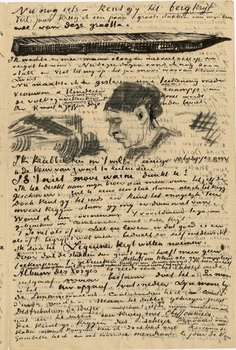
    As all of you no doubt know Vincent van Gogh carried on a voluminous correspondence, mostly with his brother Theo.  I sat down with the third (and final) volume of The Complete Letters of Vincent Van Gogh (Bullfinch Press, 2001) and read through his letters from St. Remy (June 1889 to May 1890, two months before his death 29 July 1890), as well as those from Auvers-sur-Oise (the last of which is dated one week before his death). The letters are remarkable, and were written mostly to his brother, but also to his sister, and mother, and some few others.  

    The letters are filled with fantastic observations and captured vision, comments on his artwork, technical aspects of painting, philosophy, and daily life.  And thinking.  It has always been interesting to me how people slow down a letter so it can come to a halt, and Vincent–in addition to being an excellent observer and word curator–knew how to write a letter, and it is enjoyable to step back from them a bit to look at their mechanics, especially when it comes to this slowing-down section.  So I’ve selected a few bits from what is usually the last part of the last sentence before the sign-off (hardly a rigorous process), just to see if there were the makings of a found-poem in them….and I believe there is. 

    “And believe me”

    “Good health.”

    “I shake your hand, and your wife’s too”

    “Next drawings next week”

    “And then it does one good to work for people who do not know what a picture is”


  • An Early Steam-Driven Robotic Society-Scrubber (1829)

    JF Ptak Science Books  Post 2183           History of the Future series

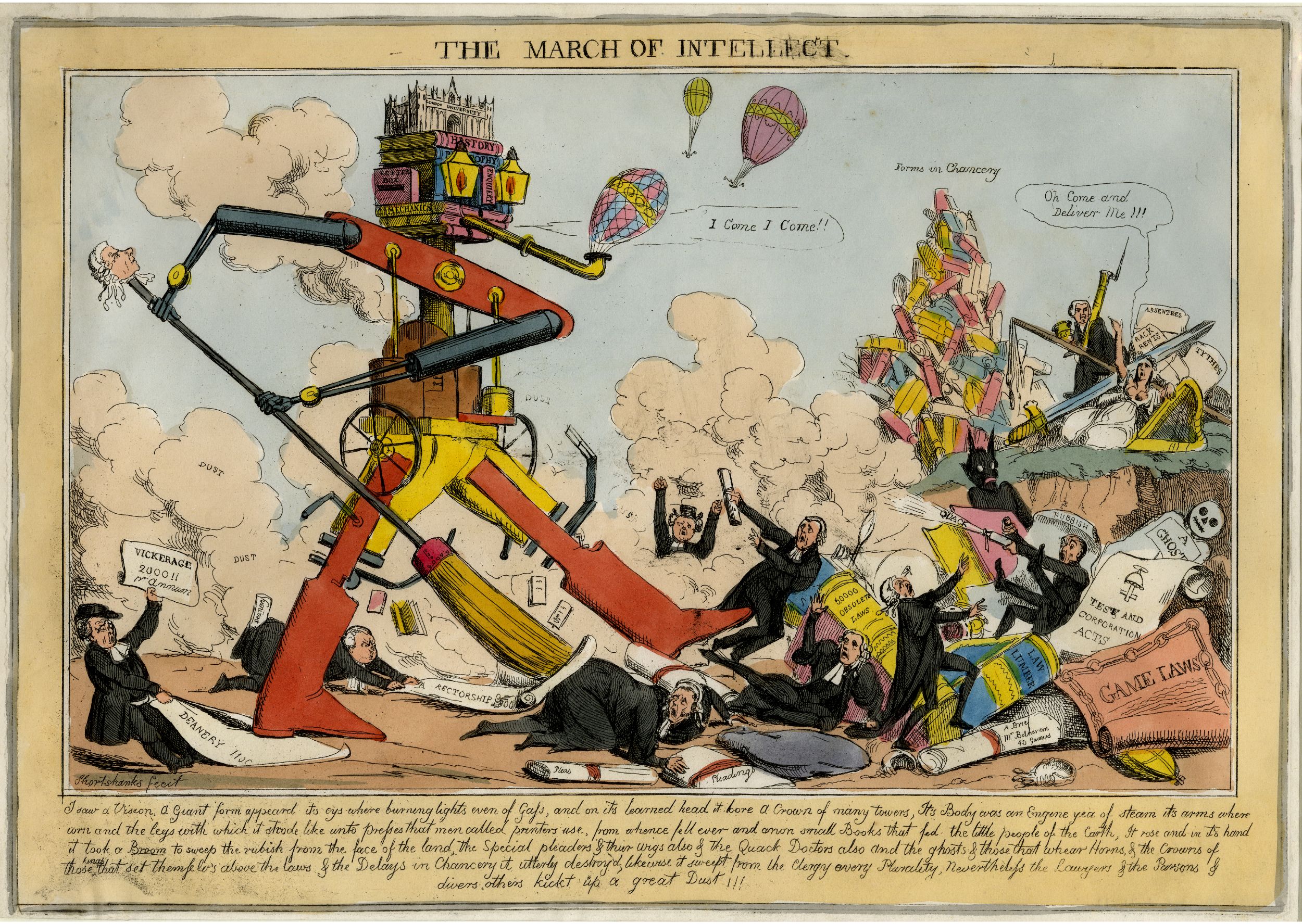
    I’ve addressed the ideas of early mechanical men elsewhere in this blog (just enter “robot” in the site search box at left and you’ll find two or three dozen related posts on the subject), but failed to include this very fine and early example by William Heath in his March of Intellect series (printed from 1825-1829).  

    Steam man heath

    He was particularly bitter about what he saw as an aristocracy of official ruination, and created an unusual steam-driven mechanical man with a book-driven intellect that swept up the great “rubbish” and “dust” of society.  At the top of this early robot (preceding the invention of the term by about 100 years) was a pile of books with a “crown of many towers”, which was London University, beneath which was a set of gas-light eyes, iron arms, and legs made of printer’s tools, sweeping away useless and insulting lawyers and jurists and their legal wigs and obsolete and repetitive rules, medical quacks, and the dust of other official abuses, “sweeping rubbish from the land”. 

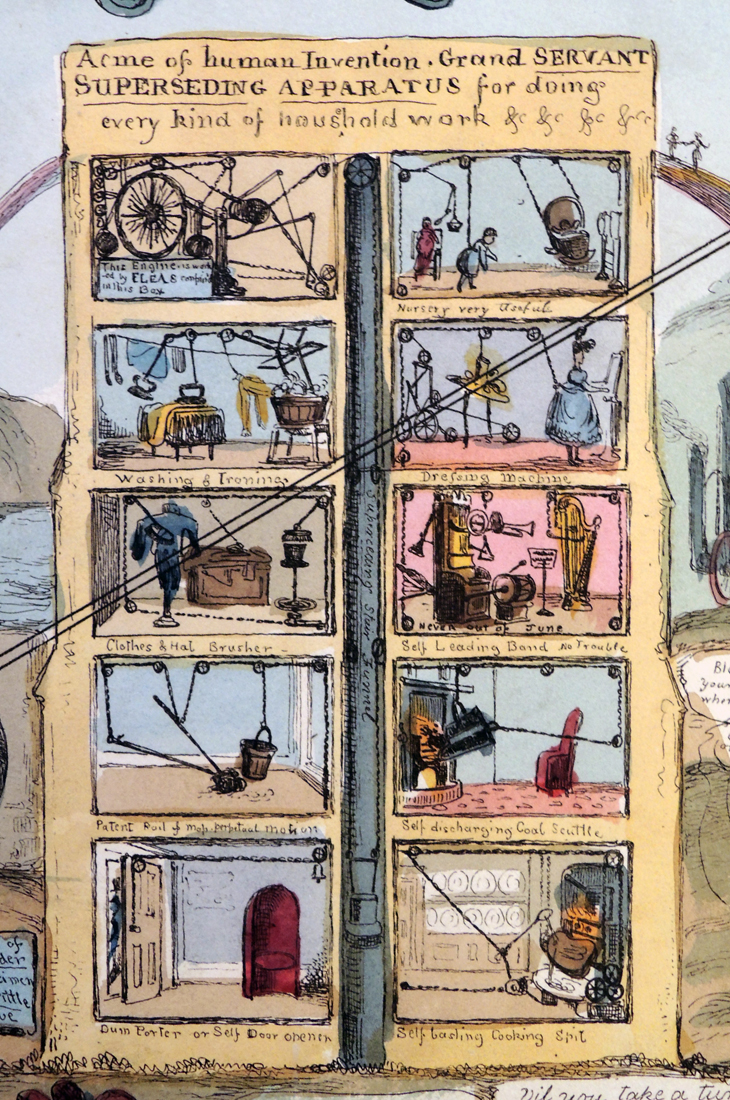
    Another near-robotic image by Heath is his pre-Rube Goldberg automatic house, a central feature in the March of the Intellect No.2 (1829) which features fantastic flying machines hovering and screaming past the house. 

    Heath march of intellect 3

    [Source:  Graphic Arts Collection, Princeton University libraries, here]

    It isn’t a robot unless you consider the entire house as a host for all of the things going on inside itself, and then you have something else entirely.  


  • A Note on the Biology of Computer Virus Names

    JF Ptak Science Books   Post 2193        

    I was looking around for one of the original references to the earliest human-tech definition of “singularity” and found it in a roundabout way, a classic reference referenced in a classic paper on singularity. Vernor Vinge wrote a breakout paper in 1993 called “The Coming Technological Singularity:  How to Survive in the Post-Human Era”1.  Among many other things the San Diego State math prof quotes how the great Stan Ulam  paraphrased John von Neumann saying: “One conversation centered on the ever accelerating progress of technology and changes in the mode of human life, which gives the appearance of approaching some essential singularity in the history of the race beyond which human affairs, as we know them, could not continue.” This was in 1958, and it appeared in Ulam’s “Tribute to John von Neumann” in the Bulletin of the American Mathematical Society, (volume 64, number 3, part 2, pp 1-49).

    It struck me as ironic that the “singularity” would appear just at the time von Neumann2–perhaps without equal in this century in thinking in terms of the computer and its applications and overall sheer brain-power–died, Ulam surfacing the term in what was basically a memorial/obituary/celebration issue of the Bulletin, the carbon-based life-form container finally failing the great mind.  

    It was then that I came to realize how much biologicalization has taken place in compsci terminology–not the least of which is the self-replicating and damaging “virus”, which itself of course is a massive biological deal, though in the digital world it is not its most abundant entity3.  E-viriology is found just about everywhere, much like its bio counterpart, which is located in every ecosystem on Earth.

    Even the word “computer” has an earlier biological counterpart–the “computer” was a human tabulator, a person grunting out figures into some sort of tabulating device. (Tracts for Computers, a series that began in 1919 and edited by Karl Pearson, is filled with statistical elements intended for the human computer…)

    But what strikes me first are the bio references for the bad stuff.  The viruses, and then later, the worms, and Trojan horses.  (I should point out the “bug” enters the computer vernacular fairly early, in 1949, via (later Admiral) Grace Murray Hooper, though it doesn’t get listed by her in her 1954 glossary of computer terms as published in two parts in Computers and Automation, volume 4, 1954.  There’s no “bug”, though there is “de-bug”.) 

    “Virus” emerges in a science fiction effort by Douglas Gerrold in 1972, a few years before they were artificially produced, which was a few years before a virus was released into the e-phere (“in the wild”).  In 1975 John Bruner unleashes a “worm” in his Shockwave Rider. 

    Others early viruses have biological names:  Creeper (1970), Rabbitt (1974), ANIMAL (by John Walker, though not created for being malicious, 1975), Top Cat (1980),   Elk (1982), Whale (1990), Hare (1996),  Blackworm (2006).  There are of course many more names for viruses (and company) that are not biological, but it struck me of how many of the earliest examples do have animal names.  I’m not sure that I have much to say about this presently, though I did want to put the general observation out there in this note.  

    Notes:

    1. The abstract of the paper begins: “The acceleration of technological progress has been the central  feature of this century. I argue in this paper that we are on the edge of change comparable to the rise of human life on Earth. The precise cause of this change is the imminent creation by technology of entities with greater than human intelligence. There are several means by which science may achieve this breakthrough…”

    2.  Perhaps of most interest here is von Neumann’s 1949 paper, “Theory and Organization of Complicated Automata”, which looks as the logic required for the self-replicating machine, in A. W. Burks, ed., Theory of Self-Reproducing Automata [by] John von Neumann, University of Illinois Press, Urbana, pp. 29-87. This was based on transcripts of lectures delivered at the University of Illinois, in December 1949, and then edited for publication by A.W. Burks. 

    3.  “Virus” is an old word, and is Latin for “poison” or “poisonous”, and which first appeared in English in 1392.  “Virulent” appears in English in 1728, “viral” in 1948, “virion” in 1958.  “Virus” as we know it bioloigcally today has a somewhat complicated history, escaping Pasteur and his microscope until it emerges (again) with Martinus Beijernick in 1898.


  • Gutenberg at the Remains of the Day

    JF Ptak Science Books   Quick Post

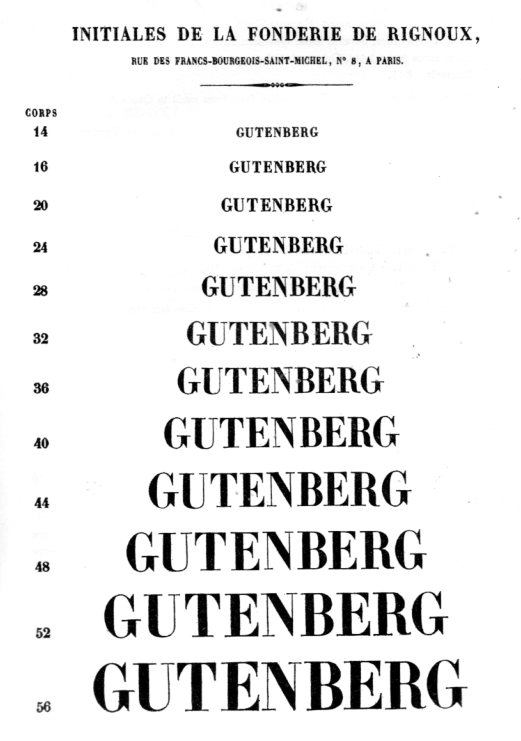
    Johannes Gutenberg just couldn’t last long enough to enjoy his vision.  His venture–or at least his end of it–went bust after his business partner filed for teh return of his investment, and Gutenberg, not having the cash and with proceeds from the sale of his bible being slower than expected (and so on), was forced to pay off the debt with his business.  He certainly got a lot of things right, and his vision was sound and accurate, but his financial planning was just not there.  He need some more money-room, as the introduction of movable type printing did not take off as quickly as he would have liked.  (THis is true even though it was widely recognized as a major achievement–it was just somewhat slow in taking footholds elsewhere.)  Plus, the Gutenberg Bible was an expensive thing, equal to the yearly wages of a skilled mason–had he invested more effort (and paper) into publishing more popular titles, he may have been much better off, and wouldn’t in the end wind up losing most everything, and broke.  

    Gutenberg078[Source: Gustave Silbermann, Album typographique, Strassbourg, 1840]

    He is hardly alone in the history of science and technology innovators/discoverers/inventors who thought that they could manage the business-end of their scientific/tech expertise.  Edison, Ford, Tesla, De Forest, Farnsworth–and I suspect an alphabet of other famous examples–all thought that hey could handle the transaltion of their discovery into the marketplace, but they couldn’t. (Edison and Ford had many more successes than failures, but they had a number of interesting/bizarre bad calls as well.)  

    Anyway, Gutenberg to me is a different case because he got almost everything correct, except for timing the money.  

    ·Posted by :

    ·in:


  • Rising to a Higher State of Misery: Books Read by Frankenstein’s “Monster”

    JF Ptak Science Books   Post 2169

    Did I request thee, Maker, from my clay
    To mould Me man? Did I solicit thee
    From darkness to promote me? John Milton, Paradise Lost (X.743–5)

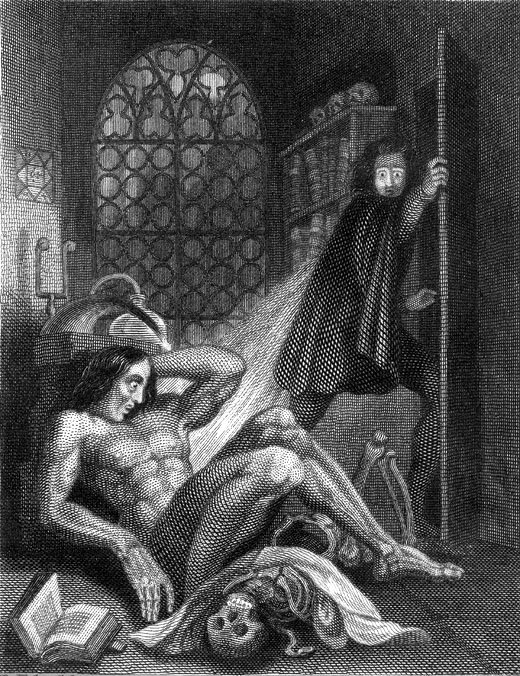
    The animated human created by Victor Frankenstein in 20-year-old Mary Shelley’s anonymously published Frankenstein, or the Modern Prometheus was a far more intelligent being than was ever portrayed in the many movies that made the novel famous in the 20th century. “Frankenstein” refers to Dr. Victor, not the creation, who refers to himself as the Adam of his maker’s labors (and then later as Victor’s Fallen Angel), while elsewhere in the book he is called “it”, as well as “being”, “creature”, “daemon”, “Fiend, “monster”, “vile insect” and “wretch”,  among other adjectival variants. 

    Frankenstein2[Illustration by Theodor von Holst for the 1831 edition of Shelley’s book.]

    “Remember that I am thy creature; I ought to be thy Adam, but I am rather the fallen angel, whom thou drivest from joy for no misdeed. Everywhere I see bliss, from which I alone am irrevocably excluded. I was benevolent and good; misery made me a fiend. Make me happy, and I shall again be virtuous.”

    Mostly the creation is referred to as a “monster”–the word being used 35 times, mostly in reference to Victor’s animated man.

    It is difficult to refer to the creation as a “monster” once you get to know him a little—he is exceptionally smart, teaching himself to read, and then reading difficult and complex works with deep understanding, which is hardly something that is expected from what Boris Karloff gave to us.


  • Tik-Tok of the Intertube // How Many Triangles are in the Web?

    JF Ptak Science Books   Quick Post

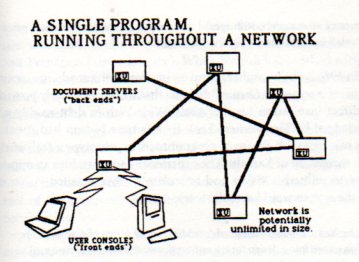
    Ted Nelson had a lot of ideas about computers, though not that many are remembered today, in spite of a bunch of them being pretty smart. (He coined the words “hypertext” and maybe “hyperlink”, for example.)  In any event there’s this little diagram of the possibilities of his “world wide network”, which I think no doubt is one of the earliest “maps” of the yet-to-exist internet. 

    Nelson dreams065

    [Picture source:  Ted Nelson, Dream Machines (1974) via Alex Wright, Glut, Mastering Information Through the Ages (2007), p 215.] 

    It is also interesting to see that the frontis illustration for his book uses Tik-tok, a metal/machine character from a series of books by (Oz) L. Frank Baum, this one Tik-tok of Oz (1914).