A Daily History of Holes, Dots, Lines, Science, History, Math, Physics, Art, the Unintentional Absurd, Architecture, Maps, Data Visualization, Blank and Missing Things, and so on. |1.6 million words, 7500 images, 4.9 million hits| Press & appearances in The Times, Le Figaro, Mensa, The Economist, The Guardian, Discovery News, Slate, Le Monde, Sci American Blogs, Le Pont, and many other places… 5000+ total posts since 2008.

Category: Anticipation, History of

  • Something No Skyscraper Could be Without: an Elevator (1893)

    JF Ptak Science Books  Quick Post

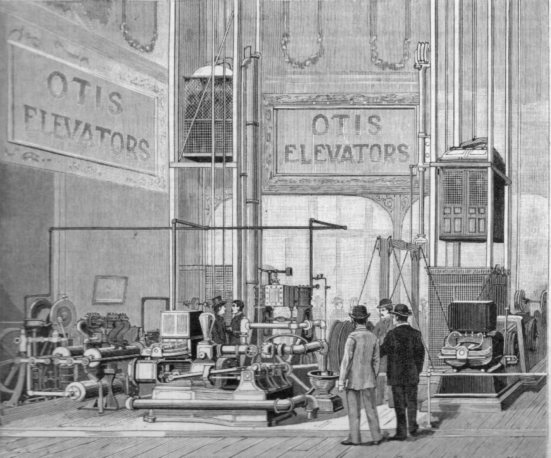
    The front page and very present image (running the full height of the magazine) of the Scientific American for the October 28, 1893 issue presents the Otis elevator on exhibit at the Columbian Exposition of 1893.  Otis was one of a dozen manufacturers showing their wares–it was also evidently the largest and most sensational display, with their demonstration (electric) elevator constructed in the center of the Manufactures and Liberal Arts Hall and rising 185′ from the ground.  At the time the nation’s tallest skyscraper was the New York World buildiing, recently finished in 1890 and 349′ high.  The tallest buildings of the previous decade weren’t close to this, and weren’t as tall as the Columbian Otis elevator, so the thrill of the folks who took the ride to the top of this great indoor structure must have been palpable.  

    And of course tall buildings wouldn’t be anything without an elevator; and elevators would be nothing without a great, reliable, and safe (Westinghouse) braking system.  

    Otis elevator 226


    And this, an accompanying image:

    Otis elevator 227


  • “The Nation” and the Scottsboro Case, Alabama, 1933

    JF Ptak Science Books   Post 2315

    I’m here again with The Nation, a marvel of social reporting and interpretation.  I was recently able to have 40 years of it come my way, and I have the luxury of sitting down with the odd volume and breezing through it–though it isn’t much of a breeze.  It is shocking to me how much of what they cover is absolutely new and fresh to me, especially since I thought I knew something about the decades that I’m pushing through right now (1919-1945).  

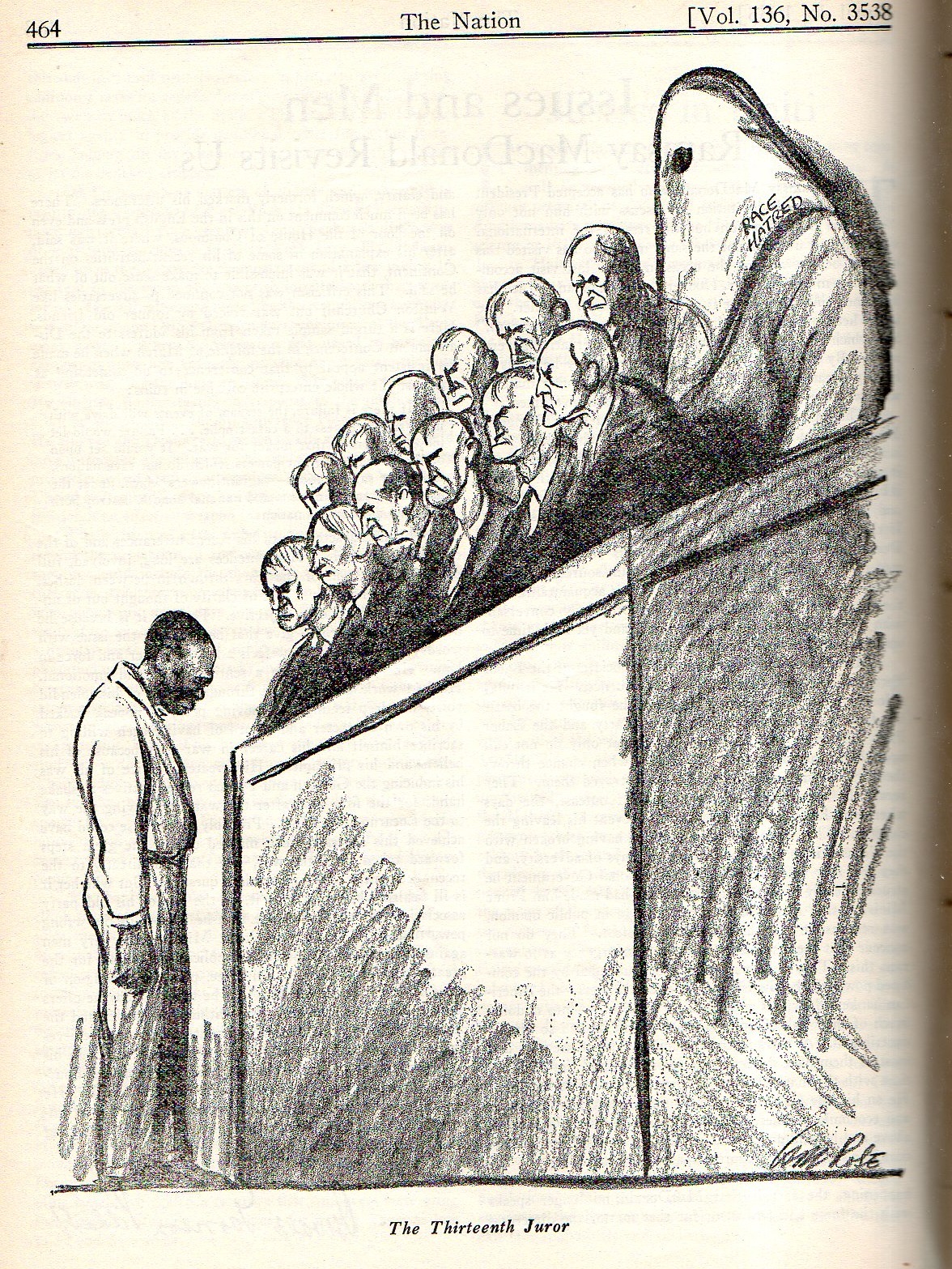
    Nation  lynching316I opened tonight almost immediately to this commentary on the Scottsboro Boys case–and it doesn’t take much to figure out what is going on, even if you never heard of it before,  This illustrate an article on Haywood Patterson, one of the nine African American teenagers who were accused of raping two white women in the state of Alabama in May 1931 and the legal morass and bitter institutional racism that he and the rest of the accused had been dragged through. It is a complicated set of cases –but the fact that there were trials and that there was some sort of legal sensibility to the matter was in itself noteworthy, because the case was highly inflammatory, enraging parts of the population who wanted immediate justice-and-punishment. 

    That didn’t happen in public, but it could be argued that is what was attempted by the Alabama criminal justice system–a judicial lynching.  The cases of these men went back and forth for a number of years, the men being convicted, and then sentenced to death by electrocution, and then appealing, and finding parts of the judgment overturned,  and then starting again, finishing again, overturning again, and other complications.  

    The cases made their way through to 1935 with sentencing in 1937, at which point the death penalties were overturned, but replaced by long prison sentences. 

    Haywood Patterson escaped the electric chair, but was sentenced to 75 years for a crime for which there was no evidence.  He wound up escaping in 1948, and wrote a book about his case (The Scottsboro Boy) in 1950; soon afterwards he was in a bar where he had an argument with a man and knifed him to death; Patterson was subsequently arrested and convicted of manslaughter, and would die of cancer in prison in 1952.  

    Mr. Patterson was evidently the first Afircan American in the history of such cases in the state of Alabama to not be executed for the crime. 

    [Image source:  “The South Speaks”, by John Henry Hammond, Jr., in The Nation, April 26, 1933, opposite page 465.]

    Lead Belly’s Scottsbor Boys”: 


    Scottsboro photo

    [Source:  NBC News.  http://www.nbcnews.com/news/other/alabama-pardons-scottsboro-boys-after-82-years-f2D11634806]

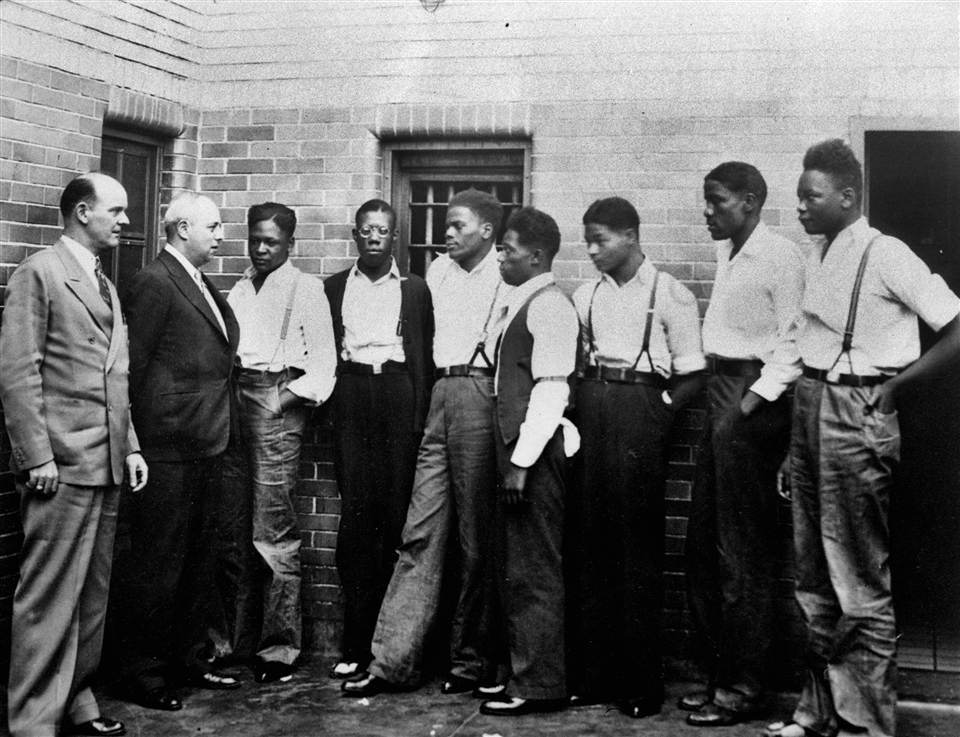
    “In this May 1, 1935 file photo, attorney Samuel Leibowitz, second left, meets with seven of the Scottsboro defendants at the jail in Scottsboro, Ala. just after he asked the governor to pardon the nine youths held in the case. From left are Deputy Sheriff Charles McComb, Leibowitz, and defendants, Roy Wright, Olen Montgomery, Ozie Powell, Willie Robertson, Eugene Williams, Charlie Weems, and Andy Wright. The black youths were charged with an attack on two white women on March 25, 1931.”–Source as above.

    [Source: Emory University, here http://www.youtube.com/watch?v=TmsYLmqx3wg]


  • Invade Europe Now! (And Nazis in New York)

    JF Ptak Science Books     Post 2313

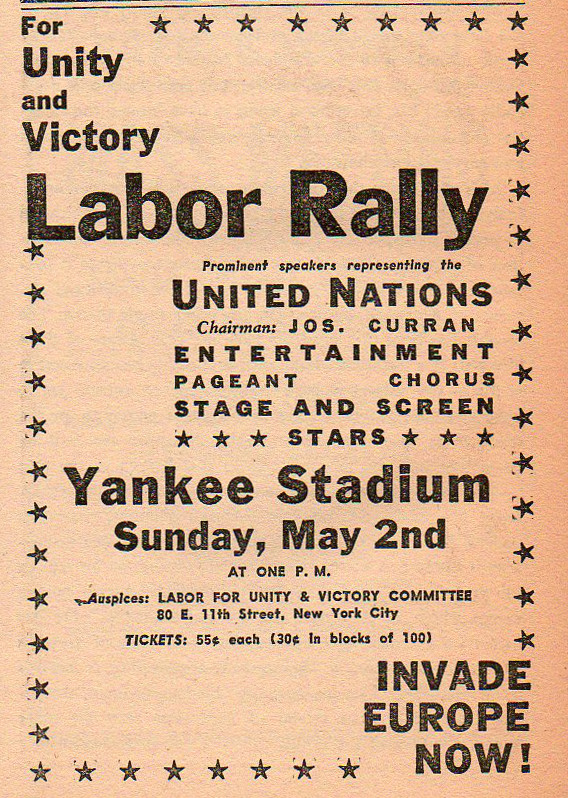
    I found this ad in the April 24, 1943 issue of The Nation, a great magazine already in its 70th year of publication.  I can’t say that I’ve seen a mention of the European invasion like this before, in an ad–certainly everyone was thinking of it, and the issue of where the invasion would take place had been decided (over Mr. Churchill’s desire for the thing to take place in southern Italy), but to see it in a advert like this was surprising.  (It turns out the Paul Robson sang at the event, urging the crowd of 54,000 to fight Fascism “abroad andf at home” (see http://www.bayarearobeson.org/Chronology_3.htm#May%202,%201943)). 

    NATION invade europe now313


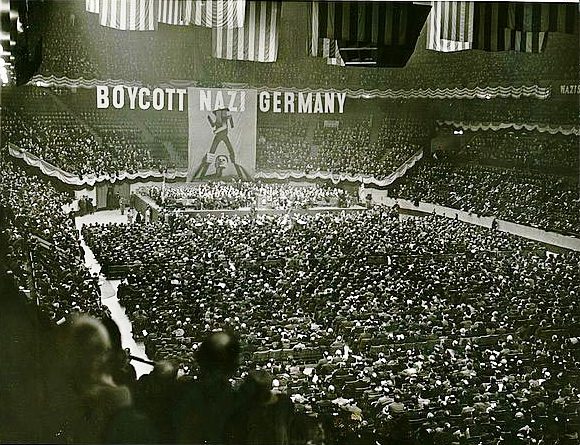
    In searching for images of this event I found something for Madison Square Garden, featuring a packed house for an anti-Nazi even in 1937.  MSG played no particular overt political favorite in the game of renting the facility (free speech and all that), because a year later there was a large meeting of the German American Bund that took places there, with reportedly 20,000 in attendance.  There’s a very unsettling video that I found for this event:

    [Source: http://youtu.be/KPGT7EaCiIY]

    They listened to a lot, not the least of which was the Bund’s leader, Fritz Kuhn, a naturalized American from Germany with a troubled relationship with the Nazi Party, and also with sticky fingers. What brought him to his knees was Fiorello La Gaurdia going after him and with Thomas Dewey prosecuting him for embezzling $14k from the groups general funds to pay for his happy times.  He went to prison in ’43, deported in ’45, and was dead in Germany in ’51.  

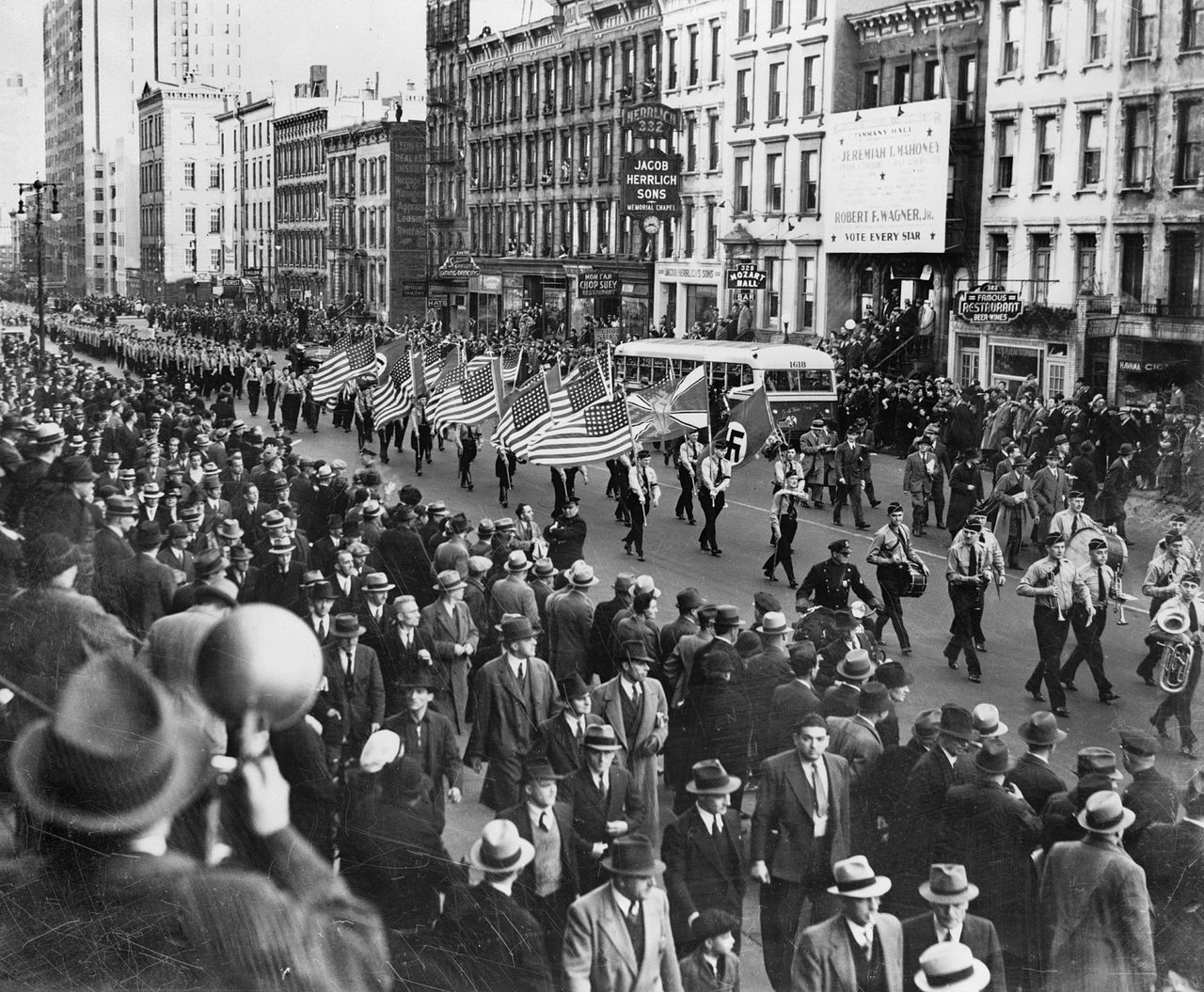
    The Bund paraded down 5th Avenue, too, in October 1939, right after the beginning of the war. From the looks of it the Nazis didn’t come close to even a small fraction of the curious and concerned onlookers.  

    German_American_Bund_NYWTS

    [Source–Wiki images, here]

    For many pro-Nazi groups–including Charles Lindbergh and the America Firsters–the bullshit parade didn’t end until Pearl Harbor, when the U.S. went to war with Germany, and at which point the Hitler admirers had a huge change of heart. Or at least became very quiet and still.

    Here’s an earlier anti-Nazi meeting, which seems to me to have had a much bigger crowd:

    Anti-Nazi rally

    I have my doubts about the 20k mentioned for the 1938 meeting–from what I can tell there were a lot of dark sections and empty chairs…

    ·Posted by :

    ·in:

    —

  • On a Certain Part of the History of Echoes

    JF Ptak Science Books   Quick Post

     There is a wonderful, short paper by Lord Rayleigh in the August  21, 1873 issue of Nature on echoes, “Harmonic Echoes”, echoes which have a life of their own, seemingly, after their initiation….echoes with 5 or 10 or more reverberations, echoes which seem to advance, or recede or both.  

    The mythological, beautiful nymph, Echo, a creature of Greek invention–or discovery–was much in love with her own voice and thus some of this interest in repetitive reverberations.  Echo was interested in Narcissus, which means that between the two of them, there was more more than enough interest in them for anyone outside themselves, but neither could get enough of themselves. And with Echo there were others who couldn’t get enough of her, though she denied herself to everyone. And so the tragedy.  Pan wants her, the old lech, and is denied, and becomes enraged which leads to her tragedy of being torn to pieces. She is resurrected, a little bit, her voice surviving everything else, repeating the last words of others.  

    I’ve repeated below a story on the Rayleigh paper which in some respects is as interesting as the original. 


  • Episodes in the Battle of Clutter over Thinking Space

    JF Ptak Science Books   Post 2281

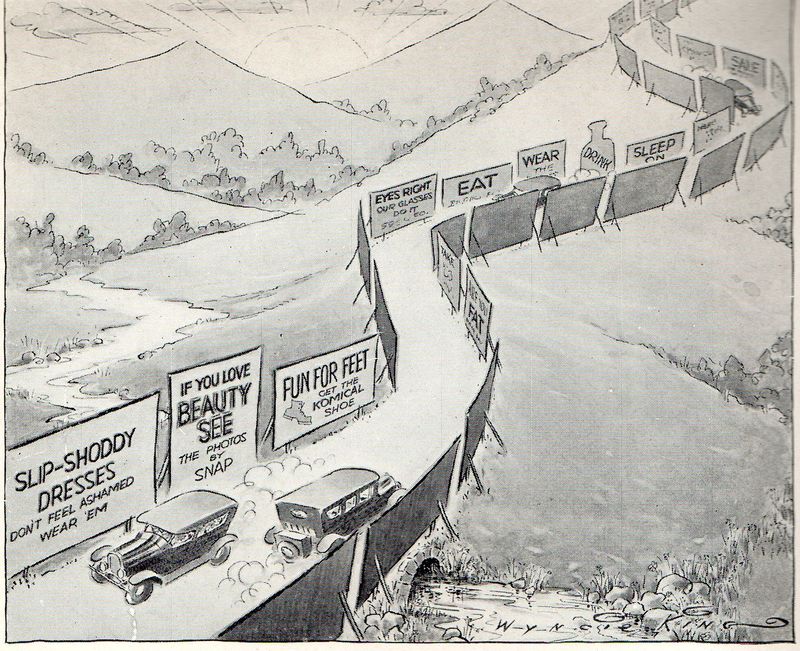
    The way of the new world, the spread of commercialism and of consumerism, the increase in the size of a middle class that was actually approaching what we today would think of as a middle class, the wanting rise of places for disposable income to go from millions of new people with spare money to spend, led the sellers of stuff-immemorial to start advertising their bits on the side of out-of-doors everything. The fight for the attention span of the new consumer went from the newspapers and magazines to the side of buildings and then, as the motor car began to proliferate, to thousands and hundreds of thousands of miles of roadway.

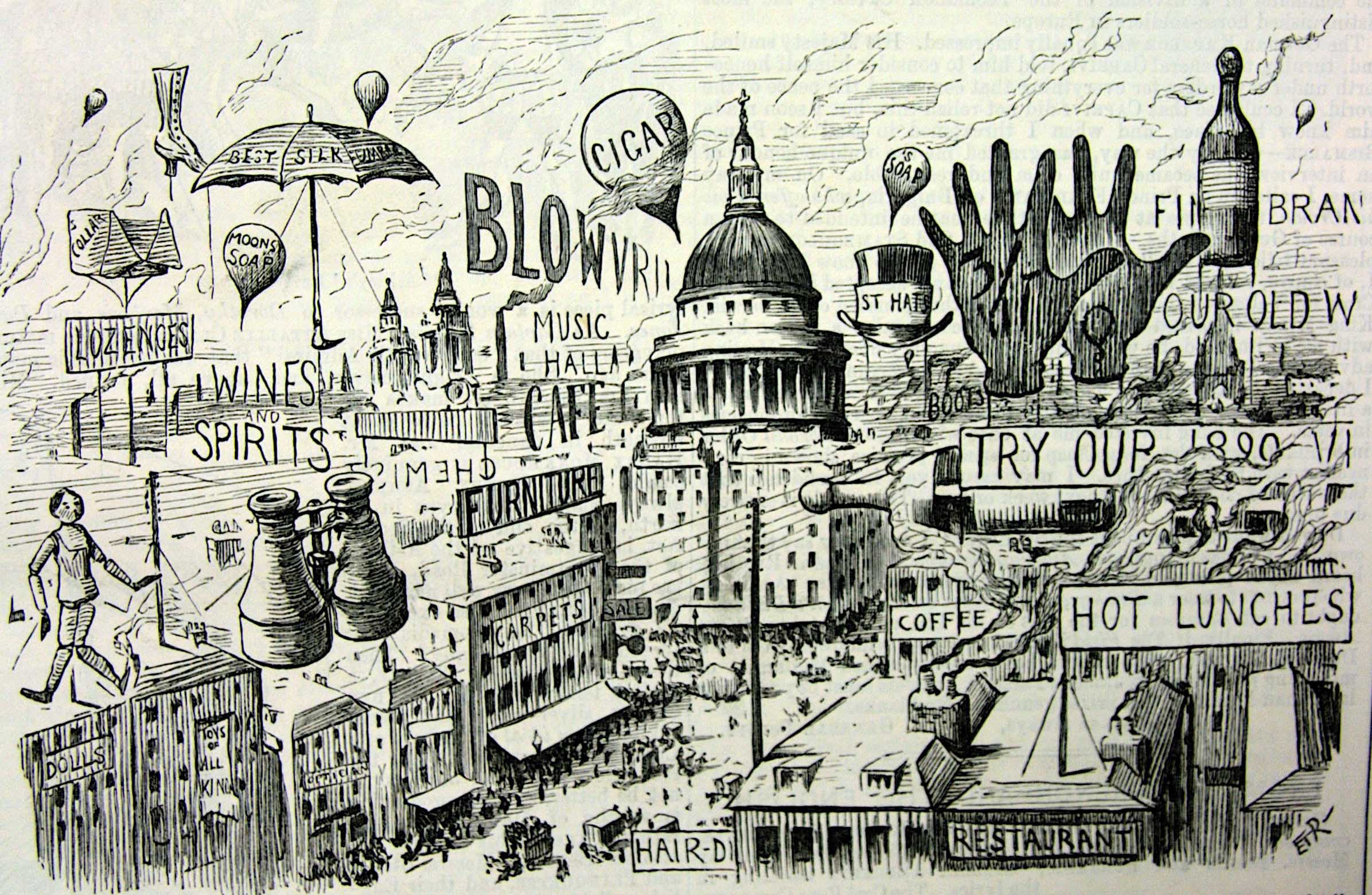
    Billboards to buildings, and buildings as billboards, and more–as some of the early branders might’ve seen it, the sky was the limit, or at least so for this caricature of the impending future, as seen in Punch, or the London Chiarivari  (‘Picturesque London – or, sky-signs of the times’, 6 September 1890, p. 119.)

    Advert posters London 1890

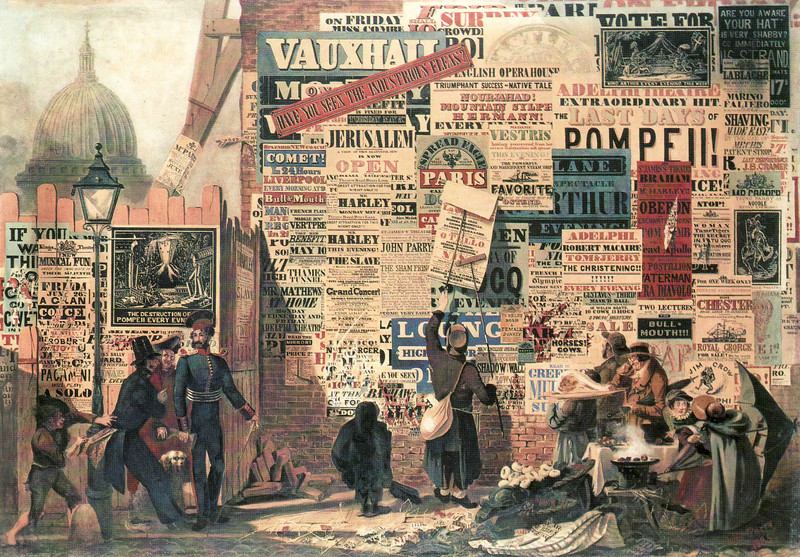
    That of course was a view to the near-future–the reality of the situation was more like what was portrayed by a watercolor by Orlando Parry, ‘A London street scene’, in 1834, so imaging a step-beyond may not have been too difficult a thing to portray:

    Ad posters

    [Image Source:  Ragpickinghistory  http://ragpickinghistory.co.uk/tag/london/]

    A more recent example of the threat of rampant billboardism and the struggle for the pocket and attention of teh consumer is seen in this 1931 illustration that was tucked inside this almost-provocatively-named pamphlet, Billboards ad Aesthetic Legislation, New Applications of Police Power (published by the St. Louis Public Library). It is astonishing to think of the vast changes that took place in the remaining American frontier, taking place so quickly–two generations separated the last of the great cattle drives to billboard legislations along auto routes in the western states. 

    00--billboards036

    Fighting for the pennies in the pocket bottoms of the working poor and the middle class is getting to be Old Stuff, an interesting chapter in the History of the Assault on the Attention Span of Human Beings.   

    ·Posted by :

    ·in:


  • An Early Publication on “Color Hearing”

    JF Ptak Science Books   Quick Post

    In an earlier issue of Nature, back on January 15, 1880, there appeared a wonderful article by Francis Galton that turned out to be one of the earliest treatments of synesthesia. “Visualized Numerals” 1 concerned (in one aspect)  the mental visualization of the act of doing mathematics. That is to say, what images people formed in their brains as they performed mathematical functions. It was also an illustrated article making it perhaps the first attempt at visualizing a thought process.  

    Browsing another issue of Nature for May 6, 1890, there appeared another unusual and related piece, this by  George N. Newton, “Visualized Images Produced by Music” (reproduced below). 


     This was probably nothing new  to a lot of people, least of whom included tone poem composers and others who heard music and experienced color sensations–but this too, like the Galton, was a very early publication on the subject.  Or at least in a reachable, non-trivial, not-obscure publication–there were instances of articles written earlier in the 19th century, though they did not find an audience like that of Nature. Folks have been thinking about color hearing for thousands of years, though not necessarily writing much about it or (later) publishing on it–to these people this article was preaching to the choir, in color.  

    Notes:

    1. See “A New Class of Scientific Image? Synesthesia, Francis Galton and Picturing Thought”, here.  

    See RhythmicLight.com for a reproduction of Bainbridge Bishop’s A Souvenir of the Color Organ (1893).

    Also for a good site with many links, see the Center for Visual Music, here.

    ·Posted by :

    ·in:


  • How Do You Measure the Distribution of a New Idea in 1878?

    JF Ptak Science Books     Post 2263

    Iron160

    Edison’s name was not a popular item in the average American home before his invention of the phonograph.  It was actually some months later, after the initial announcement in 1877, that Edison became justifiably famous. (The phonograph seems to have been up-and-running by August of 1877, though Edison did not apply for the patent until December of that year, the patent itself being granted in January 1878.) It is difficult today to place the amazement and astonishment that greeted the invention–there was nothing like it, before, ever–except for writing, of course, and then the recording telegraph.  It was a sensational piece of power, being able to record and save sound–and then play it back again.  It was the first time in human history that the auditory sense world could be audibly preserved.

    The thing about the earliest phonographs was that the recording were made on tin foil, which meant that the cylinder had a limited lifespan. The use of wax on the cylinder took a few years to come (Edison having moved on to other more interesting ideas like the light bulb rather than mess around with tweeking the phonograph) and following the initial public sensation with the invention in 1878/9 there was not another big rush towards it until the mid-1880’s with the much more durable wax cylinder.  This version not only was more stable and had a far greater shelf life, it was also much easier to use (i.e. record and play), and it was in the late 1880’s that the ideas for the use of the thing really took off.  

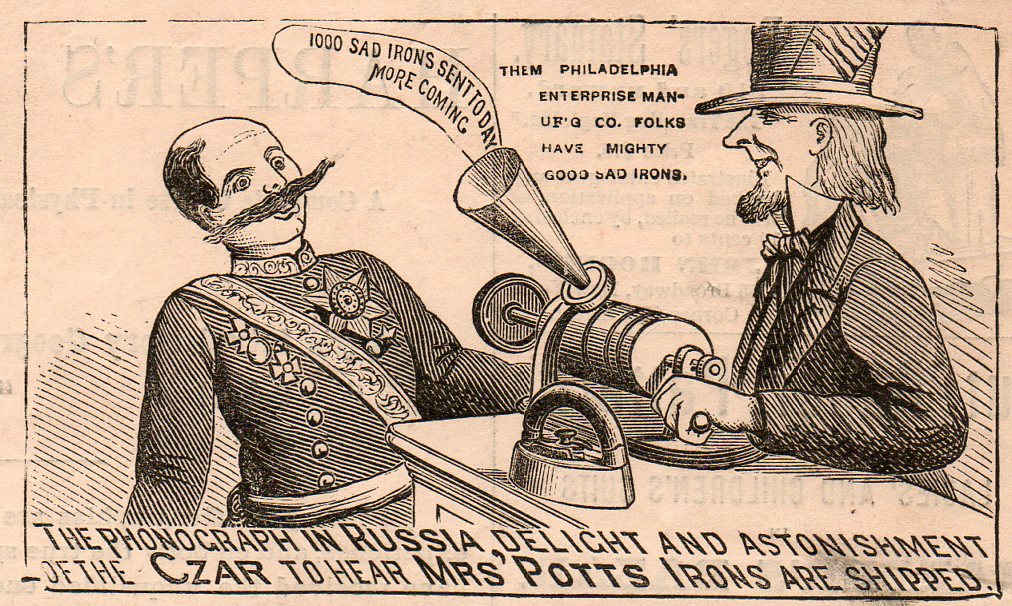
    I noticed this ad for Mrs. Potts’ “Sad Iron” at the top of the page for something that I wrote the blog-post previous to this one. It is an odd thing, Uncle Sam presenting the Czar with a recording of Mrs. Potts’ irons being shipped his way. (This was a clothing iron, shaped sort of like a boat, made of iron, and fired up on some heat source–Mrs. Potts’ big improvement was to have a detachable handle on the thing.) 

    The ad is dated June 1, 1878, which makes it quite an early use of the great new invention, still in the same year as when the thing was patented.  And here it is, a wonder of the age, used to sell irons.  

    I wonder about how quickly other great inventions succumbed to trivial notice like this…or perhaps this is more a sign of the instrument’s acceptance into popular culture, and it is actually a measure of the distribution of a great new idea that is so even and complete that six months later the thing is so well known as to be trivial?  Or perhaps this is a peek at a more-modern phenomenon for capturing teh attention of a buying public by using a word that is hyper-popular and in the news and a main point of discussion, like “Atomic Cafe” or “Radium Cakes”?  

    I don’t know–just wondering out loud.  

    ·Posted by :

    ·in:


  • A Sad Bit on Positivist Criminology, 1893 (And on Women & Tattoos)

    JF Ptak Science Books  Post 2262

    Lombroso

    In an interesting article in Popular Science Monthly (volume 44, December 1893) Helen Zimmern reviews the work and vision of positivist-criminologist Cesare Lombroso’s Criminal Woman.  Lombroso was a believer in certain bits of investigation and experimentation that he took as science. He examined the physical characteristics of criminals and made aggressive assumptions on how the shared statistics of visual clues could elucidate the character of a person.  He measured all sorts of things in prisoners–head shape, skull capacity, all manner of other body part measurement,s hearing ability, strengths,m weaknesses. color determination, acuity, agility, sagacity of facial features, and on and on, and was fairly well satisfied that he had unlocked a code of criminality determined by mostly visual interpretation–in effect, a naked-eye DNA.  It was certainly in keeping with the time and the belief in New Statistics.  Most of it was bunk, dangerous, and useless.  

    IT was all taken as a science of sorts at the time, and Ms. Zimmern reviewed the Lombroso work as a scientific, evidentiary document.  Mostly the conclusion are sad and wilting.

    Here’s a bit from the review, followed by a couple of links to other works in English by Lambroso.  

    “…on tattooing in women, the tendency to tattoo being, according to Lombroso, an infallible indication of criminal tendencies.”–Cesare Lombroso, “Criminal Woman” review, page 221. 


    ·Posted by :

    ·in:


  • Crazy Cubes, Baseball Cannons, Logic, and the 4th Dimension, 1897

    JF Ptak Science Books   Post 2258
    Hinton cannon[Source:  Joshua Robinson, “A Machine Before its Time”, Wall Street Journal, June 21, 2010. See below.]

    Somewhat Zelig-like, Charles Howard Hinton (1853-1907) is a sort of shadowy Oxford-educated figure who turns up in the beautiful Jorge Luis Borges’ works, and who married George Boole’s daughter, and who was a great and very early visualizer of geometries of higher dimensions, and who was the coiner of tesseract, and the inventor of a baseball pitching machine, and a practical joker, and a sci-fi writer, and who deserved an obituary in the New York Sun by the masterful Gellett Burgess (May 5, 1907), and who seemed to keep one step ahead of everyone and himself.

    He was also the creator of crazy cubes.

    There are many standard-bearers in the history of modern art who probably owe something to Hinton, who published his ideas on the fourth dimension (illustrated!) just at the time when this idea was in it trial runs in the artwork of the modern age.

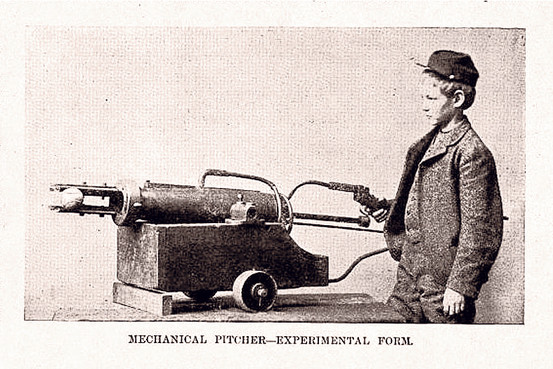
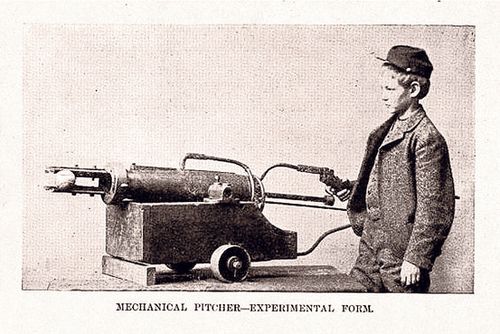
    And so do baseball players—or at least those at Princeton, where he introduced his machine which evidently was used there for several seasons. The pitching gun really was a cannon, the baseball loaded into the thing with an appropriate cartridge to shoot the ball at pitcherly speeds, which he described it in Harper’s Weekly for March 20, 1897. (How Hinton got to Princeton is interesting and a mystery, both; he was an instructor of math in England until he was charged and convicted of bigamy in 1886, whereupon he took his first wife and four (?) sons to Japan to teach in Yokohama for a while, then yadda yadda yadda he starts teaching at Princeton in 1893.)

    Hinton was into a lot of things, with a very inquisitive mind, and very smart. And so he bounced here and there in his careers, from position to position. David Toome, in his fine The New Time Travelers: A Journey to the Frontiers of Physics (2010) gently and wonderfully describes Hinton (in his relations to the exterior world of work) as “buoyant” (page 29).

    In any event, Hinton seems not to have patented the thing,so far as I can determine in 10 minutes of patent searches.

    The cannon seems to have excited a bit of baseball scifi in itself, adding to Hinton’s other pleasures.

    In a longer and better article than mine, Joshua Robinson writes in the Wall Street Journal about  Hinton’s machine and the near-roboticized future of baseball:

    “…(I)n 1896, the Los Angeles Times called it a “Frankenstein.” One Washington Post columnist worried it would ring in an age of robots ruining the national pastime—this was a long time before anyone was worried about steroids.

    “There would be the base-burning, high-pressure, anti-friction catcher,” he wrote, “and the shortstop made of aluminium and rivets and filled with cogs, cams, valves, shafts, and belting.”

    Hinton’s pitcher was an interesting idea, but ultimately it proved to be too cumbersome and slow to be of any sustained use. Plus, as Robinson points out, after the cartridge was fired there was a puff of smoke, which caused occasional consternatiuon and confusion for those standing in front of the canon. And ducking.

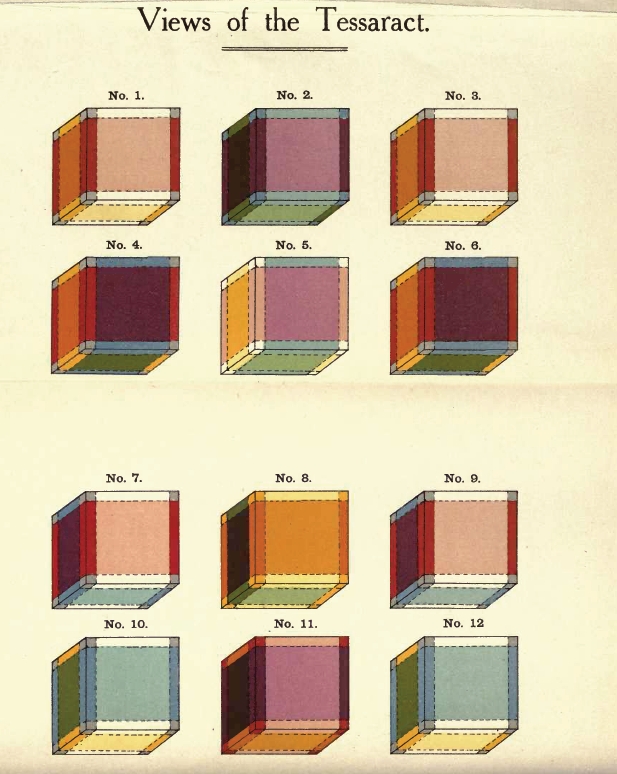
    And the so-called “crazy cubes”?  That moniker is my own creation. These were simply (really not so) creations by Hinton that he said would help people visualize his four dimensional world, as Rudy Rucker (see below) describes as “points moving around in three dimensions might be imagined as successive cross-sections of a static four-dimensional arrangement of lines passing through a three-dimensional plane…”  Evidently the cubes helped many people experience a more internalized world of fantastic difference, some stating that the cubes drove some people insane. Of course they were just colored cubes, pretty in themselves–though the problem of visualization was fairly knotty.  
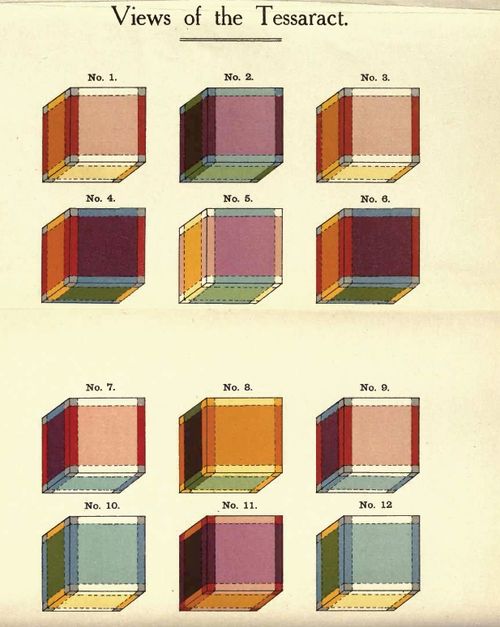
    Hinton tesseract[Source: The Fairyland of Geometry, a Cultural History of Higher Space, 1869-1909, here.]


    Notes:


  • Bitter Cold Edvard Munch Weather Maps, 1896

    JF Ptak Science Books   Quick Post

    Weathermapsillus00moorrich_0015

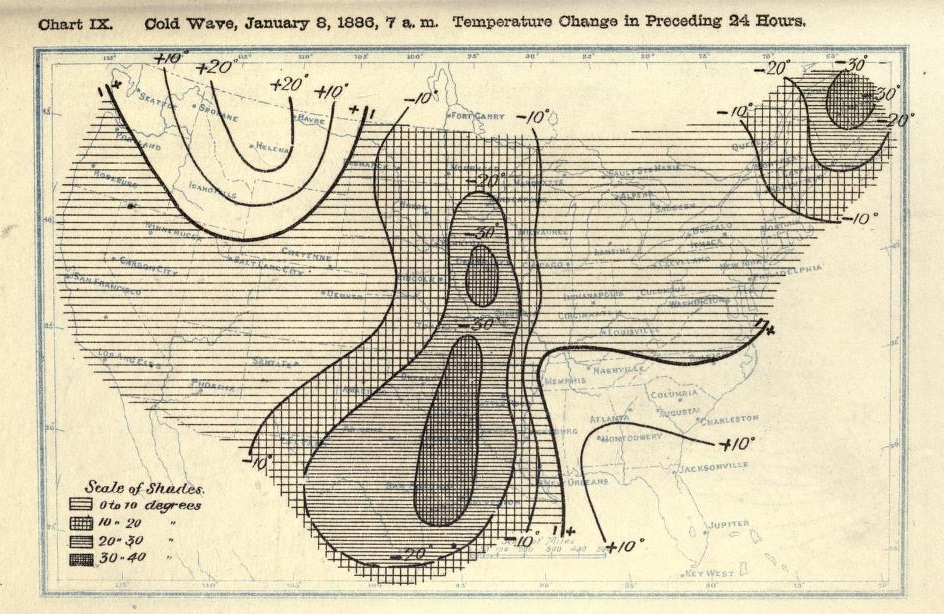
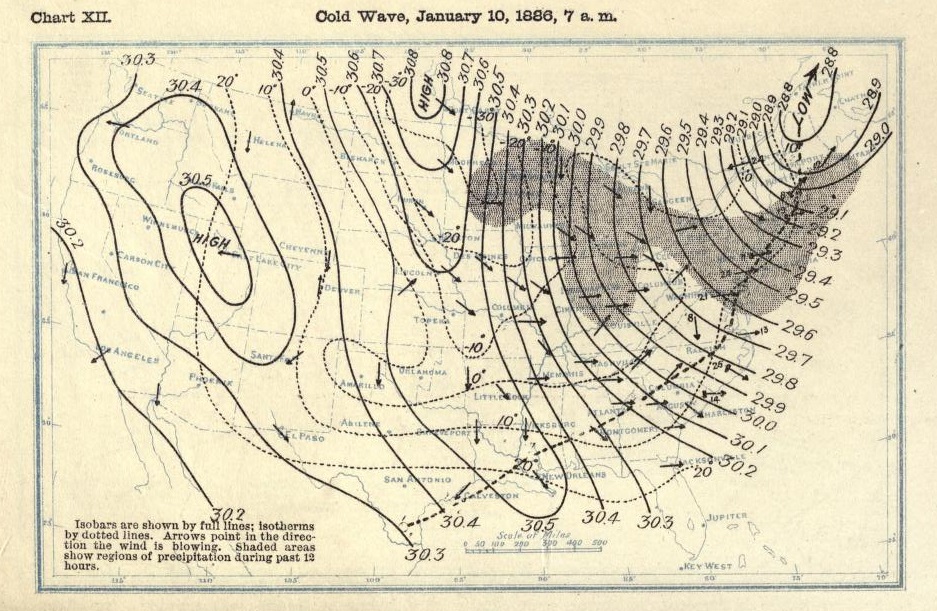
    Munch–that is the first thing that came to mind on seeing these maps from Willis Luther Moore’s Weather Maps Celebrating s Lecture on Storms and Weather Forecasts (“Delivered under the auspices of the Men’s Association of the Brown Memorial Presbyterian Church…Baltimore, Maryland, Monday, November 16, 1896, P.M.”)  Others may not see it, but I do see “The Scream” in there, in America’s heartland, in glorious black-and-white.  And screaming they should have been–that winter in January 1886 was brutal, calling for 30 below zero in places like the appropriately-named Jornada del Muerto in Texas. In any event the maps are really quite lovely, and not really “early” anymore for weather maps of such detail (these maps beginning to appear in the 1840’s and becoming pretty accurate placeholders of weather memory by the 1880’s. 

    Weathermaps cold front