A Daily History of Holes, Dots, Lines, Science, History, Math, Physics, Art, the Unintentional Absurd, Architecture, Maps, Data Visualization, Blank and Missing Things, and so on. |1.6 million words, 7500 images, 4.9 million hits| Press & appearances in The Times, Le Figaro, Mensa, The Economist, The Guardian, Discovery News, Slate, Le Monde, Sci American Blogs, Le Pont, and many other places… 5000+ total posts since 2008.

Category: Anticipation, History of

  • On the Relation of Birds to Airship Flight (1890)

    JF Ptak Science Books  Quick Post

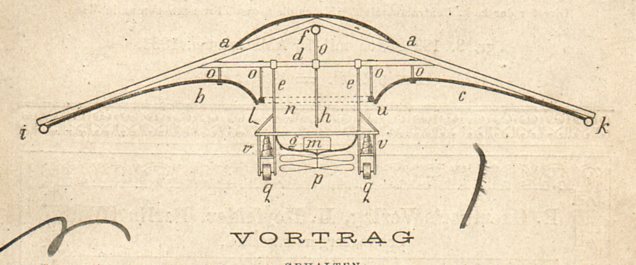
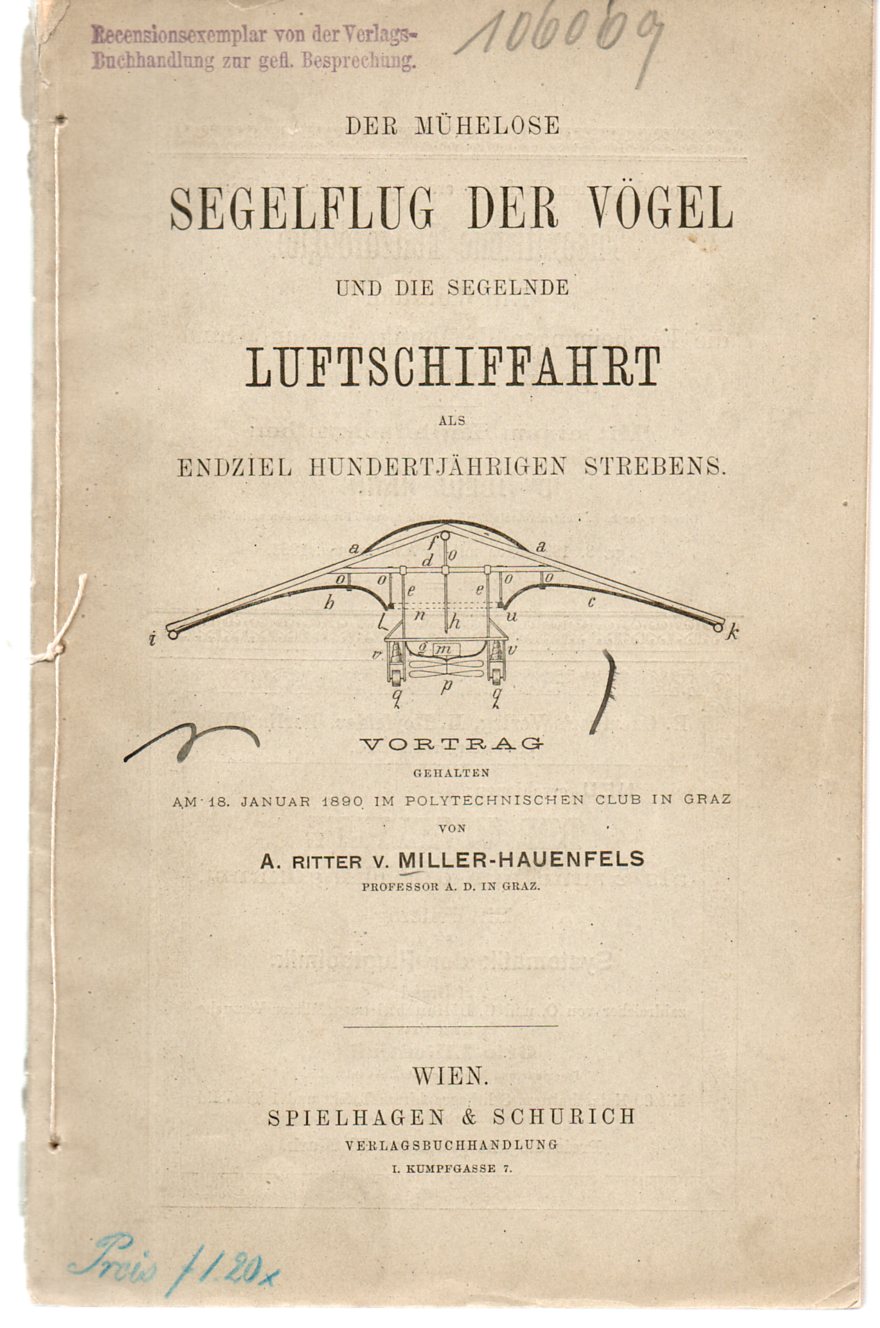
    Here’s an interesting and lovely little classic:  A. Ritter v. Miller-Hauenfels Der mühelose Segelflug der Vögel und die segelnde Luftschiffahrt als Endziel hundertjährigen Strebens. (Roughly “The effortless gliding of birds and the sailing airships as the ultimate goal for the end of the century”).The matieral was delivered  (January 18th) 1890 at the Polytechnischen Club in Graz and publisahed later that yer in Vienna by Spielhagen & Schurich.  My copy of this work also happens to have been in the collection of Vicktor Silberer, 1846-1924, a pioneer aviator from Vienna and a prolific author, jorunalist, and politician.

    Aviati0n ritter382


    Aviati0n ritter381

    In his lectures at Graz Miller-Hauenfels looks at the possibility of human (non-powered, gliding) flight via forward-progression bird flight, basing his work on that of Marey, Lilienthal and Parseval.


  • A Really, Really Good Radio Talk Show (1940)

    JF Ptak Science Books    Post 2372

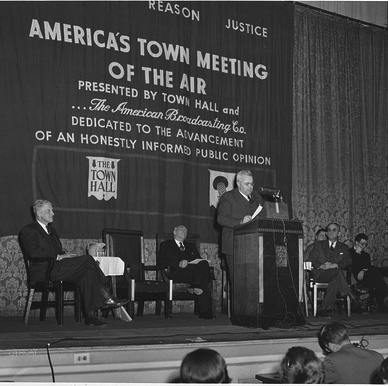
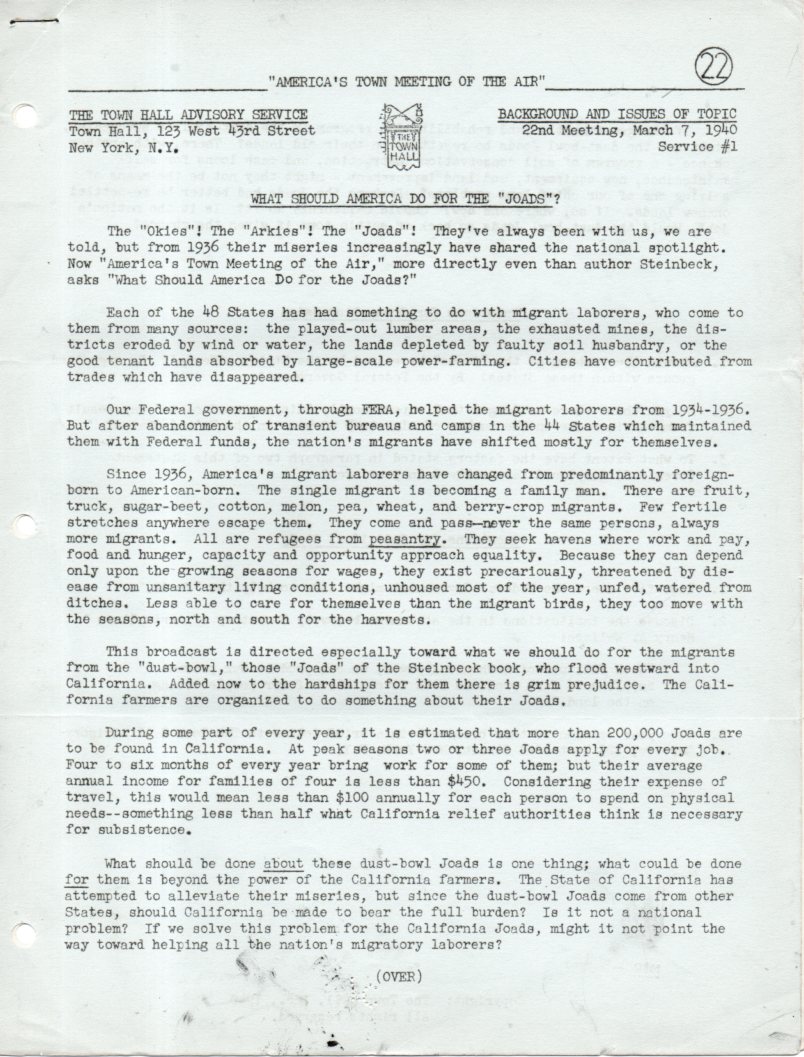
    It turns out that I own a good stack of guideline publications for what was America’s first news talk show,1 “America’s Town Meeting of the Air”, produced by the Town Hall Advisory board between 1935 and 1956.2  It was a weekly show, and in general–at least for the 90 examples I have for the 1938-1941 period–each broadcast came with a three-sheet guideline for the listeners on the subject of the weekly topic.

    The first sheet was a general statement of the show’s interest–for example, “What Shall We Do With the Joads?”, for March 7, 1940 (the Joads being the family in the Steinbeck mega-epic The Grapes of Wrath). These intro pages are usually very concise, very well written, logical, and provocative. 

    America's town meeting of the air534

    The second sheet is really what surprised me so–a bibliography and suggested reading for the discussion.  That means that before the radio program was broadcast the producers provided listeners a handy sheet with material to read so that they could better follow the discussion–this seems truly exceptional by today’s sub-standards of a great chunk of radio political discussion, where volume/noise dictates correctness over recognized references. I wondered before looking at the list if The Grapes of Wrath would be there, because, well, it wasn’t necessarily a popular read everywhere in spite of the book’s critical reception. It was there, along with (shockingly) Dorothea Lange and Paul Taylor’s (her husband) An American Exodus;  Carey McWilliams’ Factories in the Field the Story of Migratory Farm Labor in California; and You Have Seen Their Faces, by Erskine Caldwell and Margaret Bourke-White (described as “the Southern sharecropper in photographs and prose”).  Actually all of the books and articles are given a similarly very-short description like this, in spite of their Great Classic status of today–the photographs by Bourke-White and Lange and McWilliams and their accompanying texts are really nothing short of masterpieces, difficult and challenging exposes of a national tragedy –and here they are, suggested reading for listeners of a radio talk show.

    America-town-meeting-otrcat.com[Image source: Old Time Radio, here.]

    The third sheet was a “Who’s Who” of the speakers for the show. In this case, they included Rexford Tugwell (an economist and former Director of the Resettlement Administration); Hugh Bennett (Chief, U.S. Soil Conservation Service); Carey McWilliams (the author of Factories in the Fields and at the time Chief, Division of Immigration and Housing for the state of California); and Philip Bancroft (a member of the executive committee of the Associated Farmers of California, the farmers of that state being a particular target of Steinbeck’s in The Grapes of Wrath).  There were serious people.  And this was a serious radio show. Each week six pages of tight typescript on 11×8.5″ sheets would be sent out, and each we the shows were of similar quality…just very impressive stuff.  

    [A sample broadcast-on Social Security–can be heard here at the Social Security Administration.]

    The topics for conversation make for interesting discussion in themselves, and pretty much serve as a social barometer for the period.  Here’s a sample: 

    ·Posted by :

    ·in:


  • Mr. Mencken, Unterrified Jeffersonism, and the Anarchist

    JF Ptak Science Books   Quick Post

    Tucker mencken605

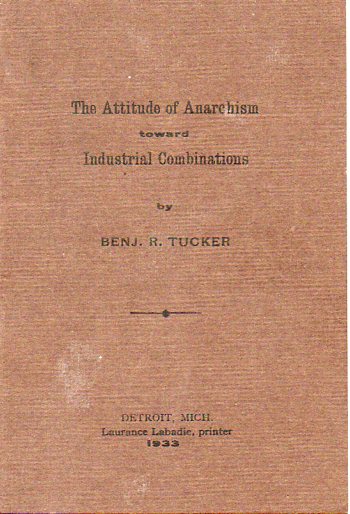
    The long-spirit anarchist (and “Unterrified Jeffersonian”) Benjamin R. Tucker (1854-1939) wrote  “The Attitude of Anarchism toward Industrial Combination” in 1926, but the one I have at  hand here was printed in Detroit (by Lawrence Labadie) in 1933–hardly a hotbead of anarchism in the the front yard of Henry Ford. 

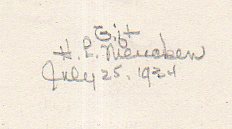
    It is interesting to see on the inside of this tiny pamphlet that the anarchist Tucker’s work was sent to H.L. Mencken, as a gift from the printer.  It wouldn’t stay long in Mr. Mencken’s possession, as he sent it (along with a number of other works by Tucker that I can’t lay my hands on at the moment) to the Library of Congress in July 1934 (and coming into my possession as part of a purchase of “the Pamphlet Collection” 65 years later.).  I’m  not so sure about what Mr. Mencken would have thought of most of it, only that he didn’t keep it for long, I think, despite what might seem to be his “Tory Anarchism” and general oppositionist stances. left and right, whatever they might have meant at the time.

    The full text of the pamphlet is found here.

    Tucker mencken607

    ·Posted by :

    ·in:


  • How to Make Yourself Hated by Your Children (1814)

    JF Ptak Science Books   Quick Post

    I was digging through a volume of The Emporium of Arts, and Sciences (Philadelphia, 1813-14), extracting the references for a long and fine article on the still-relatively-new steam engine (it runs 222 pages through several sections of the 448-page volume II) I stumbled upon this collection of pearls on how to raise children. Some of it is pretty good, some not, and some just compeltely and necessarily outdated and dusty and shrivelled and gone. But the first part, the very first bit, the very first sentence, is pretty much the whole enchilada. It was written by Christian Gotthilf Salzmann, who was the founder of the Schnepfenthal Institution, a new approach to education and a certainly-atypical school for the late 18th century.  


    [I own this volume though I’ve used the scans from the Internet Archive rather than spread the big-but-not-undelicate volume on the scanner.]

    ·Posted by :

    ·in:


  • An Annotated Poetry of Clouds

      JF Ptak Science Books  Quick Post

    Clouds cromenius

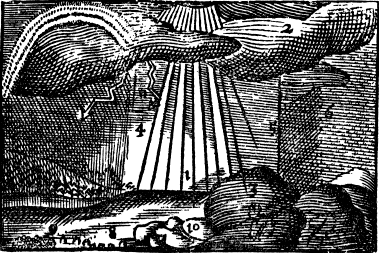
    [Image from John Comenius,  Orbis Senfualium Piélus: Omnium Principalium in Mundo Rerun/ Vita Аllопит,  translated as Pictura et Nomenclatur, the Visible World, or A Nomenclature, and Pictures of all Chief Things that are int he World, translated into English by Charles Hoof…1726.  See an earlier post here for more on Comenius. Image Source:  PROJECT GUTENBERG.]


    Clouds

    A Vapour, (1). ascendeth
    from the Water.

    From it a Cloud, (2).
    is made, and a white Mist, (3).
    near the Earth.

    Rain, (4).
    and a small Shower
    distilleth out of a Cloud,
    drop by drop.

    Which being frozen, is Hail, (5).
    half frozen is Snow, (6).
    being warm is Mel-dew.

    In a rainy Cloud,
    set over against the Sun
    the Rainbow, (7). appeareth.

    A drop falling into the water
    maketh a Bubble, (8).
    many Bubbles make
    froth, (9).

    Frozen Water
    is called Ice, (10).
    Dew congealed,
    (13) is called a white Frost

    Thunder is made of
    a brimstone-like vapour,
    which breaking out of a Cloud,
    with Lightning, (11).
    thundereth and
    striketh with lightning


  • On Death and Mayhem in Children’s Alphabets–the New England Primer

    JF Ptak Science Books   Post 2355

    Now I lay me down to sleep, I  pray thee Lord, my soul to keep;If I should die before I wake, I pray thee, Lord, my soul to take.–New England Primer, 1784 edition

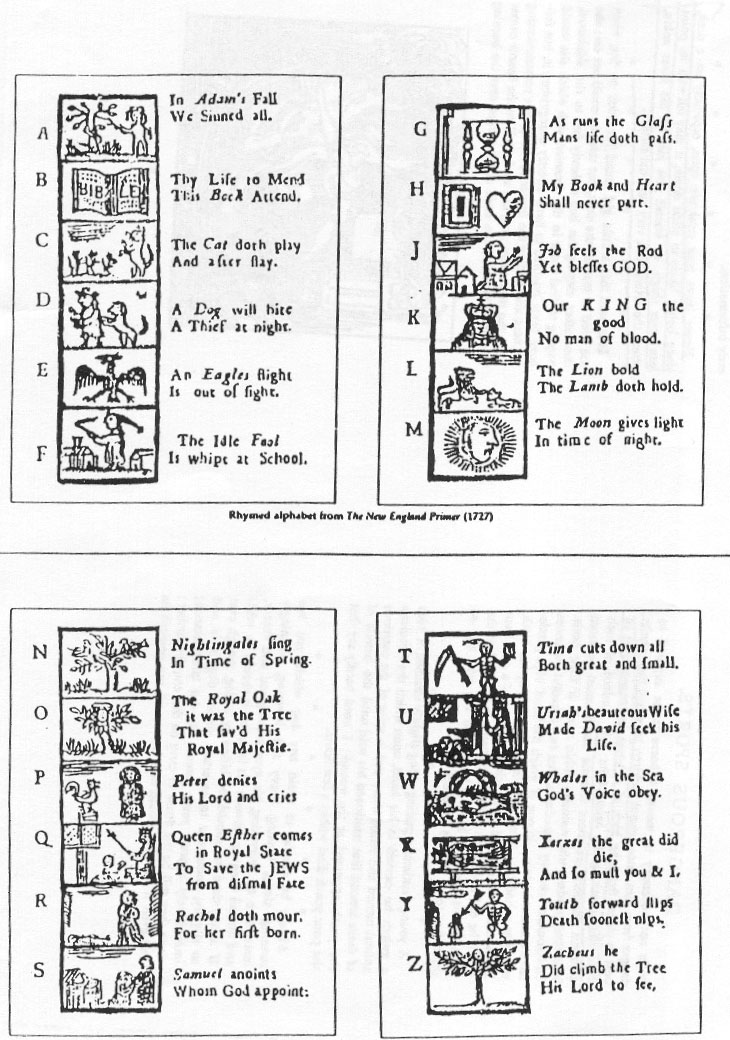
    There’s nothing scary in that is there?  The nightmare-maker may have its first introduction in the New England Primer, a book which was the backbone of North American education for many decades. as popular as it was and as much as it was used, print runs were not enormous, and most children would never actually own a copy of the book. It would be read to them for lessons, and that being the case much info was presented by vivid short rhymes , some of which are hard to forget because of the mental imagery they present.

    NEPrimer

    [Image source: Wikipedia, here.]

    For example the mnemonic devices used to help learn the alphabet is riddled with murder, mayhem, vice, death, and not all that much hope….except if you include stuff like “Job feels the rod, and praises God” as a Puritanical form of hope/salvation. Perhaps the writers were after the indelible impression as well as searing the cerebellum with the moral code. In fact, in the 24-letter alphabet presented in the   edition (“i” and “v” are not included), 12 of the letters are death- or violence-related, including the statements that we are all sinners, that cats kill things, dogs bite, fools are whipped at school, life runs out like sand in an hourglass, punishment deserves prayer, offensive things as big as armies can be swallowed up whole, a teary Rachel cries over her tiny dead child, time will kill you (again), kings will do and so will so, and youthful bits can of course kill you.  It is part-and-parcel I guess of the rearing of kids in the not-necessarily-glorious history of childhood.  Death and the possibilities of it or some close relative of it was a lot closer to reality than it is today, especially when the average life span at the time was well under 50 and infant mortality easily an order of magnitude more prevalent than it is today1.  And of course outside of the plague-of-death culture and the subjugation of kids for a better behavior there was also the screaming Calvinist theology that beat up/taught readers the abandonment of the self to the creator available to young and old.  

    This sort of indoctrination was hardly limited to the New England Primer, printed in this country as the first of its type beginning in the late 17th century (and with some familiarity several printings can be remember for famously having the “printed by B. Franklin” imprint in the 1760’s). It would be easier to name the child’s instructional that did not have this leaning (at least before 1880) though I am presently hard-pressed to think of an example off-hand).

    And lest we forget, the Grimm brothers wrote stuff for kid the vast majority of which we wouldn’t think of reading to our kids today–I didn’t.  

    Notes:

    1. Good national statistics for the U.S. before 1870 begin to get sketchy in this area, though from 1900 onward the numbers look pretty good.  Suffice to say that historians of medicine and Medieivalists and so on make pretty good educated estimates for these rates, and they’re not so good.  For example, in 1900 in America the average life span was 47 and the infant mortality at 16% (compared to about 80 or so and .7% today), though I cannot offhand find the stats for childhood survivability by age 10.  Looking back in time the numbers get really big, with some people  saying that childbirth mortality in the Medieval and Renaissance times were in the 30-50% range, and the survivability rate passed 10 was about the same.  I don’t have these rates for American colonial times, but I assume that they are closer to the Renaissance than they are to 1900 numbers.  And of course this does not apply to slaves, whose rates of survivability were smaller still.  

    ·Posted by :

    ·in:

    —

  • The Ghosts of Melville and Darwin at Tea

    JF Ptak Science Books   Post 2343

    “…a most Plutonian sight. In no world but a fallen one could such lands exist.”–Herman Melville on the Galapagos, in The Encantadas

    “It is utterly useless to say anything about the  Scenery…it would be as profitable to explain to a blind man colours, as to [a] person, who has not been out of Europe, the total 
    dissimilarity of a Tropical view.”–Charles Darwin in a letter not long after returning from his voyage on the Galapagos.–The Life and Letters of Charles Darwin, Volume I (of II), edited by His Son, Charles Darwin & Francis Darwin

    It is interesting to think of Charles Darwin and Herman Melville sharing tea prepared over a wood fire, stone chairs, looking out over the rough beach of one of the islands in the Galapagos chain from the top of the  Rock Rodondo.  And what I would have them talk about is their lives, reveiwed as spectres come back to Earth to see the advent of their careers as humans and what the future held in stock for them.

    They certainly had different views of the Galapagos–the Melville quote from his The Encantadas, which is the “Enchanted Isles/Islands” or Galapagos is pretty much what he thought of the place, which was a cruel and wrenching world.  Darwin, well… not so.  (I should also point out that there is a little bit of back-up in the Melville novella regarding ghosts–one of the stories is about the encounter of the War of 1812 USS Essex with a ghost ship.  And here are Dawin and Melville, two ghost ships passing in the night…)

    Here is the quote to start off the tenth of ten parts of the work, “Runaways, Castaways, Solitaries, Gravestones, Etc.”:

    “And all about old stocks and stubs of trees,
    Whereon nor fruit nor leaf was ever seen,
    Did hang upon ragged knotty knees,
    On which had many wretches hanged been.”

    The two men weren’t in the Galapagos at thew same time, though, during their living lives but did come within several years of one another on their respective voyages.  Both men went on great accomplishment, though Melville’s lasted only about five years, his writing and career falling out of the public eye soon after his fifth novel. Darwin was a different story.

    Melville key

    [Photo by JF Ptak of the front door keyhole at Melville’s house, Arrowhead, near Pittsfield, Massachusetts. The foundry work is old, the hardware is not.]

    Darwin became DARWIN  in 1859 and stayed there, and icon of thought. Melville achieved early fame but soon lost it. Melville’s career started out very strong in 1846, and had five successful novels in five years.  What he is remembered most for–Moby Dick–appeared in 1851, but the book was a critical and commercial failure. Pierre appeared in the next year, anf again very little success, and by just about that time his name as a highlight in the American literary world began to dim, considerably.  He lived until 1891 and spent the ’60’s through the ’80’s and into the early ’90’s as an obscure footnote int eh history of American literature.  As a matter of fact some of the short obituaries that appeared in New York papers had very little to say about him, and his great work in Moby Dick received scant (or no) attention.  Even the New York Times didn’t get the spelling correct of the title of the book1, referring to “Mobie” 

    Like the Mona Lisa, Melvillle didn’t become his famous-self until well after his death, and the Mona Lisa did achieve her iconic nature (it can be argued) for nearly two centuries.  Darwin became famous and stayed famous.  In repose, perhaps Darwin would have wished for less recognition and Melville a little more–or at least enough to allow his to earn a living from his writing.  

    Notes

    1. “Herman Melville died yesterday at his residence, 104 East Twenty-sixth Street, this city, of heart failure, aged seventy-two. He was the author of Typee, Omoo, Mobie Dick, and other sea-faring tales, written in earlier years. He leaves a wife and two daughters, Mrs. M. B. Thomas and Miss Melville.”–New York Times, September 29, 1891

    [Source: http://www.melville.org/hmobit.htm]

    ·Posted by :

    ·in:


  • The Future: Floating, Shining Soot and a SteampunkGod (1834)

     JF Ptak Science Books   Post 2340

    [This is a version of an article recently published in the Mensa Bulletin.]

    The world of possibility is limitless when there are no limits and almost no impossibilities. The history of seeing possibilities in the future, the history of looking into the future, is vast (with exponential growth in publication for each of the last three generations), and organizing it for a limited discussion difficult—there is a general temptation to simply classify all of it according to an alphabet of “ramas” of all possible Futuramas.

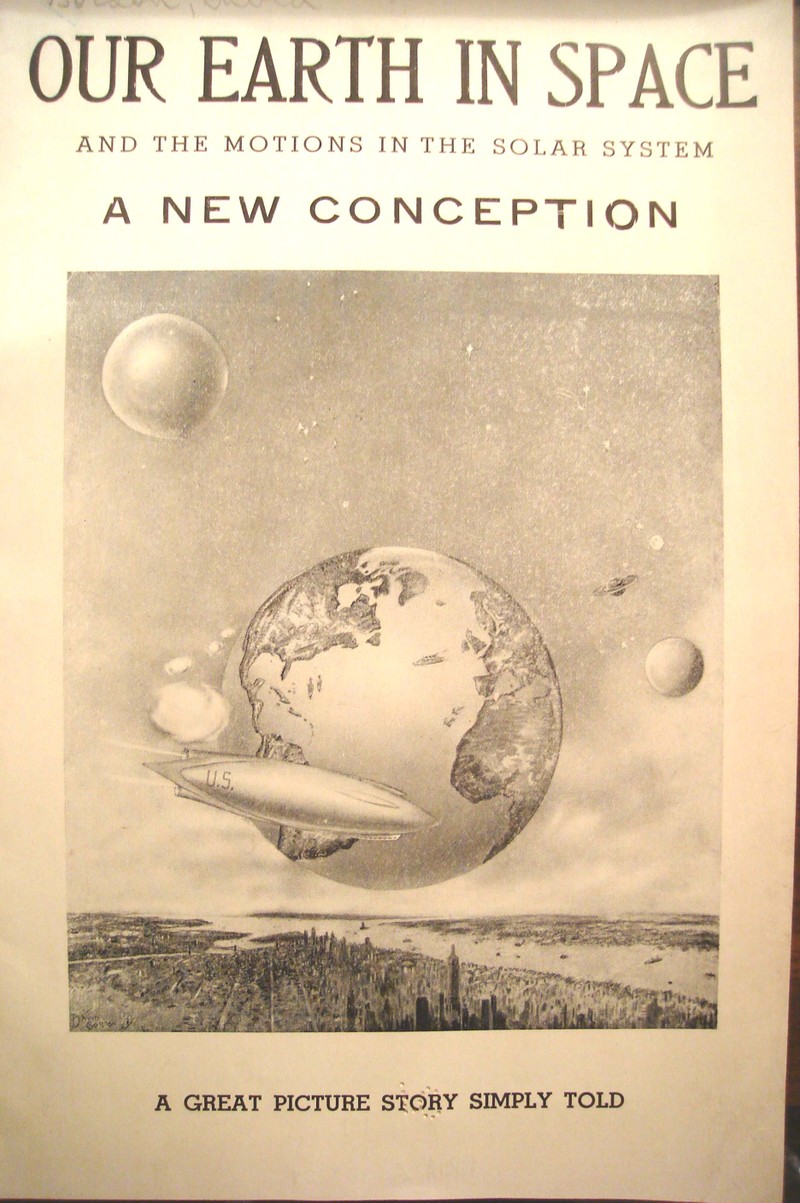
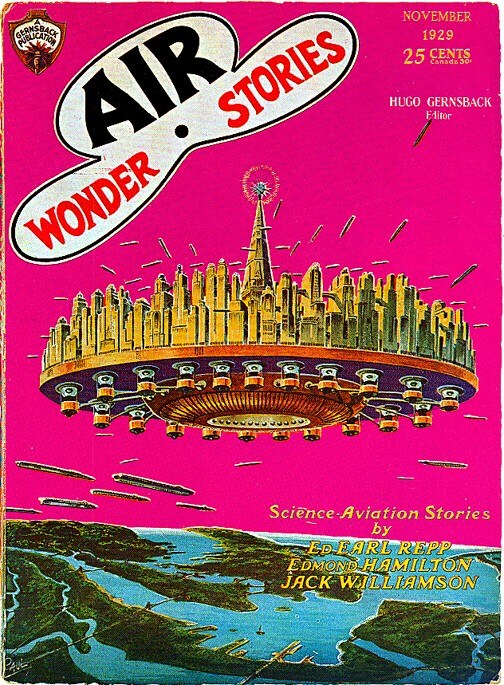
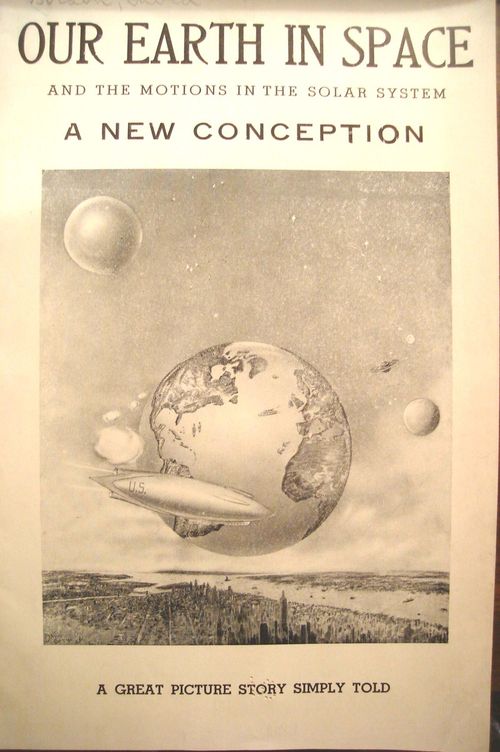
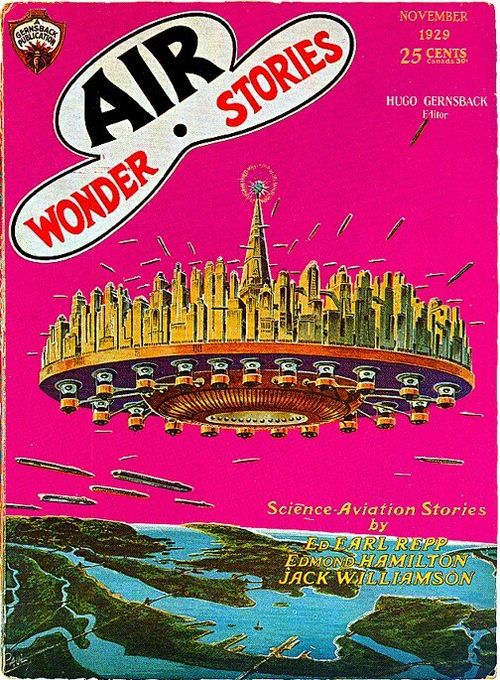
    How do we sort thousands of people writing about hundreds of thousands of future sightings in human development? Flying cars and people and cities and retrievable/liveable subconscious bits and dream, atomic blast guns, two-way wrist tv/radios, perfect places of nothing but intellect and floating intelligence, horseless cities, Soylent Green, personal computers small enough to fit into the trunk of your car, Edison’s anti-grav underwear, buffalo herding from nuclear-powered sports cars, Maginot Line-sized mobile tank-ships, rockets to the Moon, rockets to the Sun, and rockets to tomorrow and to yesterday. We have futures where Manhattan is completely covered by thirty-story skyscrapers by the social warrior Thomas Nast; where George Holmes kills off cities with airplane-filled suburbs in 1912; where electric titan tank monsters with canons instead of cigarettes crushed hopeless opponents in 1918; where atomic-powered dirigible airports free up land in 1946; where a floating NYC is moored above the hole-in-the-ground where it once stood. Where spacecraft of mega-sharp ultra-fins await their cigarette-smoking pilots in 1953 and out-Eiffeled mile-high vertical airport towers, and where an identical duplicate Earth floats serenely in place above a bird’s-eye view of Manhattan.
      Mensa extra earth

    Much of the early technical thinking on the future seems neither utopian (in the traditions of Thomas More, Francis Bacon, Plato, Robert Owen, and such) nor what we would consider today to be dystopian (as with visions of Capek, Bradbury, Orwell, Burgess)–it seems to tend more towards a neutropia. And this does not include the earlier attempts at predicting the near future by looking at frothy bits of entrails or the shades of urine, or the oracles of thrown dice bones or draw of playing cards, or following the implications of human mole maps or seeking guidance in the alignment of stars in the sky.

    And at the top and bottom of it all are the religious futures of endless pain and comfort and nothingness and repetitive existences—but that doesn’t feed into this topic, though the way time ticks through the reckoning of Brahma is very nicely suited to calculating versions of pieces of infinity.
      Mensa floating NYC

    This effort of looking at the history of the future is easier when there are bookends, and there’s no more a convenient end to the future as when it has a date. And in the past that date has often been the year 2000.

    Let’s look at two very unusual examples of future thought experiments—one of which visualizes life in the year 2000—and both of which entertain what may be one of the ultimate considerations for the evolution of humans.

    One aspect of thinking about the future is the opposite of trying to include a sense of the future in the present—instead, it can be about removal. Removal of the present, distancing it from the present and the past. Removal of practices, though not necessarily principles.

    And perhaps one of the greatest of these removals is that of the human aspect of humanity: people replaced by created entities. In a way, a sort of 19th century singularity.

    Mensa cigarette space jock

    A curious example of this can be found in the third edition of Jonathan Swift’s tales of Lemuel Gulliver, where we see a Jorge Borgesian library-producing machine, a 20′ square instrument made of cranks and cubes and turned by scribes producing an endless stream of knowledge. A wooden miracle replacing the human mind, an intelligent primum mobile with splinters.

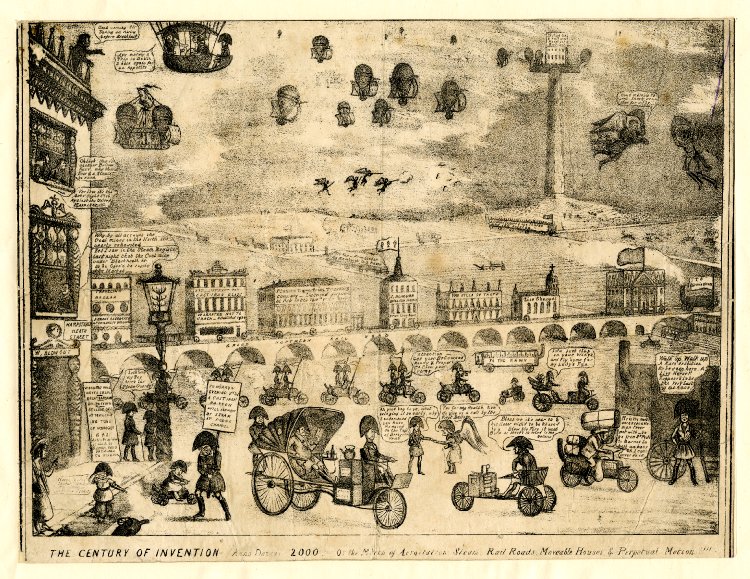
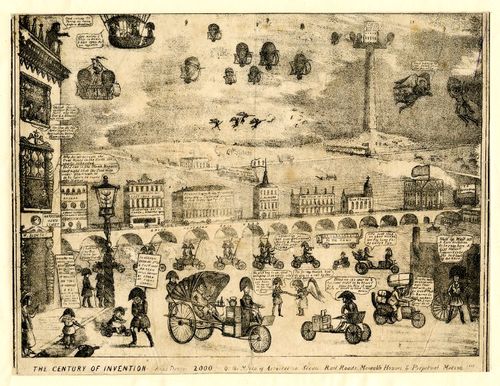
    A great example of this high removal is found in “The century of invention Anno Domini 2000 or the march of aerostation, steam, rail roads, movable houses & perpetual motion,” a terrific lithograph, made ca. 1834, the handiwork and imagination of Charles Jameson Grant, a satirist and observer of high order. He tried looking into the future 165 years hence, and in some practicable ways he got a lot of it right–the imagery wasn’t there, but the iconic sense of what may come to be was.
    Mensa Steam-powered pastor[British Museum, here.]


    We see small and large individual steam-powered four-wheeled vehicles, as well as plenty of balloons (in the spirit of aviation, at this point in its fourth decade and entering a great heyday) passing each other in every which way, off on adventures, or work, or in a race (as with the “out of Sight Club”). There are also numerous people flapping around in the sky (“winging it so early”) with their (something)-powered wings, some of whom are ironically hunting birds.

    The main sensation here is speed, though I would not say it was democratic–the means to go to Dublin in your balloon “for an appetite” and return later in the day would have been fantastic to the 1834 reader trying to imagine doing such a thing on such a whim, with a newspaper in your lap, but certainly it would be available to the leisurely class.

    There was also an idea for balloonic communication, as one man in a balloon shouts to another to “give me a call by the first balloon,” meaning perhaps a communication device, or a balloon-delivered letter.  

    The dialog certainly portrays an attitude of unremarkable observation, conveying how commonplace flight and mobile towns and steam cars would be in the year 2000. That’s where one of Grant’s the great insights comes into play–at lower left there is a person excitedly remarking about a race, and particularly on the great rarity of the exhibition of a live horse. That Grant would make this an issue is interesting, as it would certainly rub the 1830s consciousness the opposite way of what the brain expected to see in the street, and that was horses. Horses powered almost all transportation at this time—save for the invention of the railroad, some of which were horse-powered—and to imagine a world in which the horse would be gone would’ve been, well, unimaginable.

    Also, too, the great and extensive coal mines fueling the Industrial Revolution going dry, the coal consumed.
    MEnsa cast iron preacher[From Christie’s auction site, here.]

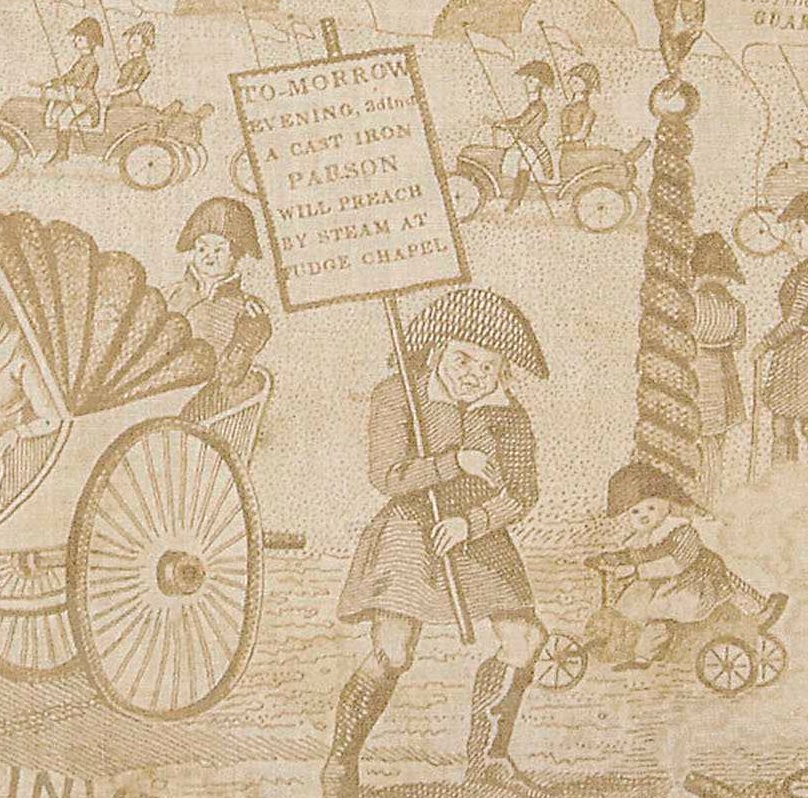
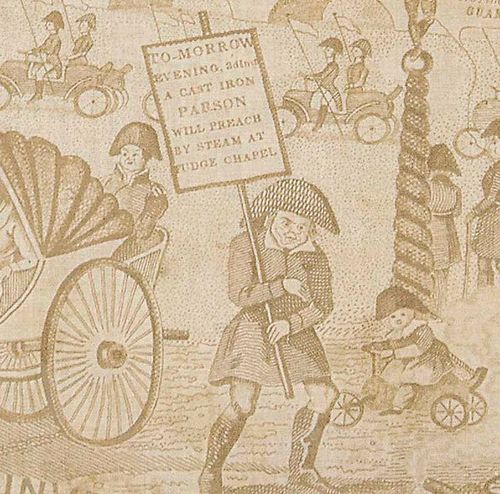
    At the bottom of the print is the prize, a very unusual placard concerning robotics: “a cast iron Parson will preach by steam at Fudge Church.” This is doubly intriguing because it not only invokes a steam-powered person—still fairly rare in the literature in the first third of the 19th century—but also a thinking one, a parson, a mechanical object trusted with the preaching and interpretation of a basic human belief system. This seems a bit on the primitive side in its display, but the intellectual imagery is pretty powerful stuff. I assume that the power of this would’ve been less so at the time of publication, guessing that Grant was making more of a not-so-subtle satire on the steam-driven puffery of some preachers with the creativity of kettles, and that in the future this would be magnified to the point of steam and smoke. But still the idea of placing the deeply emotional stuff of belief systems in the control of a machine is extraordinary for the time.
    Mensa article Heath March Intellect Robot (1)

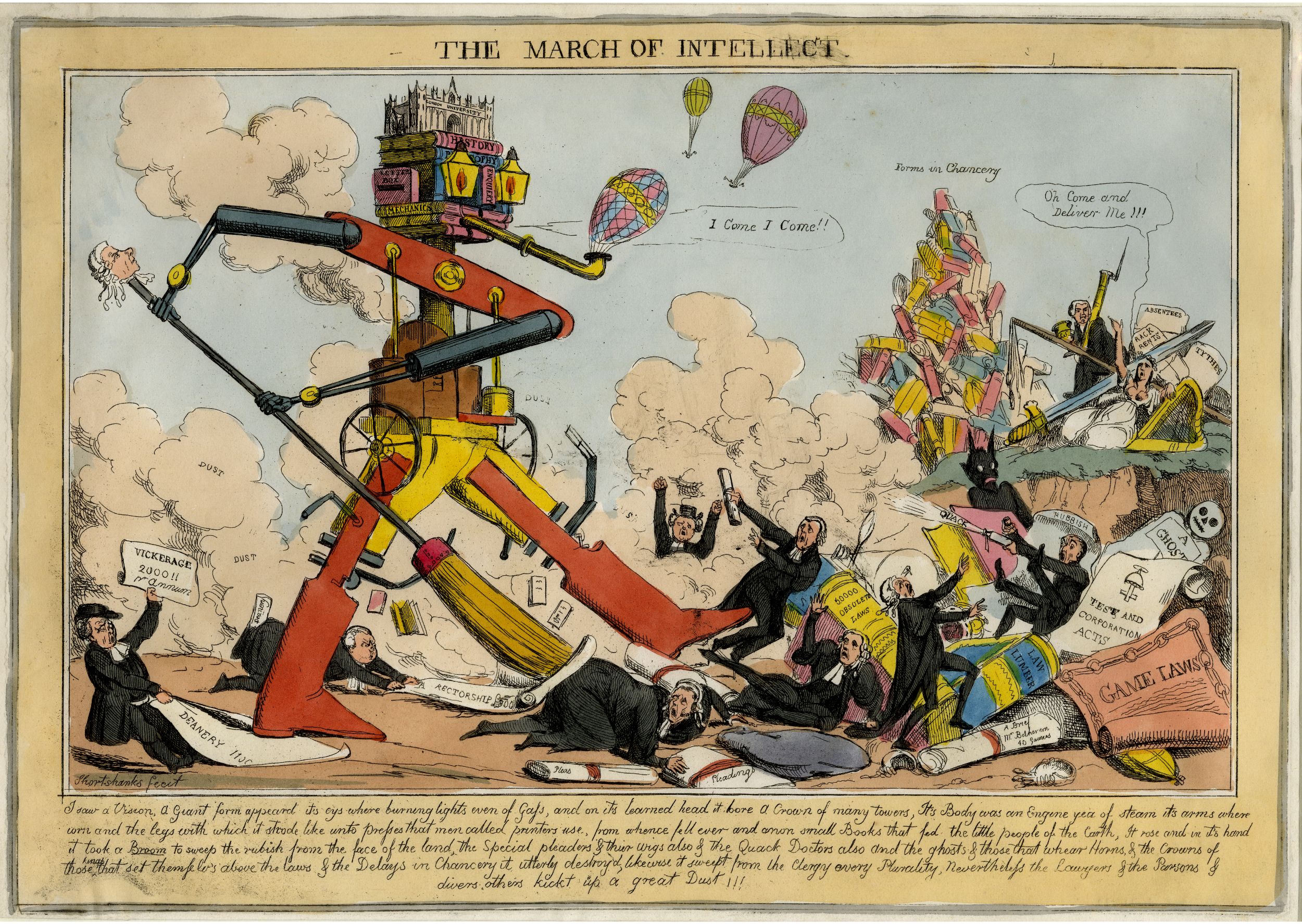
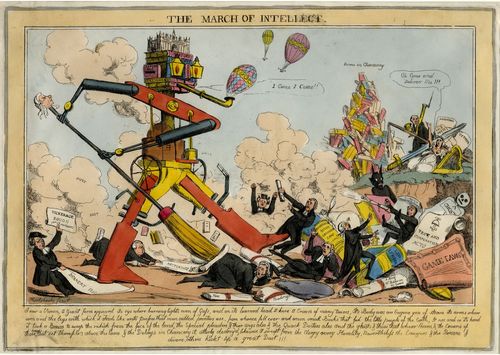
    A few years earlier William Heath’s March of the Intellect series (1825-1829) displayed another robotic entity witha book-driven intellect in its “crown of many towers” (London University) that swept up the great “rubbish” and “dust” of society. The robot was thinking in its way, distilling the promise of data and intelligence in its book-laden head, firing its set of gas-light eyes, iron arms, and legs made of printer’s tools, sweeping away useless and insulting lawyers and jurists and their legal wigs and obsolete and repetitive rules, medical quacks, and the dust of other official abuses, “sweeping rubbish from the land.” It was making decisions and acting on them, trumping the humans in its path.

    It is a remarkable leap, the consequences of which are difficult to put into perspective. I can think of an example from the novel Flatland, by Edwin Abbott, when its two dimensional characters first encounter a three dimensional figure—superbly incomprehensible at first, understanding following with some difficulty.

    Visualizing the assumption of a created intelligence developed enough to supplant or supervise human thought and activity was probably beyond the 19th century sensibility—just as its technical aspects are to us now.
  • Blood Poison and its Non-Existent Mystery Cure, 1903

    JF Ptak Science Books   Quick Post

    See also the related post from 2012 “A Bloated Alphabet of Fat Cures: Strychnine Pills, Vibrators and Hope”, here.

    Blood poison352

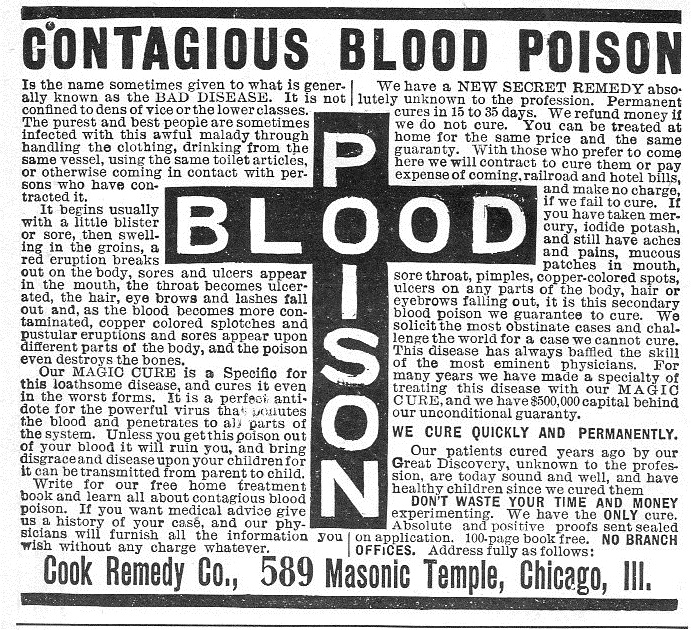
    Pushing its way past other adds in the back of the May 1903 issue of The Confederate Veteran is this contagiously interesting advertisement for a very loud quack cure for “blood poisoning”.  It was manufactured by the Cook Remedy Company of Chicago, Illinois, and offered their cure (“unknown to the profession”) to sufferers of “the Bad Disease”, which they say can affect anyone, not just confined to “dens of vice or the lower classes”.  “Our magic cure” they say, can help all sufferers, curing “quickly and permanently”–otherwise the bad stuff happens, not the least of which was bringing “disease to you and disgrace upon your children”, which is tough hardball stuff, especially coming from con-artist quick-thieves who would say anything and offer any hope to desperate people for a buck, trading on frailty, ill-health, and fear.  

    By Cook Remedy was identified as a quack organization by the federal government, having a not-so-pretty appearance in the 1912 Hearings on the Pure Food and Drug Act.  

    I suppose that the cross in “Blood Poison” was designed to resemble a cemetery/graveyard marker…

    ·Posted by :

    ·in:

    —

  • A Few Polymathic Interesting Bits by Jevons

    JF Ptak Science Books  Post 2337

    Can We See More or Less than We Used To Be Able To See?

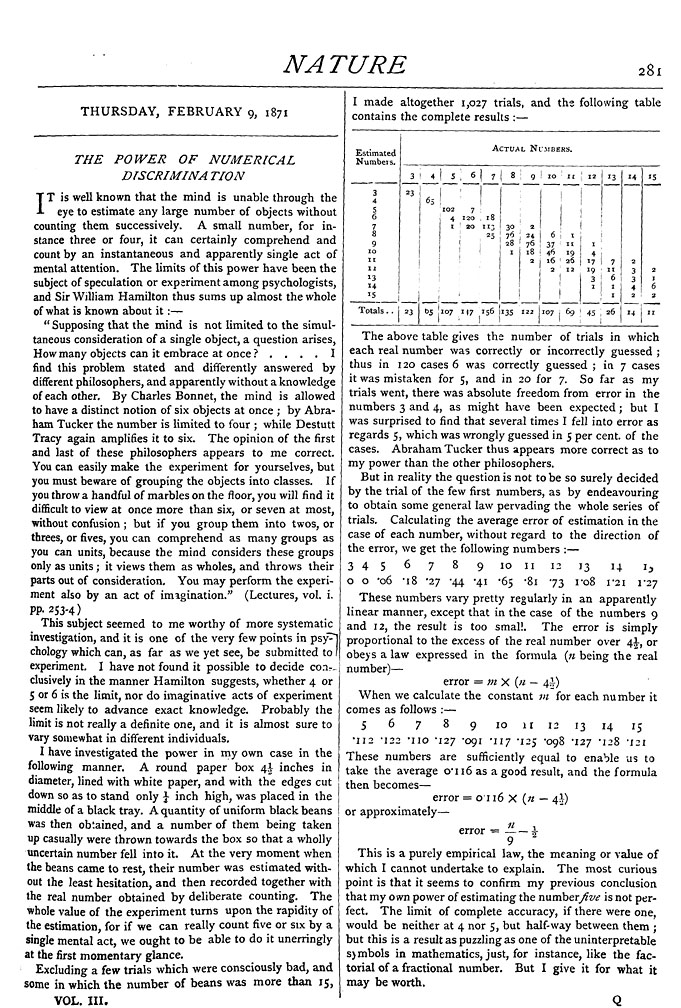
    An early study of attention and perception (or “How Many Items Can it Embrace at Once?”) popped out at me while muscling my way through another year of Nature magazine for 1871.  The article was by the polymatic W. Stanley Jevons (“The Power of Numerical Discrimination,” in Nature volume III, 1871)  who contributes an interesting and very early experimental bit on the success of the brain to correctly formulate an accurate memory when in a flash shown a number of items. (That is to say, when shown a certain group of X-number of items instantaneously and then removed, how often will the mind be able to remember the correct number upon recall–and without committing them to memory per se or counting them?) In this fascinating study Jevons records not only right/wrong answers but how “close” the remembered fit is to the original number, and in effect is a pioneering scientific effort towards understanding our abilities and limits in information processing. And as it turns out the ability to precisely recognize and remember groups of objects with success and without counting stops at about four items for the vast number of people texted. (It is another display of a famous four, including the four faces of Brahma, directions, Gospels, minute mile, playing card suits, seasons, corners of a square, virtues, color problem and of course four- letter words, to name a few.)

    Jevons numerical 1


    ·Posted by :

    ·in: