A Daily History of Holes, Dots, Lines, Science, History, Math, Physics, Art, the Unintentional Absurd, Architecture, Maps, Data Visualization, Blank and Missing Things, and so on. |1.6 million words, 7500 images, 4.9 million hits| Press & appearances in The Times, Le Figaro, Mensa, The Economist, The Guardian, Discovery News, Slate, Le Monde, Sci American Blogs, Le Pont, and many other places… 5000+ total posts since 2008.

Category: Anticipation, History of

  • The Google Car, 1916

    JF Ptak Science Books  Quick Post

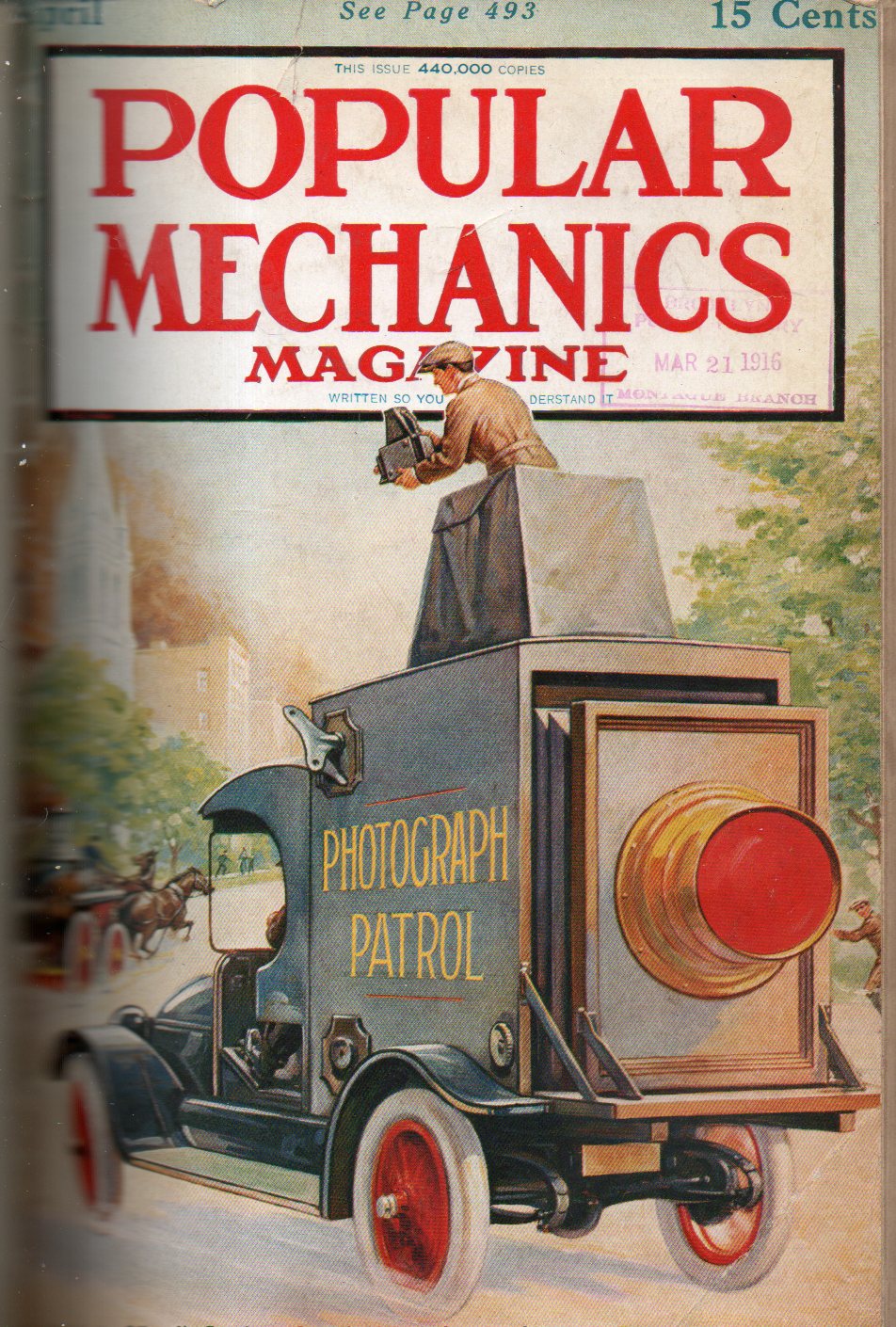
    No, this isn’t the equivalent of the Google  Street Maps photo car, but it does look a little like its great grandfather. It is simply a stunt truck, a rolling photo lab decked out to look like a camera. It appeared in Popular Mechanics for April, 1916.   

    Google car772

    ·Posted by :

    ·in:


  • Early Flight Powered by Wind, Fishing Line, and Boys (1897)

    JF Ptak Science Books     Post 2406

    Pilcer679

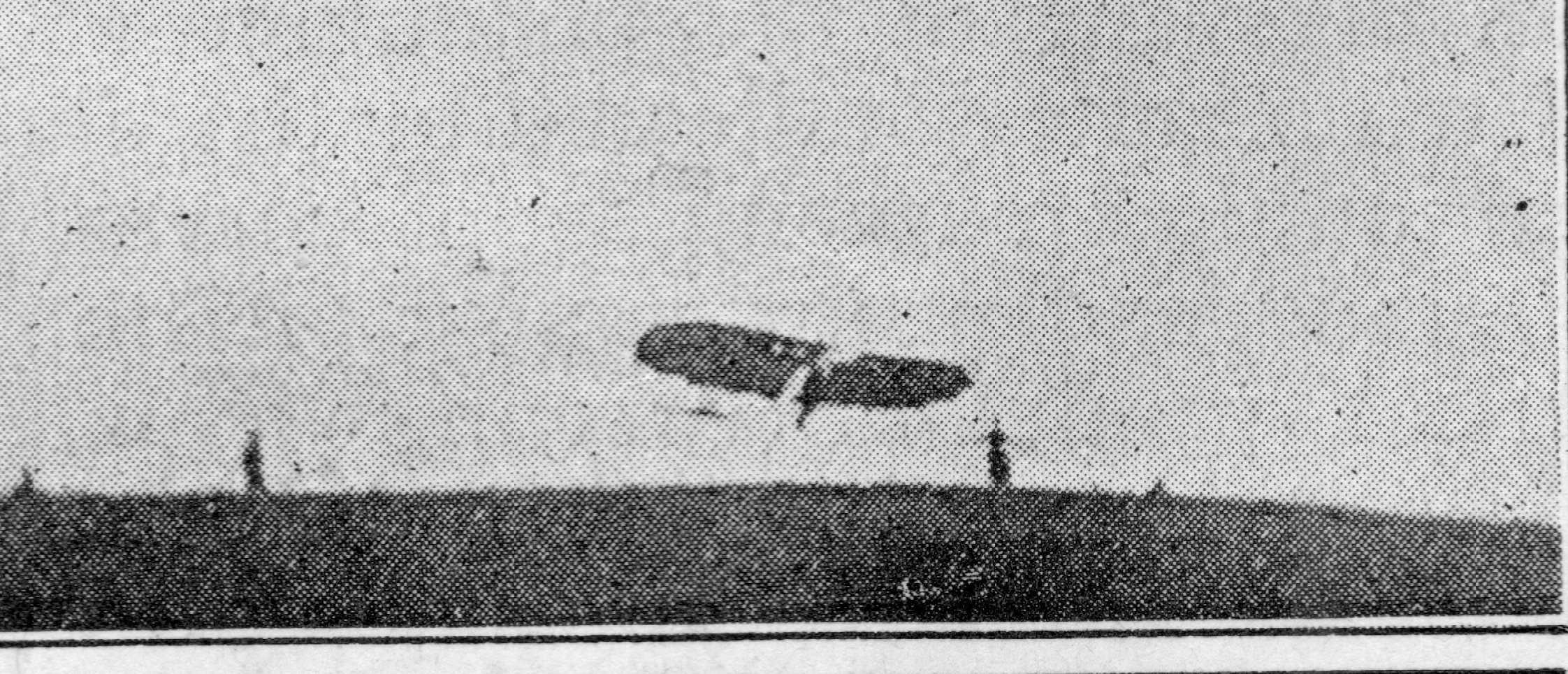
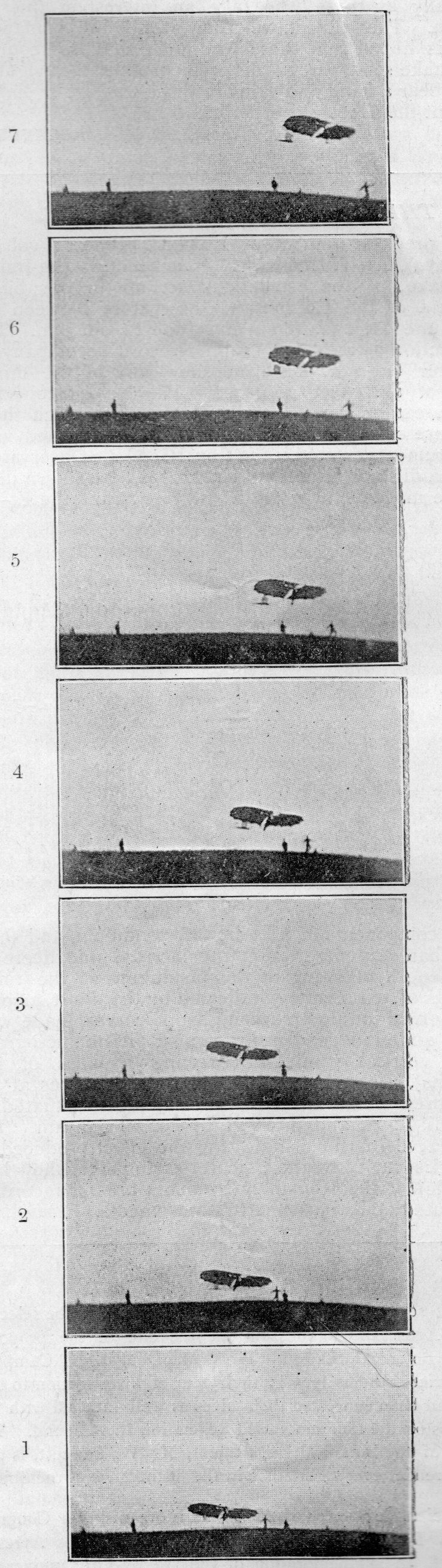
    Percy Pilcher was a true aviation pioneer who met his end very early, during an event that probably shouldn’t have happened, killed by in 30′-fall in 1899.  He was creative, and figured out a way to address the knotty problem of lift vs. wing dimensions vs. weight, coming to a tri-plane design in 1898, but was killed before he could fly it in public. His death comes about two years after this appearance in Nature magazine, which tells a quietly dramatic and essentially sotto voce story about attempted soaring flight. It seems so extraordinary to me because–aside from needing a fit of genius to try to figure out the physics of flight, there was a lot that could be done with canvas, pipes, fishing line, and boy-power. When I read this account I could literally feel that soft breeze that he looked for on my teeth–few pieces of major histories of technology get this close to the “common person”.  

    Pilcer678


    Someone made this nice, short video from the seven stills, perhaps making this one of the earliest “movies” of an human in flight:


    “At the time of the flight here illustrated the wind was so light and variable in direction that an ascent from even the elevated position taken up was almost impossible. Means however were at hand by which one end of a thin fishing line 600 yards long could be attached to the machine while the other end passed through two blocks placed close together on the ground at a distance from the aero plane of about 550 yards. These blocks were so arranged that a movement of the aerial machine in the horizontal direction corresponded to a fifth of the movement of the boys pulling the line.”

    “The start was made at a given signal the line being pulled by three boys and Mr Pilcher gradually left the ground and soared gracefully into the air attaining a maximum height of about 70 feet… A safe and graceful landing was made at a distance of 250 yards from the starting point. The photographs illustrate that part of the flight previous to the attainment of the greatest height…if the machine had been fitted with a small engine or motor to give (this) amount of thrust by means of a screw or otherwise perhaps an equal or further distance would have been covered.”

    “Mr Pilcher now proposes to employ as soon as possible a small and light engine indicating about four horsepower this being considerably more than sufficient for flights of moderate length. It is however thought advisable to have rather too much than too little power to commence with as a factor of safety. With this improvement it is hoped that further distances will be covered and a nearer approximation to a flying machine will be attained.”


  • Man as Robot and Robot as Man

    JF Ptak Science Books  

    I’ve written earlier in this blog about the advent of robots and human machines, and I’d like to add these two images to that thread.    Both are male, which is not horribly surprising since the earliest creation of a female robot belongs to the fertile Fritz Lang, who used his creation in his extraordinary movie Metropolis in 1927.  (Male robot-like creations go back fairly deeply into the 19th century; so perhaps the creation of female robots was verbotten because of the possibilities for unacceptable sexual fantasies in the high- and post-Victorian world, struggling under the weight of many and multiply-applied public inhibitions. Perhaps it was because of the possibility of sexual relations with an inanimate object that was the cause for uni-gender robots, or perhaps it was a fear of a powerful, intelligent, unstoppable, superior creation that was also “womanly”.  I don’t know.)
    Robot human machine817

    [And by the way “ca’ canny”–which I’ve never bumped into before–is evidently a practice of deliberately slowing down work.]

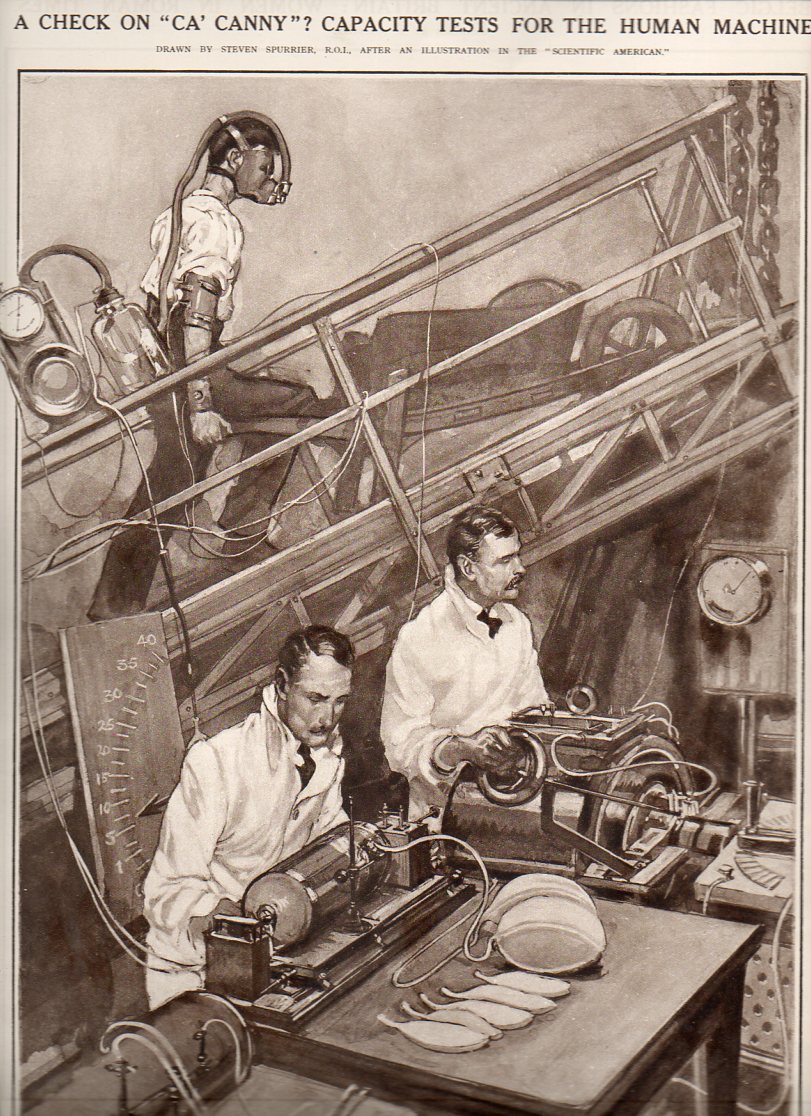
    The first is an image of the “human machine”, a cog-like adaptation of human workers in a Frederick Taylor-like Scientific Management study.  Though many people had written and worked around Taylor’s 1911 semi-revolutionary book (and not necessarily a good revolution, but one nevertheless), I’m not certain that I’ve seen the worker trussed up so before this, encumbered by so many technical testing elements as to make him look like a cyborg (though that term would still be a while coming into the vocabulary.  

    This image is actually testing a person’s energy expenditure while pushing a wheelbarrow on an incline, and utilizes the newly-created equipment of the French physiologist Langlois, which in 1921  may well have measured for the first time  the real-time changes in the rhythm of the heart and blood pressure, changes in body temperature and lung capacity of humans in an activity.  I have no doubt that the results would have been very interesting to cardiologists, and probably didn’t mean a thing to industrialists like Henry Ford, who would’ve plowed ahead with their demands on their workers regardless of what tests said, schedules being schedules and all. 

    Robot steam816 

    (I’m no tsure where this experiment fits in, historically speaking, even within the context of biological advances for that very year.  Frederick Banting was able to do some pretty nasty stuff to dogs in a basement lab somewhere at the University of Toronto and come up with a successful treatment for diabetes mellitus–insulin, which would save the lives of millions and earn Banting a Nobel two years later.  In the quasi/fake biological arenas came two biggish events: Jung’s creation of the concepts of introvert and extrovert, and Hermann Rorschach’s one-way conversational device for detecting psycho-pathological conditions (in people).  I suspect that the Langlois data would fit in there somewhere along the rough edge of Jung and Rorschack, if only because the data was real.          

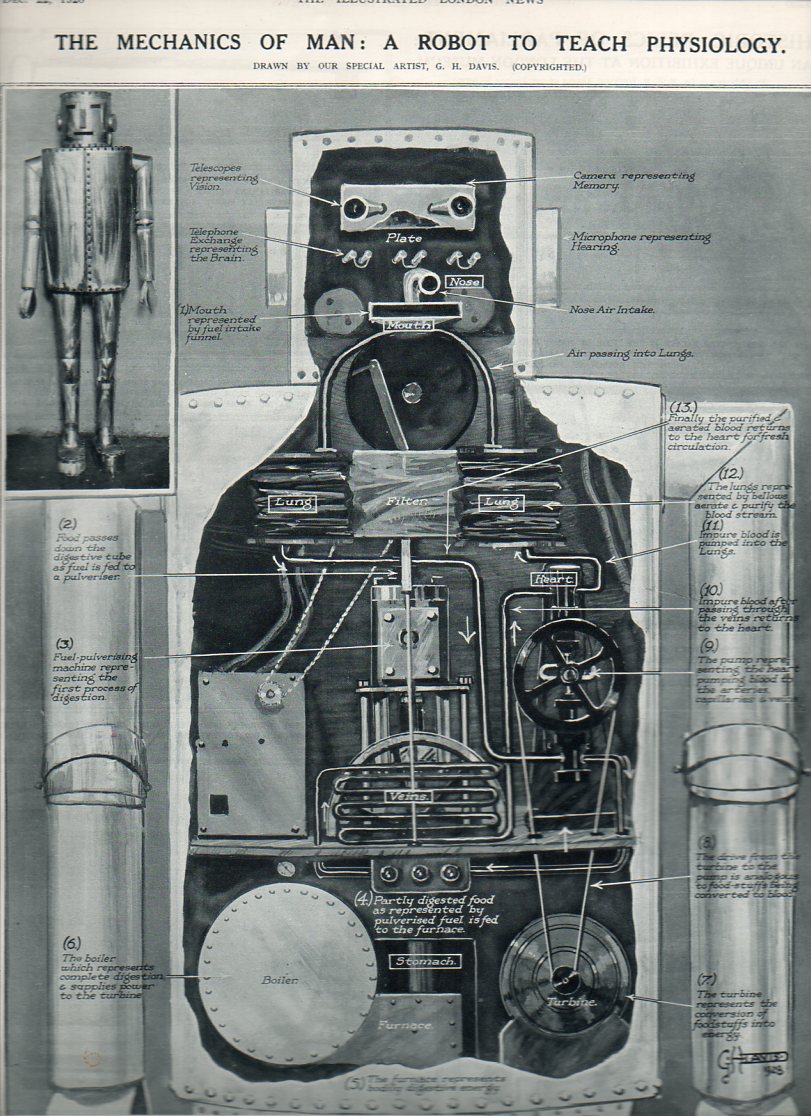
    The second image is in a way a reverse sequence of the preceding–an out-and-out robot that was being used to teach human physiology.  In this case, the robot was a steam engine, constructed for the Schoolboys’ Exhibition at the New Horticultural Hall for 1928, perhaps under the  influence of Karel Capek’s newly published drama R.U.R., which coined the term “robot”. The biological functions of humans were reinterpreted along a more user-friendly vocabulary of the steam engine, using pumps, boilers, hinges, belts, pulleys, filters, compressors and a furnace to explain the functions of respiration and circulation.   It was an interesting approach to show these functions on their most basic level–and in less than 75 years, many of these mechanically represented organs were actually replaceable by real mechanical units performing the same task as the biological (as in the heart), while others could be replaced (via transplant). 

    Man as machine and machine as man.


  • The Discovery of the Future of Roads (1918)

    JF Ptak Science Books  Quick Post

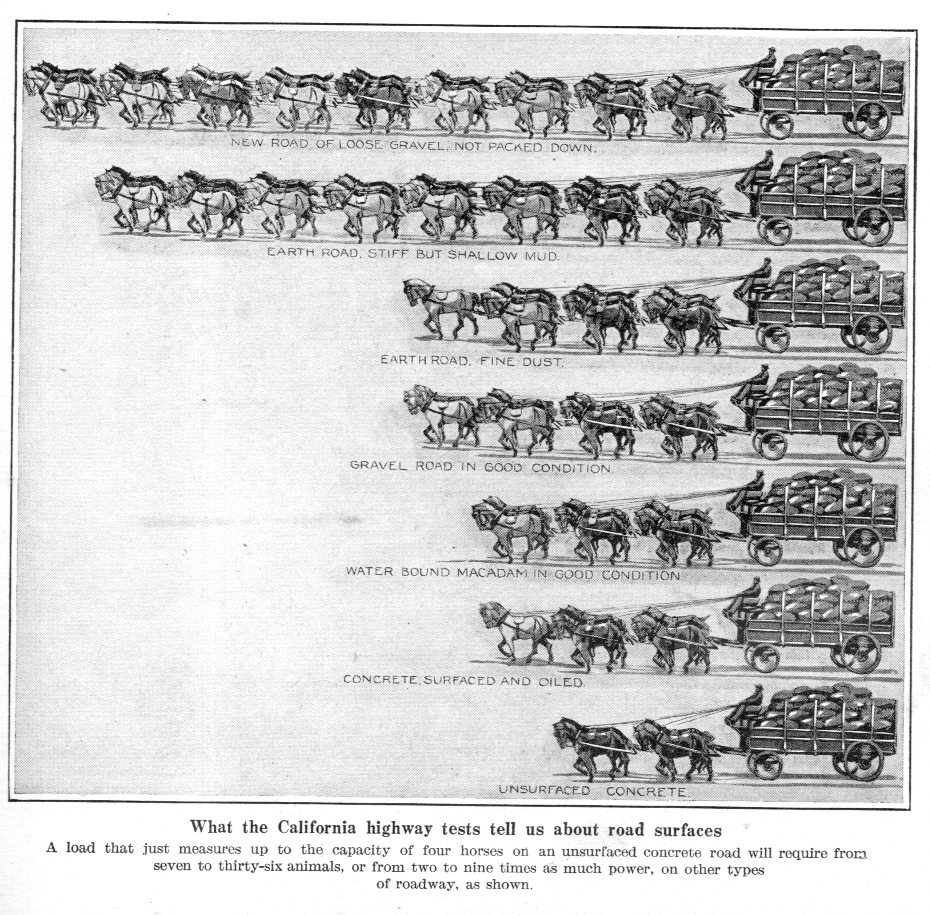
    “Only within very recent years has the paramount influence of roads upon the nation’s life been adequately realized”, so starts this article in the Scientific American for January 5, 1918. No doubt–between 1914 and 1918, the motor vehicle registration doubled and then nearly doubled again (1.7 million to 6.1 million over five years). And since it is far more relatively easy to make cars than  the roads they drove on, it is safe to assume that with this enormous increase in road traffic that it made planners and engineers of various shapes and sizes really think about the issue of roads in the future, as they could well see that car production was exploding and that car prices were making the auto affordable to just about everyone.    

    Roads571These artistic displays of quantitative data really do convey a message to a general audience–that aside from the engineering that went into them.  It is also useful to the historian or reader in history, or anyone interested in how people got from one place to another 100 years ago, and on what sort of surface they were making their way on…and what the surface of that road meant to the traveler.  I do not recall Mr. Holmes making any statements regarding travel time and the conditions of the roads on which the travel was made, but I have no doubt that he would have considered them using data much like this.  


  • War Bonds and Doing the Right Thing: Great Britain, 1943

    JF Ptak Science Books

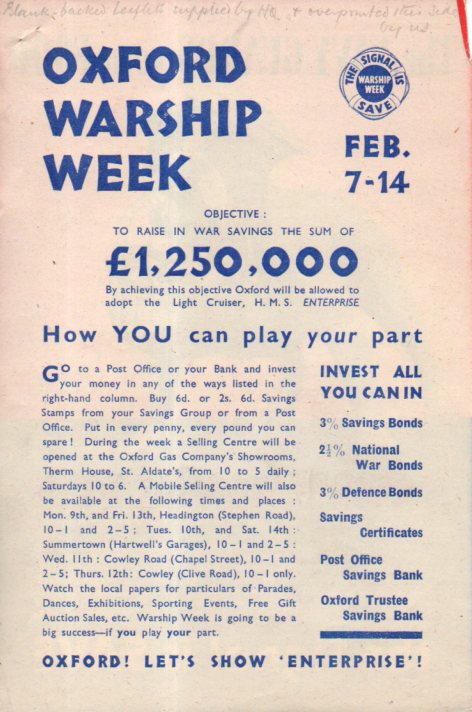
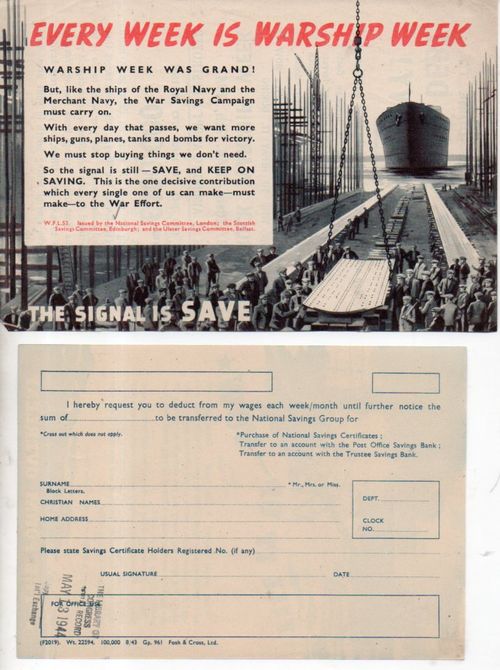
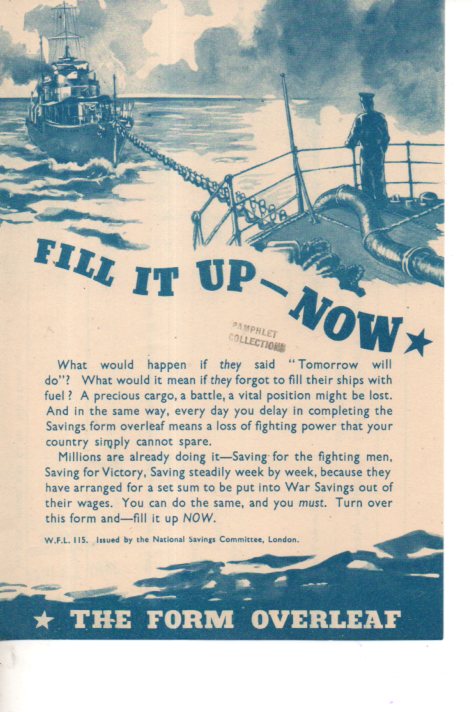
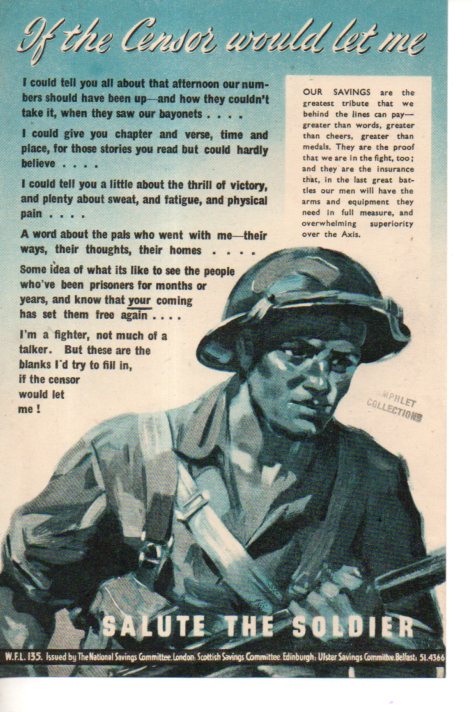
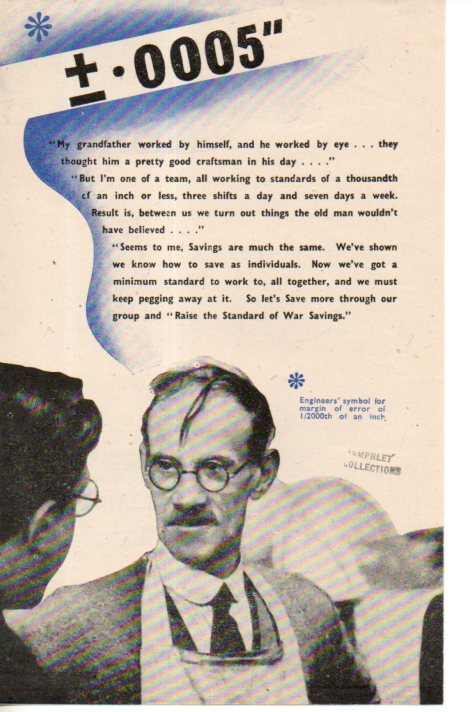
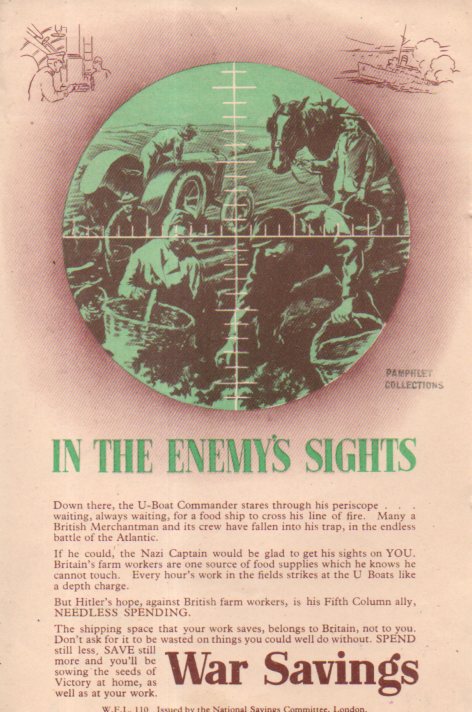
    I’ve got a small collection of bond promotionals published by the British government during WWII, mostly though for 1942/4, and they have a great feel and sense of spirit, and right, and duty. All extolled the necessary and great need for money to fight the war.  The appeals were sensible, and direct, and asked people to loan the government money.

    If you scroll down you can see a blank form for docking your paycheck to have some of it go to national defense.  

    Bonds handouts635

    Bonds handouts620

    Bonds handouts621

    Bonds handouts634


    Bonds handouts622


    Bonds handouts623


    Bonds handouts624


    Bonds handouts625

    Bonds handouts626

    Bonds handouts627

    Bonds handouts628

    Bonds handouts629

    Bonds handouts630

    Bonds handouts631

    Bonds handouts632

    Bonds handouts633


    ·Posted by :

    ·in:


  • Bicycle Story Without Words, 1869

    JF Ptak Science Books   Quick Post

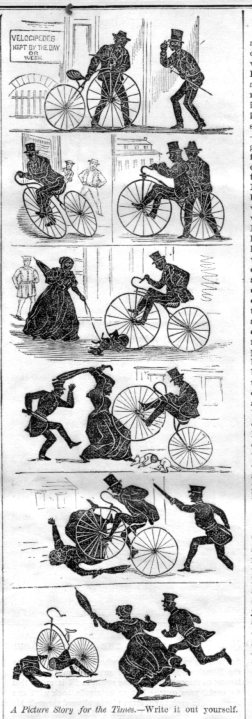
    I found this interesting story-without-words in a column in American Agriculturalist, April, 1869.    The velocipdes were fairly big, and fairly new-ish to be peddle-powered at the front wheel, and apparently not so welcome on urban streets.  (Within fifteen years the bike would take on a decidedly very modern look, easily recognizable as being a close family member to that Schwinn cruiser you owned in 1982.) I don’t have any insight about the editorial content of the segment…  

    Bicycle598


  • The Coming of Broadcast Television (1929)

    JF Ptak Science Books   Post 2388

    I found a news item in the April 6, 1929 issue of Nature that gives a real sense of the coming of the future, of the future-at-hand–and they seemed to have a sense of what was coming, though probably not as big as that future would be. In this case, it was the beginning of the passive visual assumption of the collective culture–the very quick and potentially immediate assimilation of pop culture, this by the invention of television and popular broadcasting.  

    Baird_tv_caption

    The unidentified author was reporting on the recent activities of the Baird Television Development Company, which the author was interested in, and although it was “not presently practicable ” it did “represent(s) a noteworthy scientific achievement”, which I am sure was the writer’s way of downplaying a very significant event.


  • Ars Morendi–the Book for the Dying and Dead

    JF Ptak Science Books    Post 2380

    Ars398

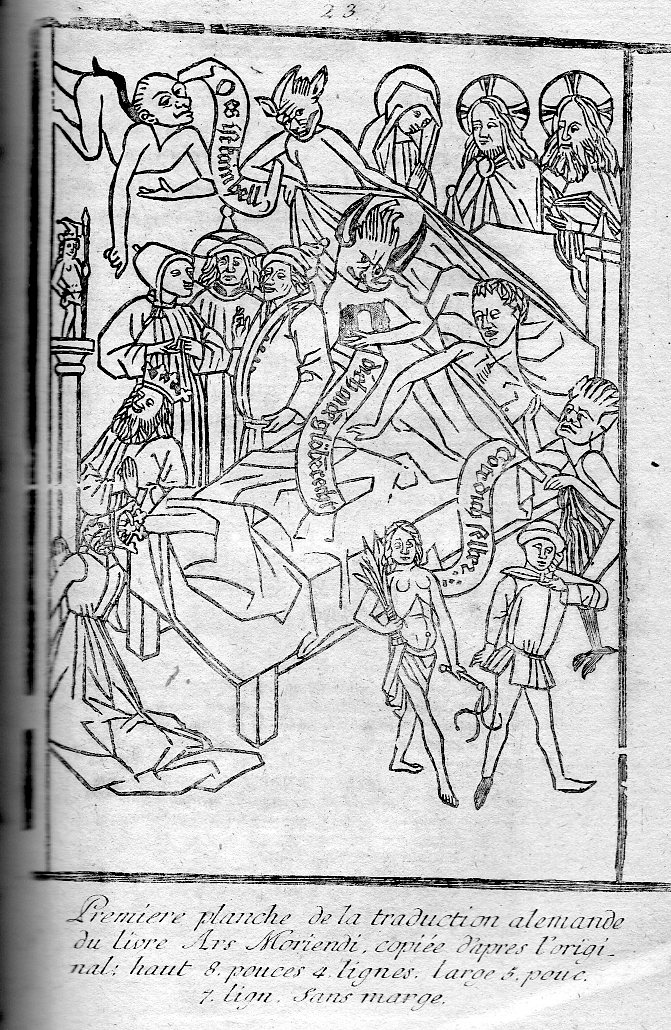
    [Woodcut, printed in 1771, from an ealier woodcut of the late 15th century;  6×4 inches. This version available from our Blog Bookstore.]

    The lare Medieval/early Renaissance Tractatus artis bene moriendi was a work book of the dead–rather, a book for those about to be dead, an instructional for the process of dying the good death along the (loose) order of the Tibetan Bardo Thodol and the Egyptian book of the dead.  The Ars was written in the early the 15th century (some sources say 1415) and began appearing in some of the earliest illustrated printed books by about 1460–it was a wildly popular/necessary book, going through some 100 editions by 15001. 

    The books basically readied the dying for death, for a holy death, a death filled with high possibilities of a rewarding afterlife, for dying in the good graces of Christ and the christian ideals.  The images were such that non-readers could understand them–and this is still pretty much the case.

    Many of the variants of this work include a dozen or more woodblock illustrations, an example of which is found above.  We see the soon-to-be-departed at the very last instant before death, surrounded by all manner of distractions and entertainments aimed at luring the person to an earthly- rather than holy-demise. Demons, conjurers, makers of greed, and devils surround his bed in temptation, all while the Virgin Mary, Christ and the creator look down upon the besieged from behind the top of the bed. 

    Death was not an uncommon visitor in Europe in the early/mid 15th century, and perhaps this book served some in the way it taught people how to die a noble and religious death, especially when clergy may not have been so available. 

    (The blog offers a version of this print, not nearly as old as the original, but with some sort of substantial age on it–it was printed in 1771 in Leipzig, and published in Heinecken’s Idee Generale d’une Collection Complette d’Estampes, and it is an attractive print suggestive of a greater age.

    Here’s another example, this time the dying man is beign attacked by agents of pride and greed.  The images are genuinely upsetting–scary even.

    Ars moredni pride
    Notes:

    1. English editions/variation of this work include The Waye of Dying Well and The Sicke Mannes Salve, and then in 1650 the Holy Living and Holy Dying. 


  • Searching for Extraterrestrial Intelligence, 1961

    JF Ptak Science Books  Post 2379

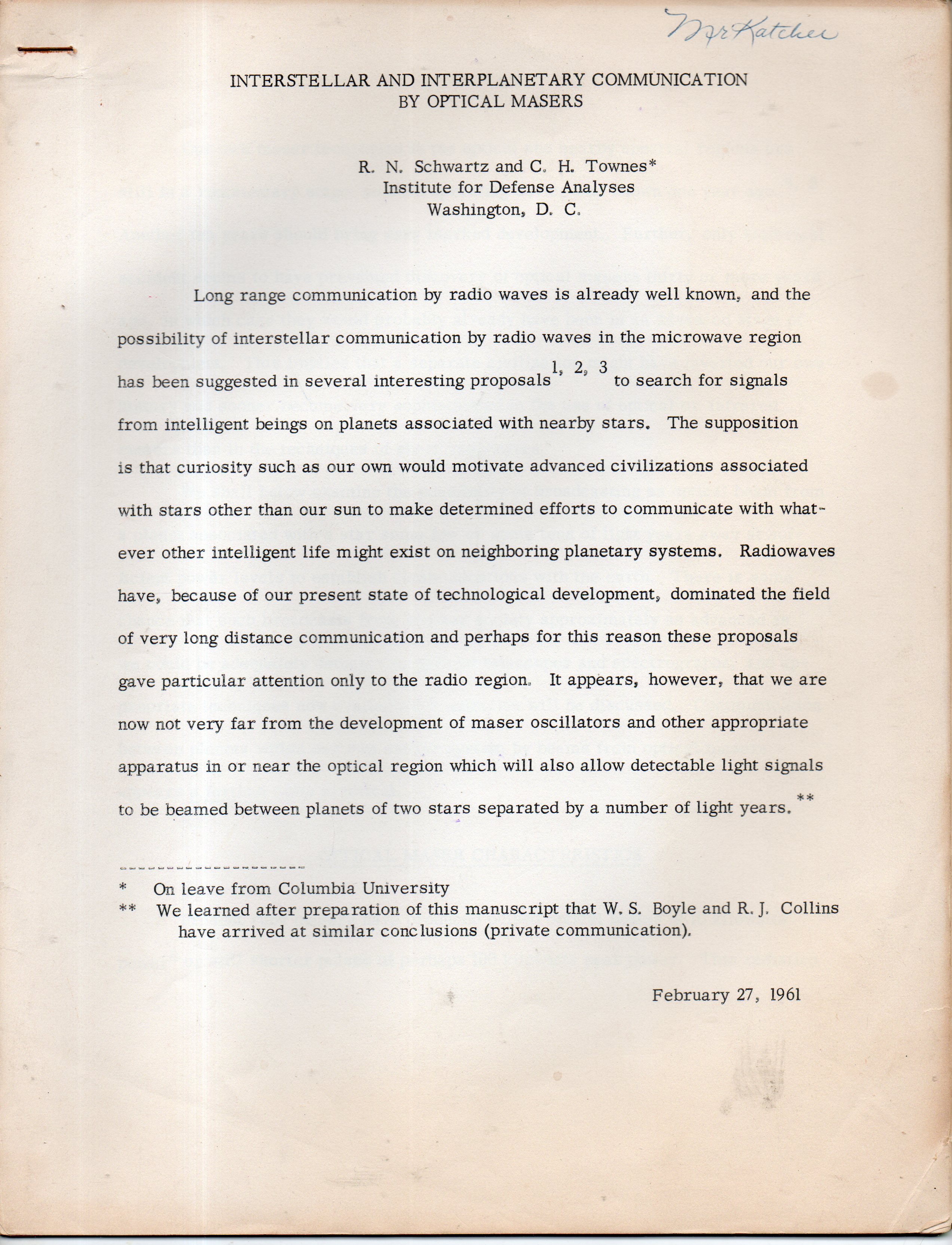
    I uncovered a somewhat found-again-lost-again paper in the collection here, an unusual small-distribution version of a great paper in the history of the search for extraterrestrial intelligence. The work is by N.R. Schwartz and Charles Townes,  “Interstellar and Interplanetary Communication by Optical Masers”, which appeared in the journal Nature for April 15, 1961 (volume 190, pp 205-208), and I have seen it referenced here and there as a started-it-all sort of paper as the first applied and elaborated scientific effort “to communicate with other intelligent life [which] might exist on neighboring planetary systems”. That is to say it is a more involved approach to detection than the two earlier and perhaps more-famous papers by G. Cocconi and P. Morrison, “Searching for interstellar communications” (a short paper published in Nature, volume 184, No. 4690, pp. 844-845, September 19,1959) and F. Drake’s “How can we detect radio transmissions from distant planetary systems?”, published in Sky and Telescope (volume 19, No. 3, pp. 140-143, January 1960).

    SETI586

    The present copy is an offset, stapled affair sent to the editor of Physics Today; it has the  annotation “Mr. Katcher” in a secretarial hand at top, that being David Katcher, the founding editor-in-chief. This is a pre-printed version, and is dated more than a month before the article’s publication, and is dated February 27, 1961. 

    Both Schwartz and Townes were at the Institute for Defense Analysis in DC at the time of publication, Townes being the Director of Research; later in 1961 Townes would become Provost and professor of physics at MIT. In addition to the Nobel Prize in physics, Townes  was awarded the Templeton Prize (in the understanding of religion and science).

    The full text as it appears in six pages in Nature appears here at Coseti; it is obviously a different format from the 14-page variety that I have here, and has a few minor changes, though for all intents and purposes the text is the same.  

    The Cocconi/Morrison paper is located in full text here at Coseti.

    Also just for the sake of it, the Drake equation (1961) for determining the number of extraterrestrial civilizations, here, again at Coseti.


  • Massiveopolis: Filling in the North Sea (1930)

    JF Ptak Science Books   Post 2378

    This is part of a series of Mega-Massive Invisible Engineering, the Filling-it-In Section. Other examples from this series not necessarily filling-stuff-up include:

    The title of this post is a bit of a tweeker–the project is not to fill in the entire the North Sea, just the southern North Sea.  This actually makes a pretty big difference bathymetrically, because the sea floor gets mighty deep up along the coast of Norway. Still, though, as impossibly ambitious projects go, this is still a massively unstable consideration, the entire North Sea or not.  
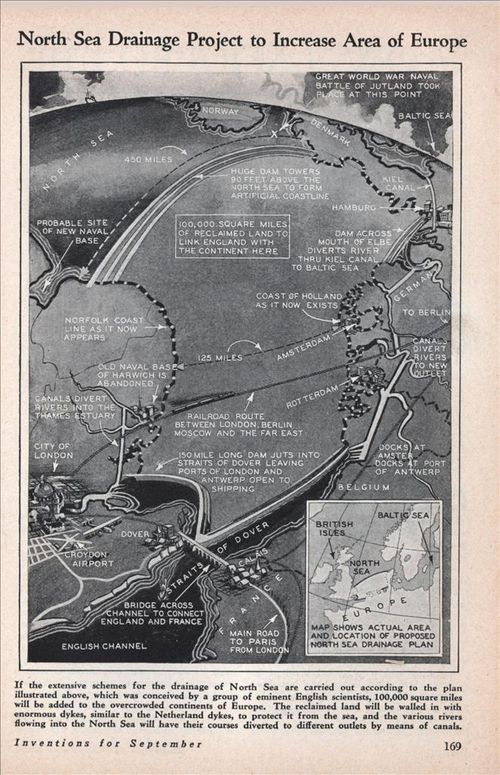
    North sea[I owe the fun I had thinking about this project to two great sites: Modern Mechanix and Imaginary Cities–Modern Mechanix for posting it to begin with and Imaginary Cities for tweeting it.  These are two great sites well worth subscribing to.]

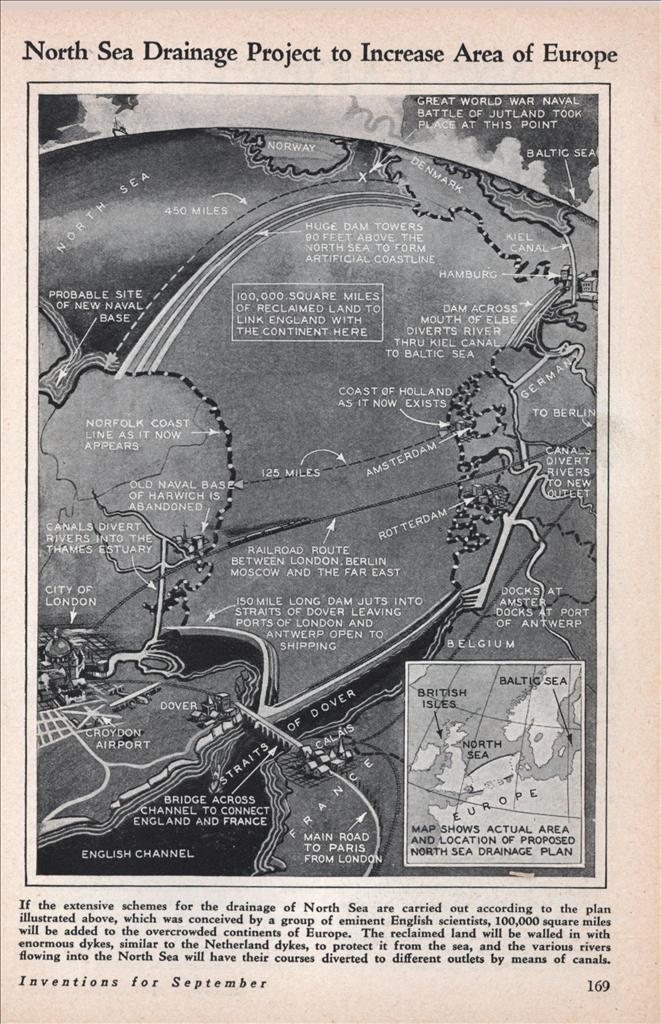
    A sort-of Atlantis was drowned some 8500 years ago, a large piece of land that connected what is today Great Britain and Europe. Rising water did away with this territory leaving behind the great island nation and much else. The plan referred to above in the title is the extraordinary thinking for “raising” that lost Atlantis-esque land, and was floated in the September 1930 of Modern Mechanics. 

    The author maintains some sort of possibility for recovering some 100,000 square miles of submerged land that would connect south-eastern England with France, Belgium, the Netherlands, and Denmark. It would be accomplished by erecting some 700+ miles of dykes and dams and then, somehow, emptying all of that surrounded and captured water into the sea that it once belonged to.  

    100,000 square surface miles is an area twice the size of England, three times the size of Lake Superior, nearly the size of the Caspian, and equal to the size of Colorado. 

    The English Channel and the straits of Dover would become a divided thoroughfare; the Thames would be part of a canal system that would extend along the old Norfolk coast to The Wash; a bay from the Straits would extend inland to Belgium, where it would be met by a canal system that would extend to the Baltic.  All of this would be held in place by a 150-mile long dam of unusual  shape. And just for good measure, bisecting these two would be a monster bridge from Dover to Calais. 

    This is of course extraordinary, but when we look north we see a breathtaking proposal for a  450-mile long, 90′-high dyke extending from the English coast to Denmark. The artwork claims that this is 90′ above the water for the rest of the North Sea, which means that the structure would have to be at least 110′-150′ high, plus the foundation. Luckily for the designer the southern North Sea is a relatively shallow water sea, 20-40′ deep, though there is a stretch of 100′ miles where the depth is considerably deeper.  I haven’t considered yet how wide this dyke would be, except that it would be, well, big.

    There is also a drawing for a London-Berlin and points east train. The  Elbe is dammed, and it looks as though the Netherlands is no longer the Lowlands, everything there being “filled in”, with the sea being moved some 200 miles to the west. 

    This is just a short spec piece that appeared in a popular science magazine 84 years ago, but there is no mention of what these changes might mean to the currents of the south North Sea, or Jutland coastal waters, or the Continental Coastal waters; or the changes it might dictate to salinity, or nutrients to the rest of the North Sea, to say nothing of the sea floor inhabitants and fish, and so on.  There would no doubt be some natural consequences to this (literal!) undertaking.  

    I suppose someone at some point would have to think about how all that new land would be divided, but I guess that would all take care of itself.  

    • Another related article from Modern Mechanix posting a Modern Mechanics May 1931 addresses the issue of water removal albeit at as much lesser scale, here.