A Daily History of Holes, Dots, Lines, Science, History, Math, Physics, Art, the Unintentional Absurd, Architecture, Maps, Data Visualization, Blank and Missing Things, and so on. |1.6 million words, 7500 images, 4.9 million hits| Press & appearances in The Times, Le Figaro, Mensa, The Economist, The Guardian, Discovery News, Slate, Le Monde, Sci American Blogs, Le Pont, and many other places… 5000+ total posts since 2008.

Category: Anticipation, History of

  • A Few Polymathic Interesting Bits by Jevons

    JF Ptak Science Books  Post 2337

    Can We See More or Less than We Used To Be Able To See?

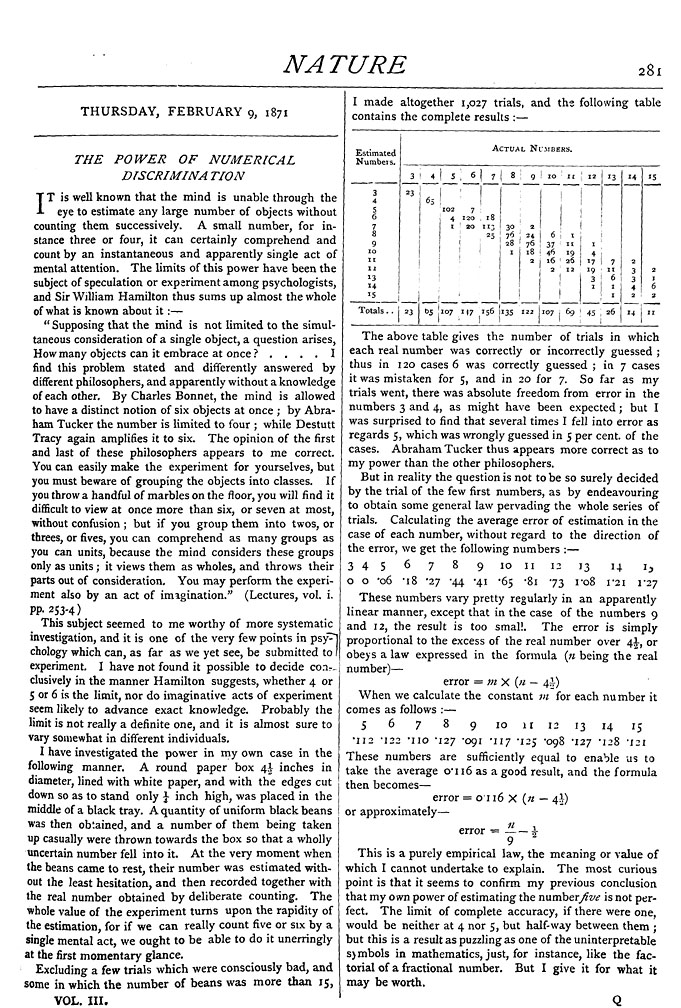
    An early study of attention and perception (or “How Many Items Can it Embrace at Once?”) popped out at me while muscling my way through another year of Nature magazine for 1871.  The article was by the polymatic W. Stanley Jevons (“The Power of Numerical Discrimination,” in Nature volume III, 1871)  who contributes an interesting and very early experimental bit on the success of the brain to correctly formulate an accurate memory when in a flash shown a number of items. (That is to say, when shown a certain group of X-number of items instantaneously and then removed, how often will the mind be able to remember the correct number upon recall–and without committing them to memory per se or counting them?) In this fascinating study Jevons records not only right/wrong answers but how “close” the remembered fit is to the original number, and in effect is a pioneering scientific effort towards understanding our abilities and limits in information processing. And as it turns out the ability to precisely recognize and remember groups of objects with success and without counting stops at about four items for the vast number of people texted. (It is another display of a famous four, including the four faces of Brahma, directions, Gospels, minute mile, playing card suits, seasons, corners of a square, virtues, color problem and of course four- letter words, to name a few.)

    Jevons numerical 1


    ·Posted by :

    ·in:


  • Reverse Memory, Synesthesia, and Modern Art (1880)

    JF Ptak Science Books   Post 2330

    I was very excited to bump into this article, ” reversals of Memory” in an 1880 issue of Nature magazine.1 Henslow2 (1835-1925) was an accomplished botanist, cleric, and Darwin correspondent who for years was a lecturer in botany at St. Bartholemew’s Hospital amongst much else in his long and accomplished career.  In the middle of it all he wrote this note in Nature which attracted my attention, though I think mostly for scifi aspects of the title, though the content is interesting, tending a little towards the brand new ideas of synesthesia. (Actually Francis Galton wrote about people who could “see” their process of mental arithmetic in their minds while calculating–this is seen as one of the earliest published efforts in synesthesia. I wrote about this article–which appeared in January of 1880 in the same publication–here about 3,000 posts ago.) It refers to a painter who painted J.M.W. Turner’s  The Fighting Temeraire (completed 1839) from memory, but who had very curiously reversed the positions of what sounded like all of the elements of the painting.  I’ve reproduced the article below and included the Turner:
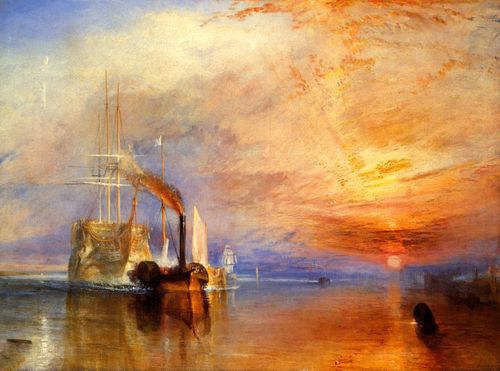
    Temerairee tner[Image source: Wikiart.org]

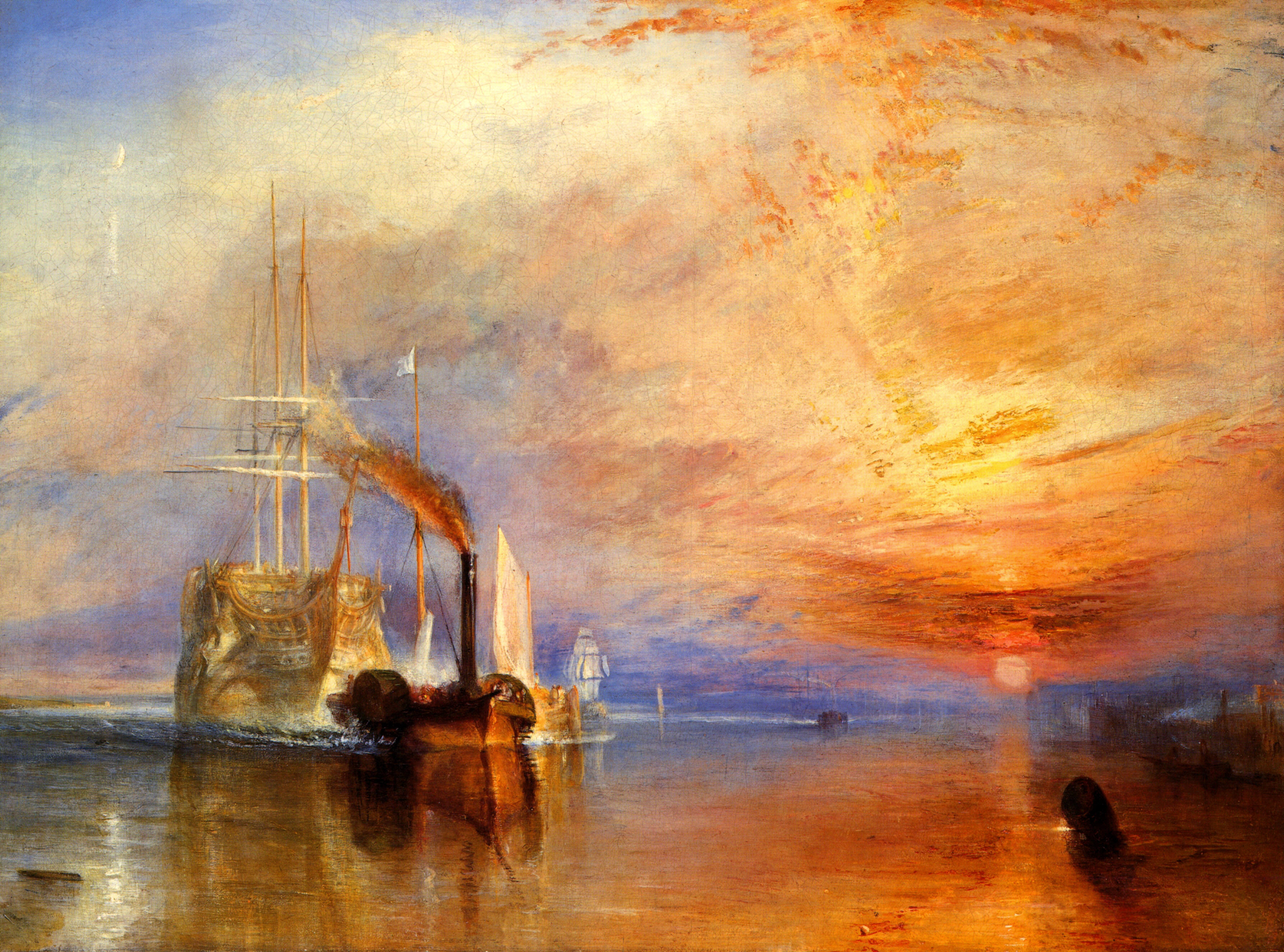
    This may well be more symbolic about the reversed memory here, with the Turner and all. Turner was at the forefront of the pre-Impressionists, or so it seems to me, what with so much of his work headed into symbolist and suggestive territory, impressionistically, as with the detail we see of the setting sun:

    Temeraire sunPerhaps it really can be seen as a reversal of memory…that is, the Impressionists come along soon afterwards and begin to paint things that are suggestive of hard elements, this after many centuries of human endeavor to perfect a true representation of the world around them.  Suddenly, by the half or 3/4s of the 19th century, there is a movement away from this, of losing and replacing detail with something that suggested it. And by the time Kandinsky roles around in 1911,  painting with no factual representational elements in them at all, it seems that the memory business of modern painting has been completely changed, or challenged.  So, the Turner may be very appropriate in this case after all…


    Reversals by Memory
    "I SHOULD much like to know if it be a common thing for people to reverse the positions of objects in the memory. An artist, on returning from the National Gallery, painted the Temeraire from memory. Taking his picture to compare it with Turner's, he found to his surprise that he had reversed the positions of the ship, tug, sun, &c. His daughter tells me that if she wants to refer to a passage in a book she as often looks for it on a left-hand page, while it is on a right-hand page, or vice versa. Another lady, on looking at a wood-engraving made from a sketch which she had seen some time previously, asked if the engraver had not reversed everything? These are the only cases known to me. Is the following universally true? — Let some one write with a blunt instrument the letter P on your forehead, or anywhere on the front half of the head from ear to ear, and the P must be written backwards for you to "see" it correctly. But if it be written anywhere at the back of the head, it must be written correctly both for you and the writer to read it. The change takes place abruptly in a line over each ear."

     –text of the Henslow from the Victorian Review, vol 5, “Outposts of the Most Advanced Physics”, p 667, by H. Mortimer Franklyn, editor. 

    Notes:

    1. HENSLOW, George. “Reversals of Memory” in Nature, July 15, 1880, short note on page 241. 

    2. [Henslow: “Clergyman, teacher, and botanist. BA, Cambridge (Christ’s College), 1858. Curate of Steyning, 1859–61; of St John’s Wood Chapel, 1868–70; of St James’s Marylebone, 1870–87. Headmaster at Hampton Lucy Grammar School, Warwick, 1861–4; at the Grammar School, Store Street, London, 1865–72. Lecturer in botany at St Bartholomew’s Hospital, 1866–80.”–Darwin Correspondence Project. Remembered as “the Cambridge mentor” of Charles Darwin

  • Der Phantastischer Pfeiffenmacher, ca. 1700

    JF Ptak Science Books  Quick Post

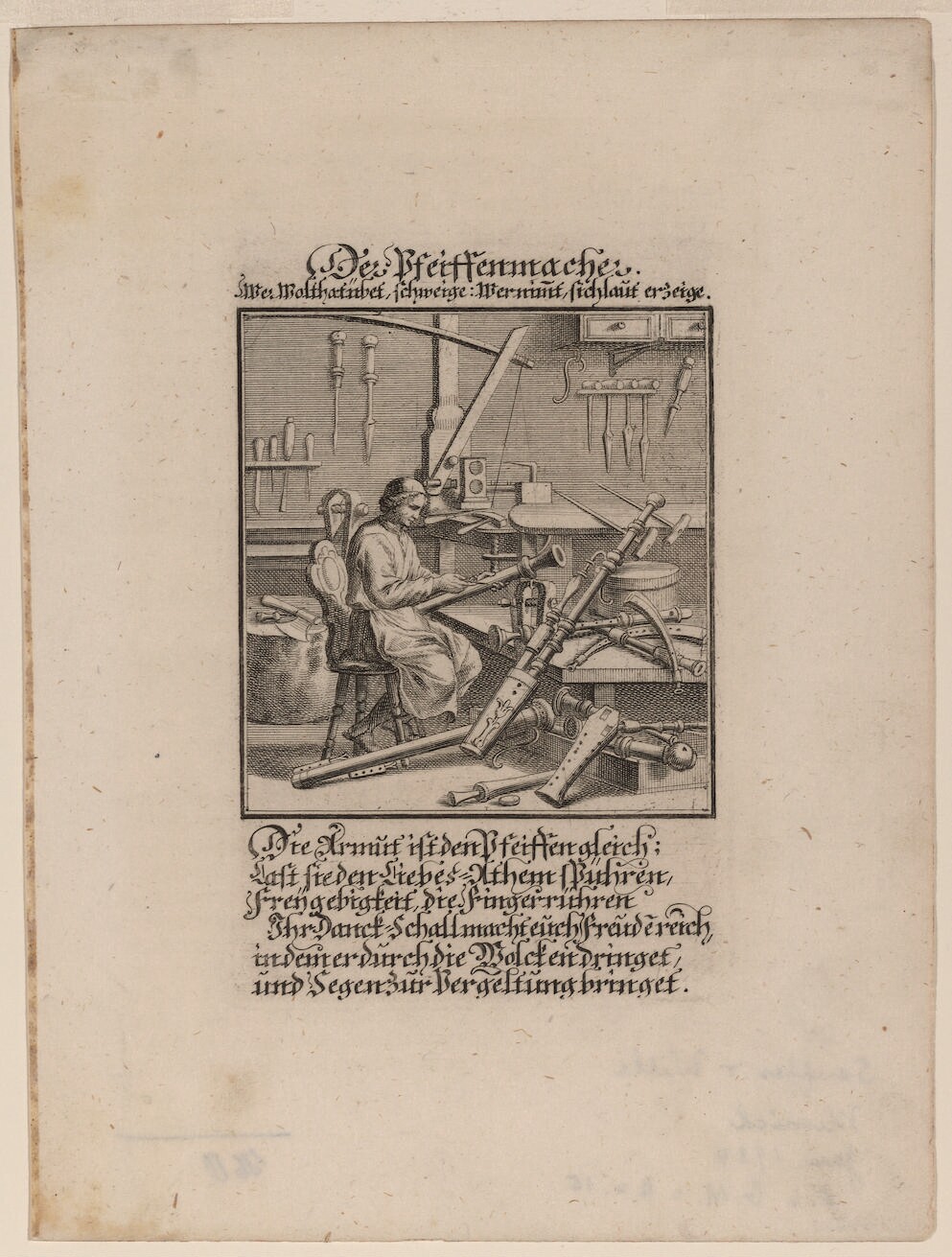
    I was very excited when I bumped into this notation for Christoph Weigel’s (1654-1725) “der Pfeiffenmacher” (the Wind Instrument Maker)! I hurriedly thought as I went to click on the link for the image what sort of instruments or tools were being made to make use of the wind in 1700? Better yet maybe–what was being built for wind protection? And then as quickly as it started the speculation stopped–it was for a wind instrument maker, a maker of wind instruments, musical instruments.  Of course it is a beautiful engraving (after a design by Caspar Luyken, 1672-1708) but it was just a little disappointing not to see a collection of scientific instruments or engineering/architectural bits rather than an assortment of musical ones. (This is from the Library of Congress and the notes in the description identifies the instruments so: Bassoon, Shawm, Curtal, Cornett, Recorder, Oboe.)  

    Weigel--wind instrument[Image source: Library of Congress, here]

    ·Posted by :

    ·in:


  • “The Nation” and the Scottsboro Case, Alabama, 1933

    JF Ptak Science Books   Post 2315

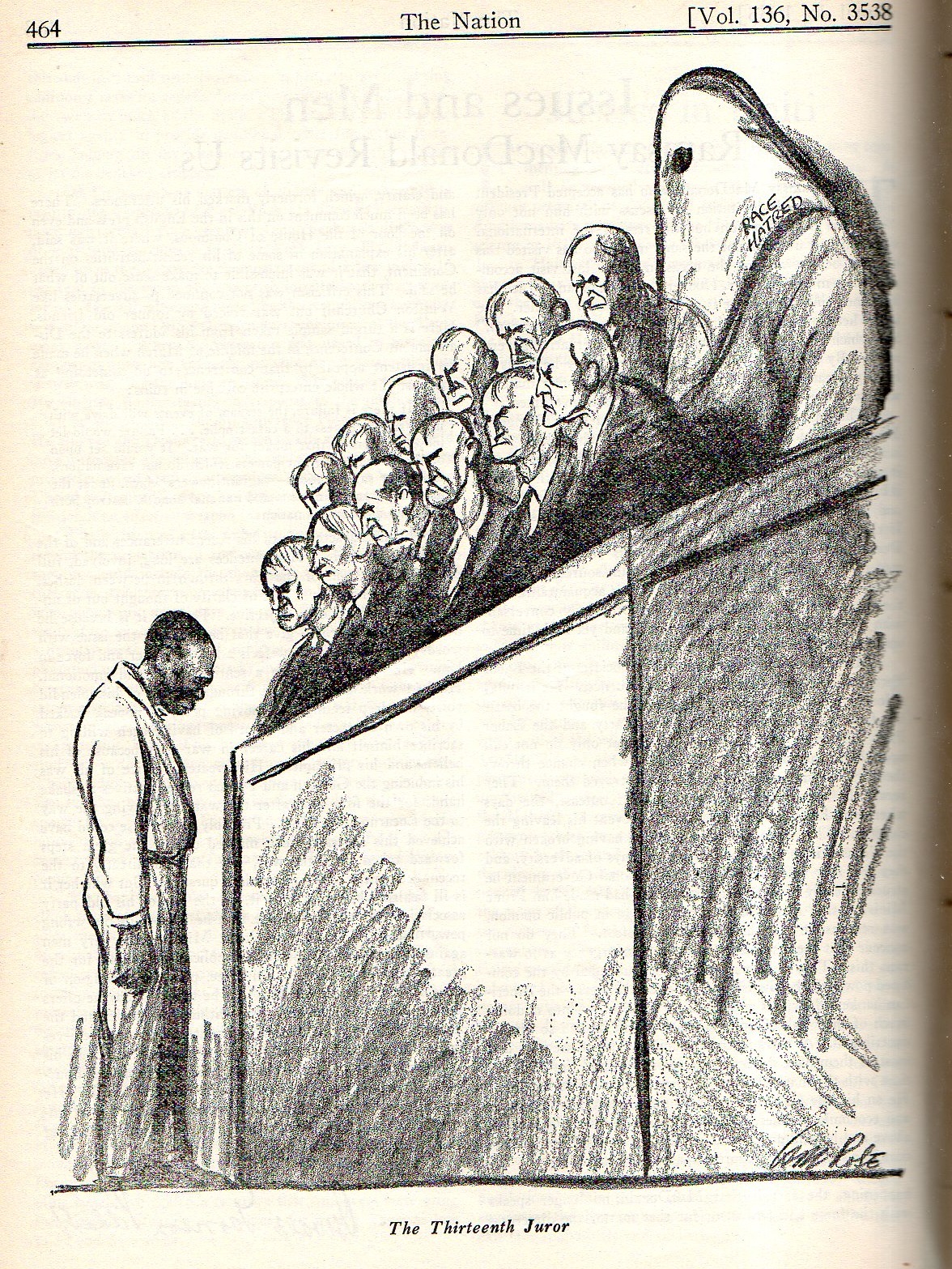
    I’m here again with The Nation, a marvel of social reporting and interpretation.  I was recently able to have 40 years of it come my way, and I have the luxury of sitting down with the odd volume and breezing through it–though it isn’t much of a breeze.  It is shocking to me how much of what they cover is absolutely new and fresh to me, especially since I thought I knew something about the decades that I’m pushing through right now (1919-1945).  

    Nation  lynching316I opened tonight almost immediately to this commentary on the Scottsboro Boys case–and it doesn’t take much to figure out what is going on, even if you never heard of it before,  This illustrate an article on Haywood Patterson, one of the nine African American teenagers who were accused of raping two white women in the state of Alabama in May 1931 and the legal morass and bitter institutional racism that he and the rest of the accused had been dragged through. It is a complicated set of cases –but the fact that there were trials and that there was some sort of legal sensibility to the matter was in itself noteworthy, because the case was highly inflammatory, enraging parts of the population who wanted immediate justice-and-punishment. 

    That didn’t happen in public, but it could be argued that is what was attempted by the Alabama criminal justice system–a judicial lynching.  The cases of these men went back and forth for a number of years, the men being convicted, and then sentenced to death by electrocution, and then appealing, and finding parts of the judgment overturned,  and then starting again, finishing again, overturning again, and other complications.  

    The cases made their way through to 1935 with sentencing in 1937, at which point the death penalties were overturned, but replaced by long prison sentences. 

    Haywood Patterson escaped the electric chair, but was sentenced to 75 years for a crime for which there was no evidence.  He wound up escaping in 1948, and wrote a book about his case (The Scottsboro Boy) in 1950; soon afterwards he was in a bar where he had an argument with a man and knifed him to death; Patterson was subsequently arrested and convicted of manslaughter, and would die of cancer in prison in 1952.  

    Mr. Patterson was evidently the first Afircan American in the history of such cases in the state of Alabama to not be executed for the crime. 

    [Image source:  “The South Speaks”, by John Henry Hammond, Jr., in The Nation, April 26, 1933, opposite page 465.]

    Lead Belly’s Scottsbor Boys”: 


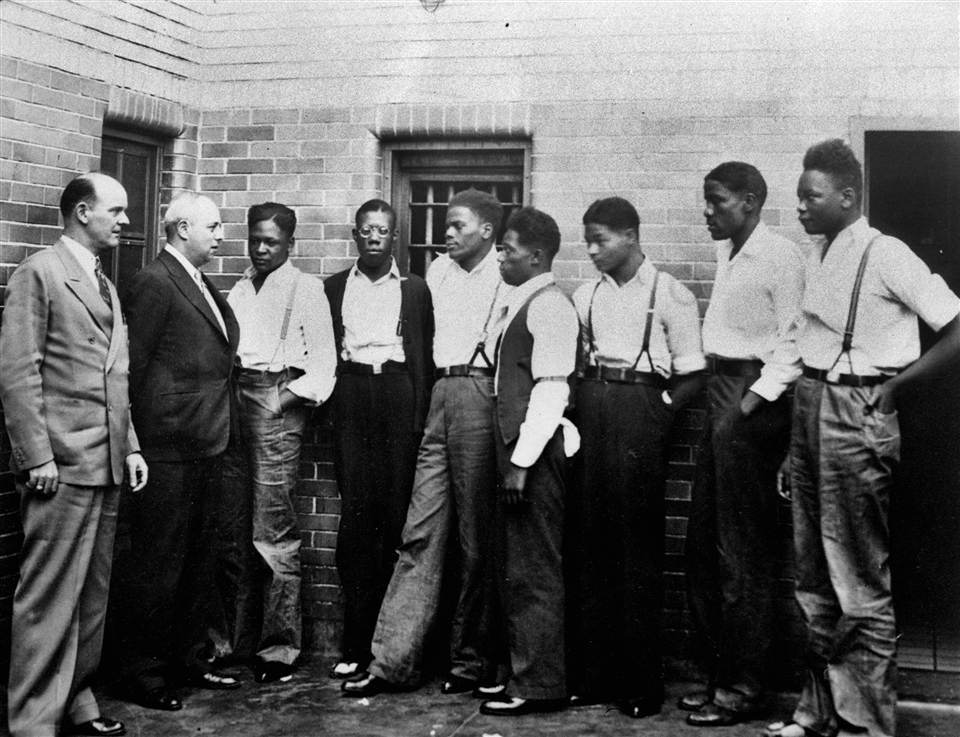
    Scottsboro photo

    [Source:  NBC News.  http://www.nbcnews.com/news/other/alabama-pardons-scottsboro-boys-after-82-years-f2D11634806]

    “In this May 1, 1935 file photo, attorney Samuel Leibowitz, second left, meets with seven of the Scottsboro defendants at the jail in Scottsboro, Ala. just after he asked the governor to pardon the nine youths held in the case. From left are Deputy Sheriff Charles McComb, Leibowitz, and defendants, Roy Wright, Olen Montgomery, Ozie Powell, Willie Robertson, Eugene Williams, Charlie Weems, and Andy Wright. The black youths were charged with an attack on two white women on March 25, 1931.”–Source as above.

    [Source: Emory University, here http://www.youtube.com/watch?v=TmsYLmqx3wg]


  • Invade Europe Now! (And Nazis in New York)

    JF Ptak Science Books     Post 2313

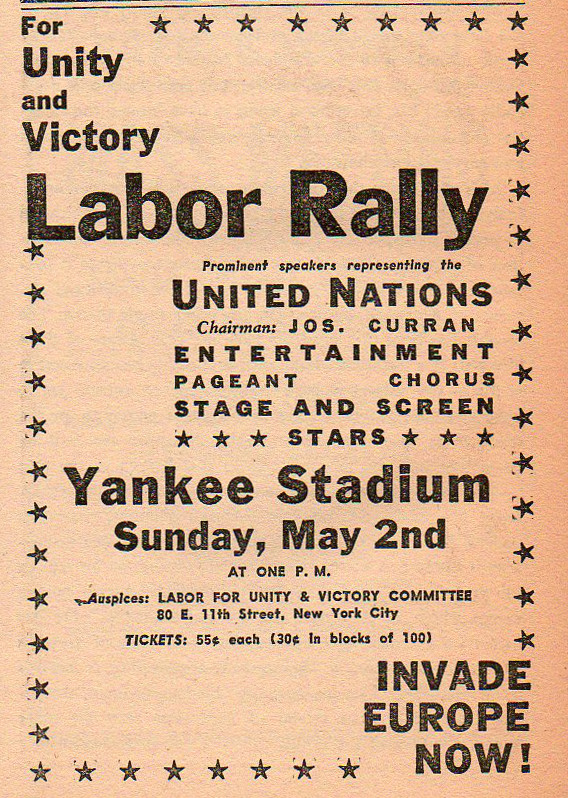
    I found this ad in the April 24, 1943 issue of The Nation, a great magazine already in its 70th year of publication.  I can’t say that I’ve seen a mention of the European invasion like this before, in an ad–certainly everyone was thinking of it, and the issue of where the invasion would take place had been decided (over Mr. Churchill’s desire for the thing to take place in southern Italy), but to see it in a advert like this was surprising.  (It turns out the Paul Robson sang at the event, urging the crowd of 54,000 to fight Fascism “abroad andf at home” (see http://www.bayarearobeson.org/Chronology_3.htm#May%202,%201943)). 

    NATION invade europe now313


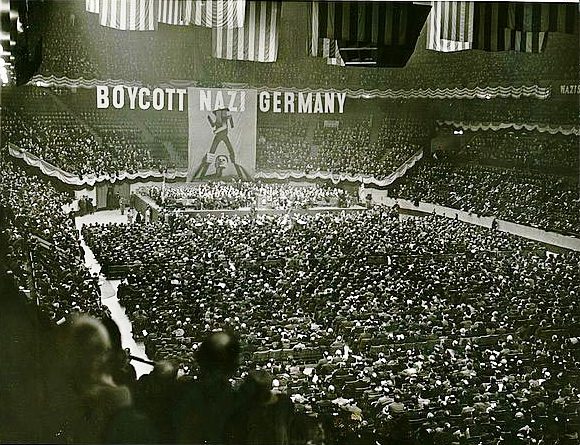
    In searching for images of this event I found something for Madison Square Garden, featuring a packed house for an anti-Nazi even in 1937.  MSG played no particular overt political favorite in the game of renting the facility (free speech and all that), because a year later there was a large meeting of the German American Bund that took places there, with reportedly 20,000 in attendance.  There’s a very unsettling video that I found for this event:

    [Source: http://youtu.be/KPGT7EaCiIY]

    They listened to a lot, not the least of which was the Bund’s leader, Fritz Kuhn, a naturalized American from Germany with a troubled relationship with the Nazi Party, and also with sticky fingers. What brought him to his knees was Fiorello La Gaurdia going after him and with Thomas Dewey prosecuting him for embezzling $14k from the groups general funds to pay for his happy times.  He went to prison in ’43, deported in ’45, and was dead in Germany in ’51.  

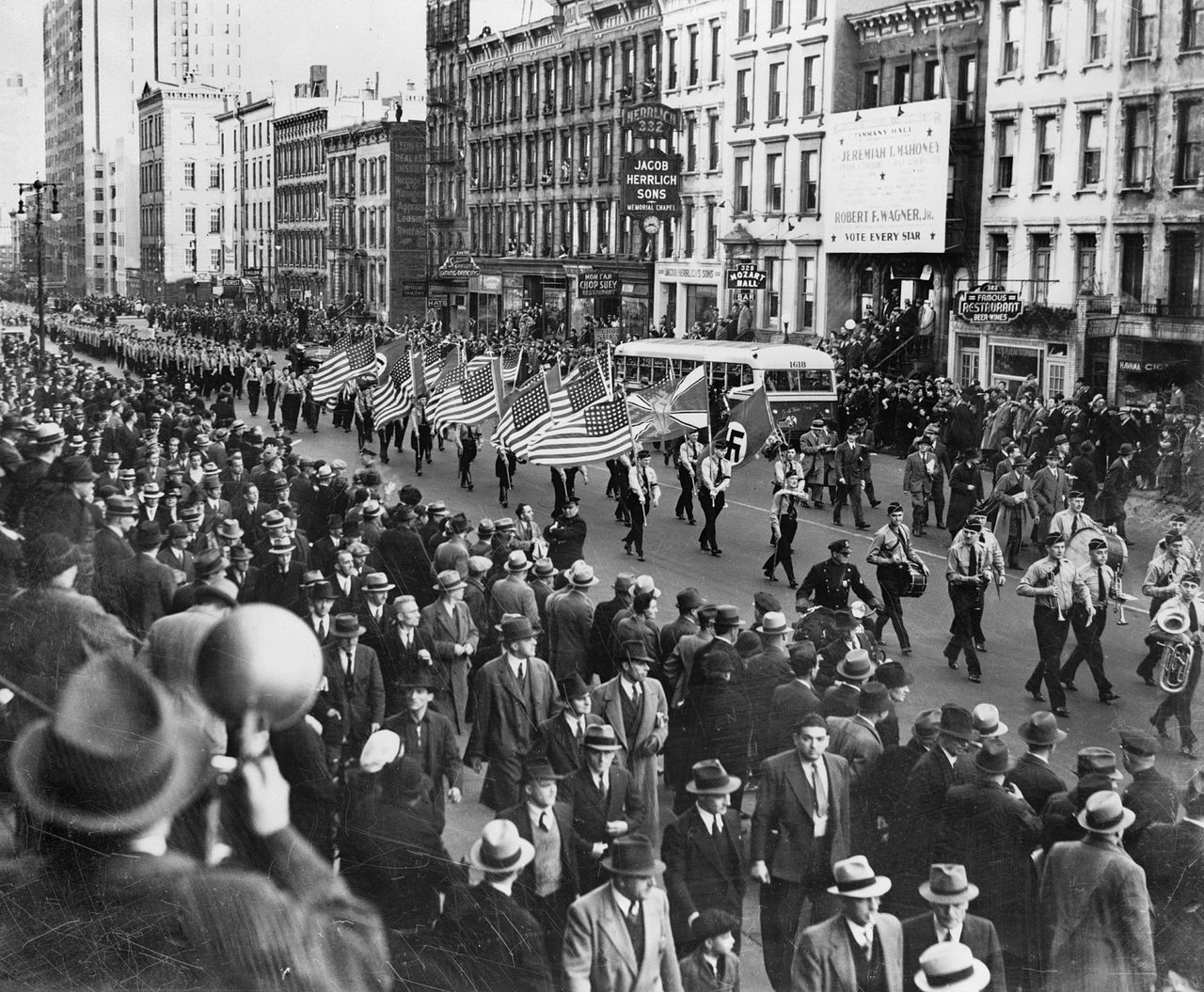
    The Bund paraded down 5th Avenue, too, in October 1939, right after the beginning of the war. From the looks of it the Nazis didn’t come close to even a small fraction of the curious and concerned onlookers.  

    German_American_Bund_NYWTS

    [Source–Wiki images, here]

    For many pro-Nazi groups–including Charles Lindbergh and the America Firsters–the bullshit parade didn’t end until Pearl Harbor, when the U.S. went to war with Germany, and at which point the Hitler admirers had a huge change of heart. Or at least became very quiet and still.

    Here’s an earlier anti-Nazi meeting, which seems to me to have had a much bigger crowd:

    Anti-Nazi rally

    I have my doubts about the 20k mentioned for the 1938 meeting–from what I can tell there were a lot of dark sections and empty chairs…

    ·Posted by :

    ·in:

    —

  • On a Certain Part of the History of Echoes

    JF Ptak Science Books   Quick Post

     There is a wonderful, short paper by Lord Rayleigh in the August  21, 1873 issue of Nature on echoes, “Harmonic Echoes”, echoes which have a life of their own, seemingly, after their initiation….echoes with 5 or 10 or more reverberations, echoes which seem to advance, or recede or both.  

    The mythological, beautiful nymph, Echo, a creature of Greek invention–or discovery–was much in love with her own voice and thus some of this interest in repetitive reverberations.  Echo was interested in Narcissus, which means that between the two of them, there was more more than enough interest in them for anyone outside themselves, but neither could get enough of themselves. And with Echo there were others who couldn’t get enough of her, though she denied herself to everyone. And so the tragedy.  Pan wants her, the old lech, and is denied, and becomes enraged which leads to her tragedy of being torn to pieces. She is resurrected, a little bit, her voice surviving everything else, repeating the last words of others.  

    I’ve repeated below a story on the Rayleigh paper which in some respects is as interesting as the original. 


  • A Rare Technical Report on the V-1, 1945, Published in Newly-Liberated Paris

    JF Ptak Science Books   Post 2304

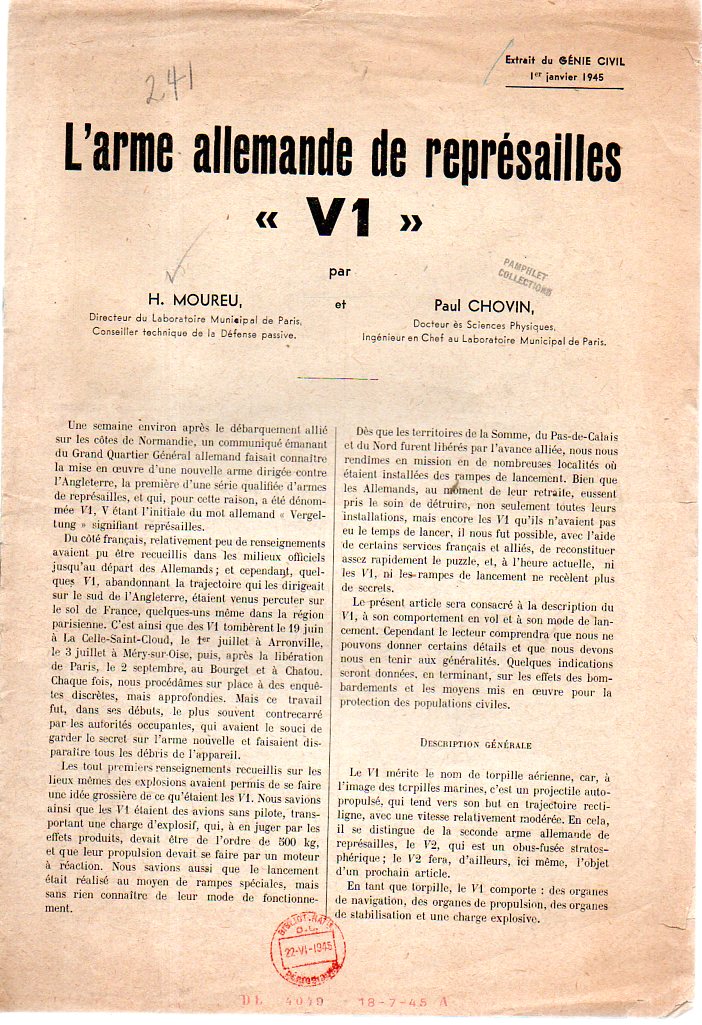
    The eyes of top-ranking Nazis must have popped when they saw this work by Henri Moreau  (1893-1978) and Paul Chovin.  It is a fairly technical paper on the V-1, the progenitor of their supposedly war-ending “secret weapon” the V-2, and to see the data and detail published in a tech journal in the city that was until very recently held in Nazi hands….well, there was very strong irony there.  “L’arme allemande de represailles <<V1>>”, seen here in offprint form, was published in Genie Civil, 1 January 1945–it is eight pages long, and printed in Paris (newly liberated from the German army 25 August 1944) in early 1945.  The offprint itself is a rare thing, with no copies whatsoever located in WorldCat, and nothing floating around on the interwebtubes. I was frankly surprised to find this fairly-well documented piece on the V-1, but no report itself, so I decided to reprint the report in its entirety. Some of the text runs off the side of the scanner, but that is the best I can do in scanning the pamphlet without taking it completely apart. 

    V1519


  • Moving Manhattan and Brooklyn Together at the Speed of…Slow (1903)

    JF Ptak Science Books   Post 2299

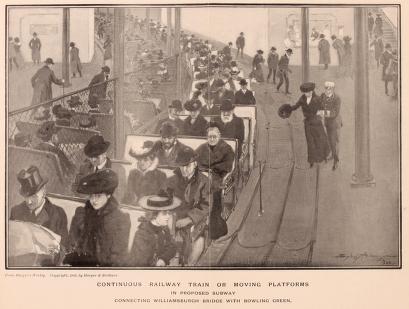
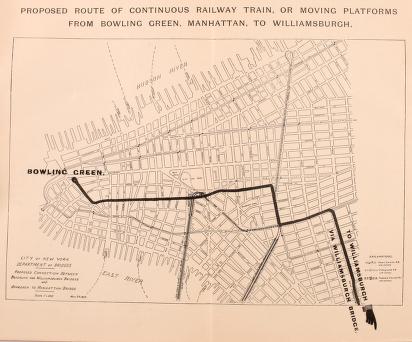
    If New York City was populated by nothing but people wearing hats, carried mink muffs, used gold-handled walking sticks, and really didn’t have to be anywhere at a particular time, then I think this invention might have been useful.  But seeing that off the engineer’s table that Manhattan was not god’s waiting room and far more Darwinian  than a high-Victorian imaginary noblese-chaste class of slow and deliberate people waiting to be waited on, then this idea wouldn’t have worked very well at all.  The seed of it all is found in Transportation of Passengers in Greater New York by Continuous Railway Train, or Moving Platforms.  Argument in favor of equipping the East River Bridges, and connecting subway to Bowling Green, Manhattan, with a continuous railway train or Moving Platforms, which was  prepared by Schmidt & Gallatin of New York in 1903.  It was only 20 pages, but it had  four folding plates, including two maps, and two drawings of the envisioned walkways, and that is the stuff upon which dreams are laid, made, and stayed.

    Sidewalks 3


    “Moving Platforms for the conveyance of passengers were recommended by Mr. Horace Greeley thirty years ago. They were successfully operated, first, at the World’s Columbian Exposition of 1893, where 2,700,000 people were transported. In 1896 they were installed at the Berlin Exposition, and again at the Paris Exposition of 1900, where they carried over eight million passengers. Few persons know what Moving Platforms are. From the face that sometimes they are called ” Moving Side- walks,” it is believed that they must be some sort of a pavement on rollers, on which it is difficult to step with safety and maintain equilibrium. The Moving Platforms are to all intents a railway, operated like other railways, propelled by electricity, with cars, seats, motors, passenger stations, ticket booths, guards, electric lights — in fact, everything belonging to a first-class railway.” 


    Sidewalks map


    “Where it differs from the ordinary railway is that the cars, or trains, are not running at intervals, but are coupled up continuously, so that there is no interruption of traffic at any time, but a large seating capacity at all times. It differs also in the construction of the cars, which are mere flat cars, provided with seats placed crosswise, and so ar- ranged that all rmssengers face in the direction of motion. Each of these seats may be made wide enough to accommodate one, two or more persons. The most approved plan is to provide seats on one side of the cars only and leave the other for passengers to walk, thus giving them an opportunity to further accelerate their speed if they so desire…”


  • Single-Line Entries of Revolutionary Ideas: the Transistor, (1949)

    JF Ptak Science Books   Post 2298

    Transistor 066
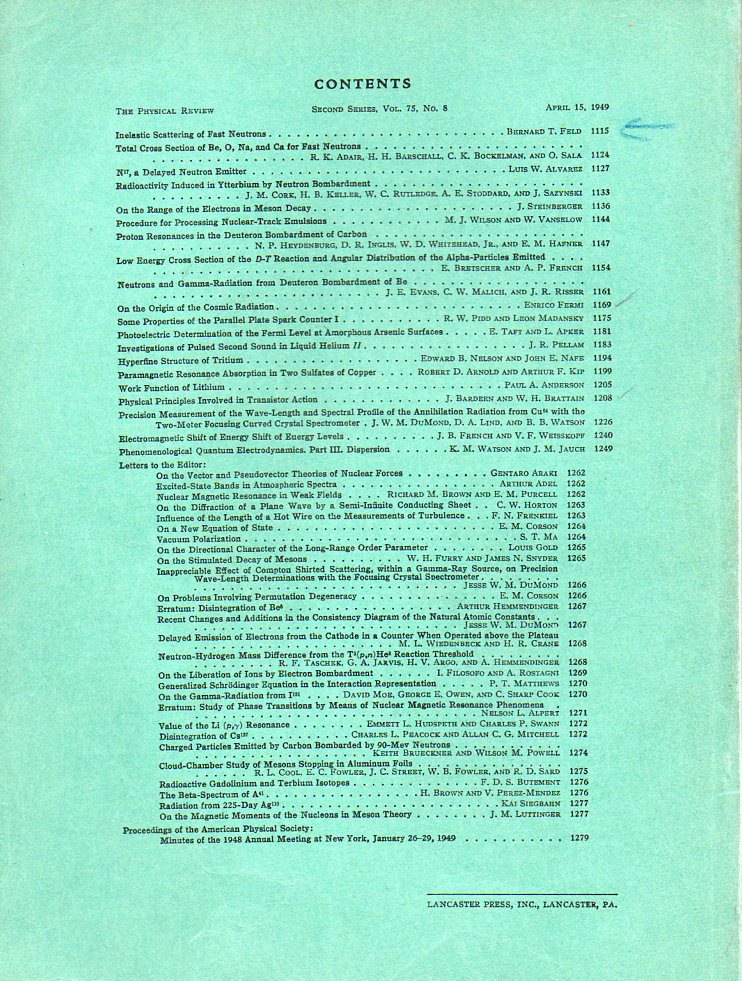
    One of the things I love about working my way through old scientific journals is when I find the issue that I’m looking for and scroll down the list of contributors to find the significant article that I want.  Long list, usually; and then, after making my way through 30 or 40 lines of tight type of the index I find it. [This by the way is one of those experiences that is being replaced by the digital library.]   Even though the paper on pp 1208 through 1226  of the 15 April 1949 issue of The Physical Review looks like any other, it is today seen as revolutionary. The entry for “Physical Principles Involved in Transistor Action” by John Bardeen (two-time Nobel in physics) and Walter Brattain (Nobel ’72) shows up about halfway down the index, sandwiched in some very good company (Enrico Fermi’s “Origins of Cosmic Radiation” and a number of others), and does not show up bolded, or highlighted, or with an asterisk.  Such is the nature of publication in the academic journal world, everything delivered with equal weight–the bolding stuff will happen later, in other venues.  But to see it right there in the flesh, so to speak, fresh and new and revolutionary, and looking like everything else, is really thrilling.  [See this entry for a similar report on the most valuable patent in history.]

    Transistor 064

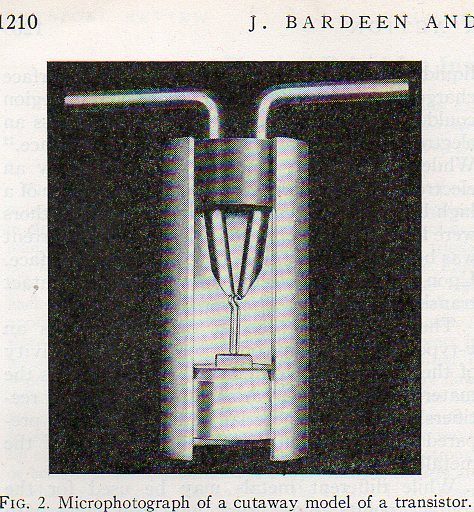
    It makes me wonder though how it would’ve felt to open this journal for the first time back there in mid-April ’49, turning to page 1210 to see the microphotograph of the cutaway of a model of the transistor.  This was the defining technical publication on the transistor1, which was the first massive step towards microminiaturization and the explosive new growth in the computer, allowing far more powerful machines to be designed in far less space, in far less amounts of time, and on and on.  It is one of the first steps in the Information Revolution, moving the computer from massive racks of electronic tubes to more simple, elegant, nimble and by-far faster circuit boards with transistors (and resistors, capacitors, inductors, diodes, etc.) to make an electronic circuit.  This would be the standard for computer construction, only supplemented by Jack Kilby (TI)  and Robert Noyce (Fairchild Camera) in 1958/9 with the integrated circuit, where transistors are made smaller still and produced in groups on circuit boards rather than individually.

    The photo above shows a cutaway of the transistor, and is the first time it was published–the first photo of what was one of the 20th century’s greatest inventions. 

    Transistor 065

    Notes

    1.  The paper was published simultaneously in the Bell System Technical Journal; Bardeen and Brattain were with the Bell Labs.  The Bell journal also contained another revolutionary paper in the same volume, Claude Shannon’s “Communication Theory of Secrecy Systems”, which is one of the most important early papers on electronics and cryptology.

    The full bit: BARDEEN,  John and Walter Brattain:  Physical Principles Involved in Transistor Action;  Lancaster, Pa:  Physical Review,  1949.  1st edition.  The Physical Review, Vol 75, Second Series, No. 8    8vo.


  • The Department of Significant Understatement & the Most Valuable Patent, Ever?

    JF Ptak Science Books   Post 2294

    Bell patent close
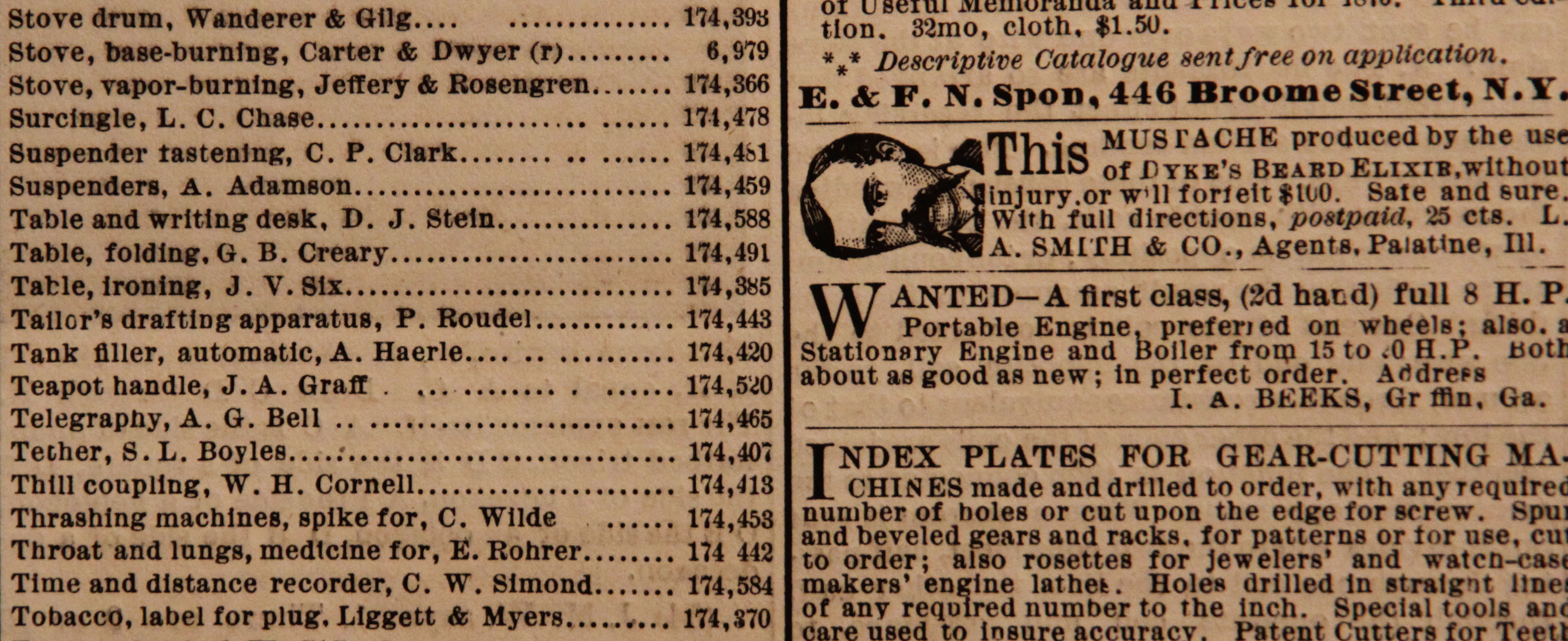
    Besides it being the (U.S.) Centennial year, 1876 saw a number of major gains in the history of human thinking. Sometimes the announcements or earliest public appearances of these breakthroughs didn’t get all that much attention.  As one of the major means of transferring technical and applied science info to the general public, it is interesting to see how Scientific American reacted to such innovations.  For the thick, heavy volume for 1876, amid patent announcements and articles on telegraphic fire alarms, electro-harmonic multiplex telegraphs, recording telegraphs, electro-magnetic telegraph railroad car signals, signal box telegraphs, underground telegraphs, telegraph keys and armature, acoustic telegraphs and the like (though there weren’t that many reported, not really, just on the order of dozens), we find one of the most important of them all, patent # 174,465, by Alexander Graham Bell, appearing 8 April 1876.  It would be a rude resumption of being here in the future of this event to call the coverage short-sighted–this is just the way the patents were reported, with no weighting, just a single line.  

     In an earlier article in the 4 March 1876 issue of SA, there appeared “The Invention of the Telephone”, by P.H. Vander Weyde, in which there is yet any mention of Mr. Bell.  There is an illustration of one of his precursors in the field, the Reuss telephone, with ample description. (This was actually Philipp Reiss, and his telephone really wouldn’t work to transmit the human voice, though did so work for music to some degree.)  Bell’s patent  would be at the Patent Office in March, and would appear as a one-line notice (among a hundred others), the patent stating it was “the method of, and apparatus for, transmitting vocal or other sounds telegraphically … by causing electrical undulations, similar in form to the vibrations of the air accompanying the said vocal or other sound”.  (The first image above is a detail; the second image a longer version, which is really only less than half of what the real-life version looks like in the tall listing.)

    Weeks later, Elisha Gray‘s (on 13 May) telegraphic telephone patent (175071) appears in the Scientific American, and later, on 9 September, on page 163, there is the article “The Human Voice Transmitted by Telegraph”, on the successful transmission by Graham Bell. 

    Admittedly there were a number of developments in the production of the speaking telephone at this time, though in general there seems to have been no great attention paid them in the pages of the Scientific American than pipe cutting machine improvements or improved gravel separators.  Obviously the great impact of the invention was yet to be appreciated, even in any sort of fictional way.