A Daily History of Holes, Dots, Lines, Science, History, Math, Physics, Art, the Unintentional Absurd, Architecture, Maps, Data Visualization, Blank and Missing Things, and so on. |1.6 million words, 7500 images, 4.9 million hits| Press & appearances in The Times, Le Figaro, Mensa, The Economist, The Guardian, Discovery News, Slate, Le Monde, Sci American Blogs, Le Pont, and many other places… 5000+ total posts since 2008.

Category: Anticipation, History of

  • German Propaganda in Sweden, 1943

    JF Ptak Science Books   Post 2239

    “Sveriges folk vet inte mycket om alt detta”/Swedish people do not know much about this…” 

    This is an unusual graphic–or at least a graphic display of information found in an unusual location, a publication in Swedish quoting sources from the Free Press from Stockholm (19 June 1943) on the effectiveness of Luftwaffe vs R.A.F. bombing.

    It is supposed to be a graphic proof for the ferociousness of the Allies, published in a pamphlet called Konst i  spillror (roughly, Art and Rubble, or Art in Rubble, something like this) which I believe was a German attempt to win Swedish hearts and minds by displaying the destructive force of teh other side of the war. The subtitle of the pamphlet is on the destruction of European cultural treasures in Antwerp, Nuremberg, Koln, Lubeck, Karlsruhe, Munich…plus bombed cemeteries, schools, hospitals, and so on. The locations are in Germany, mostly, or German-held areas, and decry the barbarity of the war in the hands of the British, Canadians, and Americans.  

    WWII graphic077

    I do not have proof of this as propaganda, but it certainly feels like it.  Sweden was a neutral country during WWII, managing to maintain its neutrality for the entire conflict. There were evidently soem concessions made to both sides–for Germany the major bit seems to have been allowing the German 163rd rail transport across Sweden in the attack on the Soviet Union (which I imagine was an enemy of my enemy move). On the other hand the Swedes accepted Jewish refugees from Norway and accepted all of the Danish Jews who were supposed to be sent to concentration camps.  I can understand the Nazis wanting to try to make inroads into the national psyche, but I have a hard time imagining that this campaign succeeded on any level. 

    My copy is a photographic negative of the original, made during the war, and was once part of the Library of Congress Pamphlet Collection.  As I said, I could be wrong in this interpretation, but I feel fairly confident that it is so.


  • Criterion of Reality, 1880 and 1935

    JF Ptak Science Books  Quick Post

    On a graze through the journal Nature (still the same Nature as today’s publication, the journal at this point being already 12 years old) looking for an article by the great W. Stanley Jevons on the aurora borealis (and the fluctuations of magnets), I bumped into the following short notice:


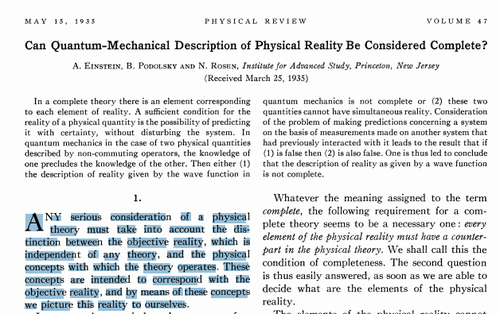
    And this, from one of the most-cited articles in the history of the Physical Review:

    “If, without in any way disturbing a system, we can predict with certainty (i.e., with probability equal to unity) the value of a physical quantity, then there exists an element of reality corresponding to that quantity.”–Einstein-Podolsky-Rosen,”Can Quantum-Mechanical Description of Physical Reality Be Considered Complete?” Physical Review, volume 47, May 15, 1935, page 777. Full text via the American Physical Society.


    EPR


    ·Posted by :

    ·in:


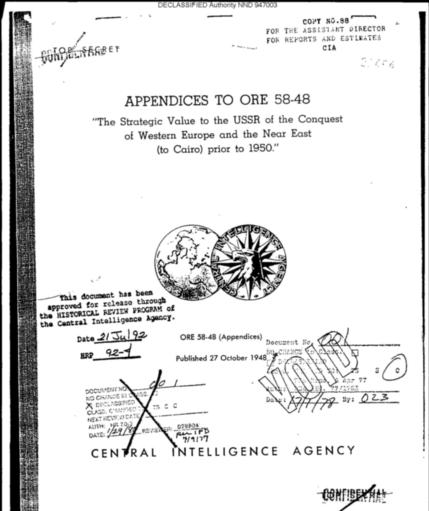
  • Top Secret CIA Report on Advantages to USSR on Attacking Europe Before 1950

    JF Ptak Science Books  Quick Post

    Fascinating reading, especially in the conclusions section.  Some sections are CONFIDENTIAL, others TOP SECRET.  

    Source:  Record Group 263:Records of the Central Intelligence Agency, 1894 – 2004, Series: Intelligence Publication Files, 1946-1950. 

    Source & text link:  National Archives.

    ORE 58-48 Addendum, The Strategic Value to the USSR of the Conquest of Western Europe and the Near East (to Cairo) Prior to 1950, 10/27/48

    CIA USSR 1


    ·Posted by :

    ·in:


  • A Note on the History of Simultaneity

    JF Ptak Science Books     

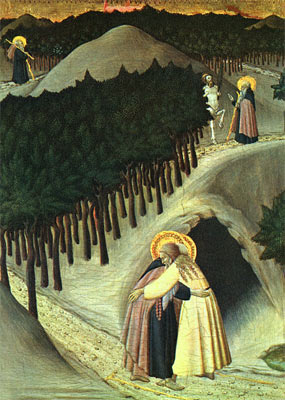
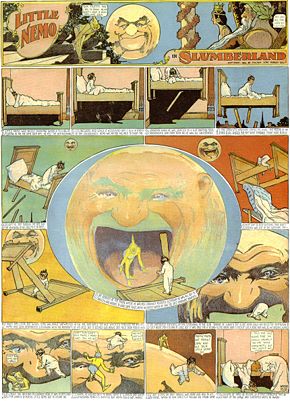
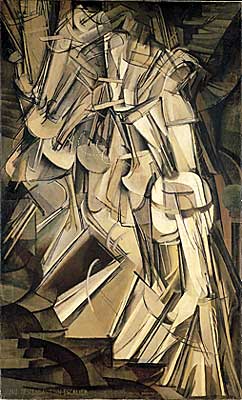
    There is a great, unifying factor drawing together Aztec glyphs, Little Nemo in Slumberland, Marcel Duchamp, the Renaissance Sienese Sassetta, Guillaume Appolinaire, William S. Porter—they all display disparate chronological sense to a single story.

    Blog--may 25--st. anthony
    The concept of displaying the passage of time, relating multiple events taking place at the same (or different) times, is really quite a lot older than the what is generally considered to be its recent modernist beginning.  Duchamp’s Nude Descending, which is a masterpiece of modernism displaying unfolding time and multiple perspective views across time of the same object, is the direct descendant of centuries-old artworks.  The Egyptians and the Aztecs certainly made use of this idea of multiple stories at multiple times in their stone storyboards.  Closer to the present is the genre of early Renaissance painting like Sassetta’s The Meeting of St Anthony Abbot and St Paul the Hermit (painted circa 1440), which shows several aspects of the story over time, and depicted on the same canvas. (We see the beginning of St. Anthony’s journey at top left, heading out on his journey as a younger man, winding his way through dark wood and along a curving trail; we see him a second time as an old man, and then lastly at bottom, elderly, finally meeting the other monk.)


    Blog--may 26--nemo

    The rollout of the Sassetta masterpiece (hanging happily at  the National Gallery in D.C.) reminds me a lot of the great hallmark of storytelling at the beginning of the twentieth century—no, not Barzun or Cendars, but Little Nemo (who predates all of the other greats who were to come in the next ten years or so).  Winsor McCay’s (1871-1934) Little Nemo in Slumberland (appearing in the Hearst newspapers beginning in 1902)—better yet, the comic strip in general—adopts a platform for storytelling that is nothing short of revolutionary.  By breaking out the development of the narrative in front of the reader and on one single sheet of paper gives the author fantastic maneuverability.  This is also seen in the early motion pictures of Edwin S. Porter (like The Ex Convict, 1905) and D.W. Griffith (The Lonely Villa, 1909) who both use a new concept of contrasting editing—cutaways from the main action and pace of the.

    Blog--may 26--nude descending


    film and incorporating vignettes of actions that are related and happening elsewhere, sometimes all of it happening at once.   The story is able to develop multiple themes that are occurring at the same time but in disparate locations—the artwork of futurists Balla and Boccioni and the unclassifiable Duchamp reach for the same end, and so to (again) with Apollinaire and Cendars and the rest…and all of them coming into view in 1912/1913 or so.

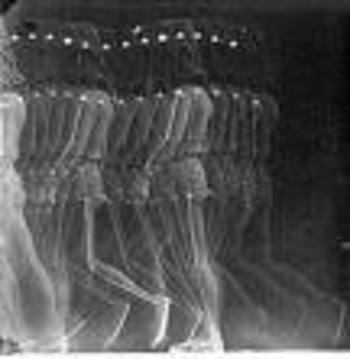
    There’s a lot to talk about on the tech end of this too, not the least of which is the work of Etienne Marey who made highly successful photographic investigations (in the 1870’s and 1880’s)
    of all manner of locomotion, some of the results of which look like the x-ray of Duchamp’s Nude.  Perhaps the greatest early enablers of technological simultaneity are the telegraph and (more impressively) the telephone, both of which allowed people to be in two different places at the same time (so to speak).

    Blog--may26--marey

    Again, this is just a note, thinking out loud, about the concept of simultaneity, and I doubt that I’ve even broken the surface…I’ve not even considered the math and physical aspects of it all, not even a whisper about Einstein and Schroedinger.  I’ve just done a search and found two works by eminent historians of science on this topic which I should think would demand reading:  Max Jammer’s Concept of Simultaneity (2005) and Peter Galison’s Einstein’s Clocks, Poincare’s Maps and the Empire of Time (2003).  I’d like to return to this post when I think I might have an idea of what I’m talking about…


    ·Posted by :

    ·in:

    — —

  • A Magazine By and About “Factory Girls”, 1845

    JF Ptak Science Books   Quick Post

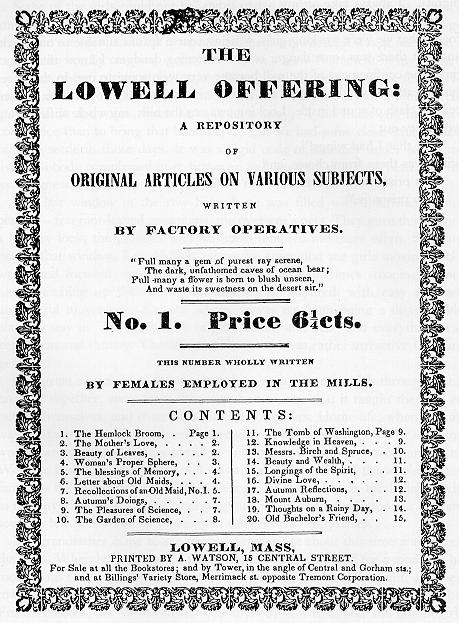
    The Lowell Offering is an extraordinary publication, featuring in its editorial and production and writing staff the women who worked in the many factories in Lowell, Massachusetts.  It didn’t start out that way–it was an ordinary-ish journal begun by Reverend Abel Charles Thomas (1807-1880, and pastor of the First Universalist Church) in 1840 and filled with popular notions and polite works by the locals.  The tables changed in 1842/3, and the writing was switched, the stories and fictions and observations made by the women of the factory, and the journal stayed that way until it folded in 1845. Women had been working in the mills of Lowell since it was Lowell, created by Francis Cabot Lowell, who got the place up and running in about 1823 as a model working community that hummed with hundreds of looms, making the area one of the leading textile producers in the world.  Actually, “hummed” is a poor selection of words–it was really more like a noisy bedlam, a cacophony of metal and leather, the background radiation so to speak of several generations of workers in America.  

    Lowell_Offering_1[Source:  Wikipedia.]

    “Lowell Massachusetts was founded in the 1820s as a planned manufacturing center for textiles and is located along the rapids of the Merrimack River, 25 miles northwest of Boston. By the 1850s Lowell had the largest industrial complex in the United States. The textile industry wove cotton produced in the South. In 1860, there were more cotton spindles in Lowell than in all eleven states combined that would form the Confederacy. Mind Amongst the Spindles is a selection of works from the Lowell Offering, a monthly periodical collecting contributed works of poetry and fiction by the female workers of the textile mills. The Lowell Mill Girls, as the workers were known, were young women aged 15-35. The Offering began in 1840 and lasted until 1845. As its popularity grew, workers contributed poems, ballads, essays and fiction. The authors often used their characters to report on conditions and situations in their lives and their works alternated between serious and farcical…”

    To the Factory Girls

    “We cordially invite the Factory Girls of Lowell, and the operatives and working people generally, whether they agree with us or not, to make the Voice a medium of communication; for it is your paper, through which you should be heard and command attention. The Press has been too long monopolized by the capitalist non-producer, party demagogues and speculators, to the exclusion of the people, whose rights are as dear and valid.”1845.11.07 Source:  Industrialrevolution.org, which has MUCH else of interest. 

    A good introductory selection from The Lowell Offering is TALES OF FACTORY LIFE, No. 1 [from Lowell Offering, 1841], here.

    Workingmen Publishing a Paper?

    “What! Those Workingmen Publishing a Paper?—Yes, friends, as strange as it may seem, “Those ignorant Workingmen” have come to the singular conclusion, to do some of their own thinking, reading, and talking. We have lived long upon the dear bought teachings of those who measure cut their knowledge according to our goal, and as this is getting rather scarce we think duty demands, that we should stir up our ideas, and see what things we have stowed up rusting away, which may be of some little value to ourselves and a portion of the community. Will you allow it?”  Source:  Industrialrevolution.org, again, 1845.05.29

    A very useful index with occasional links to articles can be found at the University of Massachusetts, Lowell  

    And Life Among the Spindles, located here.  And also here: http://www.gutenberg.org/files/37471/37471-h/37471-h.htm

    It is interesting reading, if not syrupy at times, and very highly sentimental (Dickens, in his tour of America in 1842, commented “Of the merits of the Lowell Offering as a literary production, I will observe…that it will compare advantageously with a great many English Annuals.”)–nevertheless there’s much in there to give an idea of what it was like as a lower-middle-class working stiff woman. Bottom line, it is a fabulous thing.  

    ·Posted by :

    ·in:


  • Black Holes as Dark Stars, 1784

    JF Ptak Science Books  Quick Post

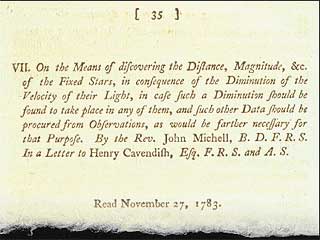
    Just a very short note here, as I was doing a little work on black holes, and read the earliest recognizable scientific papers on the idea of the black hole (I almost wrote black “whole” which is an interesting concept that I guess might be sort of the same idea as a black ‘hole” if the notion existed), and thought to reproduce parts of them here.  The paper is by John Michell (mind the ‘t”!, 1724-1793, pioneering/filed creator of seismology and magnetometry, and one of the first people to competently weight the world) and exists in this long but beautifully titled work found in the Philosophical Transactions in 1784:  

    Michell_001

    [Image source: American Museum of Natural History]

     Here’s a good quote from that work:

    “If the semi-diameter of a sphere of the same density as the Sun were to exceed that of the Sun in the proportion of 500 to 1, a body falling from an infinite height toward it would have acquired at its surface greater velocity than that of light, and consequently supposing light to be attracted by the same force in proportion to its inertia, with o ther bodies, all light emitted from such a body would be made to return toward it by its own proper gravity.” (Michell, Philosophical Transaction of the Royal Society of London, January 1,1784.

    He came up with the beautiful idea of “dark stars”, and even how to find them–it is unfortunate how (and also a function of the times) that his work would go basically unnoticed until a time when it could be better understood, but only so far as historicism is concerned.  Michell however was rescued in the 1970s at least in bibliographies, lifted from his parson’s grave of scientific anonymity.  

    ·Posted by :

    ·in:

    —

  • (Erasmus) Darwin and Powered Flight

    JF Ptak Science Books  Post 2242

    There’s a pair of short notices in two consecutive issues of Nature (September 22 and 29, 1910) that brings up a probably mostly-overlooked bit of thinking by Charles Darwin’s (and Francis Galton’s) grandfather, Erasmus Darwin (1731-1802).  Way before Charles (born 1809) and Francis (born 1822) Erasmus was a powerhouse Darwin, and a powerhouse-in-general. He was primarily a physician, but was also an inventor, physiologist, abolitionist, botanist, and inventor, among other things.  He famously speculated on evolution, and less-famously on the coming of the steam age.  

    In the first article here, pointing out a piece in The Times by R. Meldola, it is shown that Darwin saw the coming of steam from a good distance away: “As the specific levity of air is too great for the support of great burthens by balloons, there seems to be no probable method of flying conveniently but by the power of steam, or some other explosive material, which another half-century may probably discover”.)  The editors of Nature included the notice to provide a bit more evidence of Darwin’s vision via his poetry, stating that he “foretold, in the following lines, the advent of aerial navigation”:

    Soon shall thy arm, UNCONQUER’D STEAM! afar
    Drag the slow barge, or drive the rapid car;
    Or on wide-waving wings expanded bear
    The flying-chariot through the fields of air.
    — Fair crews triumphant, leaning from above,
    Shall wave their fluttering kerchiefs as they move;
    Or warrior-bands alarm the gaping crowd,
    And armies shrink beneath the shadowy cloud.

    In the next issue of Nature there’s a short notice by Arthur Platt, “Erasmus Darwin on Flying Machines”, (page 397 of September 29, 1910), where he quotes Dawin on the coming of powered flight:  “As the specific levity of air is too great for the support of great burthens by balloons, there seems to be no probable method of flying conveniently but by the power of steam, or some other explosive material, which another half-century may probably discover”.

    That’s pretty good.  Over at the Erasmus Darwin House site is another interesting side of Darwin’s interest in flight, where it is found in hi snotebooks a good and early understanding of teh mechanics of bird flight:

     “In the 18th century there was still no satisfactory explanation for the mechanics of flight and, inquisitive by nature, Darwin appears to have set himself to the task. Sketched out in his commonplace book in 1777 at the height of the 18th century quest for automata and artificial life, the bird (technically a goose) will be brought to life in a steam punk style reminiscent of the era. Using a small reservoir of compressed air as the in-flight rewinding mechanism in the book, Darwin’s description of a bird’s flight is very close to reality, and appears to be the first complete account of a power-plant and the necessary cycle of the wings’ movement…”–Erasmus Darwin House, here.


  • The Gaping Mouth of Hell, ca. 1475

    JF Ptak Science Books  Post 2233

    “If a man were a porter of hell gates, he should have old turning the key.” Shakespeare’s Macbeth.

    SPECULUM 064

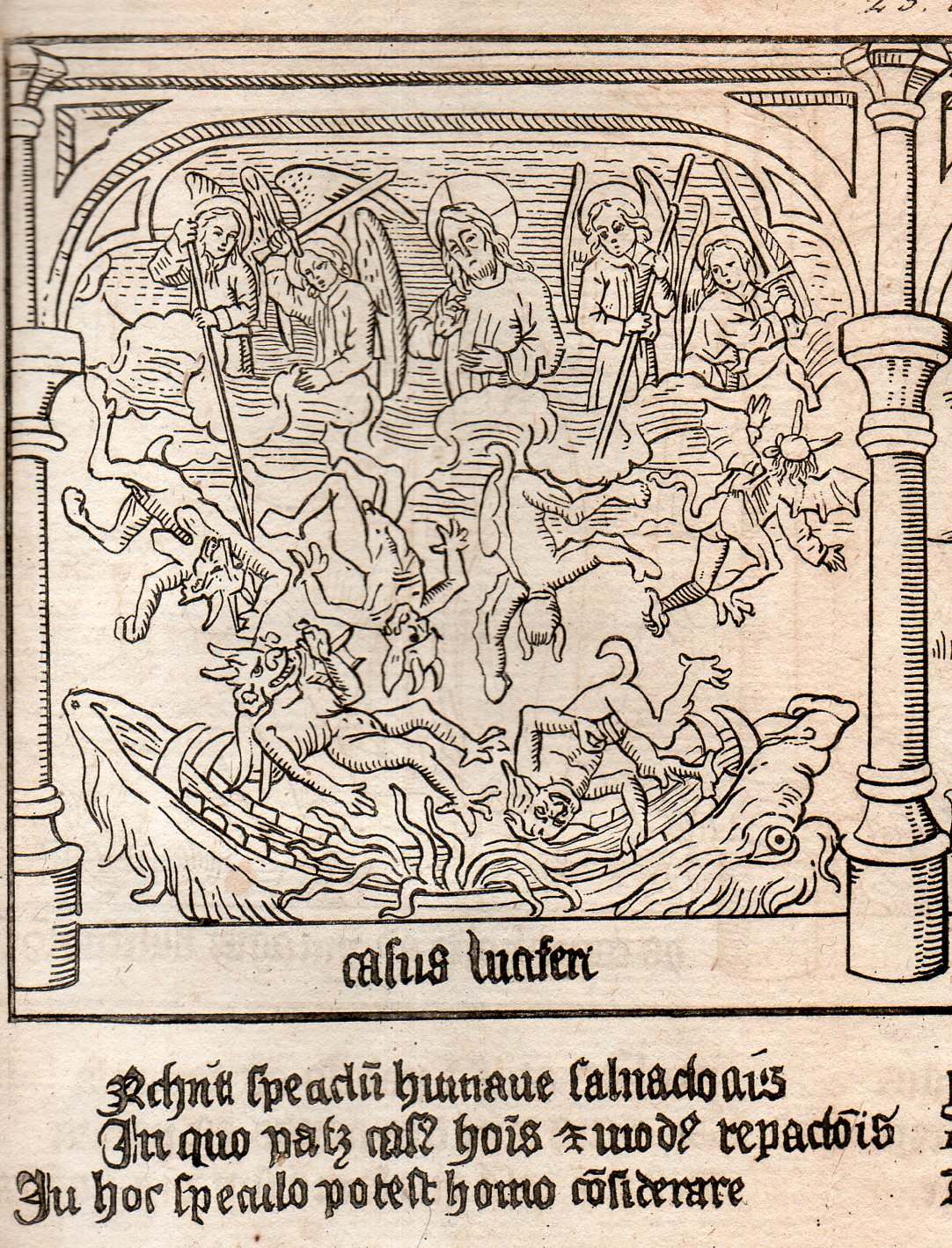
    This woodblock, printed ca. 1475, appears in a Medieval/Renaissance classic, Speculum Humanae Salvationis, which appeared in hundreds of manuscripts beginning in the early 14th century and then through 16 editions as a printed work to the year 1500.  It was a very popular work, very highly illustrated, a best-seller even, a famous work dedicated to showing the presaging relationships of the Old Testament to the New.  

    This image presented here depicts the Fall of Lucifer, overseen by Jesus and Angels, and falling into the gaping mouth of Hell.  It is a wicked image no doubt used to scare the pants off of its readers, in the general tradition of the depiction of the massive wickedness that awaits those who stray from the teachings of that which is necessary to enter Heaven1.  

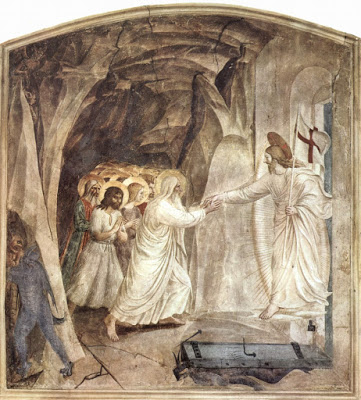
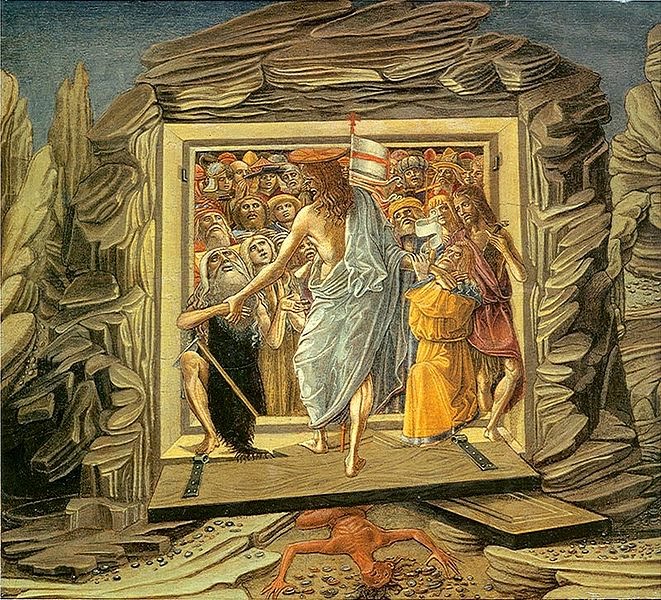
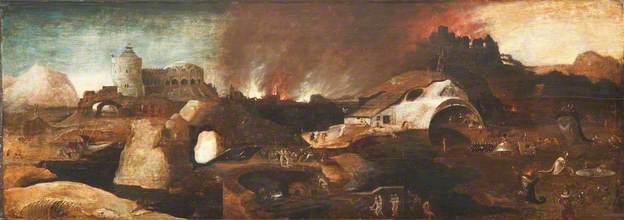
    Gaping mouths of Hell appear quite frequently in the history of Christian art, particularly in the representation of the place in the harrowing of hell, when after his execution Christ descends into the pits to bring to salvation all of those who were worthy of it who died before his appearance on earth. It is a very common seen, with hell appearing as a cave, or a hole in a mountain, and of course as ferocious monster mouth.  In a way the stunted, black hole in a mountain, lonely and dark and just about non-existent, looked more frightening in its way, its terror implied rather than overtly visualized by horrible teeth and jaws.  

    For example, Fra Angelico presents the scene in 1437(-46), and shows Christ in what looks like coldness reaching for the hand of the person usually depicted the first among the saved, Adam:

    Harrowing of hell fra angelico[Image source, here]

    It doesn’t have the flavor of fear that other entrances to Hell have, though it is forbidding, with the long line of dead stretching far back into the interior. 

    An old friend from the National Gallery in D.C., Benevento di Giovanni (ca. 1493), shows a more dramatic entry of Christ, though the crushed devil evidently doesn’t stay crushed for that long, as Limbo and Hell do not actually perish once Christ leaves: 

    Harrowing of hell Giovanni

    [Image source, here]

    There are many such examples, and perhaps more still featuring the anthropomorphically-alive and toothy entrance–few are scarier though than the entrance to Hell that meets these two ideas sort of in the middle, that being the quietlky shivering contribution by Hieronymus Bosch, placing the entrance to Hell in the mouth of a dead human.

    Harrowing bosch[Image source, here.]

    Of course Bosch can and does make the entrance more hideous and obvious in other works, but this “understated” variety is very effective.  

    But it is the image from the Speculum that attracts me right now, found in a book on my shelf on deeply old engravings and woodblocks, Idee Generale d’Une Collection Complette d’Estamps...by Heinecken, printed in Leipzig in 1771.  

    “God, shown throughout this chapter as Jesus Christ, is surrounded by the blessed angels in Heaven. Below is the scene of the Fall of Lucifer and his followers into the gaping mouth of the Leviathan, of the book of Job XLI, which is commonly identified with the inferno. The fallen angels are represented with wings, horns and cocks’ feet. The Fall of the Angels is first found in Judeo-Greek literature of Alexandria in the two centuries before Christ.”–Source: Speculum Humanae Salvationis 1324–1500,  by Adrian Wilson & Joyce Lancaster Wilson, U.C. Berkeley Press, 1985. 

    NOTES:

    1. The heaven-helly Ambrose Bierce in what would become his Devil’s Dictionary, spunkily writes of heaven so:  “HEAVEN, n.A place where the wicked cease from troubling you with talk of their personal affairs, and the good listen with attention while you expound your own.”  Uncharacteristically, he did not make an entry for hell, which I am sure he was better able to discuss.  

    ·Posted by :

    ·in:


  • The Broken Windows of Uncle Chuckles–Charles Babbage Figures Stuff Out, 1857

    JF Ptak Science Books  Post 2227   

    The polymathic Charles Babbage’s (1791-1871) name is well known as the father of the computer–creating a non-steam steampunky sense of modern computing with metal gears–though some of his other nitty and detailed research is not nearly so well known.  One fantastic example of this is his interest in public nuissance problems of Dickens’-strollable London at high-Victorian mid-century, and particularly in one case in the breaking of plate glass windows. 

    He published the results of his study in an 1857 article, “Table of the Relative Frequency of Occurrence of the Causes of Breaking of Plate Glass Windows” in the  Mechanics Magazine volume 66, the highlights of which were summarized in this appearance in The Insurance Cyclopedia‘s (1878)  chapter on “Glass Insurance”, as follows:

    I just find this fabulous!  He no doubt found the whole thing appalling, as he did the other unruly stuff of life in the streets, with a withering view of the street-side life of the working and lower classes, but mostly for street hawkers and musicians and above all else it seems the organ grinder.  Babbage had a lot on his mind but there seemed to have been plenty of micro-room for concerns like these.  

    It should be mentioned that Babbage wrote a best-selling work in the not-yet-established field of operations research, writing a great and influential work on industrial production called On the Economy of Machinery and Manufactures (1832, with a fourth edition by 1836), so the fact that he took an unusually fine interest in window breakage and how that all worked out is not so unusual, for him.

    And just because the numbers are there and the results so interesting, I’ll include the previous entry from the article above:  

    ·Posted by :

    ·in:


  • Found-Art in Electrical Discharge, 1880

    JF Ptak Science Books   Post 2212  History of Anticipation series   

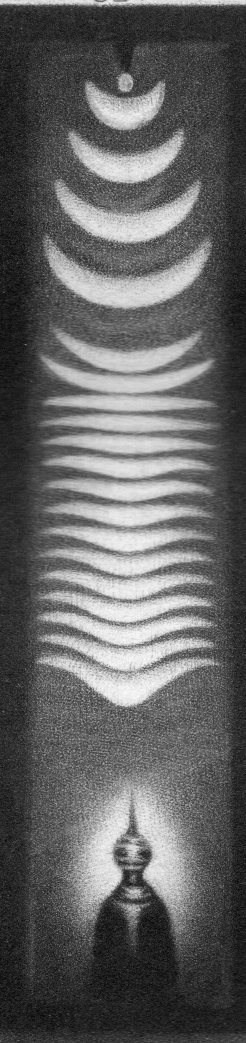
    It makes me wonder about how things were labeled “art” in the history of labeling things.  In a way it is not at all like naming where the American “West” is, or where the “South” begins, because those definitions seem to get very local and very detailed very quickly, and then the labels get bigger and wider and more open to interpretation.  That is to say that the labels make more accommodation for the idea, at least far more so than the labeling of “art” was concerned in the pre-Kandinsky/Cubist/Abstract era, or at the very least before the era of early impressionism.  
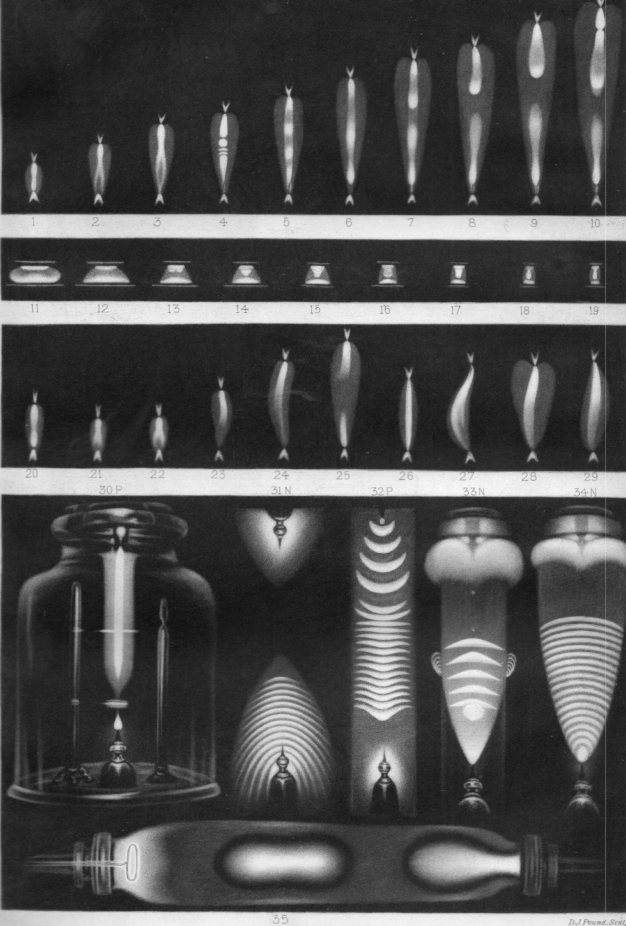
    Electrical discharge031

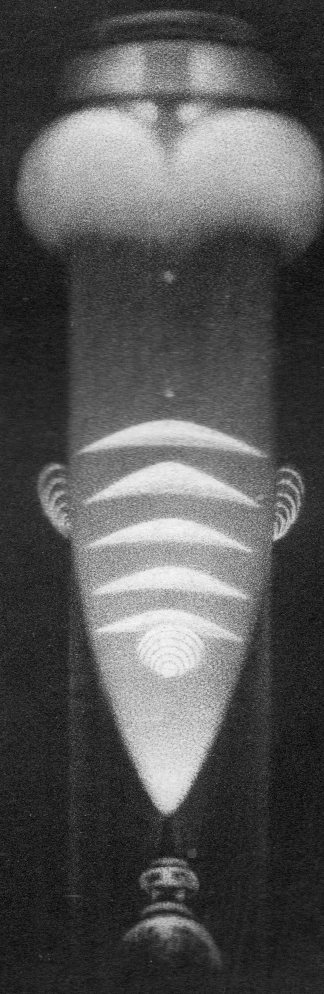
    This is a tiny detail from a full-plate plate from Nature, in an article by Warren de la Rue on electrical discharge (and printed 24 June 1880). (Actually, the big full-page images like this are fairly rare in Nature–more so when the image is mostly very dark, meaning they took a lot of ink to print.)  It is a beautiful thing, and was probably always considered beautiful in a scientific sense, though I think it would have been very highly unlikely for it to have been appreciated in an extra-scientific artistic sense by significant portion of the viewing population, let alone be called “art”.  Even if someone approached it as Impressionistic, it still did not resemble anything recognizable, and those days for non-representational art was still more than 30 years away.  

     Calling things “art” was far more regulated at this in the art history than what it would become in the decade of so after the popularization of discussion on the fourth dimension and the discovery of the X-rays and Thomson’s atom and then, just a little while later, the first appearance of the theory of relativity. The protocols were far more strict prior to the invention of Impressionism (I have no idea how J.M.W. Turner survived in his Outsider-y genre for all of those decades before progressive Impressionism) than those that existed in 1880, or at least for those that existed that could consider these electrical discharge images as “art”.  

    Of course Roualt and van Gogh and Rosseau and Braque and the rests had their own difficult experiences with acceptance, and some were even rejected by the groups that they helped to establish (like Duchamp with his readymades getting the heave-ho in NYC).  

    In general though there were very few people who had one foot in the Beaux Ecole school who could have another foot in the expansive world who could have considered scientific images like these as “art”.  

    The full image: 

    Electrical discharge030


    See also this post on Emily Van der Poel’s beautiful pre-abstract/cubist found art :  

    Art-vanderpoel186 


    Electrical discharge032


    ·Posted by :

    ·in:

    — —