A Daily History of Holes, Dots, Lines, Science, History, Math, Physics, Art, the Unintentional Absurd, Architecture, Maps, Data Visualization, Blank and Missing Things, and so on. |1.6 million words, 7500 images, 4.9 million hits| Press & appearances in The Times, Le Figaro, Mensa, The Economist, The Guardian, Discovery News, Slate, Le Monde, Sci American Blogs, Le Pont, and many other places… 5000+ total posts since 2008.

Category: Anticipation, History of

  • A Note on Franklin Roosevelt and the Holocaust, 1942

    JF Ptak Science Books   Post 2564

    FDR Jews secret

    For all of the greatness of the man, Franklin Roosevelt for whatever reason came up decidedly short on the issue of accepting German Jewish immigrants seeking to escape Nazi Germany (in the 1930’s) and then later, during the war, having a terrible record in the response to the concentration camps (1940-1942) and (somewhat later) on the identification of the extermination centers.(1943-1945).  It is certainly a large stain on this legacy, a despondency that is confused, confusing, and highly open to debate. 

    This came to mind when I reviewed an older post on this blog on books/propaganda issued by the government printing office–in particular, the “Books are Weapons” series, which is a collection of strong images used in connection with Roosevelt’s statement about books/weapons:
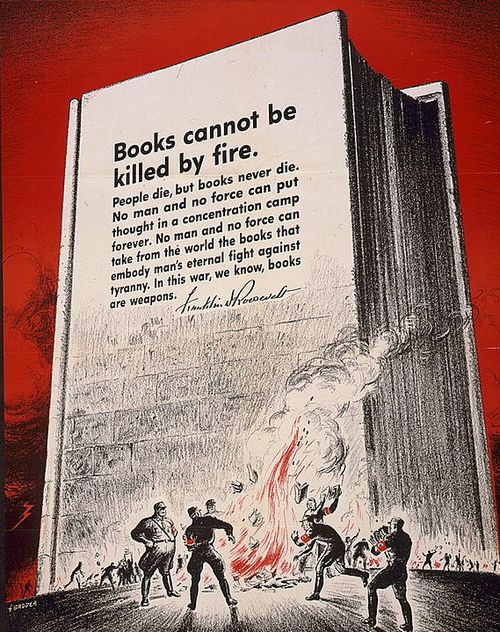
    Books are weaponsWhat struck me today for the first time is FDR’s use of “concentration camp”, which is surprising to me–at least the “me” at my level of understanding FDR and the Holocaust–because when this poster was issued by the Government Printing Office in 1942 Roosevelt had spent very little public time on the issue.  And in the course of the next 24 months or so, Roosevelt had more evidence of the gigantic crimes being perpetrated by Germany but still had very little publicly to say on the matter.  1942 though seems to be early for this sort of statement–and to find it in a mass-produced vehicle like this poster was a jolt. 

    The text on the monolithic book that stand free and tall and immobile in spite of the Nazis in the foreground and their small pyre of burning books:

    • “Books cannot be killed by fire. People die, but books never die. No man and no force can put thought in a concentration camp forever. No man and no force can take from the world the books that embody man’s eternal fight against tyranny. In this war, we know, books are weapons.” –Franklin D. Roosevelt. 1942 (the date referenced from the Library of Congress page on this poster http://www.loc.gov/pictures/item/96502725/   Another post on this blog shows two other variations on this poster:  https://historyofideasblog.com/thesciencebookstore/2014/09/books-are-weapons-in-the-war-of-ideas.html)

    This is a very long story, but for right now it seems a relatively certainty that the situation of the Jews in Germany and the rest of Europe was fairly well known and established within the Roosevelt White House, and even so too to some extent in the popular press. By 1943 there was probably no doubt whatsoever with what was going on–in an example of Roosevelt’s association with the contemporary knowledge of the Holocaust the FDR Presidential Library offers the following O.S.S. document on the destruction of the German Jews:
  • A Non-Imaginary Post about Imaginary Books in Real Books

    JF Ptak Science Books  Post 2685

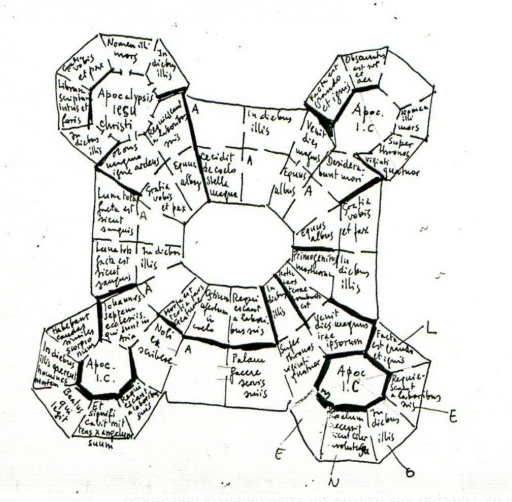
    Eco Library

    [Umberto Eco’s sketch for the imaginary library in his The Name of the Rose, from Digital Architectural Papers, here]

    “To write vast books is a laborious nonsense, much better is to offer a summary as if those books actually existed.”  — Jorge Luis Borges

    I imagined to be reading about the imaginary illustrations of a non-existent book when I wondered about the extent of (intentionally) imaginary books in the history of real books.  It was a quick realization of how deep and how old this genre is–and as a matter of fact one excellent single-stop website that displays this depth is the Librarian of Babel by Emi Hastings  (Catalogues of Imaginary Libraries https://librarianofbabel.wordpress.com/2014/04/25/bibliographies-of-imaginary-libraries/).

    At the outset I thought to write some sort of overview or a little history of the imaginary book, starting of course with Rabelais and then Borges, but there is just so much more than can be accommodated by a simple evening’s work that I decided to simply make a few lists of representative creations by a selection of some favorite biblio-creativists. So, help yourself to some interesting and humorous suggestions by Charles Dickens, John Donne, Francois Rabelais, Marcus de Fable, Douglas Adams, Jorges Luis Borges, Umberto Eco, Vladimir Nabokov, Haited Pleat,  and J.K. Rowling.

    Works invented by Charles Dickens [findable in numerous forms with this list found at http://flavorwire.com/329815/charles-dickens-library-of-fake-books]:

    Five Minutes in China. 3 vols.
    Forty Winks at the Pyramids. 2 vols.
    Abernethy on the Constitution. 2 vols.
    Mr. Green’s Overland Mail. 2 vols.
    Captain Cook’s Life of Savage. 2 vols.
    A Carpenter’s Bench of Bishops. 2 vols.
    Toot’s Universal Letter-Writer. 2 vols.
    Orson’s Art of Etiquette.
    Downeaster’s Complete Calculator.
    History of the Middling Ages. 6 vols.
    Jonah’s Account of the Whale.
    Captain Parry’s Virtues of Cold Tar.
    Kant’s Ancient Humbugs. 10 vols.
    Bowwowdom. A Poem.
    The Quarrelly Review. 4 vols.
    The Gunpowder Magazine. 4 vols.
    Steele. By the Author of “Ion.”

    Works invented by John Donne, Catalogus librorum aulicorum incomparabilium et non vendibilium, or The Courtier’s Library of Rare Books Not for Sale, was written between 16-7-1611, and published in 1650: [http://libraryofinvisible.blogspot.com/2014/03/anonymous.html]

    Edward Hoby’s Afternoon Belchings
    On Distinguishing the Sex and Hermaphroditism of Atoms
    On the art of decyphering and finding some treason in any intercepted letter
    Concerning the method of emptying the dung from Noah’s Ark
    Martin Luther, On Shortening the Lord’s Prayer
    The Princely Ocean, or The Pyramid, or The Colossus, or The Abyss of Wits: where by means of 60,000 letters to the Nobles of all nations … are related everything that is able to be related concerning toothpicks and hangnails
    On the Navigability of the Waters above the heavens, and whether Ships in the Firmament will land there or on our shores on the Day of Judgment, by John Dee
    What not? or a confutation of all errors in Theology as well as in the other sciences, and the mechanical arts, by all men, dead, living, and to be born, put together one night after supper

    The Art of Cutting the Teeth.
    Matthew’s Nursery Songs.
    Paxton’s Bloomers.
    5 vols.
    On the Use of Mercury by the Ancient Poets.
    Drowsy’s Recollections of Nothing.
    3 vols.
    Heavyside’s Conversations with Nobody.
    3 vols.
    Commonplace Book of the Oldest Inhabitant.
    2 vols.
    Growler’s Gruffiology, with Appendix.
    4 vols.
    The Books of Moses and Sons.
    2 vols.
    Burke (of Edinburgh) on the Sublime and Beautiful.
    2 vols.
    Teazer’s Commentaries.
    King Henry the Eighth’s Evidences of Christianity.
    5 vols.
    Miss Biffin on Deportment.
    Morrison’s Pills Progress.
    2 vols.
    Lady Godiva on the Horse.
    Munchausen’s Modern Miracles.
    4 vols.
    Richardson’s Show of Dramatic Literature.
    12 vols.
    Hansard’s Guide to Refreshing Sleep

    Works invented by Francois Rabelais, a selection from  Catalogue of the Choice Books Found by Pantagruel in the Abbey of Saint Victor: Devised by François Rabelais: Translated and Annotated by Walter Klinefelter, a Student of Catalogues (printed in Pantagruel, c. 1532; translated and printed separately, 1952):

    The Spur of Cheese

    The Codpiece of the Law
    The Testes of Theology
    On the Art of Discreetly Farting in Company
    Three Books on How to Chew Bacon
    Martingale Breeches with Back-flaps for Turd-droppers


  • Wood, Metal, Cubes, and Words: a Few Story-Machines since Gulliver’s Travels

    JF Ptak Science Books   Post 2579

    Over time I’ve encountered a number of ventures into the future of the future in which writing has become an automated or semi-automated activity, in their antiquarian constructions being made of wood and metal rather than nanobots and biological bits. A famous example is viewed by Jonathan Swift’s  Lemuel Gulliver in Laputa, where he finds a conversation machine, a vast assembly of word cubes set in a 400 square foot frame manipulated by 40 cranks and 40 handles and run by 40 philosophical operators.  There was also the thinking machine of Raymond Lull (of many different spellings) that was so beautifully address by Jorges Borges (“‘Ramon Lull’s Thinking Machine’ in The total library: non-fiction 1922-1986, on pp 155-160), and numerous others, some becoming steam-driven by the time of the early 19th century, and them others computer-inspired as we get into the Asimov-age. 

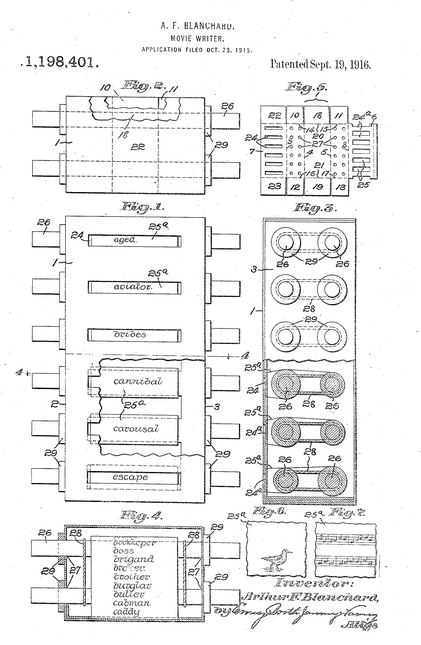
    I was moved to comment on this by a good reference made by Jennifer Ouellette (senior science editor at Gizmodo) to an article by a Gizmodo writer, Anna Green, on Arthur F. Blanchard’s (1865-1953) random story generator patent of 1916.  It is an interesting and lovely thing, lots of words of lots of rollers all working in combination to help formulate a struggling idea in the mind of a writer.  Well, actually, Blanchard writes in his patent description that it was an aid to movie writers, specifically, a kind of idea machine that would help folks with insight into creating a story for a 16-minute tale.  Of course the story might have been a little more interesting had Blanchard made the claim that his ideas for this machine were the product of a similar machine that was lashed together for the production of technical ideas. 

    In this same line of roller-and-paper idea generator I formulated a simple but distinctive device for creating the More Deconstructionist You in “Greasing the Turtle Stack: Derrida’s 10-Second Sentence-Generating Machine” (here)–this would be a fun little generator to make if the outcome wasn’t so useless and pointless, so best leave it as a two-beer bar stool idea.

    Blanchard’s idea seems to be one of the early appearances of word-generators on rollers/cards found in the collection of the U.S. Patent Office.  And so the “Movie Writer” of Albert Blanchard:

    Story machine _e_[Source:  U.S. patent US1198401, 23 October 1915, 19 Sep 1916, Arthur F Blanchard, Movie-writer at Google Patents ]

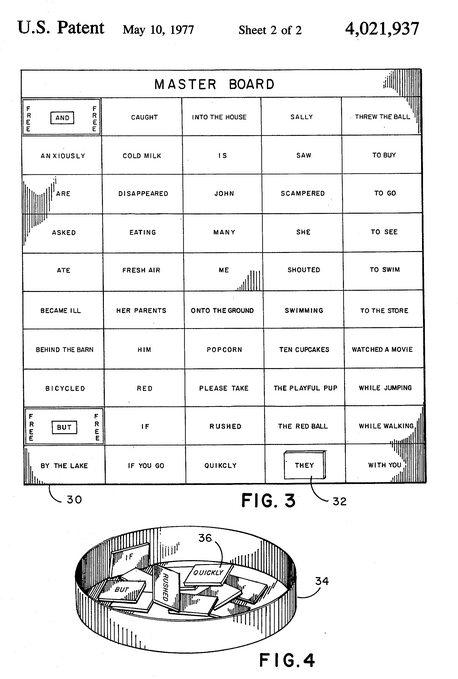
    Later on, the idea–still tried and true, or at least so on paper–came this for the “Educational Game Apparatus”, which was intended again as a spark for creative writing:

    Story machine patent _c_

    [Source: U.S. Patent US4021937, 2 Sep 1973, 10 May1977, Margery Dena Kravitz, “Educational game apparatus”]


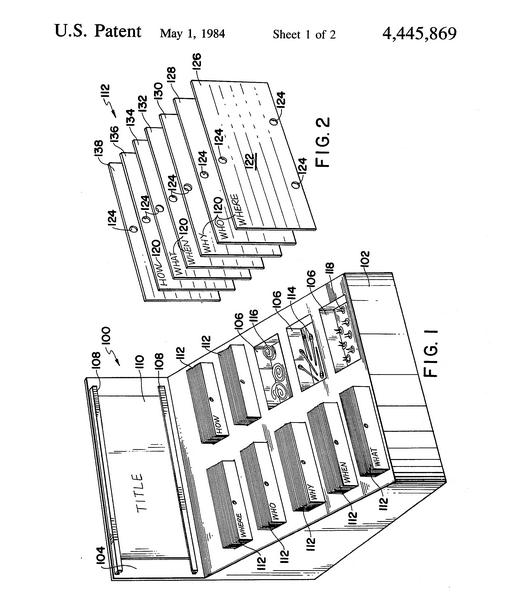
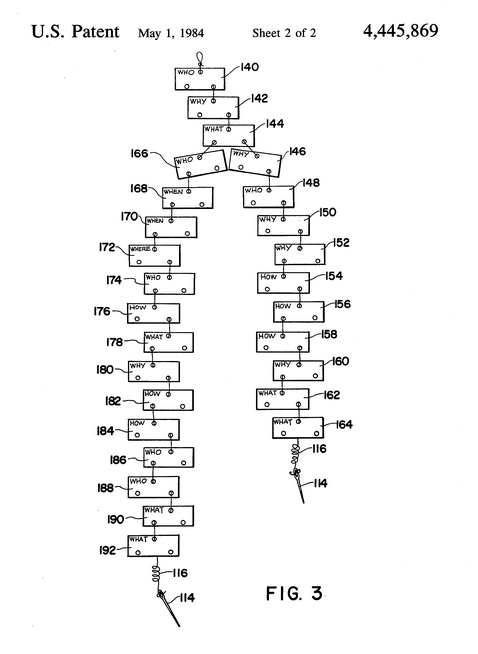
    Still later was this word-o-paper-arranger “Teaching method apparatus”,  a card-based bit that helps jostle ideas by presenting semi-random words to help the student create stories around them:

    Story machine patent _a_


    Story Machine patent_b_[ Source: U.S. patent US4445869     Nov 9, 1981    May 1, 1984, Wasserman Myrna D., “Teaching method and apparatus”.]

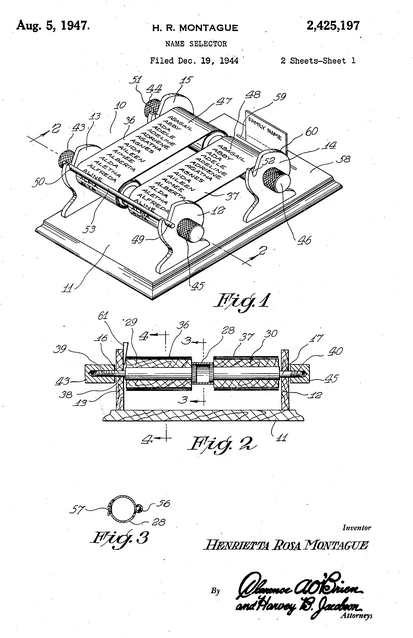
    The “Name Selector” is a simple version of some of what we see above:

    Story machine _d_[Source: U.S. Patent, US2425197 A   Aug 5, 1947, Rosa Montague Henrietta,   Aug 5, 1947   Name selector]

    No doubt there are more of these patents using this idea of single-words-on-bit-of-paper, but this should do for now.. 


  • A Forgotten Company Lost in the Surf of the Television MegaWave (1945)

    JF Ptak Science Books   Post 2577

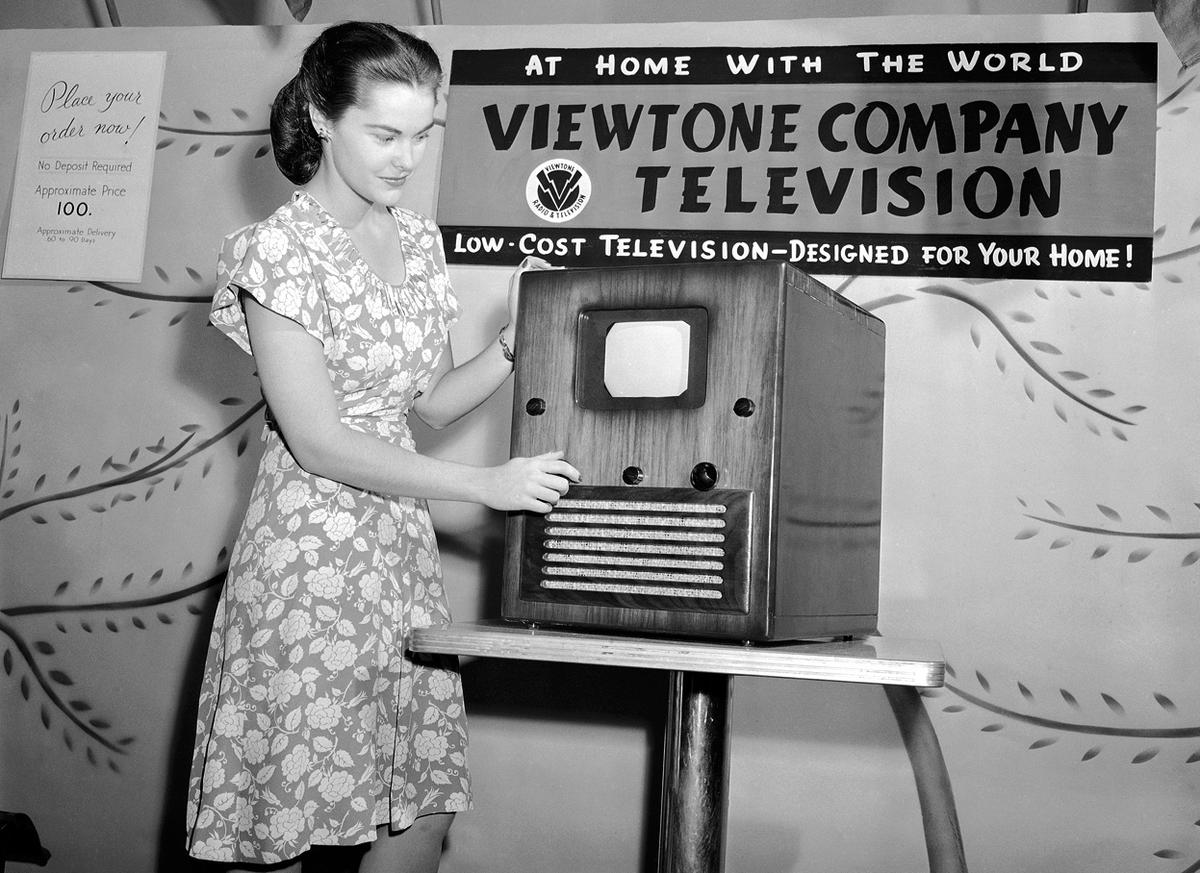
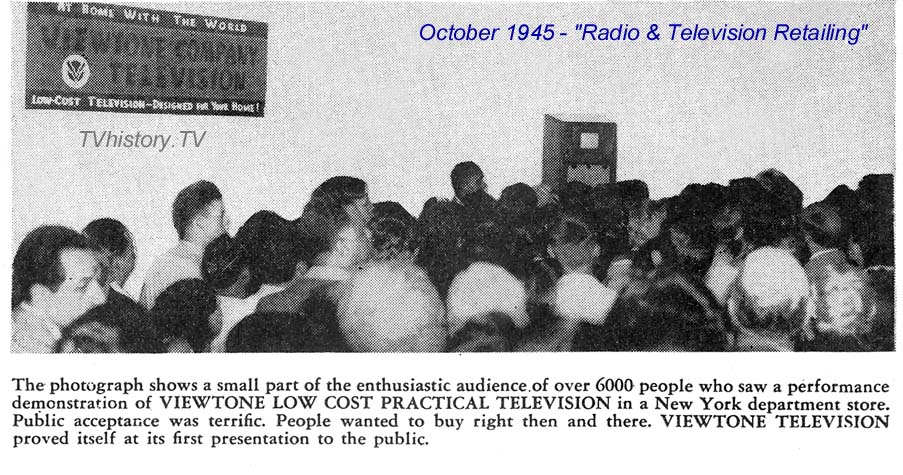
    As much into the future as this demonstration and photograph looked, the Viewtone Company would not be a part of it.  They were offering their TV at a very substantial reduction than would normally be expected in 1945, which perhaps lead to the company disappearing by mid-1947, just before the massive explosion in television ownership. 

    The TV-ubiquity that Viewtone missed out on is now  about 60 years old. In 1949 there were about 3.6 million1 TVs in U.S.. homes; by 1955, the number was 42 million, and by 1959, 67 million. By percentages2, in 1950  9% of U.S. homes enjoyed a television, while just a year later, the number shot up to 23%; by 1955 it was 64%, reaching 87% by the beginning of the next decade, in 1960. In just ten years the television went from being a luxurious oddity to  an essential societal portal. It completely dislodged the massively dominant radio by the mid-1950’s and nearly killed it by the next decade; television continued to thrive, and has accommodated the introduction of the home computer. The TV was able to adapt and strengthen itself, even though the manner in which stuff is put into the television for viewing consumption.

    TV 1945[Source: the Atlantic, http://www.theatlantic.com/photo/2011/10/world-war-ii-after-the-war/100180/]

    It strikes me as a little odd that such a push for a piece of under-priced piece of advanced technology would have such a haphazard display–the floral background standing only about six feet high, quickly hand-painted no doubt, while the television itself was placed on a lunch table–not much of an effort. 

    A few months later there was a public demonstration of what the unit could do, attracting an audience in the “thousands”.  The instrument was well-received, and the cost seemed very low–perhaps that was the culprit that forced the company into producing semi-primitive and not-well-made units and then right into oblivion right on the cusp of the coming TV fantasicalopolis.

    In any event, I just wanted to reproduce the photograph introducing the Viewtone television (above), if for no other reason than its breezy and familiar approach to the introduction of something new and, well, spectacular. 

    TV viewtone demo[Source:TVHistory.tv: http://www.tvhistory.tv/1945-Viewtone-6000-Viewing.JPG]

    Notes:

    1. TVHistory.tv, http://www.tvhistory.tv/Annual_TV_Sales_39-59.JPG

    2. TVHistory.tv, http://www.tvhistory.tv/Annual_TV_Households_50-78.JPG

    ·Posted by :

    ·in:


  • On Playing Dead for a Bucket of Bread: Finding a Way to Cheat the Royal Humane Society

    JF Ptak Science Books   Post 2572

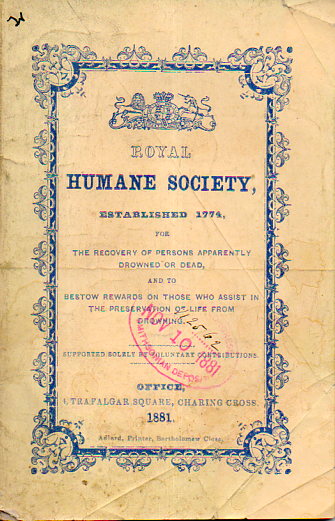
    Royl humane society310One of the great fears of humans throughout history is to be declared as being dead and treated so though alive, in a  death-like state but still breathing and functioning on scales that evaded detection.  And when you think about it a little, what is it that separates someone who you think is dead (from some sort of non-maligning adventure, not being so scarred from trauma as to be absolutely positively dead)  from the same someone who you know is dead?  This was a major issue, especially in the days of pre-stethoscopes. Of course there were physical determinants like checking for a foggy mirror under the suspected’s nose, or doing painful things to the body to make the unconscious not-dead come to life because of the searing pain (extreme tongue and nipple pulling, hot gases up the rectum, scalding the arm of a person in the no-scald/no-life venue, and that sort of thing), but the determination of death was a tricky thing.  So much so in fact that there were popular manias in the late 18th and into the 19th centuries of designing coffins that should the resumed-dead not actually be so that they could either escape or alert people topside.  (The Germans had a tidy late-19th century response to this–waiting houses/corpse halls, attached to a mortuary, where you would place the possibly dead for three days to see if it began to decay–no decay meant life, though by this time someone may have passed on due to injuries or whatever not diagnosed and left to fester for 72 hours…)

    See this related post earlier in this blog,

    • “The Worst Job of the 19th Century? Tongue-Pullers, Nipple-Pinchers & Anal Tobacco Blowers Try to Revive the Dead”, here: https://historyofideasblog.com/thesciencebookstore/2009/10/the-worst-job-of-the-19th-century-tonguepullers-nipplepinchers-anal-tobacco-blowers-try-to-revive-th.html

    The Royal Humane Society (for the humane treatment of humans), established in 1774 by doctors William Hawes (1736-1808) and Thomas Cogan (1736-1818) to prevent certain types of “premature death” and certainly premature burial, and was basically a life-saving society. Their concern was primarily with drowning victims, and their plan was to issue cash payments to those who (a) retrieved a possibly-drowned body, (b) or offered their place of business for the purposes of reviving the drowned, and then of course (c) those who attempted resuscitation  with a further prize if the techniques were successful in drawing life back into the drowned.  

    It should be remembered that swimming was not a common activity, and that very few people actually knew how to swim. Therefore falling into a river or a channel or whatever could pose a much greater risk of death then than it does today.

    The society took its business seriously, offering 

    • “to pay 2 guineas to anyone attempting a rescue in the Westminster area of London
    • to pay 4 guineas to anyone successfully bringing someone back to life
    • to pay 1 guinea to anyone – often a pub-owner – allowing a body to be treated in his house.”–History of the Royal Humane Society on the Royal Humane Society website, here: http://www.royalhumanesociety.org.uk/html/history.html

    And of course during a time when people were making a swift trade int eh sale of dead bodies, the guile of those so thanantologically-inclined stretched to meet the de(ad)man(d)s (sorry!) of the Society, which according to the Royal Humane Society site meant that people defrauded its good interests for private gain. People evidently would feign drowning, and a confederate would feign resuscitation, and the dead brought back to life, the two confidence men sharing a four guinea prize.  In short order the Society dispensed with the cash rewards and went straight-away to medals with ribbon, and thereby removing the profit from the performance of a good deed.

    This was the premature end of a potential income stream for people desperate enough to pretend to be dead for a small cash allowance.  But the Society and all of its good lived on, and evidently lives on today. My little pamphlet picture above was printed in 1881 and is filled with stories of people saved and salvaged, brought back from the edge of death.  (If anyone cares to own this little gem, you may do so and purchase it via this blog’s bookstore.)

    ·Posted by :

    ·in:


  • A Note on the Future of the Future, 1911

    JF Ptak Science Books    Post 2560

    Bloghenard029

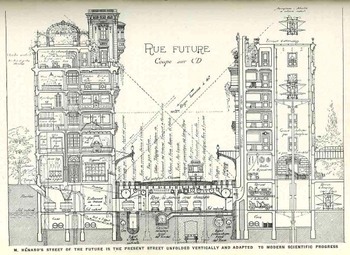
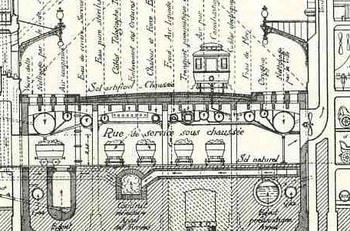
    This  cross section illustration (“Rue Future”/Future Street) is from Eugene Alfred Henard’s1 (1849-1923) article, “The Cities of the Future”, from American City, Volume 4, January, 1911. In this article Henard (architect of the city of Paris and from 1880 a life-long employee and advocate of public works in that city) looks into the future and sees the movement towards underground (or enclosed) vehicular traffic, “smart” buildings, pneumatic tubing for vacuum cleaners (“almost sure to come into general use”), an improvement in the system for water delivery and removal, replacing coal with natural gas, and more. He lays out a plan to implement his idea that, if implemented in the city  of Paris, would cost $420,000,000 (or approximately $15 billion in 2006 money) over 100 years. [This part seems a little off given that the area for public roads alone in Paris at this time was 3,700 acres–nevertheless this was an interesting appearing plan, a significant portion of which has found its way into building and community planning albeit on a far smaller scale].

    Bloghenard029_detail

    Henard was also acutely interested in the future traffic problems of Paris and other major cities, proposing revolutionary radial traffic patterns for moving cars around major metropolitan areas–which was really quite visionary as the mass production of automobiles had not yet really taken place–certainly automobiles were far more common by 1911 than 1905, but their numbers would be vaulted higher int he next decade with the first true approach to assembly line production of automobiles, making them affordable to the millions.  His plan for a ring-lime system around the city of Paris was influential to some of the ideas in the early American planning reports for San Francisco and Chicago by the great Daniel Burnham.

    What is particularly interesting for me in the Henerad plan is the room that he left for his future’s future–he attempted to make his plan adaptable for the time when the future he was writing about was becoming the past.  And so he was leaving room in his underground plans (in particular) to accommodate some of what the future might hold in store for his city, leaving unused spaces and tunnels, so that the city planners in the future would not have to go through the enormous expense of putting these things in for themselves.  Now that is future-forward thinking. 

    Notes:

    1.  Henard studied at the Ecole des Beaux-arts, graduating from there in 1880.  For a decent short bio of the man see the Wiki entry, here: https://en.wikipedia.org/wiki/Eug%C3%A8ne_H%C3%A9nard


  • Killing the Dead Poe, 1849

    JF Ptak Science Books   Post 2534

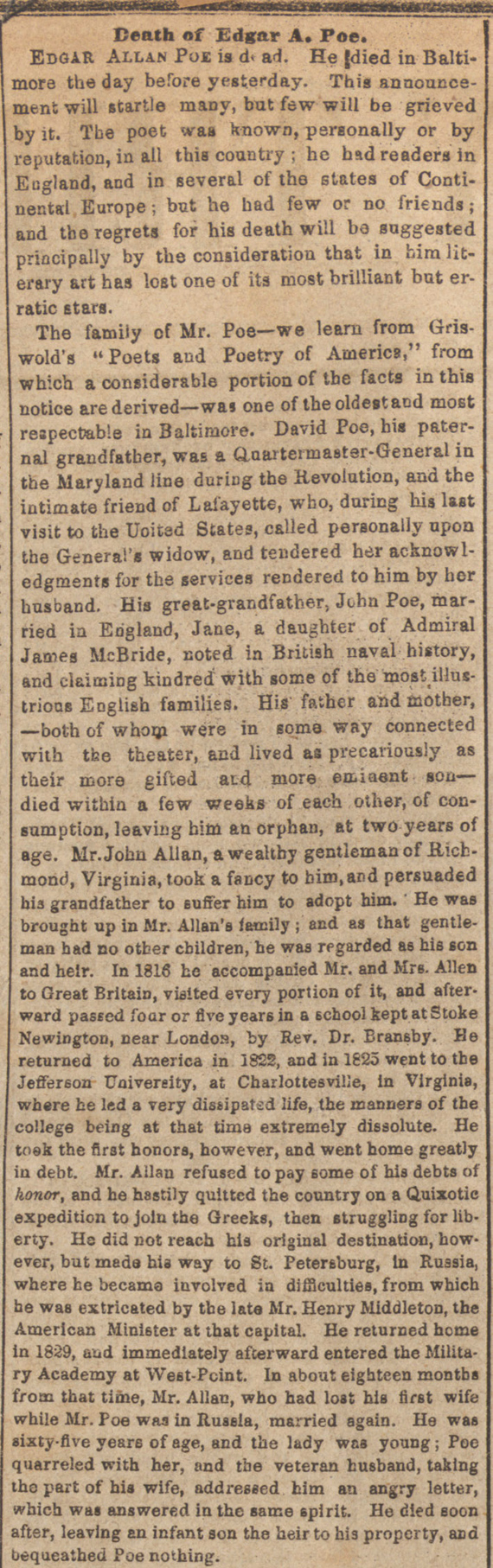
    Carl Sandburg (whose house is about 5 miles from here) wrote a long, light-but-heavy, airy three-volume biography of Abraham Lincoln that is said to have killed the president, again. Rufus Griswold, a once semi-friend of Edgar Allen Poe, became a bitter enemy whose hatred of the man extended pathologically deeply far into Poe’s death.  There are stories of cross-loved interests, and competition over a job, and the biggest (or more representative) thing–Poe’s lukewarm review of Griswold’s genre-twisting collection of American poetry, for which Poe was paid by Griswold, a bribe producing a coercion of Griwold’s work. Poe was evidently never forgiven for that, and probably never forgiven for being legions smarter and far more talented than Griswold–and for all of these real or imagined ills Griswold drove a stake through Poe’s eye in this very nasty obituary.  It was signed with a pseudonym, but it was soon discovered that Griswold was the author.  

    The obit is a diatribe, pure and simple, a revenge piece that pulled Poe from his grave and killed him again. You can tell that the long column will cleave Poe in two by the end of the second and third (short) sentences: “He died in Baltimore the day before yesterday. This announcement will startle many, but few will be grieved by it”.  You know at that point that whatever comes to follow will offer a rough ride, which indeed it was.  There’s a lot of stuff about his personal life, including a long an meandering section on his stepfather—and not one mention of anything that he wrote.  

    Griswold clawed his way into the heart of Poe’s remains like a meth addict tracking down a ten dollar bill under a soda machine, and proceeded to defame Poe and his life via forged letters, and thus creating Poe the madman/street-crawler/drug-addicted alchie who was a friendless and betraying  and brutal to anyone he knew. It took a while for Griswold’s crimes against Poe to be uncovered, but the damage was done, and life force thief Griswold was safely tucked into his own dirt nap.  No one deserves that sort of treatment, least of all Poe.  In the end the truth was outed, with Poe recognized as himself again, with Griswold becoming the pathological necro-killer.  

    Poe obitt


    [Image source: Awesome Stories,  https://www.awesomestories.com/asset/view/Poe-Obituary-by-Rufus-Griswold, reprinting the obit as it appeared in the New York Tribune, October 9, 1849.]


  • When Did Kids Start Saying “Dada” And Mean it as Art?

    JF Ptak Science Books (Updated and enlarged Archive Post)

    I guess “Dada” and not “da da” came a little before MoMA–one is from the 19-teens and the other 1929. ()I know this is a horrible joke but I’ll never have a chance to use it again…)

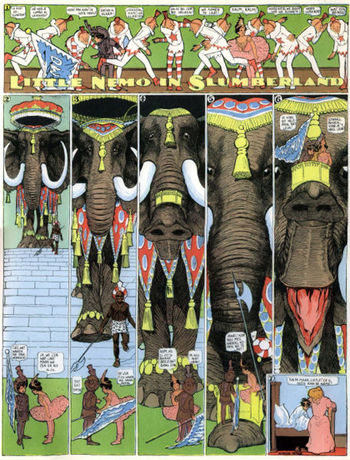
    In a sub-sub-sub category of the sub-category of “Books that I Want to See” comes Dada-ist books for children, and less loosely, modernist books for kids.  Or students.  I’m not sure how close I can define this field because, well, I know basically nothing about it, but I am interested in how long it took for the bits of created modernism (1895-1915 or so) to reach the level of publications intended for children.  And by Modernism I’m talking about the epochal changes in nearly all disciplines brought about by people like Einstein, Ibsen, Klee, Kandinsky, Braque, Stravinsky, Woolf, and so on. Blogdadanemo

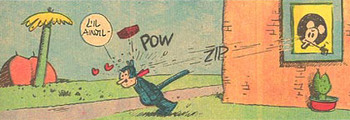
    I’ve started thinking about this in Europe but the first thing that comes to my mind is Little Nemo (and Dreams of the Rarebit Fiend too, while we’re at it), the fantastic creation of Michigan-born (Ypsilanty-schooled) Windsor McKay (1867-1934), which I think is definitely modern but not at all necessarily related to Dada, and which came to life in the miracle year of 1905.   McKay just happened to be years above and away from whatever his contemporaries were doing.  No one came close to McKay, in my opinion, until Ignatz picked up his first brick, and George Herriman drew Krazy Kat for the first time in 1913. 

    Blogdada_herriman

    Still skirting the Dada part, I’d love to see Konvolut von 14 russischen Kinderbuchern der Jahre 1930-32, a spectacular constructivist work aimed at children and from what I can see is a treasure trove of  Malevichian insight. 

    Blogbooks_wantdebussy
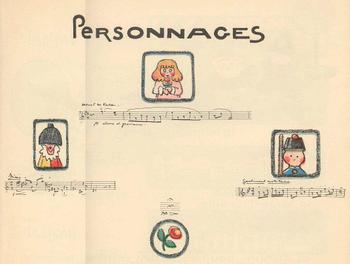
    Andrew. Helle’s La Boite a Jouhoux, (“The Box of Toys”) Ballet pour enfants (Paris, 1913), is a beautiful composition, a modernist construction, using the idea and artwork of illustrator Helle and the music of Claude Debussy.  The score is witty and has a very light touch, Debussy pleasingly borrowing from himself and his friends in a work partly inspired in a Milneian way by 7-year-old Chouchou Debussy (and her toys and dolls).  It’s a beautiful work that I’d love to have in my hands.

    Blogbdad_kid_debussy294

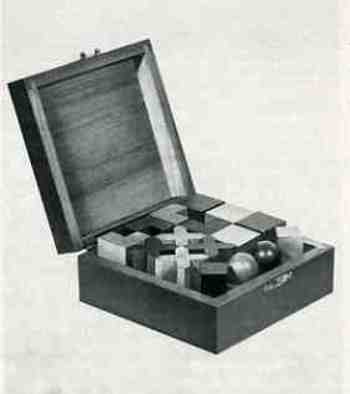
    Another magnificent-looking object that I’d like to see is the box wooden Bauhaus-inspired shapes, pictured in Junge Menschen kommt ans Bauhaus//Werbeprospekt, published in Dessau in 1929 and featuring work by Klee, Kandinsky, Albers, Ridel and Meyer.  The well-made box of shapes is to die for, and it seems as though it offered new geometrical toys/tools  for the inquiring mind in the last year of the ‘twenties.

      Blogbooks_wanted_kids291

    But I’m no closer to Dada for kids than at the beginning of this post, hoping as I was that something might shake loose if I thought about it some.  Its an interesting question to me, and I’d really like to return to it when I actually know something. 


  • What Poison Gas Warnings Sounded Like, WWI

    JF Ptak Science Books    Post 2564

    I posted this thinking that I had never heard the sound of a gas warning siren–or any other noise-making instrument–signifying the onset of a poison gas attack during WWI.  So I went poking around the web, looking for an audio recording of one.  I did find contemporary audio of an antique instrument–this was a dreadful sound, sounding somewhat like a high-pitched pulse-jet engine.  It is an awful sound (linked below) though I am sure that it did its job very effectively.  

    I haven’t yet found a contemporary recording, though I’ve got a notion that if no audio recording was made for training films and such that they may exist in movies.  

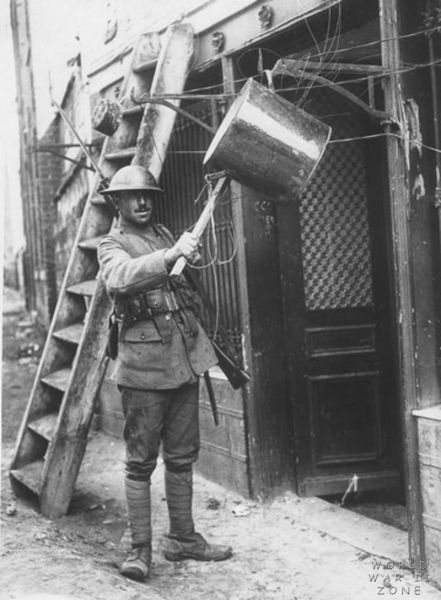
    Sirens of course was one method of alerting troops to a gas attack–there were also bells of all shapes and sizes, and kettles, wooden clappers, rattles, empty shell cases, and other such things. 

    Here’s a compelling image of conflicting emotional input, this showing a kettle with a clanger attached by a wire:

    WWI Project gas alram kettle

     [Source: http://worldwartwozone.com/forums/index.php?/topic/8851-cloud-of-terror-gas-warfare/]


  • Fantastic Stadium-Seating Skyscrapers: Imaginary New York City, 1938

    Imaginary New York City Landscapes from CON-ED, 1938

    JF Ptak Science Books  Quick Post   

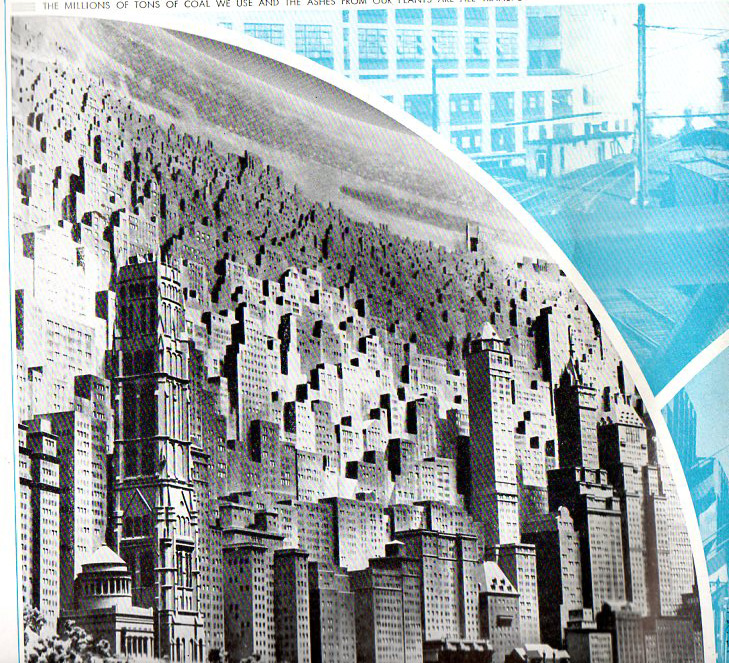
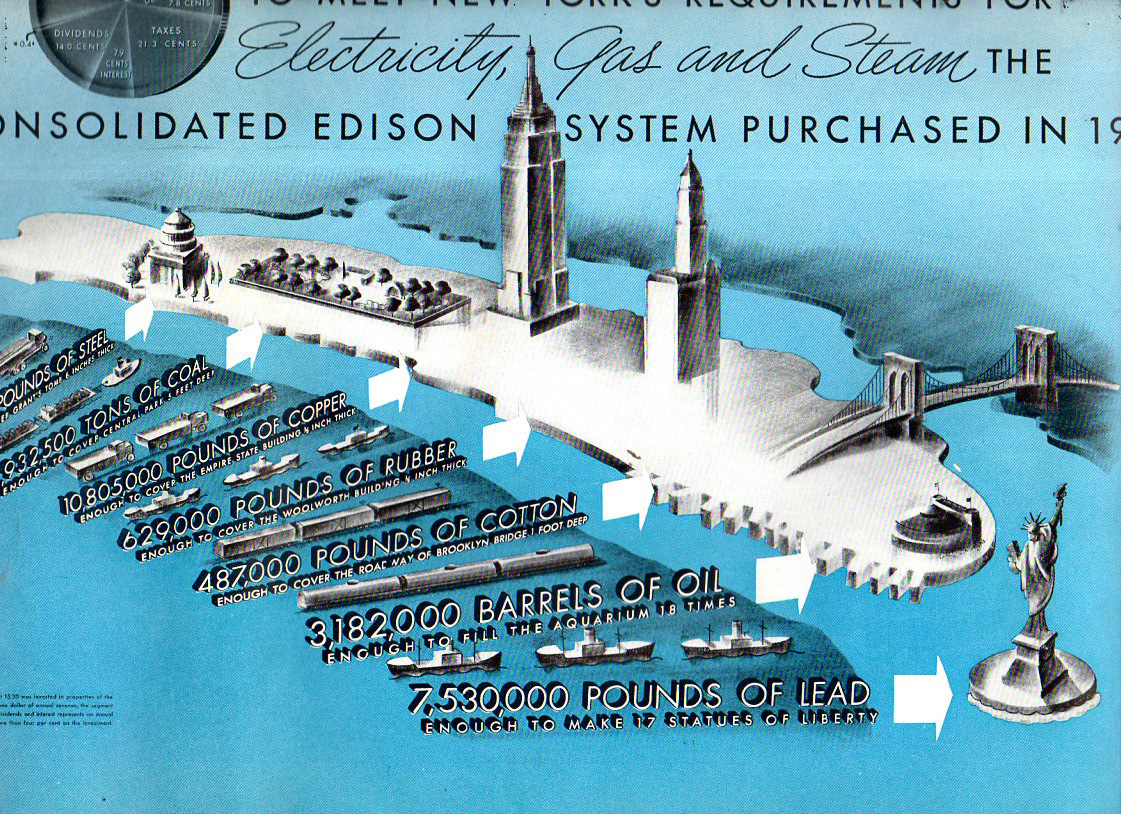
    These lovely images are found in a long, shining and slightly darkroom-scented The City of Light, which was a pamphlet made for the Consolidated Edison exhibition at the New York City World’s Fair of 1939.  Con Ed I think just wanted to get the point across that they saw into the future and were getting ready for it, NYC being stuffed to the gills with buildings and each window stuffed and outlined in Con Ed-supplied electric light.  The vision is vaguely threatening to me, though, the buildings are drawn in a very odd perspective giving the city a stadium-seating arrangement that is unsettling, like they’re part of our robot-overlord future–someone or something must be living in those room filled with Con Ed light, though…

    Nyc544

    Nyc547
    Nyc548
    Nyc546