A Daily History of Holes, Dots, Lines, Science, History, Math, Physics, Art, the Unintentional Absurd, Architecture, Maps, Data Visualization, Blank and Missing Things, and so on. |1.6 million words, 7500 images, 4.9 million hits| Press & appearances in The Times, Le Figaro, Mensa, The Economist, The Guardian, Discovery News, Slate, Le Monde, Sci American Blogs, Le Pont, and many other places… 5000+ total posts since 2008.

Category: Alphabets

  • Action Alphabet and a Touch of Evil, 1879

    JF Ptak Science Books  Post 1105

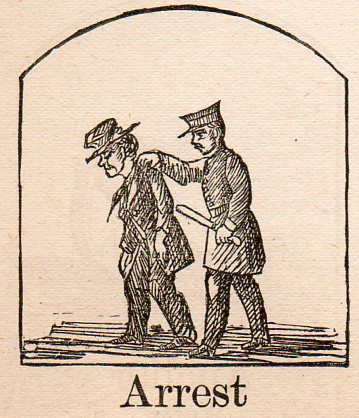
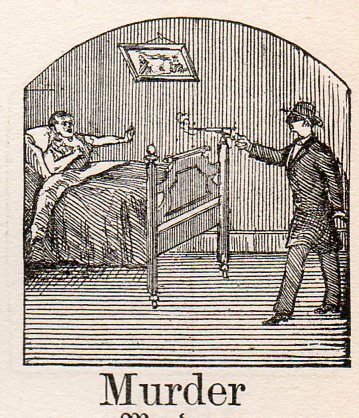
    Alphabet germ--murder298 Following yesterday’s two posts on Occupational Alphabets comes this “created” action-alphabet of late 19th century.  The source is Kantner’s Illustrated Book of Objects and Self-Educator in German and English, a self-teaching book for German vocabulary, published in Pennsylvania in 1879.  The woodcut images used to illustrate each word are fantastic, and occasionally stunning, sometimes unexpected illustrations of forgotten objects and actions.  All I’ve done is select some of the words for use as an Action Alphabet. (I failed though to provide a full alphabet, missing the letters i, u, v, x, y and z.) 

    The woodcuts appear here larger-than-life than their humble inch-square origins, and may take away a little from their mystery…or add to it.  They have an odd noir-ish, Wellesian feel to me, somehow, their tiny frames exciting a funny hankering for Kane or Macbeth or Touch of Evil, something I can’t quite understand.  Maybe it is just a happy confusion, looking too hard at too many small images, like discarded film clips on a cutting room floor, and imaging trademark deep focus bits from a famous filmmaker.  In any event, they do have their own style–perhaps tomorrow I’ll cull out the Dadaist Alphabet from their brethern.

    Alphabet germ--arrest297


  • Occupational Alphabet 2, ca. 1844

    JF Ptak Science Books   Post 1104

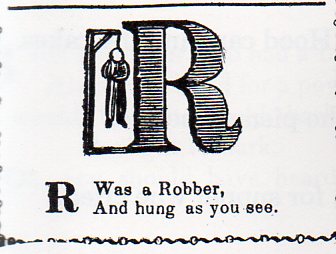
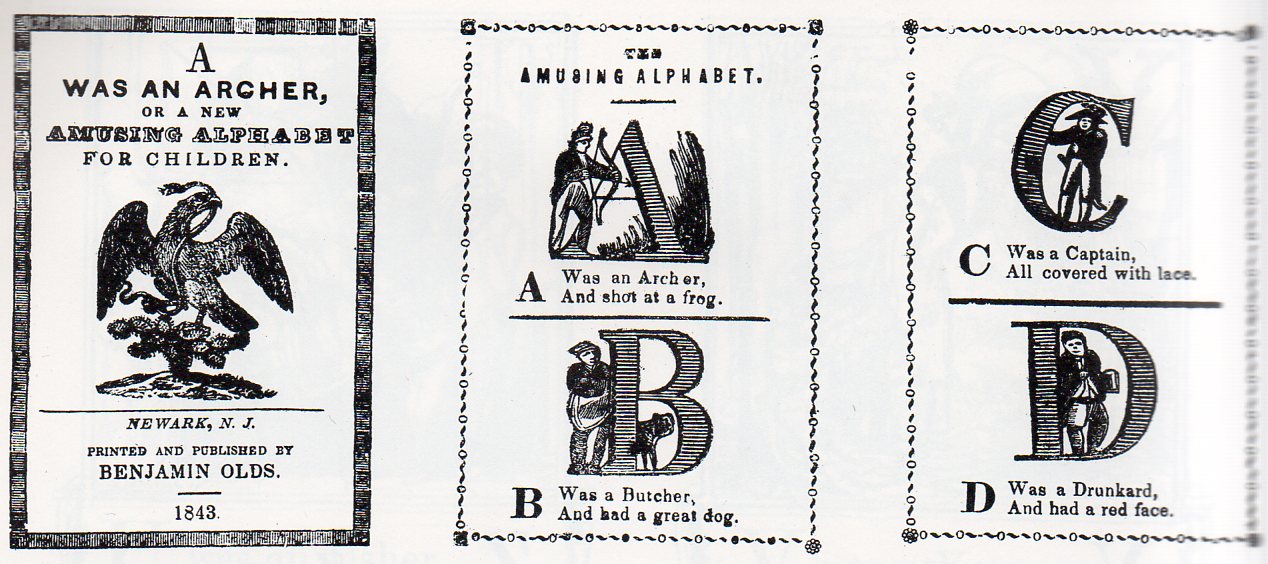
    Alphabet 2-robber280 Following yesterday’s “Occupational Alphabet” post comes A was an Archer, or a New Amusing Alphabet for Children, published in beautiful Newark, New Jersey, in 1844.  10 centimeters tall, this little 16-page pamphlet introduced children to associative memories of alphabets and occupations, accompanied by a rhyming couplet displaying a low quality of half the joined occupation. Thus, “Q” is for “Queen” but “of the lowest degree”. 

    And so:

    The Archer shot at a frog; the Captain was covered with lace, the Esquire had an insolent brow, the Gamester had ill luck, and so on.  It is interesting to note that the Robber was hanged for theft.

    Alphabet 2--a-c275


  • Occupational Alphabet, ca. 1850

    JF Ptak  Science Books   Post 1103

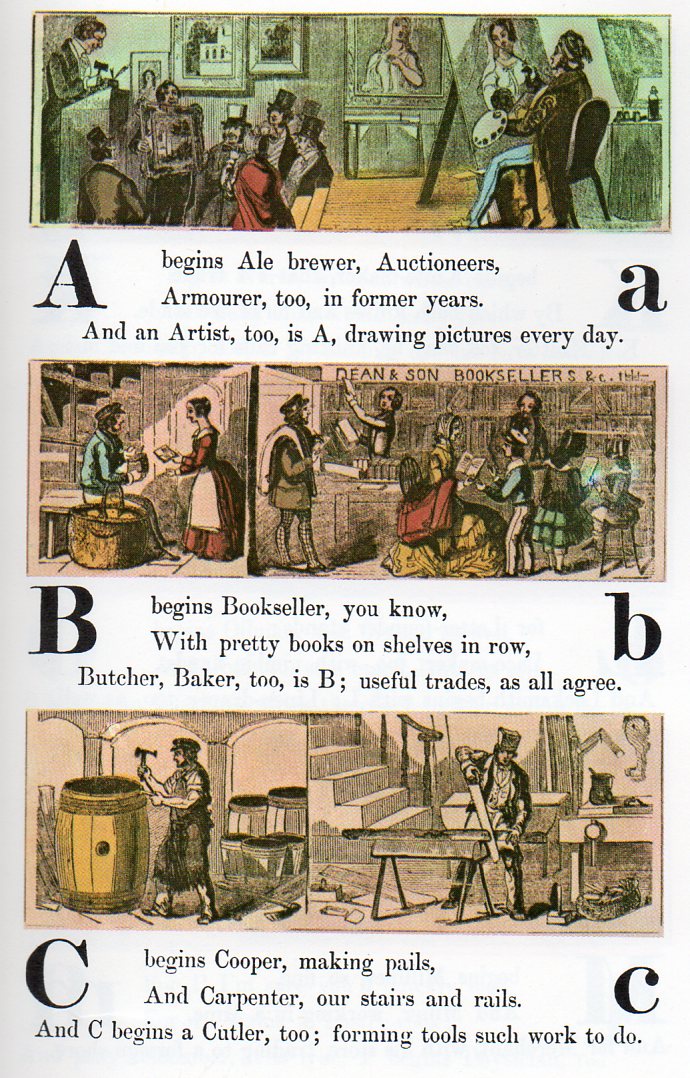
    Its interesting to see what jobs have survived over the years, and what jobs haven’t–particularly those jobs that would have been so widespread and popular that they would be instantly recognized by a child–so much part of the common culture that the initial letter of the job’s name could be used to help children learn the alphabet.

    Alphabet jobs a-c267

    In this version of commonplace employment found in a child’s alphabetical primer of ca. 1850, lists the following professions, most of which are still available for hire: ale brewer (especially here in Asheville, Beer City USA);auctioneer, armourer, artist, bookseller, butcher, baker, cooper, carpenter, cutler, dyer, dairyman, engraver, engineer, fishmonger, fiddle(r), florist, grocer, glazier, hatter, hawker, horse dealer, ironmonger, jeweller, knife-maker, knitter, letter-founder, lace-maker, locksmith, milliner, miner, merchant, nurse, newsman, oilman, optician, omnibus, pastry-cook, physician, rope-maker, rider, shoemaker, shipwright, scavenger, slater, surgeon, sawyer, saddler, tailor, turner, tanner, tinker, upholsterer, vintner, wharfinger, wax-chandler, yeoman, youth, zoologist.

    continued below with FULL ALPHABET:


  • Things that Are and Aren’t Dept: the Names of Colors


    JF Ptak Science Books                                          Part of the series Naming Things

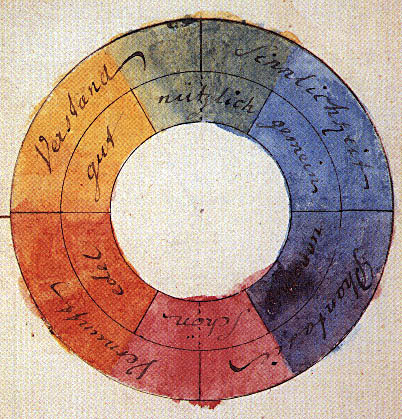
    GoetheFarbkreis

    (Almost) in the beginning were monsters.  The epic battle that Moses wages early on is not with Pharaohs, but with the dragon(s?) that the creator itself had fought on the opening whisper of creation (Book of Job 26:12, Psalms 89:10) and who would again meet at the very last bits of the closing days.  Behemoth, Leviathan, Rehab may all well have been monsters to these ancient folks, but they very well might look like rhinoceros or crocs or hippos to us.  Monster demons like Rehab (Psalm 87:4), a slaughtering beast who would be reintroduced to a different part of the world as Tiamar who would or could also be known as the Red Sea,  lifted straight from Mesopotamian mythology and placed directly into that of the Old Testament among the rest of the borrowed stories and beliefs, a problem by any other name.

    Following names and their cyclonic twists, and absences and sudden  re-emergence through the history of storytelling is dizzying—just consult your Robert Graves on myths  if you want to have  your memory plumbed (the great poet and writer doing not such a poetical or writerly job in this effort in my opinion though most people love it).  Keeping an eye on the mix and mash of gods and goddess and associated super beings from thousands of years ago, the god of the Old Testament makes it very clear and precise about just who he is in his self-introduction to Moses:  “I am the God thy Father, the God of  Abraham, the God of Isaac, and the God of Jacob” (Exodus 3:6)

    Equally almost in the beginning, again so far as the Bible is concerned, are colors—before that maybe everything was black and white, or just white, or maybe just black, depending on your epistemological concept of everythingness or nothingness.  (It looks like green may be the first color mentioned in the bible, (Gen 1:30 And to every beast of the earth, and to every fowl of the air, and to every thing that creepeth upon the earth, wherein there is life, I have given every green herb for meat: and it was so) though the mixing up of meat and veggie is a little confusing to me.))

    Over the years color names themselves have creepethed among themselves like a vocabularic ocean, a fluid dynamic of naming.  Names have flowed across their individual spectra, some names sticking, some not; the originator of the concept of the naming of “red”, the original namer of the color, lost to the earliest and deepest part f the collective human memory.

    I don’t know where many of the names of colors come from, or why.  Index to Color Names and Color Numbers of the Standard and Season Color Cards of America (published and created by the Textile Color Card Association), and published in 1923, is filled with color names whose meaning and origin are a mystery and whose necessity seem to hinge on sunspots.  Which is fine, though it might be interesting to have had color names more dependent on that which went before. Like the names of the streets on most of Connecticut Avenue in D.C. are alphabetical, and once the first 26 letters or so are monosyllabicly employed, the second set starts with two syllables, and then three.  It is a system that usefully indicates where long the long avenue you might be. It might be useful to employ such a method in color names; or not. 

    And I suspect it would be “or not”, unless the poetry and art and music inherent in these formulations would be imaginatively employed

    But on to the color names:  Ambulance, Basketball, Bosom,  Cowboy,  Squirrel, Chit, Old, Nymph, Old mephisto, Pelt, Racket are examples of some of the mystery colors.                             

    Some names which were part of institutionalized racism I’m sure are now gone:  Arab, Negro, African; Bagdahd (?), Bombay Brown,  Coolie Yellow, Coolie, Congo Brown, Egyptian Husk, Hankow (yellow), Kyoto Yellow, Korea Yellow, Mandarin Yellow, Punjab Brown, Kafir, Tar Baby.

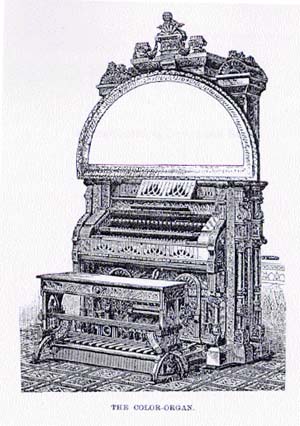
    Colororgan But I’ve got to say, even though the names may not have much to do with the colors, most of the names in the pamphlet sound quite lovely, and many are yummy: London Smoke, Log Cabin, Leadville, Madonna, Naked, Pitchpine, Pompeii, Prelate, Smoked Pearl, Swamp, Lucky Stone, to name a few. Overall I doubt that this is what Newton, Goethe, Chevreul, Rood, Maxwell and the rest had in mind when they were figuring out what color *is*, but I do think that all of them had large enough poetic natures (Newton the weakest and Goethe by far the strongest) to appreciate the occasional beauty of naming.  The unbelievable Shakespeare seems not to have spent that much time on color (so far as I know, and I don;’t much about the Bard), but (in a dear-sweet-god understatement) other people did:  people like Richard Feynman synesthesically thought in mathematical color terms, others created musical  instruments which would produce color from music while most of the rest of the world produced music which conveyed color, and on and on.  And then of course there’s the whole world of art.

    But I won’t go there now–I just wanted to follow this loose thread in what seemed to be a pretty inert pamphlet–in the end it opened itself to a lot of possibilities with just a little thinking. 


  • Specialized Vocabularly: Hobo Slang 1939

    JF Ptak Science Books Post 304

    1blog_oct_8_hobo_cvr785
    There have been many Kings of the Hobos, and Emperor of the Hobos, in the history of American Hobodom.  The most widely recognized of all this royalty is, probably, Mr. Jeff Davis, who was elected King of Hobos each year from 1908 to 1935, until in 1935 at the Pittsburgh meeting of the annual “Hobos of America” his minions gave up elected him King for Life. Of hobos, that is, the Knights of the Road; he was also a real hobo, unlike the pretenders, who in general were not. (Nels Anderson in his Men On The Move, written just as the Depression was broken, (1940) observed: “Whatever else may be said of King Jeff, his romanticizing the hobo is not without a basis in reality, and his poetic interest in the species arose from experience. But King Jeff has placed on a pedestal a man who belongs to the past. The hobo belongs with the pre-Hollywood cowboy and the lumberjacks of the Paul Bunyan legends.”)

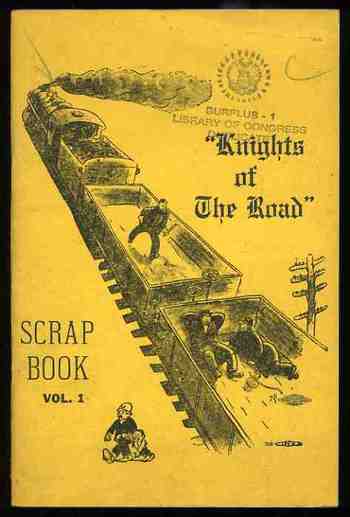
    Mr. Davis was certainly very effective in getting the message out—on freedom and responsibility to irresponsibility—and was a great organizer and popularizer. He helped to establish hobo meetings, newspapers and literature (a sample of which is at left). He also had a few movie appearances: in The Arkansas Traveler, 1938 and The Bridge of Sighs, 1915, he ably played the role of a hobo.


    And what about the missing counterpart of Jeff Davis–the Queen of the Hobos? There were certainly allot of women hobos during the Depression; Harry Hopkins estimated that there were something like 13,000 “sisters of the road” who were out and about in the 1930’s. I guess the most famous of them though was one who did not exist; and what parts of her that were real were mostly those of one man: Ben Reitman. Sister of the Road (1940) was supposed to be an autobiography of legendary Boxcar Bertha, but it was really an assimilation of Reitman’s own experiences sprinkled about those of women from his life. Reitman, who was described (by himself) as a “hobo, whorehouse physician, musician and tour manager/lover of Emma Goldman” (??) was probably not without enough experiences to float another character or two, had his story of Bertha wind up in the hands of exploitation movie maker Roger Corman. The good news about that though was that Corman gave the project to the very young Martin Scorcese who produced an odd and not bad film on no budget, and Boxcar got to live again.

    1blog_oct_8_hobo_cvr786

    But what brought me here to begin with was Davis’ breakdown of some very colorful hobo slang, all of which was found in the little yellow pamphlet (pictured above), and published as a “reference manual” in 1947.  And so:

    Gay Cat. Someone who “beats it from town”, settles down with a job and puts together some money so that he can get on the road again.

    Gandy Dancer. “Is a hobo shovel stiff, a muck-stick artist”, a common laborer

    Pearl Diver. A hobo dishwasher and who works for his meal.

    Mush fakir. A hobo umbrella mender with a patch kit and a second-hand umbrella strapped to his back. (Evidently these guys were put out of business when larger stores began offering umbrella repair on their own.)

    Bindle stiff. A hobo who carries his stuff in a sack on a stick, including toothbrush, “but he does NOT carry blankets”.

    Kywah. An honest hobo pitchman peddling soap, perfume, jewelry, novelties, pens, knives and potatoes peelers.

    Kewah. :Makes and sells articles such as willow stands…”

    Scenery Bum. “A young tramp who bums it around the country, just for the fun of it.”

    Ring-tail. “An ignorant, harmless tramp.

    Fuzzy tail. “A smart aleck tramp, jack of all trades, a fourflusher, big bluff, false alarm, and piker of the worst sort, who most always carries a “punk kid” or “road kid” (a runaway boy).”

    Dingbat. “An old tramp professional beggar who dings the main stem (begs on the main street).”

    Stew bum. “An elderly tramp who wastes his time continually drinking rot booze.”

    Jungle Buzzard. “A tramp who loves to eat but is too lazy to get the ingredients for a mulligan stew. He eats what is left when the gang leaves the jungle fire.” Yum.

    Road Yegg. “A vicious tramp of the petty larceny type, a cheap crook.”

    I like the collection—it has a high color, not terrible low cant at all.

    Notes:

    A Few Books on the History of Hobos:

    Allsop, Kenneth  Hard Travellin': The Hobo and his History. 1967.
    Black, Jack.  You Can't Win. 1926.
    Bruns, A.  Knights of the Road. 1980.
    Davies, W.H.  The Autobiography of a Supertramp. 1929.   
    Drew, Betina. The Texas Stories of Nelson Algren. 1995.
    Etulain, Richard W.  Jack London on the Road: The Tramp Diary and Other
    Writings. 1979
    Flynt, Josiah. Tramping With Tramps. 1969 reprint. 
    Flynt, Josiah. My Life. 1908.   
    Graham,  "Steam Train" Maury   Tales of the Iron Road: My Life as King of the
    Hobos. 1990.
    Kemp, Harry.  Tramping On Life: An Autobiographical Narrative, 1922.
    Kerr, Lenox.     Back Door Guest [Foreign Travelers in America
    1810-1935].  1930
    Kromer, Tom.  Waiting for Nothing. 1935.   
    Monkkonen, Eric H. Walking To Work: Tramps in America, 1790-1935.
    Ormser, Richard.   Hoboes.1994.
    Tully, Jim.  Beggars of Life: A Hobo Autobiography. 1924
       
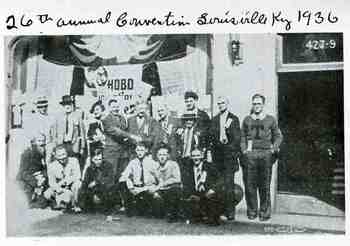
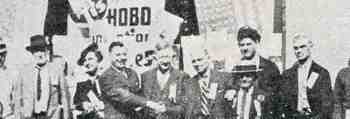
    And, by the way, this detail of the photo in the Davis book for the 1936 Hobo meeting in Kentucky--
    where, exactly, are the hoboes?  these people look pretty middle class.  And who is the lady?

    1blog_oct_8_hobo_cvr787

    ·Posted by :

    ·in:

    — —

  • Punctuation and its Elimination: Spongebobian Sentence-Enhancers and a Pickle for the Knowing Ones (1847)

    JF Ptak Science Books  Post 191 (expanded)

    I’ve made several posts about Blank and Missing People which seem to me—having had long exposure to images over the last 30 years—to be quite unusual in the history of popular-published prints.  This may actually be a simple corollary to a wider category of Blank Things, or Missing Things.  Like Dark Matter.  Or white, open, blank spaces on early, honest, maps. (And this may be part of another larger story on The  Spaces in Between, (a concept in German known as Zwischenraum), but that’s another story, identifying where the missing stuff might actually “be”. 

    Right now though I’d like to address blank spaces in literature.  It is surprising to me that in Google searches that “blank books” and “blank literature” and “books without words” (once you remove all of the hits for new diaries and new artists’ notepads and such) direct you to graphic novels.  This category hardly strikes me as being “blank” as the art and action more than accommodate the absence of written words.  (And by the way the graphic novel seems to be a fairly new invention—perhaps the work of Frans Masereel and Rockwell Kent in producing sequential, worldess books were among the first of their genre when they were published in the mid-1920’s?)

    Blank literature doesn’t mean hollow literature.  In one skinny example James Fenimore Cooper’s writings may be a little translucent and a little empty, but they aren’t blank. (Twain ripped Cooper on this point, cursing Cooper for using a bagful of woodsy woodsmen tricks to drive his story when he should’ve been writing, and not waiting for them to fill up the spaces of his missing narrative: “in his little box of stage properties he kept six or eight cunning devices, tricks, artifices for his savages and woodsmen to deceive and circumvent each other with, and he was never so happy as when he was working these innocent things and seeing them go…(another) favorite stage property that he pulled out of his box pretty frequently was his broken twig.  He prized his broken twig above all the rest of hi effects, and worked it hardest…”

    An excruciatingly direct example of the worldess book  is a remarkable, hoaxing or perhaps just simply demented set (!) of books by Timothy Dexter (Newburyport, Massachusetts).   Dexter wrote a semi-incompressible work called A Pickle for the Knowing Ones, which followed his own logic, sentence structure, vocabulary and spelling. It was also printed and published without punctuation.  In one sentence. (A sample is found below in the continued reading section.)  I think that it is interesting in that someone did it and that it exists and that it was printed in 1802, but aside from that I find little comfort or twisty inspiration from it.  His second edition of that work though is much more interesting, not so much in that it continued ((?), I use that word loosely) the shredded intellectual threads laid out in the first edition; it also contains one page of what I think of as a blank book:  the missing punctuation marks from the first edition.   

    Well, not ALL of the missing punctuation, but enough, in the mind of Dexter, to silence some of the complaints of the more faint-hearted readers of his one-sentence, non-punctuated, made-up vocabulary of the first edition.  He at least provides the punctuation–separately–in case a weak reader needed some: 
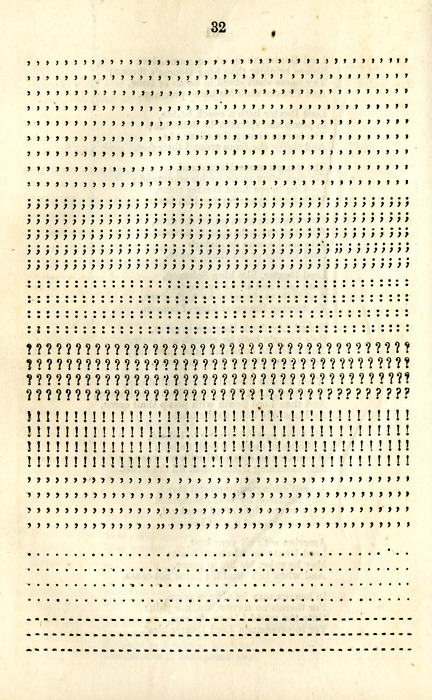
    Pickle for knowing ones

    [Image from a good treatment of Dexter at http://northofboston.org/north-of-boston-historical-figures-a-pickle-for-your-thoughts/]

    He writes “Fourder mister printer the Nowing ones complane of my book the fust edition had no stops I put A nuf here and that may peper and solt as they please.”

    That’s much in the spirit of Spongebob Squarepants and Patrick Star when they “discovered” the use of swear words and curses, which they figured had no meaning except as a sort of comfrot food to be sprinkled in conversation for flavoring–“sentence enhancers” they called them, without knowing (of course!) that their sounds were more than simple garnishes and intellectual punctuation.  

    As follows (please consult http://www.lordtimothydexter.com/the_holl_pickle.htm for a full transcription of the Dexter work–the author of the site also transcribes the Dexterian-speak into plain English, which was no doubt a labor of love): 


    ,,,,,,,,,,,,,,,, ,,,,,,,,,,,,,,,,, ,,,,,,,,,,,,,,,,, ,,,,,,,,,,,,,,,,,,, ,,,,,,,,,,,,,,,,,

    ,,,,,,,,,,,,,,,, ,,,,,,,,,,,,,,,,, ,,,,,,,,,,,,,,,,, ,,,,,,,,,,,,,,,,,,, ,,,,,,,,,,,,,,,,,

    ……………. ……………. …………….. ………………. ……………..

    ,,,,,,,,,,,,,,,, ,,,,,,,,,,,,,,,,, ,,,,,,,,,,,,,,,,, ,,,,,,,,,,,,,,,,,,, ,,,,,,,,,,,,,,,,,

    . . . . . . . . . . . . . . . . . . . . . . . . . . . . . . . . . . . . . . . . . . . . . . . . . . . . . . . . . . . .

    . . . . . . . . . . . . . . . . . . . . . . . . . . . . . . . . . . . . . . . . . . . . . . . . . . . . . . . . . . . .

    …………………………! ! ! ! ! ! ! ! ! ! ! ! ! ! ! !………………………..

    …………………………….. ! ! ! ! ! ! ! ! ! ! ! …………………………..

    …………………………………. ! ! ! ! ! ! ……………………………….

    ………………………………………!……………………………………..

    . . . . . . . . . . . . . . . . . . . . . . . . . . . . . . . . . . . . . . . . . . . . . . . . . . . . . . . . . . . .

    , , , , , , , , , , , , , , , , , , , , , , , , , , , , , , , , , , , , , , , , , , , , , , , , , , , , , , , , , , , ,

    ……………????????????????????????……………

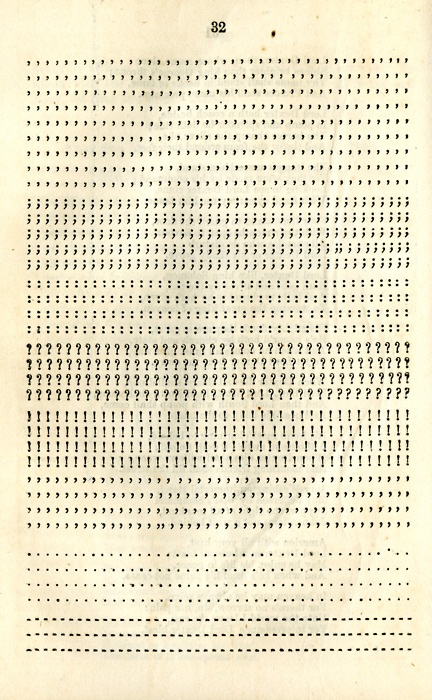
    And on page 32 more of the “missing” punctuation is provided:

    ,,,,,,,,,,,,,,,,,,,,,,,,,,,,,,,,,,,,,, ,,,,,,,,,,,,,,,,,,,,,,,,,,,,,,,,,,,,,, ,,,,,,,,,,,,,,,,,,,,,,,,,,,,,,,,,,,,,, ,,,,,,,,,,,,,,,,,,,,,,,,,,,,,,,,,,,,,, ,,,,,,,,,,,,,,,,,,,,,,,,,,,,,,,,,,,,,, ,,,,,,,,,,,,,,,,,,,,,,,,,,,,,,,,,,,,,, ,,,,,,,,,,,,,,,,,,,,,,,,,,,,,,,,,,,,,, ,,,,,,,,,,,,,,,,,,,,,,,,,,,,,,,,,,,,,, ,,,,,,,,,,,,,,,,,,,,,,,,,,,,,,,,,,,,,, ;;;;;;;;;;;;;;;;;;;;;;;;;;;;;;;;;;;;;; ;;;;;;;;;;;;;;;;;;;;;;;;;;;;;;;;;;;;;; ;;;;;;;;;;;;;;;;;;;;;;;;;;;;;;;;;;;;;; ;;;;;;;;;;;;;;;;;;;;;;;;;;;;;;;;;;;;;; ;;;;;;;;;;;;;;;;;;;;;;;;;;;;;;;;;;;;;; :::::::::::::::::::::::::::::::::::::: :::::::::::::::::::::::::::::::::::::: :::::::::::::::::::::::::::::::::::::: :::::::::::::::::::::::::::::::::::::: ?????????????????????????????????????? ?????????????????????????????????????? ?????????????????????????????????????? ??????????????????????!??????????????? !!!!!!!!!!!!!!!!!!!!!!!!!!!!!!!!!!!!!! !!!!!!!!!!!!!!!!!!!!!!!!!!!!!!!!!!!!!! !!!!!!!!!!!!!!!!!!!!!!!!!!!!!!!!!!!!!! !!!!!!!!!!!!!!!!!!!!!!!!!!!!!!!!!!!!!! ””””””””””””””””””” ””””””””””””””””””” ””””””””””””””””””” ””””””””””””””””””” ……………………………….. ……………………………….. ……………………………….. ……………………………….. ————————————– ————————————– ————————————–


    It is a brilliantly empty book, all of the characterization present and waiting for the last bit that would make this a book:  the words.

    The depths or shallownesses of Dexter’s private insight is a mystery to me, if that mystery extended beyond an elaborate and peculiar (and deep) sense of humor.  The man was a successful if not very odd businessman, after all, so he did have some sort of regulating principle in his life–its just that this sort of dark, removed humor is so incredibly pre-modern that I’ve gotten stuck thinking about Dexter being a little deranged rather than be prescient. 

  • Alphabetical Renaissance Bestiary: Edward Topsell’s “Four Footed Beasts”, 1607


    JF Ptak Science Books LLC  Post #130

    Alphabet 1:  An Alphabetical Renaissance Bestiary

    Edward Topsell (c. 1572 –1625),  English cleric (C of E) and antiquarian who played at being a naturalist was creator, writer and semi-inventor of the History of Four-footed Beasts (1607).  Actually, Topsell wasn’t a naturalist at all, not whatsoever, but did cobble together bunches of facts, true and otherwise, to assemble this fantiScience work from 401 years ago.  He relied mainly on much earlier writers like Albertus and Gesner (Historia Animalium) and transcribed their findings whole cloth, for good or for ill.  He made no pretensions about being a scholar in this area (though he did probably take his M.A. from Christ College, so he was a scholar, but of other things), and wrote his caveat: “I would not have the Reader… imagine I have … related all that is ever said of these Beasts, but only [what] is said by many”.

    I’m really just interested in the images right now and not with the entire aspect of Renaissance zoology (even though Topsell occurs in the early 17th c I think his manner still classifies him with the rest of the Renaissance). In the hulking bulk of his considerable effort Topsell tries to convey three essential aspects of animals to the readers of his work, what he calls his three holy uses: sacrifice, visions, and reproof and instruction.  In his descriptions Topsell tries to remind the reader of the uses of the animal described in sacrifice, and how to interpret the animal when seen in a vision or dream.  Pretty standard I think, even viewing Topsell outside the offices of “historian”.  The interesting bit though is from the third part–reproof and instruction–where he attempts to have the reader regard the animal for the insight and education it could provide for the human viewer.  That’s the part that strikes me as “modern”, or at least thoughtful, especially when considering the fantastic and terrific descriptions that are woven through his questionable tapestry like wide threads of glittering gold. Some of these nuggets include the statements that weasels give birth through their ears, and lemmings graze in the clouds, and elephants worship the sun and the moon and become pregnant by chewing on mandrake; those, and many others, not the least of which include further factual descriptions of Gorgon, the Sphinx, the Manticore, the Lamia, the Winged Dragon and the Unicorn.

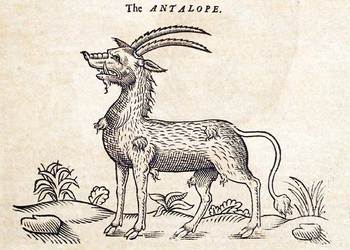
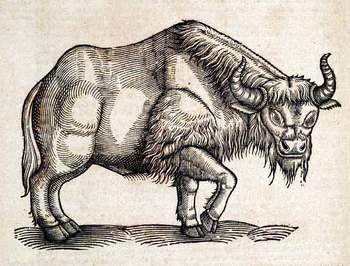
    The real treasure here is the illustration–right or wrong or both, they are gorgeous, powerful, and sumptuous. 

    We present here an Alphabetical Bestiary Based upon Topsell’s The History of Four-footed Beasts and Serpents, 1607.

    Antelope
    Topsellanatalope


    Bison

    Topedllbison


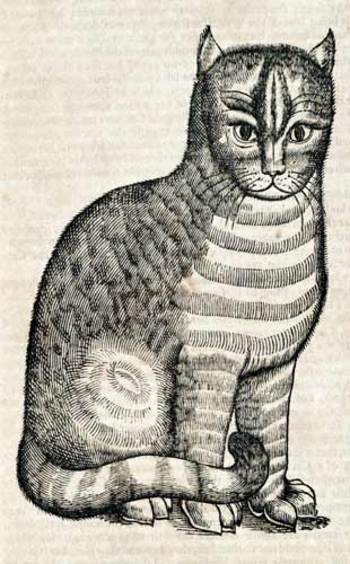
    Cat
       Topsellcat_2


  • An Alphabetical Return to Fat:1920’s Fat (Reduction) Scams; Fat Soap, Strychnine Pills, and Sugar

    JF Ptak Science Books   Post 107

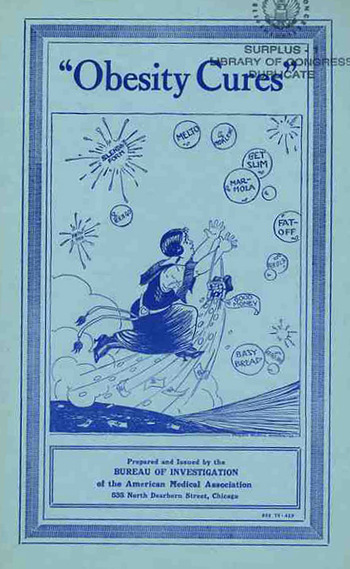
    Blogfatobesity_cures132
    Quackery in general has survived in spite of itself over many fields, not the least of which is astrology and creation science, cult religions and
    walking-with-the-dead.  In the U.S. in the 1910-1925 period however there was a attempt at investigating the most outrageous frauds in the medical profession by the American Medical Association, and of the many sorts of quacks and frauds-liver cures, neuralgia miracles, electro-vibrator hair restorers and lump removers, anti-droopy happiness pills, cocaine nervous system remedies, and so on-what I’d like to look at right now is concerned with “flesh reduction”, or, fat cures. 

    According to the AMA (in a 1934 retrospective) the chief stimulant to the obesity industry was the rise of womens’ fashions.  I think that the reasoning might wind itself around the growth of expendable money in the American rising middle class, where Americans, in general, had more money to spend on the non-essentials than any time in the history of the country.  That leads to more consumables, and that leads to more advertising, and that leads to more idealized images of what people should look like, and that leads to wanting to look like that, and that opens the door to scammers who offer a way to get to the not-actual ideal without effort and for little money.  And so in the ’20’s there was a spike in quack remedies for obesity, as there was little or no control over the content of what was being sold nor the claims about what the product did, medically speaking-there was general protection from fraud, of course, but the medical compliment for establishing what that actually was wasn’t quite yet in place. 

    There is a veritable alphabet (soup) of mondo bizarre cures that the AMA attacked and ripped apart during the 1920’s, publishing the findings of their labs on the ingredients of the cures and the possibilities of whether any of the hundreds (thousands?) of these things worked at all. 

    And what the AMA found was really pretty remarkable-lots of water, sugar, tartar, tinctures of useless this and that, desicated liver, seaweed, salt, lemon, and that sort of thing, none of which had any value for weight reduction whatsoever..  A major ingredient, for some reason, was focus vesiculosus, also known as bladderwrack, sea-wrack, kelp-ware and sea-oak-there was no indication of why this ingredient was so popular, especially since it was used in some farms as a pig feed to make the animals fat.
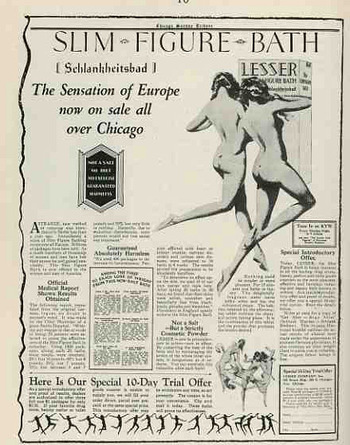
    Blogfat_slim_chicago133
     

    So, aside from the pig-fattening ingredient for human “flesh reduction”, we’ll have a quick alphabetical tour of some of the outrageous (and bizarrely-named) products and their components promising hope and physical happiness to the woman of 1925. (Let’s note that the following are just locally-applied or ingested cures-there’s an entire universe of external applications and devices that were used to solve the problem of fat.  For example, the Violet Ray Machine claimed that in addition to obesity it would cure “Problems with circulation of the blood, the heart’s action, bumps of the funny-bone, germ infections, weakness, the waste of the body, congestion, impaired physical development, pains and aches, complexion and skin diseases, facial and body blemishes, hair loss, headaches, inflammation of joints, muscles, nerves, Atrophy, circulatory disorders, constipation, deafness, goitre, high blood pressure, arteriosclerosis, insomnia (sleeplessness-Brain Fag), indigestion, dyspepsia, neuritis, nervousness, hysteria, melancholia, neurasthenia, neuralgia, obesity, pain, paralysis, prostate gland problems, scalp diseases, falling hair, dandruff, asthma, anemia, bronchitis, catarrh, hay fever, rose fever, colds and other inflammations of the upper air passages, and, of course, cancer.”  This quote with thanks from the Museum of Quack Meidcal Therapy Devices

    And so to the consumable and applied quack fat cures:

    A

    Absorbit Reducing Paste-one of my favorites.  This was a nighttime sleeping paste
    which was composed of 44% lard as well as beeswax, oil and milk.  After slathering
    yourself in this oily, waxy, milky fat cocoon (the sheets!) you were also supposed
    to ingest an accompanying night aid pill, which was 24% sulphur and 61% sugar.  So
    not only would you be oily milky waxy lardy, you’d also be stinky and, at the end of
    it all, hyper. 

    Allmans Anti Fat Anti Pon (?)).  According to its label, it was a “powerful and
    entirely harmless specific”, which the AMA revealed to be composed of citric acid,
    water and food coloring.  Sounds like Kool Aid. 

    Arbolone tablets.  These guys were made of desiccated thyroid, starch, lime and sugar.

    B

    Basy Bread was a “anti growth” bread which turned out to be just a course wheat bread

    C

    Clark’s Thinning Salts was almost entirely washing soda.

    D

    Dalloff’s Time Pills were made of lavender and bearberry.

    E

    Elfin Fat reducing Gum Drops (continuing its spectacular name by saying it was a
    product of the Pep-Giving Product Co., Inc.), was actually one of the only items
    that might have contributed to weight loss, if only for the fact that in addition to
    consuming its drops made of laxative and sugar you were supposed to adhere to a
    pretty regimented, difficult exercise routine.  Big sweat and potent laxative does
    in fact produce weight loss.  Maybe not a good weight loss, but aa weight loss
    nevertheless. 

    Elimiton (!) was a product made of caffeine and rhubarb.

    Every Woman’s Flesh Reducer promised a new figure with their mixture of Epsom salt
    and camphor.

    F

    Fatsoff, a soap product that you washed with, was not surprisingly made of soap.
    Fayro was another soap and washing flesh reduction “package” that asserted that by
    using their secret flesh reducing salve (i.e., “soap”), you would “open your pores
    to let the blood cells sweat off fat”.  I could just about see the AMA guy who was
    writing their description of this thing slamming his pen and screaming.

    Some other F’s included Fells Reducing Tablets (which were milk), Figurroids (salty
    baking soda), Floradona (sodium thiosulphate, the photographer’s “hypo”), and Folt’s
    Reducing Soap (which was, again, soap). 

    G

    Get Slim was a vile purgative of sugar, tartar and baking soda, plus perfumes.

    H

    Hall’s Tablet Triturates were ginger and a big shake of chalk; Hargreaves Reducing
    Wafers (bread and liquorice).

    J

    J.Z. Obesity tablets–were the same product as Absorbit which was the same as
    Zobeide (minus the ox mucus). 

    L

    LaMar reducing Soap (“to wash away fat”) was soap.

    M

    Marmola, “a thyroid-containing obesity cure” was composed of cornstalk, borax, baking
    soda and tartaric acid, with a special “constipation agent” (?), as well as a lot of
    salt. 

    Morlene would reduce goitersm neck fat, bust size and tumors, somehow, with the
    application of its cleansing elements (soap).

    N

    Neutroid seems to have been the most lethal of the hundreds tested, contaning bad
    dollops of magnesium carbonate and iodol, and was taken internally (where external
    application could prove fatal). 

    O

    Oil of Korein was pretty nasty stuff, containing sassafrass and about 75% petrolatum
    (a semi-solid mixture of hydrocarbons, or petroleum jelly), though it also offered
    some really good advice on foods to avoid if you didn’t want to actually gain
    weight. 

    P

    Phy-thy-rin was a calcium and sugar coated pill of iodine and dried thyroid, with
    plenty of sugar, and liquorice. 

    R

    Rusell’s Anti-Corpulent {reparation was a powdered added to water that would
    effectively produce orange Kool-Aid.

    S

    Sangra Bath Salts was perhaps the most outrageously simple, being just colored bath
    salt.  Slendaform (“just gently rub it in, and watch yourself get thin”), was a
    half-pound jar of oil of turpentine, white vinegar and milk curd.  Slyphine, which
    crowded its ads with tremendous claims to be “Absolutely The Best Weight Reducer
    Ever Discovered” and other very shouty claims (by somehow “attracting surplus
    fat”), was simply borax and talc. 

    V

    Dr. Vincent’s Anti-Stout Pills contained a pretty sounding mixture of aloes, jalap,
    cloves and bladderwrack.

    Y

    Mme. Yale’s Fertilizer Tablets-I’m not sure about the real use of “fertilizer”
    here.) was actually one of the earliest of these frauds to be attacked by the
    government, being charged with fraud by “misbranding” in 1909, as federal chemists
    could find no connection between weight loss and its sole ingredients of sugar,
    charcoal and cream of tartar. 

    Z

    Lastly, we offer Zobeude, which was just Absorbit Reducing Paste relabled for
    British consumption, though it seems to have contained an added ingredient of
    “purified ox bile”.  We are told in Bruce’s Materia Medica of 1884 that “Purified ox
    bile has the composition of fresh bile, less the mucus .”

    ·Posted by :

    ·in:

    — — —