A Daily History of Holes, Dots, Lines, Science, History, Math, Physics, Art, the Unintentional Absurd, Architecture, Maps, Data Visualization, Blank and Missing Things, and so on. |1.6 million words, 7500 images, 4.9 million hits| Press & appearances in The Times, Le Figaro, Mensa, The Economist, The Guardian, Discovery News, Slate, Le Monde, Sci American Blogs, Le Pont, and many other places… 5000+ total posts since 2008.

Author: JF Ptak

  • On Unconditional Surrender (1943)

    JF Ptak Science Books   Quick Post

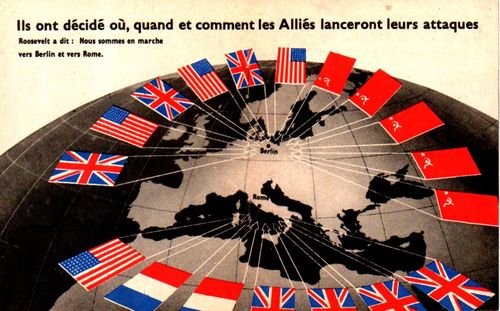
    I found this arresting map in a tiny publication called …Sans Condition, which was published in the first half of 1943. The publication is only 12 pages long but has a number of evocative images of Germany being bombed and lines of German POWs–it is in general a propaganda piece for French-speaking folk (which was printed god-knows-where) produced deep in the war and at a time when the tide has about turned on the Nazis.  The term “Sans Conditions” refers to “Unconditional surrender”, which was a phrase that President Roosevelt surprisingly used when meeting with Allied leaders at Casablanca in January 1943. It is a term that doesn’t make many appearances in U.S. military history, though it was famously endorsed by General U.S. Grant in 1862 in response to an entreaty from Confederate general Simon Bolivar Buckner jr.–and as it happened a U.S. general by the same name was killed om Okinawa by a direct hit from a Japanese heavy gun. Roosevelt would send the same directive to the government of Japan at Potsdam July 26, 1945 (later modified somewhat to accommodate the Japanese keeping their emperor). 

    Books covers sans conditions _1_

    The title of this post is the title of the map,  “Ils ont decide ou, quand et comment les Allies lanceront leurs attacques”–and you don’t need to know French to know what it says.  

    Books covers san conditions __2_

    ·Posted by :

    ·in:

    —

  • A Proto-typewriter, 1857.

    JF Ptak Science Books  Quick Post

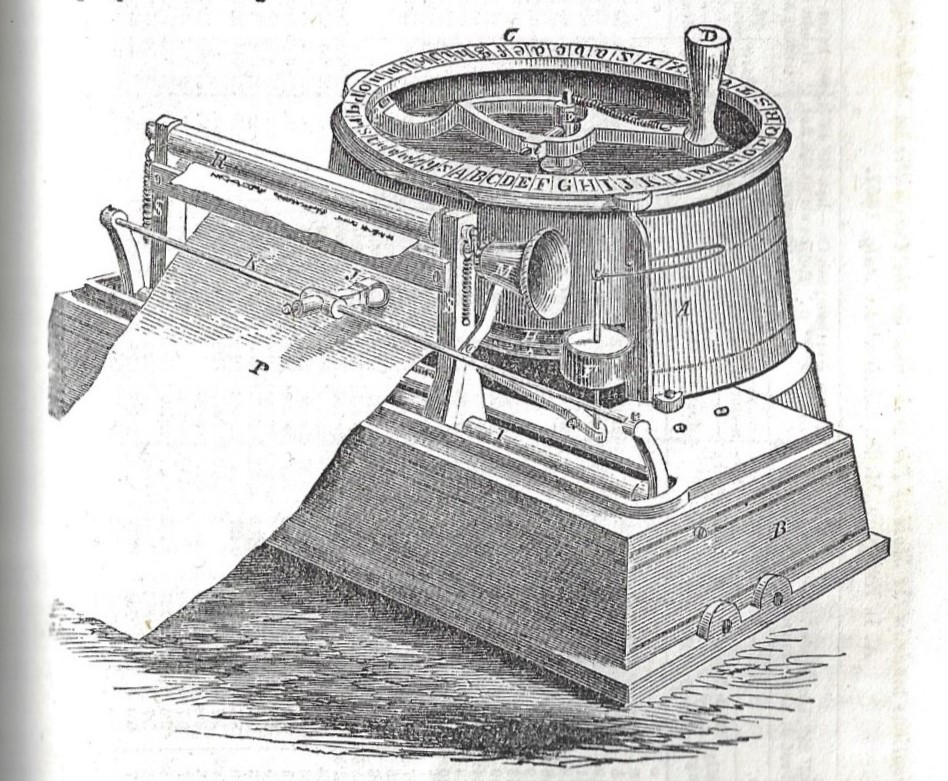
    Here we have a lovely attempt at what is close to being a typewriter (a “hand-printing machine”), found in the Journal of the Franklin Institute for June 1857. The size isn’t given but my guess is that it would be about the size of foolscap paper, easily desk-top. It seems fairly simple in a slightly complex way, and I can easily see where it would serve as a stop-gap implement between what came before and the typewriter. 

    The short article introducing the workings of the machine is surprisingly, and very readable, even though it is brisk and sharp. It is just well done.

    It is difficult to see some of the annotations, even in the original, and even with a magnifying glass, but for that first indicator “H” you can find it just southward of the bell-like object (“M”, which turns out to be a handle for the paper roller), and “E” was another difficult one to find, and that one turns out to be the pivot in the center of the type circular.  In any event, the thing operates much like a typewriter, the lever “D” moved to the position of the letter needed, then pressed down, moving the type into place against the ink and the paper, which is loaded in rollers much like a modern typewriter. 

    JFI 1857 typewriter _2_


  • A Different Sort of Motorcycle Sidecar (1917)

    JF Ptak Science Books   Quick Post
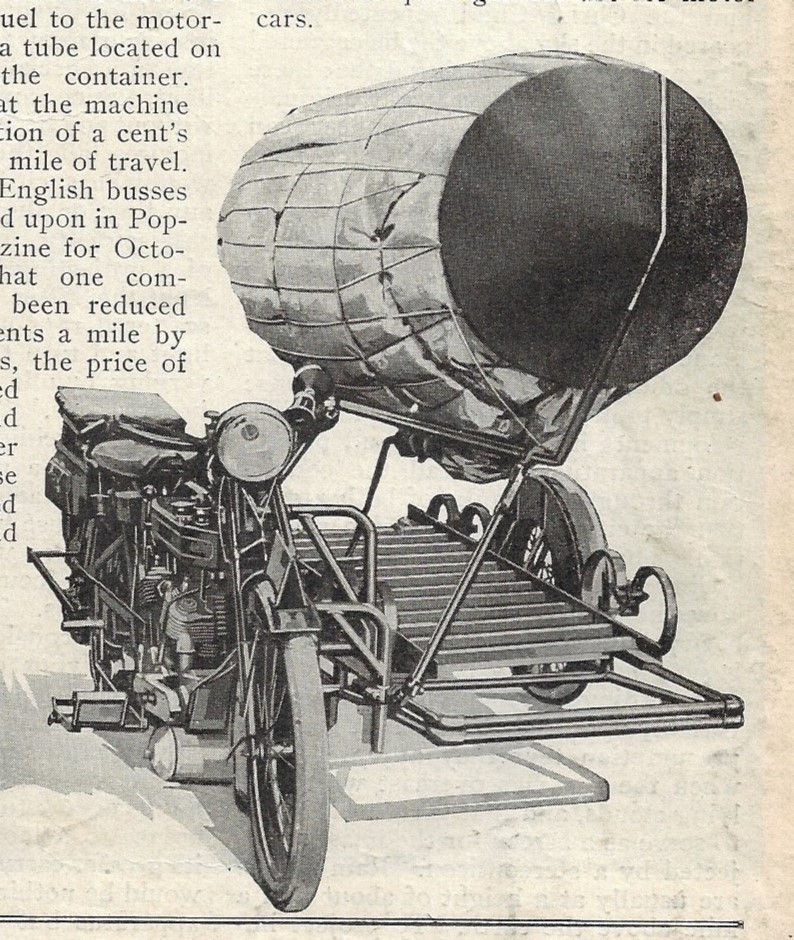
    Pop Mech 1917 gas powered motorcycleThis unlikely combination of vehicle and fuel source appeared in Popular Mechanics for June, 1917. 

    It was fueled by “illuminating gas” which was a hydrogen/hydrocarbon mix and which was made to fire street lamps and such, a destructive process introduced in the very early 19th c.  It is highly flammable. Highly.

    This suggestion for a 600 cubic ft power envelope for a motorcycle was supposed to save about two-thirds on fuel costs and replace the use of wartime gasoline, but…

    [For “illuminating gas” see the following 1869 entry from Scientific American: https://www.scientificamerican.com/article/illuminating-gas-what-it-is-and-how/]


  • Electric Time (1847)

    JF Ptak Science Books  Quick Post

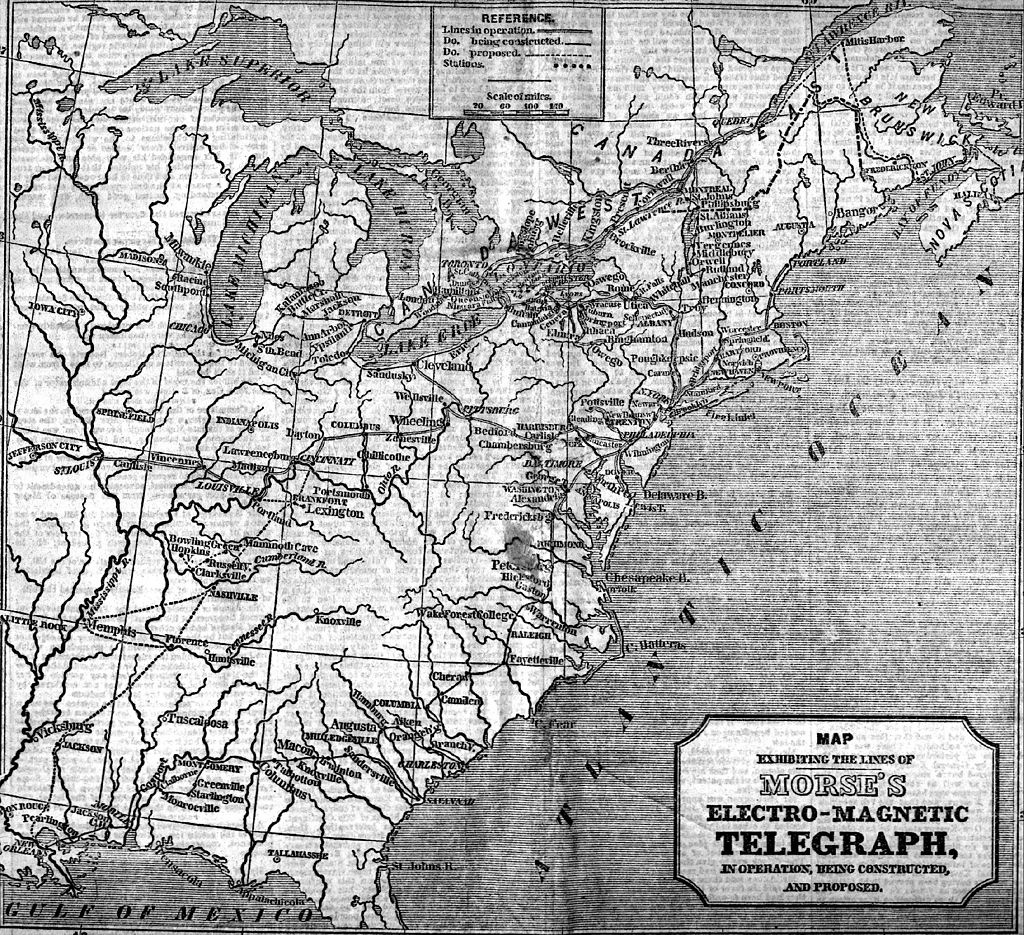
    There were some ways of getting around the problem of geography and communications over long distance–visual semaphores, smoke, drums, that sort. The issue of long-distance relatively instant communication wasn’t solved until the appearance of the telegraph, which for the most part outside of starts and fits and a complicated pre-history really wasn’t solved until Morse and Vail in about 1843. The first line was laid in the U.S. between D.C. and Baltimore in the next year, and then with the display of this success a network of electric communications exploded, as you can see in the map below showing telegraph lines in the U.S. in 1848, just five years after there was nothing at all. 

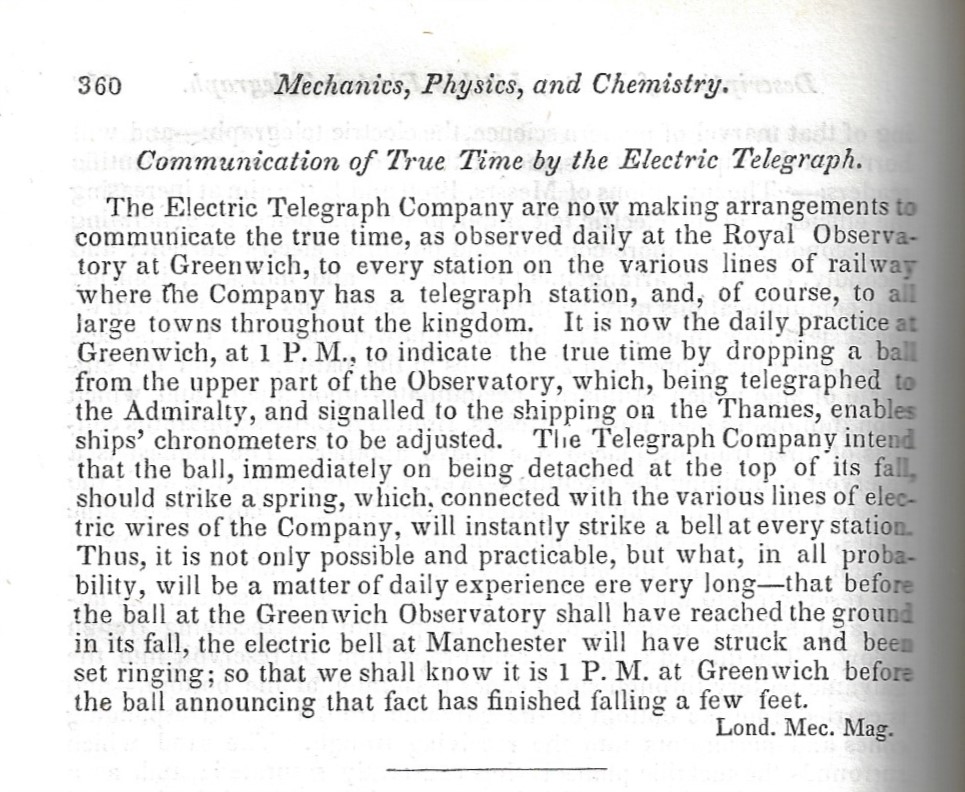
    Anyway this is what came to mind when I stumbled on the following short notice that appeared in the Journal of the Franklin Institute in December 1847–the fixing of a “constant” time communicated by electric telegraph, reporting the standard time from Greenwich, to be sent out to the furthest reaches of the telegraphic world, and which was an early attempt at the mass distribution of regulated synchronous time keeping over long distances. Pretty cool idea.  

    • “It is now the daily practice at Greenwich, at 1 P.M., to indicate the true time by dropping a ball from the upper part of the Observatory, which, being telegraphed to the Admiralty, and signaled to the shipping on the Thames, enables ships chronometers to be adjusted.”


    JFI 1847 telegraph time

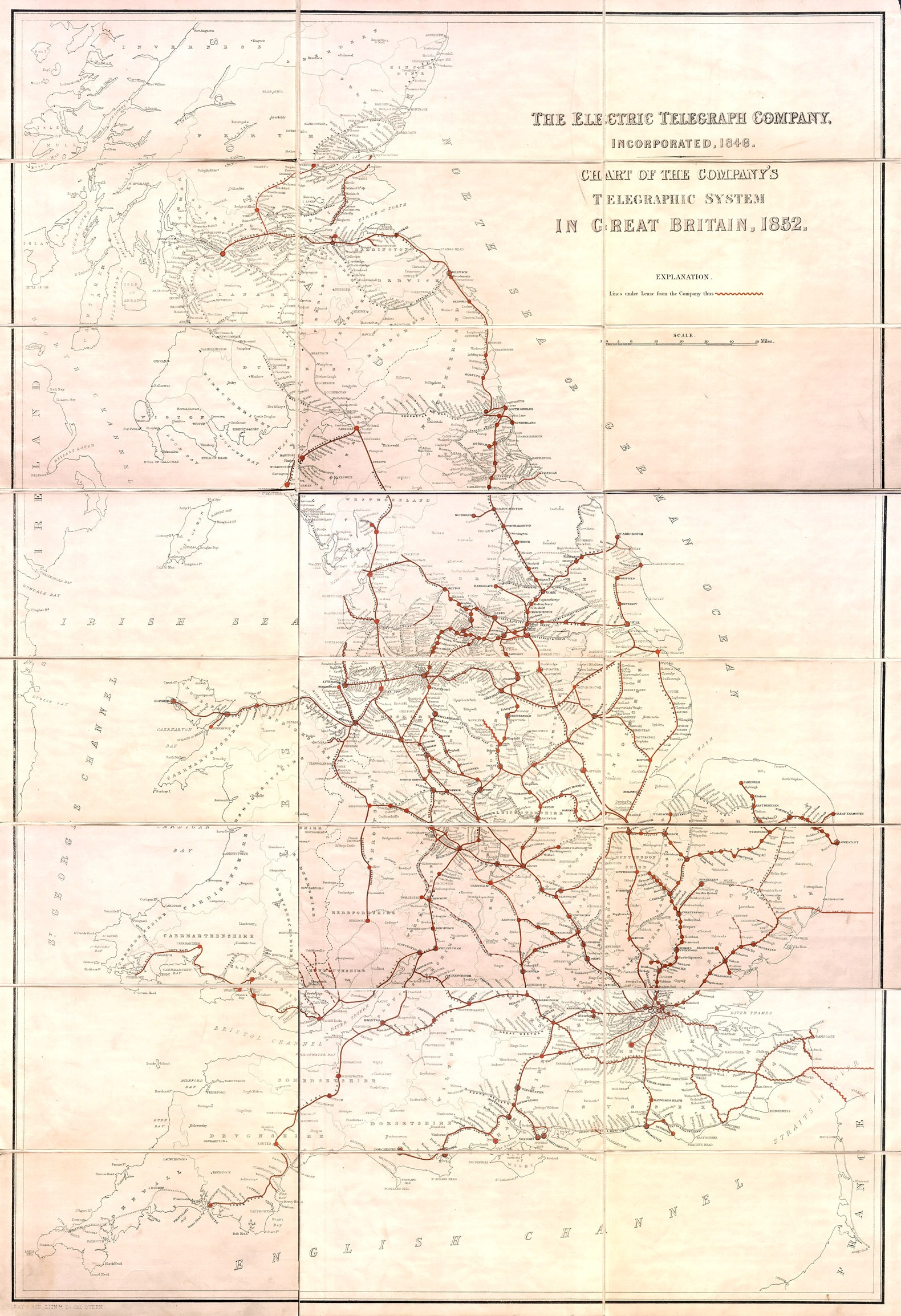
    A map of the telegraph lines in Great Britain in 1852:


    Telegraph map GB 1852

    Source: distancewriting.co.uk 

    And the map of telegraph lines in the U.S.:

    Telegraph map wikipedia

    Source: wikicommons on “telegraph history”


  • A Particular Bit of Science In Wells’ “War of the Worlds” (1894)

    JF Ptak Science Books   Quick Post

    I haven’t read in Wells’ WOTW in a long time, and when I went to it just now (reading and listening) I was surprised at how quickly the Mayday Martians element evolved.  We get to it by the end of the very first paragraph:  

    • “At most terrestrial men fancied there might be other men upon Mars, perhaps inferior to themselves and ready to welcome a missionary enterprise. Yet across the gulf of space, minds that are to our minds as ours are to those of the beasts that perish, intellects vast and cool and unsympathetic, regarded this earth with envious eyes, and slowly and surely drew their plans against us. And early in the twentieth century came the great disillusionment.”

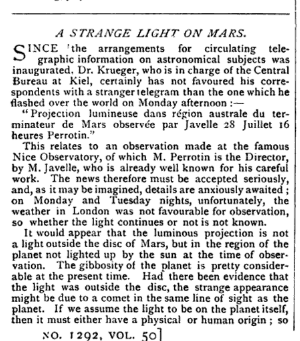
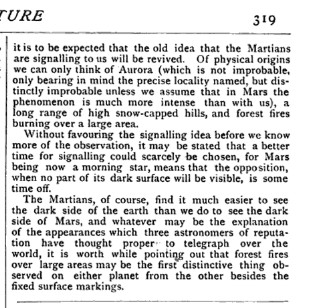
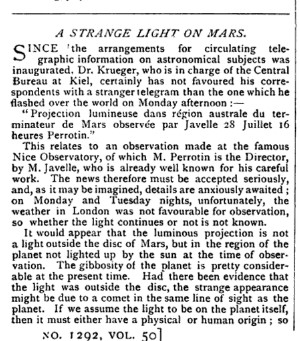
    I was also surprised by the appearance of some tech references, including a dated reference to an article in Nature magazine (2 August 1894).  The Nature article references a “strange light” which Wells uses to his own world-stabbing ends, and he gives his story some credibility by dragging in a real-life background to the possibilities of his imaginations.

    • “Had there been evidence that the light was outside the disc the strange appearance might be due to a comet in the same line of sight as the planet. If we assume the light to be on the planet itself then it must either have a physical or human origin…” (And by “human” here the editor no doubt means extra-terrestrial, or biological, or intelligent life form.)

    I’m not a big sci fi reader, but in my experience I’ve never seen a tale woven using the names of Perrotin and Schiaparelli, though I have no seen them used in the plot setup thickening agent in WOTW. (By the way Wells mentions the “palpitating” work of “Lavelle of Java” though he must have meant “Javelle”, who was Stephane Javelle, the assistant to Perrotin of the Nice Observatory.)

    On the “strange light”:
    War of the Worlds Mars in NAture _1_


    War of the Worlds Mars in NAture _1_


    Source: Nature, volume 50, August 2, 1894

    ·Posted by :

    ·in:

    —

  • When a Map Should Probably Not Have Been Made

    JF Ptak Science Books  Quick Post

    This pamphlet was a little confusing to me–at first I thought it would fit into a category of Outsider creations, a small collection of pamphlets filled with some towering and submerged ideas on curing the Depression, keeping the U.S. out of war, flagpole painting, zipper repair, exrta-Earths populating the (regular) Earth, eyestalk plant people of Mars, flooding the Sahara, damming the Hudson River, nuclear powered _____, mega weapons, mega planes, hair massage for higher IQ, and so on. The design of the pamphlet certainly had the feel and look of a great attempt at conveying some secret truth, it turns out that it is pretty straightforward, an 1890’s/1900’s  appeal to folk on acting courteously and amicably towards others to achieve a one-government-something. 

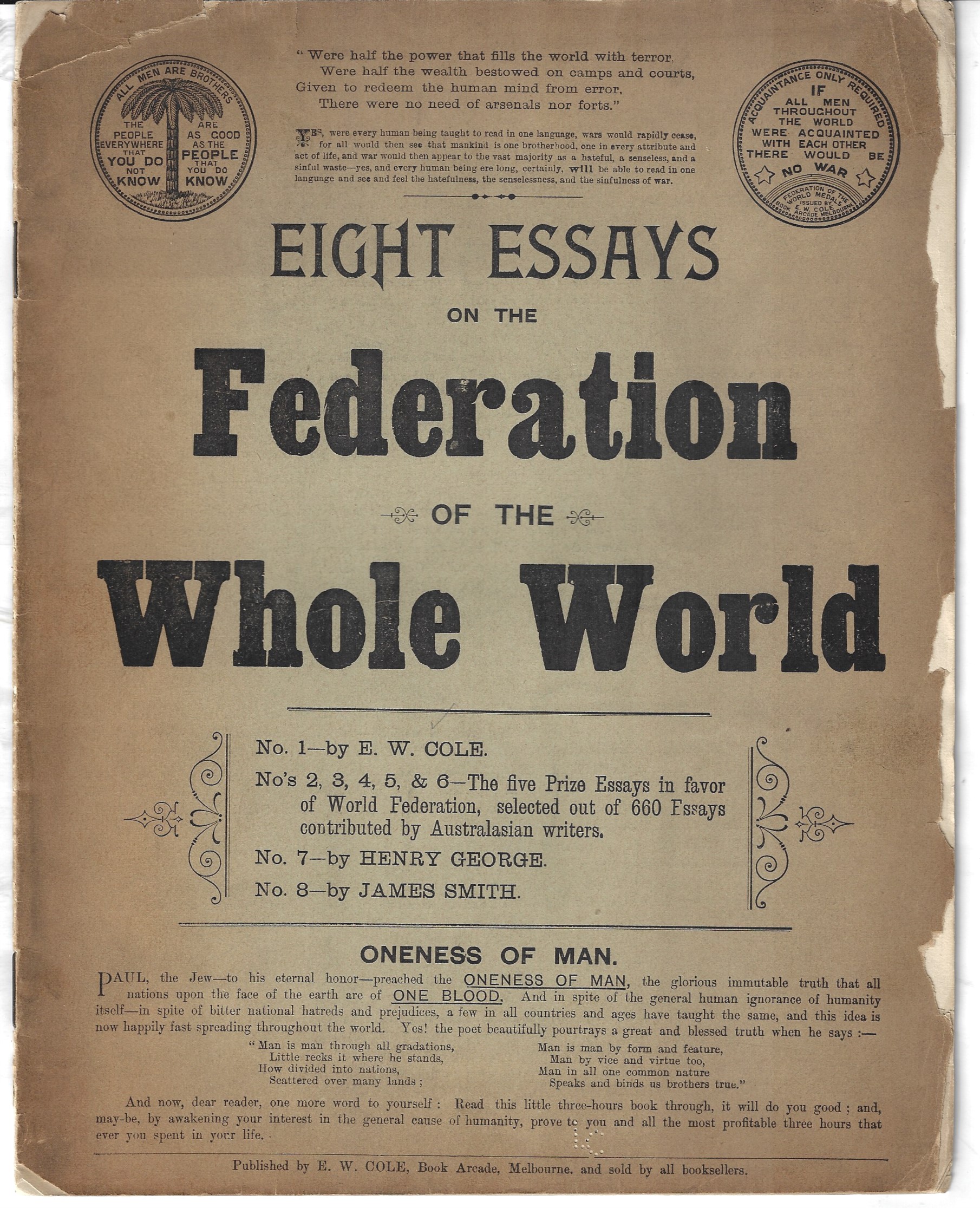
    The message was very simple: do good, be kind, help people, live your religion.  It was the work of a very successful bookseller and publisher in Melbourne, Edward William Cole1. He sounds like he was an interesting guy, autodidact and entrepreneurial, born in the U.K. and migrating to Cape Colony and on to Australia, spending time in the gold diggings, exploring the Murray, and settling into Melbourne where he opened up a bookshop in 1864 which morphed into a large arcade with many rented kiosks.

    Cole wrote a number of short pamphlets, published them, and either sold or gave them away–the pamphlet presented here was probably a gift to his customers. It published eight essays of 660 collected for the prize of publication, extolling brotherhood and the commonality of the human condition, appealing for kindness and the common good, and reading above nearly all else. 

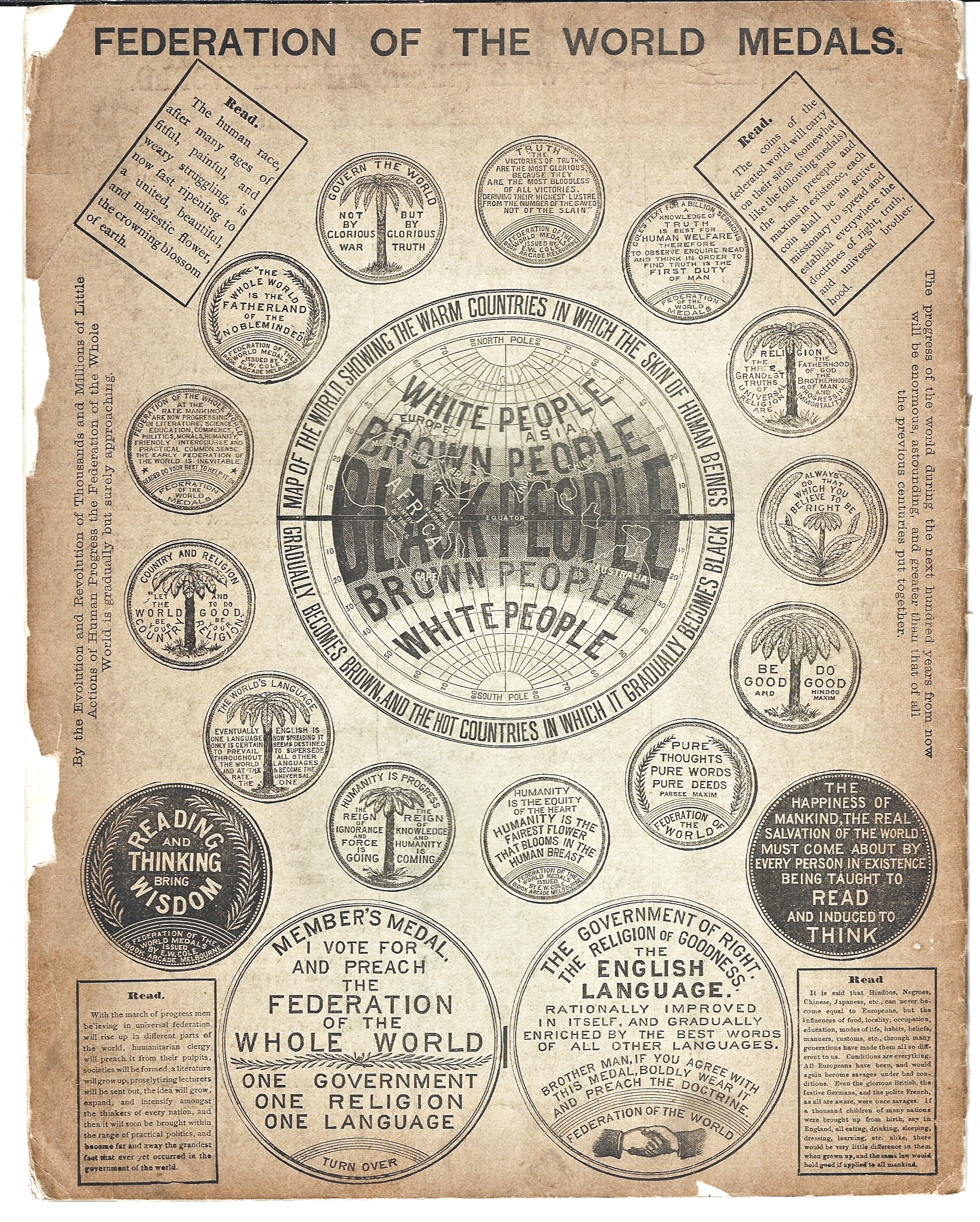
    The imagery on the rear cover is striking, most of the artwork being the fronts and backs of medals/medallions that Cole had made. The image in the middle of it all is, well, very surprising, and potentially disturbing, though it seems unconnected to any of the essays or sentiments of the pamphlet, and seems largely to be a non sequitur.  In any event there seems to be no connective text, nothing on race dominance or eugenicism, the only thing that comes close to that is a repeated belief that English should be the dominant world language for its “perfection”.  As dire as it seems the map seems to be open to speculation, though on the face of it doesn’t look like much good could come . Is it something as nasty as showing what the map maker thinks are the natural divisions of the world according to race, or could it possibly be suggesting that skin color is based on location on the globe and has nothing to do with any sponsorship of superiority or inferiority based on color? Given the rest of what seems to be in this pamphlet, it seems likely that the later is the case. The guy would’ve been better served if he left the map out.

    I’m reproducing the artwork here because there seems to be little mention2 of this work outside of stiff and undated bibliographies of books-received. 

    Black People front

    Black People front
    Black People front

    Notes:

    1.  Cole’s entry in the Dictionary of Australian Biography: http://adb.anu.edu.au/biography/cole-edward-william-3243

    2.  According to WorldCat there’s another version of this work, fleshed out to 207pp,, printed around the same time (the librarian guesses ‘189_’) and located in just one library (Victoria). There’s only one copy located of the copy mentioned here, located at the Murdoch library, 11,564 miles from where I sit in western North Carolina. 


  • Time, Motion, and Awe in Regards to Moving Pictures

    JF Ptak Science Books   (This is a revision and expansion of a post from 2012.)

    Backwards--magritte

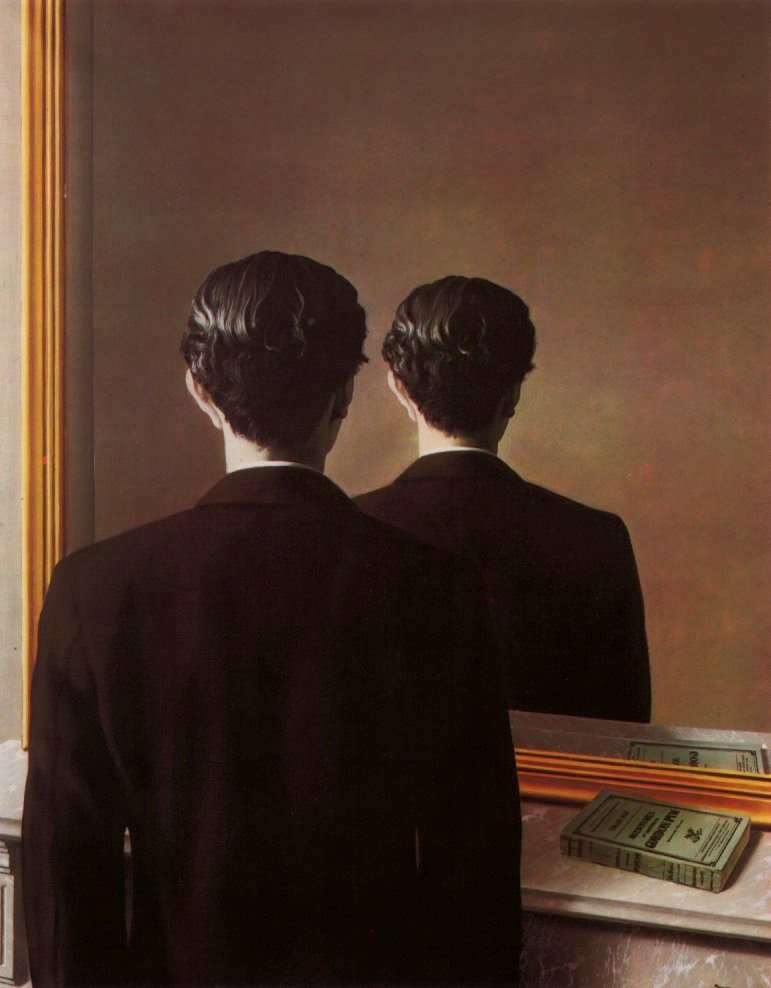
    Leonardo wrote backwards and from right to left, Benjamin Button lived backwards at the hands of Scott Fitzgerald, Rene Magritte’s man in the mirror saw the back of his head, Ignatz the Mouse I am sure saw the back of his head looking around the world with the world’s most powerful telescope, rugby passes are all done backwards, paper images of vue optiques appear backwards, lightning for all intents and purposes starts backwards from the ground up, reverse mathematics are worked from theorems to axioms, the Chicago River (1900) was engineered to flow backwards for the foreseeable future, while the Mississippi River famously flowed backwards for just a bit in the New Madrid earthquake of 1812. 

    Backwards--marey12

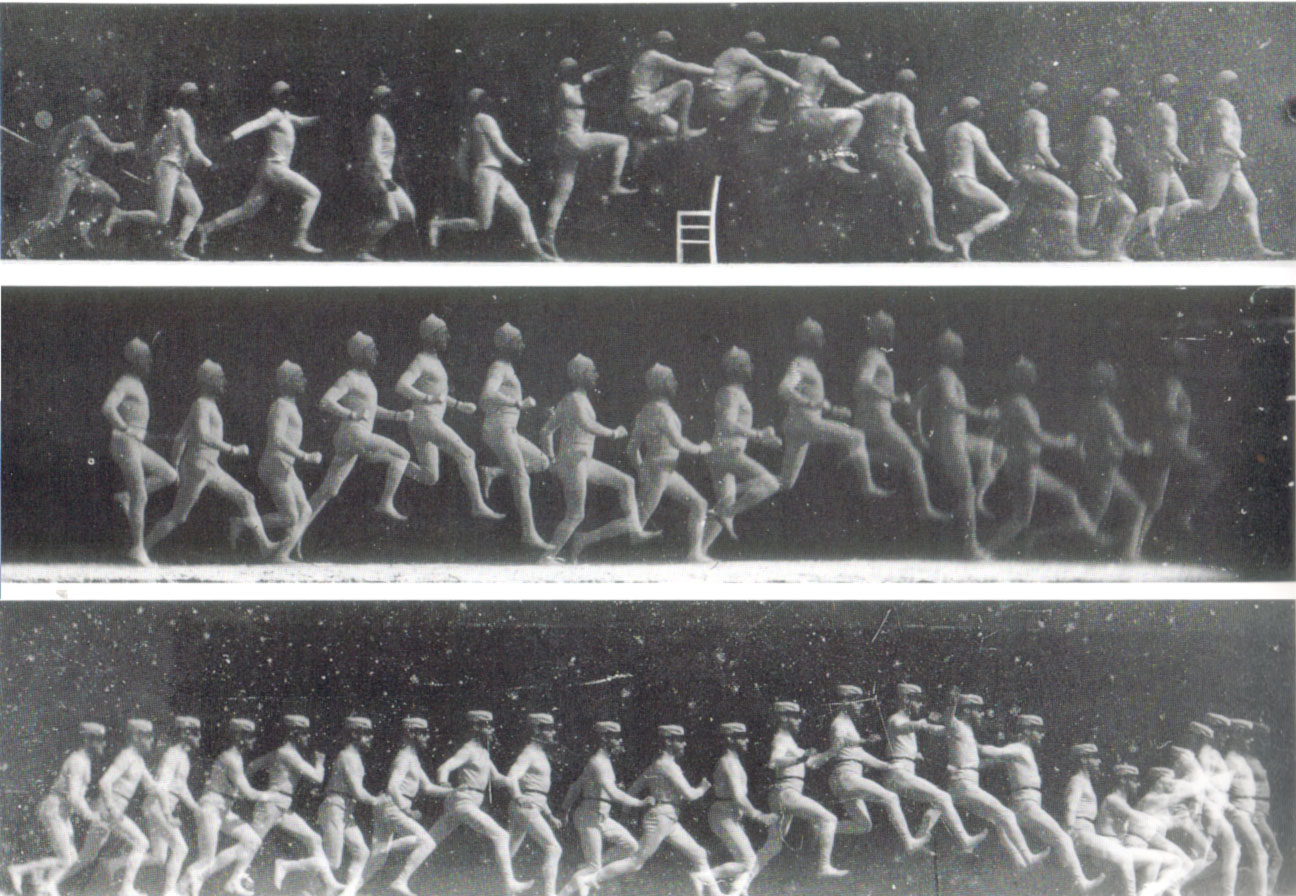
    I can only imagine what audiences must have felt when they saw the first moving pictures played backwards–seeing them played forwards was a novel-enough (and revolutionary) idea, but the simple idea of reversing the direction of the film would have proved to be equally fascinating.  Imagine the first time you witnessed a staged train wreck on film, back there in 18951, and imagine being able to see it played over and over again, until you were filled.  I’m not so sure that there were even any still photographs of a train wreck as it occurred to this point, even with advances in film speed and lens, so seeing the even unfold in front of you at leisure must have been overwhelming.  Now imagine these same folks seeing the event and watching the locomotives reconstitute themselves.  It would have been an extraordinary event.  Even observing the Marey sequences (above) and seeing what actually happens when a person bends over to pick up a pail of water would have revealed almost as much in new detail as when Galileo was in the middle of his earliest observations. 

    In a way the chance of controlling the direction telling of a story and seeing it displayed via moving images, and being able to see them backwards, may well have seemed a form of third-person time travel.  This came on the heals of what is for all intents and purposes the first time travel novel in  H.G. Wells’ (also in) 1895 The Time Machine (appearing earlier as “The Chronic Argonauts,” in 1888)2 and Mark Twain’s 1889 but much earlier than the first motion picture to use the idea of time travel (which was in 1921 and based on Twain’s work).  Being able to show a motion picture, and then stop it at will, and then reverse the order of time to begin everything all over again–visually–must have seemed a magnificent advantage. 

    And so to this end I’ve got the following few questions for which I have no firm answers:

    1. When was the first time people saw moving images of a of a currently deceased person? That is, when did the first dead person become “reanimated” by virtue of their images being captured by a motion picture? This question could be asked of the first viewing of a photograph of a dead person, and also the first experience of listening to a now-dead person whose voice had been recorded by an Edison machine, but I think the moving picture element is much more powerful. 

    1. When exactly was the first viewing of backwards motion, of seeing action in reverse?

    2. When was the first viewing of a continuous moving picture in which motion was purposely interrupted ?

    I’ve probably overlooked some long list of “firsts” in film, somewhere, but for now these questions are still questions. If anyone out there has answers, I’d love to hear them. 

    Notes:

    1.  It is interesting that this very early motion picture , made by the great scientist-brothers Lumiere, l’Arrivee d’un train en gare, was produced in the same year as the Wells book.  Just two years later, the Lumiere Brothers published a catalog of their available movie strips, numbering 338 productions.  In 1898, after six catalogs, there were over a thousand strips.  This is remarkable, especially considering that there wasn’t a cinema industry yet.  The Lumieres are an interesting pair of people (both of whom survived their invention by about a half-century), making perhaps the most important discoveries in the history of cinema, and continued to be interested in other fields throughout their lives.  The cinema-industry part of their work didn’t seem to interest them all that much. 

    The history of moving images is complex and long.  I’m not saying at all that it begins with the Lumieres, or with Edison, as the pre-1900 field is well sprinkled with different and interesting attempts at fooling our eye–Chronophotograposcopes, Counterfivoscopes, Phantasmagorias, Klondikiscopes, Vileocigraphiscope, and so on, are just a few examples of the many attempts at locating the seat of photographic motion in the brain.  There are very early efforts, principally by J.A.F. Plateau (1801-1883) who rediscovered in 1829 the “persistence of vision” effect in which the eye will see a continuous stream of images if presented with a flow of static pictures at 16 frames per second over a one second period, which of course is the basis for the rest of everything that was to come.  There’s much more, but I wanted to at least point out these few important bits. 

    2..  I’m not sure what to  with Mr. Dickens, if he fits in this order with the time traveling Scrooge in A Christmas Carol (1843), or not.  Perhaps he does, and if so, then he precedes Mr. Wells, though the latter’s time traveler is outfitted with a machine and a scientific basis for the belief in it.  At the very least he is worth mentioning in the same moment.


  • Tree Power (as in Kinetic Power Generated by Tree Movement in Wind!) (1840)

    JF Ptak Science Books  Quick Post

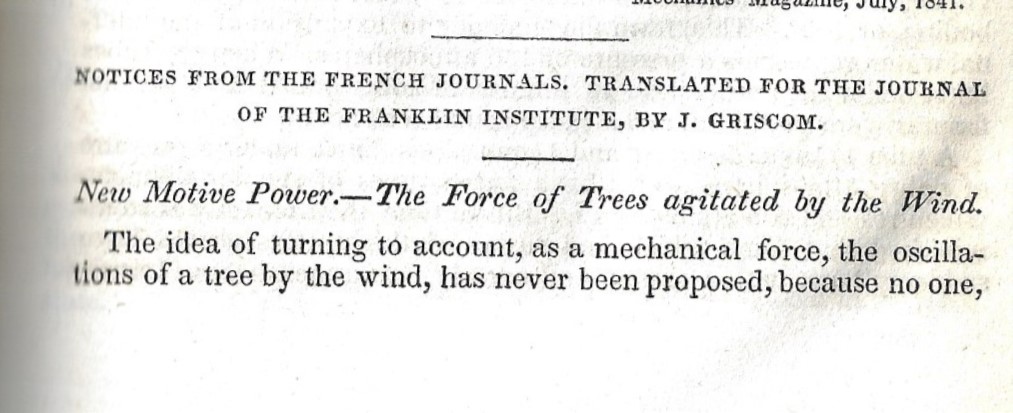
    A successful byproduct of not being to find something is finding the stuff that you weren’t looking for and didn’t know about. The article (below) is one such happy find, appearing in the pages of The Journal of the Franklin Institute, 1840. I certainly never thought of somehow (?) harnessing the movement of trees via the wind as a power source. As the author of the paper says, “The idea of turning to account, as a mechanical force, the oscillations of a tree by the wind, has never been proposed, because no one, it is probable, has ever deemed it to be a practicable source of power. A very considerable force, the least costly of all, is thus entirely lost.” There is an inventor named though I cannot find references for him–I also cannot visualize how the tree motion is transformed into that “motive force”. Have a look:


    Tree power _2_

    ·Posted by :

    ·in:


  • Abraham Lincoln, Inventor (1849)

    JF Ptak Science Books  Quick Post

    Posts to this blog have recently been clustered around volumes of the Journal of the Franklin Institute, as that is what I have been working with quite a bit over on the other side of this site dedicated to online book selling. Bits and pieces have struck me as interesting and curious and worth sharing–I’ve found often that many of these short pieces have received scant attention in the online world. Today’s adventure into the journal led to something that is well-known, but I’m sharing it anyway because it was such a surprise to come upon it “naturally” in the course of looking through one of the JFI volumes.

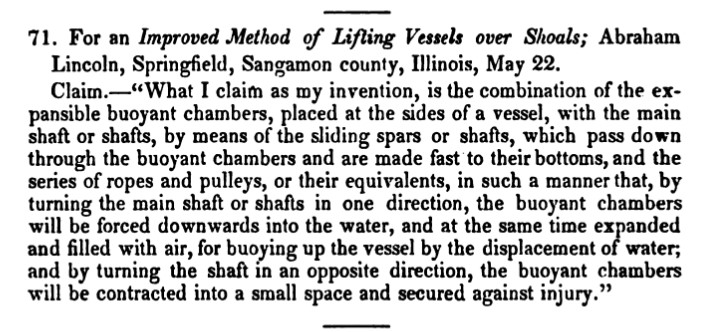
    I knew that Abraham Lincoln was the only U.S. president to receive a patent, and thought that it might show up in these volumes sooner or later, and while looking at the year 1850 I found it: #71 in the review of American Patents for January of that year. In the two open pages of that volume the Lincoln contribution settled in with seven other patents (granted to inventors from New York (2), Ohio (2), Illinois, Pennsylvania, and New Hampshire). Lincoln’s boat-lifter was there with a new method for joining staves, imitating marble, a spring saddle, improvements to scythe nibs, nozzles for ship navigation, and a shank for mineral door knobs. 

    Lincoln Patent

    I expected to find it either in late 1849 or early 1850 (for the patent issued in mid-1849) but it was still a “surprise” to see it there before me. Lincoln published this shortly after leaving his one-term position in the U.S. Congress, returning to Springfield (Illinois) to practice law. (Lincoln was born near Hodgenville, Kentucky, a town of a few hundred people and 200 miles to the southeast of Springfield, which in 1850 was home to about 5,000.)  So, there it is, the not-famous A. Lincoln’s patent for lifting a boat out of the water and over some river shoals. Nice idea.  


    ·Posted by :

    ·in:


  • On Doing and Done: the Differences in describing the Difference Engine of Charles Babbage, 1832.

    JF Ptak Science Books  Post 2792
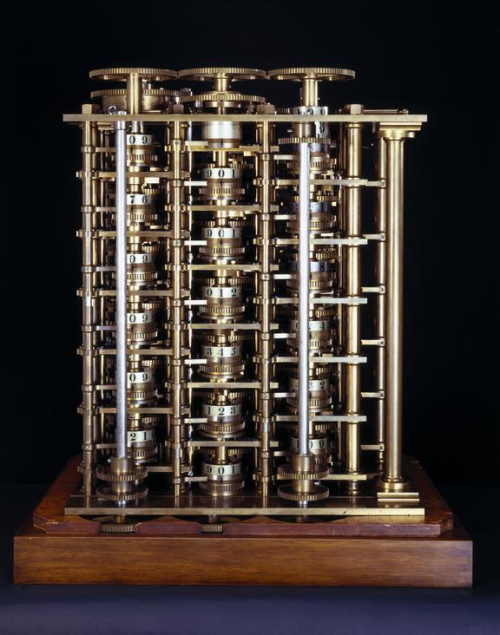
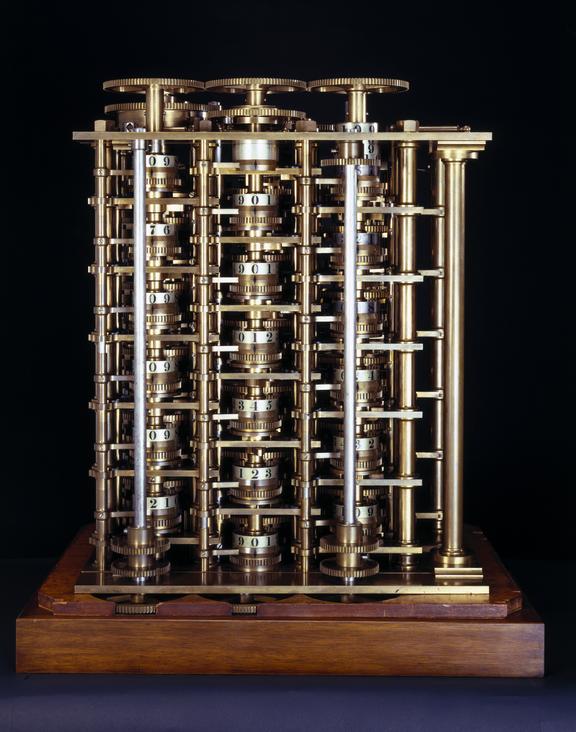
    Babbage difference engineThere’s a big difference being “inventing” and “invented”. You virtually never hear or read of someone declaring “I am inventing thus-and-so” imply that they’re working on something; “I invented the letter number seven” implies that you’ve completed the act of invention and the number seven exists. 

    In cataloging a book for my bookstore I came upon this difference in reference to Charles Babbage and his early calculating machine, and proceeded to make a mountain of a molehill, and then the reverse. 

    The “incident” was sparked by a volume of the Journal of the Franklin Institute1 with the appearance of a very early mention of Babbage having built his Difference Engine  (No. 1) found in a one-paragraph mention in the article “The Results of Machinery”:

    [Image at left of Babbage’s machine in 1832, from the Science Museum http://collection.sciencemuseum.org.uk/objects/co62243/difference-engine-no-1-difference-engine-portion-only]

    “Mr. Babbage…has invented a calculating machine…” referring to the newly (1832) “completed” 1/7th  of the machine. (The Difference Engine No. 0 announcement came June 14, 1822; the Difference Engine No. 1 appeared in this year, 1832, though work was suspended on it in 1833 (with government funding removed);’work soon to begin on Difference Engine No.2 (1846-9), (and with A. Lovelace’s famous “Notes” appearing on the Analytical Engine in 1843.)

    The article is a review/abstract of the book by Charles Knight, The results of machinery : namely, cheap production and increased employment exhibited : being an address to the working-men of the United Kingdom, which appeared in a second edition in London in 1831 (and a fifth in 1832) with a first American appearing in 1831. The Babbage calculating machine bit from the JFI is taken very nearly verbatim from these editions, where in the original the mention of the machine is referred to as “almost perfected”–here in the JFI it shows up as “invented”, which as they say is something quite different, the world of “almost-perfecteds” being much wider broader deeper than that of “the perfecteds”.

    Leaving out the fact that the machine was yet really built is of course a minor thing compared to the overall message of the paper and the book in general, but I just got my scarf wrapped around the axle on it. 

    The full note on Babbage reads:

    “The inventions for saving mental labour, in calculations of arithmetic, have been carried so far, that Mr. Babbage, a gentleman whose name we have twice before mentioned, has invented a calculating machine, which not only does its work of calculation without the possibility of error, but absolutely arranges printing types of figures, in a frame, so that no error can be produced in copying the calculations, before they are printed. We mention this curious machine, to show how far science may go in diminishing mental labour, and ensuring accuracy.”

    This was part and parcel the principle thrust of this article: investigating the application of machinery in a positive way to production and labor and showing its “…effects of saving unprofitable labor”.

    The few paragraphs of background leading to the Babbage reads as follows:

    “The foot-rule of the carpenter not only gives him the standard of a foot measure, which he could not exactly ascertain by any experience or any mental process; but it is also a scale of the proportions of an inch or several inches, to a foot, and of the parts of an inch to an inch. What a quantity of calculations, and of dividing by compasses does this little instrument save the carpenter, besides ensuring a much greater degree of accuracy in all his operations! The common rules of arithmetic, which almost every boy in England now learns, are parts of a great invention for saving mental labour. The higher branches of mathematics, of which science arithmetic is a portion, are also inventions for saving labour, and for doing what could never be done without these inventions.

    There are instruments, and very curious ones, for lessening the labour of all arithmetical calculations; and tables—that is, the results of certain calculations, which are of practical use, are constructed for the same purpose. When you buy a joint of meat, you often see the butcher turn to a little book, before he tells you how much a certain number of pounds and ounces amounts to, at a certain price per pound. This book is his “Ready Reckoner,” and a very useful book it is to him; for it enables him to despatch his customers in half the time that it would otherwise require, and thus to save himself a great deal of labour, and a great deal of inaccuracy.

    The inventions for saving mental labour, in calculations of arithmetic, have been carried so far, that Mr. Babbage, a gentleman whose name we have twice before mentioned, has invented a calculating machine, which not only does its work of calculation without the possibility of error, but absolutely arranges printing types of figures, in a frame, so that no error can be produced in copying the calculations, before they are printed. We mention this curious machine, to show how far science may go in diminishing mental labour, and ensuring accuracy.”

    So in this message of insight and hope I got stuck on one word, which ultimately really doesn’t mean anything. The message was significant and an interesting and insightful way of phrasing the possibilities for the application of more advanced machines in the future, and was much bigger whatever the state of completion of the Babbage machine was.