A Daily History of Holes, Dots, Lines, Science, History, Math, Physics, Art, the Unintentional Absurd, Architecture, Maps, Data Visualization, Blank and Missing Things, and so on. |1.6 million words, 7500 images, 4.9 million hits| Press & appearances in The Times, Le Figaro, Mensa, The Economist, The Guardian, Discovery News, Slate, Le Monde, Sci American Blogs, Le Pont, and many other places… 5000+ total posts since 2008.

Author: JF Ptak

  • On Displays of Humor, Joke-Making, and Shame in Dogs (1875)

    JF Ptak Science Books  Quick Post  

    George J. Romanes1, “Sense of Humour and Reason in Animals” (from Nature, volume 12, 1875, p 66) [With a few added annotations]

    “IN the recently published edition of the Descent of Man there is some additional matter concerning the above subjects, and as the following illustrative cases fell under my own observation, I think it is worth while to publish them as supplementary to those adduced by Mr. Darwin.

    Several years ago I used to watch carefully the young Orang Outang at the Zoological Gardens, and I am quite sure that she manifested a sense of the ludicrous. One example will suffice. Her feeding tin was of a somewhat peculiar shape, and when it was empty she used sometimes used invert it on her head. The tin then presented a comical resemblance to a bonnet, and as its wearer would generally favour the spectators with a broad grin at the lime of putting it on, she never failed to raise a laugh from them. Her success in this respect was evidently attended with no small gratification on her part.

    I once had a Skye terrier2 which, like all of his kind, was very intelligent. When in good humour he had several tricks, which I know to have been self-taught, and the sole object of which was evidently to excite laughter. For instance, while lying upon one side and violently grinning,* he would hold one leg in his mouth. Under such circumstances nothing pleased him  much as having his joke duly appreciated, while if no notice was taken of him he would become sulky. On the oilier hand, nothing that could happen displeased him so much as being laughed at when he did not intend to be ridiculous.

    Mr. Darwin says:—’Several observers have stated that monkeys certainly dislike being laughed at’ (p. 71)3. There can be little or no doubt that this is true of monkeys; but I never knew of a really good case among dogs save this one, and here the signs of dislike were un-equivocal. To give one instance. He used to be very fond of catching flies upon the window-panes, and if ridiculed when un-successful, was evidently much annoyed. On one occasion, in order to see what he would do, I purposely laughed immoderately every time he failed. It so happened that lie did so several times in succession—partly, I believe, in consequence of my laughing—and eventually he became so distressed that he positively pretended  to catch the fly, going through all the appropriate actions with his lips and tongue, and afterwards rubbing the ground with his neck as if to kill the victim : he then looked up at me with a triumphant air of success. So well was the whole process simulated, that I should have been quite deceived, had I not seen that the fly was still upon the window. Accordingly I drew his attention to that fact, as well as to the absence of anything upon the floor; and when he saw that his hypocrisy had been detected, he slunk away under some furniture, evidently very much ashamed of himself.”

    Notes:

    Romanes (1848-1894) was an interesting man, an evolutionary biologist and physiologist, and one of the founders of comparative psychology who wrote broadly on the intelligence and emotions of animals and the connections of animal intelligence and that of humans. He also was the first to use the term of “anthropomorphism”. He was a good and life-long friend of Darwin, and spent the years between Darwin’s death (1882) and his own defending and arguing Darwin’s ideas.

    Skye Terrier. I had to look this up, so aI reproduce the info from the American Kennel Club: “Long, low, and level, this unique earthdog is among the AKC’s most distinctive-looking breeds. Skyes stand 9 or 10 inches high and feature a long, flat-lying coat and peekaboo hairdo. They’re known for big, feathery ears that stand up like bat wings, but Skyes can also have “drop ears,” which lie flat against the large, long head. Beneath the profuse coat are short, muscular legs and a deep chest. When seen in profile, these elegant but substantial terriers are twice as long as they are high.”

    Darwin, Charles. The Descent of Man, and Selection in Relation to Sex, first printed in 1871.

    The note in Nature says “p.71”, but actually appears on page 42. Page 70 begins the interesting second half of a chapter on “Comparison of the Mental Powers of Man and the Lower Animals  the difference in mental power between the highest ape and the lowest savage, immense…” which could have led to the confusion. In any event, the quote:

    “Most of the more complex emotions are common to the higher animals and ourselves. Every one has seen  how jealous a dog is of his master’s affection, if lavished on any other creature; and I have observed the same fact with monkeys. This shews that animals not only love, but have the desire to be loved. Animals manifestly feel emulation. They love approbation or praise; and a dog carrying a basket for his master exhibits in a high degree self-complacency or pride. There can, I think, be no doubt that a dog feels shame, as distinct from fear, and something very like modesty when begging too often for food. A great dog scorns the snarling of a little dog, and this may be called magnanimity. Several observers have stated that monkeys certainly dislike being laughed at; and they sometimes invent imaginary offences. In the Zoological Gardens I saw a baboon who always got into a furious rage when his keeper took out a letter or book and read it aloud to him; and his rage was so violent that, as I witnessed on one occasion, he bit his own leg till the blood flowed.”
    ·Posted by :

    ·in:

    — —

  • Chicago Underground: the Hard Contrast of Work Underground and the Harsh Light of David Lynch (1943)

    JF Ptak Science Books  Quick Post

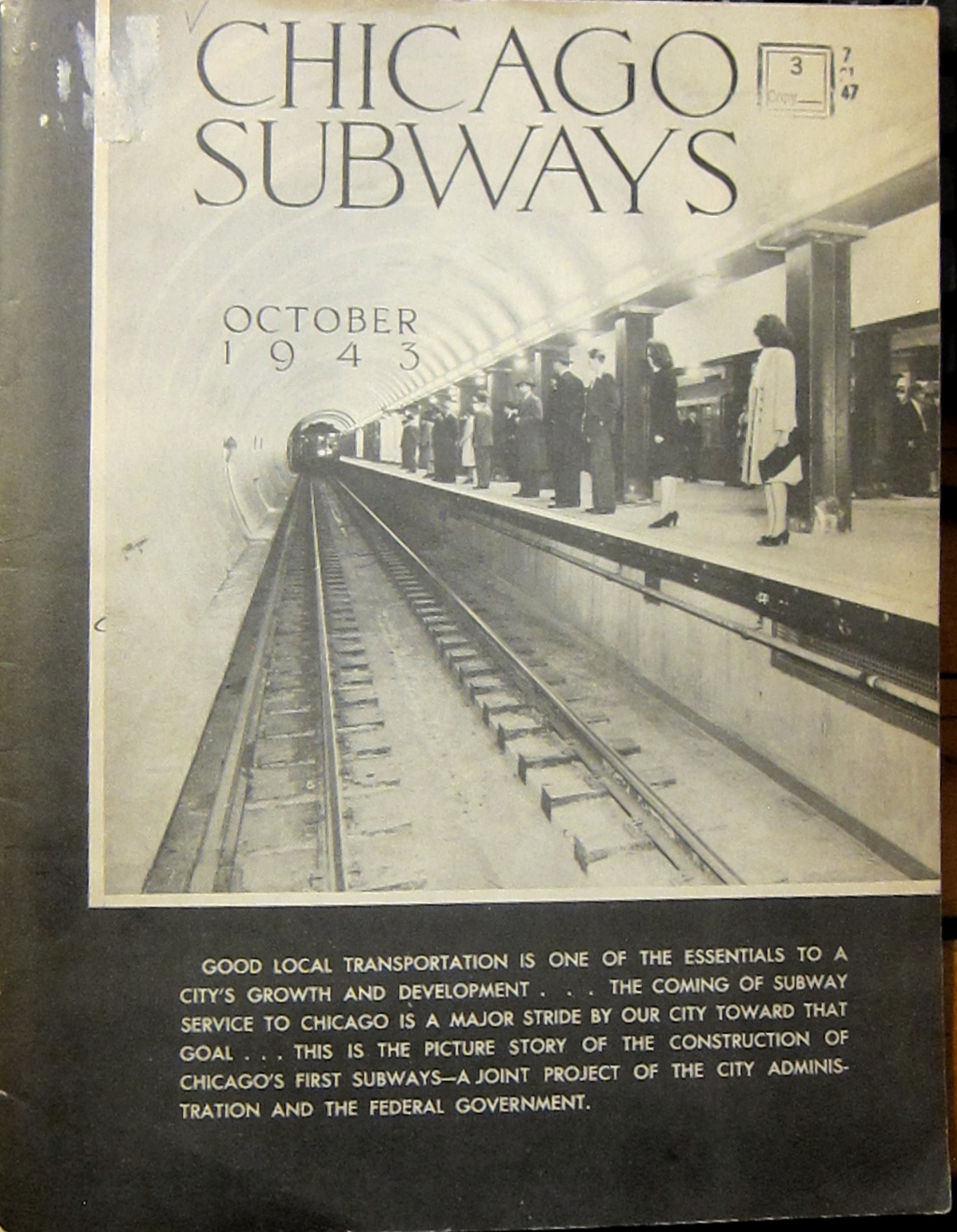
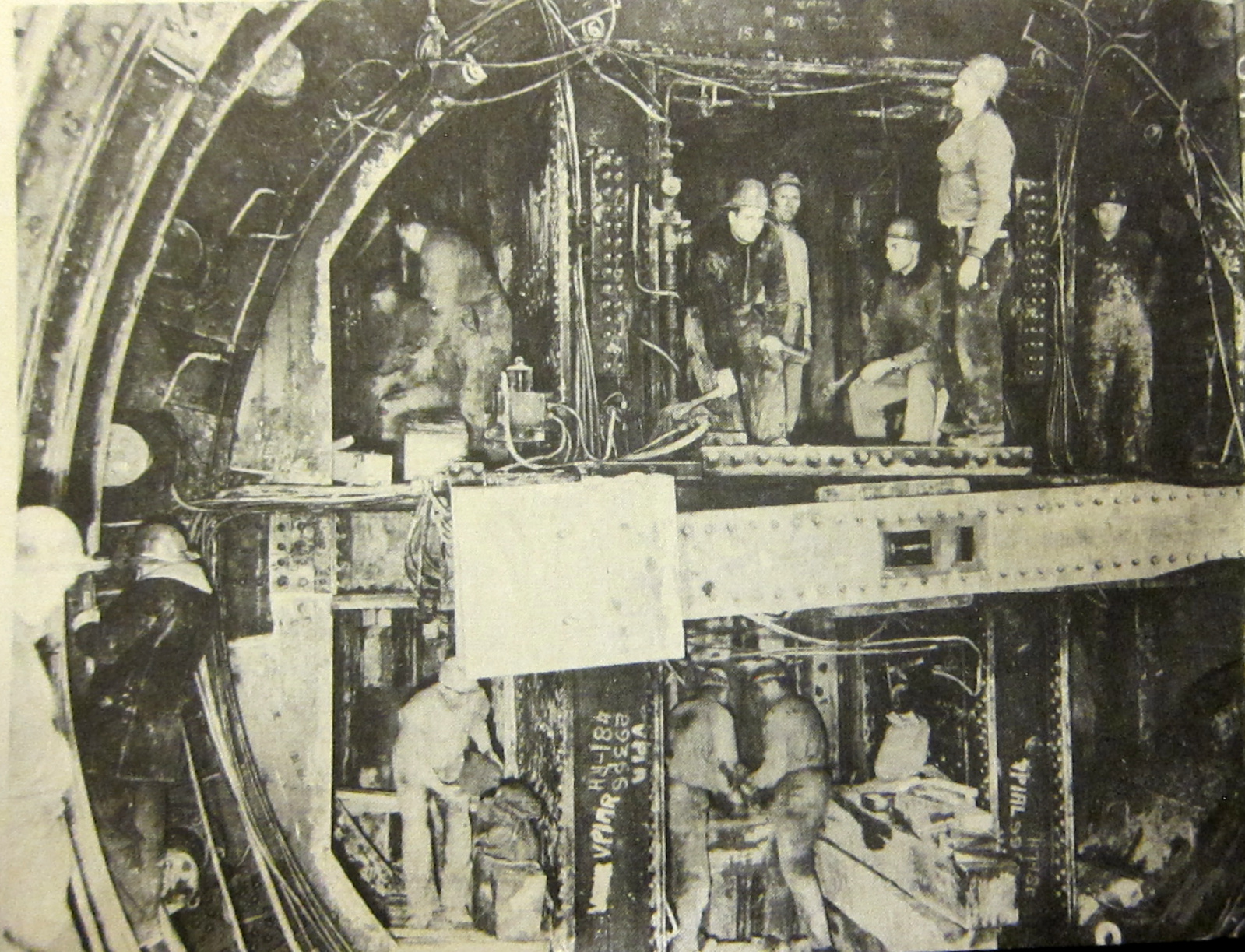
    Chicago subways 1943 coverRight at the start here I’d like to say I know nothing about the Chicago subway system–I would however like to share this little gem on it that I just found. The pamphlet looks unexceptional except for the date, which caught my attention because it is the month/year that the subway opened. The pamphlet also looks like it is a serial of some sort, but it isn’t–it just has a bad title. When I checked it out in WorldCat I was surprised to find that I couldn’t find it, even after a few adventurous searches, thinking that I was just asking the wrong questions of the enormous database…but the results held, and for some reason, the pamphlet just isn’t recorded in being in the many thousands of libraries using WorldCat. It is slim–only 31 pages long–but once you get beyond the first few pages of laudatory photos for the movers and shakers the work takes on a semi-documentary air, with some compelling images, which were another surprise. (The big exception to this flavor was the cover which features some very-regularly-spaced riders waiting for the train, giving the whole image a pod-people feeling.)  

    The photos of the workers show a familiar scene of men working in the cramp quarters of caissons and tunnels, not that much changed in a hundred years:


    Chicago Subways in tunnel _1_

    ·Posted by :

    ·in:

    —

  • A Not-So-Good Idea for Air Travel (1922)

    JF Ptak Science Books   Quick Post

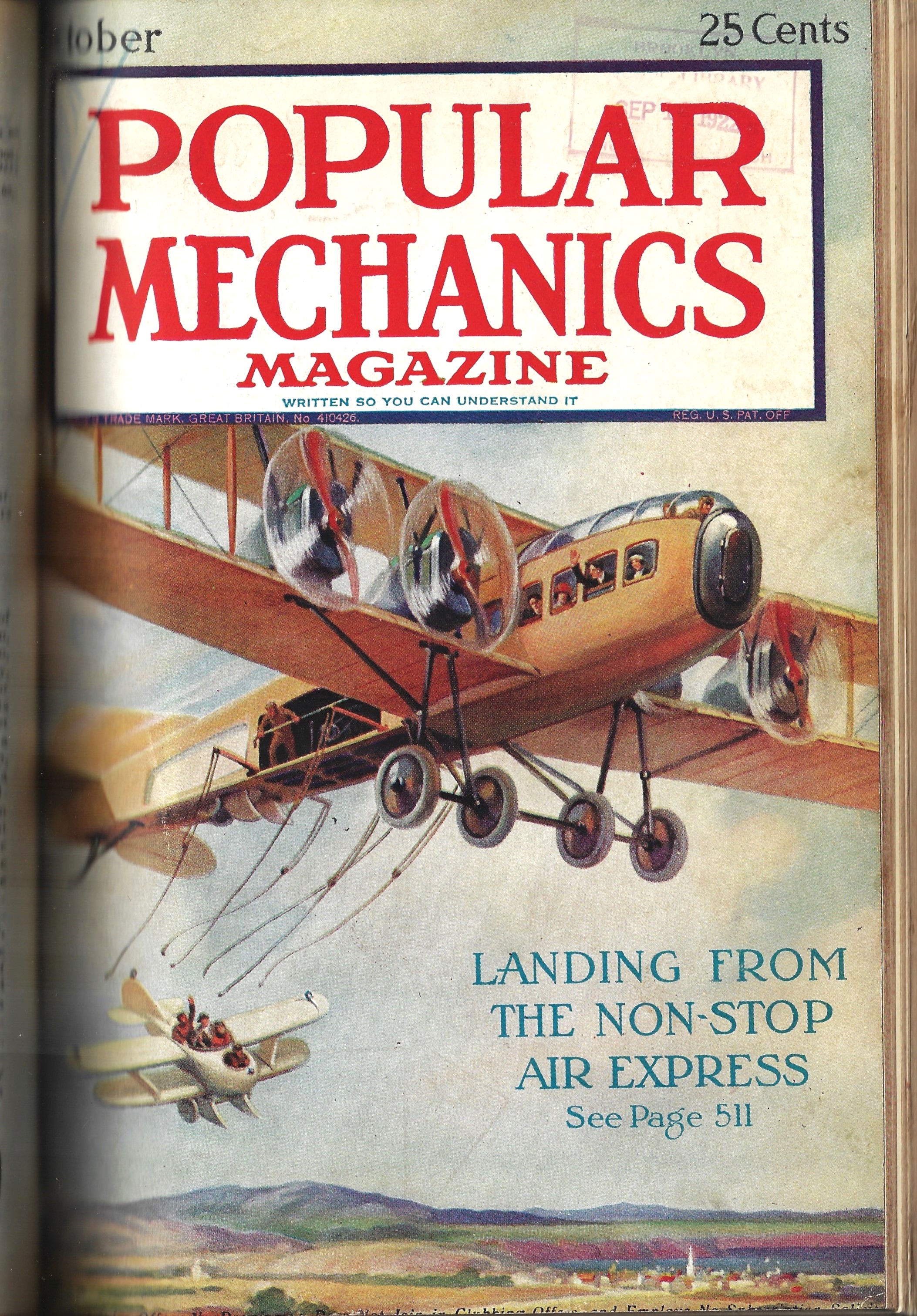
    This October issue of Popular Mechanics 1922 is robust! Here’s another attractive piece of design with loads of character and one central question:  “why?”  The image is that of a giant aeroplane capable of hauling 100 or more souls (not this particular version, though) for long distance uninterrupted flight of 1000 miles–so in order for there to be no in-between landings the aircraft came equipped with a glider aircraft (an altogether different version of the “hang glider”) that was released for the mother ship. As you can see it is a much smaller aircraft and looks to me to be pretty well packed, leading no doubt to questionable utility and much prayer. The thing is, why bother with another aircraft when you can just stop the plane and let people off? This beast was half-stopped in the air anyway by modern standards, probably chugging away at, what, 100mph? (The airspeed record at this time was just a touch over 200mph.) and it wasn’t flying very high (relative to even 1950), so stopping may not have been such a big deal. The airport or air station wouldn’t’ve been an issue either, because the glider would near to land somewhere. Anyway, I just couldn’t figure out this piece of The Possible Future.

    Pop Mech 1922 hang glider

    ·Posted by :

    ·in:

    —

  • Car Travel for No Good Reason Whatsoever and “Motorist Road Homes” To Accommodate That (1922)

    JF Ptak Science Books  Quick Post

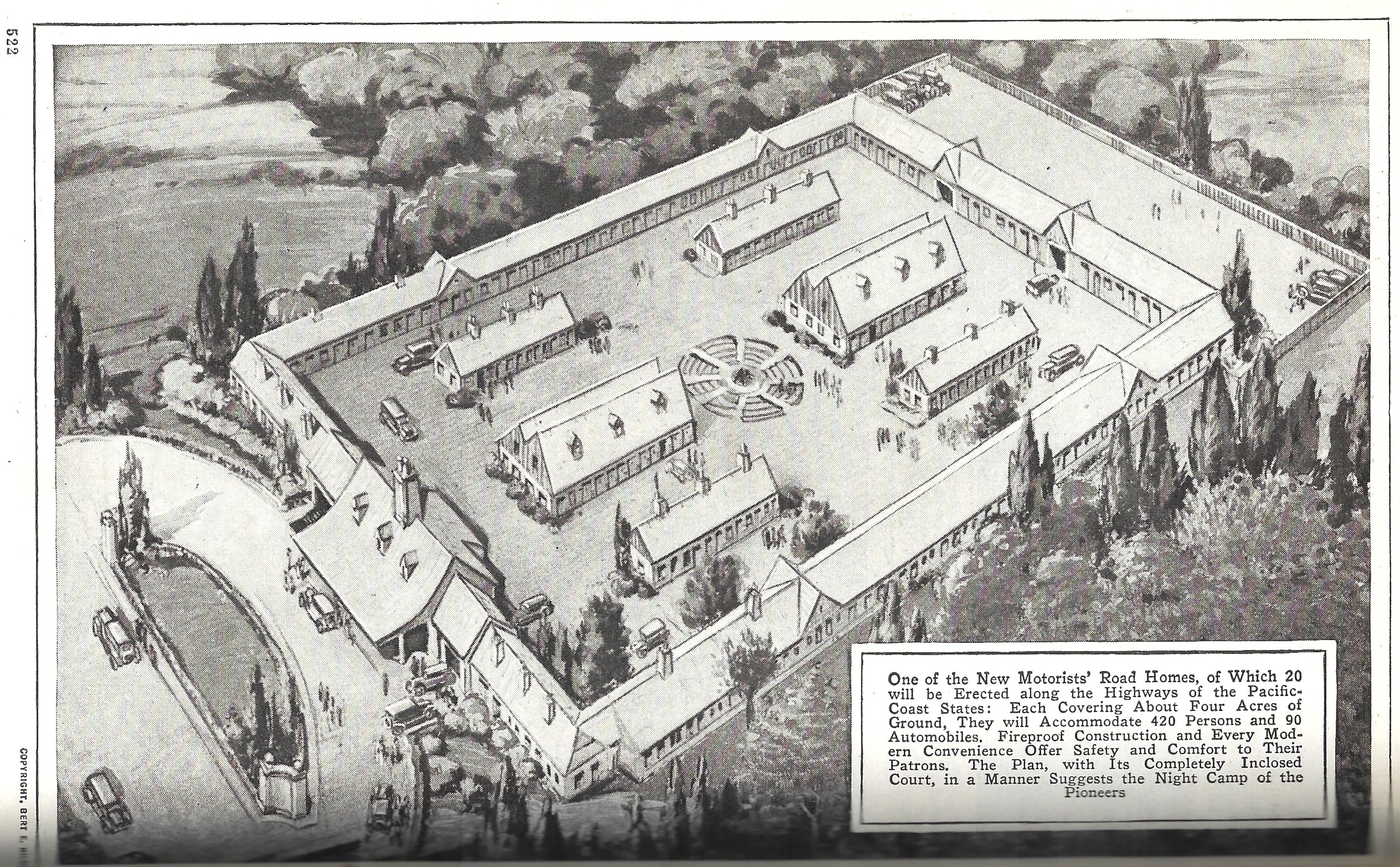
    This diagram reminds me of an enormous and mega-completed versions of the imaginary Joey the Juices’ “Stop ‘n Go Inn ‘n Out” motel down on the nice part of Rt. 1.  This exploded version of the motoring motel was meant for West Coast for travelers “aimlessly covering thousands of miles”, a giant influx of people riding the wave of massive new car ownership. This ranch was to welcome 420 people with room for 80 cars–which means, I guess, that people were traveling together–really together–five to a car, which implies that there were a good number of people contributing in an organized way to “aimless” activity. Perhaps people were just doing a lot of serendipitous driving as an organized crew. In any event I’m pretty sure that I’ve not seen plans for a motor lodge of this size, and thought to share it, finding it in the pages of Popular Mechanics for October 1922. 

    Given the birth of a much wider middle class, and the capacity for some disposable income, and access to cheap/affordable transportation and the roads to ride these new cars on, a large part of the working population of the U.S. did have the luxury at this point of travelling for the sheer hell of it. 

    Pop Mech 1922 car ranch


  • The Earliest Appearance in the U.S. of an Experiment Showing Lead in the Atmosphere? (1835)

    JF Ptak Science Books   Post 2792

    For various obscure and unknown reasons I rarely share a post from the books-for-sale section of this blog here in the “readerly” part. Today is an exception, mainly because I can’t quite hammer down what it is I’m writing about and perhaps someone out there might be able to share what they know about it.  The post is on a scientific paper from the Journal of the Franklin Institute, a quick 1-pager from 1835 that caught my eye, a middle-of-the-page bit about lead in the atmosphere. I thought it sounded “early”, this business of determining whether or not killer lead was in the air, and relatable to a lot of modern stuff, like human impact on the environment, lead-added gasoline, and that sort. So I checked it out. I couldn’t determine exactly what this little paper was in the history of such literature, but I think that I came close:

    The Earliest Appearance in the U.S. of an Experiment Showing Lead in the Atmosphere? (1835)

    Arthur Dunn, “Experiments to ascertain the Existence of Lead in the Atmosphere of a White Lead Manufactory”, pp 355-6. In: Journal of the Franklin Institute, Philadelphia, Vol 16 (third series), volume 20 (overall), July-December 1835, 438 pp, with text illustrations.  Half-calf, with raised bands. Ex-library, with some scuffing on the spine; also a few stamps on the title page. Nice copy. Good condition.  (There are dozens of other papers of interest in this volume–this seems to be the most compelling of the group.)

    • This paper seems among the earliest printed in the U.S. to experimentally demonstrate the presence of lead in the atmosphere. It is also suggestive of what would become the concern of human impact on the environment.

    The issue of lead poisoning was considerable—people became sick by touching, drinking, and breathing in lead under many different circumstances. For example, poisoning occurred when lead was used in paint by breathing or touching or eating paint chips, the most harmed of those would be the color mixers who prepared the paint. There was also a problem with lead caused by eating it in the form of food coloring for bread (to give it a yellowish tint using ‘chrome yellow”), candies, bon bons, and an emulsifier for snuff, among many other things. Lead was also ingested via the use of lead utensils, pipes, and drinking ware.

    The deadly problem of lead sickness/poisoning (“colic”) was known to the Hippocrates, Nicander, Celsus, Dioscorides, Galen, Avicenna and other ancients of Greece, Rome, and Persia, and was a known concern through the Dark and Middle Ages, through the Renaissance and up to the present day. (It should be stated that some of these writers described the effects of lead poisoning without the association with lead.) It was Stockhausen, “the father of lead colic”, who would in the 18th establish the connection between lead and the diseases caused by it, with Henkel showing lead as the exclusive vector agent to the diseases (in 1812).

    It has been shown that the “(f)irst article about lead poisoning was published in 1848” by Samuel L. Dana1. This was the first translation and expansion of the article “Traits des Maladies de Plomb, ou Saturines”, by Tanquerel des Planches, which was published nine years earlier, in 1839, which has been noted as one of the earliest papers in the medical literature on lead poisoning. 2,3 The Dana translation, according to the American Journal of Science, was a great contribution to health in the U.S., as the Tanquerel des Planches work was “doubtless unknown to intelligent readers of this country”. American Journal of Science, volume 6, November 1848.

    I have been unable to find anything by Dunn, whose work is reprinted in the Philosophical Magazine five months earlier in the year (series III, vol 7, issue 31). There are other earlier works that come close to what Dunn is doing4, but so far as I can determine this seems to be the first to prove that the lead could be supported in the atmosphere and be breathed into the body (or absorbed through the eyes), something that no doubt was suspected but not demonstrated. 

    Notes

    1.  Lead Diseases: A Treatise from the French of L. Tanquerel Des Planches: With Notes and Additions on the Use of Lead Pipe and Its Substitutes, printed in Lowell, (Ma.), by Daniel Bixby & Co., 1848)–Parissa Karrari  et al., “A systematic review on status of lead pollution and toxicity in Iran; Guidance for preventive measures” (–Daru Jnl Pharmaceutical  Sciences, 2012; 20(1): 2:.
    2. “The medical literature on lead poisoning in children can be traced back to the work of Louis Tanquerel des Planches he remarked on children placing leadpainted toys in their mouths and developing lead colic. As early as 1887, medical authorities in the United States noted cases of lead poisoning. David Stewart reported in Medical News that nine members of a single family developed lead poisoning from lead chromate used to dye bread yellow. [Stewart, “Notes on some obscure cases on poisoning by lead chromate manifested chiefly by encephalopathy.” Med News 1887; 1:676-81. 11.] In the 19th century, lead chromate was often added to lead sulfate to form what was called “chrome yellow,” a substance used by bakers and candy makers as a coloring agent. In 1889, an article in Science reported on the deaths of two children from the ingestion of baked confectioners’ products that contained chrome yellow. [Glenn W. Chrome yellow considered as a poison. Science 1889; 13:347-9. 12.]”— David Rosner, et al, “Lockhart Gibson and the Discovery of the Impact of Lead Pigments on Children’s Health: A Review of a Century of Knowledge”, Public Health Reports (1974-) Vol. 120, No. 3 (May – June., 2005), pp. 296-300
    3. On Louis Tanquerel des Planches (1795-1868): “He is known for his research of lead poisoning, about which, he is credited with conducting one of the first comprehensive studies of occupational illness. By way of analysis of 1200 cases of lead poisoning at the Hôpital de la Charité in Paris, he reported that the disease was more frequently found in workers who were exposed to lead fumes than those who worked with the solid metal. In his studies he used the term encéphalopathie saturnine to point out neuropsychiatric indications of lead poisoning.”—Wiki
    4. But then there’s this earlier paper (1830), which certainly describes the consequences of lead in a closed environment but does not discus at any point any experiment to show that this is so: “…favorables à la production du mal Qui ne sait que parmi les professions qui exposent à la colique on compte celle d imprimeur c est à dire celle de compositeur ou de metteur en page en un mot celle des ouvriers qui manient les caractères Car je ne sache pas qu on voie fréquemment cette maladie attaquer les corrcctcurs ou autres employés qui vivent dans la même atmosphère si l on se rappelle en outre que le plomb n entre que pour une très faible proportion dans l alliage dont on se sert Pour les caractères Qn comprendra qu il est fort difficile qu il s en échappe en grande quantité des émanations saturines et que ce n est que par un contact Inumédiat que l infection doit avoir lieu…” -discussing the problems to employees handling lead type in a print shop.  Fouquier, “Colique de Plombe, Nature et Traitement” (Revue Clinque de la Medicale), in Gazette Medical, vol 1, 1830, pp 430-1


    ·Posted by :

    ·in:


  • Bombing Tokyo with Dollars (1943)

    JF Ptak Science Books   Quick Post

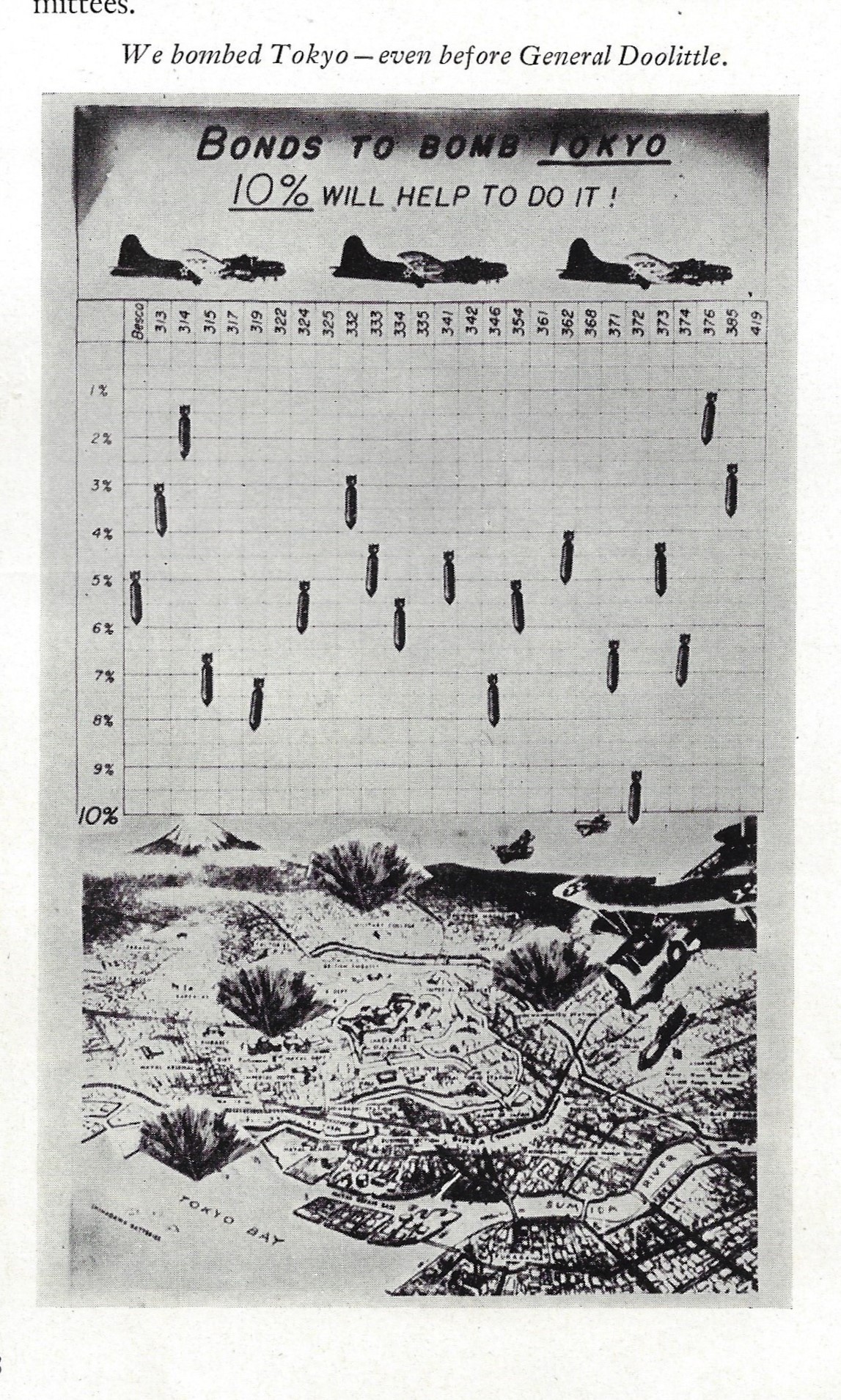
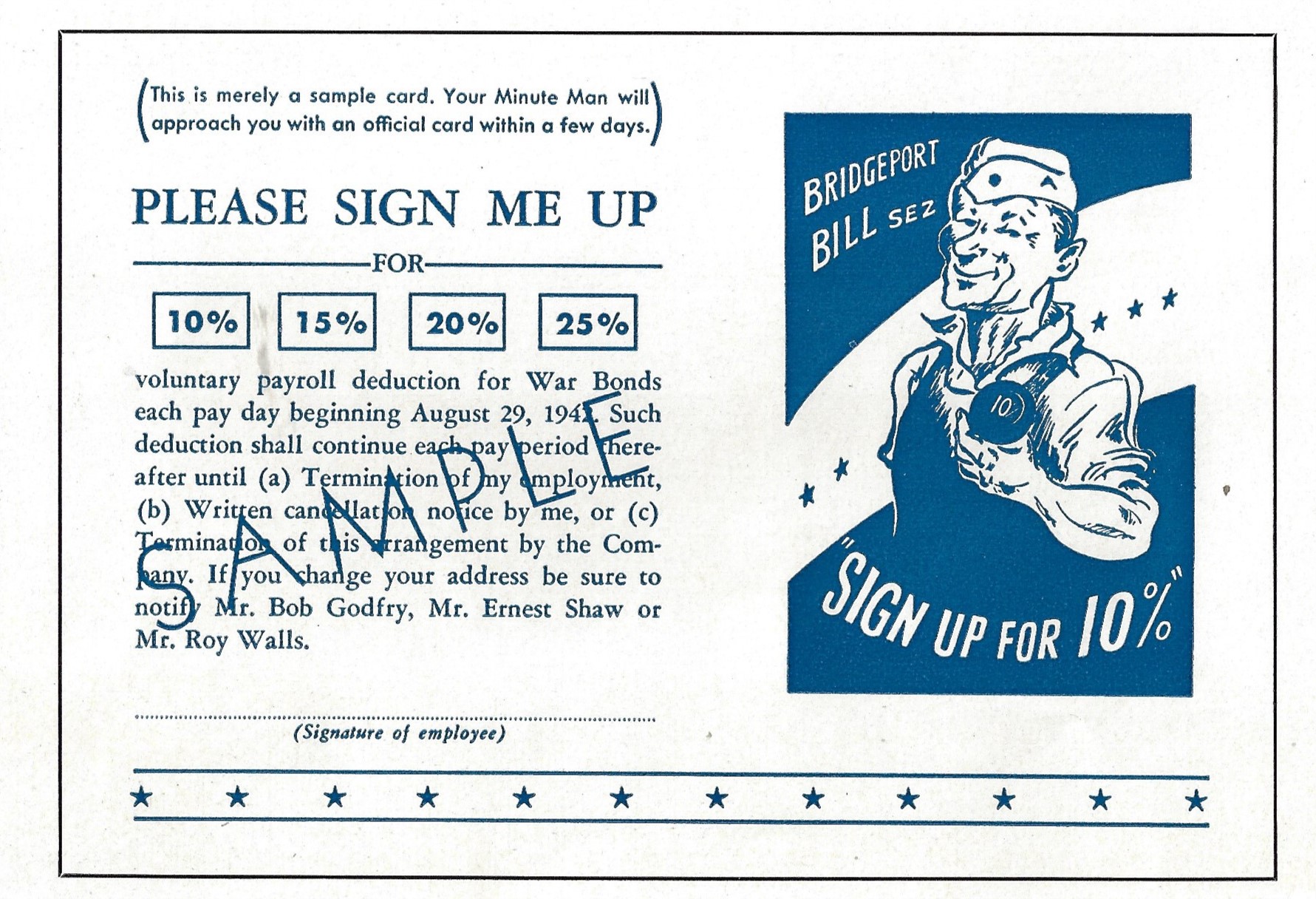
    This is part of a report of the Bridgeport Brass Company for 1943 detailing the company’s activities in the war effort. This was apart from the general war products industry, and included what the company was doing in response to the U.S. War Production Board’s outline for pulling together labor and management in joint committees to solidify the extreme national war effort. One small part of that was the donation of a portion of every paycheck–the suggested amount was 10%–that would be used towards war production. The poster below was a reminder to folks in the factories about where and how that money was being used:

    Bombing Poster money drive

    Bombing Poster 10 percent war drive billboard

    Bombing poster 10 percent card

    ·Posted by :

    ·in:


  • On Unconditional Surrender (1943)

    JF Ptak Science Books   Quick Post

    I found this arresting map in a tiny publication called …Sans Condition, which was published in the first half of 1943. The publication is only 12 pages long but has a number of evocative images of Germany being bombed and lines of German POWs–it is in general a propaganda piece for French-speaking folk (which was printed god-knows-where) produced deep in the war and at a time when the tide has about turned on the Nazis.  The term “Sans Conditions” refers to “Unconditional surrender”, which was a phrase that President Roosevelt surprisingly used when meeting with Allied leaders at Casablanca in January 1943. It is a term that doesn’t make many appearances in U.S. military history, though it was famously endorsed by General U.S. Grant in 1862 in response to an entreaty from Confederate general Simon Bolivar Buckner jr.–and as it happened a U.S. general by the same name was killed om Okinawa by a direct hit from a Japanese heavy gun. Roosevelt would send the same directive to the government of Japan at Potsdam July 26, 1945 (later modified somewhat to accommodate the Japanese keeping their emperor). 

    Books covers sans conditions _1_

    The title of this post is the title of the map,  “Ils ont decide ou, quand et comment les Allies lanceront leurs attacques”–and you don’t need to know French to know what it says.  

    Books covers san conditions __2_

    ·Posted by :

    ·in:

    —

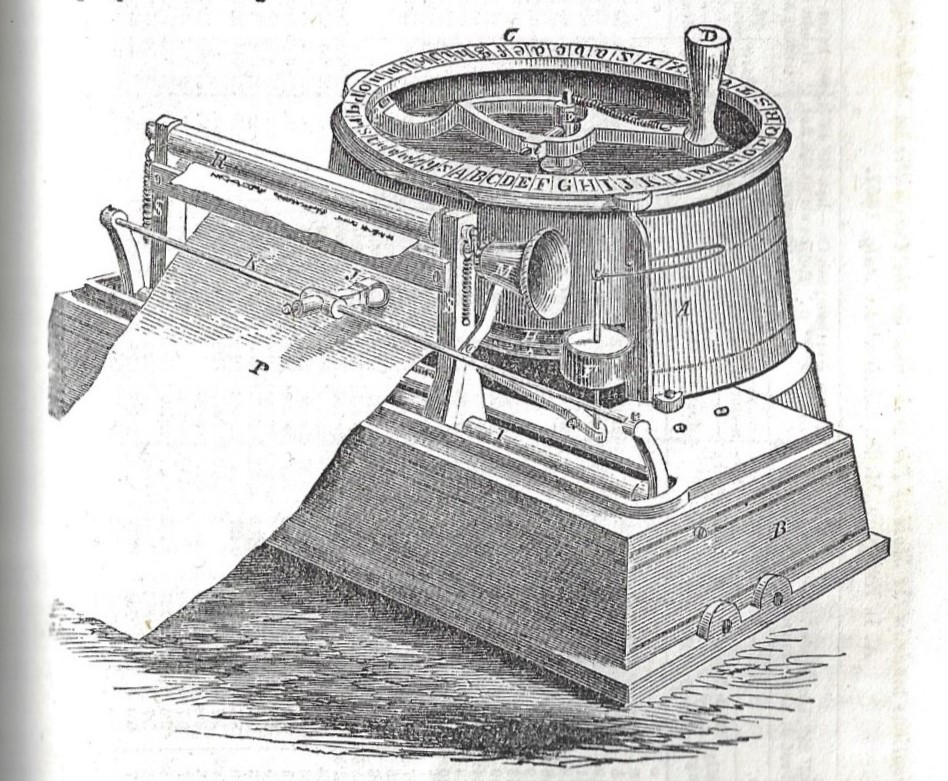
  • A Proto-typewriter, 1857.

    JF Ptak Science Books  Quick Post

    Here we have a lovely attempt at what is close to being a typewriter (a “hand-printing machine”), found in the Journal of the Franklin Institute for June 1857. The size isn’t given but my guess is that it would be about the size of foolscap paper, easily desk-top. It seems fairly simple in a slightly complex way, and I can easily see where it would serve as a stop-gap implement between what came before and the typewriter. 

    The short article introducing the workings of the machine is surprisingly, and very readable, even though it is brisk and sharp. It is just well done.

    It is difficult to see some of the annotations, even in the original, and even with a magnifying glass, but for that first indicator “H” you can find it just southward of the bell-like object (“M”, which turns out to be a handle for the paper roller), and “E” was another difficult one to find, and that one turns out to be the pivot in the center of the type circular.  In any event, the thing operates much like a typewriter, the lever “D” moved to the position of the letter needed, then pressed down, moving the type into place against the ink and the paper, which is loaded in rollers much like a modern typewriter. 

    JFI 1857 typewriter _2_


  • Electric Time (1847)

    JF Ptak Science Books  Quick Post

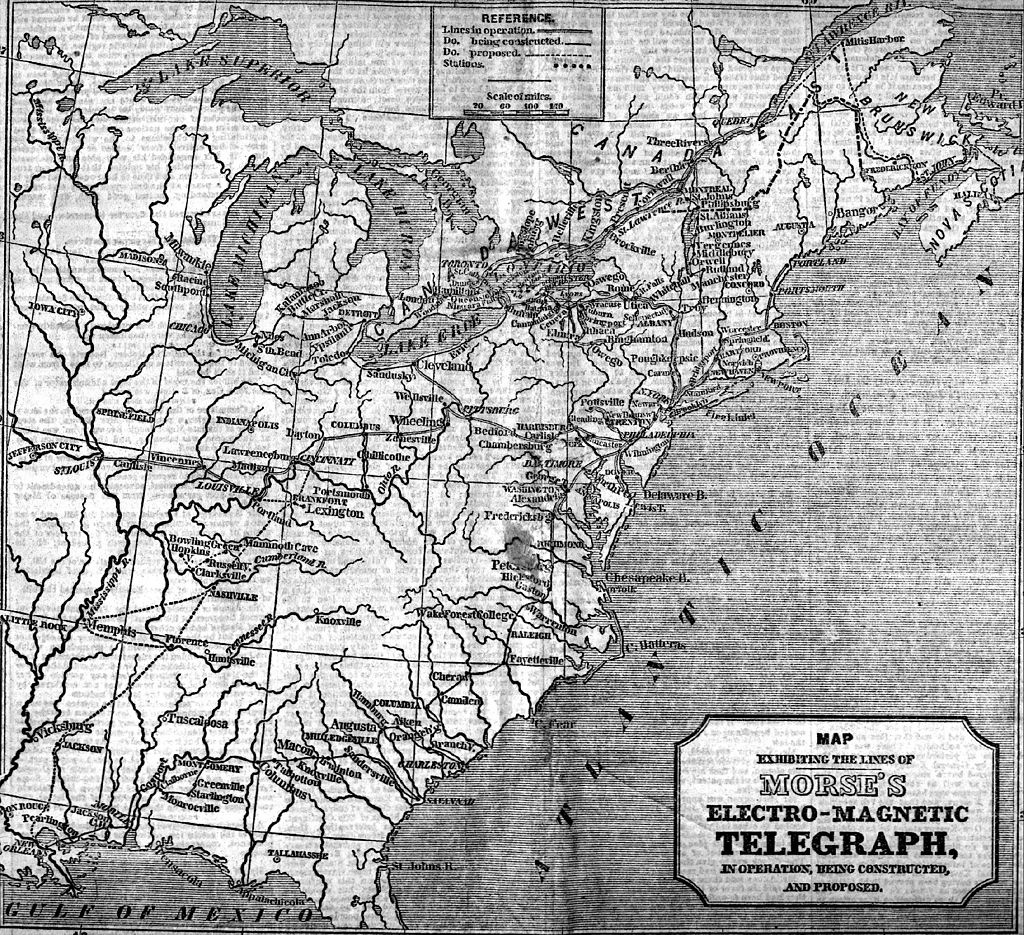
    There were some ways of getting around the problem of geography and communications over long distance–visual semaphores, smoke, drums, that sort. The issue of long-distance relatively instant communication wasn’t solved until the appearance of the telegraph, which for the most part outside of starts and fits and a complicated pre-history really wasn’t solved until Morse and Vail in about 1843. The first line was laid in the U.S. between D.C. and Baltimore in the next year, and then with the display of this success a network of electric communications exploded, as you can see in the map below showing telegraph lines in the U.S. in 1848, just five years after there was nothing at all. 

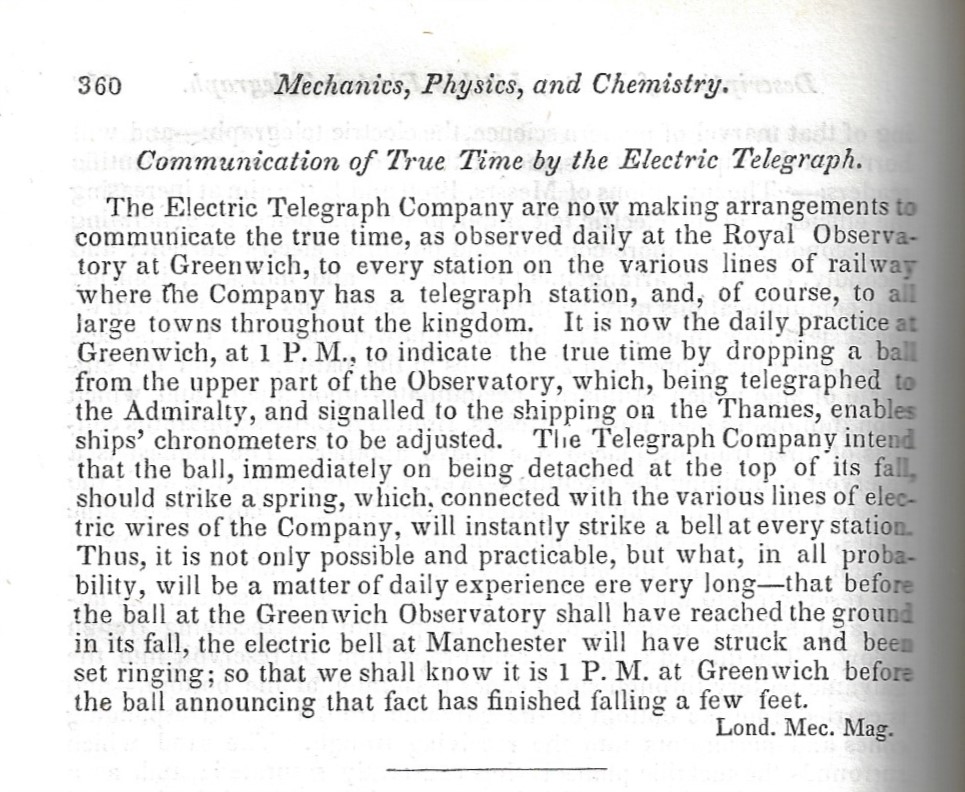
    Anyway this is what came to mind when I stumbled on the following short notice that appeared in the Journal of the Franklin Institute in December 1847–the fixing of a “constant” time communicated by electric telegraph, reporting the standard time from Greenwich, to be sent out to the furthest reaches of the telegraphic world, and which was an early attempt at the mass distribution of regulated synchronous time keeping over long distances. Pretty cool idea.  

    • “It is now the daily practice at Greenwich, at 1 P.M., to indicate the true time by dropping a ball from the upper part of the Observatory, which, being telegraphed to the Admiralty, and signaled to the shipping on the Thames, enables ships chronometers to be adjusted.”


    JFI 1847 telegraph time

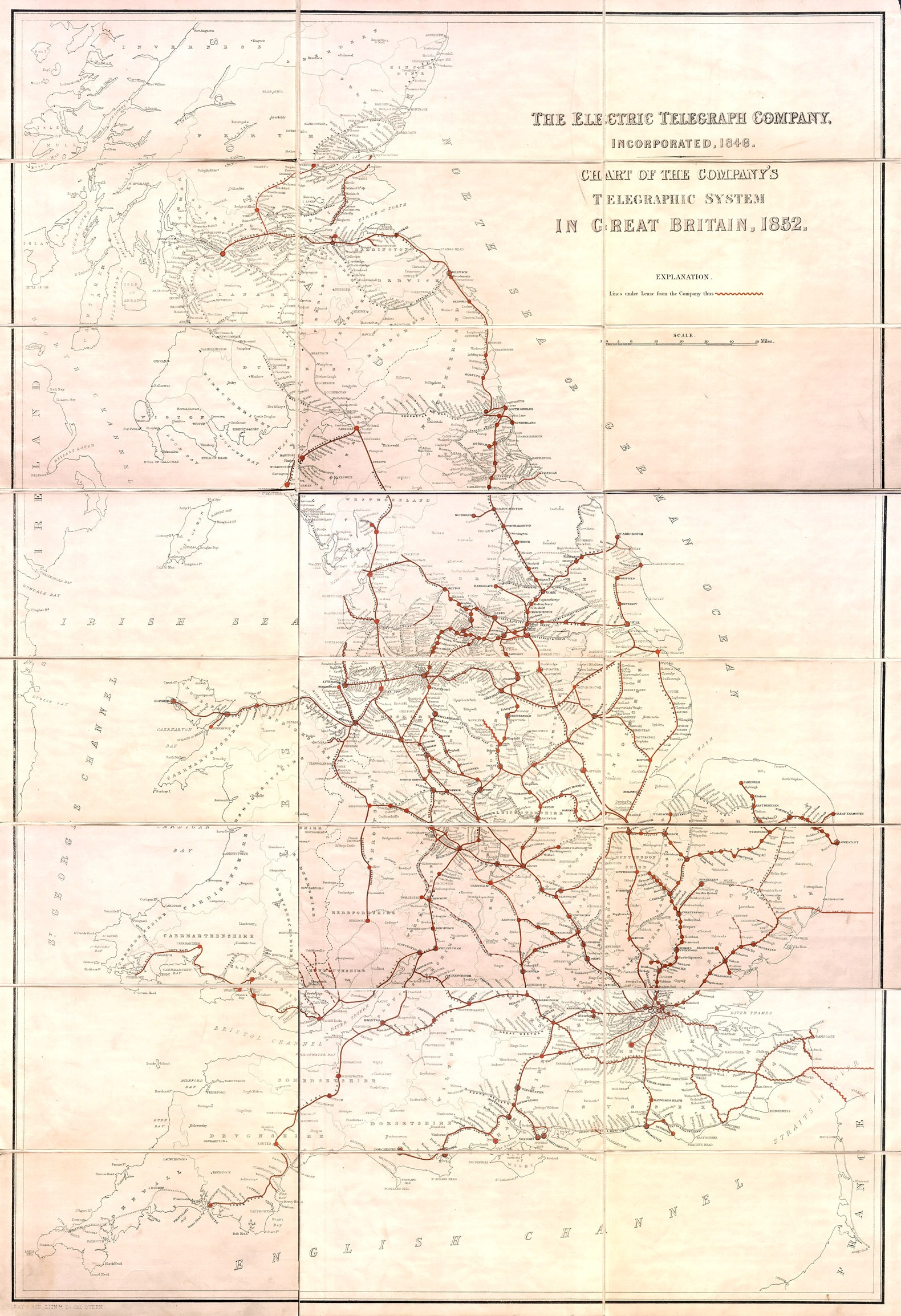
    A map of the telegraph lines in Great Britain in 1852:


    Telegraph map GB 1852

    Source: distancewriting.co.uk 

    And the map of telegraph lines in the U.S.:

    Telegraph map wikipedia

    Source: wikicommons on “telegraph history”


  • A Particular Bit of Science In Wells’ “War of the Worlds” (1894)

    JF Ptak Science Books   Quick Post

    I haven’t read in Wells’ WOTW in a long time, and when I went to it just now (reading and listening) I was surprised at how quickly the Mayday Martians element evolved.  We get to it by the end of the very first paragraph:  

    • “At most terrestrial men fancied there might be other men upon Mars, perhaps inferior to themselves and ready to welcome a missionary enterprise. Yet across the gulf of space, minds that are to our minds as ours are to those of the beasts that perish, intellects vast and cool and unsympathetic, regarded this earth with envious eyes, and slowly and surely drew their plans against us. And early in the twentieth century came the great disillusionment.”

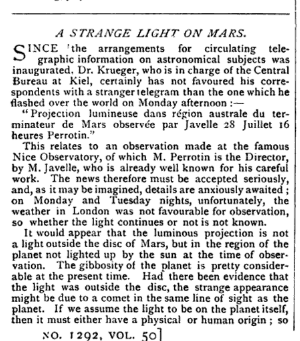
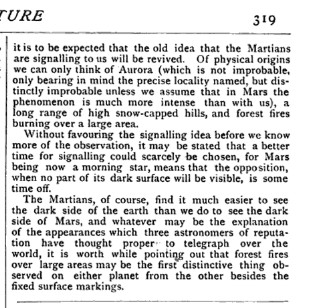
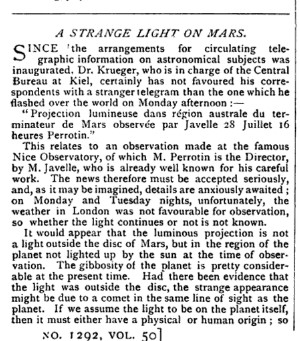
    I was also surprised by the appearance of some tech references, including a dated reference to an article in Nature magazine (2 August 1894).  The Nature article references a “strange light” which Wells uses to his own world-stabbing ends, and he gives his story some credibility by dragging in a real-life background to the possibilities of his imaginations.

    • “Had there been evidence that the light was outside the disc the strange appearance might be due to a comet in the same line of sight as the planet. If we assume the light to be on the planet itself then it must either have a physical or human origin…” (And by “human” here the editor no doubt means extra-terrestrial, or biological, or intelligent life form.)

    I’m not a big sci fi reader, but in my experience I’ve never seen a tale woven using the names of Perrotin and Schiaparelli, though I have no seen them used in the plot setup thickening agent in WOTW. (By the way Wells mentions the “palpitating” work of “Lavelle of Java” though he must have meant “Javelle”, who was Stephane Javelle, the assistant to Perrotin of the Nice Observatory.)

    On the “strange light”:
    War of the Worlds Mars in NAture _1_


    War of the Worlds Mars in NAture _1_


    Source: Nature, volume 50, August 2, 1894

    ·Posted by :

    ·in:

    —