A Daily History of Holes, Dots, Lines, Science, History, Math, Physics, Art, the Unintentional Absurd, Architecture, Maps, Data Visualization, Blank and Missing Things, and so on. |1.6 million words, 7500 images, 4.9 million hits| Press & appearances in The Times, Le Figaro, Mensa, The Economist, The Guardian, Discovery News, Slate, Le Monde, Sci American Blogs, Le Pont, and many other places… 5000+ total posts since 2008.

Author: JF Ptak

  • When Buckets were Buckets and Picks were (really) Picks

    JF Ptak Science Books   Quick Post

    Rose is a rose is a rose is a rose as Ms. Stein has said, though that doesn’t necessarily apply to buckets and picks.  Once upon a time there was a solid and universal need for many varieties of each one of these (exclusive of the not-elusive Ms. Hyacinth Bucket-pronounced-bouquet as the Major would say),and we get a taste for them in these pages of advertisements.  

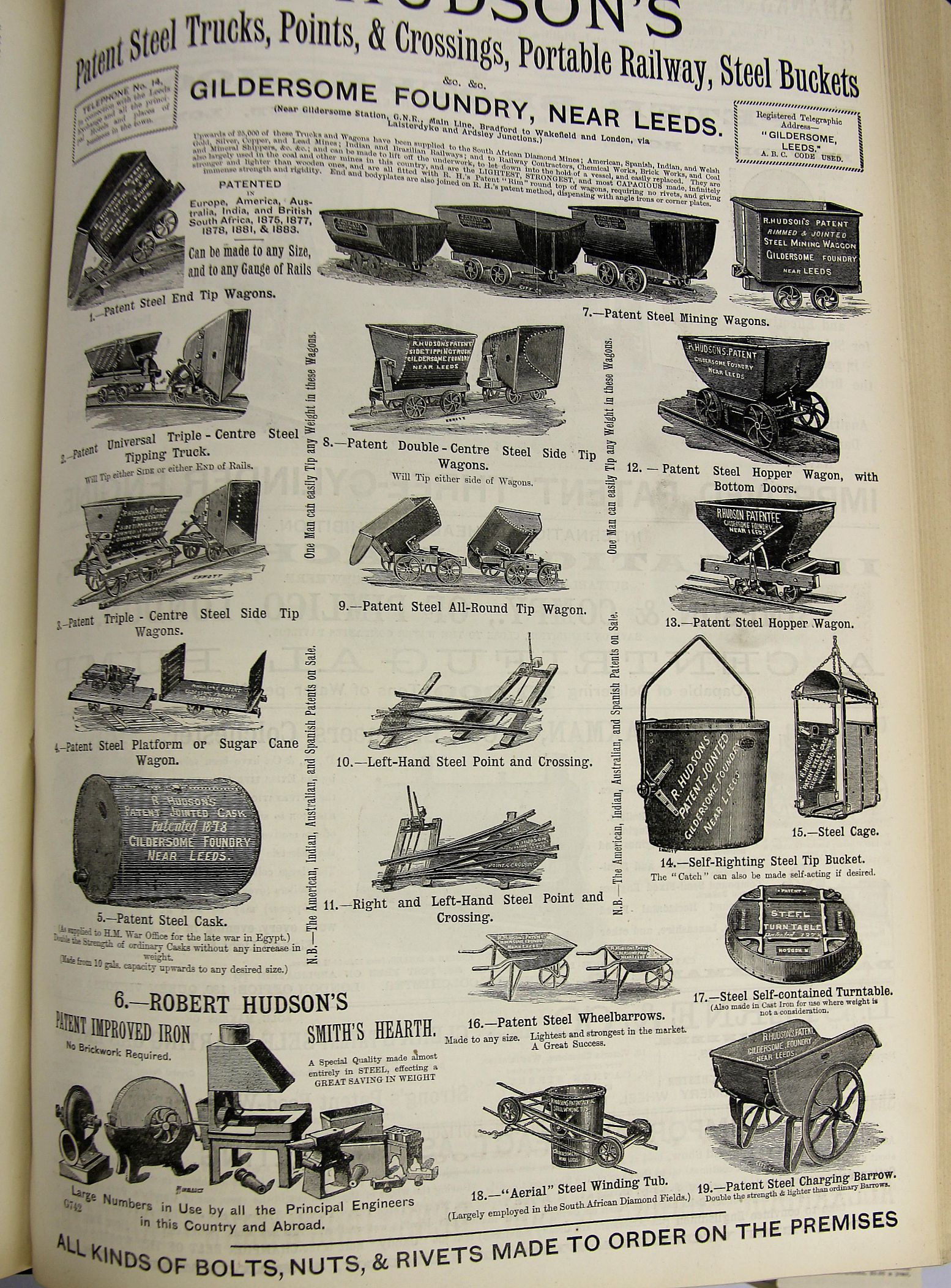
    The first is for Hudson’s hardware (“steel trucks, points, crossings, portable railway, steel buckets”) and so on, presumably mostly for mining, and it appeared in The Engineer for July 4, 1884:

    Mining buckets

    The ad has a superb aroma of engineering heavy finery.  

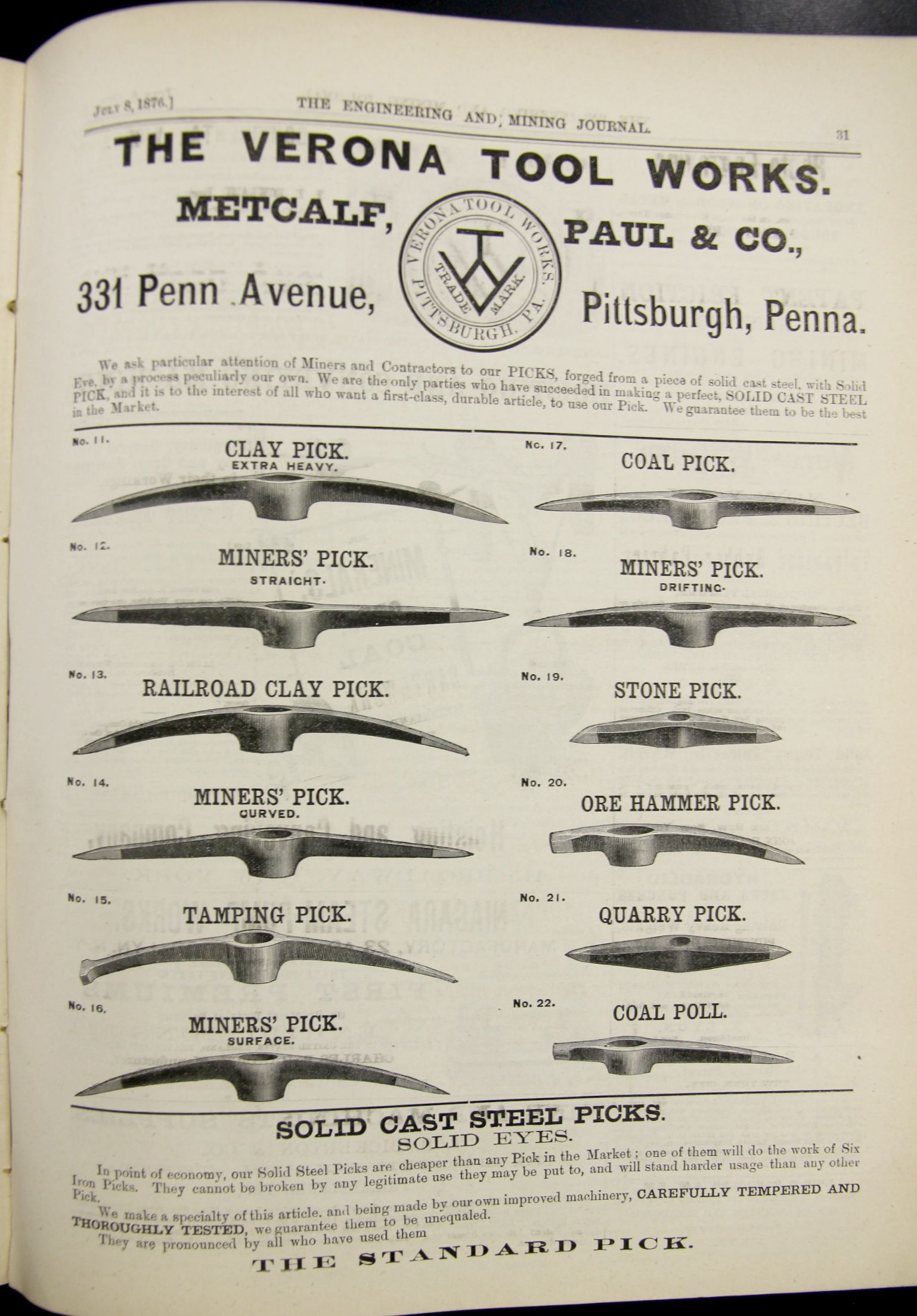
    The second is from the Engineering and Mining Journal, July 8, 1876, and the ad trumpets a “perfect, solid cast metal pick” for all sorts of segmented work.  Different jobs, different surfaces, different environments, different people–different picks for the job.  

    Mining picks


  • Outsider Politics & the Apotheosis of Religico-Governmental Control

    JF Ptak Science Books   Post 2513

    Compass057[Woodcut image by J.J. Grandville, [Jean-Ignace-Isodore Gerard (1803-1847)] from Bilder aus dem Leben der Thiere (“The Public and Private Life of Animals”) vol II, p. 224  =>For a good summary of Grandville’s fantastic work, which is completely unrelated to this post, see Opinionated Art, here.]

    People's Party058

    This wisp of a pamphlet (printed in 1937), set out on a task to introduce the idea of a theocracy and government according to Christian revelation, winds up in a rather odd and unexpected place.  If you were to remove the religious aspect of the proposals and the “theomendments” of The People’s Party, you wind up with an extreme form of dictatorship in which “the Government” and “Government-Nation” is a sort of totally-dominating  Socialist-Scriptural-Brutalista melange.


  • Table of the Compass of Voices and Instruments (1814)

    JF Ptak Science Books   Quick Post 

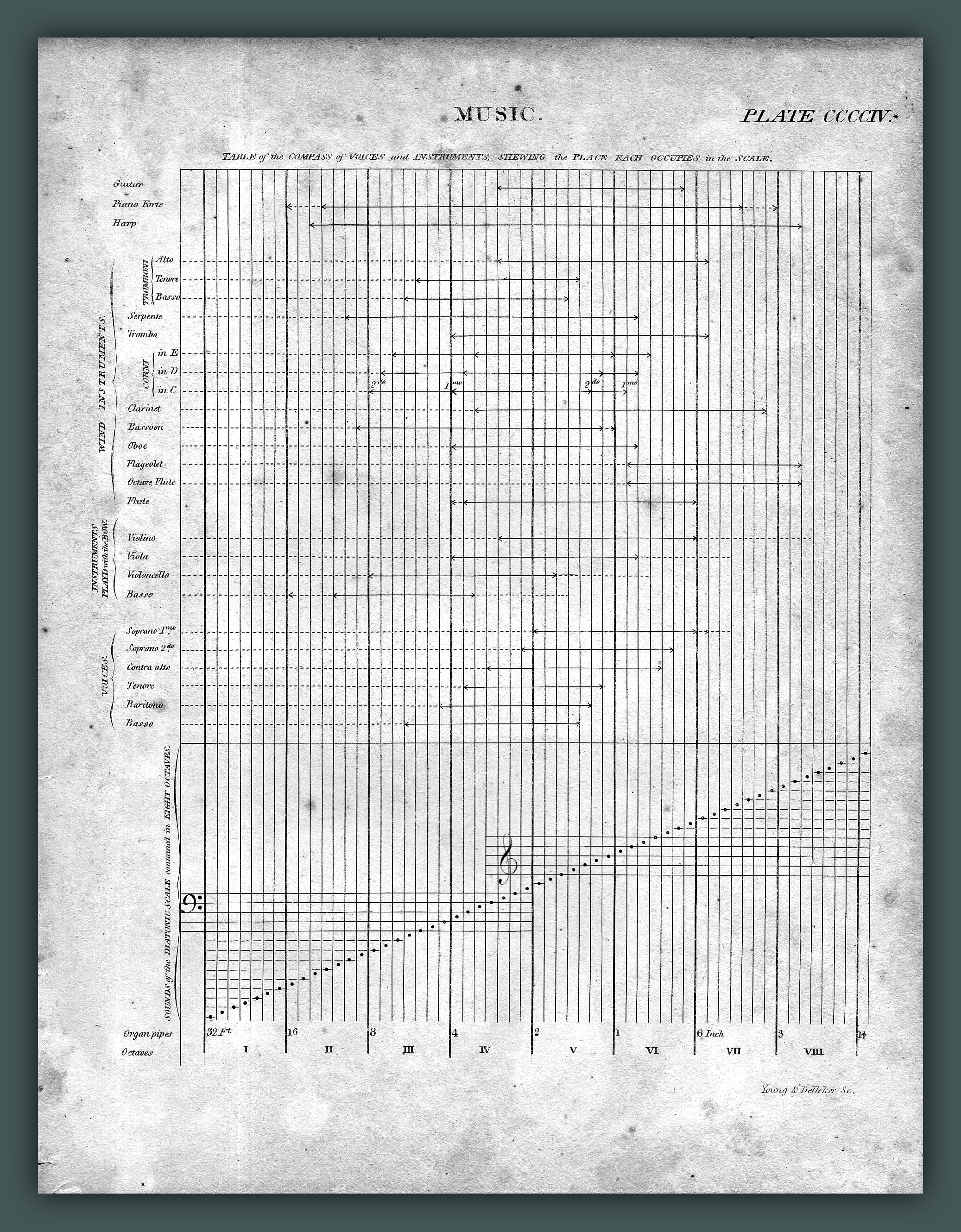
    This engraved plate from Abraham Rees’  Cyclopedia… is the wonderful invention of Alexandre Choron (1771-1834), and appeared (perhaps for the first time in an English press) in London in 1814.  It is a concise and interesting display of the comparisons of the reach of instruments along the eight octaves, and is a very strong example of clear and useful graphical display of quantitative data.  Choron graph056

     Here’s another version of the chart, expanded somewhat, and published using the bones of this earlier work, in the eighth edition (1858) of the  Encyclopedia Britannica:

    [Sopurce: the article on “Music”, Encyclopedia Britannica, via Google Books]

    The full subtitle:  “Table of the Compass of Voices and Instruments, Shewing the Place Each Occupies in the Scale”.  (The original print is also available for purchase through our blog bookstore.)

    From Grove Music Online:

    Choron, Alexandre(-Etienne)

    (b Caen, 21 Oct 1771: d Paris, 29 June 1834). French writer on music, instructor, publisher and composer. While still a boy, he taught himself Hebrew and German and acquired a permanent interest in scientific experiment and a fascination for music theory and the techniques of composition. Although he reached the age of 16 before taking music lessons, he had already attained elementary skill on keyboard and other instruments. He greatly valued a friendship with Grétry which began in his 20th year and which suggests that he moved to Paris after his father’s death.

    Choron’s earliest publications, the three-volume Principes d’accompagnement des écoles d’Italie (1804) and Principes de composition des écoles d’Italie (whose publication was announced for 1806 even though it did not appear until the end of 1808 or early 1809 – the preface is dated 9 December 1808), include courses in thoroughbass together with instruction in counterpoint and fugue, implemented by exercises from Sala, Martini, Marpurg and Fux. In February 1806 he undertook the editing for August Leduc of the scores of Haydn’s symphonies. He began his activities as a music publisher in partnership with Leduc in November of that year, in order to exploit a licence for lithographic printing bought from Frédéric André in 1807. His partnership with Leduc ended in late 1811. Choron published works by Josquin, Goudimel, Palestrina and Carissimi, as well as Italian and German music up to the time of Bach. In 1827 his daughter Alexandrine (d 1835) took over the running of her business, which after her marriage in 1832 to the composer and teacher Stéphano Nicou took the company name of the Société Nicou-Choron. There followed the two-volumeDictionnaire des musiciens (1810–11) in which Fayolle was his collaborator. Choron was too idealistic to be financially successful, and his attention to business was limited by his scholarly and scientific pursuits. What might have been his magnum opus, Introduction à l’étude générale et raisonnée de la musique, remained unfinished. He was forced to teach music and accept public appointments.

    In 1811 he was appointed a corresponding member of the Beaux-Arts class of the Institut de France in succession to Framery. From 1812 until Napoleon’s downfall he was Directeur de la Musique des Fêtes Publiques. His essays on plainsong and church music led to his nomination for the task of reorganizing music in French cathedrals and in the royal chapel after the restoration of the Bourbon monarchy. In January 1816 Louis XVIII made him régisseur général of the Académie Royale de Musique. According to Fétis he turned the Opéra ‘into a trial theatre’, and his dismissal after little more than a year enabled him to devote his energy to the founding of his Institution Royale de Musique Classique et Religieuse. He secured public grants for it between 1826 and the Revolution of 1830, but Charles X’s attempt to revive absolutism led the new government under Louis Philippe to discontinue expenditure associated with royal privilege.

    The reduced budget not only proved disastrous for Choron but incurred disappointment for music lovers in general, as Choron’s students associated with other schools to give choral festivals in Notre Dame, St Sulpice and provincial cathedrals. The programmes included unaccompanied works of the Renaissance, together with Baroque oratorios with orchestra and music of later periods. After years of decline his school was revived by Niedermeyer and renamed Ecole de Musique Religieuse Classique. It remains the most substantial testimony to the work of an influential idealist during a time when French musical life badly needed ideals.

    Although a few Conservatoire pupils sought Choron’s instruction, his school produced no outstanding composers until the Niedermeyer régime after 1836; yet Choron had a widespread influence on teachers, organists, choralists and those who were awakening to the importance of music history. His inexpensive editions of polyphonic and choral music were invaluable, despite the later issue of most of the works in better format by Proske and the Regensburg scholars and by English and German publishers; nor were his labours towards the revival of plainsong in vain, though the work of the Benedictine monks of Solesmes superseded them. His interest in the Baroque masters was more a revival than a novelty, and contributed indirectly to the demand for scholarly editions. The Manuel complet de musique vocale et instrumentale, published after his death by his collaborator, La Fage, was uniquely valuable in its day. In a country whose musical tradition was almost entirely unscholarly, and focussed on the capital, Choron stimulated interest that made his own publications impermanent.

    He composed chiefly sacred music, including a Messe brève, a Magnificat, a Stabat mater and numerous motets, both a cappella and with organ accompaniment. His opera, Nadir et Salyha, was produced in Kassel in 1811. He also wrote a number of songs, of which La sentinelle (1810) was popular in his lifetime.


  • Curious: *Two* Copies of a Quasi-Unique Work?

    JF Ptak Science Books   Quick Post

    I was cataloging some WWI material today and came across this book–again.  I thought I had placed it in with the early mimeograph/reprographic materials but then there it was, with the WWI pamphlets.  But then it struck me that I had seen it in that mimeo collection–and so I decided to check out my associative memory and, oh weird joy of weirdness, there was another copy of the work. Generally this would be rather uncommon with my stock since so much of it is really fairly obscure and scarce, but this one is exceptionally odd because it seems already to be near-unique.  

    The book is History of the Second Division (Regular) AEF. Text. -AND- History of the Second Division (Regular) AEF, Notes., and reads “Copyright 1936, The Second Division Historical Committee, Major General Preston Brown, Chairman”.  The work stands in two tall (13.5×8″)  volumes, a chunky 282+156pp; each page contains about 550 words, giving the work a length of about 250,000 words.   

    This is evidently an earlier version of a work that would be popularly published in 1937 as the The Second Division, American Expeditionary Force in France, 1917-1919, by J.W. Wright (text) and Oliver L. Spaulding (Notes), as the work above and this share the same copyright number. The authors are not identified in this work, and for its year of publication there are no copies located in the OCLC/Worldcat.  


    ·Posted by :

    ·in:

    —

  • When the Knife That Cuts Both Ways Cuts Only One

    JF Ptak Scienec Books    post 2511        Part of the series on the Graphic Display of Information

    Knife of protection053

    This is a good example of relatively-though-not-really graphic representations of data for popular consumption. (I have to apologize straight-away for the uneven color here–my scanner had a very tough time with the deep blue of this pamphlet…)

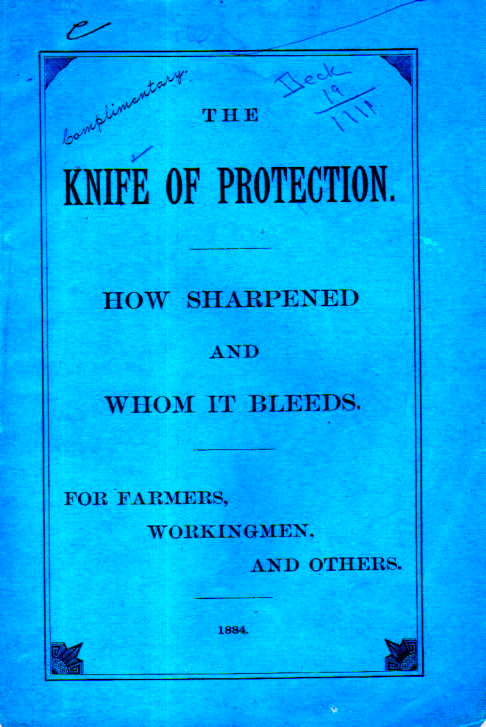
    The case being made here was for changing tariffs which at this time in 1884 were seen by the author as harmful to the common producer.  Here’s the cover of the pamphlet with its provocative title::

    Knife of protection051

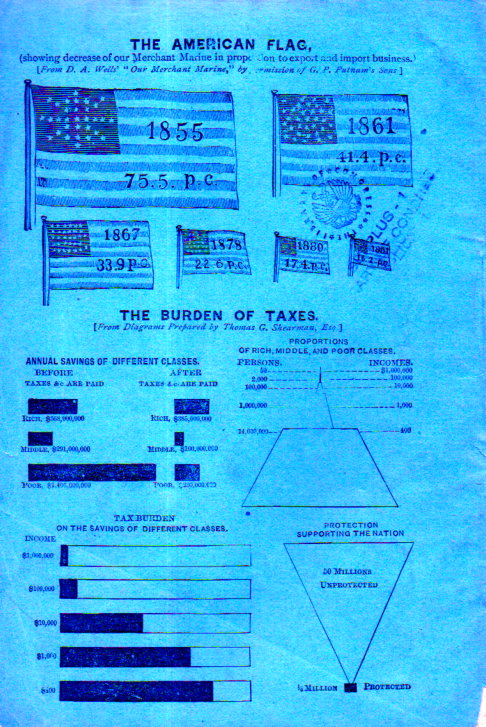
    And the back cover, where the graphic displays live, including the unusual smei-pyramid at bottom left:

    Knife of protection052


    The proportion of classes of the U.S. drawn here is probably relatively correct though some of the numbers may be wrong–granted they are for the upper classes and I think even with revision doesn’t change the structure of the graphic part of the display too much at all.  Here there are listed 59 individuals in the U.S. making $1 million per year, which seems to be a little low.  I have seen a number of references that by the end of the 1890’s  there were around 4,000 people who could be called landed millionaires though so far as I have seen they all were not making $1 million per year.  I am unsure at this point–it is possible that in, say, the 3,000 millionaires in the U.S. in 1880-1884 that 1.5% of them would be making a million/year–it seems plausible that if there were 4,000 people making a million in a year that there would be another superclass of 1% making ten times that a year…so maybe that 59 number is correct, after all.  In any event, I don not think that the correct would alter the shape of the pyramid by any measurable difference.  

    The real purpose of the pamphlet seems to have been for the wealthy to pay more than the average working person. The subtitle being “Who Pays? The Tax Payer and the Tax Eater Compared. Every Farmer Should read This”, which seems to mean that the author found farmers to be paying more than their fair share–and considering that of the 50 million people living in the U.S. (1880 census figures here and following) more than 22 million lived on farms, the issue was addressed to a near-majority of U.S. citizens.  

    I haven’t read the pamphlet–I’m just passing along the data.  


  • A Map of Judgment: Nuremberg, 1945/6

    JF Ptak Science Books     Post 2510

    Nuremberg049detail


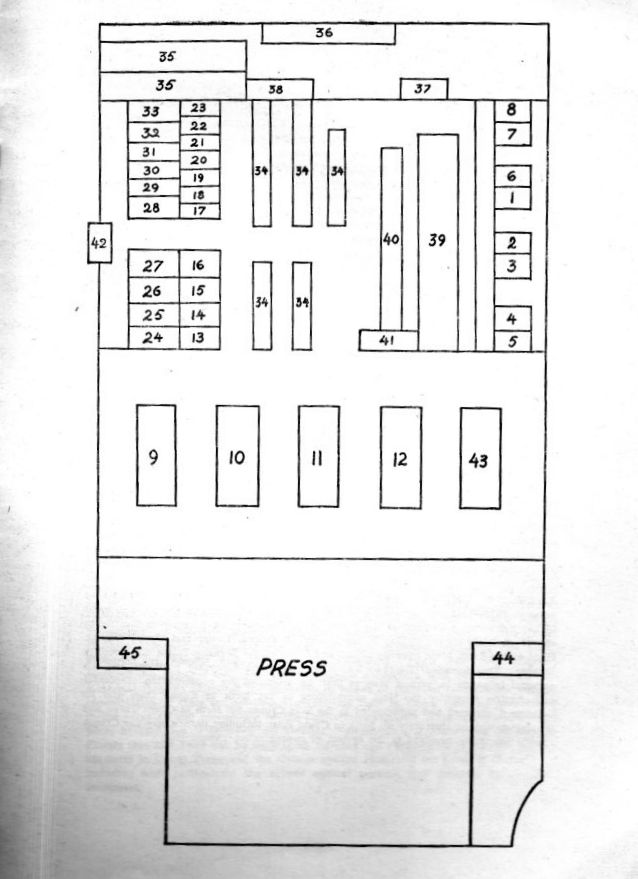
    Nuremberg048In all of the reading that I have done about WWII, I haven’t done that much on the war crimes trials and tribunals afterwards, save for Goering, Schacht, and several of the companies/industries like I.G.Fraben–still, I think I’ve never seen a diagram of the seating arrangement at Nuremberg.  But here one is, in this small pamphlet introducing the International Military Tribunal printed by military order in 1946.  

    We have all seen images from the newsreels shown in documentaries, which seems to give the physical auditorium a rather large feel–with this diagram, and seeing how closely the accused Nazis sat next to each other, the proceedings looked as though they took place in a rather not-large space.  


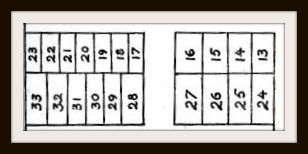
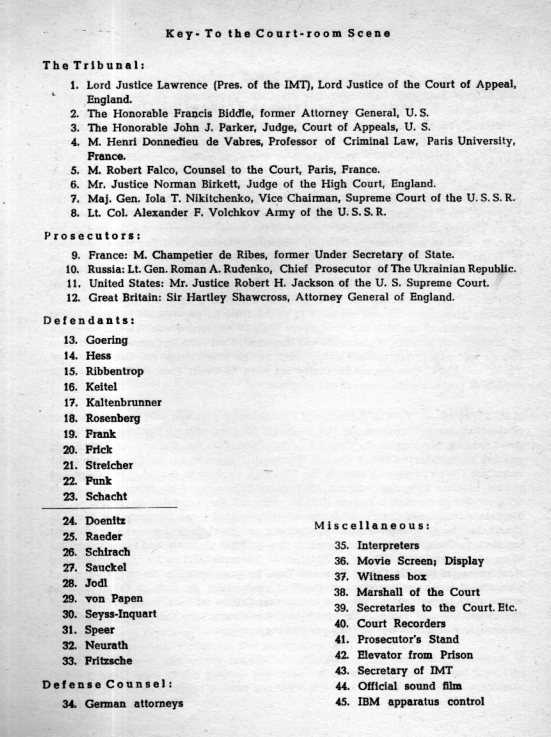
    More to the point though is the detail which I’ve segregated above.  These are seat assignments along benches for  the Nazis being adjudicated for war crimes.  The diagrams make the seating arrangements look segmented, by they are not. (The key to the seating arrangements is reproduced below.)

    There are 21 names associated with those space, 21 of the most infamous names in the Nazi regime; 11 would receive the death penalty; 3 would receive life, 4 would receive various sentences of 10-20 years, and 3 would be found not guilty. 

    Nuremberg049

    For the record, and in order as they appear on  the list below:  Goering, death; Hess, life; Ribbentrop, death; Keitel, death; Keltenbrunner, death; Rosenberg, death; Hess, death; Frick, death; Streicher, death; Funk, life; Schacht, noty guilty; Doeniotz, 10 years; Raider, life; von Schirach, 20 years; Saukel, death; Jodl, death; von Papen, not guilty; Seyss, death; Speer, 20 years; Neurath, 15 years; Fritsche, not guilty. 

    Nuremberg050

    Here’s a photo of the seated group from above, Goering (#13) is seated at bottom left center, head in hand.  He would soon be dead by his own hand.  

    Nuremberg photo

    [Source:  https://www.jewishvirtuallibrary.org/jsource/Holocaust/nurtrialtoc.html]

    I’ve not had anything to say about the Nuremberg Trials ebcause I think that everyone coming here already knows enough about them to appreciate this “map”.  


  • The Not-so-Sunny Aspect of Easter Island

    JF Ptak Science Books   Post 2509

    Easter043

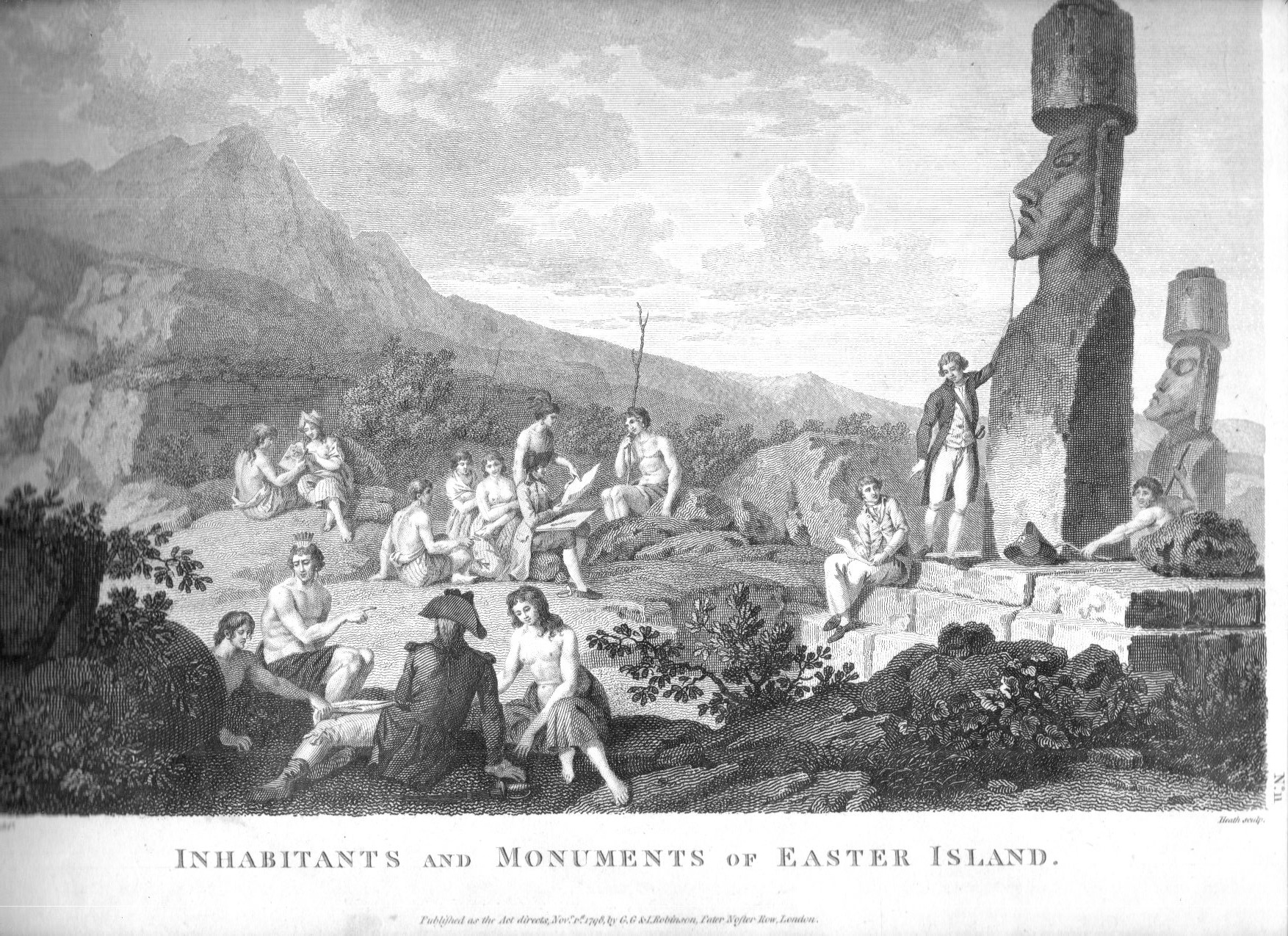
    The “Easter” part of Easter Island is fairly ironic–new, rising, hopeful connotations packing something not-so-joyful.  I was looking at this engraving from the bookstore, an image from a famous exploration journal of  Captain Jean-François de Galaup, comte de La Pérouse, showing a landing party and very western-looking Polynesians. La Perouse was off on a journey that would take him along the trail of Captain Cook, a scientific/ethnographic/cartographic expedition (along with the appropriate trailing or leading religious/economic benefits of such a thing) that landed him on the island 9 August 1786.  He left Brest on 1 August the previous year, and he would venture round-the-world, or almost, as he would never make it home, disappearing along the northwest coast of North America in 1789.  His journals did complete the voyage, however, being taken back to France by a British ship in Australia.

    • [The original print is available for purchase at the blog’s bookstore, here.]

    The island is so-named because it was first recorded by a European, Captain Jacob Roggoveen, Easter 5 April, 1722. La Perouse was there 64 years later, when things were already quite heated, in a most unfortunate way, for the two clans who shared the island, each already suffering substantial losses, as la Perouse found the place sparely inhabited. 

    Easter044

    As you can see there are a few shrubs in the foreground and some other bits, but there are no trees.  Easter Island was by that point largely denuded of trees, making it impossible for the islanders to build boats to fish, and their crops ultimately failing because of the attendant problems erosion and wildlife, making it difficult for much to survive on the island.  The clans set at each other, and had bitter fights, resulting later on in the clans toppling in spite the great  stone figures of the opposite clan. Easter Island became a port of call for slavers, and the population began to disappear into greed and economic lust. 

    This was still decades in the future from the la Perouse expedition, his work being published posthumously nearly ten years after the captain’s death.

    Easter045

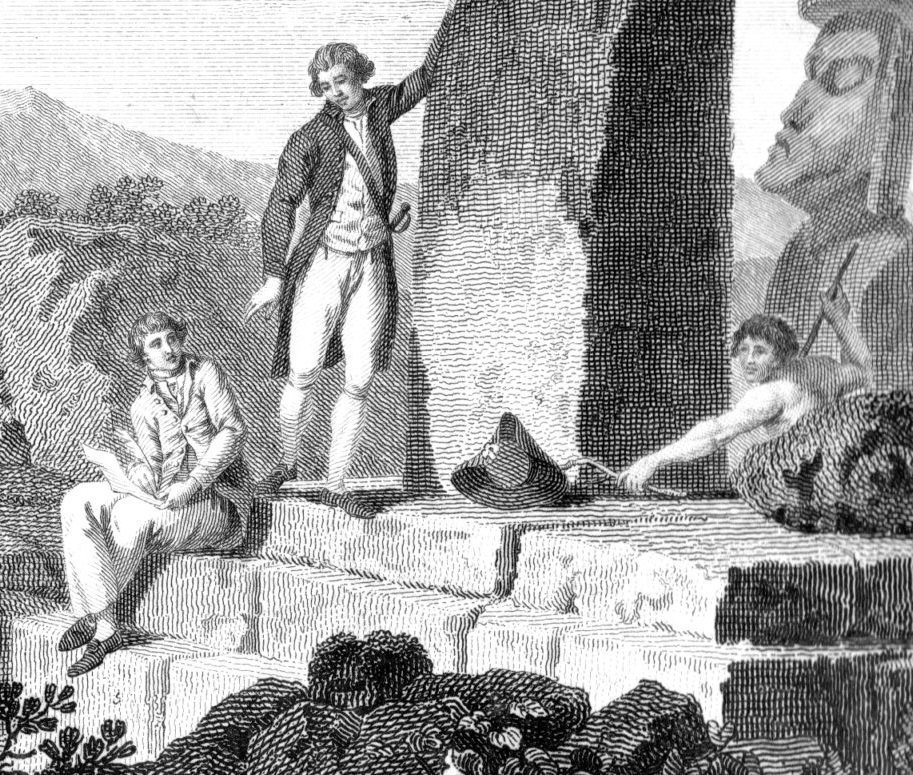
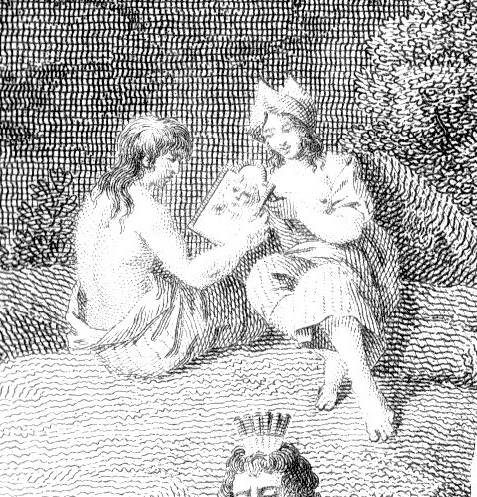
    In this  image, though, we see a rather playful interaction between the sailors and the islanders.  In the foreground-center we see an officer with two men and a woman, one of the men fingering a piece of cloth while the officer is no doubt otherwise distracted. In their background two women are seen using a mirror; to the right of them is a small group watching one of the officers draw an image of one of the Moai.  At right, around the Moai, two officers make observations for the ethnographic record, while around the corner at the monument’s base an island uses a stick to try to steal one of the officer’s hat.

    The Maoi were still standing in 1798.  Later in the 19th century, though, after devastating attacks on one another, every monument was toppled. As were the people.  There’s really not that much to the Easter-y history of the European part of the island’s history, and so the irony of its naming. 

    ·Posted by :

    ·in:


  • Road Map of Mud and Dust (1936)

    JF Ptak Science Books  Quick Post

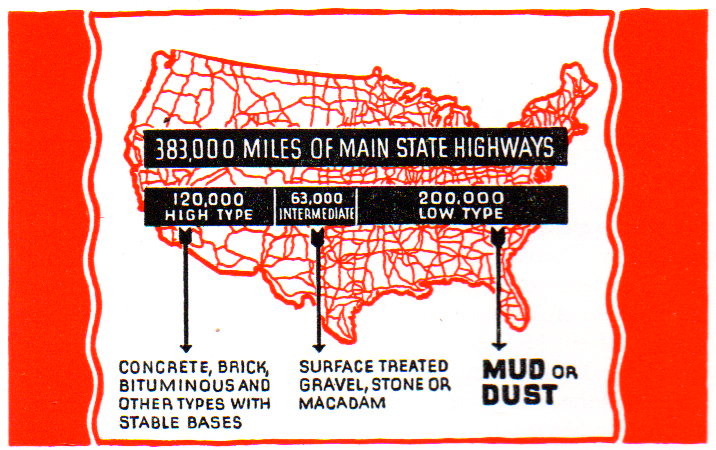
    What a simple and semi-magnificent map is this! A spaghetti map of the U.S. featuring road types, more than half of which were allocated as a “low type” of “MUD or DUST”. 

    Map of dusty roads040

    The map is in a disheartening and potentially numbing pamphlet on road improvement, which– had there been a simple cover for the work I would have quickly skipped by–however, the maps, data, and the lurking insomnia of boredom is perfectly hidden by this:

    Map of dusty roads041

    Holy cow!  This is marvelously striking–and just look at that “T”! 

    In any event, the pamphlet is loaded with small woodcuts and graphics illustrating its point, which was to take Depression-available workforces and put them to work on repair of old and construction of new roads. 

    Map of dusty roads042The anonymous illustrator and/or designer certainly made a commendable and superior effort in making this fairly dry pamphlet, um, interesting. 


  • A Leonardoesque Pre-Surrealist Anatomy Book for Artists, 1884

    JF Ptak Science Books (Expanding Post 667 from June 2009)
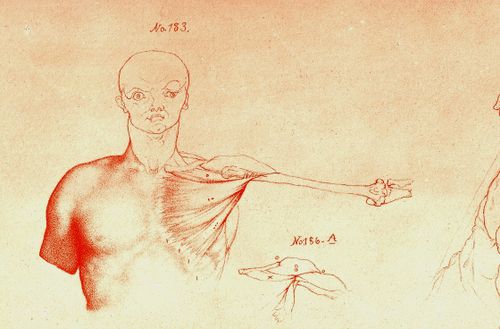
    Blog==June 29--rimmer pecs det

     Looking at old prints sometimes reveals more than just their own history, simple or not:  there are, from time to time, subtle bits of otherness that creeps into the image, if you allow yourself the time to see it. 

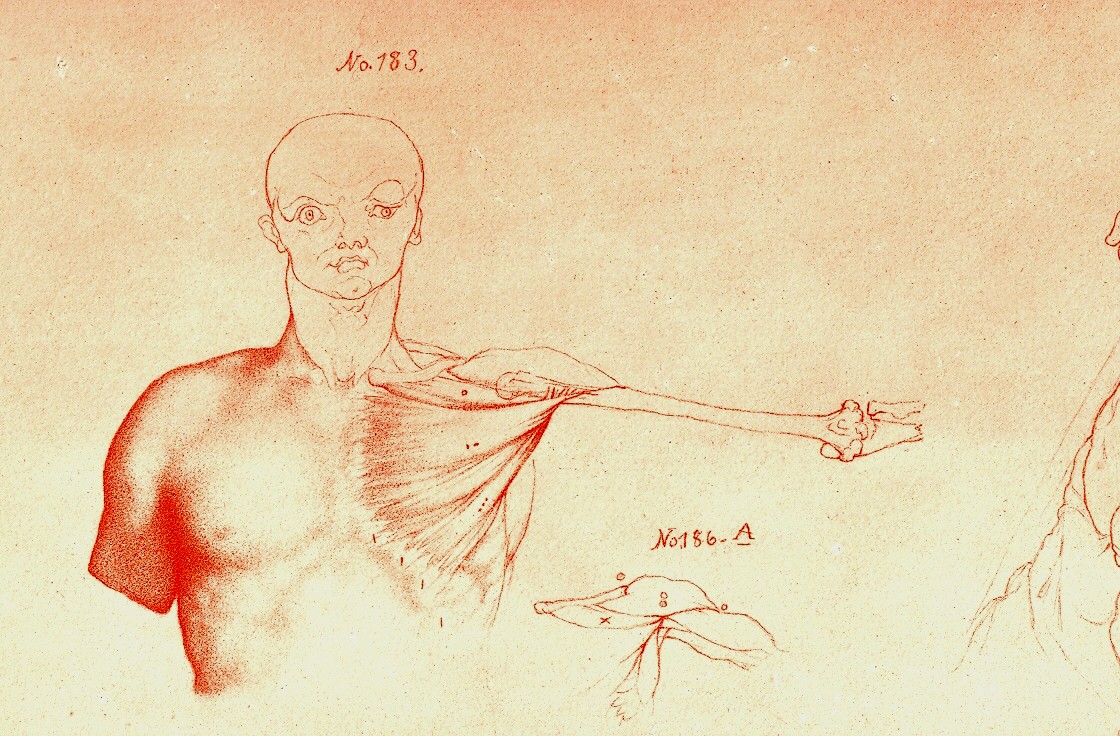
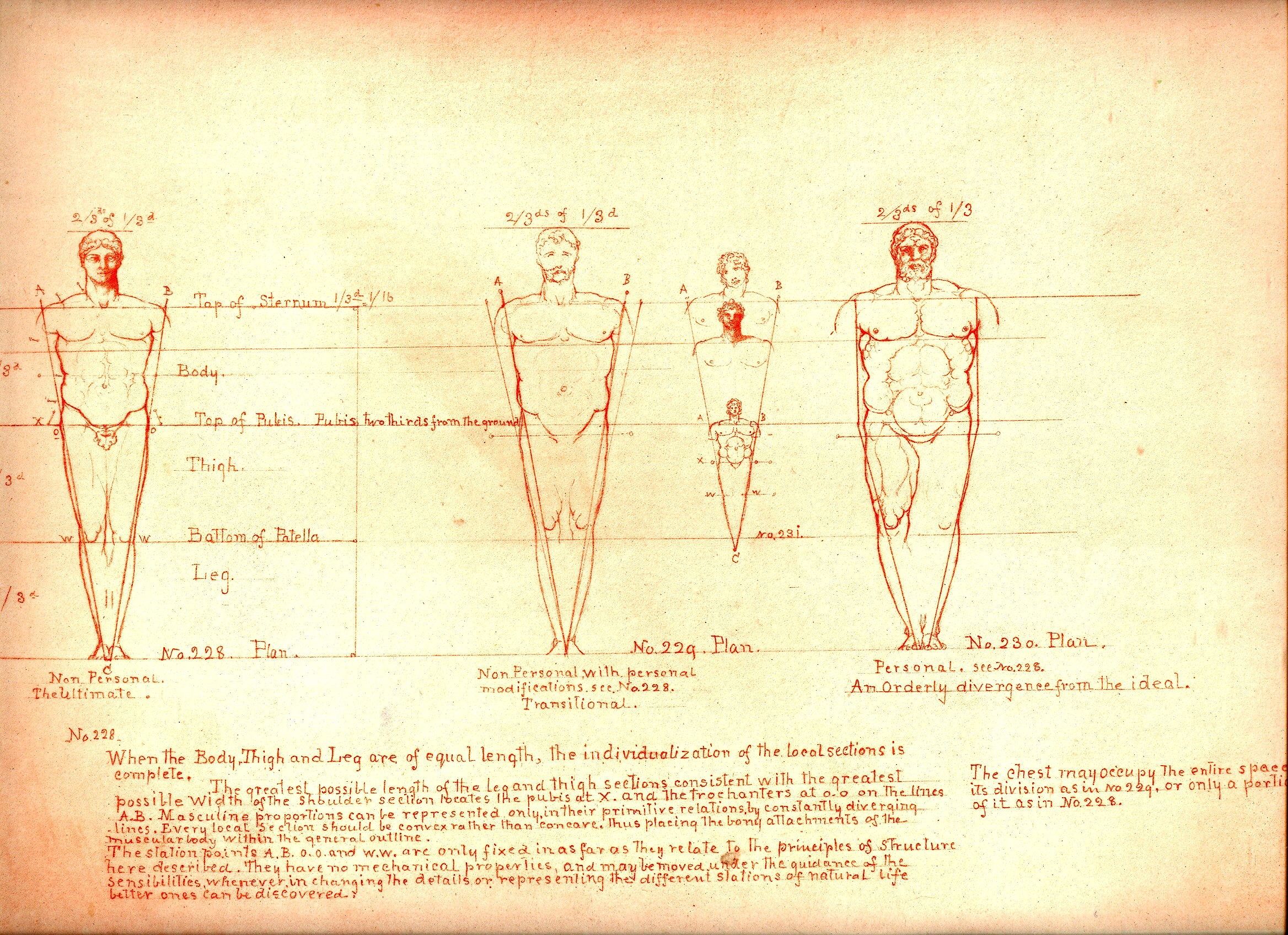
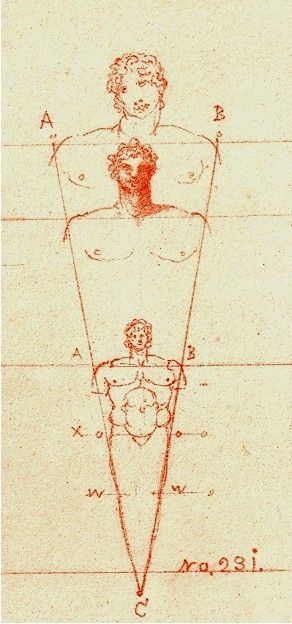
    And sometimes looking at images of the past reveal a little of the future, or the possibility of the future, as we can see here in these examples in the book by the art-anatomist William Rimmer (1816-1879).  His work is superior, and spot-on, and has Leonardo-flourishes all throughout his work–he reaches deeply into the past to the great anatomical standards, and also employs newly established work too (as with Charles Darwin1). There is also–to me anyway–a certain quality of his work that predates modern art movements, like the Surrealists, and Dadaists, that melt into his work, giving it a very post-modern sympathy.  The drawings sometimes have a great “unexpected” sense to them, which I think is not often found in anatomical artwork, given the nature of the exercise and all, giving Rimmer a sense of surprise and somewhat-removed fantasy.

    (In another example of this idea of pre-dating a modern movement, I wrote a little about the odd art/color textbooks of the pre-Kandinskian Emily Vanderpoel , about whose color theory I still understand not at all, though the images that she produced as illustrations to these bizarre theories are stunning, pre-modernist, and unintentional creations.)

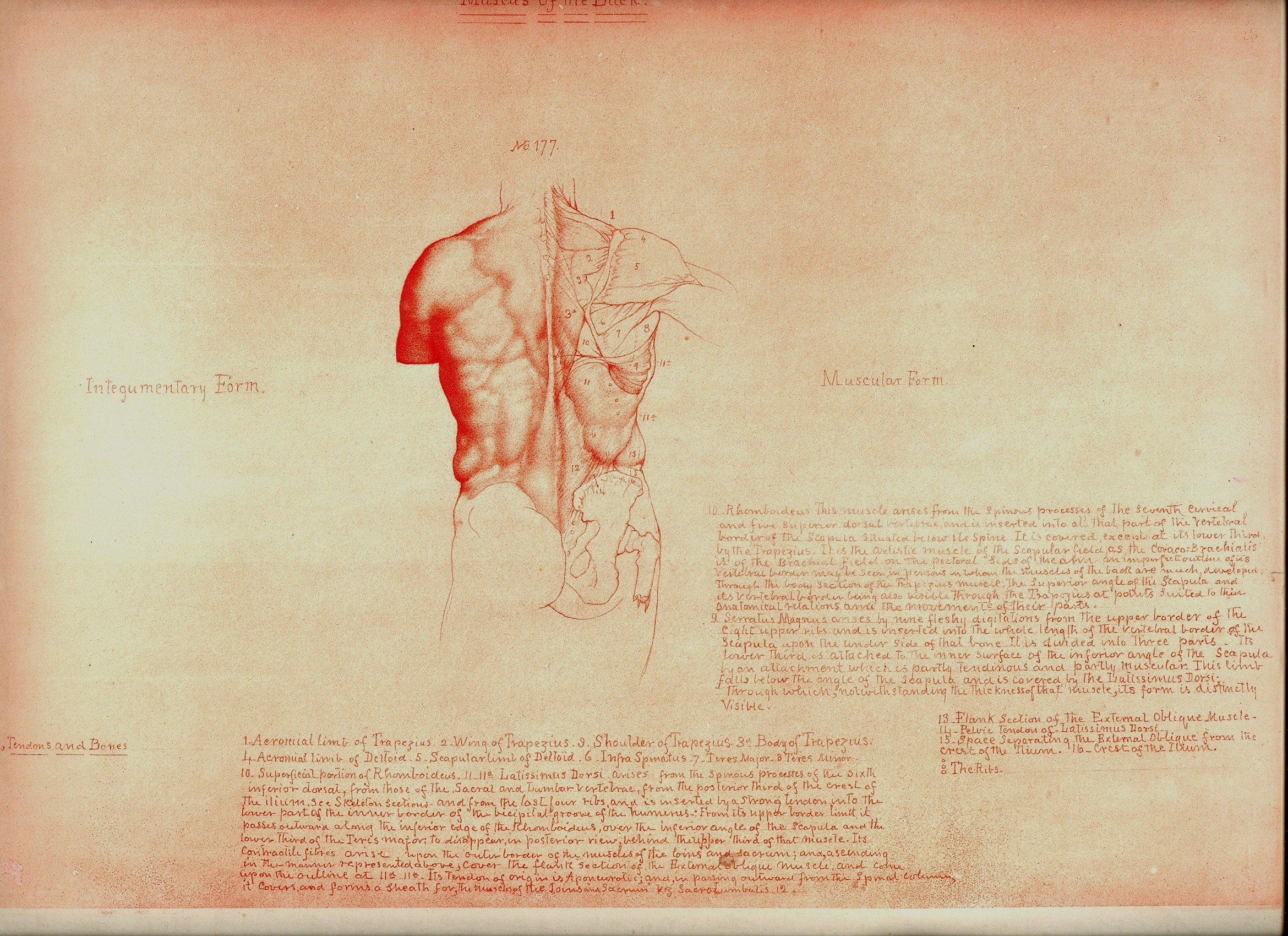
    The images being discussed here are found in Rimmer’s  Art Anatomy (1877 is the first edition and very rare for its process and for being destroyed in a printing house fire, and subsequent printings, this one being the subsequent 1884 printing).  He was a very accomplished artist, and was also a physician and a fine anatomist, with a long career of having varied careers in the arts.  He was very concerned and interested in what happens to the skin, forced into action by all of the stuff underneath it.  He pursued the movement of muscle, and bone, and the interplay of the two, and produced a wonderful exponent of artistic anatomy. 
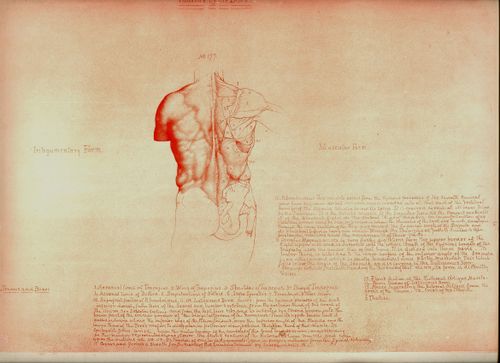
    Blog==June 29--rimmer back

    Even the design of the book and the placement of drawings and text on the page–page after page–is both antique and pre-modernist, the images surrounded by the author’s notes and explanations, sometimes the very spacing and placement on the page is an evocative mystery.  

    Perhaps some of this “mystery” may be easily solved given the way in which the book came into being.  According to Amy Beth Werbel in her Thomas Eakins: Art, Medicine, and Sexuality in Nineteenth-century Philadelphia (Yale University Press, page 61, here) Rimmer constructed most of the work while on vacation, using no models, and seemingly working without reference. That would be an extraordinary accomplishment, and might explain some of the “surprising” parts that I just spoke of, but it really doesn’t necessarily address that dreamy quality of looking not-so-quietly into the future of art. (There are other odd and, well, bizarre, bits that Rimmer writes about that seem unrelated to this anatomy task, but I’ll just have to chalk that up to “personality” at the present time.)

    (I’ll expand this quite a bit as I’ve got 50 or so of these lithographs that I’ll be selling.)
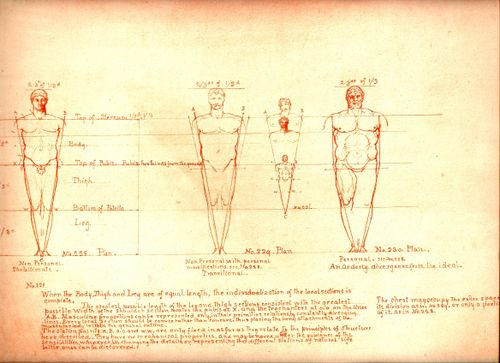
    Blog==June 29--rimmer little man


    Notes:

    1. Elliott Davis writes a very interesting article on Darwin and Rimmer and about the influence of the former on our artist.  For example, Davis writes that Rimmer’s work “represents the most comprehensive anatomy book issued in the United States at the time and provides new insight into the influence of Darwin’s evolutionary theory on artistic practice.“ See:  ”Life Drawing from Ape to Human: Charles Darwin’s Theories of Evolution and William Rimmer’s Art Anatomy” by Elliott Bostwick Davis, on the Nineteenth Century Art Worldwide blog http://www.19thc-artworldwide.org, here. Also from Davis’ article is this good footnote on two further sources of information for Rimmer:  “Marzio, 1976, p. 1. For information on Rimmer, see Truman H. Bartlett, The Art Life of William Rimmer: Sculptor, Painter, Physician. Boston and New York: Houghton Mifflin, 1890. [And] Jeffrey Weidman, Neil Harris, and Philip Cash, William Rimmer. A Yankee Michelangelo, Exh. Cat. Brockton, Brockton Art Museum/Fuller Memorial (Hanover and London: University Press of New England, 1985).
  • Non-Observatory Telescope Houses and Rolling Homes

    JF Ptak Science Books   Quick Post   [Part of a series on the History of the Future]

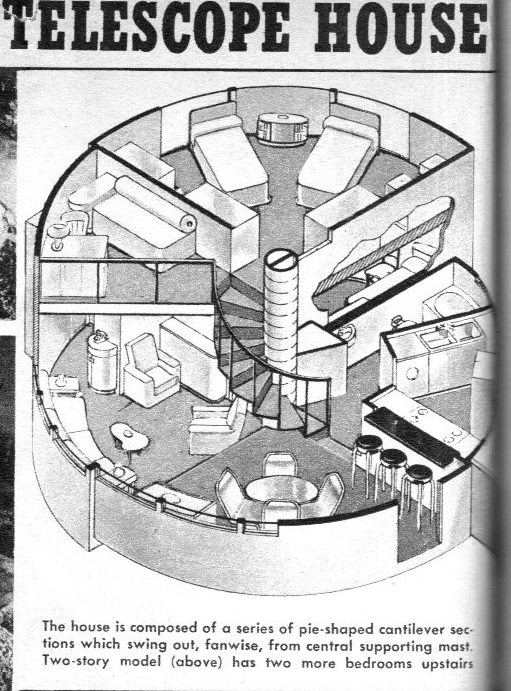
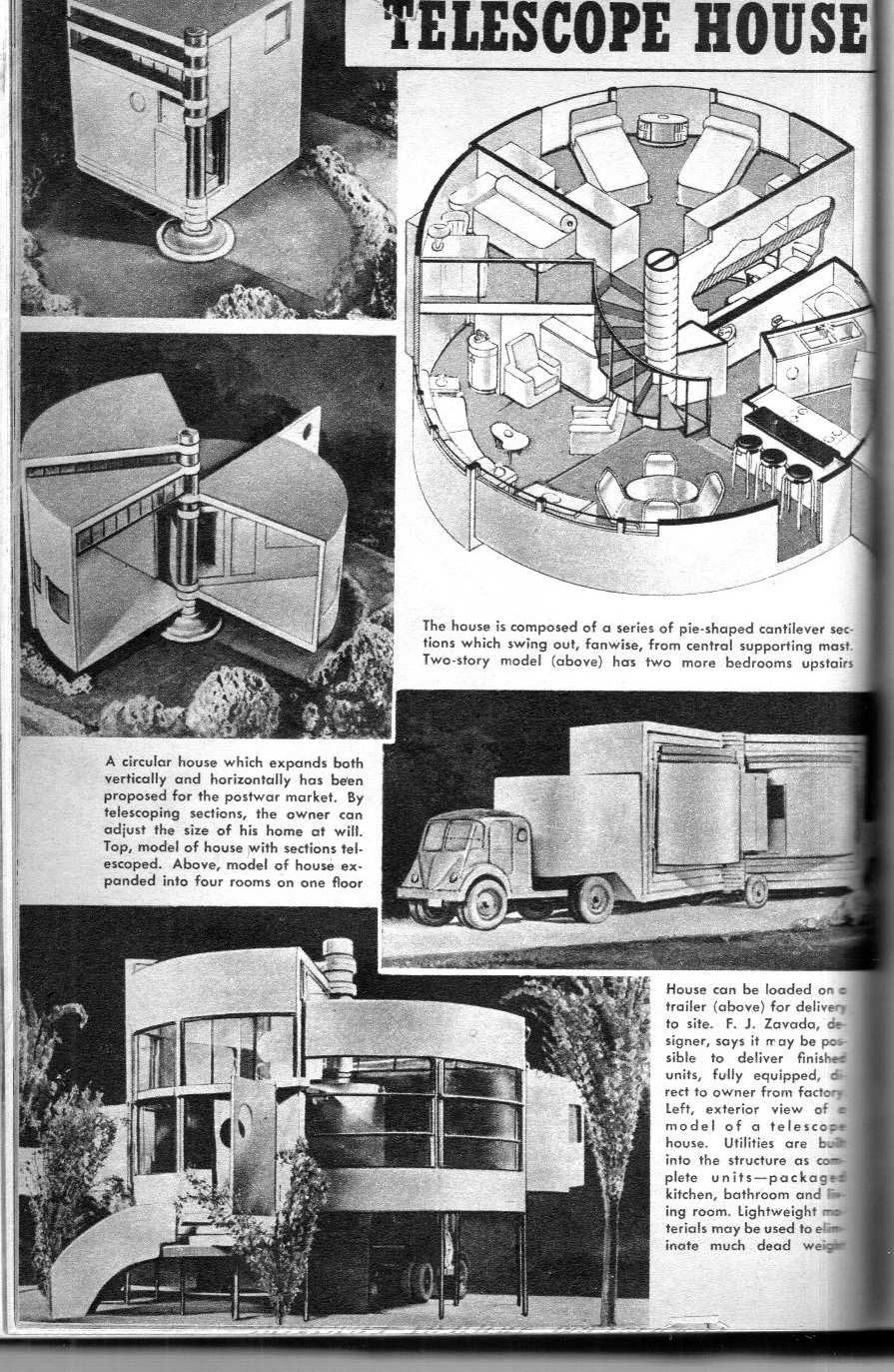
    Say “hello” to the “telescope house”, an unusual idea in small house design, found in Popular Mechanics for the March, 1945 issue, just before the end of WWII in Europe.  It was designed by F(rank) J. Zavada (1916-1998?), and it is a tidy little place:  four rooms on the first floor and two bedrooms on the second, the house is made to collapse and expand vertically and horizontally.  I don’t see area  mentioned, but it looks to be on the order of 400 sq ft or so. 

    Telescope house detail[Detail]

    Telescope house039

    This design put me in mind of a much-inferior idea: the rolling house of the future (offered in the September, 1934 issue of Everyday Science and Mechanics). Etienne Boullee it is not. The house does, however, roll, for whatever that is worth, and if that is a positive thing then that would be one advantage it would have over a non-rolling house. (I don’ get to write that phrase very often.) And it rolls exclusive of  some rolling platform, which somehow seemed like  a better idea than just having a more-traditional house with wheels.  Presumably the rolling house would be filled with E. Lloyd Wright nothingness, so there will be no displacement issues. 

    Rolling_house_large

    [Read more about the Rolling Houses and Glass Homes of Futurlandia here.]