A Daily History of Holes, Dots, Lines, Science, History, Math, Physics, Art, the Unintentional Absurd, Architecture, Maps, Data Visualization, Blank and Missing Things, and so on. |1.6 million words, 7500 images, 4.9 million hits| Press & appearances in The Times, Le Figaro, Mensa, The Economist, The Guardian, Discovery News, Slate, Le Monde, Sci American Blogs, Le Pont, and many other places… 5000+ total posts since 2008.
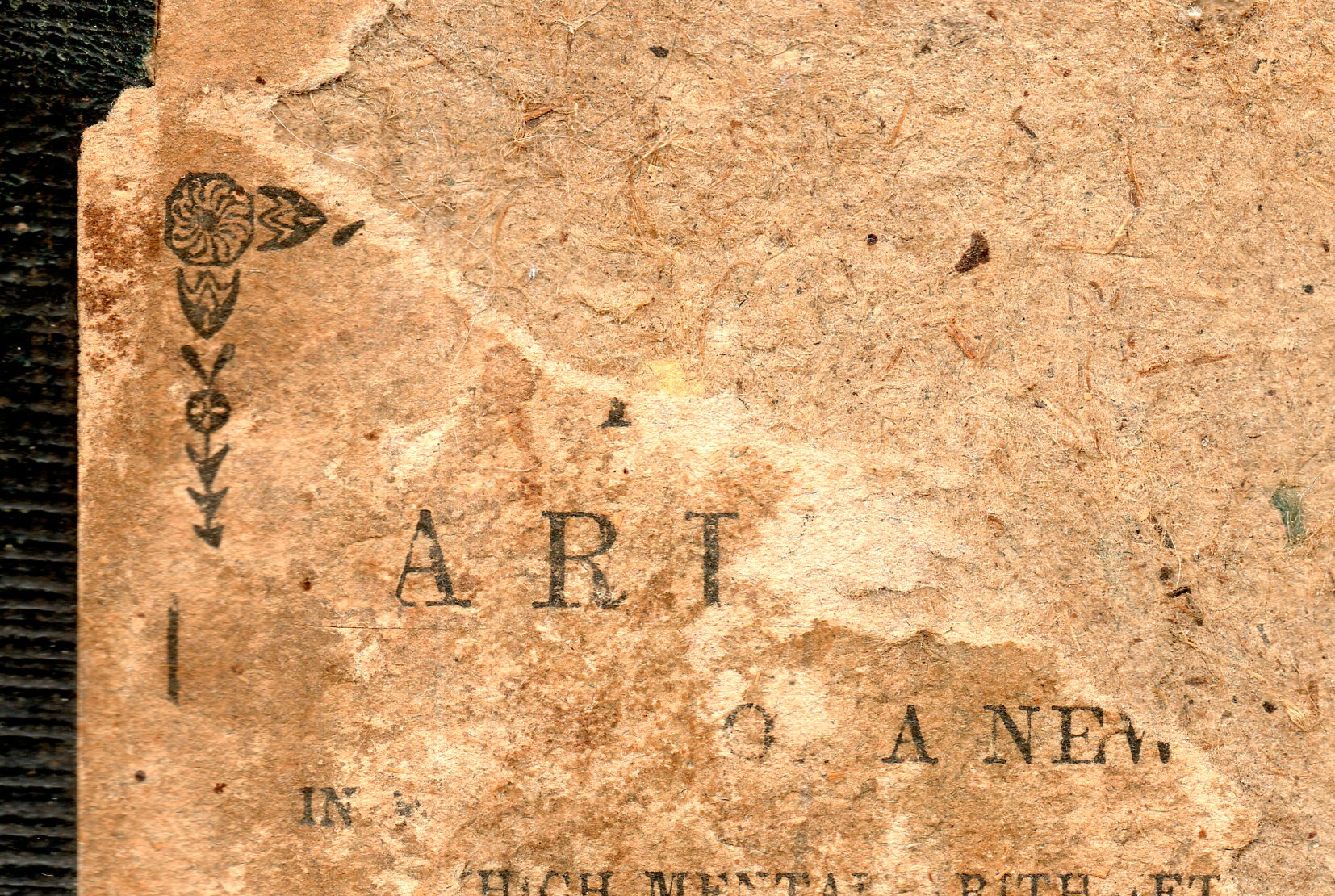
I have a little pocket-sized book at home, a fine little arithmetic book by Roswell C. Smith, Practical and Mental Arithmetic on a New Plan in Which Mental Arithmetic is Combined with the Use of the Slate–it was published in Hartford, and this copy was printed in 1836, in its every energetic 53rd edition. Mr. Smith wrote himself one fine and popular arithmetic tract, and the book is absolutely loaded with all sorts of info that could see a person through most aspects of figuring-life for years to come. My copy is very very well worn, and although it is missing pieces of the paper cover and the surface of the books looks like the Somme, it is actually very smooth–worn and rubbed smooth from years of use.
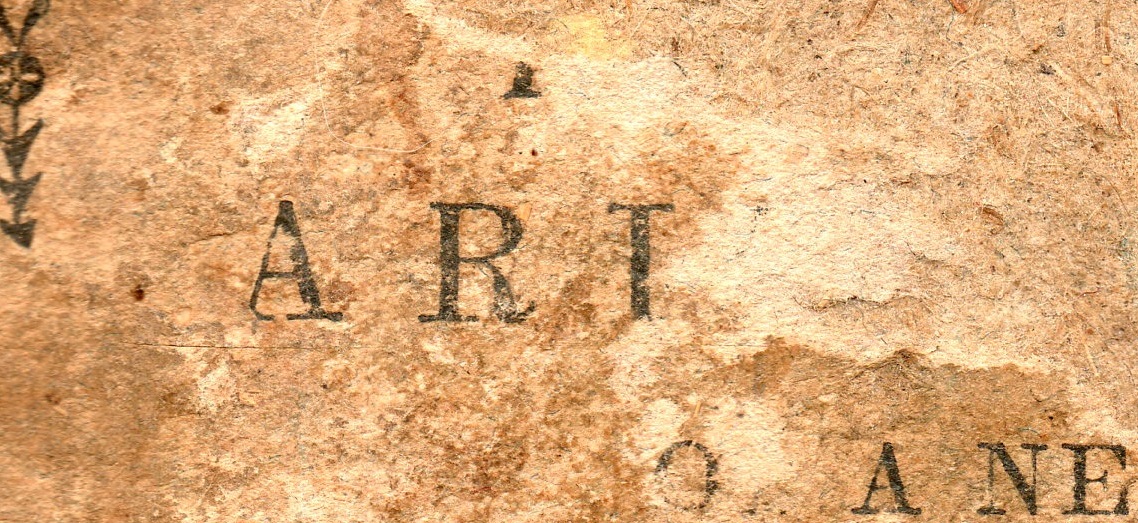
And just about the only word left visible from these years of being handled by little hands is the fragment “ART” from “Arithmetic”, which I thought was a lovely thing.
As a matter of fact there is plenty in this books that is perfectly fine and applicable at the rudimentary math stages–of course some of the units of measurement have long since fallen into obscurity (even by the late 19th century) the lessons remain useful, if a little stiff, especially when you’re asked to work out some of the results on your slate.
But the issue remains that this tidily compacted work is a pretty thing to work with:
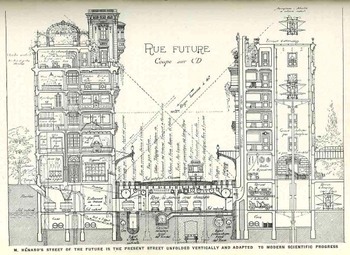
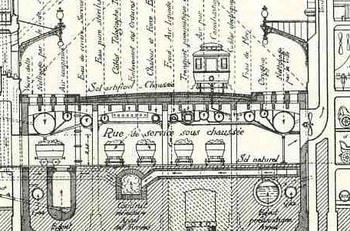
This cross section illustration (“Rue Future”/Future Street) is from Eugene Alfred Henard’s1 (1849-1923) article, “The Cities of the Future”, from American City, Volume 4, January, 1911. In this article Henard (architect of the city of Paris and from 1880 a life-long employee and advocate of public works in that city) looks into the future and sees the movement towards underground (or enclosed) vehicular traffic, “smart” buildings, pneumatic tubing for vacuum cleaners (“almost sure to come into general use”), an improvement in the system for water delivery and removal, replacing coal with natural gas, and more. He lays out a plan to implement his idea that, if implemented in the city of Paris, would cost $420,000,000 (or approximately $15 billion in 2006 money) over 100 years. [This part seems a little off given that the area for public roads alone in Paris at this time was 3,700 acres–nevertheless this was an interesting appearing plan, a significant portion of which has found its way into building and community planning albeit on a far smaller scale].
Henard was also acutely interested in the future traffic problems of Paris and other major cities, proposing revolutionary radial traffic patterns for moving cars around major metropolitan areas–which was really quite visionary as the mass production of automobiles had not yet really taken place–certainly automobiles were far more common by 1911 than 1905, but their numbers would be vaulted higher int he next decade with the first true approach to assembly line production of automobiles, making them affordable to the millions. His plan for a ring-lime system around the city of Paris was influential to some of the ideas in the early American planning reports for San Francisco and Chicago by the great Daniel Burnham.
What is particularly interesting for me in the Henerad plan is the room that he left for his future’s future–he attempted to make his plan adaptable for the time when the future he was writing about was becoming the past. And so he was leaving room in his underground plans (in particular) to accommodate some of what the future might hold in store for his city, leaving unused spaces and tunnels, so that the city planners in the future would not have to go through the enormous expense of putting these things in for themselves. Now that is future-forward thinking.
Notes:
1. Henard studied at the Ecole des Beaux-arts, graduating from there in 1880. For a decent short bio of the man see the Wiki entry, here: https://en.wikipedia.org/wiki/Eug%C3%A8ne_H%C3%A9nard
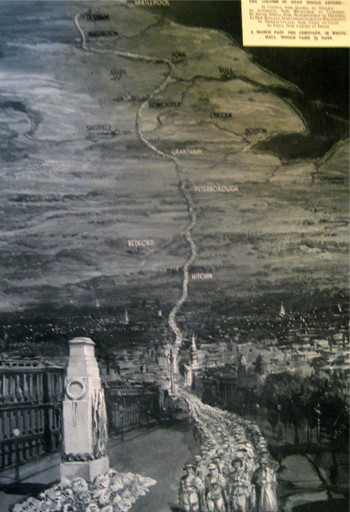
The Illustrated London News published this very sobering image showing the general reader in London in 1933. It is entitled “In Memory of the 1,104,890 British Dead of the Great War”, and was drawn by D. Macpherson. It very graphically represents all of the war dead of the British Empire of 1914-1918, depicted as a line of men, four across, extending from London to Durhham.
The column passes from London through Hitchin, through Bedford and Peterborough and Grantham, past Sheffield and Leeds and York, and then on to Durham. An extraordinary column of the war dead: 900,000 of the dead were not soldiers at the beginning of the war, but they sure died that way, and this map shows them all in a line, marching from a point 269 miles distant.
“A current such that, although they had great wind, they could not proceed forward, but backward and it seems that they were proceeding well; at the end it was known that the current was more powerful than the wind.”–Ponce de Leon, the first to record the Gulf Stream, 1513
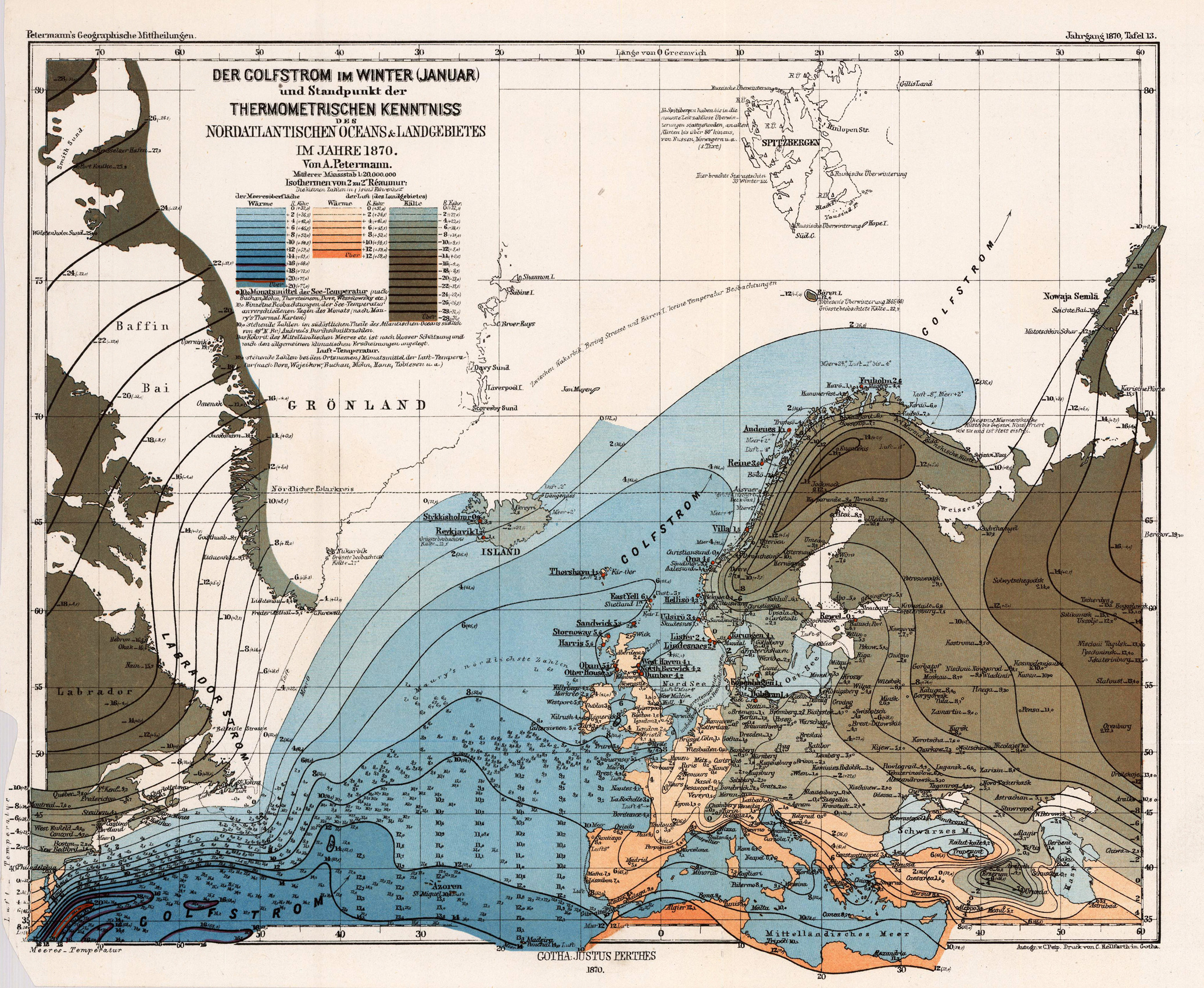
The first map of the Gulf Stream was created by the venerable Benjamin Franklin in 1769–a smart and busy man. 101 years later came this beautiful map, “Der Golfstrom im Winter (Januar) und Standpunkt der Thermometrischen Kenntniss des nordatlantischen Oceans & Landgebietes im Jahre 1870” by A. Petermann and published in Gotha by Justus Perthes in 1870. It is highly detailed, and sumptuous, with a certain depth to it–which is a good thing, because it was showing a lot more data than its great grandfather map could possibly have imagined. For as extraordinary as Franklin’s map was, it was equally astonishing how much data was collected from the mid 19th century onwards, and the beauty of this map displays a lot of it, including the temperature of the water at its different depths, the direction and the velocity of the currents, including the depth of the water, and the like.
[Source: Antiquariat Reinhold Berg, here: https://www.bergbook.com/images/23212-01.jpg]
The next beauty is a depth and temperature map of the Atlantic, “Wärme-Vertheilung im Nord-und Südatlantischen Ocean. Nach den Messungen der Challenger Expedition von Portsmouth bis zur Capstadt 1872/3”, again by A. Petermann, and published by Perthes in Gotha in 1874 (in Mihhheilungen us Justus Perthes Geographischer anstalt uber Wichtigue Beue Erforschungen, vol 20).
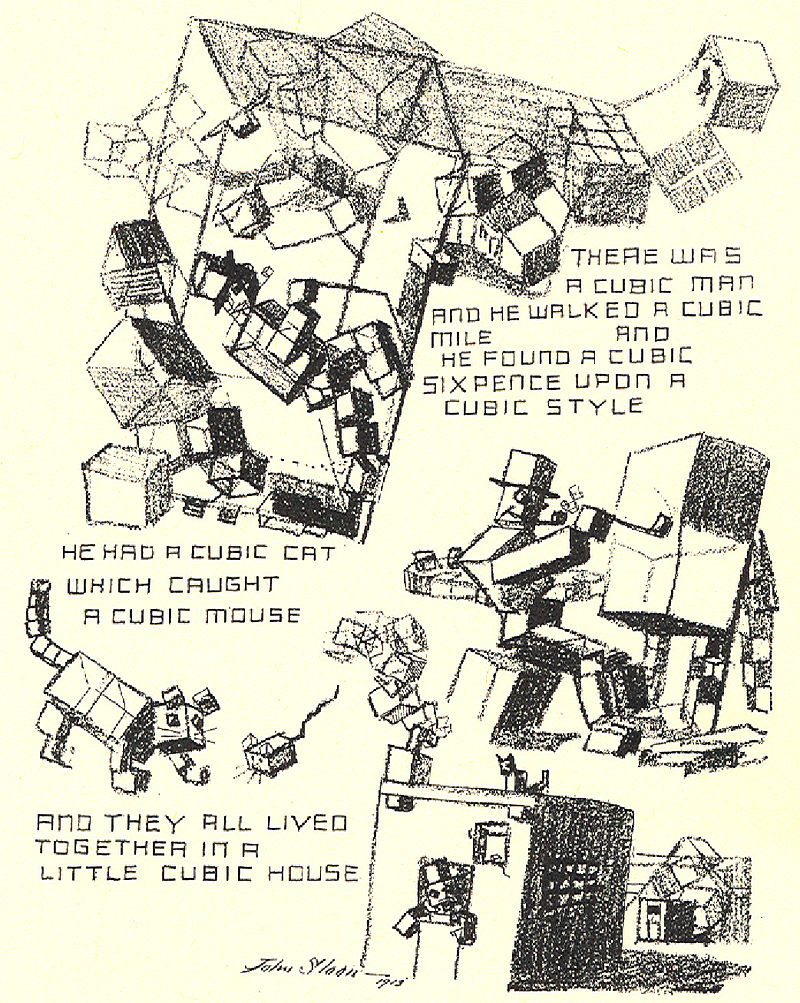
“A Slight Attack of Dimentia Brought on by Excessive Study of the Much Talked of Cubist Pictures in the International Exhibition in New York.”
This is John Sloan’s illustration in The Masses summing up the legendary Armory Show of 1913.
Between 17 February and 15 March 1913 there occurred in the huge building at Lex between 25th and 26th streets in NYC–the monumental International Exhibition of Modern Art at the armory of the Sixty-Ninth Regiment, the Fighting 69th (so called by Robert E. Lee), the “Fighting Irish”, the famous Armory Show, the Armory Show. This was the first large public exhibition of modern art in America, and even though the 69th regiment had seen five wars (at least, so far as I can tell), the armory itself hadn’t really seen one, until 1913, when battle lines were drawn among the Cubists and within and without the confines of the modern” part of modern art, the sensitive honor of the nature of art laid bare.
Here’s a good source for other caricatures of the show: http://armory.nyhistory.org/category/artworks/
Interestingly, Sloan was one of the organizers of the show, as well as a contributor–his artistic orientation was far from the base that made the show so famous. Sloan (1871-1951) was on his own a wonderful artist, of a different school, and one of my favorites depicting city/street urban life of the 1920’s.
His cartoon for the radical The Masses is interesting and poignant, and although it pokes fun at the Cubists, it is respectful, and intriguing (in spite of the clever “dimentia”). There were a number of other artful interpretations of the vast modernity of the show that weren’t nearly so kind, not understanding or appreciating the Abstract and Cubist work.
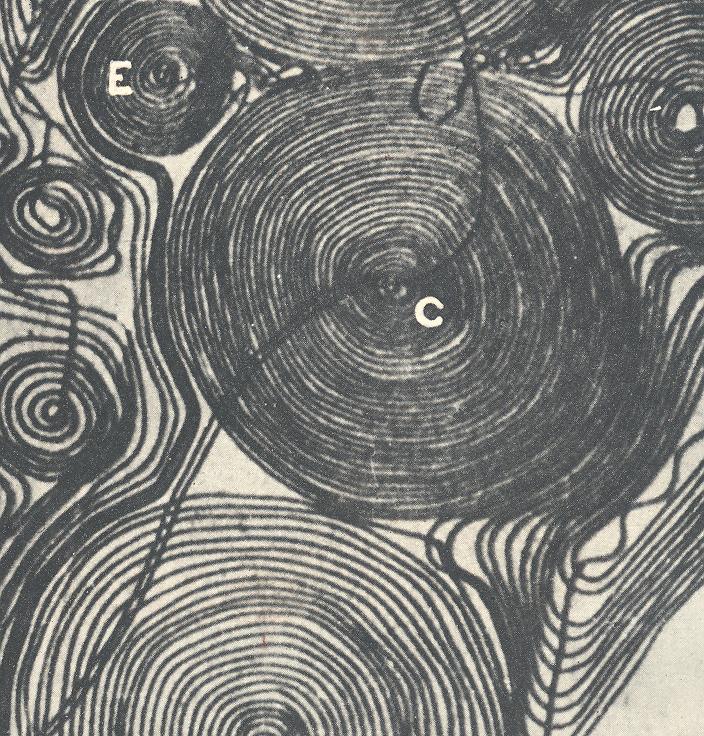
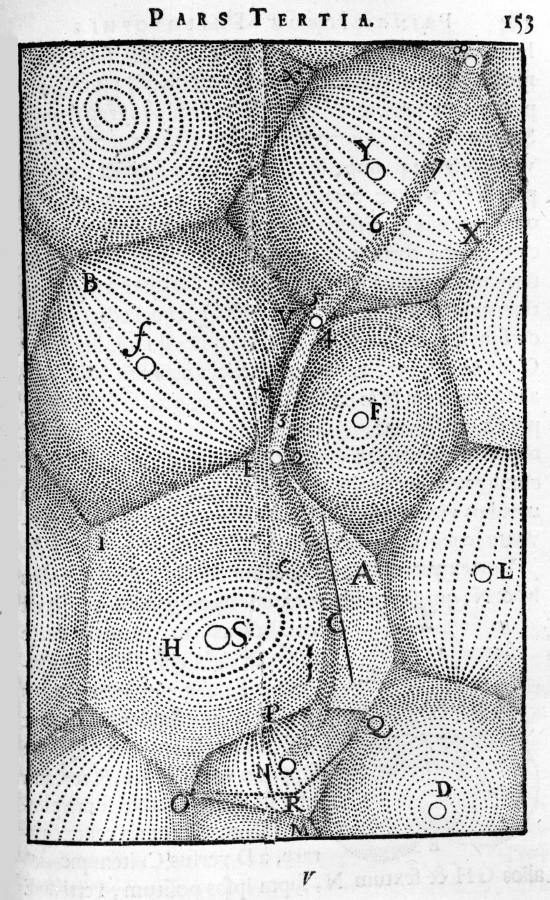
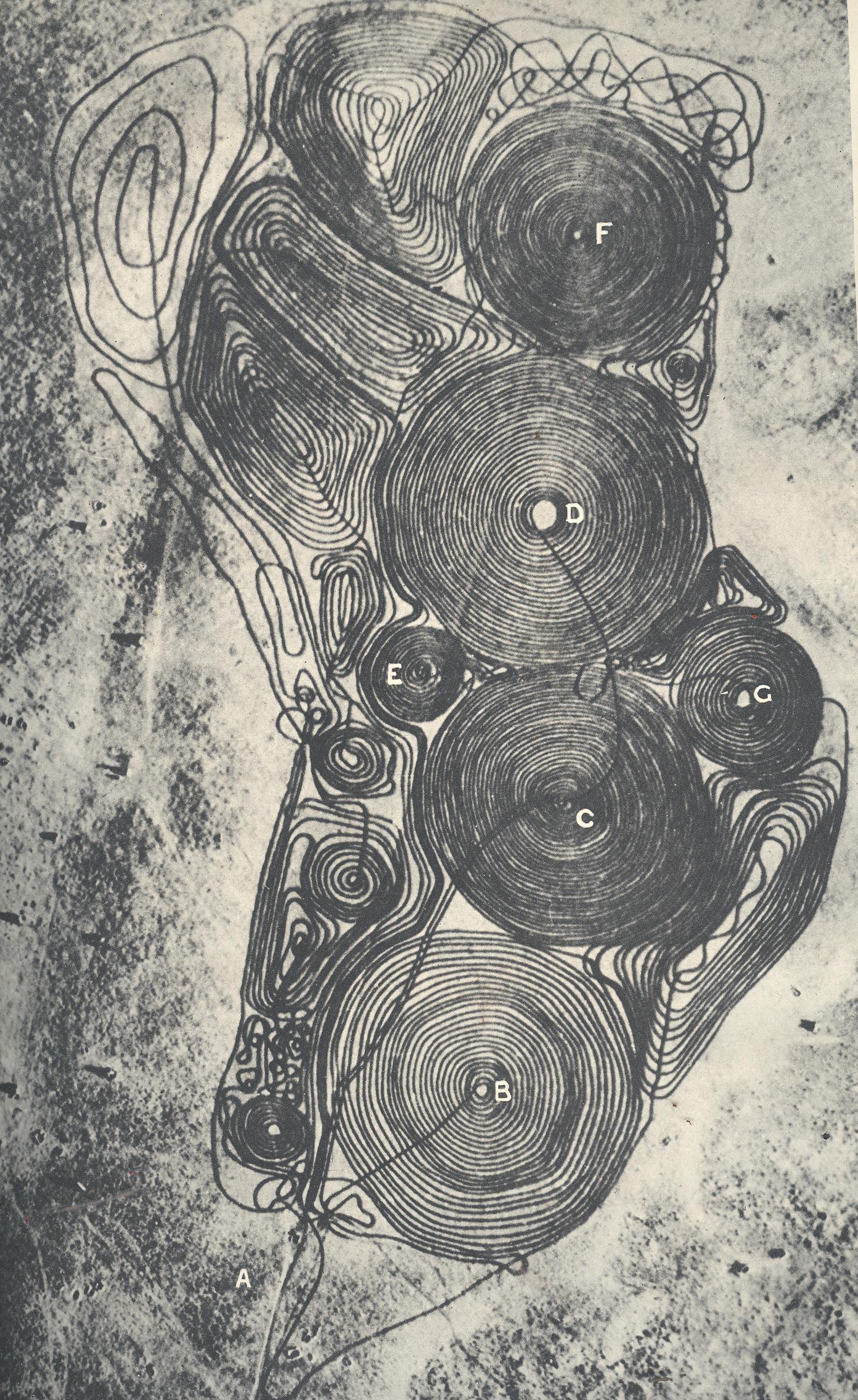
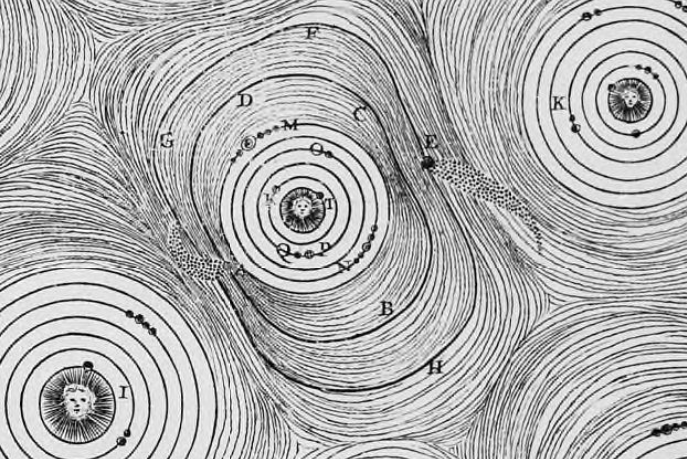
At first (and second) glance this image comes very close to looking like a display of Rene Descartes’ illustrated cosmology (featuring his vortices (“tourbillons”)). The images are indeed similar–first, the mystery image, followed by one of the Cartesian tourbillons (from Principes de la Philosophie from 1644):
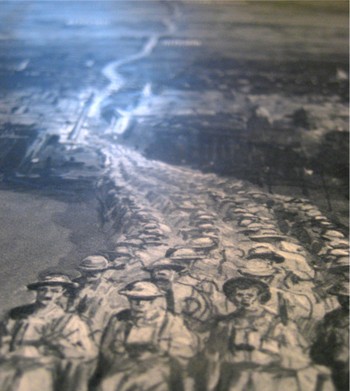
[Primary image, detail.]
And the image from Descartes:
[Primary image, receding.]
Is the primary image another incidence of the Cartesian cosmology as we see in the original and in other places, like in Nicholas Bion (in 1710)?
Surprise!
The primary image in question is actually a plowed-over landing strip, the place done in by German sappers sometime in 1944, to render the airfield useless once the Germans pulled back. In any event the image struck me as being similar in design to Descartes, though for the Germans it represented more a catastrophic collapse more than anything else.
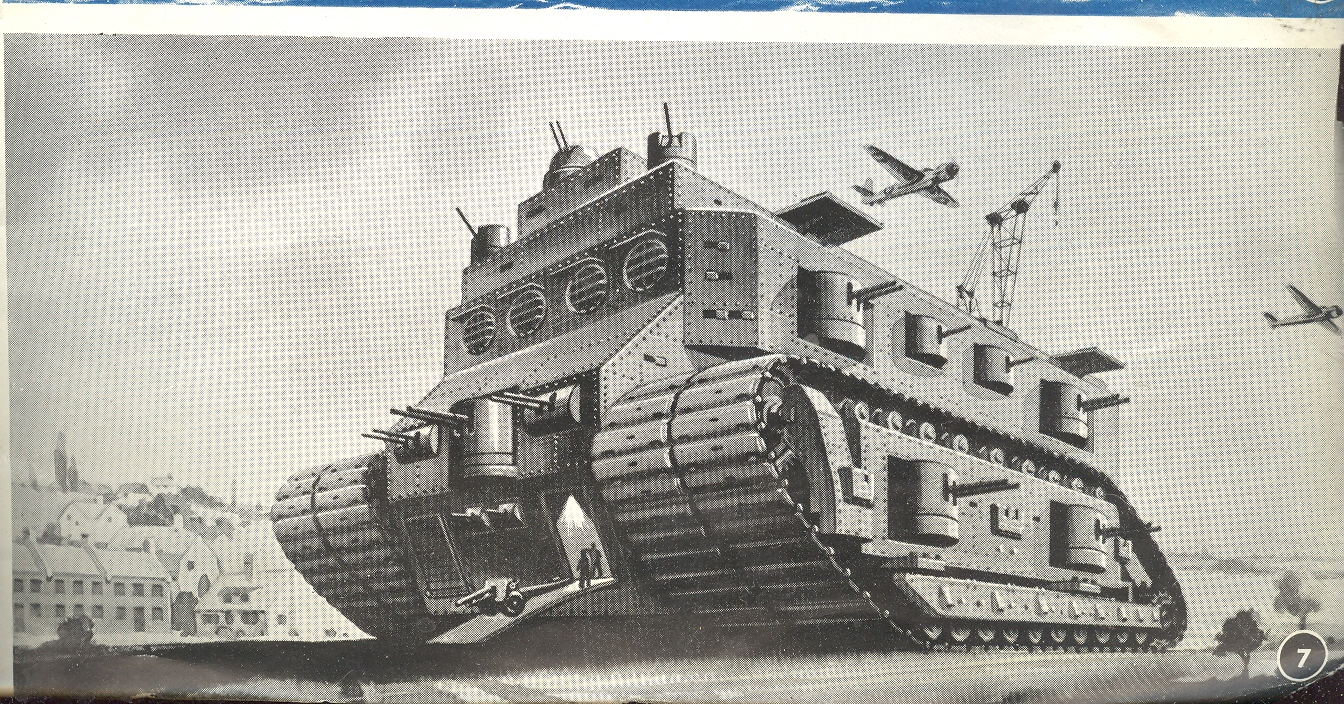
I’ve written earlier in this blog on fabulosity in land battleships though not so much about the real thing.
For example, in “Movable Maginot: a Feast of Morbidly Techno-Gigantism”, https://historyofideasblog.com/thesciencebookstore/2012/12/moveable-maginot-a-feast-of-morbidly-techno-gigantism.html, as well as others:
[Also “moveable maginot” is a phrase that does not show up online, except for here.]
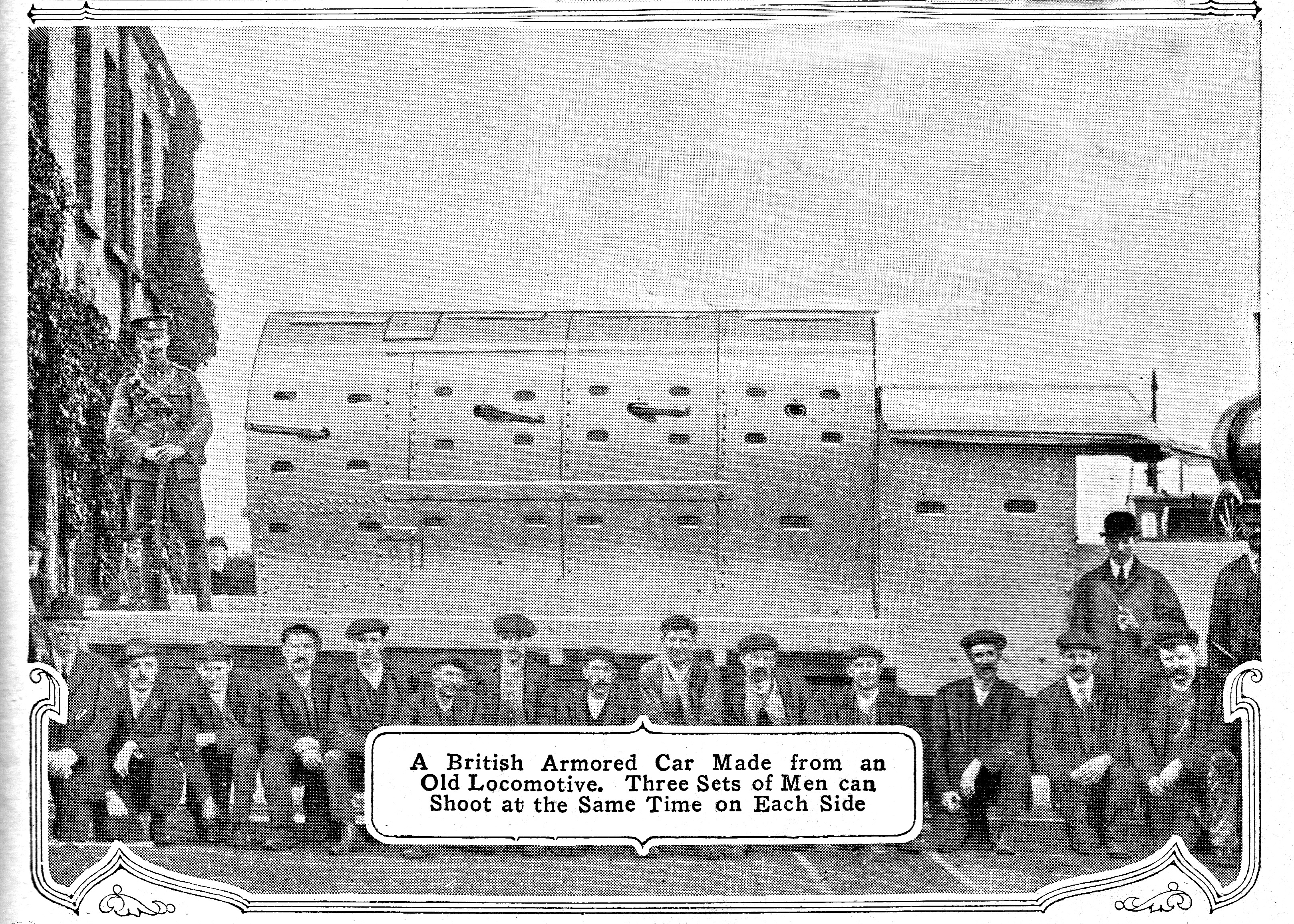
Moving away from the mega-behemoth of imagination, let’s have a look at this loco-tank as it was contrived and constructed in 1916, with the photograph appearing in Popular Mechanics Magazine for November, 1916 (midway through WWI).
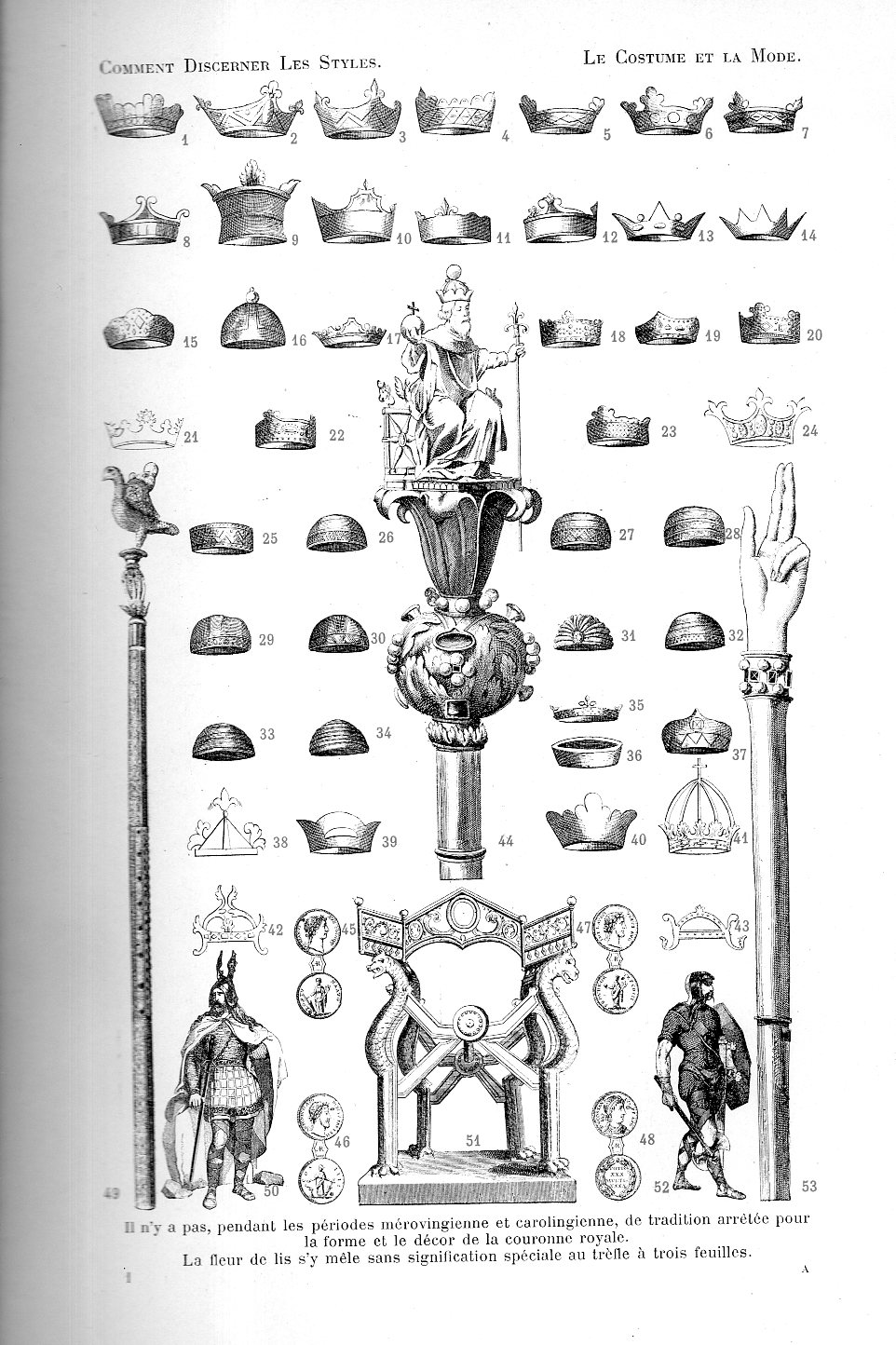
This detail of a couer du sacre/hand of justice was a sceptre used in coronation in the years shortly after the reign of Charlemagne (d 814) and Charles le Chauve (d. 877, and sounding so much nicer than Charles the Bald). It is the last illustration on a 53-item engraved page displaying ancient crowns and tiaras in the very useful Comment Discerner les Styles du VIIIe au XIXe Siecle…etudes sur les formers et les Variations dans le Costume et la Mode, by L(eon) Roger-Miles, volume III, and published in Lyon around 1900. Roger-Miles (1859-1928) was a fastidious presenter, and over the course of his work illustrated several thousand items of clothing and accoutrement. The reason I like this book so much I think was Roger-Miles’ success in arranging all of these bits on relatively limited space, and doing so in a clear, articulate, and artistic manner. Here’s the full page of illustrations from which the sceptre was taken:
[This is not the cleanest scan, but it is a thick book, and doesn’t want to be opened too broadly…]
Even though there is a lot of material and many drawings on this sheet, there is still a very good amount of clean, unused space.
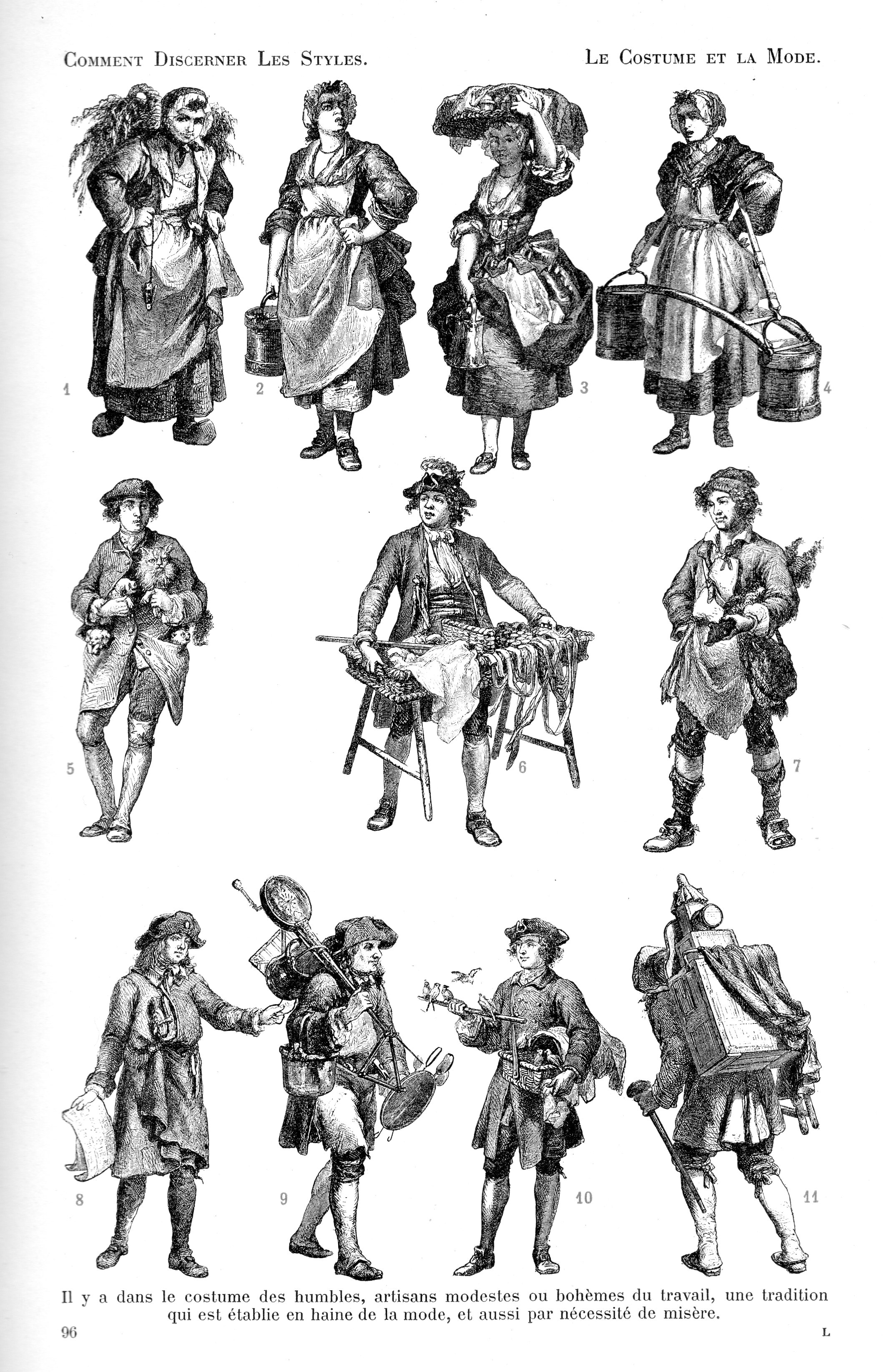
This is a rather poetic approach to describing and naming street vendors during the reign of Louis XVI–of course these sorts of descriptions tend to be so in another language. “La boheme du travail une sorte de tradition de la misere, la defroque prend sur le dos de ces irreguliers du travailuine mem forme et une meme coleur…” is how these images are described by L(eon) Roger-Miles’ in Comment Discerner les Styles du VIIIe au XIXe Siecle…etudes sur les formers et les Variations dans le Costume et la Mode, by L(eon) Roger-Miles, volume III, and published in Lyon around 1900. Bohemian workers in a tradition of misery (or thereabouts) is how this is described–common people of a remedial ability, trying to make a penny. Street vendors.
Earlier in this blog I wrote on a more-fanciful description of professions in “The Dance of Work: Satires and Grotesques of the Professions, 1700”, here.
Also, another interesting bit, “The Alphabet of Professions, 1850”, here
And what these people are selling: (1) oyster seller (with a stubby knife hanging from a string); (2) a kernel seller (which I think refers to corn); (3) a cream and milk seller; (4) water carrier; (5) petseller, with pockets filled with puppies and kittens; (6) ribbon seller, when ribbons were much more popular and played roles in courtship; (7) rabbit skin seller; (8) lottery seller; (9) I believe is a clothing cleaner, fabric cleaner, who would boil materials and such; (10) bird seller; and (11) a magic lantern performer. Perhaps the most interesting to me in this group is the last, a guy hauling around a magic lantern and slides, offering up optical performances to whatever audience he could muster.
There is an image that I have in my head of a grey train car of WWI. There were trains that would pull into stations of large cities, trains with cars of wounded soldiers back from the front, with Red Cross designations on the car sides. Crowds would come to the station to see and cheer the wounded soldiers.
There were some trains that would pull a car at the very end of the line, a car with no cross. It was in these cars that the shell shocked soldiers would sometimes be brought back home.
“War neurosis” and “combat stress” was generally what was known as “shell shock” (not named until 1917 by Charles Myers), and what we’d more commonly referred to today as post traumatic stress syndrome (PTSD). Shell shock was little understood during the war, and soldiers who manifested the behaviors associated with it were often accused of cowardice, and desertion, and in some cases faced disciplinary action that could end in jail or (in some cases) death. They certainly weren’t necessarily treated as “wounded”, and so it seems for the most part they were treated as separate cases.
Given what was known of shell shock the treatment to the modern eye can look severe, odd, and austere, and wrong–soldiers were subjected to electro-shock therapy, physical routines leading to exhaustion, solitary confinement, and simple incarceration. In other cases the condition would be recognized as a defense detriment and in order to alleviate it the soldiers would be sent back from the front for a few days’ rest. The problem with shell shock though would continue to grow, and could be seen as a threat to a fighting force in general, and therefore some of the official responses to it left no doubt that succumbing to shell shock was a serious business, and that soldiers so afflicted would be treated differently from other wounded soldiers.2
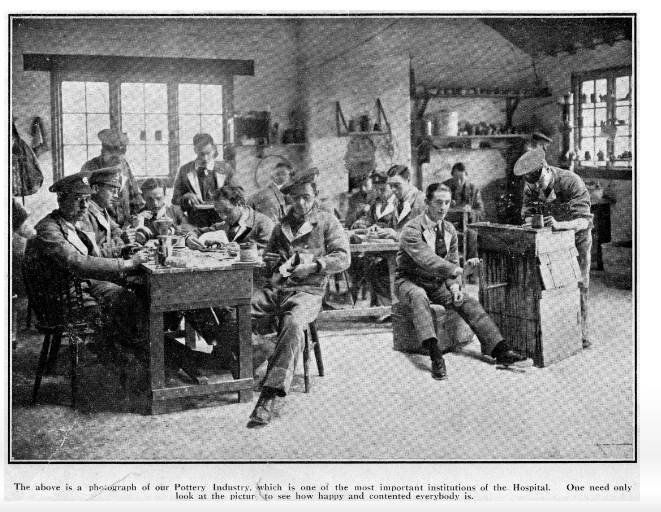
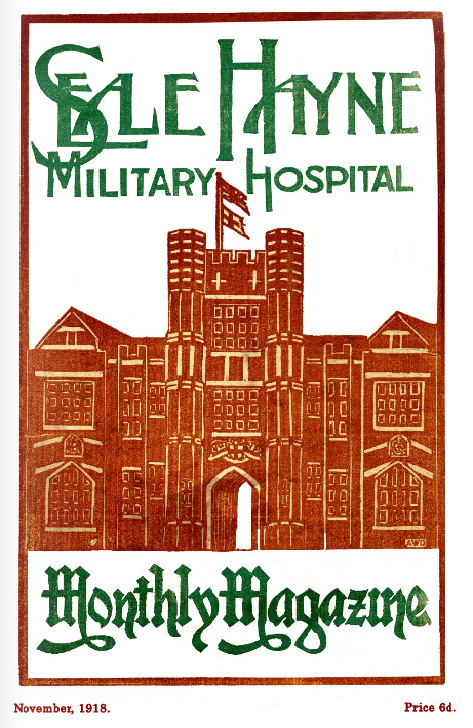
By 1917 though Major Arthur Hurst devised a new method for treating the shell shocked soldier, with a major emphasis establishing the condition as caused by battle, and not a flight-not-fight syndrome. At the Seale-Hayne Hospital, in Devon, Hurst treated some 300 soldiers over the course of 15 months, from April 1918 to July 1919, and seemed to have caused some real improvement. That said, there were many detractors of his methods, and many more who questioned its effectiveness–to that end there seems to be no longitudinal data to support much of a claim for long-term success in Hurst’s treatment.
He did however make a major contribution to the treatment of PTSD by attempting to deal with it medically, and also employing a large dose of occupational therapy in additiion to many other proactive responses to shell shock. In another interesting and pioneering move Austin made use of motion picture cameras to record the before/after effects of his treatments. This however has also come into question because some amount of the “before” images were dramatized1.
I found these videos of the Hurst treatments on youtube, and whether some of the “before treatment” footage was acted or not, the images are very jarring:
There are also a few samples of the magazine/newspaper produced at Seale-Hayner Hospital during this time, with contributions by the patients, some of which is reproduced below:
More photographs are available here: http://seale-hayne.com/?flagallery=seale-hayne-military-hospital
And more: http://www.seale-hayne.com/books/mag1st/#p=1 http://www.seale-hayne.com/books/magWW1/#p=2
The poet Siegfried Sassoon (1886–1967) described victims of shell shock in his 1917 poem “Survivors”, written while Sassoon was himself being treated for the condition at the more-enlightened Craiglockhart medical facility in Edinburgh, and published in Counter-Attack and Other Poems (1918):
NO doubt they’ll soon get well; the shock and strain Have caused their stammering, disconnected talk. Of course they’re ‘longing to go out again,’— These boys with old, scared faces, learning to walk. They’ll soon forget their haunted nights; their cowed Subjection to the ghosts of friends who died,— Their dreams that drip with murder; and they’ll be proud Of glorious war that shatter’d all their pride… Men who went out to battle, grim and glad; Children, with eyes that hate you, broken and mad.
Notes:
1. “From 1917 to 1918, Major Arthur Hurst filmed shell-shocked patients home from the war in France. Funded by the Medical Research Committee, and using Pathé cameramen, he recorded soldiers who suffered from intractable movement disorders as they underwent treatment at the Royal Victoria Hospital in Netley and undertook programs of occupational therapy at Seale Hayne in Devon. “ From: “War Neuroses and Arthur Hurst: A Pioneering Medical Film about the Treatment of Psychiatric Battle Casualties”, by Edgar Jones, Journal of the History of Medicine, May 2011, http://jhmas.oxfordjournals.org/content/early/2011/05/19/jhmas.jrr015,
2. “When evacuation to the base hospital is necessary, cases should be treated in a separate hospital or separate sections of a hospital, and not with the ordinary sick and wounded patients. Only in exceptional circumstances should cases be sent to the United Kingdom, as, for instance, men likely to be unfit for further service of any kind with the forces in the field. This policy should be widely known throughout the Force.”–Report of the War Office Committee of Enquiry into “Shell-Shock”, 1922.
See also a good entry “War Psychiatry”, in WWI Online, http://encyclopedia.1914-1918-online.net/article/war_psychiatry