A Daily History of Holes, Dots, Lines, Science, History, Math, Physics, Art, the Unintentional Absurd, Architecture, Maps, Data Visualization, Blank and Missing Things, and so on. |1.6 million words, 7500 images, 4.9 million hits| Press & appearances in The Times, Le Figaro, Mensa, The Economist, The Guardian, Discovery News, Slate, Le Monde, Sci American Blogs, Le Pont, and many other places… 5000+ total posts since 2008.

Author: JF Ptak

  • Magritte, Bruegel, and Mid-western Streetlights (1908)

    JF Ptak Science Books  Quick Post

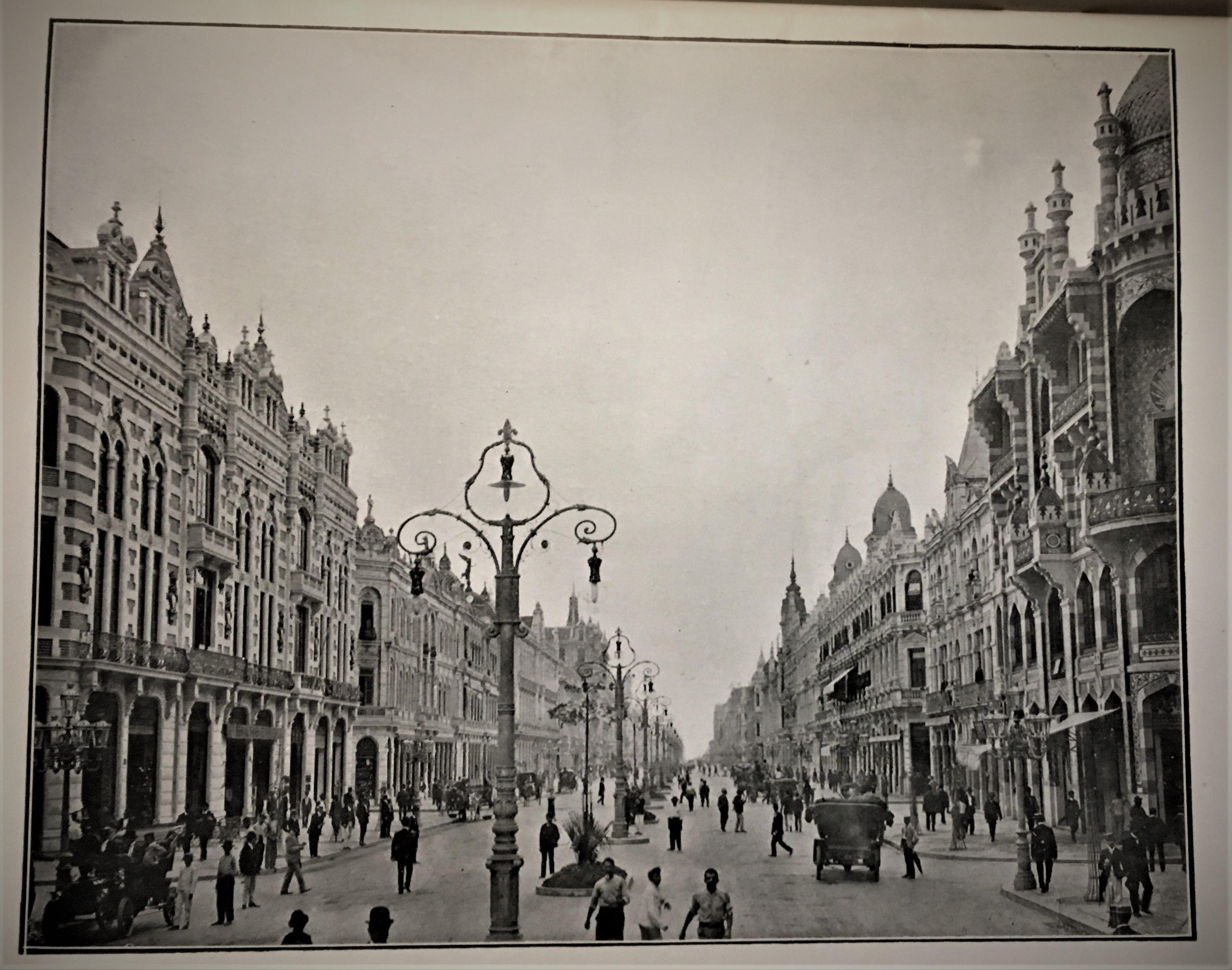
    IMG_1851 (1)I am somewhere between the 16th and 20th centuries with this image–I see a bit of Pieter Bruegel (d. 1569) in this, one of his involved  and diverse human landscapes set into a complex physical environment. In spite of its great and inquisitive artfulness, this photo was made to illustrate the streetlights of Central Avenue in Rio de Janiero for a speculative publication called Public Lighting for St, Louis, which was printed in 1908 and published to solicit opinion on the style of street lighting that was to take place in the city.  Fairly mundane stuff, except that several of the photos used in that slim pamphlet are quiet little sub-masterworks of nothing. I think too that the perspective here of the horizon disappearing down the avenue and the sky being about the same color as the street lend a certain arrogance to the realism of the thing.

    I also see the possibility of Rene Magritte (d. 1967) at work here as well–or a Dada-reconstruction of his Golconda, if you applied a heavier gravity a bit and placed all of those raining bodies from his painting  carefully onto the streets of Rio.   Or it is a combination of the two…in any event it is an evocative photo, buried up to its eyeballs in total obscurity in this 1908 pamphlet, and which probably has not seen the light of day in a hundred years. 

    ·Posted by :

    ·in:


  • Color, in Living Color! Occasional and Segmented Brutalist Design in Data Visualization. (1944)

    JF Ptak Science Books  Quick Post        

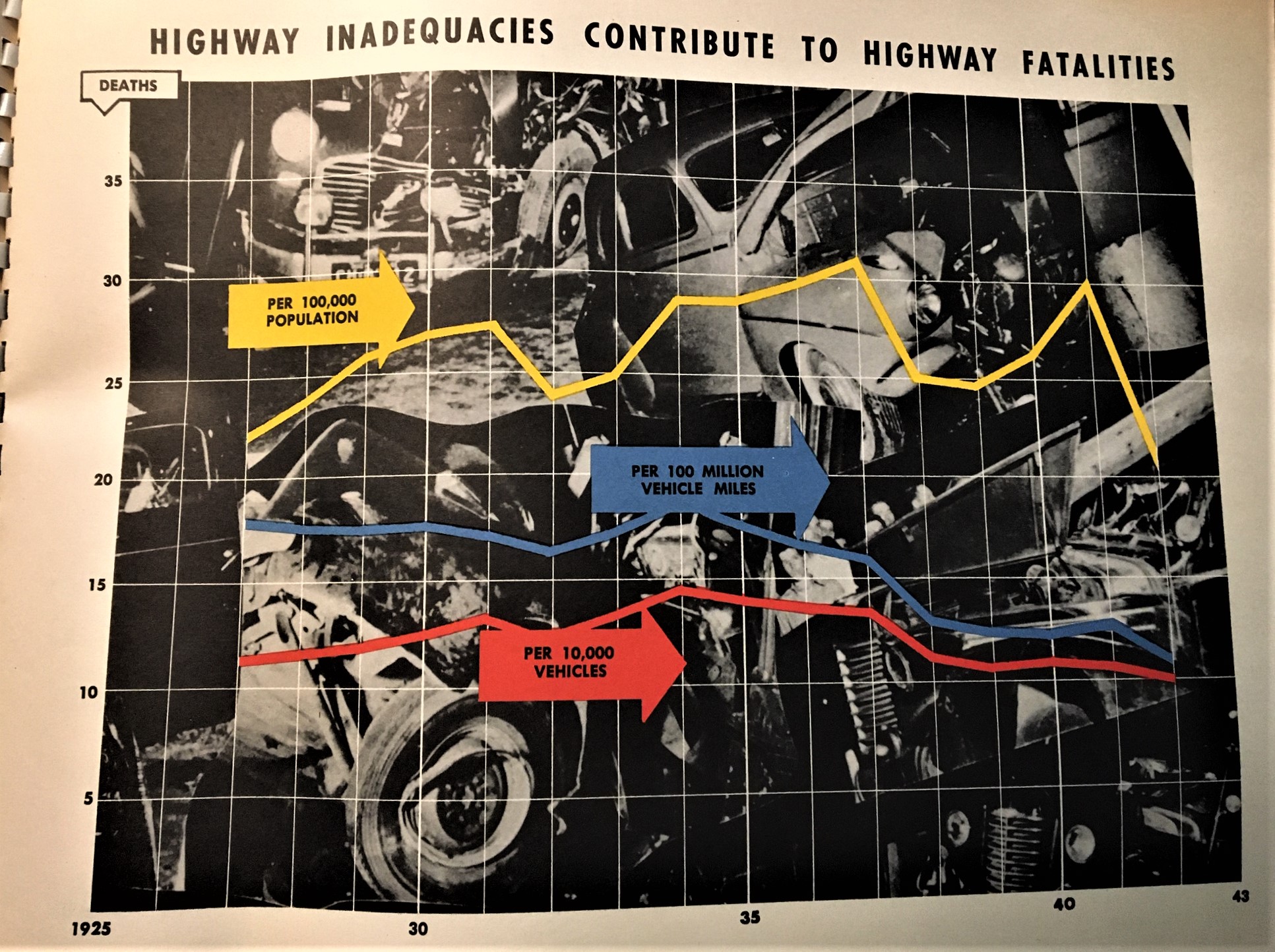
    I’ve made a number of posts to this blog on color and the lack of it (for example, see the series on “Color and its Advanced Abuses”) mostly concentrating on MONUMENTAL color or the lack of it when it could have been there (this, for example, exemplified in a beginner book on color theory with illustrations in glorious black and white). Today’s example comes from a oversize pamphlet called The Story of Highways, which I think was a vehicle used to deliver highway stats to crowds of congressional interest. The 16″-wide pamphlet contains 26 graphs/charts that reproduce 30″x 40″ posters used in a presentation somewhere to justify federal money spent on highways during WWII.  Some of them are unexpectedly colorful, very flat, and as I said in the title of this post, somewhat Brutalist in design. It isn’t quite Soviet Style or Brut Soviet, but there are those elements that I think are pretty noticeable. And if not, they’re interesting to see.

    IMG_1912


  • Is This the First Mention of the Word “Cybersex”? Â

    JF Ptak Science Books  Post 2888

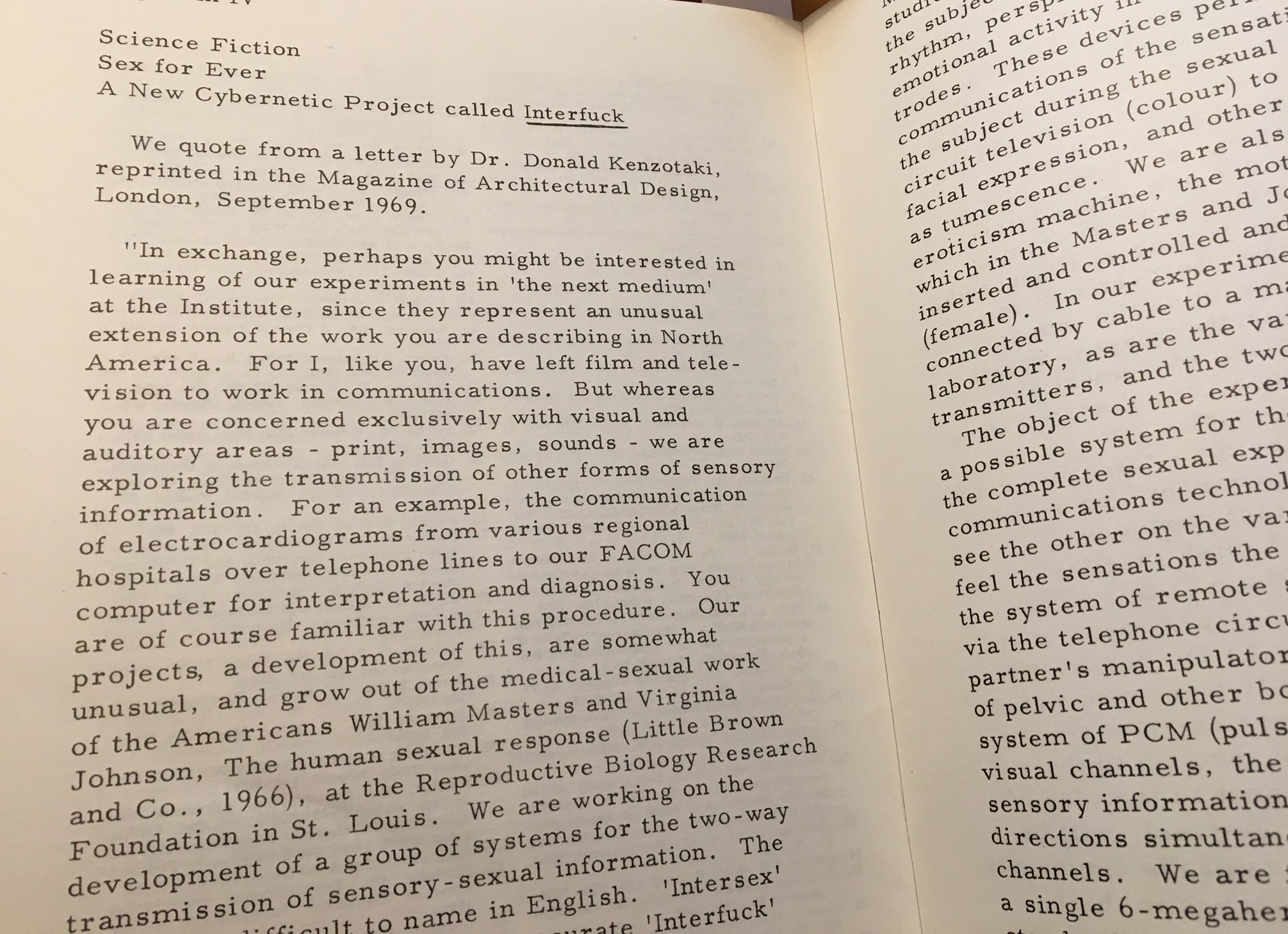
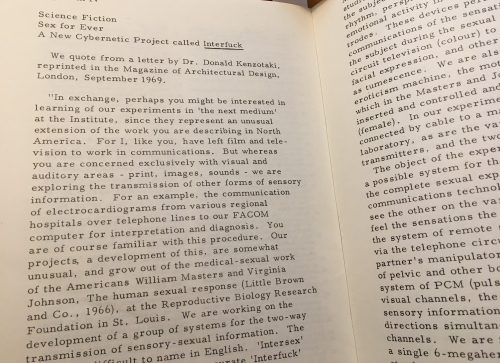
    At first it appeared that this was indeed the first appearance of “cybersex” (in 1970), and that it pre-dated the established conception of its first appearance by twenty years. But, well: no. After much ado, and after some very subdued and annoyed half-bored/boring interest, it turns out that this is a reprint of an article that appeared in 1967, three years previously.

    “Science Fiction—Sex for Ever—a New Cybernetic Project Called Interfuck” is the in-your-face uncertain “title” of the article under consideration here, and it seems to be bouncing its little four-page self around without attribution. Its weirdness caught my eye, and I quickly zeroed-in on the unexpected word, “cybersex”. Now, there’s a LOT of speculation going on in this short article about how all of that person-to-person-to-machine loop happens, and I have no interest in going through it—you can certainly read it for yourself, though, as I’ve scanned the thing and attached it below.
    IMG_1869 (1)

    The article appears in a badly-titled booklet by O.D. Wells, How Could You be So Naive!, published by Artorga and distributed by Modern Books Limited, Berkshire. There are six other papers/articles in this issue in addition to the Wells, including mostly serious stuff: H. Maturan, “Neurophysiology of Cognition”; David Redman “Processing Information with Light”; Roland Fischer, “The Perception-Hallucination Continuum”; J.L. Synge (?!) “A Plea for Chronometry”’ A. Battersby, How to Bury and Idea”; and the our problem, “Science Fiction—Sex for Ever—a New Cybernetic Project Called Interfuck [sic]”…plus a foreword by F.H. George.

    The course of the article wasn’t so obvious because it seemed that this was a bit of a sci-fi story wrapped around a parody and tied up with short anxieties, and the references in the article weren’t accurate, and perhaps not real. Also the publisher, Artorga, is enigmatic, and sometimes to me seems to not take itself seriously even though there are some very serious contributors. There weren’t that many places to turn to check this piece out after the first obvious choices proved to go nowhere.

    It is difficult to find out anything about Artorga (“Artificial Organism”), though the “Paragram” of this work cites heavy hitters Gordon Pask, Ehinz von Foerster, W. Ross Ashby, and Stafford Beer as being “the Committee of Artorga” establishing it in 1958.

    Anyway, “cybersex” as a word hunt was enough for me, and the earliest uses of the word were given as 1991 (Oxford English Dictionary), 1990 (Merriam-Webster), and then a myriad of other minor notes (almost all unreferenced) for the period 1985-1990. This example of course has them all beat, and by a wide margin.

    It also predates just about all of the other “cyber-” created words prefixed to a wide variety of nouns, including a number of words that are slightly more removed than “cybersex”. There’s “cyber-porn” from 1989; -romance, 1992; -smut, 1993; -friend, 1986; and -affair, 1994, for example. The only references I can find for earlier “cyber” prefixes are “cyberkid” which I’ve never encountered (1966); “cyberman”, which evidently has something to do with Dr. Who and also from 1966; and “cybertron”, as a sort of computer hardware reference, from 1961. All of this flows from the first introduction of “cyber” in its creation by Norbert Wiener (a very smart guy who also happened to control greatly to the US war effort in WWII with fire-control in AA weapons derived from his famous “Yellow Peril” book) in his work Cybernetics (1948). Oh yes–”cyberneticist” and “cybernetician” appear in 1948 and 1950.

  • Aether Ennui (1927)

    JF Ptak Science Books  Quick Post

    IMG_1822 (1) (2)IMG_1822 (1) (4)

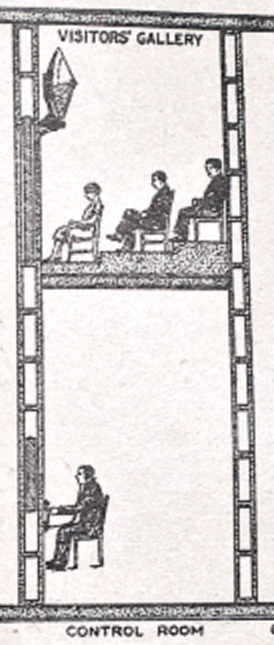
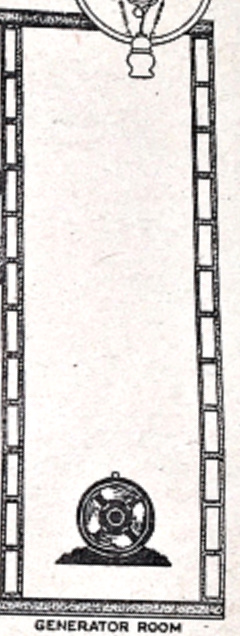
    This story on the new Roxy theater appeared in Radio World in 1927, and it caught my attention with its peculiar empty space and loneliness in elements of the article’s image. 

    Even though we are reading about a new state-of-the-art performance and broadcast facility, a story filled with hope and possibility of another brand new stage opening, the imagery has that certain varnish of vague ennui.

    There is also a lot of space, open space,  over-strong areas of nothing, flat, forbidding, and perhaps even a little cold and frightening. It does fit rather nicely into my collection of images and idea in the History of Blank, Empty and Missing Things series on this blog.   

    I’ve included the full illustration below.  


  • The Library of the Future (ca. 1960)

    JF Ptak Science Books  Quick Post

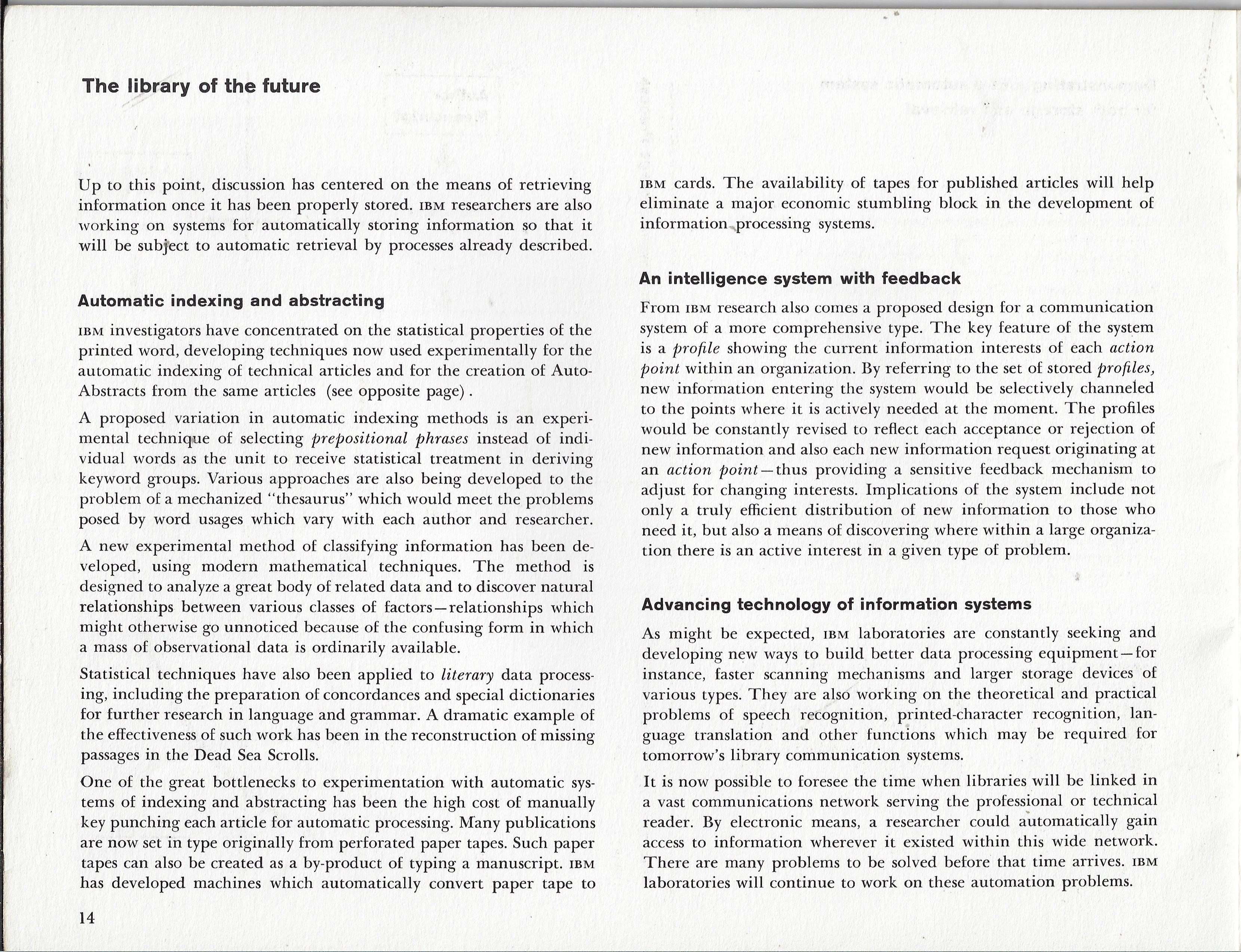
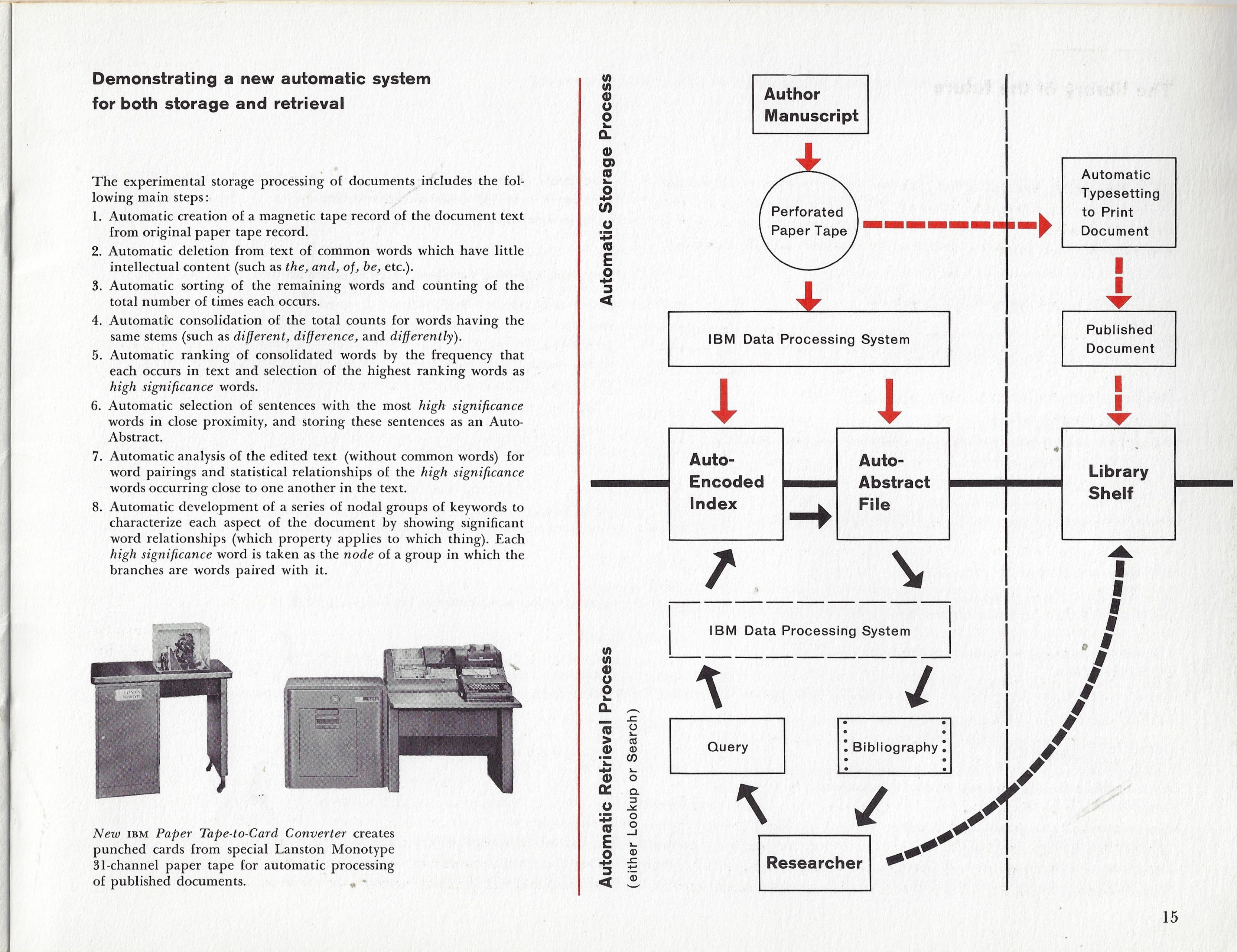
    The oblong pamphlet IBM Information Retrieval was published around 1959/1961 (this is an early evergreen pub with no date but the bibliography cites only 1957 and 1958 “recent” works)  and is a visual/expressive/schematic summation of the current state of affairs in info storage and retrieval delivered in a step-by-step presentation, concentrating on library applications. The main IBM machine at use here is the RAMAC (unnumbered) which made its first appearance in sales in 1956. This is a far more realistic (and existent!) peek at the possibilities of the control of information than the Bush MEMEX (1945, etc.), though of course it wasn’t nearly as far-reaching as Bush envisioned, and didn’t actually deliver the text to the end user, though it did deliver a great deal else, maintaining massive amounts of data in a usable format. It is a fairly scarce document, so I reproduced the small section on “the library of the future” which we are well passed, probably by 1975. 

    • This is another example of something I’m just in the early stages of attention–when the time of effectiveness of what was reckoned to be part of the future and a great innovation turns out to have a very short lifespan and becomes outdated relatively quickly.  

    IBM Info retrieval _2_

    IBM Info retrieval _2_

    ·Posted by :

    ·in:


  • When the New Deal of FDR Was Just Another Capitalist Ploy (1934)

    JF Ptak Science Books  Quick Post

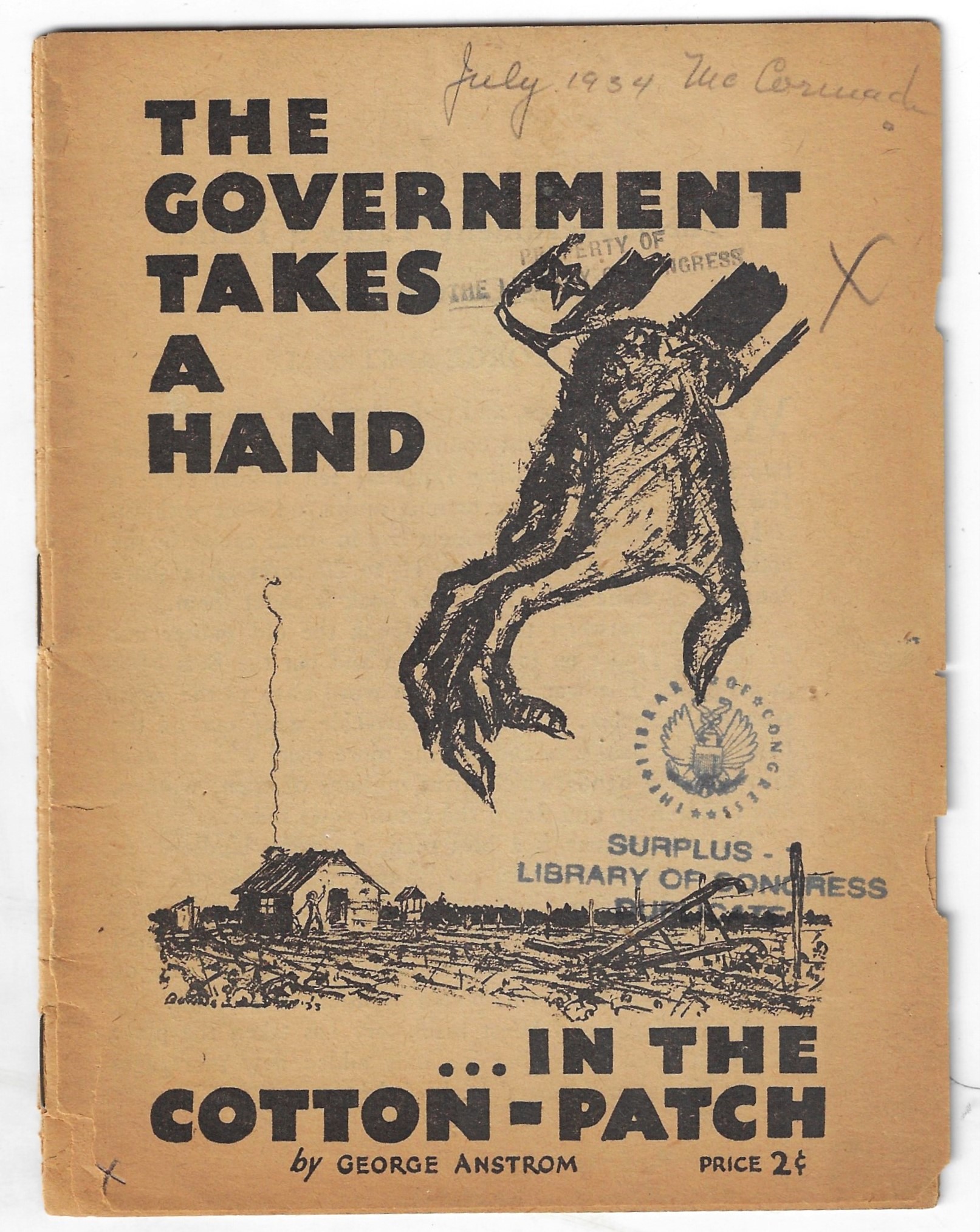
    Harold Ware, 1889-1935, son of activist and Communist Ella Reeve Bloor, early member of what would be the Communist Party of the United States and suspected spy for the USSR, gave Franklin Roosevelt a very grabby and animalistic (in the bad sense of the word) hand for attacking/taking the goods of the poor working class…amidst much else. This occurs on the cover of his 1934 pamphlet–sold for 2 cents and written “George Anstrom”–The Government Takes a Hand, which was an indictment of the enforcement of class and racial conflict in the working classes of the United State. In particular Ware takes aim at the cotton workers and their plight. I’ve included some of what he wrote (below) as there’s a lot of it that makes pretty good sense, and much of it which is correct. He does however take a dim view of the New Deal  and of the agricultural relief action of 1933/4, which Ware maintained was the theft of what little belonged to cotton workers.  In any event, here’s a sampling from Ware’s work:: 

    Cotton-patch“The Wall of Race Prejudice Set Up by the Bosses

    Across narrow country roads white tenants and croppers see Negro neighbors pulling cotton like themselves. But more than that road separates them. Between them rises an invisible wall——the barrier of race prejudice-—deliberately set up by the boss class and its government agencies. That wall is built of fairy tales of white supremacy to keep the white toilers from uniting with the Negro masses against their common exploiters. From the cradle to the grave the poorest white child is taught to look down on, hate and fear his Negro neighbors.”

    “Any sign of protest from Negroes is met with instant terror. Boss inspired Ku Klux Klan raids and lynching parties are the order of the day. The Negro share croppers of Camp Hill, Alabama, organized and fought back against a lynch gang in 1931. They won their demands through organized struggle. But the bosses create a general scare of “Negro rebellion” to justify their chain gangs and other forms of suppression.”

    ·Posted by :

    ·in:


  • A Hole in the Ground vs. a Hole in the Sky

    JF Ptak Science Books  Quick Post

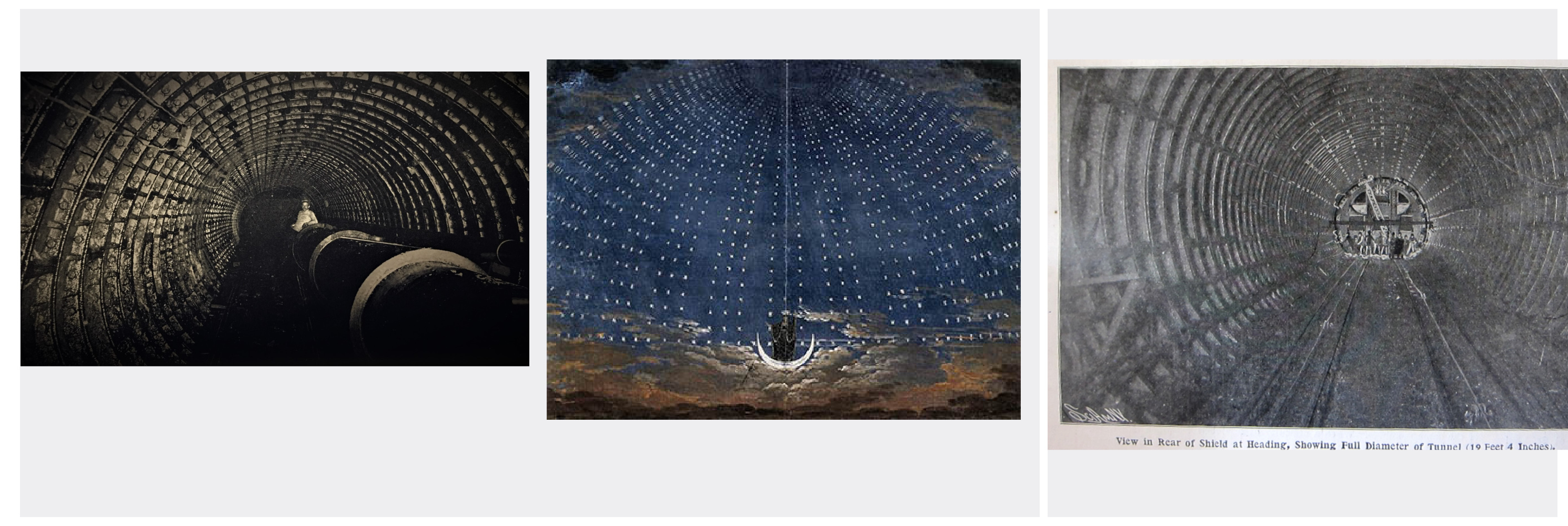
    Tunnel collage


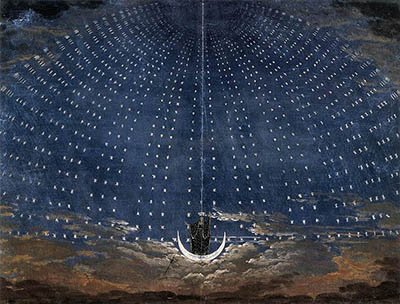
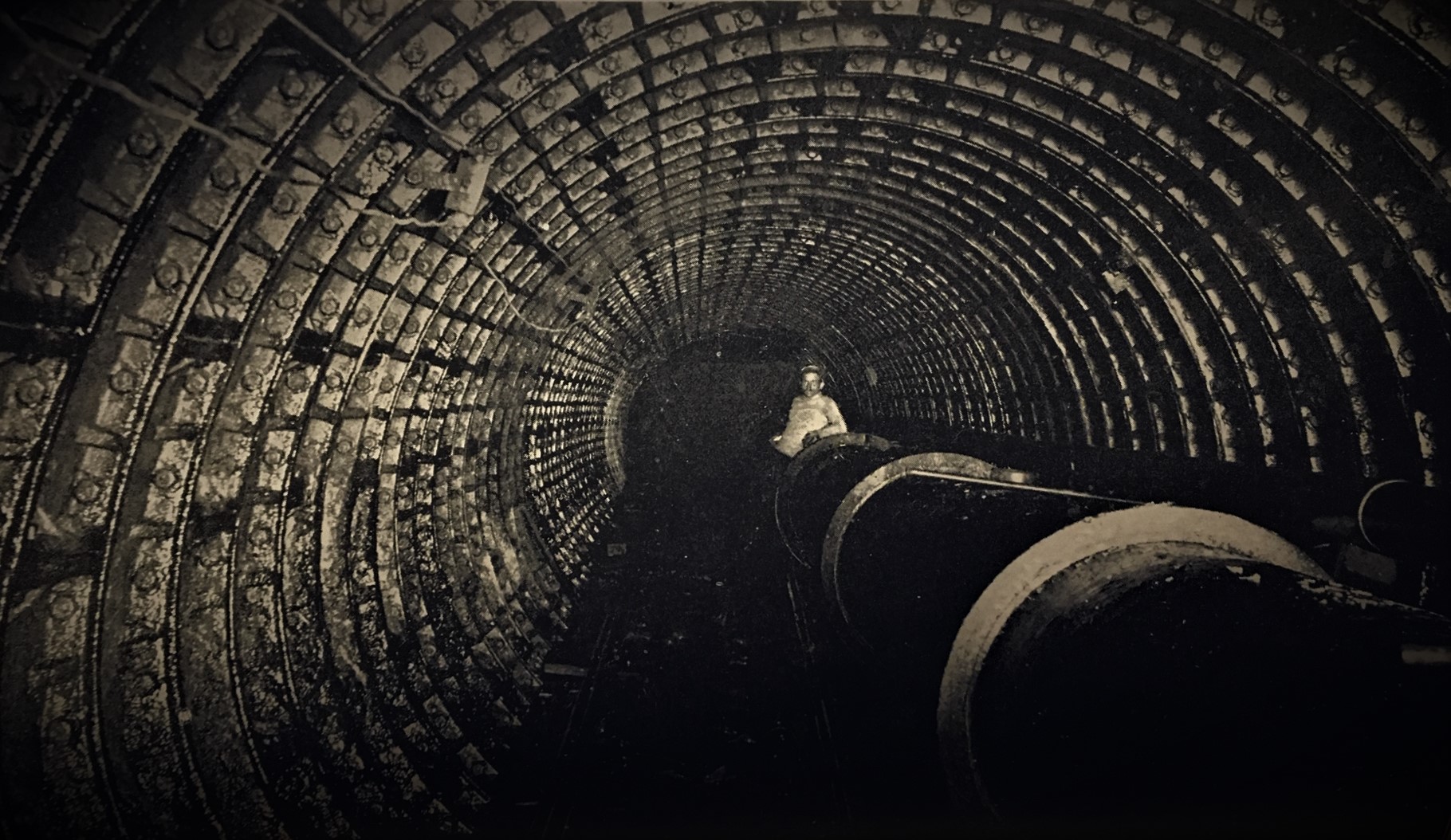
    Mozart tunnel _2_A while ago I wrote about a brief connection that I saw in a  photographic view of the 19′ tunnel section of the Hudson River tunnel with  the 1815 stage set by Karl Friedrich Schinkel (1781-1841) for Mozart’s Magic Flute1. Its just the initial reaction to the perspective pulled up the Schinkel more than anything else, except maybe for a non-existent underground image from Jan Vredeman de Vries’ book on perspective. That said, the set design I’m thinking of features the arrival of the Queen of the Night/Königin der Nacht, so perhaps this association isn’t too meshuga…excepting the ripped-to-shreds lust for revenge that the Queen of the Night sings about, which hasn’t much to do with digging a tunnel. 


    Perhaps this is an association that can be made for any tunnel being dug and illuminated in the 19th century, as I stumbled upon another example of this association, a photograph2 in another NYC tunnel–this one the tunnel under construction under the East River for the East River Gas Company, 1894. It is a little antithetical that these similarities are seen between an image of starry vault surrounding the Earth while the photos depict a lighted tube surrounded by Earth, a sort of alpha and omega of endless light…a contraction of environment filled with light compared to a contraction of the limitless night sky as seen as a theatrical set.  (I understand that there aren’t a long series of lights in the tunnels, just that it looks so because of the no-doubt heavy-duty light source and its reflections on the odd surfaces/bolts/etc. the metal tubing surfaces…and that is a riff in itself.)

    In any event, I like these images, and so I’ll share the newest of my finds here this morning.  

    Tunnel lights mozart


  • “Castration vs. Vasectomy in the Feebleminded as a Surgical Problem” (1941)

    JF Ptak Science Books  Post 2886

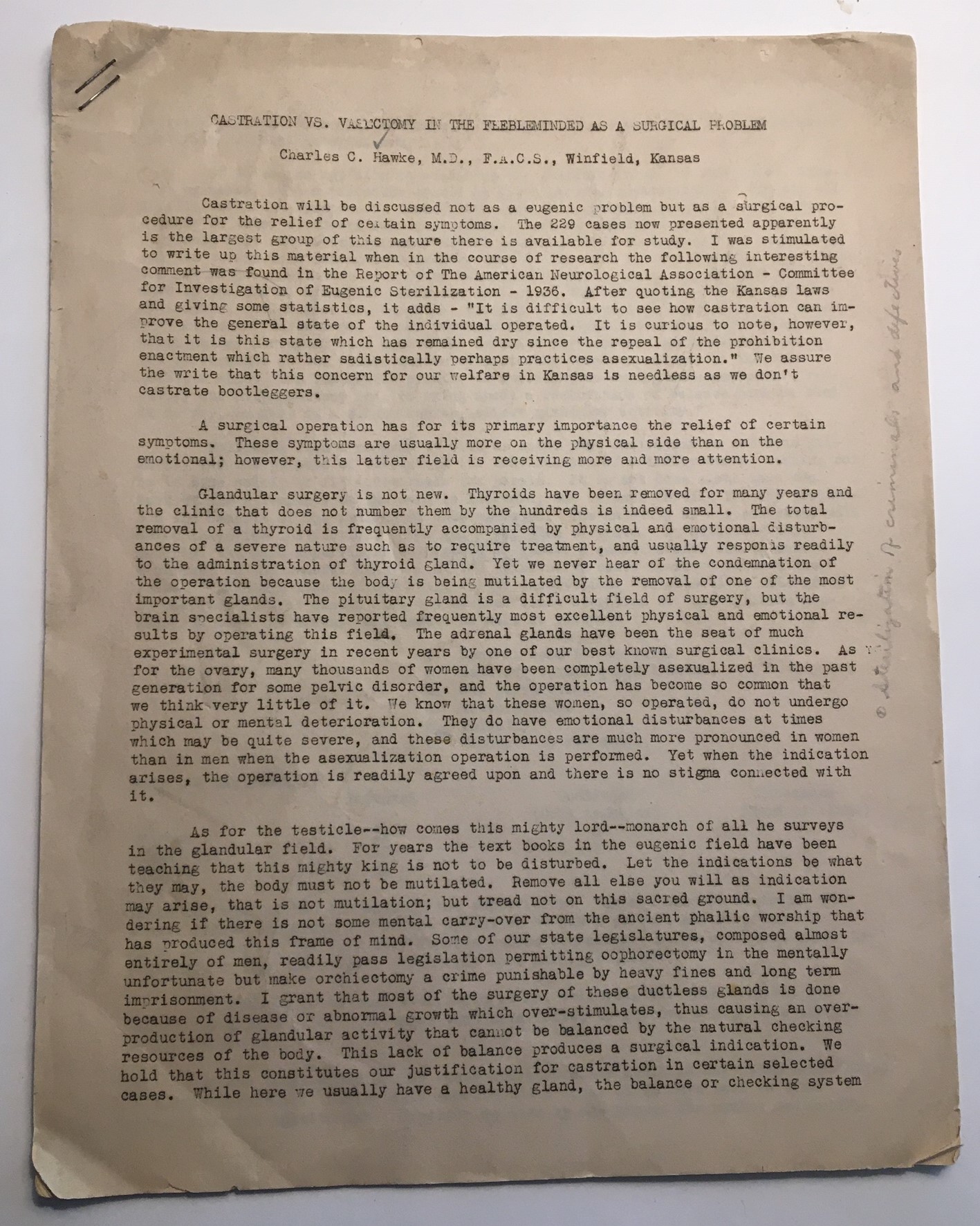
    This is an issue that you don’t hear every day…and offhand it seems to be a little late in the asking by 1941. But it wasn’t too late, unfortunately, and the question was a debated one in some halls of practicing eugenic and mental health academe. This is the title to a paper1 written by Dr. Charles C. Hawke (M.D., F.A.C.S.) while superintendent of the Kansas State Asylum in 1941, and it entailed a discussion of the efficacy of the enforced sterilization practice–a procedure under law that was basically discontinued as a medical/surgical response to mental issues in 1950 (in Kansas). 

    Castration Hawke _1_Dr. Hawke wonders—somewhat facetiously to my reading—about the reluctance of including testicles in the field of “glandular surgery”, noting that “text books in the eugenic field” teach that “this mighty king is not to be disturbed”, along with a few other purplely examples. He quickly establishes the castration (and ovariectomy) as well as vasectomy and salpingectomy may be the way to stabilize “the unstable group” (in institutions), “be they idiot, imbecile or moron” and that the procedure should “be given serious consideration”.

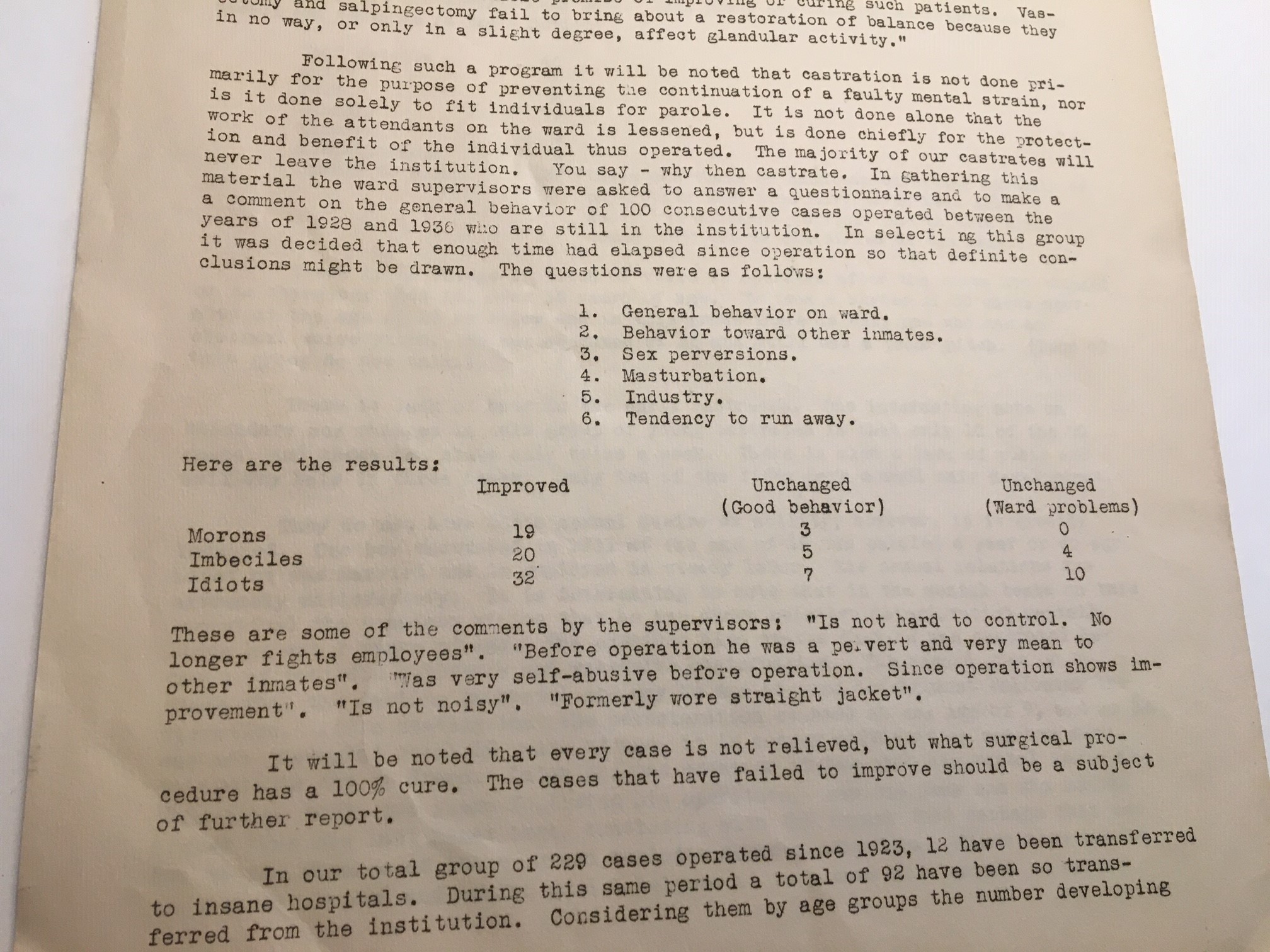
    He states that “the majority of our castrates will never leaves the institution. You ask—why then castrate[?]” He doesn’t seem to answer this directly, but does provide some evidence (below) that the behavior of 71% those castrated and confined does improve. It is not 100%, Dr. Hawke notes, and adds the corollary “…but what surgical procedure has a 100% cure [sic]”.

    There are other reports of successes in castration, including a long paragraph of Dr. (F. Hoyt) Pilcher, (Superintendent of the Kansas State Asylum for Idiotic and Imbecile Children) who began his work in the early 1890s. There is also a review of the 1917 (and 1928) laws passed by the Kansas legislature on “asexualization”. It seems that the state can uphold recommendations from medical officials recommending castration; the person in question can register a “protest” (“which are rare”). These laws extended its reach into “state penitentiaries, the boys’ reformatories, state hospitals for the insane, and the state hospital for epileptics, the state home for the feebleminded and the state industrial school for girls…”

    Castration Hawke _2_

    It is quite a document of those eugenical times.

    Notes:

    1. Charles C. Hawke (M.D., F.A.C.S., Winfield, Kansas).  Castration vs. Vasectomy in the Feebleminded as a Surgical Problem. 12 leaves (including a 17-item bibliography. Mimeographed. Stapled. GOOD+ copy. This copy’s provenance: “Gift from the author, 1941” in pencil notation on the back of the first leaf, with the LC rubber stamp on the rear leaf.  WorldCat records only ONE copy (Tozzer Libray, Harvard), so as a single-issue “offprint” it is a rare thing.

    2. For a deep review see: Cean T. Collins, “CHILDREN OF SORROW: A History of the Mentally Retarded in Kansas”, in Bulletin of the History of Medicine, Vol. 39, No. 1 , 1965, pp. 53-78

    ·Posted by :

    ·in:

    —

  • The Towering Magnificence of the Porcupine

    JF Ptak Science Books   Quick Post                                    

    000-ebay--Nov 4--porcupine995

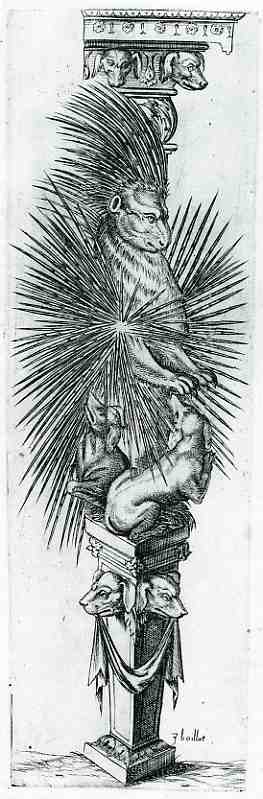
    This is perhaps the greatest monument ever erected to the porcupine–of course it may be the only monument ever erected to the porcupine, but it is undeniably monumental.  This unusual image was published in Strassburg in 1604  in Joseph Boillot’s (1546-1603) sumptuous New Termis Buch (first printed in 1592 as a Nouveaux pourtraits et figures de termes).  It is a bestiary of sorts, a very curious book, offering real and imaginary animals together in alabastered, marblized, memorialized, architectural form, with the  great hope of offering them to fellow engineers and builders for incorporation into the real world.  Or perhaps not, perhaps it was all just done in fun, an exercise, an experience, an artistic creation wrapped inside  the fundus of a great Baroque eyeball.  Unicorn


    The end result is the Boillot produced some extraordinary beasts, wrapping them in extraordinary garments, surrounded by other wonderful animals real and not, and elevated to extraordinary heights.  The powerful unicorn, draped with the vicious but subdued lion; the ass, regal, judicious, pensive, thoughtful, kept in place, or warm, by a dragon. Then of course there is the porcupine, absolutely magnificently appointed with spikes  kept by by dogs, supported at all levels by the creatures.

    ·Posted by :

    ·in:


  • Internal Document Proposing an Organization to Establish Post-Nuclear Exchange Damage Assessment (1956)

    JF Ptak Science Books  Post 2885

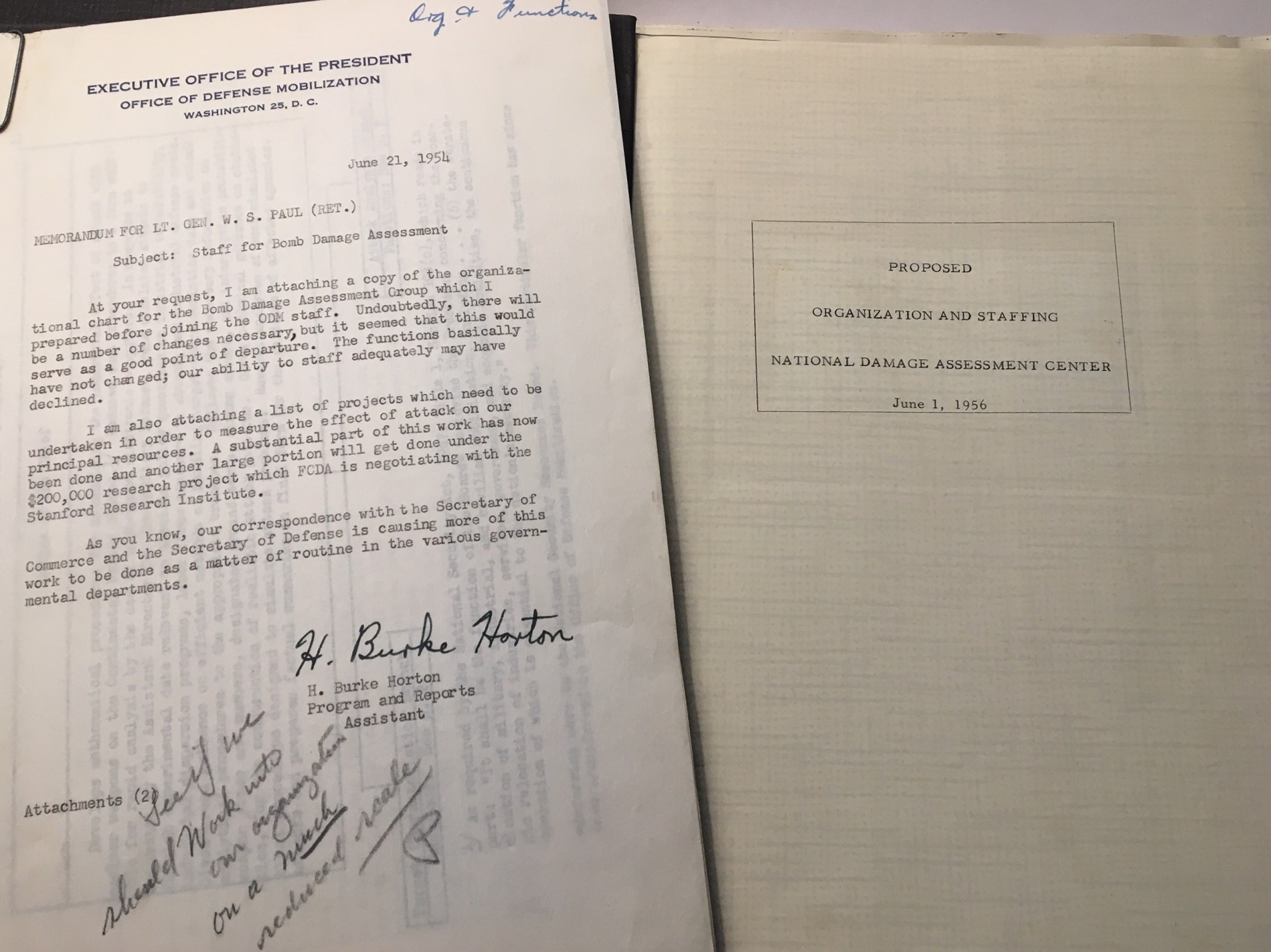
    Proposed organ _2_I’ve written many times on the technical and political end of the creation and deployment of the atomic bomb, along with some posts on the use and manipulation of language in controlling the sense impressions of nuclear war and survivability.  What I have found so extraordinary about this second part is the creation of ordinariness, or mechanization, or acceptance, of the aftermath of nuclear warfare–and what we’re talking about here is the
    “exchange” of not just a few 20 kiloton Hiroshima-type weapons, but thousands of megatons of explosives and massive amounts of radiation. But this is the function of familiarity, I guess–given the situation it was essential to plan for eventualities A-Z, and for that you need structure, and vocabulary. 

    All things being equal, such things as an Terrestrial Afterlife in the United States needed to be contemplated because that is what we do–we make the situation possible for end-of-the-world stuff to happen, and so we have to plan for building things up again with radioactive detritus once all of the keys get turned and buttons pushed, as  it is just a natural course of that historical river. That the bomb would be built was a given; that the Soviets would develop the a bomb and delivery capacities was just a matter of time, and that they would be our sworn death-enemies was also a fait accompli. To develop a way to somehow survive a nuclear war may have been a major deterrent to not launching an attack, especially when linked with a Mutually Assured Destruction (MAD) arms build up (where everyone and everything would be obliterated if there was a nuclear war, or at least so by 1965 (and probably earlier than that). All this insane stuff may have worked, and somehow we managed not to ignite the world, because (to paraphrase Frank Zappa) there would be no real estate left.

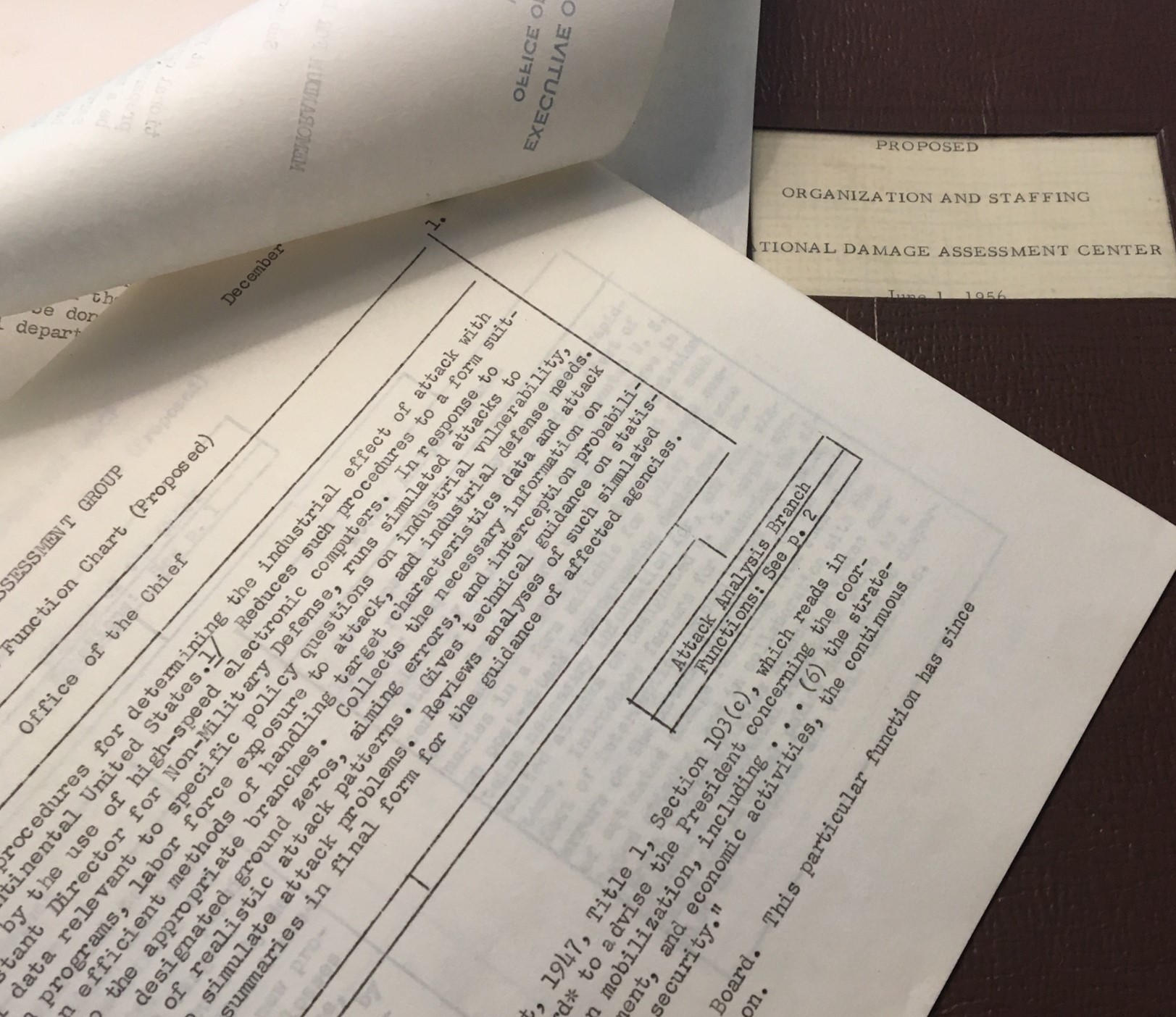
    Proposed organ _1_On the other hand, building all of these weapon systems and planning for attack and the post attack world could have pushed us into a final confrontation, making all of this sound “winable”, “doable” somehow, that once the bombs had all exploded and nothing worked anymore, that there would be enough to pull together of our civilization to declare that we had indeed “won’”. 

    And the only way to declare a winner was to have something to stand on besides pieces of green glass and Earth, and so  plans for communications and a military, police force, fire brigades, medical care, food distribution, banking, and all the rest–the pieces of a recognizable backbone of American society–would have to be undertaken.  All of this could very well accomplish the creation of an illusion in the mind of the adversary that you are capable of surviving a nuclear war, and so there would be no great gain in attacking; or it could send the message that by doing this preparation that you were preparing a first strike scenario, and so the adversary would attack while the odds were still not horribly out of balance.  And on and–it all looks like a lose-lose endgame to me, which is hardly a “game” at all when all players are losers.

    But still there was a need to staff the thousands of positions that went into the theoretical end of figuring out the non-weapon-end world after nuclear war, and the above “position description” is an example of that, a necessarily pro forma form, just another job in a ea of jobs.  This one’s job descriptions read like any other, except of course that the content was much different.  Form the same, sentence structure the same, vocabulary basically invariable. 

    One aspect of this planning for the Afterlife was the planning part itself, planning to plan, how to make sense of the answers and the questions, a form into which the parts of a process are poured before they become the process itself.