A Daily History of Holes, Dots, Lines, Science, History, Math, Physics, Art, the Unintentional Absurd, Architecture, Maps, Data Visualization, Blank and Missing Things, and so on. |1.6 million words, 7500 images, 4.9 million hits| Press & appearances in The Times, Le Figaro, Mensa, The Economist, The Guardian, Discovery News, Slate, Le Monde, Sci American Blogs, Le Pont, and many other places… 5000+ total posts since 2008.

Author: JF Ptak

  • Albert Messiah in Berchtesgaden (1945)

    JF Ptak Science Books   Post 2881

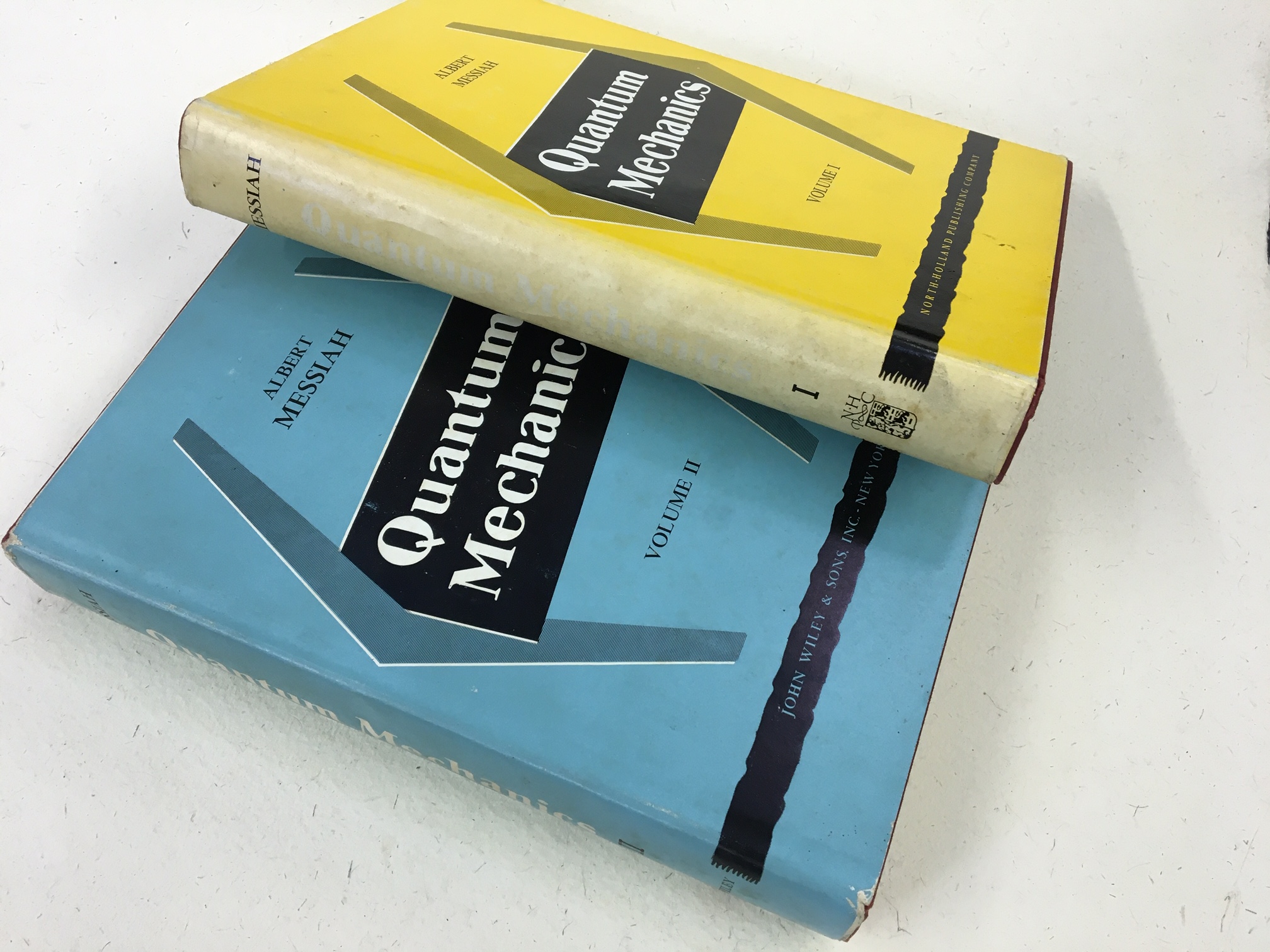
    I recently unboxed (after a long and deep in-box slumber) the classic two-volume work Quantum Mechanics by Albert Messiah. It was published in French in 1959 and soon found its way into English in 1961 (and 1962), and was a staple in the studies of two generations of physicists.

    I had no idea of Messiah’s background, which is extraordinary. I learned that he was accept to the IAS (Princeton) with only a high school education—this was due to Messiah (1921-2013) having spent his formative years from 1940 to 1945 fighting and killing Nazis. He heard Petain on the radio announcing that the gentlemanly thing to do for much-fallen-France in 1940 was to lay down arms, which to Messiah was the clarion call to resistance. He also refers to Petain as an imbecile. He recalls Petain intoning a vainglorious “…entre soldats et dans l’honneur, il fallait cesser le combat, etc. etc.” , and that he does not recall this “stupidity” being much shared at the time (“…cette stupidité n’était pas tellement partagé à l’époque.”)  This was indeed his path, as he joined the Resistance and fought for five years.
    IMG_1417 (1)

    Here are a few interesting responses to questions put to Messiah at the Ecole Polytechnique in January 2009 regarding his time during WWII:

    On a question of the lack of use of armor in 1940, Messiah says it simply was that French command sucked. (“Tout simplement parce que le commandement militaire français était un peu nul, c’est tout.”) Mediocrity was the ruler by which things were measured, and in general is very well spread. (“La médiocrité est une chose qui finalement est relativement répandue.”)

    The people who won the war, and the reason why the Resistance was successful, were those who could think and stand out from the crowd. (“Parce que l’histoire justement est faite par les gens qui se démarquent de ça, des gens qui réfléchissent et qui éventuellement prennent des risques, c’est ce qui a donné la Résistance d’ailleurs, des gens qui prennent des risques mais qui ne vont pas dans le sens de l’histoire.”)

    At the end of the interview Messiah relates being among the first to occupy Hitler’s residence/seat of government in Berchtesgaden in May, 1945. He found it very amusing and ironic that Hitler’s place would in the end by occupied by a Jew. (“…le malheureux Hitler a eu la malchance de voir son repaire occupé par un Juif.”) 

    And a Jew named “Messiah” at that.

    ·Posted by :

    ·in:

    —

  • Subduing Insanity with Narcotized Sleep: Mental Illness Treatments in 1846

    JF Ptak Science Books (Earlier post, expanded)

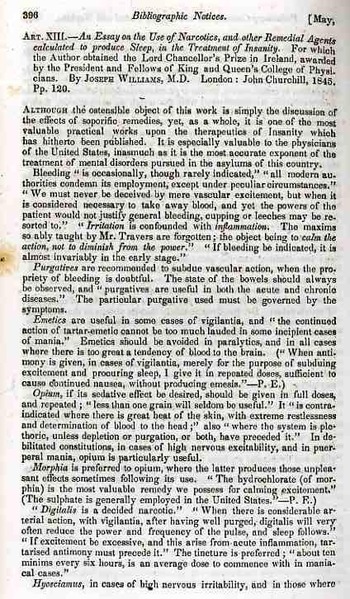
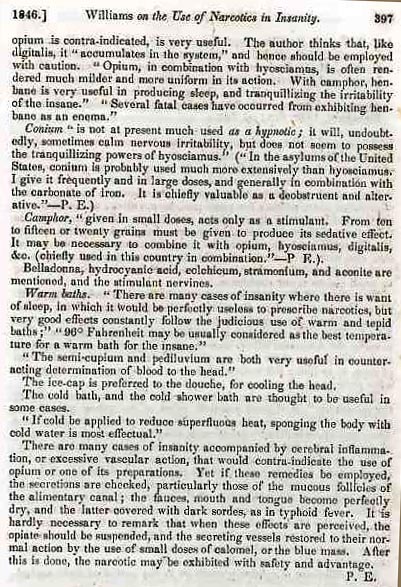
    Drugs for insanity _1_This book review on the use of narcotics to induce sleep in treating the insane appeared in the New York Journal of Medicine for 1846.  The book, An Essay on the Use of Narcotics, and other remedial Agents calculated to produce Sleep in the Treatment of Insanity…., was written by Joseph Williams, M.D., and was published in London in 1845.  The theory behind the sleep treatment was that the basic mechanism of insanity was “cerebral inflammation” or “excessive vascular action” in the brain—inducing deep sleep, evidently, was a good way to combat the over-active brain.

    The article itself comes at an odd time in the history of the treatment of the insane.  It came almost 40 years after the establishment of  McLean Hospital (first known as the “Asylum for the Insane,” a division of the Massachusetts General Hospital), which opened on Oct. 1, 1818, and was the first hospital dedicated to the treatment of the insane in the U.S.  It came 70 years after the great advances of Benjamin Rush, who elevated the “Mental Patient” from chains on the floor to the status of medical or nervous illness or disease.  The use of narcotics over this period seems to have surged and waned.  In 1879, in an article in the New York Times, the reputation of the Asylum for the Insane on Ward’s Island in NYC was considered—and one of the high points was that it had (largely) discontinued the use of narcotics. (There were still problems, of course, what with the asylum being overcrowded, housing 1100 in an institution meant to house 700, and where the chores and even nursing positions were staffed by the inmates, who were feed on 32 cents a day.)  As late as 1921, though, Jacob Alter Goldberg notes in his Social Aspects of the Treatment of the Insane, that there was a new, sharp increase in “toxic narcotic” treatments of the insane.  Of course, I guess one could replace “narcotic” with some sort of other misplaced treatment, like shock therapy, or Freudian mélanges, or something.  Each age must necessarily have their entry in the encyclopedia of embarrassments

    In this article we find sleep assaulted by the use of the following: purgatives (“to subdue vascular action when the propriety of bleeding is doubtful’), emetics, opium (to be used “in cases of high nervous excitability and in puerperal mania”), morphia (“the most valuable remedy for calming excitement”), hyosciamus (“to produce sleep, tranquilizing the irritability of the insane”).  It is weird to see that the last sentence in the description of hyosciamus reads “some fatal cases have occurred from exhibiting henbane as an enema”. 

    A narcotic enema?  Still to come in the review is conium (“I have used it frequently and in large doses…it is chiefly valuable as a deobstruent and alternative”, followed by camphor, Belladonna, hydrocyanic acid, colchirum, stramonium aconite, and others.  “Warm baths’ makes an appearance (“90 degrees may be considered to be the best temperature for a warm bath for the insane”), as do cold baths, and the applications of ice caps. 

    Drugs for insanity _2_

    I’m not so sure about what to make of it all, the sleep treatment of insanity I mean—after all, Joseph Lister only makes his epochal pronouncements on cleanliness in the operating theatre 15 or so years after this paper, which seems today to be the most rudimentary thing that one could do in treatment in the surgical room, so treating extra blood in the brain through drug-induced sleep doesn’t seem all that far away from the realm of possibility back there in early Victorian England.

    I don’t think I’ll forget the toxic narcotic enema any time soon, though.  Or the word “deobstruent”. 

    ·Posted by :

    ·in:


  • Simple Sublimity: Images of Disappeared Common Objects. Traffic Lights from 1936.

    JF Ptak Science Books  Quick Post

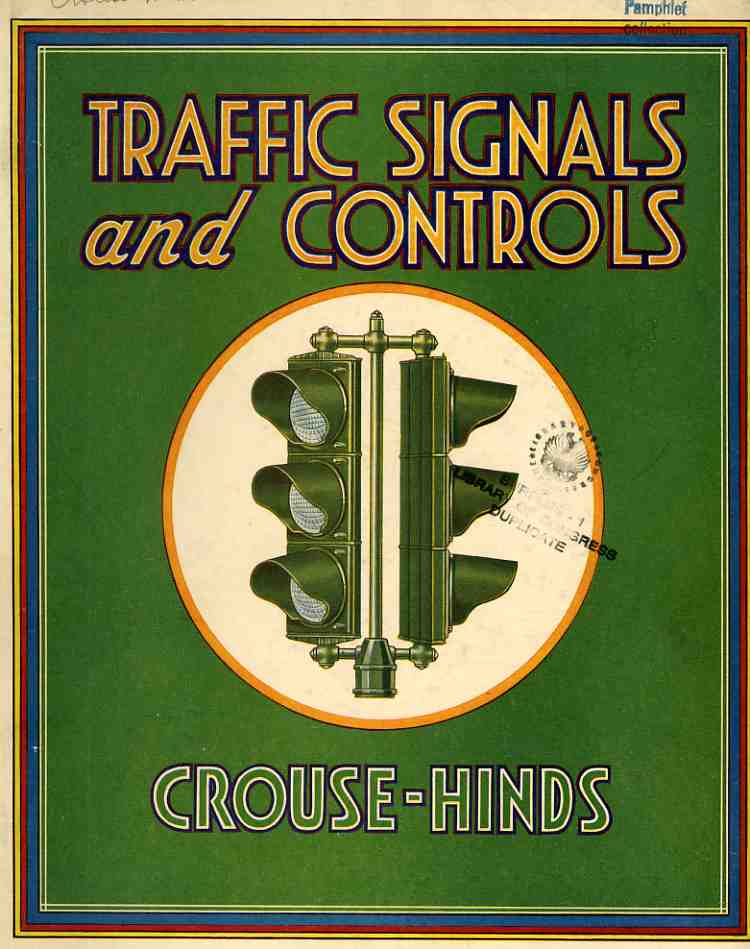
    Traffic lights _1_These images are about as basic as it gets for the common, everyday, overlooked objects from the disappeared past.  They come from the Course-Linds manufacturer’s catalog for traffic lights and other control systems called, yes, Traffic Signals and Controls, published in Syracuse (NY) in 1936. It is a beautifully designed catalog—excellent illustrations laid out perfectly on their pages, with all of the data you’d ever need to order these things for your municipality. 

    What I find so fascinating about the images here is that they depict ubiquitous objects that today would today—given their ephemeral nature—be exceptionally difficult to find. 
    Given this catalog, today they are not.


  • Front Line Field Medical Station, Italy, June 1918

    JF Ptak Science Books  Quick Post

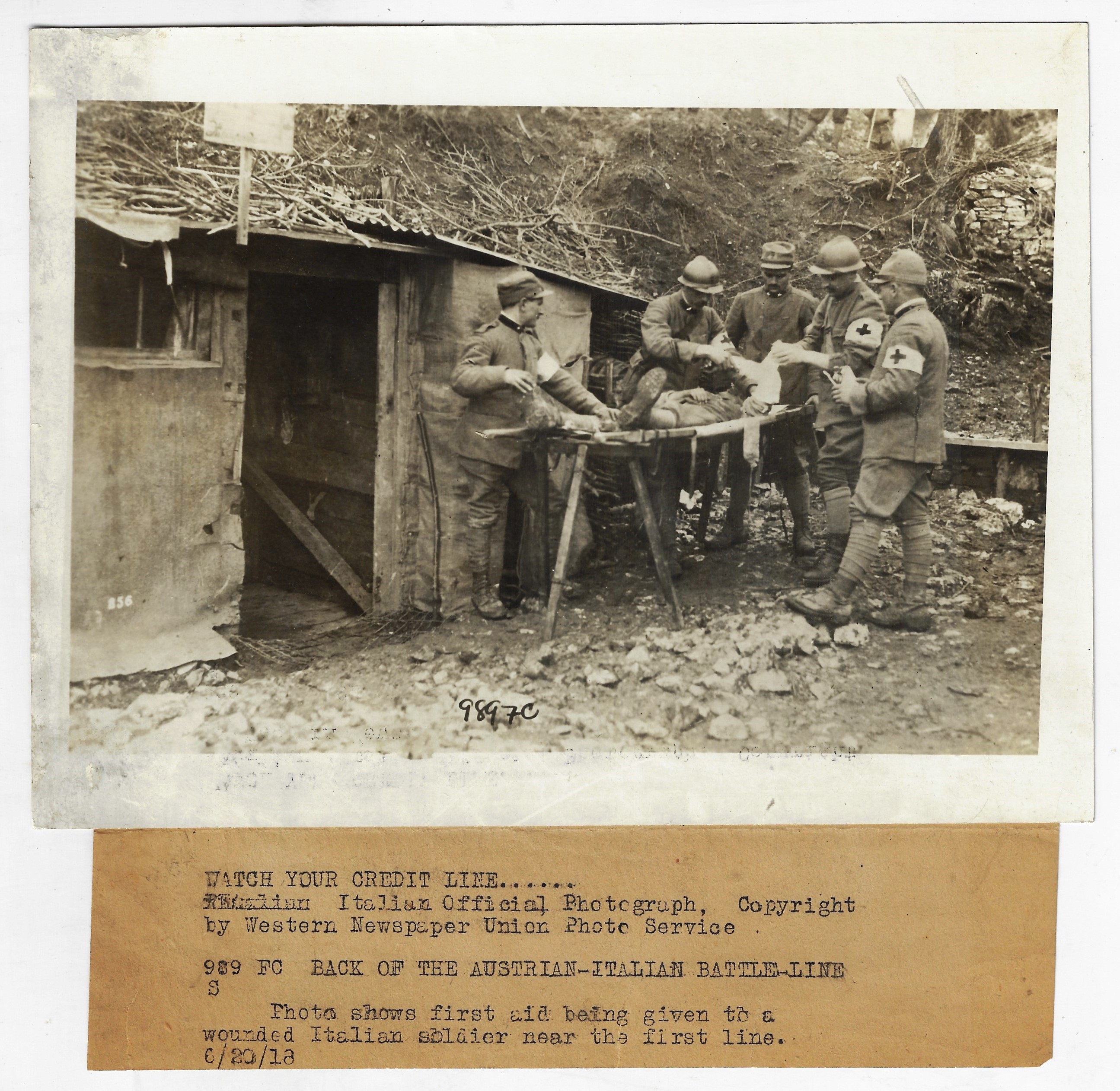
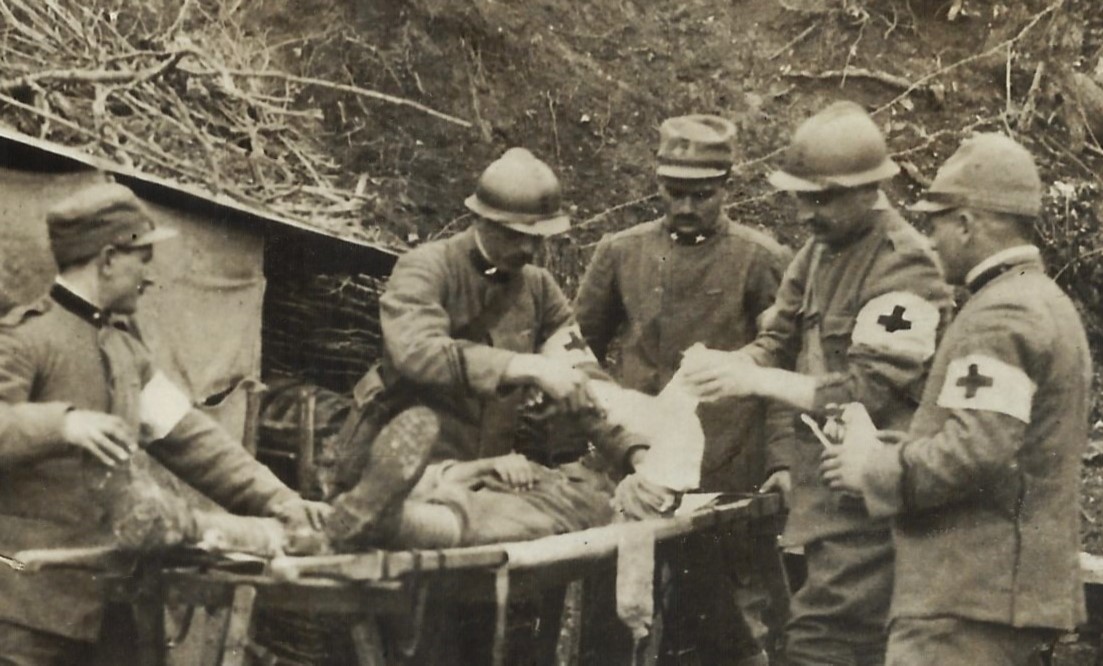
    This is another interest image from my WWI News Photo collection–a front line Italian medical/triage post on the Italian-Austrian front, June 1918.  It is bare-knuckle bare, very rudimentary, though the soldier is receiving the attention of five medical personnel. What attracted my attention was the fifth medical aid, standing at the foot of the soldier, placing two calming hands on the soldier’s leg and foot, delivering calm and sympathy.  

    WWI Photo field hospital _1_

    Western Newspaper Union Photo Service, Itaian Official Photograph

    WWI Photo field hospital _2_

    ·Posted by :

    ·in:

    —

  • A Sympathetic Pamphlet on the Plight of U.S. Japanese, 1944.

    JF Ptak Science Books   Post 2880

    70 000 JapaneseThis pamphlet, 70,000 American Refugees, Made in U.S.A., by Truman  B. Douglass1, was a sympathetic appeal to the deeply grave situation legislated to 140,000 Americans. They were Americans of Japanese descent, many of them U.S. citizens, who by Executive Order 9066  were ordered to stand down from their lives for the sake of national security and be removed to distant and remote internment/concentration camps  in May 1942, mostly for the duration of the war.  There weren’t that many appeals for the primacy of the rights of these people at this time–the war for the United States was newly begun via the Japanese attack on Pearl Harbor five months earlier–and the understanding was to protect the security of the country via the segregation and housing of what were seen to be the potential enemies in the existing Japanese-American population living on the U.S. west coast.

     Franklin Roosevelt’s  February 1942 Executive Order 9066 (issued 19 February 1942) to imprison more than 140,000 Americans (70,000 of whom were U.S. citizens, including children) for the duration of the war was the legal bombshell that gave the War Department the authority to authorize the removal of the Japanese  to theoretically prevent those people from engaging in sub rosa and fifth column activities and wartime terrorists fighting for Imperial Japan.

    Given that this pamphlet was in it third edition just a few months past its first appearance in October 1944 says that there was at least some interest in this political/moral anti-Executive Order 90662 position, though how much of that is from a popular groundswell of support it is not possible to say. (Also “edition” could mean “printing”, and the print run may have only been a few thousand at a time). That said I imagine that the print runs of this pamphlet were rather small given that there are only ten copies of all three editions in the collections of libraries worldwide.  And since there are many collections that should have this pamphlet but don’t–copies are found in California State University Northridge, California State Irvine, Yale, Wisconsin Historical, Cornell, Berkeley, Davis, Huntington, according to WorldCat–and no copies seem to pop into the rare book market very often at all, I suspect that not many copies were printed per edition, which means that there was a repetitive demand for the pamphlet that exhausted small print runs, which means maybe there were 2000 copies printed…not exactly “groundswell” support for what was an unpopular position).  

    The story of the removal and control of the American Japanese population is complex and deep and has been addressed in many places in print and online (and even on this blog several times), and it is not my intent to address that issue in this post.  I want to highlight what must have been a largely high-minority and mostly lonely voice of consideration and caution

    Full text available via the California Digital Library. 

    Notes:
    1.  The printing and publication information for the pamphlet:  “The Citizens Committee for Resettlement, 6501 Wydown Blvd., St. Louis 5, Missouri, 25 cents. May also be ordered separately at cost indicated. Reduced price in quantities. Community Preparation for Resettlement of Japanese Americans, published by The Committee on Resettlement of Japanese Americans, The Federal Council of Churches”.  

    ·Posted by :

    ·in:

    —

  • A Report from Warsaw including News of Treblinka, Auschwitz, and Majdanek, 1944 (Reproduced in Full)

    JF Ptak Science Books  Quick Post

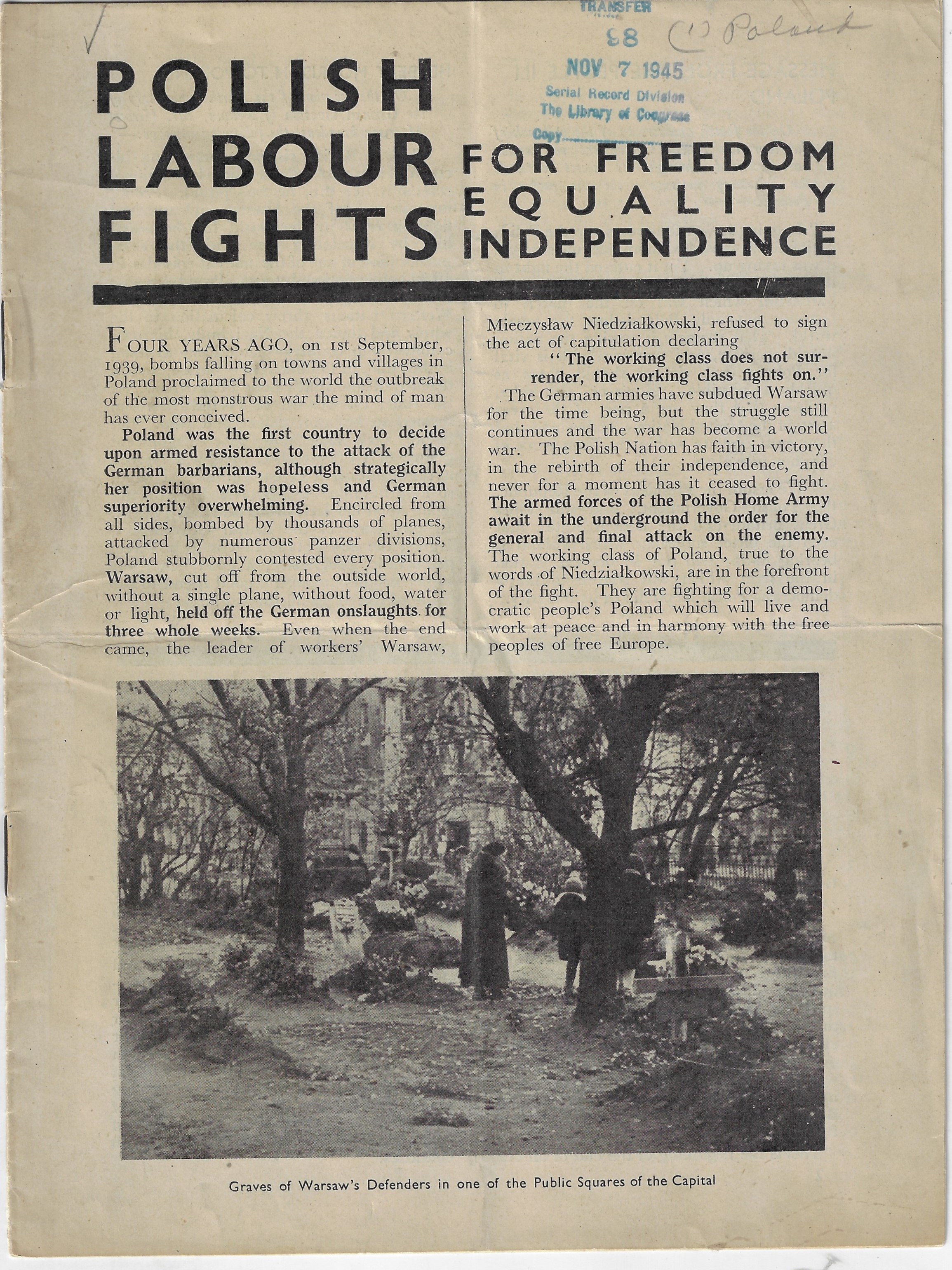
    I decided to share the entire Ploish Labour Fights for Freedom, Equality, Independence because it is pretty scarce and its content is very powerful and deserves to be read. It is only 12 pages long but there is a lot in there.  The pamphlet was printed in London by Liberty Publishers in 1944, though I cannot tell if it is before/during/after the Warsaw Uprising. There photo on the front cover (“Graves of Warsaw’s defenders in one of the public squares…”) may reference those killed in the Uprising, so it may well be printed in August at the beginning of the battle, as there is no direct reference to it in the text. By the end of the Uprising there were 10,000 of these defenders who would be killed as well as 200,000 people living in the city. 

    Of particular note here are the four pages devoted to the Nazi/German treatment of children. There are also specific references to the deathcamps/KL Treblinka, Majdanek, and Oswiecim (Auschwitz). 

    (There is an impressive lineage for libraries holding this title as found in WorldCat. Of the 12 copies located worldwide, only three are in the US (NYPL, Harvard, Notre Dame); the others are found in England (University College, LSE, British Library), Israel (Yivo and National Library), France (Bib Nationale, Paris), Poland (Nardowa and Dukat), and the IISG (Amsterdam).)

    Polish Labour Fights _1_

    This is an ocr of the original—all bold appeared in the original.

    CHILDREN ARE DYING

    “It is not surprising, therefore, if among the Polish children, who lack food, clothing and warmth in the winter, and who lead the most wretched existence, epidemics…”

    CHILDREN IN PRISONS AND CONCENTRATION CAMPS

    “The Polish children are not even spared the grimmest forms of persecution. They share with the adults the sufferings which the Germans are visiting upon the Polish nation. They crowd the prisons and die at the hands of executioners, together with the adults.”

    “Between 11th and 28th November, 1942, for example, a large number of women, together with 60 children, were brought into the Pawiak prison in Warsaw. Children from 12 years of age and upwards are being sent to the notorious camp at Oswiecim. Children under 12 sent to Oswiecim are not admitted to the barracks. They are killed on the spot.”

    “From the very beginning of the occupation the Germans have made it clear that, even when dealing with children, they will not hesitate to employ the severest measures. Immediately after the September campaign in Poland the Germans murdered, in Bydgoszcz, nearly one hundred Polish boy scouts, who faced the firing squad singing the Polish national anthem. In application of the principle of collective responsibility, when many Poles perished in mass executions for deeds they never committed, children died with their parents, either shot or burned alive.”


    ·Posted by :

    ·in:

    —

  • .0000015% of All of the Artillery Shells Fired in WWI (1918)

    JF Ptak Science Books  Quick Post

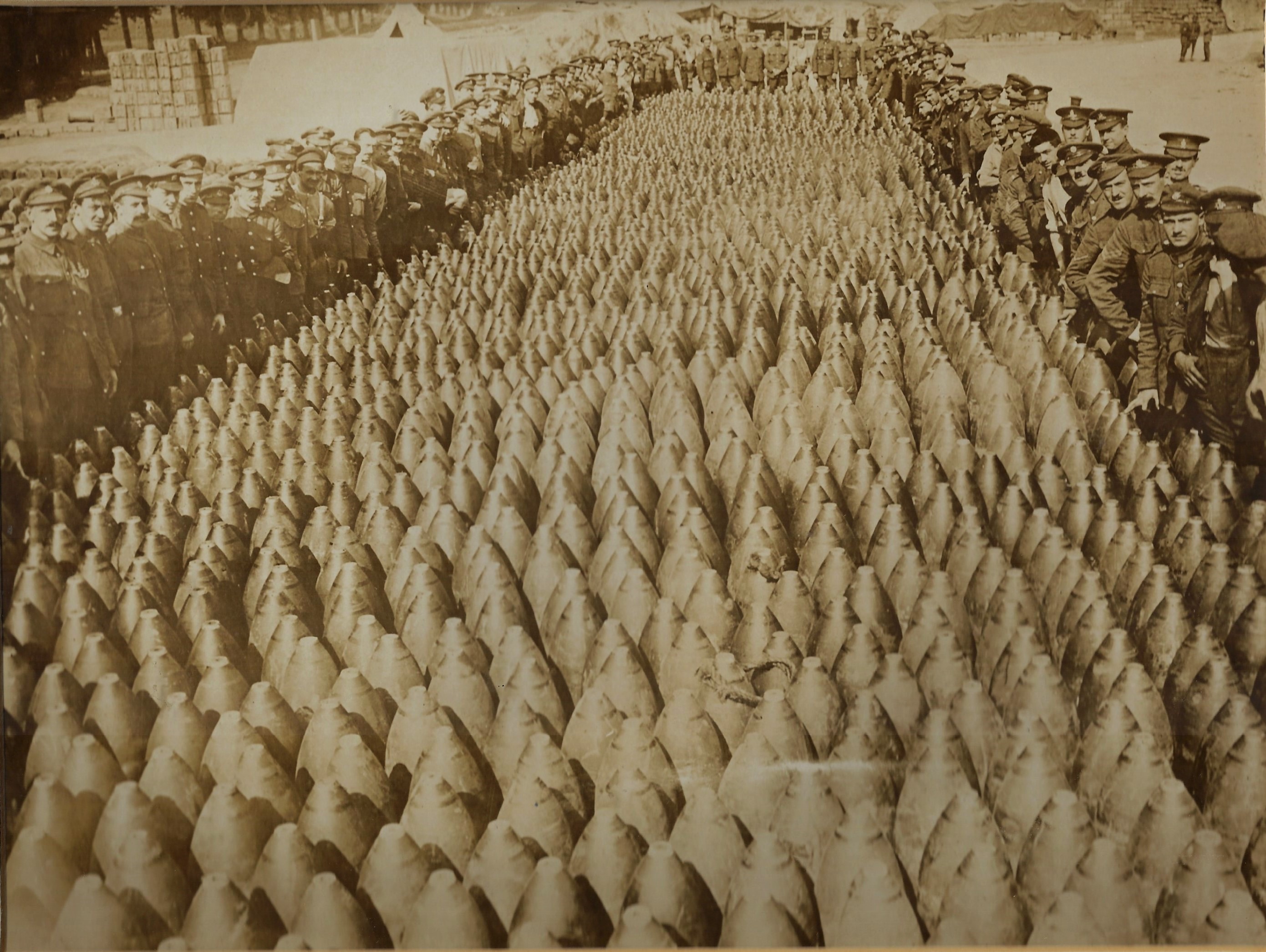
    This is another in a series of quick posts on images from my WWI photo collection. Photographs were made by pools of photographers working for several different photographic news agencies, with the content of the images generally secured and approved by the Committee for Public Information (CPI), which came into existence by executive order under President Woodrow Wilson on April 13, 1917, and which was charged with the task of wining the hearts and minds of the people of the U.S. to gain public support for the war and for American participation.   The way that many newspapers obtained the war images that they published in their papers was via a semi-centralized pool of war images.  The newspaper would request, say, a photo of German prisoners, and would contact one of these photographic agencies—for example, say, the Central News Photo Service of 26-28 Beaver Street, NYC—and purchase the rights for republication, and then print it in the newspaper along with the story.  In almost every case the photo would be accompanied by a caption mimeographed onto an attached piece of cheap paper, or have the information stamped on the reverse.

    WWI Shells 1918 _3_


    WWI Shells 1918 _3_

    WWI Shells 1918 _3_

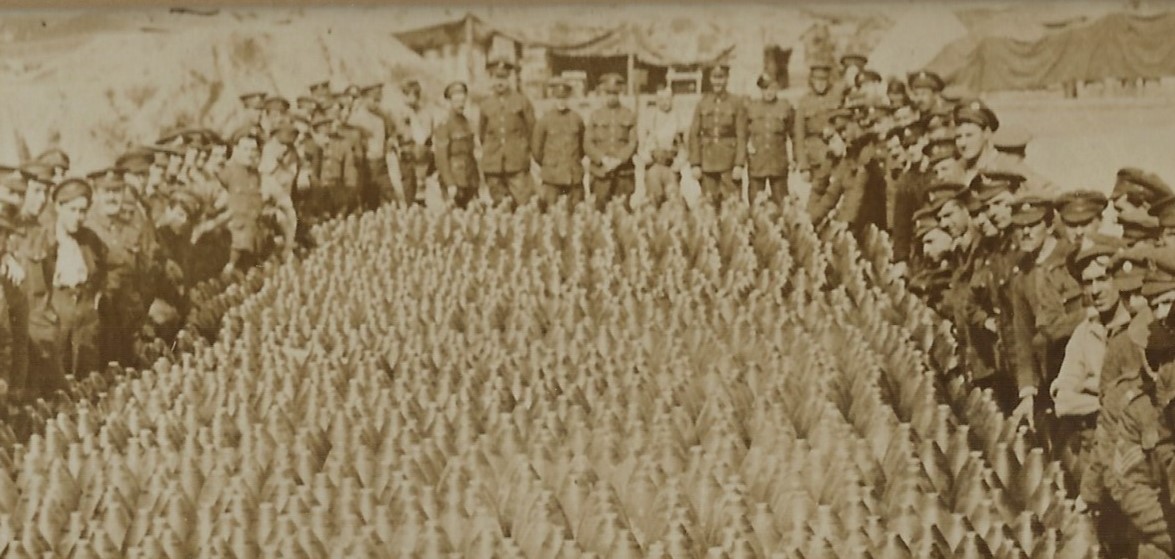
    In this photo I’m struck by the depth and breadth of the shells, and that they would represent a not very long salvo by a battery of 25 cannon.  I don’t know artillery, though it seems to me that these look like they are in the 200-300mm range. My guess is that we’re looking at 1500 or thereabouts rounds, which distributed to just 25 cannon would be 60 each which means that these shells could be used up in an hour or two of firing.  

    I’m guessing that something like 1 billion artillery shells were fired during WWI (this would be on the low end of estimates, I think) which means  that what you’re seeing here is .0000015% of the total.  For comparison .0000015% of the population of the U.S. would be 525 people. 

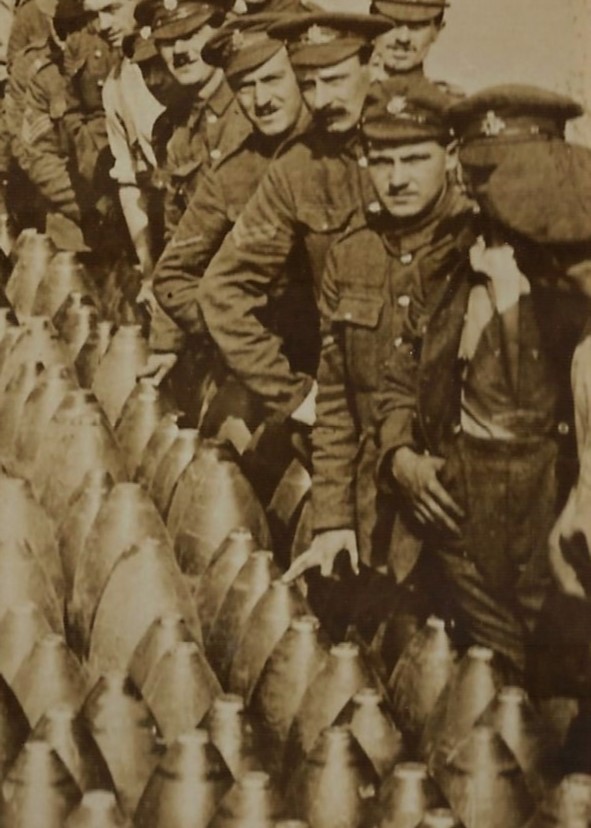
    The other noticeable thing is that of this group of soldiers (I reckon there’s a hundred or so who are directly lined up against the shells) there are only 5 or 6 who are touching the shells.  

    Estimating that the standing shells occupied 500,000,000 sq ft on base they would fill the floor space of 344 Pentagon Buildings. 


  • Extra-Earths Redux (and Turbines in Space!) 1955

    JF Ptak Science Books  Quick Post

    Extra earth battle of two earths“Extra-Earths”  is a very modest category on this blog with only five posts–they do not take up much space in the bulk of the 2,780 full posts and 2,400 “quick posts”.  The subject rarely comes up, and no wonder! How many times do you see an image of Earth from Earth–and why would this be happening?  Obviously the Earths that I am interested in pop into existence in the science fiction/comics/Outsider Logic worlds. There are some who use “extra Earths” as a unit of measure, as in “the global resources consumed would be the equivalent of an extra Earth’s production” or some such thing–those don’t work for me here, as I am just interested in the visuals of the extra of two Earths.  

    For example, in an earlier post, “The Battle of the Extra Earths: Mini-Extra-Earth Vs. Full-Sized-Standard-Earth (?)”, there is a full-on frontal assault by an Earth-mini, or some such thing (I have not read the story because, frankly, there is only just so much time to burn on these things and I was just interested in the artwork.)

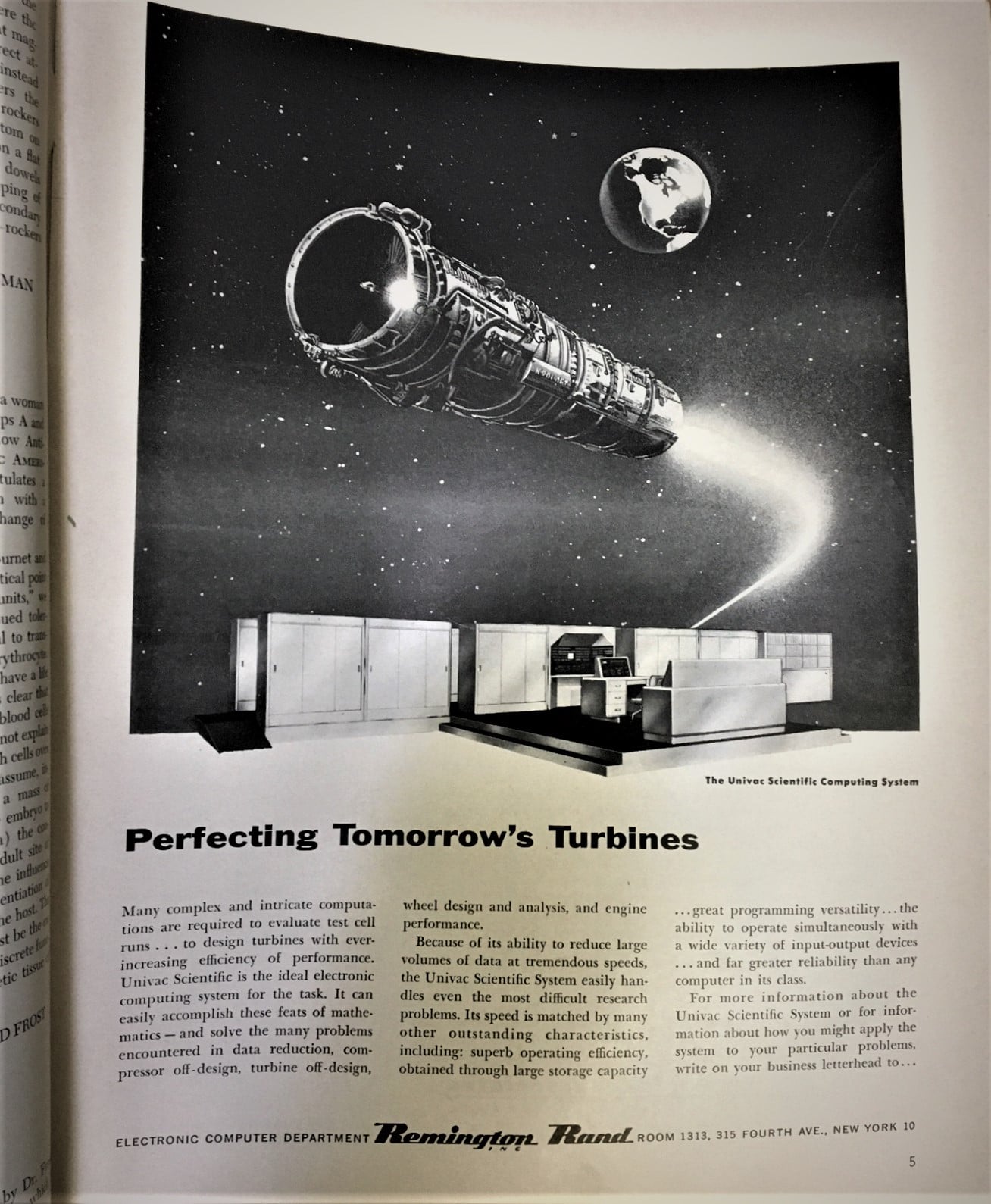
    Today’s example is more-or-less an Extra-Earth and it is close enough for me: this one appears in the September 1955 issue of Scientific American and is a big full page ad for Remington Rand’s UNIVAC. This computer was only about five years old or so at this point and Remington Rand was selling it for computing complex engineering bits, as with that screaming turbine. I assume that the turbine–which is inoperable in outer space of course–is coming from that Earth of the black seas, or something, and that by a very long stretch the UNIVAC has to be somewhere so I guess it could be another Earth. Yes, this really doesn’t fit, but it is close enough for me. (Also the business-end of the UNIVAC is not what looks like a monitor facing the machine’s main component-it is the longish podium-lookng piece opposite that “monitor”, which would be the “supervisory control panel”. 

    Sci Am 1955 TUrbine UNIVAC

    I’m told by our son Feliks that there is a “Counter Earth” in the Marvel universe, where there is an “Extra Earth” on the other side of the Sun, neither Earth ever in line of sight to one another…that seems to be another category of its own, too: things that exist but are invisible because they are on the other side of something, like the bizarro story of Nazis escaping to the far side of the Moon. But that’s another story. 

    • To see the other Extra-Earth posts, just enter the term in the site’s Google search box.  

  • Munitions Train, France, 1918

    JF Ptak Science Books  Quick Post    

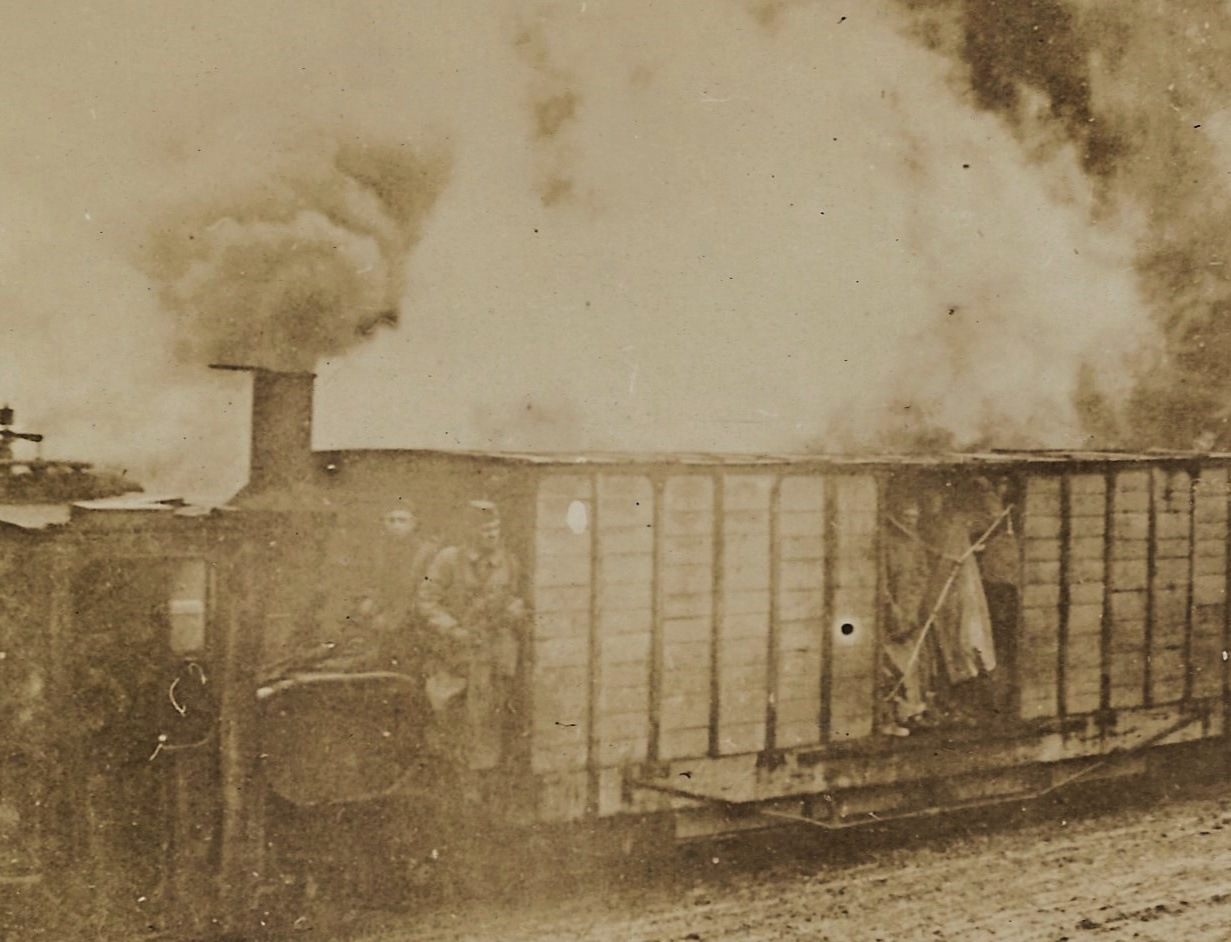
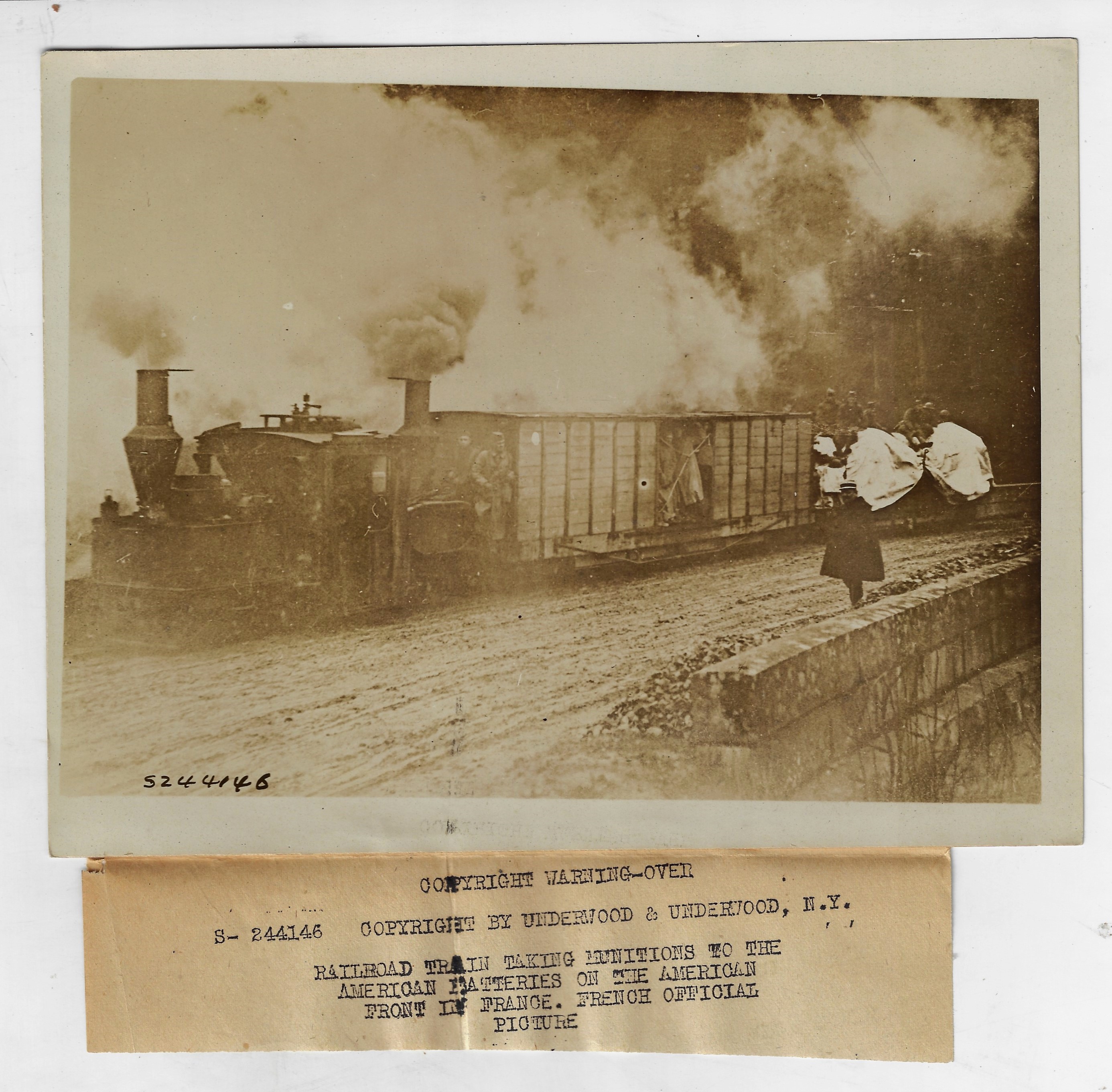
    This is a New Photo Service image by Underwood & Underwood of a laboring narrow gauge train making its way along to the front with two cars full of munition and men, on its way to U.S. batteries at the front in France, 1918.  

    (The original wasn’t robust enough to pull much detail in the faces of the troops in the railway car doorway…I also couldn’t tell what they were standing on…)WWI Photos train munitions_detail_
    WWI Photos train munitions_detail_

    ·Posted by :

    ·in:

    —

  • An Audio Internet for Six (1888)

    JF Ptak Science Books  Post 2838

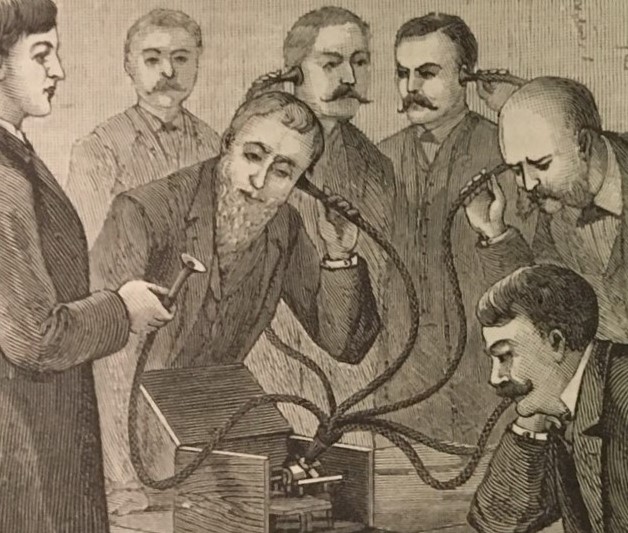
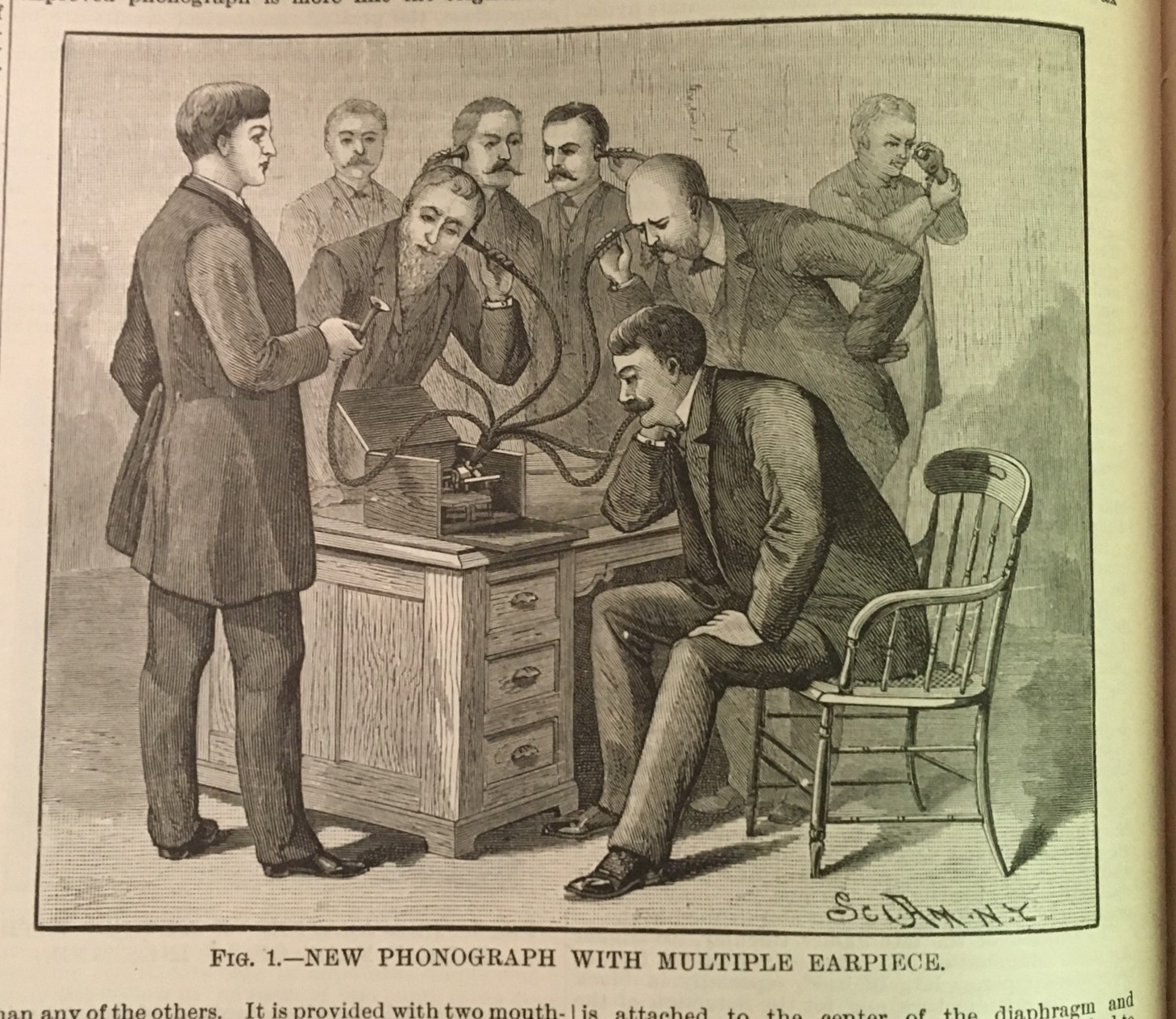
    This device isn’t so much a six-person internet as it is…well, it isn’t that at all. It was however one of the first times where a group of people could share a recorded piece on their own earphones, though.  This was Thomas Edison’s new photograph of 1888:

    Sci Am SUpp 1888 Edison phonograph _2_

    Thomas Edison–who in a furious few years in the mid 1870’s–invented the light bulb and the phonograph  (the later coming as a direct byproduct on work done on the telephone and telegraph)..He celebrates his phonograph in the North American Review (May 1878)  and then lists what he saw as the readymade faits acomplis of the phonograph, the first of which was weirdly/spectacularly worded:   “1. The captivity of all manner of sound-waves heretofore designated as fugitive, and their permanent retention.”  Do you hear a soundtrack with that description?  I did.  He proceeded with less fanfare: “2. Their reproduction with all their original characteristics at will, without the presence or consent of the original source, and after the lapse of any period of time. 3. The transmission of such captive sounds through the ordinary channels of commercial intercourse and trade in material form, for purposes of communication or as merchantable goods. 4. Indefinite multiplication and preservation of such sounds, without regard to the existence or non-existence of the original source. 5. The captivation of sounds, with or without the knowledge or consent of the source of their origin.

    Sci Am SUpp 1888 Edison phonograph _2_


    Edison then goes on to list what he saw as distinct “possibilities” for the use of the phonograph in the not-too-distant future. There are ten major prospects, the “bookish” aspect and the first major assault on the way we read is listed fourth (though he wasn’t necessarily weighting his list in any way).  Some of the others in this list (all of which cam to fruition) include: 1.Dictation and letter writing—using the phonograph to record letters and correspondence, which was baldly aimed at the business and corporate trade as the machine was relatively difficult to operate and expensive. 2  Phonographic “books”. I noticed that that Edison did not change the word “book” in any way, even though the book is no longer there with the application of the phonograph, just the read and spoken words.  “Books may be read by the charitably-inclined professional reader, or by such readers especially employed for that purpose, and the record of such book used in the asylums of the blind, hospitals, the sick-chamber, or even with great profit and amusement by the lady or gentleman whose eyes and hands may be otherwise employed; or, again, because of the greater enjoyment to be had from a book when read by an elocutionist than when read by the average reader.” 3. Family records. “For the purpose of preserving the sayings, the voices, and the last words of the dying member of the family [emphasis mine] as of great men the phonograph will unquestionably outrank the photograph.”4. Toys:  “A doll which may speak, sing, cry, or laugh, may be safely promised our children for the Christmas holidays ensuing. Every species of animal or mechanical toy such as locomotives, etc. may be supplied with their natural and characteristic sounds.”

    Edison continued, writing on the phonograph’s application for the study of elocution, speaking clocks, language preservation (as in documentation of the proper way of speaking a certain language, something that would’ve come in handy in the spike of disappearing languages at the end of the 19th century), telephone recorders and pedagogical lessons.

    There was a lull in activity on the phonograph for Mr. Edison between the machine’s invention and 1888—this was the first major iteration/improvement the man made on his machine in nearly 10 years. The most significant reach was replacing the surface of the recording foil cylinder with wax, which was more reliable. In any event, in this picture (published in Scientific American Supplement in March 1888, we see the new instrument, equipped as it was for six private listeners.

    ·Posted by :

    ·in: