A Daily History of Holes, Dots, Lines, Science, History, Math, Physics, Art, the Unintentional Absurd, Architecture, Maps, Data Visualization, Blank and Missing Things, and so on. |1.6 million words, 7500 images, 4.9 million hits| Press & appearances in The Times, Le Figaro, Mensa, The Economist, The Guardian, Discovery News, Slate, Le Monde, Sci American Blogs, Le Pont, and many other places… 5000+ total posts since 2008.

Category: Technology, History of

  • Unusual Shading/Shadows (1866)

    JF Ptak Science Books  Quick Post

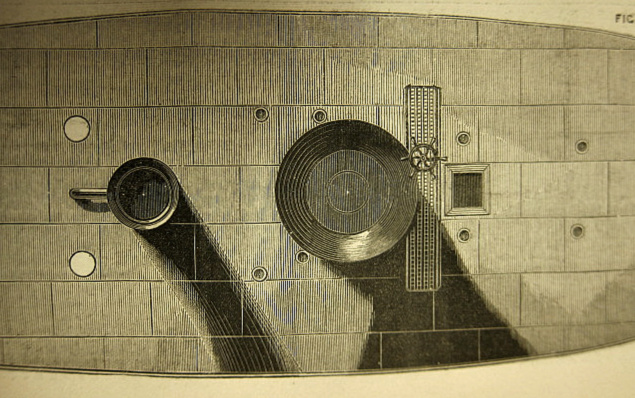
    I’ve made a number of entries on this blog of beautiful/odd shadow practices in antique mechanical and technical drawings, though not so for a while. Today’s entry comes from a stout volume of Engineering (volume 2) 0.for 1866 and comes in an illustration for the U.S. Navy torpedo boat, the Spuyten Duyvil. The boat’s name seems like a bit difficult to maneuver, except if you’re Dutch, though it is far-better sounding than the original name, which was Stromboli.  In any event this was a torpedo boat that saw a little bit of service right at the end of the Civil War–mostly on the James River in Virginia, it seems–and was a torpedo boat. (The “torpedo” at this time was more like a mine than a powered underwater “missile” that we’d think of in these terms today.)  The chief attraction for me for these images though is a bit wholly unnecessary to understanding the boat or its workings, and that’s the shadowing for the exhaust stacks, which to me seem a little unusual, though quite lovely. And so the sharing…

    ENgineer 1866_2_


  • “Told by some nice computors of national glory” and the “Cumputor” (1951)

    JF Ptak Science Books  Quick Post

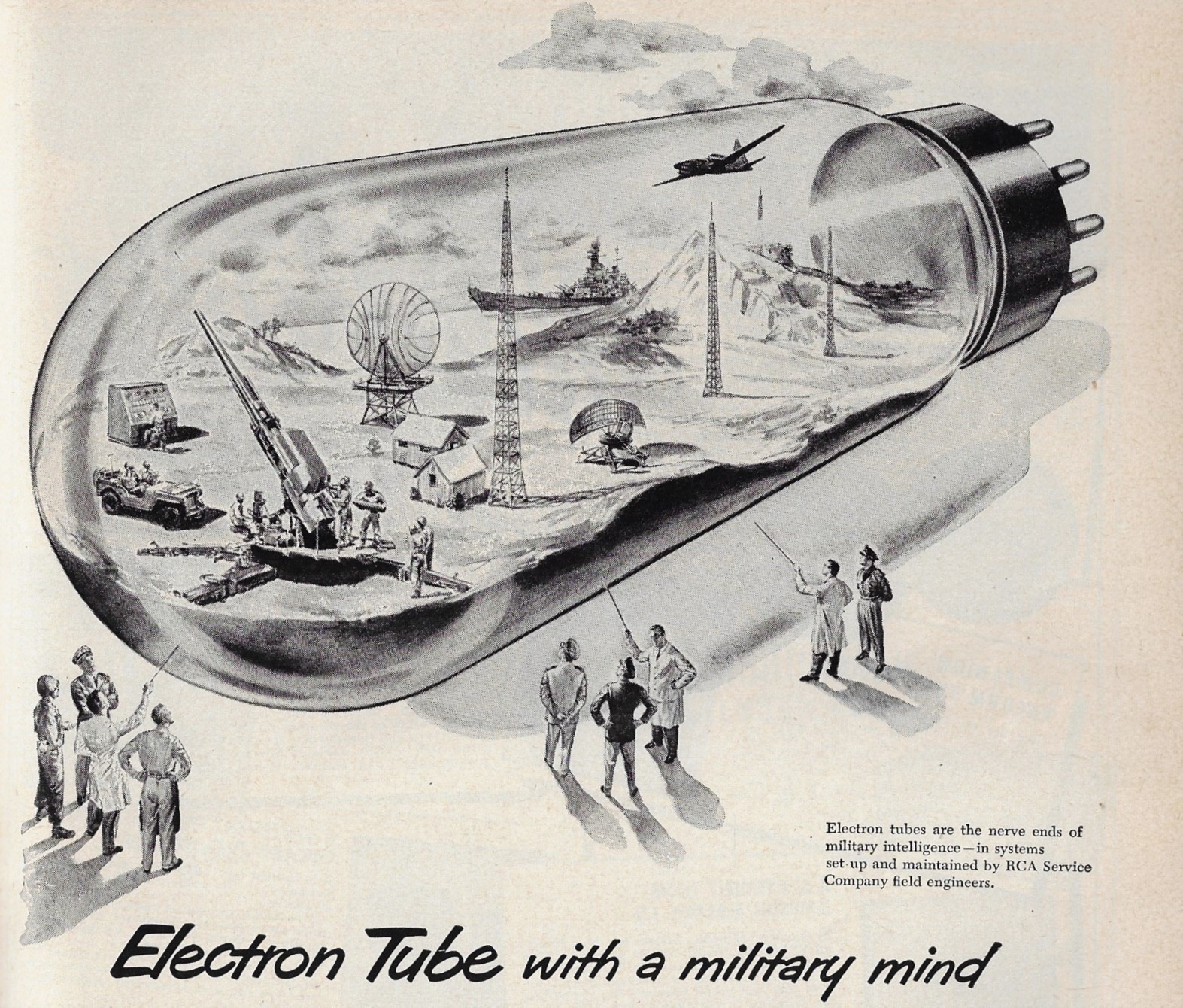
    Here’s a terrific little ad that appeared for RCA electronics in the November 1951 issue of Radio & Television News (“the Radio-Electronic Engineering edition”).  The main article of interest–and what brought me to this journal in the beginning–was the two-page story “Analogue Cumputors [sic] Solve Complex Problems” about the differential analyzer (the Bush machine I reckon), thermal analyzer, and electric differential analyzer  at UCLA, and which was the main title and illustration on the cover of the magazine.
    Tube military

    I could not find “cumputor” in the OED, though I did find “computor” (as a person who computes or calculates) which came into recorded being in 1669. (“Told by some nice computors of national glory”, H. Walpole Let. 18 June in Corr. (1954) XVIII. 463.) “Computer” occurs a little earlier in 1613, found in another very quotable quote: “I haue read the truest computer of Times, and the best Arithmetician that euer breathed, and he reduceth thy dayes into a short number.”, (‘R. B.’ Yong Mans Gleanings). 

    This is a short article of only a few pages and a lot of pictures, but that spelling of “cumputor” does not occur in the article, though the word “computer” does. Apparently “cumputor” is a simple typo on the cover of the magazine.


  • Very Early Special Effects in Reproduced Audio (1878)

    JF Ptak Science Books  Quick Post

    This title for this post is fairly accurate given that the phonograph had been invented by Edison only months earlier and that this is one of the earliest publications on manipulating the sound that it reproduces.  The author of the paper, “The Phonograph” (published July 18, 1878 in Nature), George Bidder, experimented by laying down a spoken “track” on the tinfoil medium and then recording on top of it, finding that “after a series of musical or articulate sounds have been recorded other series could successively be superimposed…and reproduced.” I’m not sure when this became standard practice in the recording industry (the musical “industry” part of the phonograph was still about two decades away), but my feeling is that this was a technique that would remain a peep into the future for some time to come. No?  

    “The Phonograph”, by George Bidder.  

    • “In experimenting lately with the phonograph it occurred to me to try whether, after a series of musical or articulate sounds have been recorded, other series could successively be superimposed on the same tinfoil and reproduced. I found that if the instrument be simply reset to the starting-point, and sung or spoken to a second time, it will afterwards faithfully reproduce both series of sounds as though two persons were singing or speaking simultaneously, and by repeating the same process, a third and fourth voice may be added, or one or more instrumental parts, all of which will be reproduced. This experiment forms a striking commentary on Helmholtz’s theory of the mode in which the ear recognises different tones in a chaos of sound, by analysing the compound wave, which it receives, into its component simple vibrations. Here the aggregate impressions on the tin-foil produce, so to speak, a compound indentation capable of reproducing a wave of sound which the ear can resolve into the original constituents.”


  • The First Microscopical Images of Captured-and-Reproducible Sound? (1878)

    JF Ptak Science Books   Quick Post

    Only months into the invention of the phonograph by Thomas Edison (at Menlo Park in December of 1877 and patented in January 1878) Alexander J. Ellis reviewed a version of it constructed in London by Mr. Stroh, and found it, well, wanting.  Ellis (1814-1890) was a product of Eton, Cambridge, Trinity, and was a gifted mathematician, philologist, and a groundbreaking ethnomusicologist, and did see some limited utility of the machine to restricted areas of his research. In the short note he wrote for Nature in their April 18, 1878 issue1, he mostly found that the phonograph was generally flawed in its reproductive capacity, and did not venture far from this interpretation so far as the possible applications of the machine was concerned, which seems iconically short-sighted from my perch here in the future. Even though Ellis recognized that “the effects produced are sometimes startling (as in cries, coughs, laughter, music), the philosophy of the process (making a permanent impression of a very complex compound vibration, and using it as a mould to reproduce that vibration is exceedingly attractive, but at present the instrument–at least the one that I saw…” he concludes that the status of the invention “…has not risen beyond a lecture illustration or a philosophical toy”.  

    Nature 1878 Perifser Frazer

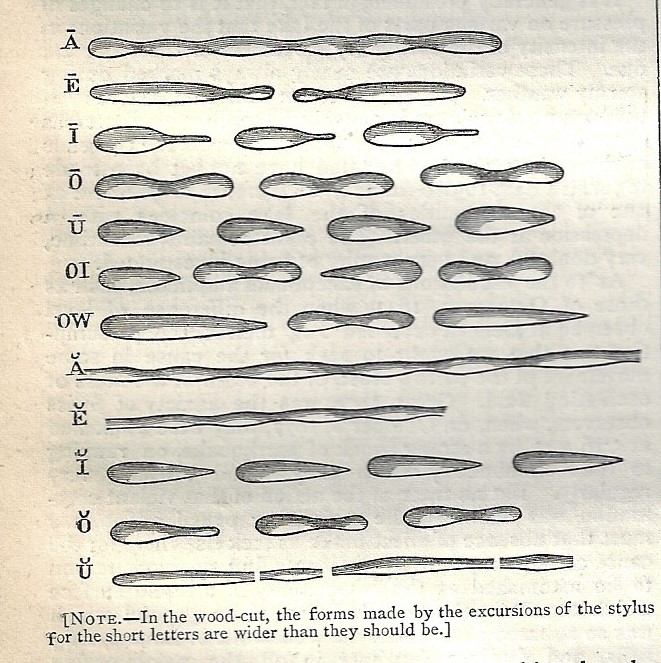
    Five weeks after this article and about four months following the patenting a visually-arresting article appeared in Nature which contains what I am assuming to be the first microscopic images of recorded and reproducible sound. I know that is a pretty deep qualification, but I think that’s its accurate. The article appeared as “Examination of the Phonograph Record under the Microscope” by Persifor Frazer2, who investigated what the impression of the stylus looked like as known sounds are recorded on tin foil. And so this remarkable image, showing what vowel and some dipthongs “look like”.  

    Notes:

    1. Persifer Frazer,   “Examination of the Phonograph record under the Microscope”,  an abstract of a paper presented at the Franklin Institute April 17, 1878, by Persifor Frazer, Nature, May 23, 1878, p. 102, in the weekly issue. 
    2. Persifor Frazer was of the Philadelphia Frazers, of long and interesting lineage. A Gettysburg vet, he was in professional life mainly a geologist; he did become expert in handwriting and the detection of forgeries using photographic means.  

  • Found-Art in a Beautiful Book about Pipes

    JF Ptak Science Books  Quick Post

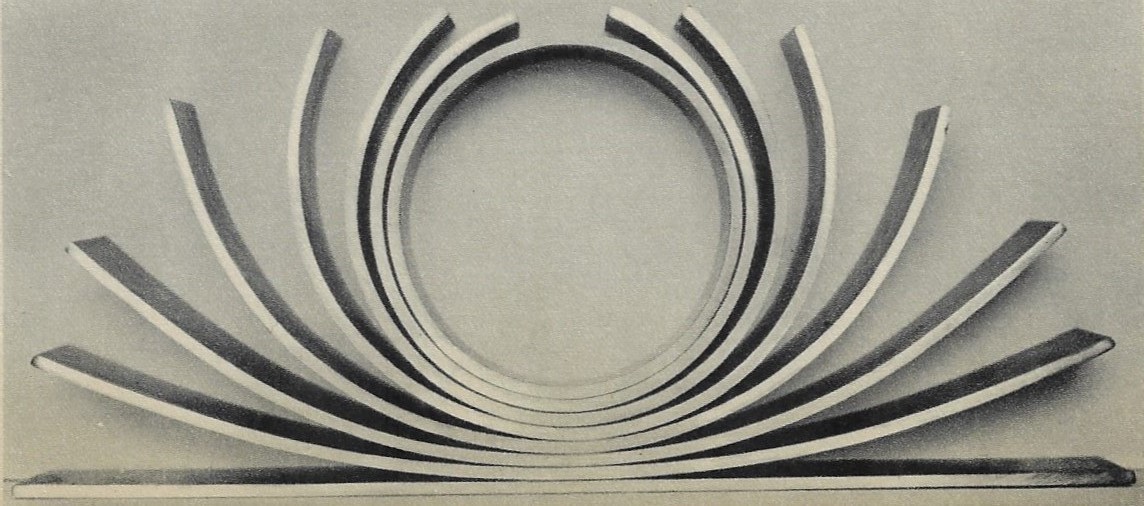
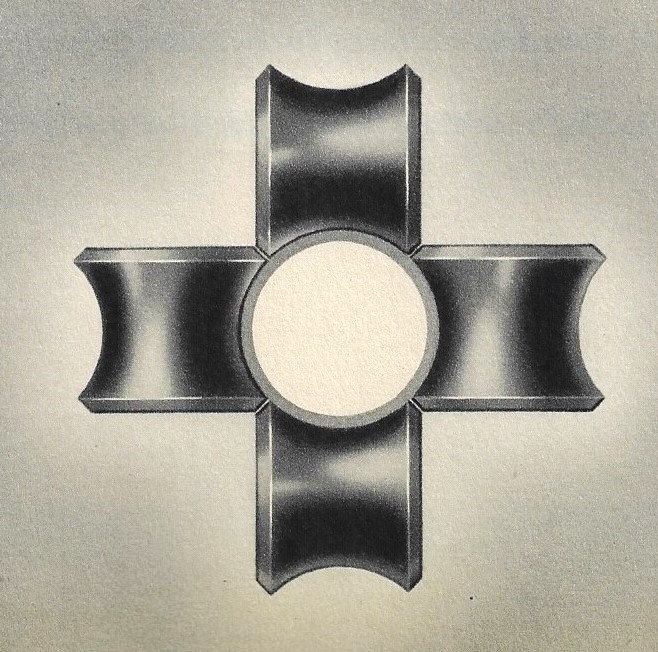
    In the long-developing series on Found Art (categorized here under “Absurdist, Unintentional”, a header that certainly needs changing) is today’s entry: two designs in the unintentional abstract, like a sort of colorless color school Barnett Newman…or perhaps not, maybe they’re more like Duchamp readymades, though heavier. In  any  event,  The  Pipe  of  Progress,  published  by  the  advertising  department  of  Republic Steel in  1940,  is unexpectedly  quite  lovely,  which  a number  of  Bernice-Abbott-like photos  plus  the  already-mentioned  Found  Art.  For  example,  here’s  a cross  section  of  pipe  in  the stages  of  pre-wielded  shaping:                

    Books covers pipes _2_

    And another image showing a cross section of  pipe as it is cold-shaped to its final diameter by one of the series of rollers

    Books covers pipe detail roller

    And the cover of the work:


  • Glass Globes, Light, and Volcanoes (1898)

    JF Ptak Science Books Quick Post 

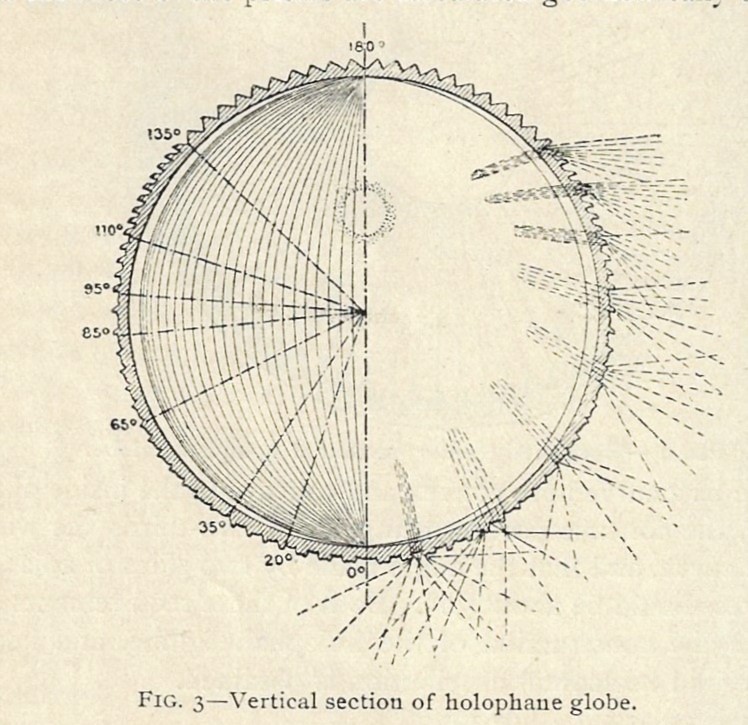
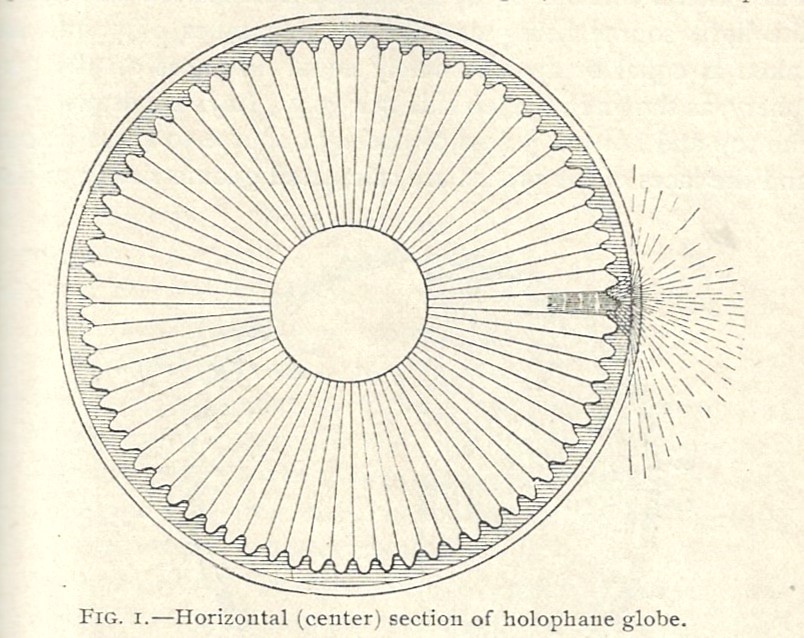
    I happened upon these lovely technical drawings –in plan and cross section–of the newly-patented Holophane Globe. The inventors and coiners of the Holophane were French scientist Andre Bondel and the Turkish Spiridion Psaroudak who patented their illuminating globe in the U.S. in 1896 (and five other countries between 1893-1895). It was designed with inverted and excised cuts in the glass dome to refract and reflect the interior lighting source, and successfully illuminated more area with “less light waste” than most other globes. Not only was the design effective, but the effects were also pretty, as were the schematics of the globe.  (The profile and paln remind me of some early engravings and woodcut of the interior of the Earth showing the sources of volcanic action…or in the case of our not-recently-mentioned friend Athanasius Kircher, the source of water.)

    • Source: “The Holophane Glass Globes for Effecting the Better Diffusion and Distribution of Artificial Light”, Journal of the Franklin Institute, vol 145, April 1898. The article is a technical review of the glass globe and wound up being highly favorable, awarding the inventors the John Scott Legacy Medal for their invention, “…for [the invention] of a globe that secures much better diffusion and more satisfactory distribution than any other globe…” 


    JFI 1897 Holophane _1_ JFI 1897 holophane _2_

    ·Posted by :

    ·in:


  • Display of Information–a Brooklyn Bridge Contribution to the “History of Lines” Series

    JF Ptak Science Books   Quick Post 

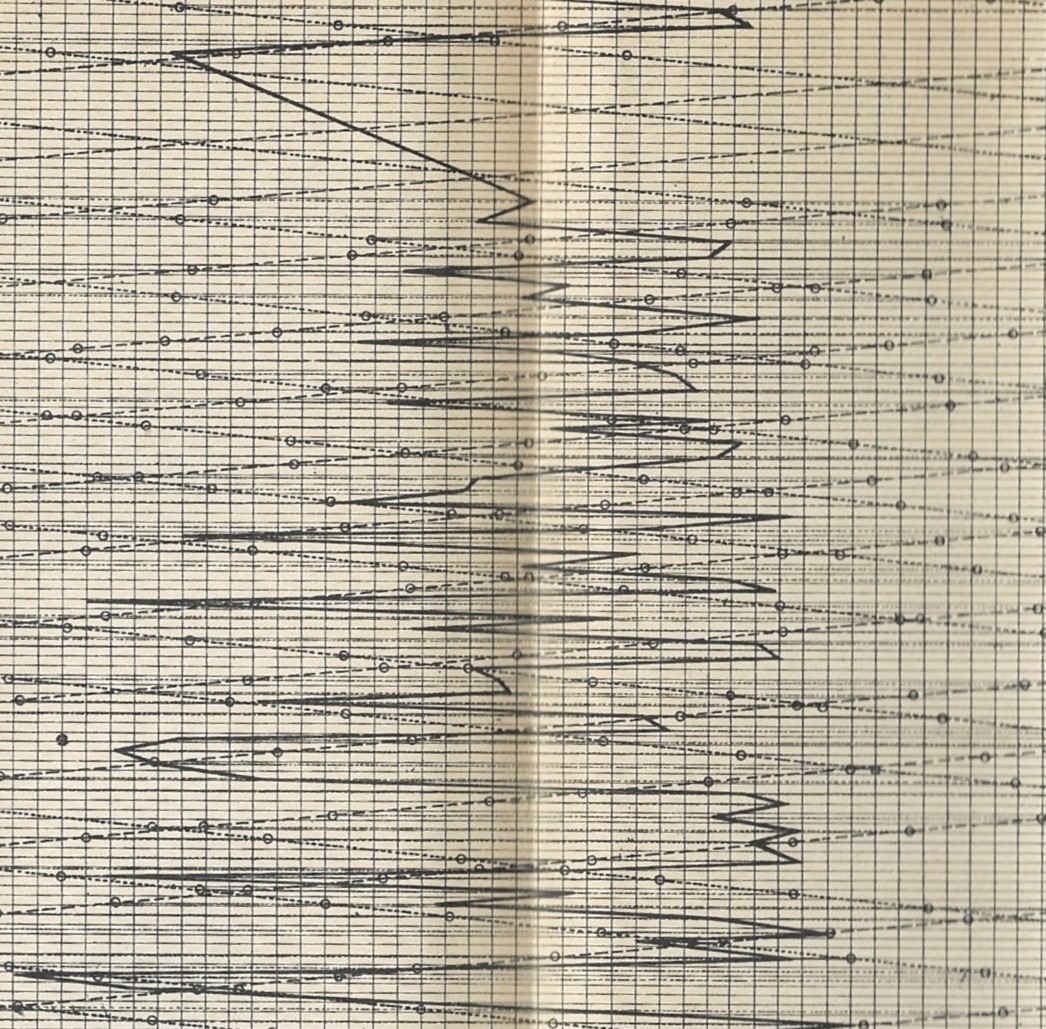
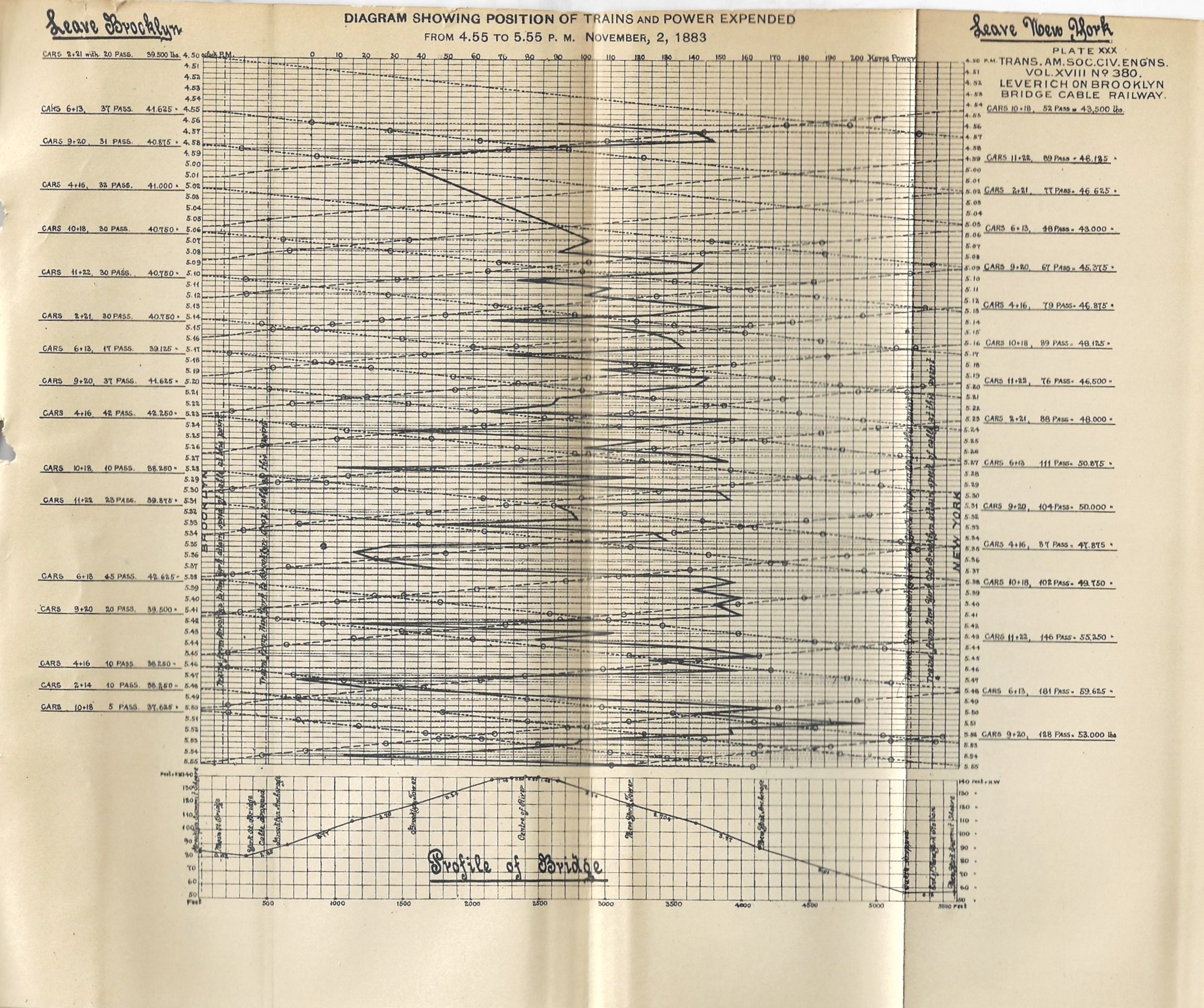
    It has been a while since I’ve added a post  to the History of Lines series, but today I’ve found a good one: a graphical display of the limited comings-and-goings of the cable tram on the Brooklyn Bridge in 1888.  The bridge–still not yet quite the “Brooklyn Bridge”, but the “New York and Brooklyn Bridge”–was open at this point for only five years, still relatively new. and this chart shows the power expense and general time table of the small train that ran pedestrians from one end of the bridge to the other.  It wasn’t a continuously moving cable train, and had regular departure times.  In any event I’m happy to display the complicated and not altogether clear display of the data associated with the train:

    Brooklyn Bridge 1888 cable railway detail

    And the full display, with legend and explanation:

    Brooklyn Bridge 1888 cable railway

    Source: G. Leverich, “The Cable Railway on the New York and Brooklyn Bridge”, from American Society of Civil Engineers, Transactions, vol XVIII, March  1888, #380, pp (67)-102, plates 4-30 (25 folding plates of various aspects of the power train and fittings, complete).  


  • A Very Early (First?) Description of a Panoramic Daguerreotype (1845)

    JF Ptak Science Books  Quick Post

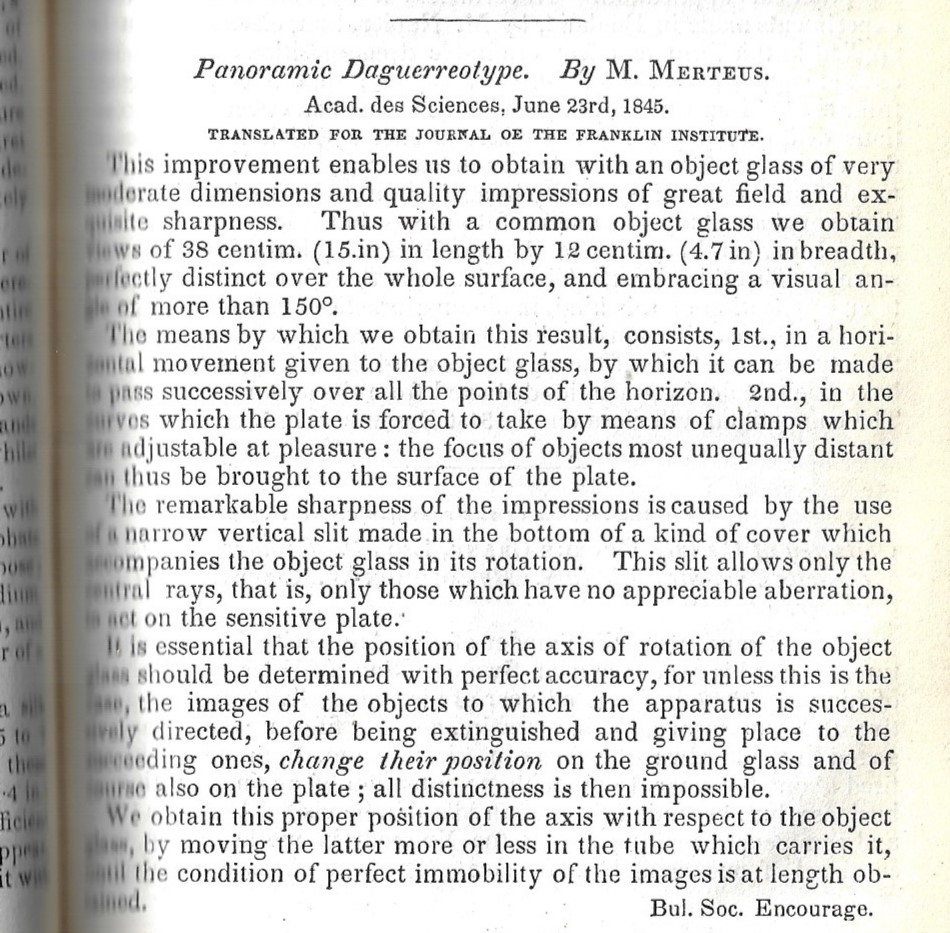
    Just five years after the announcement of Daguerre’s invention of photography, and just four years after the beginning of the early photo craze, there appeared in the Comptes Rendus in mid-1845 a paper by Friedrich von Martens (1809-1875) on an expansive use of the new media: the panorama.  It was certainly the first paper to appear in this journal on the subject; when I checked a likely U.S. source on the subject (Journal of the Franklin Institute, 1846) I found only one mention prior to 1865: a translation of the Martens paper (recorded though as “Merteus”). This seems a little obscure but not unimportant, as Martens may have been either the second (and possibly first) to perfect a panoramic camera, patenting his “Megaskop Kamera” in 1844.

    • I’ve decided to share the Martens paper in both the original and the American translation: 

    JFI 1846 panorama

    • Here’s the text version of the original article, from the Comptes rendus de l’Academie des Sciences..., Paris, June 23, 1845:

  • On the Future of the Telephone as an Instrument for Listening to Music Remotely (Summer, 1876)

    JF Ptak Science Books  Quick Post

    Here’s an interesting piece on the future of the telephone, written just a few months after Bell’s patent was granted him (at the age of 29) on March 7, 1876. “Telephones and other Applications of Electricity”, appearing August 24, 1876 in Nature (volume 14, pp 353-355),  was written anonymously though probably by the editor (and founder of the journal) J. Norman Lockyer, who discusses advancements in telegraphy and then switches his interest to the telephone. It was not Bell’s telephone that the writer was discussing, but (mostly) that of Elisha Gray and “Reuss” (actually meaning Philip Reis).—and as a matter of fact there is no mention whatsoever of Mr. Bell.
    The article turns its interest to the future and to the telephone, and how it may come to be that you could basically dial up any sort of music you’d like to hear, and thus do away with live musical entertainment. Curiously there isn’t an implication for the using the telephone for communication–maybe the absence of Bell is less surprising in a way because Reis’ instrument was actually pretty good at transmitting musical sounds and not-so with voice. Still this is a little odd, given that Bell made his famous demonstrations of the instrument’s efficacy just weeks after his patent was granted.

    The text:

    • “We do not, however, believe that in its [the telephone’s] present state, the invention is so complete that we can, at a distance, repeat on one or more pianos the air played by a similar instrument at the point of departure. There is a possibility here, we must admit, of a curious use of electricity. When we are going to have a dancing-party, there will be no need to provide a musician. By paying a subscription to some enterprising individual, who will, no doubt come forward to work this vein, we can have from him, a waltz, a quadrille, or a gallop, just as we may desire. Simply turn a bell-handle, as we do the cock of a water or gas-pipe, and we shall be supplied with what we want. Perhaps our children may find the thing simple enough.”


    ·Posted by :

    ·in:


  • A Note on the History of Backwards (1878)

    JF Ptak Science Books  Quick Post

    This is a tiny note on the idea of seeing/listening/thinking backwards–I’m not even sure what that means, except for teh obvious cases, especially when you throw technology into the mix to spice up the possibilities of investigation of a backwards form. First of all, the words “backward” and “backwards” go all the way back in the history of English, as we can see in these two pretty examples from the OED:

    • 1398   J. Trevisa tr. Bartholomew de Glanville De Proprietatibus Rerum (1495) xiii. xxvi. 456   “By vyolente puttynge of ayre bakward the body of the byrde meuyth forwarde.”

    •  1697  Dryden tr. Virgil Georgics iii, in tr. Virgil Wks. 101   “Clouds of Sand arise; Spurn’d, and cast backward on the Follower’s Eyes”

    • 1953 “When I go backwards I’m generally backing up”–Not Yogi Berra

    With technology I’m referring to the more subtle ways of exhibiting something/someone in backwards motion rather than the reserve of raising an obelisk–it would be more like seeing a fire burn a house in reverse or rain falling up or a locomotive recovering itself from a head-on collision with a tree via motion picture recordings, things can can’t be reproduced backwards simply by reversing the motion. 

    As long as I’m at it, I think this sense of “backwards” is differentiated from a reverse chronology.  Citizen Kane starts at the end and works it long and angled-dark ways from the beginning to the opening shot; the movies Momento and Eternal Sunshine… are fuller in their reverse chronology, as is the occasional episode of Seinfeld and the book (and movie) Benjamin Button, to name a few examples. 

    What brought me to this place was an article  by Fleeming Jenkin and J.A. Ewing on the new invention, “The Phonograph” in Nature (1878), where their entire interest in the short note was the use of the machine in playing recorded speech backwards. This would be among the first uses of the new technology in a way that displayed info in a new way from all other previous human experience. This leads me to think about the next step in the development of the motion picture, where people could “unwatch” a developed motion of something and have it reconstitute itself right before their eyes. No doubt that was an extraordinary experience. So far as the motion picture goes, it would be almost another twenty years before a motion picture would be exhibited popularly that showed an action in reverse–and that honor goes yet again to Louis Lumiere and his “Demolition of a Wall” in 1896, still in the first decade-ish of the invention of what we would think of as a motion picture film.  

    In any event, these are just some loose thoughts on the subject of “Backwards”. 

    Here’s the short article by Jenkin and  Ewing: