A Daily History of Holes, Dots, Lines, Science, History, Math, Physics, Art, the Unintentional Absurd, Architecture, Maps, Data Visualization, Blank and Missing Things, and so on. |1.6 million words, 7500 images, 4.9 million hits| Press & appearances in The Times, Le Figaro, Mensa, The Economist, The Guardian, Discovery News, Slate, Le Monde, Sci American Blogs, Le Pont, and many other places… 5000+ total posts since 2008.

Category: Technology, History of

  • Dialing Remote Live Music–a Trip into the Future, 1892

    JF Ptak Science Books   Quick Post

    Theatrophone

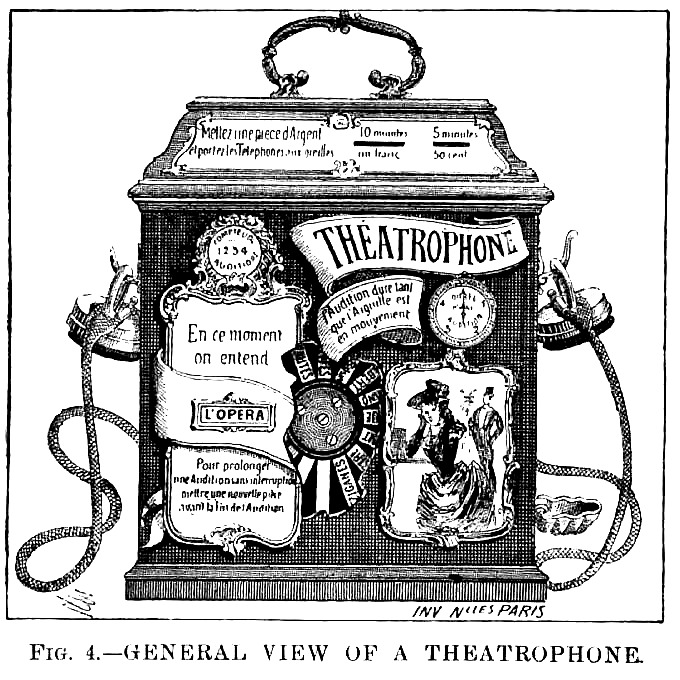
    There is a veyr interesting period in the history of thought transmission where answers were coming together–they were interesting technological answers in the steps towards mass broadcast that were fruitful for the time and capacity but which were ultimately overtaken by other events.  Such is the case in this case of early “radio” transmission, with the popular introduction of a device called the “Theatrophone”, explained in this article in the Scientific American for July 2, 1892.  The device was a telephone-like device that allowed people to listen to live performances of opera/symphony remotely–for a modest fee of one franc for ten minutes or half a franc for five minutes.  There was also a dial to select the sort of entertainment you wanted if there was a selection available, which you can see in the semi-cutaway in the image above (with “opera” being the selection).  I feel that the first exposure of this device to a general audience in 1892 would have been an astonishing next-step in the development of a new medium, like being exposed to the internet while only having known television. 

    The Theatrophone makes its big appearance in La Nature and Scientific American at a time of dynamic change in the development of radio. Elements of radio were established by Faraday (1831), Henry (1842), Maxwell (1864), Houston (1871), and Hertz (1888)–the experience in the 1890’s was different, with wireless transmission  nearly established, and with Elihu Thompson, Wm Crookes writing in 1892 about the possibility of this capacity in “Hertzian Waves” and with Tesla, FitzGerald, Lodge, Dolbear and other giant names saying in 1893 that sound transmission would soon be accomplished.  Marconi’s patent would be issued four years later in 1896, and by the end of the century and into 1902 there are reports of trans-Atlantic transmissions by Marconi and Fessenden.  But back in 1892, the Theatrophone offered a glimpse into the near-future, allowing people to listen to live entertainment, remotely. 

    • The Scientific American article is reproduced in full at the Radio History website, here: http://earlyradiohistory.us/1892the.htm

  • Troncet’s Arithmographe, the “Instant Calculator” (1892)

    JF Ptak Science Books  Quick Post

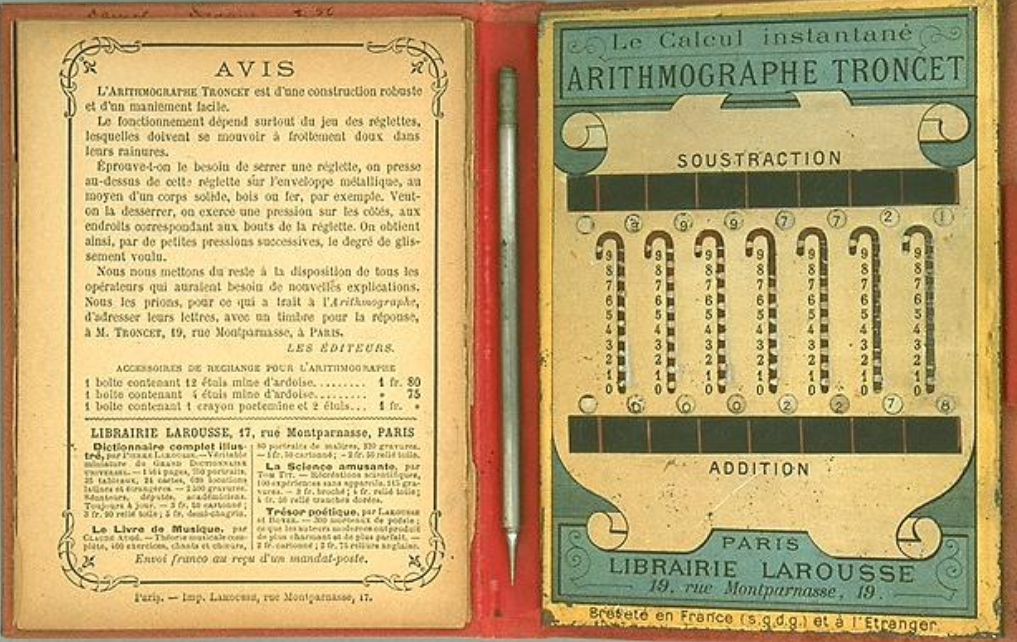
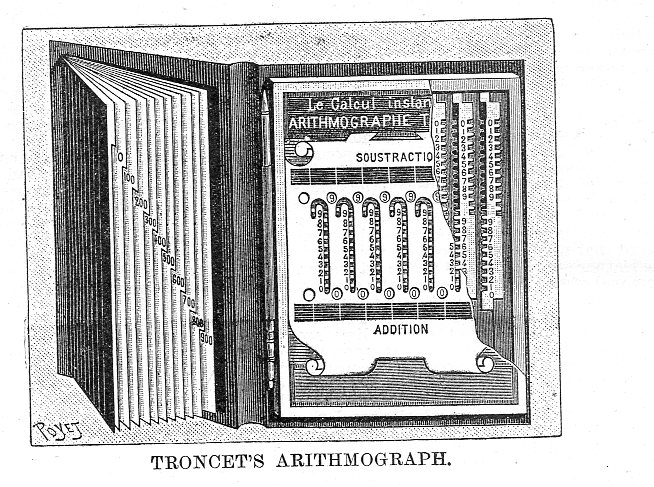
    I came upon a short notice in the Scientific American (January 30, 1892) for Louis-J. Troncet’s ingenious and very popular instant-calculator. It was a small and powerful machine  (10x6cm) that Troncet had patented in 1889, and was issued in a small book-like folding case, with the accordion folding bit containing multiplication tables. It was quick and easy to use, sold for a few dollars, and became a cheap arithmetic staple for decades. 

    Troncet arithmometer430(I’m pretty sure that the image that appeared in Scientific American, above,  was the one used in the article by G. Mareschal, “Calculateur mecanique instante,”  in La Nature,  in 1890 (pp. 307-308).

    Here’s a color image of the Troncet at the National Museum of American History:

    Troncet in color two

    [Source: http://americanhistory.si.edu/collections/search/object/nmah_690248  For another visit with the Troncet see the History of Computers site  http://history-computer.com/CalculatingTools/Gadgets/Troncet.html]


  • Illustrating the Effect of Destructive Capacity: August, 1914

    JF Ptak Science Books  Quick Press

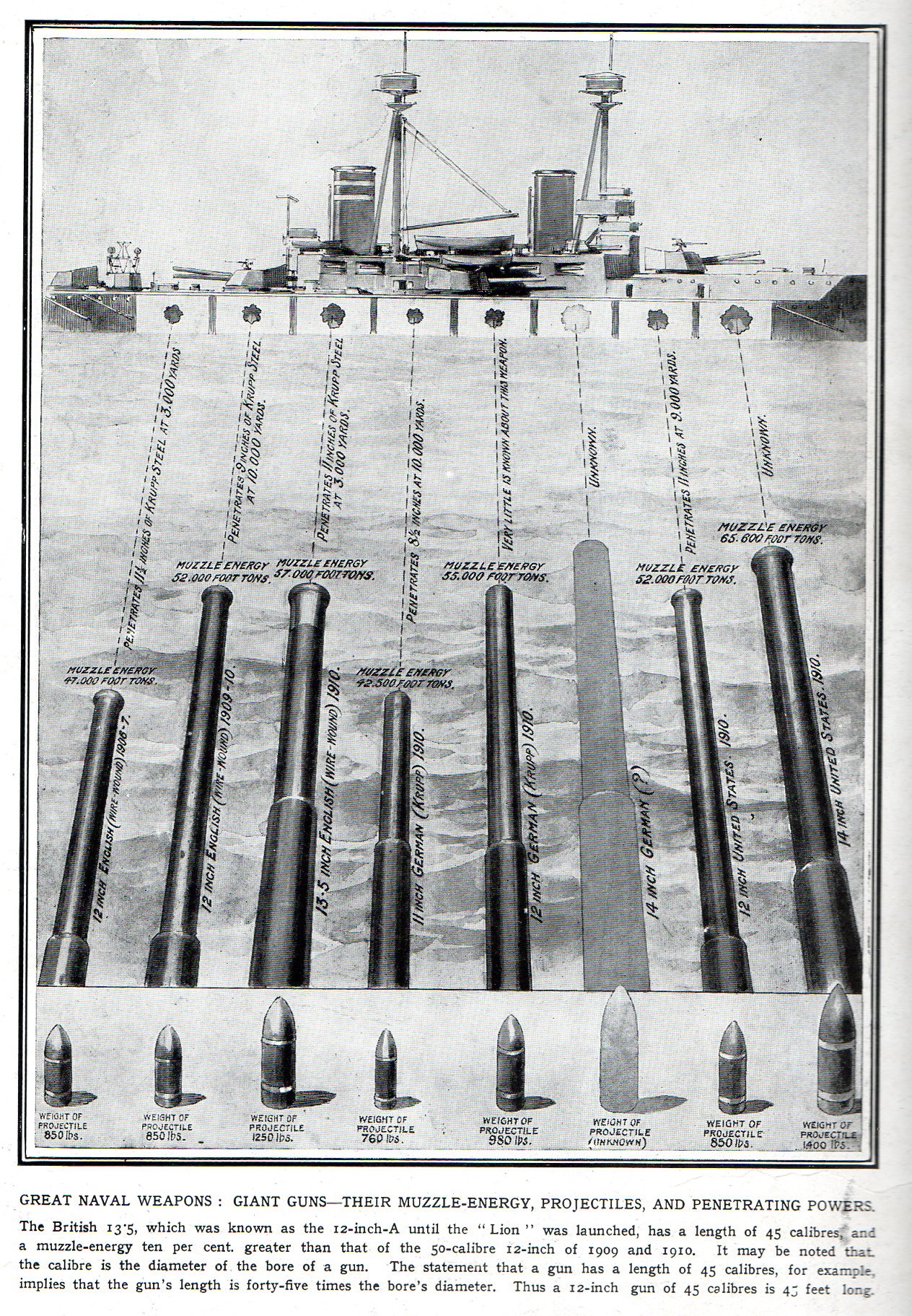
    I found this lovely infographic in the August 29, 1914 issue of The Illustrated London News, coming a little more than three weeks after the beginning of WWI.  It is one of the earliest issues almost fully dedicated to war coverage, and in its many articles covers the fall of Namur, the fight at Mons, the destruction of the HMS Amphion, and images of long lines of Belgian refugees, the fight at Haelen (and the dog-drawn heavy machine guns), and the first drawing of the BEF in action in France. The image below addresses what was seen early on as the war’s premier issue in military strength, which was seen in the power of navies, and hence the depiction of the relative “strengths” (projectile weight (760-1400 lbs), barrel length, “muzzle energy”, steel penetration) of the big shells:

    Schematics naval guns 416

    I think I’ve never seen a display quite like this one, before.

    And just for the fun of it, “caliber/calibre” from the Oxford English Dictionary:


    ·Posted by :

    ·in:

    —

  • A Fine Locomotive Schematic, 1928

    JF Ptak Science Books  Quick Post


    Roundhouset1 

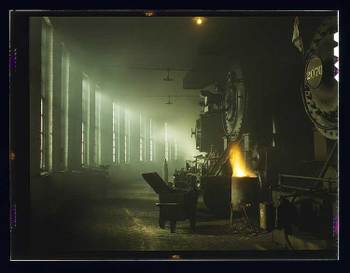
    I’ve admired this image for quite some time, finding it in the Library of Congress’ collection of the Historical Section of the Farm Security Administration (FSA) color photographs.  It is anonymous, unfortunately, but since there were really only 23 or so staff photographers for this gigantic undertaking (including Esther Bubley, Marjory Collins, Mary Post Wolcott, Arthur Rothstein, Walker Evans, Russell Lee, Jack Delano, Gordon Parks, Charlotte Brooks, John Vachon, Carl Mydans, Dorothea Lange, and Ben Shahn, ten of which are truly monumental names in the history of 20th century American photography) I think that we could guess that it was done by the hands of a master.  It seems as though less than 2% of the 163,000 or so photographs made by this section during its eight-year run (1937-1945) were made in color, and I’m glad that this was one of them. 

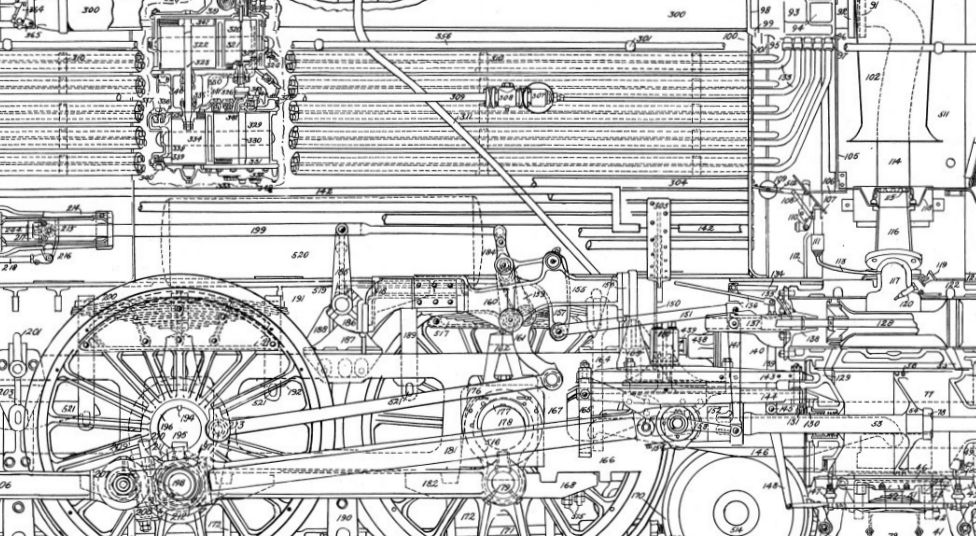
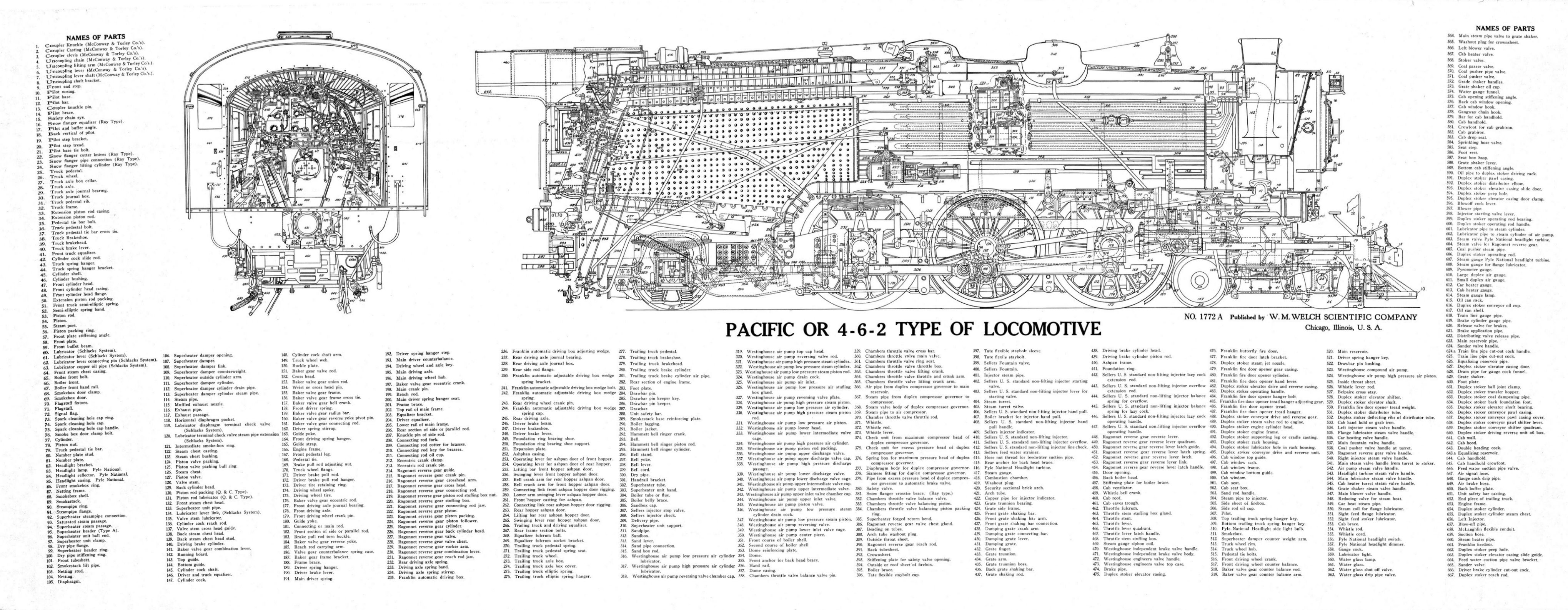
    This photo reminded me of a very detailed, three foot long locomotive schematic that I have in the studio.  It is a wonderful thing, and I’ve included some images of it below, all of which are clickable and very expandable (and clearer).  Here’s the first detail:


    Loco _2_detail

    [For info on the locomotive, see http://www.railarchive.net/alcopacifics/]

    Loco _2

    And the full locomotive, laterally, and large–I couldn’t straighten it out without loss of text, so apologies for the miscue:


  • The Horizontal Section of the Deep Dark (1887)

    JF Ptak Science Books   Quick Post

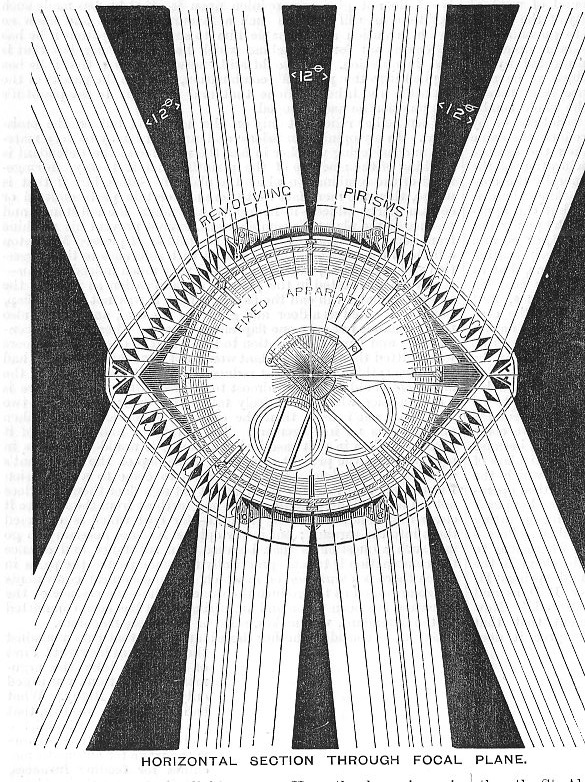
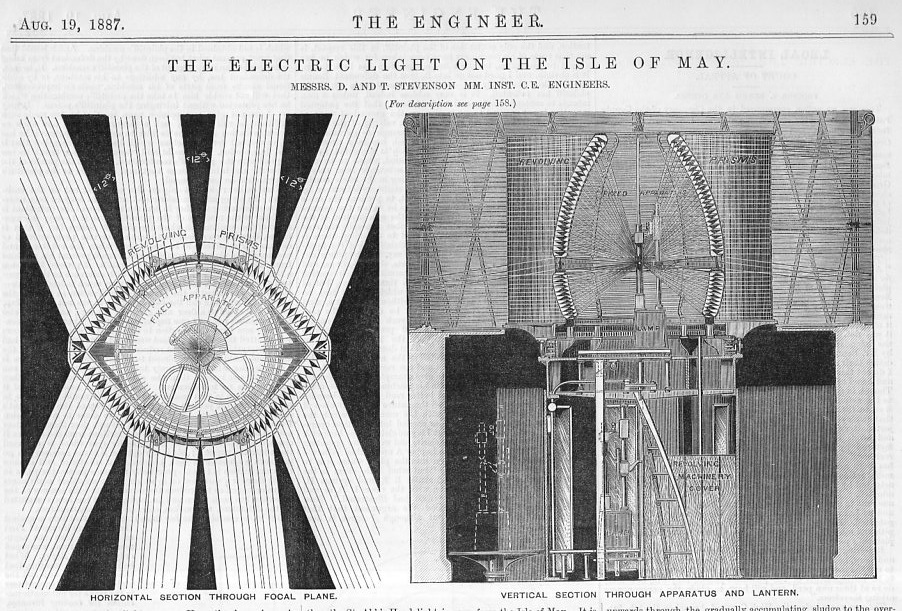
    Thomas Edison’s November 1879 patent on the incandescent light bulb is generally take as being the first great step into the modern age of electric lighting, this following decades of other groundbreaking research by a dozen others in the field.  And so electric was popularly brought to the popular world, though it existed elsewhere decades earlier–for example, in lighthouses, where the first electric arc lamp was used beginning in 1858.  By the time this image (below) appeared in The Engineer in 1887, there were nearly thirty years of improvements to the electric light house–and the cross section of the lamp at the Isle of May from this issue proves to be a particularly beautiful example of art-in-engineering.   The first lighthouse on this remote piece of land off the coast of Scotland appeared about 200 years earlier–a coal-fired light.  This one, built beginning in 1885, would be extraordinarily powerful, achieving as much as 6-million candlepower.

    Lighthouse cross section373

    And the full image, occupying the top third of the page:

    Lighthouse cross section374


  • Balloons I Know But Do Not Love–Deaths from Above in Ads and Bombs (Revisited)

    JF Ptak Science Books   Post 1771 (b) (from 2012)

    In the early days of aviation aerial assault must have seemed incredible–and an abomination.  Hurling stones and other offensive weapons by trebuchet and catapult is one thing, and  launching balls and shot from cannons and mortars is quite another–but actually having your weapon flown over an enemy’s position and dropped, remotely or via cable, must have been ab excruciating achievement, militarily speaking.  To be able to direct an explosive charge over a position not reachable by an infantry (say in 1915) must’ve been a short-lived comfort on the offensive end, though the user of such a technology would also have to contend with the contrary, as the enemy would be able to do the same thing themselves. 

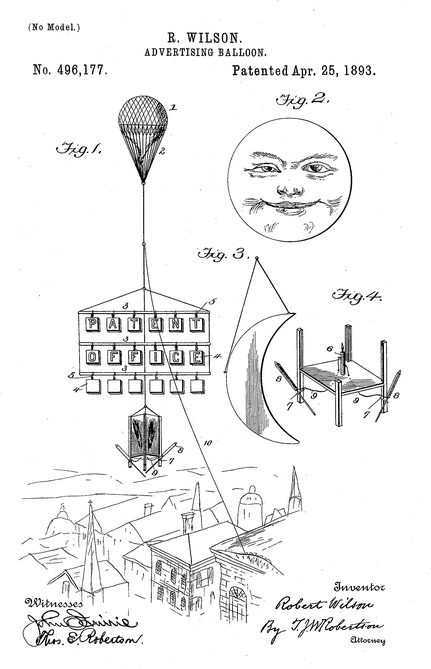
    This idea was not limited to just military purposes.  Companies could now wage an advertising war war against competitors  in a thee-sky’s-the-limit campaign, hoisting their ads on balloons anchored over a city, making it possible for the first time to have your message so universally read, a pre-intertubes version of smoke signals. 

    Patent balloon advertising 1893[Source:  Google patents, http://www.google.com/patents/US496177?dq=balloon]

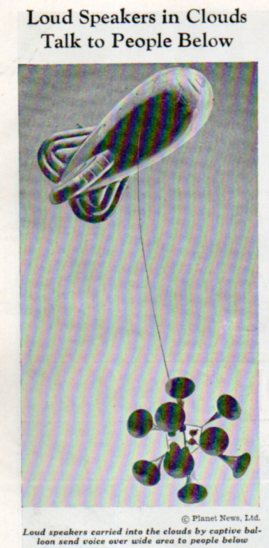
    Sky speakers413

    And this, seeming more on the Orwellian/1984 side, or perhaps more contemporary as an instrument of the Dear Leader in North Korea (left, from Popular Mechanics, July, 1939).


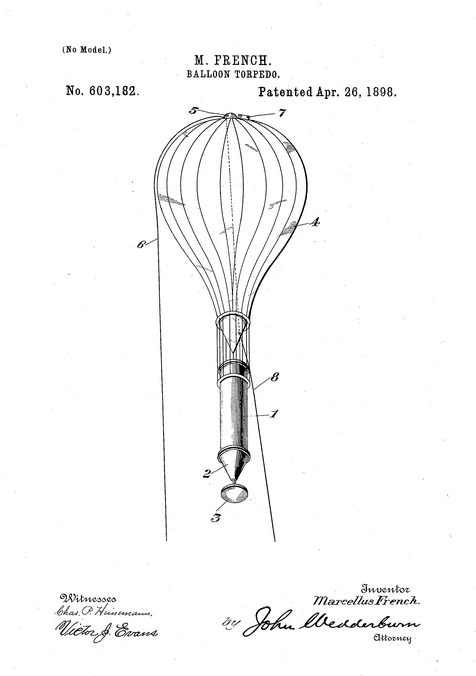
    Here’s an interesting, pre-airplane, airship-delivered explosive device: floated over an enemy’s position, the chord would be pulled at the desired time to create a tear in the balloon’s top, sending the craft down, with the bomb exploding on impact:

    Patent balloon torpedo[Source: Google patents, http://www.google.com/patents/US603182?dq=balloon]

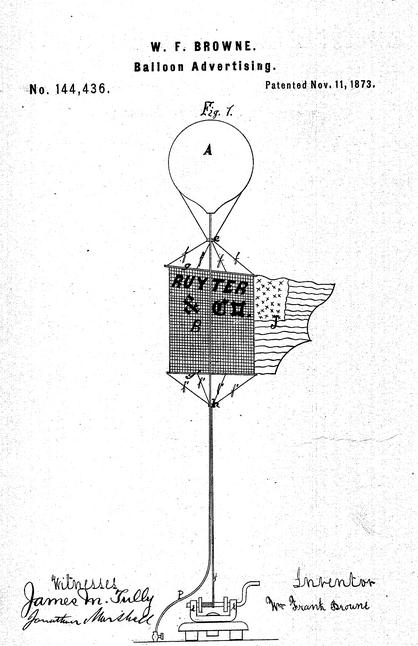
     Another sort of slow death from above advertising scheme:

    Patent balloon 1873

    [Google patent:  http://www.google.com/patents/US144436?dq=balloon]

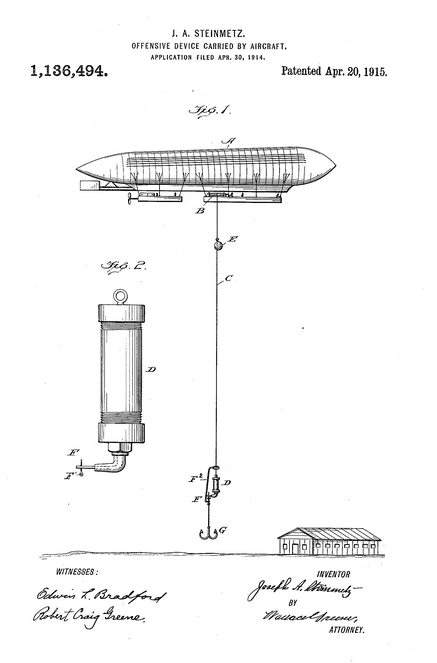
    In this device patented by Steinmetz the explosive device is still actually attached to the aircraft when exploded–not a very common way of delivering your weapon.  The airship would advance on the enemy, with the bomb  attached to a cable just above an anchor at bottom; the anchor would grapple the target, and the bomb detonated from the  gondola of the airship:

    Patent Balloon gondola


  • Wood, Metal, Cubes, and Words: a Few Story-Machines since Gulliver’s Travels

    JF Ptak Science Books   Post 2579

    Over time I’ve encountered a number of ventures into the future of the future in which writing has become an automated or semi-automated activity, in their antiquarian constructions being made of wood and metal rather than nanobots and biological bits. A famous example is viewed by Jonathan Swift’s  Lemuel Gulliver in Laputa, where he finds a conversation machine, a vast assembly of word cubes set in a 400 square foot frame manipulated by 40 cranks and 40 handles and run by 40 philosophical operators.  There was also the thinking machine of Raymond Lull (of many different spellings) that was so beautifully address by Jorges Borges (“‘Ramon Lull’s Thinking Machine’ in The total library: non-fiction 1922-1986, on pp 155-160), and numerous others, some becoming steam-driven by the time of the early 19th century, and them others computer-inspired as we get into the Asimov-age. 

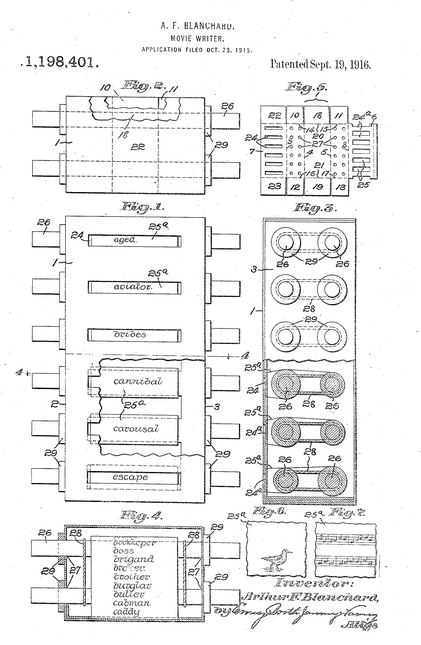
    I was moved to comment on this by a good reference made by Jennifer Ouellette (senior science editor at Gizmodo) to an article by a Gizmodo writer, Anna Green, on Arthur F. Blanchard’s (1865-1953) random story generator patent of 1916.  It is an interesting and lovely thing, lots of words of lots of rollers all working in combination to help formulate a struggling idea in the mind of a writer.  Well, actually, Blanchard writes in his patent description that it was an aid to movie writers, specifically, a kind of idea machine that would help folks with insight into creating a story for a 16-minute tale.  Of course the story might have been a little more interesting had Blanchard made the claim that his ideas for this machine were the product of a similar machine that was lashed together for the production of technical ideas. 

    In this same line of roller-and-paper idea generator I formulated a simple but distinctive device for creating the More Deconstructionist You in “Greasing the Turtle Stack: Derrida’s 10-Second Sentence-Generating Machine” (here)–this would be a fun little generator to make if the outcome wasn’t so useless and pointless, so best leave it as a two-beer bar stool idea.

    Blanchard’s idea seems to be one of the early appearances of word-generators on rollers/cards found in the collection of the U.S. Patent Office.  And so the “Movie Writer” of Albert Blanchard:

    Story machine _e_[Source:  U.S. patent US1198401, 23 October 1915, 19 Sep 1916, Arthur F Blanchard, Movie-writer at Google Patents ]

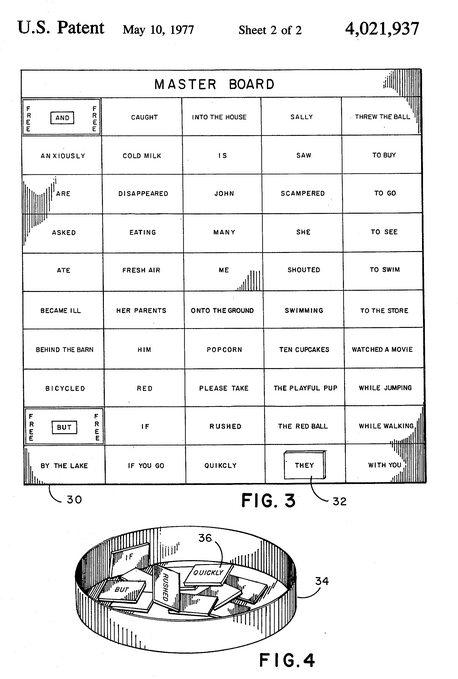
    Later on, the idea–still tried and true, or at least so on paper–came this for the “Educational Game Apparatus”, which was intended again as a spark for creative writing:

    Story machine patent _c_

    [Source: U.S. Patent US4021937, 2 Sep 1973, 10 May1977, Margery Dena Kravitz, “Educational game apparatus”]


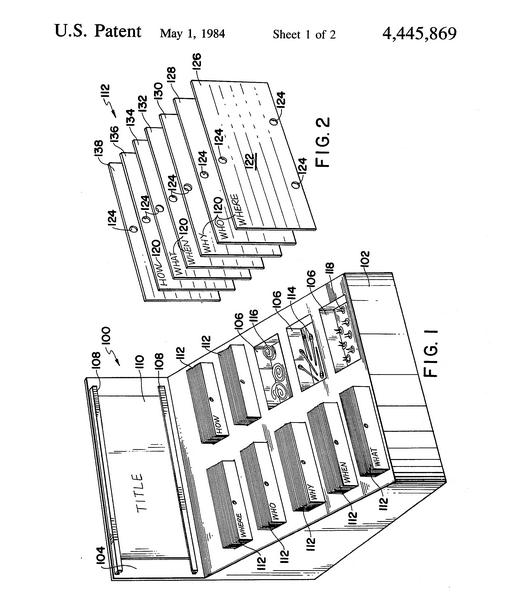
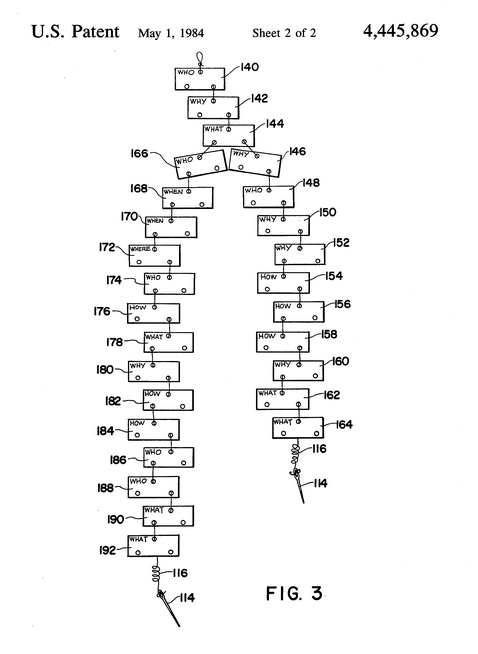
    Still later was this word-o-paper-arranger “Teaching method apparatus”,  a card-based bit that helps jostle ideas by presenting semi-random words to help the student create stories around them:

    Story machine patent _a_


    Story Machine patent_b_[ Source: U.S. patent US4445869     Nov 9, 1981    May 1, 1984, Wasserman Myrna D., “Teaching method and apparatus”.]

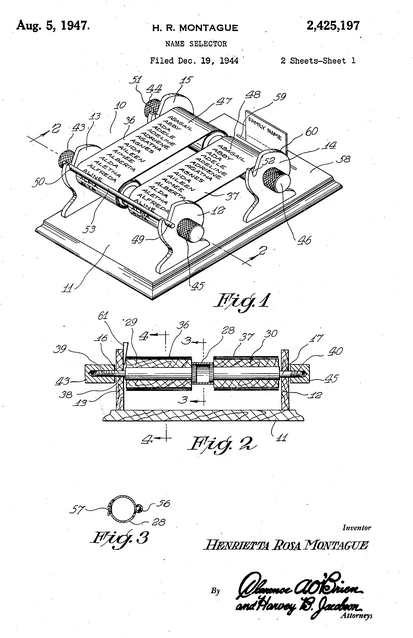
    The “Name Selector” is a simple version of some of what we see above:

    Story machine _d_[Source: U.S. Patent, US2425197 A   Aug 5, 1947, Rosa Montague Henrietta,   Aug 5, 1947   Name selector]

    No doubt there are more of these patents using this idea of single-words-on-bit-of-paper, but this should do for now.. 


  • Gears, Teeth, Minie Bullets, Cloth Bindings (1864)

    JF Ptak Science Books   Post 2575

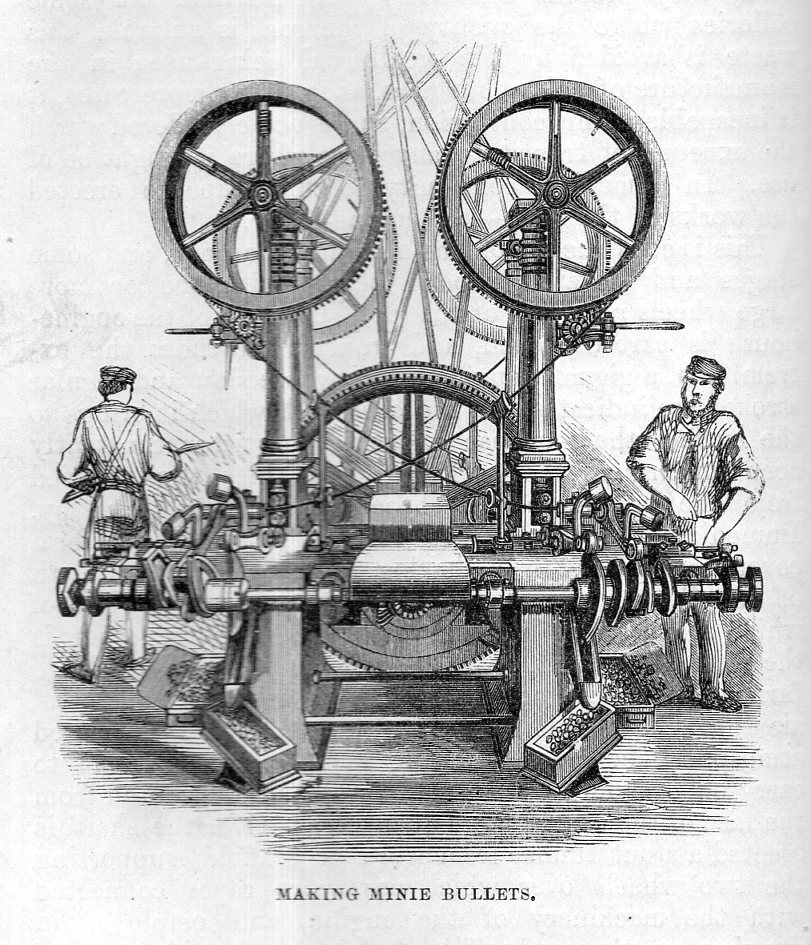
    Claude-Étienne Minié (1804-1879) was an influential military designer and French officer who designed what was to become know as the “Minie ball”. This was a cylindrically-shaped conical-pointed bullet the design of which greatly increased fire at long ranges. The bullet was designed in 1847 and soon became standard issue in Europe and (especially?) in the U.S. during the Civil War.  I’m taking notice of these projectiles after having made this very accidental discovery of the machine that formed them in the Victorian review of technology and invention, Great Inventors, the Sources of their Usefulness and the Results of their Efforts, printed in London in the rockingly good year of 1864.  It makes me think about the fabulous machinery that produces stuff like bubble gum–glorious metallic ideas for production and packaging, all combined in effort to produce a piece of fluff that you chew on and then discard.  With the Minie Ball, though, you have a massively-geared machine used to produce little bits of metal meant to pass more efficiently and with more accuracy through a body. (Also it is another representative of a genre of illustration of looking at the object straight on.)  

      Minie balls318

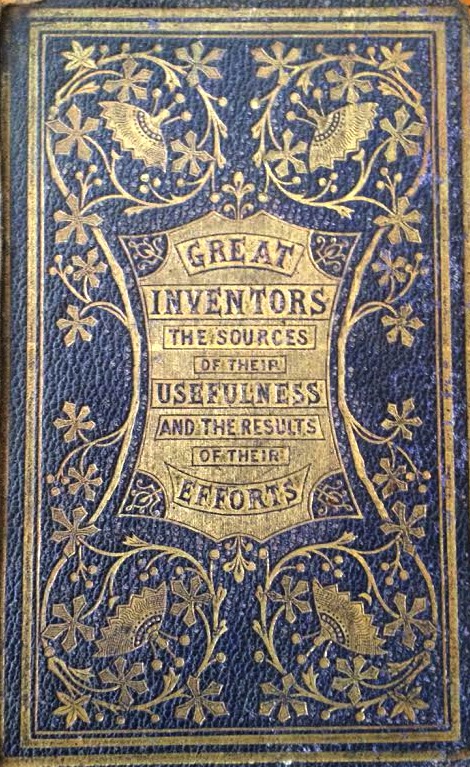
    The cover of the book is interesting in its own right, being bound in an elaborate publisher’s cloth with gilt-stamped decorations.  Books before, say, 1800, were almost entirely bound according to the wishes of the customer, who would/could purchase the sheets and have them bound according to their wishes.  That, or booksellers would offer the book for sale in a small election of available bindings.  The cloth binding that we would recognize today really didn’t start to make an appreciable appearance until the 1830s, when a simple cloth cover replaced its more-elaborate brethren, making things much easier for the publisher and the bookbinder, allowing for much less expensive production and a quicker turn-around time.  It also brought in a far greater distinction in the now-divergent industries of bookselling and publishing–and of course bookbinding.  So the entry of the semi-standard plain cloth binding also brought in the possibility for design and art in standard book production, with less to the introduction of the decorated cloth cover.  

    The cover for the book described here comes from about the second full decade of a standardized-luxury of decoration in cloth-bound books.  Over the years I’ve paid only a little attention to the decorated cloth bindings of scientific books, but never collected them, something I somewhat regret at this point. In any event, Great Inventors… is a good example of a relatively inexpensive but nicely-designed book cover.  

    Binding great inventors


  • Bumping Into the Very Early Days of Television–the “Electric Telescope” and “Seeing by Telegraphy”, 1880

    JF Ptak Science Books   Post 2570

    This short notice of work-under-way,  “Seeing by Telegraphy” by William.Edward Ayrton  (1847-1908, electrical engineer, F.R.S., and electrical infrastructure pioneer of Japan and India) and John Perry (M.E., F.R.S.), is one of those fascinating little “pop-ups” that appeared in the preeminent weekly journal Nature on May 13, 1880 (page 31).  Nature of course published quick announcements of breaking scientific research in lengthier articles, and it would also publish short notices of articles appearing in other journals, and also would have shorter notices like the one below.

    This is why it is so exciting to just browse/graze in these journals–you never really know what you might find.  This was unexpected, though had it not been for the catching title, I would have no doubt passed it by.  

    It turns out that this is a very early rumination on the possibilities of “television”, though at this time that name didn’t exist, and the people working in the area of transmitting images by wire referred to it  (for example) as “Seeing by Telegraphy” (Henry Middleton, 1880) and “Seeing by Electricity” (J.E.H. Gordon, again in an article in 1880). Earlier still (and perhaps first on the scene) is Adriano de Paivra (1847-1907), who wrote “A Telephonia, a telegraphia, e a telescopia” in 1878, introducing a fantastic and beautifully-named idea of the electric telescope, the telectroscope, or long distance vision by wire.  


    A longer article on the above appears slightly later in Science, in 1880, the full text available below.

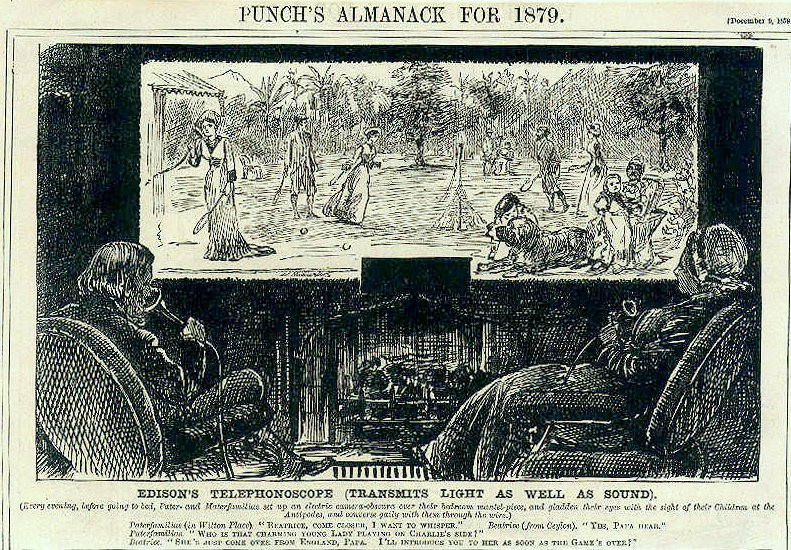
    As it turns out, I’ve read that Perry and Ayrton were influenced/energized by a cartoon of the future of communication that appeared in Punch magazine in the “Almanak” section for 1879.  This was supposed to be an invention named the “Telephonoscope”

    File:Telephonoscope.jpg


  • Canary Girls & T.N.T.

    JF Ptak Science Books  Post 2565

    One of the odd, interesting things that might not occur to the casual reader about the scope of the massiveness of WWI is, well, its massive newness in being massive. A significant measure of this is simply the number of people who served, compared to the number of people who served King and country at other times. For example, in 1905, at a high point of empire, there were approximately 450,000 serving; for the length of WWI, something on the order of 7 million men were in uniform. In the  first few months of the beginning of the war in 1914, there was nearly this number who enlisted, and then another 300,000 in just another two months later. 

    Quickly put, this is a new and enormous army, and that means that with an army of millions there are hugely increased demands on keeping the army going–outfitted, fed, housed, equipped, moved, trained, and then, of course, led into battle.  

    The army needed an army, and in some cases, that army consisted of women, particularly in the munitions industry, where the increased need for a vastly articulated labor force was deeply felt, and which became much more apparent by the the middle of 1915, after the development of the shell shortage.  The involvement of women grew greatly after the introduction of military conscription in 1916, and by 1917 something on the order of 80% of all munitions workers in the U.K. were women (according to Christopher Addison, the Minister of Munitions)–there were some 212,000 women in munitions at the end of 1914, by the end of the war there were nearly a million.   

    That said, these were paying positions, and though the women were in the majority of the workers and therefore of great importance to the production of munitions, they were paid fractionally what the men were being paid.1 

    WWI Project Canary Girls
    [Source: Horace Nicholls, British Official Photographer, Imperial War Museum IWMQ 30040, “Female munitions workers guide 6 inch howitzer shells being lowered to the floor at the Chilwell ammunition factory in Nottinghamshire, UK.”]

    The work was dangerous not only for the obvious reasons, but also for the toxic side effects of working with the chemicals to produce the explosives.  That’s where the “Canary2 girls” comes in. The name comes from the side effects of workers handling the component chemicals in T.N.T., that would affect the color of the worker’s hair, and skin, and eyes–turning them yellow–and then eventually leading to liver failure. It could also be transmitted to the worker’s babies (known as “canary babies”). It was an issue that was known, and addressed in medical journals during the war; some of the issues in the danger of the toxic elements in creating the munitions were addressed, but certainly not fully, and the work went necessarily on.  

    Notes:

    1. According to the website Spartacus Educational http://spartacus-educational.com/Wmunitions.html “…1918, whereas the average male wage in the munitions industry was £4 6s. 6d. for women it was only £2 2s. 4d” which is nowhere near equal pay.

    Here’s a couple of references, the very tip of the tip, of work that has been done on the women munition workers, the first dealing with toxic exposure of the workers to T.N.T. and the second on the munitionettes in general: 

    • ‘Toxic Jaundice in Munition Workers’, Matthew J. Stewart, M.B.; The Lancet, Volume 189, Issue 4874, 27 January 1917, Pages 153–155
    • Munitionettes, 1914-1918 (many links and references),  https://munitionettesww1svhlf.wordpress.com/shaping-voices-volunteer-researchers/cherine-maskill/
    • Another very good site for images of Munitionettes: Science and Society Picture,Library http://www.scienceandsociety.co.uk/results.asp?txtkeys1=Munitionettes
    • BBC News  “World War One: The risks for women on the home front”  http://www.bbc.com/news/uk-england-26225744

    “July 22nd 1916 Today I was shown over the factory as a great favour. First I saw cordite made into charges. Each charge consists of five or six little bagsful and a core. Each little bag is shaped like a lifebelt. The quantity of cordite it contains has to be weighed to a pin’s head. Even the silk it is sewn up with is weighed. Each bag contains a different weight and the five or six are then threaded on the core. The core is made of a bundle of cordite like a faggot. The whole charge is then packed in a box with a detonator. Then I was shown the lyddite works. This is a bright canary yellow powder (picric acid) and comes to the factory in wooden tubs. It is then sifted. The house (windows, doors, floor and walls) is bright yellow, and so are the faces & hands of all the workers. As soon as you go in the powder in the air makes you sneeze and splutter and gives you a horrid bitter taste at the back of the throat. After sifting, the acid is put in cans and stood in tanks where it is boiled until it melts into a clear fluid like vinegar. Then it is poured into the shell case. But a mould is put in before it has time to solidify. This mould when drawn out leaves a space down the middle of the shell. Before it is drawn out beeswax is poured in, & then several cardboard washers put in. Then the mould is replaced by a candle shaped exploder of TNT or some other very high explosive is put in. After this the freeze cap is screwed in and then two screws have to be put in to hold it firm. The holes for these screws must not be drilled straight into the detonator. If they do the thing explodes.” – See more at: http://alphahistory….h.7vwIX7ui.dpuf

    2.  The canary was as we all know a symbol of life and death in the mines, used to detect carbon monoxide–if the canary in the cage in the mine died, then the miners knew it was time to hustle away.  The idea was originated by the fabulously-mustached John Scott Haldane at the end of the 19th c–as it turns out Haldane was a very busy guy who in addition to much else pioneered the gas mask at the beginning of WWI
    ·Posted by :

    ·in:

    —