A Daily History of Holes, Dots, Lines, Science, History, Math, Physics, Art, the Unintentional Absurd, Architecture, Maps, Data Visualization, Blank and Missing Things, and so on. |1.6 million words, 7500 images, 4.9 million hits| Press & appearances in The Times, Le Figaro, Mensa, The Economist, The Guardian, Discovery News, Slate, Le Monde, Sci American Blogs, Le Pont, and many other places… 5000+ total posts since 2008.

Category: Technology, History of

  • Finding Anthropomorphism in an Electric Chair Patent (1897)

    JF Ptak Science Books  Quick Post

    This image of among the first electric/electrocution chairs is based on the designs of Dr. Alfred P. Southwick (1826-1898, MDS, DDS, SUNY Buffalo), who came up with the idea and started experimenting with it beginning in 1881. His was a mission of mercy, looking to find a quick if not instant salient to carry out the death penalty of a convicted murderer. NY Governor David B. Hill (1843-1910) looked to Southwick for a solution to a more humane way of executing people, establishing a distinguished panel of advisers to help him with this task. (In the small-world department, Hill succeeded Grover Cleveland as governor in 1885 following Cleveland’s election as president of the U.S.–he also acted as executioner in at least two cases while he was the Sheriff of Erie county in the mid 1870s.)

    Southwick’s design/chair was first used on the condemned criminal William Kemmler in August 1890. Most everyone who witnessed this first attempt were aghast at the spectacle; George Westinghouse is reported to have uttered that the executions “would have been better off using an axe”. Theoretically the first application of electricity kills the brain in less time than it takes the body to respond to pain. This seems not to have been the case in many instances.

    No tong afterwards Edwin F. Davis (1846-1923) conducted his own research on an effective and humane way to execute people and was awarded a patent in August 1897 for his “electrocution chair”. Davis would serve as NY state’s “electrician”/electrocutionist from 1890-1914, delivering the final blow to 240 of the condemned during that time.

    It was strange to me how anthropomorphic the design was, including the obvious head and less so for arms and feet. Overall, I think the relationship to a human form is unmistakable. 
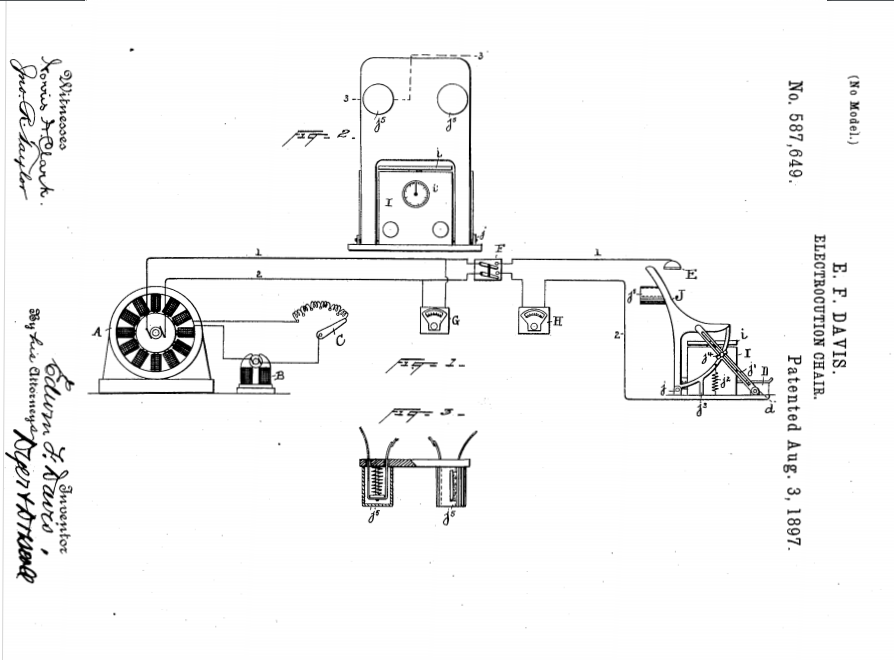
    Electric chair patent

    Excerpt from the article illustrating the 1888 electric chair:

    “Execution by Electricity. The State of New York may pride herself in the fact that the gallows is to be banished and a more humane and scientific method of executing criminals is to be instituted. On June 4 Governor [David B.] Hill signed the bill authorizing that criminals should be put to death by an electric shock. The bill is to go into effect on January 1 1889 and new method of execution be applied in the punishment of crimes committed after date.”

    SciAm writes that “instant death” occurs with the electric chair—it doesn’t. The condemned would be lucky to have their brains damaged enough to not register pain, as it takes 45 seconds to several minutes for death to occur.

    “…the criminal is seated bound to a chair having a metal seat connected with one pole of the current. At the back of the chair there is an adjustable head rest having a metal plate on its face and a metal band which passes around the forehead of criminal. The wires may be connected with dynamo which according to the bill may be of any approved type or the current may be supplied from electric light plant or there may be a private plant arranged especially for that purpose at the place of execution. Sponges or dampened cloths should be at the points of contact with the convict to render connection more perfect. At the proper moment switch is turned by the officer and instant death ensues. The current passes along the spinal column and the brain and nerve centers. The current may be few moments to bring about complete exhaustion.”

    Scientific American, 30 June 1888, vol 58.
    ·Posted by :

    ·in:

    —

  • Bubbles, Anti-Bubbles, and Reflections (and Not)

    JF Ptak Science Books   Post 2758     

    [For Jeff Donlan, Extreme Answer Lad of Answers!]

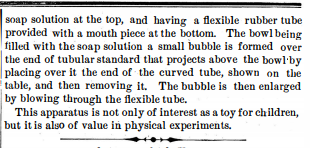
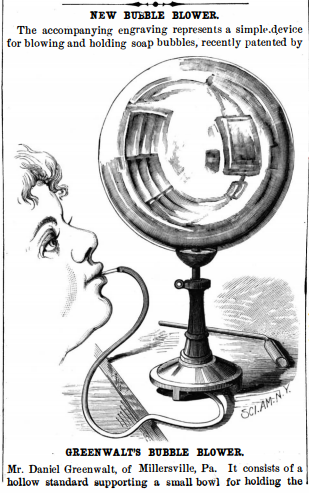
    This article was just a small 4″ or so notice  in the Scientific American on 2 August 1879, written for a new sort of apparatus to make bubble-blowing easier, or more effective, or “rounder”, or less anti-bubbly. (Actually that last would be a trick though I guess you could rig something like this up in an anti-air-breathing way, to create a bubble of liquid encapsulated by a layer of gas surrounded by a liquid. This is actually pretty easy to do standing around and would probably be a much harder thing to accomplish if you needed an apparatus for it. By the way “anti-bubble” should not be associated with the “Dirty Bubble”, which is a character from SpongeBob SquarePants.) 

    Back to the illustration: it is only about 2″ tall and a bit of a “filler”, but enough care is given it that it displays something which you never really see on bubbles in artwork: a reflection of an image! 


    Sci Am 1879 bubble blower _1_

    Sci Am 1879 bubble blower _2_

    If you go to Google and search out Renaissance/Bubble/painting or some such, you will find a number of examples of fine-looking bubbles: Gerrit Dou’s young boy blowing bubbles has life to the boy but not so much to the bubbles he’s blowing; J.E. Mallais bubble boy also has some somber fun but little exclusivity is paid to the bubble, same to for Naiveau, and de Gheyn; David Bailly’s self portrait has three happy bubbles with flair and color, and Desjardin’s allegory’s bubble maker is standing on a bubble with a fair amount of color and light to it. Even  the much-reproduced “Soap Bubbles” (ca. 1733-4) painting  by Jean Siméon Chardin (1699–1779)–which is perhaps one of the most famous antiquarian paintings involving bubbles–finds us with a bubble that is not very bubbly, without much reflection and optical interest…a too-subtle bubble. Not so in this image above, the anonymous artist collecting the 25-cent fee and giving the bubble some of the greatest bubble-life that I’ve noticed. 

    One thing those older artists do have a feel for more so than this piece above is the thinness of the wall of a bubble–here it looks pretty defined whereas with the others you get a real sense of lightness and fragility (though hardly knowing the thickness in terms of ^…as a matter of fact some of the artists mentioned were active before Newton, others before Huygens, and all before Young.) Anyway even though the business of bubbles seems to be kids’ stuff, with children playing at making bubbles in the artwork mentioned above, bubbles are worthy of some real thinking–if you understand bubbles (and anti-bubbles), you can address a fair amount more than that. 

    [I can’t really tell what the bubble-blower is seeing, what is being reflected, though one of the objects definitely seems to be a painting…]

    ·Posted by :

    ·in:


  • Mechanization, Sea Biscuits, & Jolly Tars

    JF Ptak Science Books   Post 2752

    “It is pleasant to think that our jolly tars are no sufferers by this expeditious mode of making their sea bread. It seems to be admitted that the machine made biscuits are better mixed and better kneaded than those made by hand. The three bakeries at the three arsenals before named could produce when at full work six or eight thousand tons of biscuits in a year which would effect a saving of ten or twelve thousand a year as compared with the old method.”

    This is the paragraph that ends the long selection, below, taken from The Pictorial and Literary Sketch Book of the British Empire, (volume 1, published by Charles Knight, London, 1849). It is a great and lovely ending and also a fine beginning to describing a curious and engaging article, “Biscuit Baking Machinery”, in the Journal of the Franklin Institute, 1833. Overall, this is a chapter in the history of machine-over-human, of “Mechanization Takes Command” (with reference to Giedion’s superb and occasionally gut-wrenching book), and takes place in regards to sea biscuits, Jolly Tars, and a beautifully named Royal Clarence Victualling Establishment (“at Weevil, near Portsmouth”)

    It all boils out to biscuits. And in this case a Mr. T.T. Grant received a 2000-pound grant to develop his machine. The article goes into some great detail on it, though I found this curious before-and-after article (quoted below) that describes the biscuits made by hand and those by machine. One thing was certain: the machinery saved time in labor and also seems to have cut cost by 75%.  In any event, I wanted to share these two episodes in the early stages of the introduction of machines in the mass production of food.

    ·Posted by :

    ·in:


  • How to Straighten the World’s Tallest Chimney (1860)

    JF Ptak Science Books   Quick Post

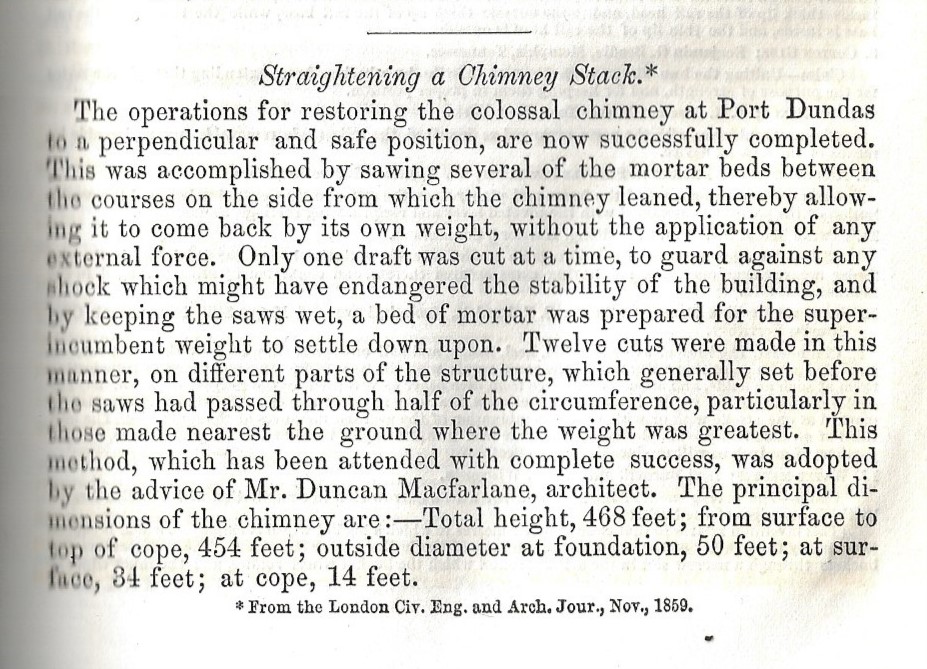
    JFI 1860 straightening chimneyThe running title at the top of the page in the Journal of the Franklin Institute (September 1860) reads “Straightening a Colossal Chimney Stack”, which attracted my immediate attention. It was constructed in 1859 in Port Dundas, near Glasgow, Scotland, and evidently needed some help in being straight-out perpendicular. The chimney was 454′ tall, and the tallest in the world–it was also one of the tallest masonry structures in existence. And it needed straightening. 

    “The tallest chimney was built at Port Dundas, Glasgow, Scotland, 1857 to 1859, for F. Townsend. It is the highest chimney in the world, (454 feet,) and one of the loftiest masonry structures in existence. It is, independent of its size, one of the best specimens of substantial, well-made brickwork in existence.”-­September 8, 1895, Page 17, The New York Times Archives

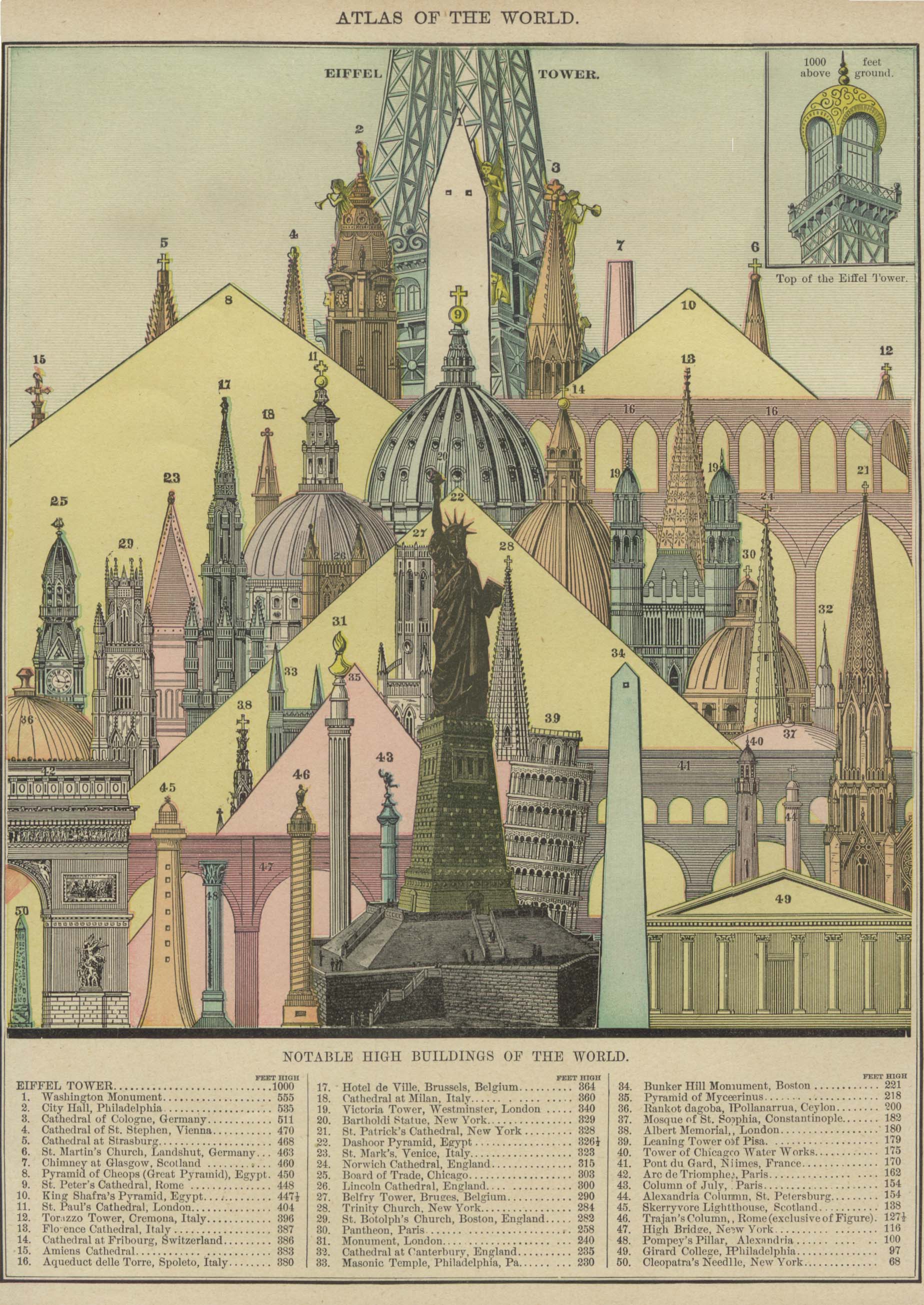
    The structure turns up in this delightful illustration of the world’s tallest structures in  Rand, McNally & Co.’s Universal Atlas of The World. Edition 1896 (as #7):

    Dataviz tallest buildings


  • Morse Code to Mars, 1921

    JF Ptak Science Books   Post 2750

    “Blapo”

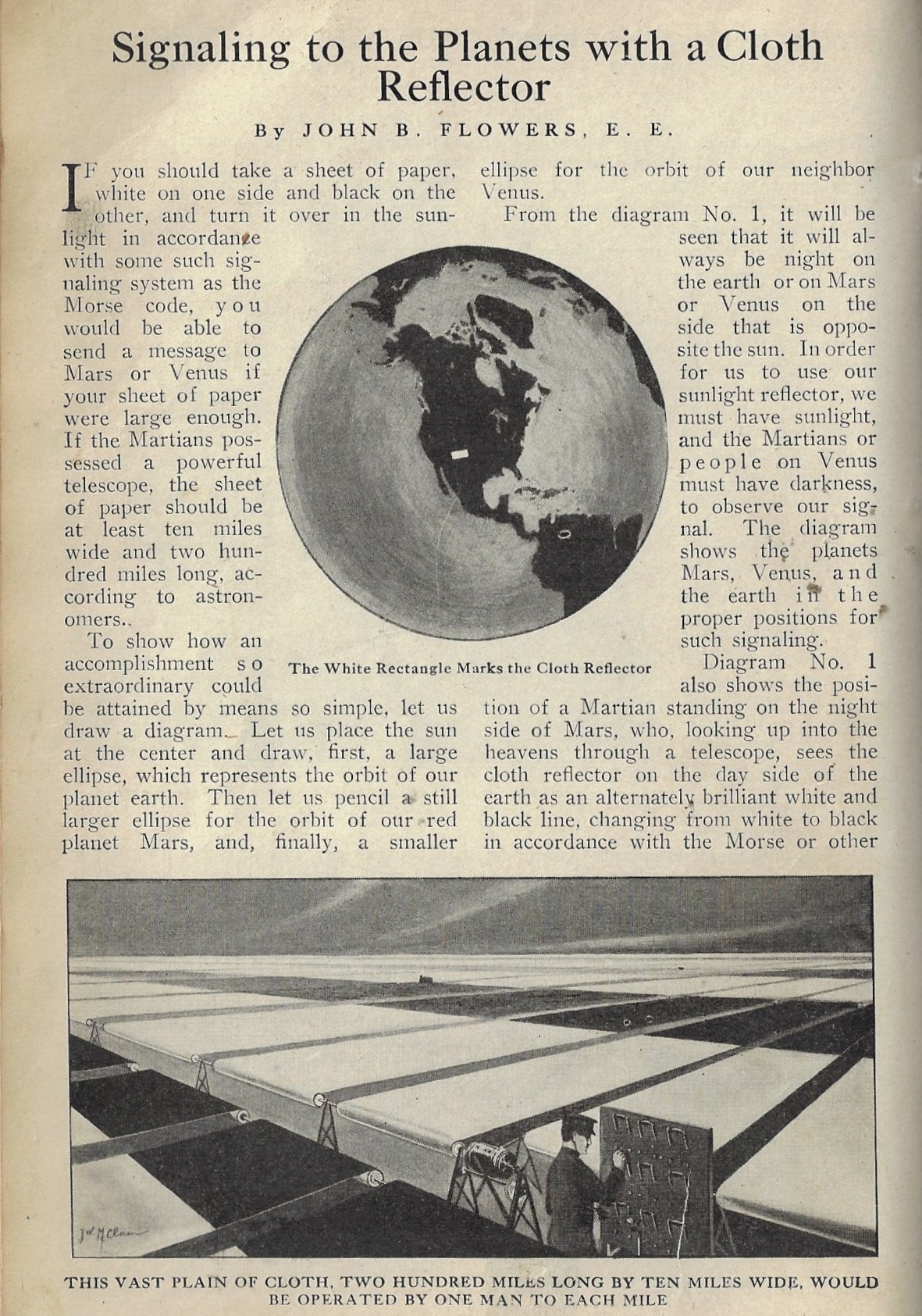
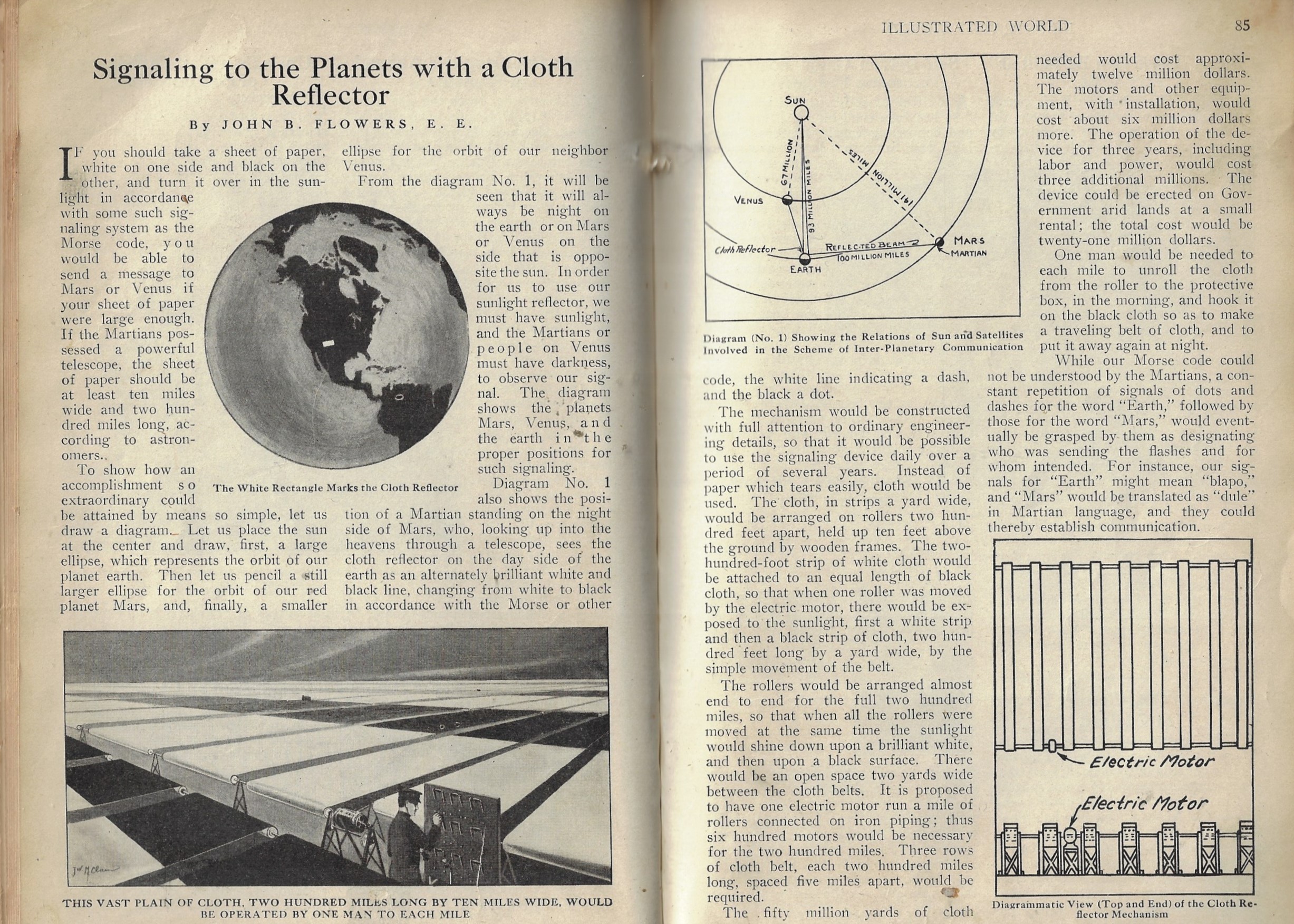
    A provocative article appeared in the somewhat obscure magazine Illustrated World suggesting a gigantic apparatus for signalling to possible observing beings on Mars. John B. Flowers, author of “Signaling to the Planets with a Cloth Reflector”, reported on a remarkable structure suggesting a possible way of communicating with intelligent life on the other planets–principally, it seems, Mars.  The briefest background here shows that the most popularizing idea of life on Mars came about as a mistranslation/interpretation  of astronomer’s Giovanni Schiaparelli’s observing term “canali” to be “canals/channels”, meaning an intelligent life form existed on the planet capable of constructing large technological forms. This idea was given full flight by Percy Lowell in his 1895 book Mars, followed just two years later by H.G. Welles’ War of the Worlds. 

    The uncredited idea in the Flowers article  called for a a series of connected mechanisms holding white sheets over a 200 x 10 mile (!) section of Federal desert lands, the movements of the sheets conducted by 600 large motors, making use of the segmented sheets to send messages via Morse code. The $21 million plan would repeat “Earth” and “Mars” over and over again until a response was heard. It was the hope that the Martians receiving the message would figure out the the dots/dashes related to Earth/Mars, finding that “Earth” was equal to their word for Earth (“Blapo”, for example) and “Mars” for (again, for example) their “Dule”.  And so on.  The article is only two pages long and for what its worth it spends a fair amount of space on the description of the apparatus, and a little on what it was that would be transmitted. There isn’t a word spent on what the consequences might be if the Martians returned the favor. 

    That said, the idea of life on Mars had mostly lost its pinkish pulse by 1920, though people still were still tinkering with ideas of how to communicate with alien forms of life over vast distances. Camille Flammarion, for example, advocated turning desert land into a massive Las Vegas, heating up the desert with millions of light bulbs and then using them to flash signals who-knows-where. Harvard’s William Pickering advocated an enormous mirror to reflect sunlight back into space somewhere, and R.W. Wood floated a similar idea to what is described by flowers, except the opposite, using black cloth over white sand. Over the next twenty years, into the 1940’s,  the interest seems less in communication than with the visiting the place.

    Notes

    • For a contemporary description of these ideas see “Hello Mars, this is Earth! Will the Martians Answer Us?”, in Popular Science Monthly, 1919, July-December, pp 74-5, full text here:  https://babel.hathitrust.org/cgi/pt?id=uc1.d0002769792;view=1up;seq=345
    • Also: here’s a good article (with the same title as the above but written in 2012) by Matt Novak in Smithsonian dot com exactly on this Pop Sci Monthly 1919 article. Well done! 


    Illus World Morse Code to MArs


    Illus World 1925 Morse to Mars 2pp


  • Tri-Triplane Monster Plane (1921)

    JF Ptak Science Books   Quick Post

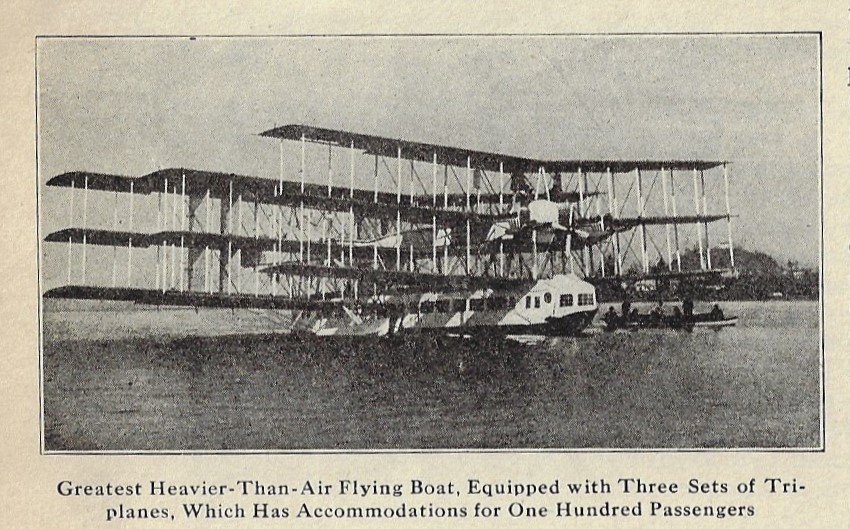
    A short article (with a smaller photo illustration)  on a very big topic appeared in Illustrated World in June 1921. The photo showed a remarkable plane constructed by aeronautical engineer Giovanni Caproni (1886-1957)–three planes, really. Three triplanes were attached to a floating Pullman-like fuselage, making this the largest/heaviest aircraft ever built at that time. It was 32′ high, 66′ long, and 130′ wide, and was made to seat 100 and make a transatlantic voyage. This was the “Noviplano” (the Caproni Ca. 6c, and translated in the article as “Nine-plannen”), and presented itself in an impressive if not complicated manner–it was a prototype, though, and was crashed and finished on its second flight.  

    Illus world caproni flyer 1921


  • The Private Public Face of the Brooklyn Bridge: Emily Roebling, 1883

    JF Ptak Science Books   Quick Post

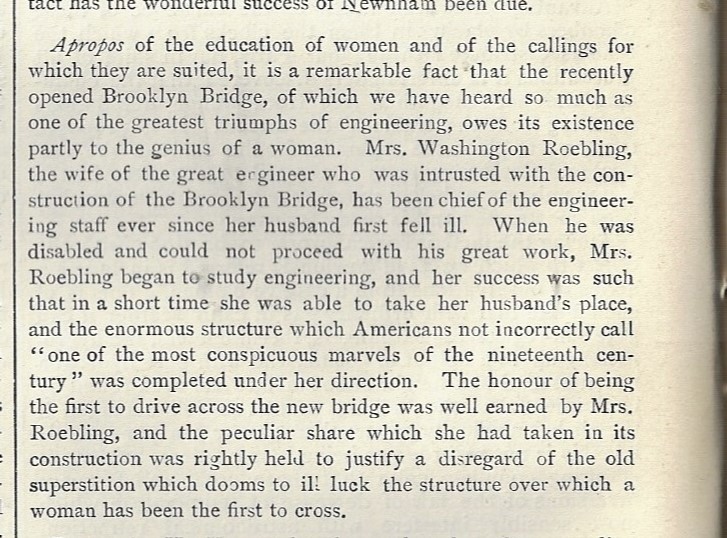
    I stumbled upon this, a fine notice on a matter of fact that was somewhat obscured, then and now–that the surrogate chief engineer of the Brooklyn Bridge was Emily Warren Roebling, the wife of the ill and disabled Washington Roebling.  The small notice of her achievement appears in the 14 June 1883 issue of Nature, just a few weeks after The Bridge was opened, with Emily Roebling being the first to cross. Washington Roebling took over as chief engineer following the death of his father, John A., in 1869, following a freak accident and the ill-conceived treatments for it that brought on the tetanus that wound up killing the man. Washington in just the next year suffered debilitating illnesses brought on by decompression sickness–that came on as a result of his famous leadership and participation in fighting an underwater fire in the Brooklyn caisson of the great bridge. After that, Washington became the shadowy Man-n-the-Window of his Brooklyn townhouse, seeing almost no one for years, though still conducting the engineering and almost everything else having to do with the construction of the bridge in concert with Emily. And so life went on like this for 13 years, and as David McCulloch wrote in his lovely work, The Great Bridge, Washington was as indispensable to the bridge as Emily was to Washington–it could not have been built without the pair of them.

    As encouraging as this small notice is in recognizing and congratulating “Mrs. Washington Roebling”, they did not recognize her given name. That was the practice, back then, but it would have made a finer point to elevate the woman to her own name rather than keep her as “the wife of”. 

    Nature 1883 MRs. Roebling

    Source:  Nature, volume 28, 14 June 1883, p 156.


  • The Human Buoy (1877)

    JF Ptak Science Books  Quick Post

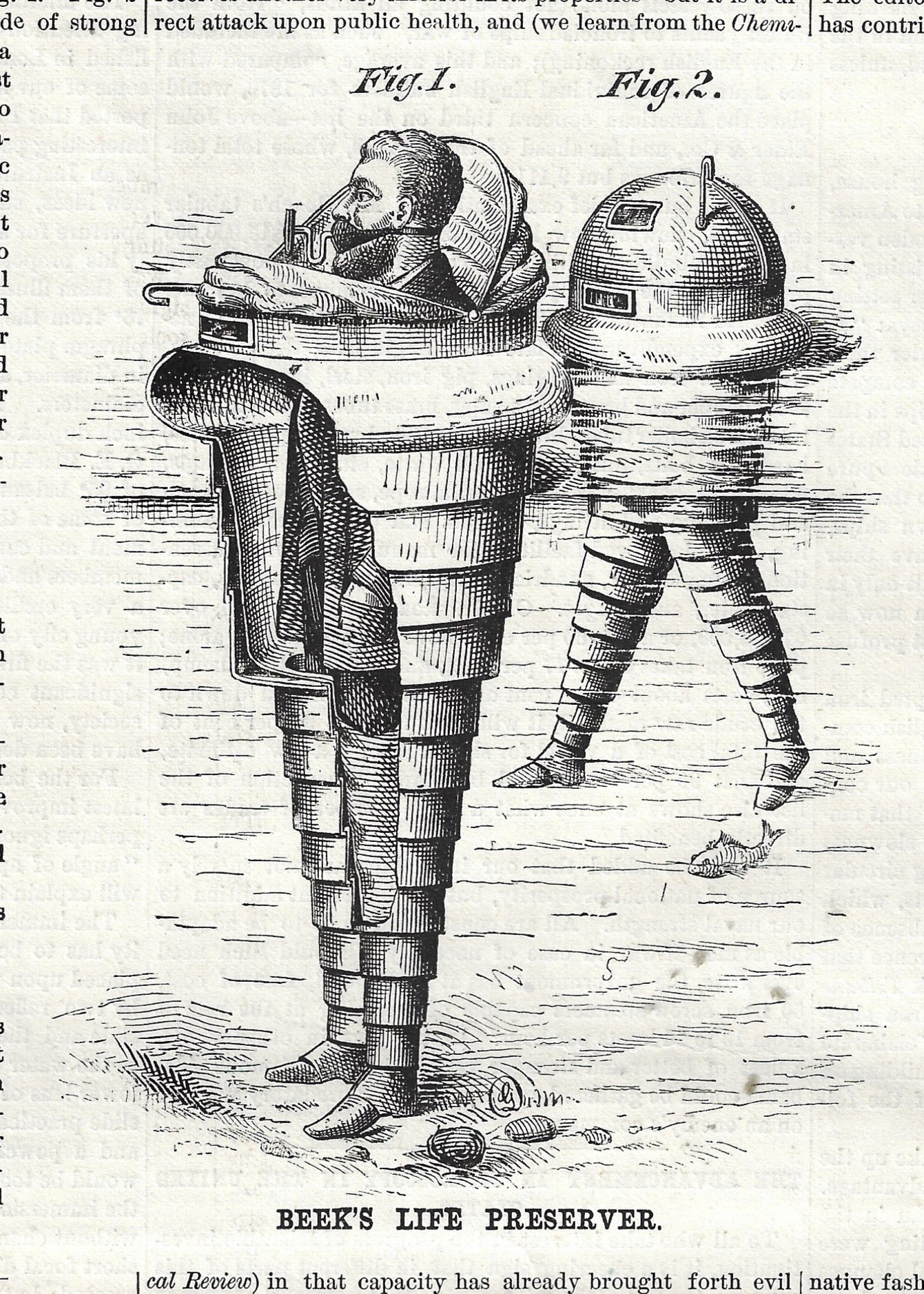
    1876/7 were pretty good years for science and technology (though a poor one for U.S. presidential elections): there was the telephone, cathode rays (Eugen Goldstein), John Draper’s photography of the solar spectrum, Berliner’s microphone, Boltzmann’s 2nd Law, and so on. In the middle of the Scientific American for 1877 there were two articles on the telephone and the Grant calculating machine, and in between these two articles was another less important but still fascinating and unexpected story on the human buoy:


    Sci Am 1877 full body buoy

    Well, it really wasn’t a buoy though it behaved like one–the real cause to action here was a survivor suit. It was a big, armless version of Robbie the Robot, a roomy and I guess somewhat versatile suit that one could jump into and then would float around in like a dud torpedo. What caught my attention with the thing was that there was food and drink enough in it for a person to live a month (“if need be, in safety and comfort”). Source: Scientific American, 5 May 1877, p. 274l, and invented by the wonderfully-named Traugott Beek, of Newark, NJ.  


    ·Posted by :

    ·in:


  • A Glorious Issue of Scientific American featuring NYC (1908)

    JF Ptak Science Books   Quick Post  

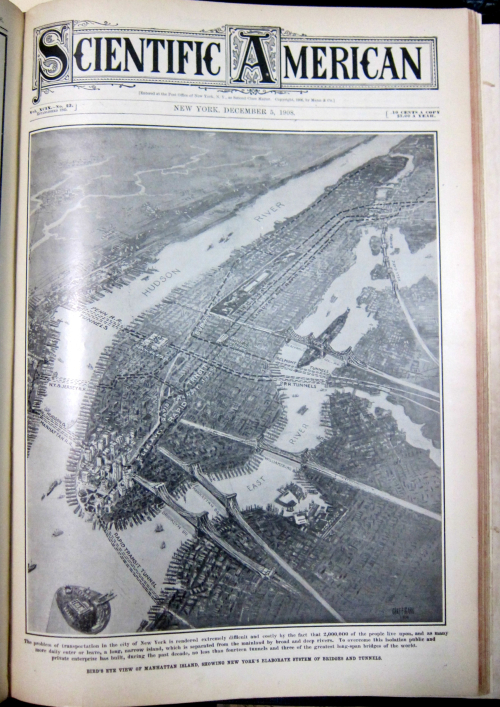
    I don’t have that much to say about the series of images that I found in the 5 December 1908 issue of Scientific American–except for “Wow!” Sometimes that is about all I can manage, and that’s fine. (Richard Feynman, on witnessing the Alamogordo test shot in the desert in 1945, simply said “hot dog!”, which was quite a distance away from Oppenheimer’s reaction, and one which I like more.) Anyway, opening up the volume and by chance opening to this full-pager was very pleasantly surprising, and this from a journal which was very successful in achieving their constant goal of being “surprising”. 

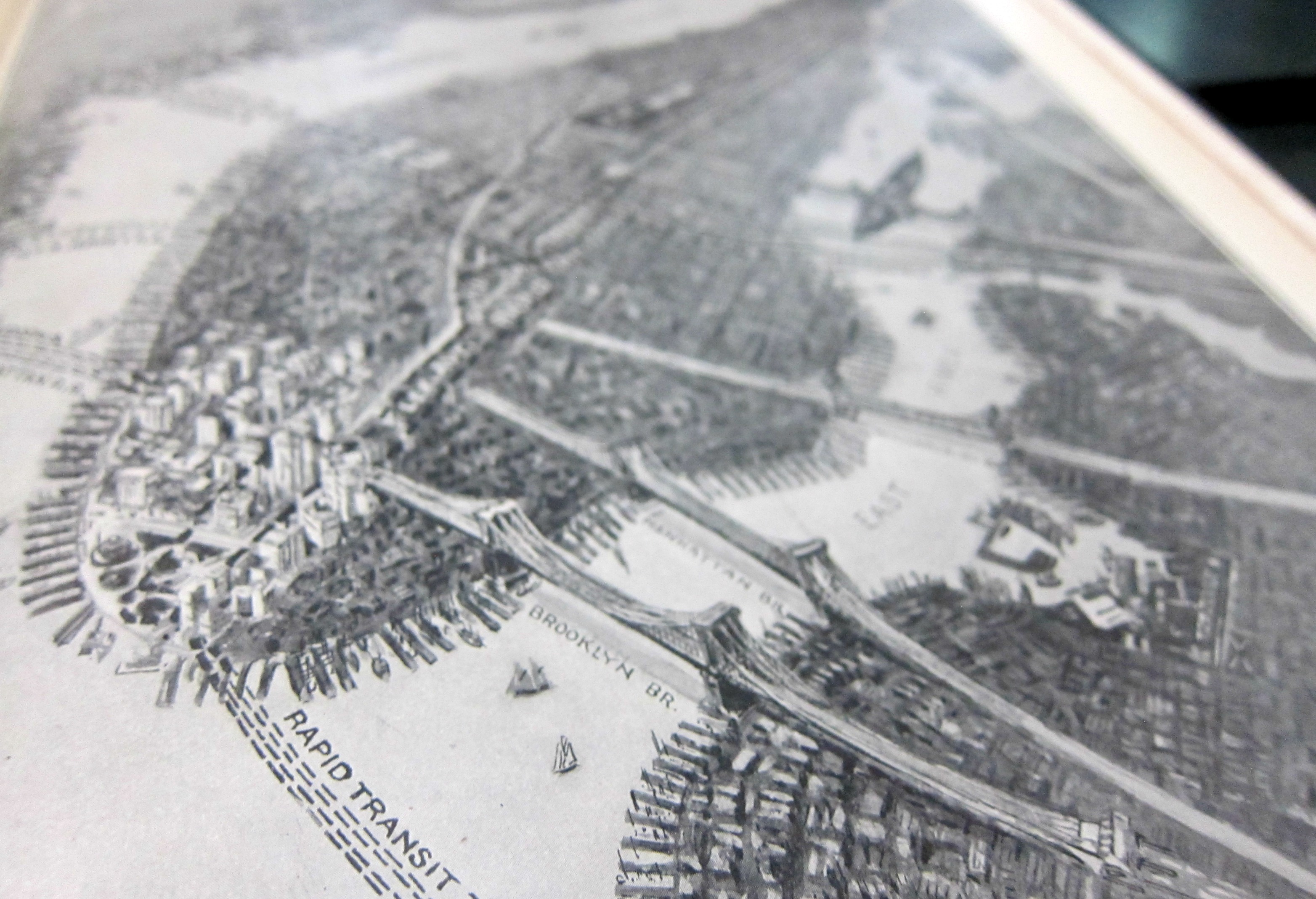
    And as you can well see, “wow” can be shared:


    NYC Sci Am map 3d detail

    The bird’s-eye view has a peculiar 3D sense to it–you could make any of the bridges pop to life by changing your angle of perspective, like so:


    NYC Sci Am map 3d detail


  • A Note on Dragging Ships (1) Over a Mountain and (2) Over Land

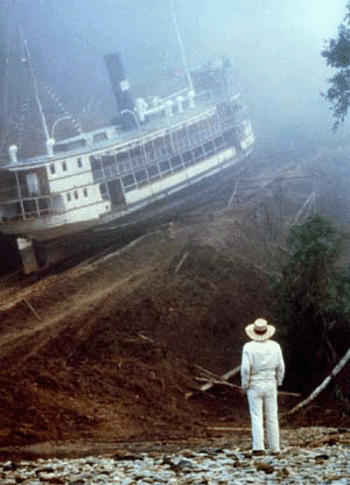
    Blogbig_sciencefitz[This is an expansion of an earlier post on Herzog.] In 1982 Werner Herzog, in what may have been the culmination of a weirdly fashioned and irresistible death-wish effort, released a film that he wrote and directed:  Fitzcarraldo.  It is a spill-over big, magnificent film about a would-be ice-making rubber baron bringing an opera house into the trans-Andes, trying to make his way into the dense forest in a huge (320 tons) steamboat on the Amazon to stake a claim in exploiting previously un-leased lands filled with rubber trees  The problem faced by Fitzcarraldo (played by the probably-slightly-insane Klaus Kinski1–just see Herzog’s 1972 Aguirre, Wrath of God and you’ll know what I mean) is that his path is blocked by unnavigable rapids–he can however reach his destination by hauling his very large ship up and over a mountain to get to a more pliant river and then to his goal.  Herzog actually does this for the film–no digital anything here2,3–in what is one of the most glorious things I’ve ever seen in the movies.  He really does have native people clear a path up the side of a mountain, and they DO haul this ship up and over.  It is truly magnificent, especially seeing the boat moving slowly up a mountain as background to a sweating Fitz.  

    The story is partially based upon the adventure of Carlos Fermín Fitzcarrald, who in 1890 attempted a similar feat, though with a much smaller vessel, and who also dismantled the craft to haul it overland. (Its not a bad idea, necessarily, to do this dismantling thing, especially if it has to be done and there’s no other way to do it. The North Vietnamese famously did the impossible by hauling artillery up through the jungle and up mountains to shockingly surround the French at Dien Bien Phu.) 

    Blogbig_sciencefitzcarraldo    The bigger and deeper back-story though is the effort–mainly by Elmer Corthell and James Eads–to build a combination railroad ship canal across the Tehuantepec isthmus in Nicaragua.  The idea of moving across Central America rather than taking the enormously long route around the tip of South America and up again is hundreds of years old.  The Corthell/Eads plan, begun in 1870’s and alive in the early ’80’s, was really the first feasible (and workable) initiative.
     

    Blog_big_large_ship

    It would have been a gigantic undertaking, and even though it was much longer (130 miles or so)  than the more-favored Panama location for the canal, it seemed more workable as there would be less digging and no need for a lock/canal system as required at Panama. 

    The French began a doomed attempt at conquering Panama shortly before this.  Ferdinand de Lesseps tried to build a canal in 1880, but the organization and general construction plan was truly inferior; also, the sanitary and medical conditions were terrible, with the French losing perhaps 22 thousand men in the failed process to disease (mainly malaria).  (The United States would lose 5,609 workers while building the Panama canal, on land granted as a payback for “helping” Panama release themselves from Columbia.)

    Blog_big_closeup

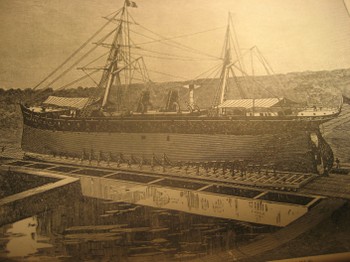
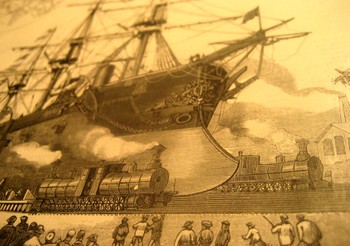
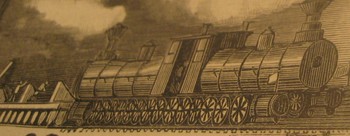
    The Corthell/Eads (who by the way was a master builder perhaps best known for his inspired masterpiece of a bridge at St. Louis) plan called for hauling the ships up and out of the water in a short canal and placing them on an enormous floating roundabout; the roundabout would then be raised, and the ship place on huge cradles borne upon vastly augmented railway lines.  Once on the cradle, the ship would be pulled and pushed by a team of four large locomotive teams which were in turn composed of two large engines.  Happily aboard, the ship would then be taken on the extended, expanded wide and augmented rail 130 miles overland and dumped into the Pacific.

    It was evidently not a workable deal all the way around, though, as the U.S. decided on the new Panama to works its engineering miracle.

    Blog_big_big_closeup

    There is something pleasing though about the Ship Railway, though, something that appeals to the little bit of Mr. Herzog in me.  Perhaps it was the appraisal of the very stiff-lipped Sir Edward Reed–who was the former master engineer for the British navy and consultant to Eads—that makes it all so irresistible.  “It would be best to avoid a very high rate of speed” when hauling the massive ocean-going and heavily laden cargo ships.  Indeed.

    Oh, wait: there’s also this example:

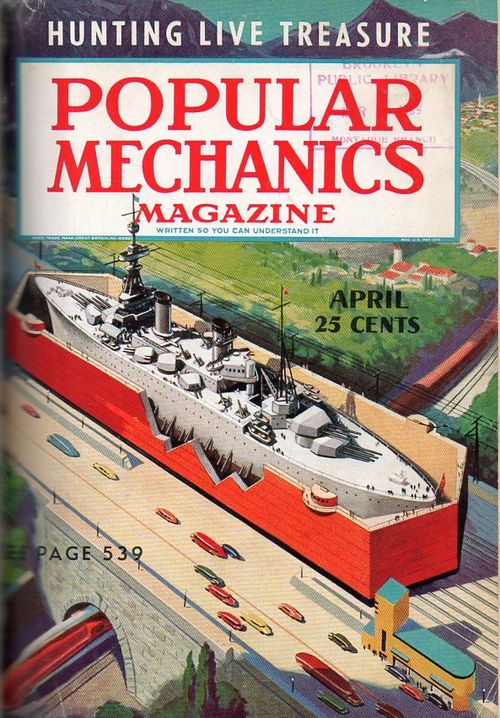
    This fantastic cover appeared in Popular Mechanics, volume 71 (1939, right at the brink of doom), and showed a devotion to a monumental idea of dragging enormous ships by rail from the Atlantic Ocean to the Mediterranean Sea.  It was to be 300 miles long, and what looks like 125′ wide, connecting Port le Verdon and Beziers, putting down the 1,200-mile Bay of Biscaye/Gibraltar/Mediterranean route. It seems a kind of mobile Maginot Line, except this bad idea wasn’t constructed. 

    Ship overland

    Notes

    1. The original actor in the Fitzcarraldo role was Jason Robards, who had to give the film up after about a third or so the way through as he came down with dysentery. Kinski came into the role after that, and the film was re-shot. 

    2. There is a scene showing the steamboat being unmoored and sent down the rapids on its own–that is done with a model. So far as I know, that is the only bit of post production trickery for the film. 

    3. There’s an interesting documentary of the film also released in 1982, Burden of Dreams.

    ·Posted by :

    ·in: